## Diagram: Process Flow for Heuristic Function Evolution with LLM and MCTS
### Overview
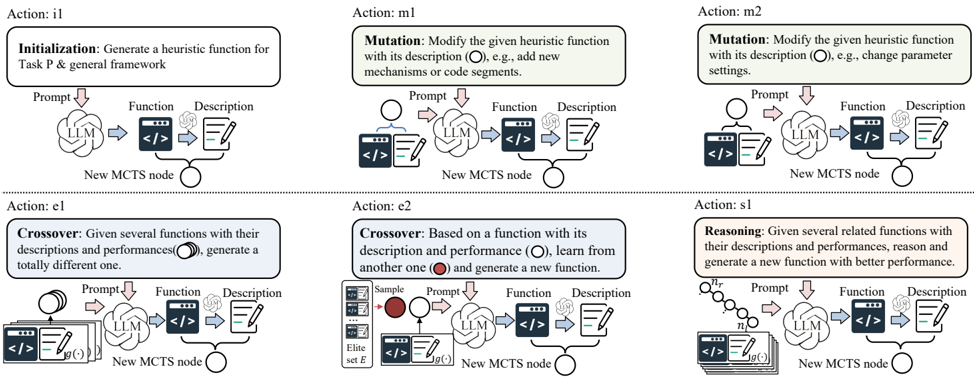
The diagram illustrates a six-step process for evolving heuristic functions using a Large Language Model (LLM) and Monte Carlo Tree Search (MCTS) nodes. It is structured as a grid with two rows and three columns, each cell representing a distinct action (i1, m1, m2, e1, e2, s1). Arrows indicate the flow of information between components: **Prompt**, **Function**, **Description**, and **New MCTS Node**.
---
### Components/Axes
1. **Actions**:
- **i1 (Initialization)**: Generate a heuristic function for Task P & general framework.
- **m1 (Mutation)**: Modify the heuristic function by adding new mechanisms/code segments.
- **m2 (Mutation)**: Modify the heuristic function by changing parameter settings.
- **e1 (Crossover)**: Combine multiple functions to generate a totally new one.
- **e2 (Crossover)**: Learn from another function’s performance to generate a new one.
- **s1 (Reasoning)**: Generate a new function with better performance by analyzing related functions.
2. **Components**:
- **Prompt**: Input text guiding the LLM.
- **Function**: Code snippet (represented by `< / >` icons).
- **Description**: Textual explanation of the function.
- **New MCTS Node**: Output node representing an evolved heuristic function.
3. **Flow**:
- Arrows connect components sequentially: **Prompt → LLM → Function/Description → New MCTS Node**.
- Colors differentiate sections (e.g., green for initialization, blue for mutation, gray for crossover, red for reasoning).
---
### Detailed Analysis
1. **Action i1 (Initialization)**:
- **Process**: The LLM generates a heuristic function and its description based on a prompt.
- **Output**: A new MCTS node is created.
2. **Actions m1/m2 (Mutation)**:
- **m1**: Adds new mechanisms/code segments to an existing function.
- **m2**: Adjusts parameter settings of the function.
- Both use the LLM to refine the function and description before updating the MCTS node.
3. **Actions e1/e2 (Crossover)**:
- **e1**: Combines multiple functions (with descriptions and performances) into a novel one.
- **e2**: Samples an "elite set E" (highlighted in red) to learn from high-performing functions and generate a new one.
4. **Action s1 (Reasoning)**:
- Analyzes multiple related functions (with descriptions and performances) to reason and produce a better-performing function.
---
### Key Observations
- **Modular Design**: Each action operates independently but contributes to the same MCTS node evolution.
- **LLM as Mediator**: The LLM translates prompts into code/descriptions and refines functions across all actions.
- **Elite Set E**: Explicitly referenced in e2, suggesting a selection mechanism for high-performing functions.
- **Iterative Improvement**: The process emphasizes combining, mutating, and reasoning to enhance function performance.
---
### Interpretation
This diagram represents a hybrid approach to heuristic function evolution, blending genetic algorithms (mutation, crossover) with LLM-driven reasoning. The LLM acts as a bridge between human-readable prompts and executable code, while MCTS nodes represent the evolving solutions. The use of an "elite set" in e2 implies a Pareto optimization strategy, prioritizing functions with superior performance metrics. The structured flow ensures systematic exploration of the solution space, balancing creativity (crossover) with refinement (mutation, reasoning). The absence of numerical data suggests the focus is on procedural logic rather than quantitative analysis.