## Flowchart: LLM-Based System with Tool Integration
### Overview
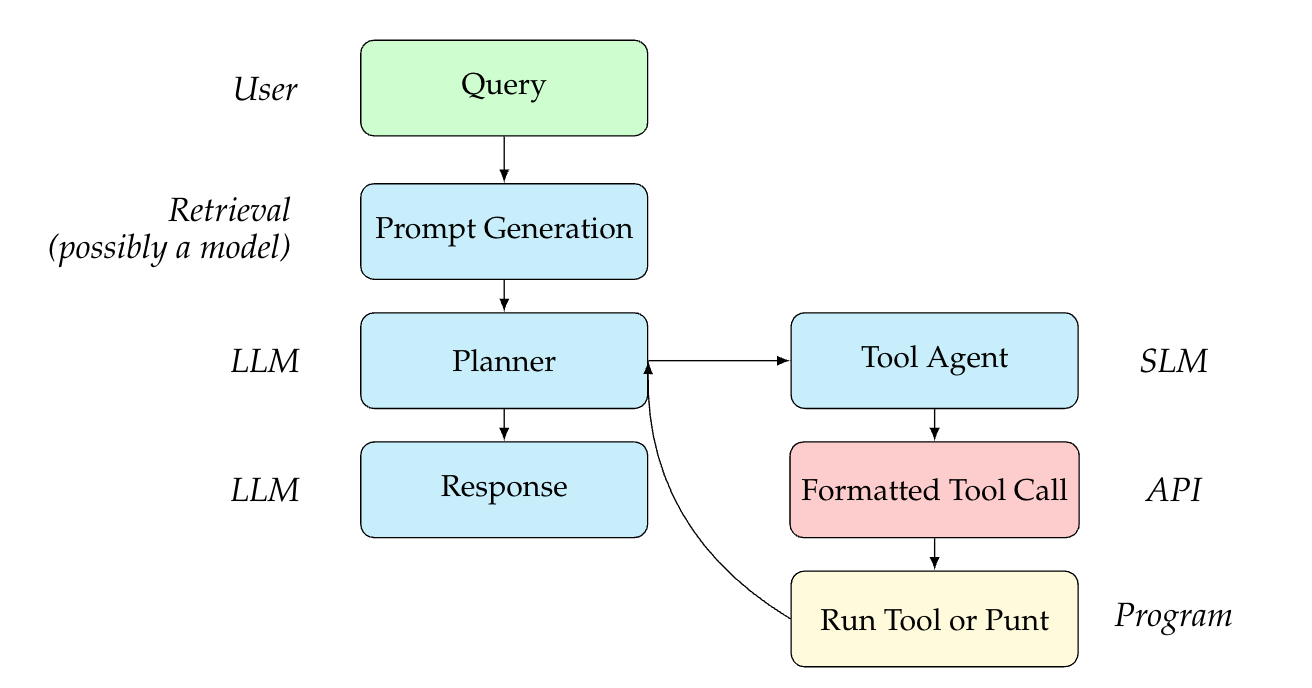
This flowchart illustrates a multi-stage process for handling user queries through a combination of Large Language Models (LLM), Small Language Models (SLM), and external tools. The system demonstrates conditional logic for direct response generation versus tool-assisted processing.
### Components/Axes
**Key Elements:**
1. **User** (Top-left, green box)
2. **Query** (Directly below User)
3. **Prompt Generation** (LLM component, blue box)
4. **Planner** (LLM component, blue box)
5. **Response** (LLM output, blue box)
6. **Tool Agent** (Blue box, right branch from Planner)
7. **Formatted Tool Call** (Red box, API interface)
8. **Run Tool or Punt** (Yellow box, program execution)
9. **API** (Pink box, rightmost)
10. **Program** (Pink box, rightmost)
11. **SLM** (Pink box, rightmost)
**Flow Direction:**
- Top-to-bottom vertical flow for initial processing
- Rightward horizontal flow for tool integration
- Circular feedback loop from "Run Tool or Punt" to "Planner"
### Detailed Analysis
**Color Coding:**
- Green: User/Query (input stage)
- Blue: Core LLM components (Planner, Prompt Generation, Response)
- Red: API interface (Tool Call)
- Yellow: Program execution (Run Tool or Punt)
- Pink: SLM and Program (external system components)
**Key Connections:**
1. User → Query → Prompt Generation → Planner
2. Planner branches to:
- Direct Response (LLM output)
- Tool Agent → Formatted Tool Call → API/Program
3. Program/Run Tool or Punt loops back to Planner
4. SLM receives output from API/Program
### Key Observations
1. **Conditional Logic:** The Planner determines whether to generate a direct response or invoke external tools.
2. **Tool Integration:** When tools are needed, the system uses an API to interact with external programs.
3. **Feedback Mechanism:** The "Run Tool or Punt" step creates a closed-loop system for iterative processing.
4. **Model Specialization:** Distinguishes between LLM (complex reasoning) and SLM (specialized tasks).
### Interpretation
This architecture demonstrates a hybrid AI system that:
- Uses LLMs for initial query understanding and planning
- Leverages SLMs for specialized tasks through API integration
- Maintains flexibility through the "Punt" option (fallback to direct response)
- Enables iterative refinement via the feedback loop
The system appears designed for complex query handling where:
1. Direct LLM responses may be insufficient
2. External data/programs are required for accurate answers
3. Multiple processing stages are needed for optimal results
Notable design choices include:
- Separation of concerns between reasoning (LLM) and execution (SLM/Program)
- Explicit error handling through the "Punt" mechanism
- Modular architecture allowing independent component updates