\n
## Stacked Bar Chart: Build Duration Comparison Across Compiler/Kernel Configurations
### Overview
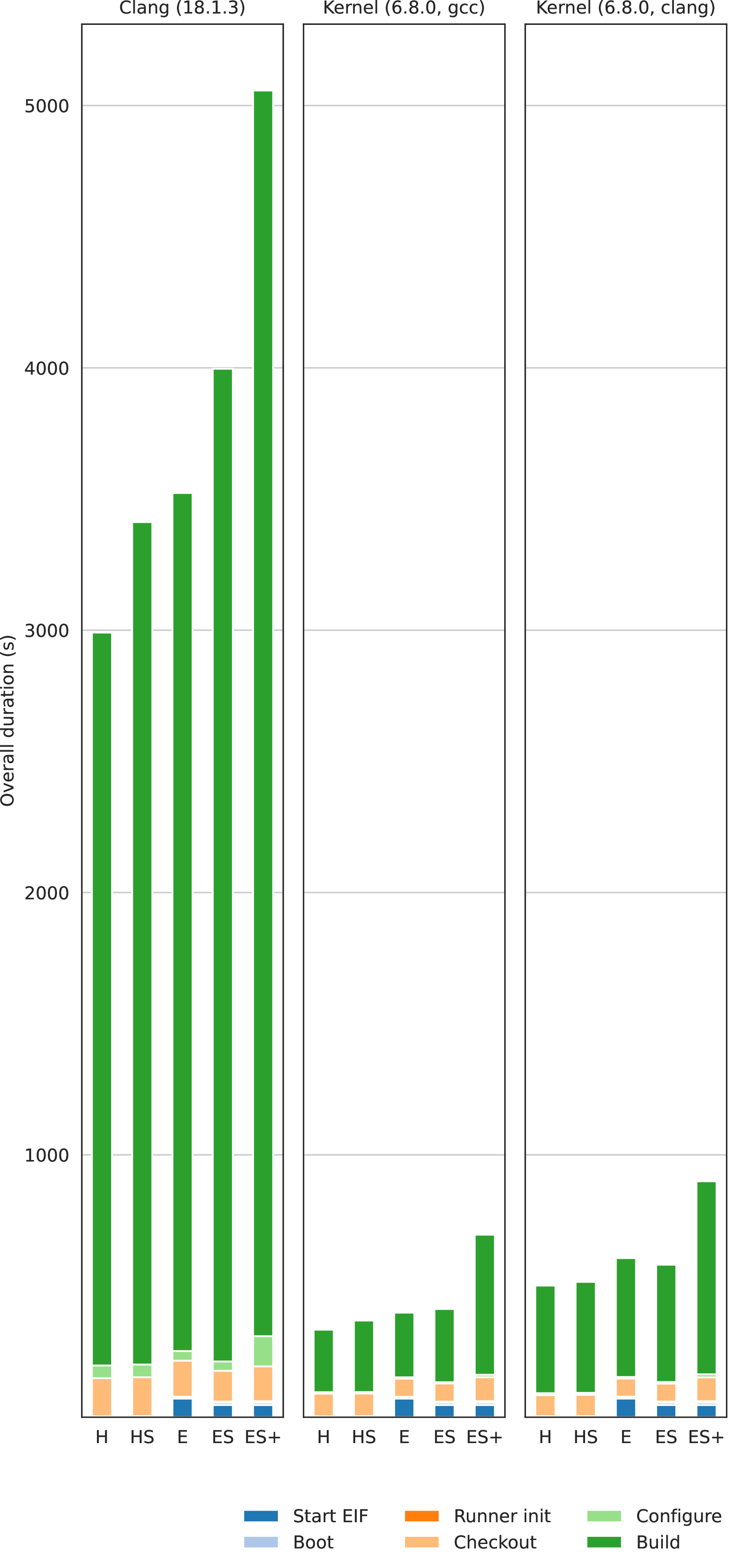
The image displays a stacked bar chart comparing the overall duration (in seconds) of a build process across five different configurations (H, HS, E, ES, ES+) for three distinct compiler/kernel setups. The chart is divided into three vertical panels, each representing a different build environment. The primary finding is a dramatic difference in total build time between the first environment and the other two.
### Components/Axes
* **Chart Type:** Stacked Bar Chart (3 panels).
* **Y-Axis:** Labeled "Overall duration (s)". Scale ranges from 0 to over 5000 seconds, with major gridlines at 1000-second intervals.
* **X-Axis (per panel):** Five categorical configurations labeled: **H**, **HS**, **E**, **ES**, **ES+**.
* **Panel Titles (Top):**
1. **Clang (18.1.3)** - Left panel.
2. **Kernel (6.8.0, gcc)** - Center panel.
3. **Kernel (6.8.0, clang)** - Right panel.
* **Legend (Bottom Center):** Six color-coded components that make up the total build duration:
* **Start EIF** (Dark Blue)
* **Boot** (Light Blue)
* **Runner init** (Orange)
* **Checkout** (Light Orange/Peach)
* **Configure** (Light Green)
* **Build** (Dark Green)
### Detailed Analysis
**Panel 1: Clang (18.1.3)**
* **Trend:** Total duration increases steadily from configuration H to ES+.
* **Data Points (Approximate Total Duration):**
* H: ~3000 s
* HS: ~3400 s
* E: ~3600 s
* ES: ~4000 s
* ES+: ~5100 s
* **Component Breakdown:** The **Build** (dark green) phase overwhelmingly dominates each bar, accounting for the vast majority of the time. The other five components (Start EIF, Boot, Runner init, Checkout, Configure) are visible as thin bands at the base of each bar, collectively contributing a small fraction (estimated <200-300 s) to the total.
**Panel 2: Kernel (6.8.0, gcc)**
* **Trend:** Total duration increases from H to ES+, but the overall scale is an order of magnitude lower than Panel 1.
* **Data Points (Approximate Total Duration):**
* H: ~400 s
* HS: ~450 s
* E: ~500 s
* ES: ~550 s
* ES+: ~700 s
* **Component Breakdown:** The **Build** (dark green) phase is still the largest component. The **Checkout** (light orange) and **Configure** (light green) phases are more proportionally significant here than in Panel 1, though still minor compared to Build.
**Panel 3: Kernel (6.8.0, clang)**
* **Trend:** Similar increasing trend from H to ES+. Durations are slightly higher than the gcc kernel build but still far below the Clang-only build.
* **Data Points (Approximate Total Duration):**
* H: ~500 s
* HS: ~550 s
* E: ~600 s
* ES: ~650 s
* ES+: ~900 s
* **Component Breakdown:** Pattern is very similar to the gcc kernel build, with **Build** (dark green) as the dominant phase.
### Key Observations
1. **Massive Disparity in Scale:** The "Clang (18.1.3)" build process is dramatically slower (5-10x) than building the "Kernel (6.8.0)" with either gcc or clang.
2. **Consistent Configuration Impact:** Across all three panels, the **ES+** configuration results in the longest build time, followed by ES, E, HS, and H. This suggests ES+ is the most complex or feature-rich configuration.
3. **Dominant Phase:** The **Build** phase is the primary contributor to total duration in every single case.
4. **Compiler Comparison for Kernel:** Building the same kernel (6.8.0) with **clang** is consistently slower than with **gcc**, with the difference becoming more pronounced for the ES+ configuration (~900 s vs. ~700 s).
### Interpretation
This chart likely compares the performance of different build pipelines or toolchains for a large software project (possibly a Linux kernel or related components). The "Clang (18.1.3)" panel may represent building a large user-space component or the entire toolchain itself with Clang, which is a notoriously resource-intensive process. The other two panels show the time to compile the Linux kernel version 6.8.0 using two different compilers (gcc and clang).
The data demonstrates that the choice of compiler and build configuration has a profound impact on development cycle time. The **Build** phase's dominance indicates that compilation, not setup or checkout, is the critical bottleneck. The significant overhead of using Clang for the larger build (Panel 1) versus its more modest overhead when compiling the kernel (Panel 3 vs. Panel 2) suggests the performance characteristics are highly workload-dependent. For a development team, this data would argue for using gcc for kernel builds to save time, while highlighting that any process involving the standalone Clang 18.1.3 build is a major time investment. The consistent cost of the ES+ configuration implies it includes additional features or optimizations that substantially increase compilation complexity.