## Diagram: U-Net Architecture for Image Segmentation
### Overview
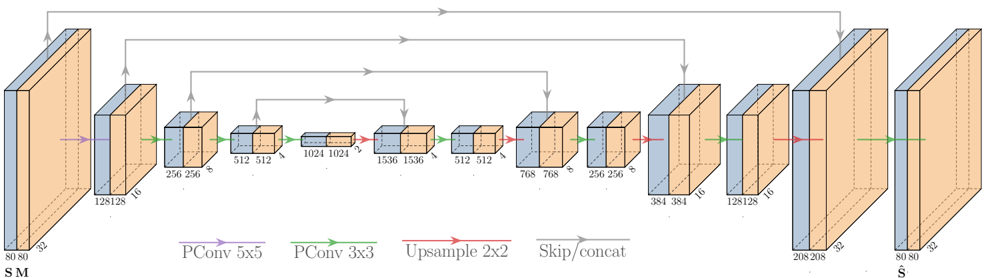
The diagram illustrates a U-Net neural network architecture, commonly used for biomedical image segmentation. It shows the flow of data through encoder-decoder blocks with skip connections, highlighting dimensional changes and operations at each layer.
### Components/Axes
- **Input Block (SM)**: 80x80x32 (spatial dimensions x channels)
- **Encoder Path**:
- 128x128x16 → 256x256x8 → 512x512x4 → 1024x1024x2
- Operations: PConv 5x5 (purple), PConv 3x3 (green)
- **Decoder Path**:
- 1536x1536x2 → 512x512x4 → 768x768x8 → 1024x1024x16 → 128x128x32 → 80x80x32
- Operations: Upsample 2x2 (red), Skip/concat (gray)
- **Output Block (Ŝ)**: 80x80x32 (same as input)
- **Legend**:
- Purple: PConv 5x5
- Green: PConv 3x3
- Red: Upsample 2x2
- Gray: Skip/concat
### Detailed Analysis
- **Encoder**:
- Spatial resolution increases (80→128→256→512→1024) while channel depth decreases (32→16→8→4→2)
- Uses PConv 5x5 and PConv 3x3 for feature extraction
- **Decoder**:
- Spatial resolution decreases (1536→512→768→1024→128→80) while channel depth increases (2→4→8→16→32)
- Upsampling via 2x2 convolution (red arrows)
- **Skip Connections**:
- Gray arrows connect encoder and decoder layers at matching spatial resolutions (e.g., 128x128x16 ↔ 128x128x16)
- Preserve spatial information lost during downsampling
### Key Observations
1. **Symmetry**: Encoder and decoder paths mirror each other in spatial resolution progression
2. **Channel Depth**: Encoder reduces channels for feature abstraction; decoder increases channels for reconstruction
3. **Skip Connections**: Critical for maintaining positional accuracy in segmentation outputs
4. **Dimensional Consistency**: Input/output dimensions match (80x80x32), ensuring spatial alignment
### Interpretation
This architecture demonstrates a classic U-Net design optimized for medical image segmentation:
- **Encoder-Decoder Balance**: Progressive downsampling captures global context, while upsampling with skip connections preserves local details
- **Pixel Convolutions**: Efficient spatial operations tailored for image data
- **Skip Connections**: Enable direct feature reuse between encoder/decoder, critical for accurate segmentation
- **Channel Progression**: Balances feature complexity (encoder) with reconstruction capacity (decoder)
The architecture's design prioritizes spatial fidelity through skip connections while maintaining computational efficiency via pixel-wise convolutions. The symmetric structure ensures the network can learn both coarse and fine segmentation details.