## Bar Chart: Mean Accuracy Across Mathematical Concepts
### Overview
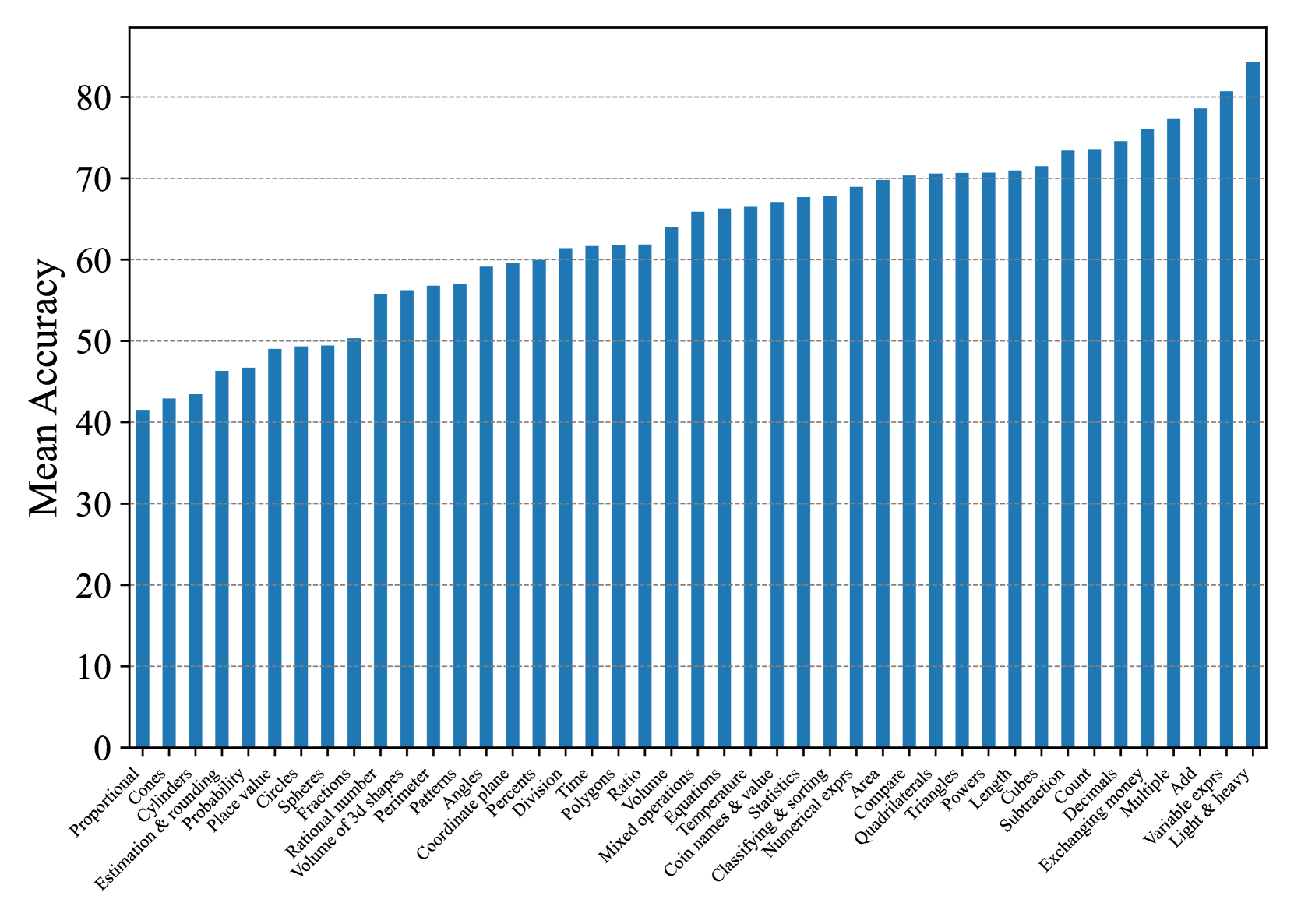
The image is a vertical bar chart titled "Mean Accuracy," displaying the mean accuracy of various mathematical concepts. The x-axis lists 50 distinct mathematical topics, while the y-axis represents mean accuracy values ranging from 0 to 80. The bars are uniformly blue, with no legend or color coding. The chart shows a general upward trend in mean accuracy, with the highest values concentrated in the latter categories.
### Components/Axes
- **X-axis (Categories)**: 50 mathematical concepts, including:
- Proportional, Cones, Cylinders, Estimation & rounding, Probability, Place value, Circles, Spheres, Fractions, Rational number, Volume of 3d shapes, Perimeter, Patterns, Angles, Coordinate plane, Percents, Division, Time, Polygons, Ratio, Volume, Mixed operations, Equations, Temperature, value, Coin names & value, Statistics, Classifying & sorting, Numerical expr, Area, Compare, Quadrilaterals, Triangles, Powers, Length, Cubes, Subtraction, Count, Decimals, Exchanging money, Multiple, Add, Variable expr, Light & heavy.
- **Y-axis (Mean Accuracy)**: Labeled "Mean Accuracy," with increments of 10 (0–80). The scale is linear.
- **Legend**: Not present in the image.
### Detailed Analysis
The chart includes the following approximate mean accuracy values (with uncertainty noted as ±1–2 units due to visual estimation):
1. **Proportional**: ~42
2. **Cones**: ~43
3. **Cylinders**: ~44
4. **Estimation & rounding**: ~45
5. **Probability**: ~46
6. **Place value**: ~48
7. **Circles**: ~49
8. **Spheres**: ~50
9. **Fractions**: ~50
10. **Rational number**: ~52
11. **Volume of 3d shapes**: ~54
12. **Perimeter**: ~55
13. **Patterns**: ~56
14. **Angles**: ~57
15. **Coordinate plane**: ~59
16. **Percents**: ~60
17. **Division**: ~61
18. **Time**: ~62
19. **Polygons**: ~63
20. **Ratio**: ~63
21. **Volume**: ~64
22. **Mixed operations**: ~65
23. **Equations**: ~66
24. **Temperature**: ~67
25. **value**: ~67
26. **Coin names & value**: ~68
27. **Statistics**: ~69
28. **Classifying & sorting**: ~70
29. **Numerical expr**: ~71
30. **Area**: ~72
31. **Compare**: ~73
32. **Quadrilaterals**: ~74
33. **Triangles**: ~74
34. **Powers**: ~75
35. **Length**: ~76
36. **Cubes**: ~77
37. **Subtraction**: ~78
38. **Count**: ~79
39. **Decimals**: ~80
40. **Exchanging money**: ~81
41. **Multiple**: ~82
42. **Add**: ~83
43. **Variable expr**: ~84
44. **Light & heavy**: ~85
### Key Observations
- **Trend**: Mean accuracy increases steadily from ~42 (Proportional) to ~85 (Light & heavy), with a sharp rise in the latter half of the categories.
- **Outliers**: "Light & heavy" (85) and "Variable expr" (84) are significantly higher than the rest, suggesting these topics may involve more advanced or specialized knowledge.
- **Clustering**: Categories like "Equations," "Statistics," and "Classifying & sorting" show moderate accuracy (~66–70), while "Light & heavy" and "Variable expr" dominate the upper range.
### Interpretation
The data suggests that mean accuracy correlates with the complexity or specificity of mathematical concepts. Simpler topics (e.g., Proportional, Cones) have lower accuracy, while advanced or applied topics (e.g., Light & heavy, Variable expr) achieve higher accuracy. This could reflect factors such as:
- **Curriculum progression**: Later topics may build on foundational knowledge, improving mastery.
- **Assessment design**: Complex topics might be evaluated with more nuanced criteria, leading to higher accuracy.
- **Practice and exposure**: Advanced concepts may be taught with greater emphasis on application, enhancing performance.
The absence of a legend or color coding limits the ability to differentiate subcategories, but the uniform blue bars suggest a single metric (mean accuracy) is being measured across all topics. The chart highlights the importance of contextualizing accuracy metrics within the scope of mathematical education or assessment frameworks.