\n
## Network Graph: Complex Multi-Cluster Topology
### Overview
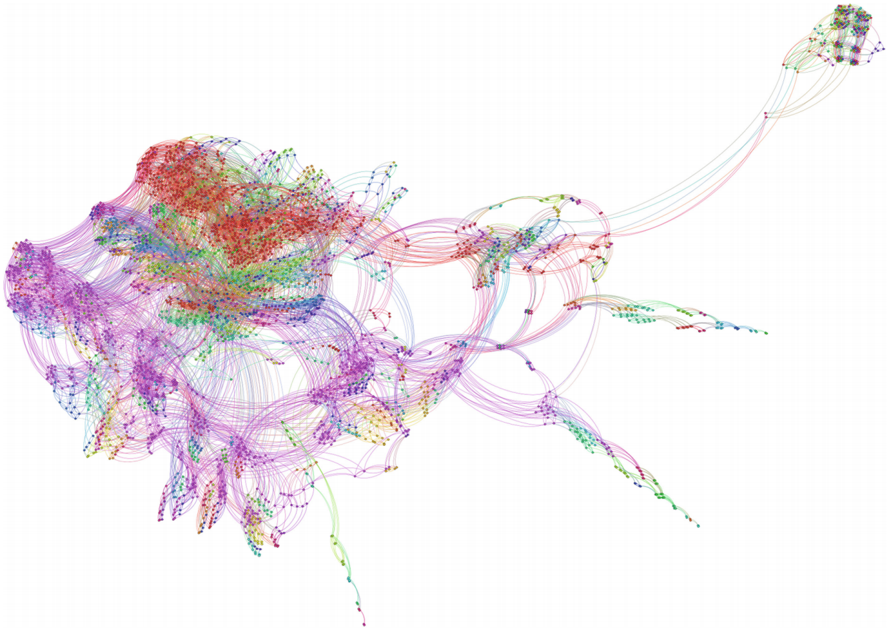
The image displays a complex, force-directed network graph or visualization of interconnected data points (nodes) and their relationships (edges). The graph is characterized by a dense, multi-colored central cluster with several elongated, branching structures extending outward, culminating in a distinct, smaller cluster at the far top-right. There is **no visible textual information**—no labels, titles, legends, axis markers, or annotations—embedded within the image itself. The visualization is purely graphical.
### Components/Axes
* **Nodes:** Represented as small, colored dots. The colors appear to categorize the nodes into different groups or communities. Observed colors include: red, green, blue, purple, yellow/orange, and teal/cyan.
* **Edges:** Represented as thin, curved lines connecting the nodes. The edges are colored, often matching or blending the colors of the nodes they connect, suggesting the relationship type or strength may be encoded in the edge color.
* **Spatial Layout:** The graph is arranged in a 2D space with no defined axes or coordinate system. The layout is organic, likely generated by a force-directed algorithm that positions connected nodes closer together.
* **Primary Dense Cluster (Center-Left):** A large, tangled mass of nodes and edges, indicating a highly interconnected core community. Red and green nodes are particularly prominent here.
* **Secondary Clusters & Branches:** Several smaller, semi-distinct clusters and linear chains branch off from the main mass, primarily in purple and blue hues.
* **Elongated Tail (Top-Right):** A long, sweeping bundle of edges connects the main cluster to a small, isolated cluster of nodes at the extreme top-right of the image. This suggests a strong, specific connection between two distant communities.
* **Sparse Outliers:** A few isolated nodes and very short chains are scattered at the periphery, especially at the bottom.
### Detailed Analysis
* **Node Distribution:** The highest density of nodes is in the central red/green cluster. Purple nodes form significant sub-clusters on the left and bottom-left. Blue nodes are interspersed throughout but also form a distinct chain extending to the right.
* **Edge Patterns:** Edges are not straight lines but smooth curves, creating a flowing, organic aesthetic. The density of edges is highest within the central cluster and along the main "tail" to the top-right. The curvature and overlap of edges make it impossible to trace individual connections precisely without interactive tools.
* **Color Grouping:** While colors are mixed, clear zones of dominance exist:
* **Red:** Concentrated in the upper-central part of the main cluster.
* **Green:** Intermixed with red in the core and forming some outer branches.
* **Purple:** Forms large, dense sub-structures on the western and southwestern side.
* **Blue:** Appears in linear chains and smaller clusters, notably one extending eastward.
* **Yellow/Orange:** Scattered sparsely, often at the edges of clusters.
* **Teal/Cyan:** Also scattered, frequently appearing at the tips of branches.
### Key Observations
1. **Absence of Metadata:** The complete lack of labels, a legend, or a title is the most critical observation. It is impossible to determine what the nodes represent (e.g., people, concepts, neurons, websites) or what the edges signify (e.g., friendships, citations, synapses, links).
2. **Community Structure:** The visualization strongly suggests the presence of multiple communities or modules within the dataset, indicated by the color-coded clustering.
3. **Core-Periphery Architecture:** The graph exhibits a classic core-periphery structure, with a densely connected core and sparsely connected peripheral nodes.
4. **Long-Range Connection:** The prominent "tail" to the top-right cluster is a significant topological feature, indicating a strong, dedicated pathway or relationship between two otherwise distant groups.
5. **Visual Complexity:** The high node and edge count, combined with the curved edges and color mixing, create a visually complex image that conveys the scale and intricacy of the underlying network but hinders precise quantitative analysis.
### Interpretation
This image is a **purely exploratory visualization** of a complex network dataset. Its primary purpose is to reveal the **macro-scale topological structure**—the existence of clusters, the density of connections, and the presence of bridges between communities.
* **What it Suggests:** The data likely represents a system where entities form tight-knit groups (the colored clusters) with some groups having stronger or more numerous interconnections than others. The long tail could represent a critical link, a hierarchical relationship, or a flow of information between a major hub and a specialized satellite group.
* **Relationship Between Elements:** The spatial proximity of nodes (driven by the force-directed layout) implies similarity or strong connectivity. The color coding adds a layer of categorical metadata, showing how a pre-defined or algorithmically detected attribute (like topic, department, or species) correlates with the network position.
* **Notable Anomalies:** The most striking "anomaly" is the isolated top-right cluster. In a real-world context, this could represent a specialized team, a foreign entity, a outlier dataset, or a terminal node in a process flow. The lack of labels prevents further investigation.
* **Limitations:** Without a legend, the color semantics are unknown. Without node/edge labels, no specific entities or relationships can be identified. This image is a starting point for inquiry, not a source of factual data. To derive meaning, one would need the accompanying metadata, interactive exploration capabilities, or a descriptive caption.
**Conclusion:** The image contains **no extractable textual facts or numerical data**. It is a graphical representation of network topology, useful for assessing structural properties like clustering, connectivity, and hierarchy, but devoid of semantic content without external context.