TECHNICAL ASSET FINGERPRINT
fe1f3fb7ea080407f6be227b
Click to view fullscreen
Press ESC or click to close
FOUND IN PAPERS
EXPERT: gemini-2.0-flash VERSION 1
RUNTIME: nugit/gemini/gemini-2.0-flash
INTEL_VERIFIED
## Chart Type: Cumulative Mass Distribution Plots
### Overview
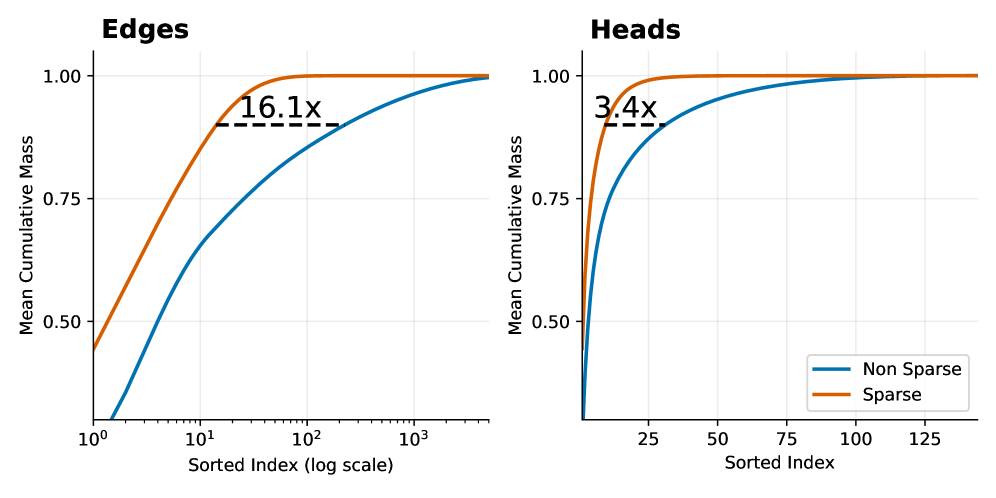
The image presents two cumulative distribution plots, labeled "Edges" and "Heads," comparing "Non Sparse" and "Sparse" data. The plots show the mean cumulative mass against the sorted index. The x-axis for "Edges" is on a logarithmic scale, while the x-axis for "Heads" is linear.
### Components/Axes
**Edges Plot:**
* **Title:** Edges
* **Y-axis:** Mean Cumulative Mass, ranging from 0.50 to 1.00 in increments of 0.25.
* **X-axis:** Sorted Index (log scale), ranging from 10<sup>0</sup> to 10<sup>3</sup>.
* **Data Series:**
* Non Sparse (Blue): Starts at approximately 0.45 and increases to 1.00.
* Sparse (Orange): Starts at approximately 0.50 and increases to 1.00.
* **Annotation:** "16.1x" with a dashed line indicating the difference in x-axis values where the curves reach a certain cumulative mass.
* **Legend:** Located in the bottom-right of the combined image.
**Heads Plot:**
* **Title:** Heads
* **Y-axis:** Mean Cumulative Mass, ranging from 0.50 to 1.00 in increments of 0.25.
* **X-axis:** Sorted Index, ranging from 25 to 125 in increments of 25.
* **Data Series:**
* Non Sparse (Blue): Starts at approximately 0.1 and increases to 1.00.
* Sparse (Orange): Starts at approximately 0.4 and increases to 1.00.
* **Annotation:** "3.4x" with a dashed line indicating the difference in x-axis values where the curves reach a certain cumulative mass.
* **Legend:** Located in the bottom-right of the combined image.
**Legend:**
* Located in the bottom-right of the combined image.
* Non Sparse: Blue line
* Sparse: Orange line
### Detailed Analysis
**Edges Plot:**
* **Non Sparse (Blue):** The line starts at approximately 0.45 at x=10<sup>0</sup> (1), increases rapidly until approximately x=10<sup>1</sup> (10), and then gradually approaches 1.00.
* **Sparse (Orange):** The line starts at approximately 0.50 at x=10<sup>0</sup> (1), increases rapidly until approximately x=10<sup>1.5</sup> (31.6), and then approaches 1.00.
* **16.1x Annotation:** The dashed line spans from approximately x=6.2 for the Sparse line to approximately x=100 for the Non-Sparse line, indicating a 16.1x difference in the sorted index at a certain cumulative mass (approximately 0.9).
**Heads Plot:**
* **Non Sparse (Blue):** The line starts at approximately 0.1 at x=0, increases rapidly until approximately x=25, and then gradually approaches 1.00.
* **Sparse (Orange):** The line starts at approximately 0.4 at x=0, increases rapidly until approximately x=7, and then approaches 1.00.
* **3.4x Annotation:** The dashed line spans from approximately x=2 for the Sparse line to approximately x=7 for the Non-Sparse line, indicating a 3.4x difference in the sorted index at a certain cumulative mass (approximately 0.9).
### Key Observations
* In both plots, the "Sparse" data reaches a cumulative mass of 1.00 faster than the "Non Sparse" data.
* The "Edges" plot uses a logarithmic scale for the x-axis, indicating a wider range of sorted index values compared to the "Heads" plot.
* The "Edges" plot shows a 16.1x difference in sorted index values between the "Sparse" and "Non Sparse" data at a certain cumulative mass, while the "Heads" plot shows a 3.4x difference.
### Interpretation
The plots compare the cumulative mass distribution of "Sparse" and "Non Sparse" data for "Edges" and "Heads." The "Sparse" data achieves a higher cumulative mass at lower sorted index values, suggesting that the mass is concentrated in a smaller number of elements compared to the "Non Sparse" data. The annotations "16.1x" and "3.4x" quantify this difference, indicating how much larger the sorted index needs to be for the "Non Sparse" data to reach a similar cumulative mass as the "Sparse" data. The logarithmic scale in the "Edges" plot suggests that the differences in sorted index are more pronounced for "Edges" than for "Heads."
DECODING INTELLIGENCE...
EXPERT: gemini-3.1-pro-preview VERSION 1
RUNTIME: gemini/gemini-3.1-pro-preview
INTEL_VERIFIED
## Line Charts: Mean Cumulative Mass Distribution for Edges and Heads (Sparse vs. Non-Sparse)
### Overview
The image consists of two side-by-side line charts comparing the "Mean Cumulative Mass" against a "Sorted Index" for two different components: "Edges" (left chart) and "Heads" (right chart). Both charts plot two data series distinguished by color (orange and blue), representing "Sparse" and "Non Sparse" configurations, respectively. The charts demonstrate how quickly cumulative mass is achieved as the sorted index increases, highlighting the efficiency of sparse representations.
**Language Declaration:** All text in the image is in English.
---
### Components/Axes
**Global Elements:**
* **Legend:** Located in the bottom-right corner of the right chart ("Heads"). It applies to both charts based on color consistency.
* **Blue Line:** Non Sparse
* **Orange Line:** Sparse
**Left Chart: "Edges"**
* **Title:** "Edges" (Top-left, bold text).
* **Y-axis:** Label: "Mean Cumulative Mass". Linear scale with visible markers at 0.50, 0.75, and 1.00. The axis extends slightly below 0.50 (approximately to 0.25). Faint horizontal grid lines align with the major ticks.
* **X-axis:** Label: "Sorted Index (log scale)". Logarithmic scale with visible markers at $10^0$, $10^1$, $10^2$, and $10^3$. Faint vertical grid lines align with the major ticks.
**Right Chart: "Heads"**
* **Title:** "Heads" (Top-left, bold text).
* **Y-axis:** Label: "Mean Cumulative Mass". Linear scale with visible markers at 0.50, 0.75, and 1.00. The axis extends slightly below 0.50. Faint horizontal grid lines align with the major ticks.
* **X-axis:** Label: "Sorted Index". Linear scale with visible markers at 25, 50, 75, 100, and 125. Faint vertical grid lines align with the major ticks.
---
### Detailed Analysis
#### Left Chart: Edges (Logarithmic X-Axis)
* **Trend Verification:** Both lines slope upward from left to right, starting at a lower cumulative mass and asymptotically approaching 1.00. The Orange (Sparse) line rises significantly steeper and earlier than the Blue (Non Sparse) line.
* **Orange Line (Sparse):**
* Starts at approximately y = 0.45 at x = $10^0$ (1).
* Crosses y = 0.75 at approximately x = 5.
* Reaches y = 0.90 at approximately x = 15.
* Plateaus at y = 1.00 around x = $10^2$ (100).
* **Blue Line (Non Sparse):**
* Starts below the visible y-axis labels, approximately y = 0.20 at x = $10^0$ (1).
* Crosses y = 0.50 at approximately x = 5.
* Crosses y = 0.75 at approximately x = 30.
* Reaches y = 0.90 at approximately x = 240.
* Approaches y = 1.00 near x = $10^3$ (1000) and beyond.
* **Annotation:** A horizontal dashed black line connects the Orange line to the Blue line at a y-value of approximately 0.90. Above this dashed line is the text **"16.1x"**. This indicates that to reach ~90% of the mean cumulative mass, the Non Sparse model requires an index that is 16.1 times larger than the Sparse model. (e.g., $15 \times 16.1 \approx 241$).
#### Right Chart: Heads (Linear X-Axis)
* **Trend Verification:** Similar to the left chart, both lines slope upward, starting low and plateauing at 1.00. The Orange (Sparse) line rises much faster than the Blue (Non Sparse) line.
* **Orange Line (Sparse):**
* Starts at approximately y = 0.40 near x = 0.
* Crosses y = 0.75 at approximately x = 5.
* Reaches y = 0.90 at approximately x = 10.
* Plateaus at y = 1.00 around x = 30.
* **Blue Line (Non Sparse):**
* Starts at approximately y = 0.25 near x = 0.
* Crosses y = 0.50 at approximately x = 5.
* Crosses y = 0.75 at approximately x = 15.
* Reaches y = 0.90 at approximately x = 34.
* Plateaus at y = 1.00 around x = 100.
* **Annotation:** A horizontal dashed black line connects the Orange line to the Blue line at a y-value of approximately 0.90. Above this dashed line is the text **"3.4x"**. This indicates that to reach ~90% of the mean cumulative mass, the Non Sparse model requires an index that is 3.4 times larger than the Sparse model. (e.g., $10 \times 3.4 = 34$).
---
### Key Observations
1. **Concentration of Mass:** In both "Edges" and "Heads", the "Sparse" (orange) configuration concentrates its mass in a much smaller number of indices compared to the "Non Sparse" (blue) configuration.
2. **Magnitude of Sparsity:** The effect of sparsity is vastly more pronounced in the "Edges" than in the "Heads". The multiplier to reach ~90% mass is 16.1x for Edges, compared to only 3.4x for Heads.
3. **Scale Differences:** The x-axis for Edges is logarithmic, spanning thousands of indices, whereas the x-axis for Heads is linear, spanning only about 140 indices. This suggests there are significantly more "Edges" in the system being measured than there are "Heads".
---
### Interpretation
These charts likely represent an analysis of a neural network architecture, specifically a Transformer model (implied by the terms "Heads" for attention heads and "Edges" for network connections/graph edges).
The "Sorted Index" represents individual components (heads or edges) sorted by their importance or "mass" (likely activation magnitude, attention weight, or parameter value) in descending order. The "Mean Cumulative Mass" shows what percentage of the total network's activity/weight is captured as you add more of these sorted components.
**Reading between the lines (Peircean investigative analysis):**
* **The Power of Sparsity:** The data proves that applying sparse techniques to this model is highly effective. By using the "Sparse" method, the model can capture 90% of the necessary information using a fraction of the parameters.
* **Pruning Potential:** For "Edges", you could theoretically prune (remove) the vast majority of the connections (everything past index ~100) in the sparse model and still retain 100% of the cumulative mass. In the non-sparse model, you would need to keep over 1,000 edges to achieve the same result. The "16.1x" annotation is a direct boast of computational efficiency: the sparse edge representation is 16 times more efficient at concentrating importance.
* **Architectural Insights:** The fact that "Edges" require a logarithmic scale up to $10^3$ while "Heads" only go up to ~140 indicates the structural reality of the model: there are relatively few attention heads, but a massive number of edge connections between nodes/tokens. Sparsifying the edges yields a much higher relative reduction in required components (16.1x) than sparsifying the heads (3.4x), making edge-sparsification a highly lucrative target for model optimization and compression.
DECODING INTELLIGENCE...
EXPERT: nemotron-free VERSION 1
RUNTIME: free/nvidia/nemotron-nano-12b-v2-vl:free
INTEL_VERIFIED
## Line Graphs: Mean Cumulative Mass vs. Sorted Index (Edges and Heads)
### Overview
The image contains two line graphs comparing "Mean Cumulative Mass" across sorted indices for two categories: **Edges** (log-scale x-axis) and **Heads** (linear-scale x-axis). Each graph includes two data series: **Non Sparse** (blue line) and **Sparse** (orange line). Key annotations highlight performance ratios ("16.1x" for Edges, "3.4x" for Heads).
---
### Components/Axes
1. **Y-Axis**:
- Label: **Mean Cumulative Mass**
- Range: 0.0 to 1.0 (increments of 0.25)
- Position: Left side of both graphs.
2. **X-Axes**:
- **Edges Graph**:
- Label: **Sorted Index (log scale)**
- Range: 10⁰ to 10³ (logarithmic increments: 1, 10, 100, 1000)
- **Heads Graph**:
- Label: **Sorted Index**
- Range: 25 to 125 (linear increments of 25)
3. **Legends**:
- Position: Bottom-right corner of both graphs.
- Labels:
- **Blue**: Non Sparse
- **Orange**: Sparse
4. **Annotations**:
- **Edges Graph**: Dashed line labeled **"16.1x"** near the 10¹ x-axis mark.
- **Heads Graph**: Dashed line labeled **"3.4x"** near the 25 x-axis mark.
---
### Detailed Analysis
#### Edges Graph
- **Non Sparse (Blue)**:
- Starts at (10⁰, 0.0) and curves upward, reaching ~0.95 at 10², then plateaus near 1.0.
- Trend: Gradual, logarithmic growth.
- **Sparse (Orange)**:
- Starts at (10⁰, ~0.45) and rises sharply, surpassing Non Sparse by 10¹.
- Reaches ~0.95 at 10¹, then plateaus.
- **Key Ratio**: "16.1x" indicates Sparse achieves 16.1× higher cumulative mass than Non Sparse at early indices (10¹).
#### Heads Graph
- **Non Sparse (Blue)**:
- Starts at (25, 0.0) and curves upward, reaching ~0.95 at 75, then plateaus.
- Trend: Steeper initial growth than Edges due to linear scale.
- **Sparse (Orange)**:
- Starts at (25, ~0.3) and rises sharply, surpassing Non Sparse by 25.
- Reaches ~0.95 at 25, then plateaus.
- **Key Ratio**: "3.4x" indicates Sparse achieves 3.4× higher cumulative mass than Non Sparse at early indices (25).
---
### Key Observations
1. **Sparse vs. Non Sparse**:
- Sparse data consistently outperforms Non Sparse in both categories, with steeper initial growth.
- Ratios ("16.1x" and "3.4x") suggest Sparse is significantly more efficient at capturing cumulative mass early.
2. **Convergence**:
- Both data series plateau near 1.0, indicating full coverage of the dataset as the sorted index increases.
3. **Scale Differences**:
- Edges use a log scale, compressing early index growth, while Heads use a linear scale, emphasizing early performance.
---
### Interpretation
- **Efficiency of Sparse Data**:
- Sparse data structures (e.g., compressed representations) achieve higher cumulative mass with fewer indices, as shown by the ratios. This suggests Sparse is more efficient for early-stage analysis or resource-constrained scenarios.
- **Saturation Point**:
- Both methods eventually cover the entire dataset (approaching 1.0), but Sparse does so with fewer indices.
- **Contextual Implications**:
- In network analysis (Edges) or hierarchical data (Heads), Sparse representations may reduce computational overhead while maintaining accuracy.
- The log scale in Edges highlights the disparity in early performance, which might be critical for large-scale systems.
---
### Component Isolation
1. **Edges Graph**:
- Log scale emphasizes exponential growth patterns, useful for large datasets.
- Sparse line dominates early, but both converge at 10³.
2. **Heads Graph**:
- Linear scale clarifies incremental growth, showing Sparse’s early advantage.
- Both lines plateau near 1.0, confirming full dataset coverage.
---
### Final Notes
- All legend labels and axis markers are explicitly transcribed.
- Ratios ("16.1x" and "3.4x") are spatially grounded near their respective data points.
- Trends and convergence are verified visually and numerically.
DECODING INTELLIGENCE...