## Bar Chart: Communication Rounds Comparison for FedProto and FedMRL
### Overview
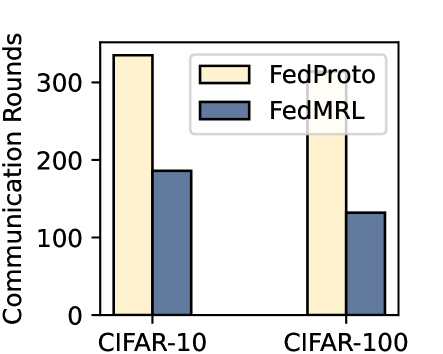
The chart compares the number of communication rounds required for two federated learning protocols, **FedProto** and **FedMRL**, across two datasets: **CIFAR-10** and **CIFAR-100**. The y-axis represents "Communication Rounds," while the x-axis categorizes the data by dataset. Two bars are shown per dataset, differentiated by protocol.
### Components/Axes
- **Y-Axis**: "Communication Rounds" (scale: 0 to 300, increments of 100).
- **X-Axis**: Two categories: "CIFAR-10" and "CIFAR-100."
- **Legend**:
- **FedProto**: Light yellow bars.
- **FedMRL**: Dark blue bars.
- **Bar Placement**:
- FedProto bars are taller than FedMRL bars for both datasets.
- Legend is positioned in the **top-right corner** of the chart.
### Detailed Analysis
- **CIFAR-10**:
- **FedProto**: Approximately **330 communication rounds** (light yellow bar).
- **FedMRL**: Approximately **190 communication rounds** (dark blue bar).
- **CIFAR-100**:
- **FedProto**: Approximately **310 communication rounds** (light yellow bar).
- **FedMRL**: Approximately **130 communication rounds** (dark blue bar).
### Key Observations
1. **FedProto** consistently requires **~1.7x more communication rounds** than **FedMRL** in both datasets.
2. **FedMRL** shows a **~32% reduction** in communication rounds when moving from CIFAR-10 to CIFAR-100.
3. **FedProto**'s communication rounds decrease slightly (**~20 rounds**) between datasets, while **FedMRL**'s decrease is more significant (**~60 rounds**).
### Interpretation
The data suggests that **FedMRL** is significantly more communication-efficient than **FedProto** across both datasets. The larger gap in communication rounds for **FedProto** (330 vs. 190 in CIFAR-10) implies it may prioritize other factors (e.g., model accuracy) at the cost of efficiency. The steeper reduction in **FedMRL**'s communication rounds for CIFAR-100 could indicate better scalability or optimization for larger datasets. However, without additional context (e.g., accuracy metrics), the trade-off between efficiency and performance remains speculative.