## Data Structure: Mapping of Actions to Numerical Values
### Overview
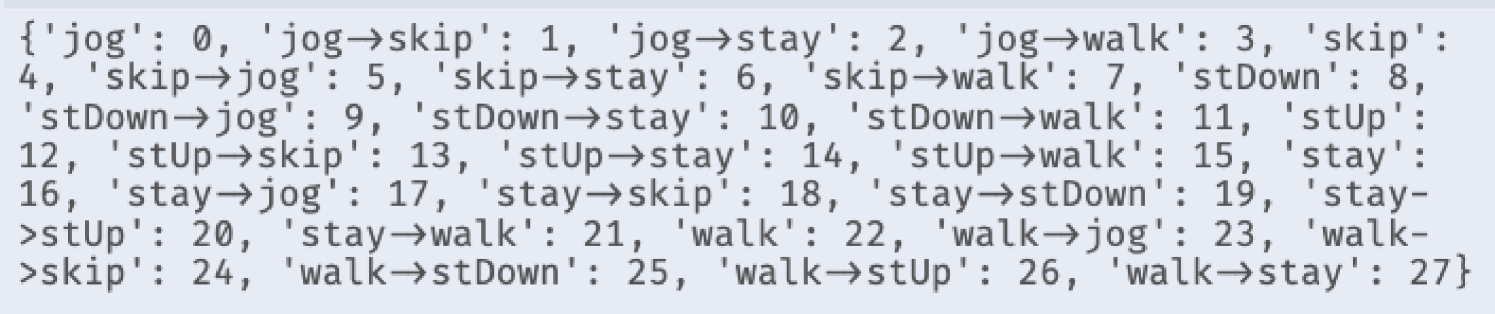
The image presents a data structure, specifically a dictionary or mapping, that associates various actions or states with numerical values. The actions involve movements like jogging, skipping, walking, standing up (stUp), standing down (stDown), and staying. The structure maps both individual actions and transitions between actions to integer values.
### Components/Axes
* **Keys:** String representations of actions or transitions between actions (e.g., 'jog', 'jog->skip', 'walk->stay').
* **Values:** Integer numbers assigned to each action or transition.
### Detailed Analysis or ### Content Details
The data structure maps the following actions and transitions to numerical values:
* 'jog': 0
* 'jog->skip': 1
* 'jog->stay': 2
* 'jog->walk': 3
* 'skip': 4
* 'skip->jog': 5
* 'skip->stay': 6
* 'skip->walk': 7
* 'stDown': 8
* 'stDown->jog': 9
* 'stDown->stay': 10
* 'stDown->walk': 11
* 'stUp': 12
* 'stUp->skip': 13
* 'stUp->stay': 14
* 'stUp->walk': 15
* 'stay': 16
* 'stay->jog': 17
* 'stay->skip': 18
* 'stay->stDown': 19
* 'stay->stUp': 20
* 'stay->walk': 21
* 'walk': 22
* 'walk->jog': 23
* 'walk->skip': 24
* 'walk->stDown': 25
* 'walk->stUp': 26
* 'walk->stay': 27
### Key Observations
* The mapping covers a range of basic actions (jog, skip, walk, stUp, stDown, stay) and transitions between them.
* The numerical values assigned appear to be sequential, starting from 0 and incrementing by 1 for each new action or transition.
### Interpretation
This data structure likely serves as an encoding scheme, where each action or transition is represented by a unique integer. This could be used in a variety of applications, such as:
* **Machine Learning:** Representing actions in a numerical format suitable for training models.
* **Animation/Simulation:** Indexing different states or animations of a character or system.
* **Data Compression:** Encoding a sequence of actions using these numerical values to reduce storage space.
The specific choice of numerical values (0 to 27) and the order in which actions are assigned values may be significant depending on the application. For example, the order might reflect the frequency of occurrence or the logical sequence of actions.