\n
## Data Structure: Dictionary of State Transitions
### Overview
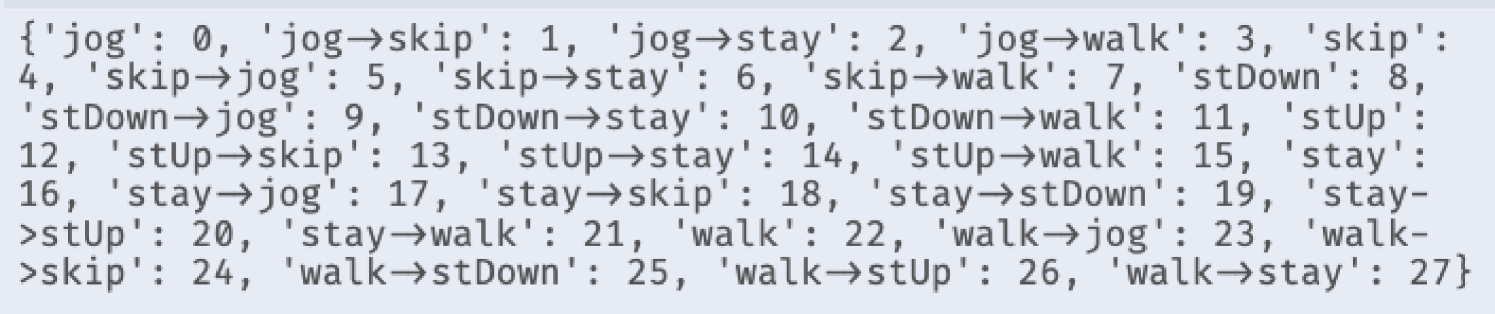
The image presents a dictionary-like data structure, likely representing state transitions within a system. The keys are strings describing transitions between different states (e.g., "jog", "jog->skip", "stDown->walk"), and the values are integer indices.
### Components/Axes
There are no axes or traditional components as in a chart or diagram. The structure consists of key-value pairs. The keys represent state transitions, and the values are numerical identifiers.
### Detailed Analysis or Content Details
The dictionary contains 28 key-value pairs. Here's a complete listing:
* 'jog': 0
* 'jog->skip': 1
* 'jog->stay': 2
* 'jog->walk': 3
* 'skip': 4
* 'skip->jog': 5
* 'skip->stay': 6
* 'skip->walk': 7
* 'stDown': 8
* 'stDown->jog': 9
* 'stDown->stay': 10
* 'stDown->walk': 11
* 'stUp': 12
* 'stUp->skip': 13
* 'stUp->stay': 14
* 'stUp->walk': 15
* 'stay': 16
* 'stay->jog': 17
* 'stay->skip': 18
* 'stay->stDown': 19
* 'stay->stUp': 20
* 'stay->walk': 21
* 'walk': 22
* 'walk->jog': 23
* 'walk->skip': 24
* 'walk->stDown': 25
* 'walk->stUp': 26
* 'walk->stay': 27
The states involved appear to be: 'jog', 'skip', 'stDown' (likely standing down), 'stUp' (likely standing up), 'stay', and 'walk'. The transitions indicate possible movements or changes between these states.
### Key Observations
The dictionary provides a mapping between state transitions and integer identifiers. The identifiers range from 0 to 27. The structure suggests a discrete state machine or a similar system where transitions between states are explicitly defined and indexed.
### Interpretation
This data likely represents a state transition table used in a control system, animation system, or a similar application where an entity can be in one of several states and move between them. The integer identifiers could be used as indices into an array or other data structure to store additional information about each transition (e.g., duration, animation frame, associated action). The naming convention of the keys (e.g., "state1->state2") clearly indicates the direction of the transition. The inclusion of 'stay' as a state suggests the possibility of remaining in the current state. The 'stDown' and 'stUp' states suggest a vertical component to the system's behavior. This data is a foundational element for implementing state-based logic in a software or hardware system.