## Text Block: Movement State Transition Dictionary
### Overview
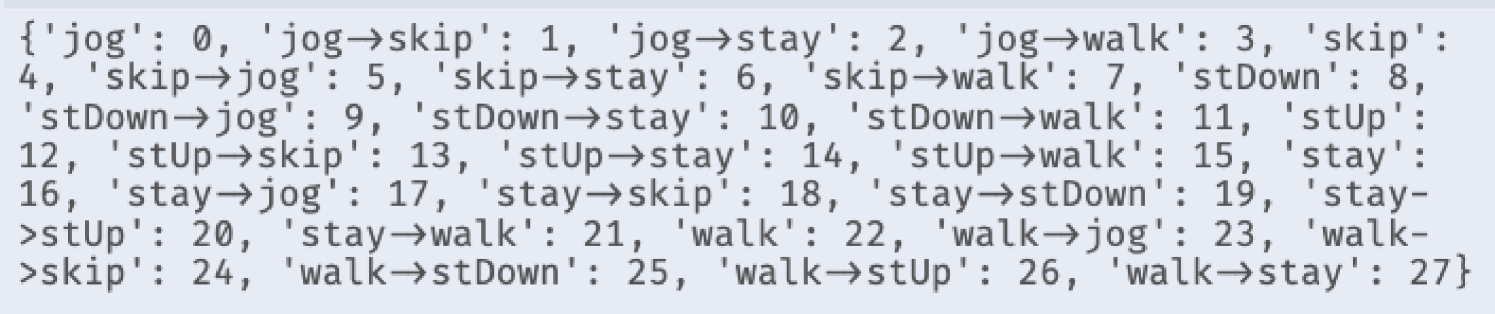
The image displays a single line of text formatted as a Python dictionary. It maps string keys representing human movement states and transitions between those states to integer values (indices). The text is presented in a monospaced font against a light gray background, suggesting it is a code snippet or data structure definition.
### Components/Axes
The content is a single dictionary with 28 key-value pairs. The keys are strings describing either a static movement state (e.g., `'jog'`) or a transition from one state to another (e.g., `'jog→skip'`). The values are sequential integers starting from 0. The arrow symbol `→` is used to denote a transition.
### Detailed Analysis
The dictionary entries are as follows, transcribed exactly as they appear:
```python
{'jog': 0, 'jog→skip': 1, 'jog→stay': 2, 'jog→walk': 3, 'skip': 4, 'skip→jog': 5, 'skip→stay': 6, 'skip→walk': 7, 'stDown': 8, 'stDown→jog': 9, 'stDown→stay': 10, 'stDown→walk': 11, 'stUp': 12, 'stUp→skip': 13, 'stUp→stay': 14, 'stUp→walk': 15, 'stay': 16, 'stay→jog': 17, 'stay→skip': 18, 'stay→stDown': 19, 'stay→stUp': 20, 'stay→walk': 21, 'walk': 22, 'walk→jog': 23, 'walk→skip': 24, 'walk→stDown': 25, 'walk→stUp': 26, 'walk→stay': 27}
```
**Structure Breakdown:**
* **Static States:** There are 6 base movement states, each assigned an index:
* `jog`: 0
* `skip`: 4
* `stDown`: 8 (Likely an abbreviation for "stand down" or a crouching position)
* `stUp`: 12 (Likely an abbreviation for "stand up")
* `stay`: 16 (Likely meaning "stationary" or "idle")
* `walk`: 22
* **Transitions:** The remaining 22 entries are transitions *from* one of the base states *to* another (or possibly to itself, though none are listed). The transition key format is `'StateA→StateB'`.
### Key Observations
1. **Sequential Indexing:** The integers are assigned sequentially from 0 to 27, with no gaps. The static states are not grouped together numerically; they are interspersed with their outgoing transitions (e.g., `jog` is 0, followed by its transitions `jog→skip` (1), `jog→stay` (2), `jog→walk` (3), before the next static state `skip` (4)).
2. **Transition Coverage:** Not all possible transitions between the 6 states are present. For example, there is no `jog→stDown` or `walk→jog` (wait, correction: `walk→jog` is present as 23). A full cross-product would yield 30 transitions (6 states * 5 possible destination states each). This list contains 22 transitions, indicating some transitions are either not observed, not labeled, or considered invalid in the underlying dataset or model.
3. **Abbreviations:** The terms `stDown` and `stUp` are abbreviations. Their meaning is context-dependent but strongly suggests postural changes.
### Interpretation
This dictionary serves as a **label encoding schema** for a time-series classification task, most likely in the domain of human activity recognition (HAR) or motion analysis.
* **Purpose:** It translates descriptive, human-readable labels of movement and movement changes into a numerical format suitable for training machine learning models (e.g., a neural network classifier) or for indexing into a data array.
* **Data Structure Implication:** The sequential, non-grouped indexing suggests the original data might be structured as a single sequence of these 28 classes. A model would be trained to predict one of these 28 labels for each time window in a sensor data stream (e.g., from accelerometers or video).
* **Investigative Insight:** The specific set of transitions included reveals the focus of the study or system. The absence of certain transitions (like direct transitions between `stDown` and `stUp`, or from `stay` to itself) implies the dataset or task design considers only a specific, possibly realistic, subset of movement dynamics. The inclusion of transitions like `stay→stDown` and `stay→stUp` highlights the importance of capturing the initiation of movement from a stationary posture.