## Diagram: Binary Weight Processing Architecture
### Overview
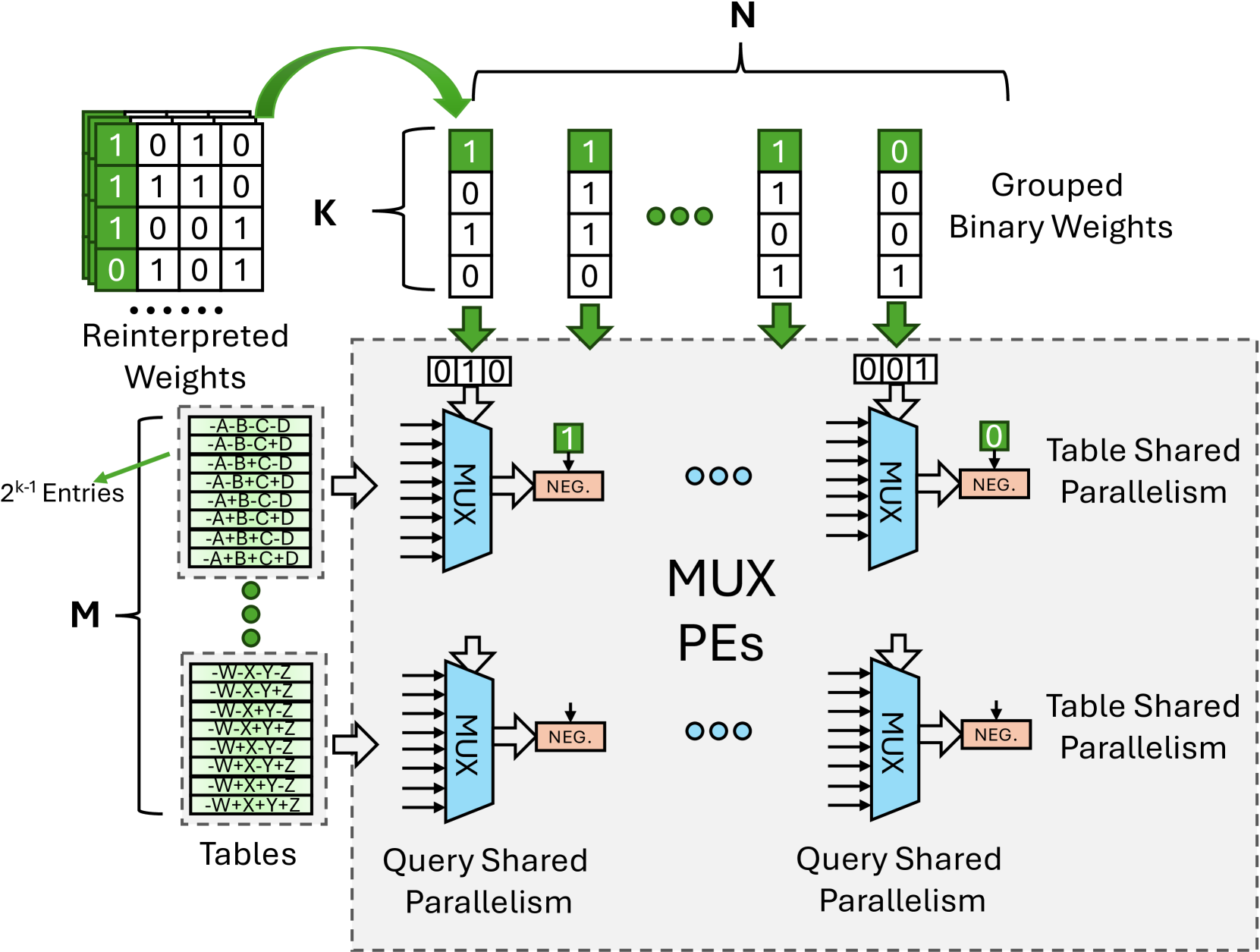
The diagram illustrates a technical architecture for processing binary weights in a computational system. It includes components for reinterpreting weights, grouping binary weights, and parallel processing via MUX PEs (Multiplexer Processing Elements). The flow involves reinterpreting weights, grouping them, and distributing them across query and table shared parallelism units.
### Components/Axes
1. **Reinterpreted Weights**:
- A matrix with green and white blocks labeled "1" and "0".
- Contains 2^(k-1) entries, with examples like "-A-B-C-D" and "-W-X-Y-Z".
2. **Grouped Binary Weights**:
- A matrix with 1s and 0s, labeled "Grouped Binary Weights".
- Arrows point from "Reinterpreted Weights" to this section.
3. **Tables**:
- Contains entries like "-W-X-Y-Z" with variations (e.g., "+", "-").
- Arrows point from "Tables" to "Query Shared Parallelism" and "Table Shared Parallelism".
4. **MUX PEs**:
- Central processing units labeled "MUX" with arrows from "Grouped Binary Weights".
- Connected to "NEG." (negation) blocks.
5. **Parallelism Sections**:
- **Query Shared Parallelism**: Arrows from MUX PEs to this section.
- **Table Shared Parallelism**: Arrows from MUX PEs to this section.
6. **NEG. Blocks**:
- Labeled "NEG." with arrows from MUX PEs.
### Detailed Analysis
- **Reinterpreted Weights**:
- A 4x4 matrix with green (1) and white (0) blocks.
- Example entries: "1 0 1 0", "1 1 1 0", "1 0 0 1", "0 1 0 1".
- **Grouped Binary Weights**:
- A 4x4 matrix with 1s and 0s.
- Example entries: "1 1 1 0", "1 1 0 0", "1 0 1 0", "0 1 0 1".
- **Tables**:
- Contains 2^(k-1) entries with variable combinations (e.g., "-W-X-Y-Z", "-W+X-Y+Z").
- Example entries: "-W-X-Y-Z", "-W-X+Y+Z", "-W+X-Y-Z", "-W+X+Y+Z".
- **MUX PEs**:
- Blue rectangular blocks labeled "MUX".
- Arrows from "Grouped Binary Weights" to MUX PEs.
- **Parallelism Sections**:
- **Query Shared Parallelism**: Arrows from MUX PEs to this section.
- **Table Shared Parallelism**: Arrows from MUX PEs to this section.
- **NEG. Blocks**:
- Pink rectangular blocks labeled "NEG.".
- Arrows from MUX PEs to these blocks.
### Key Observations
- The architecture emphasizes **parallelism** through MUX PEs and shared processing units.
- **Binary weights** are grouped and distributed to both query and table shared parallelism.
- **Negation** is applied after MUX processing, suggesting a step for sign handling.
- The "2^(k-1) Entries" in tables imply exponential scaling with variable k.
### Interpretation
This diagram represents a hardware or algorithmic framework for optimizing binary weight processing, likely in a neural network or machine learning context. The **reinterpreted weights** are transformed into grouped binary weights, which are then processed in parallel via MUX PEs. The **query and table shared parallelism** suggest a design for efficient data handling, where shared resources (e.g., memory or computation units) are utilized to reduce redundancy. The **negation blocks** indicate a step to handle signed weights, ensuring correct sign propagation. The use of **2^(k-1) Entries** implies a scalable system where the number of entries grows exponentially with the number of variables (k), enabling complex weight combinations.
The flow from "Reinterpreted Weights" to "Grouped Binary Weights" to MUX PEs and then to parallelism sections highlights a pipeline for efficient computation. This architecture likely aims to balance computational efficiency with flexibility in handling diverse weight configurations.