## Diagram: Model Adaptation Techniques
### Overview
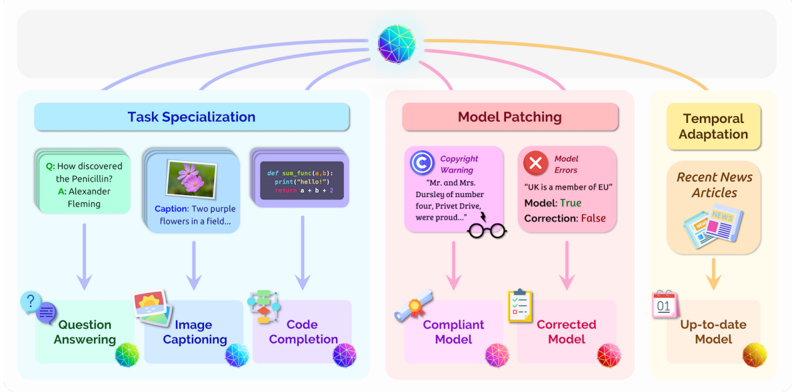
The image is a diagram illustrating three different techniques for adapting models: Task Specialization, Model Patching, and Temporal Adaptation. Each technique is represented as a separate column, with examples and visual cues to explain the concept. The diagram shows how a central model can be adapted to perform specific tasks, correct errors, and stay up-to-date.
### Components/Axes
* **Title:** Model Adaptation Techniques (inferred)
* **Central Node:** A multi-faceted sphere at the top, connected to each adaptation technique.
* **Task Specialization:**
* Example 1: Question Answering (Q: How discovered the Penicillin? A: Alexander Fleming)
* Example 2: Image Captioning (Caption: Two purple flowers in a field...)
* Example 3: Code Completion (def sum_func(a,b): print("hello!") return a+b+2)
* Output: Question Answering, Image Captioning, Code Completion
* **Model Patching:**
* Copyright Warning ("Mr. and Mrs. Dursley of number four, Privet Drive, were proud...")
* Model Errors ("UK is a member of EU" Model: True, Correction: False)
* Output: Compliant Model, Corrected Model
* **Temporal Adaptation:**
* Recent News Articles (with a newspaper icon labeled "NEWS")
* Output: Up-to-date Model (with a calendar icon showing "01")
### Detailed Analysis or ### Content Details
**Task Specialization:**
* **Question Answering:** Shows a question about the discovery of penicillin and the answer.
* **Image Captioning:** Shows an image of two purple flowers and a caption describing the image.
* **Code Completion:** Shows a code snippet defining a function and returning a value.
**Model Patching:**
* **Copyright Warning:** Includes a quote from a book, possibly indicating a copyright issue.
* **Model Errors:** Shows a statement about the UK being a member of the EU, with the model incorrectly stating "True" and the correction stating "False".
**Temporal Adaptation:**
* **Recent News Articles:** Shows a newspaper icon, indicating the use of recent news to update the model.
* **Up-to-date Model:** Shows a calendar icon, indicating the model is kept up-to-date.
### Key Observations
* The diagram uses visual cues and examples to illustrate each adaptation technique.
* Each technique has a clear input and output, showing how the model is adapted.
* The central node represents the original model, which is adapted using the three techniques.
### Interpretation
The diagram illustrates three key methods for adapting models to improve their performance and accuracy. Task Specialization allows a model to be fine-tuned for specific tasks, such as question answering or image captioning. Model Patching addresses errors in the model's knowledge or reasoning. Temporal Adaptation ensures the model stays current with new information. The diagram suggests that a combination of these techniques can lead to a more robust and reliable model. The "Model Patching" section highlights the importance of correcting factual errors in models, especially regarding current events. The "Temporal Adaptation" section emphasizes the need for models to stay up-to-date with the latest information to remain relevant and accurate.