## Diagram: Model Adaptation Strategies
### Overview
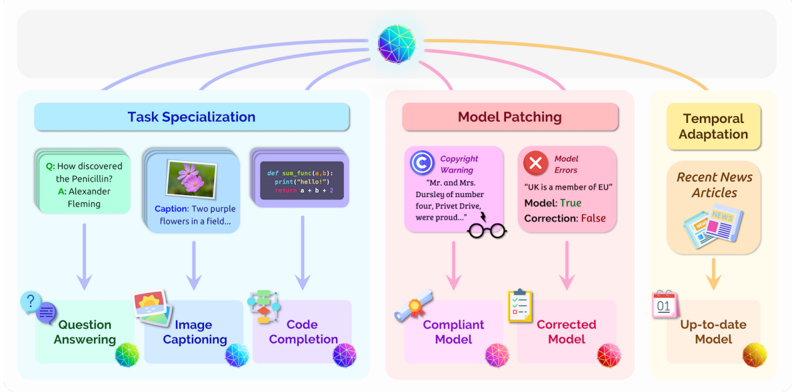
The image is a diagram illustrating three strategies for adapting a core model: Task Specialization, Model Patching, and Temporal Adaptation. Each strategy takes the core model (represented by a purple sphere with radiating lines) as input and transforms it into a specialized model. The diagram visually represents the input-process-output relationship for each adaptation method.
### Components/Axes
The diagram is divided into three main sections, each representing a different adaptation strategy. Each section contains:
* **Input:** The core model (purple sphere) and specific data relevant to the strategy.
* **Process:** A rectangular box representing the adaptation process.
* **Output:** A specialized model resulting from the adaptation.
* **Arrows:** Illustrate the flow of information from the core model to the specialized model.
The three sections are:
1. **Task Specialization** (left, light blue background)
2. **Model Patching** (center, light pink background)
3. **Temporal Adaptation** (right, light orange background)
### Detailed Analysis or Content Details
**1. Task Specialization:**
* **Input:** Core model (purple sphere) and example data:
* Question: "How discovered the Penicillin?"
* Answer: "Alexander Fleming"
* Image: A photograph of two purple flowers in a field.
* Caption: "Two purple flowers in a field…"
* Code: `def sum_func(a,b): print("hello") return a + b + 1`
* **Process:** "Task Specialization" is written inside a light blue rectangle.
* **Output:** Three specialized models:
* Question Answering (icon: a question mark)
* Image Captioning (icon: a camera)
* Code Completion (icon: curly braces)
* **Color Association:** The arrows from the core model to the specialized models are colored purple, green, and blue respectively.
**2. Model Patching:**
* **Input:** Core model (purple sphere) and example data:
* Copyright Warning: "Mr. and Mrs. Dursley of number four, Privet Drive, were proud…" (with a copyright symbol)
* Model Errors: "UK is a member of EU"
* Model: True
* Correction: False
* **Process:** "Model Patching" is written inside a light pink rectangle.
* **Output:** Two specialized models:
* Compliant Model (icon: a robot)
* Corrected Model (icon: a document with a checkmark)
* **Color Association:** The arrows from the core model to the specialized models are colored pink and red respectively.
**3. Temporal Adaptation:**
* **Input:** Core model (purple sphere) and example data:
* Recent News Articles (icon: a newspaper)
* **Process:** "Temporal Adaptation" is written inside a light orange rectangle.
* **Output:** One specialized model:
* Up-to-date Model (icon: a calendar with the number 1)
* **Color Association:** The arrow from the core model to the specialized model is colored orange.
### Key Observations
* The core model (purple sphere) serves as the central point, branching out to different adaptation strategies.
* Each adaptation strategy focuses on a specific type of improvement: specialization for tasks, correction of errors, and updating with temporal information.
* The diagram uses icons to represent the specialized models, making it visually intuitive.
* The color coding of the arrows helps to associate the core model with its corresponding specialized models.
### Interpretation
The diagram illustrates a modular approach to model adaptation. Instead of retraining the entire model for every new task or change, the core model can be adapted through specialized modules. This approach offers several advantages:
* **Efficiency:** Adapting a smaller module is computationally less expensive than retraining the entire model.
* **Flexibility:** Different adaptation strategies can be applied independently, allowing for targeted improvements.
* **Maintainability:** The modular design makes it easier to update and maintain the model.
The diagram highlights the importance of addressing different types of model limitations:
* **Task Specialization** addresses the need for models to perform specific tasks effectively.
* **Model Patching** addresses the need to correct errors and ensure compliance.
* **Temporal Adaptation** addresses the need to keep models up-to-date with changing information.
The radiating lines from the core model suggest that these adaptation strategies are not mutually exclusive and can be combined to create even more powerful and versatile models. The diagram suggests a layered approach to AI development, where a foundational model is continuously refined and adapted to meet evolving needs.