## Line Graph: Mean Up-Clipped Probability Over Steps
### Overview
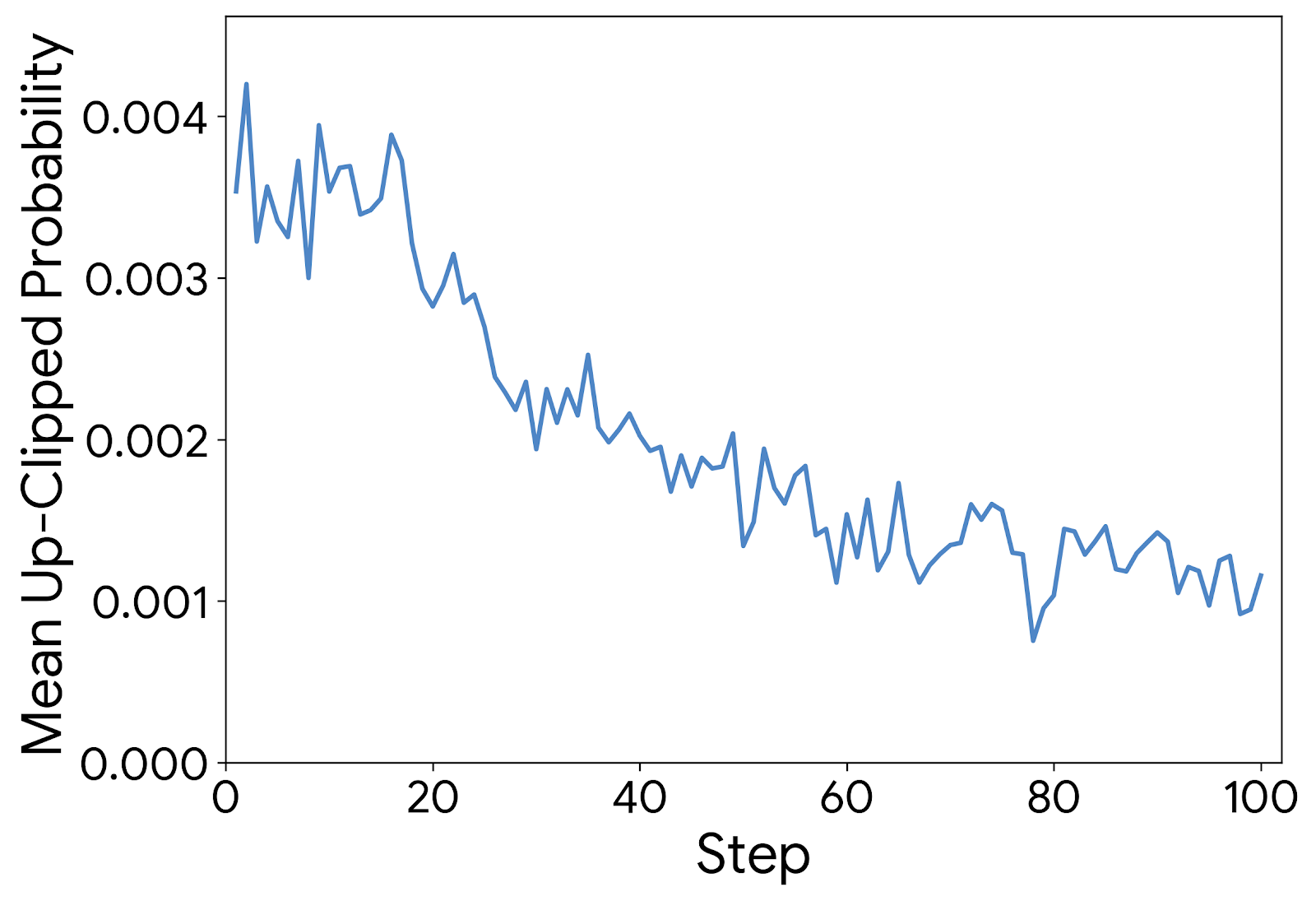
The image depicts a line graph illustrating the trend of "Mean Up-Clipped Probability" across sequential "Steps" (0 to 100). The blue line exhibits a general downward trajectory with localized fluctuations, starting near 0.004 and stabilizing around 0.001 by Step 100.
### Components/Axes
- **Y-Axis (Left)**: Labeled "Mean Up-Clipped Probability," scaled logarithmically from 0.000 to 0.004 in increments of 0.001.
- **X-Axis (Bottom)**: Labeled "Step," with integer markers at 0, 20, 40, 60, 80, and 100.
- **Line**: A single blue line representing the data series, positioned centrally in the plot area.
### Detailed Analysis
- **Initial Phase (Steps 0–20)**: The line begins at approximately 0.004, with sharp oscillations between 0.003 and 0.004. A notable dip occurs near Step 10, reaching ~0.003.
- **Mid-Phase (Steps 20–60)**: A steady decline to ~0.002 by Step 40, followed by minor fluctuations (0.0015–0.0025) until Step 60.
- **Final Phase (Steps 60–100)**: Further reduction to ~0.001 by Step 80, with stabilization and minor oscillations (0.0008–0.0012) toward Step 100.
### Key Observations
1. **Downward Trend**: The mean up-clipped probability decreases monotonically over time, suggesting a stabilizing or converging process.
2. **Fluctuations**: Localized spikes (e.g., Step 5, 25, 70) indicate transient variability, possibly due to noise or model adjustments.
3. **Stabilization**: By Step 80, the line flattens, implying diminishing changes in the probability metric.
### Interpretation
The data suggests a system where the "Mean Up-Clipped Probability" diminishes as steps progress, potentially reflecting iterative refinement or decay in a modeled process. The initial volatility may stem from transient factors, while the later stabilization indicates equilibrium. The absence of a legend implies a single data series, and the logarithmic y-axis emphasizes relative changes over absolute values. This trend could be critical for understanding convergence rates in algorithms, decay in probabilistic models, or similar phenomena.