## Diagram: Kernel State Transformation
### Overview
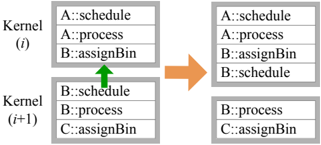
This diagram illustrates a transformation process involving two distinct kernel states, labeled "Kernel (i)" and "Kernel (i+1)", which represent sequential or related execution contexts. The diagram shows the contents of these kernels before and after a specific operation, highlighting the movement of one particular item from "Kernel (i+1)" to "Kernel (i)". An internal dependency or interaction within the initial state is also depicted.
### Components/Axes
The diagram is structured into two main vertical columns, representing the "before" and "after" states of the kernels, separated by a large horizontal orange arrow indicating the transformation. Each kernel state is represented by a grey-bordered rectangular block containing a list of textual items.
**Left Column (Before Transformation):**
* **Top Block:** Labeled "Kernel (i)" on its left side. This block contains three items, listed vertically:
* "A::schedule"
* "A::process"
* "B::assignBin"
* **Bottom Block:** Labeled "Kernel (i+1)" on its left side. This block contains three items, listed vertically:
* "B::schedule"
* "B::process"
* "C::assignBin"
* **Green Upward Arrow:** A green arrow originates from the "B::schedule" item within the "Kernel (i+1)" block and points upwards to the "B::assignBin" item within the "Kernel (i)" block. This arrow indicates a relationship or flow from "B::schedule" in Kernel (i+1) to "B::assignBin" in Kernel (i).
**Right Column (After Transformation):**
* **Top Block:** This block, corresponding to the transformed "Kernel (i)", contains four items, listed vertically:
* "A::schedule"
* "A::process"
* "B::assignBin"
* "B::schedule"
* **Bottom Block:** This block, corresponding to the transformed "Kernel (i+1)", contains two items, listed vertically:
* "B::process"
* "C::assignBin"
**Transformation Indicator:**
* **Orange Rightward Arrow:** A large, thick orange arrow is positioned horizontally in the center of the diagram, pointing from the left column (before state) to the right column (after state). This signifies the overall transformation or transition.
### Detailed Analysis
**Initial State (Left Column):**
* **Kernel (i):** Contains tasks "A::schedule", "A::process", and "B::assignBin". These appear to be operations or functions prefixed by a module or component identifier (A or B).
* **Kernel (i+1):** Contains tasks "B::schedule", "B::process", and "C::assignBin".
* **Inter-kernel Relationship:** The green arrow explicitly shows a connection where "B::schedule" from Kernel (i+1) is directed towards "B::assignBin" in Kernel (i).
**Transformation (Orange Arrow):**
The orange arrow indicates a change from the initial state to the final state.
**Final State (Right Column):**
* **Transformed Kernel (i):** The contents have changed. It now includes all the original items from Kernel (i) ("A::schedule", "A::process", "B::assignBin") PLUS the item "B::schedule" which was originally in Kernel (i+1).
* **Transformed Kernel (i+1):** The contents have changed. It now contains only "B::process" and "C::assignBin". The item "B::schedule" is no longer present in this kernel.
### Key Observations
1. **Item Movement:** The primary change observed is the movement of the item "B::schedule" from "Kernel (i+1)" to "Kernel (i)".
2. **Kernel (i) Expansion:** "Kernel (i)" gains an item, increasing its task list from three to four.
3. **Kernel (i+1) Contraction:** "Kernel (i+1)" loses an item, decreasing its task list from three to two.
4. **Stable Items:** "A::schedule", "A::process", "B::assignBin" (in Kernel i) and "B::process", "C::assignBin" (in Kernel i+1) remain in their respective kernels, though "B::assignBin" in Kernel (i) is the target of the green arrow.
5. **Green Arrow Context:** The green arrow, originating from the item that moves, and pointing to an item in the destination kernel, suggests a dependency or a reason for the movement.
### Interpretation
This diagram illustrates a mechanism for task or operation migration between sequential kernel states. The "Kernel (i)" and "Kernel (i+1)" likely represent different phases, iterations, or levels of execution within a system.
The core idea is that a task, "B::schedule", initially designated for a later kernel state (i+1), is "pulled" or "promoted" into an earlier kernel state (i). This could be driven by several factors:
* **Dependency Resolution:** The green arrow from "B::schedule" (in i+1) to "B::assignBin" (in i) strongly suggests that "B::schedule" might be a prerequisite or a closely related operation that needs to be executed within the context of "Kernel (i)", possibly before or in conjunction with "B::assignBin". To satisfy this dependency, "B::schedule" is moved.
* **Optimization/Scheduling:** Moving "B::schedule" earlier might be an optimization to improve performance, reduce latency, or ensure critical tasks are handled sooner.
* **Contextual Shift:** The task "B::schedule" might be more relevant or efficient to execute within the environment or resources available to "Kernel (i)" rather than "Kernel (i+1)".
* **Dynamic Reconfiguration:** The diagram could represent a dynamic reconfiguration of kernel tasks based on runtime conditions or specific system requirements.
The "A::" and "C::" prefixed tasks, along with "B::process", remain static, indicating that this specific transformation targets only "B::schedule" and its relationship with "B::assignBin". This suggests a fine-grained control over task placement and execution order across kernel states. The diagram effectively visualizes a "task hoisting" or "pre-scheduling" operation.