## Diagram: Kernel Function Mapping and Transition
### Overview
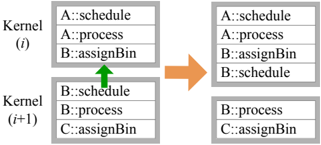
The image is a technical diagram illustrating a relationship and transition between two computational kernels, labeled Kernel (i) and Kernel (i+1). It depicts the functions contained within each kernel and shows a specific dependency link between them, as well as an overall progression from one kernel to the next.
### Components/Axes
The diagram consists of two primary rectangular blocks representing the kernels, positioned side-by-side.
* **Left Block (Kernel (i)):**
* **Header:** "Kernel (i)"
* **Content (List of Functions):**
1. `A::schedule`
2. `A::process`
3. `A::assignBin`
* **Right Block (Kernel (i+1)):**
* **Header:** "Kernel (i+1)"
* **Content (List of Functions):**
1. `B::schedule`
2. `B::process`
3. `C::assignBin`
* **Connecting Elements:**
1. A **green arrow** originates from the `A::assignBin` function in Kernel (i) and points directly to the `B::schedule` function in Kernel (i+1).
2. A large, **orange arrow** is positioned between the two kernel blocks, pointing from left (Kernel (i)) to right (Kernel (i+1)), indicating a general transition or sequence.
### Detailed Analysis
The diagram presents a structured view of two sequential computational units.
* **Kernel (i) Composition:** Contains three functions, all prefixed with the module/component identifier `A`. The functions are `schedule`, `process`, and `assignBin`.
* **Kernel (i+1) Composition:** Contains three functions with different prefixes. Two are prefixed with `B` (`schedule`, `process`), and one is prefixed with `C` (`assignBin`).
* **Specific Dependency (Green Arrow):** The green arrow establishes a direct, specific link. It shows that the output or completion of the `assignBin` function from module `A` in the first kernel is a prerequisite for, or triggers, the `schedule` function from module `B` in the subsequent kernel.
* **General Transition (Orange Arrow):** The orange arrow signifies the overall flow or progression from the state or execution context of Kernel (i) to that of Kernel (i+1). This could represent a pipeline stage, a time step, or a logical sequence in a larger process.
### Key Observations
1. **Function Naming Convention:** All functions follow a `Module::FunctionName` pattern, indicating a modular design where functions belong to specific components (A, B, C).
2. **Asymmetric Composition:** While both kernels have three functions, the module prefixes change. Kernel (i) is entirely from module `A`, while Kernel (i+1) mixes modules `B` and `C`.
3. **Cross-Module Dependency:** The critical insight is the green arrow, which highlights a cross-module (`A` to `B`) and cross-kernel dependency. This is a more specific relationship than the general kernel-to-kernel transition shown by the orange arrow.
4. **Spatial Layout:** The legend (the function lists) is contained within each kernel block. The key relational elements (the arrows) are placed in the space between the blocks, with the green arrow's tail and head precisely aligned with the specific functions it connects.
### Interpretation
This diagram likely models a **task scheduling or pipeline execution system** in a parallel or modular computing environment.
* **What it suggests:** The system is broken down into discrete kernels (i, i+1), which could be time steps, pipeline stages, or thread blocks. Within each kernel, tasks (schedule, process, assignBin) from different modules (A, B, C) are executed.
* **How elements relate:** The orange arrow shows the sequential flow of kernels. The green arrow reveals a finer-grained, data-flow or control-flow dependency: the "bin assignment" task in the first stage (by module A) must complete before the "scheduling" task in the next stage (by module B) can begin. This implies that `A::assignBin` produces data or a state that `B::schedule` requires.
* **Notable pattern/anomaly:** The shift from a single-module kernel (`A`) to a multi-module kernel (`B` and `C`) is significant. It suggests that Kernel (i+1) integrates work from different components, possibly coordinating their outputs. The absence of a direct link to `C::assignBin` might indicate it operates independently or depends on other, unshown factors.
* **Underlying principle:** The diagram emphasizes that understanding a system requires looking at both the **macro-level sequence** (kernel transitions) and the **micro-level dependencies** (specific function calls between modules). The green arrow is the most critical piece of information, exposing a potential bottleneck or synchronization point in the workflow.