## 2D Embedding Visualization: Devanagari Character Space
### Overview
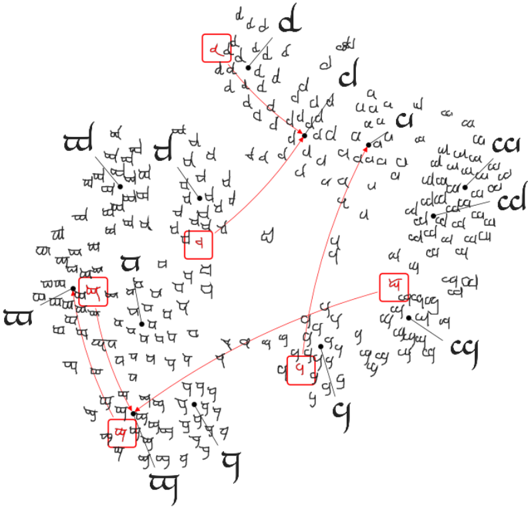
The image displays a 2D projection (likely generated via t-SNE, UMAP, or a similar dimensionality reduction technique) of a dataset containing Devanagari script characters. The spatial arrangement demonstrates the clustering of characters based on visual and structural similarity. Five specific characters are highlighted with red boxes and connected by red lines, indicating a specific path or sequence through the embedding space.
### Components/Axes
* **Data Points:** Individual Devanagari glyphs scattered across the 2D plane.
* **Highlights:** Five red boxes containing specific characters.
* **Connectors:** Red lines with directional arrows connecting the highlighted characters, forming a closed loop.
* **Markers:** Small black dots located near specific glyphs, likely representing cluster centroids or specific data points of interest.
* **Language:** The text consists of Devanagari script (used for Hindi, Sanskrit, Marathi, etc.).
### Detailed Analysis
The visualization groups characters based on morphological similarity. Below is the transcription and identification of the highlighted characters (in red boxes):
1. **Top (Red Box):** Character **'द'** (Transliteration: *da*).
2. **Middle-Left (Red Box):** Character **'व'** (Transliteration: *va*).
3. **Bottom-Left (Red Box):** Character **'प'** (Transliteration: *pa*).
4. **Bottom-Middle (Red Box):** Character **'य'** (Transliteration: *ya*).
5. **Middle-Right (Red Box):** Character **'घ'** (Transliteration: *gha*).
**Red Line Path Analysis:**
The red lines connect these characters in a specific sequence, forming a cycle:
* **'द' (Top)** connects to **'व' (Middle-Left)**.
* **'व' (Middle-Left)** connects to **'प' (Bottom-Left)**.
* **'प' (Bottom-Left)** connects to **'य' (Bottom-Middle)**.
* **'य' (Bottom-Middle)** connects to **'घ' (Middle-Right)**.
* **'घ' (Middle-Right)** connects back to **'द' (Top)**.
**Spatial Distribution:**
* **Top Cluster:** Dominated by variations of 'द' (da) and similar curved-top characters.
* **Left Cluster:** Dominated by 'व' (va), 'प' (pa), 'म' (ma), and 'य' (ya). These characters share structural similarities (vertical lines, loops).
* **Right Cluster:** Dominated by 'घ' (gha), 'च' (cha), and 'ध' (dha).
### Key Observations
* **Clustering Logic:** The embedding successfully groups characters that share visual features. For instance, 'प' (pa) and 'य' (ya) are positioned in close proximity, which is logical as they share similar stroke structures in the Devanagari script.
* **Pathing:** The red lines do not appear to be random; they connect distinct clusters. This suggests the visualization might be demonstrating a "nearest neighbor" path, a transition sequence, or a specific trajectory of character recognition within a machine learning model.
* **Outliers:** There are sparse areas between the main clusters, indicating distinct visual differences between the character groups (e.g., the gap between the 'द' cluster and the 'घ' cluster).
### Interpretation
This image is a technical visualization of a machine learning model's feature space (likely a Convolutional Neural Network or similar architecture) trained on Devanagari character recognition.
* **What the data demonstrates:** The model has successfully learned to map visual features of the script into a 2D space where "similar-looking" characters are placed near each other.
* **Why it matters:** This type of visualization is critical for debugging character recognition models. If a model frequently confuses 'प' (pa) and 'य' (ya), this plot would show them overlapping or being very close, explaining the source of the classification error.
* **The Red Path:** The closed loop formed by the red lines likely represents a "path of least resistance" or a sequence of nearest neighbors between these specific character classes. It demonstrates how the model perceives the "distance" or "difference" between these distinct characters. The path suggests that the model views these five characters as a connected chain of morphological transformations.