\n
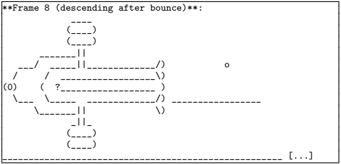
## Diagram: Frame 8 (descending after bounce)
### Overview
This image is a technical schematic or ASCII-art style diagram representing a physical system or process state, specifically labeled as "Frame 8" in a sequence where an object is "descending after bounce." The diagram uses monospaced characters (dashes, pipes, braces, etc.) to depict components, connections, and possibly motion paths. It appears to be a snapshot from a simulation, animation, or technical analysis of a bouncing or oscillating system.
### Components/Axes
* **Header/Title:** Located at the top-left corner: `**Frame 8 (descending after bounce)**:`
* **Main Diagram Structure:** The central diagram is composed of several interconnected parts:
* A vertical central axis or column, primarily defined by pairs of pipe characters (`||`).
* Horizontal lines extending left and right from this axis, made of dashes (`---`).
* Curved or angled connectors represented by forward slashes (`/`) and backslashes (`\`).
* Enclosures or containers depicted with curly braces (`{`, `}`).
* A small circle (`o`) positioned to the right of the main structure.
* **Footer/Annotation:** At the bottom-right corner: `{...}`. This likely serves as a legend placeholder, a reference marker, or an indicator of continuation.
### Detailed Analysis
The diagram can be segmented into the following spatial regions and components:
1. **Top Section (Above Central Axis):**
* Two horizontal dashed lines (`-------`) are stacked vertically.
* Below them, a vertical pair of pipes (`||`) connects to the main horizontal structure.
2. **Central Horizontal Structure:**
* A long horizontal line of dashes (`-------------------`) forms the main beam.
* At its left end, a forward slash (`/`) angles down to connect to a lower structure.
* At its right end, a backslash (`\`) angles down to connect to a lower structure.
* A question mark (`?`) is embedded within the central part of this horizontal line, suggesting an unknown variable, a point of interest, or a label for that segment.
3. **Left Lower Structure:**
* Connected from the left end of the central beam via a forward slash (`/`).
* Features an opening curly brace (`{`) on the far left.
* Contains a vertical pair of pipes (`||`).
* Has a horizontal dashed line (`-------`) extending left from the brace.
4. **Right Lower Structure:**
* Connected from the right end of the central beam via a backslash (`\`).
* Features a closing curly brace (`}`) on the far right.
* Contains a vertical pair of pipes (`||`).
* Has a horizontal dashed line (`-------`) extending right from the brace.
5. **Isolated Element:**
* A small circle (`o`) is positioned in the upper-right quadrant, separate from the main connected structure. Its meaning is not explicitly defined by a label.
6. **Base Line:**
* A long, continuous line of dashes (`--------------------------------------------------`) runs along the bottom of the diagram, potentially representing a ground plane, a baseline, or a timeline.
### Key Observations
* **Symmetry and Asymmetry:** The diagram exhibits a rough bilateral symmetry around the central vertical axis, with left and right lower structures mirroring each other. However, the isolated circle (`o`) on the right breaks this symmetry.
* **Symbolic Language:** The diagram relies entirely on standard typographic characters to convey structure, which is common in plain-text technical documentation, early computer graphics, or physics model schematics.
* **State Indication:** The title explicitly states this is a dynamic state ("descending after bounce"), implying the diagram represents a specific moment in a temporal sequence. The configuration of lines and braces likely illustrates the position, deformation, or stress state of a system at that moment.
* **Ambiguous Elements:** The meaning of the question mark (`?`) and the isolated circle (`o`) are not defined within the image itself. They are critical unknowns for interpretation.
### Interpretation
This diagram is a **kinematic or dynamic state snapshot**. It most likely models the behavior of an elastic or articulated system—such as a spring-mass system, a bouncing ball with internal structure, a mechanical linkage, or a simplified model of a deformable object—immediately after it has rebounded from a surface and is now moving downward.
* **The Central Horizontal Beam** could represent the main body or a rigid component of the system.
* **The Curved Connectors (`/`, `\`)** and **Lower Structures with Braces (`{`, `}`)** likely depict springs, dampers, or flexible joints that are compressing or extending as the system descends. The braces may symbolize the endpoints of these elastic elements.
* **The Vertical Pipes (`||`)** might indicate guides, pistons, or points of concentrated mass.
* **The Base Dashed Line** is almost certainly the impact surface or ground plane from which the object has just bounced.
* **The Isolated Circle (`o`)** could represent a separate particle, a center of mass, a reference point, or an artifact of the simulation (like a previous position marker).
* **The Question Mark (`?`)** highlights a parameter or state variable that is either unknown, being solved for, or is the focus of analysis in this frame (e.g., instantaneous velocity, force, or displacement at that point).
**In essence, the image provides a qualitative, structural understanding of a system's configuration during a specific phase of motion.** It communicates relationships and states (compression/extension, connection points, unknown variables) rather than precise quantitative data. To fully understand it, one would need the context of the preceding frames (1-7) and the accompanying technical documentation that defines the symbols and the physical model being represented.