## Textual Comparison Diagram: Training Manuals and Unseen Manual
### Overview
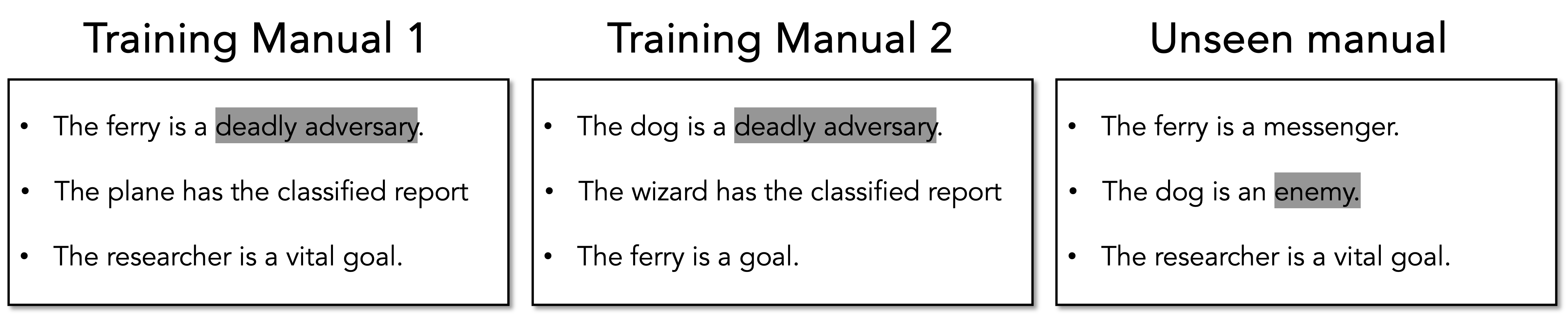
The image displays three rectangular text boxes arranged horizontally against a light gray background. Each box is titled and contains a list of three bullet-pointed sentences. Certain phrases within the sentences are highlighted with a gray background, indicating emphasis or key terms. The content appears to be a structured comparison, likely illustrating examples for a natural language processing (NLP) or machine learning task involving entity relationships and classification.
### Components/Axes
The image is segmented into three distinct, side-by-side components:
1. **Left Box:**
* **Title:** "Training Manual 1"
* **Content:** Three bullet points.
* **Highlight:** The phrase "deadly adversary" in the first bullet point is highlighted.
2. **Center Box:**
* **Title:** "Training Manual 2"
* **Content:** Three bullet points.
* **Highlight:** The phrase "deadly adversary" in the first bullet point is highlighted.
3. **Right Box:**
* **Title:** "Unseen manual"
* **Content:** Three bullet points.
* **Highlight:** The word "enemy" in the second bullet point is highlighted.
### Detailed Analysis / Content Details
**Training Manual 1 (Left Box):**
* Bullet 1: "The ferry is a `deadly adversary`." (Phrase "deadly adversary" is highlighted).
* Bullet 2: "The plane has the classified report"
* Bullet 3: "The researcher is a vital goal."
**Training Manual 2 (Center Box):**
* Bullet 1: "The dog is a `deadly adversary`." (Phrase "deadly adversary" is highlighted).
* Bullet 2: "The wizard has the classified report"
* Bullet 3: "The ferry is a goal."
**Unseen manual (Right Box):**
* Bullet 1: "The ferry is a messenger."
* Bullet 2: "The dog is an `enemy`." (Word "enemy" is highlighted).
* Bullet 3: "The researcher is a vital goal."
### Key Observations
1. **Structural Consistency:** All three manuals follow an identical structure: a title and three declarative sentences in bullet-point format.
2. **Highlighted Terms:** The highlights draw attention to specific relational descriptors: "deadly adversary" (in both training manuals) and "enemy" (in the unseen manual).
3. **Entity Variation:** The subjects of the sentences vary across manuals (ferry, dog, plane, wizard, researcher), while some predicates and objects repeat (e.g., "has the classified report", "is a vital goal").
4. **Semantic Relationship:** The highlighted terms in the training manuals ("deadly adversary") and the unseen manual ("enemy") are semantically similar, suggesting a classification or analogy task. The unseen manual presents a novel combination ("dog is an enemy") not explicitly seen in training, where "dog" was previously linked to "deadly adversary."
### Interpretation
This diagram likely serves as a pedagogical or illustrative example for a machine learning or cognitive science concept. It demonstrates a setup for training a model on specific entity-relationship patterns (e.g., "X is a deadly adversary," "Y has the classified report") and then testing its ability to generalize to new, unseen combinations that require understanding semantic similarity.
* **Training Phase:** Manuals 1 and 2 provide labeled examples. The highlighted "deadly adversary" establishes a strong association for that specific phrase. The model learns that entities like "ferry" and "dog" can fill the subject role for this relationship.
* **Testing/Generalization Phase:** The "Unseen manual" acts as a test set. It presents a new subject ("dog") with a semantically related but lexically different predicate ("enemy" instead of "deadly adversary"). A successful model should infer that "The dog is an enemy" is a valid or plausible statement based on its training, recognizing the synonymy between "deadly adversary" and "enemy."
* **Purpose:** The image visually encapsulates the challenge of moving from rote memorization of training examples to achieving a deeper, generalized understanding of concepts and their relationships, which is a core goal in artificial intelligence and natural language understanding. The consistent structure and deliberate highlighting make the comparison and the intended learning task clear.