## Textual Analysis: Training Manuals and Unseen Manual
### Overview
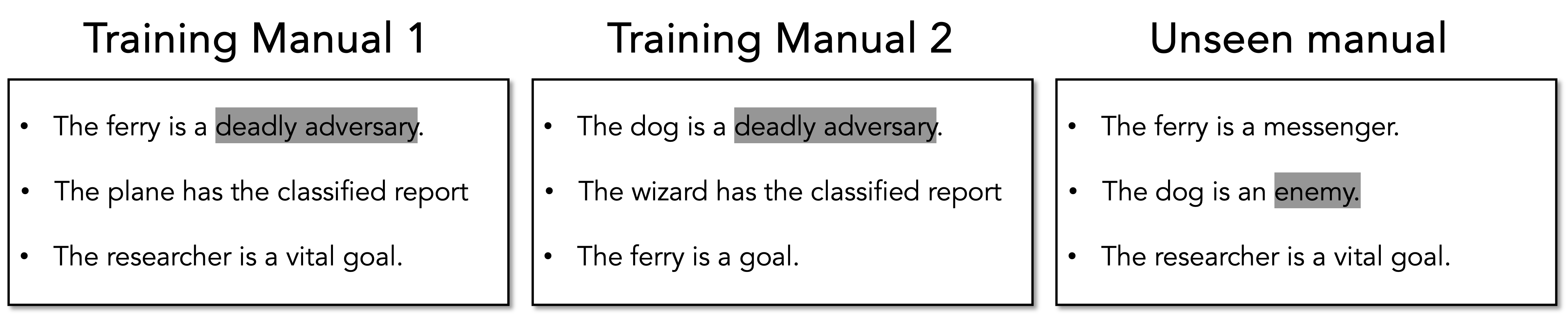
The image presents three distinct sections labeled **Training Manual 1**, **Training Manual 2**, and **Unseen manual**, each containing three bullet-pointed statements. Key terms are highlighted in gray, indicating potential emphasis or contextual differences.
### Components/Axes
- **Sections**:
1. **Training Manual 1**
2. **Training Manual 2**
3. **Unseen manual**
- **Bullet Points**: Each section contains three statements with varying terminology.
- **Highlighted Terms**:
- "deadly adversary" (Training Manual 1, Training Manual 2)
- "enemy" (Unseen manual)
### Detailed Analysis
#### Training Manual 1
1. **The ferry is a deadly adversary.**
- Highlighted term: "deadly adversary"
2. **The plane has the classified report.**
3. **The researcher is a vital goal.**
#### Training Manual 2
1. **The dog is a deadly adversary.**
- Highlighted term: "deadly adversary"
2. **The wizard has the classified report.**
3. **The ferry is a goal.**
#### Unseen manual
1. **The ferry is a messenger.**
2. **The dog is an enemy.**
- Highlighted term: "enemy"
3. **The researcher is a vital goal.**
### Key Observations
1. **Terminology Shifts**:
- "Deadly adversary" (Training Manuals 1 and 2) vs. "enemy" (Unseen manual) for the dog.
- The ferry’s role changes from "deadly adversary" (Training Manual 1) to "goal" (Training Manual 2) to "messenger" (Unseen manual).
2. **Consistency**:
- "The researcher is a vital goal" appears unchanged across all sections.
3. **Contextual Ambiguity**:
- The "classified report" is attributed to different entities (plane in Training Manual 1, wizard in Training Manual 2).
### Interpretation
The highlighted terms ("deadly adversary," "enemy") suggest a progression or variation in threat perception across manuals. The ferry’s evolving role (adversary → goal → messenger) implies shifting objectives or scenarios. The consistent labeling of the researcher as a "vital goal" underscores its central importance. The Unseen manual’s deviation in terminology ("enemy" instead of "deadly adversary") may indicate a distinct operational context or updated protocol.
This analysis highlights how minor lexical changes can alter perceived relationships between entities, potentially affecting training outcomes or strategic decisions. Further investigation into the rationale behind these shifts is warranted.