## Line Chart: ImageNet Accuracy vs Model size
### Overview
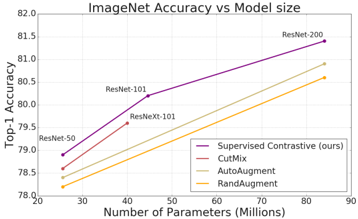
The chart compares the top-1 accuracy of different neural network architectures and augmentation methods on ImageNet, plotted against model size (number of parameters in millions). Four lines represent distinct methods: Supervised Contrastive (ours), CutMix, AutoAugment, and RandAugment. Data points correspond to specific ResNet/ResNeXt variants.
### Components/Axes
- **X-axis**: Number of Parameters (Millions) – ranges from 20 to 90 million, with markers at 20, 30, 40, 50, 60, 70, 80, 90.
- **Y-axis**: Top-1 Accuracy – ranges from 78.0 to 82.0, with increments of 0.5.
- **Legend**:
- Purple: Supervised Contrastive (ours)
- Red: CutMix
- Green: AutoAugment
- Orange: RandAugment
- **Data Points**: Labeled with ResNet/ResNeXt model names (e.g., ResNet-50, ResNeXt-101).
### Detailed Analysis
1. **Supervised Contrastive (Purple Line)**:
- Starts at **ResNet-50**: ~78.5 accuracy (30M parameters).
- Increases to **ResNeXt-101**: ~79.5 accuracy (40M parameters).
- Reaches **ResNet-101**: ~80.5 accuracy (50M parameters).
- Ends at **ResNet-200**: ~81.5 accuracy (80M parameters).
- **Trend**: Steep upward slope, indicating strong correlation between parameter count and accuracy.
2. **CutMix (Red Line)**:
- Begins at **ResNet-50**: ~78.5 accuracy (30M parameters).
- Rises to **ResNeXt-101**: ~79.5 accuracy (40M parameters).
- **Trend**: Gradual upward trajectory, less steep than Supervised Contrastive.
3. **AutoAugment (Green Line)**:
- Starts at **ResNet-50**: ~78.5 accuracy (30M parameters).
- Progresses to **ResNet-101**: ~80.0 accuracy (50M parameters).
- **Trend**: Moderate upward slope, plateauing slightly at higher parameter counts.
4. **RandAugment (Orange Line)**:
- Begins at **ResNet-50**: ~78.0 accuracy (30M parameters).
- Ends at **ResNet-200**: ~80.5 accuracy (80M parameters).
- **Trend**: Consistent upward progression, outperforming CutMix and AutoAugment at larger scales.
### Key Observations
- **Model Size vs. Accuracy**: All methods show improved accuracy with increased parameters, but Supervised Contrastive achieves the highest gains.
- **Method Effectiveness**:
- Supervised Contrastive outperforms others across all model sizes.
- RandAugment closes the gap at larger scales (80M parameters: ~80.5 accuracy).
- CutMix and AutoAugment lag behind, with CutMix showing the least improvement.
- **Data Point Alignment**: All ResNet/ResNeXt variants align precisely with their respective method’s line, confirming color-legend consistency.
### Interpretation
The chart demonstrates that **larger models (higher parameter counts) achieve better ImageNet accuracy**, with **Supervised Contrastive** being the most effective augmentation method. The linear trends suggest diminishing returns at extreme parameter scales (e.g., ResNet-200 at 80M parameters). Notably, RandAugment’s performance improves significantly at larger scales, indicating its potential for high-capacity models. CutMix’s flat trajectory implies limited scalability compared to other methods. This analysis underscores the trade-off between model complexity and augmentation strategy in achieving state-of-the-art results.