## Memory System Diagram
### Overview
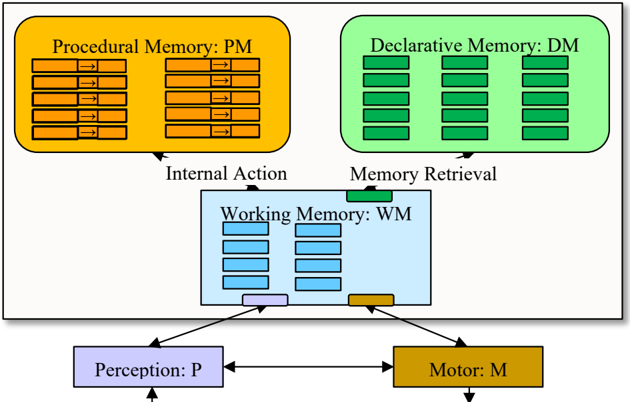
The image is a diagram illustrating the flow of information between different types of memory and processes within a cognitive system. It depicts the interaction between Perception, Motor functions, Working Memory, Procedural Memory, and Declarative Memory.
### Components/Axes
* **Procedural Memory: PM**: Located at the top-left, represented by an orange rounded rectangle. It contains two sets of five orange blocks, each with a right-pointing arrow inside.
* **Declarative Memory: DM**: Located at the top-right, represented by a green rounded rectangle. It contains two sets of five green blocks.
* **Working Memory: WM**: Located in the center, represented by a light blue rectangle. It contains two sets of four light blue blocks, one light purple block, and one light orange block.
* **Perception: P**: Located at the bottom-left, represented by a light blue rectangle.
* **Motor: M**: Located at the bottom-right, represented by an orange rectangle.
* **Internal Action**: Text label positioned between Procedural Memory and Working Memory.
* **Memory Retrieval**: Text label positioned between Declarative Memory and Working Memory.
* Arrows indicate the flow of information between the components.
### Detailed Analysis or ### Content Details
* **Procedural Memory (PM)**: Contains 10 blocks in total, arranged in two columns of 5. Each block has a small arrow pointing to the right.
* **Declarative Memory (DM)**: Contains 10 blocks in total, arranged in two columns of 5.
* **Working Memory (WM)**: Contains 8 light blue blocks, 1 light purple block, and 1 light orange block. These are arranged in a somewhat irregular pattern.
* **Perception (P)**: Has an arrow pointing into it from below, and arrows pointing to Working Memory and Motor.
* **Motor (M)**: Has an arrow pointing into it from Perception and Working Memory, and an arrow pointing out from below.
* **Internal Action**: An arrow points from Procedural Memory to Working Memory.
* **Memory Retrieval**: An arrow points from Declarative Memory to Working Memory.
### Key Observations
* The diagram emphasizes the central role of Working Memory in processing information from both Perception and long-term memory systems (Procedural and Declarative).
* There is a clear distinction between the types of memory represented by color and label.
* The arrows indicate the flow of information and the interactions between different components of the system.
### Interpretation
The diagram illustrates a simplified model of a cognitive architecture, likely intended to demonstrate how different memory systems and processes interact. Perception provides input to Working Memory, which can then interact with both Procedural and Declarative Memory to retrieve information. The Motor system receives input from both Perception and Working Memory to execute actions. The presence of both light purple and light orange blocks in the Working Memory suggests that it can hold information from different sources or in different formats. The diagram suggests a cyclical flow of information, where perception influences action, and action can, in turn, influence future perception and memory.