\n
## Diagram: Cognitive Architecture Model
### Overview
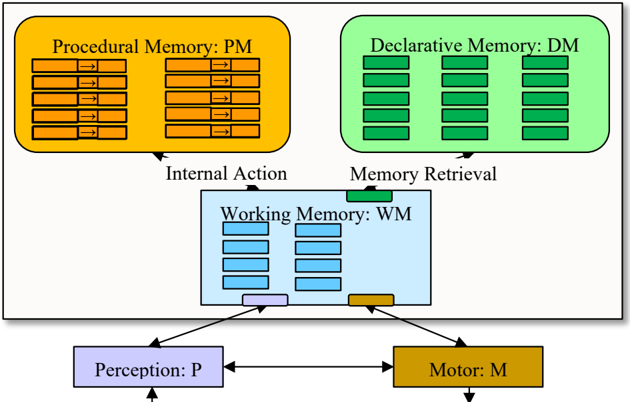
The image depicts a cognitive architecture model illustrating the interaction between different memory systems (Procedural, Declarative, and Working Memory) and cognitive processes (Perception and Motor). The diagram uses rectangular blocks to represent these components, with arrows indicating the flow of information between them. The entire diagram is contained within a larger light-yellow rectangle, suggesting a system boundary.
### Components/Axes
The diagram consists of the following components:
* **Procedural Memory (PM):** Represented by an orange block at the top-left. Contains multiple orange rectangles with arrows inside.
* **Declarative Memory (DM):** Represented by a green block at the top-right. Contains multiple green rectangles.
* **Working Memory (WM):** Represented by a light-blue block in the center. Contains multiple light-blue rectangles.
* **Perception (P):** Represented by a green block at the bottom-left.
* **Motor (M):** Represented by an orange block at the bottom-right.
The diagram also includes labels indicating the direction of information flow:
* "Internal Action" connecting Procedural Memory to Working Memory.
* "Memory Retrieval" connecting Declarative Memory to Working Memory.
### Detailed Analysis or Content Details
The diagram shows a flow of information as follows:
* **Procedural Memory (PM)**: Contains approximately 12 orange rectangles, each with a bidirectional arrow inside, suggesting a cyclical or iterative process.
* **Declarative Memory (DM)**: Contains approximately 15 green rectangles, suggesting stored facts or knowledge.
* **Working Memory (WM)**: Contains approximately 10 light-blue rectangles, representing active information being processed.
* **Perception (P)**: Receives input (indicated by an arrow) and sends output to Working Memory.
* **Motor (M)**: Receives output from Working Memory and executes actions.
The arrows indicate the following connections:
* Procedural Memory sends information to Working Memory via "Internal Action".
* Declarative Memory sends information to Working Memory via "Memory Retrieval".
* Working Memory receives input from Perception.
* Working Memory sends output to Motor.
* Perception sends information to Motor.
### Key Observations
The diagram highlights the interconnectedness of different memory systems and cognitive processes. Procedural and Declarative memory both feed into Working Memory, which then interacts with both Perception and Motor. The bidirectional arrows within Procedural Memory suggest a dynamic and iterative process. The diagram does not provide any quantitative data or specific values, but rather illustrates a conceptual model.
### Interpretation
This diagram represents a simplified model of human cognition, likely based on ACT-R or similar cognitive architectures. It suggests that cognitive processes are not isolated but rather interact in a complex network. Procedural memory, responsible for skills and habits, and declarative memory, responsible for facts and knowledge, both contribute to the information available in working memory. Working memory serves as a central hub for processing information from perception and generating actions through the motor system. The model emphasizes the role of working memory as a bottleneck for cognitive processing, as it receives input from multiple sources and directs output to multiple destinations. The arrows indicate a flow of activation or information, but the diagram does not specify the nature of this information or the mechanisms by which it is processed. The diagram is a high-level representation and does not delve into the neural or computational details of these processes.