## Diagram: Cognitive Architecture Model
### Overview
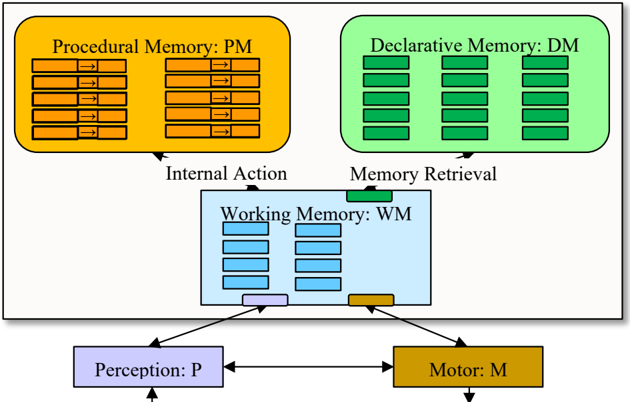
The diagram illustrates a cognitive architecture model depicting interactions between memory systems (Procedural, Declarative, Working), perception, and motor functions. It uses color-coded blocks and directional arrows to represent information flow and processing relationships.
### Components/Axes
1. **Procedural Memory (PM)**:
- Orange blocks with bidirectional arrows (→) indicating procedural knowledge storage/retrieval.
- Positioned in the top-left quadrant.
2. **Declarative Memory (DM)**:
- Green blocks with unidirectional arrows (→) suggesting sequential storage.
- Positioned in the top-right quadrant.
3. **Working Memory (WM)**:
- Blue blocks with unidirectional arrows (→) representing active processing.
- Positioned centrally, below PM and DM.
4. **Perception (P)**:
- Purple block labeled "Perception: P" at the bottom-left.
- Arrows point from P to WM, indicating sensory input processing.
5. **Motor (M)**:
- Brown block labeled "Motor: M" at the bottom-right.
- Arrows point from WM to M, indicating output execution.
6. **Key Processes**:
- **Internal Action**: Arrows from PM to WM (orange → blue).
- **Memory Retrieval**: Arrows from DM to WM (green → blue).
### Detailed Analysis
- **Memory Systems**:
- PM (orange) and DM (green) feed into WM (blue), suggesting integration of learned skills (procedural) and factual knowledge (declarative) into active processing.
- WM acts as a hub, receiving input from perception (P) and sending output to motor functions (M).
- **Flow Direction**:
- Perception (P) → WM → Motor (M) forms the primary input-output pathway.
- Internal Action (PM → WM) and Memory Retrieval (DM → WM) modulate WM activity.
- **Block Counts**:
- PM: 10 slots (5 rows × 2 columns).
- DM: 12 slots (6 rows × 2 columns).
- WM: 8 slots (4 rows × 2 columns).
### Key Observations
- **Hierarchical Structure**:
- PM and DM are positioned above WM, implying foundational roles in supporting active cognition.
- P and M are at the periphery, emphasizing their roles as input/output interfaces.
- **Color Coding**:
- Orange (PM), green (DM), and blue (WM) are distinct, avoiding ambiguity in component identification.
### Interpretation
This model represents a simplified cognitive architecture where:
1. **Perception** provides raw input to **Working Memory**, which integrates information from **Procedural Memory** (skills) and **Declarative Memory** (facts).
2. **Internal Action** (PM → WM) and **Memory Retrieval** (DM → WM) highlight dynamic interactions between long-term and short-term systems.
3. **Motor Output** (WM → M) executes actions based on processed information.
The diagram emphasizes modularity, with specialized memory systems contributing to adaptive behavior. The lack of numerical data suggests a conceptual rather than quantitative framework, focusing on functional relationships over measurable metrics.