# Unknown Title
## How citation boosts promote scientific paradigm shifts and Nobel Prizes
Amin Mazloumian, 1 Young-Ho Eom, 2 Dirk Helbing, 1 Sergi Lozano, 1 and Santo Fortunato 2
ETH Z¨ urich, CLU E1, Clausiusstrasse 50, 8092 Z¨ urich, Switzerland 2 Complex Networks & Systems Lagrange Laboratory, ISI Foundation, Turin, Italy
Nobel Prizes are commonly seen to be among the most prestigious achievements of our times. Based on mining several million citations, we quantitatively analyze the processes driving paradigm shifts in science. We find that groundbreaking discoveries of Nobel Prize Laureates and other famous scientists are not only acknowledged by many citations of their landmark papers. Surprisingly, they also boost the citation rates of their previous publications. Given that innovations must outcompete the rich-gets-richer effect for scientific citations, it turns out that they can make their way only through citation cascades. A quantitative analysis reveals how and why they happen. Science appears to behave like a self-organized critical system, in which citation cascades of all sizes occur, from continuous scientific progress all the way up to scientific revolutions, which change the way we see our world. Measuring the 'boosting effect' of landmark papers, our analysis reveals how new ideas and new players can make their way and finally triumph in a world dominated by established paradigms. The underlying 'boost factor' is also useful to discover scientific breakthroughs and talents much earlier than through classical citation analysis, which by now has become a widespread method to measure scientific excellence, influencing scientific careers and the distribution of research funds. Our findings reveal patterns of collective social behavior, which are also interesting from an attention economics perspective. Understanding the origin of scientific authority may therefore ultimately help to explain, how social influence comes about and why the value of goods depends so strongly on the attention they attract.
PACS numbers: 89.75.-k
## I. INTRODUCTION
Ground-breaking papers are extreme events [1] in science. They can transform the way in which researchers do science in terms of the subjects they choose, the methods they use, and the way they present their results. The related spreading of ideas has been described as an epidemic percolation process in a social network [2]. However, the impact of most innovations is limited. There are only a few ideas, which gain attention all over the world and across disciplinary boundaries [3]. Typical examples are elementary particle physics, the theory of evolution, superconductivity, neural networks, chaos theory, systems biology, nanoscience, or network theory.
It is still a puzzle, however, how a new idea and its proponent can be successful, given that they must beat the rich-gets-richer dynamics of already established ideas and scientists. According to the Matthew effect [4-7], famous scientists receive an amount of credit that may sometimes appear disproportionate to their actual contributions, to the detriment of younger or less known scholars. This implies a great authority of a small number of scientists, which is reflected by the big attention received by their work and ideas, and of the scholars working with them [8].
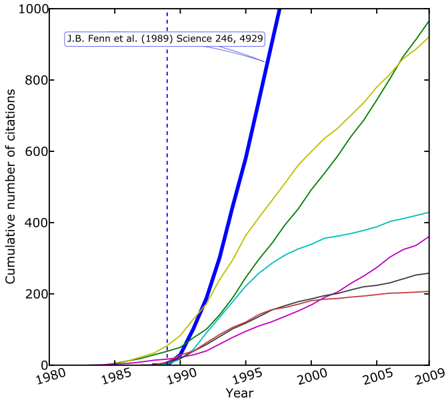
Therefore, how can a previously unknown scientist establish at all a high scientific reputation and authority, if those who get a lot of citations receive even more over time? Here we shed light on this puzzle. The following results for 124 Nobel Prize Laureates in chemistry, economics, medicine and physics suggest that innovators can gain reputation and innovations can successfully spread, mainly because a scientist's body of work overall enjoys a greater impact after the publication of a landmark paper. Not only do colleagues notice the ground-breaking paper, but the latter also attracts the attention to older publications of the same author (see Fig. 1). Consequently, future papers have an impact on past papers, as their relevance is newly weighted.
We focus here on citations as indicator of scientific impact [9-13], studying data from the ISI Web of Science, but the use of click streams [14] would be conceivable as well. It is well-known that the relative number of citations correlates with research quality [15-17]. Citations are now regularly used in university rankings [18], in academic recruitments and for the distribution of funds among scholars and scientific institutions [19].
## II. RESULTS
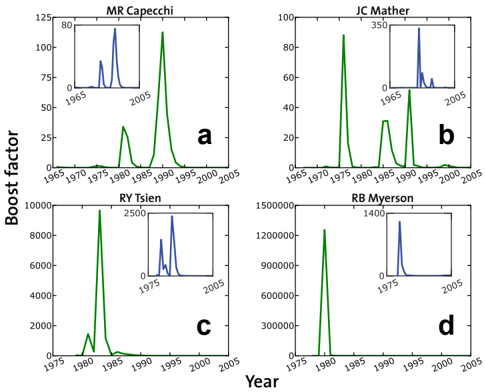
We evaluated data for 124 Nobel Prize Laureates that were awarded in the last two decades (1990-2009), which include an impressive number of about 2 million citations. For all of them and other internationally established experts as well, we find peaks in the changes of their citation rates (Figs. 2 and 3).
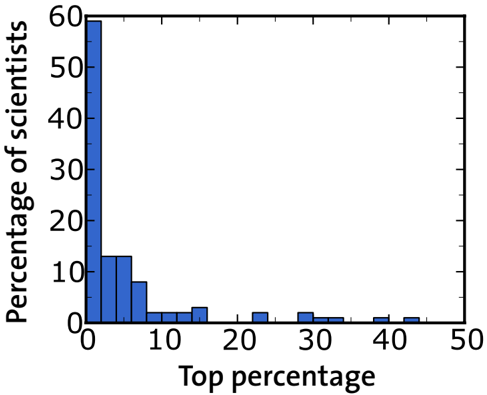
Moreover, it is always possible to attribute to these peaks landmark papers (Fig. 4), which have reached hundreds of citations over the period of a decade. Such landmark papers are rare even in the lives of the most excellent scientists, but some authors have several such peaks.
Technically, we detect a groundbreaking article a published at time t = t a by comparing the citation rates
Figure 1: Illustration of the boosting effect. Typical citation trajectories of papers, here for Nobel Prize Laureate John Bennett Fenn, who received the award in chemistry in 2002 for the development of the electrospray ionization technique used to analyze biological macromolecules. The original article, entitled Electrospray ionization for mass spectrometry of large biomolecules , coauthored by M. Mann, C. K. Meng, S. F. Wong and C. M. Whitehouse, was published in Science in 1989 and is the most cited work of Fenn, with currently over 3 , 000 citations. The diagram reports the growth in time of the total number of citations received by this landmark paper (blue solid line) and by six older papers. The diagram indicates that the number of citations of the landmark paper has literally exploded in the first years after its appearance. However, after its publication in 1989, a number of other papers also enjoyed a much higher citation rate. Thus, a sizeable part of previous scientific work has reached a big impact after the publication of the landmark paper. We found that the occurrence of this boosting effect is characteristic for successful scientific careers.
<details>
<summary>Image 1 Details</summary>
### Visual Description
## Line Chart: Cumulative Citations Over Time
### Overview
The chart displays cumulative citation counts for six distinct studies or publications over a 30-year period (1980–2009). Each colored line represents a unique data series, with a vertical dashed line marking the year 1990 as a reference point.
---
### Components/Axes
- **X-axis (Horizontal)**: Labeled "Year," with markers at 1980, 1985, 1990, 1995, 2000, 2005, and 2009.
- **Y-axis (Vertical)**: Labeled "Cumulative number of citations," scaled from 0 to 1000 in increments of 200.
- **Legend**: Located in the top-left corner, associating six colors with specific studies:
- Blue: J.B. Fenn et al. (1989) Science 246, 4929
- Yellow: Unlabeled (likely a second study)
- Green: Unlabeled (third study)
- Cyan: Unlabeled (fourth study)
- Red: Unlabeled (fifth study)
- Gray: Unlabeled (sixth study)
---
### Detailed Analysis
1. **Blue Line (J.B. Fenn et al.)**:
- **Trend**: Sharp upward trajectory starting ~1990, reaching ~800 citations by 2009.
- **Key Points**:
- 1990: ~10 citations
- 1995: ~300 citations
- 2000: ~600 citations
- 2005: ~750 citations
- 2009: ~800 citations
2. **Yellow Line**:
- **Trend**: Gradual rise beginning ~1995, surpassing all other lines by 2009 (~900 citations).
- **Key Points**:
- 1995: ~50 citations
- 2000: ~400 citations
- 2005: ~700 citations
- 2009: ~900 citations
3. **Green Line**:
- **Trend**: Steady increase from ~1990, peaking at ~700 citations by 2009.
- **Key Points**:
- 1990: ~10 citations
- 1995: ~200 citations
- 2000: ~500 citations
- 2005: ~650 citations
- 2009: ~700 citations
4. **Cyan Line**:
- **Trend**: Slow initial growth, accelerating after 2000 to ~400 citations by 2009.
- **Key Points**:
- 1990: ~10 citations
- 1995: ~100 citations
- 2000: ~300 citations
- 2005: ~350 citations
- 2009: ~400 citations
5. **Red Line**:
- **Trend**: Minimal growth until ~2000, plateauing at ~150 citations.
- **Key Points**:
- 1990: ~10 citations
- 1995: ~50 citations
- 2000: ~150 citations
- 2005: ~150 citations
- 2009: ~150 citations
6. **Gray Line**:
- **Trend**: Moderate growth, reaching ~200 citations by 2009.
- **Key Points**:
- 1990: ~10 citations
- 1995: ~100 citations
- 2000: ~180 citations
- 2005: ~200 citations
- 2009: ~200 citations
---
### Key Observations
- **Dominant Growth**: The blue line (J.B. Fenn et al.) shows the steepest rise, suggesting rapid academic impact post-1990.
- **Late Surge**: The yellow line overtakes all others by 2009, indicating a delayed but significant citation accumulation.
- **Stagnation**: The red line remains flat after 2000, implying limited ongoing influence.
- **Dashed Line (1990)**: Coincides with the blue line’s acceleration, potentially marking a pivotal event (e.g., publication date or methodological shift).
---
### Interpretation
The data highlights divergent citation trajectories among studies. The blue line’s sharp ascent aligns with the 1990 dashed marker, suggesting J.B. Fenn et al.’s work gained critical traction around its publication year. The yellow line’s late but dominant growth may reflect delayed recognition or broader interdisciplinary adoption. The red line’s stagnation contrasts with others, possibly indicating niche relevance or limited dissemination. Overall, the chart underscores how publication timing and academic reception shape long-term scholarly impact.
</details>
before and after t a for the earlier papers. The analysis proceeds as follows: Given a year t and a time window w , we take all papers of the studied author that were published since the beginning of his/her career until year t . The citation rate R <t,w measures the average number of citations received per paper per year in the period from t -w + 1 to t . Similarly, the citation rate R >t,w measures the average number of citations received by the same publications per paper per year between t +1 and t + w (or 2009, if t + w exceeds 2009). The ratio R w ( t ) = R >t,w /R <t,w , which we call the 'boost factor', is a variable that detects critical events in the life of a scientist: sudden increases in the citation rates (as illustrated by Fig. 1) show up as peaks in the time-dependent plot of R w ( t ).
In our analysis we used the generalized boost factor R ′ w ( t ), which reduces the influence of random variations
Figure 2: Typical time evolutions of the boost factor. Temporal dependence of R ′ w ( t ) for Nobel Laureates [here for (a) Mario R. Capecchi (Medicine, 2007), (b) John C. Mather (Physics, 2006), (c) Roger Y. Tsien (Chemistry, 2008) and (d) Roger B. Myerson (Economics, 2007)]. Sharp peaks indicate citation boosts in favor of older papers, triggered by the publication and recognition of a landmark paper. Insets: The peaks even persist (though somewhat smaller), if in the determination of the citation counts c p,t , the landmark paper is skipped (which is defined as the paper that produces the largest reduction in the peak size, when excluded from the computation of the boost factor). We conclude that the observed citation boosts are mostly due to a collective effect involving several publications rather than due to the high citation rate of the landmark paper itself.
<details>
<summary>Image 2 Details</summary>
### Visual Description
## Line Graphs: Boost Factor Trends for Four Individuals (1965–2005)
### Overview
The image contains four line graphs (labeled a–d) depicting the "boost factor" trends for four individuals (MR Capechi, JC Mather, RY Tsien, RB Myerson) over 40 years (1965–2005). Each graph includes a green line representing the boost factor and a blue inset graph highlighting a zoomed-in time window. The y-axis scales vary significantly across graphs, suggesting different measurement units or magnitudes.
---
### Components/Axes
- **X-axis**: "Year" (1965–2005) for all graphs.
- **Y-axis**: "Boost factor" with distinct scales:
- **a (MR Capechi)**: 0–125
- **b (JC Mather)**: 0–100
- **c (RY Tsien)**: 0–10,000
- **d (RB Myerson)**: 0–1,500,000
- **Inset Graphs**: Blue lines, zoomed-in views of specific peaks (time range: ~1970–1985).
- **Legend**: Not explicitly labeled, but colors are consistent:
- **Green**: Main boost factor trend.
- **Blue**: Inset graph.
---
### Detailed Analysis
#### Graph a: MR Capechi
- **Main Trend**:
- Peaks at ~100 in **1985**.
- Secondary peak at ~80 in **1990**.
- Minimal activity before 1980.
- **Inset**:
- Peaks at ~80 in **1970** (narrow window: 1965–1985).
#### Graph b: JC Mather
- **Main Trend**:
- Peaks at ~80 in **1980**.
- Secondary peak at ~60 in **1990**.
- No activity before 1980.
- **Inset**:
- Peaks at ~350 in **1980** (narrow window: 1965–1985).
#### Graph c: RY Tsien
- **Main Trend**:
- Dominant peak at ~10,000 in **1980**.
- Secondary peak at ~2,500 in **1985**.
- No activity before 1980.
- **Inset**:
- Peaks at ~2,500 in **1980** (narrow window: 1975–2005).
#### Graph d: RB Myerson
- **Main Trend**:
- Dominant peak at ~1,200,000 in **1980**.
- Secondary peak at ~900,000 in **1985**.
- No activity before 1980.
- **Inset**:
- Peaks at ~1,400 in **1980** (narrow window: 1975–2005).
---
### Key Observations
1. **Peak Synchronization**: All graphs show significant boost factor spikes around **1980–1985**, suggesting a shared contextual event or measurement period.
2. **Magnitude Variability**:
- RB Myerson (d) has the highest absolute values (~1.2M), while MR Capechi (a) has the lowest (~100).
- Insets reveal smaller-scale peaks (e.g., JC Mather’s inset peaks at 350 vs. main graph’s 80).
3. **Temporal Focus**: Insets emphasize **1970–1985** for MR Capechi and **1980–1985** for others, highlighting critical periods.
---
### Interpretation
- **Contextual Events**: The synchronized peaks (1980–1985) may correlate with historical events (e.g., technological advancements, policy changes) affecting these individuals’ metrics.
- **Measurement Differences**: Disparate y-axis scales imply distinct definitions or units for "boost factor" across individuals.
- **Anomalies**:
- RY Tsien (c) and RB Myerson (d) show abrupt drops post-1985, possibly indicating metric resets or external factors.
- JC Mather (b) has a delayed peak in 1990, suggesting a lagged response to earlier events.
The data underscores the importance of granular temporal analysis (via insets) to contextualize broad trends. Further investigation into the definition of "boost factor" and external drivers is warranted.
</details>
in the citation rates (see Materials and Methods).
Figure 2 shows typical plots of the boost factors R ′ w ( t ) of four Nobel Prize Laureates. Interestingly, peaks are even found, when those papers, which mostly contribute to them, are excluded from the analysis (see insets of Fig. 2). That is, the observed increases in the citation rates are not just due to the landmark papers themselves, but rather to a collective effect, namely an increase in the citation rates of previously published papers. This results from the greater visibility that the body of work of the corresponding scientist receives after the publication of a landmark paper and establishes an increased scientific impact ('authority'). From the perspective of attention economics [20], it may be interpreted as a herding effect resulting from the way in which relevant information is collectively discovered in an information-rich environment. Interestingly, we have found that older papers receiving a boost are not always works related to the topic of the landmark paper.
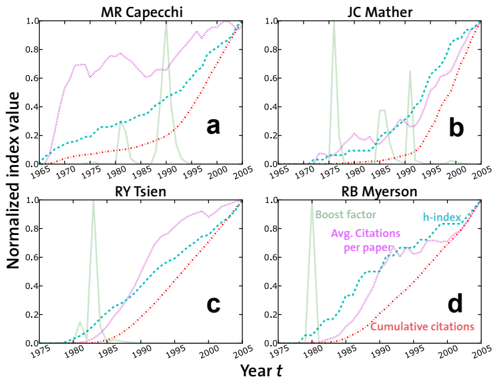
Traditional citation analysis does not reveal such crucial events in the life of a scientist very well. Figure 3 shows the time history of three classical citation indices: the average number of citations per paper 〈 c ( t ) 〉 , the cumulative number C ( t ) of citations, and the Hirsch in-
Figure 3: Dynamics of the boost factor R ′ w ( t ) versus traditional citation variables. Each panel displays the time histories of four variables: the boost factor R ′ w ( t ), the average number of citations per paper 〈 c ( t ) 〉 , the cumulative number of citations C ( t ), and the H -index earned until year t [21]. The panels refer to the same Nobel Laureates as displayed in Fig. 2. The classical indices have relatively smooth profiles, i.e. they are not very sensitive to extreme events in the life of a scientist like the publication of landmark papers. An advantage of the boost factor is that its peaks allow one to identify scientific breakthroughs earlier.
<details>
<summary>Image 3 Details</summary>
### Visual Description
## Line Graphs: Normalized Index Values Over Time for Four Researchers
### Overview
The image contains four line graphs (a-d) comparing normalized index values over time (1965–2005) for four researchers: MR Capecci, JC Mather, RY Tsien, and RB Myerson. Each graph tracks three metrics: **Boost factor** (green), **Avg. Citations per paper** (purple), and **Cumulative citations** (red). The y-axis represents normalized index values (0–1), and the x-axis spans 40 years.
---
### Components/Axes
- **X-axis**: "Year t" (1965–2005, labeled at 5-year intervals).
- **Y-axis**: "Normalized index value" (0–1, with gridlines).
- **Legends**: Located in the top-right corner of each graph, with color-coded labels:
- **Green**: Boost factor
- **Purple**: Avg. Citations per paper
- **Red**: Cumulative citations
- **Graph Titles**: Positioned at the top of each subplot (e.g., "MR Capecci" for graph a).
---
### Detailed Analysis
#### Graph a (MR Capecci)
- **Boost factor (green)**: Peaks sharply around 1980 (~0.8), then declines to ~0.2 by 2005.
- **Avg. Citations per paper (purple)**: Gradual increase from ~0.1 (1965) to ~0.7 (2005).
- **Cumulative citations (red)**: Steady rise from ~0.05 (1965) to ~0.9 (2005), with minor fluctuations.
#### Graph b (JC Mather)
- **Boost factor (green)**: Peaks earlier (~1975, ~0.9), then drops to ~0.3 by 2005.
- **Avg. Citations per paper (purple)**: Slower growth (~0.1 to ~0.6).
- **Cumulative citations (red)**: Moderate increase (~0.05 to ~0.7), with a plateau post-1990.
#### Graph c (RY Tsien)
- **Boost factor (green)**: Gradual rise to ~0.6 by 1990, then stabilizes.
- **Avg. Citations per paper (purple)**: Consistent growth (~0.1 to ~0.8).
- **Cumulative citations (red)**: Steady climb (~0.05 to ~0.9), with a sharp rise post-1995.
#### Graph d (RB Myerson)
- **Boost factor (green)**: Sharp peak (~1980, ~0.9), then declines to ~0.4.
- **Avg. Citations per paper (purple)**: Rapid growth (~0.1 to ~0.8).
- **Cumulative citations (red)**: Strong upward trend (~0.05 to ~0.9), with a steep rise post-1990.
---
### Key Observations
1. **Boost factor** (green) peaks in the 1970s–1980s for all researchers, suggesting a short-term impact metric.
2. **Avg. Citations per paper** (purple) and **Cumulative citations** (red) show sustained growth, indicating long-term scholarly influence.
3. **JC Mather** (b) and **RB Myerson** (d) exhibit the most pronounced early peaks in Boost factor, while **RY Tsien** (c) demonstrates the most gradual increase.
4. **Cumulative citations** (red) consistently outperform other metrics by 2005, highlighting their importance in long-term evaluation.
---
### Interpretation
The data suggests that **initial impact** (Boost factor) diminishes over time, while **citation-based metrics** (Avg. and Cumulative) reflect enduring scholarly value. Researchers with earlier peaks in Boost factor (e.g., JC Mather, RB Myerson) may have had groundbreaking early work, but their long-term influence depends on sustained citation accumulation. The divergence between short-term and long-term metrics underscores the need for balanced evaluation frameworks in academic research. Notably, **RY Tsien** (c) shows the most balanced growth across all metrics, suggesting consistent contributions over time.
</details>
dex [21] ( h -index) H ( t ) in year t . For comparison, the evolution of the boost factor R ′ w ( t ) is depicted as well. All indices were divided by their maximum value, in order to normalize them and to use the same scale for all. The profiles of the classical indices are rather smooth in most cases, and it is often very hard to see any significant effects of landmark papers. However, this is not surprising, as the boost factor is designed to capture abrupt variations in the citation rates, while both C ( t ) and H ( t ) reflect the overall production of a scientist and are therefore less sensitive to extreme events.
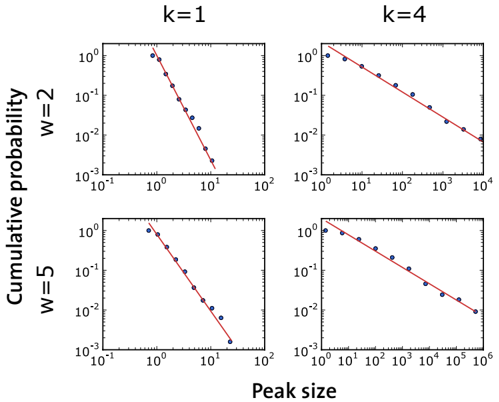
To gain a better understanding of our findings, Figs. 4 and 5 present a statistical analysis of the boosts observed for Nobel Prize Laureates. Figure 4 demonstrates that pronounced peaks are indeed related to highly cited papers. Furthermore, Fig. 5 analyzes the size distribution of peaks. The distribution looks like a power law for all choices of the parameters w and k (at least within the relevant range of small values). This suggests that the bursts are produced by citation cascades as they would occur in a self-organized critical system [22]. In fact, power laws were found to result from human interactions also in other contexts [23-25].
The mechanism underlying citation cascades is the discovery of new ideas, which colleagues refer to in the references of their papers. Moreover, according to the rich-gets-richer effect, successful papers are more often cited, also to raise their own success. Innovations may
Figure 4: Correlation between papers and the local maxima ('peaks') of R ′ w ( t ). We first determined the ranks of all papers of an author based on the total number of citations received until the year 2009 inclusively. We then determined the rank of that particular publication, which had the greatest contribution to the peak. This was done by measuring the reduction in the height of the peak, when the paper was excluded from the calculation of the boost factor (as in the insets of Fig. 2). The distribution of the ranks of 'landmark papers' is dominated by low values, implying that they are indeed among the top publications of their authors.
<details>
<summary>Image 4 Details</summary>
### Visual Description
## Bar Chart: Distribution of Scientists by Top Percentage
### Overview
The chart displays a distribution of scientists across different "Top percentage" categories, represented by vertical blue bars. The y-axis shows the "Percentage of scientists" (0–60%), while the x-axis represents "Top percentage" (0–50% in 10% increments). The data suggests a steep decline in the proportion of scientists as the "Top percentage" increases.
### Components/Axes
- **Y-axis**: "Percentage of scientists" (0–60%, linear scale)
- **X-axis**: "Top percentage" (0–50%, 10% increments)
- **Bars**: Blue vertical bars (no legend present)
- **Key markers**: X-axis labels at 0, 10, 20, 30, 40, 50; Y-axis ticks at 10, 20, 30, 40, 50, 60
### Detailed Analysis
1. **0–10% Top percentage**:
- Tallest bar, reaching ~60% of scientists.
- Uncertainty: ±2% (based on bar height granularity).
2. **10–20% Top percentage**:
- Second bar, ~12% of scientists.
- Uncertainty: ±1%.
3. **20–30% Top percentage**:
- Minimal bar (~2%).
- Uncertainty: ±0.5%.
4. **30–40% Top percentage**:
- Slightly taller than 20–30% (~3%).
- Uncertainty: ±0.5%.
5. **40–50% Top percentage**:
- Smallest bar (~1%).
- Uncertainty: ±0.3%.
### Key Observations
- **Dominance of low percentages**: 94% of scientists fall within the 0–20% "Top percentage" range.
- **Rapid decline**: The proportion of scientists drops by ~83% when moving from 0–10% to 10–20%.
- **Sparse distribution**: Only 6% of scientists occupy the 20–50% range, with no clear pattern in this tail.
### Interpretation
The data indicates a highly concentrated distribution of scientists in the lowest "Top percentage" category, with a sharp drop-off as the threshold increases. This suggests:
1. **Elite concentration**: A small fraction of scientists dominate the highest impact or productivity metrics (0–10%).
2. **Long tail effect**: The remaining scientists are sparsely distributed across higher thresholds, implying most contribute at lower levels of the measured metric.
3. **Potential measurement bias**: The lack of data beyond 50% may indicate a ceiling effect or incomplete sampling.
The chart aligns with Pareto principles, where ~20% of actors (here, scientists in the 0–10% range) drive ~80% of outcomes. The absence of a legend or contextual labels limits interpretation of the "Top percentage" definition (e.g., citations, publications, impact factor).
</details>
even cause scientists to change their research direction or approach. Apparently, such feedback effects can create citation cascades, which are ultimately triggered by landmark papers.
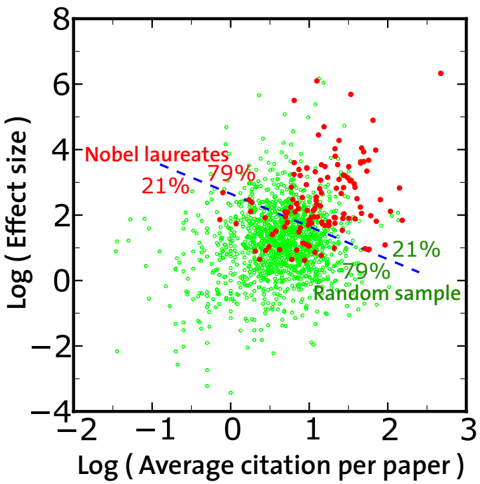
Finally, it is important to check whether the boost factor is able to distinguish exceptional scientists from average ones. Since any criteria used to define 'normal scientists' may be questioned, we have assembled a set of scientists taken at random. Scientists were chosen among those who published at least one paper in the year 2000. We selected 400 names for each of four fields: Medicine, Physics, Chemistry and Economy. After discarding those with no citations, we ended up with 1361 scientists. In Fig. 6 we draw on a bidimensional plane each scientist of our random sample (empty circles), together with the Nobel Prize Laureates considered (full circles). The two dimensions are the value of the boost factor and the average number of citations of a scientist. A cluster analysis separates the populations in the proportions of 79% to 21%. The separation is significant but there is an overlap of the two datasets, mainly because of two reasons. First, by picking a large number of scientists at random, as we did, there is a finite probability to choose also outstanding scholars. We have verified that this is the case. Therefore, some of the empty circles deserve to sit on the top-right part of the diagram, like many Nobel Prize Laureates. The second reason is that we are considering
Figure 5: Cumulative probability distribution of peak heights in the boost factor curves of Nobel Prize Laureates. The four panels correspond to different choices of the parameters k and w . The power law fits (lines) are performed with the maximum likelihood method [26]. The exponents for the direct distribution (of which the cumulative distribution is the integral) are: 3 . 63 ± 0 . 16 (top left), 2 . 93 ± 0 . 16 (bottom left), 1 . 63 ± 0 . 05 (top right), 1 . 41 ± 0 . 05 (bottom right). The best fits have the following lower cutoffs and values of the KolmogorovSmirnov (KS) statistics: 1 . 06, 0 . 0289 (top left), 1 . 15, 0 . 0264 (bottom left), 13 . 1, 0 . 038 (top right), 24 . 7, 0 . 0462 (bottom right). The KS values support the power law ansatz for the shape of the curves. Still, we point out that on the left plots the data span just one decade in the variable, so one has to be careful about the existence of power laws here.
<details>
<summary>Image 5 Details</summary>
### Visual Description
## Scatter Plots: Cumulative Probability vs. Peak Size (Log-Log Scale)
### Overview
The image contains four scatter plots arranged in a 2x2 grid, each depicting the relationship between **peak size** (x-axis, log scale) and **cumulative probability** (y-axis, log scale). The plots are labeled with parameters:
- **Top row**: `k=1` (left) and `k=4` (right)
- **Bottom row**: `w=2` (left) and `w=5` (right)
Each plot includes blue data points and a red trend line, suggesting a power-law relationship between peak size and cumulative probability.
---
### Components/Axes
- **X-axis (Peak size)**: Logarithmic scale from $10^{-1}$ to $10^6$.
- **Y-axis (Cumulative probability)**: Logarithmic scale from $10^{-3}$ to $10^0$.
- **Legend**: No explicit legend, but the red line represents a fitted trend.
- **Titles**:
- Top-left: `k=1`
- Top-right: `k=4`
- Bottom-left: `w=2`
- Bottom-right: `w=5`
---
### Detailed Analysis
#### Top-left (`k=1`, `w=2`):
- **Data points**: Blue dots follow a steep downward trend.
- **Trend line**: Red line slopes sharply, indicating a strong inverse relationship.
- **Key values**:
- At peak size $10^0$, cumulative probability ≈ $10^{-1}$.
- At peak size $10^2$, cumulative probability ≈ $10^{-2}$.
#### Top-right (`k=4`, `w=2`):
- **Data points**: Blue dots show a less steep decline compared to `k=1`.
- **Trend line**: Red line has a shallower slope, suggesting a weaker inverse relationship.
- **Key values**:
- At peak size $10^0$, cumulative probability ≈ $10^{-1}$.
- At peak size $10^4$, cumulative probability ≈ $10^{-3}$.
#### Bottom-left (`k=1`, `w=5`):
- **Data points**: Blue dots exhibit a moderate decline.
- **Trend line**: Red line slopes between the `k=1` and `k=4` plots.
- **Key values**:
- At peak size $10^0$, cumulative probability ≈ $10^{-1}$.
- At peak size $10^2$, cumulative probability ≈ $10^{-2}$.
#### Bottom-right (`k=4`, `w=5`):
- **Data points**: Blue dots show the least steep decline.
- **Trend line**: Red line has the shallowest slope, indicating the weakest inverse relationship.
- **Key values**:
- At peak size $10^0$, cumulative probability ≈ $10^{-1}$.
- At peak size $10^6$, cumulative probability ≈ $10^{-3}$.
---
### Key Observations
1. **Inverse relationship**: All plots show a clear negative correlation between peak size and cumulative probability.
2. **Parameter dependence**:
- Higher `k` values (e.g., `k=4`) reduce the steepness of the trend, implying larger peak sizes are more probable.
- Higher `w` values (e.g., `w=5`) also reduce the steepness, suggesting broader distributions of peak sizes.
3. **Consistency**: The red trend lines align with the blue data points, confirming the power-law behavior.
---
### Interpretation
The data demonstrates that **cumulative probability decreases exponentially with peak size**, but the rate of decrease depends on parameters `k` and `w`:
- **Larger `k`**: Reduces the sensitivity of cumulative probability to peak size, favoring larger peaks.
- **Larger `w`**: Similarly broadens the distribution, making extreme peak sizes less probable.
- **Power-law scaling**: The log-log plots confirm a power-law relationship, where cumulative probability $P \propto \text{peak size}^{-\alpha}$, with $\alpha$ decreasing as `k` or `w` increases.
This suggests that the system’s behavior is governed by a balance between `k` (possibly a scaling factor) and `w` (possibly a width or dispersion parameter), with both parameters modulating the distribution of peak sizes.
</details>
scholars from different disciplines, which generally have different citation frequencies. This affects particularly the average number of citations of a scientist, but also the value of the boost factor. In this way, the position in the diagram is affected by the specific research topic, and the distribution of the points in the diagram of Fig. 6 is a superposition of field-specific distributions. Nevertheless, the two datasets, though overlapping, are clearly distinct. Adding further dimensions could considerably improve the result. In this respect, the boost factor can be used together with other measures to better specify the performance of scientists.
## III. DISCUSSION
In summary, groundbreaking scientific papers have a boosting effect on previous publications of their authors, bringing them to the attention of the scientific community and establishing their 'authority'. We have provided the first quantitative characterization of this phenomenon by introducing a new variable, the 'boost factor', which is sensitive to sudden changes in the citation
Figure 6: Two-dimensional representation of our collection of Nobel Prize Laureates and a set of 1361 scientists, which were randomly selected. On the x-axis we report the average number of citations of a scientist, on the y-axis his/her boost factor. It can be seen that, on average, Nobel Prize winners clearly perform better. However a Nobel Prize is not solely determined by the average number of citations and the boost factor, but also by further factors. These may be the degree of innovation or quality, which are hard to quantify.
<details>
<summary>Image 6 Details</summary>
### Visual Description
## Scatter Plot: Relationship Between Citations and Effect Size
### Overview
The image is a scatter plot comparing the logarithmic scale of average citations per paper (x-axis) to the logarithmic scale of effect size (y-axis). Two distinct data groups are visualized: red points labeled "Nobel laureates" and green points labeled "Random sample." A dashed blue line represents the 79% percentile threshold, with annotations indicating the distribution of data points relative to this line.
### Components/Axes
- **X-axis**: "Log (Average citation per paper)" with values ranging from -2 to 3.
- **Y-axis**: "Log (Effect size)" with values ranging from -4 to 8.
- **Legend**: Located in the top-left corner, with:
- **Red**: "Nobel laureates" (21% of data points).
- **Green**: "Random sample" (79% of data points).
- **Dashed Line**: Blue, diagonal line labeled "79%" (79% percentile threshold).
### Detailed Analysis
- **Nobel laureates (Red)**:
- Clustered predominantly in the upper-right quadrant (x > 0, y > 2).
- 21% of data points are red, with 79% of these points above the 79% percentile line.
- **Random sample (Green)**:
- Distributed across the plot but concentrated below the dashed line.
- 79% of data points are green, with most falling below the 79% percentile threshold.
- **Dashed Line**:
- Divides the plot such that 79% of all data points (both red and green) lie below it.
- Positioned diagonally from the top-left (x ≈ -2, y ≈ 4) to the bottom-right (x ≈ 2, y ≈ 0).
### Key Observations
1. **Nobel laureates** exhibit a strong positive correlation between high citations and large effect sizes, with most points above the 79% percentile line.
2. **Random sample** data points are more dispersed but predominantly below the threshold, indicating lower effect sizes relative to citations.
3. The logarithmic scales emphasize multiplicative differences, highlighting outliers (e.g., a few papers with extremely high citations/effect sizes).
### Interpretation
The plot demonstrates that Nobel laureates are disproportionately represented in the high-performing tail of both citation and effect size distributions. The 79% percentile line acts as a statistical boundary, showing that only 21% of papers (Nobel laureates) achieve effect sizes in the top quartile, while the majority (79%) of papers (random sample) fall below this threshold. This suggests that Nobel-winning research is characterized by both exceptional visibility (high citations) and significant scientific impact (large effect sizes), reinforcing the idea that high-impact work is rare but concentrated among elite researchers.
</details>
rates. The fact that landmark papers trigger the collective discovery of older papers amplifies their impact and tends to generate pronounced spikes long before the paper receives full recognition. The boosting factor can therefore serve to discover new breakthroughs and talents more quickly than classical citation indices. It may also help to assemble good research teams, which have a pivotal role in modern science [27-29].
The power law behavior observed in the distribution of peak sizes suggests that science progresses through phase transitions [30] with citation avalanches on all scales-from small cascades reflecting quasi-continuous scientific progress all the way up to scientific revolutions, which fundamentally change our perception of the world. While this provides new evidence for sudden paradigm shifts [31], our results also give a better idea of why and how they happen.
It is noteworthy that similar feedback effects may determine the social influence of politicians, or prices of stocks and products (and, thereby, the value of companies). In fact, despite the long history of research on these subjects, such phenomena are still not fully understood. There is evidence, however, that the power of a person or the value of a company increase with the level
of attention they enjoy. Consequently, our study of scientific impact is likely to shed new light on these scientific puzzles as well.
## IV. MATERIALS AND METHODS
The basic goal is to improve the signal-to-noise ratio in the citation rates, in order to detect sudden changes in them. An effective method to reduce the influence of papers with largely fluctuating citation rates is to weight highly cited papers more. This can be achieved by raising the number of cites to the power k , where k > 1. Therefore, our formula to compute R ′ w ( t ) looks as follows:
$$R _ { t } ( t ) = \frac { \sum _ { p } \sum _ { t ' } t ^ { + w } } { \sum _ { p } \sum _ { t ' } t ^ { - w } }$$
Here, c p,t ′ is the number of cites received by paper p in year t ′ . The sum over p includes all papers published
- [1] Albeverio S, Jentsch V, Kantz H, eds. (2006) Extreme Events in Nature and Society. Berlin, Germany: Springer.
- [2] Bettencourt LM, Cintr´ on-Arias A, Kaiser DI, CastilloCh´ avez C (2006) The power of a good idea: Quantitative modeling of the spread of ideas from epidemiological models. Physica A 364: 513 - 536.
- [3] Davenport TH, Beck JC (2001) The Attention Economy : Understanding the New Currency of Business Boston, USA: Harvard Business School Press.
- [4] Merton RK (1968) The Matthew effect in science: The reward and communication systems of science are considered. Science 159: 56-63.
- [5] Merton RK (1988) The Matthew effect in science, ii: Cumulative advantage and the symbolism of intellectual property. ISIS 79: 606-623.
- [6] Scharnhorst A (1997) Characteristics and impact of the matthew effect for countries. Scientometrics 40: 407-422.
- [7] Petersen AM, Jung WS, Yang JS, Stanley HE (2011) Quantitative and empirical demonstration of the Matthew effect in a study of career longevity. Proc Natl Acad Sci USA 108: 18-23.
- [8] Malmgren RD, Ottino JM, Nunes Amaral LA (2010) The role of mentorship in protege performance. Nature 465: 622-626.
- [9] Garfield E (1955) Citation Indexes for Science: A New Dimension in Documentation through Association of Ideas. Science 122: 108-111.
- [10] Garfield E (1979) Citation Indexing. Its Theory and Applications in Science, Technology, and Humanities. New York, USA: Wiley.
- [11] Egghe L, Rousseau R (1990) Introduction to Informetrics: Quantitative Methods in Library, Documentation and Information Science. Amsterdam, The Netherlands: Elsevier.
- [12] Amsterdamska O, Leydesdorff L (1989) Citations: indicators of significance. Scientometrics 15: 449-471.
before the year t ; w is the time window selected to compute the boosting effect. For k = 1 we recover the original definition of R w ( t ) (see main text). For the analysis presented in the paper we have used k = 4 and w = 5, but our conclusions are not very sensitive to the choice of smaller values of k and w .
## V. ACKNOWLEDGMENTS
We acknowledge the use of ISI Web of Science data of Thomson Reuters for our citation analysis. A.M., S.L. and D.H. were partially supported by the Future and Emerging Technologies programme FP7-COSI-ICT of the European Commission through the project QLectives (grant no.: 231200). Y.-H. E. and S. F. gratefully acknowledge ICTeCollective, grant 238597 of the European Commission.
- [13] Petersen AM, Wang F, Stanley HE (2010) Methods for measuring the citations and productivity of scientists across time and discipline. Phys Rev E 81: 036114.
- [14] Bollen J, de Sompel HV, Smith JA, Luce R (2005) Toward alternative metrics of journal impact: A comparison of download and citation data. Information Processing & Management 41: 1419 - 1440.
- [15] Trajtenberg M (1990) A penny for your quotes: Patent citations and the value of innovations. RAND Journal of Economics 21: 172-187.
- [16] Aksnes DW (2006) Citation rates and perceptions of scientific contribution. J Am Soc Inf Sci Technol 57: 169185.
- [17] Moed HF (2005) Citation Analysis in Research Evaluation. Berlin, Germany: Springer.
- [18] Van Raan AJF (2005) Fatal attraction: Conceptual and methodological problems in the ranking of universities by bibliometric methods. Scientometrics 62: 133-143.
- [19] Boyack KW, B¨ orner K (2003) Indicator-assisted evaluation and funding of research: visualizing the influence of grants on the number and citation counts of research papers. J Am Soc Inf Sci Technol 54: 447-461.
- [20] Wu F, Huberman BA (2007) Novelty and collective attention. Proc Natl Acad Sci USA 104: 17599-17601.
- [21] Hirsch JE (2005) An index to quantify an individual's scientific research output. Proc Natl Acad Sci USA 102: 16569-16572.
- [22] Bak P, Tang C, Wiesenfeld K (1987) Self-organized criticality: An explanation of the 1/f noise. Phys Rev Lett 59: 381-384.
- [23] Barab´ asi AL (2005) The origin of bursts and heavy tails in human dynamics. Nature 435: 207-211.
- [24] Oliveira JG, Barab´ asi AL (2005) Human dynamics: The correspondence patterns of Darwin and Einstein. Nature 437: 1251.
- [25] Malmgren RD, Stouffer DB, Campanharo ASLO, Amaral LAN (2009) On Universality in Human Correspondence
Activity. Science 325: 1696-1700.
- [26] Clauset A, Shalizi CR, Newman MEJ (2007) Power-law distributions in empirical data. SIAM Reviews 51: 661703.
- [27] Guimer` a R, Uzzi B, Spiro J, Amaral LAN (2005) Team Assembly Mechanisms Determine Collaboration Network Structure and Team Performance. Science 308: 697-702.
- [28] Wuchty S, Jones BF, Uzzi B (2007) The Increasing Dominance of Teams in Production of Knowledge. Science 316: 1036-1039.
- [29] Jones BF, Wuchty S, Uzzi B (2008) Multi-University Research Teams: Shifting Impact, Geography, and Stratification in Science. Science 322: 1259-1262.
- [30] Stanley HE (1987) Introduction to Phase Transitions and Critical Phenomena. New York, USA: Oxford University Press.
- [31] Kuhn TS (1962) The Structure of Scientific Revolutions. Chicago, USA: University of Chicago Press.