# Binaural coherent-to-diffuse-ratio estimation for dereverberation using an ITD model
**Authors**: Chengshi Zheng, Andreas Schwarz, Walter Kellermann, Xiaodong Li
∗
## BINAURAL COHERENT-TO-DIFFUSE-RATIO ESTIMATION FOR DEREVERBERATION USING AN ITD MODEL
Chengshi Zheng ∗† , Andreas Schwarz † , Walter Kellermann † , Xiaodong Li ∗
Communication Acoustics Laboratory Institute of Acoustics, CAS 100190 Beijing, China
† Chair of Multimedia Communications and Signal Processing Friedrich-Alexander-Universit¨ at Erlangen-N¨ urnberg 91058 Erlangen, Germany
## ABSTRACT
Most previously proposed dual-channel coherent-to-diffuseratio (CDR) estimators are based on a free-field model. When used for binaural signals, e.g., for dereverberation in binaural hearing aids, their performance may degrade due to the influence of the head, even when the direction-of-arrival of the desired speaker is exactly known. In this paper, the head shadowing effect is taken into account for CDR estimation by using a simplified model for the frequency-dependent interaural time difference and a model for the binaural coherence of the diffuse noise field. Evaluation of CDR-based dereverberation with measured binaural impulse responses indicates that the proposed binaural CDR estimators can improve PESQ scores.
Index Terms -Binaural speech dereverberation, interaural time difference, coherent-to-diffuse-ratio
Recently, coherent-to-diffuse-ratio (CDR) estimators have been proposed, which can be seen as an alternative formulation of coherence-based dereverberation approaches [12]. In [6], the assumption was made that binaural signals are time-aligned before calculating the spectral weights of the Wiener filter. In [11], two CDR estimators were proposed, where one requires knowledge on both the direction of arrival (DOA) of the desired speaker and the spatial coherence of the late reverberant speech, and the other does not need the DOA information. In [12], Schwarz and Kellermann proposed improved estimators both for the case of known and unknown DOA, which were shown to lead to improved dereverberation performance (see [12, Table III] for details). To the best of our knowledge, these CDR estimators have not been applied to binaural dereverberation and their performance has not been reported until now.
## 1. INTRODUCTION
Both speech quality and speech intelligibility may dramatically degrade in reverberant and noisy environments. Many different algorithms were proposed to suppress noise and the reverberation during the past decades (see [1-3] and references therein). This paper focuses on binaural speech dereverberation, where the binaural signals are recorded with two microphones located at two human ears.
Previous studies have already shown that it is important to preserve both the interaural time difference (ITD) and the interaural level difference (ILD) cues when applying binaural dereverberation methods for hearing aids [4-9], since, when binaural cues are distorted, localization of sound sources becomes difficult [10]. This condition is ensured by a twochannel postfiltering approach where the same gain is applied to both channels [6]. In [6], Jeub et al. took the shadowing effect of the head into account in the diffuse sound field model. In [8, 9], interaural coherence histograms were mapped to a gain function to suppress the reverberant components in each frequency channel.
This work was supported by the National Science Fund of China (NSFC) under Grants 61201403 and 61302126.
After briefly reviewing CDR estimators for free-field conditions, i.e., for a sound field with no obstructions close to the microphones, we describe models for the ITD and the coherence of diffuse noise under the influence of the head in a binaural scenario, and show that the direction-dependent CDR estimators based on a free-field assumption are not robust under this model. We propose to modify the CDR estimators to use binaural models. Experimental results confirm that the proposed estimators achieve higher PESQ scores than the free-field estimators when applied to coherence-based dereverberation. The proposed binaural CDR estimators have numerous applications, such as binaural hearing aids, robotics, or immersive audio communication systems.
## 2. FREE-FIELD SIGNAL MODEL AND CDR ESTIMATION
We model two reverberant and noisy microphone signals x i ( t ) , i = 1 , 2 , as the sum of a desired speech component x i, coh ( t ) and an undesired component x i, diff ( t ) consisting of diffuse reverberation and/or noise:
<!-- formula-not-decoded -->
As in previous studies, we assume both microphones to be omnidirectional and the desired component to be a plane wave in the free (locally unobstructed) field, so that x 2 , coh ( t ) is a time-shifted version of x 1 , coh ( t ) [6, 11, 12]:
<!-- formula-not-decoded -->
where τ 12 is the time difference of arrival (TDOA) of the desired sound between the first and the second microphone. The free-field model for the spatial coherence between the desired speech component at both microphones, x 1 , coh ( t ) and x 2 , coh ( t ) , is given by
<!-- formula-not-decoded -->
If θ = 0 ◦ corresponds to broadside direction, the TDOA in the free field can be expressed as
<!-- formula-not-decoded -->
where d is the distance of the two microphones and c is the speed of sound.
The spatial coherence between the reverberation/noise components x 1 , diff ( t ) and x 2 , diff ( t ) is given by the spatial coherence function of two omnidirectional sensors in a diffuse (spherically isotropic), locally unobstructed sound field:
<!-- formula-not-decoded -->
where f is the frequency in Hz. For the cylindrically isotropic field, the spatial coherence can be given by
<!-- formula-not-decoded -->
Generally, (5) often fits better than (6) in practical applications [12], therefore we use Γ FF diff ( f ) in this paper, although Γ FF 2D -iso ( f ) may be applied analogously.
The CDR at the i -th microphone can be given by
<!-- formula-not-decoded -->
where Φ i, coh ( k, f ) and Φ i, diff ( k, f ) are the short-time power spectra of x i, coh ( t ) and x i, diff ( t ) , respectively, with the frame index k and frequency f (we will omit both k and f in the following for brevity). We further assume that the power spectra are identical at the two microphones for both the desired and undesired component, i.e., Φ coh = Φ 1 , coh = Φ 2 , coh and Φ diff = Φ 1 , diff = Φ 2 , diff , and therefore
<!-- formula-not-decoded -->
Using the models for the coherence of the desired and diffuse signal components given above, and a short-time estimate of the coherence between x 1 ( t ) and x 2 ( t ) , which is in the following denoted as ˆ Γ x ( k, f ) and which may be obtained by recursive averaging, it is possible to estimate the time- and frequency-dependent CDR, as described in detail in [12]. The CDRestimators which are evaluated in this paper are summarized in Table 1.
Table 1 : Summary of CDR estimators evaluated in this paper. Γ coh and Γ diff indicate the model coherence functions used for desired signal and diffuse noise, respectively, ˆ Γ x indicates the estimated coherence of the mixed sound field. {·} extracts the real part of a complex value and ∗ denotes the complex conjugate.
| Estimator | Direction-dependent |
|-----------------------------|-----------------------------------------------------------------------------------------------------------------------------------------------------------------------------------------------|
| ˜ η Schwarz1 ˜ η Schwarz2 | { Γ ∗ coh ( Γ diff - ˆ Γ x )}/( { Γ ∗ coh ˆ Γ x } - 1 ) ∣ ∣ ∣ Γ ∗ coh ( Γ diff - ˆ Γ x )/( { Γ ∗ coh ˆ Γ x } - 1 )∣ ∣ ∣ Direction-independent |
| Estimator | {( Γ diff - ˆ Γ x )/( ˆ Γ x - exp ( j ˆ Γ x ))} [12, (25)] |
| ˜ η Thiergart2 ˜ η Schwarz3 | |
## 3. BINAURAL SIGNAL MODEL
When the two microphones are placed at the two ears, the ITD is the propagation delay of the desired sound from the left ear to the right ear and the ILD measures the power level difference between the two microphones. Both the ITD and the ILD have already been widely studied, and various models can be found in [13, 14] and references therein. As in [6], the impact of the ILD is neglected in the following, i.e., we maintain the assumption of equal power at both microphones. Based on this assumption, both the CDRs and the postfilter gain functions are the same at the two microphones placed at the two ears.
In this section, we first describe a simplified model for the frequency-dependent ITD and use it to derive a coherence model for the desired signal component. Then, we describe appropriate models for the diffuse sound field coherence which account for the effect of the head. Finally, we describe the application of these models for binaural CDR estimation and compare the robustness of CDR estimators based on the free-field model to the binaural CDR estimators.
## 3.1. ITD and Desired Signal Coherence Model
Previous studies have shown that, unlike the TDOA in the free-field case given by (4), the ITD is highly dependent on the frequency, the azimuth angle, the elevation angle and the distance of the desired speaker from the head [14-16]. Here, we use a simplified ITD model to make it applicable for practical application to binaural dereverberation. We assume that the distance of the desired speaker from the head is larger than 1m, and thus does not have a significant effect on the ITD [15, Fig. 9]. Furthermore, we neglect separate consideration of elevation and azimuth angles, and instead model the ITD as a function of the angle θ , which we define as the angle between the direction of the desired speaker and the forward median plane of the head. According to the head-related spherical coordinate system [15, Fig. 7], θ = 0 and θ = ± π correspond to the forward and the backward median planes of the head, respectively.
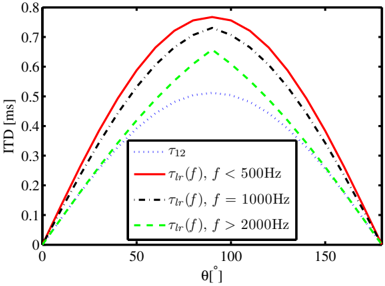
Fig. 1 : Comparison of τ 12 and τ lr ( f ) versus the angle of the desired sound for different frequencies.
<details>
<summary>Image 1 Details</summary>
### Visual Description
## Chart: Interaural Time Difference (ITD) vs. Angle
### Overview
The image is a 2D plot showing the relationship between the Interaural Time Difference (ITD) in milliseconds (ms) and the angle θ in degrees. There are four data series plotted, each representing a different condition or model. The plot shows how ITD varies with angle for different frequency ranges and a reference model.
### Components/Axes
* **X-axis:** Angle θ, labeled "θ [°]". The scale ranges from 0 to 180 degrees, with tick marks at 0, 50, 100, and 150 degrees.
* **Y-axis:** Interaural Time Difference (ITD), labeled "ITD [ms]". The scale ranges from 0 to 0.8 ms, with tick marks at 0, 0.1, 0.2, 0.3, 0.4, 0.5, 0.6, 0.7, and 0.8 ms.
* **Legend:** Located in the center-right of the plot, enclosed in a box. The legend identifies the four data series:
* τ₁₂ (dotted blue line)
* τlr(f), f < 500Hz (solid red line)
* τlr(f), f = 1000Hz (dashed black line)
* τlr(f), f > 2000Hz (dashed green line)
### Detailed Analysis
* **τ₁₂ (dotted blue line):** This line represents a reference model. It starts at 0 ms at 0 degrees, increases to a peak of approximately 0.5 ms around 90 degrees, and then decreases back to 0 ms at 180 degrees.
* **τlr(f), f < 500Hz (solid red line):** This line represents the ITD for frequencies less than 500 Hz. It starts at 0 ms at 0 degrees, increases to a peak of approximately 0.77 ms around 90 degrees, and then decreases back to 0 ms at 180 degrees.
* **τlr(f), f = 1000Hz (dashed black line):** This line represents the ITD for a frequency of 1000 Hz. It starts at 0 ms at 0 degrees, increases to a peak of approximately 0.72 ms around 90 degrees, and then decreases back to 0 ms at 180 degrees.
* **τlr(f), f > 2000Hz (dashed green line):** This line represents the ITD for frequencies greater than 2000 Hz. It starts at 0 ms at 0 degrees, increases to a peak of approximately 0.65 ms around 90 degrees, and then decreases back to 0 ms at 180 degrees.
All lines start at (0,0) and end at (180,0).
### Key Observations
* All four data series exhibit a symmetrical, bell-shaped curve, peaking around 90 degrees.
* The ITD values are highest for lower frequencies (f < 500Hz) and decrease as the frequency increases.
* The reference model (τ₁₂) has the lowest ITD values compared to the other three series.
### Interpretation
The plot illustrates how the Interaural Time Difference (ITD) varies with the angle of sound incidence for different frequency ranges. The ITD is a crucial cue for sound localization, particularly at lower frequencies. The data suggests that:
* Lower frequencies (below 500 Hz) result in larger ITDs, which could contribute to more accurate sound localization at these frequencies.
* As frequency increases, the ITD decreases, potentially making sound localization less precise at higher frequencies based on ITD alone. Other cues, such as Interaural Level Difference (ILD), become more important at higher frequencies.
* The reference model (τ₁₂) consistently underestimates the ITD compared to the other models, suggesting it may not accurately capture the ITD across all frequency ranges.
</details>
Kuhn has shown that the ITD is frequency-dependent [16], which can be approximately summarized as
<!-- formula-not-decoded -->
and, for f ≥ f H = 2000 ,
<!-- formula-not-decoded -->
where (9) and (10) are identical to [16, (7) and (12)], respectively. However, for the middle frequency range, there is not an explicit expression. We propose to use a linear interpolation to model the ITD in the middle frequency range, which agrees well with the measurement results [16] and is given by
<!-- formula-not-decoded -->
where f = f Mid ∈ [500 2000] Hz.
Compared to τ 12 , the ITD τ lr ( f ) is not only a function of the DOA but also of the frequency. τ 12 and τ lr ( f ) versus θ are plotted in Fig. 1 for different frequencies. Fig. 1 shows that the difference between | τ lr ( f ) | and | τ 12 | is largest for f ≤ 500 Hz. For f > 2000 Hz, τ lr ( f ) is close to τ 12 when | θ | or | π ± θ | is smaller than π/ 4 , while | τ lr ( f ) | is much larger than | τ 12 | for | θ | close to π/ 2 .
Without the shadowing effect of the head, the free-field coherence model of the desired signal is given by (3). Based on the frequency-dependent ITD model which accounts for the head effect, we can now define the coherence of the desired component for the binaural case as:
<!-- formula-not-decoded -->
## 3.2. Diffuse Noise Coherence Model
The shadowing effect of the head also has an impact on the spatial coherence of the two microphone signals in a diffuse
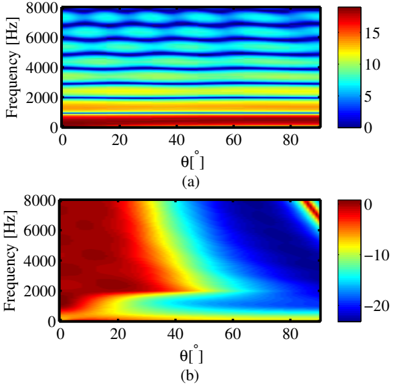
Fig. 2 : CDR estimation error of the free-field estimator, ∆ , versus f and θ for (a) the input CDR η in = -20 dB, (b) the input CDR η in = 20 dB.
<details>
<summary>Image 2 Details</summary>
### Visual Description
## Heatmaps: Frequency vs. Angle
### Overview
The image contains two heatmaps, (a) and (b), both displaying the relationship between frequency (0-8000 Hz) and angle θ (0-90 degrees). The heatmaps use color to represent a third, unspecified variable. Heatmap (a) uses a color scale from 0 to 15, while heatmap (b) uses a color scale from -20 to 10.
### Components/Axes
**Heatmap (a):**
* **X-axis:** Angle θ in degrees, ranging from 0 to 90 degrees. Axis markers are present at 0, 20, 40, 60, and 80 degrees.
* **Y-axis:** Frequency in Hz, ranging from 0 to 8000 Hz. Axis markers are present at 0, 2000, 4000, 6000, and 8000 Hz.
* **Colorbar:** Located on the right side of the heatmap, ranging from 0 (dark blue) to 15 (dark red).
* **Title:** (a)
**Heatmap (b):**
* **X-axis:** Angle θ in degrees, ranging from 0 to 90 degrees. Axis markers are present at 0, 20, 40, 60, and 80 degrees.
* **Y-axis:** Frequency in Hz, ranging from 0 to 8000 Hz. Axis markers are present at 0, 2000, 4000, 6000, and 8000 Hz.
* **Colorbar:** Located on the right side of the heatmap, ranging from -20 (dark blue) to 10 (dark red).
* **Title:** (b)
### Detailed Analysis
**Heatmap (a):**
* **Trend:** At lower frequencies (below approximately 1000 Hz), the color is consistently red, indicating a high value (close to 15) across all angles. Above 2000 Hz, the heatmap shows a series of alternating bands of higher and lower values, creating a wavy pattern. The bands are roughly horizontal, indicating that the frequency is the primary determinant of the value, with angle having a modulating effect.
* **Specific Values:**
* Frequency 0-1000 Hz: Value ~15 across all angles.
* Frequency 2000 Hz: Value oscillates between ~5 and ~10 as angle changes.
* Frequency 4000 Hz: Value oscillates between ~5 and ~10 as angle changes.
* Frequency 6000 Hz: Value oscillates between ~5 and ~10 as angle changes.
* Frequency 8000 Hz: Value oscillates between ~5 and ~10 as angle changes.
**Heatmap (b):**
* **Trend:** At lower frequencies (below approximately 2000 Hz), the color transitions from red (high value) at low angles to blue (low value) at higher angles. Above 2000 Hz, the heatmap shows a more complex pattern, with a region of high values (red/yellow) extending from low angles to higher frequencies, and a region of low values (blue) at higher angles and frequencies.
* **Specific Values:**
* Frequency 0-1000 Hz: Value transitions from ~10 at 0 degrees to ~-20 at 90 degrees.
* Frequency 2000 Hz: Value transitions from ~0 at 0 degrees to ~-20 at 90 degrees.
* Frequency 4000 Hz: Value transitions from ~5 at 20 degrees to ~-10 at 90 degrees.
* Frequency 6000 Hz: Value transitions from ~0 at 20 degrees to ~-5 at 90 degrees.
* Frequency 8000 Hz: Value transitions from ~-5 at 20 degrees to ~-5 at 90 degrees.
### Key Observations
* Heatmap (a) shows a relatively consistent high value at low frequencies, with oscillating patterns at higher frequencies.
* Heatmap (b) shows a more complex relationship between frequency, angle, and value, with a clear transition from high to low values as angle increases, particularly at lower frequencies.
### Interpretation
The heatmaps likely represent the magnitude of some physical quantity (e.g., sound pressure level, signal strength) as a function of frequency and angle. Heatmap (a) suggests that the quantity is strong at low frequencies, with some interference patterns at higher frequencies. Heatmap (b) suggests that the quantity is strongly dependent on angle, particularly at lower frequencies, possibly indicating directionality or attenuation effects. The specific nature of the quantity and the physical setup would be needed to provide a more detailed interpretation.
</details>
sound field. Both theoretical results and experimental results can be found in [17, 18]. Here we use the analytic representation of the binaural correlation function proposed by Lindevald and Benade [17], given by
<!-- formula-not-decoded -->
where α = 2 . 2 and β = 0 . 5 .
The binaural CDR estimators are now obtained by inserting the binaural coherence models Γ Binaural coh and Γ Binaural diff into the estimators given in Table 1. This extension makes the direction-dependent CDR estimators suitable for binaural dereverberation. The corresponding estimators are denoted as ˜ η Binaural · in the following, where · represents the name of the technique that is being used.
## 3.3. Robustness of the Free-Field Estimators in the Binaural Scenario
This part evaluates the robustness of the direction-dependent CDR estimators using the free-field model against the shadowing effect of the head. For the limited space of this paper, only ˜ η Binaural Schwarz2 is chosen to compare with ˜ η FF Schwarz2 , since a previous study [12] has already shown that ˜ η FF Schwarz2 has the best performance among the direction-dependent CDR estimators in Table 1 (see [12, Table III] for details). For the comparison, we generate values of the mixture coherence ˆ Γ x for a certain input CDR η in and different angles and frequencies according to the binaural coherence models defined above, and insert these coherence values into the free-field estimator. We then define the estimation error of the free-field CDR
Table 2 : PESQ scores averaged over all angles for CDR estimators in Table 1, using free-field ( ˜ η FF · ) or binaural coherence models ( ˜ η Binaural · ).
| AIR | Unprocessed | Direction-dependent | Direction-dependent | Direction-dependent | Direction-dependent | Direction-independent | Direction-independent | Direction-independent | Direction-independent |
|----------|---------------|-----------------------|-----------------------|-----------------------|-----------------------|-------------------------|-------------------------|-------------------------|-------------------------|
| Distance | Left/Right | ˜ η FF Schwarz1 | ˜ η Binaural Schwarz1 | ˜ η FF Schwarz2 | ˜ η Binaural Schwarz2 | ˜ η FF Thiergart2 | ˜ η Binaural Thiergart2 | ˜ η FF Schwarz3 | ˜ η Binaural Schwarz3 |
| 1m | 2.24/2.25 | 2.40/2.41 | 2.65/2.68 | 2.57/2.59 | 2.69/2.71 | 2.66/2.67 | 2.64/2.65 | 2.65/2.67 | 2.64/2.65 |
| 2m | 1.88/1.90 | 2.00/2.00 | 2.12/2.13 | 2.10/2.10 | 2.17/2.18 | 2.16/2.17 | 2.15/2.15 | 2.16/2.17 | 2.15/2.16 |
| 3m | 1.77/1.77 | 1.85/1.84 | 1.91/1.90 | 1.92/1.91 | 1.97/1.96 | 1.95/1.95 | 1.95/1.95 | 1.96/1.96 | 1.95/1.95 |
estimator compared to the true CDR η in as
<!-- formula-not-decoded -->
Fig. 2 plots ∆ versus f and θ for the true input CDR η in = -20 dB (a) and η in = 20 dB (b). Only θ ∈ [0 π/ 2] is considered due to the symmetry of the scenario. Fig. 2 shows that the CDR is somewhat overestimated for low input CDR, while for high input CDR, the CDR is seriously underestimated for angles larger than 45 ◦ . The influence of the head on the coherence, especially the one of the desired speech component Γ Binaural coh ( f ) , is significant enough to deteriorate the performance of the free-field CDR estimator considerably.
## 4. EVALUATION
This section evaluates the application of the CDR estimators in Table 1 with the free-field and binaural coherence models to the problem of dereverberation. We use the Aachen Impulse Response (AIR) database [19], which consists of binaural RIRs measured by a dummy head with azimuth angles from -90 ◦ to 90 ◦ with 15 ◦ increments and source-head distances from 1 m to 3 m with 1 m increments.
Ten clean speech samples (five female and five male speakers) are taken from the TIMIT database [20]. The reverberant speech samples are generated by convolving the clean speech with the 'stairway' RIRs from the AIR database. We use the same filterbank, postfilter gain function and parameters as in [12, (29)], with the CDR estimators in Table 1. Knowledge of the true DOA is assumed for computation of the desired signal coherence models. The gain function is applied to the two microphone signals separately. PESQ is chosen as evaluation measure since it was found to be highly correlated with speech quality for the evaluation of noise and reverberation suppression methods [21, 22]. Here, we give raw MOS scores obtained by wideband PESQ. The PESQ scores of the two microphone signals and those of the processed signals are given separately. Note that the average PESQ scores for both ears are very similar, due to the symmetry of the scenario. The experimental results for the different distances are presented in Table 2. From these results, we can make the following observations:
- (1) Using the ITD and binaural diffuse coherence model can improve all of the direction-dependent CDR estimators.
- (2) The direction-independent CDR estimators, which do not rely on a model of the desired signal coherence, are robust
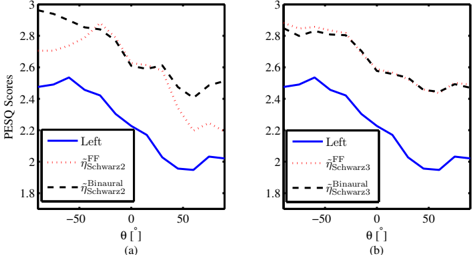
Fig. 3 : PESQ scores versus DOA for the 1 m distance case: (a) direction-dependent CDR estimators; (b) direction-independent CDR estimators. Left represents the unprocessed signal recorded by the microphone located at the left ear.
<details>
<summary>Image 3 Details</summary>
### Visual Description
## Chart: PESQ Scores vs. Theta
### Overview
The image contains two line charts, (a) and (b), displaying PESQ (Perceptual Evaluation of Speech Quality) scores as a function of theta (θ) in degrees. Each chart compares three different conditions: "Left," "-FF ηSchwarz2" (or "ηSchwarz3" in chart (b)), and "-Binaural ηSchwarz2" (or "ηSchwarz3" in chart (b)). The x-axis represents theta (θ) ranging from approximately -60 to +60 degrees, and the y-axis represents PESQ scores ranging from 1.8 to 3.0.
### Components/Axes
* **X-axis (Horizontal):** Theta (θ) in degrees. Markers are present at approximately -50, 0, and 50 degrees.
* **Y-axis (Vertical):** PESQ Scores. Markers are present at 1.8, 2.0, 2.2, 2.4, 2.6, 2.8, and 3.0.
* **Chart (a) Legend (Left Side):**
* **Blue Solid Line:** Left
* **Red Dotted Line:** -FF ηSchwarz2
* **Black Dashed Line:** -Binaural ηSchwarz2
* **Chart (b) Legend (Right Side):**
* **Blue Solid Line:** Left
* **Red Dotted Line:** -FF ηSchwarz3
* **Black Dashed Line:** -Binaural ηSchwarz3
### Detailed Analysis
**Chart (a):**
* **Left (Blue Solid Line):** Starts at approximately 2.5 at -60 degrees, increases slightly to about 2.55 near -40 degrees, then decreases to approximately 1.95 at +60 degrees.
* (-60, 2.5)
* (-40, 2.55)
* (0, 2.4)
* (40, 2.0)
* (60, 1.95)
* **-FF ηSchwarz2 (Red Dotted Line):** Starts at approximately 2.7 at -60 degrees, increases to about 2.85 near -40 degrees, then decreases to approximately 2.4 at +60 degrees.
* (-60, 2.7)
* (-40, 2.85)
* (0, 2.8)
* (40, 2.5)
* (60, 2.4)
* **-Binaural ηSchwarz2 (Black Dashed Line):** Starts at approximately 2.9 at -60 degrees, decreases to about 2.45 at +60 degrees.
* (-60, 2.9)
* (-40, 2.85)
* (0, 2.6)
* (40, 2.5)
* (60, 2.45)
**Chart (b):**
* **Left (Blue Solid Line):** Starts at approximately 2.5 at -60 degrees, increases slightly to about 2.55 near -40 degrees, then decreases to approximately 1.95 at +60 degrees.
* (-60, 2.5)
* (-40, 2.55)
* (0, 2.3)
* (40, 2.0)
* (60, 1.95)
* **-FF ηSchwarz3 (Red Dotted Line):** Starts at approximately 2.8 at -60 degrees, increases to about 2.85 near -40 degrees, then decreases to approximately 2.5 at +60 degrees.
* (-60, 2.8)
* (-40, 2.85)
* (0, 2.7)
* (40, 2.5)
* (60, 2.5)
* **-Binaural ηSchwarz3 (Black Dashed Line):** Starts at approximately 2.85 at -60 degrees, decreases to about 2.5 at +60 degrees.
* (-60, 2.85)
* (-40, 2.8)
* (0, 2.6)
* (40, 2.5)
* (60, 2.5)
### Key Observations
* In both charts, the "Left" condition consistently has the lowest PESQ scores, especially at higher theta values.
* The "-Binaural" condition generally has the highest PESQ scores across all theta values in both charts.
* The "-FF" condition's PESQ scores are generally between the "Left" and "-Binaural" conditions.
* The PESQ scores for all conditions tend to decrease as theta increases from negative to positive values.
* The difference between ηSchwarz2 and ηSchwarz3 appears to have a minor impact on the overall trends.
### Interpretation
The charts suggest that binaural processing (represented by the "-Binaural" condition) improves speech quality compared to the "Left" condition alone. The "-FF" condition, which likely represents some form of feed-forward processing, also improves speech quality compared to the "Left" condition, but not as much as the "-Binaural" condition. The decrease in PESQ scores as theta increases may indicate that speech quality degrades as the sound source moves further to the right. The similarity between the results for ηSchwarz2 and ηSchwarz3 suggests that the specific parameter being varied has a relatively small impact on the overall speech quality.
</details>
in the binaural case, even when using the free-field diffuse coherence model. This indicates that the choice of the diffuse coherence model is not critical, and the main effect of the head is on the ITD.
- (3) The direction-independent estimators almost reach the performance of the best binaural direction-dependent estimator.
To reveal the mechanism of the better performance of the proposed direction-dependent binaural CDR estimators, the PESQ scores versus θ are plotted in Fig. 3 (due to symmetry, only PESQ scores for the left microphone are shown). As can be seen from this figure, ˜ η Binaural Schwarz2 is much better than ˜ η FF Schwarz2 for | θ | ≥ 45 ◦ . This phenomenon can be explained by the robustness analysis results in Fig. 2, where it was found that the estimation error of ˜ η FF Schwarz2 becomes significant for | θ | > 45 ◦ . However, ˜ η FF Schwarz3 and ˜ η Binaural Schwarz3 nearly have the same performance for all angles, which confirms that the effect of using Γ FF diff ( f ) or Γ Binaural diff ( f ) is not critical for the direction-independent CDR estimators.
The estimators ˜ η Thiergart2 and ˜ η Schwarz3 show similar behavior in this scenario, although the former is biased [12]. This can be explained by the fact that the bias is roughly proportional to the noise coherence and disappears for Γ diff → 0 ; since, for binaural signals, the noise coherence is lower than for the setup investigated in [12], due to the large spacing of the sensors and the shadowing effect of the head, the practical impact of the bias is not significant here.
## 5. CONCLUSIONS
This paper extends previously proposed free-field CDR estimators to binaural dereverberation by using a simplified model for the ITD. Experimental results show that this extension is important for the direction-dependent CDR estimators, where PESQ scores for dereverberation can be significantly improved. It is further shown that the direction-independent CDR estimators, which do not require a model of the desired signal coherence, can achieve similar performance and are robust towards the shadowing effect of the head. Further work could concentrate on studying the impact of the ILD on binaural dereverberation and the theoretical limits of the CDR estimators by using statistical analysis [23].
## REFERENCES
- [1] M. Brandstein, and D. Ward, Microphone arrays: signal processing techniques and applications . Berlin: Springer-Verlag, 2001.
- [2] J. Benesty, S. Makino, and J. Chen, Speech Enhancement . Berlin: Springer-Verlag, 2005.
- [3] P. A. Naylor, and N. D. Gaubitch, Speech dereverberation . London: Springer-Verlag, 2010.
- [4] J. B. Allen, D. A. Berkley, and J. Blauert. 'Multimicrophone signal-processing technique to remove room reverberation from speech signals.' J. Acoust. Soc. Am. , vol. 62, pp. 912-915, 1977.
- [5] K. Lebart, J. Boucher, and P. Denbigh. 'A binaural system for the suppression of late reverberation.' in Proc. EUSIPCO , Island of Rhodes, Greece, 1998.
- [6] M. Jeub, M. Schafer, T. Esch, and P. Vary. 'Model-based dereverberation preserving binaural cues.' IEEE Trans. Audio, Speech, and Lang. Process. , vol. 18, pp. 17321745, 2010.
- [7] A. Kuklasinski, S. Doclo, S. H. Jensen, and J. Jensen. 'Maximum likelihood based multi-channel isotropic reverberation reduction for hearing aids.' in Proc. EUSIPCO , Lisbon, Portugal, 2014.
- [8] A. Westermann, J. M. Buchholz, and T. Dau. 'Binaural dereverberation based on interaural coherence histograms.' J. Acoust. Soc. Am. , vol. 133, pp. 2767-2777, 2013.
- [9] A. Tsilfidis, A.Westermann, J. M. Buchholz, E. Georganti and J. Mourjopoulos. Binaural Dereverberation . Berlin: Springer-Verlag, 2013.
- [10] V. Hamacher, J. Chalupper, J. Eggers, E. Fischer, U. Kornagel, H. Puder, U. Rass. 'Signal Processing in HighEnd Hearing Aids: State of the Art, Challenges, and Future Trends.' EURASIP J. on Adv. in Signal Process. , vol. 18, pp. 2915-2929, 2005.
- [11] O. Thiergart, G. Del Galdo, and E. A. P. Habets. 'Signal-to-reverberant ratio estimation based on the complex spatial coherence between omnidirectional microphones.' in Proc. ICASSP , Kyoto, Japan, 2012.
- [12] A. Schwarz, and W. Kellermann. 'Coherent-to-diffuse power ratio estimation for dereverberation.' IEEE/ACM Trans. on Audio, Speech and Lang. Process. , vol. 23, pp. 1006-1018, 2015.
- [13] J. Blauert. Spatial Hearing . The MIT Press: Harvard MA, 1997.
- [14] J. Blauert. The Technology of Binaural Listening . Berlin-Heidelberg-New York: Springer-Verlag, 2013.
- [15] T. Qu, Z. Xiao, M. Gong, Y. Huang, X. Li, and X. Wu. 'Distance-dependent head-related transfer functions measured with high spatial resolution using a spark gap.' IEEE Trans. on Audio, Speech, and Lang. Process. , vol. 17, no. 6, pp. 1124-1132, Aug. 2009.
- [16] G. F. Kuhn. 'Model for the interaural time differences in the azimuthal plane.' J. Acoust. Soc. Am. , vol. 62, pp. 157-167, 1977.
- [17] I. M. Lindevald and A. H. Benade. 'Two-ear correlation in the statistical sound fields of rooms.' J. Acoust. Soc. Am. , vol. 80, pp. 661-664, 1986.
- [18] M. Jeub, M. Dorbecker and P. Vary. 'A semi-analytical model for the binaural coherence of noise fields.' IEEE Signal Process. Letters , vol. 18, pp. 197-200, 2011.
- [19] M. Jeub, M. Schafer, and P. Vary. 'A binaural room impulse response database for the evaluation of dereverberation algorithms.' in Proc. Int. Conf. Digital Signal Process. (DSP) , Santorini, Greece, 2009.
- [20] J. S. Garofolo. 'Getting Started With the DARPA TIMIT CD-ROM: An Acoustic-Phonetic Continous Speech Database.' Nat. Inst. of Standards and Technology (NIST) , Gaithersburg, MD, 1993.
- [21] Y. Hu and P. C. Loizou. 'Evaluation of objective quality measures for speech enhancement.' IEEE Trans. Audio, Speech and Lang. Process. , vol. 16, pp. 229-238, 2008.
- [22] S. Goetze, A. Warzybok, I. Kodrasi, J. O. Jungmann, B. Cauchi, J. Rennies, E. A. P. Habets, A. Mertins, T. Gerkmann, S. Doclo, and B. Kollmeier. 'A Study on Speech Quality and Speech Intelligibility Measures for Quality Assessment of Single-Channel Dereverberation Algorithms,.' in Proc. IWAENC , Antibes, France, 2014.
- [23] C. Zheng, H. Liu, R. Peng,and X. Li. 'A Statistical Analysis of Two-Channel Post-Filter Estimators in Isotropic Noise Fields.' IEEE Trans. on Audio, Speech, and Lang. Process. , vol. 21, pp. 336-342, 2013.