## AUTOMATICALLY LOCATING ARM INSTRUCTIONS DEVIATION BETWEEN REAL DEVICES AND CPU EMULATORS
## A PREPRINT
Muhui Jiang 1,2 , Tianyi Xu 1 , Yajin Zhou ∗ 1 , Yufeng Hu 1 , Ming Zhong 1 , Lei Wu 1 , Xiapu Luo 2 , and Kui Ren 1
1 Zhejiang University 2 The Hong Kong Polytechnic University
August 13, 2021
## ABSTRACT
Emulator is widely used to build dynamic analysis frameworks due to its fine-grained tracing capability, full system monitoring functionality, and scalability of running on different operating systems and architectures. However, whether the emulator is consistent with real devices is unknown. To understand this problem, we aim to automatically locate inconsistent instructions, which behave differently between emulators and real devices.
We target ARM architecture, which provides machine readable specification. Based on the specification, we propose a test case generator by designing and implementing the first symbolic execution engine for ARM architecture specification language (ASL). We generate 2,774,649 representative instruction streams and conduct differential testing with these instruction streams between four ARM real devices in different architecture versions (i.e., ARMv5, ARMv6, ARMv7-a, and ARMv8-a) and the state-of-the-art emulators (i.e., QEMU). We locate 155,642 inconsistent instruction streams, which cover 30% of all instruction encodings and 47.8% of the instructions. We find undefined implementation in ARM manual and implementation bugs of QEMU are the major causes of inconsistencies. Furthermore, we discover four QEMU bugs, which are confirmed and patched by the developers, covering 13 instruction encodings including the most commonly used ones (e.g., STR , BLX ). With the inconsistent instructions, we build three security applications and demonstrate the capability of these instructions on detecting emulators, anti-emulation, and anti-fuzzing.
## 1 Introduction
CPU emulator is a powerful tool as it provides fundamental functionalities (e.g., tracing, record and replay) for the dynamic analysis. Though hardware-based tracing techniques exist, they have limitations compared with software emulation. For example, ARM ETM has limited Embedded Trace Buffer (ETB). The size of ETB of the Juno Development Board is 64KB 2 [1]. On the contrary, software emulation is capable of tracing the whole program, provides user-friendly APIs for runtime instrumentation, and can run on multiple operating systems (e.g., Windows and Linux) and host machines in different architectures. Nevertheless, software emulation complements the hardware-based tracing and provides rich functionalities that dynamic analysis systems can build upon.
Indeed, many dynamic analysis frameworks [14, 18, 44, 9, 40, 10, 12, 21, 11, 16, 31, 26, 22] are built based on the state-of-the-art CPU emulator, i.e., QEMU, to conduct malware analysis, live-patching, crash analysis and etc. Meanwhile, many fuzzing tools utilize CPU emulators to fuzz binaries, e.g., the QEMU mode of AFL [2], FirmAFL [45], P2IM [15], HALucinator [13] and TriforceAFL [7].
The wide adoption of software emulation usually has an implicit assumption that the execution result of an instruction on the CPU emulator and the real device is identical, thus running a program on the CPU emulator can reflect the result
∗ Corresponding author (yajin zhou@zju.edu.cn).
2 The ETB size of different SoCs may be different. However, it's usually limited due to the chip cost and size.
on the real hardware. However, whether this assumption really holds in reality is unknown. In fact, the execution result could be different (as shown in our work), either because the CPU emulator has bugs or because it uses a different implementation from the real device. These differences impede the reliability of emulator-based dynamic analysis. For instance, the malware can abuse the differences to protect the malicious behaviors from being analyzed in the emulator [37, 20, 19, 30].
In this work, we aim to automatically locate inconsistent instructions between real devices and the CPU emulator for the ARM architecture. If an instruction behaves differently between them, then it is an inconsistent instruction. Although previous research [32, 33, 35, 34] provides valuable insights, they are limited to the x86/x64 architecture and cannot be directly applied to the ARM architecture. Our work leverages the differential testing [36] for the purpose. Specifically, we provide the same instruction stream 3 to both the real device and a CPU emulator, and compare the execution result to check whether it is an inconsistent one.
Though the basic idea is straightforward, it faces the following two challenges. First , the ARM architecture has multiple versions (e.g., ARM v5, v6, v7 and v8), different register widths (16 bits or 32 bits) and instruction sets. Besides, it has mixed instruction modes (ARM, Thumb-1 and Thumb-2). Thus, how to generate effective test cases, i.e. instruction streams that cover previously mentioned architecture variants, while at the same time generating only necessary test cases to save the time cost, is the first challenge. Notice that if we naively enumerate 32-bit instruction streams, the number of test cases would be 2 32 , which is inefficient, if not possible, to be evaluated. Meanwhile, randomly generated instruction streams are not representative and many instructions are not covered (Section 4.1). Second , for each test case, we should provide a deterministic environment to execute the single instruction stream and automatically compare the result after the execution. This requires us to set up the same context (with CPU registers and memory regions) before the execution and compare the context afterwards.
Our system solves the challenges with the following two key techniques.
Syntax and semantics aware test case generation To generate representative instruction streams, we propose a syntax and semantics aware test case generation methodology. Each ARM instruction consists of several encoding schemas , which is called instruction encodings in this paper, that define the instruction's structure (syntax). Each encoding schema maps to one decoding and execution logic that defines the instruction semantics. The encoding schema shows which parts of an instruction are constants and which parts can be mutated (Figure 2(a)). The non-constant parts of an instruction are called encoding symbols in this paper. The decoding and execution logic is expressed in the ARM's Architecture Specific Language (ASL) [38] . We call it the ASL code in this paper (Figure 2(b) and (c)). The ASL code executes based on the concrete values of the encoding symbols. For instance, if the concrete value of the encoding symbol W (the eighth bit of STR (immediate) instruction) is 1 , then the new address will be written back into the destination register Rn (line 4 of Figure 2(c)).
Specifically, during the test case generation, we first take the syntax-aware strategy. For each encoding symbol, we mutate it based on pre-defined rules. For instance, for the immediate value symbol, the values in the mutation set cover the maximum value, the minimum value and a fixed number of random values. This strategy generates syntactically correct instructions.
We further take a semantics-aware strategy to generate more instruction streams. That's because the previous strategy may only cover limited instruction semantics as different encoding symbol values can result in different decoding and executing behaviors (Section 3.1). To this end, we extract the constraints in ASL code of decoding and executing. We solve the constraints and their negations by designing and implementing the first symbolic execution engine for ASL to find the satisfied values of the encoding symbols. By doing so, the generated test cases can cover different semantics of an instruction.
Deterministic differential testing engine Our differential testing engine uses the generated test cases as inputs. To get a deterministic testing result, we provide the same context when executing an instruction stream on a real CPU and an emulator. Besides, an instruction stream cannot be directly loaded and executed by the emulator, we carefully design a template binary that converts one instruction stream to a testing binary by inserting the prologue and epilogue instructions. The prologue instructions aim to set the execution environment while the epilogue instructions will dump the execution result for comparison to check whether the testing instruction stream is an inconsistent one.
We have implemented a prototype system called INSDET. Our test case generator generated 2 , 774 , 649 instruction streams that cover all the 1 , 998 ARMinstruction encodings from 1 , 070 instructions in four instruction sets (i.e., A64, A32, T32, and T16).
3 In this paper, instruction and instruction stream represent different meanings. For example , we call STR (immediate) an instruction. We call the concrete bytecode (i.e., 0xf84f0ddd) an instruction stream. See Section 2.1
On the contrary, the same number of randomly generated instruction streams can only cover 51 . 4% Instructions. This result shows the sufficiency of our test case generator.
We then feed these test cases into our differential testing engine. By comparing the result between the state-of-the-art emulator (i.e., QEMU) and real devices with four architecture versions (ARMv5, ARMv6, ARMv7-a, and ARMv8a), our system detected 155 , 642 inconsistent instruction streams. Furthermore, these inconsistent instruction streams cover 47 . 8% of the instructions.
We then explore the root causes of them. It turns out that implementation bugs of QEMU and the undefined implementation in the ARM manual (i.e., the instruction does not have a well-defined behavior) are the major causes. We discovered four implementation bugs of QEMU and all of them have been confirmed by developers. These bugs influence 13 instruction encodings, including commonly used instructions, e.g., BLX , STR .
To show the usage of our findings, we further build three applications, i.e., emulator detection, anti-emulation and anti-fuzzing. By (ab)using inconsistent instructions, a program can successfully detect the existence of the CPU emulator and prevent the malicious behavior from being monitored by the dynamic analysis framework based on QEMU. Besides, the coverage of the program being fuzzed inside an emulator can be highly decreased. Note that, we only use these applications to demonstrate the usage scenarios of our findings. There may exist other applications, and we do not claim the contribution of them in this paper.
Our work makes the following main contributions.
New test case generator We propose a test case generator by introducing the first symbolic execution engine for ARM ASL code. It can generate representative instruction streams that sufficiently cover different instructions (encodings) and semantics.
New prototype system We implement a prototype system named INSDET that consists of a test case generator and a differential testing engine. Our experiments showed INSDET can automatically locate inconsistent instructions.
New findings We explore and report the root cause of the inconsistent instructions. Implementation bugs of QEMU and undefined implementation in ARM manual are the major causes. Furthermore, four bugs have been discovered and confirmed by QEMU developers. Some of them influence commonly used instructions (e.g., STR , BLX ).
We will release generated test cases and the source code of our system to engage the community.
## 2 Background
## 2.1 Terms
For better illustration and avoid the potential confusion. We give detailed definition towards the following terms used in this paper.
Instruction Instruction denotes the category of ARM instructions in terms of functionality, which is usually represented by its name in ARM manual. For example, STR (immediate) is an instruction, which aims to store a word from a register to memory.
Instruction Encoding Instruction encoding refers to the encoding schemas for each instruction. We also call it encoding diagram in this paper. One instruction can have several encoding schemas.
Instruction Stream Instruction stream refers to the bytecode of an instruction. For example, 0xf84f0ddd, which meets one of the encoding schema of instruction STR (immediate) . We call 0xf84f0ddd an instruction stream.
## 2.2 ARMInstruction and Instruction Encoding
Processor specification is important as it can verify the implementation of hardware, compilers, emulators, etc. To formalize the specification, ARM introduced the Architecture specification language (ASL) [38], which is machinereadable and executable.
ARM instructions usually have a fixed length (16 bits or 32 bits). According to ARM manual, one instruction may consist of several different instruction encodings, which describe the instruction structure (syntax). Our system generates the instruction streams that cover all the instruction encodings (which cover all instructions.) Specifically, the instruction encoding describes which parts of the instruction are constant and which parts are not. Each instruction encoding is further described with specific decoding and executing logic. The decoding and executing logic (expressed in ASL) defines the semantics of the instruction.
<details>
<summary>Image 1 Details</summary>

### Visual Description
## Flowchart: Process Flow for Test Case Generation and Validation
### Overview
The image depicts a linear flowchart illustrating a technical process for generating and validating test cases. The flow begins with "ASL" (likely representing a source language or input) and progresses through four sequential components: "Test Case Generator," "Instruction Streams," "Differential Testing Engine," and "Inconsistent Instructions." Arrows indicate the direction of data or process flow between components.
### Components/Axes
- **Components**:
1. **ASL** (leftmost box)
2. **Test Case Generator** (second box)
3. **Instruction Streams** (third box)
4. **Differential Testing Engine** (fourth box)
5. **Inconsistent Instructions** (rightmost box)
- **Arrows**:
- Connect components in a left-to-right sequence, indicating a unidirectional process flow.
- **No legends, axes, or numerical data** are present in the image.
### Detailed Analysis
- **ASL** → **Test Case Generator**: The process starts with "ASL," which is fed into the "Test Case Generator." This suggests the generator creates test cases based on the input from ASL.
- **Test Case Generator** → **Instruction Streams**: The output of the generator is "Instruction Streams," which are then processed by the next component.
- **Instruction Streams** → **Differential Testing Engine**: The streams are input to the "Differential Testing Engine," which likely compares or analyzes the instructions for discrepancies.
- **Differential Testing Engine** → **Inconsistent Instructions**: The final output is "Inconsistent Instructions," indicating the engine identifies or flags inconsistencies in the input streams.
### Key Observations
- The flowchart is strictly linear, with no branching or feedback loops.
- All components are labeled in English, with no additional annotations or numerical values.
- The flow emphasizes a sequential, deterministic process from input (ASL) to output (Inconsistent Instructions).
### Interpretation
This flowchart represents a structured workflow for testing or validation, likely in software or linguistic systems. The process begins with an input (ASL), generates test cases, processes them into instruction streams, and uses a differential testing engine to detect inconsistencies. The final output highlights errors or discrepancies, which could be used for debugging or quality assurance. The absence of feedback loops suggests a one-time, linear evaluation rather than an iterative process. The simplicity of the diagram implies a focus on clarity and direct causality between stages.
</details>
Figure 1: The work flow of our system
```
<loc_0><loc_1><loc_500><loc_500><_ObjectiveC_> 1 1 1 1 0 0 0 0 1 0 0
```
(a) The encoding schema of the STR (immediate) instruction in Thumb-2 mode.
```
l if Rn == '1111' || (P == '0' && W == '0') then UNDEFINED;
2 t = UInt(Rt);
3 n = UInt(Rn);
4 imm32 = ZeroExtend(imm8, 32);
5 index = (P == '1');
6 add = (U == '1');
7 wback = (W == '1');
8 if t == 15 || (wback && n == t) then UNPREDICTABLE;
```
(b) The ASL code for decoding the instruction.
```
l offset_addr = if add then (R[n] + imm32) else (R[n] - imm32);
2 address = if index then offset_addr else R[n];
3 MemU[address,4] = R[t];
4 if wback then R[n] = offset_addr;
```
(c) The ASL code for executing the instruction.
Figure 2: A motivating example.
## 2.3 Instruction Decoding in QEMU
QEMU is the state-of-the-art CPU emulator that supports multiple CPU architectures. When executing an instruction stream, it needs to decode the instruction stream. QEMU adopts a two-stage decoding schema. In the first stage, it matches an instruction stream with pre-defined patterns, each of them represent multiple instructions. Then it distinguishes each instruction encoding based on the concrete value of the instruction. For instance, QEMU groups VLD4 , VLD3 , VLD2 , and VLD1 instruction into one group (with one common pattern) and then identifies them inside the instruction decoding routine. If no instruction pattern can be found or further decoding routine cannot recognize an instruction stream, the SIGILL signal will be raised for the user mode emulation of QEMU.
## 3 Design and Implementation
Figure 1 shows the workflow of INSDET, which consists of a test case generator and a differential testing engine. First, the test case generator retrieves the ASL code to generate the test cases (Section 3.2). Then, the differential testing engine receives the generated test cases and conducts differential testing between the state-of-the-art emulator (i.e., QEMU) and real devices (Section 3.3). The instructions that can result in different behaviors are reported as inconsistent instructions. We further analyze the identified inconsistent instructions to understand the root cause of them and how they can be (ab)used.
In the following, we first use an inconsistent instruction detected by our system as a motivating example (Section 3.1), and then elaborate the test case generator and the differential testing engine in Section 3.2 and Section 3.3, respectively.
## 3.1 A Motivating Example
## 3.1.1 The encoding schema and semantics of the STR (immediate) instruction
Figure 2 shows one of the encoding schema of instruction STR (immediate) and the corresponding ASL code for decoding and execution logic. According to the encoding schema in Figure 2a, the value is constant (i.e., 111110000100 ) for offset [31:20]. The encoding symbol Rn and Rt represent the addressing register and the source register, respectively. The last eight bits ([7:0]) represents a symbol value named imm8 that will be used as the offset.
Figure 2b shows the ASL code of the decoding logic for the encoding schema. Note that the ASL code is simplified for presentation. The complete code can be found in ARM official site [3].
- The ASL code at Line 1 checks the value of Rn , P , and W . If the conditions are satisfied (or constraints are met), the instruction stream will be treated as an UNDEFINED one. Consequently, a SIGILL signal will be raised in QEMU user mode emulation when an UNDEFINED instruction stream is executed.
- In line 2 and 3, the symbol Rt and Rn will be converted to unsigned integer t and n , respectively. Similarly, the symbol imm8 will be extended into a 32-bit integer imm32 . In line 5, 6, and 7, symbol index , add , and wback will be assigned according to the value of P , U , and W , respectively.
- In line 8, the symbol t , wback , and n will be checked. If the constraint of each condition is met, the instruction stream should be treated as an UNPREDICTABLE one. According to ARM's manual, the behavior of an UNPREDICTABLE instruction stream is not defined. The CPU processor vendors and the emulator developers can choose an implementation that they think it's proper.
Similarly, Figure 2c shows the ASL code for the execution logic of the instruction. The ASL code in Figure 2b and Figure 2c defines the semantics of the instruction.
## 3.1.2 Test case generation
By analyzing the encoding schema, INSDET generates the test cases by mutating the non-constant fields, including Rn , Rt , P , U , W and Imm8 . This can generate syntactically correct instructions. However, this step is not enough, since it may not generate the values that satisfy the symbolic expression in the ASL code. For instance, one symbolic expression in line 8 of Figure 2b is t == 15 . The random values generated in the first step may not satisfy this expression (all of them are not equal to 15). To this end, we leverage a constraint solver to find the concrete value of the encoding symbol Rt that satisfies the constraint, i.e., 15 . Note that, we only use this to illustrate the basic idea. The concrete value 15 of Rt likely has been generated in the first step. We take similar actions to solve the constraints for other symbols in line 1 ( add ), 2 ( index ) and 4 ( wback ) of Figure 2c. During this process, we generated 576 instruction streams as test cases in total.
## 3.1.3 Differential testing
We feed each instruction stream into our differential testing engine. The engine generates a corresponding ELF binary for each test case by adding prologue and epilogue instructions. The prologue instructions first set the initial execution context, then the instruction stream will be executed. Finally, the epilogue instructions will dump the result for comparison. We execute the binary on both QEMU and real devices (e.g., RasberryPi 2B). By comparing the execution result, we confirm that 0xf84f0ddd is an inconsistent instruction stream. Specifically, It will generate a SIGILL signal in a real device while a SIGSEGV signal in QEMU.
We further analyzed the root cause and successfully disclosed a bug in QEMU. According to Figure 2a, the concrete value of the encoding symbol Rn of the instruction stream 0xf84f0ddd is 1111 . As shown in the ASL code (line 1) in Figure 2b. it is an UNDEFINED instruction stream. However, QEMU does not properly check this condition. Figure 3 shows the (patched) function (i.e., op store ri ) in QEMU for decoding the instruction STR (immediate). It continues the decoding process directly from line 12 without any check. We then submit this bug to QEMU developers and the patch is issued (as shown in line 8-10).
## 3.2 Test Case Generator
In theory, for a 32-bit instruction, there exist 2 32 = 4 , 294 , 967 , 296 possible instruction streams, which are not practical for evaluation. In our work, we need to generate a small number of representative test cases that cover most behaviors of an instruction.
Specifically, we first parse the encoding schema to retrieve the encoding symbols and then infer the type for symbols, e.g., a register index or an immediate value. After that, we generate an initialized mutation set by pre-defined rules for each type of the symbol (Table 1 shows the detailed rules). For instance, we generate the maximum, minimum and random values for an immediate value. Then, we develop a symbolic execution engine to solve the constraints in the ASL code for the decoding and execution logic. This step can add more values to the mutation set to satisfy the constraints of the symbols in the ASL program. At last, we remove duplicate values and then generate instruction streams as test cases.
Algorithm 1 shows how we generate the test cases. For each instruction, ARM provides a XML file to describe the instruction. We extract the encoding schemas and the corresponding ASL code for decoding and execution by parsing
```
static bool op_store_ri(DisasContext *s, arg_ldst_ri *a, MemOp mop, int mem_idx)
{
ISSInfo issinfo = make_issinfo(s, a->rt, a->p, a->w) | ISSIsWrite;
TCGv_i32 addr, tmp;
// Rn=1111 is UNDEFINED for Thumb;
+ if (s->thumb && a->rn == 15) {
+ return false;
+ }
addr = op_addr_ri_pre(s, a);
tmp = load_reg(s, a->rt);
gen_aa32_st_i32(s, args);
disas_set_da_iss(s, mop, issinfo);
tcg_temp_free_i32(tmp);
op_addr_ri_post(s, a, addr, 0);
return true;
}
```
Figure 3: Original code of QEMU and the patch for function op store ri, which aims to translate STR instruction
```
Figure 3: Original code of QEMU and the patch for function op store ri, which aims to translate ST
```
the XML file. We first retrieve the encoding symbols ( Symbols ) and constant values ( Constants ) in the encoding schema, as well as Constraints for the symbolic expression in decoding and execution ASL code (line 2). We then iterate over the Symbols and generate the MutationSet for each symbol (line 3-4), which will be introduced in detail in Section 3.2.1. Note this is the initial mutation set for each symbol. For the Constants , the MutationSet contains only the fixed value (line 5-6). After that, we solve the constraints to generate new mutation set (i.e., V alueSet ) for each symbol (line 7-8), which will be introduced in detail in Section 3.2.2. Then we check whether the solved value for each symbol is in the symbol's MutationSet (line 9). If not, we append it to the symbols's MutationSet (line 10-11). After that, we combine them to get the MutationSets (line 12).
Finally, considering all the possible combinations of the candidates in the MutationSet for each symbol, we conduct the Cartesian Product on the MutationSets to get the test cases for this specific instruction encoding (line 13).
## 3.2.1 Initialize Mutation Set
In the phase of initializing mutation set for each symbol, we consider the types of different symbols and aim to cover different values for different types of symbols. In particular, we infer the type based on the symbol name. For instance, a symbol that represents a register index usually has the name Rd , Rm , Rn , etc. As for the immediate value, the symbol name used to be immn where n represents the length of the value. For example, the symbol imm8 represents a 8-bit immediate value.
Table 1: The rules of initializing the mutation set.
| Type of Symbol Name | Mutation Set |
|---------------------------|----------------------------------------------------------------------------------------|
| Register Index | 0 (R0); 1 (R1); 15 (PC); Random index values |
| Immediate Value in N bits | Maximum value: 2ˆN -1; Minimum value: 0; (N-2) Random Value from the enumerated values |
| Condition | '1110' (Always execute) |
| Others in 1 bit | '0'; '1' |
| Others in N bit (N > 1) | N random value from the enumerated values |
## 31 30 29 28 27 26 25 24 23 22 21 20 19 18 17 16 15 14 13 12 11 10 9 8 7 6 5 4 3 2 1 0
D 1
Rn
Vd
0 0 0 x
Type
```
(a) Encoding diagram of instruction VLD4 in A32 instructi
```
(a) Encoding diagram of instruction VLD4 in A32 instruction set
(b) Decoding code of instruction VLD4 in A32 instruction set
Figure 4: Test case generator example.
Table 1 shows the rules to initialize the mutation set. For a register index, we include the PC register (index 15), R0 , R1 and random values in the set. The register R0 and R1 are used to represent the return value for function calls. As for PC, it can explicitly change the execution flow of the program. Thus, the register index in many instruction encodings cannot be 15. We include it in the mutation set to cover such cases. For the immediate value, the maximum and minimum value are the two boundary values that need to be covered. Apart from this, we randomly select (N-2) values, where N represents the bit length of the symbol. Note that enumerating all the values for one symbol is not realistic because immediate values have 24 bits, resulting in 2 24 = 16777216 candidates.
## 3.2.2 Solve Constraints
Symbolic expressions in ASL code represent the different execution paths of the instruction. For instance, d4 in Figure 4 is a symbolic expression ( d 4 = UInt ( D : V d ) + inc + inc + inc ) that determines whether the instruction is an UNPREDICTABLE one. To make our test case representative, the generated test cases should cover as many execution paths as possible. To this end, we design and implement a symbolic execution engine for the ASL code. Specifically, we assign symbolic values for encoding symbols. Then we generate the symbolic expression for each variable in the ASL code. After that, we retrieve the constraint of the symbolic expression and find the concrete values of the encoding symbols that satisfy the constraint and its negation, e.g., solve the constraints ( d 4 > 31) == true and ( d 4 > 31) == false .
Figure 4 shows a concrete example. In line 18, there is a symbolic expression d4 and a constraint d 4 > 31 . All the related statements (line 3, 5, 10, 11, 12, and 13) are retrieved via backward slicing and highlighted in the green color. To solve this constraint, we conduct backward symbolic execution. Specifically, the symbol d4 is calculated by the expression d 4 = d 3 + inc in line 13. Thus, the constraint is converted to d 3 + inc > 31 . Given the relationship between d3 and d2 in line 11, and between d2 and d1 in line 11, we further convert it to UInt ( D : V d ) + 3 × inc > 31 . The expression UInt(D:Vd) is converted to V d +2 4 × D as the symbol Vd has 4 bits. Thus, we have the constraint V d +16 × D +3 × inc > 31 . Symbol inc is assigned at line 3 and line 5. Thus, the constraint is inc == 1 or inc == 2 .
Size
Align
Rm
Apart from this, we need to consider the length of each symbol. Since D is one bit and V d has four bits. Their constraints are D ≥ 0 and D < 2 , V d ≥ 0 and V d < 16 .
We feed all these constraints to the SMT solver. It returns a solution which is a combination of symbol values that satisfy the constraints. One possible solution is that V d is 13, D is 1, and inc is 2. We then negate the constraint d 4 > 31 and repeat the above mentioned process. In this case, the solution is V d is 0, D is 0 and inc is 1. Thus, the generated V alueSet contains three symbols and each symbol has two candidate values. Note inc 's value depends on Type 's value. As we will also solve the constraint Type == ' 0000 ' and Type == ' 0001 ', the final mutation set of Type must contain the value that can make inc to be either 1 or 2. Due to the Cartesian Product between each symbol's mutation set, we can always generate the instruction streams that can satisfy the constraint d 4 > 31 and its negation.
Note that the path explosion in symbolic execution is not an issue for our purpose since the decoding and execution ASL code has limited constraints, resulting in limited paths. Meanwhile, we model the utility function calls (e.g., UInt) so that the symbol will not be propagated into these functions. Our experiment in Section 4.1 shows that we can generate the test cases within 4 minutes.
## 3.2.3 A Demonstration Example
Table 2 describes how we generate all the test cases for instruction VLD4 in Figure 4. In total, we split the encoding diagram into nine parts including seven symbols and two constant values (None in the column 'Symbol Name'). For constant values, the initialized mutation set has one fixed value. For other symbols, we initialize the mutation set, which is described in column 'Init Mutation Set', according to algorithm 1. Then we extract the constraints, and find the satisfied values. Column 'Related Constraints' lists the constraints for each symbol. After solving the constraints and their negations, new mutation sets for each symbol will be generated. Finally, we have the mutation set for each symbol, which is denoted by column 'Final Mutation Set'. We conduct the Cartesian Product between the mutation set of each symbol. In total, we generate 1 × 2 × 1 × 4 × 6 × 2 × 4 × 3 × 5 = 5 , 760 test cases for this instruction encoding.
Table 2: The generated mutation set for each symbol of instruction VLD4 in Figure 4
| Symbol Name | Bit Length | Start Offset | End Offset | Type | Init Mutation Set | Related Constraint | Set Added by Solving Constraints and Their Negations | Final Mutation Set | Set Size |
|---------------|--------------|----------------|--------------|-----------------|------------------------------|-------------------------------|--------------------------------------------------------|--------------------------------------------|------------|
| None | 9 | 23 | 31 | Fixed Value | '111101000' | NA | NA | '111101000' | 1 |
| D | 1 | 22 | 22 | Others in 1 bit | '0', '1' | d 4 > 31 | '0', '1' | '0', '1' | 2 |
| None | 2 | 20 | 21 | Fixed Value | '10' | NA | NA | '10' | 1 |
| Rn | 4 | 16 | 19 | Register Index | '0000','0001', '0110','1111' | n == 15 | '0000','1111' | '0000','0001', '0110','1111' | 4 |
| Vd | 4 | 12 | 15 | Others in 4 bit | '0101','0110', '1001','1100' | d 4 > 31 | '0000','1101' | '0000','0101','0110', '1001','1100','1101' | 6 |
| Type | 4 | 8 | 11 | Others in 4 bit | '0000','0001' | Type == '0000' Type == '0001' | '0000','0001' | '0000','0001' | 2 |
| Size | 2 | 6 | 7 | Others in 2 bit | '01','10' | Size == '11' | '00','11' | '00','01','10','11' | 4 |
| Align | 2 | 4 | 5 | Others in 2 bit | '00','11' | Align == '00' | '00','01' | '00','01','11' | 3 |
| Rm | 4 | 0 | 3 | Register Index | '0000','0001', '0111','1111' | m!= 15 m!= 13 | '0000','1101','1111' | '0000','0001', '0111','1101','1111' | 5 |
## 3.3 Differential Testing Engine
## 3.3.1 Model the CPU
The differential testing engine receives the generated test cases (instruction streams), and detects inconsistent ones. Formally, given one instruction stream I , we denote the state before the execution of I as the initial state CPU I and the state after the execution of I as the final state CPU F . We denote the CPU T 's initial state CPU I ( T ) with the tuple < PC T , Reg T , Mem T , Sta T > . PC denotes the program counter, which points to the next instruction that will be executed. Reg denotes the registers used by processors while Mem denotes the memory space that the tested instruction I may write into. Note we do not consider the whole memory space due to two reasons. First, comparing the whole memory space is time- and resource-consuming. Second, memory addresses like stack address are different each time due to specific memory management strategies (e.g., Address Space Layout Randomization). Sta denotes the status register, which is APSR in ARM architecture.
We denote the CPU T 's final state CPU F ( T ) with the tuple [ PC T , Reg T , Mem T , Sta T , Sig T ] . Inside CPU F ( T ) , all the other attributes except Sig have the same meanings as they are inside CPU I ( T ) . Sig denotes the signal that the instruction stream I may trigger. If no signal is triggered, the value of Sig is 0 .
Given the CPU emulator E , the real device R , our differential testing engine guarantees that E 's initial state CPU I ( E ) is equal to the R 's initial state CPU I ( R ) . CPU I ( E ) = CPU I ( R ) iff:
```
int main() {
register_signals(sig_handler);
set_init_state();
__asm__("nop");
dump_final_state();
exit();
}
void sig_handler() {
dump_final_state();
exit();
}
```
Figure 5: The pseudo code for rendering different test cases.
```
\forall \phi \in < P C , R e g , M e m , S t a > \colon \phi _ { E } = \phi _ { R }
```
After the execution of I , I is treated as an inconsistent instruction stream if the final state CPU F ( E ) is not equal to the R 's final state CPU F ( R ) . More formally, CPU F ( E ) = CPU F ( R ) iff:
```
{ \begin{array} { c } { \exists \phi \in [ P C , R e g , M e m , S t a ] \colon \phi _ { E } \neq \phi _ { R } } & { S i g _ { E } = S i g _ { R } = 0 } \\ { T r u e } & { S i g _ { E } \neq S i g _ { R } } \\ { \exists \phi \in [ P C , R e g , S t a ] \colon \phi _ { E } \neq \phi _ { R } } & { S i g _ { E } = S i g _ { R } \neq 0 } \end{array} } \end{array}
```
This is because if the instruction stream I triggers a signal on both CPU emulator E and a real device R with a different signal number, CPU F ( E ) is not equal to CPU F ( R ) . If the signal number is the same, we need to compare the PC , Reg , and Sta as the instruction stream is not executed normally (otherwise no signal will be raised). When the I does not trigger a signal on a CPU emulator E or a real device R ( Sig E = Sig R = 0 ), we will compare Mem .
Note we do not change any internal logic of the CPU emulator. Thus, our differential testing engine can be principally applied to different emulators, if necessary.
## 3.3.2 Our Strategy
To conduct the differential testing, we build a template binary B . Given one instruction I , we will generate a new binary B I by inserting prologue and epilogue instructions. Figure 5 shows pseudo code. We first register the signal handlers (line 2) to capture different signals. This is because the test instruction may trigger exceptions such as illegal encoding, memory error, etc.
To make the initial state consistent (line 3), we set the value of general purpose registers to zero except the frame register (R11), the stack register (R13), the link register (R14), and the PC. This is because these registers have specific functionalities. For instance, link register is used to save the return address (a non-zero value) while PC can influence the execution flow.
After setting up the initial state, a test case (an instruction stream) will be executed. We set the instruction nop with inline assembly (line 4). Given one test instruction stream, we statically rewrite the binary and change the nop instruction to the test instruction stream to generate a new binary. After the execution, we need to dump the CPU state (line 5 and line 10) so that we can compare the execution result. Note the test instruction stream could trigger a signal, thus, we also need to dump the result in signal handlers.
For register values, we push them on the stack and then write them into a file. For the memory, we check the test instruction with Capstone [4], analyze the instruction to see whether it will write a value into a memory location. If so, we load the memory address, and push it on the stack for later inspection. Finally, we compare the result collected from the emulator and a real device. If the instruction stream results in a different CPU final state, ( CPU F ( E ) = CPU F ( R ) ), it will be treated as an inconsistent instruction stream.
## 3.4 Implementation Details
We have implemented a prototype system INSDET using Python, C and ARM assembly. In particular, we implement the test case generator in Python. We parse the ASL code, extract the lexical and syntactic information with regular expressions. We use Z3 [8] as the SMT solver to solve the constraints. The differential testing engine is implemented in C and assembly code with some glue scripts in Python. Specifically, the initial state setup and the execution result
Table 3: The statistics of the generated instructions. 'GIS' denotes the number of generated instruction streams. 'VIS' denotes the number of valid instruction streams, which means they match the instruction encodings. 'VISR' denotes the percentage of dividing 'VIS' by 'GIS'. 'AE' denotes the number of all instruction encodings. 'CE' denotes the number of covered instruction encodings by the generated instruction streams. 'CER' denotes the percentage of dividing 'CE' by 'AE'. 'AI' denotes the number of all instructions. 'CI' denotes the number of covered instruction encodings by the generated instruction streams. CIR denotes the percentage of dividing 'CI' by 'AI'. Note one instruction may have different instruction encodings for different instruction set. The total instruction for instruction set A32, T32, and T16 is 489.
| Instruction Set | Time (s) | GIS | VIS | VISR | AE | CE | CER | AI | CI | CIR | Solved Constraints |
|-------------------|------------|-----------|-----------|--------|-------|-------|-------|-------|-------|-------|----------------------|
| A64 | 70.51 | 1,094,700 | 1,094,700 | 100 | 839 | 839 | 100 | 581 | 581 | 100 | 3,436 |
| A32 | 75.05 | 870,221 | 870,221 | 100 | 550 | 550 | 100 | 481 | 481 | 100 | 4,718 |
| T32 | 74.58 | 808,770 | 808,770 | 100 | 531 | 531 | 100 | 451 | 451 | 100 | 4,425 |
| T16 | 2.32 | 958 | 958 | 100 | 78 | 78 | 100 | 68 | 68 | 100 | 122 |
| Overall | 222.46 | 2,774,649 | 2,774,649 | 100 | 1,998 | 1,998 | 100 | 1,070 | 1,070 | 100 | 12,701 |
dumping is implemented with inline assembly. In total, INSDET contains 5 , 074 lines of Python code, 220 lines of C code, and 200 lines of assembly code.
## 4 Evaluation
In this section, we evaluate INSDET by answering the following three research questions.
- RQ1: Is INSDET able to generate sufficient test cases?
- RQ2: Is INSDET able to detect inconsistent instructions? What are the root causes of these inconsistent instructions?
- RQ3: What are the possible usage scenarios of inconsistent instructions?
## 4.1 Sufficiency of Test Case Generator (RQ1)
We generate the test cases according to ARMv8-A manual, which introduces ASL. Specifically, the manual includes four different instruction sets. In AArch 64 mode, A64 instruction set is supported. For the AArch 32 mode, it consists of three different instruction sets. They are ARM32 with 32-bit instruction length (A32), Thumb-2 with instruction length of mixed 16-bits and 32-bits (T32), and Thumb-1 with 16-bit instruction length (T16). They are also supported by previous ARM architectures (e.g., ARMv6, ARMv7). To locate the inconsistent instructions in different ARM architectures, we generate the test cases for all the instruction sets.
The generated test case is sufficient. Table 3 shows the statistics of the generated instructions. For A64, we generate around 1 million instructions, which cover all the 839 instruction encodings in 581 instructions. In the decoding and executing ASL code, we solved 3 , 436 constraints that are related to encoding symbols.
We noticed that both A32 and T32 have around 5 hundred instruction encodings and more than 800 thousands instructions are generated. For T16, the generated instruction streams are rather small due to the small number of instruction encoding schemes and limited instruction length. Overall, all the generated instruction streams are valid instruction streams, which means they meet the encoding schema of one instruction encoding. Meanwhile, all the instruction encodings and instructions are covered. Furthermore, more than 12 thousand constraints, which are related to encoding symbols, are solved, indicating the multiple behaviors of the instructions are explored.
To demonstrate the effectiveness of the test case generation algorithm, we randomly generate some instruction streams. To make the comparison fair, we generate the same number of test cases for each instruction set. Table 4 shows the result. We repeat the randomly generated process for 10 times. Then we check whether the generated instructions are valid instruction streams or not. If they are the valid instruction streams, we calculate how many instruction encodings, how many instructions, and how many constraints are covered by these instruction streams. We noticed that only 37.3% generated instruction streams are valid instruction streams, which means all the other instructions are illegal instructions and they are not effective to test the potential different behaviors between real devices and CPU emulators. Among the valid instruction streams, it can only cover 54.5% instruction encodings and 51.4% instructions. Nearly a half of instructions can not be covered with the randomly generated instruction streams. Specifically, many of the T32 instructions cannot be covered with randomly generated instructions, which means many of these instructions have fixed value. As for the coverage of constraints, 62.6% constraints are covered while the left 37.4% constraints can not be explored, resulting in a relatively low behavior space.
Table 4: The statistics of the generated instructions in random. 'IS' denotes instruction set. 'Ave' denotes average value. For each instruction set and the overall result, 'R' inside column 'VIS', 'CE', 'CI', and 'CC' denotes the percentage of dividing 'Ave' inside the same column by 'VIS', 'CE', 'CI', and 'Solved Constraints' in Table 3, respectively. 'GIS', 'VIS', 'CE', 'CI' denotes the same meaning illustrated in Table 3. 'CC' denotes covered constraints.
| IS | GIS | VIS | VIS | CE | CE | CI | CI | CC | CC |
|---------|-----------|-----------|-------|-------|------|------|------|-------|------|
| | | Ave | R | Ave | R | Ave | R | Ave | R |
| A64 | 1,094,700 | 421,645 | 38.5 | 265 | 31.6 | 178 | 30.6 | 934 | 27.2 |
| A32 | 870,221 | 578,845 | 66.5 | 415 | 75.5 | 361 | 75.1 | 3,725 | 79.0 |
| T32 | 808,770 | 34,598 | 4.2 | 351 | 66.1 | 283 | 62.7 | 3,203 | 72.3 |
| T16 | 958 | 796 | 83.0 | 57 | 73.1 | 49 | 72.1 | 84 | 68.9 |
| Overall | 2,774,649 | 1,035,884 | 37.3 | 1,088 | 54.5 | 550 | 51.4 | 7,946 | 62.6 |
Answer to RQ1: INSDET can generate sufficient test cases, which are all valid instruction streams and can cover all instruction encodings and instructions. On the contrary, Only 37.3% of the same number of randomly generated instruction streams are valid instruction streams. Furthermore, 45.5% instruction encodings, 48.6% instructions, and 37.4% constraints cannot be explored by these randomly generated instructions.
## 4.2 Differential Testing Results and Root Causes (RQ2)
With the generated test cases in four different instruction set. We feed them into our differential testing engine to locate the inconsistent instructions. Table 5 shows the result.
Experiment Setup In total, we conduct the differential testing between QEMU (version 5.1.0) and four different ARM architecture versions (i.e., ARMv5, ARMv6, ARMv7-a, ARMv8-a). For each ARM architecture version, we select one real device. Specifically, we select devices OLinuXino iMX233 for ARMv5, RaspberryPi Zero for ARMv6, RaspberryPi 2B for ARMv7-a, and Hikey 970 for ARMv8-a. To make the differential testing fair, we use the same or similar CPU model between the emulator and real device. Note the CPU model for Hikey 970 is A73 while the most advanced CPU model supported by QEMU is A72, which is selected. However, they two both share the same instruction set (i.e., ARMv8-a). For ARMv5, only A32 instruction set is supported. Since QEMU does not support Thumb2 for ARM1176 of ARMv6, we only test the A32 instruction set on ARMv6. For ARMv7, all the instruction set is supported except A64. Since the T16 instruction has a rather small number of set. We combine the T16 and T32 in the testing process. For ARMv8-A, only A64 instruction set is supported in user-level programs. The 'Generated Instruction Streams', 'All Instruction Encodings', and 'All Instructions ' in Table 5 are from the 'GIS', 'AE', and 'AI' in Table 3, respectively. In total, it takes around 2700 seconds of CPU time for QEMU, which is run on the Intel i7-9700 CPU. For the real devices, the CPU time cost ranges from 5276 seconds to 46238 seconds (around 13 hours), depending on the specific devices. Thanks to the representative test cases, the differential testing for all the test cases can be finished within acceptable time.
Testing Result Among all the test cases, some of them may read from or write into SP and FP registers. SP and FP are used to store function parameters and local variables. They are influenced by the memory management strategy (e.g., Address Space Layout Randomization) of the whole system and are different for each run. Meanwhile, some instruction streams may change these two registers and result in crash of the whole test binary. Thus, instruction streams that read from or write into these two registers are filtered. Apart from this, some instruction streams are branch instructions. These instructions may execute normally on both emulator and real devices. Then inconsistent behaviors may occur due to the other instructions as the branch instructions change the execution flow of the binary. We also filter these instructions if they execute normally. For the left instruction streams, we noticed around 90% instruction streams (from 88.9% to 94.3% for each architecture version) are consistent for four different ARM architectures. However, there are still thousands of inconsistent instruction streams. In particular, 155,642 inconsistent instruction streams are found, owning to 5.6% of the whole test cases. Note one instruction may be tested in different architectures (e.g.,A32 instruction set in ARMv5, ARMv6, and ARMv7), the number in column 'Overall' is the union of the other columns, which means the instruction stream can cause inconsistent behavior in at least one architecture. Furthermore, these inconsistent instruction streams cover 600 different instruction encodings and 511 instructions, owning 30% and 47.8% of the all instruction encodings and instructions, respectively.
Inconsistent Behavior We further analyze the inconsistent instruction streams and categorize them according to our modeled CPU. We noticed nearly half of the inconsistent instruction streams (i.e., 47.3%) raise different signal numbers during the execution. Meanwhile, 42.1% inconsistent instruction streams would trigger signals in real devices while they can be executed normally in QEMU. The percentage of inconsistent instruction streams drops to 4.6%
Table 5: The results of differential testing. 'CPU Time' denotes the sum of the time used by CPU for all the test cases, which is in seconds. We do not count the overall CPU time for real devices as different devices have different CPUs. 'Inst': Instructions; 'Enc': Encodings; 'Cons Unpre': Constraint UNPREDICTABLE; 'Annotation Def': Defined in Annotation; 〈 X | Y 〉 : For each instruction set and overall result, X denotes the number of the attribute indicated by the row name while Y denotes the percentage of dividing X by Z. For data in 'Testing Result', Z stands for the row 'Generated Instruction Streams', 'All Instruction Encodings', and 'All Instructions'. For data in 'Inconsistent Behaviors' and 'Root Cause', Z stands for 'Inconsistent Instruction Streams'. [ M | N ] : For each instruction set and overall result, M denotes the number of instruction encodings while N denotes how many instructions M belongs to. We do not calculate the percentage of instruction encodings or instructions for 'Inconsistent Behaviors' and 'Root Cause' as one encoding or instruction can have more than one inconsistent behaviors, resulting from different root causes.
| Arachitecture | ARMv5 | ARMv6 | ARMv7-a | | ARMv8-a | Overall |
|-----------------------------------------------------------------------------------------------------------------------------------------------------------------------------------------------------------------------------------------------------------------------------------------------------------------------------------------------------------------------------------------------------------------------------------------------------------------------------------------------------------------------------------------------------------------------------------------------------------------------------------------------------------------|------------------------------------------------------------------------------------------------------------------------------------------------------------------------------------------------------------------------------------------------------------------------------------------------------------------------------------------------------------------------------------------------------|----------------------------------------------------------------------------------------------------------------------------------------------------------------------------------------------------------------------------------------------------------------------------------------------------------------------------------------------------------------------------------------------------------------------------------------------|---------------------------------------------------------------------------------------------------------------------------------------------------------------------------------------------------------------------------------------------------------------------------------------------------------------------------------------------------------------------------------------------------------------------------------------------|---------------------------------------------------------------------------------------------------------------------------------------------------------------------------------------------------------------------------------------------------------------------------------------------------------------------------------------------------------------------------------------------------------------------------------------------------------------|----------------------------------------------------------------------------------------------------------------------------------------------------------------------------------------------------------------------------------------------------------------------------------------------------------------------------------------------------------------------------------------------------------------------|-------------------------------------------------------------------------------------------------------------------------------------------------------------------------------------------------------------------------------------------------------------------------------------------------------------------------------------------------------------------------------------------------------------------------------------|
| Experiment Setup | | | | | | |
| QEMU Binary QEMU Model Device Name Device Model Instruction Set | qemu-arm ARM926 OLinuXino IMX233 ARM926 A32 | qemu-arm ARM1176 RaspberryPi Zero ARM1176 A32 | qemu-arm Cortex-A7 RaspberryPi 2B Cortex-A7 A32 | T32&T16 | qemu-aarch64 Cortex-A72 Hikey 970 Cortex-A73 A64 | - - - - - |
| Testing Result Read/Write to SP/FP | The percentage is based on the number of generated instructions and all 〈 37 , 002 | 4 . 3% 〉 〈 37 , | | encodings 002 | 4 . 3% 〉 | 〈 24 , 582 | 3 . 0% 〉 | 〈 45 , 985 | 4 . 2% 〉 | 〈 107 , 569 | 3 . 9% 〉 |
| Branch Consistent Instruction Streams Inconsistent Instruction Streams Inconsistent Instruction Encodings Inconsistent Instructions Inconsistent Behaviors Sig E = Sig R = 0 〈 I S | I S R 〉 Sig E = Sig R = 0 [ Enc | Inst ] Sig E = Sig R = 0 〈 I S | I S R 〉 Sig E = Sig R = 0 [ Enc | Inst ] Sig R = Sig E = 0 〈 I S | I S R 〉 Sig R = Sig E = 0 [ Enc | Inst ] Sig R = Sig E = 0 〈 I S | I S R 〉 Sig R = Sig E = 0 [ Enc | Inst ] Sig R = Sig E = 0 〈 I S | I S R 〉 Sig R = Sig E = 0 [ Enc | Inst ] Others 〈 I S | I S R 〉 Others [ Enc | Inst ] Root Cause Bugs of QEMU 〈 I S | I S R 〉 | 〈 3 , 557 | 0 . 4% 〉 〈 794 , 418 | 91 . 3% 〉 〈 35 , 244 | 4 . 1% 〉 〈 108 | 19 . 6% 〉 〈 98 | 20 . 4% 〉 〈 10 , 748 | 30 . 6% 〉 [57 | 51] 〈 4 , 559 | 13 . 0% 〉 [34 | 33] 〈 13 , 827 | 39 . 3% 〉 [42 | 35] 〈 0 | 0 . 0% 〉 [0 | 0] 〈 2 , 389 | 6 . 8% 〉 [25 | 25] 〈 3 , 721 | 10 . 6% 〉 [8 | 8] 〈 1 | 0 . 0% 〉 | 〈 36 , 879 | 4 . 2% 〉 〈 5 , 431 | 0 . 6% 〉 〈 818 , 744 | 94 . 1% 〉 〈 9 , 167 | 1 . 1% 〉 〈 86 | 15 . 6% 〉 〈 84 | 17 . 5% 〉 The percentage is 〈 6 , 853 | 74 . 8% 〉 [63 | 61] 〈 1 , 433 | 15 . 6% 〉 [47 | 46] 〈 3 | 0 . 0% 〉 [1 | 1] 〈 67 | 0 . 7% 〉 [6 | 6] 〈 318 | 3 . 5% 〉 [6 | 6] 〈 493 | 5 . 4% 〉 [2 | 2] The percentage is 〈 1 | 0 . 0% 〉 | 〈 1 , 821 | 0 . 2% 〉 〈 773 , 906 | 88 . 9% 〉 〈 57 , 492 | 6 . 6% 〉 〈 270 | 49 . 0% 〉 〈 229 | 47 . 6% 〉 based on the number of 〈 35 , 628 | 62 . 0% 〉 [209 | 186] 〈 551 | 1 . 0% 〉 [18 | 18] 〈 21 , 135 | 36 . 8% 〉 [193 | 168] 〈 174 | 0 . 3% 〉 [18 | 18] 〈 3 | 0 . 0% 〉 [1 | 1] 〈 1 | 0 . 0% 〉 [1 | 1] on the number 〈 1 | 0 . 0% 〉 [1 | 1] | 〈 1 , 048 | 0 . 1% 〉 〈 738 , 369 | 91 . 2% 〉 〈 45 , 729 | 5 . 6% 〉 〈 266 | 43 . 6% 〉 〈 223 | 48 . 3% 〉 inconsistent instructions 〈 24 , 094 | 52 . 7% 〉 [212 | 181] 〈 836 | 1 . 8% 〉 [9 | 0] 〈 19 , 915 | 43 . 6% 〉 [203 | 177] 〈 873 | 1 . 9% 〉 [18 | 15] 〈 8 | 0 . 0% 〉 [1 | 1] 〈 3 | 0 . 0% 〉 [3 | 2] 〈 583 | 1 . 3% 〉 [10 | 7] 〈 44 , 869 | 98 . 1% 〉 | 〈 210 | 0 . 0% 〉 〈 1 , 031 , 901 | 94 . 3% 〉 〈 16 , 604 | 1 . 5% 〉 〈 15 | 1 . 8% 〉 〈 13 | 2 . 2% 〉 〈 667 | 4 . 0% 〉 [7 | 5] 〈 0 | 0 . 0% 〉 [0 | 0] 〈 11 , 219 | 67 . 6% 〉 [7 | 7] 〈 4 , 716 | 28 . 4% 〉 [3 | 3] 〈 0 | 0 . 0% 〉 [0 | 0] 〈 2 | 0 . 0% 〉 [2 | 2] 〈 2 | 0 . 0% 〉 [2 | 2] 〈 2 | 0 . 0% 〉 [0 | 0] | 〈 7 , 017 | 0 . 4% 〉 〈 2 , 598 , 695 | 93 . 7% 〉 〈 155 , 642 | 5 . 6% 〉 〈 600 | 30% 〉 〈 511 | 47 . 8% 〉 〈 73 , 619 | 47 . 3% 〉 [458 | 401] 〈 7 , 197 | 4 . 6% 〉 [72 | 70] 〈 65 , 599 | 42 . 1% 〉 [420 | 367] 〈 5 , 763 | 3 . 7% 〉 [39 | 36] 〈 2 , 410 | 1 . 5% 〉 [27 | 27] 〈 4 , 218 | 2 . 8% 〉 [14 | 13] 〈 586 | 0 . 4% 〉 [13 | 10] |
| | based of inconsistent instructions | | | | | |
| Bugs of QEMU [ Enc | Inst ] UNPREDICTABLE 〈 I S | I S R 〉 UNPREDICTABLE [ Enc | Inst ] Cons UNPRE 〈 I S | I S R 〉 Cons UNPRE [ Enc | Inst ] Annotation Def 〈 I S | I S R 〉 Annotation Def [ Enc | Inst ] Others 〈 I S | I S R 〉 Others [ Enc | Inst ] | [1 | 1] 〈 35 , 147 | 99 . 7% [106 | 96] 〈 0 | 0 . 0% 〉 [0 | 0] 〈 0 | 0 . 0% 〉 [0 | 0] 〈 96 | 0 . 3% 〉 [1 | 1] | [1 | 1] 〈 8 , 913 | 97 . 2% 〉 [77 | 75] 〈 0 | 0 . 0% 〉 [0 | 0] 〈 253 | 2 . 8% 〉 [8 | 8] 〈 0 | 0 . 0% 〉 [0 | 0] | 〈 57 , 428 | 99 . 9% 〉 [265 | 224] 〈 0 | 0 . 0% 〉 [0 | 0] 〈 63 | 0 . 1% 〉 [4 | 4] 〈 0 | 0 . 0% 〉 [0 | 0] | [261 | 218] 〈 0 | 0 . 0% 〉 [0 | 0] 〈 277 | 0 . 6% 〉 [4 | 4] 〈 0 | 0 . 0% 〉 [0 | 0] | 〈 16 , 602 | 100 . 0% [15 | 13] 〈 0 | 0 . 0% 〉 [0 | 0] 〈 0 | 0 . 0% 〉 [0 | 0] | 〈 137 , 828 | 88 . 6% 〉 [570 | 483] 〈 16 , 602 | 10 . 7% 〉 [15 | 13] 〈 530 | 0 . 3% 〉 [12 | 12] 〈 96 | 0 . 0% 〉 |
| | 〉 | | | | 〉 | [1 | 1] |
if they can trigger signals on QEMU but cannot on real devices, which demonstrate that QEMU is more tolerant compared with real devices for many instructions. Overall, the above mentioned three cases ( Sig E = Sig R ) take 94.0% (47.3 + 4.6 + 42.1) of all the inconsistent instruction streams. A small number of instruction streams may (i.e., 3.7%) or may not (i.e., 1.5%) trigger the same signals but have different register or memory values. They mainly because of the UNPREDICTABLE conditions. The left 2.8% inconsistent instruction streams are due to the other problems. These instruction can make the emulator or real devices crash or stuck.
Note instruction streams generated from one instruction encoding can result in different inconsistent behaviors due to the detail decoding and executing logic. According to our experiments, the inconsistent behaviors with more inconsistent instruction streams usually cover more instruction encodings and instructions. For example, 458 different instruction encodings from 401 instructions are covered by the 73 , 619 inconsistent instruction streams that trigger different signals.
Root Cause Based on the above mentioned inconsistent behavior, we explore the root cause of the inconsistent instructions. First, there are implementation bugs of QEMU. We discovered 4 bugs in total, which come from 586 inconsistent instruction streams and 13 instruction encodings. Some of the bugs are related to very common instructions. For example, many load and store instructions (e.g., LDRD , STRD , LDM , STM , etc.) in A32 instruction set should check the alignments mandatory while QEMU does not check. Instructions like STR , BLX may be undefined instructions in specific cases, which should raise SIGILL signal, even they may meet the corresponding encoding schema. However,
```
```
Figure 6: Two different implementations are defined in the annotation of function ExclusiveMonitorsPass, which is called by many instructions' executing code
Table 6: The statistics on detecting emulators
| Mobile Type | CPU | A64 | A32 | T32 &T16 |
|-------------------------------------------------------------------------------------------------------------------------------------------|----------------------------------------------------------------------------------------------------------------------------------------------|------------------------------------------------------------------------------------------------------------------------------------------------|------------------------------------------------------------------------------------------------------------------------------------------------|------------------------------------------------------------------------------------------------------------------------------------------------|
| Samsung S8 Huawei Mate20 IQOO Neo5 Huawei P40 Huawei Mate40 Pro Honor 9 Honor 20 Blackberry Key2 Google Pixel Samsung Zflip Google Pixel3 | SnapDragon 835 Kirin 980 SnapDragon 870 Kirin 990 Kirin 9000 Kirin 960 Kirin 710 SnapDragon 660 SnapDragon 821 SnapDragon 855 SnapDragon 845 | | | |
QEMU does not follow the specification. We also noticed one instruction (i.e., WFI ) that can make QEMU crash. WFI denotes waiting for interrupt and is usually used in system-mode emulation. However, ARM manual specifies that it can also be used in user-space. QEMU does not handle this instruction well and an abort will be generated during user-space emulation. After our report, all of these bugs are confirmed by developers and are in patching process. This also demonstrates the capability of INSDET in discovering the bugs of the emulator implementation.
Apart from the bugs, many other inconsistent instruction streams are due to the undefined implementation in the ARM manual. There are three different kinds of undefined implementation. The first one is UNPREDICTABLE, which is introduced in Section 3.1. UNPREDICTABLE leaves open implementation decision for emulators and processors, which can result in inconsistent instructions. UNPREDICTABLE is the major reason and it takes 88.6% for all the inconsistent instruction streams. The second is Constraint UNPREDICTABLE ('Cons UNPRE' in Table 5). Constraint UNPREDICTABLE provides candidate implementation strategies and the developer or vendor can choose from one of them, which only exists in A64 instructions. The last one is defined in the annotation part of the ASL code ('Annotation Def' in Table 5). Figure 6 shows an example. In the function ExclusiveMonitorsPass , which is called by the executing code of instruction STREXH , there is an annotation for the implementation. Note the check on the local Exclusive Monitor would update the value of a register. Thus, if the detection of memory aborts happens before the check, the value of the register would not be updated while the detection happens after the check can update the value, resulting in different register value.
Some specific instructions (i.e., BKPT ) can trigger SIGTRAP signal in QEMU while make the real devices stuck. As we cannot verify the detail implementation logic of real devices without the design specification, we left it to be others.
Answer to RQ2: INSDET can detect inconsistent instructions. In total, 155,642 inconsistent instruction streams are found, which covers 30% (i.e.,600/1998) instruction encodings and 47.8% instructions (i.e., 511/1070). The implementation bugs of QEMU and the undefined implementation in ARM manual are the major root causes. Four bugs are discovered and confirmed by QEMU developers. These bugs influence 13 instruction encodings including commonly used instructions (e.g., STR , BLX ).
## 4.3 Applications of Inconsistent Instructions (RQ3)
According to the evaluation result in Section 4.2, there are many inconsistent instructions (i.e., 47.8%) in ARM architectures. These instructions can be used to detect the existence of emulators. Furthermore, detecting emulator can prevent the binary from being analyzed or fuzzed, which is known as anti-emulation and anti-fuzzing technique.
```
1 void sig_handler(int signum) {
2 record_execution_result(i++);
3 siglongjmp(sig_env, i);
4 }
6 Bool JNI_Function_Is_In_Emulator() {
7 register_signals(sig_handler);
8 i = sigsetjmp(sig_handler,0);
9 switch (i){
10 case 1:
11 execute(inconsistent_instruction_n);
12 record_execution_result(i++);
13 longjmp(sig_env,i++);
14 }
15 return compare_result();
16 }
```
Figure 7: Pseudo code of the native code for detecting the emulator.
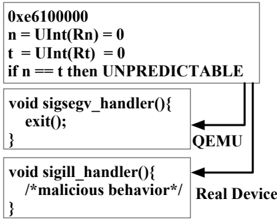
Figure 8: Inconsistent instruction can prevent the malicious behavior being detected by emulators
<details>
<summary>Image 2 Details</summary>
### Visual Description
## Flowchart: Signal Handler Decision Process
### Overview
The diagram illustrates a conditional logic flow for handling signals in a technical system, with branches leading to different handler functions. It includes code snippets, conditional checks, and references to QEMU and Real Device environments.
### Components/Axes
1. **Top Box (Decision Logic)**:
- Contains hexadecimal value: `0xe6100000`
- Variable assignments:
- `n = UInt(Rn) = 0`
- `t = UInt(Rt) = 0`
- Conditional check: `if n == t then UNPREDICTABLE`
- Arrows labeled `QEMU` (left) and `Real Device` (right).
2. **Middle Box (Signal Handler)**:
- Function: `void sigsegv_handler(){ exit(); }`
- Connected to the top box via the `QEMU` arrow.
3. **Bottom Box (Malicious Handler)**:
- Function: `void sigill_handler(){ /*malicious behavior*/ }`
- Connected to the top box via the `Real Device` arrow.
### Detailed Analysis
- **Top Box**:
- The hexadecimal value `0xe6100000` likely represents a memory address or register value.
- Variables `n` and `t` are initialized to 0 using `UInt` (unsigned integer) operations on registers `Rn` and `Rt`.
- The condition `if n == t` triggers an `UNPREDICTABLE` state, implying undefined behavior or a critical decision point.
- **Arrows**:
- The `QEMU` arrow directs to the `sigsegv_handler`, which calls `exit()` to terminate the process.
- The `Real Device` arrow directs to the `sigill_handler`, annotated with `/*malicious behavior*/`, suggesting this path is associated with adversarial actions.
### Key Observations
- The flowchart bifurcates based on whether `n` equals `t`, with distinct outcomes for QEMU (controlled environment) and Real Device (potentially untrusted environment).
- The `UNPREDICTABLE` label indicates a critical failure or edge case requiring special handling.
- The `sigill_handler` is explicitly marked as malicious, implying it may execute unauthorized or harmful code.
### Interpretation
This diagram models a security-critical decision process in low-level system programming. The `QEMU` path represents a safe, predictable environment where signal handling terminates the process gracefully. In contrast, the `Real Device` path introduces risk, as the `sigill_handler` could exploit the `UNPREDICTABLE` condition to execute malicious code. The use of `exit()` in the `sigsegv_handler` ensures stability in controlled environments, while the absence of such safeguards in the `sigill_handler` highlights vulnerabilities in real-world deployments. The diagram emphasizes the importance of isolating untrusted code execution paths to prevent security breaches.
</details>
## 4.3.1 Emulator Detection
The inconsistent instructions can be used to detect emulators. We use the inconsistent instructions for emulator detection. Considering the popularity of Android systems, we target Android applications. Specifically, we build a native library by using the inconsistent instructions. For each encoding of one inconsistent behavior, we select one instruction stream.
Figure 7 shows the pseudo code of the library. Function JNI Function Is In Emulator (line 6) returns True if the emulator is detected. Inside the function, we register signal handlers for different signals (line 7). After the execution of each instruction stream, we will record the execution result either in the signal handler (line 2) or after the execution (line 12), which depends on the execution result. Then we use the function longjmp (line 13) or siglongjmp (line 3) to jump back to the place where calling sigsetjmp (line 8). Note the return value of sigsetjmp depends on the parameter of the longjmp or siglongjmp . Thus, the switch would check the value of i , which is the return value of sigsetjmp , repeatedly. As i would increase one after the execution of one instruction stream, we can execute hundreds of instruction streams in one function by adding corresponding case conditions. Each instruction stream can make an equal contribution to the final decision on whether the current execution environment is in real devices or emulators. Finally, if more instruction streams decide the application are running inside an emulator, the compare result() will return True and vice versa.
We automatically generate the test library with template code and build three Android apps for different instruction set (one for A64, one for A32, and one for T32 & T16). We run the applications on 12 different mobiles from 6 different vendors. These mobiles also use different CPUs, which decides how an instruction stream should be executed. Meanwhile, we run the applications in the Android emulator provided by Android studio (Version 4.1.2). We compare the result running in each real mobiles with the one in emulators. If the function JNI Function Is In Emulator returns True in emulator and returns False in real mobiles. We consider it will successfully detect the emulator. Table 6 shows the evaluation result, by testing the three Android apps (one for A64, one for A32, and one for T32 & T16) in 12 mobiles, all the mobile apps can detect the existence of emulator and real mobiles successfully.
```
1 0x10000: e51b3008 LDR r3,[fp,#-8]
2 0x10004: e1a03000 MOV r3,r0
3 0x10008: e7cf0e9f BFC r0, #0xf, #1
4 // BFC instruction is to clear specific bits
5 // e7cf0e9f is an UNPREDICTABLE encoding
6 // e7cf0e9f is executed normally in real device
7 // e7cf0e9f triggers SIGILL signal on QEMU
8 0x1000c: e1a00003 MOV r0,r3
9 0x10010: e50b3008 STR r3,[fp,#-8]
```
Figure 9: Instrumented instruction streams for anti-fuzzing.
## 4.3.2 Anti-Emulation
Anti-emulation technique is important. On the attacker's side, it can be proposed to increase the bar for analyzing the malware so that the defense mechanism can be developed slower. On the defender's side, commercial software needs to protect the core functionality and algorithms from being analyzed. Thus, it is widely used in the wild [43].
The inconsistent instructions can be used to conduct anti-emulation and can prevent the malware's malicious behavior being analyzed. We demonstrate how the inconsistent instruction can be used to hide the malicious behavior.
We use one of the state-of-the-art dynamic analysis platforms (i.e., PANDA [5]) to demonstrate the usage. PANDA is built upon QEMU and supports taint analysis, record and replay, operating system introspection, and so on. We port one of the open source rootkits (i.e., Suterusu [6]) to Debian 7.3. We register two different signal handlers for SIGILL and SIGSEGV, respectively. Then we instrument one instruction stream (i.e., 0xe61000000). This is a LDR instruction encoding in ARM instruction set. According to the encoding schema, n equals to t and both these two symbols' values are zero. The ASL code of decoding would check whether n equals to t. If so, it should be the UNPREDICTABLE behavior. Real devices think this is an illegal instruction stream and will raise the SIGILL signal while QEMU tries to execute the instruction stream. Then SIGSEGV will be raised as the address pointed by R0 cannot be accessed. In this case, the malicious behavior will only be triggered in real devices. Meanwhile, when we use the PANDA to analyze the malware, no malicious behavior will be monitored and the program will exit inside the sigsegv handler .
## 4.3.3 Anti-Fuzz
Fuzzing is widely used to explore the zero-day vulnerabilities. To help the released binaries from being fuzzed by attackers, researchers utilize anti-fuzzing techniques [24, 17]. Considering that many new binary fuzzing frameworks are based on QEMU, the inconsistent instructions can be used by developers as a mitigation approach towards fuzzing technique.
We demonstrate how the inconsistent instructions can be used to conduct anti-fuzzing tasks with a relatively low overhead and high decreased coverage ratio.
Figure 9 shows a snippet of assembly code instrumented into the release binary. In address 0x10008, the instruction BFC is used to clear bits for register R0. Note we move the value of R0 to R3 before the instruction BFC and return it back after the execution of BFC . This can guarantee the instrumented instructions will not affect the execution of the binary on the real device. The instruction stream 0xe7cf0e9f results in an UNPREDICTABLE condition. It can be executed normally in real devices while triggering a signal on QEMU.
We developed a GCC plugin to instrument the above mentioned inconsistent instruction streams at each function entry and apply this plugin on three popular used libraries (i.e., libtiff, libpng, and libjpeg) during the compilation process to generate released binaries.
Table 7 shows the space and runtime overhead of the instrumented binary compared with the normal (non-instrumented) one. The space overhead is measured by comparing the binary size. For runtime overhead, we measure it by running test suites on both binaries and comparing the cost of time. We noticed that the instrumented binary imposes negligible space and runtime overhead to the binary. The average space overhead for the protected binary is around 4%, and the runtime overhead is less than 1%.
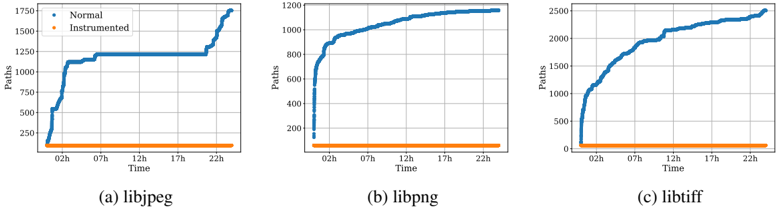
We then measure the functionality of anti-fuzzing. We fuzz the instrumented binaries and the normal ones with AFLQEMU (version 2.56b) for 24 hours. The seed corpus is the test suite used for each library in Table 7. We collect the coverage information for the instrumented and the normal ones. Figure 10 shows the results. It is easy to see that the coverage for instrumented binaries cannot increase (because QEMU fails to execute binaries correctly), while the normal ones will increase with the fuzzing time.
Table 7: Overhead information of anti-fuzzing.
| Library 1 | Test Suite 2 | Space Overhead | Runtime Overhead |
|--------------------|----------------|------------------|--------------------|
| libpng (readpng) | built-in (254) | 4.0% (+7KB) | 0.52% |
| libjpeg (djpeg) | GIT 3 (97) | 4.3% (+8KB) | 0.61% |
| libtiff (tiffinfo) | built-in (61) | 2.2% (+8KB) | 0.59% |
| Overall | | 3.5% | 0.57% |
- 1 All libraries are compiled using default compile parameters.
- 2 The test inputs for libjpeg is taken from Google Image Test Suite.
3 The number of test inputs in test suite is shown in the bracket.
Note this is to demonstrate the ability of inconsistent instructions on anti-fuzzing tasks. How to stealthily use these instructions is out of our scope. It is not easy for attackers to precisely recognize all the inconsistent instructions, which will be discussed in detail (Section 5).
Figure 10: The result of Anti-Fuzzing experiment on three libraries. The blue lines show the coverage over 24 hours of fuzzing. The orange line shows the coverage for instrumented binaries, which decreases due to failed executions of QEMU.
<details>
<summary>Image 3 Details</summary>
### Visual Description
## Line Charts: Path Counts Over Time for libjpeg, libpng, and libtiff
### Overview
The image contains three line charts comparing "Normal" and "Instrumented" path counts over a 24-hour period (02h to 22h) for three compression libraries: libjpeg, libpng, and libtiff. Each chart uses a blue line for "Normal" and an orange line for "Instrumented," with the y-axis representing path counts and the x-axis representing time.
---
### Components/Axes
- **X-axis (Time)**: Labeled "Time" with hourly markers (02h, 07h, 12h, 17h, 22h).
- **Y-axis (Paths)**: Labeled "Paths," with approximate scales:
- libjpeg: 250–1750
- libpng: 200–1200
- libtiff: 0–2500
- **Legends**: Positioned in the top-left corner of each chart, with:
- Blue dots labeled "Normal"
- Orange dots labeled "Instrumented"
- **Chart Titles**:
- (a) libjpeg
- (b) libpng
- (c) libtiff
---
### Detailed Analysis
#### (a) libjpeg
- **Normal (Blue)**:
- Starts at ~250 paths at 02h.
- Jumps to ~1250 paths by 07h.
- Remains flat until 17h.
- Rises sharply to ~1750 paths by 22h.
- **Instrumented (Orange)**:
- Flat line at ~250 paths throughout the day.
#### (b) libpng
- **Normal (Blue)**:
- Starts at ~200 paths at 02h.
- Gradually increases to ~1000 paths by 22h.
- **Instrumented (Orange)**:
- Flat line at ~200 paths throughout the day.
#### (c) libtiff
- **Normal (Blue)**:
- Starts at ~500 paths at 02h.
- Steady upward trend, reaching ~2500 paths by 22h.
- **Instrumented (Orange)**:
- Flat line at ~500 paths throughout the day.
---
### Key Observations
1. **Instrumented Lines**: All three Instrumented lines remain perfectly flat, indicating no change in path counts over time.
2. **Normal Lines**:
- libjpeg shows a bimodal pattern (sharp rise at 07h, then another rise at 22h).
- libpng exhibits a gradual, linear increase.
- libtiff demonstrates the steepest and most consistent growth.
3. **Instrumented vs. Normal**: Instrumented paths are consistently ~20–40% of Normal paths across all libraries.
---
### Interpretation
- **Instrumented Behavior**: The flat Instrumented lines suggest that instrumentation (e.g., monitoring tools) does not alter the baseline path count, possibly due to overhead or static configuration.
- **Normal Trends**:
- libjpeg’s bimodal pattern may reflect periodic processing bursts (e.g., batch jobs at 07h and 22h).
- libtiff’s linear growth could indicate sustained, high-volume operations (e.g., image rendering pipelines).
- libpng’s moderate growth might represent steady, incremental processing.
- **Technical Implications**: The disparity between Instrumented and Normal paths highlights potential overhead from instrumentation or differences in workload handling between monitored and unmonitored systems.
---
### Spatial Grounding & Verification
- Legends are consistently placed in the top-left corner of each chart.
- Colors match legend labels: Blue = Normal, Orange = Instrumented.
- Axis labels and scales are clearly aligned with chart titles.
---
### Content Details
- **libjpeg (a)**:
- Normal: 250 (02h) → 1250 (07h) → 1250 (17h) → 1750 (22h)
- Instrumented: 250 (constant)
- **libpng (b)**:
- Normal: 200 (02h) → 1000 (22h)
- Instrumented: 200 (constant)
- **libtiff (c)**:
- Normal: 500 (02h) → 2500 (22h)
- Instrumented: 500 (constant)
---
### Final Notes
The data suggests that Instrumented systems maintain stable path counts, while Normal systems exhibit varying growth patterns tied to their specific use cases. Further investigation into the instrumentation methodology and workload distribution could clarify the observed trends.
</details>
Answer to RQ3: The inconsistent instructions are useful. We demonstrate that the inconsistent instructions can be used to detect the existence of the CPU emulator and prevent the malicious behavior from being monitored by dynamic analysis frameworks. Furthermore, the path coverage of programs fuzzed in emulators can be highly decreased with the help of inconsistent instructions.
## 5 Discussion
Testing Instructions in Privileged Environments Currently, the generated instruction streams are tested under unprivileged mode in both CPU emulators and real devices. Some instruction streams may have different execution results under privileged mode. For instance, instruction WFI , which results in a bug of QEMU user-mode, may not be an inconsistent instruction while executing in privileged mode. We plan to port INSDET to kernel-space for a more thorough testing.
Testing Instruction Stream Sequences INSDET now tests only one instruction stream each time during the differential testing. We can also test multiple instruction streams (instruction stream sequences) in the differential testing. The instruction stream sequences may trigger multiple system states and can test the decoding/executing logic of real devices and CPU emulators towards different state flags. How to design representative instruction stream sequences, and how to locate the inconsistent one will be the challenge. This will be our future work. Nevertheless, We have already discovered a huge number of inconsistent instruction streams with INSDET, covering 47.8% of the whole instructions. Every instruction stream sequence that contain the inconsistent instruction stream can result in inconsistent behaviors.
Detecting (Ab)Used Inconsistent Instructions The experiments in Section 4.3.2 and 4.3.3 show that attackers or vendors can (ab)use these inconsistent instructions to prevent the released binary from being monitored or fuzzed. It is not easy to recognize these inconsistent instructions due to the huge number of inconsistent instruction streams from 511 instructions. Some of these instructions are even commonly used (i.e., STR and BLX instruction). Apart from this, attackers can encrypt these instruction streams as data. Then these encrypted instruction streams can be decrypted and executed during runtime, which can increase the bar for detection. Thus, it is challenging to precisely detect those
inconsistent instruction streams if they are used to conduct anti-emulation or anti-fuzzing tasks. Furthermore, how to hide these inconsistent instruction streams from being detected is a Cat and Mouse problem. Stealthily using these instructions is not the purpose of our work.
Other Emulators and Architectures We test QEMU as it is one of the state-of-the-art emulators, which is well maintained and used by many industry tools (e.g., Android Studio) and academic prototypes [14, 18, 44, 9, 40, 10, 12, 21, 11, 16, 31]. However, INSDET can also be used to test the other emulators. Generally, all the tools (e.g., angr, Unicorn) including an emulated execution engine can be tested, which will be left as the future work. The whole framework of INSDET is architecture independent. However, we rely on ARM ASL to generate the test cases, which can explore multiple behaviors. If other architectures propose such kinds of specification language, we are able to generate the test cases. Otherwise, new test case generation algorithm should be developed.
## 6 Related Work
## 6.1 Testing CPU Emulators
Several works are proposed to test the CPU emulators. Lorenzo et al. proposed EmuFuzzer to test the CPU emulators [35, 34]. However, the seed used for testing mainly relies on randomization and a CPU-assisted mechanism, which may not cover all the CPU behaviors. Apart from testing user-level instructions, KEmuFuzzer is proposed to test the whole system emulators [33]. However, KEmuFuzzer relies on the manually written template to generate test cases. For better test case coverage, PokeEMU [32] is proposed. PokeEMU utilizes binary symbolic execution to generate more test cases from a high-fidelity emulator and apply these test cases on low-fidelity emulators. However, whether the high-fidelity emulator strictly follow the rule of specification is unknown. Furthermore, all the above mentioned works target on x86/x64 architectures. With the development of embedded systems and mobiles, the faithfully emulating ability for ARM architecture is a urgent need. Our work targets on ARM architecture and generates test cases from the specification itself (i.e., ARM ASL). The evaluation results show that we can find the real bugs and many inconsistent implementations between real devices and emulators, which can be abused by attackers.
## 6.2 Differential Testing
Differential testing is introduced by McKeeman et al. [36] to detect the implementation bugs by comparing the inconsistent behaviors between different software. For example, Yang et al. proposed Csmith, a powerful tool that can generate multiple C programs. With Csmith, hundreds of bugs are detected in the C compiler. Regarding the same goal, Le et al. introduced equivalence modulo inputs (EMI) [28] and many other differential testing tools are built based on EMI to validate the compiler implementations [29, 39].
Apart from testing compilers, researchers also utilize differential testing to validate the Database Management Systems (DBMS). Slutz et al. proposed the tool RAGS to explore bugs by executing different SQL queries on multiple DBMS. Though it is effective, it can only support a small set of SQL statements. Gu et al. evaluate the accuracy of DBMS optimizer by using options and hints to force the generation of different query plans. Jung et al. developed APOLLO [23] to test the performance regression bugs in DBMSs .
Furthermore, differential testing is powerful and applied to different domains such as testing SMT solvers [42, 41], JVM implementations [25] , symbolic execution engines [25], and PDF readers [27]. .
## 6.3 Anti-Emulation Technique
Previous anti-emulation works [37] divide the anti-emulation technique into three categories. They are differences in behavior, differences in timing, and hardware specific values. Our work can automatically locate the inconsistent instructions, which result in different behavior and can be used by the previous anti-emulation technique. Jang et al. [20] address the importance of anti-emulation techniques on protecting the Commercial-Off-the-Shelf (COTS) software from being debugged or used without buying hardwares. They propose three different anti-emulation techniques. However, some techniques rely on the race condition and are not easy to trigger.
## 7 Conclusion
We design and implement INSDET, a framework that can automatically locate the inconsistent ARM instructions, which can result in inconsistent behaviors between CPU emulator and real devices. With INSDET, we generate 2,774,649 representative instruction streams and detect 155,642 inconsistent instruction streams covering 30% of the
instruction encodings and 47.8% instructions. By analyzing the root cause of inconsistent instructions, we noticed four bugs of QEMU, which are confirmed by QEMU developers, covering 13 instruction encodings including very commonly used ones (e.g., STR , BLX ). We also demonstrate the capability of inconsistent instructions on detecting emulators, anti-emulation, and anti-fuzzing.
## References
- [1] 64 bit juno r2 arm® development platform. https://developer.arm.com/-/media/Arm%20Developer% 20Community/PDF/Juno%20r2%20datasheet.pdf .
- [2] Afl qemu mode: high-performance binary-only instrumentation for afl-fuzz. https://github.com/google/ afl/tree/master/qemu\_mode .
- [3] ARM Exploration tools. https://developer.arm.com/architectures/cpu-architecture/ a-profile/exploration-tools .
- [4] Capstone. https://www.capstone-engine.org/ .
- [5] Panda.re. https://panda.re/ .
- [6] Suterusu. https://github.com/mncoppola/suterusu .
- [7] TriforceAFL. https://github.com/nccgroup/TriforceAFL .
- [8] Z3Prover. https://github.com/Z3Prover/z3 .
- [9] Abdulla Alwabel, Hao Shi, Genevieve Bartlett, and Jelena Mirkovic. Safe and automated live malware experimentation on public testbeds. In Proceedings of the 7th Workshop on Cyber Security Experimentation and Test , 2014.
- [10] Curtis Carmony, Xunchao Hu, Heng Yin, Abhishek Vasisht Bhaskar, and Mu Zhang. Extract me if you can: Abusing pdf parsers in malware detectors. In Proceedings of the 23rd Annual Network and Distributed System Security Symposium , 2016.
- [11] Daming D Chen, Maverick Woo, David Brumley, and Manuel Egele. Towards automated dynamic analysis for linux-based embedded firmware. In Proceedings of the 23rd Annual Network and Distributed System Security Symposium , 2016.
- [12] Vitaly Chipounov, Volodymyr Kuznetsov, and George Candea. S2e: A platform for in-vivo multi-path analysis of software systems. Acm Sigplan Notices , 2011.
- [13] Abraham A Clements, Eric Gustafson, Tobias Scharnowski, Paul Grosen, David Fritz, Christopher Kruegel, Giovanni Vigna, Saurabh Bagchi, and Mathias Payer. Halucinator: Firmware re-hosting through abstraction layer emulation. In Proceedings of the 29th USENIX Security Symposium , 2020.
- [14] Ali Davanian, Zhenxiao Qi, Yu Qu, and Heng Yin. Decaf++: Elastic whole-system dynamic taint analysis. In Proceedings of the 22nd International Symposium on Research in Attacks, Intrusions and Defenses , 2019.
- [15] Bo Feng, Alejandro Mera, and Long Lu. P2IM: Scalable and hardware-independent firmware testing via automatic peripheral interface modeling. In Proceedings of the 29th USENIX Security Symposium , 2019.
- [16] Qian Feng, Aravind Prakash, Heng Yin, and Zhiqiang Lin. Mace: High-coverage and robust memory analysis for commodity operating systems. In Proceedings of the 30th annual computer security applications conference , 2014.
- [17] Emre G¨ uler, Cornelius Aschermann, Ali Abbasi, and Thorsten Holz. Antifuzz: Impeding fuzzing audits of binary executables. In Proceedings of the 28th { USENIX } Security Symposium , 2019.
- [18] Andrew Henderson, Aravind Prakash, Lok Kwong Yan, Xunchao Hu, Xujiewen Wang, Rundong Zhou, and Heng Yin. Make it work, make it right, make it fast: building a platform-neutral whole-system dynamic binary analysis platform. In Proceedings of the 2014 International Symposium on Software Testing and Analysis , 2014.
- [19] Anoirel Issa. Anti-virtual machines and emulations. Journal in Computer Virology , 2012.
- [20] Daehee Jang, Yunjong Jeong, Sungman Lee, Minjoon Park, Kuenhwan Kwak, Donguk Kim, and Brent Byunghoon Kang. Rethinking anti-emulation techniques for large-scale software deployment. Computers &Security , 2019.
- [21] Xuxian Jiang, Xinyuan Wang, and Dongyan Xu. Stealthy malware detection and monitoring through vmm-based 'out-of-the-box' semantic view reconstruction. ACM Transactions on Information and System Security , 2010.
- [22] Evan Johnson, Maxwell Bland, YiFei Zhu, Joshua Mason, Stephen Checkoway, Stefan Savage, and Kirill Levchenko. Jetset: Targeted firmware rehosting for embedded systems. In Proceedings of the 30th { USENIX } Security Symposium , 2021.
- [23] Jinho Jung, Hong Hu, Joy Arulraj, Taesoo Kim, and Woonhak Kang. Apollo: Automatic detection and diagnosis of performance regressions in database systems. Proceedings of the VLDB Endowment , 2019.
- [24] Jinho Jung, Hong Hu, David Solodukhin, Daniel Pagan, Kyu Hyung Lee, and Taesoo Kim. Fuzzification: Antifuzzing techniques. In Proceedings of the 28th { USENIX } Security Symposium , 2019.
- [25] Timotej Kapus and Cristian Cadar. Automatic testing of symbolic execution engines via program generation and differential testing. In Proceedings of the 32nd IEEE/ACM International Conference on Automated Software Engineering , 2017.
- [26] Mingeun Kim, Dongkwan Kim, Eunsoo Kim, Suryeon Kim, Yeongjin Jang, and Yongdae Kim. Firmae: Towards large-scale emulation of iot firmware for dynamic analysis. In Proceedings of the 2020 Annual Computer Security Applications Conference , 2020.
- [27] Tomasz Kuchta, Thibaud Lutellier, Edmund Wong, Lin Tan, and Cristian Cadar. On the correctness of electronic documents: studying, finding, and localizing inconsistency bugs in pdf readers and files. Empirical Software Engineering , 2018.
- [28] Vu Le, Mehrdad Afshari, and Zhendong Su. Compiler validation via equivalence modulo inputs. ACMSIGPLAN Notices , 2014.
- [29] Christopher Lidbury, Andrei Lascu, Nathan Chong, and Alastair F Donaldson. Many-core compiler fuzzing. ACM SIGPLAN Notices , 2015.
- [30] C˘ at˘ alin Valeriu Lit ¸˘ a, Doina Cosovan, and Dragos ¸ Gavrilut ¸. Anti-emulation trends in modern packers: a survey on the evolution of anti-emulation techniques in upa packers. Journal of Computer Virology and Hacking Techniques , 2018.
- [31] Lannan Luo, Yu Fu, Dinghao Wu, Sencun Zhu, and Peng Liu. Repackage-proofing android apps. In Proceedings of the 46th Annual IEEE/IFIP International Conference on Dependable Systems and Networks , 2016.
- [32] Lorenzo Martignoni, Stephen McCamant, Pongsin Poosankam, Dawn Song, and Petros Maniatis. Pathexploration lifting: Hi-fi tests for lo-fi emulators. In Proceedings of the Seventeenth International Conference on Architectural Support for Programming Languages and Operating Systems , 2012.
- [33] Lorenzo Martignoni, Roberto Paleari, Giampaolo Fresi Roglia, and Danilo Bruschi. Testing system virtual machines. In Proceedings of the 19th international symposium on software testing and analysis , 2010.
- [34] Lorenzo Martignoni, Roberto Paleari, Alessandro Reina, Giampaolo Fresi Roglia, and Danilo Bruschi. A methodology for testing cpu emulators. ACM Transactions on Software Engineering and Methodology , 2013.
- [35] Lorenzo Martignoni, Roberto Paleari, Giampaolo Fresi Roglia, and Danilo Bruschi. Testing cpu emulators. In Proceedings of the eighteenth international symposium on Software testing and analysis , 2009.
- [36] William M McKeeman. Differential testing for software. Digital Technical Journal , 1998.
- [37] Thomas Raffetseder, Christopher Kruegel, and Engin Kirda. Detecting system emulators. In Proceedings of the 2007 International Conference on Information Security . Springer, 2007.
- [38] Alastair Reid. Trustworthy specifications of arm® v8-a and v8-m system level architecture. In Proceedings of the 16th Formal Methods in Computer-Aided Design , 2016.
- [39] Chengnian Sun, Vu Le, and Zhendong Su. Finding compiler bugs via live code mutation. In Proceedings of the 2016 ACM SIGPLAN International Conference on Object-Oriented Programming, Systems, Languages, and Applications , 2016.
- [40] Jinpeng Wei, Lok K Yan, and Muhammad Azizul Hakim. Mose: Live migration based on-the-fly software emulation. In Proceedings of the 31st Annual Computer Security Applications Conference , 2015.
- [41] Dominik Winterer, Chengyu Zhang, and Zhendong Su. On the unusual effectiveness of type-aware operator mutations for testing smt solvers. Proceedings of the ACM on Programming Languages , (OOPSLA), 2020.
- [42] Dominik Winterer, Chengyu Zhang, and Zhendong Su. Validating smt solvers via semantic fusion. In Proceedings of the 41st ACM SIGPLAN Conference on Programming Language Design and Implementation , 2020.
- [43] Xu Chen, J. Andersen, Z. M. Mao, M. Bailey, and J. Nazario. Towards an understanding of anti-virtualization and anti-debugging behavior in modern malware. In Proceedings of the 38th IEEE International Conference on Dependable Systems and Networks , 2008.
- [44] Lok Kwong Yan and Heng Yin. Droidscope: Seamlessly reconstructing the { OS } and dalvik semantic views for dynamic android malware analysis. In Proceedings of the 21st { USENIX } Security Symposium , 2012.
- [45] Yaowen Zheng, Ali Davanian, Heng Yin, Chengyu Song, Hongsong Zhu, and Limin Sun. Firm-afl: highthroughput greybox fuzzing of iot firmware via augmented process emulation. In Proceedings of the 28th { USENIX } Security Symposium , 2019.