## Generating Hypothetical Events for Abductive Inference
Debjit Paul
Research Training Group AIPHES Institute for Computational Linguistics Heidelberg University paul@cl.uni-heidelberg.de
## Abstract
Abductive reasoning starts from some observations and aims at finding the most plausible explanation for these observations. To perform abduction, humans often make use of temporal and causal inferences, and knowledge about how some hypothetical situation can result in different outcomes. This work offers the first study of how such knowledge impacts the Abductive α NLI task - which consists in choosing the more likely explanation for given observations. We train a specialized language model LM I that is tasked to generate what could happen next from a hypothetical scenario that evolves from a given event. We then propose a multi-task model MTL to solve the α NLI task , which predicts a plausible explanation by a) considering different possible events emerging from candidate hypotheses events generated by LM I - and b) selecting the one that is most similar to the observed outcome. We show that our MTL model improves over prior vanilla pre-trained LMs finetuned on α NLI. Our manual evaluation and analysis suggest that learning about possible next events from different hypothetical scenarios supports abductive inference.
## 1 Introduction
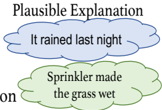
Abductive reasoning (AR) is inference to the best explanation. It typically starts from an incomplete set of observations about everyday situations and comes up with what can be considered the most likely possible explanation given these observations (Pople, 1973; Douven, 2017). One of the key characteristics that make abductive reasoning more challenging and distinct from other types of reasoning is its non-monotonic character (Strasser and Antonelli, 2019) i.e., even the most likely explanations are not necessarily correct. For example, in Figure 1, the most likely explanation for Observation 1: 'wet grass outside my house' is that 'it has been
Anette Frank
Research Training Group AIPHES Institute for Computational Linguistics Heidelberg University frank@cl.uni-heidelberg.de
Observation 1 :
The grass outside my house is wet
Observation 2 :
The sprinkler outside was switched on
Figure 1: Motivational example illustrating Abductive Reasoning and its non-monotonic character.
<details>
<summary>Image 1 Details</summary>
### Visual Description
## Diagram: Plausible Explanations
### Overview
The image presents two plausible explanations for an unstated observation, likely related to wet grass. The explanations are visually represented as speech bubbles or thought clouds, each containing a different reason.
### Components/Axes
* **Top Cloud (Blue):** Labeled "Plausible Explanation" and contains the text "It rained last night."
* **Bottom Cloud (Green):** Contains the text "Sprinkler made the grass wet." The word "on" is partially visible to the left of the cloud.
### Detailed Analysis
The diagram presents two possible causes for an event. The top cloud, colored blue, suggests that rain is the explanation. The bottom cloud, colored green, suggests that a sprinkler is the explanation.
### Key Observations
* The two explanations are presented as equally plausible.
* The visual representation as clouds suggests these are potential thoughts or hypotheses.
### Interpretation
The diagram illustrates the concept of multiple possible explanations for a single observation. It highlights the need to consider various factors when trying to understand the cause of an event. The diagram does not provide any data or facts, but rather presents a conceptual scenario.
</details>
raining' . However, when a new piece of information (observation or evidence) becomes available, the explanation must possibly be retracted, showing the defeasible character of abduction . With the new observation ( 'the sprinkler was switched on ') the most plausible explanation changes to 'Sprinkler caused the grass to be wet' . Humans, in such situations, could induce or validate such abductive inferences by performing hypothetical reasoning (such as 'What would happen if the sprinkler was switched on?' ) to arrive at a plausible explanation for 'wet grass outside my house' .
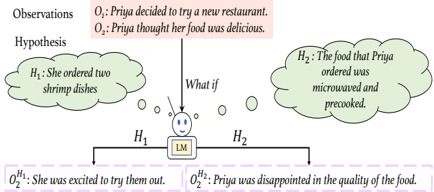
In this work, we focus on the α NLI task (Bhagavatula et al., 2020), where given two observations ( O 1 at time t 1 , O 2 at time t 2 , with t 1 < t 2 ) as an incomplete context, the task is to predict which of two given hypothesized events ( H 1 or H 2 ) is more plausible to have happened between O 1 and O 2 . Figure 2 illustrates this with an example: given observations O 1 :'Priya decided to try a new restaurant. ' and O 2 : 'Priya thought her food was delicious. ' , the task is to predict whether H 1 or H 2 is the more plausible explanation given observations O 1 and O 2 . Both H 1 and H 2 are different plausible hypothetical situations that can evolve from the same observation (premise) O 1 .
In this paper, we hypothesize that learning how different hypothetical scenarios ( H 1 and H 2 ) can result in different outcomes (e.g., O H j 2 , Fig. 2) can help in performing abductive inference. In order to decide which H i , is more plausible given observa-
Figure 2: Motivational example for α NLI : The top box (red) shows the observations and two callout clouds (green) contain the hypotheses. The implications ( O H i i ) - generated by the LM conditioned on each hypothesis and the observations - are given in pink colored boxes.
<details>
<summary>Image 2 Details</summary>
### Visual Description
## Diagram: Hypothesis Generation
### Overview
The image illustrates a hypothesis generation process based on observations and a language model (LM). It shows how different hypotheses can lead to different subsequent observations.
### Components/Axes
* **Observations:**
* O₁: Priya decided to try a new restaurant. (Top-right, in a light red box)
* O₂: Priya thought her food was delicious. (Top-right, in a light red box)
* **Hypothesis:**
* H₁: She ordered two shrimp dishes (Left, in a green cloud shape)
* H₂: The food that Priya ordered was microwaved and precooked. (Right, in a green cloud shape)
* **Language Model (LM):** Represented by a smiling face with "LM" written on a box below it (Center).
* **What if:** Text above the LM, indicating the LM is considering different possibilities.
* **Resulting Observations:**
* O₂<sup>H₁</sup>: She was excited to try them out. (Bottom-left, in a dashed purple box)
* O₂<sup>H₂</sup>: Priya was disappointed in the quality of the food. (Bottom-right, in a dashed purple box)
### Detailed Analysis
The diagram depicts a scenario where initial observations (O₁ and O₂) lead to the generation of two different hypotheses (H₁ and H₂) by a language model (LM). The "What if" question suggests the LM is exploring different possibilities based on the initial observations. Each hypothesis then leads to a different subsequent observation (O₂<sup>H₁</sup> and O₂<sup>H₂</sup>).
* **Observations (O₁ and O₂):** The initial observations set the context for the scenario. Priya's decision to try a new restaurant and her initial positive impression of the food are the starting points.
* **Hypotheses (H₁ and H₂):** The LM generates two possible explanations for Priya's initial positive impression:
* H₁: She ordered two shrimp dishes.
* H₂: The food that Priya ordered was microwaved and precooked.
* **Language Model (LM):** The LM acts as the reasoning engine, generating hypotheses based on the initial observations.
* **Resulting Observations (O₂<sup>H₁</sup> and O₂<sup>H₂</sup>):** These are the observations that would follow if each hypothesis were true:
* If H₁ is true (she ordered two shrimp dishes), then O₂<sup>H₁</sup>: She was excited to try them out.
* If H₂ is true (the food was microwaved and precooked), then O₂<sup>H₂</sup>: Priya was disappointed in the quality of the food.
### Key Observations
* The diagram illustrates how different hypotheses can lead to different outcomes or subsequent observations.
* The language model plays a central role in generating these hypotheses.
* The diagram highlights the importance of considering multiple possibilities when interpreting observations.
### Interpretation
The diagram demonstrates a simple model of hypothesis generation and evaluation. The LM takes initial observations and generates possible explanations (hypotheses). These hypotheses are then tested or evaluated based on their ability to predict subsequent observations. The diagram suggests that the quality of the hypotheses generated by the LM directly impacts the accuracy of predicting future events or observations. It highlights the iterative nature of the scientific method, where observations lead to hypotheses, which are then tested and refined based on new observations. The diagram also implies that the LM's ability to generate relevant and accurate hypotheses is crucial for effective reasoning and decision-making.
</details>
tions, we assume each H i to be true and generate a possible next event O H i 2 for each of them independently (e.g.: What will happen if Priya's ordered food was microwaved and precooked? ). We then compare the generated sentences ( O H 1 2 , O H 2 2 in Fig. 2) to what has been observed ( O 2 ) and choose as most plausible hypothesis the one whose implication is closest to observation O 2 .
We design a language model ( LM I ) which, given observations and a hypothesis, generates a possible event that could happen next, given one hypothesis. In order to train this language model, we use the TIMETRAVEL (TT) corpus (Qin et al., 2019) (a subpart of the ROCStories corpus 1 ). We utilize the LM I model to generate a possible next event for each hypothesis, given the observations. We then propose a multi-task learning model MTL that jointly chooses from the generated possible next events ( O H 1 2 or O H 2 2 ) the one most similar to the observation O 2 and predicts the most plausible hypothesis ( H 1 or H 2 ).
Our contributions are: i) To our best knowledge, we are the first to demonstrate that a model that learns to perform hypothetical reasoning can support and improve abductive tasks such as α NLI. We show that ii) for α NLI our multi-task model outperforms a strong BERT baseline (Bhagavatula et al., 2020).
Our code is made publicly available. 2
## 2 Learning about Counterfactual Scenarios
The main idea is to learn to generate assumptions, in a given situation, about 'What could have hap-
1 We ensure that α NLI testing instances are held out.
2 https://github.com/Heidelberg-NLP/ HYPEVENTS
<details>
<summary>Image 3 Details</summary>
### Visual Description
## Diagram: Causal Reasoning Diagrams
### Overview
The image presents three diagrams illustrating different types of causal reasoning. The diagrams use nodes (circles) to represent states or events and arrows to represent causal relationships. The diagrams are labeled (a) αNLI, (b) Counterfactual Reasoning from TimeTravel, and (c) a third diagram with branching causal paths.
### Components/Axes
* **Nodes:** Represented by circles, labeled with letters and numbers (e.g., O1, H1, S2). The color of the nodes varies between a light peach and a light green.
* **Arrows:** Indicate causal relationships between nodes. Solid arrows represent direct causal links, while dashed arrows represent potential or counterfactual links.
* **Labels:** Each diagram has a title indicating the type of reasoning it represents.
* **Counterfactual Label:** In diagram (b), the word "Counterfactual" is written near the arrow that splits from node S2 to node S2'.
### Detailed Analysis
**Diagram (a): αNLI**
* Nodes: O1 (peach), Hi (green), O2 (peach)
* Arrows: O1 -> Hi -> O2
* Description: A linear causal chain where O1 causes Hi, which in turn causes O2.
**Diagram (b): Counterfactual Reasoning from TimeTravel**
* Nodes: S1 (peach), S2 (green), S3 (peach), S2' (green), S3' (peach)
* Arrows: S1 -> S2 -> S3, S1 -> S2' -> S3', S2 -> S2' (labeled "Counterfactual")
* Description: A branching causal diagram. S1 leads to S2 and S3. A counterfactual scenario is introduced where S2 could have led to S2' and S3' instead.
**Diagram (c): Branching Causal Paths**
* Nodes: O1 (peach), H1 (green), H2 (green), O2^H1_2 (peach), O2^H2_2 (peach), O2 (peach)
* Arrows: O1 -> H1 -> O2^H1_2, O1 -> H2 -> O2^H2_2, O2^H1_2 --> O2 (dashed), O2^H2_2 --> O2 (dashed)
* Description: O1 branches into two paths, one leading to H1 and then to O2^H1_2, and the other leading to H2 and then to O2^H2_2. Both O2^H1_2 and O2^H2_2 potentially lead to O2, indicated by dashed arrows.
### Key Observations
* Diagrams (a) and (b) have a clear separation due to a vertical dashed line.
* Diagram (b) introduces the concept of counterfactual reasoning, where an alternative outcome is considered.
* Diagram (c) shows a branching causal structure with potential outcomes converging to a single final state.
* The use of dashed arrows in diagram (c) indicates potential or less certain causal links.
### Interpretation
The diagrams illustrate different ways of representing causal relationships and reasoning. Diagram (a) shows a simple linear causal chain. Diagram (b) introduces counterfactual reasoning, which is essential for understanding alternative possibilities and hypothetical scenarios. Diagram (c) shows a more complex branching causal structure, where multiple paths can lead to the same outcome. These diagrams are useful for modeling and analyzing complex systems where multiple factors can influence the outcome. The use of different arrow types (solid vs. dashed) helps to distinguish between direct and potential causal links. The diagrams are likely used to explain or visualize causal inference methods in a technical context.
</details>
(c) Learning to generate possible future event for each hypothesis
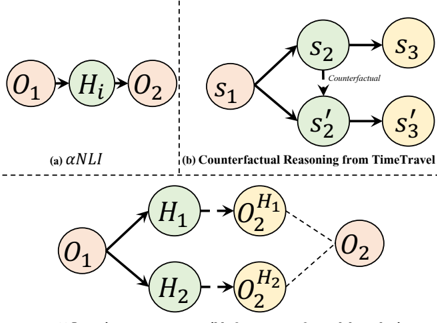
Figure 3: Different reasoning schemes and settings for our task and approach. The arrows denote the direction (temporal flow) of the reasoning chain. The dotted arrow in (b) denotes the derivation of a counterfactual situation s ′ 2 from a factual s 2 . In (c), the dotted arrows denote the learned inference; the dotted lines indicate the similarity between O 2 and O H i 2 .
pened (next) if we had done X?' or 'What could happen (next) if we do X?' (Bhatt and Flanagan, 2010). Figure 3(a) depicts the α NLI task framework. We hypothesize that getting to know what will happen (next) if any of two hypotheses occurs , will help us verifying which of them is more plausible (see Fig. 3(c)). Therefore, we encourage the model to learn how different hypothetical events (including counterfactual events) evolving from the same premise ( s 1 ) can lead to different or similar outcomes (see Fig. 3(b)).
Accordingly, we teach a pre-trained GPT-2 (Radford et al., 2019) language model how to generate a sequence of possible subsequent events given different hypothetical situations in a narrative setting. Training such a model on narrative texts encourages it to learn causal and temporal relations between events. We train a conditional language model, LM I , which generates a possible event that could happen next, given some counterfactual scenarios for a given story.
We train this model on the TIMETRAVEL (TT) dataset (Qin et al., 2019), by fine-tuning GPT-2 to learn about possible next events emerging from a situation in a story, given some alternative, counterfactual event. The TT dataset consists of fivesentence instances S =( s 1 , s 2 ,.., s 5 ) 3 from the ROCStories corpus 1 plus additional crowd-sourced sen-
3 s 1 = premise , s 2 = initial context , s 3:5 = original ending
O
1 : Dotty was being very grumpy. 2 : She felt much better afterwards. 1 : Dotty ate something bad. 2 Dotty call some close friends to chat. H 2 : She started to feel sick. : They all tried to make her happy.
O
H
H :
O 1
O H 2 2
Table 1: Example of generated possible next events O H j 2 using the LM I model. Bold hypothesis ( H 2 ) is more plausible.
tences s ′ 2:5 , where s ′ 2 is counterfactual 4 to s 2 from the original story 5 . There are two reasons for using the TT dataset for our purposes: a) the domains on which GPT-2 was pretrained are broad 6 and different from the domain of ROCStories, b) the model can see how alternative situations can occur starting from the same premise s 1 , resulting in similar or different outcomes. Note that, although intermediate situations may be counterfactual to each other, the future outcome can still be similar to the original ending due to causal invariance 7 .
Concretely, the language model LM I reads the premise ( s 1 ) and the alternative event(s) ( s 2 or s ′ 2 ), the masked token (serving as a placeholder for the missing possible next event(s) ( s 3: i or s ′ 3: i ), then the rest of the story ( s i +1:5 or s ′ i +1:5 ) and again the premise ( s 1 ). We train the model to maximize the log-likelihood of the missing ground-truth sentence(s) ( s 3: i ).
$$\mathcal { L } ^ { L M _ { \mathcal { I } } } ( \beta ) = \begin{array} { r l } & { t h e o u n d B E R T a t e o u n d e v e n s h o u l } \\ \log _ { p _ { \beta } } ( s _ { 3 ; i } | [ S ] s _ { 1 } , [ M ] , s _ { i + 1 ; 5 } , [ E ] , [ S ] , s _ { 1 } , s _ { 2 } ) & ( 1 ) } \end{array}$$
where i ∈ [3 , 4] , s i = { w s i 1 , .., w s i n } a sequence of tokens, [ S ] =start-of-sentence token, [ E ] =end-ofsentence token, [ M ] =mask token.
## 3 Generating Hypothetical Events to support the α NLI task
In this paper, we aim to investigate whether models perform better on the α NLI task when explicitly learning about events that could follow other events in a hypothetical scenario. We do so by introducing two methods LM I + BERTScore and LM I +
4 a counterfactual s ′ states something that is contrary to s
During our experiments we treat them as two separate S s S s s ′
5 instances: 1 =( 1:5 ) and 2 = ( 1 , 2:5 ).
6 GPT-2 was trained on the WebText Corpus.
7 the future events that are invariant under the counterfactual conditions (Qin et al., 2019)
MTL for unsupervised and supervised settings, respectively.
We first apply the trained model LM I on the α NLI task, where the given observations O 1 and O 2 , and alternative hypotheses H j are fed as shown in (2) below. 8
$$\begin{array} { r l } { v e n t s } & O _ { 2 } ^ { H _ { j } } = \beta ( [ S ] , O _ { 1 } , [ M ] , O _ { 2 } , [ E ] , [ S ] , O _ { 1 } , H _ { j } ) \quad ( 2 ) } \end{array}$$
We generate a possible next event for each hypothetical event H j , i.e., O H 1 2 and O H 2 2 (or: what will happen if some hypothesis H j occurs given the observations), where j ∈ [1 , 2] . Table 1 illustrates an example where different O H j 2 are generated using LM I . One of the challenges when generating subsequent events given a hypothetical situation is that there can be infinite numbers of possible next events. Therefore, to constrain this range, we chose to give future events ( O 2 ) as input, such that the model can generate subsequent events in a constrained context.
## 3.1 Unsupervised Setting
In this setting, we do not train any supervised model to explicitly predict which hypothesis is more plausible given the observations. Instead, we apply the fine-tuned LM I model to the α NLI data, generate possible next events O H j 2 given O 1 and H j , as described above, and measure the similarity between such possible next events ( O H j 2 ) and the observation ( O 2 ) in an unsupervised way, using BERTScore (BS) (Zhang et al., 2020) 9 . We evaluate our hypothesis that the generated possible next event O H j 2 given the more plausible hypothesis H j should be more similar to observation O 2 . Table 1 illustrates an example where H 2 is the more plausible hypothesis. We impose the constraint that for a correctly predicted instance BS( O 2 H + , O 2 ) > BS( O 2 H -, O 2 ) should hold, where H + , H -are the more plausible vs. implausible hypothesis, respectively.
## 3.2 Supervised Setting
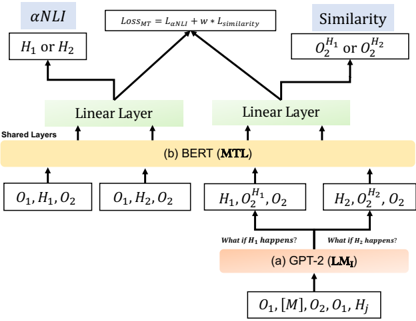
In this setting, displayed in Figure 4, we explore the benefits of training a multi-task MTL model that predicts i) the most plausible hypothesis and ii) which possible next event ( O H j 2 ) is more similar
8 For definition of placeholders see (1).
9 BERTScore is an automatic evaluation metric for text generation that leverages the pre-trained contextual embeddings from BERT and matches words in candidate and reference sentences by cosine similarity.
Figure 4: Overview of our LM I + MTL model for α NLI: (a) language model LM I takes the input in a particular format to generate different possible next events, (b) the MTL model learns to predict the best explanation ( H j ) and possible next events ( O H j 2 ) at the same time to perform the α NLI task.
<details>
<summary>Image 4 Details</summary>
### Visual Description
## Diagram: Model Architecture Comparison
### Overview
The image presents a diagram comparing two model architectures: GPT-2 (LM₁) and BERT (MTL). It illustrates how these models process input and generate outputs, highlighting the flow of information and the layers involved. The diagram focuses on how each model handles Natural Language Inference (NLI) and Similarity tasks.
### Components/Axes
* **Title:** The diagram compares two models, GPT-2 (LM₁) and BERT (MTL).
* **Top:** The diagram shows the loss function `LOSS_MT = L_αNLI + w * L_similarity` at the top, which is the combined loss for the multi-task learning.
* **Left Branch:** Represents the αNLI task, outputting `H₁ or H₂`.
* **Right Branch:** Represents the Similarity task, outputting `O₂^H₁ or O₂^H₂`.
* **Middle Section:** Shows the shared layers and the BERT (MTL) model.
* **Bottom Section:** Shows the GPT-2 (LM₁) model and its input.
* **Arrows:** Indicate the flow of information.
* **Boxes:** Represent layers or data representations.
### Detailed Analysis
1. **GPT-2 (LM₁) - Bottom Section:**
* Input: `O₁, [M], O₂, O₁, Hⱼ`
* Process: The input goes into the GPT-2 (LM₁) model, labeled as `(a) GPT-2 (LM₁)`.
* Conditional Statements: Two branches emerge from the GPT-2 block, labeled "What if H₁ happens?" and "What if H₂ happens?".
* Outputs: These branches feed into the BERT (MTL) layer with inputs `H₁, O₂^H₁, O₂` and `H₂, O₂^H₂, O₂` respectively.
2. **BERT (MTL) - Middle Section:**
* Input from GPT-2: `H₁, O₂^H₁, O₂` and `H₂, O₂^H₂, O₂`
* Input directly: `O₁, H₁, O₂` and `O₁, H₂, O₂`
* Process: The inputs are processed by the BERT (MTL) model, labeled as `(b) BERT (MTL)`. This layer is marked as "Shared Layers".
* Outputs: The BERT layer feeds into two "Linear Layer" blocks.
3. **Linear Layers:**
* Two "Linear Layer" blocks receive input from the BERT (MTL) layer.
* These layers feed into the αNLI and Similarity tasks.
4. **αNLI and Similarity - Top Section:**
* αNLI: Outputs `H₁ or H₂`.
* Similarity: Outputs `O₂^H₁ or O₂^H₂`.
* Loss Function: The outputs of these tasks are combined using the loss function `LOSS_MT = L_αNLI + w * L_similarity`.
### Key Observations
* The diagram illustrates a multi-task learning approach where GPT-2 generates conditional inputs for BERT.
* BERT acts as a shared layer, processing both direct inputs and inputs conditioned on GPT-2's output.
* The final loss function combines the losses from the αNLI and Similarity tasks.
### Interpretation
The diagram demonstrates a model architecture that leverages both GPT-2 and BERT for Natural Language Inference and Similarity tasks. GPT-2 is used to generate conditional inputs, allowing the model to explore different scenarios (H₁ or H₂). BERT then processes these inputs, along with direct inputs, to perform the NLI and Similarity tasks. The combined loss function ensures that the model learns to perform both tasks effectively. This architecture suggests a way to combine the strengths of different pre-trained models for improved performance on complex NLP tasks.
</details>
to the observation ( O 2 ). Multi-task learning aims to improve the performance of a model for a task by utilizing the knowledge acquired by learning related tasks (Ruder, 2019). We hypothesize that a) the possible next event O H j 2 of the more plausible hypothesis H j should be most similar to observation O 2 , and that b) learning which possible next event is more similar supports the model in the α NLI task ( inductive transfer ).
The architecture of LM I + MTL model is shown in Figure 4. The model marked (a) in Figure 4 depicts the LM I model as described in §3. The outputs of the LM I model, which we get from Eq. (2) for both hypotheses are incorporated as an input to the MTL model. Concretely, we feed the MTL classifier a sequence of tokens as stated in part (b) of Figure 4, and aim to compute their contextualized representations using pre-trained BERT. The input format is described in Table 3. Similar to (Devlin et al., 2019), two additional tokens are added [CLS] at the start of each sequence input and [SEP] at the end of each sentence. In the shared layers (see Fig 4(b)), the model first transform the input sequence to a sequence of embedding vectors. Then it applies an attention mechanism that learns contextual relations between words (or sub-words) in the input sequence.
For each instance we get four [CLS] embeddings ( CLS H j , CLS O Hj 2 ; j ∈ [1 , 2] ) which are then passed through two linear layers, one for the α NLI (main task) and another for predicting the
Table 2: Dataset Statistics: nb. of instances
| Task | Train | Dev | Test |
|------------------|---------|-------|--------|
| α NLI | 169654 | 1532 | 3059 |
| TimeTravel (NLG) | 53806 | 2998 | - |
Table 3: Input and output format for the α NLI task: [CLS] is a special token used for classification, [SEP] a delimiter.
| Input Format | Output |
|-----------------------------------------|--------------------|
| [CLS] O 1 [SEP] H i [SEP] O 2 [SEP] | H 1 or H 2 |
| [CLS] H i [SEP] O H i 2 [SEP] O 2 [SEP] | O H 1 2 or O H 2 2 |
similarity (auxiliary task) between O H j 2 and O 2 . We compute the joint loss function L = L αNLI + w ∗ L similarity ; where w is a trainable parameter, L αNLI and L similarity are the loss function for the αNLI task and auxiliary task, respectively.
## 4 Experimental Setup
Data. We conduct experiments on the ART (Bhagavatula et al., 2020) dataset. Data statistics are given in Table 2. For evaluation, we measure accuracy for α NLI.
Hyperparameters. To train the LM I model we use learning rate of 5 e -05 . We decay the learning rate linearly until the end of training; batch size: 12. In the supervised setting for the α NLI task , we use the following set of hyperparameters for our MTL model with integrated LM I model ( LM I + MTL ): batch size: { 8 , 16 } ; epochs: { 3 , 5 } ; learning rate: { 2 e -5 , 5 e -6 } . For evaluation, we measure accuracy. We use Adam Optimizer, and dropout rate = 0 . 1 . We experimented on GPU size of 11 GB and 24 GB. Training is performed using cross-entropy loss. The loss function is L αNLI + w ∗ L similarity , where w is a trainable parameter. During our experiment we initialize w = 1 . The input format is depicted in Table 3. We report performance by averaging results along with the variance obtained for 5 different seeds.
Baselines. We compare to the following baseline models that we apply to the α NLI task, training them on the training portion of the ART dataset (cf. Table 2).
- ESIM + ELMo is based on the ESIM model previously used for NLI (Chen et al., 2017). We use (a) ELMo to encode the observations and hypothesis, followed by (b) an attention
Table 4: Results on α NLI task , : as in Bhagavatula et al. (2020) (no unpublished leaderboard results). For each row, the best results are in bold, and performance of our models are in blue.
| Model | Dev Acc.(%) Test Acc.(%) | Dev Acc.(%) Test Acc.(%) |
|----------------------------------------------|----------------------------|----------------------------|
| Majority ( from dev set ) | - | 50.8 |
| LM I + BERTScore | 62.27 | 60.08 |
| Infersent | 50.9 | 50.8 |
| ESIM + ELMo | 58.2 | 58.8 |
| BERT Large | 69.1 | 68.9 ± 0 . 5 |
| GPT-2 + MTL | 68.9 ± 0 . 3 | 68.8 ± 0 . 3 |
| COMET + MTL | 69.4 ± 0 . 4 | 69.1 ± 0 . 5 |
| LM I + MTL | 72.9 ± 0 . 5 | 72.2 ± 0 . 6 |
| Human Performance | - | 91.4 |
layer, (c) a local inference layer, and (d) another bi-directional LSTM inference composition layer, and (e) a pooling operation,
- Infersent (Conneau et al., 2017) uses sentence encoding based on a bi-directional LSTM architecture with max pooling.
- BERT (Devlin et al., 2019) is a LM trained with a masked-language modeling (MLM) and next sentence prediction objective.
As baselines for using the MTL model, we replace LM I with alternative generative LMs:
- GPT-2 + MTL . In this setup, we directly use the pretrained GPT-2 model and task it to generate a next sentence conditioned on each hypothesis ( O H i 2 ) without finetuning it on the TIMETRAVEL data. We then use the supervised MTL model to predict the most plausible hypothesis and which of the generated observations is more similar to O 2 .
- COMET + MTL . In this setting, we make use of inferential if-then knowledge from ATOMIC (Sap et al., 2019a) as background knowledge. Specifically, we use COMET to generate objects with Effect 10 relations for each hypothesis as a textual phrase.
## 5 Results
In Table 4, we compare our models LM I + BERTScore and LM I + MTL against the models proposed in Bhagavatula et al. (2020): a majority baseline, supervised models ( Infersent and
10 as a result PersonX feels; as a result PersonX wants; PersonX then
ESIM+ELMo ), as well as BERT Large . Bhagavatula et al. (2020) re-train the ESIM+ELMo and Infersent models on the ART dataset and fine-tuned the BERT model on the α NLI task and report the results.
We find that our unsupervised model with BERTScore ( LM I + BERTScore) outperforms (by +9 . 28 pp. and +1 . 28 pp.) strong ESIM+ELMo and Infersent baseline models. Table 5 shows some examples of our generation model LM I along with the obtained BERTScores.
Unlike the unsupervised LM I + BERTScore, our supervised LM I + MTL model also improves over the BERT Large baseline, by +3 . 3 pp. We can attribute the improvement to the model having been jointly trained to assess the similarity and dissimilarity of possible next events O H j 2 and observations ( O 2 ) along with the α NLI task. One of the advantages of training our proposed multitask learning ( MTL ) model, instead of directly feeding the possible next events O H j 2 as knowledge inputs is that it adds an explainable component to the model. One can view the generated next events O H j 2 as natural language rationales and our multitask model explicitly chooses one of them. Hence, the multi-task framework makes the model more expressive. Finally, we compare, for the MTL model, our embedded generation model LM I to pre-trained GPT-2 and COMET. Table 4 shows that LM I + MTL yields better performance compared to both COMET + MTL ( +3 . 1 pp.) and GPT-2 + MTL ( +3 . 4 pp.) - the intuitive reason being that the next events generated by LM I are more helpful than events generated using pretrained GPT-2 and objects generated by COMET.
Table 5 illustrates some examples where our MTL model not only chooses the correct hypothesis, but also a likely possible next event that is similar to the observation O 2 . Interestingly, during training of MTL we initialize w = 1, and after training the model we found the w value had been adjusted to a range between 0 . 85 and 0 . 75 , which intuitively shows both the effectiveness of our LM I -generated possible next events, and their similarity to the given observations O 2 .
## 5.1 Case Study
Table 5 displays possible next events, generated by our LM I model - along with the BERTscore measured between the possible next events O H j 2 and observation O 2 . We see two different scenarios:
Table 5: Examples of generated possible next events for solving α NLI using our LM I model. Column 3: Hypothesis and possible next events chosen by our LM I + MTL model; Column 4: Reasoning type between the hypothesis H j and O 2 ; Column 5: BERTScore between the O H j 2 and O 2 ; Column5: Human evaluation of the possible next events with respect the observation O 2 .
| Observation ( O ) | Given Hypotheses ( H j ) | What if H j happens? Generated possible next events O H j 2 | MTL | Reasoning Type | BERT Score | Human Evalua- tion |
|-------------------------------------------------------------------|--------------------------------------------------------------------|---------------------------------------------------------------------|---------------|------------------|--------------|----------------------|
| a. O 1 : Jim got ready for his first date. | H 1 : Jim's date wasn't at- tracted to him. | O H 2 1 : He tried to get her num- ber. She never responded to him. | H 1 , O H 1 2 | Reaction | 47.34 | Non- Contradiction |
| O 2 : Since then, she has ig- nored all of Jim's text mes- sages. | H 2 : Jim went on the date and said he didn't like the girl. | O H 2 2 : He told her that he didn't want to date her. | | | 44.19 | Contradiction |
| b. O 1 : Nate had the summer off before college. | H 1 : Nate spent the summer traveling and partying. | O H 1 2 : Nate had a lot of fun. | H 1 , O H 1 2 | Motivation | 49.02 | Non- Contradiction |
| O 2 : Nate's last summer before college was a total blast! | H 2 :Nate decided to spend the entire summer working in the Mines. | O H 2 2 : Nate spent the summer working in the mines. | | | 44.34 | Redundancy |
| c. O 1 : Dotty was being very grumpy. | H 1 : Dotty ate something bad. | O H 1 2 : She started to feel sick. | H 2 , O H 2 2 | Emotional Effect | 0.604 | Contradiction |
| O 2 : She felt much better afterwards | H 2 : Dotty call some close friends to chat. | O H 2 2 : They all tried to make her happy. | | | 0.405 | Non- Contradiction |
| d. O 1 : Cay had a crush on a boy in her class. | H 1 : Cay sent a love note to the boy. | O H 1 2 : The boy responded and said he liked Cay. | H 1 , O H 1 2 | Emotional Effect | 0.509 | Non- Contradiction |
| O 2 : He smiled at her after and said he liked her too! | H 2 : She told him she did not like him. | O H 2 2 : The boy was very sad about it. | | | 0.423 | Contradiction |
(i) examples (a), (b) and (d) depicting the scenario where possible next events and observation pairs correctly achieve higher BERTscores 11 , (ii) example (c) depicting the scenario where an incorrect possible next event and observation pair achieves higher BERTscores than the correct one. Intuitive reasons for these scenarios are, for example, for (a): there is a higher word overlap and semantic similarity between a correct next event and observation O 2 , for example (b): there is higher semantic similarity; whereas for example (c): although there is a higher semantic dissimilarity, the word overlap between the wrong possible next event ( 'She started to feel sick. ' ) and the observation ( 'She felt much better afterwards. ' ) is much higher.
## 6 Manual Evaluation
Since the automatic scores only account for wordlevel similarity between observations and generated possible next events, we conduct a manual evaluation study, to assess the quality of sentences generated by our LM I model.
Annotation Study on LM I generations. The annotation was performed by three annotators with computational linguistic background. We provide each of the three annotators with observations, hypotheses and sentences, as produced by our LM I
11 BERTscore matches words in candidate and reference sentences by cosine similarity.
model, for 50 randomly chosen instances from the α NLI task. They obtain i) generated sentences for a next possible event for the correct and incorrect hypothesis , as well as ii) the sentence stating observation O 2 .
We ask each annotator to rate the sentences according to four quality aspects as stated below.
Grammaticality: the sentence is i) grammatical, ii) not entirely grammatical but understandable, or iii) completely not understandable;
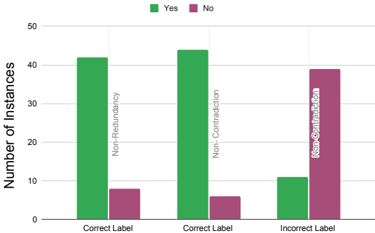
Redundancy: the sentence contains redundant or repeated information;
Contradiction: the sentence contains any pieces of information that are contradicting the given observation O 2 or not;
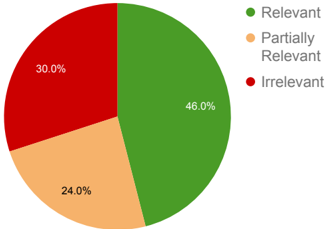
Relevance: the possible next event is i) relevant, ii) partially relevant, or iii) not relevant.
For each aspect, they are asked to judge the sentence generated for the correct hypothesis 12 . Only for Contradiction , they are asked to judge both sentences, for correct and the incorrect hypotheses.
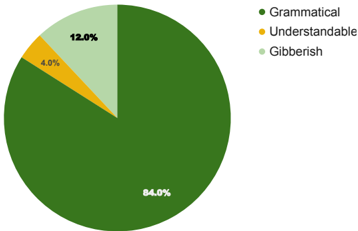
Results and Discussion. Figures 5, 7, and 6 present the results of manual evaluations of the generation quality, according to the different criteria described above.
12 The correct hypothesis was marked for the annotation.
Figure 5: Human evaluation of the grammaticality of generated sentences: ratio of i) grammatical, ii) not entirely grammatical but understandable, iii) completely not understandable sentences.
<details>
<summary>Image 5 Details</summary>
### Visual Description
## Chart Type: Pie Chart
### Overview
This image is a pie chart that displays the distribution of three categories: Grammatical, Understandable, and Gibberish. The chart visually represents the percentage of each category, with Grammatical dominating the pie.
### Components/Axes
* **Categories:**
* Grammatical (represented by dark green)
* Understandable (represented by yellow)
* Gibberish (represented by light green)
* **Percentages:** The percentages are displayed directly on the pie chart slices.
* **Legend:** Located in the top-right corner, the legend maps the colors to the categories.
### Detailed Analysis
* **Grammatical:** The dark green slice occupies the largest portion of the pie chart, accounting for 84.0%.
* **Understandable:** The yellow slice is the smallest, representing 4.0%.
* **Gibberish:** The light green slice accounts for 12.0%.
### Key Observations
* The vast majority of the data falls into the "Grammatical" category.
* "Understandable" has the smallest representation.
* "Gibberish" makes up a small but noticeable portion.
### Interpretation
The pie chart suggests that the majority of the data being analyzed is grammatically correct. A small fraction is understandable, and a slightly larger fraction is gibberish. This could indicate a high level of accuracy or quality in the data, with only minor issues related to comprehensibility or meaninglessness. The dominance of the "Grammatical" category implies that the data is well-structured from a linguistic perspective.
</details>
Figure 6: Human evaluation of the Relevance of generated sentences for possible next events.
<details>
<summary>Image 6 Details</summary>
### Visual Description
## Pie Chart: Relevance Distribution
### Overview
The image is a pie chart illustrating the distribution of relevance across three categories: Relevant, Partially Relevant, and Irrelevant. The chart shows the percentage of each category.
### Components/Axes
* **Categories:**
* Relevant (Green)
* Partially Relevant (Light Orange)
* Irrelevant (Red)
* **Percentages:**
* Relevant: 46.0%
* Partially Relevant: 24.0%
* Irrelevant: 30.0%
* **Legend:** Located on the top-right of the chart.
### Detailed Analysis
* **Relevant (Green):** The largest slice of the pie chart, representing 46.0% of the total.
* **Partially Relevant (Light Orange):** The second largest slice, representing 24.0% of the total.
* **Irrelevant (Red):** The smallest slice, representing 30.0% of the total.
### Key Observations
* The "Relevant" category constitutes the largest portion of the pie chart.
* The "Irrelevant" category is slightly larger than the "Partially Relevant" category.
### Interpretation
The pie chart indicates that nearly half (46.0%) of the items assessed are considered "Relevant." A significant portion (30.0%) is deemed "Irrelevant," while almost a quarter (24.0%) are "Partially Relevant." This suggests that while a substantial amount is directly applicable, a considerable portion is not, and a smaller fraction has some degree of relevance.
</details>
For measuring inter-annotator agreement, we computed Krippendorff's α (Hayes and Krippendorff, 2007) for Grammaticality and Relevance , as it is suited for ordinal values, and Cohen's Kappa κ for Redundancy and Contradiction . We found α values are 0 . 587 and 0 . 462 for Grammaticality and Relevance , respectively (moderate agreement) and κ values 0 . 61 and 0 . 74 for Redundancy and Contradiction (substantial agreement). We aggregated the annotations from the three annotators using majority vote. Figure 5 shows that the majority of sentences ( 96 %) are grammatical or understandable. Figure 7 shows that most sentences for correct labels are non-redundant ( 84 %) and noncontradictory ( 88 %), whereas for incorrect labels 39 instances are found to be contradictory with the observation O 2 ( 78 %). The manual evaluation supports our hypothesis that the generated sentences for correct labels should be more similar (less contradictory) compared to the sentences generated for incorrect labels. Figure 6 shows the ratio of sentences considered by humans as relevant, partially relevant, and irrelevant. The results show that 46 % of cases are relevant (based on majority agreement) and 24 %of cases are partially relevant. This yields that the generated sentences are (partially) relevant
Figure 7: Human evaluation of Redundancy and Contradiction of generations for possible next events.
<details>
<summary>Image 7 Details</summary>
### Visual Description
## Bar Chart: Label Correctness vs. Redundancy/Contradiction
### Overview
The image is a bar chart comparing the number of instances of "Yes" and "No" responses across three categories: "Correct Label" with "Non-Redundancy", "Correct Label" with "Non-Contradiction", and "Incorrect Label" with "Non-Contradiction". The chart visually represents the distribution of these responses.
### Components/Axes
* **Y-axis:** "Number of Instances", ranging from 0 to 50 in increments of 10.
* **X-axis:** Categorical, with three categories:
* "Correct Label" with "Non-Redundancy"
* "Correct Label" with "Non-Contradiction"
* "Incorrect Label" with "Non-Contradiction"
* **Legend:** Located at the top of the chart.
* Green: "Yes"
* Purple: "No"
### Detailed Analysis
* **Correct Label - Non-Redundancy:**
* "Yes" (Green): Approximately 42 instances.
* "No" (Purple): Approximately 8 instances.
* **Correct Label - Non-Contradiction:**
* "Yes" (Green): Approximately 44 instances.
* "No" (Purple): Approximately 6 instances.
* **Incorrect Label - Non-Contradiction:**
* "Yes" (Green): Approximately 11 instances.
* "No" (Purple): Approximately 39 instances.
### Key Observations
* For both "Correct Label" categories ("Non-Redundancy" and "Non-Contradiction"), the number of "Yes" instances is significantly higher than "No" instances.
* For the "Incorrect Label - Non-Contradiction" category, the number of "No" instances is significantly higher than "Yes" instances.
### Interpretation
The data suggests that when labels are correct, there is a higher likelihood of a "Yes" response, indicating agreement or confirmation. Conversely, when labels are incorrect, there is a higher likelihood of a "No" response, indicating disagreement or rejection. This highlights the importance of correct labeling in eliciting positive responses or agreement. The large difference in "Yes" vs "No" for the "Incorrect Label" category suggests a strong negative correlation between incorrect labels and positive responses.
</details>
in most cases and thus should support abduction for both unsupervised ( LM I + BERTScore) and supervised ( LM I + MTL ) models.
Impact of Reasoning types. Finally, to better assess the performance of our model, we determine what types of reasoning underly the abductive reasoning tasks in our data, and examine to what extent our models capture or not these reasoning types. We consider again the 50 instances that were annotated by our previous annotators and manually classify them into different reasoning types. We broadly divided the data into 6 categories: (i) Motivation, (ii) Spatial-Temporal, (iii) Emotional, (iv) Negation, (v) Reaction, (vi) Situational fact. The most frequent type was Emotional (10), most infrequent was Spatial (7). We ask a new annotator to annotate the reasoning types for these 50 instances. Considering the relevance and contradiction categories from the previous annotations we determine that for Negation ( 8 ), Emotional ( 10 ), and Reaction ( 8 ) all generated events for correct labels are partially or fully relevant and non-contradictory . An intuitive reason can be that we train our LM I model to learn how different counterfactual hypothetical events emerging from a single premise can lead to the same or different outcomes through a series of events. Some counterfactual events ( s ′ 2 ) are negations of the original event ( s 2 ) in the TIMETRAVEL dataset. This may support the reasoning class Negation. For the other categories: Motivation, Spatial-temporal, and Situational fact, we detect errors regarding (missing) Relevance in 21 %, 14 %and 28 %of cases, respectively. Table 6 illustrates an example from the class Situational Fact, where our generated next event is irrelevant and redundant .
- O 1 : Jenna hit the weight hard in the gym.
O 2 : She took a cold bath in order to alleviate her pain.
- H 1 : Her neck pain stopped because of this.
H 2 : Jenna pulled a muscle lifting weights.
O 1 2 : She decided to take a break .
H
O H 2 2 : Jenna lost weight in the gym.
Table 6: Error Analysis: An example of generated possible next event O H j 2 from Situational Fact category.
## 7 Related Work
Commonsense Reasoning. There is growing interest in this research field, which led to the creation of several new resources on commonsense reasoning, in form of both datasets , such as SocialIQA (Sap et al., 2019b), CommonsenseQA (Talmor et al., 2019), CosmosQA (Huang et al., 2019) and knowledge bases , e.g. ConceptNet (Speer et al., 2017), ATOMIC (Sap et al., 2019a), or Event2Mind (Rashkin et al., 2018). Recently, many works proposed to utilize external static knowledge graphs (KGs) to address the bottleneck of obtaining relevant commonsense knowledge. Lin et al. (2019) proposed to utilize knowledge graph embeddings to rank and select relevant knowledge triples or paths. Paul and Frank (2019) proposed to extract subgraphs from KGs using graph-based ranking methods and further Paul et al. (2020) adopted the graph-based ranking method and proposed to dynamically extend the KG to combat sparsity. In concurrent work, Paul and Frank (2021) introduced a method to dynamically generate contextually relevant knowledge that guides a model while performing the narrative story completion task.
Both hypothetical reasoning and abductive reasoning are understudied problems in NLP. Recently, Tandon et al. (2019) proposed a first large-scale dataset of 'What if... ' questions over procedural text. They introduced the dataset to study the effect of perturbations in procedural text. Related to our work, Qin et al. (2019) investigated the capabilities of state-of-the-art LMs to rewrite stories with counterfactual reasoning. In our work we utilize this dataset to model how to generate possible next events emerging from different hypothetical and counterfactual events. Mostafazadeh et al. (2016) designed the narrative cloze task, a task to choose the correct ending of a story. 13 Conversely, Bhagavatula et al. (2020) proposed a task that requires
13 Their dataset, ROCStories, was later extended in Qin et al. (2019) and Bhagavatula et al. (2020).
reasoning about plausible explanations for narrative omissions. Our research touches on the issue of hypothetical reasoning about alternative situations. We found that making language models learn how different hypothetical events can evolve from a premise and result in similar or different future events forming from a premise and how these events can result in similar or different future events helps models to perform better in abduction.
Explainability. Despite the success of large pretrained language models, recent studies have raised some critical points such as: high accuracy scores do not necessarily reflect understanding (Min et al., 2019), large pretrained models may exploit superficial clues and annotation artifacts (Gururangan et al., 2018; Kavumba et al., 2019). Therefore, the ability of models to generate explanations has become desirable, as this enhances interpretability. Recently, there has been substantial effort to build datasets with natural language explanations (Camburu et al., 2018; Park et al., 2018; Thayaparan et al., 2020). There have also been numerous research works proposing models that are interpretable or explainable (Rajani et al., 2019; Atanasova et al., 2020; Latcinnik and Berant, 2020; Wiegreffe and Marasovi´ c, 2021). Our work sheds light in this direction, as our MTL model not only predicts the plausible hypothesis H j but also generates possible next events O H j 2 and chooses the one that is closer to the given context, thereby making our model more expressive.
Abductive Reasoning. There has been longstanding work on theories of abductive reasoning (Peirce, 1903, 1965a,b; Kuipers, 1992, 2013). Researchers have applied various frameworks, some focused on pure logical frameworks (Pople, 1973; Kakas et al., 1992), some on probabilistic frameworks (Pearl, 1988), and others on Markov Logics (Singla and Mooney, 2011). Recently, moving away from logic-based abductive reasoning, Bhagavatula et al. (2020) proposed to study languagebased abductive reasoning. They introduced two tasks: Abductive Natural Language Inference ( α NLI) and Generation ( α NLG) . They establish baseline performance based on state-of-the-art language models and make use of inferential structured knowledge from ATOMIC (Sap et al., 2019a) as background knowledge. Zhu et al. (2020) proposed to use a learning-to-rank framework to address the abductive reasoning task. Ji et al. (2020)
proposed a model GRF that enables pre-trained models (GPT-2) with dynamic multi-hop reasoning on multi-relational paths extracted from the external ConceptNet commonsense knowledge graph for the α NLG task. Paul and Frank (2020) have proposed a multi-head knowledge attention method to incorporate commonsense knowledge to tackle the α NLI task. Unlike our previous work in Paul and Frank (2020), which focused on leveraging structured knowledge, in this work, we focus on learning about what will happen next from different counterfactual situations in a story context through language model fine-tuning. Specifically, we study the impact of such forward inference on the α NLI task in a multi-task learning framework and show how it can improve performance over a strong BERT model.
## 8 Conclusion
We have introduced a novel method for addressing the abductive reasoning task by explicitly learning what events could follow other events in a hypothetical scenario, and learning to generate such events, conditioned on a premise or hypothesis. We show how a language model - fine-tuned for this capability on a suitable narrative dataset - can be leveraged to support abductive reasoning in the α NLI tasks, in two settings: an unsupervised setting in combination with BertScore , to select the proper hypothesis, and a supervised setting in a MTL setting.
The relatively strong performance of our proposed models demonstrates that learning to choose from generated hypothetical next events the one that is most similar to the observation, supports the prediction of the most plausible hypothesis. Our experiments show that our unsupervised LM I + BERTScore model outperforms some of the strong supervised baseline systems on α NLI. Our research thus offers new perspectives for training generative models in different ways for various complex reasoning tasks.
## Acknowledgements
This work has been supported by the German Research Foundation as part of the Research Training Group 'Adaptive Preparation of Information from Heterogeneous Sources' (AIPHES) under grant No. GRK 1994/1. We thank our annotators for their valuable annotations. We also thank NVIDIA Corporation for donating GPUs used in this research.
## References
Pepa Atanasova, Jakob Grue Simonsen, Christina Lioma, and Isabelle Augenstein. 2020. Generating fact checking explanations. In Proceedings of the 58th Annual Meeting of the Association for Computational Linguistics , pages 7352-7364, Online. Association for Computational Linguistics.
- Chandra Bhagavatula, Ronan Le Bras, Chaitanya Malaviya, Keisuke Sakaguchi, Ari Holtzman, Hannah Rashkin, Doug Downey, Wen tau Yih, and Yejin Choi. 2020. Abductive commonsense reasoning. In International Conference on Learning Representations .
- M. Bhatt and G. Flanagan. 2010. Spatio-temporal abduction for scenario and narrative completion ( a preliminary statement). In ECAI .
Oana-Maria Camburu, Tim Rockt¨ aschel, Thomas Lukasiewicz, and Phil Blunsom. 2018. e-SNLI: Natural Language Inference with Natural Language Explanations. In S. Bengio, H. Wallach, H. Larochelle, K. Grauman, N. Cesa-Bianchi, and R. Garnett, editors, Advances in Neural Information Processing Systems 31 , pages 9539-9549. Curran Associates, Inc.
Qian Chen, Xiaodan Zhu, Zhen-Hua Ling, Si Wei, Hui Jiang, and Diana Inkpen. 2017. Enhanced LSTM for natural language inference. In Proceedings of the 55th Annual Meeting of the Association for Computational Linguistics (Volume 1: Long Papers) , pages 1657-1668, Vancouver, Canada. Association for Computational Linguistics.
Alexis Conneau, Douwe Kiela, Holger Schwenk, Lo¨ ıc Barrault, and Antoine Bordes. 2017. Supervised learning of universal sentence representations from natural language inference data. In Proceedings of the 2017 Conference on Empirical Methods in Natural Language Processing , pages 670-680, Copenhagen, Denmark. Association for Computational Linguistics.
Jacob Devlin, Ming-Wei Chang, Kenton Lee, and Kristina Toutanova. 2019. BERT: Pre-training of deep bidirectional transformers for language understanding. In Proceedings of the 2019 Conference of the North American Chapter of the Association for Computational Linguistics: Human Language Technologies, Volume 1 (Long and Short Papers) , pages 4171-4186, Minneapolis, Minnesota. Association for Computational Linguistics.
Igor Douven. 2017. Abduction. In Edward N. Zalta, editor, The Stanford Encyclopedia of Philosophy , summer 2017 edition. Metaphysics Research Lab, Stanford University.
Suchin Gururangan, Swabha Swayamdipta, Omer Levy, Roy Schwartz, Samuel Bowman, and Noah A Smith. 2018. Annotation artifacts in natural language inference data. In Proceedings of the 2018 Conference of the North American Chapter of the
- Association for Computational Linguistics: Human Language Technologies, Volume 2 (Short Papers) , pages 107-112.
- A. Hayes and K. Krippendorff. 2007. Answering the call for a standard reliability measure for coding data. Communication Methods and Measures , 1:77 - 89.
- Lifu Huang, Ronan Le Bras, Chandra Bhagavatula, and Yejin Choi. 2019. Cosmos QA: Machine reading comprehension with contextual commonsense reasoning. In Proceedings of the 2019 Conference on Empirical Methods in Natural Language Processing and the 9th International Joint Conference on Natural Language Processing (EMNLP-IJCNLP) , pages 2391-2401, Hong Kong, China. Association for Computational Linguistics.
- Haozhe Ji, Pei Ke, Shaohan Huang, Furu Wei, Xiaoyan Zhu, and Minlie Huang. 2020. Language generation with multi-hop reasoning on commonsense knowledge graph. In Proceedings of the 2020 Conference on Empirical Methods in Natural Language Processing (EMNLP) , pages 725-736, Online. Association for Computational Linguistics.
- Antonis C Kakas, Robert A. Kowalski, and Francesca Toni. 1992. Abductive logic programming. Journal of logic and computation , 2(6):719-770.
- Pride Kavumba, Naoya Inoue, Benjamin Heinzerling, Keshav Singh, Paul Reisert, and Kentaro Inui. 2019. When Choosing Plausible Alternatives, Clever Hans can be Clever. In Proceedings of the First Workshop on Commonsense Inference in Natural Language Processing , pages 33-42, Hong Kong, China. Association for Computational Linguistics.
- Theo AF Kuipers. 1992. Naive and refined truth approximation. Synthese , 93(3):299-341.
- Theo AF Kuipers. 2013. From instrumentalism to constructive realism: On some relations between confirmation, empirical progress, and truth approximation , volume 287. Springer Science & Business Media.
- Veronica Latcinnik and Jonathan Berant. 2020. Explaining question answering models through text generation. arXiv preprint arXiv:2004.05569 .
- Bill Yuchen Lin, Xinyue Chen, Jamin Chen, and Xiang Ren. 2019. Kagnet: Knowledge-aware graph networks for commonsense reasoning. In Proceedings of the 2019 Conference on Empirical Methods in Natural Language Processing and the 9th International Joint Conference on Natural Language Processing (EMNLP-IJCNLP) , pages 2822-2832.
- Sewon Min, Eric Wallace, Sameer Singh, Matt Gardner, Hannaneh Hajishirzi, and Luke Zettlemoyer. 2019. Compositional questions do not necessitate multi-hop reasoning. In Proceedings of the 57th Annual Meeting of the Association for Computational Linguistics , pages 4249-4257, Florence, Italy. Association for Computational Linguistics.
- Nasrin Mostafazadeh, Nathanael Chambers, Xiaodong He, Devi Parikh, Dhruv Batra, Lucy Vanderwende, Pushmeet Kohli, and James Allen. 2016. A corpus and cloze evaluation for deeper understanding of commonsense stories. In Proceedings of the 2016 Conference of the North American Chapter of the Association for Computational Linguistics: Human Language Technologies , pages 839-849, San Diego, California. Association for Computational Linguistics.
- Dong Huk Park, L. Hendricks, Zeynep Akata, Anna Rohrbach, B. Schiele, T. Darrell, and M. Rohrbach. 2018. Multimodal explanations: Justifying decisions and pointing to the evidence. 2018 IEEE/CVF Conference on Computer Vision and Pattern Recognition , pages 8779-8788.
- Debjit Paul and Anette Frank. 2019. Ranking and selecting multi-hop knowledge paths to better predict human needs. In Proceedings of the 2019 Conference of the North American Chapter of the Association for Computational Linguistics: Human Language Technologies, Volume 1 (Long and Short Papers) , pages 3671-3681, Minneapolis, Minnesota. Association for Computational Linguistics.
- Debjit Paul and Anette Frank. 2020. Social commonsense reasoning with multi-head knowledge attention. In Findings of the Association for Computational Linguistics: EMNLP 2020 , pages 2969-2980, Online. Association for Computational Linguistics.
- Debjit Paul and Anette Frank. 2021. COINS: Dynamically Generating COntextualized Inference Rules for Narrative Story Completion. In Proceedings of the Joint Conference of the 59th Annual Meeting of the Association for Computational Linguistics and the 11th International Joint Conference on Natural Language Processing (ACL-IJCNLP 2021) , Online. Association for Computational Linguistics. Long Paper.
- Debjit Paul, Juri Opitz, Maria Becker, Jonathan Kobbe, Graeme Hirst, and Anette Frank. 2020. Argumentative Relation Classification with Background Knowledge. In Proceedings of the 8th International Conference on Computational Models of Argument (COMMA 2020) , volume 326 of Frontiers in Artificial Intelligence and Applications , pages 319-330. Computational Models of Argument.
- Judea Pearl. 1988. Probabilistic Reasoning in Intelligent Systems: Networks of Plausible Inference . Morgan Kaufmann Publishers Inc., CA.
- C. S. Peirce. 1903. Pragmatism as the Logic of Abduction . https://www.textlog.de/7663.html .
- Charles Sanders Peirce. 1965a. Collected papers of Charles Sanders Peirce , volume 5. Harvard University Press. http://www.hup.harvard.edu/ catalog.php?isbn=9780674138001 .
- Charles Sanders Peirce. 1965b. Pragmatism and pragmaticism , volume 5. Belknap Press of Harvard University Press. https://www.jstor.org/ stable/224970 .
- Harry E Pople. 1973. On the mechanization of abductive logic. In Proceedings of the 3rd international joint conference on Artificial intelligence , pages 147-152.
- Lianhui Qin, Antoine Bosselut, Ari Holtzman, Chandra Bhagavatula, Elizabeth Clark, and Yejin Choi. 2019. Counterfactual story reasoning and generation. In 2019 Conference on Empirical Methods in Natural Language Processing. , Hongkong, China. Association for Computational Linguistics.
- Alec Radford, Jeff Wu, Rewon Child, David Luan, Dario Amodei, and Ilya Sutskever. 2019. Language models are unsupervised multitask learners.
- Nazneen Fatema Rajani, Bryan McCann, Caiming Xiong, and Richard Socher. 2019. Explain yourself! leveraging language models for commonsense reasoning. In Proceedings of the 57th Annual Meeting of the Association for Computational Linguistics , pages 4932-4942, Florence, Italy. Association for Computational Linguistics.
- Hannah Rashkin, Maarten Sap, Emily Allaway, Noah A. Smith, and Yejin Choi. 2018. Event2Mind: Commonsense inference on events, intents, and reactions. In Proceedings of the 56th Annual Meeting of the Association for Computational Linguistics (Volume 1: Long Papers) , pages 463-473, Melbourne, Australia. Association for Computational Linguistics.
- Sebastian Ruder. 2019. Neural transfer learning for natural language processing . Ph.D. thesis, NUI Galway.
- Maarten Sap, Ronan Le Bras, Emily Allaway, Chandra Bhagavatula, Nicholas Lourie, Hannah Rashkin, Brendan Roof, Noah A. Smith, and Yejin Choi. 2019a. ATOMIC: an atlas of machine commonsense for if-then reasoning. In The Thirty-Third AAAI Conference on Artificial Intelligence, AAAI 2019, The Thirty-First Innovative Applications of Artificial Intelligence Conference, IAAI 2019, The Ninth AAAI Symposium on Educational Advances in Artificial Intelligence, EAAI 2019, Honolulu, Hawaii, USA, January 27 - February 1, 2019. , pages 3027-3035.
- Maarten Sap, Hannah Rashkin, Derek Chen, Ronan Le Bras, and Yejin Choi. 2019b. Social IQa: Commonsense reasoning about social interactions. In Proceedings of the 2019 Conference on Empirical Methods in Natural Language Processing and the 9th International Joint Conference on Natural Language Processing (EMNLP-IJCNLP) , pages 44634473, Hong Kong, China. Association for Computational Linguistics.
- Parag Singla and Raymond J Mooney. 2011. Abductive markov logic for plan recognition. In TwentyFifth AAAI Conference on Artificial Intelligence .
- Robyn Speer, Joshua Chin, and Catherine Havasi. 2017. Conceptnet 5.5: An open multilingual graph of general knowledge. In Thirty-First AAAI Conference on Artificial Intelligence .
- Christian Strasser and G. Aldo Antonelli. 2019. Nonmonotonic logic. In Edward N. Zalta, editor, The Stanford Encyclopedia of Philosophy , summer 2019 edition. Metaphysics Research Lab, Stanford University.
- Alon Talmor, Jonathan Herzig, Nicholas Lourie, and Jonathan Berant. 2019. CommonsenseQA: A question answering challenge targeting commonsense knowledge. In Proceedings of the 2019 Conference of the North American Chapter of the Association for Computational Linguistics: Human Language Technologies, Volume 1 (Long and Short Papers) , pages 4149-4158, Minneapolis, Minnesota. Association for Computational Linguistics.
- Niket Tandon, Bhavana Dalvi, Keisuke Sakaguchi, Peter Clark, and Antoine Bosselut. 2019. WIQA: A dataset for 'what if...' reasoning over procedural text. In Proceedings of the 2019 Conference on Empirical Methods in Natural Language Processing and the 9th International Joint Conference on Natural Language Processing (EMNLP-IJCNLP) , pages 6076-6085, Hong Kong, China. Association for Computational Linguistics.
- Mokanarangan Thayaparan, Marco Valentino, and Andr´ e Freitas. 2020. A survey on explainability in machine reading comprehension. arXiv preprint arXiv:2010.00389 .
- Sarah Wiegreffe and Ana Marasovi´ c. 2021. Teach me to explain: A review of datasets for explainable nlp. ArXiv:2102.12060.
- Tianyi Zhang, Varsha Kishore, Felix Wu, Kilian Q. Weinberger, and Yoav Artzi. 2020. BERTScore: Evaluating Text Generation with BERT. In International Conference on Learning Representations .
- Yunchang Zhu, Liang Pang, Yanyan Lan, and Xueqi Cheng. 2020. l 2 r 2 : Leveraging ranking for abductive reasoning. In Proceedings of the 43rd International ACM SIGIR Conference on Research and Development in Information Retrieval , SIGIR '20, page 1961-1964, New York, NY, USA. Association for Computing Machinery.