## Probabilistic computing with p-bits
Jan Kaiser 1, a) and Supriyo Datta 1
Elmore Family School of Electrical and Computer Engineering, Purdue University, West Lafayette, IN, 47906 USA
(Dated: 14 October 2021)
Digital computers store information in the form of bits that can take on one of two values 0 and 1, while quantum computers are based on qubits that are described by a complex wavefunction whose squared magnitude gives the probability of measuring either a 0 or a 1. Here we make the case for a probabilistic computer based on p-bits which take on values 0 and 1 with controlled probabilities and can be implemented with specialized compact energy-efficient hardware. We propose a generic architecture for such p-computers and emulate systems with thousands of p-bits to show that they can significantly accelerate randomized algorithms used in a wide variety of applications including but not limited to Bayesian networks, optimization, Ising models and quantum Monte Carlo.
## I. INTRODUCTION
Feynman 1 famously remarked 'Nature isn't classical, dammit, and if you want to make a simulation of nature, you'd better make it quantum mechanical' . In the same spirit we could say 'Many real life problems are not deterministic, and if you want to simulate them, you'd better make it probabilistic' . But there is a difference. Quantum algorithms require quantum hardware and this has motivated a worldwide effort to develop a new appropriate technology. By contrast probabilistic algorithms can be and are implemented on existing deterministic hardware using pseudo RNG's (random number generators). Monte Carlo algorithms represent one of the top ten algorithms of the 20 th century 2 and are used in a broad range of problems including Bayesian learning, protein folding, optimization, stock option pricing, cryptography just to name a few. So why do we need a p-computer ?
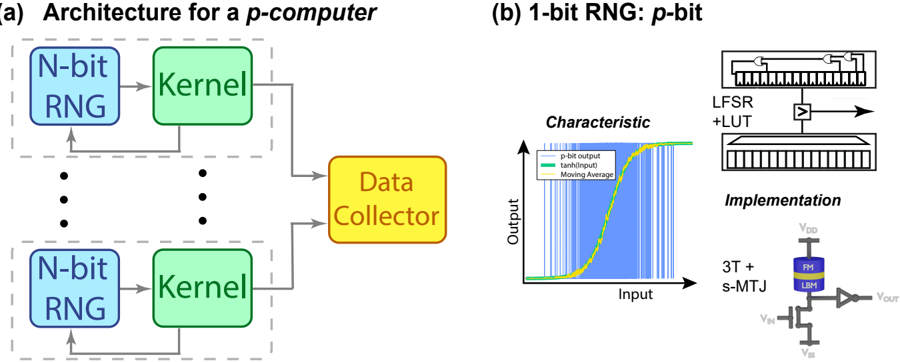
A key element in a Monte Carlo algorithm is the RNG which requires thousands of transistors to implement with deterministic elements, thus encouraging the use of architectures that time share a few RNG's. Our work has shown the possibility of high quality true RNG's using just three transistors 3 , prompting us to explore a different architecture that makes use of large numbers of controlled-RNG's or p-bits . Fig. 1 (a) 4 shows a generic vision for a probabilistic or a p-computer having two primary components: an N-bit random number generator (RNG) that generates N-bit samples and a Kernel that performs deterministic operations on them. Note that each RNG-Kernel unit could include multiple RNGKernel sub-units (not shown) for problems that can benefit from it. These sub-units could be connected in series as in Bayesian networks (Fig. 2 (a) or in parallel as done in parallel tempering 5,6 or for problems that allow graph coloring 7 . The parallel RNG-Kernel units shown in Fig. 1 (a) are intended to perform easily parallelizable operations like ensemble sums using a data collector unit to combine all outputs into a single consolidated output.
a) kaiser32@purdue.edu
Ideally the Kernel and data collector are pipelined so that they can continually accept new random numbers from the RNG 4 , which is assumed to be fast and available in numerous numbers. The p-computer can then provide N p f c samples per second, N p being the number of parallel units 9 , and f c the clock frequency. We argue that even with N p = 1, this throughput is well in excess of what is achieved with standard implementations on either CPU (central processing unit) or GPU (graphics processing unit) for a broad range of applications and algorithms including but not limited to those targeted by modern digital annealers or Ising solvers 8,10-17 . Interestingly, a p-computer also provides a conceptual bridge to quantum computing, sharing many characteristics that we associate with the latter 18 . Indeed it can implement algorithms intended for quantum computers, though the effectiveness of quantum Monte Carlo depends strongly on the extent of the so-called sign problem specific to the algorithm and our ability to 'tame' it 19 .
## II. IMPLEMENTATION
Of the three elements in Fig. 1, two are deterministic . The Kernel is problem-specific ranging from simple operations like addition or multiplication to more elaborate operations that could justify special purpose chiplets 20 . Matrix multiplication for example could be implemented using analog options like resistive crossbars 16,21-23 . The data collector typically involves addition and could be implemented with adder trees. The third element is probabilistic , namely the N-bit RNG which is a collection of N 1-bit RNG's or p -bits . The behavior of each p -bit can be described by 24
$$s _ { i } = \Theta [ \, \sigma ( I _ { i } - r ) \, ] \quad \, ( 1 )$$
where s i is the binary p-bit output, Θ is the step function, σ is the sigmoid function, I i is the input to the p-bit and r is a uniform random number between 0 and 1. Eq. (1) is illustrated in Fig. 1 (b). While the p-bit output is always binary, the p-bit input I i influences the mean of the output sequence. With I i = 0, the output
FIG. 1. Probabilistic computer: (a) Overall architecture combining a probabilistic element (N-bit RNG) with deterministic elements (kernel and data collector). The N-bit RNG block is a collection of N 1-bit RNG's, or p-bits. (b) p-bit: Desired input-output characteristic along with two possible implementations, one with CMOS technology using linear feedback shift registers (LFSR's) and lookup tables (LUT's) 8 and the other using three transistors and a stochastic magnetic tunnel junction (s-MTJ) 3 . The first is used to obtain all the results presented here, while the second is a nascent technology with many unanswered questions.
<details>
<summary>Image 1 Details</summary>
### Visual Description
## Diagram: Architecture for a p-computer and 1-bit RNG
### Overview
The image presents two diagrams: (a) an architectural overview of a p-computer, and (b) a detailed view of a 1-bit RNG (Random Number Generator) with its characteristic curve and implementation. The diagrams illustrate the components and flow of data within these systems.
### Components/Axes
**Diagram (a): Architecture for a p-computer**
* **Components:** N-bit RNG, Kernel, Data Collector.
* **Connections:** Dotted lines indicate connections between N-bit RNGs and Kernels, and between Kernels and the Data Collector. Solid lines indicate connections between the Data Collector and the Kernels.
* **Labels:** "Architecture for a p-computer", "N-bit RNG", "Kernel", "Data Collector".
**Diagram (b): 1-bit RNG: p-bit**
* **Components:** LFSR + LUT, Characteristic Curve (plot), Implementation (circuit diagram with 3T + s-MTJ, PM, LBM, NM).
* **Axes (Characteristic Curve):**
* X-axis: "Input"
* Y-axis: "Output"
* **Legend (Characteristic Curve):**
* Blue Line: "p-bit output"
* Green Line: "tanh(Input)"
* Light Blue Shaded Area: "Moving Average"
* **Labels:** "1-bit RNG: p-bit", "Characteristic", "Implementation", "Vdd", "Vout", "Vin", "Vss".
### Detailed Analysis or Content Details
**Diagram (a): Architecture for a p-computer**
The diagram shows a parallel architecture. Multiple "N-bit RNG" blocks are connected to "Kernel" blocks. Each Kernel is then connected to a central "Data Collector". The dotted lines suggest a many-to-one connection from RNGs to Kernels, and from Kernels to the Data Collector. The solid lines from the Data Collector to the Kernels suggest a feedback or control mechanism. The number of N-bit RNGs and Kernels is not explicitly stated, but there are at least two of each visible.
**Diagram (b): 1-bit RNG: p-bit**
* **LFSR + LUT:** A block diagram representing a Linear Feedback Shift Register combined with a Look-Up Table. An arrow indicates data flow from left to right.
* **Characteristic Curve:** The curve shows the relationship between Input and Output.
* The "p-bit output" (blue line) starts near 0 for low input values, then rapidly transitions to 1 as the input increases. The transition appears to occur around an input value of approximately 0.5.
* The "tanh(Input)" (green line) is a sigmoid function, starting at approximately -1 for low input values and approaching 1 as the input increases. It crosses 0 at an input value of approximately 0.
* The "Moving Average" (light blue shaded area) represents a smoothed version of the p-bit output, showing a gradual transition from 0 to 1.
* **Implementation:** The circuit diagram shows a 3T + s-MTJ (Spin-Transfer Torque Magnetic Tunnel Junction) configuration with PM (P-channel MOSFET) and LBM (likely a Load Block MOSFET). The circuit is powered by Vdd and grounded by Vss. Vin is the input voltage, and Vout is the output voltage.
### Key Observations
* The p-computer architecture (a) emphasizes parallelism, utilizing multiple RNGs and Kernels.
* The 1-bit RNG (b) utilizes a non-linear characteristic curve (tanh) and a moving average to generate random bits.
* The implementation of the 1-bit RNG (b) uses a 3T + s-MTJ circuit, suggesting a hardware-based implementation.
* The characteristic curve shows a clear threshold effect, where the output switches from 0 to 1 within a narrow range of input values.
### Interpretation
The diagrams illustrate a system for generating random numbers. The p-computer architecture (a) suggests a parallel processing approach to enhance the speed and efficiency of random number generation. The 1-bit RNG (b) provides a detailed view of a specific implementation, utilizing a non-linear function and a hardware circuit to produce random bits. The tanh function and moving average likely contribute to the randomness and statistical properties of the generated bits. The use of an s-MTJ suggests a potential application in secure random number generation, as these devices are sensitive to physical noise. The feedback loop in diagram (a) could be used for error correction or to improve the quality of the random numbers. The overall system appears to be designed for high-performance and potentially secure random number generation.
</details>
is distributed 50 -50 between 0 and 1 and this may be adequate for many algorithms. But in general a nonzero I i determined by the current sample is necessary to generate desired probability distributions from the N-bit RNG -block.
One promising implementation of a p-bit is based on a stochastic magnetic tunnel junction (s-MTJ) as shown in Fig. 1 (b) whose resistance state fluctuates due to thermal noise. It is placed in series with a transistor, and the drain voltage is thresholded by an inverter 3 to obtain a random binary output bit whose average value can be tuned through the gate voltage V IN . It has been shown both theoretically 25,26 and experimentally 27,28 that sMTJ -based p-bits can be designed to generate new random numbers in times ∼ nanoseconds . The same circuit could also be used with other fluctuating resistors 29 , but one advantage of s-MTJ's is that they can be built by modifying magnetoresistive random access memory (MRAM) technology that has already reached gigabit levels of integration 30 .
Note, however, that the examples presented here all use p-bits implemented with deterministic CMOS elements or pseudo-RNG's using linear feedback shift registers (LFSR's) combined with lookup tables (LUT's) and thresholding elements 8 as shown in Fig. 1 (b). Such random numbers are not truly random, but have a period that is longer than the time range of interest. The longer the period, the more registers are needed to implement it. Typically a p-bit requires ∼ 1000 transistors 30 , the actual number depending on the quality of the pseudo RNG that is desired. Thirty-two stage LFSR's require ∼ 1200 transistors, while a Xoshiro128+ 31 would require around four times as many. Physics-based approaches, like s-MTJ's , naturally generate true random numbers with infinite repetition period and ideally require only 3 transistors and 1 MTJ.
A simple performance metric for p-computers is the ideal sampling rate N p f c mentioned above. The results presented here were all obtained with an fieldprogrammable gate array (FPGA) running on a 125 MHz clock, for which 1 /f c = 8 ns, which could be significantly shorter (even ∼ 0 . 1 ns 25 ) if implemented with s-MTJ's . Furthermore, s-MTJ's are compact and energy-efficient, allowing up to a factor of 100 larger N p for a given area and power budget. With an increase of f c and N p , a performance improvement by 2-3 orders of magnitude over the numbers presented here may be possible with s-MTJ's or other physics-based hardware.
We should point out that such compact p-bit implementations are still in their infancy 30 and many questions remain. First is the inevitable variation in RNG characteristics that can be expected. Initial studies suggest that it may be possible to train the Kernel to compensate for at least some of these variations 32,33 . Second is the quality of randomness, as measured by statistical quality tests which may require additional circuitry as discussed for example in Ref. 27 . Certain applications like simple integration (Section III A) may not need high quality random numbers, while others like Bayesian correlations (Section III B) or Metropolis-Hastings methods that require a proposal distribution (Section III C) may have more stringent requirements. Third is the possible difficulty associated with reading sub-nanosecond fluctuations in the output and communicating them faithfully. Finally, we note that the input to a p-bit is an analog quantity requiring Digital-to-Analog Converters (DAC's)
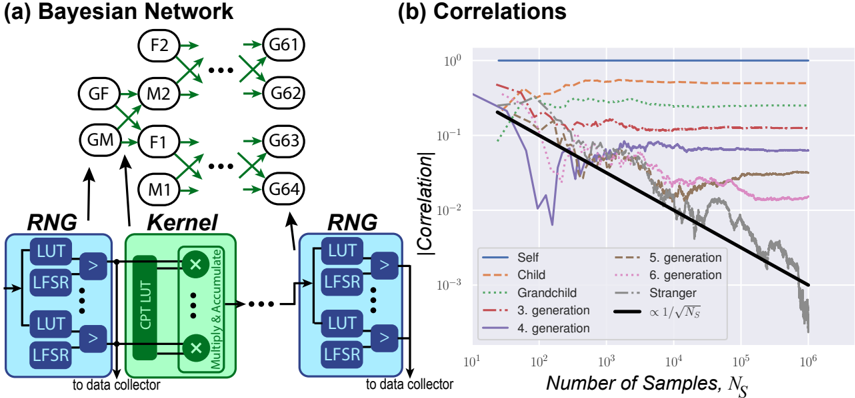
FIG. 2. Bayesian network for genetic relatedness mapped to a p-computer (a) with each node represented by one p-bit. With increasing N S , the correlations (b) between different nodes is obtained more accurately.
<details>
<summary>Image 2 Details</summary>
### Visual Description
\n
## Diagram & Chart: Bayesian Network and Correlations
### Overview
The image presents two related components: (a) a diagram of a Bayesian Network with a Random Number Generator (RNG) and Kernel, and (b) a chart illustrating correlations between samples generated by the network, plotted against the number of samples. The diagram shows the data flow from RNGs through a kernel to generate features, and the chart shows how the correlation between samples decreases as the number of samples increases.
### Components/Axes
**(a) Bayesian Network Diagram:**
* **RNG:** Two RNG blocks are present, labeled "RNG" and colored green. Each RNG contains:
* LUT (Lookup Table)
* LFSR (Linear Feedback Shift Register)
* CPT LUT (Conditional Probability Table Lookup Table)
* **Kernel:** A green block labeled "Kernel" containing multiple multiplication and accumulation operations (represented by 'x' symbols).
* **Bayesian Network Nodes:** A network of nodes labeled F1, F2, … F64, M1, M2, GF, GM. Nodes are connected by directed edges.
* **Data Flow:** Arrows indicate data flow from RNGs to the Kernel, and from the Kernel to the Bayesian Network nodes. An output path labeled "to data collector" is shown for both RNGs.
**(b) Correlations Chart:**
* **X-axis:** "Number of Samples, N<sub>s</sub>" on a logarithmic scale from 10<sup>1</sup> to 10<sup>6</sup>.
* **Y-axis:** "|Correlation|" on a logarithmic scale from 10<sup>-3</sup> to 10<sup>0</sup>.
* **Legend:** Located in the top-right corner, with the following lines and corresponding colors:
* Self (Blue) - Solid line
* Child (Purple) - Dashed line
* Grandchild (Pink) - Dashed-dotted line
* Stranger (Gray) - Solid line
* 3. generation (Orange) - Dashed line
* 4. generation (Red) - Dashed-dotted line
* 5. generation (Brown) - Dotted line
* 6. generation (Teal) - Dotted line
* α 1/√N<sub>s</sub> (Black) - Solid line
### Detailed Analysis or Content Details
**(a) Bayesian Network Diagram:**
The diagram illustrates a system where two RNGs feed into a Kernel. The Kernel performs multiplication and accumulation operations on the RNG outputs. The Kernel's output then influences the Bayesian Network nodes (F1-F64, M1-M2, GF, GM). The network structure suggests a hierarchical relationship between the nodes, with directed edges indicating dependencies. The RNGs provide the initial randomness, the Kernel processes it, and the Bayesian Network models the relationships between the features.
**(b) Correlations Chart:**
* **Self:** Starts at approximately |Correlation| = 0.9, and decreases rapidly to approximately |Correlation| = 0.01 at N<sub>s</sub> = 10<sup>6</sup>.
* **Child:** Starts at approximately |Correlation| = 0.4, and decreases rapidly to approximately |Correlation| = 0.005 at N<sub>s</sub> = 10<sup>6</sup>.
* **Grandchild:** Starts at approximately |Correlation| = 0.2, and decreases to approximately |Correlation| = 0.003 at N<sub>s</sub> = 10<sup>6</sup>.
* **Stranger:** Starts at approximately |Correlation| = 0.1, and decreases to approximately |Correlation| = 0.002 at N<sub>s</sub> = 10<sup>6</sup>.
* **3. generation:** Starts at approximately |Correlation| = 0.05, and decreases to approximately |Correlation| = 0.001 at N<sub>s</sub> = 10<sup>6</sup>.
* **4. generation:** Starts at approximately |Correlation| = 0.03, and decreases to approximately |Correlation| = 0.001 at N<sub>s</sub> = 10<sup>6</sup>.
* **5. generation:** Starts at approximately |Correlation| = 0.02, and decreases to approximately |Correlation| = 0.001 at N<sub>s</sub> = 10<sup>6</sup>.
* **6. generation:** Starts at approximately |Correlation| = 0.015, and decreases to approximately |Correlation| = 0.001 at N<sub>s</sub> = 10<sup>6</sup>.
* **α 1/√N<sub>s</sub>:** A black line representing the theoretical decay rate of correlation with increasing sample size. It starts at approximately |Correlation| = 1 at N<sub>s</sub> = 10<sup>1</sup> and decreases to approximately |Correlation| = 0.001 at N<sub>s</sub> = 10<sup>6</sup>.
All lines exhibit a decreasing trend, indicating that the correlation between samples diminishes as the number of samples increases. The "Self" correlation decays the fastest, followed by "Child", "Grandchild", and "Stranger". The correlations for generations 3-6 are lower and decay more slowly. The experimental data closely follows the theoretical decay rate (α 1/√N<sub>s</sub>).
### Key Observations
* The correlation between samples generated by the Bayesian Network decreases as the number of samples increases, following an inverse square root relationship.
* The correlation is highest for "Self" (a sample compared to itself), and decreases with increasing generational distance ("Child", "Grandchild", "Stranger").
* The experimental data aligns well with the theoretical prediction of correlation decay.
* The logarithmic scales on both axes emphasize the rapid initial decay of correlation and the slower decay at higher sample sizes.
### Interpretation
The diagram and chart demonstrate the effectiveness of the Bayesian Network and RNG system in generating uncorrelated samples. The decreasing correlation with increasing sample size indicates that the system produces statistically independent outputs. The alignment between the experimental data and the theoretical decay rate (α 1/√N<sub>s</sub>) validates the system's design and confirms its ability to generate high-quality random samples. The hierarchical structure of the Bayesian Network, combined with the randomness provided by the RNGs, ensures that the generated samples are not simply copies of each other but rather represent diverse and independent outcomes. The different correlation levels for different generations suggest that the influence of the initial random seed diminishes with each step in the network. This is crucial for applications requiring truly random and uncorrelated data, such as Monte Carlo simulations, cryptography, and machine learning.
</details>
unless the kernel itself is implemented with analog components.
## III. APPLICATIONS
## A. Simple integration
Avariety of problems such as high dimensional integration can be viewed as the evaluation of a sum over a very large number N of terms. The basic idea of the Monte Carlo method is to estimate the desired sum from a limited number N s of samples drawn from configurations α generated with probability q α :
$$M = \sum _ { \alpha = 1 } ^ { N } m _ { \alpha } \approx \frac { 1 } { N _ { S } } \sum _ { \alpha = 1 } ^ { N _ { S } } \frac { m _ { \alpha } } { q _ { \alpha } } \quad ( 2 ) \quad H o n$$
The distribution { q } can be uniform or could be cleverly chosen to minimize the standard deviation of the estimate 34 . In any case the standard deviation goes down as 1 / √ N s and all such applications could benefit from a p-computer to accelerate the collection of samples.
## B. Bayesian Network
A little more complicated application of a p-computer is to problems where random numbers are generated not according to a fixed distribution, but by a distribution determined by the outputs from a previous set of RNG ′ s . Consider for example the question of genetic relatedness in a family tree 35,36 with each layer representing one generation. Each generation in the network in Fig. 2 (a)
with N nodes can be mapped to a N-bit RNG -block feeding into a Kernel which stores the conditional probability table (CPT) relating it to the next generation. The correlation between different nodes in the network can be directly measured and an average over the samples computed to yield the correct genetic correlation as shown in Fig. 2 (b). Nodes separated by p generations have a correlation of 1 / 2 p . The measured absolute correlation between strangers goes down to zero as 1 / √ N s .
This is characteristic of Monte Carlo algorithms, namely, to obtain results with accuracy ε we need N s = 1 /ε 2 samples. The p-computer allows us to collect samples at the rate of N p f c = 125 MSamples per second if N p = 1 and f c = 125 MHz. This is about two orders of magnitude faster than what we get running the same algorithm on a Intel Xeon CPU.
How does it compare to deterministic algorithms run on CPU ? As Feynman noted in his seminal paper 1 , deterministic algorithms for problems of this type are very inefficient compared to probabilistic ones because of the need to integrate over all the unobserved nodes { x B } in order to calculate a property related to nodes { x A }
$$P _ { A } ( x _ { A } ) = \int d x _ { B } P ( x _ { A } , x _ { B } ) \quad \quad ( 3 )$$
By contrast, a p-computer can ignore all the irrelevant nodes { x b } and simply look at the relevant nodes { x A } . We used the example of genetic correlations because it is easy to relate to. But it is representative of a wide class of everyday problems involving nodes with oneway causal relationships extending from 'parent' nodes to 'child' nodes 37-39 , all of which could benefit from a p-computer .
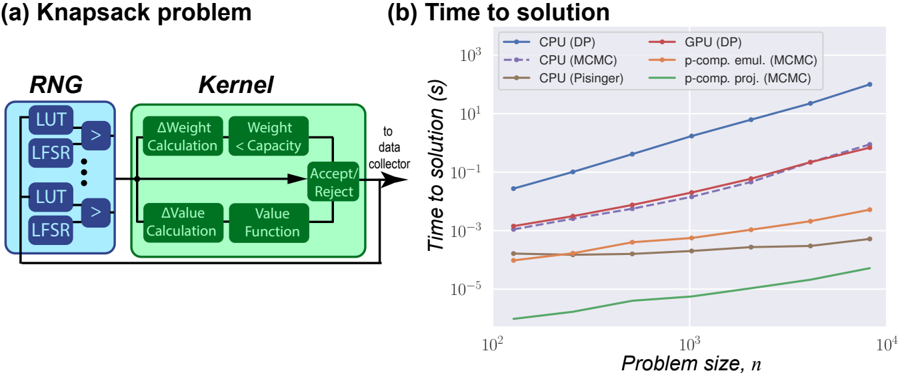
FIG. 3. Example of MCMC - Knapsack problem: (a) Mapping to the general p-computer framework. (b) Performance of the p-computer compared to CPU implementation of the same probabilistic algorithm and along with two well-known deterministic approaches. A deterministic algorithm like Pisinger's 40 which is optimized specifically for the Knapsack problem can outperform MCMC. But for a given MCMC algorithm, the p-computer provides orders of magnitude improvement over the standard CPU implementation.
<details>
<summary>Image 3 Details</summary>
### Visual Description
## Diagram & Chart: Knapsack Problem & Time to Solution
### Overview
The image presents a diagram illustrating the components of a Knapsack problem solver, alongside a chart showing the time to solution for different algorithms as a function of problem size. The diagram details the Random Number Generator (RNG) and Kernel components, while the chart compares the performance of CPU and GPU implementations using different methods.
### Components/Axes
**Diagram:**
* **Header:** "Knapsack problem"
* **Left Block:** "RNG" containing "LUT" and "LFSR" repeated multiple times. Arrows indicate flow.
* **Right Block:** "Kernel" containing "ΔWeight Calculation", "Weight < Capacity", "Accept/Reject", "ΔValue Calculation", "Value Function". Arrows indicate flow.
* **Connections:** Arrows connect the RNG to the Kernel for both weight and value calculations. An arrow leads from "Accept/Reject" to "to data collector".
**Chart:**
* **Title:** "Time to solution"
* **X-axis:** "Problem size, n" (logarithmic scale, ranging from 10<sup>2</sup> to 10<sup>4</sup>)
* **Y-axis:** "Time to solution (s)" (logarithmic scale, ranging from 10<sup>-5</sup> to 10<sup>1</sup>)
* **Legend (top-right):**
* Blue Solid Line: "CPU (DP)"
* Red Solid Line: "GPU (DP)"
* Orange Dashed Line: "CPU (MCMC)"
* Yellow Dashed Line: "p-comp. emul. (MCMC)"
* Green Solid Line: "CPU (Pisinger)"
* Teal Dashed Line: "p-comp. proj. (MCMC)"
### Detailed Analysis or Content Details
**Diagram:**
The diagram illustrates a system for solving the Knapsack problem. The "RNG" block generates random numbers using Look-Up Tables (LUTs) and Linear Feedback Shift Registers (LFSRs). These random numbers are fed into the "Kernel" block, where weight and value differences are calculated. The calculated weight is compared against the "Capacity". Based on this comparison, solutions are either "Accept"ed or "Reject"ed and sent to a "data collector".
**Chart:**
* **CPU (DP) (Blue Solid Line):** Starts at approximately 0.1 seconds at n=10<sup>2</sup>, increases steadily to approximately 10 seconds at n=10<sup>4</sup>. The line is nearly linear on this log-log scale.
* **GPU (DP) (Red Solid Line):** Starts at approximately 0.01 seconds at n=10<sup>2</sup>, increases to approximately 0.1 seconds at n=10<sup>4</sup>. The line is nearly linear on this log-log scale.
* **CPU (MCMC) (Orange Dashed Line):** Starts at approximately 0.001 seconds at n=10<sup>2</sup>, increases to approximately 0.01 seconds at n=10<sup>4</sup>. The line is relatively flat.
* **p-comp. emul. (MCMC) (Yellow Dashed Line):** Starts at approximately 0.0005 seconds at n=10<sup>2</sup>, increases to approximately 0.005 seconds at n=10<sup>4</sup>. The line is relatively flat.
* **CPU (Pisinger) (Green Solid Line):** Starts at approximately 0.00001 seconds at n=10<sup>2</sup>, increases to approximately 0.0001 seconds at n=10<sup>4</sup>. The line is nearly flat.
* **p-comp. proj. (MCMC) (Teal Dashed Line):** Starts at approximately 0.000005 seconds at n=10<sup>2</sup>, increases to approximately 0.00005 seconds at n=10<sup>4</sup>. The line is nearly flat.
### Key Observations
* The CPU (DP) method is significantly slower than all other methods, especially as the problem size increases.
* The GPU (DP) method is faster than the CPU (DP) method, but still slower than the MCMC-based methods.
* The MCMC-based methods (CPU (MCMC), p-comp. emul. (MCMC), CPU (Pisinger), and p-comp. proj. (MCMC)) exhibit relatively constant solution times regardless of problem size.
* The "p-comp. proj. (MCMC)" method is the fastest across all problem sizes.
* The chart uses a logarithmic scale for both axes, indicating a wide range of values.
### Interpretation
The data suggests that for solving the Knapsack problem, Dynamic Programming (DP) is computationally expensive and scales poorly with problem size. The GPU implementation of DP offers some improvement over the CPU implementation, but the performance is still limited. Markov Chain Monte Carlo (MCMC) methods, particularly the "p-comp. proj. (MCMC)" variant, provide a much more efficient solution, with solution times remaining relatively constant even as the problem size increases. This indicates that MCMC methods are better suited for large-scale Knapsack problems.
The diagram illustrates the underlying process of the Knapsack solver, highlighting the role of random number generation and the iterative acceptance/rejection process within the Kernel. The connection between the RNG and the Kernel suggests that the quality of the random numbers is crucial for the performance of the solver. The "Accept/Reject" step implies a probabilistic approach to finding optimal solutions, which is consistent with the use of MCMC methods. The "to data collector" arrow indicates that the accepted solutions are accumulated for analysis.
</details>
## C. Knapsack Problem
Let us now look at a problem which requires random numbers to be generated with a probability determined by the outcome from the last sample generated by the same RNG. Every RNG then requires feedback from the very Kernel that processes its output. This belongs to the broad class of problems that are labeled as Markov Chain Monte Carlo (MCMC) . For an excellent summary and evaluation of MCMC sampling techniques we refer the reader to Ref. 41 .
The knapsack is a textbook optimization problem described in terms of a set of items, m = 1 , · · N , the m th , each containing a value v m and weighing w m . The problem is to figure out which items to take ( s m = 1) and which to leave behind ( s m = 0) such that the total value V = ∑ m v m s m is a maximum, while keeping the total weight W = ∑ m w m s m below a capacity C . We could straightforwardly map it to the p -computer architecture (Fig. 1), using the RNG to propose solutions { s } at random, and the Kernel to evaluate V, W and decide to accept or reject. But this approach would take us toward the solution far too slowly. It is better to propose solutions intelligently looking at the previous accepted proposal, and making only a small change to it. For our examples we proposed a change of only two items each time.
This intelligent proposal, however, requires feedback from the kernel which can take multiple clock cycles. One could wait between proposals, but the solution is faster if instead we continue to make proposals every clock cycle in the spirit of what is referred to as multiple-try Metropolis 42 . The results are shown in Fig. 3 4 and compared with CPU (Intel Xeon @ 2.3GHz) and GPU (Tesla T4 @ 1.59GHz) implementations, using the probabilistic algorithm. Also shown are two efficient deterministic algorithms, one based on dynamic programming (DP), and one due to Pisinger et al. 40,43 .
Note that the probabilistic algorithm (MCMC) gives solutions that are within 1% of the correct solution, while the deterministic algorithms give the correct solution. For the Knapsack problem getting a solution that is 99% accurate should be sufficient for most real world applications. The p-computer provides orders of magnitude improvement over CPU implementation of the same MCMC algorithm. It is outperformed by the algorithm developed by Pisinger et al. 40,43 , which is specifically optimized for the Knapsack problem. However, we note that the pcomputer projection in Fig. 3 (b) is based on utilizing better hardware like s-MTJ's but there is also significant room for improvement of the p-computer by optimizing the Metropolis algorithm used here and/or by adding parallel tempering 5,6 .
## D. Ising model
Another widely used model for optimization within MCMC is based on the concept of Boltzmann machines (BM) defined by an energy function E from which one can calculate the synaptic function I i
$$I _ { i } = \beta ( E ( s _ { i } = 0 ) - E ( s _ { i } = 1 ) ) , \quad \ \ ( 4 )$$
that can be used to guide the sample generation from each RNG 'i' in sequence 44 according to Eq. (1). Alternatively the sample generation from each RNG
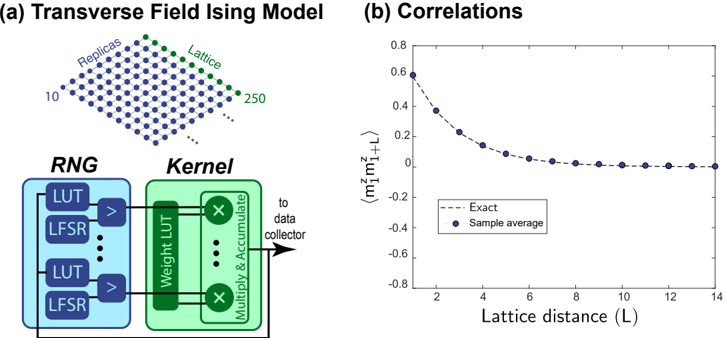
FIG. 4. Example of Quantum Monte Carlo (QMC) - Transverse Field Ising model: (a) Mapping to the general p-computer framework. (b) Solving the transverse Ising model for quantum annealing. Subfigure (b) is adapted from B. Sutton, R. Faria, L. A. Ghantasala, R. Jaiswal, K. Y. Camsari and S. Datta, IEEE Access, vol. 8, pp. 157238-157252, 2020 licensed under a Creative Commons Attribution (CC BY) license 8 .
<details>
<summary>Image 4 Details</summary>
### Visual Description
\n
## Diagram & Chart: Transverse Field Ising Model & Correlations
### Overview
The image presents two related components: (a) a diagram illustrating the structure of a Transverse Field Ising Model simulation, including a Random Number Generator (RNG) and Kernel, and (b) a chart displaying correlations as a function of lattice distance. The diagram shows the flow of data from the RNG to the Kernel, while the chart presents a comparison between exact calculations and sample averages of correlation values.
### Components/Axes
**(a) Diagram:**
* **RNG (Random Number Generator):** Composed of two LFSR (Linear Feedback Shift Register) blocks and two LUT (Lookup Table) blocks.
* **Kernel:** Contains a "Weight LUT" and "Multiply & Accumulate" blocks.
* **Replicas:** A diagonal axis labeled "Replicas" ranging from approximately 10 to 250.
* **Lattice:** A diagonal axis labeled "Lattice" ranging from approximately 10 to 250.
* **Arrows:** Indicate the flow of data from the RNG to the Kernel and then "to collector".
**(b) Chart:**
* **X-axis:** "Lattice distance (L)", ranging from 2 to 14.
* **Y-axis:** "(mᵢmᵢ₊₁₋L)", ranging from -0.8 to 0.8.
* **Legend:**
* "Exact" - Represented by a dashed black line.
* "Sample average" - Represented by blue circles.
### Detailed Analysis or Content Details
**(a) Diagram:**
The RNG section consists of two LFSR blocks connected to two LUT blocks via ">" symbols, likely representing a comparison or transformation. The output of the LUTs feeds into the Kernel. The Kernel contains a "Weight LUT" and a "Multiply & Accumulate" block, suggesting a weighted summation process. The output of the Kernel is directed "to collector". The diagonal axes labeled "Replicas" and "Lattice" suggest a simulation setup involving multiple replicas and a lattice structure. The axes are not linear, and the values are approximate.
**(b) Chart:**
The dashed black line ("Exact") starts at approximately 0.68 at L=2 and decreases rapidly, crossing the x-axis around L=4. It continues to decrease, approaching approximately -0.1 at L=14. The blue circles ("Sample average") follow a similar trend, starting at approximately 0.65 at L=2. The sample average line is more noisy than the exact line, but generally tracks the exact line. At L=2, the sample average is approximately 0.65. At L=4, the sample average is approximately 0.2. At L=6, the sample average is approximately -0.1. At L=8, the sample average is approximately -0.2. At L=10, the sample average is approximately -0.25. At L=12, the sample average is approximately -0.25. At L=14, the sample average is approximately -0.1.
### Key Observations
* The "Exact" and "Sample average" lines show a strong correlation, but the sample average exhibits more fluctuation.
* The correlation values decrease with increasing lattice distance, eventually becoming negative.
* The diagram suggests a computational setup for simulating the Transverse Field Ising Model, with a focus on generating random numbers and applying a kernel function.
* The diagonal axes in the diagram suggest a relationship between the number of replicas and the lattice size.
### Interpretation
The image illustrates a computational approach to studying the Transverse Field Ising Model. The diagram outlines the key components of the simulation, including a random number generator and a kernel function. The chart presents the results of the simulation, specifically the correlation between spins at different lattice distances. The decreasing correlation with increasing distance suggests that the system exhibits short-range order. The comparison between the "Exact" and "Sample average" lines indicates the accuracy of the simulation. The fluctuations in the "Sample average" line are likely due to statistical noise, which can be reduced by increasing the number of samples. The model is likely used to study phase transitions and critical phenomena in magnetic materials. The use of replicas suggests a technique to average over different configurations or disorder. The overall setup suggests a Monte Carlo simulation approach to solving the Ising model.
</details>
can be fixed and the synaptic function used to decide whether to accept or reject it within a MetropolisHastings framework 45 . Either way, samples will be generated with probabilities P α ∼ exp ( -βE α ). We can solve optimization problems by identifying E with the negative of the cost function that we are seeking to minimize. Using a large β we can ensure that the probability is nearly 1 for the configuration with the minimum value of E.
In principle, the energy function is arbitrary, but much of the work is based on quadratic energy functions defined by a connection matrix W ij and a bias vector h i (see for example 8,10-17 ):
$$E = - \sum _ { i j } W _ { i j } s _ { i } s _ { j } - \sum _ { i } h _ { i } s _ { i } , \quad ( 5 ) \quad o r a$$
For this quadratic energy function, Eq. (4) gives I i = β ( ∑ j W ij s j + h i ) , so that the Kernel has to perform a multiply and accumulate operation as shown in Fig. 4 (a). We refer the reader to Sutton et al. 8 for an example of the max-cut optimization problem on a two-dimensional 90 × 90 array implemented with a pcomputer .
Eq. (4), however, is more generally applicable even if the energy expression is more complicated, or given by a table. The Kernel can be modified accordingly. For an example of a energy function with fourth order terms implemented on an eight bit p-computer , we refer the reader to Borders et al. 30 .
A wide variety of problems can be mapped onto the BM with an appropriate choice of the energy function. For example, we could generate samples from a desired probability distribution P , by choosing βE = -nP . Another example is the implementation of logic gates by defining E to be zero for all { s } that belong to the truth table, and have some positive value for those that do not 24 . Unlike standard digital logic, such a BM-based implementation would provide invertible logic that not only provides the output for a given input, but also generates all possible inputs corresponding to a specified output 24,46,47 .
## E. Quantum Monte Carlo
Finally let us briefly describe the feasibility of using p-computers to emulate quantum or q-computers. A qcomputer is based on qubits that are neither 0 or 1, but are described by a complex wavefunction whose squared magnitude gives the probability of measuring either a 0 or a 1. The state of an n -qubit computer is described by a wavefunction { ψ } with 2 n complex components, one for each possible configuration of the n qubits.
In gate-based quantum computing (GQC) a set of qubits is placed in a known state at time t , operated on with d quantum gates to manipulate the wavefunction through unitary transformations [ U ( i ) ]
$$\begin{array} { r l r l } & { a p ^ { - } } & \\ & { \left \{ \psi ( t + d ) \right \} = [ U ^ { ( d ) } ] \cdots \cdots [ U ^ { ( 1 ) } ] \{ \psi ( t ) \} } & & { ( G Q C ) \ ( 6 ) } \\ \end{array}$$
and measurements are made to obtain results with probabilities given by the squared magnitudes of the final wavefunctions. From the rules of matrix multiplication, the final wavefunction can be written as a sum over a very large number of terms:
$$\psi _ { m } ( t + d ) = \sum _ { i , \cdot \cdot j , k } U _ { m , i } ^ { ( d ) } \cdots \cdots U _ { j , k } ^ { ( 1 ) } \, \psi _ { k } ( t ) \quad ( 7 )$$
Conceptually we could represent a system of n qubits and d gates with a system of ( n × d ) p-bits with 2 nd states which label the 2 nd terms in the summation in Eq.(7) 48 . Each of these terms is often referred to as a Feynman path and what we want is the sum of the amplitudes of
all such paths:
$$\psi _ { m } ( t + d ) = \sum _ { \alpha = 1 } ^ { 2 ^ { n d } } A _ { m } ^ { ( \alpha ) }$$
The essential idea of quantum Monte Carlo is to estimate this enormous sum from a few suitably chosen samples, not unlike the simple Monte Carlo stated earlier in Eq. (2). What makes it more difficult, however, is the socalled sign problem 19 which can be understood intuitively as follows. If all the quantities A ( α ) m are positive then it is relatively easy to estimate the sum from a few samples. But if some are positive while some are negative with lots of cancellations, then many more samples will be required. The same is true if the quantities are complex quantities that cancel each other.
The matrices U that appear in GQC are unitary with complex elements which often leads to significant cancellation of Feynman paths, except in special cases when there may be complete constructive interference. In general this could make it necessary to use large numbers of samples for accurate estimation. A noiseless quantum computer would not have this problem, since qubits intuitively perform the entire sum exactly and yield samples according to the squared magnitude of the resulting wavefunction. However, real world quantum computers have noise and p-computers could be competitive for many problems.
Adiabatic quantum computing (AQC) operates on very different physical principles but its mathematical description can also be viewed as summing the Feynman paths representing the multiplication of r matrices:
$$[ e ^ { - \beta H / r } ] \cdots \, \cdot \cdot [ e ^ { - \beta H / r } ] \quad ( A Q C ) \quad ( 9 )$$
This is based on the Suzuki-Trotter method described in Camsari et al. 49 , where the number of replicas, r , is chosen large enough to ensure that if H = H 1 + H 2 , one can approximately write e -βH/r ≈ e -βH 1 /r e -βH 2 /r . The matrices e -βH/r in AQC are Hermitian, and their elements can be all positive 50 . A special class of Hamiltonians H having this property is called stoquastic and there is no sign problem since the amplitudes A ( α ) m in the Feynman sum in Eq. (8) all have the same sign.
An example of such a stoquastic Hamiltonian is the transverse field Ising model (TFIM) commonly used for quantum annealing where a transverse field which is quantum in nature is introduced and slowly reduced to zero to recover the original classical problem. Fig. 4 adapted from Sutton et al. 8 , shows a n = 250 qubit problem mapped to a 2-D lattice of 250 × 10 = 2500 p-bits using r = 10 replicas to calculated average correlations between the z-directed spins on lattice sites separated by L . Very accurate results are obtained using N s = 10 5 samples. However,these samples were suitably spaced to ensure their independence, which is an important concern in problems involving feedback.
Finally we note that quantum Monte Carlo methods, both GQC and AQC, involve selective summing of Feynman paths to evaluate matrix products. As such we might expect conceptual overlap with the very active field of randomized algorithms for linear algebra 51,52 , though the two fields seem very distinct at this time.
## IV. CONCLUDING REMARKS
In summary, we have presented a generic architecture for a p-computer based on p-bits which take on values 0 and 1 with controlled probabilities, and can be implemented with specialized compact energy-efficient hardware. We emulate systems with thousands of p-bits to show that they can significantly accelerate the implementation of randomized algorithms that are widely used for many applications 53 . A few prototypical examples are presented such as Bayesian networks, optimization, Ising models and quantum Monte Carlo.
## ACKNOWLEDGMENTS
The authors are grateful to Behtash Behin-Aein for helpful discussions and advice. We also thank Kerem Camsari and Shuvro Chowdhury for their feedback on the manuscript. The contents are based on the work done over the last 5-10 years in our group, some of which has been cited here, and it is a pleasure to acknowledge all who have contributed to our understanding. This work was supported in part by ASCENT, one of six centers in JUMP, a Semiconductor Research Corporation (SRC) program sponsored by DARPA.
## DATA AVAILABILITY
The data that support the findings of this study are available from the corresponding author upon reasonable request.
## AUTHOR DECLARATIONS
## Conflict of interests
One of the authors (SD) has a financial interest in Ludwig Computing.
- 1 R. P. Feynman, 'Simulating physics with computers,' Int. J. Theor. Phys 21 (1982).
- 2 B. A. Cipra, 'The Best of the 20th Century: Editors Name Top 10 Algorithms,' SIAM News 33 , 1-2 (2000).
- 3 K. Y. Camsari, S. Salahuddin, and S. Datta, 'Implementing pbits with Embedded MTJ,' IEEE Electron Device Letters 38 , 1767-1770 (2017).
- 4 J. Kaiser, R. Jaiswal, B. Behin-Aein, and S. Datta, 'Benchmarking a Probabilistic Coprocessor,' arXiv:2109.14801 [cond-mat] (2021), arXiv:2109.14801 [cond-mat].
- 5 R. Swendsen and J.-S. Wang, 'Replica Monte Carlo Simulation of Spin-Glasses,' Physical review letters 57 , 2607-2609 (1986).
- 6 D. J. Earl and M. W. Deem, 'Parallel tempering: Theory, applications, and new perspectives,' Physical Chemistry Chemical Physics 7 , 3910-3916 (2005).
- 7 G. G. Ko, Y. Chai, R. A. Rutenbar, D. Brooks, and G.-Y. Wei, 'Accelerating Bayesian Inference on Structured Graphs Using Parallel Gibbs Sampling,' in 2019 29th International Conference on Field Programmable Logic and Applications (FPL) (IEEE, Barcelona, Spain, 2019) pp. 159-165.
- 8 B. Sutton, R. Faria, L. A. Ghantasala, R. Jaiswal, K. Y. Camsari, and S. Datta, 'Autonomous Probabilistic Coprocessing with Petaflips per Second,' IEEE Access , 1-1 (2020).
- 9 Here, we assume that every RNG-Kernel unit gives one sample per clock cycle. There could be cases where multiple samples could be extracted from one unit per clock cycle.
- 10 H. Goto, K. Tatsumura, and A. R. Dixon, 'Combinatorial optimization by simulating adiabatic bifurcations in nonlinear Hamiltonian systems,' Science Advances 5 , eaav2372 (2019).
- 11 M. Aramon, G. Rosenberg, E. Valiante, T. Miyazawa, H. Tamura, and H. G. Katzgraber, 'Physics-Inspired Optimization for Quadratic Unconstrained Problems Using a Digital Annealer,' Frontiers in Physics 7 (2019), 10.3389/fphy.2019.00048.
- 12 K. Yamamoto, K. Ando, N. Mertig, T. Takemoto, M. Yamaoka, H. Teramoto, A. Sakai, S. Takamaeda-Yamazaki, and M. Motomura, '7.3 STATICA: A 512-Spin 0.25M-Weight Full-Digital Annealing Processor with a Near-Memory All-Spin-Updates-atOnce Architecture for Combinatorial Optimization with Complete Spin-Spin Interactions,' in 2020 IEEE International SolidState Circuits Conference - (ISSCC) (IEEE, San Francisco, CA, USA, 2020) pp. 138-140.
- 13 M. Yamaoka, C. Yoshimura, M. Hayashi, T. Okuyama, H. Aoki, and H. Mizuno, '24.3 20k-spin Ising chip for combinational optimization problem with CMOS annealing,' in 2015 IEEE International Solid-State Circuits Conference - (ISSCC) Digest of Technical Papers (2015) pp. 1-3.
- 14 I. Ahmed, P.-W. Chiu, and C. H. Kim, 'A Probabilistic SelfAnnealing Compute Fabric Based on 560 Hexagonally Coupled Ring Oscillators for Solving Combinatorial Optimization Problems,' in 2020 IEEE Symposium on VLSI Circuits (IEEE, Honolulu, HI, USA, 2020) pp. 1-2.
- 15 S. Patel, L. Chen, P. Canoza, and S. Salahuddin, 'Ising Model Optimization Problems on a FPGA Accelerated Restricted Boltzmann Machine,' arXiv:2008.04436 [physics] (2020), arXiv:2008.04436 [physics].
- 16 F. Cai, S. Kumar, T. Van Vaerenbergh, X. Sheng, R. Liu, C. Li, Z. Liu, M. Foltin, S. Yu, Q. Xia, J. J. Yang, R. Beausoleil, W. D. Lu, and J. P. Strachan, 'Power-efficient combinatorial optimization using intrinsic noise in memristor Hopfield neural networks,' Nature Electronics 3 , 409-418 (2020).
- 17 S. Dutta, A. Khanna, A. S. Assoa, H. Paik, D. G. Schlom, Z. Toroczkai, A. Raychowdhury, and S. Datta, 'An Ising Hamiltonian solver based on coupled stochastic phase-transition nanooscillators,' Nature Electronics 4 , 502-512 (2021).
- 18 K. Camsari and S. Datta, 'Dialogue Concerning the Two Chief Computing Systems: Imagine yourself on a flight talking to an engineer about a scheme that straddles classical and quantum,' IEEE Spectrum 58 , 30-35 (2021).
- 19 M. Troyer and U.-J. Wiese, 'Computational Complexity and Fundamental Limitations to Fermionic Quantum Monte Carlo Simulations,' Physical Review Letters 94 , 170201 (2005).
- 20 T. Li, J. Hou, J. Yan, R. Liu, H. Yang, and Z. Sun, 'Chiplet Heterogeneous Integration Technology-Status and Challenges,' Electronics 9 , 670 (2020).
- 21 C. Liu, B. Yan, C. Yang, L. Song, Z. Li, B. Liu, Y. Chen, H. Li, Q. Wu, and H. Jiang, 'A spiking neuromorphic design with resistive crossbar,' in 2015 52nd ACM/EDAC/IEEE Design Automation Conference (DAC) (IEEE, 2015) pp. 1-6.
- 22 B. Li, Y. Shan, M. Hu, Y. Wang, Y. Chen, and H. Yang, 'Memristor-based approximated computation,' in International Symposium on Low Power Electronics and Design (ISLPED) (IEEE, 2013) pp. 242-247.
23 M. Demler, 'MYTHIC MULTIPLIES IN A FLASH,' , 3 (2018).
- 24 K. Y. Camsari, R. Faria, B. M. Sutton, and S. Datta, 'Stochastic p -Bits for Invertible Logic,' Physical Review X 7 (2017), 10.1103/PhysRevX.7.031014.
- 25 J. Kaiser, A. Rustagi, K. Y. Camsari, J. Z. Sun, S. Datta, and P. Upadhyaya, 'Subnanosecond Fluctuations in Low-Barrier Nanomagnets,' Physical Review Applied 12 , 054056 (2019).
- 26 S. Kanai, K. Hayakawa, H. Ohno, and S. Fukami, 'Theory of relaxation time of stochastic nanomagnets,' Physical Review B 103 , 094423 (2021).
- 27 C. Safranski, J. Kaiser, P. Trouilloud, P. Hashemi, G. Hu, and J. Z. Sun, 'Demonstration of Nanosecond Operation in Stochastic Magnetic Tunnel Junctions,' Nano Letters 21 , 2040-2045 (2021).
- 28 K. Hayakawa, S. Kanai, T. Funatsu, J. Igarashi, B. Jinnai, W. A. Borders, H. Ohno, and S. Fukami, 'Nanosecond Random Telegraph Noise in In-Plane Magnetic Tunnel Junctions,' Physical Review Letters 126 , 117202 (2021).
- 29 O. Hassan, S. Datta, and K. Y. Camsari, 'Quantitative Evaluation of Hardware Binary Stochastic Neurons,' Physical Review Applied 15 , 064046 (2021).
- 30 W. A. Borders, A. Z. Pervaiz, S. Fukami, K. Y. Camsari, H. Ohno, and S. Datta, 'Integer factorization using stochastic magnetic tunnel junctions,' Nature 573 , 390-393 (2019).
- 31 S. Vigna, 'Further scramblings of Marsaglia's xorshift generators,' Journal of Computational and Applied Mathematics 315 , 175-181 (2017).
- 32 J. Kaiser, R. Faria, K. Y. Camsari, and S. Datta, 'Probabilistic Circuits for Autonomous Learning: A simulation study,' Frontiers in Computational Neuroscience 14 (2020), 10.3389/fncom.2020.00014.
- 33 J. Kaiser, W. A. Borders, K. Y. Camsari, S. Fukami, H. Ohno, and S. Datta, 'Hardware-aware in-situ Boltzmann machine learning using stochastic magnetic tunnel junctions,' arXiv:2102.05137 [cond-mat] (2021), arXiv:2102.05137 [condmat].
- 34 C. M. Bishop, Pattern Recognition and Machine Learning: All 'Just the Facts 101' Material (Springer (India) Private Limited, 2013).
- 35 R. Faria, J. Kaiser, K. Y. Camsari, and S. Datta, 'Hardware Design for Autonomous Bayesian Networks,' Frontiers in Computational Neuroscience 15 (2021), 10.3389/fncom.2021.584797.
- 36 R. Faria, K. Y. Camsari, and S. Datta, 'Implementing Bayesian networks with embedded stochastic MRAM,' AIP Advances 8 , 045101 (2018).
- 37 D. Koller and N. Friedman, Probabilistic Graphical Models: Principles and Techniques (MIT Press, 2009).
- 38 B. Behin-Aein, V. Diep, and S. Datta, 'A building block for hardware belief networks,' Scientific Reports 6 , 29893 (2016).
- 39 K. Yang, A. Malhotra, S. Lu, and A. Sengupta, 'All-Spin Bayesian Neural Networks,' IEEE Transactions on Electron Devices 67 , 1340-1347 (2020).
- 40 S. Martello, D. Pisinger, and P. Toth, 'Dynamic Programming and Strong Bounds for the 0-1 Knapsack Problem,' Management Science 45 , 414-424 (1999).
- 41 X. Zhang, R. Bashizade, Y. Wang, S. Mukherjee, and A. R. Lebeck, 'Statistical robustness of Markov chain Monte Carlo accelerators,' in Proceedings of the 26th ACM International Conference on Architectural Support for Programming Languages and Operating Systems (ACM, Virtual USA, 2021) pp. 959-974.
- 42 J. S. Liu, F. Liang, and W. H. Wong, 'The Multiple-Try Method and Local Optimization in Metropolis Sampling,' Journal of the American Statistical Association 95 , 121-134 (2000).
- 43 H. Kellerer, U. Pferschy, and D. Pisinger, Knapsack Problems (2004).
- 44 S. Geman and D. Geman, 'Stochastic Relaxation, Gibbs Distributions, and the Bayesian Restoration of Images,' IEEE Transactions on Pattern Analysis and Machine Intelligence PAMI-6 , 721-741 (1984).
- 45 W. K. Hastings, 'Monte Carlo sampling methods using Markov chains and their applications,' Biometrika 57 , 97-109 (1970).
- 46 Y. Lv, R. P. Bloom, and J.-P. Wang, 'Experimental Demonstration of Probabilistic Spin Logic by Magnetic Tunnel Junctions,' IEEE Magnetics Letters 10 , 1-5 (2019).
- 47 N. A. Aadit, A. Grimaldi, M. Carpentieri, L. Theogarajan, G. Finocchio, and K. Y. Camsari, 'Computing with Invertible Logic: Combinatorial Optimization with Probabilistic Bits,' IEEE International Electron Devices Meeting (IEDM) (To appear) (2021).
- 48 S. Chowdhury, K. Y. Camsari, and S. Datta, 'Emulating Quantum Interference with Generalized Ising Machines,' arXiv:2007.07379 [cond-mat, physics:quant-ph] (2020), arXiv:2007.07379 [cond-mat, physics:quant-ph].
- 49 K. Y. Camsari, S. Chowdhury, and S. Datta, 'Scalable Emulation of Sign-Problem-Free Hamiltonians with RoomTemperature $ p $ -bits,' Phys. Rev. Applied 12 , 034061 (2019).
- 50 S. Bravyi, D. P. Divincenzo, R. Oliveira, and B. M. Terhal, 'The complexity of stoquastic local Hamiltonian problems,' Quantum
Information & Computation 8 , 361-385 (2008).
- 51 P. Drineas, R. Kannan, and M. W. Mahoney, 'Fast Monte Carlo Algorithms for Matrices I: Approximating Matrix Multiplication,' SIAM Journal on Computing 36 , 132-157 (2006).
- 52 P. Drineas, R. Kannan, and M. W. Mahoney, 'Fast Monte Carlo Algorithms for Matrices II: Computing a Low-Rank Approximation to a Matrix,' SIAM Journal on Computing 36 , 158-183 (2006).
- 53 A. Buluc, T. G. Kolda, S. M. Wild, M. Anitescu, A. DeGennaro, J. Jakeman, C. Kamath, Ramakrishnan, Kannan, M. E. Lopes, P.-G. Martinsson, K. Myers, J. Nelson, J. M. Restrepo, C. Seshadhri, D. Vrabie, B. Wohlberg, S. J. Wright, C. Yang, and P. Zwart, 'Randomized Algorithms for Scientific Computing (RASC),' arXiv:2104.11079 [cs] (2021), arXiv:2104.11079 [cs].