2111.02123
Model: nemotron-free
## Marriage is a Peach and a Chalice: Modelling Cultural Symbolism on the Semantic Web
Bruno Sartini bruno.sartini3@unibo.it University of Bologna Bologna, Italy
## ABSTRACT
In this work, we fill the gap in the Semantic Web in the context of Cultural Symbolism. Building upon earlier work in [29], we introduce the Simulation Ontology, an ontology that models the background knowledge of symbolic meanings, developed by combining the concepts taken from the authoritative theory of Simulacra and Simulations of Jean Baudrillard with symbolic structures and content taken from 'Symbolism: a Comprehensive Dictionary' by Steven Olderr. We re-engineered the symbolic knowledge already present in heterogeneous resources by converting it into our ontology schema to create HyperReal, the first knowledge graph completely dedicated to cultural symbolism. A first experiment run on the knowledge graph is presented to show the potential of quantitative research on symbolism.
## CCS CONCEPTS
· Information systems → Web Ontology Language (OWL) ; Query languages; Resource Description Framework (RDF) .
## KEYWORDS
symbolism; semantic web; ontology; linked data; knowledge graph
## ACMReference Format:
Bruno Sartini, Marieke van Erp, and Aldo Gangemi. 2021. Marriage is a Peach and a Chalice: Modelling Cultural Symbolism on the Semantic Web. In Proceedings of the 11th Knowledge Capture Conference (K-CAP '21), December 2-3, 2021, Virtual Event, USA. ACM, New York, NY, USA, 8 pages. https: //doi.org/10.1145/3460210.3493552
## 1 INTRODUCTION
Symbols are strongly related to human expression and communication, for this reason, they can be found in many contexts such as art, literature, music, as well as more recently in movies and commercials. However, the knowledge about symbolism, which encompasses interpretations of cultural objects, along with the information about canonical symbols from different cultures is mostly stored in unstructured sources such as encyclopedias and dictionaries of symbols. Accessing and processing this information quantitatively is therefore currently not possible. This paper
Permission to make digital or hard copies of all or part of this work for personal or classroom use is granted without fee provided that copies are not made or distributed for profit or commercial advantage and that copies bear this notice and the full citation on the first page. Copyrights for components of this work owned by others than the author(s) must be honored. Abstracting with credit is permitted. To copy otherwise, or republish, to post on servers or to redistribute to lists, requires prior specific permission and/or a fee. Request permissions from permissions@acm.org.
K-CAP '21, December 2-3, 2021, Virtual Event, USA
© 2021 Copyright held by the owner/author(s). Publication rights licensed to ACM.
ACM ISBN 978-1-4503-8457-5/21/12...$15.00
https://doi.org/10.1145/3460210.3493552
Marieke van Erp marieke.van.erp@dh.huc.knaw.nl KNAW Humanities Cluster Amsterdam, The Netherlands
Aldo Gangemi aldo.gangemi@unibo.it University of Bologna Bologna, Italy
presents a novel approach in modeling cultural symbolic knowledge. We focus on conventional symbolic knowledge as expressed by experts or in a dictionary as opposed to symbolic knowledge expressed in a specific work of art.
Symbols are complex objects: the same symbol might convey different meanings depending on the cultural or artistic context in which it is found [12, 28]. Furthermore, different cultures might convey the same meaning with different symbols. This is for example the case for the concept of marriage, that is expressed in the Chinese Culture by the symbol of a peach [23], but in the Celtic context, the concept of marriage is expressed by the symbol of a Chalice [22].
Linked open data sets in the cultural heritage domain currently lack domain-specific ontologies that are able to express symbolic relationships in a structured way. [29] explains how the lack of semantic models on the domain of symbolism negatively affects the interlinking of resources through their symbols and shows promising results in the application of a prototype ontology schema to a small set of data. Given the impact of symbols, not only on the representation, comparison and evolution of human cultures, but also in common expressions, we are bringing symbolic knowledge, that has been accumulated throughout centuries, into a machine readable and open format to foster quantitative research on this topic.
Specifically, our goal is to fill the gaps on cultural symbolism that currently exist in linked open data through: (i) the Simulation Ontology, a newly developed ontology that conceptualises symbolic relationships; and (ii) HyperReal, a knowledge graph that contains data from heterogeneous sources converted into the Simulation Ontology schema. The Simulation Ontology and HyperReal are interoperable with current knowledge graphs, open resources and utilisable to encode symbolic knowledge contained in written unstructured sources.
## 2 STATE OF THE ART
In this section, we analyse the coverage of existing ontologies and knowledge graphs with respect to their symbolic content and whether these are modelled as instances of symbolism, and relationships that link a symbol to its symbolic meaning.
General domain knowledge bases, such as Wikidata [32] and DBpedia [1] contain some properties that link a resource to its symbolic meaning. In Wikidata, the property P4878 1 ( symbolizes ) is a qualifier for statements in which the property P180 2 ( depicts ) is used and it should represent the symbolic meaning of elements depicted in a work of art. Out of more than half a million elements
1 https://www.wikidata.org/wiki/Property:P4878
2 https://www.wikidata.org/wiki/Property:P180
that have been linked to a work of art using the P180 property, only 313 have a symbolizes qualifier. 3
DBpedia uses the property dbp:symbol 4 to link a concept to a symbol that represents it. The range of the dbp:symbol property is very general, as the property is used both to describe cultural symbols, for instance thunderbolts as the symbol of Zeus 5 but also to express that 'metro' is the symbol of the Atocha railway station in Madrid. 6
Iconclass [9] is a classification system used for attributing of subjects to works of art. Each subjects is given a specific code according to the hierachical structure of the system. Specific codes are also given for attributing subjects that appear with symbols, for example, the Iconclass code 11HH(MARY MAGDALENE) 7 is defined as 'the penitent harlot Mary Magdalene; possible attributes: book (or scroll), crown, crown of thorns, crucifix, jar of ointment, mirror[...]'. In this sense, Iconclass contains relevant symbolic information for western art subjects, but its linked open data version consists of a hierarchical SKOS vocabulary. Our work, compared to Iconclass, uses linked open data semantic web technologies to express more specific relationships between symbols and their meaning.
CIDOC CRM[5] is a popular conceptual model for describing museum and cultural heritage artefacts. Its event-centric structure makes it possible to attribute a particular meaning to a specific cultural object. This possibility was extended by the VIR ontology [6], based on CIDOC, using a specific property symbolize 8 to link certain elements in a representation of an artwork to their symbolic meaning. The model was enriched to describe complex iconological case studies of interpretation [3]. However, the dependency of the interpretation acts makes symbolic relationships encoded using this ontology solely based on the single work of art (i.e. not generalized). In other words, currently CIDOC and VIR permit to describe symbols that are only valid in the context of the work of art in which they are found as a result of an interpretation. The purpose of our work is to first introduce a model that can express general background symbolic knowledge without covering the hermeneutical act of interpretation. Parts of CIDOC model will be re-used to develop an additional ontology of iconographic interpretations in future work.
Gartner [16] proposes an ontology to conceptualize iconographical recognition of subjects in artworks according to Panofsky's second level of interpretation. 9 Among the classes that are conceptualized in Gartner's ontology there is a mention of symbols as recognizing elements for specific work of art subject. Unfortunately, the ontology has not been released yet.
Symbolic information can also be found in Wordnet [11], a lexical database of words and relationships between them that has been
3 This data was extracted through two queries in the Wikidata SPARQL portal: the query https://w.wiki/3z56 counts the number of times P4878 is used as a qualifier, the query https://w.wiki/3z5A counts the number of elements linked with the property
P180.
4 http://dbpedia.org/property/symbol
5 https://dbpedia.org/page/Zeus
6 https://dbpedia.org/page/Madrid\_Atocha\_railway\_station
7 http://iconclass.org/rkd/11HH%28MARY%20MAGDALENE%290/
8 https://ncarboni.github.io/vir/#K14\_symbolize url not working for every browser. Persistent URI of vir ontology: http://w3id.org/vir
9 Panofsky's second level of iconographic interpretation is about the subject matter of works of art. In this level characters, symbols, places, events, allegories and stories are associated to the artistic motifs present in the work of art [24].
under development by cognitive linguists since 1985. The dollar sign 10 for example is defined as 'a symbol of commercialism or greed', but it does not contain structured information to distinguish between its meaning as denoting a currency and as a symbol of greed. Only in some cases, a meaning is described as figurative, although only in its definition. For instance, for Albatross 11 the definition '(figurative) something that hinders or handicaps' appears in the textual description of the entry. Wordnet's aim is not to distinguish between symbolic and literal meanings, but the information that can be found in this resource can be extracted and re-engineered in order to highlight the former from the latter. As explained in Section 3.4, Wordnet's symbolic data was ingested in our knowledge graph.
## 3 ONTOLOGY DESIGN AND IMPLEMENTATION
In this section, we explain the design stages of the ontology together with the first implementation of the ontological model through a conversion of data from multiple heterogeneous sources.
The ontology was designed following the agile ontology development methodologies of SAMOD[25] and extremeDesign[27]. The design of the ontology was completed in three SAMOD iterations. The first iteration covers the aspects related to the top-down modelling (subsection 3.1), the second and third iterations cover aspects related to the data-driven modelling (subsection 3.2). For each iteration, the following documentation items were generated: (i) a motivating scenario; (ii) an example of data that covers the scenario in natural language; (iii) a series of competency questions in natural language with the expected results related to the example; (iv) a glossary that contains descriptions of the terms used in the motivating scenario; (v) an ABOX that contains the example encoded using the ontology schema as a turtle 12 serialisation, (vi) unit tests that test the competency questions. The full documentation is available at https://www.w3id.org/simulation/development.
## 3.1 Top-down Ontology Development
Eco [10] presents an overview of different theories on symbols and symbolism. Compared to the highly debated topic (according to [10]) of what symbols are and what can be considered a symbol, there is less discussion about the relationship that links the symbol to what it symbolizes. This relationship is partly related to Eco's view on ratio difficilis : the meaning of the expression is connected with its content and the 'deciphering' or inference of this meaning depends on whether the correlation between the expression and content is based on pre-existing rules or it is something personally created by the issuer of the symbolic linking.
Of the theories in Eco's overview, Baudrillard's Simulation and Simulacra [4], mentions the terms simulation, simulacrum and reality counterpart as the three main elements of a symbolic relationship. A simulation is intended as the relationship between a symbolic element and its meaning. The meaning expressed in a simulation is different from the literal meaning of the element. Lion
10 http://wordnet-rdf.princeton.edu/id/06834465-n
11 http://wordnet-rdf.princeton.edu/id/05697450-n
12 https://www.w3.org/TR/turtle/
Figure 1: Simulation Pattern - Classes and Properties
<details>
<summary>Image 1 Details</summary>

### Visual Description
## Diagram: Conceptual Relationship Model
### Overview
The diagram illustrates a conceptual relationship model involving four entities: **Simulacrum**, **Simulation**, **Context**, and **RealityCounterpart**. Arrows represent directional relationships between these entities, with labels describing the nature of the connections.
### Components/Axes
- **Nodes (Entities)**:
- Simulacrum
- Simulation
- Context
- RealityCounterpart
- **Edges (Relationships)**:
- `hasSimulacrum` (from Simulation to Simulacrum)
- `hasContext` (from Simulation to Context)
- `hasRealityCounterpart` (from Simulation to RealityCounterpart)
### Detailed Analysis
- **Simulacrum**: A standalone node with no incoming or outgoing edges.
- **Simulation**: Central node with three outgoing edges:
- `hasSimulacrum` → Simulacrum
- `hasContext` → Context
- `hasRealityCounterpart` → RealityCounterpart
- **Context**: Receives input from Simulation via `hasContext`.
- **RealityCounterpart**: Receives input from Simulation via `hasRealityCounterpart`.
### Key Observations
1. **Central Role of Simulation**: The Simulation node acts as a hub, connecting to three other entities.
2. **Unidirectional Flow**: All relationships are one-way, indicating a hierarchical or dependency-based structure.
3. **Isolation of Simulacrum**: Simulacrum is only referenced by Simulation and has no further connections.
### Interpretation
This diagram likely represents a theoretical framework for understanding how simulations (e.g., models, abstractions) relate to their real-world counterparts and contextual environments. The `hasRealityCounterpart` relationship suggests a focus on grounding simulations in tangible reality, while `hasContext` emphasizes situational or environmental dependencies. The isolated `Simulacrum` node may symbolize a purely abstract or detached concept within this model.
No numerical data or trends are present, as this is a conceptual diagram rather than a quantitative chart.
</details>
as a symbol of courage [22] is a simulation, lion as 'a large wild animal of the cat family with yellowish-brown fur that lives in Africa and southern Asia' [26] would not be considered as a simulation. The simulacrum is the symbolic element, it is the representation of something else. The reality counterpart is the 'something else' represented by the simulacrum , not the literal meaning of the simulacrum itself. An olive branch (simulacrum) represents 'peace' (reality counterpart). The simulation 'olive branch-peace' is the symbolic relationship that links these two elements. Simulations are not universally valid, some only exist in specific settings or contexts. An owl is the symbol of death in Hindu, Japanese, and Mayan contexts. That means that the simulation owl-death exists in those contexts. On the other hand, in a Siberian context, owls are symbols of helpful spirits [22].
From the analysis of Simulation theory, the following competency questions emerged: (Q1.1) What are the reality counterparts of the simulations that have a specific simulacrum? (Q1.2) What are the simulations that exist within a certain context? (Q1.3) What are the simulations in which a certain element participates as either the simulacrum or the reality counterpart? (Q1.4) What are the simulacra that share the same reality counterpart in their respective simulations and what is the context in which their simulations exist? A negative competency question 13 was also formulated: (Q1.5) Are there simulations that have multiple simulacra?
As the ontology was not intended as an in-depth description of the philosophical theories of Baudrillard, only the main concepts of his work were reused for the conceptualization of symbolic meanings. To establish a solid foundation in existing good practices, [18] three off-the-shelf ontology patterns were reused to design the OWL2 version of the Simulation ontology: situation 14 provides a general structure and vocabulary for N-ary relations; semiotics 15 founds Baudrillard's simulations as semiotic acts. An expression (here a simulacrum) denotes a reference (here a reality counterpart), with an interpreted meaning (here muted, but actualizable in the context of a specific interpretation act e.g. in iconology); and information realization , 16 which lets us distinguish information objects from their realization or manifestation (here relevant for distinguishing conventional simulations from simulations interpreted e.g. for a specific work of art). In other words, the simulation ontology for conventional symbolic meaning presented here holds between pure information objects (e.g. a lion prototype), and concepts (e.g.
13 Intended as a competency question which should not return any result because it asks for something which does not follow the logical structure of the ontology.
14 http://www.ontologydesignpatterns.org/cp/owl/situation.owl
15 http://www.ontologydesignpatterns.org/cp/owl/semiotics.owl
16 http://www.ontologydesignpatterns.org/cp/owl/informationrealization.owl
Figure 2: Simulation Pattern - Bee-resurrection simulation example
<details>
<summary>Image 2 Details</summary>
### Visual Description
## Diagram: bee-resurrection conceptual framework
### Overview
The diagram illustrates a conceptual framework titled "bee-resurrection," depicting relationships between entities through directed arrows and labeled nodes. It combines elements of semiotics, mythology, and philosophical concepts.
### Components/Axes
- **Nodes**:
- `bee` (leftmost node)
- `hasSimulacrum` (central node)
- `hasContext` (right of `hasSimulacrum`)
- `egyptian` (rightmost node)
- `resurrection` (bottom node)
- **Arrows**:
- `bee → hasSimulacrum` (labeled "hasSimulacrum")
- `hasSimulacrum → hasContext` (labeled "hasContext")
- `hasSimulacrum → resurrection` (labeled "hasRealityCounterpart")
- `hasContext → egyptian` (labeled "hasContext")
### Detailed Analysis
- **Node Relationships**:
- The `bee` node initiates the flow, connecting to `hasSimulacrum`, which acts as a central hub.
- `hasSimulacrum` branches into two paths:
1. To `hasContext`, which then links to `egyptian`.
2. Directly to `resurrection` via "hasRealityCounterpart."
- **Labels**:
- All arrow labels are explicit and unambiguous (e.g., "hasSimulacrum," "hasRealityCounterpart").
- No numerical data or scales are present.
### Key Observations
- The diagram emphasizes hierarchical and associative relationships, with `hasSimulacrum` serving as a pivotal node.
- The term "resurrection" is positioned as a reality counterpart to the simulacrum, suggesting a philosophical contrast between simulation and authenticity.
- The inclusion of "egyptian" implies a cultural or symbolic context tied to the concept of resurrection.
### Interpretation
This diagram appears to explore the idea of "bee-resurrection" as a metaphorical or conceptual process. The `bee` (a symbol of industriousness or community) generates a *simulacrum* (a copy without an original), which then acquires contextual meaning through its association with "egyptian" (possibly referencing Egyptian mythology, where resurrection is a central theme). The "resurrection" node, linked via "hasRealityCounterpart," suggests a tension between simulated existence and genuine revival.
The structure aligns with Jean Baudrillard’s theory of simulacra, where copies precede and replace the original, while the "resurrection" node introduces a counterpoint to this cycle. The "egyptian" context may allude to the myth of Osiris or the afterlife, framing resurrection as both a cultural narrative and a philosophical inquiry.
No numerical data or trends are present; the diagram focuses on abstract relationships rather than empirical analysis.
</details>
force), or stereotyped individuals (e.g., a generic Persia). 17 The design pattern for simulations is presented in Figure 1.
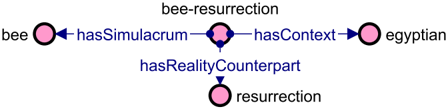
Simulacra, reality counterparts, and contexts of symbolic meanings are linked in this pattern through the n-ary relationship (situation) class Simulation. For example, in an Egyptian context, bees signify resurrection. This can be modelled through the hasSimulacrum , hasRealityCounterpart and hasContext properties in our model, as shown in Figure 2.
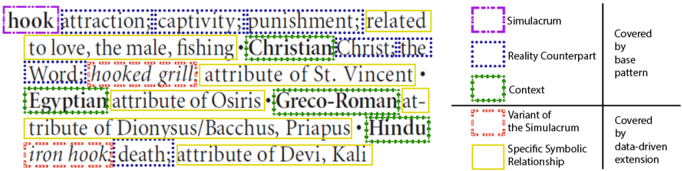
To evaluate the initial version of the developed pattern, we qualitatively compare its ontological structure to the structure of a dictionary of symbols. We selected Olderr's [22] dictionary of symbols for this task because it offers more than 40,000 symbolic meanings. Moreover, its structure is similar to a dictionary of synonyms and antonyms: for each symbol, a list of potential symbolic meanings is provided along with the context in which those symbolic meanings are valid, often without any additional information. As we will discuss in the conversion Section 3.4 the repetitive patterns in the structure of this dictionary facilitate the automatic conversion of its data into the ontology schema. An example of fitting the pattern to the structure of the dictionary is shown in Figure 3. The example shows the 'hook' entry of the dictionary. Hook translates in our ontology as the simulacrum. The terms in green (e.g. Christian) represent the contexts in which some hook simulations are valid. The terms in blue represent reality counterparts of simulations that have hook as a simulacrum. However, some reality counterparts (in yellow) are introduced by phrases such as 'related to', 'attribute of' that suggest a specific type of simulation. Also, the terms in red represent some variants of the 'hook' entry that have their own symbolic meaning. Both variants and specific simulations were addressed in the design extension of the pattern. The conceptualized classes and properties derived from this qualitative comparison are described in the Subsection 3.2.
## 3.2 Data-driven Ontology Enrichment
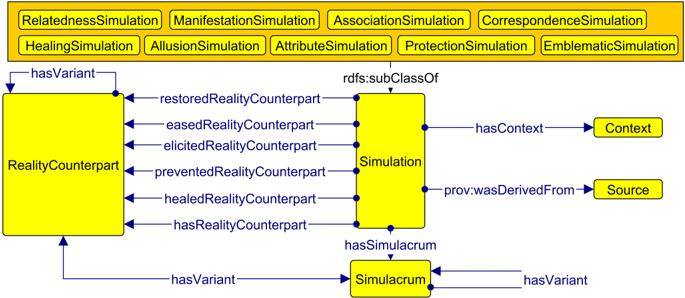
To cover concepts not dealt with in Baudrillard's Simulation theory, we add 7 new properties and 9 new classes via a bottom-up approach.
Simulations are linked to the sources that support their existence, opening up new competency questions: (Q2.1) What are the simulations and respective reality counterparts that have the same simulacrum but a different source? (Q2.2) What are the contexts of the simulations listed in a specific source? (Q2.3) What
17 This is contrasted by using different ontologies that implement simulation occurrences, e.g. a specific interpretation of Persepolis' Achaemenid Persian relief with the Sign of Lion, as a realized simulacrum of Achaemenid Persia power.
Figure 3: Fitting the simulation pattern over Olderr's dictionary "hook" entry
<details>
<summary>Image 3 Details</summary>
### Visual Description
## Diagram: Semantic Relationships and Cultural Attributions
### Overview
The image is a conceptual diagram illustrating semantic relationships between words and their cultural, symbolic, or contextual associations. It uses color-coded boxes and dotted lines to map connections between terms, attributes, and categories. The diagram is divided into two main sections: a legend on the right and a word-attribute matrix on the left.
---
### Components/Axes
#### Legend (Right Side)
- **Simulacrum** (Purple): Represented by a purple dotted box.
- **Reality Counterpart** (Yellow): Represented by a yellow dotted box.
- **Context** (Green): Represented by a green dotted box.
- **Variant of Simulacrum** (Red): Represented by a red dotted box.
- **Specific Symbolic Relationship** (Yellow): Represented by a yellow solid box.
#### Left Side (Word-Attribute Matrix)
- **Words/Phrases**:
- "hook" (Purple)
- "to love, the male, fishing" (Yellow)
- "Christian" (Yellow)
- "Word: hooked grill" (Red)
- "Egyptian" (Green)
- "Greco-Roman" (Green)
- "tribute of Dionysus/Bacchus, Priapus" (Green)
- "Hindu" (Green)
- "iron hook" (Red)
- **Attributes/Connections**:
- "attraction; captivity; punishment; related to love, the male, fishing" (linked to "hook")
- "attribute of St. Vincent" (linked to "hooked grill")
- "attribute of Osiris" (linked to "Egyptian")
- "attribute of Devi, Kali" (linked to "iron hook")
- "Greco-Roman attribute of Dionysus/Bacchus, Priapus" (linked to "Greco-Roman")
- "Hindu" (linked to "Kali")
---
### Detailed Analysis
#### Word-Attribute Relationships
1. **Simulacrum (Purple)**:
- "hook" is associated with abstract concepts like "attraction," "captivity," and "punishment."
- Dotted lines connect "hook" to its attributes, suggesting a foundational or archetypal relationship.
2. **Reality Counterpart (Yellow)**:
- "Christian" and "Hindu" are linked to cultural/religious figures ("Christ," "Kali").
- "to love, the male, fishing" is tied to human experiences or narratives.
3. **Context (Green)**:
- "Egyptian," "Greco-Roman," and "Hindu" are tied to cultural attributes (e.g., "Osiris," "Dionysus/Bacchus/Priapus").
- These terms emphasize historical or mythological contexts.
4. **Variant of Simulacrum (Red)**:
- "hooked grill" and "iron hook" are specific extensions of the "hook" concept.
- "hooked grill" is an attribute of St. Vincent, while "iron hook" relates to "death" and deities like Devi and Kali.
5. **Specific Symbolic Relationship (Yellow)**:
- No direct connections are shown, but the category implies unique, data-driven extensions (e.g., "iron hook" as a symbolic variant).
---
### Key Observations
- **Color Consistency**: The legend’s colors (purple, yellow, red, green) are strictly applied to words and their attributes.
- **Hierarchical Structure**:
- "Simulacrum" and "Reality Counterpart" represent abstract or foundational relationships.
- "Context" and "Variant of Simulacrum" add specificity (cultural or symbolic).
- **Cultural Symbolism**: Terms like "Osiris," "Dionysus," and "Kali" anchor the diagram in mythological or religious frameworks.
- **Ambiguity in "Specific Symbolic Relationship"**: The yellow solid box lacks explicit connections, suggesting it may require further data-driven interpretation.
---
### Interpretation
The diagram categorizes words into semantic and cultural frameworks, using color to distinguish between abstract relationships (Simulacrum, Reality Counterpart) and contextual or symbolic extensions (Context, Variant of Simulacrum). For example:
- **"Hook"** serves as a base concept (Simulacrum), with attributes like "attraction" and "punishment."
- **"Christian"** and **"Hindu"** act as Reality Counterparts, linking to religious figures.
- **"Iron hook"** and **"hooked grill"** are Variants of Simulacrum, tied to specific symbolic meanings (death, St. Vincent).
- **"Egyptian"** and **"Greco-Roman"** emphasize cultural Context, connecting to deities like Osiris and Dionysus.
The absence of explicit data points (e.g., numerical values) suggests the diagram is a conceptual model rather than a quantitative analysis. The use of dotted lines implies flexible or overlapping relationships, while solid boxes (e.g., "Specific Symbolic Relationship") may require additional data to define.
This structure could be used to analyze how language, culture, and symbolism intersect in semantic networks, with potential applications in linguistics, cultural studies, or AI-driven semantic modeling.
</details>
are the sources of a specific simulation? Another negative competency question was formulated: (Q2.4) Are there simulations that do not have a source? The source of the simulation was included in the ontology using the class source . PROV-O[20] is the W3C standard ontology to express provenance. The property of PROV-O wasDerivedFrom 18 is used to link a simulation to its source.
In Olderr's dictionary of symbols [22], simulacra and reality counterparts can have variants that can belong to different simulations compared to the original simulacra or reality counterparts. Variants in this ontology are either represented as (i) a narrower concept than the original simulacrum or reality counterpart, such as night bird , which in Olderr's dictionary is a variant of bird , (ii) as a set of things of which the original simulacrum is a part of, such as in the case of black and white , which is a variant of black in the same dictionary, or (iii) as the simulacrum put in a specific situation such as bloodstone placed in a glass of water during a drought as a variant of bloodstone .
Variants are conceptualized in the ontology with the introduction of the property hasVariant that links either a simulacrum or reality counterpart to its variant (which can be either another simulacrum or a reality counterpart). We test this property using additional competency questions to handle the conceptualization of variants: (Q3.1) What are the variants of a certain element? (Q3.2) What are the reality counterparts of the simulations with a specific simulacrum or its variants?
In Olderr's dictionary, Simulations can be specialized according to the specific symbolic relationship that links a simulacrum with its reality counterpart. If a simulacrum is the emblem of a certain reality counterpart, or an allusion, this specific relationship can be expressed through specialized simulations. Olderr [21] provides some definitions for specific symbolic relationships such as the Allusion, described as
[...]a reference to an historical person or event, or an artistic or literary work. To have an 'albatross around one's neck' is an allusion to Coleridge's poem 'The Rhyme of the ancient Mariner'.
or the Association, described as
[...]something linked in memory or imagination, or by correlation or an analogy with an object, idea, person, or event. The letter 'A' is associated with beginning.
Although we suggest potential users of the ontology to follow his definitions, given the highly subjective topic of the ontology, we tried to not limit the use of the classes through logical constrains,
18 https://www.w3.org/TR/prov-o/#wasDerivedFrom
as seen in section 3.3. In some specialized simulations, the reality counterpart might not be the exact symbolic meaning of a simulacrum. In these cases, the reality counterpart might be something that is prevented, elicited, restored by the simulacrum in a symbolic way. Finally, some simulations might have a reality counterpart that represents the symbolic meaning of the simulacrum, and an additional one that represents something that is prevented, elicited, restored by the simulacrum. For instance, in an Arabian context, an agate is seen as a charm for healthy blood [22]. Therefore, the resulting simulation is agate-charm-healthyBlood where agate is the simulacrum, charm is a reality counterpart, healthy blood is an elicited reality counterpart and Arabian is the context. Given that a reality counterpart, such as healthy blood , does not change its identity whether it is prevented, elicited, or generally symbolically meant by a Simulacrum, we decided to introduce specific reality counterpart relationships as sub-properties of hasRealityCounterpart and not as sub-classes of RealityCounterpart .
To address specific simulations, we formulate the following competency questions: (Q3.3) What are the simulations in which the simulacra are seen as symbolical protection against reality counterparts? (Q3.4) What are the simulations that have a specific reality counterpart and other additional reality counterparts, and what specific relationship link those simulations to their reality counterparts? (Q3.5) What are the simulations and their respective simulacra, contexts and reality counterparts in which their simulacrum is a symbolical cure for their reality counterpart?
The newly added classes and properties are summarized in Table 1. Examples of use, and a glossary containing definitions of all classes and properties can be found in the ontology development documentation.
## 3.3 Ontology Axiomatisation
The simulation ontology uses OWL logical axioms to specify its conceptualisation, to enable logical inferences on the symbolic knowledge graph, and to perform automated classification and consistency checking.
Besides the basic classes and properties that have been introduced in the previous sections, and their subsumption and domain/range axioms, we exemplify some OWL axioms that perform restrictions on the main classes, written in Manchester Syntax[19].
- Simulation:
hasContext some Context hasRealityCounterpart some RealityCounterpart hasSimulacrum exactly 1 Simulacrum wasDerivedFrom some Source
Table 1: Specific Simulation and related reality counterpart properties
| Class | Specific reality counterpart property |
|------------------------------|-----------------------------------------|
| Association Simulation | no specific property |
| Correspondence Simulation | no specific property |
| Manifestation Simulation | no specific property |
| Relatedness Simulation | no specific property |
| Attribute Simulation | no specific property |
| Allusion Simulation | no specific property |
| Protection Simulation | preventedRealityCounterpart |
| Emblematic Simulation | no specific property |
| Healing Simulation | healedRealityCounterpart |
| no specific simulation class | restoredRealityCounterpart |
| no specific simulation class | easedRealityCounterpart |
| no specific simulation class | elicitedRealityCounterpart |
- •
- Healing Simulation: 1
```
```
```
```
We also introduce a property chain to provide a direct relation facility between simulacra and reality counterparts:
```
```
Further details can be found in the ontology documentation. 19
## 3.4 Creating the Symbolic Knowledge Graph
The knowledge base was developed by extracting and converting data from different sources: DBpedia, Wordnet and Olderr's Symbolism: a comprehensive dictionary .
DBpedia Conversion. We use the DBpedia SPARQL endpoint 20 to retrieve resources related to the property dbp:symbol and for resources of type skos:Concept 21 that contain the string "symbol" in their label and that have these concepts as their subject (using the property dct:subject . 22 ) For instance, the resource dbr:Eagle 23 is the subject of dbc:National\_symbols\_of\_Liechtenstein. 24
To filter out station signs and chemical codes that are also modelled using the dbp:symbol property, but are purely iconic tools, we exclude resources of type Railway Stations and Public Companies. On the one hand, in the triple ?subject dbp:symbol ?object , ?subject becomes our reality counterpart, and ?object the simulacrum. The ?type of the same subject, in the triple ?subject rdf:type ?type was considered as the context of the simulation.
On the other hand, in the triple ?subject dct:subject ?object , ?subject became the simulacrum and ?object (cleaned of the initial parts such as 'National Symbol of' or 'Symbol of') became the reality counterpart. The contexts, in this second case were not extracted for
19 https://www.w3id.org/simulation/docs
20 https://dbpedia.org/sparql
21 http://www.w3.org/2004/02/skos/core#Concept
22 http://purl.org/dc/terms/subject
23 http://dbpedia.org/resource/Eagle
24 http://dbpedia.org/resource/Category:National\_symbols\_of\_Liechtenstein
these triples, therefore General or Unknown was set as the context for every simulation. For instance, in the triple dbr:Eagle dct:subject dbc:dbc:National\_symbols\_of\_Liechtenstein , Eagle became the simulacrum and Liechtenstein became the reality counterpart in a Simulation with a General or Unknown context. Our DBpedia conversion yielded 3,727 simulations expressed in 47,696 triples.
WordNet conversion. From Wordnet, we extract Symbol and emblem synsets 25 and their hyponyms, as well as synsets that contain phrases such as symbol of or emblem of in their definition. For each element, we extract its label and definition. The natural language definition of each synset was processed to extract potential contexts and symbolic meanings. For instance, the Penelope synset 26 has "Penelope" as a label and "(Greek mythology) the wife of Odysseus and a symbol of devotion and fidelity[...]" as the definition. The label of the synset was converted into the simulacrum and we extracted the context and reality counterparts from the definition. In this case, two simulations were created from this synset, penelope-fidelity and penelope-devotion , both with greekMythology as a context. The penelope simulacrum was then linked to its original WordNet synset with the property owl:sameAs . Our WordNet conversion process yielded 81 simulations captured in 1,191 triples.
Olderr's Dictionary Conversion. We used the markup such as boldface in Olderr's dictionary to distinguish between different lemmas, contexts and variants and converted this to RDF. A simulation URI was formed by joining the simulacrum and reality counterpart labels with a hyphen. The style consistency in the original document made the conversion process almost completely automatic. Some manual corrections had to be done after the automatic conversion in the rare cases of mistakes in the source. 27 A list of bigrams such as related to and protection from were used to create Relatedness and Protection simulations, respectively. 37,647 simulations were generated from the dictionary captured in 450,679 triples.
For every converted simulation, the respective sources (either DBpedia, Wordnet or Olderr's dictionary) have been added using the prov:wasDerivedFrom property.
Quality Control. After the conversion, we performed several error analysis cycles to assess the knowledge graph's quality, we adjusted the algorithms, and reconverted the knowledge graph where needed. The most common errors were instantiations of some simulacra or reality counterparts that were not linked to any simulation. Other errors occurred during automatic URI generation or in the labeling of elements. Specifically for Olderr's dictionary, some errors were due to editing errors in the original source. In those cases, the txt version of the dictionary was manually corrected.
Table 2 summarizes the number of resources that were generated by the conversion. 28 An evaluation of the conversion algorithms can be found in Section 4.4.
25 http://Wordnet-rdf.princeton.edu/id/05773412-n and http://Wordnet-rdf.princeton. edu/id/06893714-n respectively
26 http://wordnet-rdf.princeton.edu/id/09616318-n
https://github.com/br0ast/simulationontology lists examples of manual corrections 28 The totals are not the exact sum of the previous numbers because some simulacra, reality counterparts, contexts and simulations are shared by different sources.
Table 2: Knowledge Graph statistics
| Source | # of Simulacra | # of Rc | # of Contexts | # of Simulations | # of Triples |
|--------------------------------|------------------|-----------|-----------------|--------------------|----------------|
| Olderr's dictionary of symbols | 8,900 | 17,959 | 303 | 37,647 | 450,679 |
| DBpedia | 3,024 | 782 | 36 | 3,727 | 47,696 |
| Wordnet | 61 | 76 | 5 | 81 | 1,191 |
| Total | 11,663 | 18,676 | 323 | 41,416 | 498,525 |
Figure 4: Simulation Ontology - Classes and Properties
<details>
<summary>Image 4 Details</summary>
### Visual Description
## UML Class Diagram: Simulation Framework Architecture
### Overview
The diagram illustrates a hierarchical classification of simulation-related concepts, focusing on relationships between reality counterparts, simulations, and their variants. It uses UML notation with classes, inheritance arrows, and association relationships.
### Components/Axes
1. **Classes**:
- `RealityCounterpart` (root class)
- `Simulation` (subclass of `RealityCounterpart`)
- `Simulacrum` (variant of `Simulation`)
- `Context` (associated with `Simulation`)
- Multiple simulation subtypes (e.g., `RelatednessSimulation`, `HealingSimulation`)
2. **Relationships**:
- Inheritance: `Simulation rdfs:subClassOf RealityCounterpart`
- Association: `Simulation hasContext Context`
- Derivation: `Simulation prov:wasDerivedFrom Source`
- Variant relationships: `hasVariant` between classes
3. **Methods/Attributes**:
- `restoredRealityCounterpart`, `easedRealityCounterpart`, `elicitedRealityCounterpart`, `preventedRealityCounterpart`, `healedRealityCounterpart`
- `hasSimulacrum`, `hasVariant`
### Detailed Analysis
1. **RealityCounterpart**:
- Central class with 6 specialized simulation counterparts
- Contains methods for different simulation states (restored, eased, etc.)
2. **Simulation Hierarchy**:
- Base class with 10 specialized subtypes (e.g., `ManifestationSimulation`, `ProtectionSimulation`)
- Contains contextual relationships (`hasContext`) and derivation provenance (`prov:wasDerivedFrom`)
3. **Simulacrum**:
- Specialized variant of `Simulation`
- Contains its own variant relationships (`hasVariant`)
4. **Context**:
- Separate entity associated with simulations
- Positioned at the top-right of the diagram
### Key Observations
1. **Hierarchical Structure**:
- `RealityCounterpart` → `Simulation` → 10 specialized simulations
- `Simulation` → `Simulacrum` (variant relationship)
2. **Temporal/State Relationships**:
- Methods like `restoredRealityCounterpart` suggest temporal states
- `healedRealityCounterpart` implies recovery processes
3. **Provenance Tracking**:
- Explicit derivation tracking via `prov:wasDerivedFrom Source`
4. **Ontological Relationships**:
- Uses RDF schema (`rdfs:subClassOf`) for classification
- Employs PROV-O (`prov:`) for provenance
### Interpretation
This diagram represents a formal ontology for modeling simulations and their relationship to reality. The architecture suggests:
1. **Simulation Taxonomy**: 10 distinct simulation types organized under a base `Simulation` class
2. **Reality Interaction**: Multiple pathways for reality-simulation interaction (restoration, prevention, healing)
3. **Epistemological Framework**: Explicit tracking of simulation provenance and contextual relationships
4. **Variant Management**: Hierarchical handling of simulation variants through both class inheritance and direct relationships
The structure appears designed for knowledge representation systems, possibly in AI or simulation theory contexts. The use of RDF and PROV-O standards indicates semantic web compatibility. The "hasSimulacrum" relationship suggests a focus on hyperreal or mediated reality concepts.
</details>
## Ontology and knowledge graph release
The w3id service was used to obtain persistent URIs. The current version of the Simulation Ontology is available at https://www. w3id.org/simulation/docs. Its structure is shown in Figure 4.
Due to copyright issues, the public version of HyperReal contains only the converted data from DBpedia and WordNet. The knowledge graph is available at https://www.w3id.org/simulation/data/ and includes the import axiom for the ontology schema.
Finally, https:www.w3id.org/simulation/development and www. w3id.org/simulation/code are the persistent URIs that lead respectively to the ontology development GitHub repository and the scripts used to create HyperReal and our analyses (see the experiment in section 5) over it.
## 4 EVALUATION
In this section, we discuss the evaluation of the ontology via competency questions and an internal consistency check as well as the evaluation of the automatic conversion of Olderr's dictionary.
## 4.1 Competency Question evaluation
The ontology requirements were expressed through competency questions mentioned in Section 3. For each iteration of the ontology, weexecuted unit tests to verify that the results of the SPARQL query that formalizes the competency question matched the expected results of those questions in a toy dataset. All unit tests are available from our Github repository in the form of Jupyter notebooks to promote the reproducibility of our results. 29
29 The jupyter notebooks for testing the CQs are available for each SAMOD iteration, respectively in: 1, 2, 3.
All competency questions matched with their expected results. For instance, in CQ2.2 'What are the simulations and respective reality counterparts and sources that have the same simulacrum but a different source?' the expected results for the toy dataset are the simulations (i) olive-fertility with fertility as a reality counterpart and dictionaryOfSymbols1 as a source and (ii) olive-immortality with immortality as a reality counterpart and dictionaryOfSymbols2 as a source. Listing 1 shows the formalized query in SPARQL. The retrieved results from this query match the expected results.
```
```
Listing 1: CQ2.2 Formalization in SPARQL
## 4.2 Automatic ontology evaluation
Foops! [14] is a web application that evaluates ontologies by verifying that they comply with FAIR principles [15]. According to Foops!,
Table 3: Conversion algorithms evaluation metrics (reporting micro averages)
| Element | Precision | Recall | F 1 |
|---------------------|-------------|----------|-------|
| Simulation | 0.96 | 0.97 | 0.97 |
| Simulacrum | 0.97 | 0.98 | 0.98 |
| Reality counterpart | 0.96 | 0.97 | 0.97 |
| Context | 0.97 | 0.98 | 0.98 |
| Type of Simulation | 0.94 | 0.95 | 0.94 |
| Variant | 0.97 | 0.98 | 0.98 |
| Average | 0.96 | 0.97 | 0.97 |
our ontology scores 77%. The tool highlighted the ontology has not been inserted in a public ontology metadata registry of ontology such as LOV [31] and that it currently lacks versioning information. Both of these aspects will be addressed in future releases.
The ontology's syntax was evaluated through the online RDF validator offered by w3. 30 The tool highlighted no pitfalls in syntax.
## 4.3 Reasoning over the knowledge graph
The entire knowledge graph was analyzed by the HermiT Reasoner [17] to check inconsistencies. The reasoner showed no inconsistencies. The OWL Profile Checker tool (V1.1.0) 31 positions the knowledge graph in the OWL2-DL profile. 32
## 4.4 Conversion Evaluation
To evaluate the quality of the conversion of the algorithms, we manually annotated 112 simulations sampled from some lines of Olderr's dictionary and compared it to the automatic conversion of those same lines using precision, recall and F1 measure of simulacra, reality counterparts, variants, contexts and simulations and specific types of simulations retrieved.
On average, the conversion achieves a performance of 97% of precision (micro), recall (micro) and F1 (micro). Table 3 summarizes the metrics for this evaluation. Errors in the conversion stem from deviations from the dictionary structure, for example when two reality counterparts are provided instead of one.
## 5 CASE STUDY: WHITE ROSES
In this use case, we show how the knowledge graph can be used to investigate the different meanings of a symbol. We investigate whether there is a correlation between the symbolic meaning of a simulacrum and its colour. We chose white roses as our symbol as they occur across many cultures and in different contexts.
We extract the symbolic meanings of a white rose from the knowledge graph through the SPARQL query shown in Listing 2. With another series of queries (available on Github), we extract all simulacra that share a symbolic meaning with a white rose that are associated with the colours red, green, black, white, gold, blue, and purple. We created nine sets; one for each symbolic meaning of the white rose, and the coloured extracted simulacra were placed in the set they share the symbolic meaning with (in case of more than
30 https://www.w3.org/RDF/Validator/
31 https://github.com/stain/profilechecker
32 The description logic complexity of the entire knowledge graph is ALCHOIQ (role hierarchies, nominals, inverse properties, qualified cardinality restrictions).
<details>
<summary>Image 5 Details</summary>
### Visual Description
## Circular Diagram: Virtues and Symbolic Representation
### Overview
The image depicts a circular diagram centered on a white rose with a green stem and leaves. Surrounding the rose are eight colored segments, each labeled with a virtue. The diagram uses a gradient of colors (blue, green, yellow, red, purple) to differentiate the segments. A legend on the right side maps colors to labels. The design emphasizes symbolic relationships between virtues and the central rose.
### Components/Axes
- **Central Element**: A white rose with a green stem and leaves, positioned at the center of the circle.
- **Segments**: Eight radial sections radiating outward from the rose, each labeled with a virtue.
- **Legend**: Located on the right side of the diagram, associating colors with labels.
- **Color Gradient**: Each segment uses a distinct color (e.g., blue, green, yellow, red, purple) to differentiate virtues.
### Detailed Analysis
- **Labels and Colors**:
- **Innocence**: Top-left segment, blue and green gradient.
- **Faith**: Adjacent to Innocence, blue gradient.
- **Chastity**: Red gradient, positioned clockwise from Faith.
- **Virginity**: Yellow gradient, next clockwise.
- **Virgin Mary**: Blue gradient, adjacent to Virginity.
- **Purity**: Yellow gradient, next clockwise.
- **Love**: Purple gradient, positioned opposite Innocence.
- **Joy**: Red and green gradient, adjacent to Love.
- **Spatial Grounding**:
- The legend is placed on the right side, with colors matching the segments (e.g., red for Chastity, yellow for Virginity).
- The rose is centrally located, with segments arranged clockwise around it.
### Key Observations
- No numerical data or quantitative values are present. The diagram is purely symbolic.
- The rose’s central placement suggests it is the focal point, with virtues radiating outward.
- Color choices (e.g., red for Chastity, purple for Love) may reflect traditional symbolic associations.
### Interpretation
The diagram appears to represent a conceptual or philosophical framework, possibly rooted in religious or moral symbolism. The rose, often associated with purity or love, anchors the diagram, while the surrounding virtues (e.g., Innocence, Faith, Chastity) suggest a hierarchy or interconnected system of values. The absence of numerical data implies the diagram is not meant for quantitative analysis but rather for illustrative or educational purposes. The color coding and spatial arrangement emphasize the relationship between the central symbol (rose) and the virtues, potentially reflecting cultural or theological interpretations of moral or spiritual ideals.
**Note**: The image contains no numerical data, trends, or anomalies. The analysis focuses on symbolic structure and color-label relationships.
</details>
t y
Figure 5: Distribution of coloured simulacra across the symbolic meanings of a white rose
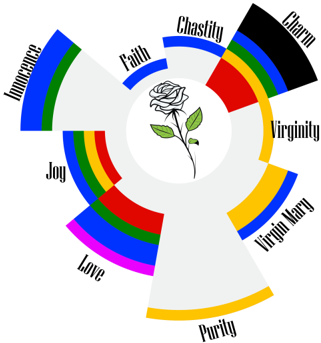
one matching of symbolic meaning they were placed in more than one set). For instance, one of the symbolic meanings of a white rose is purity . golden hair , white knight , white swan share the same symbolic meaning so they were put in the purity set. Only the simulacra's colours were kept, leaving each set with the frequency of colours of simulacra that had the same symbolic meaning.
Figure 5 shows the distribution of coloured simulacra across the different symbolic meanings of a white rose we could extract from our knowledge graph. Every bar represents a symbolic meaning of the white rose. The length of each colour in a bar is proportional to the number of simulacra of that colour that share the same symbolic meaning. As the figure indicates, the white colour is present in almost all symbolic meanings, with a high peak in purity and innocence . This suggests that the white colour itself brings these symbolic values to white objects. Moreover, apart from the charm symbolic meaning, white has the highest percentage of colour in all meanings of white rose except in the meaning for faith which is half white and half blue.
```
```
Listing 2: White rose symbolic meaning SPARQL query
## 6 CONCLUSIONS AND FUTURE WORK
In this paper, we present a new ontology and knowledge graph that fill an existing gap in the domain of symbolic knowledge. Our ontology and knowledge graph bring together knowledge from semiotics, mediation, symbolism, and semantic web. We hope this resource will foster research on new quantitative approaches to symbolism that were not possible beforehand.
In future iterations, the knowledge graph could be further enriched by adding information from additional resources describing symbolic information such as Iconclass [9]. A SKOS [2] taxonomy could be generated not only to link simulacra and reality counterparts to their variants, but also in between contexts, to enable more complex queries regarding similar, broader or narrower contexts of simulations. Whilst our ontology and knowledge graph focus on symbolism, metaphorical meanings are partly related to symbolic meaning [8], especially when cultural symbols have less conventional, specific meaning. We aim to link our ontology and knowledge graph to MetaNet[30], an online repository of metaphors and frames. Further integration with external general knowledge graphs such as Wikidata or Framester[13] would allow interoperability between heterogeneous sources in the context of symbolism, extending the reach of structured symbolic knowledge. This same knowledge could be used to enrich broad knowledge graphs, such as ArCo [7], a knowledge graph of Italian cultural heritage. By automatically assigning potential simulations and symbolic meanings to ArCo objects, scholars and cultural heritage professionals could get access to rich symbolic knowledge, allowing for the discovery of symbolic links between objects that were previously hidden.
## ACKNOWLEDGMENTS
This work has been partially funded from the Emilia Romagna Region (grant agreement no. 462 25/03/2019).We thank the anonymous reviewers for their constructive feedback.
## REFERENCES
- [1] Sören Auer, Christian Bizer, Georgi Kobilarov, Jens Lehmann, Richard Cyganiak, and Zachary Ives. 2007. DBpedia: A Nucleus for a Web of Open Data. In The Semantic Web , Karl Aberer, Key-Sun Choi, Natasha Noy, Dean Allemang, KyungIl Lee, Lyndon Nixon, Jennifer Golbeck, Peter Mika, Diana Maynard, Riichiro Mizoguchi, Guus Schreiber, and Philippe Cudré-Mauroux (Eds.). Springer Berlin Heidelberg, Berlin, Heidelberg, 722-735.
- [2] Thomas Baker, Sean Bechhofer, Antoine Isaac, Alistair Miles, Guus Schreiber, and Ed Summers. 2013. Key choices in the design of Simple Knowledge Organization System (SKOS). Journal of Web Semantics 20 (2013), 35-49. https://doi.org/10. 1016/j.websem.2013.05.001
- [3] S. Baroncini, M. Daquino, and F. Tomasi. 2021. Modelling Art Interpretation and Meaning. A Data Model for Describing Iconology and Iconography. arXiv:2106.12967 [cs.DL]
- [4] Jean Baudrillard. 1981. Simulacra and Simulation . University of Michigan Press, Ann Arbor, MI, USA.
- [5] C. Bekiari, G. Bruseker, M. Doerr, C.-E. Ore, S. Stead, and A. Velios. 2021. Definition of the CIDOC Conceptual Reference Model v7.1.1. https://doi.org/10.26225/ FDZH-X261
- [6] Nicola Carboni and Livio de Luca. 2019. An Ontological Approach to the Description of Visual and Iconographical Representations. Heritage 2, 2 (2019), 1191-1210. https://doi.org/10.3390/heritage2020078
- [7] Valentina Anita Carriero, Aldo Gangemi, Maria Letizia Mancinelli, Ludovica Marinucci, Andrea Giovanni Nuzzolese, Valentina Presutti, and Chiara Veninata. 2019. ArCo: The Italian Cultural Heritage Knowledge Graph. In The Semantic Web - ISWC 2019 , Chiara Ghidini, Olaf Hartig, Maria Maleshkova, Vojtěch Svátek, Isabel Cruz, Aidan Hogan, Jie Song, Maxime Lefrançois, and Fabien Gandon (Eds.). Springer International Publishing, Cham, 36-52. https://doi.org/10.1007/978-3030-30796-7\_3
- [8] Seana Coulson and Teenie Matlock. 2001. Metaphor and the Space Structuring Model. Metaphor and Symbol 16 (10 2001), 295-316. https://doi.org/10.1080/ 10926488.2001.9678899
- [9] L. D. Couprie. 1983. Iconclass: an iconographic classification system. Art libraries journal 8 (1983), 32-49.
- [10] Umberto Eco. 1996. Semiotica e filosofia del linguaggio . Einaudi, Turin, Italy. Google-Books-ID: pYFvAAAACAAJ.
- [11] Christiane Fellbaum (Ed.). 1998. WordNet: An Electronic Lexical Database . A Bradford Book, Cambridge, MA, USA.
- [12] J. G. Frazer. 1922. The Golden Bough: A Study in Magic and Religion . Palgrave Macmillan UK, London, United Kingdom. https://doi.org/10.1007/978-1-34900400-3
- [13] Aldo Gangemi, Mehwish Alam, Luigi Asprino, Valentina Presutti, and Diego Reforgiato Recupero. 2016. Framester: A Wide Coverage Linguistic Linked Data Hub. In Knowledge Engineering and Knowledge Management . Springer International Publishing, Cham, Switzerland, 239-254. https://doi.org/10.1007/978-3319-49004-5\_16
- [14] Daniel Garijo, Oscar Corcho, and María Poveda-Villalón. 2021. FOOPS!: An Ontology Pitfall Scanner for the FAIR principles. In Proceedings of the ISWC 2021 Posters, Demos and Industry Tracks: From Novel Ideas to Industrial Practice colocated with 20th International Semantic Web Conference (ISWC 2021) . CEUR-WS, Online. https://foops.linkeddata.es/assets/iswc\_2021\_demo.pdf
- [15] Daniel Garijo and María Poveda-Villalón. 2020. Best Practices for Implementing FAIR Vocabularies and Ontologies on the Web. Studies on the Semantic Web 49 (2020), 39-54. https://doi.org/10.3233/SSW200034 Publisher: IOS Press.
- [16] Richard Gartner. 2020. Towards an ontology-based iconography. Digital Scholarship in the Humanities 35, 1 (April 2020), 43-53. https://doi.org/10.1093/llc/fqz009
- [17] Birte Glimm, Ian Horrocks, Boris Motik, Giorgos Stoilos, and Zhe Wang. 2014. Hermit: An Owl 2 Reasoner. Journal of Automated Reasoning 53 (10 2014), 245-269. https://doi.org/10.1007/s10817-014-9305-1
- [18] P. Hitzler, A. Gangemi, K. Janowicz, A. A. Krisnadhi, and V. Presutti. 2016. Ontology Engineering with Ontology Design Patterns: Foundations and Applications . IOS Press, Amsterdam, the Netherlands.
- [19] Matthew Horridge, Nick Drummond, John Goodwin, Alan Rector, Robert Stevens, and Hai Wang. 2006. The Manchester OWL syntax. In Proceedings of the OWLED*06 Workshop on OWL: Experiences and Directions . CEUR-WS, Athens, GA, USA.
- [20] Timothy Lebo, Satya Sahoo, Deborah McGuinness, Khalid Belhajjame, James Cheney, David Corsar, Daniel Garijo, Stian Soiland-Reyes, Stephan Zednik, and Jun Zhao. 2013. Prov-o: The prov ontology. https://www.w3.org/TR/2013/RECprov-o-20130430/
- [21] Steven Olderr. 2005. Reverse symbolism dictionary: symbols listed by subject . McFarland, Jefferson, N.C. OCLC: 156738525.
- [22] Steven Olderr. 2012. Symbolism a Comprehensive Dictionary (2 ed.). McFarland, London.
- [23] Alexander Francis Otto. 2014. Mythological Japan: The Symbolisms of Mythology in Relation to Japanese Art, with Illustrations Drawn in Japan, by Native Artists Primar . Bibliolife DBA of Bibilio Bazaar II LLC, Charleston, SC, USA. GoogleBooks-ID: 0Ki8oAEACAAJ.
- [24] Erwin Panofsky. 1962. Studies in Iconology: Humanistic Themes in the Art of the Renaissance . Harper & Row, New York, NY, USA.
- [25] Silvio Peroni. 2016. A Simplified Agile Methodology for Ontology Development.. In Proceedings of the 13th OWL: Experiences and Directions Workshop and 5th OWL reasoner evaluation workshop (OWLED-ORE 2016) . Springer, Cham, Switzerland, 55-69. https://doi.org/10.6084/M9.FIGSHARE.3189769.V2
- [26] Cambridge University Press. 2021. https://dictionary.cambridge.org/dictionary/english/lion.
lion.
- [27] Valentina Presutti, Enrico Daga, Aldo Gangemi, and Eva Blomqvist. 2009. EXtreme Design with Content Ontology Design Patterns. In Proceedings of the 2009 International Conference on Ontology Patterns - Volume 516 (Washington DC) (WOP'09) . CEUR-WS.org, Aachen, DEU, 83-97. https://doi.org/10.5555/2889761. 2889768
- [28] Helene Roberts. 2013. Encyclopedia of Comparative Iconography : Themes Depicted in Works of Art . Routledge, Miton Park, United Kingdom. https://doi.org/10. 4324/9780203825587
- [29] Bruno Sartini and Aldo Gangemi. 2021. Towards the unchaining of symbolism from knowledge graphs: how symbolic relationships can link cultures.. In Book of extended abstracts of the 10th national AIUCD conference. AIUCD, Pisa, 576-580.
- [30] Elise Stickles, Oana David, Ellen Dodge, and Jisup Hong. 2016. Formalizing contemporary conceptual metaphor theory: A structured repository for metaphor analysis. Constructions and Frames 8 (12 2016), 166 -213. https://doi.org/10.1075/ cf.8.2.03sti
- [31] Pierre-Yves Vandenbussche, Ghislain Atemezing, María Poveda-Villalón, and Bernard Vatant. 2017. Linked Open Vocabularies (LOV): A gateway to reusable semantic vocabularies on the Web. Semantic Web 8 (01 2017), 437-452. https: //doi.org/10.3233/SW-160213
- [32] Denny Vrandečić and Markus Krötzsch. 2014. Wikidata: A Free Collaborative Knowledgebase. Commun. ACM 57, 10 (Sept. 2014), 78-85.