## SELF-CONSISTENCY IMPROVES CHAIN OF THOUGHT REASONING IN LANGUAGE MODELS
Xuezhi Wang †‡ Jason Wei † Dale Schuurmans † Quoc Le † Ed H. Chi † Sharan Narang † Aakanksha Chowdhery † Denny Zhou †§
xuezhiw@google.com dennyzhou@google.com
## ABSTRACT
Chain-of-thought prompting combined with pre-trained large language models has achieved encouraging results on complex reasoning tasks. In this paper, we propose a new decoding strategy, self-consistency , to replace the naive greedy decoding used in chain-of-thought prompting. It first samples a diverse set of reasoning paths instead of only taking the greedy one, and then selects the most consistent answer by marginalizing out the sampled reasoning paths. Self-consistency leverages the intuition that a complex reasoning problem typically admits multiple different ways of thinking leading to its unique correct answer. Our extensive empirical evaluation shows that self-consistency boosts the performance of chain-of-thought prompting with a striking margin on a range of popular arithmetic and commonsense reasoning benchmarks, including GSM8K (+17.9%), SVAMP (+11.0%), AQuA (+12.2%), StrategyQA (+6.4%) and ARC-challenge (+3.9%).
## 1 INTRODUCTION
Although language models have demonstrated remarkable success across a range of NLP tasks, their ability to demonstrate reasoning is often seen as a limitation, which cannot be overcome solely by increasing model scale (Rae et al., 2021; BIG-bench collaboration, 2021, inter alia ). In an effort to address this shortcoming, Wei et al. (2022) have proposed chain-of-thought prompting , where a language model is prompted to generate a series of short sentences that mimic the reasoning process a person might employ in solving a task. For example, given the question 'If there are 3 cars in the parking lot and 2 more cars arrive, how many cars are in the parking lot?' , instead of directly responding with '5' , a language model would be prompted to respond with the entire chain-of-thought: 'There are 3 cars in the parking lot already. 2 more arrive. Now there are 3 + 2 = 5 cars. The answer is 5. ' . It has been observed that chain-of-thought prompting significantly improves model performance across a variety of multi-step reasoning tasks (Wei et al., 2022).
In this paper, we introduce a novel decoding strategy called self-consistency to replace the greedy decoding strategy used in chain-of-thought prompting (Wei et al., 2022), that further improves language models' reasoning performance by a significant margin. Self-consistency leverages the intuition that complex reasoning tasks typically admit multiple reasoning paths that reach a correct answer (Stanovich & West, 2000). The more that deliberate thinking and analysis is required for a problem (Evans, 2010), the greater the diversity of reasoning paths that can recover the answer.
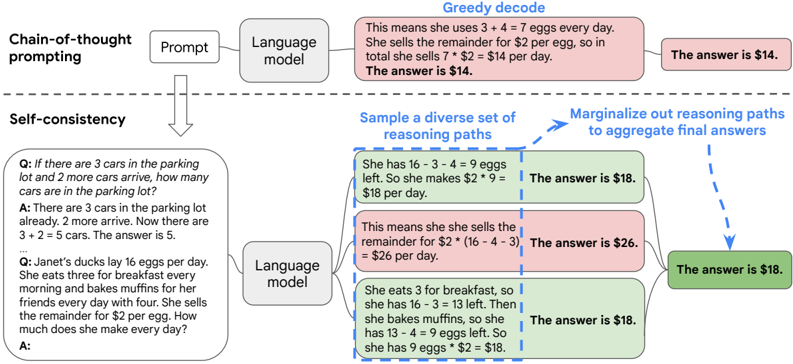
Figure 1 illustrates the self-consistency method with an example. We first prompt the language model with chain-of-thought prompting, then instead of greedily decoding the optimal reasoning path, we propose a 'sample-and-marginalize' decoding procedure: we first sample from the language model's decoder to generate a diverse set of reasoning paths; each reasoning path might lead to a different final answer, so we determine the optimal answer by marginalizing out the sampled reasoning paths to find the most consistent answer in the final answer set. Such an approach is analogous to the human experience that if multiple different ways of thinking lead to the same answer, one has greater confidence that the final answer is correct. Compared to other decoding methods, self-consistency avoids the repetitiveness and local-optimality that plague greedy decoding, while mitigating the stochasticity of a single sampled generation.
† Google Research, Brain Team ‡ , §
Figure 1: The self-consistency method contains three steps: (1) prompt a language model using chain-of-thought (CoT) prompting; (2) replace the 'greedy decode' in CoT prompting by sampling from the language model's decoder to generate a diverse set of reasoning paths; and (3) marginalize out the reasoning paths and aggregate by choosing the most consistent answer in the final answer set.
<details>
<summary>Image 1 Details</summary>
### Visual Description
## Diagram: Chain-of-Thought Prompting vs. Self-Consistency
### Overview
The image illustrates two different approaches to problem-solving using language models: Chain-of-Thought prompting and Self-Consistency. It compares how these methods arrive at solutions to mathematical word problems, highlighting the reasoning steps involved.
### Components/Axes
* **Titles:** "Chain-of-thought prompting" (top-left), "Self-consistency" (bottom-left), "Greedy decode" (top-center), "Sample a diverse set of reasoning paths" (center), "Marginalize out reasoning paths to aggregate final answers" (top-right).
* **Nodes:**
* "Prompt" (top-left, gray rounded rectangle)
* "Language model" (top-center, gray rounded rectangle)
* "Language model" (bottom-center, gray rounded rectangle)
* Reasoning steps and answers (various colored rounded rectangles)
* **Arrows:** Solid arrows indicate the flow of information in Chain-of-Thought prompting. Dashed arrows indicate the flow of information in Self-Consistency.
* **Color Coding:** Green rounded rectangles indicate correct answers. Red rounded rectangles indicate incorrect answers.
### Detailed Analysis
**1. Chain-of-Thought Prompting (Top Section):**
* **Prompt:** An unspecified prompt is fed into a language model.
* **Language Model:** The language model processes the prompt and generates a step-by-step reasoning process.
* **Greedy Decode:** The reasoning steps are as follows:
* "This means she uses 3 + 4 = 7 eggs every day."
* "She sells the remainder for $2 per egg, so in total she sells 7 * $2 = $14 per day."
* **The answer is $14.** (Red rounded rectangle, indicating an incorrect answer)
**2. Self-Consistency (Bottom Section):**
* **Prompt:** Two questions are presented:
* "Q: If there are 3 cars in the parking lot and 2 more cars arrive, how many cars are in the parking lot?"
* "A: There are 3 cars in the parking lot already. 2 more arrive. Now there are 3 + 2 = 5 cars. The answer is 5."
* "Q: Janet's ducks lay 16 eggs per day. She eats three for breakfast every morning and bakes muffins for her friends every day with four. She sells the remainder for $2 per egg. How much does she make every day?"
* "A:" (The language model will provide the answer)
* **Language Model:** The language model processes the prompt.
* **Sample a diverse set of reasoning paths:** The language model generates multiple reasoning paths. Three paths are shown:
* Path 1 (Green rounded rectangle):
* "She has 16 - 3 - 4 = 9 eggs left. So she makes $2 * 9 = $18 per day."
* **The answer is $18.**
* Path 2 (Red rounded rectangle):
* "This means she sells the remainder for $2 * (16 - 4 - 3) = $26 per day."
* **The answer is $26.**
* Path 3 (Green rounded rectangle):
* "She eats 3 for breakfast, so she has 16 - 3 = 13 left. Then she bakes muffins, so she has 13 - 4 = 9 eggs left. So she has 9 eggs * $2 = $18."
* **The answer is $18.**
* **Marginalize out reasoning paths to aggregate final answers:** The answers from the different reasoning paths are aggregated.
* **The answer is $18.** (Green rounded rectangle, indicating a correct answer)
### Key Observations
* Chain-of-Thought prompting, in this example, leads to an incorrect answer.
* Self-Consistency, by sampling multiple reasoning paths and aggregating the results, arrives at the correct answer.
* The color-coding clearly distinguishes between correct (green) and incorrect (red) answers.
### Interpretation
The diagram demonstrates the advantage of the Self-Consistency method over the Chain-of-Thought prompting method for solving complex problems. Self-Consistency leverages the diversity of reasoning paths generated by the language model to arrive at a more robust and accurate solution. By sampling multiple paths and aggregating the results, the Self-Consistency method mitigates the risk of relying on a single, potentially flawed, line of reasoning, as seen in the Chain-of-Thought example. The example highlights the importance of exploring multiple perspectives and aggregating information to improve the accuracy and reliability of language model outputs.
</details>
Self-consistency is far simpler than prior approaches that either train an additional verifier (Cobbe et al., 2021) or train a re-ranker given additional human annotations to improve generation quality (Thoppilan et al., 2022). Instead, self-consistency is entirely unsupervised , works off-the-shelf with pre-trained language models, requires no additional human annotation, and avoids any additional training, auxiliary models or fine-tuning. Self-consistency also differs from a typical ensemble approach where multiple models are trained and the outputs from each model are aggregated, it acts more like a 'self-ensemble' that works on top of a single language model.
We evaluate self-consistency on a wide range of arithmetic and commonsense reasoning tasks over four language models with varying scales: the public UL2-20B (Tay et al., 2022) and GPT-3-175B (Brown et al., 2020), and two densely-activated decoder-only language models: LaMDA-137B (Thoppilan et al., 2022) and PaLM-540B (Chowdhery et al., 2022). On all four language models, self-consistency improves over chain-of-thought prompting by a striking margin across all tasks. In particular, when used with PaLM-540B or GPT-3, self-consistency achieves new state-of-the-art levels of performance across arithmetic reasoning tasks, including GSM8K (Cobbe et al., 2021) (+17.9% absolute accuracy gains), SV AMP (Patel et al., 2021) (+11.0%), AQuA (Ling et al., 2017) (+12.2%), and across commonsense reasoning tasks such as StrategyQA (Geva et al., 2021) (+6.4%) and ARCchallenge (Clark et al., 2018) (+3.9%). In additional experiments, we show self-consistency can robustly boost performance on NLP tasks where adding a chain-of-thought might hurt performance compared to standard prompting (Ye & Durrett, 2022). We also show self-consistency significantly outperforms sample-and-rank, beam search, ensemble-based approaches, and is robust to sampling strategies and imperfect prompts.
## 2 SELF-CONSISTENCY OVER DIVERSE REASONING PATHS
A salient aspect of humanity is that people think differently. It is natural to suppose that in tasks requiring deliberate thinking, there are likely several ways to attack the problem. We propose that such a process can be simulated in language models via sampling from the language model's decoder. For instance, as shown in Figure 1, a model can generate several plausible responses to a math question that all arrive at the same correct answer (Outputs 1 and 3). Since language models are not perfect reasoners, the model might also produce an incorrect reasoning path or make a mistake in one of the reasoning steps (e.g., in Output 2), but such solutions are less likely to arrive at the same answer. That is, we hypothesize that correct reasoning processes, even if they are diverse, tend to have greater agreement in their final answer than incorrect processes.
We leverage this intuition by proposing the following self-consistency method. First, a language model is prompted with a set of manually written chain-of-thought exemplars (Wei et al., 2022). Next,
Table 1: Accuracy comparison of different answer aggregation strategies on PaLM-540B.
| | GSM8K | MultiArith | AQuA | SVAMP | CSQA | ARC-c |
|--------------------------------|------------|--------------|------------|------------|------------|------------|
| Greedy decode | 56.5 | 94.7 | 35.8 | 79.0 | 79.0 | 85.2 |
| Weighted avg (unnormalized) | 56.3 ± 0.0 | 90.5 ± 0.0 | 35.8 ± 0.0 | 73.0 ± 0.0 | 74.8 ± 0.0 | 82.3 ± 0.0 |
| Weighted avg (normalized) | 22.1 ± 0.0 | 59.7 ± 0.0 | 15.7 ± 0.0 | 40.5 ± 0.0 | 52.1 ± 0.0 | 51.7 ± 0.0 |
| Weighted sum (unnormalized) | 59.9 ± 0.0 | 92.2 ± 0.0 | 38.2 ± 0.0 | 76.2 ± 0.0 | 76.2 ± 0.0 | 83.5 ± 0.0 |
| Weighted sum (normalized) | 74.1 ± 0.0 | 99.3 ± 0.0 | 48.0 ± 0.0 | 86.8 ± 0.0 | 80.7 ± 0.0 | 88.7 ± 0.0 |
| Unweighted sum (majority vote) | 74.4 ± 0.1 | 99.3 ± 0.0 | 48.3 ± 0.5 | 86.6 ± 0.1 | 80.7 ± 0.1 | 88.7 ± 0.1 |
we sample a set of candidate outputs from the language model's decoder, generating a diverse set of candidate reasoning paths. Self-consistency is compatible with most existing sampling algorithms, including temperature sampling (Ackley et al., 1985; Ficler & Goldberg, 2017), topk sampling (Fan et al., 2018; Holtzman et al., 2018; Radford et al., 2019), and nucleus sampling (Holtzman et al., 2020). Finally, we aggregate the answers by marginalizing out the sampled reasoning paths and choosing the answer that is the most consistent among the generated answers.
In more detail, assume the generated answers a i are from a fixed answer set, a i ∈ A , where i = 1 , . . . , m indexes the m candidate outputs sampled from the decoder. Given a prompt and a question, self-consistency introduces an additional latent variable r i , which is a sequence of tokens representing the reasoning path in the i -th output, then couples the generation of ( r i , a i ) where r i → a i , i.e., generating a reasoning path r i is optional and only used to reach the final answer a i . As an example, consider Output 3 from Figure 1: the first few sentences ' She eats 3 for breakfast ... So she has 9 eggs * $2 = $18. ' constitutes r i , while the answer 18 from the last sentence, ' The answer is $18 ', is parsed as a i . 1 After sampling multiple ( r i , a i ) from the model's decoder, self-consistency applies a marginalization over r i by taking a majority vote over a i , i.e., arg max a ∑ m i =1 ✶ ( a i = a ) , or as we defined as the most 'consistent' answer among the final answer set.
In Table 1, we show the test accuracy over a set of reasoning tasks by using different answer aggregation strategies. In addition to majority vote, one can also weight each ( r i , a i ) by P ( r i , a i | prompt , question ) when aggregating the answers. Note to compute P ( r i , a i | prompt , question ) , we can either take the unnormalized probability of the model generating ( r i , a i ) given ( prompt , question ) , or we can normalize the conditional probability by the output length (Brown et al., 2020), i.e.,
<!-- formula-not-decoded -->
where log P ( t k | prompt , question , t 1 , . . . , t k -1 ) is the log probability of generating the k -th token t k in ( r i , a i ) conditioned on the previous tokens, and K is the total number of tokens in ( r i , a i ) . In Table 1, we show that taking the 'unweighted sum', i.e., taking a majority vote directly over a i yields a very similar accuracy as aggregating using the 'normalized weighted sum'. We took a closer look at the model's output probabilities and found this is because for each ( r i , a i ) , the normalized conditional probabilities P ( r i , a i | prompt , question ) are quite close to each other, i.e., the language model regards those generations as 'similarly likely'. 2 Additionally, when aggregating the answers, the results in Table 1 show that the 'normalized' weighted sum (i.e., Equation 1) yields a much higher accuracy compared to its unnormalized counterpart. For completeness, in Table 1 we also report the results by taking a 'weighted average', i.e., each a gets a score of its weighted sum divided by ∑ m i =1 ( a i = a ) , which results in a much worse performance.
✶ Self-consistency explores an interesting space between open-ended text generation and optimal text generation with a fixed answer. Reasoning tasks typically have fixed answers, which is why researchers have generally considered greedy decoding approaches (Radford et al., 2019; Wei et al., 2022; Chowdhery et al., 2022). However, we have found that even when the desired answer is fixed, introducing diversity in the reasoning processes can be highly beneficial; therefore we leverage
1 The parser is task dependent. For arithmetic reasoning, we parse the first numerical part as the final answer after the model generates 'The answer is '. For commonsense reasoning, we parse the full string answer as the final answer after the model generates 'The answer is '. Most generated outputs have a consistent format of '{Reasoning paths}. The answer is X.' if we prompt the language model in this format.
2 This also means that the language model is not well calibrated and thus cannot distinguish well between correct solutions and wrong solutions, which also explains why additional re-rankers were trained to better judge the quality of the solutions in previous work (Cobbe et al., 2021; Thoppilan et al., 2022).
sampling, as commonly used for open-ended text generation (Radford et al., 2019; Brown et al., 2020; Thoppilan et al., 2022), to achieve this goal. One should note that self-consistency can be applied only to problems where the final answer is from a fixed answer set, but in principle this approach can be extended to open-text generation problems if a good metric of consistency can be defined between multiple generations, e.g., whether two answers agree or contradict each other.
## 3 EXPERIMENTS
We conducted a series of experiments to compare the proposed self-consistency method with existing approaches on a range of reasoning benchmarks. We find that self-consistency robustly improves reasoning accuracy for every language model considered, spanning a wide range of model scales.
## 3.1 EXPERIMENT SETUP
Tasks and datasets. We evaluate self-consistency on the following reasoning benchmarks. 3
- Arithmetic reasoning . For these tasks, we used the Math Word Problem Repository (KoncelKedziorski et al., 2016), including AddSub (Hosseini et al., 2014), MultiArith (Roy & Roth, 2015), and ASDiv (Miao et al., 2020). We also included AQUA-RAT (Ling et al., 2017), a recently published benchmark of grade-school-math problems (GSM8K; Cobbe et al., 2021), and a challenge dataset over math word problems (SVAMP; Patel et al., 2021).
- Commonsense reasoning . For these tasks, we used CommonsenseQA (Talmor et al., 2019), StrategyQA (Geva et al., 2021), and the AI2 Reasoning Challenge (ARC) (Clark et al., 2018).
- Symbolic Reasoning . We evaluate two symbolic reasoning tasks: last letter concatenation (e.g., the input is 'Elon Musk' and the output should be 'nk'), and Coinflip (e.g., a coin is heads-up, after a few flips is the coin still heads-up?) from Wei et al. (2022).
Language models and prompts. We evaluate self-consistency over four transformer-based language models with varying scales:
- UL2 (Tay et al., 2022) is an encoder-decoder model trained on a mixture of denoisers with 20billion parameters. UL2 is completely open-sourced 4 and has similar or better performance than GPT-3 on zero-shot SuperGLUE, with only 20B parameters and thus is more compute-friendly;
- GPT-3 (Brown et al., 2020) with 175-billion parameters. We use two public engines code-davinci001 and code-davinci-002 from the Codex series (Chen et al., 2021) to aid reproducibility; 5
- LaMDA-137B (Thoppilan et al., 2022) is a dense left-to-right, decoder-only language model with 137-billion parameters, pre-trained on a mixture of web documents, dialog data and Wikipedia;
- PaLM-540B (Chowdhery et al., 2022) is a dense left-to-right, decoder-only language model with 540-billion parameters, pre-trained on a high quality corpus of 780 billion tokens with filtered webpages, books, Wikipedia, news articles, source code, and social media conversations.
We perform all experiments in the few-shot setting, without training or fine-tuning the language models. For a fair comparison we use the same prompts as in Wei et al. (2022): for all arithmetic reasoning tasks we use the same set of 8 manually written exemplars; for each commonsense reasoning task, 4-7 exemplars are randomly chosen from the training set with manually composed chain-of-thought prompts. 6 Full details on the prompts used are given in Appendix A.3.
Sampling scheme. To sample diverse reasoning paths, we followed similar settings to those suggested in Radford et al. (2019); Holtzman et al. (2020) for open-text generation. In particular, for UL2-20B and LaMDA-137B we applied temperature sampling with T = 0 . 5 and truncated at the topk ( k = 40 ) tokens with the highest probability, for PaLM-540B we applied T = 0 . 7 , k = 40 , and for GPT-3 we use T = 0 . 7 without topk truncation. We provide an ablation study in Section 3.5 to show that self-consistency is generally robust to sampling strategies and parameters.
3 By default we use the test split for all datasets if the labels are available for evaluation. For CommonsenseQA we use the dev split; for StrategyQA we use the question-only set from BIG-bench collaboration (2021): https://github.com/google/BIG-bench/tree/main/bigbench/benchmark\_tasks/strategyqa .
4 Model checkpoints at https://github.com/google-research/google-research/tree/master/ul2 .
5 Public API available at https://openai.com/api/ .
6 Self-consistency is robust to different sets of prompts and we provide a study in Appendix A.1.2.
## 3.2 MAIN RESULTS
We report the results of self-consistency averaged over 10 runs, where we sampled 40 outputs independently from the decoder in each run. The baseline we compare to is chain-of-thought prompting with greedy decoding (Wei et al., 2022), referred to as CoT-prompting , which has been previously used for decoding in large language models (Chowdhery et al., 2022).
Arithmetic Reasoning The results are shown in Table 2. 7 Self-consistency improves the arithmetic reasoning performance over all four language models significantly over chain-of-thought prompting. More surprisingly, the gains become more significant when the language model's scale increases, e.g., we see +3%-6% absolute accuracy improvement over UL2-20B but +9%-23% for LaMDA137B and GPT-3. For larger models that already achieve high accuracy on most tasks (e.g., GPT-3 and PaLM-540B), self-consistency still contributes significant additional gains with +12%-18% absolute accuracy on tasks like AQuA and GSM8K, and +7%-11% on SVAMP and ASDiv. With self-consistency, we achieve new state-of-the-art results on almost all tasks: despite the fact that selfconsistency is unsupervised and task-agnostic, these results compare favorably to existing approaches that require task-specific training, or fine-tuning with thousands of examples (e.g., on GSM8K).
Table 2: Arithmetic reasoning accuracy by self-consistency compared to chain-of-thought prompting (Wei et al., 2022). The previous SoTA baselines are obtained from: a : Relevance and LCA operation classifier (Roy & Roth, 2015), b : Lan et al. (2021), c : Amini et al. (2019), d : Pi et al. (2022), e : GPT-3 175B finetuned with 7.5k examples (Cobbe et al., 2021), g : GPT-3 175B finetuned plus an additional 175B verifier (Cobbe et al., 2021). The best performance for each task is shown in bold.
| | Method | AddSub | MultiArith | ASDiv | AQuA | SVAMP | GSM8K |
|------------------------|--------------------------------|-------------------|-------------------|------------------|-------------------|-------------------|-------------------|
| | Previous SoTA | 94.9 a | 60.5 a | 75.3 b | 37.9 c | 57.4 d | 35 e / 55 g |
| UL2-20B | CoT-prompting Self-consistency | 18.2 24.8 (+6.6) | 10.7 15.0 (+4.3) | 16.9 21.5 (+4.6) | 23.6 26.9 (+3.3) | 12.6 19.4 (+6.8) | 4.1 7.3 (+3.2) |
| LaMDA-137B | CoT-prompting Self-consistency | 52.9 63.5 (+10.6) | 51.8 75.7 (+23.9) | 49.0 58.2 (+9.2) | 17.7 26.8 (+9.1) | 38.9 53.3 (+14.4) | 17.1 27.7 (+10.6) |
| PaLM-540B | CoT-prompting Self-consistency | 91.9 93.7 (+1.8) | 94.7 99.3 (+4.6) | 74.0 81.9 (+7.9) | 35.8 48.3 (+12.5) | 79.0 86.6 (+7.6) | 56.5 74.4 (+17.9) |
| GPT-3 Code-davinci-001 | CoT-prompting Self-consistency | 57.2 67.8 (+10.6) | 59.5 82.7 (+23.2) | 52.7 61.9 (+9.2) | 18.9 25.6 (+6.7) | 39.8 54.5 (+14.7) | 14.6 23.4 (+8.8) |
| GPT-3 Code-davinci-002 | CoT-prompting Self-consistency | 89.4 91.6 (+2.2) | 96.2 100.0 (+3.8) | 80.1 87.8 (+7.6) | 39.8 52.0 (+12.2) | 75.8 86.8 (+11.0) | 60.1 78.0 (+17.9) |
Table 3: Commonsense and symbolic reasoning accuracy by self-consistency compared to chainof-thought prompting (Wei et al., 2022). The previous SoTA baselines are obtained from: a : DeBERTaV3-large + KEAR (Xu et al., 2021b), b : Chowdhery et al. (2022), c : UnifiedQA-FT (Khashabi et al., 2020). The best performance for each task is shown in bold.
| | Method | CSQA | StrategyQA | ARC-e | ARC-c | Letter (4) | Coinflip (4) |
|------------------------|--------------------------------|------------------|------------------|------------------|-------------------|------------------|------------------|
| | Previous SoTA | 91.2 a | 73.9 b | 86.4 c | 75.0 c | N/A | N/A |
| UL2-20B | CoT-prompting Self-consistency | 51.4 55.7 (+4.3) | 53.3 54.9 (+1.6) | 61.6 69.8 (+8.2) | 42.9 49.5 (+6.8) | 0.0 0.0 (+0.0) | 50.4 50.5 (+0.1) |
| LaMDA-137B | CoT-prompting Self-consistency | 57.9 63.1 (+5.2) | 65.4 67.8 (+2.4) | 75.3 79.3 (+4.0) | 55.1 59.8 (+4.7) | 8.2 8.2 (+0.0) | 72.4 73.5 (+1.1) |
| PaLM-540B | CoT-prompting Self-consistency | 79.0 80.7 (+1.7) | 75.3 81.6 (+6.3) | 95.3 96.4 (+1.1) | 85.2 88.7 (+3.5) | 65.8 70.8 (+5.0) | 88.2 91.2 (+3.0) |
| GPT-3 Code-davinci-001 | CoT-prompting Self-consistency | 46.6 54.9 (+8.3) | 56.7 61.7 (+5.0) | 63.1 72.1 (+9.0) | 43.1 53.7 (+10.6) | 7.8 10.0 (+2.2) | 71.4 75.9 (+4.5) |
| GPT-3 | CoT-prompting | 79.0 81.5 (+2.5) | 73.4 (+6.4) | 94.0 96.0 (+2.0) | 87.5 (+3.9) | 73.4 (+3.0) | 99.0 99.5 (+0.5) |
| Code-davinci-002 | Self-consistency | | 79.8 | | 83.6 | 70.4 | |
7 The standard deviation of self-consistency is ≤ 0 . 5 for all tasks and is thus omitted in the table. Please refer to Figure 2, Figure 7 and 8 for the standard deviations under varying numbers of sampled paths.
Commonsense and Symbolic Reasoning Table 3 shows the results on commonsense and symbolic reasoning tasks. Similarly, self-consistency yields large gains across all four language models, and obtained SoTA results on 5 out of 6 tasks. For symbolic reasoning, we test the out-of-distribution (OOD) setting where the input prompt contains examples of 2-letters or 2-flips but we test examples of 4-letters and 4-flips (this setting is more challenging as PaLM-540B or GPT-3 can already achieve perfect in-distribution accuracy). In this challenging OOD setting, the gain of self-consistency is still quite significant compared to CoT-prompting with sufficient model sizes.
To show the effect of the number of sampled reasoning paths, we plot the accuracy (mean and standard deviation over 10 runs) with respect to varying numbers of sampled paths (1, 5, 10, 20, 40) in Figure 2. The results show that sampling a higher number (e.g., 40) of reasoning paths leads to a consistently better performance, further emphasizing the importance of introducing diversity in the reasoning paths. In Table 4, we show self-consistency yields a richer set of reasoning paths compared to greedy decoding with a few example questions from two tasks.
Figure 2: Self-consistency (blue) significantly improves accuracy over CoT-prompting with greedy decoding (orange) across arithmetic and commonsense reasoning tasks, over LaMDA-137B. Sampling a higher number of diverse reasoning paths consistently improves reasoning accuracy.
<details>
<summary>Image 2 Details</summary>

### Visual Description
## Line Charts: Performance Comparison of Reasoning Methods
### Overview
The image contains four line charts comparing the performance of two reasoning methods, "Greedy Decode (Single-path)" and "Self Consistency (Multi-path)", across four different tasks: MultiArith, SVAMP, Commonsense QA, and ARC (Challenge). The x-axis represents the number of sampled reasoning paths, and the y-axis represents accuracy in percentage. Error bars are present on the "Self Consistency" data series.
### Components/Axes
* **Titles (Top of each chart):**
* Chart 1: MultiArith
* Chart 2: SVAMP
* Chart 3: Commonsense QA
* Chart 4: ARC (Challenge)
* **X-axis (All charts):**
* Label: "#Sampled Reasoning Paths"
* Ticks: 0, 5, 10, 15, 20, 25, 30, 35, 40
* **Y-axis (All charts):**
* Label: "Accuracy (%)"
* Chart 1 Ticks: 50, 55, 60, 65, 70, 75
* Chart 2 Ticks: 33, 36, 39, 42, 45, 48, 51, 54
* Chart 3 Ticks: 56, 58, 60, 62
* Chart 4 Ticks: 50, 52, 54, 56, 58, 60
* **Legend (Bottom-right of the last chart):**
* Orange Line: "Greedy Decode (Single-path)"
* Blue Line: "Self Consistency (Multi-path)"
### Detailed Analysis
**Chart 1: MultiArith**
* **Greedy Decode (Single-path) - Orange:** The line is approximately flat at around 51% accuracy.
* Data points: (0, ~51%), (10, ~51%), (20, ~51%), (40, ~51%)
* **Self Consistency (Multi-path) - Blue:** The line slopes upward, starting around 50% and reaching approximately 76%.
* Data points: (0, ~50%), (5, ~64%), (10, ~70%), (20, ~74%), (40, ~76%)
**Chart 2: SVAMP**
* **Greedy Decode (Single-path) - Orange:** The line is approximately flat at around 39% accuracy.
* Data points: (0, ~39%), (10, ~39%), (20, ~39%), (40, ~39%)
* **Self Consistency (Multi-path) - Blue:** The line slopes upward, starting around 34% and reaching approximately 53%.
* Data points: (0, ~34%), (5, ~43%), (10, ~49%), (20, ~52%), (40, ~53%)
**Chart 3: Commonsense QA**
* **Greedy Decode (Single-path) - Orange:** The line is approximately flat at around 58% accuracy.
* Data points: (0, ~58%), (5, ~58%), (10, ~58%), (20, ~58%), (40, ~58%)
* **Self Consistency (Multi-path) - Blue:** The line slopes upward, starting around 57% and reaching approximately 62%.
* Data points: (0, ~57%), (5, ~61%), (10, ~62%), (20, ~62%), (40, ~62%)
**Chart 4: ARC (Challenge)**
* **Greedy Decode (Single-path) - Orange:** The line is approximately flat at around 55% accuracy.
* Data points: (0, ~55%), (5, ~55%), (10, ~55%), (20, ~55%), (40, ~55%)
* **Self Consistency (Multi-path) - Blue:** The line slopes upward, starting around 50% and reaching approximately 60%.
* Data points: (0, ~50%), (5, ~57%), (10, ~59%), (20, ~60%), (40, ~60%)
### Key Observations
* In all four tasks, the "Self Consistency (Multi-path)" method (blue line) generally outperforms the "Greedy Decode (Single-path)" method (orange line), especially as the number of sampled reasoning paths increases.
* The "Greedy Decode (Single-path)" method shows a relatively flat performance across all tasks, regardless of the number of sampled reasoning paths.
* The "Self Consistency (Multi-path)" method shows the most significant improvement in accuracy on the MultiArith task.
* Error bars are present on the "Self Consistency" data series, indicating the variability in the results.
### Interpretation
The data suggests that using multiple reasoning paths ("Self Consistency") leads to better performance than using a single path ("Greedy Decode") for these tasks. The improvement is more pronounced for some tasks (e.g., MultiArith) than others. The flat performance of "Greedy Decode" indicates that simply sampling more paths without a consistency mechanism does not improve accuracy. The error bars on the "Self Consistency" data series suggest that the performance of this method can vary, possibly depending on the specific implementation or the nature of the task.
</details>
Table 4: Examples where self-consistency helps repair the errors over greedy decode, on PaLM-540B. Two sampled reasoning paths that are consistent with the ground truth are shown.
| | GSM8K | StrategyQA |
|----------------|---------------------------------------------------------------------------------------------------------------------------------------------------------------------------------------------------------------------------------------------------------------------------------------------------------------------------------|-------------------------------------------------------------------------------------------------------------------------------------------------------------------------------------|
| Question | Henry made two stops during his 60-mile bike trip. He first stopped after 20 miles. His second stop was 15 miles before the end of the trip. How many miles did he travel between his first and second stops? | Yes or no: Is Albany, Georgia the most populous US Albany? |
| Greedy Decode | He traveled 60 miles in total. He stopped after 20 miles, so he traveled 60 - 20 = 40 miles between the first and second stops. The answer is 40. | Albany, Georgia is the most populous US Al- bany. Thus, the answer is yes. |
| Sampled Path 1 | Henry travelled a total of 60 miles. His first stop was 20 miles in, and his second stop was 15 miles before the end. So between his first and second stops he travelled 60 - 20 -15 = 25 miles. The answer is 25. | The most populous US Albany is Albany, New York. Thus, Albany, Georgia is not the most populous US Albany. So the answer is no. |
| Sampled Path 2 | He made two stops during a 60-mile trip. The first was 20 miles into the trip. The second was 15 miles before the end of the trip. This means the second stop was 60 - 15 = 45 miles into the trip. Since he made the stops in order, the second stop must have been 45 - 20 = 25 miles after the first stop. The answer is 25. | Albany, Georgia has a population of about 88,000. Albany, New York has a population of about 95,000. Thus, Albany, Georgia is not the most populous US Albany. So the answer is no. |
## 3.3 SELF-CONSISTENCY HELPS WHEN CHAIN-OF-THOUGHT HURTS PERFORMANCE
Ye & Durrett (2022) show that sometimes chain-of-thought prompting could hurt performance compared to standard prompting in few-shot in-context learning. Here we perform a study using self-consistency to see if it can help fill in the gap, over a set of common NLP tasks, including (1) Closed-Book Question Answering: BoolQ (Clark et al., 2019), HotpotQA (Yang et al., 2018), and (2) Natural Language Inference: e-SNLI (Camburu et al., 2018), ANLI (Nie et al., 2020) and RTE (Dagan et al., 2005; Bar-Haim et al., 2006; Giampiccolo et al., 2007; Bentivogli et al., 2009).
The results over PaLM-540B are shown in Table 5. For some tasks (e.g., ANLI-R1, e-SNLI, RTE), adding chain-of-thought does hurt performance compared to standard prompting (Brown et al., 2020), but self-consistency is able to robustly boost the performance and outperform standard prompting, making it a reliable way to add rationales in few-shot in-context learning for common NLP tasks.
Table 5: Compare Standard/CoT prompting with self-consistency on common NLP tasks.
| | ANLI R1 / R2 / R3 | e-SNLI | RTE | BoolQ | HotpotQA (EM/F1) |
|-----------------------------------|---------------------|----------|-------|---------|--------------------|
| Standard-prompting (no-rationale) | 69.1 / 55.8 / 55.8 | 85.8 | 84.8 | 71.3 | 27.1 / 36.8 |
| CoT-prompting (Wei et al., 2022) | 68.8 / 58.9 / 60.6 | 81 | 79.1 | 74.2 | 28.9 / 39.8 |
| Self-consistency | 78.5 / 64.5 / 63.4 | 88.4 | 86.3 | 78.4 | 33.8 / 44.6 |
## 3.4 COMPARE TO OTHER EXISTING APPROACHES
We conduct a set of additional studies and show that self-consistency significantly outperforms existing methods including sample-and-rank, beam search, and ensemble-based approaches.
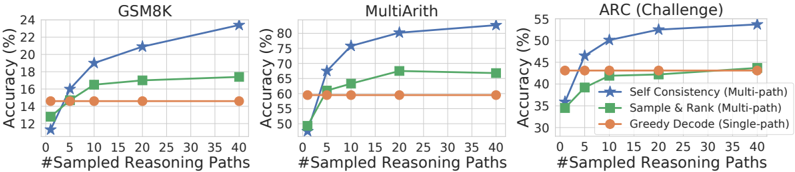
Comparison to Sample-and-Rank One commonly used approach to improve generation quality is sample-and-rank, where multiple sequences are sampled from the decoder and then ranked according to each sequence's log probability (Adiwardana et al., 2020). We compare self-consistency with sample-and-rank on GPT-3 code-davinci-001 , by sampling the same number of sequences from the decoder as self-consistency and taking the final answer from the top-ranked sequence. The results are shown in Figure 3. While sample-and-rank does improve the accuracy with additionally sampled sequences and ranking, the gain is much smaller compared to self-consistency.
Figure 3: Self-consistency significantly outperforms sample-and-rank with the same # of samples.
<details>
<summary>Image 3 Details</summary>
### Visual Description
## Line Charts: Accuracy vs. Sampled Reasoning Paths for Different Datasets
### Overview
The image presents three line charts comparing the accuracy of different reasoning methods across three datasets: GSM8K, MultiArith, and ARC (Challenge). The x-axis represents the number of sampled reasoning paths, and the y-axis represents the accuracy in percentage. Three methods are compared: Self Consistency (Multi-path), Sample & Rank (Multi-path), and Greedy Decode (Single-path).
### Components/Axes
* **X-axis (all charts):** "#Sampled Reasoning Paths" with markers at 0, 5, 10, 15, 20, 25, 30, 35, and 40.
* **Y-axis (GSM8K):** "Accuracy (%)" with markers at 12, 14, 16, 18, 20, 22, and 24.
* **Y-axis (MultiArith):** "Accuracy (%)" with markers at 50, 55, 60, 65, 70, 75, and 80.
* **Y-axis (ARC (Challenge):** "Accuracy (%)" with markers at 30, 35, 40, 45, 50, and 55.
* **Legend (bottom-right):**
* Blue line with star markers: "Self Consistency (Multi-path)"
* Green line with square markers: "Sample & Rank (Multi-path)"
* Orange line with circle markers: "Greedy Decode (Single-path)"
### Detailed Analysis
**1. GSM8K Chart (left)**
* **Self Consistency (Multi-path) - Blue:** The line starts at approximately 12% accuracy with 0 sampled paths and increases to approximately 23% accuracy with 40 sampled paths. The trend is upward.
* (0, 12%), (5, 16%), (10, 19%), (20, 21%), (40, 23%)
* **Sample & Rank (Multi-path) - Green:** The line starts at approximately 13% accuracy with 0 sampled paths, increases to approximately 17% accuracy with 20 sampled paths, and remains relatively flat until 40 sampled paths.
* (0, 13%), (5, 16%), (10, 17%), (20, 17%), (40, 17%)
* **Greedy Decode (Single-path) - Orange:** The line remains relatively flat at approximately 14-15% accuracy across all sampled reasoning paths.
* (0, 14%), (5, 15%), (10, 15%), (20, 15%), (40, 15%)
**2. MultiArith Chart (center)**
* **Self Consistency (Multi-path) - Blue:** The line starts at approximately 48% accuracy with 0 sampled paths and increases to approximately 82% accuracy with 40 sampled paths. The trend is upward.
* (0, 48%), (5, 73%), (10, 77%), (20, 80%), (40, 82%)
* **Sample & Rank (Multi-path) - Green:** The line starts at approximately 50% accuracy with 0 sampled paths, increases to approximately 68% accuracy with 20 sampled paths, and remains relatively flat until 40 sampled paths.
* (0, 50%), (5, 62%), (10, 65%), (20, 68%), (40, 68%)
* **Greedy Decode (Single-path) - Orange:** The line remains relatively flat at approximately 60% accuracy across all sampled reasoning paths.
* (0, 60%), (5, 60%), (10, 60%), (20, 60%), (40, 60%)
**3. ARC (Challenge) Chart (right)**
* **Self Consistency (Multi-path) - Blue:** The line starts at approximately 36% accuracy with 0 sampled paths and increases to approximately 54% accuracy with 40 sampled paths. The trend is upward.
* (0, 36%), (5, 48%), (10, 51%), (20, 52%), (40, 54%)
* **Sample & Rank (Multi-path) - Green:** The line starts at approximately 34% accuracy with 0 sampled paths, increases to approximately 42% accuracy with 20 sampled paths, and remains relatively flat until 40 sampled paths.
* (0, 34%), (5, 39%), (10, 41%), (20, 42%), (40, 42%)
* **Greedy Decode (Single-path) - Orange:** The line remains relatively flat at approximately 43% accuracy across all sampled reasoning paths.
* (0, 43%), (5, 43%), (10, 43%), (20, 43%), (40, 43%)
### Key Observations
* **Self Consistency (Multi-path)** consistently shows the highest accuracy and the most significant improvement with an increasing number of sampled reasoning paths across all three datasets.
* **Sample & Rank (Multi-path)** shows some improvement with an increasing number of sampled reasoning paths, but the improvement plateaus after a certain point.
* **Greedy Decode (Single-path)** consistently shows the lowest accuracy and minimal improvement with an increasing number of sampled reasoning paths.
### Interpretation
The data suggests that using multiple reasoning paths (as implemented in Self Consistency and Sample & Rank) generally leads to higher accuracy compared to using a single reasoning path (Greedy Decode). The Self Consistency method, which likely aggregates information from multiple paths more effectively, consistently outperforms the other methods. The diminishing returns observed with Sample & Rank suggest that simply sampling and ranking paths has limitations, and a more sophisticated aggregation method like Self Consistency is needed to fully leverage the benefits of multiple reasoning paths. The Greedy Decode method's flat performance indicates that its single-path approach is insufficient for these complex reasoning tasks. The performance differences across datasets highlight the varying difficulty levels and the suitability of different methods for specific problem types.
</details>
Comparison to Beam Search In Table 6, we compare self-consistency with beam search decoding on the UL2-20B model. For a fair comparison we report the accuracy under the same number of beams and reasoning paths. On both tasks self-consistency outperforms beam search significantly. Note self-consistency can also adopt beam search to decode each reasoning path (results are shown as 'Self-consistency using beam search'), but its performance is worse compared to self-consistency with sampling. The reason is that beam search yields a lower diversity in the outputs (Li & Jurafsky, 2016), while in self-consistency the diversity of the reasoning paths is the key to a better performance.
Table 6: Compare self-consistency with beam search decoding on the UL2-20B model.
| | Beam size / Self-consistency paths | 1 | 5 | 10 | 20 | 40 |
|------------|--------------------------------------|------------|------------|------------|------------|------------|
| | Beam search decoding (top beam) | 23.6 | 19.3 | 16.1 | 15.0 | 10.2 |
| AQuA | Self-consistency using beam search | 23.6 | 19.8 ± 0.3 | 21.2 ± 0.7 | 24.6 ± 0.4 | 24.2 ± 0.5 |
| AQuA | Self-consistency using sampling | 19.7 ± 2.5 | 24.9 ± 2.6 | 25.3 ± 1.8 | 26.7 ± 1.0 | 26.9 ± 0.5 |
| MultiArith | Beam search decoding (top beam) | 10.7 | 12.0 | 11.3 | 11.0 | 10.5 |
| MultiArith | Self-consistency using beam search | 10.7 | 11.8 ± 0.0 | 11.4 ± 0.1 | 12.3 ± 0.1 | 10.8 ± 0.1 |
| MultiArith | Self-consistency using sampling | 9.5 ± 1.2 | 11.3 ± 1.2 | 12.3 ± 0.8 | 13.7 ± 0.9 | 14.7 ± 0.3 |
Comparison to Ensemble-based Approaches We further compare self-consistency to ensemblebased methods for few-shot learning. In particular, we consider ensembling by: (1) prompt order permutation: we randomly permute the exemplars in the prompt 40 times to mitigate model's sensitivity to prompt order (Zhao et al., 2021; Lu et al., 2021); and (2) multiple sets of prompts (Gao et al., 2021): we manually write 3 different sets of prompts. We took majority vote of the answers from greedy decoding in both approaches as an ensemble. Table 7 shows that compared to self-consistency, existing ensemble-based approaches achieve a much smaller gain. 8 In addition, note that self-consistency is different from a typical model-ensemble approach, where multiple models are trained and their outputs are aggregated. Self-consistency acts more like a 'self-ensemble' on top of a single language model. We additionally show the results of ensembling multiple models in Appendix A.1.3 where the model-ensembles perform much worse compared to self-consistency.
Table 7: Self-consistency outperforms prompt-order and multi-prompt ensembles on LaMDA-137B.
| | GSM8K | MultiArith | SVAMP | ARC-e | ARC-c |
|-------------------------------------|------------|--------------|------------|------------|------------|
| CoT (Wei et al., 2022) | 17.1 | 51.8 | 38.9 | 75.3 | 55.1 |
| Ensemble (3 sets of prompts) | 18.6 ± 0.5 | 57.1 ± 0.7 | 42.1 ± 0.6 | 76.6 ± 0.1 | 57.0 ± 0.2 |
| Ensemble (40 prompt permutations) | 19.2 ± 0.1 | 60.9 ± 0.2 | 42.7 ± 0.1 | 76.9 ± 0.1 | 57.0 ± 0.1 |
| Self-Consistency (40 sampled paths) | 27.7 ± 0.2 | 75.7 ± 0.3 | 53.3 ± 0.2 | 79.3 ± 0.3 | 59.8 ± 0.2 |
8 Self-consistency is compatible with both ensemble approaches and we show the results in Appendix A.1.4.
## 3.5 ADDITIONAL STUDIES
We conducted a number of additional experiments to analyze different aspects of the self-consistency method, including its robustness to sampling strategies and parameters, and how it works with imperfect prompts and non-natural-language reasoning paths.
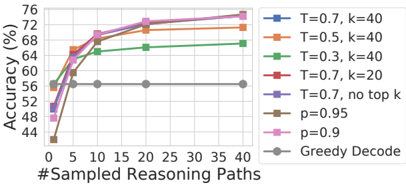
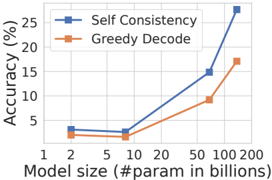
Self-Consistency is Robust to Sampling Strategies and Scaling We show self-consistency is robust to sampling strategies and parameters, by varying T in temperature sampling (Ackley et al., 1985; Ficler & Goldberg, 2017), k in topk sampling (Fan et al., 2018; Holtzman et al., 2018; Radford et al., 2019), and p in nucleus sampling (Holtzman et al., 2020), over PaLM-540B in Figure 4 (left). Figure 4 (right) shows that self-consistency robustly improves performance across all scales for the LaMDA-137B model series. The gain is relatively lower for smaller models due to certain abilities (e.g., arithmetic) only emerge when the model reaches a sufficient scale (Brown et al., 2020).
Figure 4: GSM8K accuracy. (Left) Self-consistency is robust to various sampling strategies and parameters. (Right) Self-consistency improves performance across language model scales.
<details>
<summary>Image 4 Details</summary>
### Visual Description
## Line Chart: Accuracy vs. Sampled Reasoning Paths
### Overview
The image is a line chart comparing the accuracy (%) of different decoding strategies against the number of sampled reasoning paths. The chart includes seven different decoding strategies, each represented by a distinct colored line. The x-axis represents the number of sampled reasoning paths, and the y-axis represents the accuracy percentage.
### Components/Axes
* **X-axis:** "#Sampled Reasoning Paths" with tick marks at 0, 5, 10, 15, 20, 25, 30, 35, and 40.
* **Y-axis:** "Accuracy (%)" with tick marks at 44, 48, 52, 56, 60, 64, 68, 72, and 76.
* **Legend:** Located at the top-right of the chart, it identifies each line by color and decoding strategy:
* Blue: T=0.7, k=40
* Orange: T=0.5, k=40
* Green: T=0.3, k=40
* Red: T=0.7, k=20
* Purple: T=0.7, no top k
* Brown: p=0.95
* Pink: p=0.9
* Gray: Greedy Decode
### Detailed Analysis
* **T=0.7, k=40 (Blue):** Starts at approximately 49% accuracy at 0 sampled paths, rises sharply to about 62% at 5 paths, reaches approximately 71% at 10 paths, and plateaus around 74% at 40 paths.
* **T=0.5, k=40 (Orange):** Starts at approximately 44% accuracy at 0 sampled paths, rises sharply to about 65% at 5 paths, reaches approximately 70% at 10 paths, and plateaus around 72% at 40 paths.
* **T=0.3, k=40 (Green):** Starts at approximately 56% accuracy at 0 sampled paths, rises sharply to about 64% at 5 paths, reaches approximately 66% at 10 paths, and plateaus around 68% at 40 paths.
* **T=0.7, k=20 (Red):** Starts at approximately 56% accuracy at 0 sampled paths, rises sharply to about 64% at 5 paths, reaches approximately 70% at 10 paths, and plateaus around 72% at 40 paths.
* **T=0.7, no top k (Purple):** Starts at approximately 50% accuracy at 0 sampled paths, rises sharply to about 60% at 5 paths, reaches approximately 70% at 10 paths, and plateaus around 75% at 40 paths.
* **p=0.95 (Brown):** Starts at approximately 56% accuracy at 0 sampled paths, rises sharply to about 65% at 5 paths, reaches approximately 70% at 10 paths, and plateaus around 72% at 40 paths.
* **p=0.9 (Pink):** Starts at approximately 48% accuracy at 0 sampled paths, rises sharply to about 65% at 5 paths, reaches approximately 71% at 10 paths, and plateaus around 74% at 40 paths.
* **Greedy Decode (Gray):** Remains constant at approximately 57% accuracy regardless of the number of sampled reasoning paths.
### Key Observations
* All decoding strategies, except for "Greedy Decode," show a significant increase in accuracy as the number of sampled reasoning paths increases from 0 to 10.
* After 10 sampled paths, the accuracy for most strategies plateaus, with only marginal improvements beyond that point.
* The "Greedy Decode" strategy has a constant accuracy, indicating that it does not benefit from increased sampling.
* The "T=0.7, no top k" strategy (Purple) appears to achieve the highest accuracy at 40 sampled paths.
### Interpretation
The chart suggests that sampling multiple reasoning paths can significantly improve the accuracy of decoding strategies, but the benefits diminish after a certain number of samples (around 10). The "Greedy Decode" strategy is not effective in this context, as it does not leverage multiple reasoning paths. The "T=0.7, no top k" strategy seems to be the most effective among those tested, achieving the highest accuracy with a larger number of sampled paths. The parameters T and k likely represent temperature and the number of top candidates, respectively, in a decoding algorithm. The 'p' parameter likely represents a probability threshold. The chart highlights the trade-off between computational cost (number of sampled paths) and accuracy, suggesting that an optimal balance can be achieved with around 10 sampled paths for most strategies.
</details>
<details>
<summary>Image 5 Details</summary>
### Visual Description
## Chart: Accuracy vs. Model Size
### Overview
The image is a line chart comparing the accuracy of "Self Consistency" and "Greedy Decode" methods across different model sizes. The x-axis represents model size in billions of parameters, and the y-axis represents accuracy in percentage.
### Components/Axes
* **X-axis:** Model size (#param in billions). Values: 1, 2, 5, 10, 20, 50, 100, 200.
* **Y-axis:** Accuracy (%). Values range from 0 to 25, with increments of 5.
* **Legend:** Located at the top-right of the chart.
* Blue line with square marker: "Self Consistency"
* Orange line with square marker: "Greedy Decode"
### Detailed Analysis
* **Self Consistency (Blue Line):**
* Trend: Generally slopes upward, indicating increasing accuracy with larger model sizes.
* Data Points:
* Model size 2: Accuracy ~3%
* Model size 10: Accuracy ~3%
* Model size 50: Accuracy ~15%
* Model size 100: Accuracy ~20%
* Model size 200: Accuracy ~27%
* **Greedy Decode (Orange Line):**
* Trend: Generally slopes upward, indicating increasing accuracy with larger model sizes.
* Data Points:
* Model size 2: Accuracy ~3.5%
* Model size 10: Accuracy ~2%
* Model size 50: Accuracy ~10%
* Model size 100: Accuracy ~17%
### Key Observations
* Both methods show an increase in accuracy as the model size increases.
* "Self Consistency" consistently outperforms "Greedy Decode" across all model sizes.
* The accuracy of "Self Consistency" increases more rapidly than "Greedy Decode" as the model size grows beyond 50 billion parameters.
### Interpretation
The chart demonstrates that increasing model size generally improves the accuracy of both "Self Consistency" and "Greedy Decode" methods. However, "Self Consistency" appears to be more effective at leveraging larger models, resulting in higher accuracy gains compared to "Greedy Decode." This suggests that "Self Consistency" may be a more scalable approach for improving model performance as computational resources allow for larger models. The flattening of the "Greedy Decode" line at larger model sizes could indicate a diminishing return for this method, or that it requires further optimization to fully utilize the increased model capacity.
</details>
Self-Consistency Improves Robustness to Imperfect Prompts For few-shot learning with manually constructed prompts, human annotators sometimes make minor mistakes when creating the prompts. We further study if self-consistency can help improve a language model's robustness to imperfect prompts. 9 We show the results in Table 8: while imperfect prompts decrease accuracy with greedy decoding (17.1 → 14.9), self-consistency can fill in the gaps and robustly improve the results.
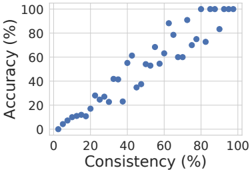
Additionally, we found that the consistency (in terms of % of decodes agreeing with the final aggregated answer) is highly correlated with accuracy (Figure 5, over GSM8K). This suggests that one can use self-consistency to provide an uncertainty estimate of the model in its generated solutions. In other words, one can use low consistency as an indicator that the model has low confidence; i.e., self-consistency confers some ability for the model to 'know when it doesn't know'.
| LaMDA-137B | Prompt with correct chain-of-thought | 17.1 14.9 |
|--------------|----------------------------------------------------------------------|-------------|
| LaMDA-137B | Prompt with imperfect chain-of-thought + Self-consistency (40 paths) | 23.4 |
| LaMDA-137B | Prompt with equations | 5 |
| LaMDA-137B | + Self-consistency (40 paths) | 6.5 |
| PaLM-540B | Zero-shot CoT (Kojima et al., 2022) | 43 |
| PaLM-540B | + Self-consistency (40 paths) | 69.2 |
Figure 5: The consistency is correlated with model's accuracy.
<details>
<summary>Image 6 Details</summary>
### Visual Description
## Chart: Accuracy vs. Consistency
### Overview
The image is a scatter plot showing the relationship between Accuracy (on the y-axis) and Consistency (on the x-axis), both measured in percentage. The plot shows a general trend of increasing accuracy with increasing consistency, although there is significant scatter.
### Components/Axes
* **X-axis:** Consistency (%), ranging from 0 to 100 in increments of 20.
* **Y-axis:** Accuracy (%), ranging from 0 to 100 in increments of 20.
* The plot contains a series of blue data points.
### Detailed Analysis
The data points show a positive correlation between consistency and accuracy.
* **Trend:** As consistency increases, accuracy generally increases.
* **Specific Values (Approximate):**
* At 10% consistency, accuracy is approximately 10%.
* At 20% consistency, accuracy is approximately 25%.
* At 40% consistency, accuracy is approximately 40%.
* At 60% consistency, accuracy is approximately 60%.
* At 80% consistency, accuracy is approximately 95%.
* At 100% consistency, accuracy is approximately 100%.
* **Scatter:** There is considerable scatter in the data, especially in the middle range of consistency (40-80%). For example, at around 60% consistency, accuracy varies from approximately 50% to 90%.
* **Plateau:** The accuracy seems to plateau around 100% consistency, with several points clustered near 100% accuracy.
### Key Observations
* The plot indicates a positive relationship between consistency and accuracy.
* The relationship is not perfectly linear, as there is significant scatter.
* Accuracy tends to plateau as consistency approaches 100%.
### Interpretation
The data suggests that higher consistency generally leads to higher accuracy. However, the scatter indicates that other factors also influence accuracy. The plateauing of accuracy at high consistency levels may indicate a ceiling effect, where further increases in consistency do not significantly improve accuracy. The relationship between consistency and accuracy is likely complex and influenced by multiple variables.
</details>
Self-Consistency Works for Non-Natural-Language Reasoning Paths and Zero-shot CoT We also tested the generality of the self-consistency concept to alternative forms of intermediate reasoning like equations (e.g., from ' There are 3 cars in the parking lot already. 2 more arrive. Now there are 3 + 2 = 5 cars. ' to ' 3 + 2 = 5 '). The results are shown in Table 8 ('Prompt with equations'): self-consistency still improves accuracy by generating intermediate equations; however, compared to generating natural language reasoning paths, the gain is smaller since the equations are much shorter and less opportunity remains for generating diversity in the decoding process. In addition, we tested self-consistency with zero-shot chain-of-thought (Kojima et al., 2022) and show that self-consistency works for zero-shot CoT as well and improves the results significantly (+26.2%) in Table 8.
9 We use the same prompts as before, but swap all the numbers in the reasoning paths with random numbers except the final answer, e.g., from ' There are 3 cars in the parking lot already. 2 more arrive. Now there are 3 + 2 = 5 cars. ' to ' There are 7 cars in the parking lot already. 6 more arrive. Now there are 7 + 6 = 5 cars. '.
## 4 RELATED WORK
Reasoning in language models. Language models are known to struggle in Type 2 tasks, such as arithmetic, logical and commonsense reasoning (Evans, 2010). Previous work has primarily focused on specialized approaches for improving reasoning (Andor et al., 2019; Ran et al., 2019; Geva et al., 2020; Pi˛ ekos et al., 2021). Compared to prior work, self-consistency is applicable to a wide range of reasoning tasks without any additional supervision or fine-tuning, while still substantially improving the performance of the chain-of-thought prompting approach proposed in Wei et al. (2022).
Sampling and re-ranking in language models. Multiple decoding strategies for language models have been proposed in the literature, e.g., temperature sampling (Ackley et al., 1985; Ficler & Goldberg, 2017), topk sampling (Fan et al., 2018; Holtzman et al., 2018; Radford et al., 2019), nucleus sampling (Holtzman et al., 2020), minimum Bayes risk decoding (Eikema & Aziz, 2020; Shi et al., 2022), and typical decoding (Meister et al., 2022). Other work has sought to explicitly promote diversity in the decoding process (Batra et al., 2012; Li et al., 2016; Vijayakumar et al., 2018).
Re-ranking is another common approach to improve generation quality in language models (Adiwardana et al., 2020; Shen et al., 2021). Thoppilan et al. (2022) collect additional human annotations to train a re-ranker for response filtering. Cobbe et al. (2021) train a 'verifier' to re-rank generated solutions, which substantially improves the solve rate on math tasks compared to just fine-tuning the language model. Elazar et al. (2021) improve the consistency of factual knowledge extraction by extending pre-training with an additional consistency loss. All these methods require either training an additional re-ranker or collecting additional human annotation, while self-consistency requires no additional training, fine-tuning, nor extra data collection.
Extract reasoning paths. Some previous work has considered task-specific approaches for identifying reasoning paths, such as constructing semantic graphs (Xu et al., 2021a), learning an RNN to retrieve reasoning paths over the Wikipedia graph (Asai et al., 2020), fine-tuning with human annotated reasoning paths on math problems (Cobbe et al., 2021), or training an extractor with heuristic-based pseudo reasoning paths (Chen et al., 2019). More recently, the importance of diversity in the reasoning processes has been noticed, but only leveraged via task-specific training, either through an additional QA model over extracted reasoning paths (Chen et al., 2019), or by the introduction of latent variables in a commonsense knowledge graph (Yu et al., 2022). Compared to these approaches, self-consistency is far simpler and requires no additional training. The approach we propose simply couples the generation of reasoning paths and a final answer by sampling from the decoder, using aggregation to recover the most consistent answer without additional modules.
Consistency in language models. Some prior work has shown that language models can suffer from inconsistency in conversation (Adiwardana et al., 2020), explanation generation (Camburu et al., 2020), and factual knowledge extraction (Elazar et al., 2021). Welleck et al. (2020) use 'consistency' to refer to generating an infinite-length sequence in recurrent language models. Nye et al. (2021) improve the logical consistency of samples from a System 1 model by adding a System 2-inspired logical reasoning module. In this paper we focus on a slightly different notion of 'consistency', i.e., utilizing answer consistency among diverse reasoning paths to improve accuracy.
## 5 CONCLUSION AND DISCUSSION
We introduced a simple yet effective method called self-consistency, and observed that it significantly improves accuracy in a range of arithmetic and commonsense reasoning tasks, across four large language models with varying scales. Beyond accuracy gains, self-consistency is also useful for collecting rationales when performing reasoning tasks with language models, and for providing uncertainty estimates and improved calibration of language model outputs.
One limitation of self-consistency is that it incurs more computation cost. In practice people can try a small number of paths (e.g., 5 or 10) as a starting point to realize most of the gains while not incurring too much cost, as in most cases the performance saturates quickly (Figure 2). As part of future work, one could use self-consistency to generate better supervised data to fine-tune the model, such that the model can give more accurate predictions in a single inference run after fine-tuning. In addition, we observed that language models can sometimes generate incorrect or nonsensical reasoning paths (e.g., the StrategyQA example in Table 4, the two population numbers are not exactly correct), and further work is needed to better ground models' rationale generations.
## REPRODUCIBILITY STATEMENT
In experiments, we included four different language models with varying scales. Two of them are public models: UL2 is a completely open-sourced model with model checkpoints available at https:// github.com/google-research/google-research/tree/master/ul2 ; GPT-3 is also a public model with public API available at https://openai.com/api/ . For GPT-3, we have included two public engines ('code-davinci-001' and 'code-davinci-002') to further aid reproducibility, as Codex is currently free so anyone can reproduce the results. In addition, as our results make use of LaMDA-137B and PaLM-540B that are not publicly available, we provide the exact input prompts for all tasks in Appendix A.3 (and note that we do not perform any finetuning and only apply prompting to off-the-shelf language models).
## ETHICS STATEMENT
As we stated in the discussion, language models can sometimes generate nonsensical or non-factual reasoning paths, so one should use language models' outputs with extra caution. We deal with reasoning tasks mostly and the generated rationales are only used for inspecting how a model reaches its answer. One could potentially use the generated rationales to further check why the model makes certain mistakes or whether the model contains any biases when performing a certain task. For language model in real-world use, further work is needed to better ground models' predictions and improve model's factuality and safety, to ensure the models do not cause harms to users.
## REFERENCES
- David H. Ackley, Geoffrey E. Hinton, and Terrence J. Sejnowski. A learning algorithm for boltzmann machines. Cognitive Science , 9(1):147-169, 1985. ISSN 0364-0213. URL https://www. sciencedirect.com/science/article/pii/S0364021385800124 .
- Daniel Adiwardana, Minh-Thang Luong, David R. So, Jamie Hall, Noah Fiedel, Romal Thoppilan, Zi Yang, Apoorv Kulshreshtha, Gaurav Nemade, Yifeng Lu, and Quoc V. Le. Towards a human-like open-domain chatbot, 2020.
- Aida Amini, Saadia Gabriel, Shanchuan Lin, Rik Koncel-Kedziorski, Yejin Choi, and Hannaneh Hajishirzi. MathQA: Towards interpretable math word problem solving with operation-based formalisms. In Proceedings of the 2019 Conference of the North American Chapter of the Association for Computational Linguistics: Human Language Technologies, Volume 1 (Long and Short Papers) , pp. 2357-2367. Association for Computational Linguistics, June 2019. URL https://aclanthology.org/N19-1245 .
- Daniel Andor, Luheng He, Kenton Lee, and Emily Pitler. Giving BERT a calculator: Finding operations and arguments with reading comprehension. In Proceedings of the 2019 Conference on Empirical Methods in Natural Language Processing and the 9th International Joint Conference on Natural Language Processing (EMNLP-IJCNLP) , 2019. URL https://aclanthology. org/D19-1609 .
- Akari Asai, Kazuma Hashimoto, Hannaneh Hajishirzi, Richard Socher, and Caiming Xiong. Learning to retrieve reasoning paths over wikipedia graph for question answering. In International Conference on Learning Representations , 2020. URL https://openreview.net/forum? id=SJgVHkrYDH .
- Roy Bar-Haim, Ido Dagan, Bill Dolan, Lisa Ferro, Danilo Giampiccolo, Bernardo Magnini, and Idan Szpektor. The second pascal recognising textual entailment challenge. In Proceedings of the second PASCAL challenges workshop on recognising textual entailment , 2006.
- Dhruv Batra, Payman Yadollahpour, Abner Guzman-Rivera, and Gregory Shakhnarovich. Diverse m-best solutions in markov random fields. In Proceedings of the 12th European Conference on Computer Vision - Volume Part V , ECCV'12, pp. 1-16, Berlin, Heidelberg, 2012. Springer-Verlag. ISBN 9783642337147. URL https://doi.org/10.1007/978-3-642-33715-4\_1 .
- Luisa Bentivogli, Peter Clark, Ido Dagan, and Danilo Giampiccolo. The fifth pascal recognizing textual entailment challenge. In TAC , 2009.
- BIG-bench collaboration. Beyond the imitation game: Measuring and extrapolating the capabilities of language models. In preparation , 2021. URL https://github.com/google/ BIG-bench/ .
- Tom Brown, Benjamin Mann, Nick Ryder, Melanie Subbiah, Jared D Kaplan, Prafulla Dhariwal, Arvind Neelakantan, Pranav Shyam, Girish Sastry, Amanda Askell, Sandhini Agarwal, Ariel Herbert-Voss, Gretchen Krueger, Tom Henighan, Rewon Child, Aditya Ramesh, Daniel Ziegler, Jeffrey Wu, Clemens Winter, Chris Hesse, Mark Chen, Eric Sigler, Mateusz Litwin, Scott Gray, Benjamin Chess, Jack Clark, Christopher Berner, Sam McCandlish, Alec Radford, Ilya Sutskever, and Dario Amodei. Language models are few-shot learners. In Advances in Neural Information Processing Systems , 2020. URL https://proceedings.neurips.cc/paper/2020/ file/1457c0d6bfcb4967418bfb8ac142f64a-Paper.pdf .
- Oana-Maria Camburu, Tim Rocktäschel, Thomas Lukasiewicz, and Phil Blunsom. esnli: Natural language inference with natural language explanations. In S. Bengio, H. Wallach, H. Larochelle, K. Grauman, N. Cesa-Bianchi, and R. Garnett (eds.), Advances in Neural Information Processing Systems 31 , pp. 9539-9549. Curran Associates, Inc., 2018. URL http://papers.nips.cc/paper/ 8163-e-snli-natural-language-inference-with-natural-language-explanations. pdf .
- Oana-Maria Camburu, Brendan Shillingford, Pasquale Minervini, Thomas Lukasiewicz, and Phil Blunsom. Make up your mind! adversarial generation of inconsistent natural language explanations. In Proceedings of the 58th Annual Meeting of the Association for Computational Linguistics , pp. 4157-4165, Online, July 2020. Association for Computational Linguistics. doi: 10.18653/v1/2020. acl-main.382. URL https://aclanthology.org/2020.acl-main.382 .
- Jifan Chen, Shih-Ting Lin, and Greg Durrett. Multi-hop question answering via reasoning chains. CoRR , abs/1910.02610, 2019. URL http://arxiv.org/abs/1910.02610 .
- Mark Chen, Jerry Tworek, Heewoo Jun, Qiming Yuan, Henrique Ponde de Oliveira Pinto, Jared Kaplan, Harri Edwards, Yuri Burda, Nicholas Joseph, Greg Brockman, et al. Evaluating large language models trained on code. arXiv preprint arXiv:2107.03374 , 2021.
- Aakanksha Chowdhery, Sharan Narang, Jacob Devlin, Maarten Bosma, Gaurav Mishra, Adam Roberts, Paul Barham, Hyung Won Chung, Charles Sutton, Sebastian Gehrmann, Parker Schuh, Kensen Shi, Sasha Tsvyashchenko, Joshua Maynez, Abhishek Rao, Parker Barnes, Yi Tay, Noam Shazeer, Vinodkumar Prabhakaran, Emily Reif, Nan Du, Ben Hutchinson, Reiner Pope, James Bradbury, Jacob Austin, Michael Isard, Guy Gur-Ari, Pengcheng Yin, Toju Duke, Anselm Levskaya, Sanjay Ghemawat, Sunipa Dev, Henryk Michalewski, Xavier Garcia, Vedant Misra, Kevin Robinson, Liam Fedus, Denny Zhou, Daphne Ippolito, David Luan, Hyeontaek Lim, Barret Zoph, Alexander Spiridonov, Ryan Sepassi, David Dohan, Shivani Agrawal, Mark Omernick, Andrew M. Dai, Thanumalayan Sankaranarayana Pillai, Marie Pellat, Aitor Lewkowycz, Erica Moreira, Rewon Child, Oleksandr Polozov, Katherine Lee, Zongwei Zhou, Xuezhi Wang, Brennan Saeta, Mark Diaz, Orhan Firat, Michele Catasta, Jason Wei, Kathy Meier-Hellstern, Douglas Eck, Jeff Dean, Slav Petrov, and Noah Fiedel. Palm: Scaling language modeling with pathways, 2022. URL https://arxiv.org/abs/2204.02311 .
- Christopher Clark, Kenton Lee, Ming-Wei Chang, Tom Kwiatkowski, Michael Collins, and Kristina Toutanova. Boolq: Exploring the surprising difficulty of natural yes/no questions. In NAACL , 2019.
- Peter Clark, Isaac Cowhey, Oren Etzioni, Tushar Khot, Ashish Sabharwal, Carissa Schoenick, and Oyvind Tafjord. Think you have solved question answering? try arc, the ai2 reasoning challenge. ArXiv , abs/1803.05457, 2018.
- Karl Cobbe, Vineet Kosaraju, Mohammad Bavarian, Mark Chen, Heewoo Jun, Lukasz Kaiser, Matthias Plappert, Jerry Tworek, Jacob Hilton, Reiichiro Nakano, Christopher Hesse, and John Schulman. Training verifiers to solve math word problems, 2021.
- Ido Dagan, Oren Glickman, and Bernardo Magnini. The pascal recognising textual entailment challenge. In Machine Learning Challenges Workshop , pp. 177-190. Springer, 2005.
- Bryan Eikema and Wilker Aziz. Is MAP decoding all you need? the inadequacy of the mode in neural machine translation. In Proceedings of the 28th International Conference on Computational Linguistics , pp. 4506-4520, Barcelona, Spain (Online), December 2020. International Committee on Computational Linguistics. URL https://aclanthology.org/2020.coling-main. 398 .
- Yanai Elazar, Nora Kassner, Shauli Ravfogel, Abhilasha Ravichander, Eduard Hovy, Hinrich Schütze, and Yoav Goldberg. Measuring and improving consistency in pretrained language models. Transactions of the Association for Computational Linguistics , 9:1012-1031, 2021. doi: 10.1162/tacl\_a\_00410. URL https://aclanthology.org/2021.tacl-1.60 .
- Jonathan St BT Evans. Intuition and reasoning: A dual-process perspective. Psychological Inquiry , 21(4):313-326, 2010.
- Angela Fan, Mike Lewis, and Yann Dauphin. Hierarchical neural story generation. In Proceedings of the 56th Annual Meeting of the Association for Computational Linguistics (Volume 1: Long Papers) , pp. 889-898, Melbourne, Australia, July 2018. Association for Computational Linguistics. doi: 10.18653/v1/P18-1082. URL https://aclanthology.org/P18-1082 .
- Jessica Ficler and Yoav Goldberg. Controlling linguistic style aspects in neural language generation. In Proceedings of the Workshop on Stylistic Variation , pp. 94-104, Copenhagen, Denmark, September 2017. Association for Computational Linguistics. doi: 10.18653/v1/W17-4912. URL https: //aclanthology.org/W17-4912 .
- Tianyu Gao, Adam Fisch, and Danqi Chen. Making pre-trained language models better few-shot learners. In Proceedings of the 59th Annual Meeting of the Association for Computational Linguistics and the 11th International Joint Conference on Natural Language Processing (Volume 1: Long Papers) , pp. 3816-3830, Online, August 2021. Association for Computational Linguistics. doi: 10.18653/v1/2021.acl-long.295. URL https://aclanthology.org/2021.acl-long. 295 .
- Mor Geva, Ankit Gupta, and Jonathan Berant. Injecting numerical reasoning skills into language models. In Proceedings of the 58th Annual Meeting of the Association for Computational Linguistics , 2020. doi: 10.18653/v1/2020.acl-main.89. URL https://aclanthology.org/2020. acl-main.89 .
- Mor Geva, Daniel Khashabi, Elad Segal, Tushar Khot, Dan Roth, and Jonathan Berant. Did aristotle use a laptop? A question answering benchmark with implicit reasoning strategies. Transactions of the Association for Computational Linguistics , 2021. URL https://aclanthology.org/ 2021.tacl-1.21 .
- Danilo Giampiccolo, Bernardo Magnini, Ido Dagan, and Bill Dolan. The third pascal recognizing textual entailment challenge. In Proceedings of the ACL-PASCAL workshop on textual entailment and paraphrasing , pp. 1-9. Association for Computational Linguistics, 2007.
- Ari Holtzman, Jan Buys, Maxwell Forbes, Antoine Bosselut, David Golub, and Yejin Choi. Learning to write with cooperative discriminators. In Proceedings of the 56th Annual Meeting of the Association for Computational Linguistics (Volume 1: Long Papers) , pp. 1638-1649, Melbourne, Australia, July 2018. Association for Computational Linguistics. doi: 10.18653/v1/P18-1152. URL https://aclanthology.org/P18-1152 .
- Ari Holtzman, Jan Buys, Li Du, Maxwell Forbes, and Yejin Choi. The curious case of neural text degeneration. In International Conference on Learning Representations , 2020. URL https: //openreview.net/forum?id=rygGQyrFvH .
- Mohammad Javad Hosseini, Hannaneh Hajishirzi, Oren Etzioni, and Nate Kushman. Learning to solve arithmetic word problems with verb categorization. In Proceedings of the 2014 Conference on Empirical Methods in Natural Language Processing (EMNLP) , 2014. doi: 10.3115/v1/D14-1058. URL https://aclanthology.org/D14-1058 .
- Daniel Khashabi, Sewon Min, Tushar Khot, Ashish Sabharwal, Oyvind Tafjord, Peter Clark, and Hannaneh Hajishirzi. UNIFIEDQA: Crossing format boundaries with a single QA system. In Findings of the Association for Computational Linguistics: EMNLP 2020 , pp. 1896-1907, Online, November 2020. Association for Computational Linguistics. doi: 10.18653/v1/2020.findings-emnlp.171. URL https://aclanthology.org/2020.findings-emnlp.171 .
- Takeshi Kojima, Shixiang Shane Gu, Machel Reid, Yutaka Matsuo, and Yusuke Iwasawa. Large language models are zero-shot reasoners. In Alice H. Oh, Alekh Agarwal, Danielle Belgrave, and Kyunghyun Cho (eds.), Advances in Neural Information Processing Systems , 2022. URL https://openreview.net/forum?id=e2TBb5y0yFf .
- Rik Koncel-Kedziorski, Subhro Roy, Aida Amini, Nate Kushman, and Hannaneh Hajishirzi. MAWPS: A math word problem repository. In Proceedings of the 2016 Conference of the North American Chapter of the Association for Computational Linguistics: Human Language Technologies , 2016. doi: 10.18653/v1/N16-1136. URL https://aclanthology.org/N16-1136 .
- Yihuai Lan, Lei Wang, Qiyuan Zhang, Yunshi Lan, Bing Tian Dai, Yan Wang, Dongxiang Zhang, and Ee-Peng Lim. MWPToolkit: An open-source framework for deep learning-based math word problem solvers. arXiv preprint arXiv:2109.00799 , 2021. URL https://arxiv.org/abs/ 2109.00799 .
- Jiwei Li and Dan Jurafsky. Mutual information and diverse decoding improve neural machine translation, 2016. URL https://arxiv.org/abs/1601.00372 .
- Jiwei Li, Will Monroe, and Dan Jurafsky. A simple, fast diverse decoding algorithm for neural generation. CoRR , abs/1611.08562, 2016. URL http://arxiv.org/abs/1611.08562 .
- Wang Ling, Dani Yogatama, Chris Dyer, and Phil Blunsom. Program induction by rationale generation: Learning to solve and explain algebraic word problems. In Proceedings of the 55th Annual Meeting of the Association for Computational Linguistics (Volume 1: Long Papers) , 2017. doi: 10.18653/v1/P17-1015. URL https://aclanthology.org/P17-1015 .
- Yao Lu, Max Bartolo, Alastair Moore, Sebastian Riedel, and Pontus Stenetorp. Fantastically ordered prompts and where to find them: Overcoming few-shot prompt order sensitivity. ArXiv , abs/2104.08786, 2021.
- Clara Meister, Tiago Pimentel, Gian Wiher, and Ryan Cotterell. Typical decoding for natural language generation. arXiv preprint arXiv:2202.00666 , 2022.
- Shen Yun Miao, Chao Chun Liang, and Keh Yih Su. A diverse corpus for evaluating and developing English math word problem solvers. In Proceedings of the 58th Annual Meeting of the Association for Computational Linguistics , 2020. URL https://aclanthology.org/2020. acl-main.92 .
- Yixin Nie, Adina Williams, Emily Dinan, Mohit Bansal, Jason Weston, and Douwe Kiela. Adversarial NLI: A new benchmark for natural language understanding. In Proceedings of the 58th Annual Meeting of the Association for Computational Linguistics . Association for Computational Linguistics, 2020.
- Maxwell Nye, Michael Henry Tessler, Joshua B. Tenenbaum, and Brenden M. Lake. Improving coherence and consistency in neural sequence models with dual-system, neuro-symbolic reasoning. In A. Beygelzimer, Y. Dauphin, P. Liang, and J. Wortman Vaughan (eds.), Advances in Neural Information Processing Systems , 2021. URL https://openreview.net/forum?id= uyKk\_avJ-p4 .
- Arkil Patel, Satwik Bhattamishra, and Navin Goyal. Are NLP models really able to solve simple math word problems? In Proceedings of the 2021 Conference of the North American Chapter of the Association for Computational Linguistics: Human Language Technologies , pp. 2080-2094, Online, June 2021. Association for Computational Linguistics. doi: 10.18653/v1/2021.naacl-main. 168. URL https://aclanthology.org/2021.naacl-main.168 .
- Xinyu Pi, Qian Liu, Bei Chen, Morteza Ziyadi, Zeqi Lin, Yan Gao, Qiang Fu, Jian-Guang Lou, and Weizhu Chen. Reasoning like program executors, 2022.
- Piotr Pi˛ ekos, Mateusz Malinowski, and Henryk Michalewski. Measuring and improving BERT's mathematical abilities by predicting the order of reasoning. In Proceedings of the 59th Annual Meeting of the Association for Computational Linguistics and the 11th International Joint Conference on Natural Language Processing (Volume 2: Short Papers) , 2021. doi: 10.18653/v1/2021.acl-short.49. URL https://aclanthology.org/2021.acl-short.49 .
- Alec Radford, Jeff Wu, Rewon Child, David Luan, Dario Amodei, and Ilya Sutskever. Language models are unsupervised multitask learners. 2019.
- Jack W Rae, Sebastian Borgeaud, Trevor Cai, Katie Millican, Jordan Hoffmann, Francis Song, John Aslanides, Sarah Henderson, Roman Ring, Susannah Young, et al. Scaling language models: Methods, analysis & insights from training gopher. arXiv preprint arXiv:2112.11446 , 2021.
- Qiu Ran, Yankai Lin, Peng Li, Jie Zhou, and Zhiyuan Liu. NumNet: Machine reading comprehension with numerical reasoning. In Proceedings of the 2019 Conference on Empirical Methods in Natural Language Processing and the 9th International Joint Conference on Natural Language Processing (EMNLP-IJCNLP) , 2019. doi: 10.18653/v1/D19-1251. URL https://aclanthology. org/D19-1251 .
- Subhro Roy and Dan Roth. Solving general arithmetic word problems. In Proceedings of the 2015 Conference on Empirical Methods in Natural Language Processing , 2015. doi: 10.18653/v1/ D15-1202. URL https://aclanthology.org/D15-1202 .
- Jianhao Shen, Yichun Yin, Lin Li, Lifeng Shang, Xin Jiang, Ming Zhang, and Qun Liu. Generate & rank: A multi-task framework for math word problems. In Findings of the Association for Computational Linguistics: EMNLP 2021 , pp. 2269-2279, Punta Cana, Dominican Republic, November 2021. Association for Computational Linguistics. URL https://aclanthology. org/2021.findings-emnlp.195 .
- Freda Shi, Daniel Fried, Marjan Ghazvininejad, Luke Zettlemoyer, and Sida I. Wang. Natural language to code translation with execution. In Proceedings of the 2022 Conference on Empirical Methods in Natural Language Processing , pp. 3533-3546, Abu Dhabi, United Arab Emirates, December 2022. Association for Computational Linguistics. URL https://aclanthology. org/2022.emnlp-main.231 .
- Keith E Stanovich and Richard F West. Individual differences in reasoning: Implications for the rationality debate? Behavioral and brain sciences , 23(5):645-665, 2000. URL https: //pubmed.ncbi.nlm.nih.gov/11301544/ .
- Alon Talmor, Jonathan Herzig, Nicholas Lourie, and Jonathan Berant. CommonsenseQA: A question answering challenge targeting commonsense knowledge. In Proceedings of the 2019 Conference of the North American Chapter of the Association for Computational Linguistics: Human Language Technologies, Volume 1 (Long and Short Papers) , 2019. URL https://aclanthology. org/N19-1421 .
- Yi Tay, Mostafa Dehghani, Vinh Q. Tran, Xavier Garcia, Jason Wei, Xuezhi Wang, Hyung Won Chung, Dara Bahri, Tal Schuster, Steven Zheng, Denny Zhou, Neil Houlsby, and Donald Metzler. Unifying language learning paradigms, 2022. URL https://arxiv.org/abs/2205.05131 .
- Romal Thoppilan, Daniel De Freitas, Jamie Hall, Noam Shazeer, Apoorv Kulshreshtha, Heng-Tze Cheng, Alicia Jin, Taylor Bos, Leslie Baker, Yu Du, et al. Lamda: Language models for dialog applications. arXiv preprint arXiv:2201.08239 , 2022. URL https://arxiv.org/abs/ 2201.08239 .
- Ashwin Vijayakumar, Michael Cogswell, Ramprasaath Selvaraju, Qing Sun, Stefan Lee, David Crandall, and Dhruv Batra. Diverse beam search for improved description of complex scenes. Proceedings of the AAAI Conference on Artificial Intelligence , 32, Apr. 2018. URL https: //ojs.aaai.org/index.php/AAAI/article/view/12340 .
- Jason Wei, Xuezhi Wang, Dale Schuurmans, Maarten Bosma, Brian Ichter, Fei Xia, Ed Chi, Quoc Le, and Denny Zhou. Chain of thought prompting elicits reasoning in large language models. Conference on Neural Information Processing Systems (NeurIPS) , 2022. URL https://arxiv. org/pdf/2201.11903 .
- Sean Welleck, Ilia Kulikov, Jaedeok Kim, Richard Yuanzhe Pang, and Kyunghyun Cho. Consistency of a recurrent language model with respect to incomplete decoding. In Proceedings of the 2020 Conference on Empirical Methods in Natural Language Processing (EMNLP) , pp. 5553-5568, Online, November 2020. Association for Computational Linguistics. doi: 10.18653/v1/2020. emnlp-main.448. URL https://aclanthology.org/2020.emnlp-main.448 .
- Weiwen Xu, Yang Deng, Huihui Zhang, Deng Cai, and Wai Lam. Exploiting reasoning chains for multi-hop science question answering. In Findings of the Association for Computational Linguistics: EMNLP 2021 , pp. 1143-1156, Punta Cana, Dominican Republic, November 2021a. Association for Computational Linguistics. URL https://aclanthology.org/2021. findings-emnlp.99 .
- Yichong Xu, Chenguang Zhu, Shuohang Wang, Siqi Sun, Hao Cheng, Xiaodong Liu, Jianfeng Gao, Pengcheng He, Michael Zeng, and Xuedong Huang. Human parity on commonsenseqa: Augmenting self-attention with external attention, 2021b. URL https://arxiv.org/abs/ 2112.03254 .
- Zhilin Yang, Peng Qi, Saizheng Zhang, Yoshua Bengio, William Cohen, Ruslan Salakhutdinov, and Christopher D. Manning. HotpotQA: A dataset for diverse, explainable multi-hop question answering. In Proceedings of the 2018 Conference on Empirical Methods in Natural Language Processing , pp. 2369-2380, Brussels, Belgium, October-November 2018. Association for Computational Linguistics. doi: 10.18653/v1/D18-1259. URL https://aclanthology.org/D18-1259 .
- Xi Ye and Greg Durrett. The unreliability of explanations in few-shot prompting for textual reasoning. In Alice H. Oh, Alekh Agarwal, Danielle Belgrave, and Kyunghyun Cho (eds.), Advances in Neural Information Processing Systems , 2022. URL https://openreview.net/forum? id=Bct2f8fRd8S .
- Wenhao Yu, Chenguang Zhu, Lianhui Qin, Zhihan Zhang, Tong Zhao, and Meng Jiang. Diversifying content generation for commonsense reasoning with mixture of knowledge graph experts. In Findings of Annual Meeting of the Association for Computational Linguistics (ACL) , 2022.
- Zihao Zhao, Eric Wallace, Shi Feng, Dan Klein, and Sameer Singh. Calibrate before use: Improving few-shot performance of language models. In Marina Meila and Tong Zhang (eds.), Proceedings of the 38th International Conference on Machine Learning , volume 139 of Proceedings of Machine Learning Research . PMLR, 2021. URL https://proceedings.mlr.press/ v139/zhao21c.html .
## A APPENDIX
## A.1 ADDITIONAL EXPERIMENT RESULTS
## A.1.1 ROBUSTNESS TO SAMPLING STRATEGIES AND PARAMETERS
In Figure 6 we ablate the results with respect to different sampling strategies and parameters by varying T in temperature sampling and k in Topk sampling, on LaMDA-137B. We show that self-consistency is robust to various sampling strategies and parameters.
Figure 6: GSM8K accuracy over LaMDA-137B. Self-consistency works under various sampling strategies and sampling parameters.
<details>
<summary>Image 7 Details</summary>
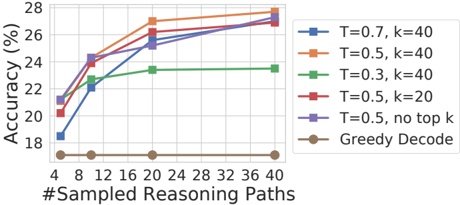
### Visual Description
## Line Chart: Accuracy vs. Number of Sampled Reasoning Paths
### Overview
The image is a line chart comparing the accuracy (%) of different reasoning strategies against the number of sampled reasoning paths. The chart includes five different reasoning strategies, each represented by a distinct colored line, and a baseline "Greedy Decode" strategy. The x-axis represents the number of sampled reasoning paths, ranging from 4 to 40. The y-axis represents the accuracy in percentage, ranging from 18% to 28%.
### Components/Axes
* **X-axis:** "#Sampled Reasoning Paths" with tick marks at 4, 8, 12, 16, 20, 24, 28, 32, 36, and 40.
* **Y-axis:** "Accuracy (%)" with tick marks at 18, 20, 22, 24, 26, and 28.
* **Legend:** Located on the right side of the chart, it identifies each line by its color and corresponding reasoning strategy:
* Blue: T=0.7, k=40
* Orange: T=0.5, k=40
* Green: T=0.3, k=40
* Red: T=0.5, k=20
* Purple: T=0.5, no top k
* Brown: Greedy Decode
### Detailed Analysis
* **T=0.7, k=40 (Blue):** The line starts at approximately 18.5% accuracy with 4 sampled paths, increases to approximately 22.8% at 8 paths, reaches approximately 25% at 16 paths, and plateaus around 27% at 40 paths.
* **T=0.5, k=40 (Orange):** The line starts at approximately 21% accuracy with 4 sampled paths, increases to approximately 24.5% at 8 paths, reaches approximately 27% at 20 paths, and plateaus around 27.5% at 40 paths.
* **T=0.3, k=40 (Green):** The line starts at approximately 20.8% accuracy with 4 sampled paths, increases to approximately 22.8% at 12 paths, and plateaus around 23.5% at 40 paths.
* **T=0.5, k=20 (Red):** The line starts at approximately 20.2% accuracy with 4 sampled paths, increases to approximately 24.2% at 8 paths, reaches approximately 26% at 20 paths, and plateaus around 27% at 40 paths.
* **T=0.5, no top k (Purple):** The line starts at approximately 21% accuracy with 4 sampled paths, increases to approximately 24.5% at 12 paths, reaches approximately 26% at 40 paths.
* **Greedy Decode (Brown):** This line remains relatively flat at approximately 17% accuracy across all numbers of sampled reasoning paths.
### Key Observations
* The "Greedy Decode" strategy consistently performs worse than all other strategies.
* The strategies T=0.7, k=40 (Blue), T=0.5, k=40 (Orange), T=0.5, k=20 (Red), and T=0.5, no top k (Purple) show significant improvement in accuracy as the number of sampled reasoning paths increases, but they plateau after 20 sampled paths.
* The strategy T=0.3, k=40 (Green) shows a smaller increase in accuracy compared to the other strategies as the number of sampled reasoning paths increases.
### Interpretation
The data suggests that sampling multiple reasoning paths generally improves accuracy compared to the "Greedy Decode" baseline. The strategies with T=0.5 and T=0.7 appear to perform better than T=0.3. The parameter 'k' (likely representing a top-k sampling strategy) also seems to influence performance, although the "no top k" strategy performs comparably to the k=20 and k=40 strategies when T=0.5. The plateauing of accuracy after 20 sampled paths suggests diminishing returns for increasing the number of sampled paths beyond this point. The "Greedy Decode" strategy's consistently low performance indicates that exploring multiple reasoning paths is crucial for achieving higher accuracy in this context.
</details>
In Figure 7 and Figure 8, we show the results of self-consistency compared with greedy decoding a single path over LaMDA-137B and PaLM-540B, respectively. Self-consistency improves over greedy decode by a quite significant margin on both models, on top of high accuracy already achieved by scaling up model sizes.
Figure 7: Self-consistency (blue) significantly improves accuracy across various arithmetic and commonsense reasoning tasks, over LaMDA-137B. Sampling a higher number of diverse reasoning paths consistently improves reasoning accuracy.
<details>
<summary>Image 8 Details</summary>
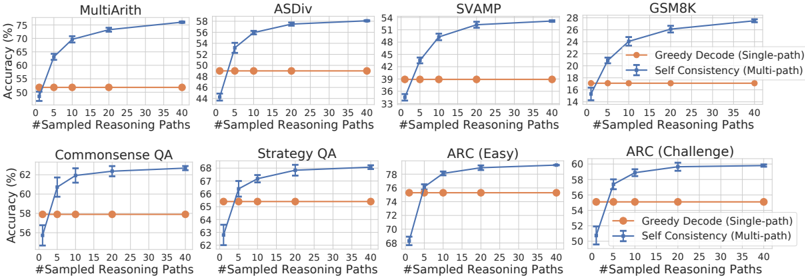
### Visual Description
## Chart Type: Multiple Line Charts Comparing Reasoning Methods
### Overview
The image presents eight line charts arranged in a 2x4 grid. Each chart compares the accuracy (%) of two reasoning methods, "Greedy Decode (Single-path)" and "Self Consistency (Multi-path)", across different numbers of sampled reasoning paths (from 0 to 40). The charts are grouped by the task they evaluate: MultiArith, ASDiv, SVAMP, GSM8K, Commonsense QA, Strategy QA, ARC (Easy), and ARC (Challenge).
### Components/Axes
* **X-axis (Horizontal):** "#Sampled Reasoning Paths". The scale ranges from 0 to 40 in increments of 5.
* **Y-axis (Vertical):** "Accuracy (%)". The scale varies for each chart, but generally covers a range relevant to the observed accuracy.
* **Legend (Right of GSM8K and ARC(Challenge) charts):**
* Orange line with circular markers: "Greedy Decode (Single-path)"
* Blue line with error bars: "Self Consistency (Multi-path)"
* **Chart Titles:**
* Top Row: MultiArith, ASDiv, SVAMP, GSM8K
* Bottom Row: Commonsense QA, Strategy QA, ARC (Easy), ARC (Challenge)
### Detailed Analysis
**1. MultiArith**
* Y-axis: 50 to 75
* Greedy Decode (Single-path) (Orange): Constant at approximately 51%.
* Self Consistency (Multi-path) (Blue): Starts at approximately 51% and increases sharply to approximately 75% by 40 sampled reasoning paths.
**2. ASDiv**
* Y-axis: 44 to 58
* Greedy Decode (Single-path) (Orange): Constant at approximately 49%.
* Self Consistency (Multi-path) (Blue): Starts at approximately 45% and increases to approximately 58% by 40 sampled reasoning paths.
**3. SVAMP**
* Y-axis: 33 to 54
* Greedy Decode (Single-path) (Orange): Constant at approximately 39%.
* Self Consistency (Multi-path) (Blue): Starts at approximately 36% and increases to approximately 53% by 40 sampled reasoning paths.
**4. GSM8K**
* Y-axis: 14 to 28
* Greedy Decode (Single-path) (Orange): Constant at approximately 17%.
* Self Consistency (Multi-path) (Blue): Starts at approximately 16% and increases to approximately 28% by 40 sampled reasoning paths.
**5. Commonsense QA**
* Y-axis: 56 to 63
* Greedy Decode (Single-path) (Orange): Constant at approximately 58%.
* Self Consistency (Multi-path) (Blue): Starts at approximately 57% and increases to approximately 62% by 40 sampled reasoning paths.
**6. Strategy QA**
* Y-axis: 62 to 68
* Greedy Decode (Single-path) (Orange): Constant at approximately 65%.
* Self Consistency (Multi-path) (Blue): Starts at approximately 63% and increases to approximately 68% by 40 sampled reasoning paths.
**7. ARC (Easy)**
* Y-axis: 68 to 78
* Greedy Decode (Single-path) (Orange): Constant at approximately 76%.
* Self Consistency (Multi-path) (Blue): Starts at approximately 68% and increases to approximately 78% by 40 sampled reasoning paths.
**8. ARC (Challenge)**
* Y-axis: 50 to 60
* Greedy Decode (Single-path) (Orange): Constant at approximately 55%.
* Self Consistency (Multi-path) (Blue): Starts at approximately 50% and increases to approximately 60% by 40 sampled reasoning paths.
### Key Observations
* The "Self Consistency (Multi-path)" method consistently shows improved accuracy as the number of sampled reasoning paths increases across all tasks.
* The "Greedy Decode (Single-path)" method maintains a relatively constant accuracy regardless of the number of sampled reasoning paths.
* The magnitude of improvement from "Self Consistency" varies across tasks. MultiArith shows the most significant improvement, while Strategy QA shows the least.
* Error bars are present on the "Self Consistency" data, indicating the variability in the results.
### Interpretation
The data suggests that using multiple reasoning paths ("Self Consistency") generally improves the accuracy of the model compared to using a single reasoning path ("Greedy Decode"). The improvement is more pronounced for some tasks (e.g., MultiArith, SVAMP, GSM8K) than others (e.g., Strategy QA, Commonsense QA). This could be due to the nature of the tasks themselves, where some tasks benefit more from exploring multiple reasoning strategies. The constant accuracy of "Greedy Decode" indicates that simply increasing the number of samples without exploring diverse reasoning paths does not lead to better performance. The error bars on the "Self Consistency" data suggest that the improvement is not always consistent and may depend on the specific samples used.
</details>
We further show additional sampled reasoning paths from the LaMDA-137B model in Table 12, and sampled reasoning paths from the PaLM-540B model in Table 13. We see that the diversity in the additionally sampled reasoning paths indeed helps the model arrive at a more correct final answer after aggregation.
## A.1.2 ROBUSTNESS TO DIFFERENT SETS OF PROMPTS
In Table 9, we further show that self-consistency is quite robust to different sets of input prompts. We manually wrote 3 different sets of chain-of-thought as prompts to the model. Across all sets of prompts, self-consistency yields consistent gains over the original CoT approach.
## A.1.3 COMPARED TO MODEL ENSEMBLES
Additionally, we provide results of directly ensembling the outputs from multiple language models . The results are shown in Table 10, by greedily decoding sequences from 3 language models and
Figure 8: Self-consistency (blue) significantly improves accuracy across various arithmetic and commonsense reasoning tasks, over PaLM-540B. Sampling a higher number of diverse reasoning paths consistently helps reasoning accuracy.
<details>
<summary>Image 9 Details</summary>
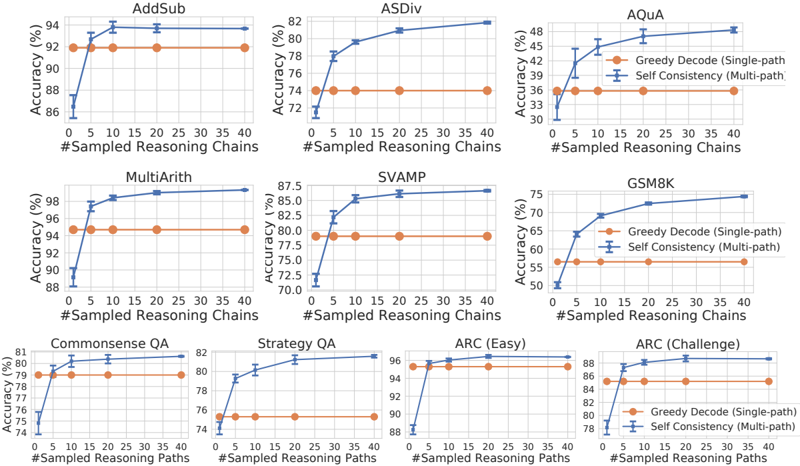
### Visual Description
## Chart: Accuracy vs. Sampled Reasoning Chains/Paths for Various Datasets
### Overview
The image presents a series of line graphs comparing the accuracy of two methods, "Greedy Decode (Single-path)" and "Self Consistency (Multi-path)", across different datasets. The x-axis represents the number of sampled reasoning chains or paths, while the y-axis represents the accuracy in percentage. Each graph corresponds to a specific dataset.
### Components/Axes
* **X-axis:** "#Sampled Reasoning Chains" or "#Sampled Reasoning Paths". The scale ranges from 0 to 40 in increments of 5.
* **Y-axis:** "Accuracy (%)". The scale varies depending on the dataset, but generally covers a range relevant to the observed accuracy.
* **Legend (Located in the top-right of the AQUA chart and bottom-right of the GSM8K and ARC(Challenge) charts):**
* **Orange Line:** "Greedy Decode (Single-path)"
* **Blue Line:** "Self Consistency (Multi-path)"
* **Titles:** Each chart has a title indicating the dataset name (e.g., "AddSub", "ASDiv", "AQuA", "MultiArith", "SVAMP", "GSM8K", "Commonsense QA", "Strategy QA", "ARC (Easy)", "ARC (Challenge)").
### Detailed Analysis
**1. AddSub**
* **Y-axis:** 86 to 94
* **Greedy Decode (Single-path) - Orange:** The accuracy is constant at approximately 92%.
* **Self Consistency (Multi-path) - Blue:** The accuracy starts at approximately 87% at 0 sampled chains, rises sharply to approximately 92% at 5 sampled chains, and then plateaus around 93-94% with minor fluctuations.
**2. ASDiv**
* **Y-axis:** 72 to 82
* **Greedy Decode (Single-path) - Orange:** The accuracy is constant at approximately 74%.
* **Self Consistency (Multi-path) - Blue:** The accuracy starts at approximately 72% at 0 sampled chains, rises sharply to approximately 80% at 10 sampled chains, and then continues to increase gradually to approximately 82% at 40 sampled chains.
**3. AQuA**
* **Y-axis:** 30 to 48
* **Greedy Decode (Single-path) - Orange:** The accuracy is constant at approximately 36%.
* **Self Consistency (Multi-path) - Blue:** The accuracy starts at approximately 32% at 0 sampled chains, rises sharply to approximately 44% at 10 sampled chains, and then continues to increase gradually to approximately 48% at 40 sampled chains.
**4. MultiArith**
* **Y-axis:** 88 to 98
* **Greedy Decode (Single-path) - Orange:** The accuracy is constant at approximately 95%.
* **Self Consistency (Multi-path) - Blue:** The accuracy starts at approximately 89% at 0 sampled chains, rises sharply to approximately 97% at 10 sampled chains, and then plateaus around 98% with minor fluctuations.
**5. SVAMP**
* **Y-axis:** 70 to 87.5
* **Greedy Decode (Single-path) - Orange:** The accuracy is constant at approximately 80%.
* **Self Consistency (Multi-path) - Blue:** The accuracy starts at approximately 72% at 0 sampled chains, rises sharply to approximately 85% at 10 sampled chains, and then plateaus around 86-87% with minor fluctuations.
**6. GSM8K**
* **Y-axis:** 50 to 75
* **Greedy Decode (Single-path) - Orange:** The accuracy is constant at approximately 57%.
* **Self Consistency (Multi-path) - Blue:** The accuracy starts at approximately 50% at 0 sampled chains, rises sharply to approximately 68% at 10 sampled chains, and then continues to increase gradually to approximately 74% at 40 sampled chains.
**7. Commonsense QA**
* **Y-axis:** 74 to 81
* **Greedy Decode (Single-path) - Orange:** The accuracy is constant at approximately 79%.
* **Self Consistency (Multi-path) - Blue:** The accuracy starts at approximately 75% at 0 sampled paths, rises sharply to approximately 80% at 5 sampled paths, and then plateaus around 80-81% with minor fluctuations.
**8. Strategy QA**
* **Y-axis:** 74 to 82
* **Greedy Decode (Single-path) - Orange:** The accuracy is constant at approximately 76%.
* **Self Consistency (Multi-path) - Blue:** The accuracy starts at approximately 75% at 0 sampled paths, rises sharply to approximately 81% at 5 sampled paths, and then plateaus around 81-82% with minor fluctuations.
**9. ARC (Easy)**
* **Y-axis:** 88 to 96
* **Greedy Decode (Single-path) - Orange:** The accuracy is constant at approximately 91%.
* **Self Consistency (Multi-path) - Blue:** The accuracy starts at approximately 89% at 0 sampled paths, rises sharply to approximately 96% at 5 sampled paths, and then plateaus around 96% with minor fluctuations.
**10. ARC (Challenge)**
* **Y-axis:** 78 to 88
* **Greedy Decode (Single-path) - Orange:** The accuracy is constant at approximately 85%.
* **Self Consistency (Multi-path) - Blue:** The accuracy starts at approximately 79% at 0 sampled paths, rises sharply to approximately 87% at 5 sampled paths, and then plateaus around 88% with minor fluctuations.
### Key Observations
* For all datasets, the "Self Consistency (Multi-path)" method generally outperforms the "Greedy Decode (Single-path)" method, especially as the number of sampled reasoning chains/paths increases.
* The "Greedy Decode (Single-path)" method shows a relatively constant accuracy regardless of the number of sampled reasoning chains/paths.
* The "Self Consistency (Multi-path)" method shows a significant initial increase in accuracy with a small number of sampled reasoning chains/paths (typically up to 10), after which the accuracy plateaus or increases only marginally.
* The performance difference between the two methods varies across datasets.
### Interpretation
The data suggests that using a self-consistency approach with multiple reasoning paths significantly improves the accuracy of the models on these datasets compared to a greedy decoding approach with a single path. The initial increase in accuracy with a small number of sampled paths indicates that exploring multiple reasoning paths is beneficial, but the diminishing returns suggest that there is a limit to the benefits of increasing the number of sampled paths. The consistent performance of the greedy decoding method implies that it may be less sensitive to the complexity of the reasoning process and more reliant on the inherent structure of the dataset. The varying performance differences across datasets highlight the importance of choosing the appropriate method based on the specific characteristics of the task.
</details>
Table 9: GSM8K accuracy over PaLM-540B. The results show robustness of self-consistency with respect to different prompts in the input.
| | Prompt set 1 (used in the main text) | Prompt set 2 | Prompt set 3 |
|------------------------|----------------------------------------|----------------|----------------|
| CoT (Wei et al., 2022) | 56.5 | 54.6 | 54.0 |
| Self-consistency | 74.4 (+17.9) | 72.1 (+17.5) | 70.4 (+16.4) |
taking the majority vote (averaged over 10 runs). Note this is a typical ensemble approach (averaging over the predictions over multiple models) and it achieves a performance significantly worse than self-consistency (self-consistency over PaLM-540B gets an accuracy of 74.4%), as lower-capacity models drag down the performance of higher-capacity models. In addition, this approach is limited in two ways: 1) It requires multiple models for an ensemble which might not always be available, while self-consistency only requires one single model to 'self-ensemble'; 2) If one of the models is much weaker, it can actually hurt the final performance.
Table 10: Comparison of GSM8K accuracy over multiple-model ensembles.
| Method | Method | GSM8K accuracy |
|--------------------|---------------------------------------------------------|------------------|
| Single model | PaLM-540B, greedy / self-consistency | 56.5 / 74.4 |
| | LaMDA-137B + PaLM-540B | 36.9 ± 0.5 |
| Ensemble of models | PaLM-540B + GPT-3 (code-davinci-001, 175B) | 36.6 ± 0.4 |
| Ensemble of models | LaMDA-137B + GPT-3 (code-davinci-001, 175B) | 16.0 ± 0.8 |
| Ensemble of models | LaMDA-137B + PaLM-540B + GPT-3 (code-davinci-001, 175B) | 33.3 ± 0.7 |
## A.1.4 COMBINING SELF-CONSISTENCY WITH OTHER ENSEMBLING STRATEGIES
Self-consistency is completely compatible with other ensemble strategies, although the gains achieved by self-consistency are significantly higher than other ensemble strategies (and can 'override' the performance gains achieved by other ensemble strategies). We further performed experiments and include the results in Table 11 (for a fair comparison, we use 40 sets of prompts, or 40 prompt permutations to compare with self-consistency with 40 paths, all experiments are based on PaLM540B).
Table 11: Combining self-consistency with other ensembling strategies.
| | GSM8K accuracy |
|----------------------------------------------------|------------------|
| Different sets of prompts (x40) | 58.9 |
| Prompt-permutation (x40) | 59.6 |
| Self-consistency (x40) | 74.4 |
| Self-consistency + different sets of prompts (x40) | 75.4 |
| Self-consistency + prompt-permutation (x40) | 73.8 |
## A.2 DETAILS ON RESOURCES AND INFERENCE
For all four language models we perform prompting-based inference only. For UL2 we use TPU v3 (2x2 configuration, 4 chips, 8 cores). For GPT-3 models the experiments are done though the public API. 10 For LaMDA-137B we use TPU v3 (8x8 configuration, 64 chips, 128 cores). For PaLM-540B we use TPU v4 (4x4x12 configuration, 192 chips, 384 cores). Most inference jobs take 1 to 4 hours (over about 1,000 examples) for each task on UL2 and LaMDA-137B, and about 2 to 12 hours on PaLM-540B. Some tasks (e.g., commonsense reasoning) take longer but do not exceed 2 days for each task.
For GPT-3 models, we use 128 max tokens for all methods, without frequency penalty or presence penalty. For all models, we take the generated outputs until the start of the next 'Q:" to parse the final answers, consistent with our prompting format.
Table 12: Additional examples where self-consistency helps repair the errors over greedy decode on LaMDA-137B. Two sampled reasoning paths that are consistent with the ground truth are shown.
| Question | Greedy Decode | Sampled Path 1 | Sampled Path 2 |
|--------------------------------------------------------------------------------------------------------------------------------------------------------------------------------------------------------|------------------------------------------------------------------------------------------------------------------------------------------------------------------------|--------------------------------------------------------------------------------------------------------------------------------------------------|------------------------------------------------------------------------------------------------------------------------------------------------------------------------------------------------|
| [MultiArith] Sam had 10 socks. If he threw away 3 old ones that didn't fit and bought 36 new ones, how many socks would he have? | Sam had 10 socks. He threw away 3 old ones that didn't fit. He bought 36 new ones. That means he has 10 + 36 - 3 = 41 socks. The answer is 41. | Sam had 10 socks. He threw away 3 old ones. So now he has 7 left. Then he bought 36 new ones. So now he has 7 + 36 = 43 socks. The answer is 43. | He had 10 socks. He threw away 3 old ones that didn't fit. He bought 36 new ones. So in total he has 10 - 3 + 36 = 43 socks. The answer is 43. |
| [SVAMP] In a school there are 697 girls and the rest are boys. If there are 228 more girls than boys. How many boys are there in that school? | There are 697 girls and the rest are boys. That means there are 697 + 228 = 925 girls. The rest are boys. So the number of boys is 925 - 697 = 228. The answer is 228. | The number of boys is the difference between 697 and 228. This is 697 - 228 = 469. The answer is 469. | In the beginning there are 697 girls and the rest are boys. So, the number of boys must be 697 - 228 = 469 boys. The answer is 469. |
| [AQuA] There are 10 oranges in a basket. Find the no. of ways in which 2 oranges are chosen from the basket? (a) 45 (b) 90 (c) 120 (d) 150 (e) 180 | There are 10 oranges in a bas- ket. So there are 10 ways in which 2 oranges are chosen from the basket. | There are 10 oranges in a basket. We need to choose 2 oranges from the basket. So the number of ways are 10C2. So the answer is (a). | There are 10 oranges in the bas- ket. If you choose 2 oranges, you have 10C2 = 45 ways of choosing 2 oranges. So the answer is (a). |
| [CommonsenseQA] The man laid on the soft moss and looked up at the trees, where was the man? (a) niagra falls (b) forest (c) waterfall (d) ground (e) tree | The answer must be something that is soft and mossy. Of the above choices, only ground is soft and mossy. So the answer is (d). | The answer must be somewhere where moss is found. Of the above choices, only forests are known for having moss. So the answer is (b). | The answer must be a place where the man is laying down and look- ing up at trees. Of the above choices, only forest is a place where people lay down and look at trees. So the answer is (b). |
| [ARC] Which of these will most likely harm a habitat? (a) plant- ing trees. (b) water pollution. (c) rainfall. (d) sunlight. | Planting trees will not harm a habitat. So the answer is (a). | The answer is (b), water pollution, because it will most likely harm the habi- tat. The other answers are not likely to harm the habi- tat. | The answer is (b), water pollution. Trees are good for a habitat, rain- fall is necessary for a habitat, and sunlight is necessary for a habitat. So the answer is (b). |
| [ARC-challenge] Which pro- cess in the carbon cycle takes the longest to complete? (a) emis- sion of waste. (b) respiration in animals. (c) photosynthesis in plants. (d) formation of fossil fu- els. | The process of photosynthesis in plants takes the longest to complete. So the answer is (c). | The formation of fossil fu- els takes the longest time to complete. So the an- swer is (d). | The process that takes the longest time to complete is the forma- tion of fossil fuels, which hap- pens over millions of years. So the answer is (d). |
10 https://beta.openai.com/docs/api-reference/making-requests
| Question | Greedy Decode | Sampled Path 1 | Sampled Path 2 |
|-------------------------------------------------------------------------------------------------------------------------------------------------------------------------------------------------------|-----------------------------------------------------------------------------------------------------------------------------------------------------------------------------------------------------------------------------------------------------------------------------------------|--------------------------------------------------------------------------------------------------------------------------------------------------------------------------------------|------------------------------------------------------------------------------------------------------------------------------------------------------------------------------------------------------------------------------------------------------------------------------------------------------------------------|
| [GSM8K] Kyle bought last year's best-selling book for $19.50. This is with a 25% dis- count from the original price. What was the original price of the book? | The book was sold for $19.50. This is 25% less than the origi- nal price. This means the original price was 100%. 25% of 100% is 25%. So the original price was 100% - 25% = 75%. The original price was 75% of $19.50. 75% of $19.50 is 75% * $19.50 = $14.625. The answer is $14.625. | The original price of the book is $19.50. Since it was dis- counted by 25%, the original price was 19.50 / 0.75 = 26. The answer is 26. | Kyle bought a book that is sold for $19.50. With a 25% discount, the original price must be higher. If we call the original price x, then the discounted price is 0.75x. Since this is $19.50, we can write 0.75x = 19.50. Solving this, we find that the original price is x = 19.50 / 0.75 = $26. The answer is $26. |
| [AQuA] The capacity of a tank of dimensions (8 m x 6 m x 2.5 m) is (a) 120 litres (b) 1200 litres (c) 12000 litres (d) 120000 litres (e) None of these | The volume of the tank is 8 m * 6 m * 2.5 m = 120 m 3 . So the capacity of the tank is120m 3 . So the answer is (c). | The volume of the tank is 8m * 6m* 2.5m = 120m 3 . This is equal to 120000 litres. So the answer is (d) | The volume of the tank is 8 m * 6 m * 2.5 m = 120 m3. One cu- bic meter contains 1000 litres, so the tank contains 120 m3 * 1000 liters/m3 = 120,000 liters. So the answer is (d). |
| [StrategyQA] Yes or no: Can the Great Depression be treated with Prozac? | The Great Depression was an economic depression. Prozac is a drug used to treat depression. Thus, the Great Depression could be treated with Prozac. So the an- swer is yes. | Prozac is an anti-depressant medication. The Great Depres- sion is not a disease. Thus, Prozac cannot treat the Great Depression. So the answer is no. | The Great Depression is a time pe- riod. Prozac is used to treat de- pression (the mental illness). Thus, the Great Depression can not be treated with Prozac. So the answer is no. |
| [ARC-easy] Which source of energy is nonrenewable? (a) coal. (b) sunlight. (c) water. (d) wood. | Coal, sunlight, and water are all renewable sources of energy. Woodis a nonrenewable source of energy. So the answer is (d). | A nonrenewable source of en- ergy is one in which the source is not replenished in a short amount of time. Thus, the only option that is nonrenewable is coal. So the answer is (a). | Coal is a fossil fuel and is formed from dead organisms from the past. Coal cannot be produced in a short period of time, so it is considered a nonrenewable source of energy. So the answer is (a). |
| [ARC-challenge] Students studied the revolution of Earth around the Sun. During which month will Florida have the most sunlight energy avail- able? (a) March. (b) June. (c) September. (d) December. | The Earth is closest to the Sun in December, hence Florida will have the most sunlight energy available in December. So the an- swer is (d). | Earth is closest to the Sun on June 21, the summer solstice. So the answer is (b). | Florida is closer to the sun during June, so it will have the most sun- light energy during that month. So the answer is (b). |
Table 13: Additional examples where self-consistency helps repair the errors over greedy decode on PaLM-540B. Two sampled reasoning paths that are consistent with the ground truth are shown.
## A.3 FULL SETS OF PROMPTS
We list the full details of the prompts used for two newly-introduced datasets, AQUA-RAT (Ling et al., 2017) and AI2 Reasoning Challenge (ARC) (Clark et al., 2018), where we manually composed the example chain-of-thought in this paper, in Table 14 and Table 15, respectively.
Table 14: Few-shot exemplars for AQUA-RAT.
Q: John found that the average of 15 numbers is 40. If 10 is added to each number then the mean of the numbers is? Answer Choices: (a) 50 (b) 45 (c) 65 (d) 78 (e) 64
A: If 10 is added to each number, then the mean of the numbers also increases by 10. So the new mean would be 50. The answer is (a).
Q: If a / b = 3/4 and 8a + 5b = 22,then find the value of a. Answer Choices: (a) 1/2 (b) 3/2 (c) 5/2 (d) 4/2 (e) 7/2
A: If a / b = 3/4, then b = 4a / 3. So 8a + 5(4a / 3) = 22. This simplifies to 8a + 20a / 3 = 22, which means 44a / 3 = 22. So a is equal to 3/2. The answer is (b).
Q: Aperson is traveling at 20 km/hr and reached his destiny in 2.5 hr then find the distance? Answer Choices: (a) 53 km (b) 55 km (c) 52 km (d) 60 km (e) 50 km
A: The distance that the person traveled would have been 20 km/hr * 2.5 hrs = 50 km. The answer is (e).
Q: How many keystrokes are needed to type the numbers from 1 to 500? Answer Choices: (a) 1156 (b) 1392 (c) 1480 (d) 1562 (e) 1788
A: There are 9 one-digit numbers from 1 to 9. There are 90 two-digit numbers from 10 to 99. There are 401 three-digit numbers from 100 to 500. 9 + 90(2) + 401(3) = 1392. The answer is (b).
## Table 15: Few-shot exemplars for ARC easy/challenge.
Q: George wants to warm his hands quickly by rubbing them. Which skin surface will produce the most heat? (a) dry palms. (b) wet palms. (c) palms covered with oil. (d) palms covered with lotion.
A: Dry surfaces will more likely cause more friction via rubbing than other smoother surfaces, hence dry palms will produce the most heat. The answer is (a).
Q: Which factor will most likely cause a person to develop a fever? (a) a leg muscle relaxing after exercise. (b) a bacterial population in the bloodstream. (c) several viral particles on the skin. (d) carbohydrates being digested in the stomach.
A: Option (b), bacterial population is the most likely cause for a person developing fever. The answer is (b).
Q: Which change in the state of water particles causes the particles to become arranged in a fixed position? (a) boiling. (b) melting. (c) freezing. (d) evaporating.
A: When water is freezed, the particles are arranged in a fixed position; the particles are still moving for all other options. The answer is (c).
Q: When a switch is used in an electrical circuit, the switch can (a) cause the charge to build. (b) increase and decrease the voltage. (c) cause the current to change direction. (d) stop and start the flow of current.
A: The function of a switch is to start and stop the flow of a current. The answer is (d).
Table 16: Few-shot exemplars for HotpotQA (closed-book setting).
Q: Which magazine was started first Arthur's Magazine or First for Women?
A: Arthur's Magazine started in 1844. First for Women started in 1989. So Arthur's Magazine was started first. The answer is Arthur's Magazine.
Q: The Oberoi family is part of a hotel company that has a head office in what city?
A: The Oberoi family is part of the hotel company called The Oberoi Group. The Oberoi Group has its head office in Delhi. The answer is Delhi.
Q: What nationality was James Henry Miller's wife?
A: James Henry Miller's wife is June Miller. June Miller is an American. The answer is American.
Q: The Dutch-Belgian television series that "House of Anubis" was based on first aired in what year?
A: "House of Anubis" is based on the Dutch-Belgian television series Het Huis Anubis. Het Huis Anubis is first aired in September 2006. The answer is 2006.
As additional information, we also list the exact set of prompts used for all arithmetic reasoning tasks in Table 17, since there are multiple sets of prompts introduced in Wei et al. (2022). The prompts for CommonsenseQA and StrategyQA are the same as used in Wei et al. (2022).
We provide the exact prompts used for common NLP tasks in the following tables as well, including NLI (Table 18, Table 19, Table 20) and Closed-Book Question-Answering tasks (Table 16, Table 21).
Table 17: Few-shot exemplars for all arithmetic reasoning tasks, from Wei et al. (2022).
Q: There are 15 trees in the grove. Grove workers will plant trees in the grove today. After they are done, there will be 21 trees. How many trees did the grove workers plant today?
A: We start with 15 trees. Later we have 21 trees. The difference must be the number of trees they planted. So, they must have planted 21 - 15 = 6 trees. The answer is 6.
Q: If there are 3 cars in the parking lot and 2 more cars arrive, how many cars are in the parking lot?
A: There are 3 cars in the parking lot already. 2 more arrive. Now there are 3 + 2 = 5 cars. The answer is 5.
Q: Leah had 32 chocolates and her sister had 42. If they ate 35, how many pieces do they have left in total?
A: Leah had 32 chocolates and Leah's sister had 42. That means there were originally 32 + 42 = 74 chocolates. 35 have been eaten. So in total they still have 74 - 35 = 39 chocolates. The answer is 39.
Q: Jason had 20 lollipops. He gave Denny some lollipops. Now Jason has 12 lollipops. How many lollipops did Jason give to Denny?
A: Jason had 20 lollipops. Since he only has 12 now, he must have given the rest to Denny. The number of lollipops he has given to Denny must have been 20 - 12 = 8 lollipops. The answer is 8.
Q: Shawn has five toys. For Christmas, he got two toys each from his mom and dad. How many toys does he have now?
A: He has 5 toys. He got 2 from mom, so after that he has 5 + 2 = 7 toys. Then he got 2 more from dad, so in total he has 7 + 2 = 9 toys. The answer is 9.
Q: There were nine computers in the server room. Five more computers were installed each day, from monday to thursday. How many computers are now in the server room?
A: There are 4 days from monday to thursday. 5 computers were added each day. That means in total 4 * 5 = 20 computers were added. There were 9 computers in the beginning, so now there are 9 + 20 = 29 computers. The answer is 29.
Q: Michael had 58 golf balls. On tuesday, he lost 23 golf balls. On wednesday, he lost 2 more. How many golf balls did he have at the end of wednesday?
A: Michael initially had 58 balls. He lost 23 on Tuesday, so after that he has 58 - 23 = 35 balls. On Wednesday he lost 2 more so now he has 35 - 2 = 33 balls. The answer is 33.
Q: Olivia has $23. She bought five bagels for $3 each. How much money does she have left?
A: She bought 5 bagels for $3 each. This means she spent 5 * $3 = $15 on the bagels. She had $23 in beginning, so now she has $23 - $15 = $8. The answer is 8.
Premise:
"Conceptually cream skimming has two basic dimensions - product and geography."
Based on this premise, can we conclude the hypothesis "Product and geography are what make cream skimming work." is true?
OPTIONS:
- yes
- no
- it is not possible to tell
A: Based on "cream skimming has two basic dimensions" we can't infer that these two dimensions are what make cream skimming work. The answer is it is not possible to tell.
Premise:
"One of our member will carry out your instructions minutely."
Based on this premise, can we conclude the hypothesis "A member of my team will execute your orders with immense precision." is true?
OPTIONS:
- yes
- no
- it is not possible to tell
A: "one of" means the same as "a member of", "carry out" means the same as "execute", and "minutely" means the same as "immense precision". The answer is yes.
Premise:
"Fun for adults and children."
Based on this premise, can we conclude the hypothesis "Fun for only children." is true? OPTIONS:
- yes
- no
- it is not possible to tell
A: "adults and children" contradicts "only children". The answer is no.
Premise:
"He turned and smiled at Vrenna."
Based on this premise, can we conclude the hypothesis "He smiled at Vrenna who was walking slowly behind him with her mother." is true?
OPTIONS:
- yes
- no
- it is not possible to tell
A: the premise does not say anything about "Vrenna was walking". The answer is it is not possible to tell.
Premise:
"well you see that on television also"
Based on this premise, can we conclude the hypothesis "You can see that on television, as well." is true? OPTIONS:
- yes
- no
- it is not possible to tell
A: "also" and "as well" mean the same thing. The answer is yes.
Premise:
"Vrenna and I both fought him and he nearly took us."
Based on this premise, can we conclude the hypothesis "Neither Vrenna nor myself have ever fought him." is true?
OPTIONS:
- yes
- no
- it is not possible to tell
A: "Vrenna and I both" contradicts "neither Vrenna nor myself". The answer is no.
## Table 18: Few-shot exemplars for ANLI.
Table 19: Few-shot exemplars for e-SNLI (the rationales are crowd-sourced annotations from the original dataset).
Premise:
"A person on a horse jumps over a broken down airplane."
Based on this premise, can we conclude the hypothesis "A person is training his horse for a competition." is true? OPTIONS:
- yes
- no
- it is not possible to tell
A: The person is not necessarily training his horse. The answer is it is not possible to tell.
Premise:
"A person on a horse jumps over a broken down airplane."
Based on this premise, can we conclude the hypothesis "A person is at a diner, ordering an omelette." is true? OPTIONS:
- yes
- no
- it is not possible to tell
A: One jumping horse cannot be in a diner ordering food. The answer is no.
Premise:
"A person on a horse jumps over a broken down airplane."
Based on this premise, can we conclude the hypothesis "A person is outdoors, on a horse." is true? OPTIONS:
- yes
- no
- it is not possible to tell
A: A broken down airplane is outdoors. The answer is yes.
Premise:
"Children smiling and waving at camera."
Based on this premise, can we conclude the hypothesis "They are smiling at their parents." is true?
OPTIONS:
- yes
- no
- it is not possible to tell
A: Just because they are smiling and waving at a camera does not imply their parents or anyone is anyone behind it. The answer is it is not possible to tell.
Premise:
"Children smiling and waving at camera."
Based on this premise, can we conclude the hypothesis "The kids are frowning." is true? OPTIONS:
- yes
- no
- it is not possible to tell
A: One cannot be smiling and frowning at the same time. The answer is no.
Premise:
"Children smiling and waving at camera."
Based on this premise, can we conclude the hypothesis "There are children present." is true? OPTIONS:
- yes
- no
- it is not possible to tell
A: The children must be present to see them smiling and waving. The answer is yes.
Premise:
"No Weapons of Mass Destruction Found in Iraq Yet."
Based on this premise, can we conclude the hypothesis "Weapons of Mass Destruction Found in Iraq." is true?
A: "No Weapons of Mass Destruction Found" contradicts "Weapons of Mass Destruction Found". The answer is no.
Premise:
"A place of sorrow, after Pope John Paul II died, became a place of celebration, as Roman Catholic faithful gathered in downtown Chicago to mark the installation of new Pope Benedict XVI."
Based on this premise, can we conclude the hypothesis "Pope Benedict XVI is the new leader of the Roman Catholic Church." is true?'
A: "installation of new Pope Benedict XVI." means "Pope Benedict XVI is the new leader". The answer is yes.
Premise:
"A man is due in court later charged with the murder 26 years ago of a teenager whose case was the first to be featured on BBC One's Crimewatch. Colette Aram, 16, was walking to her boyfriend's house in Keyworth, Nottinghamshire, on 30 October 1983 when she disappeared. Her body was later found in a field close to her home. Paul Stewart Hutchinson, 50, has been charged with murder and is due before Nottingham magistrates later."
Based on this premise, can we conclude the hypothesis "Paul Stewart Hutchinson is accused of having stabbed a girl." is true?
A: The premise does not say Paul Stewart Hutchinson "stabbed" this girl. The answer is no.
Premise:
"Herceptin was already approved to treat the sickest breast cancer patients, and the company said, Monday, it will discuss with federal regulators the possibility of prescribing the drug for more breast cancer patients." Based on this premise, can we conclude the hypothesis "Herceptin can be used to treat breast cancer." is true?
A: "Herceptin was approved to treat breast cancer" implies that "Herceptin can be used to treat breast cancer". The answer is yes.
Table 21: Few-shot exemplars for BoolQ (closed-book setting).
Q: does system of a down have 2 singers?
A: System of a Down currently consists of Serj Tankian, Daron Malakian, Shavo Odadjian and John Dolmayan. Serj and Daron do vocals, so the band does have two singers. The answer is yes.
Q: do iran and afghanistan speak the same language?
A: Iran and Afghanistan both speak the Indo-European language Persian. The answer is yes.
Q: is a cello and a bass the same thing?
A: The cello is played sitting down with the instrument between the knees, whereas the double bass is played standing or sitting on a stool. The answer is no.
Q: can you use oyster card at epsom station?
A: Epsom railway station serves the town of Epsom in Surrey and is not in the London Oyster card zone. The answer is no.
## Table 20: Few-shot exemplars for RTE.