# Systematic KMTNet Planetary Anomaly Search, Paper VII: Complete Sample of $q < 10^{-4}$ Planets from the First Four-Year Survey
**Authors**: Weicheng Zang, Youn Kil Jung, Hongjing Yang, Xiangyu Zhang, Andrzej Udalski, Jennifer C. Yee, Andrew Gould, Shude Mao, Michael D. Albrow, Sun-Ju Chung, Cheongho Han, Kyu-Ha Hwang, Yoon-Hyun Ryu, In-Gu Shin, Yossi Shvartzvald, Sang-Mok Cha, Dong-Jin Kim, Hyoun-Woo Kim, Seung-Lee Kim, Chung-Uk Lee, Dong-Joo Lee, Yongseok Lee, Byeong-Gon Park, Richard W. Pogge, Przemek Mróz, Jan Skowron, Radoslaw Poleski, Michał K. Szymański, Igor Soszyński, Paweł Pietrukowicz, Szymon Kozłowski, Krzysztof Ulaczyk, Krzysztof A. Rybicki, Patryk Iwanek, Marcin Wrona, Mariusz Gromadzki, Hanyue Wang, Jiyuan Zhang, Wei Zhu
## Systematic KMTNet Planetary Anomaly Search, Paper VII: Complete Sample of q < 10 -4 Planets from the First Four-Year Survey
WEICHENG ZANG, 1,2 YOUN KIL JUNG, 3,4 HONGJING YANG, 1 XIANGYU ZHANG, 5 ANDRZEJ UDALSKI, 6 JENNIFER C. YEE, 2 ANDREW GOULD, 5,7 AND SHUDE MAO 1,8
(LEADING AUTHORS)
MICHAEL D. ALBROW, 9 SUN-JU CHUNG, 3,4 CHEONGHO HAN, 10 KYU-HA HWANG, 3 YOON-HYUN RYU, 3 IN-GU SHIN, 2 YOSSI SHVARTZVALD, 11 SANG-MOK CHA, 3,12 DONG-JIN KIM, 3 HYOUN-WOO KIM, 3 SEUNG-LEE KIM, 3,4 CHUNG-UK LEE, 3 DONG-JOO LEE, 3 YONGSEOK LEE, 3,12 BYEONG-GON PARK, 3,4 AND RICHARD W. POGGE 7 (THE KMTNET COLLABORATION)
PRZEMEK MR´ OZ, 6 JAN SKOWRON, 6 RADOSLAW POLESKI, 6 MICHAŁ K. SZYMA´ NSKI, 6 IGOR SOSZY ´ NSKI, 6 PAWEŁ PIETRUKOWICZ, 6 SZYMON KOZŁOWSKI, 6 KRZYSZTOF ULACZYK, 13 KRZYSZTOF A. RYBICKI, 6 PATRYK IWANEK, 6 MARCIN WRONA, 6 AND MARIUSZ GROMADZKI 6
(THE OGLE COLLABORATION)
HANYUE WANG, 2 JIYUAN ZHANG, 1 AND WEI ZHU 1 (THE MAP COLLABORATION)
1 Department of Astronomy, Tsinghua University, Beijing 100084, China
2 Center for Astrophysics | Harvard & Smithsonian, 60 Garden St.,Cambridge, MA 02138, USA
3 Korea Astronomy and Space Science Institute, Daejon 34055, Republic of Korea
4 University of Science and Technology, Korea, (UST), 217 Gajeong-ro Yuseong-gu, Daejeon 34113, Republic of Korea
Max-Planck-Institute for Astronomy, K¨ onigstuhl 17, 69117 Heidelberg, Germany
6 Astronomical Observatory, University of Warsaw, Al. Ujazdowskie 4, 00-478 Warszawa, Poland
7 Department of Astronomy, Ohio State University, 140 W. 18th Ave., Columbus, OH 43210, USA
8 National Astronomical Observatories, Chinese Academy of Sciences, Beijing 100101, China
9 University of Canterbury, Department of Physics and Astronomy, Private Bag 4800, Christchurch 8020, New Zealand
10 Department of Physics, Chungbuk National University, Cheongju 28644, Republic of Korea
11 Department of Particle Physics and Astrophysics, Weizmann Institute of Science, Rehovot 76100, Israel
12 School of Space Research, Kyung Hee University, Yongin, Kyeonggi 17104, Republic of Korea
13 Department of Physics, University of Warwick, Gibbet Hill Road, Coventry, CV4 7AL, UK
## ABSTRACT
We present the analysis of seven microlensing planetary events with planet/host mass ratios q < 10 -4 : KMT-2017-BLG-1194, KMT-2017-BLG-0428, KMT-2019-BLG-1806, KMT-2017-BLG-1003, KMT-2019BLG-1367, OGLE-2017-BLG-1806, and KMT-2016-BLG-1105. They were identified by applying the Korea Microlensing Telescope Network (KMTNet) AnomalyFinder algorithm to 2016-2019 KMTNet events. A Bayesian analysis indicates that all the lens systems consist of a cold super-Earth orbiting an M or K dwarf. Together with 17 previously published and three that will be published elsewhere, AnomalyFinder has found a total of 27 planets that have solutions with q < 10 -4 from 2016-2019 KMTNet events, which lays the foundation for the first statistical analysis of the planetary mass-ratio function based on KMTNet data. By reviewing the 27 planets, we find that the missing planetary caustics problem in the KMTNet planetary sample has been solved by AnomalyFinder. We also find a desert of high-magnification planetary signals ( A 65 ), and a follow-up project for KMTNet high-magnification events could detect at least two more q < 10 -4 planets per year and form an independent statistical sample.
1. INTRODUCTION
Among current exoplanet detection methods, a unique capability of the gravitational microlensing technique (Mao & Paczynski 1991; Gould & Loeb 1992) is to detect lowmass ( M planet 20 M ⊕ ) cold planets beyond the snow line (Hayashi 1981; Min et al. 2011), including Neptune-mass cold planets, which are common (Uranus and Neptune) in
our Solar System and cold terrestrial planets, which are absent in our Solar System. Because the typical host stars of the microlensing planetary systems are M and K dwarfs, detections of q < 10 -4 planets (where q is the planet/host mass ratio) can reveal the abundance of low-mass cold planets and answer how common the outer solar system is.
However, since the first microlensing planet, which was detected in 2003 (Bond et al. 2004), the first 13 years of microlensing planetary detections only discovered six q < 10 -4 planets 1 and none of them had mass ratios below 4 . 4 × 10 -5 . The paucity of detected q < 10 -4 planets led to important statistical implications for cold planets. Suzuki et al. (2016) analyzed 1474 microlensing events discovered by the Microlensing Observations in Astrophysics (MOA) survey (Sako et al. 2008) and formed a homogeneously selected sample including 22 planets. They found that the mass-ratio function of microlensing planets increases as q decreases until a break at q ∼ 1 . 7 × 10 -4 , below which the planetary occurrence rate likely drops. This break suggests that the Neptune-mass planets are likely to be the most common of cold planets. However, the Suzuki et al. (2016) sample only contains two q < 10 -4 and thus may be affected by small number statistics. To examine the existence of the break, a larger q < 10 -4 sample is needed.
After its commissioning season in 2015, the new-generation microlensing survey, the Korea Microlensing Telescope Network (KMTNet, Kim et al. 2016), has been conducting nearcontinuous, wide-area, high-cadence surveys for ∼ 96 deg 2 . The fields with cadences of Γ ≥ 2 hr -1 are the KMTNet prime fields ( ∼ 12 deg 2 ) and the other fields are the KMTNet sub-prime fields ( ∼ 84 deg 2 ). Since 2016, the detections of q < 10 -4 planets have been greatly increased in two ways, and the KMTNet data played a major or decisive role in all detections. First, more than ten q < 10 -4 planets have been detected from by-eye searches, including three with q < 2 × 10 -5 (Gould et al. 2020; Yee et al. 2021; Zang et al. 2021a). Second, Zang et al. (2021b, 2022a) developed the KMTNet AnomalyFinder algorithm to systematically search for planetary signals. This algorithm has been applied to the 2018 and 2019 KMTNet prime fields ( Γ ≥ 2 hr -1 ) and uncovered five new q < 10 -4 planets (Zang et al. 2021b; Hwang et al. 2022; Gould et al. 2022). Moreover, the systematic search opens a window for a homogeneous large-scale KMTNet planetary sample. According to the experience from 2018 and 2019 KMTNet prime fields, we expect to detect 20 planets with q < 10 -4 from 2016-2019 seasons.
1 They are OGLE-2005-BLG-169Lb (Gould et al. 2006), OGLE-2005BLG-390Lb (Beaulieu et al. 2006), OGLE-2007-BLG-368Lb (Sumi et al. 2010), MOA-2009-BLG-266Lb (Muraki et al. 2011), OGLE-2013-BLG0341Lb (Gould et al. 2014b), OGLE-2015-BLG-1670 (Ranc et al. 2019).
This will be an order of magnitude larger than the Suzuki et al. (2016) sample at q < 10 -4 .
To build the first KMTNet q < 10 -4 statistical sample, we applied the KMTNet AnomalyFinder algorithm to the 2016-2019 KMTNet microlensing events. In this paper, we introduce seven new q < 10 -4 events from this search. They are KMT-2017-BLG-1194, KMT-2017BLG-0428, KMT-2019-BLG-1806/OGLE-2019-BLG-1250, KMT-2017-BLG-1003, KMT-2019-BLG-1367, OGLE2017-BLG-1806/KMT-2017-BLG-1021, and KMT-2016BLG-1105. Together with 17 already published and three that will be published elsewhere, the KMTNet AnomalyFinder algorithm found 27 events that can be fit by q < 10 -4 models from 2016-2019 KMTNet data. However, whether a planet can be used for statistical studies requires further investigations, which is beyond the scope of this paper.
The paper is structured as follows. In Section 2, we briefly introduce the KMTNet AnomalyFinder algorithm and the procedure to form the q < 10 -4 sample. In Sections 3, 4 and 5, we present the observations and the analysis of seven q < 10 -4 events. Finally, we discuss the implications from the 2016-2019 KMTNet q < 10 -4 planetary sample in Section 6.
## 2. THE BASIC OF ANOMALYFINDER AND THE PROCEDURE
Section 2 of Zang et al. (2021b) and Section 2 of Zang et al. (2022a) together introduced the KMTNet AnomalyFinder algorithm. The AnomalyFinder uses a Gould (1996) 2dimensional grid of ( t 0 , t eff ) to search for and fit anomalies from the residuals to a point-source point-lens (PSPL, Paczy´ nski 1986) model. Here t 0 is the time of maximum magnification, and t eff is the effective timescale. For our search, the shortest t eff is 0.05 days and the longest t eff is 6.65 days. The parameters that evaluate the significance of a candidate anomaly are ∆ χ 2 0 and ∆ χ 2 flat . See Equation (4) of Zang et al. (2021b) for their definitions. The criteria of ∆ χ 2 0 and ∆ χ 2 flat are the same as the criteria used in Zang et al. (2022a); Gould et al. (2022); Jung et al. (2022), with ∆ χ 2 0 > 200 , or ∆ χ 2 0 > 120 and ∆ χ 2 flat > 60 for the KMTNet prime-field events and ∆ χ 2 0 > 100 , or ∆ χ 2 0 > 60 and ∆ χ 2 flat > 30 for the KMTNet sub-prime-field events. Future statistical studies should use the same criteria. In addition, an anomaly is required to contain at least three successive points ≥ 2 σ away from a PSPL model.
As a result, we found 464 and 608 candidate anomalies from 2016-2019 KMTNet prime-field and sub-prime-field events, respectively. We checked whether the data from other surveys are consistent with the KMTNet-based anomalies and cross-checked with C. Han's modeling. We fitted all the q < 10 -3 candidates with online data and found 13 new
candidates with q < 2 × 10 -4 . Then, we conducted tenderloving care (TLC) re-reductions and re-fitted the 13 events. Of these, eight events unambiguously have q < 10 -4 , three events, KMT-2016-BLG-1307, KMT-2017-BLG-0849, and KMT-2017-BLG-1057, have 10 -4 < q < 2 × 10 -4 , and two events, KMT-2016-BLG-0625 (Shin et al. in prep) and OGLE-2017-BLG-0448/KMT-2017-BLG-0090 (Zhai et al. in prep), have ambiguous mass ratios at 10 -5 q 10 -3 and will be published elsewhere.
Among the eight unambiguous q < 10 -4 events, one event, OGLE-2016-BLG-0007/MOA-2016-BLG-088/KMT2016-BLG-1991, will be published elsewhere because it has the lowestq of this sample. We analyze and publish the remaining seven events in this paper. We note that the planetary signals of the seven events are not strong, although they are confirmed by at least two data sets. We thus further check whether the light curves have other similar anomalies, to exclude the possibility of unknown systematic errors. We applied the AnomalyFinder algorithm to the re-reduction data. For all of the seven events, besides the known planetary signals no anomaly with ∆ χ 2 0 > 20 was detected. Therefore, the light curves of the seven events are stable and planetary signals are reliable.
## 3. OBSERVATIONS AND DATA REDUCTIONS
Table 1 lists the basic observational information for the seven events, including event names, the first discovery date, the coordinates in the equatorial and galactic systems, and the nominal cadences ( Γ ). The seven planetary events were all identified by the KMTNet post-season EventFinder algorithm (Kim et al. 2018a). Of them, KMT2019-BLG-1806/OGLE-2019-BLG-1250 and OGLE-2017BLG-1806/KMT-2017-BLG-1021 were discovered by the KMTNet alert-finder system (Kim et al. 2018b) and the Early Warning System (Udalski et al. 1994; Udalski 2003) of the Optical Gravitational Lensing Experiment (OGLE, Udalski et al. 2015), respectively, during their observational seasons. Hereafter, we designate KMT-2019-BLG-1806/OGLE2019-BLG-1250 and OGLE-2017-BLG-1806/KMT-2017BLG-1021 by their first-discovery name, KMT-2019-BLG1806 and OGLE-2017-BLG-1806. During the 2019 observational season, the KMTNet alert-finder system also discovered KMT-2019-BLG-1367. In addition, OGLE observed the locations of KMT-2019-BLG-1367 and KMT-2016-BLG1105 but did not alert them. We also include the OGLE data for these two events into the light-curve analysis, for which the OGLE data confirm the planetary signals found by the KMTNet. MOA did not issue alerts for any of the seven events, and there were no follow-up data to the best of our knowledge.
KMTNet conducted observations from three identical 1.6 m telescopes equipped with 4 deg 2 cameras in Chile
(KMTC), South Africa (KMTS), and Australia (KMTA). OGLE took data using an 1.3m telescope with 1.4 deg 2 field of view in Chile. For both surveys, most of the images were taken in the I band, and a fraction of V -band images were acquired for source color measurements. Each KMTNet Vband data point was taken one minute before or after one KMTNet I-band data point of the same field.
The KMTNet and OGLE data used in the light-curve analysis were reduced using the custom photometry pipelines based on the difference imaging technique (Tomaney & Crotts 1996; Alard & Lupton 1998): pySIS (Albrow et al. 2009, Yang et al. in prep) for the KMTNet data, and Wozniak (2000) for the OGLE data. For each event, the KMTC data were additionally reduced using the pyDIA photometry pipeline (Albrow 2017) to measure the source color. Except for OGLE-2017-BLG-1806 and KMT-2016-BLG-1105 whose sources are not located in any OGLE star catalog, the I -band magnitudes of the other five events reported in this paper have been calibrated to the standard I -band magnitude using the OGLE-III star catalog (Szyma´ nski et al. 2011).
## 4. LIGHT-CURVE ANALYSIS
## 4.1. Preamble
Because all seven events contain short-lived deviations from a PSPL model, we first introduce the common methods for the light-curve analysis. The PSPL model is described by three parameters, t 0 , u 0 , and t E , which respectively represent the time of lens-source closest approach, the closest lens-source projected separation normalized to the angular Einstein radius θ E , and the Einstein timescale,
<!-- formula-not-decoded -->
where κ ≡ 4 G c 2 au 8 . 144 mas M , M L is the lens mass, and ( π rel , µ rel ) are the lens-source relative (parallax, proper motion). In addition, for each data set i , we introduce two linear parameters, ( f S ,i , f B ,i ), to fit the flux of the source and any blend flux, respectively.
We search for binary-lens single-source (2L1S) models for each event. A 2L1S model requires four parameters in addition to the PSPL parameters, ( s, q, α, ρ ) , which respectively denote the planet-host projected separation in units of θ E , the planet/host mass ratio, the angle between the source trajectory and the binary axis, and the angular source radius θ ∗ scaled to θ E , i.e., ρ = θ ∗ /θ E .
Although the final results need detailed numerical analysis, some of the 2L1S parameters can be estimated by heuristic analysis. A PSPL fit excluding the data points around the anomaly can yield the three PSPL parameters, t 0 , u 0 , and t E . If an anomaly occurred at t anom , the corresponding lens-
Table 1. Event Names, Alerts, Locations, and Cadences for the six planetary events
| Event Name | Alert Date | RA J2000 | Decl . J2000 | | b | Γ(hr - 1 ) |
|--------------------|--------------|-------------|----------------|------------------|--------|--------------|
| KMT-2017-BLG-1194 | Post Season | 18:17:17.31 | - 25:19:26.18 | +6.63 | - 4.34 | 0.4 |
| KMT-2017-BLG-0428 | Post Season | 18:05:32.46 | - 28:29:25.01 | +2.59 | - 3.55 | 4 |
| KMT-2019-BLG-1806 | 26 Jul 2019 | 18:02:09.01 | - 29:24:53.60 | +1.41 | - 3.35 | 1 |
| OGLE-2019-BLG-1250 | | | | | | 0.3 |
| KMT-2017-BLG-1003 | Post Season | 17:41:38.76 | - 24:22:26.18 | +3.42 | +3.15 | 1 |
| KMT-2019-BLG-1367 | 27 Jun 2019 | 18:09:53.12 | - 29:45:43.96 | +1.93 | - 4.99 | 0.4 |
| OGLE-2017-BLG-1806 | 14 Oct 2017 | 17:46:29.58 | - 24:16:20.17 | +4.09 | +2.26 | 0.3 |
| KMT-2017-BLG-1021 | | | | | | 1 |
| KMT-2016-BLG-1105 | Post Season | 17:45:47.34 | - 26:15:58.93 | +2.30 | +1.16 | 1 |
source offset, u anom , and α can be estimated by
<!-- formula-not-decoded -->
Because the planetary caustics are located at the position of | s -s -1 | ∼ u anom , we obtain
<!-- formula-not-decoded -->
where s = s + and s = s -correspond to the major-image (quadrilateral) and the minor-image (triangular) planetary caustics, respectively. For two degenerate solutions with similar q but different s , Ryu et al. (2022) suggested that the geometric mean of two solutions satisfies
<!-- formula-not-decoded -->
In addition, Zhang et al. (2022) suggested a slightly different formalism, and Zhang & Gaudi (2022) provided a theoretical treatment of it. For a dip-type planetary signal, Hwang et al. (2022) pointed out that the mass ratio can be estimated by
<!-- formula-not-decoded -->
where ∆ t dip is the duration of the dip, and the accuracy of Equation (5) should be at a factor of ∼ 2 level.
To find all the possible 2L1S models, we conduct twophase grid searches for the parameters, ( log s , log q , α , ρ ). In the first phase, we conduct a sparse grid, which consists of 21 values equally spaced between -1 . 0 ≤ log s ≤ 1 . 0 , 20 values equally spaced between 0 ◦ ≤ α < 360 ◦ , 61 values equally spaced between -6 . 0 ≤ log q ≤ 0 . 0 and five values equally spaced between -3 . 5 ≤ log ρ ≤ -1 . 5 . We use a code based on the advanced contour integration code (Bozza 2010; Bozza et al. 2018), VBBinaryLensing 2 to compute the 2L1S magnification. For each grid point, we search for the minimum χ 2 by Markov chain Monte Carlo (MCMC) χ 2 minimization using the emcee ensemble sampler (Foreman-Mackey et al. 2013), with fixed ( log q , log s ) and free ( t 0 , u 0 , t E , ρ, α ). In the second phase, we conduct a denser ( log s , log q , α , ρ ) grid search around each local minimum (e.g., Zang et al. 2022b). Finally, we refine the best-fit models by MCMC with all parameters free.
For degenerate solutions, Yang et al. (2022) suggested that the phase-space factors can be used to weight the probability of each solution. We follow the procedures of Yang et al. (2022) and first calculate the covariance matrix, C , of ( log s, log q, α ) from the MCMC chain. Then, the phasespace factor is
<!-- formula-not-decoded -->
Because whether a planet and its individual solutions can be used for statistical studies requires further investigations, we provide the phase-space factors for the event with multiple solutions but do not use them to weight or reject solutions.
We also investigate whether the inclusion of two highorder effects can improve the fit. The first is the microlensing parallax effect (Gould 1992, 2000, 2004), which is due to the Earth's orbital acceleration around the Sun. We fit it by two parameters, π E , N and π E , E , which are the north and east components of the microlensing parallax vector π E in equatorial coordinates,
<!-- formula-not-decoded -->
2 http://www.fisica.unisa.it/GravitationAstrophysics/VBBinaryLensing. htm
Table 2. 2L1S Parameters for KMT-2017-BLG-1194
| Parameter | A | B |
|---------------|---------------------|---------------------|
| χ 2 /dof | 928.0/928 | 950.6/928 |
| t 0 ( HJD ′ ) | 7942 . 66 ± 0 . 13 | 7942 . 59 ± 0 . 13 |
| u 0 | 0 . 256 ± 0 . 018 | 0 . 246 ± 0 . 011 |
| t E (days) | 47 . 0 ± 2 . 5 | 47 . 9 ± 1 . 7 |
| ρ (10 - 3 ) | < 2 . 6 | < 1 . 4 |
| α (rad) | 2 . 505 ± 0 . 013 | 2 . 515 ± 0 . 011 |
| s | 0 . 8063 ± 0 . 0103 | 0 . 8055 ± 0 . 0065 |
| log q | - 4 . 582 ± 0 . 058 | - 4 . 585 ± 0 . 074 |
| I S , OGLE | 20 . 28 ± 0 . 08 | 20 . 34 ± 0 . 06 |
NOTE-The upper limit on ρ is 3 σ .
We also fit the u 0 > 0 and u 0 < 0 solutions to consider the 'ecliptic degeneracy' (Jiang et al. 2004; Poindexter et al. 2005). For four cases in this paper, the parallax contours take the form of elongated ellipses, so we report the constraints on the minor axes of the error ellipse, ( π E , ‖ ), which is approximately parallel with the direction of the Earth's acceleration. For the major axes of the parallax contours, π E , ⊥ ∼ π E , N , we only report it when the constraint is useful.
The second effect is the lens orbital motion effect (Batista et al. 2011; Skowron et al. 2011), and we fit it by the parameter γ = ( ds/dt s , dα dt ) , where ds/dt and dα/dt represent the instantaneous changes in the separation and orientation of the two components defined at t 0 , respectively. To exclude unbound systems, we restrict the MCMC trials to β < 1 . 0 . Here β is the absolute value of the ratio of projected kinetic to potential energy (An et al. 2002; Dong et al. 2009),
<!-- formula-not-decoded -->
and where π S is the source parallax estimated by the mean distance to red clump stars in the direction of each event (Nataf et al. 2013).
<!-- formula-not-decoded -->
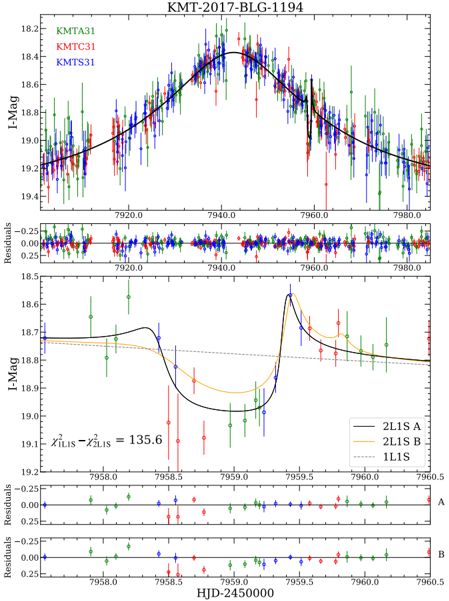
Figure 1 shows the observed data together with the best-fit PSPL and 2L1S models for KMT-2017-BLG-1194. There is a dip centered on HJD ′ ∼ 7958 . 9 (HJD ′ = HJD -2450000) , i.e., t anom ∼ 7958 . 9 , with a duration of ∆ t dip ∼ 1 . 05 days. The dip and the ridge around the dip are covered by three KMTNet sites, so the anomaly is secure. A PSPL fit yields ( t 0 , u 0 , t E ) = (7942.7, 0.26, 46), and using the heuristic formalism of Section 4.1, we obtain
<!-- formula-not-decoded -->
Figure 1. The observed data and the 2L1S (the black and orange solid lines) and 1L1S models (the grey dashed line) for KMT-2017BLG-1194. The data taken from different data sets are shown with different colors. The bottom panels show a close-up of the dip-type planetary signal and the residuals to the 2L1S models.
<details>
<summary>Image 1 Details</summary>
### Visual Description
## Light Curve Analysis: KMT-2017-BLG-1194
### Overview
The image presents a series of light curves and residual plots for the astronomical object KMT-2017-BLG-1194. The top section displays the overall light curve with data from three different telescopes (KMTA31, KMTC31, KMTS31) along with a fitted model. The bottom section focuses on a specific region of the light curve, showing data fitted with different models (2L1S A, 2L1S B, 1L1S) and their corresponding residuals.
### Components/Axes
**Top Chart:**
* **Title:** KMT-2017-BLG-1194
* **Y-axis:** I-Mag (I-band Magnitude), ranging from approximately 18.2 to 19.4.
* **X-axis:** HJD-2450000 (Heliocentric Julian Date minus 2450000), ranging from approximately 7920.0 to 7980.0.
* **Data Series:**
* KMTA31: Blue data points with error bars.
* KMTC31: Red data points with error bars.
* KMTS31: Green data points with error bars.
* Model Fit: A black line representing the overall fitted model to the data.
* **Residuals Plot (Top):**
* Y-axis: Residuals, ranging from approximately -0.25 to 0.25.
* X-axis: HJD-2450000, ranging from approximately 7920.0 to 7980.0.
* Data points: Blue, Red, and Green, corresponding to KMTA31, KMTC31, and KMTS31 respectively.
**Bottom Chart:**
* **Y-axis:** I-Mag (I-band Magnitude), ranging from approximately 18.5 to 19.2.
* **X-axis:** HJD-2450000 (Heliocentric Julian Date minus 2450000), ranging from approximately 7958.0 to 7960.5.
* **Data Series:**
* 2L1S A: Black line.
* 2L1S B: Orange line.
* 1L1S: Dashed gray line.
* **Residuals Plots (Bottom):**
* Y-axis: Residuals, ranging from approximately -0.25 to 0.25.
* X-axis: HJD-2450000, ranging from approximately 7958.0 to 7960.5.
* Plot A: Residuals for model A.
* Plot B: Residuals for model B.
* **Text:**
* χ²<sub>1L1S</sub> - χ²<sub>2L1S</sub> = 135.6
### Detailed Analysis
**Top Chart:**
* **KMTA31 (Blue):** The blue data points show a general trend of increasing I-Mag values from HJD-2450000 = 7920 to a peak around 7940, then decreasing to 7980.
* **KMTC31 (Red):** The red data points follow a similar trend to the blue data, with a peak around HJD-2450000 = 7940.
* **KMTS31 (Green):** The green data points also follow the same trend, peaking around HJD-2450000 = 7940.
* **Model Fit (Black):** The black line represents a smooth curve that fits the overall trend of the data points. It peaks around HJD-2450000 = 7940.
**Top Residuals Plot:**
* The residuals appear to be randomly distributed around zero, indicating a good fit of the model to the data.
**Bottom Chart:**
* **2L1S A (Black):** The black line shows a sharp dip in I-Mag around HJD-2450000 = 7958.7, followed by a rapid increase.
* **2L1S B (Orange):** The orange line shows a similar dip in I-Mag, but slightly less pronounced than the black line.
* **1L1S (Dashed Gray):** The dashed gray line represents a flatter curve, with a slight dip around HJD-2450000 = 7958.7.
**Bottom Residuals Plots:**
* The residuals for both models A and B appear to be randomly distributed around zero, but with some noticeable deviations around the dip in I-Mag.
### Key Observations
* The top chart shows a general brightening of the object around HJD-2450000 = 7940.
* The bottom chart focuses on a specific event, likely a microlensing event, around HJD-2450000 = 7958.7.
* The value χ²<sub>1L1S</sub> - χ²<sub>2L1S</sub> = 135.6 suggests that the 2L1S model provides a significantly better fit to the data than the 1L1S model.
### Interpretation
The data suggests that KMT-2017-BLG-1194 experienced a microlensing event. The top chart shows the overall light curve, while the bottom chart zooms in on the microlensing event. The different models (2L1S A, 2L1S B, 1L1S) represent different interpretations of the event, with the 2L1S model providing a better fit to the data. The residuals plots help to assess the quality of the fit for each model. The difference in chi-squared values (χ²<sub>1L1S</sub> - χ²<sub>2L1S</sub> = 135.6) indicates that the 2L1S model is statistically more significant than the 1L1S model. The different colors in the top chart represent data from different telescopes, which helps to improve the accuracy and reliability of the light curve.
</details>
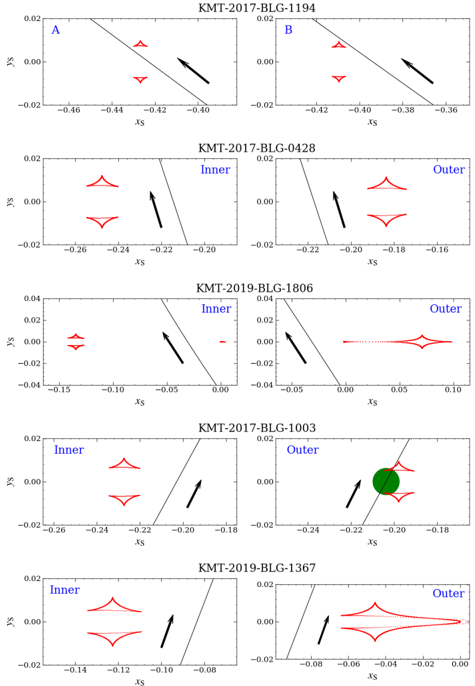
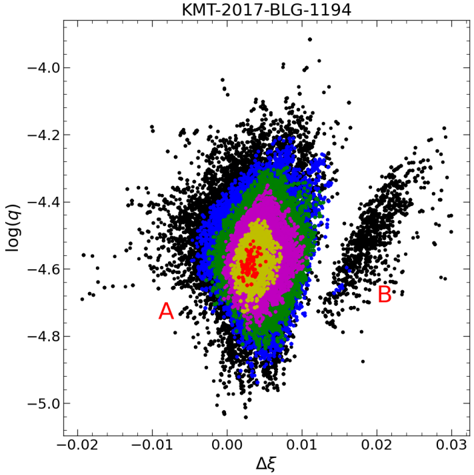
The grid search yields one solution. Its parameters are presented in Table 2 and are in good agreement with the heuristic estimates. The top left panel of Figure 2 displays the caustic structure and the source trajectory, for which the two minor-image planetary caustics are located on both sides of the source trajectory. We label the solution as the solution 'A'. To further investigate the parameter space and check whether the event has the inner/outer solutions (Gaudi & Gould 1997), for which the source passes inside (the 'Inner' solution) the two planetary caustics (closer to the central caustic) or outside (the 'Outer' solution), we follow the procedures of Hwang et al. (2018a). First, we conduct a 'hotter' MCMC with the error bar inflated by a factor of √ 3 . 0 . Second, we make a scatter plot of log q versus ∆ ξ from the 'hotter' MCMC chain. Here ∆ ξ represents the offset between the source and the planetary caustic as the source crosses the binary axis,
<!-- formula-not-decoded -->
The resulting scatter plot is shown in Figure 3, from which we find another local minimum at ∆ ξ ∼ 0 . 02 . We label this solution as the 'B' solution. As shown in the top right panel
<details>
<summary>Image 2 Details</summary>
### Visual Description
## Chart: Microlensing Caustic Structures
### Overview
The image presents six separate plots, each depicting the caustic structure of a microlensing event. Each plot shows the xS and yS coordinates, with red lines indicating the caustic curves. A black arrow indicates the direction of motion. The plots are labeled with the event name (e.g., KMT-2017-BLG-1194) and, in some cases, "Inner" or "Outer" to distinguish between different caustic regions.
### Components/Axes
* **Axes:** Each plot has an x-axis labeled "xS" and a y-axis labeled "yS".
* The y-axis ranges from approximately -0.02 to 0.02 in the top two rows, and from -0.04 to 0.04 in the middle row, and -0.02 to 0.02 in the bottom two rows.
* The x-axis ranges vary for each plot, as detailed below.
* **Titles:** Each plot has a title indicating the microlensing event name (e.g., "KMT-2017-BLG-1194").
* **Caustic Curves:** Red lines represent the caustic curves.
* **Motion Vector:** A black arrow indicates the direction of motion.
* **Region Labels:** Some plots are labeled with "Inner" or "Outer" in blue text.
### Detailed Analysis
**Plot 1: KMT-2017-BLG-1194 (A)**
* x-axis: Ranges from approximately -0.46 to -0.36.
* y-axis: Ranges from approximately -0.02 to 0.02.
* Caustic Structure: Two small, triangular-shaped caustics are visible.
* Motion Vector: Points towards the top-right.
**Plot 2: KMT-2017-BLG-1194 (B)**
* x-axis: Ranges from approximately -0.42 to -0.36.
* y-axis: Ranges from approximately -0.02 to 0.02.
* Caustic Structure: Two small, triangular-shaped caustics are visible.
* Motion Vector: Points towards the top-right.
**Plot 3: KMT-2017-BLG-0428 (Inner)**
* x-axis: Ranges from approximately -0.26 to -0.20.
* y-axis: Ranges from approximately -0.02 to 0.02.
* Caustic Structure: A single, larger caustic structure is visible.
* Motion Vector: Points upwards and slightly to the right.
**Plot 4: KMT-2017-BLG-0428 (Outer)**
* x-axis: Ranges from approximately -0.22 to -0.16.
* y-axis: Ranges from approximately -0.02 to 0.02.
* Caustic Structure: A single, larger caustic structure is visible.
* Motion Vector: Points upwards and slightly to the right.
**Plot 5: KMT-2019-BLG-1806 (Inner)**
* x-axis: Ranges from approximately -0.15 to 0.00.
* y-axis: Ranges from approximately -0.04 to 0.04.
* Caustic Structure: A small caustic structure is visible.
* Motion Vector: Points upwards and slightly to the right.
**Plot 6: KMT-2019-BLG-1806 (Outer)**
* x-axis: Ranges from approximately -0.05 to 0.10.
* y-axis: Ranges from approximately -0.04 to 0.04.
* Caustic Structure: A larger caustic structure is visible.
* Motion Vector: Points upwards and slightly to the right.
**Plot 7: KMT-2017-BLG-1003 (Inner)**
* x-axis: Ranges from approximately -0.26 to -0.18.
* y-axis: Ranges from approximately -0.02 to 0.02.
* Caustic Structure: A single, larger caustic structure is visible.
* Motion Vector: Points upwards and slightly to the right.
**Plot 8: KMT-2017-BLG-1003 (Outer)**
* x-axis: Ranges from approximately -0.24 to -0.18.
* y-axis: Ranges from approximately -0.02 to 0.02.
* Caustic Structure: A single, larger caustic structure is visible. A green circle is drawn over the caustic.
* Motion Vector: Points upwards and slightly to the right.
**Plot 9: KMT-2019-BLG-1367 (Inner)**
* x-axis: Ranges from approximately -0.14 to -0.08.
* y-axis: Ranges from approximately -0.02 to 0.02.
* Caustic Structure: A single, larger caustic structure is visible.
* Motion Vector: Points upwards and slightly to the right.
**Plot 10: KMT-2019-BLG-1367 (Outer)**
* x-axis: Ranges from approximately -0.08 to 0.00.
* y-axis: Ranges from approximately -0.02 to 0.02.
* Caustic Structure: A single, larger caustic structure is visible.
* Motion Vector: Points upwards and slightly to the right.
### Key Observations
* Each plot represents a different microlensing event or a different region (Inner/Outer) of the same event.
* The caustic structures vary in size and shape across the different events.
* The motion vectors generally point in a similar direction (upwards and slightly to the right), but there are slight variations.
* The green circle in Plot 8 is an anomaly and may indicate a specific feature or event related to that caustic.
### Interpretation
The plots illustrate the complex caustic structures that can arise in microlensing events. The different shapes and sizes of the caustics, along with the motion vectors, provide information about the lens system's configuration and dynamics. The "Inner" and "Outer" labels suggest that some events have multiple caustic regions, potentially due to the presence of multiple lenses. The green circle in one of the plots likely highlights a specific feature or event of interest within that particular caustic structure. The data suggests that microlensing events can exhibit a wide range of caustic morphologies, reflecting the diversity of lens systems in the galaxy.
</details>
Xs
Figure 2. Geometries of the five 'dip' planetary events. In each panel, the red lines represent the caustic, the black solid line represents the source trajectory, and the line with an arrow indicates the direction of the source motion. For the outer solution of KMT2017-BLG-1003, ρ is constrained at the > 3 σ level, so the radius of the green dot represents the source radius. For other solutions, ρ only has weak constraints with < 3 σ , so their source radii are not shown.
of Figure 2, the 'B' solution corresponds to the 'Inner' solution. Its parameters from MCMC are given in Table 2 and it is disfavored by ∆ χ 2 = 22 . 6 compared to the 'A' solution. In Figure 1, the 'B' solution cannot fit the anomaly well and all three KMTNet data sets contribute to the ∆ χ 2 . The ratio of the phase-space factors is p A : p B = 1 : 0 . 54 , which also prefers the 'A' solution. Thus, we exclude the 'B' solution. In addition, the models, which have the geometry of the 'Outer' solution, do not form a local minimum and are disfavored by ∆ χ 2 > 60 compared to the 'A' solution.
For the 'A' solution a point-source model is consistent within 1 σ and the 3 σ upper limit is ρ < 0 . 0026 . The inclusion of higher-order effects yields a constraint on π E , ‖ , and with the other 2L1S parameters being almost unchanged. We obtain π E , ‖ = -0 . 18 ± 0 . 35 and adopt the constraints on π E and ρ in the Bayesian analysis of Section 5. This is a new
Figure 3. Scatter plot of log q vs. ∆ ξ for KMT-2017-BLG-1194, where ∆ ξ = u 0 csc( α ) -( s -s -1 ) represents the offset between the source and the center of the planetary caustic at the moment that the source crosses the binary axis. The distribution is derived by inflating the error bars by a factor of √ 3 and then multiplying the resulting χ 2 by 3 for the plot. Red, yellow, magenta, green, blue and black colors represent ∆ χ 2 < 2 × (1 , 4 , 9 , 16 , 25 , ∞ ) . 'A' and 'B' represent two local minima and the corresponding parameters are given in Table 2.
<details>
<summary>Image 3 Details</summary>
### Visual Description
## Scatter Plot: KMT-2017-BLG-1194
### Overview
The image is a scatter plot showing the relationship between log(q) and Δξ. The plot displays a dense cluster of points, with different colored regions indicating varying densities or confidence levels. There are two distinct clusters, labeled A and B.
### Components/Axes
* **Title:** KMT-2017-BLG-1194
* **X-axis:** Δξ, ranging from approximately -0.02 to 0.03. Axis markers are present at -0.02, -0.01, 0.00, 0.01, 0.02, and 0.03.
* **Y-axis:** log(q), ranging from approximately -5.0 to -4.0. Axis markers are present at -5.0, -4.8, -4.6, -4.4, -4.2, and -4.0.
* **Data Points:** The plot contains a high density of data points, primarily concentrated in two clusters. The main cluster is centered around (0, -4.5), and a smaller cluster is located around (0.02, -4.6).
* **Colored Regions:** Concentric regions of different colors (red, yellow, magenta, green, blue) surround the main cluster, indicating varying densities or confidence levels. The red region is the most concentrated, followed by yellow, magenta, green, and blue.
### Detailed Analysis
* **Cluster A:** Located at approximately (-0.01, -4.75). This point lies outside the main cluster.
* **Cluster B:** Located at approximately (0.02, -4.65). This is a smaller, distinct cluster separate from the main concentration.
* **Red Region:** The innermost region, centered around (0, -4.55), represents the highest density of data points.
* **Yellow Region:** Surrounds the red region, indicating a slightly lower density.
* **Magenta Region:** Surrounds the yellow region, indicating a further decrease in density.
* **Green Region:** Surrounds the magenta region, indicating a lower density than the magenta region.
* **Blue Region:** The outermost colored region, indicating the lowest density among the colored regions.
* **Black Data Points:** The black data points form the outer layer of the main cluster and also constitute the entirety of cluster B.
### Key Observations
* The data points are heavily concentrated in the main cluster, with density decreasing outwards from the center.
* Cluster B is a distinct, smaller cluster located away from the main concentration.
* The colored regions provide a visual representation of the density distribution within the main cluster.
### Interpretation
The scatter plot likely represents the results of a simulation or experiment, where log(q) and Δξ are two parameters being investigated. The high density of points in the central cluster suggests a strong correlation or convergence of results around those values. The colored regions could represent confidence intervals or probability densities, with the red region indicating the most likely values. Cluster B might represent a secondary solution or a different mode of behavior in the system being studied. The labels A and B likely highlight specific points of interest or outliers within the data.
</details>
microlensing planet with q ∼ 2 . 62 × 10 -5 ; i.e., about nine times the Earth/Sun mass ratio.
## 4.2.2. KMT-2017-BLG-0428
Table 3. 2L1S Parameters for KMT-2017-BLG-0428
| Parameter | Inner | Outer |
|---------------|----------------------|----------------------|
| χ 2 /dof | 9952.0/9952 | 9952.1/9952 |
| t 0 ( HJD ′ ) | 7943 . 976 ± 0 . 030 | 7943 . 978 ± 0 . 031 |
| u 0 | 0 . 205 ± 0 . 009 | 0 . 205 ± 0 . 009 |
| t E (days) | 44 . 4 ± 1 . 5 | 44 . 3 ± 1 . 5 |
| ρ (10 - 3 ) | < 6 . 4 | < 6 . 1 |
| α (rad) | 1 . 890 ± 0 . 005 | 1 . 889 ± 0 . 005 |
| s | 0 . 8819 ± 0 . 0044 | 0 . 9146 ± 0 . 0050 |
| log q | - 4 . 295 ± 0 . 072 | - 4 . 302 ± 0 . 075 |
| I S , OGLE | 20 . 43 ± 0 . 05 | 20 . 43 ± 0 . 05 |
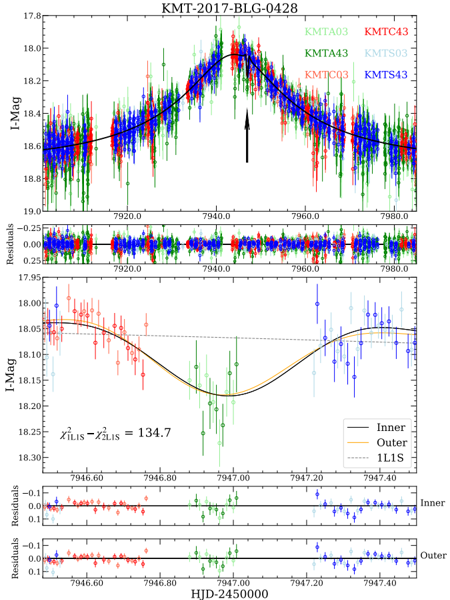
Figure 4 shows a ∆ I ∼ 0 . 12 mag dip at t anom ∼ 7947 . 00 , with a duration of ∆ t dip ∼ 0 . 74 days. The dip is defined by the KMTA and KMTC data, and the subtle ridges are sup-
Figure 4. The observed data and models for KMT-2017-BLG-0428. The symbols are similar to those in Figure 1. In the top panel, the black arrow indicates the position of the planetary signal.
<details>
<summary>Image 4 Details</summary>
### Visual Description
## Light Curve Analysis: KMT-2017-BLG-0428
### Overview
The image presents a light curve analysis of the astronomical event KMT-2017-BLG-0428. It consists of two main plots showing the I-band magnitude (I-Mag) variations over time (HJD-2450000), along with residual plots below each main plot. The data is from multiple telescopes (KMTA03, KMTC43, KMTA43, KMTS03, KMTC03, KMTS43). The analysis includes fitted models (Inner, Outer, 1L1S) to the light curve.
### Components/Axes
**Top Plot:**
* **Title:** KMT-2017-BLG-0428
* **Y-axis:** I-Mag (I-band magnitude), ranging from 17.8 to 19.0.
* **X-axis:** HJD-2450000 (Heliocentric Julian Date minus 2450000), ranging from approximately 7920.0 to 7980.0.
* **Data Series:**
* KMTA03 (Green): Data points scattered around the fitted curve.
* KMTC43 (Red): Data points scattered around the fitted curve.
* KMTA43 (Light Blue): Data points scattered around the fitted curve.
* KMTS03 (Green): Data points scattered around the fitted curve.
* KMTC03 (Red): Data points scattered around the fitted curve.
* KMTS43 (Blue): Data points scattered around the fitted curve.
* **Fitted Curve:** Black line representing the overall trend of the data.
* **Arrow:** A black arrow points to the minimum of the light curve, indicating the peak of the event.
* **Residuals Plot (below top plot):**
* Y-axis: Residuals, ranging from -0.25 to 0.25.
* X-axis: HJD-2450000, ranging from approximately 7920.0 to 7980.0.
* Data points: Residuals corresponding to the data series in the top plot.
**Bottom Plot:**
* **Y-axis:** I-Mag, ranging from 17.95 to 18.30.
* **X-axis:** HJD-2450000, ranging from approximately 7946.60 to 7947.40.
* **Data Series:**
* KMTA03 (Green): Data points showing a dip in magnitude.
* KMTC43 (Red): Data points showing a dip in magnitude.
* KMTA43 (Light Blue): Data points showing a dip in magnitude.
* KMTS03 (Green): Data points showing a dip in magnitude.
* KMTC03 (Red): Data points showing a dip in magnitude.
* KMTS43 (Blue): Data points showing a dip in magnitude.
* **Fitted Curves:**
* Inner (Black): Represents the inner model fit.
* Outer (Orange): Represents the outer model fit.
* 1L1S (Dashed Gray): Represents the 1L1S model fit.
* **Text:** "χ²₁L1S - χ²₂L1S = 134.7"
* **Residuals Plots (below bottom plot):**
* Top Residuals Plot (Inner):
* Y-axis: Residuals, ranging from -0.1 to 0.1.
* X-axis: HJD-2450000, ranging from approximately 7946.60 to 7947.40.
* Data points: Residuals corresponding to the "Inner" model fit.
* Bottom Residuals Plot (Outer):
* Y-axis: Residuals, ranging from -0.1 to 0.1.
* X-axis: HJD-2450000, ranging from approximately 7946.60 to 7947.40.
* Data points: Residuals corresponding to the "Outer" model fit.
### Detailed Analysis
**Top Plot:**
* The I-Mag values generally range from approximately 18.2 to 18.8, with a clear dip (increase in brightness) around HJD-2450000 = 7947.
* The fitted black curve shows a smooth trend, capturing the overall shape of the light curve.
* The residuals in the plot below are scattered around zero, indicating a reasonable fit.
**Bottom Plot:**
* The I-Mag values range from approximately 18.0 to 18.25, focusing on the region around the dip.
* The "Inner" (black) and "Outer" (orange) fitted curves closely follow the data points. The "1L1S" (dashed gray) curve is also shown.
* The residuals in the plots below are centered around zero, indicating a good fit for both "Inner" and "Outer" models.
* The value "χ²₁L1S - χ²₂L1S = 134.7" indicates the difference in chi-squared values between the 1L1S model and another model (likely the 2L1S model), quantifying the improvement in fit.
### Key Observations
* The light curve shows a clear brightening event (decrease in I-Mag) around HJD-2450000 = 7947.
* Multiple telescopes (KMTA03, KMTC43, KMTA43, KMTS03, KMTC03, KMTS43) contribute data to the light curve.
* The "Inner" and "Outer" models provide good fits to the data, as indicated by the residuals.
* The difference in chi-squared values suggests that the 1L1S model provides a different fit compared to the 2L1S model.
### Interpretation
The light curve analysis of KMT-2017-BLG-0428 reveals a significant brightening event, likely due to gravitational microlensing. The data from multiple telescopes ensures a comprehensive view of the event. The fitted models ("Inner," "Outer," and "1L1S") help to characterize the shape and duration of the event. The residuals plots confirm the goodness-of-fit of the models. The difference in chi-squared values between the 1L1S and 2L1S models suggests that the 1L1S model may be a better representation of the data, but further analysis is needed to confirm this. The arrow indicates the peak of the microlensing event.
</details>
ported by both the KMTC and KMTS data. These data were taken in good seeing ( 1 . ′′ 4 -2 . ′′ 5 ) and the anomaly does not correlate with seeing, sky background or airmass. In addition, Ishitani Silva et al. (2022) found that the KMTA data show systematic errors and excluded them from the analysis. In that case, the KMTA data exhibit similar residuals from one-night data in many places of the light curves. For the present case, the anomaly is mainly covered by the KMTA data, but as presented in Section 2, there is no similar deviation in other places of the light curves. We also carefully checked the KMTA data but did not find any similar residuals. Hence, the anomaly is secure. Applying the heuristic formalism of Section 4.1, we obtain
<!-- formula-not-decoded -->
The 2L1S modeling yields two degenerate solutions with ∆ χ 2 = 0 . 1 . As shown in Figure 2, the two solutions are subjected to the inner/outer degeneracy. Their parameters are given in Table 3, for which α and q are consistent with Equation (11). For s , we note that the geometric mean of the two solutions, s mean = 0 . 898 ± 0 . 005 , is in good agreement with Equation (11) and thus the formalism of Ryu et al. (2022). In addition, the observed data only provide a 3 σ upper limit on ρ , and a point-source model is consistent within 1 σ . The ratio of the phase-space factors is p inner : p outer = 0 . 78 : 1 .
With high-order effects, we find that the χ 2 improvement is ∼ 3 and other parameters are almost the same. The constraint of π E , π E , ‖ = -0 . 35 ± 0 . 26 , will be used in the Bayesian analysis. This is a microlensing planet with a Neptune/Sun mass ratio.
## 4.2.3. KMT-2019-BLG-1806
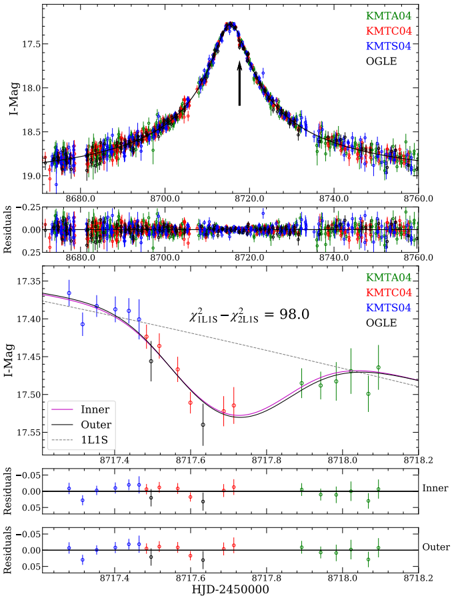
Figure 5. The observed data and models for KMT-2019-BLG-1806. The symbols are similar to those in Figure 1. In the top panel, the black arrow indicates the position of the planetary signal.
<details>
<summary>Image 5 Details</summary>
### Visual Description
## Light Curve Analysis
### Overview
The image presents a series of light curves and residual plots, likely from astronomical observations. The top section shows a broad light curve with data from multiple sources (KMTA04, KMTC04, KMTS04, and OGLE). The middle section focuses on a smaller time range, showing light curves fitted with different models (Inner, Outer, and 1L1S). The bottom sections display residuals for the "Inner" and "Outer" models.
### Components/Axes
**Top Plot:**
* **Y-axis:** I-Mag (I-band Magnitude), ranging from approximately 17.3 to 19.1.
* **X-axis:** HJD-2450000 (Heliocentric Julian Date minus 2450000), ranging from 8680.0 to 8760.0.
* **Data Series:**
* KMTA04 (Green)
* KMTC04 (Red)
* KMTS04 (Blue)
* OGLE (Black)
* **Arrow:** A black arrow points to the peak of the light curve.
**Top Residual Plot:**
* **Y-axis:** Residuals, ranging from -0.25 to 0.25.
* **X-axis:** HJD-2450000, ranging from 8680.0 to 8760.0.
* **Data Series:** Residuals corresponding to the data series in the top plot.
**Middle Plot:**
* **Y-axis:** I-Mag, ranging from 17.35 to 17.55.
* **X-axis:** HJD-2450000, ranging from 8717.4 to 8718.2.
* **Data Series:**
* Inner (Magenta)
* Outer (Black)
* 1L1S (Gray, dashed)
* KMTA04 (Green)
* KMTC04 (Red)
* KMTS04 (Blue)
* OGLE (Black)
* **Text:** "χ²₁L1S - χ²₂L1S = 98.0"
**Bottom Residual Plots:**
* **Y-axis:** Residuals, ranging from -0.05 to 0.05.
* **X-axis:** HJD-2450000, ranging from 8717.4 to 8718.2.
* **Data Series:**
* Inner (Top Residual Plot): Residuals corresponding to the "Inner" model.
* Outer (Bottom Residual Plot): Residuals corresponding to the "Outer" model.
### Detailed Analysis
**Top Plot:**
* The light curve shows a significant brightening event (increase in flux, decrease in magnitude) around HJD-2450000 = 8720.
* The data from different sources (KMTA04, KMTC04, KMTS04, OGLE) generally agree, although there are some discrepancies.
* The peak of the light curve is indicated by a black arrow.
* Before the brightening event, the I-Mag is approximately 19.0. At the peak, the I-Mag reaches approximately 17.3.
**Top Residual Plot:**
* The residuals appear to be randomly distributed around zero, suggesting that the model (represented by the black line in the top plot) fits the data reasonably well.
* There might be some systematic deviations around the peak of the light curve.
**Middle Plot:**
* This plot focuses on the region around the brightening event.
* The "Inner" and "Outer" models appear to fit the data well, with the "Outer" model perhaps capturing the overall shape slightly better.
* The "1L1S" model (dashed gray line) seems to deviate more from the data.
* The equation "χ²₁L1S - χ²₂L1S = 98.0" suggests a comparison of chi-squared values between two models, with a significant difference of 98.0.
**Bottom Residual Plots:**
* The residuals for the "Inner" and "Outer" models are generally small and randomly distributed around zero.
* There might be some subtle differences in the distribution of residuals between the two models.
### Key Observations
* A significant brightening event is observed in the light curve.
* Multiple data sources provide consistent measurements.
* The "Inner" and "Outer" models provide reasonable fits to the data, with the "Outer" model potentially being slightly better.
* The "1L1S" model deviates more from the data.
* The chi-squared difference between two models is significant.
### Interpretation
The data suggests the observation of a transient astronomical event, such as a microlensing event or a supernova. The light curve shows a clear brightening, and the different models attempt to explain the shape of this event. The chi-squared difference indicates that one model (likely the "Outer" model, given its visual fit) provides a significantly better explanation of the data than the "1L1S" model. The residual plots help assess the goodness of fit for each model. The consistency between different data sources strengthens the reliability of the observations. Further analysis would be needed to determine the exact nature of the event.
</details>
The anomaly of KMT-2019-BLG-1806 is also a dip, as shown in Figure 5. The dip has ∆ t dip ∼ 0 . 6 days and centers on t anom ∼ 8717 . 72 . The dip is defined by the KMTC data and the two contemporaneous OGLE points, which were taken in good seeing ( 1 . ′′ 1 -2 . ′′ 4 ) and low sky background. Hence, the anomaly is secure. Applying the heuristic formalism of Section 4.1, we obtain
<!-- formula-not-decoded -->
In addition, given the Einstein timescale ( t E ∼ 135 days), we expect that π E should be either measured or strongly constrained.
The 2L1S modeling also finds a pair of inner/outer solutions and combined the u 0 > 0 and u 0 < 0 degeneracy
## ZANG ET AL.
Table 4. 2L1S Parameters KMT-2019-BLG-1806
| Parameter | Inner | Inner | Outer | Outer |
|---------------|----------------------|-----------------------|----------------------|-----------------------|
| | u 0 > 0 | u 0 < 0 | u 0 > 0 | u 0 < 0 |
| χ 2 /dof | 3132.5/3132 | 3132.9/3132 | 3132.2/3132 | 3131.8/3132 |
| t 0 ( HJD ′ ) | 8715 . 452 ± 0 . 015 | 8715 . 451 ± 0 . 015 | 8715 . 453 ± 0 . 014 | 8715 . 453 ± 0 . 015 |
| u 0 | 0 . 0260 ± 0 . 0017 | - 0 . 0251 ± 0 . 0020 | 0 . 0257 ± 0 . 0016 | - 0 . 0255 ± 0 . 0015 |
| t E (days) | 132 . 8 ± 8 . 1 | 138 . 5 ± 10 . 8 | 134 . 1 ± 7 . 9 | 135 . 6 ± 7 . 9 |
| ρ (10 - 3 ) | < 1 . 8 | < 1 . 8 | < 1 . 9 | < 1 . 7 |
| α (rad) | 2 . 150 ± 0 . 008 | - 2 . 147 ± 0 . 008 | 2 . 151 ± 0 . 009 | - 2 . 148 ± 0 . 008 |
| s | 0 . 9377 ± 0 . 0069 | 0 . 9383 ± 0 . 0073 | 1 . 0339 ± 0 . 0084 | 1 . 0352 ± 0 . 0085 |
| log q | - 4 . 724 ± 0 . 117 | - 4 . 734 ± 0 . 109 | - 4 . 717 ± 0 . 117 | - 4 . 714 ± 0 . 116 |
| π E , N | - 0 . 055 ± 0 . 150 | - 0 . 066 ± 0 . 161 | - 0 . 060 ± 0 . 156 | - 0 . 019 ± 0 . 160 |
| π E , E | - 0 . 058 ± 0 . 017 | - 0 . 059 ± 0 . 014 | - 0 . 057 ± 0 . 017 | - 0 . 060 ± 0 . 013 |
| I S | 21 . 33 ± 0 . 07 | 21 . 37 ± 0 . 09 | 21 . 34 ± 0 . 07 | 21 . 35 ± 0 . 07 |
there are four solutions in total. See Table 4 for their parameters. The inclusion of π E improves the fits by ∆ χ 2 = 31 , and all four data sets contribute to the improvement, so the parallax signal is reliable. The angle of the minor axis of the parallax ellipse (north through east) is ψ = 82 . 0 ◦ and ψ = 82 . 5 ◦ for the u 0 > 0 and u 0 < 0 solutions, respectively. π E , ‖ = 0 . 06 ± 0 . 01 , and π E , ⊥ is constrained to be σ ( π E , ⊥ ) ∼ 0 . 2 . We obtain s mean = 0 . 985 ± 0 . 008 , α = 123 . 1 ± 0 . 5 , and log q ∼ -4 . 72 , in good agreement with Equation (12). The ratio of the phase-space factors is p inner : p outer = 0 . 80 : 1 .
We find that the inclusion of the lens orbital motion effect only improves the fit by ∆ χ 2 < 1 for 2 degree-of-freedom and is not correlated with π E , so we exclude the lens orbital motion effect. With q ∼ 1 . 9 × 10 -5 , this new planet is the fifth robust q < 2 × 10 -5 microlensing planet.
## 4.2.4. KMT-2017-BLG-1003
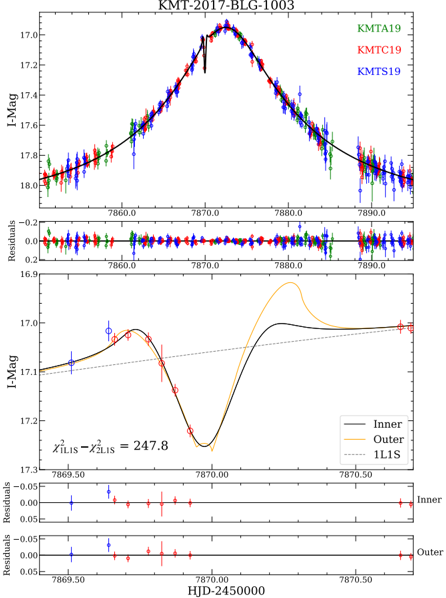
Figure 6 shows the light curve and the best-fit models for KMT-2017-BLG-1003. The KMTC data show a sudden dip and the ridge is confirmed by the KMTC and KMTS data. These data were taken in good seeing ( 1 . ′′ 2 -2 . ′′ 2 ) and low sky background, so the anomaly is of astrophysical origin. Although the end of the dip is not covered, the KMTC point at HJD ′ = 7870 . 66 indicates ∆ t dip < 0 . 85 days, which yields
<!-- formula-not-decoded -->
The numerical analysis yields a pair of inner/outer solutions, and Table 5 lists their parameters. As shown in Figure 2, the 'Outer' solution has caustic crossings, so its ρ is measured at the 4 . 5 σ level. For the 'Inner' solution, a pointsource model is consistent within 2 σ . We note that the geometric mean of s , s mean = 0 . 899 ± 0 . 004 , which is slightly
Figure 6. Light curve and models for KMT-2017-BLG-1003. The symbols are similar to those in Figure 1.
<details>
<summary>Image 6 Details</summary>
### Visual Description
## Light Curve Analysis: KMT-2017-BLG-1003
### Overview
The image presents a light curve analysis of the astronomical object KMT-2017-BLG-1003. It includes two main plots showing the I-band magnitude (I-Mag) variations over time (HJD-2450000), along with residual plots indicating the difference between the observed data and model fits. The analysis involves fitting different models (Inner, Outer, 1L1S) to the observed data from three different telescopes (KMTA19, KMTC19, KMTS19).
### Components/Axes
* **Top Plot:**
* **Title:** KMT-2017-BLG-1003
* **Y-axis:** I-Mag (I-band magnitude), ranging from approximately 17.0 to 18.0. Note that magnitude decreases upwards.
* **X-axis:** HJD-2450000 (Heliocentric Julian Date minus 2450000), ranging from approximately 7860.0 to 7890.0.
* **Data Series:**
* KMTA19 (Green): Data points from the KMTA19 telescope.
* KMTC19 (Red): Data points from the KMTC19 telescope.
* KMTS19 (Blue): Data points from the KMTS19 telescope.
* Black Line: Model fit to the data.
* **Residuals Plot (Top):** Residuals corresponding to the top plot, with the same x-axis. Y-axis ranges from -0.2 to 0.2.
* **Bottom Plot:**
* **Y-axis:** I-Mag, ranging from approximately 16.9 to 17.3.
* **X-axis:** HJD-2450000, ranging from approximately 7869.50 to 7870.50.
* **Data Series:**
* Inner (Black): Model fit representing the "Inner" region.
* Outer (Orange/Yellow): Model fit representing the "Outer" region.
* 1L1S (Dashed Gray): Model fit representing the "1L1S" model.
* **Residuals Plots (Bottom):** Two residual plots corresponding to the "Inner" and "Outer" models, with the same x-axis. Y-axis ranges from -0.05 to 0.05 for both.
* **Equation:** χ²₁L₁S - χ²₂L₁S = 247.8
### Detailed Analysis
* **Top Plot Data:**
* The data points from KMTA19 (Green), KMTC19 (Red), and KMTS19 (Blue) show a clear dip in magnitude around HJD-2450000 = 7870, indicating a brightening event.
* The black line represents a model fit to the combined data. It captures the overall trend of the light curve.
* The residuals in the top plot are generally close to zero, indicating a good fit of the model to the data.
* **Bottom Plot Data:**
* The bottom plot focuses on a smaller time range around the brightening event.
* The "Inner" (Black) and "Outer" (Orange/Yellow) models show different fits to the data, particularly around the peak of the brightening.
* The "1L1S" (Dashed Gray) model appears to be a linear fit.
* The residuals for the "Inner" and "Outer" models are shown in the bottom two plots.
### Key Observations
* The light curve shows a significant brightening event around HJD-2450000 = 7870.
* The different models ("Inner," "Outer," "1L1S") provide varying fits to the data, suggesting different interpretations of the event.
* The equation χ²₁L₁S - χ²₂L₁S = 247.8 likely represents a comparison of the goodness-of-fit between two models (1L1S and 2L1S), with a significant difference indicating that the 2L1S model is a better fit.
### Interpretation
The light curve analysis of KMT-2017-BLG-1003 reveals a microlensing event. The brightening observed around HJD-2450000 = 7870 is caused by the gravitational lensing of a background star by a foreground object. The different models ("Inner," "Outer," "1L1S") likely represent different assumptions about the lens system, such as the presence of a binary lens or a planet orbiting the lens star. The residuals plots help assess the quality of each model fit. The equation χ²₁L₁S - χ²₂L₁S = 247.8 suggests that a more complex model (2L1S) provides a significantly better fit to the data than a simpler model (1L1S), indicating a more complex lens system.
</details>
different from s -by 1 σ . This indicates that the prediction of Ryu et al. (2022) might be imperfect for minor-image anomalies with finite-source effects or incomplete coverage. The ratio of the phase-space factors is p inner : p outer = 0 . 80 : 1 .
Table 5. 2L1S Parameters for KMT-2017-BLG-1003
| Parameter | Inner | Outer |
|---------------|----------------------|----------------------|
| χ 2 /dof | 2433.2/2433 | 2433.0/2433 |
| t 0 ( HJD ′ ) | 7872 . 484 ± 0 . 020 | 7872 . 482 ± 0 . 020 |
| u 0 | 0 . 179 ± 0 . 005 | 0 . 179 ± 0 . 005 |
| t E (days) | 25 . 65 ± 0 . 57 | 25 . 66 ± 0 . 59 |
| ρ (10 - 3 ) | < 6 . 7 | 5 . 22 ± 1 . 16 |
| α (rad) | 1 . 073 ± 0 . 006 | 1 . 072 ± 0 . 006 |
| s | 0 . 8889 ± 0 . 0043 | 0 . 9096 ± 0 . 0045 |
| log q | - 4 . 260 ± 0 . 152 | - 4 . 373 ± 0 . 144 |
| I S , OGLE | 19 . 30 ± 0 . 04 | 19 . 30 ± 0 . 04 |
With high-order effects, the χ 2 improvement is 1.7. Although this event is shorter than the first two events, π E is better constrained due to the about one magnitude brighter data, with π E , ‖ = -0 . 11 ± 0 . 15 . This is another Neptune/Sun mass-ratio planet.
## 4.2.5. KMT-2019-BLG-1367
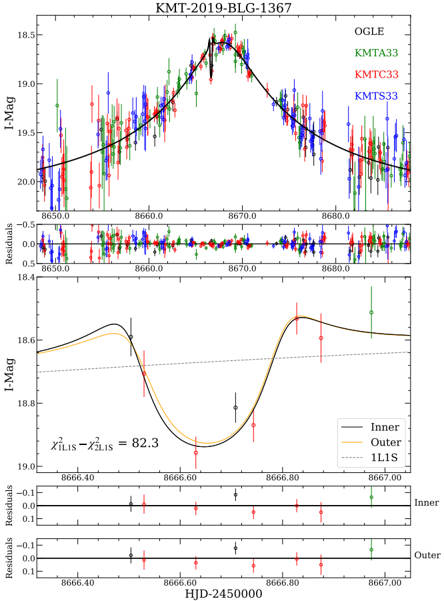
Figure 7. Light curve and models for KMT-2019-BLG-1367. The symbols are similar to those in Figure 1.
<details>
<summary>Image 7 Details</summary>
### Visual Description
## Light Curve Analysis: KMT-2019-BLG-1367
### Overview
The image presents a light curve analysis of the astronomical object KMT-2019-BLG-1367. It includes plots of I-band magnitude (I-Mag) versus time (HJD-2450000), along with residual plots. The data is from multiple observatories (OGLE, KMTA33, KMTC33, KMTS33). The analysis focuses on modeling the light curve with different models (Inner, Outer, 1L1S) to understand the underlying astrophysical processes.
### Components/Axes
* **Top Panel:**
* **Title:** KMT-2019-BLG-1367
* **Y-axis:** I-Mag (I-band magnitude), ranging from approximately 18.5 to 20.5.
* **X-axis:** HJD-2450000 (Heliocentric Julian Date minus 2450000), ranging from 8650 to 8680.
* **Data Series:**
* OGLE: Green data points with error bars.
* KMTA33: Red data points with error bars.
* KMTC33: Pink data points with error bars.
* KMTS33: Blue data points with error bars.
* Model Fit: Black line representing the overall model fit to the data.
* **Top Residual Panel:**
* **Y-axis:** Residuals, ranging from -0.5 to 0.5.
* **X-axis:** HJD-2450000, ranging from 8650 to 8680.
* Residuals for each data series are plotted with corresponding colors.
* **Bottom Panel:**
* **Y-axis:** I-Mag, ranging from 18.4 to 19.0.
* **X-axis:** HJD-2450000, ranging from 8666.40 to 8667.00.
* **Data Series:**
* Inner: Black line.
* Outer: Orange line.
* 1L1S: Dashed gray line.
* Data points with error bars, color not specified.
* **Text:** "χ²₁L₁S - χ²₂L₁S = 82.3" (Chi-squared difference between models).
* **Bottom Residual Panels:**
* **Y-axis:** Residuals, ranging from -0.1 to 0.1.
* **X-axis:** HJD-2450000, ranging from 8666.40 to 8667.00.
* Two residual plots are shown, labeled "Inner" and "Outer".
### Detailed Analysis
* **Top Panel:**
* The light curve shows a clear dip, indicating a possible microlensing event or eclipse.
* The peak of the event occurs around HJD-2450000 = 8667.
* The data points from different observatories generally agree, although there is some scatter.
* The black line represents a model fit to the data, capturing the overall shape of the light curve.
* The residuals appear to be randomly distributed around zero, suggesting a good fit.
* OGLE (green) data points are present throughout the entire range.
* KMTA33 (red) data points are present throughout the entire range.
* KMTC33 (pink) data points are present mostly around the peak.
* KMTS33 (blue) data points are present throughout the entire range.
* **Bottom Panel:**
* This panel focuses on the region around the dip in the light curve.
* The "Inner" (black) and "Outer" (orange) models are compared to a "1L1S" (dashed gray) model.
* The "Inner" and "Outer" models appear to fit the data better than the "1L1S" model, especially around the peak.
* The residuals for the "Inner" and "Outer" models are shown in the bottom panels.
* The chi-squared difference between the 1L1S and 2L1S models is 82.3, suggesting a statistically significant improvement in the fit.
### Key Observations
* The light curve exhibits a significant dip, indicating a possible microlensing event or eclipse.
* The "Inner" and "Outer" models provide a better fit to the data than the "1L1S" model.
* The chi-squared difference suggests that the "Inner" and "Outer" models are statistically more significant.
### Interpretation
The data suggests that the observed dip in the light curve of KMT-2019-BLG-1367 is likely due to a microlensing event or eclipse. The comparison of different models indicates that the "Inner" and "Outer" models provide a better explanation of the data than the "1L1S" model. The chi-squared difference supports this conclusion. Further analysis may be needed to determine the exact nature of the event and the properties of the lensing object. The different observatories provide complementary data, enhancing the reliability of the analysis.
</details>
Table 6. 2L1S Parameters for KMT-2019-BLG-1367
| Parameter | Inner | Outer |
|---------------|----------------------|----------------------|
| χ 2 /dof | 1404.0/1404 | 1404.2/1404 |
| t 0 ( HJD ′ ) | 8667 . 883 ± 0 . 051 | 8667 . 884 ± 0 . 048 |
| u 0 | 0 . 083 ± 0 . 009 | 0 . 082 ± 0 . 009 |
| t E (days) | 39 . 3 ± 3 . 8 | 39 . 8 ± 4 . 0 |
| ρ (10 - 3 ) | < 5 . 3 | < 5 . 6 |
| α (rad) | 1 . 208 ± 0 . 016 | 1 . 207 ± 0 . 016 |
| s | 0 . 9389 ± 0 . 0066 | 0 . 9763 ± 0 . 0070 |
| log q | - 4 . 303 ± 0 . 118 | - 4 . 298 ± 0 . 103 |
| I S , OGLE | 21 . 46 ± 0 . 13 | 21 . 48 ± 0 . 13 |
Figure 7 shows a dip 1.2 days before the peak of an otherwise normal PSPL event, with a duration of ∆ t dip ∼ 0 . 35 days. The dip-type anomaly is covered by the KMTC data and one contemporaneous OGLE point, and these data were taken in good seeing ( < 2 . ′′ 0 ) and low sky background. Therefore, the anomaly is secure. Applying the heuristic formalism of Section 4.1, we obtain
<!-- formula-not-decoded -->
The 2L1S modeling also yields a pair of inner/outer solutions, with ∆ χ 2 = 0 . 2 . The resulting solutions are given in Table 6 and Figure 2. A point-source model is consistent within 1 σ and the 3 σ upper limit is ρ < 0 . 0056 , so we expect that the Ryu et al. (2022) formula is applicable. We obtain s mean = 0 . 957 ± 0 . 007 , in good agreement with s -. The ratio of the phase-space factors is p inner : p outer = 0 . 82 : 1 . We find that the inclusion of higher-order effects only improves the fitting by ∆ χ 2 < 1 and the 1 σ uncertainty of parallax is > 0 . 9 at all directions, so the constraint on π E is not useful for the Bayesian analysis. This is another planet with a Neptune/Sun mass ratio.
## 4.3. 'Bump' Anomalies
For bump-type planetary signals, we also check whether the observed data can be fitted by a single-lens binary-source (1L2S) model (Gaudi 1998) because it can also produce such anomalies (e.g., Hwang et al. 2013; Jung et al. 2017; Rota et al. 2021). For a 1L2S model, its magnification, A λ , is the superposition of magnifications for two single-lens singlesource (1L1S) models,
<!-- formula-not-decoded -->
where f i ,λ is the source flux at wavelength λ , and i = 1 and i = 2 correspond to the primary and the secondary sources, respectively.
## 4.3.1. OGLE-2017-BLG-1806
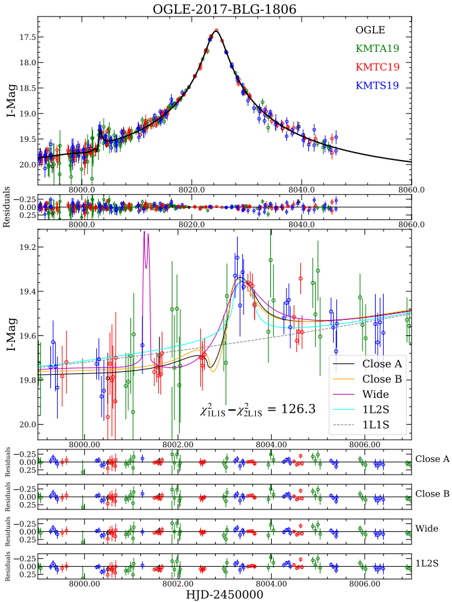
Figure 8. Light curve and models for OGLE-2017-BLG-1806. The symbols are similar to those in Figure 1. Different with the previous four events, the anomaly is bump-type, so the best-fit 1L2S model is provided.
<details>
<summary>Image 8 Details</summary>
### Visual Description
## Light Curve Analysis: OGLE-2017-BLG-1806
### Overview
The image presents a light curve analysis of the astronomical event OGLE-2017-BLG-1806. It consists of two main plots showing the I-band magnitude (I-Mag) variation over time (HJD-2450000), along with residual plots below each main plot. The first plot shows the overall light curve, while the second plot focuses on a specific region with different models fitted.
### Components/Axes
**Top Plot:**
* **Title:** OGLE-2017-BLG-1806
* **Y-axis:** I-Mag (I-band magnitude), ranging from approximately 17.5 to 20.0.
* **X-axis:** HJD-2450000 (Heliocentric Julian Date minus 2450000), ranging from 8000.0 to 8060.0.
* **Data Series:**
* OGLE (no color specified, but represented by a black line)
* KMTA19 (green data points)
* KMTC19 (red data points)
* KMTS19 (blue data points)
* **Residuals Plot (below top plot):**
* Y-axis: Residuals, ranging from -0.25 to 0.25.
* X-axis: HJD-2450000, ranging from 8000.0 to 8060.0.
* Data points correspond to the KMTA19 (green), KMTC19 (red), and KMTS19 (blue) datasets.
**Bottom Plot:**
* **Y-axis:** I-Mag, ranging from approximately 19.2 to 20.0.
* **X-axis:** HJD-2450000, ranging from 8000.00 to 8006.00.
* **Data Series:**
* Close A (black line)
* Close B (brown/orange line)
* Wide (purple line)
* 1L2S (cyan line)
* 1L1S (dashed gray line)
* **Text:** χ²_1L1S - χ²_2L1S = 126.3
* **Residuals Plots (below bottom plot):**
* Y-axis: Residuals, ranging from -0.25 to 0.25.
* X-axis: HJD-2450000, ranging from 8000.00 to 8006.00.
* Data points correspond to the Close A (black), Close B (green), Wide (red), and 1L2S (blue) datasets.
### Detailed Analysis
**Top Plot:**
* The OGLE data (black line) shows a clear peak around HJD-2450000 = 8025. This indicates a brightening event.
* KMTA19 (green), KMTC19 (red), and KMTS19 (blue) data points generally follow the trend of the OGLE data, with some scatter.
* The residuals plot shows the difference between the data points and the OGLE model. The residuals appear to be randomly distributed around zero, suggesting a good fit overall.
**Bottom Plot:**
* This plot zooms in on the region around HJD-2450000 = 8000 to 8006.
* The Close A (black), Close B (brown/orange), Wide (purple), 1L2S (cyan), and 1L1S (dashed gray) lines represent different models fitted to the data.
* The models diverge significantly in this region, suggesting that the data can be used to discriminate between them.
* The residuals plots show the difference between the data points and the corresponding models.
### Key Observations
* The OGLE data shows a significant brightening event around HJD-2450000 = 8025.
* Different models (Close A, Close B, Wide, 1L2S, 1L1S) provide varying fits to the data, particularly in the zoomed-in region.
* The value χ²_1L1S - χ²_2L1S = 126.3 suggests a significant difference in the goodness-of-fit between the 1L1S and 2L1S models.
### Interpretation
The light curve analysis of OGLE-2017-BLG-1806 reveals a microlensing event. The peak in the I-band magnitude indicates a temporary brightening of the source star due to the gravitational lensing effect of a foreground object. The different models (Close A, Close B, Wide, 1L2S, 1L1S) represent different physical scenarios for the lensing system, such as the presence of a binary lens or a planet orbiting the lens star. The residuals plots and the χ² difference provide information about the goodness-of-fit of each model, allowing astronomers to determine which scenario is most likely. The large difference in χ² between the 1L1S and 2L1S models suggests that the 2L1S model provides a significantly better fit to the data.
</details>
As shown in Figure 8, the light curve of OGLE-2017-BLG1806 exhibits a bump centered on t anom ∼ 8003 . 5 , defined by the KMTC and KMTS data. Except for two KMTS points, all the KMTC and KMTS data during 8003 < HJD ′ < 8005 were taken in good seeing ( < 2 . ′′ 2 ) and low sky background. In addition, most of the data before the bump ( 8000 < HJD ′ < 8003 ) are fainter than the 1L1S model. Hence, the signal is secure. Because both the major-image and the two minor-image planetary caustics can produce a bump-type anomaly (e.g., Wang et al. 2022), we obtain
<!-- formula-not-decoded -->
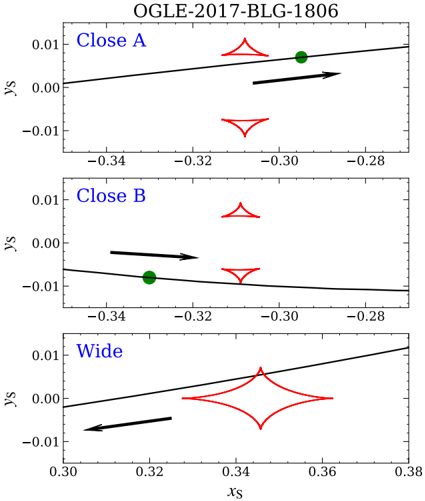
The grid search returns three local minima, and their caustic structures are given in Figure 9. As expected, the three solutions respectively correspond to sources crossing a majorimage (quadrilateral) planetary caustic and two minor-image (triangular) planetary caustics. We label the three solutions as 'Close A', 'Close B', and 'Wide', respectively, and their parameters are presented in Table 7.
y
y
y
Figure 9. Geometries of OGLE-2017-BLG-1806. The symbols are similar to those in Figure 2. For the two 'Close' solutions, ρ is constrained at the > 3 σ level, so the radius of the two green dots represent the source radius. For the 'Wide' solution, ρ only has weak constraints with < 3 σ , so its source radius is not shown.
<details>
<summary>Image 9 Details</summary>
### Visual Description
## Chart/Diagram Type: Parameter Space Diagrams
### Overview
The image presents three parameter space diagrams, each depicting a different scenario labeled "Close A", "Close B", and "Wide". Each diagram shows a black line, a red shape, a green dot, and a black arrow. The diagrams illustrate the relationship between two parameters, xs and ys, under different conditions.
### Components/Axes
* **Title:** OGLE-2017-BLG-1806
* **Y-axis (ys):** Ranges from approximately -0.01 to 0.01 in each subplot.
* **X-axis (xs):**
* Top subplot (Close A): Ranges from approximately -0.34 to -0.28.
* Middle subplot (Close B): Ranges from approximately -0.34 to -0.28.
* Bottom subplot (Wide): Ranges from approximately 0.30 to 0.38.
* **Labels:**
* Top subplot: "Close A" (blue)
* Middle subplot: "Close B" (blue)
* Bottom subplot: "Wide" (blue)
* **Elements:**
* Black line: Represents a trajectory or a curve in the parameter space.
* Red shape: Represents a region or a constraint in the parameter space. The shape varies between the subplots.
* Green dot: Represents a specific point in the parameter space.
* Black arrow: Indicates a direction or a movement in the parameter space.
### Detailed Analysis or Content Details
**Top Subplot: Close A**
* **Black Line:** The black line is nearly linear, with a slight curve. It starts at approximately (-0.34, -0.005) and ends at approximately (-0.28, 0.005).
* **Red Shape:** There are two red shapes. The top one is centered around (-0.31, 0.005), and the bottom one is centered around (-0.31, -0.01).
* **Green Dot:** The green dot is located at approximately (-0.295, 0.003).
* **Black Arrow:** The black arrow starts near the black line at approximately (-0.31, 0.002) and points towards the right.
**Middle Subplot: Close B**
* **Black Line:** The black line is curved. It starts at approximately (-0.34, -0.008) and ends at approximately (-0.28, -0.002).
* **Red Shape:** There is one red shape centered around (-0.31, 0.007).
* **Green Dot:** The green dot is located at approximately (-0.335, -0.008).
* **Black Arrow:** The black arrow starts near the green dot at approximately (-0.335, -0.007) and points towards the right.
**Bottom Subplot: Wide**
* **Black Line:** The black line is nearly linear, with a slight curve. It starts at approximately (0.30, -0.008) and ends at approximately (0.38, 0.008).
* **Red Shape:** There is one red shape centered around (0.34, 0.00). This shape is more complex than the other two, resembling a four-pointed star.
* **Green Dot:** There is no green dot in this subplot.
* **Black Arrow:** The black arrow starts near the black line at approximately (0.31, -0.007) and points towards the right.
### Key Observations
* The "Close A" and "Close B" subplots have similar x-axis ranges, while the "Wide" subplot has a different x-axis range.
* The red shapes vary significantly between the three subplots, suggesting different constraints or regions of interest in the parameter space.
* The green dot is present only in the "Close A" and "Close B" subplots.
* The black arrows indicate a direction or movement in the parameter space, but their starting points and lengths vary.
### Interpretation
The diagrams likely represent different scenarios or configurations in a parameter space related to the OGLE-2017-BLG-1806 event. The "Close A", "Close B", and "Wide" labels likely refer to different parameter regimes or observational setups. The black lines could represent the trajectory of an object or a system in the parameter space, while the red shapes could represent regions of interest or constraints on the parameters. The green dots could represent specific data points or measurements. The arrows indicate the direction of movement or evolution in the parameter space. The differences in the red shapes, green dots, and arrow placements between the subplots suggest that the underlying physical processes or observational conditions are different in each scenario.
</details>
The 'Close A' solution provides the best fit to the observed data, and the 'Close B' and 'Wide' solutions are disfavored by ∆ χ 2 = 14 . 1 and 8.3, respectively. We find that the inclusion of the parallax effect improves the fit by ∆ χ 2 = 7.8, 20.4, and 11.1 for the 'Close A', 'Close B', and 'Wide' solutions, respectively, and during the anomaly region ( 7998 < HJD ′ < 8008 ), ∆ χ 2 = 2.2, 22.3, and 6.8. With the anomaly removed, fitting the data by a 1L1S model yields a similar constraint on π E , ‖ and a weaker constraint on π E , ⊥ , with σ ( π E , ⊥ ) ∼ 0 . 5 . Thus, the long planetary signal plays an important role in improving the constraint on π E , ⊥ and reduces the χ 2 differences between the three solutions.
The ratio of the phase-space factors is p CloseA : p CloseB : p Wide = 1 : 0 . 95 : 0 . 61 . For the 'Close A', and 'Close B' solutions, the bump was produced by a caustic crossing, so ρ is constrained at the > 3 σ level. For the 'Wide' solution, the bump was a result of a cusp approach. Although the 'Wide' solution has caustic crossing features, due to the lack of data during the crossing, a point-source model is consistent within 1 σ .
The 1L2S model is disfavored by ∆ χ 2 = 30 . 7 compared to the 'Close A' solution, and the 1L2S parameters are shown in Table 8. Although the 1L2S model fits the bump well, it provides a worse fit to the observed data before the bump, during which most of the data from the three KMTNet sites
Table 7. 2L1S Parameters for OGLE-2017-BLG-1806
| Parameter | Close A | Close A | Close B | Close B | Wide | Wide |
|---------------|-------------------------|-------------------------|-------------------------|-------------------------|----------------------|-----------------------|
| χ 2 /dof | u 0 > 0 1650.9/1651 | u 0 < 0 1650.7/1651 | u 0 > 0 1664.8/1651 | u 0 < 0 1665.5/1651 | u 0 > 0 1659.1/1651 | u 0 < 0 1659.0/1651 |
| t 0 ( HJD ′ ) | 8024 . 392 ± 0 . 020 | 8024 . 393 ± 0 . 019 | 8024 . 388 ± 0 . 020 | 8024 . 388 ± 0 . 020 | 8024 . 388 ± 0 . 020 | 8024 . 379 ± 0 . 020 |
| u 0 | 0 . 0249 ± 0 . 0016 | - 0 . 0260 ± 0 . 0016 | 0 . 0256 ± 0 . 0020 | - 0 . 0253 ± 0 . 0019 | 0 . 0269 ± 0 . 0018 | - 0 . 0257 ± 0 . 0017 |
| t E (days) | 69 . 4 ± 4 . 0 | 66 . 8 ± 3 . 9 | 69 . 4 ± 4 . 8 | 69 . 6 ± 4 . 6 | 64 . 5 ± 3 . 9 | 67 . 0 ± 3 . 9 |
| ρ (10 - 3 ) | 1 . 74 +0 . 78 - 0 . 44 | 1 . 83 +0 . 80 - 0 . 50 | 1 . 50 +0 . 62 - 0 . 47 | 1 . 65 +0 . 67 - 0 . 50 | < 2 . 8 | < 2 . 4 |
| α (rad) | 0 . 001 ± 0 . 034 | - 0 . 002 ± 0 . 037 | 0 . 267 ± 0 . 066 | - 0 . 263 ± 0 . 068 | 3 . 121 ± 0 . 034 | - 3 . 121 ± 0 . 036 |
| s | 0 . 8609 ± 0 . 0069 | 0 . 8566 ± 0 . 0075 | 0 . 8592 ± 0 . 0085 | 0 . 8601 ± 0 . 0080 | 1 . 1900 ± 0 . 0117 | 1 . 1806 ± 0 . 0108 |
| log q | - 4 . 392 ± 0 . 180 | - 4 . 352 ± 0 . 171 | - 4 . 766 ± 0 . 220 | - 4 . 768 ± 0 . 209 | - 4 . 317 ± 0 . 126 | - 4 . 441 ± 0 . 168 |
| π E , N | - 0 . 278 ± 0 . 148 | 0 . 292 ± 0 . 170 | 0 . 774 ± 0 . 315 | - 0 . 756 ± 0 . 326 | - 0 . 535 ± 0 . 175 | 0 . 504 ± 0 . 170 |
| π E , E | 0 . 105 ± 0 . 056 | 0 . 144 ± 0 . 058 | 0 . 157 ± 0 . 070 | 0 . 124 ± 0 . 059 | 0 . 120 ± 0 . 065 | 0 . 133 ± 0 . 056 |
| I S , KMTC | 21 . 12 ± 0 . 07 | 21 . 07 ± 0 . 07 | 21 . 10 ± 0 . 08 | 21 . 10 ± 0 . 08 | 21 . 03 ± 0 . 07 | 21 . 08 ± 0 . 07 |
Table 8. 1L2S Parameters for OGLE-2017-BLG-1806 and KMT-2016-BLG-1105
| Parameters | OGLE-2017-BLG-1806 | OGLE-2017-BLG-1806 | KMT-2016-BLG-1105 |
|-------------------|-------------------------|-------------------------|----------------------|
| χ 2 /dof | u 0 > 0 1682 . 0 / 1651 | u 0 < 0 1681 . 4 / 1651 | 2298 . 7 / 2288 |
| t 0 , 1 ( HJD ′ ) | 8024 . 383 ± 0 . 020 | 8024 . 381 ± 0 . 020 | 7555 . 972 ± 0 . 094 |
| t 0 , 2 ( HJD ′ ) | 8003 . 876 ± 0 . 274 | 8003 . 913 ± 0 . 253 | 7547 . 890 ± 0 . 021 |
| u 0 , 1 | 0 . 0288 ± 0 . 0023 | - 0 . 0282 ± 0 . 0019 | 0 . 143 ± 0 . 022 |
| u 0 , 2 | 0 . 003 ± 0 . 025 | - 0 . 004 ± 0 . 023 | 0 . 0001 ± 0 . 0007 |
| t E (days) | 61 . 2 ± 4 . 3 | 62 . 2 ± 3 . 5 | 44 . 9 ± 5 . 8 |
| ρ 2 ( 10 - 3 ) | < 7 . 3 | < 7 . 0 | < 3 . 3 |
| q f,I (10 - 3 ) | 2 . 76 ± 0 . 76 | 2 . 63 ± 0 . 74 | 1 . 98 ± 0 . 48 |
| π E , N | 0 . 041 ± 0 . 388 | 0 . 059 ± 0 . 355 | ... |
| π E , E | 0 . 111 ± 0 . 072 | 0 . 117 ± 0 . 063 | ... |
| I S , KMTC | 20 . 96 ± 0 . 09 | 20 . 98 ± 0 . 07 | 21 . 31 ± 0 . 18 |
are fainter than the 1L2S model. Hence, the 1L2S model is rejected. We find that the lens orbital motion effect is not detectable ( ∆ χ 2 < 0 . 5 ), so we adopt the parameters with the microlensing parallax effect as our final results.
## 4.3.2. KMT-2016-BLG-1105
The anomaly in Figure 10 is a short-lived bump centered on t anom ∼ 7547 . 85 , which is defined by four KMTC data points and supported by one OGLE data point. These data were taken in good seeing ( < 2 . ′′ 0 ) and low sky background, so the anomaly is secure. Similar to OGLE-2017-BLG-1806, we expect both the major-image and the minor-image plane- tary caustics can produce the bump and obtain
<!-- formula-not-decoded -->
The 2L1S modeling yields five solutions, including one with the minor-image planetary caustics and four with the major-image planetary caustics. We label them as 'Close', 'Wide A', 'Wide B', 'Wide C' and 'Wide D', respectively, and their parameters are given in Table 9. Figure 11 displays the caustic structures and source trajectories. The 'Wide A', 'Wide B' and 'Close' solutions exhibit caustic crossings, but only for the 'Wide B' and 'Close' solutions ρ are constrained at the > 3 σ level. For the 'Wide A', 'Wide C' and 'Wide D' solutions, a point-source model is consistent
Table 9. 2L1S Parameters for KMT-2016-BLG-1105
| Parameters | Wide A | Wide B | Wide C | Wide D | Close |
|----------------|----------------------|----------------------|----------------------|----------------------|----------------------|
| χ 2 /dof | 2286 . 7 / 2288 | 2289 . 0 / 2288 | 2291 . 1 / 2288 | 2289 . 4 / 2288 | 2290 . 2 / 2288 |
| t 0 ( HJD ′ ) | 7555 . 834 ± 0 . 096 | 7555 . 789 ± 0 . 102 | 7555 . 772 ± 0 . 093 | 7555 . 781 ± 0 . 099 | 7555 . 896 ± 0 . 093 |
| u 0 | 0 . 171 ± 0 . 012 | 0 . 153 ± 0 . 013 | 0 . 154 ± 0 . 014 | 0 . 154 ± 0 . 014 | 0 . 148 ± 0 . 008 |
| t E (days) | 38 . 8 ± 2 . 0 | 42 . 4 ± 2 . 9 | 42 . 5 ± 3 . 1 | 42 . 4 ± 3 . 1 | 43 . 3 ± 1 . 8 |
| ρ 1 ( 10 - 3 ) | < 2 . 4 | 2 . 92 ± 0 . 82 | < 4 . 6 | < 5 . 5 | 0 . 75 ± 0 . 14 |
| α (rad) | 3 . 836 ± 0 . 014 | 3 . 830 ± 0 . 016 | 3 . 832 ± 0 . 014 | 3 . 831 ± 0 . 014 | 0 . 691 ± 0 . 021 |
| s | 1 . 143 ± 0 . 009 | 1 . 136 ± 0 . 011 | 1 . 155 ± 0 . 012 | 1 . 106 ± 0 . 013 | 0 . 888 ± 0 . 007 |
| log q | - 5 . 194 ± 0 . 248 | - 4 . 423 ± 0 . 197 | - 4 . 069 ± 0 . 182 | - 4 . 184 ± 0 . 206 | - 5 . 027 ± 0 . 080 |
| I S , KMTC | 21 . 09 ± 0 . 08 | 21 . 20 ± 0 . 05 | 21 . 22 ± 0 . 11 | 21 . 22 ± 0 . 11 | 21 . 27 ± 0 . 06 |
Figure 10. Light curve and models for KMT-2016-BLG-1105. The symbols are similar to those in Figure 1. Because a 1L2S model can produce a short-lived bump, the best-fit 1L2S model is also shown.
<details>
<summary>Image 10 Details</summary>
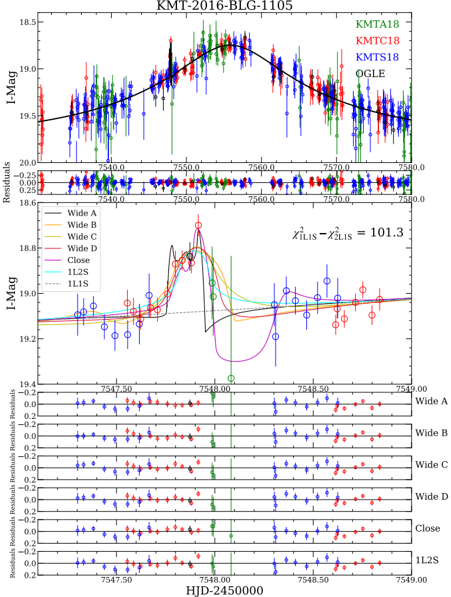
### Visual Description
## Light Curve Analysis: KMT-2016-BLG-1105
### Overview
The image presents a series of light curves and residual plots for the astronomical object KMT-2016-BLG-1105. The top section displays the I-band magnitude (I-Mag) over time (HJD-2450000) from different observatories (KMTA18, KMTC18, KMTS18, and OGLE). The middle section shows a zoomed-in portion of the light curve with different model fits (Wide A, Wide B, Wide C, Wide D, Close, 1L2S, and 1L1S). The bottom section shows the residuals for each of these model fits.
### Components/Axes
**Top Plot:**
* **Title:** KMT-2016-BLG-1105
* **Y-axis:** I-Mag (I-band magnitude), ranging from approximately 18.5 to 19.5.
* **X-axis:** HJD-2450000 (Heliocentric Julian Date minus 2450000), ranging from approximately 7540 to 7580.
* **Data Series (Legend - top-right):**
* KMTA18 (Green)
* KMTC18 (Red)
* KMTS18 (Blue)
* OGLE (Black)
* **Residuals Plot (below top plot):**
* Y-axis: Residuals, ranging from -0.25 to 0.25.
* X-axis: HJD-2450000, same as the top plot.
**Middle Plot:**
* **Y-axis:** I-Mag, ranging from approximately 18.6 to 19.4.
* **X-axis:** HJD-2450000, ranging from approximately 7547.50 to 7549.00.
* **Model Fits (Legend - top-left):**
* Wide A (Black)
* Wide B (Gray)
* Wide C (Yellow)
* Wide D (Orange)
* Close (Purple/Magenta)
* 1L2S (Cyan)
* 1L1S (Dashed Gray)
* **Text:** χ²_1L1S - χ²_2L1S = 101.3 (located at the top-right of the middle plot)
**Bottom Plots (Residuals):**
* **Y-axis:** Residuals, ranging from -0.2 to 0.2.
* **X-axis:** HJD-2450000, same as the middle plot.
* **Residuals for each model fit:**
* Wide A
* Wide B
* Wide C
* Wide D
* Close
* 1L2S
### Detailed Analysis
**Top Plot:**
* The light curve shows a clear brightening event (decrease in I-Mag) between HJD-2450000 = 7550 and 7570.
* The KMTA18 (green) data appears to have the highest density of points around the peak.
* The OGLE (black) data provides a broader baseline.
* The residuals plot shows scatter around zero, indicating the overall fit quality.
**Middle Plot:**
* This plot focuses on the peak of the brightening event.
* The different model fits (Wide A, Wide B, Wide C, Wide D, Close, 1L2S, 1L1S) attempt to capture the shape of the light curve.
* The "Close" (purple) model appears to fit the peak most closely.
* The vertical green line is at approximately HJD-2450000 = 7548.00.
**Bottom Plots:**
* These plots show the residuals for each model fit, allowing for a visual assessment of how well each model captures the data.
* The residuals for the "Close" model appear to have less systematic deviation from zero compared to the "Wide" models.
### Key Observations
* The light curve exhibits a significant brightening event, indicative of a microlensing event.
* Different models provide varying degrees of fit to the data, with the "Close" model appearing to capture the peak most accurately.
* The residuals plots provide a visual assessment of the model fit quality.
* The value χ²_1L1S - χ²_2L1S = 101.3 suggests a significant difference in the goodness-of-fit between the 1L1S and 1L2S models.
### Interpretation
The data suggests a microlensing event observed in the light curve of KMT-2016-BLG-1105. The different models represent various attempts to fit the observed light curve, with the "Close" model providing the best fit around the peak of the event. The residuals plots and the χ² difference provide quantitative measures of the model fit quality. The microlensing event is likely caused by a foreground object passing in front of a background star, causing the background star to temporarily brighten. The different models likely represent different assumptions about the properties of the lens and source objects.
</details>
within ∆ χ 2 = 3, 1, and 1, respectively, and thus we only report their 3 σ upper limit on ρ in Table 9. The ratio of the phase-space factors is p WideA : p WideB : p WideC : p WideD : p Close = 0 . 82 : 0 . 76 : 0 . 74 : 1 : 0 . 41 , so the wide solutions are slightly favored in the phase-space factors.
For the 'Close' solution, the bump was produced by a cusp approach with the lower triangular planetary caustic, followed by a dip that occurred in the data gap between
Figure 11. Geometries of KMT-2016-BLG-1105. The symbols are similar to those in Figure 2.
<details>
<summary>Image 11 Details</summary>
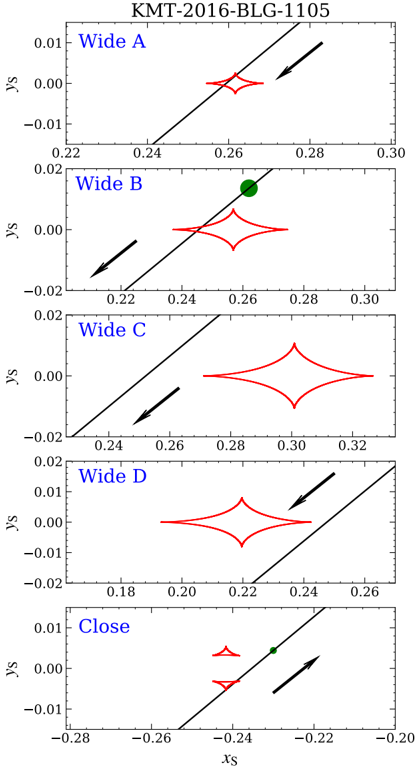
### Visual Description
## Chart/Diagram Type: Parameter Space Plots
### Overview
The image presents a series of five 2D plots, each displaying a parameter space with a red, closed contour and a black line. The plots are titled "Wide A", "Wide B", "Wide C", "Wide D", and "Close". Each plot has axes labeled 'xs' and 'ys'. The plots show how the red contour changes shape and position across different parameter ranges. Arrows are present in each plot, indicating a direction. Two of the plots, "Wide B" and "Close", also contain a green dot. The title of the entire figure is "KMT-2016-BLG-1105".
### Components/Axes
* **Title:** KMT-2016-BLG-1105
* **Plot Titles:** Wide A, Wide B, Wide C, Wide D, Close (arranged vertically)
* **X-axis (xs):**
* Wide A: 0.22 to 0.30
* Wide B: 0.22 to 0.30
* Wide C: 0.24 to 0.32
* Wide D: 0.18 to 0.26
* Close: -0.28 to -0.20
* **Y-axis (ys):**
* Wide A: -0.01 to 0.01
* Wide B: -0.02 to 0.02
* Wide C: -0.02 to 0.02
* Wide D: -0.02 to 0.02
* Close: -0.01 to 0.01
* **Data Elements:**
* Red closed contour (shape varies across plots)
* Black line (appears to be a linear function)
* Black arrow (direction indicator)
* Green dot (present in "Wide B" and "Close" plots)
### Detailed Analysis or Content Details
**Wide A:**
* xs ranges from 0.22 to 0.30
* ys ranges from -0.01 to 0.01
* Red contour is centered around xs = 0.26, ys = 0.00
* Black line slopes upwards from left to right.
* Arrow points towards the top-right.
**Wide B:**
* xs ranges from 0.22 to 0.30
* ys ranges from -0.02 to 0.02
* Red contour is centered around xs = 0.26, ys = 0.00
* Black line slopes upwards from left to right.
* Green dot is located at approximately xs = 0.26, ys = 0.015
* Arrow points towards the bottom-left.
**Wide C:**
* xs ranges from 0.24 to 0.32
* ys ranges from -0.02 to 0.02
* Red contour is centered around xs = 0.29, ys = 0.00
* Black line slopes upwards from left to right.
* Arrow points towards the bottom-left.
**Wide D:**
* xs ranges from 0.18 to 0.26
* ys ranges from -0.02 to 0.02
* Red contour is centered around xs = 0.22, ys = 0.00
* Black line slopes upwards from left to right.
* Arrow points towards the top-right.
**Close:**
* xs ranges from -0.28 to -0.20
* ys ranges from -0.01 to 0.01
* Red contour is centered around xs = -0.24, ys = -0.005
* Black line slopes upwards from left to right.
* Green dot is located at approximately xs = -0.225, ys = 0.005
* Arrow points towards the top-right.
### Key Observations
* The red contour shape varies across the plots, suggesting different parameter configurations.
* The black line represents a consistent linear relationship in each plot.
* The green dot appears in two plots ("Wide B" and "Close"), potentially indicating a specific condition or data point of interest.
* The arrows indicate a direction, possibly representing a gradient or flow within the parameter space.
* The x-axis range varies between plots.
### Interpretation
The plots likely represent different regions or scales within a parameter space related to the KMT-2016-BLG-1105 event. The red contours could represent regions of interest or confidence intervals for a particular model. The black line might represent a constraint or relationship between the 'xs' and 'ys' parameters. The green dots could indicate the best-fit parameters or a specific observation. The arrows might indicate the direction of increasing likelihood or a gradient in the parameter space. The different "Wide" and "Close" plots suggest a multi-scale analysis, where "Wide" plots explore broader parameter ranges and "Close" plots focus on specific regions. The changing shape of the red contour across the plots indicates how the parameter space changes under different conditions or scales.
</details>
HJD ′ = 7548 . 0 and HJD ′ = 7548 . 3 . If the bump were
produced by a cusp approach with the upper triangular planetary caustic, there would be a dip before the bump, but the region before the bump is well covered by the KMTS and the KMTC data, which are consistent with the 1L1S model. Thus, the minor-image perturbation only has one solution.
Figure 12. Scatter plot of log q vs. ∆ ξ for KMT-2016-BLG-1105. The distribution is derived by inflating the error bars by a factor of √ 2 . 5 and then multiplying the resulting χ 2 by 2.5 for the plot. The colors are the same as those in Figure 3. 'A', 'B', 'C', and 'D' represent four local minima and the corresponding parameters are given in Table 9.
<details>
<summary>Image 12 Details</summary>
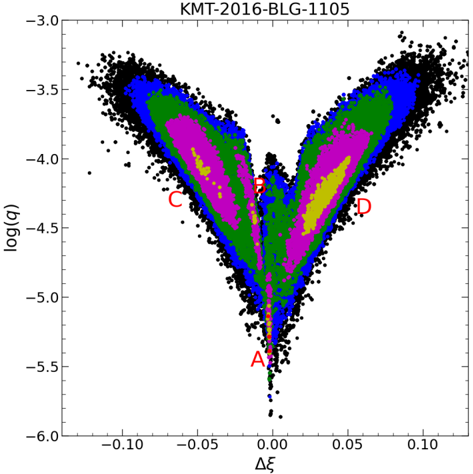
### Visual Description
## Scatter Plot: KMT-2016-BLG-1105
### Overview
The image is a scatter plot displaying data points in a distribution resembling a butterfly or an hourglass shape. The plot visualizes the relationship between two variables: log(q) on the y-axis and Δξ on the x-axis. The data points are clustered and colored in distinct regions, with black points forming the outer boundary and inner regions colored in blue, green, magenta, and gold. The plot also contains four red labels: A, B, C, and D.
### Components/Axes
* **Title:** KMT-2016-BLG-1105
* **X-axis:** Δξ (Delta xi)
* Scale ranges from -0.10 to 0.10, with tick marks at -0.10, -0.05, 0.00, 0.05, and 0.10.
* **Y-axis:** log(q)
* Scale ranges from -6.0 to -3.0, with tick marks at -6.0, -5.5, -5.0, -4.5, -4.0, -3.5, and -3.0.
* **Data Points:** The data points are colored in black, blue, green, magenta, and gold, forming distinct regions.
* **Labels:** Red labels A, B, C, and D are placed at specific locations on the plot.
* A is located near (0.00, -5.6).
* B is located near (0.00, -4.1).
* C is located near (-0.07, -4.3).
* D is located near (0.07, -4.3).
### Detailed Analysis or Content Details
* **Black Data Points:** These points form the outermost layer of the distribution, creating the overall butterfly/hourglass shape. They are most dense at the top (around log(q) = -3.2) and taper towards the bottom (around log(q) = -5.5).
* **Blue Data Points:** These points are clustered inside the black points, forming a similar but smaller butterfly/hourglass shape.
* **Green Data Points:** These points are clustered inside the blue points, forming a similar but smaller butterfly/hourglass shape.
* **Magenta Data Points:** These points are clustered inside the green points, forming a similar but smaller butterfly/hourglass shape.
* **Gold Data Points:** These points are clustered inside the magenta points, forming a similar but smaller butterfly/hourglass shape.
* **Point A:** Located at approximately (0.00, -5.6). This point is at the bottom of the distribution, where the butterfly/hourglass shape narrows.
* **Point B:** Located at approximately (0.00, -4.1). This point is at the "neck" of the butterfly/hourglass shape, where the distribution narrows again.
* **Point C:** Located at approximately (-0.07, -4.3). This point is on the left side of the distribution, within the magenta region.
* **Point D:** Located at approximately (0.07, -4.3). This point is on the right side of the distribution, within the magenta region.
### Key Observations
* The data points are highly concentrated in the central region of the plot.
* The distribution is roughly symmetrical about the y-axis (Δξ = 0).
* The different colored regions (black, blue, green, magenta, gold) suggest different levels or categories within the data.
* The labels A, B, C, and D mark specific locations of interest within the distribution.
### Interpretation
The scatter plot likely represents the results of a scientific experiment or simulation. The x and y axes represent two different parameters, and the clustering of data points suggests correlations between these parameters. The different colored regions could represent different experimental conditions, simulation parameters, or data categories. The labels A, B, C, and D likely highlight specific data points or regions of interest that warrant further investigation. The butterfly/hourglass shape suggests a complex relationship between the two variables, possibly involving a threshold effect or a non-linear interaction. The symmetry of the plot suggests that the underlying process is also symmetrical.
</details>
For the four 'Wide' solutions, the 'Wide A' and 'Wide B' solutions have a source crossing the planetary caustic, and the 'Wide C' and 'Wide D' solutions that contain a source that passes to one side or the other of the planetary caustic. This topology is qualitatively similar to the topology of OGLE-2017-BLG-0173 (Hwang et al. 2018a). We thus also investigate the parameter space by a 'hotter' MCMC with the error bar inflated by a factor of √ 2 . 5 . The resulting scatter plot is shown in Figure 12, from which we find that the topology of KMT-2016-BLG-1105 has differences in three aspects from the topology of OGLE-2017-BLG-0173. First, for the two solutions in which the source passes to one side or the other of the planetary caustic, OGLE-2017-BLG-0173 has caustic crossings and the source is comparable to the size of the planetary caustic, but in the present case, the source does not cross the caustic. Second, for the solution in which the source passes directly over the planetary caustic, the source is much larger than the planetary caustics in the case of OGLE2017-BLG-0173, while the source of KMT-2016-BLG-1105 is smaller than the caustic. Third, OGLE-2017-BLG-0173
exhibits a bimodal minimum when the source passes directly over the caustic, and the mass-ratio difference between the two local minima is ∆log q < 0 . 1 . The corresponding solutions for KMT-2016-BLG-1105, the 'Wide A' and 'Wide B' solutions, have ∆log q ∼ 1 . We note that the 'Wide A' and 'Wide B' solutions have ∆ ξ ∼ 0.00 and -0.01, respectively. Considering the approximate symmetry with respect to ∆ ξ , one might expect an additional minimum that has ∆ ξ ∼ 0 . 01 and a similar log q as the log q of the 'Wide B' solution. However, such a potential solution 'disappeared' from the numerical analysis. Because the trajectories of the 'Wide' B solution and the putative minimum at ∆ ξ ∼ 0 . 01 should be almost symmetric with respect to the center of the caustics, their corresponding planetary signals should also be almost symmetric. As shown in Figure 10, the 'Wide B' solution drops rapidly during the caustic exit, followed by a dip, so the putative minimum at ∆ ξ ∼ 0 . 01 should contain a dip followed by a sudden rise during the caustic entry, which is not supported by the KMTC and KMTS data. Thus, in Figure 12 this topology is absorbed into the MCMC chain of the 'Wide D' solution and there is no new discrete solution.
We also check whether the bump-type anomaly can be fitted by a 1L2S model. Table 8 lists the 1L2S parameters. We find that the best-fit 1L2S model is disfavored by ∆ χ 2 = 12 . 0 compared to the best-fit 2L1S model. The bestfit 1L2S model has ρ 2 = 0 . 0018 . We note that the flux ratio is q f,I ∼ 2 × 10 -3 , corresponding to a magnitude difference of 6.7 mag. According to Section 5, the primary source lies 4.1 mag below the red giant clump, so the putative source companion would have an absolute magnitude of M I, 2 ∼ 10 . 7 mag, corresponding to an angular source radius of θ ∗ , 2 ∼ 0 . 1 µ as. This yields the lens-source relative proper motion of µ rel = θ ∗ , 2 /ρ 2 /t E ∼ 0 . 5 mas yr -1 , which is lower than the typical µ rel of bulge microlensing events (See Figure 2 of Zhu et al. (2017) for examples). However, a model with ρ 2 = 0 is only disfavored by ∆ χ 2 = 1 , so any reasonable µ rel is only disfavored by ∆ χ 2 < 1 . Thus, while the planetary model is strongly favored, there is a possibility that the anomaly is caused by a second source.
With high-order effects, we find that ∆ χ 2 < 1 and the 1 σ uncertainty of parallax is > 0 . 9 at all directions, so the constraint on π E is not useful.
## 5. SOURCE AND LENS PROPERTIES
## 5.1. Preamble
Combining Equations (1) and (7), the mass M L and distance D L of a lens system are related to the angular Einstein radius θ E and the microlensing parallax π E by (Gould 1992, 2000)
<!-- formula-not-decoded -->
<details>
<summary>Image 13 Details</summary>
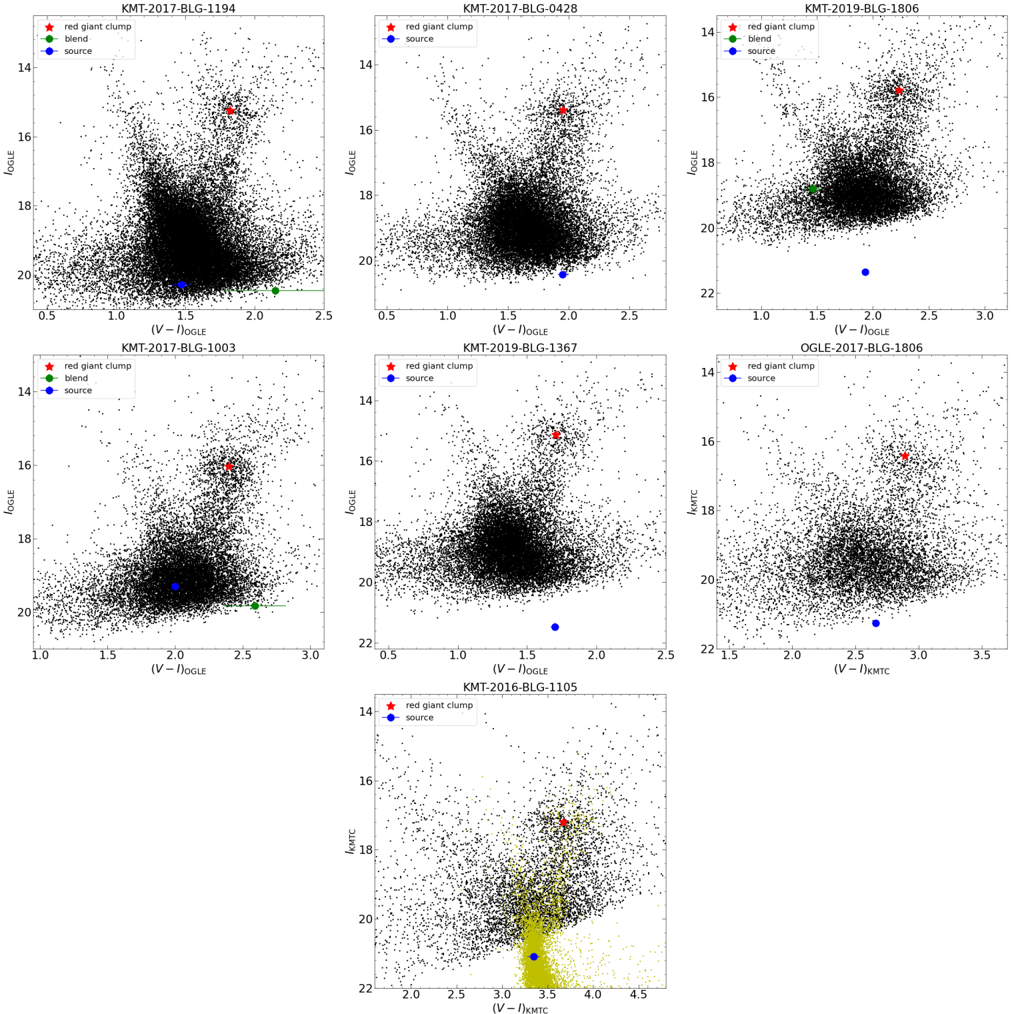
### Visual Description
## Scatter Plot Grid: Stellar Magnitude vs. Color Index
### Overview
The image presents a grid of seven scatter plots. Each plot displays the relationship between stellar magnitude (I band) and color index (V-I) for different fields of view, likely targeting the Galactic bulge. The plots are titled with identifiers such as "KMT-2017-BLG-1194" and "OGLE-2017-BLG-1806". Each plot highlights the location of the red giant clump and a specific source.
### Components/Axes
* **Titles:** Each plot has a title indicating the field of view, e.g., "KMT-2017-BLG-1194".
* **X-axis:** Represents the color index (V-I). The label is "(V-I)OGLE" for most plots, but "(V-I)KMTC" for the bottom two plots on the right.
* **Y-axis:** Represents the I-band magnitude. The label is "IOGLE" for most plots, but "IKMTC" for the bottom two plots on the right.
* **X-axis Scale:** Varies slightly between plots, but generally ranges from approximately 0.5 to 3.5.
* **Y-axis Scale:** Ranges from approximately 14 to 22.
* **Data Points:** Each plot contains a dense scatter of black points, representing individual stars.
* **Red Giant Clump Marker:** A red star marks the location of the red giant clump in each plot.
* **Source Marker:** A blue circle marks the location of a specific source in each plot.
* **Blend Marker:** Some plots contain a green circle, labeled as "blend".
* **Legend:** Located in the top-left corner of some plots, explaining the markers: red star for "red giant clump", green circle for "blend", and blue circle for "source".
### Detailed Analysis
**Plot 1: KMT-2017-BLG-1194**
* X-axis: (V-I)OGLE, ranging from 0.5 to 2.5
* Y-axis: IOGLE, ranging from 14 to 20
* Red Giant Clump: Located at approximately (1.7, 14.5)
* Source: Located at approximately (1.8, 20)
* Blend: Located at approximately (2.2, 20)
* Trend: The stellar density increases towards lower magnitudes and a color index around 1.
**Plot 2: KMT-2017-BLG-0428**
* X-axis: (V-I)OGLE, ranging from 0.5 to 2.5
* Y-axis: IOGLE, ranging from 14 to 20
* Red Giant Clump: Located at approximately (1.7, 14.5)
* Source: Located at approximately (1.9, 20.2)
* Trend: The stellar density increases towards lower magnitudes and a color index around 1.
**Plot 3: KMT-2019-BLG-1806**
* X-axis: (V-I)OGLE, ranging from 1.0 to 3.0
* Y-axis: IOGLE, ranging from 14 to 22
* Red Giant Clump: Located at approximately (1.7, 14.5)
* Source: Located at approximately (2.0, 21)
* Blend: Located at approximately (1.2, 18.5)
* Trend: The stellar density increases towards lower magnitudes and a color index around 1.5.
**Plot 4: KMT-2017-BLG-1003**
* X-axis: (V-I)OGLE, ranging from 1.0 to 3.0
* Y-axis: IOGLE, ranging from 14 to 22
* Red Giant Clump: Located at approximately (2.3, 16)
* Source: Located at approximately (2.2, 19.5)
* Blend: Located at approximately (2.7, 20)
* Trend: The stellar density increases towards lower magnitudes and a color index around 2.
**Plot 5: KMT-2019-BLG-1367**
* X-axis: (V-I)OGLE, ranging from 1.0 to 2.5
* Y-axis: IOGLE, ranging from 14 to 22
* Red Giant Clump: Located at approximately (1.7, 16)
* Source: Located at approximately (1.8, 20.5)
* Trend: The stellar density increases towards lower magnitudes and a color index around 1.5.
**Plot 6: OGLE-2017-BLG-1806**
* X-axis: (V-I)KMTC, ranging from 1.5 to 3.5
* Y-axis: IKMTC, ranging from 14 to 22
* Red Giant Clump: Located at approximately (2.3, 15)
* Source: Located at approximately (2.5, 20.5)
* Trend: The stellar density increases towards lower magnitudes and a color index around 2.
**Plot 7: KMT-2016-BLG-1105**
* X-axis: (V-I)KMTC, ranging from 2.0 to 4.5
* Y-axis: IKMTC, ranging from 14 to 22
* Red Giant Clump: Located at approximately (3.5, 16)
* Source: Located at approximately (3.4, 21)
* Trend: The stellar density increases towards lower magnitudes and a color index around 3. The stellar distribution is more elongated and vertical compared to other plots. There is a distinct yellow-ish concentration of stars.
### Key Observations
* The red giant clump is consistently located around I ~ 14-16 magnitude.
* The source locations vary across the plots, but are generally fainter (higher magnitude) than the red giant clump.
* The stellar density is highest in regions corresponding to the main sequence and red giant branch.
* The color index (V-I) values for the densest regions vary slightly between plots, possibly due to differences in extinction or stellar populations.
* The bottom two plots use KMTC filters, while the others use OGLE filters.
* Plot KMT-2016-BLG-1105 shows a distinct vertical feature, possibly indicating a specific stellar population or an artifact.
### Interpretation
The plots are color-magnitude diagrams (CMDs) used in stellar population studies. The red giant clump serves as a standard candle, allowing for distance estimation and comparison of stellar populations across different fields of view. The variations in stellar density and color index distribution suggest differences in extinction, metallicity, or age of the stellar populations in each field. The source markers likely indicate specific stars of interest for further study. The difference between OGLE and KMTC filters could be due to different telescope facilities or filter systems, requiring careful calibration when comparing data. The vertical feature in KMT-2016-BLG-1105 warrants further investigation to determine its origin and significance.
</details>
(V-I)KMTC
Figure 13. Color magnitude diagrams for the seven planetary events analyzed in this paper. The first five CMDs are constructed using the OGLE-III star catalog (Szyma´ nski et al. 2011), and the other two CMDs are constructed using the KMTC pyDIA photometry reduction. For each panel, the red asterisk and the blue dot are shown as the centroid of the red giant clump and the microlensed source star, respectively. The three green dots on the CMDs of KMT-2017-BLG-1194, KMT-2019-BLG-1806, and KMT-2017-BLG-1003 represent the blended light. For the bottom panel, the yellow dots represent the HST CMD of Holtzman et al. (1998) whose red-clump centroid has been matched to that of KMTC using ( V -I, I ) cl , HST = (1 . 62 , 15 . 15) (Bennett et al. 2008).
Table 10. CMDparameters, θ ∗ , θ E and µ rel for the five 'dip' planetary events
| Parameter | KB171194 | KB170428 | KB191806 | KB171003 | KB171003 | KB191367 |
|---------------------|-------------------|-------------------|-------------------|-------------------|-------------------|-------------------|
| | | | | Inner | Outer | |
| ( V - I ) cl | 1 . 82 ± 0 . 01 | 1 . 95 ± 0 . 01 | 2 . 23 ± 0 . 01 | 2 . 39 ± 0 . 01 | ← | 1 . 70 ± 0 . 01 |
| I cl | 15 . 25 ± 0 . 01 | 15 . 39 ± 0 . 01 | 15 . 79 ± 0 . 02 | 16 . 04 ± 0 . 01 | ← | 15 . 13 ± 0 . 01 |
| I cl , 0 | 14 . 26 ± 0 . 04 | 14 . 36 ± 0 . 04 | 14 . 39 ± 0 . 04 | 14 . 34 ± 0 . 04 | ← | 14 . 37 ± 0 . 04 |
| ( V - I ) S | 1 . 47 ± 0 . 07 | 1 . 95 ± 0 . 04 | 1 . 93 ± 0 . 03 | 2 . 00 ± 0 . 02 | ← | 1 . 70 ± 0 . 03 |
| I S | 20 . 28 ± 0 . 08 | 20 . 43 ± 0 . 05 | 21 . 35 ± 0 . 07 | 19 . 30 ± 0 . 04 | 19 . 30 ± 0 . 04 | 21 . 47 ± 0 . 13 |
| ( V - I ) S , 0 | 0 . 71 ± 0 . 08 | 1 . 06 ± 0 . 05 | 0 . 76 ± 0 . 05 | 0 . 67 ± 0 . 04 | ← | 1 . 06 ± 0 . 04 |
| I S , 0 | 19 . 29 ± 0 . 09 | 19 . 40 ± 0 . 07 | 19 . 95 ± 0 . 08 | 17 . 60 ± 0 . 06 | 17 . 60 ± 0 . 06 | 20 . 71 ± 0 . 14 |
| θ ∗ ( µ as) | 0 . 448 ± 0 . 038 | 0 . 578 ± 0 . 034 | 0 . 345 ± 0 . 020 | 0 . 942 ± 0 . 046 | 0 . 942 ± 0 . 046 | 0 . 316 ± 0 . 023 |
| θ E (mas) | > 0 . 17 | > 0 . 09 | > 0 . 19 | > 0 . 14 | 0 . 180 ± 0 . 041 | > 0 . 06 |
| µ rel ( masyr - 1 ) | > 1 . 3 | > 0 . 74 | > 0 . 51 | > 2 . 0 | 2 . 56 ± 0 . 58 | > 0 . 53 |
NOTE- ( V - I ) cl , 0 = 1 . 06 ± 0 . 03 . Event names are abbreviations, e.g., KMT-2017-BLG-1194 to KB171194.
Table 11. CMDparameters, θ ∗ , θ E and µ rel for OGLE-2017-BLG-1806.
| Parameter | Close A | Close A | Close B | Close B | Wide | Wide |
|---------------------|----------------------------|----------------------------|----------------------------|----------------------------|-------------------|-------------------|
| | u 0 > 0 | u 0 < 0 | u 0 > 0 | u 0 < 0 | u 0 > 0 | u 0 < 0 |
| ( V - I ) cl | 2 . 89 ± 0 . 01 | ← | ← | ← | ← | ← |
| I cl | 16 . 42 ± 0 . 02 | ← | ← | ← | ← | ← |
| I cl , 0 | 14 . 33 ± 0 . 04 | ← | ← | ← | ← | ← |
| ( V - I ) S | 2 . 66 ± 0 . 03 | ← | ← | ← | ← | ← |
| I S | 21 . 12 ± 0 . 07 | 21 . 07 ± 0 . 07 | 21 . 10 ± 0 . 08 | 21 . 10 ± 0 . 08 | 21 . 03 ± 0 . 07 | 21 . 08 ± 0 . 07 |
| ( V - I ) S , 0 | 0 . 83 ± 0 . 04 | ← | ← | ← | ← | ← |
| I S , 0 | 19 . 03 ± 0 . 08 | 18 . 98 ± 0 . 08 | 19 . 01 ± 0 . 09 | 19 . 01 ± 0 . 09 | 18 . 94 ± 0 . 08 | 18 . 99 ± 0 . 08 |
| θ ∗ ( µ as) | 0 . 561 ± 0 . 031 | 0 . 574 ± 0 . 031 | 0 . 566 ± 0 . 033 | 0 . 566 ± 0 . 033 | 0 . 584 ± 0 . 032 | 0 . 571 ± 0 . 032 |
| θ E (mas) | 0 . 322 +0 . 083 - 0 . 145 | 0 . 314 +0 . 087 - 0 . 138 | 0 . 377 +0 . 120 - 0 . 157 | 0 . 343 +0 . 105 - 0 . 141 | > 0 . 21 | > 0 . 24 |
| µ rel ( masyr - 1 ) | 1 . 69 +0 . 45 - 0 . 77 | 1 . 72 +0 . 49 - 0 . 76 | 1 . 98 +0 . 64 - 0 . 84 | 2 . 08 +0 . 65 - 0 . 87 | > 1 . 2 | > 1 . 3 |
Table 12. CMDparameters, θ ∗ , θ E and µ rel for KMT-2016-BLG-1105.
| | Wide A | Wide B | Wide C | Wide D | Close |
|---------------------|-------------------|-------------------|-------------------|-------------------|-------------------|
| I cl | 17 . 20 ± 0 . 01 | ← | ← | ← | ← |
| I cl , 0 | 14 . 39 ± 0 . 04 | ← | ← | ← | ← |
| I S | 21 . 09 ± 0 . 08 | 21 . 20 ± 0 . 05 | 21 . 22 ± 0 . 11 | 21 . 22 ± 0 . 11 | 21 . 27 ± 0 . 06 |
| ( V - I ) S , 0 | 0 . 74 ± 0 . 07 | 0 . 75 ± 0 . 07 | 0 . 75 ± 0 . 07 | 0 . 75 ± 0 . 07 | 0 . 75 ± 0 . 07 |
| I S , 0 | 18 . 28 ± 0 . 09 | 18 . 39 ± 0 . 07 | 18 . 41 ± 0 . 12 | 18 . 41 ± 0 . 12 | 18 . 46 ± 0 . 07 |
| θ ∗ ( µ as) | 0 . 732 ± 0 . 057 | 0 . 702 ± 0 . 051 | 0 . 696 ± 0 . 061 | 0 . 696 ± 0 . 061 | 0 . 680 ± 0 . 050 |
| θ E (mas) | > 0 . 31 | 0 . 240 ± 0 . 070 | > 0 . 15 | > 0 . 13 | 0 . 907 ± 0 . 182 |
| µ rel ( masyr - 1 ) | > 2 . 9 | 2 . 07 ± 0 . 62 | > 1 . 3 | > 1 . 1 | 7 . 65 ± 1 . 54 |
To obtain the angular Einstein radius through θ E = θ ∗ /ρ , we first estimate the angular source radius θ ∗ by locating the source on a color-magnitude diagram (CMD, Yoo et al. 2004). For each event, we construct a V -I versus I CMD using the ambient stars of the OGLE-III catalog (Szyma´ nski et al. 2011) or the KMTC images with the pyDIA reductions. See Figure 13 for the CMDs of the seven planetary events. Weestimate the centroid of the red giant clump as ( V -I, I ) cl from CMDs and adopt the de-reddened color and magnitude of the red giant clump, ( V -I, I ) cl , 0 , from Bensby et al. (2013) and Table 1 of Nataf et al. (2013). We obtain the source apparent magnitude from the light-curve analysis of Section 4, and the source color by a regression of the KMTC V versus I flux with the change of the lensing magnification.
We find that the V -band observations of KMT-2016-BLG1105 have insufficient signal-to-noise ratio to determine the source color, so we estimate the source color by the Hubble Space Telescope ( HST ) CMD of Holtzman et al. (1998) (see Section 5.7 for details). Finally, using the color/surfacebrightness relation of Adams et al. (2018), we obtain the angular source radius θ ∗ . Tables 10, 11 and 12 present the CMD values and ( θ ∗ , θ E , µ rel ) from the procedures above.
Because the blended light could provide additional constraints on the lens properties (e.g., the upper limits for the lens brightness), we also check the brightness and the astrometric alignment of the baseline object. For KMT-2017BLG-0428 and KMT-2019-BLG-1806, we adopt the i ′ -band baseline images taken by the 3.6m Canada-France-Hawaii Telescope (CFHT) from 2020 to 2022, whose seeing FWHM is 0 . ′′ 55 -0 . ′′ 70 . For the other five events which do not have any CFHT image, we check the baseline objects from the KMTC pyDIA reduction, whose seeing FWHM is about 1 . ′′ 0 .
Because none of the seven planetary events have simultaneous measurements of π E and θ E at the > 3 σ level, the lens masses and distances cannot be directly determined by Equa- tion (18). We conduct a Bayesian analysis using a Galactic model to estimate the lens properties. The Galactic model and the procedures we adopt are the same as described in Zang et al. (2021b). We refer the reader to that work for details. The only exception is that we include upper limits of the lens light, I L , limit , from the analysis of the blended light. We adopt the mass-luminosity relation of Wang et al. (2018),
<!-- formula-not-decoded -->
where M I is the absolute magnitude in the I band, and we reject trial events for which the lens properties obey
<!-- formula-not-decoded -->
where A I,D L is the extinction at D L . We adopt an extinction curve with a scale height of 120 pc. For the five events with OGLE CMDs, the total extinction is derived from the CMD analysis, A I = I cl -I cl , 0 . For the other two events with KMTC CMDs, we adopt the extinction in the K band from Gonzalez et al. (2012) and A I = 7 . 26 A K from Nataf et al. (2016).
Table 13 presents the resulting Bayesian estimates of the host mass M host , the planet mass M planet , the lens distance D L , the projected planet-host separation a ⊥ and the lenssource relative proper motion µ rel . For events with multiple solutions, we show the results for each solution and the 'combined results' of combining all solutions weighted by their Galactic-model likelihood and exp( -∆ χ 2 / 2) , where ∆ χ 2 is the χ 2 difference compared to the best-fit solution. Here the Galactic-model likelihood represents the total weight for the simulated events given the error distributions of t E , θ E and π E . See Equation (16) of Zang et al. (2021b) for the weight procedures.
We do not adopt the 'combined results' as the final physical parameters but just show them for consideration, be-
Table 13. Physical parameters of the six planetary events from a Bayesian analysis.
| Event | Solution | Physical Properties | Physical Properties | Physical Properties | Physical Properties | Physical Properties | Relative Weights | Relative Weights |
|----------|---------------------|-------------------------------|--------------------------|-------------------------|-------------------------|-------------------------|--------------------|--------------------|
| | | M host [ M ] | M planet [ M ⊕ ] | D L [kpc] | a ⊥ [au] | µ rel [ masyr - 1 ] | Gal.Mod. | χ 2 |
| KB171194 | | 0 . 41 +0 . 23 - 0 . 19 | 3 . 54 +1 . 95 - 1 . 63 | 4 . 24 +2 . 16 - 1 . 71 | 1 . 78 +0 . 45 - 0 . 46 | 4 . 29 +2 . 50 - 1 . 66 | ... | ... |
| KB170428 | Inner | 0 . 34 +0 . 22 - 0 . 17 | 5 . 63 +3 . 59 - 2 . 85 | 5 . 40 +1 . 82 - 2 . 60 | 1 . 78 +0 . 54 - 0 . 58 | 3 . 27 +2 . 26 - 1 . 32 | 0.99 | 1.00 |
| KB170428 | Outer | 0 . 34 +0 . 22 - 0 . 17 | 5 . 55 +3 . 53 - 2 . 81 | 5 . 40 +1 . 82 - 2 . 60 | 1 . 85 +0 . 55 - 0 . 60 | 3 . 28 +2 . 24 - 1 . 34 | 1.00 | 0.95 |
| KB170428 | Combined | 0 . 34 +0 . 22 - 0 . 17 | 5 . 59 +3 . 57 - 2 . 83 | 5 . 40 +1 . 82 - 2 . 60 | 1 . 81 +0 . 55 - 0 . 59 | 3 . 27 +2 . 26 - 1 . 32 | ... | ... |
| KB191806 | Inner ( u 0 > 0 ) | 0 . 75 +0 . 24 - 0 . 25 | 4 . 67 +1 . 52 - 1 . 52 | 6 . 62 +0 . 72 - 1 . 93 | 2 . 87 +0 . 64 - 0 . 66 | 1 . 17 +0 . 70 - 0 . 34 | 1.00 | 0.70 |
| KB191806 | Inner ( u 0 < 0 ) | 0 . 74 +0 . 25 - 0 . 26 | 4 . 47 +1 . 56 - 1 . 52 | 6 . 63 +0 . 73 - 2 . 01 | 2 . 85 +0 . 66 - 0 . 70 | 1 . 11 +0 . 74 - 0 . 34 | 0.84 | 0.58 |
| KB191806 | Outer ( u 0 > 0 ) | 0 . 73 +0 . 25 - 0 . 26 | 4 . 63 +1 . 60 - 1 . 64 | 6 . 68 +0 . 72 - 1 . 97 | 3 . 11 +0 . 73 - 0 . 79 | 1 . 13 +0 . 70 - 0 . 36 | 0.98 | 0.82 |
| KB191806 | Outer ( u 0 < 0 ) | 0 . 75 +0 . 24 - 0 . 25 | 4 . 79 +1 . 56 - 1 . 60 | 6 . 62 +0 . 74 - 2 . 09 | 3 . 17 +0 . 70 - 0 . 75 | 1 . 15 +0 . 74 - 0 . 36 | 0.98 | 1.00 |
| KB191806 | Combined | 0 . 74 +0 . 25 - 0 . 25 | 4 . 67 +1 . 56 - 1 . 60 | 6 . 64 +0 . 72 - 2 . 01 | 3 . 02 +0 . 70 - 0 . 73 | 1 . 13 +0 . 74 - 0 . 34 | ... | ... |
| KB171003 | Inner | 0 . 37 +0 . 32 - 0 . 19 | 6 . 75 +5 . 79 - 3 . 44 | 7 . 03 +0 . 61 - 0 . 74 | 1 . 54 +0 . 38 - 0 . 37 | 3 . 55 +0 . 88 - 0 . 84 | 1.00 | 0.90 |
| KB171003 | Outer | 0 . 27 +0 . 26 - 0 . 13 | 3 . 72 +3 . 71 - 1 . 80 | 7 . 16 +0 . 61 - 0 . 65 | 1 . 25 +0 . 27 - 0 . 25 | 2 . 75 +0 . 56 - 0 . 54 | 0.74 | 1.00 |
| KB171003 | Combined | 0 . 32 +0 . 31 - 0 . 17 | 5 . 19 +5 . 39 - 2 . 80 | 7 . 09 +0 . 61 - 0 . 70 | 1 . 38 +0 . 39 - 0 . 32 | 3 . 11 +0 . 94 - 0 . 72 | ... | ... |
| KB191367 | Inner | 0 . 25 +0 . 16 - 0 . 13 | 4 . 06 +2 . 56 - 2 . 08 | 4 . 68 +2 . 44 - 2 . 10 | 1 . 67 +0 . 49 - 0 . 55 | 3 . 92 +2 . 57 - 1 . 71 | 1.00 | 1.00 |
| KB191367 | Outer | 0 . 25 +0 . 16 - 0 . 13 | 4 . 12 +2 . 58 - 2 . 10 | 4 . 67 +2 . 45 - 2 . 10 | 1 . 73 +0 . 51 - 0 . 57 | 3 . 89 +2 . 55 - 1 . 71 | 0.96 | 0.90 |
| KB191367 | Combined | 0 . 25 +0 . 16 - 0 . 13 | 4 . 08 +2 . 58 - 2 . 08 | 4 . 67 +2 . 45 - 2 . 10 | 1 . 70 +0 . 50 - 0 . 56 | 3 . 91 +2 . 56 - 1 . 71 | ... | ... |
| OB171806 | Close A ( u 0 > 0 ) | 0 . 44 +0 . 33 - 0 . 23 | 5 . 87 +4 . 43 - 3 . 04 | 6 . 60 +0 . 65 - 1 . 06 | 1 . 84 +0 . 44 - 0 . 51 | 1 . 95 +0 . 46 - 0 . 54 | 0.85 | 0.90 |
| OB171806 | Close A ( u 0 < 0 ) | 0 . 33 +0 . 33 - 0 . 16 | 4 . 83 +4 . 83 - 2 . 44 | 6 . 17 +0 . 92 - 1 . 57 | 1 . 69 +0 . 46 - 0 . 43 | 2 . 13 +0 . 56 - 0 . 58 | 1.00 | 1.00 |
| OB171806 | Close B ( u 0 > 0 ) | 0 . 44 +0 . 39 - 0 . 26 | 2 . 40 +2 . 24 - 1 . 48 | 5 . 95 +1 . 11 - 2 . 13 | 1 . 89 +0 . 58 - 0 . 62 | 2 . 39 +0 . 78 - 0 . 70 | 0.21 | 10 - 3 . 1 |
| OB171806 | Close B ( u 0 < 0 ) | 0 . 48 +0 . 35 - 0 . 26 | 2 . 68 +1 . 96 - 1 . 48 | 6 . 53 +0 . 69 - 1 . 41 | 1 . 91 +0 . 50 - 0 . 58 | 2 . 09 +0 . 58 - 0 . 60 | 0.16 | 10 - 3 . 2 |
| OB171806 | Wide ( u 0 > 0 ) | 0 . 34 +0 . 31 - 0 . 16 | 5 . 47 +4 . 87 - 2 . 60 | 3 . 01 +2 . 22 - 1 . 09 | 2 . 53 +1 . 06 - 0 . 78 | 4 . 92 +1 . 74 - 1 . 94 | 10 - 1 . 5 | 10 - 1 . 8 |
| OB171806 | Wide ( u 0 < 0 ) | 0 . 41 +0 . 23 - 0 . 17 | 4 . 87 +2 . 72 - 2 . 00 | 2 . 87 +1 . 13 - 0 . 86 | 2 . 82 +0 . 85 - 0 . 78 | 5 . 48 +1 . 30 - 1 . 42 | 0.24 | 10 - 1 . 8 |
| OB171806 | Combined | 0 . 38 +0 . 34 - 0 . 20 | 5 . 27 +4 . 71 - 2 . 72 | 6 . 40 +0 . 77 - 1 . 51 | 1 . 75 +0 . 46 - 0 . 47 | 2 . 05 +0 . 52 - 0 . 56 | ... | ... |
| KB161105 | Wide A | 0 . 43 +0 . 22 - 0 . 20 | 0 . 92 +0 . 44 - 0 . 44 | 3 . 79 +1 . 38 - 1 . 44 | 2 . 93 +0 . 69 - 0 . 91 | 6 . 48 +2 . 08 - 1 . 30 | 0.37 | 1.00 |
| KB161105 | Wide B | 0 . 37 +0 . 31 - 0 . 21 | 4 . 67 +3 . 75 - 2 . 64 | 7 . 12 +0 . 65 - 1 . 10 | 2 . 03 +0 . 52 - 0 . 53 | 2 . 29 +0 . 62 - 0 . 56 | 1.00 | 0.32 |
| KB161105 | Wide C | 0 . 43 +0 . 27 - 0 . 23 | 12 . 14 +7 . 63 - 6 . 31 | 5 . 42 +1 . 85 - 2 . 33 | 2 . 63 +0 . 79 - 0 . 83 | 3 . 97 +2 . 68 - 1 . 58 | 0.66 | 0.11 |
| KB161105 | Wide D | 0 . 44 +0 . 27 - 0 . 23 | 9 . 51 +5 . 75 - 4 . 87 | 5 . 28 +1 . 92 - 2 . 23 | 2 . 56 +0 . 73 - 0 . 74 | 4 . 11 +2 . 64 - 1 . 56 | 0.64 | 0.26 |
| KB161105 | Close | 0 . 43 +0 . 18 - 0 . 18 | 1 . 32 +0 . 56 - 0 . 56 | 3 . 27 +1 . 28 - 1 . 15 | 2 . 26 +0 . 51 - 0 . 69 | 6 . 74 +1 . 74 - 1 . 58 | 0.29 | 0.17 |
| KB161105 | Combined | 0 . 41 +0 . 25 - 0 . 21 | 2 . 32 +7 . 43 - 1 . 56 | 5 . 08 +2 . 24 - 2 . 18 | 2 . 44 +0 . 88 - 0 . 75 | 4 . 68 +2 . 76 - 2 . 50 | ... | ... |
NOTE-The combined solution is obtained by a combination of all solutions weighted by the probability for the Galactic model (Gal.Mod.) and exp( -∆ χ 2 / 2) .
cause there is no conclusion about how to combine degenerate solutions. We note that the exp( -∆ χ 2 / 2) probability might be suffered from systematic errors of the observed data. However, the weight from ∆ χ 2 only has minor effects on the 'combined results'. Except for KMT-2016-BLG1105 the degenerate solutions have similar physical interpretations and except for OGLE-2017-BLG-1806 the ∆ χ 2 is small, but for OGLE-2017-BLG-1806 the 'combined results' are already dominated by the 'Close A' solutions due to their Galactic-model likelihoods. Due to similar reasons, whether to include the phase-space factors also has a minor impact on the 'combined results'.
## 5.2. KMT-2017-BLG-1194
The corresponding CMD shown in Figure 13 is constructed from the OGLE-III field stars within 240 ′′ centered on the event. The baseline object has ( V, I ) base = (21 . 343 ± 0 . 085 , 19 . 608 ± 0 . 051) , yielding a blend of ( V -I, I ) B = (2 . 15 ± 0 . 39 , 20 . 45 ± 0 . 14) . We display the blend on the CMD. The source position measured by the difference imaging analysis is displaced from the baseline object by ∆ θ ( N,E ) = ( -26 , 41) mas. We estimate the error of the baseline position by the fractional astrometric error being equal to the fractional photometric error (Jung et al. 2020), which yields σ ast = 0 . 39 σ I FWHM = 20 mas. We note that the astrometric error should be underestimated due to the mottled background from unresolved stars and other systematic errors, but the whole astrometric error should be not more than twice our estimate. Thus, the baseline object is astrometrically consistent with the source and the lens within 2 σ . The blend does not have a useful color constraint. We adopt the 3 σ upper limit of the blended light, I L , limit = 20 . 03 , as the upper limit of the lens brightness.
As given in Table 13, the preferred host star is an M dwarf located in the Galactic disk, and the planet is probably a super-Earth beyond the snow line of the lens system (assuming a snow line radius a SL = 2 . 7( M/M ) au, Kennedy & Kenyon 2008).
## 5.3. KMT-2017-BLG-0428
The corresponding CMD shown in Figure 13 consists of the OGLE-III field stars within 150 ′′ centered on the event. The baseline object on the CFHT images has I base = 20 . 056 ± 0 . 063 , with an astrometric offset of ∆ θ ( N,E ) = (6 , -2) mas and an astrometric error of σ ast ∼ 5 mas. Thus, the baseline object is astrometrically consistent with the source at about 1 σ . Because the CFHT images do not contain color information, we do not display the blend on the CMD. We also adopt the 3 σ upper limit of the blended light, I L , limit = 20 . 81 , as the upper limit of the lens brightness.
As shown in Table 13, the Bayesian analysis indicates another cold super-Earth orbiting an M dwarf.
## 5.4. KMT-2019-BLG-1806
The CMD of this event is constructed from the OGLEIII field stars within 150 ′′ centered on the event, shown in Figure 13. The baseline object on the KMTC images has ( V, I ) base = (20 . 155 ± 0 . 125 , 18 . 685 ± 0 . 076) . We plot the blend on the CMD and find that the blend probably belongs to the foreground main-sequence branch and thus could be the lens. However, the astrometric offset is ∆ θ ( N,E ) = (433 , -76) mas and ∆ θ ( N,E ) = (416 , -96) mas on the CFHT and KMTC images, respectively, so the majority of the blended light is unrelated to the lens. We adopt the median value of the blended light, I L , limit = 18 . 8 , as the upper limit of the lens brightness.
The results of the Bayesian analysis are given in Table 13. The planet is another cold super-Earth, and the preferred host is a K dwarf.
## 5.5. KMT-2017-BLG-1003
We use the OGLE-III field stars within 180 ′′ centered on the event to build the CMD. Combining the measured ρ from the light-curve analysis, we obtain θ E = 0 . 180 ± 0 . 041 mas for the 'Outer' solution and θ E > 0 . 14 mas ( 3 σ ) for the 'Inner' solution. The KMTNet baseline object has ( V, I ) base = (20 . 968 ± 0 . 046 , 18 . 780 ± 0 . 028) , corresponding to a blend of ( V -I, I ) B = (2 . 54 ± 0 . 20 , 19 . 83 ± 0 . 10) , and we display the blend on the CMD. The source-baseline astrometric offset is ∆ θ ( N,E ) = ( -64 , -77) mas, with an astrometric error of σ ast ∼ 12 mas, implying that most of the blend light should be unrelated to the event. We adopt the median value of the blended light, I L , limit = 19 . 83 , as the upper limit of the lens brightness.
The Bayesian analysis shows that the host star is probably an M dwarf located in the Galactic bulge. Again, the preferred planet is a cold super-Earth.
## 5.6. KMT-2019-BLG-1367
In Figure 13, we display the position of the source on the CMDof stars within 180 ′′ around the source. On the KMTC images, there is no star within 1 . ′′ 4 around the source position. We thus adopt the detection limit of the KMTC images, I = 21 . 0 , as the upper limit of the baseline brightness, yielding the 3 σ upper limit of the blended light, I L , limit = 21 . 6 . Applying Equations (19) and (20) and assuming D L < 8 kpc, this flux constraint corresponds to an upper limit of the lens mass of 0 . 6 M .
As shown in Table 13, the Bayesian estimate shows another cold super-Earth orbiting an M dwarf.
## 5.7. OGLE-2017-BLG-1806
The CMD of this event is constructed from KMTC field stars within a 300 ′′ square centered on the event position. The baseline object, ( V, I ) base = (22 . 300 ± 0 . 308 , 20 . 042 ±
0 . 128) , is displaced from the source by 835 mas. Thus, most of the blend light should be unrelated to the event. We do not show the blend on the CMD and adopt the median value of the blended light, I L , limit = 20 . 5 , as the upper limit of the lens brightness.
The results of the Bayesian analysis are presented in Table 13, and all solutions indicate a cold super-Earth orbiting a low-mass star. The constraints on π E , ⊥ from the lightcurve analysis are useful. The 'Wide' solution has a relatively large θ E , with a 2 σ lower limit of 0 . 60 mas and the best-fit value of ∼ 1 . 1 mas, so the corresponding lens system is located in the Galactic disk. Then, the 'Wide ( u 0 > 0 )' solution has π E , ⊥ < 0 and thus a lens velocity in Galactic coordinates of v ∼ 100 km s -1 , so this solution is strongly disfavored. For the two 'Close' solutions, both the π E , ⊥ < 0 solutions are slightly disfavored and have relatively higher probabilities of a bulge lens system.
For the 'Wide' solution, the predicted apparent magnitude of the lens system is fainter than the source by ∼ 0 . 8 mag in the H band. In the case of OGLE-2012-BLG-0950, the source and the lens have roughly equal brightness and were resolved by the Keck AO imaging and the HST imaging when they were separated by about 34 mas (Bhattacharya et al. 2018). For OGLE-2017-BLG-1806, we estimate that resolving the lens and source probably requires a separation of 45 mas for the 'Wide' solution. We note that the proper motions of the two 'Close' solutions are ∼ 2 masyr -1 . If high-resolution observations resolve the lens and the source and find that µ rel (e.g., ∼ 5 masyr -1 ) is much higher than that of the 'Close' solutions, the three solutions can be distinguished. Such observations can be taken in 2026 or earlier.
## 5.8. KMT-2016-BLG-1105
To collect enough red-giant stars to determine the centroid of the red giant clump, the CMD of this event shown in Figure 13 contains KMTC field stars within a 280 ′′ × 300 ′′ rectangle region. Because the event lies about 80 ′′ from the edge of the CCD chip, it is displaced from the center of the rectangle region by about 70 ′′ . The V -band data have insufficient signal-to-noise ratio to determine the source color, so we adopt the method of Bennett et al. (2008) to estimate the source color. We first calibrate the CMD of Holtzman et al. (1998) HST observations to the KMTC CMD using the centroids of red giant clumps. We then estimate the source color by taking the color of the HST field stars whose brightness are within the 5 σ of the source star.
The baseline object has I base = 20 . 729 ± 0 . 125 without color information, so we do not plot the blend on the CMD.The source-baseline astrometric offset is ∆ θ ( N,E ) = (73 , 166) mas, at about 3 σ . Because the baseline object is marginally detected on the KMTC images, we adopt the me- dian value of the blended light, I L , limit = 21 . 7 , as the upper limit of the lens brightness.
The Bayesian analysis indicates that the host star is probably an M dwarf. Due to a factor of ∼ 13 differences within the mass ratios of the five degenerate solutions, there is a wide range for the planetary mass, from sub-Earth-mass to sub-Neptune-mass. Because no solution has a very different proper motion from other solutions, future high-resolution observations cannot break the degeneracy. However, such observations are still important because the measurements of the host brightness can yield the host mass and distance, which could be used for studying the relation between the planetary occurrence rate and the host properties. For the 'Wide A' and 'Close' solutions, the predicted apparent magnitude of the lens system is fainter than the source by ∼ 2 mag and ∼ 3 mag in the H and I bands, respectively. In 2025, the lens and the source will be separated by 50 mas and may be resolved.
## 6. DISCUSSION
In this paper, we have presented the analysis of seven q < 10 -4 planets. Together with 17 already published and three that will be published elsewhere, the KMTNet AnomalyFinder algorithm has found 27 events that can be fit by q < 10 -4 models from 2016-2019 KMTNet data. For the analysis above and in other published papers, all of the local minima are investigated, but here for each planet, we only consider the models with ∆ χ 2 < 10 compared to the best-fit model.
Table 14 presents the event name, log q , s , u 0 , discovery method, ∆ χ 2 compared to the best-fit models, whether it has a caustic crossing, anomaly type (bump or dip), and the KMTNet fields (prime or sub-prime) of each planet, rankedordered by log q of the best-fit models. Of them, 15 were solely detected using AnomalyFinder, and 12 were first discovered from by-eye searches and then recovered by AnomalyFinder, which illustrates the importance of systematic planetary anomaly searches in finding low mass-ratio microlensing planets. The seasonal distribution, (5, 8, 8, 6) for 20162019, is consistent with normal Poisson variations.
Among the 27 planets, four have alternative possible models with q > 10 -4 , and 23 are secure q < 10 -4 planets. Because the detection of q < 10 -4 planets is one of the major scientific goals of the ongoing KMTNet survey and future space-based microlensing projects (Penny et al. 2019; Ge et al. 2022; Yan & Zhu 2022), it is worthwhile to review the properties of the 27 planetary events and study how to detect more such planets.
## 6.1. The Missing Planetary Caustics Problem
As illustrated by Zang et al. (2021b), the motivation for building the KMTNet AnomalyFinder algorithm is to exhume the buried signatures of 'missing planetary caustics'
Figure 14. log q vs. log s distribution for the 27 planetary events with q < 10 -4 shown in Table 14, adapted from Figure 11 of Yee et al. (2021). The red points represent planets that were solely detected by AnomalyFinder, and the black points represent planets that were first discovered from by-eye searches and then recovered by AnomalyFinder. Solutions are considered to be 'unique' (filled points) if there are no competing solutions within ∆ χ 2 < 10 . Otherwise, they are shown by open circles. The event KMT-2016-BLG1105 has five degenerate solutions, but we only plot the best-fit s > 1 and s < 1 solutions for simplicity. For two solutions that are subject to the u 0 > 0 and u 0 < 0 degeneracy, we show them as one solution and take the average values. The two green dashed lines indicate the boundaries for 'near-resonant' caustics (Dominik 1999).
<details>
<summary>Image 14 Details</summary>
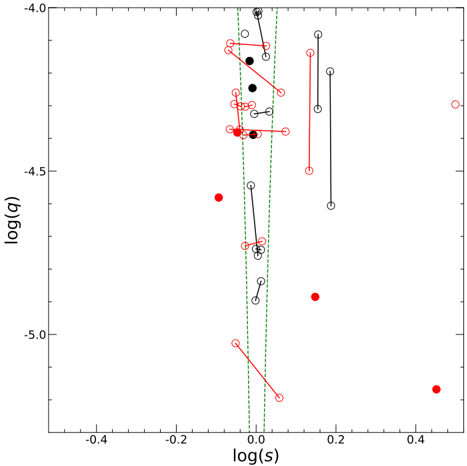
### Visual Description
## Scatter Plot: Logarithmic Relationships between q and s
### Overview
The image is a scatter plot displaying the relationship between log(q) on the y-axis and log(s) on the x-axis. The plot includes data points represented by red filled circles, black filled circles, and open circles (both red and black). Some data points are connected by lines, either red or black, indicating a relationship or transition between those points. Two vertical dashed green lines are present, possibly indicating a region of interest or a threshold.
### Components/Axes
* **X-axis:** log(s), with scale markers at -0.4, -0.2, 0.0, 0.2, and 0.4.
* **Y-axis:** log(q), with scale markers at -4.0, -4.5, and -5.0.
* **Data Points:**
* Red filled circles: Represent one set of data points.
* Black filled circles: Represent another set of data points.
* Open circles (red and black): Represent additional data points, some connected by lines.
* **Lines:** Red and black lines connect pairs of data points.
* **Vertical Dashed Lines:** Two parallel vertical dashed green lines are positioned near log(s) = 0.0.
### Detailed Analysis
* **Data Point Distribution:**
* Most data points are clustered between log(s) values of -0.2 and 0.2.
* A few red filled circles are located at log(s) values of approximately 0.2 and 0.4.
* The log(q) values range from approximately -4.0 to -5.2.
* **Connected Data Points:**
* Several pairs of data points are connected by black lines, primarily within the log(s) range of -0.1 to 0.1.
* Several pairs of data points are connected by red lines, also primarily within the log(s) range of -0.1 to 0.1, but some extend to higher log(s) values.
* **Vertical Dashed Lines:**
* The dashed green lines are located at approximately log(s) = -0.03 and log(s) = 0.03.
### Key Observations
* There is a concentration of data points and connecting lines near log(s) = 0.
* The red filled circles appear to be more scattered compared to the other data points.
* The connecting lines suggest a relationship or transition between specific data points.
### Interpretation
The scatter plot visualizes the relationship between log(q) and log(s). The clustering of data points near log(s) = 0 suggests a significant interaction or phenomenon occurring in that region. The red filled circles, being more scattered, might represent outliers or a different type of behavior compared to the other data points. The connecting lines likely indicate a change or transition in the system being studied, with the color of the line possibly indicating the type or direction of the change. The vertical dashed lines could represent a critical region or threshold for the log(s) value. Without further context, it's difficult to determine the exact meaning of q and s, but the plot suggests a complex relationship with notable behavior around log(s) = 0.
</details>
in the KMTNet data. Zhu et al. (2014) predicted that ∼ 50% of the KMTNet q < 10 -4 planets should be detected by caustics outside of the near-resonant (Dominik 1999; Yee et al. 2021) range. Below we follow the definitions of Zang et al. (2021b) and refer to caustics inside and outside of the near-resonant range as near-resonant caustics and pureplanetary caustics. Contrary to the prediction of Zhu et al. (2014), before the application of AnomalyFinder only two of ten q < 10 -4 KMTNet planets were detected by pureplanetary caustics. The two cases are OGLE-2017-BLG0173Lb (Hwang et al. 2018a) and KMT-2016-BLG-0212Lb (Hwang et al. 2018b). Hence, it is necessary to check the caustic types for the planetary sample of AnomalyFinder.
Figure 14 shows the log q versus log s plot for the 27 planets. The red and black points represent planets that were first discovered using AnomalyFinder and by-eye searches, respectively. The two green dashed lines indicate the boundaries for the near-resonant range. A striking feature is that in constrast to the locations of the by-eye planets, of the
15 AnomalyFinder planets 11 have pure-planetary caustics, two have both pure-planetary and near-resonant caustics, and only two are fully located inside the near-resonant range. In total, at least 13 planets were detected by pure-planetary caustics. Thus, the caustic types of the AnomalyFinder planetary sample agree with the expectation of Zhu et al. (2014), and the missing planetary caustics problem has been solved by the systematic planetary anomaly search.
## 6.2. Caustic Crossing and Anomaly Type
Zhu et al. (2014) predicted that about half of the KMTNet planets will be detected by caustic-crossing anomalies. Jung et al. (2022) found that 16/33 of 2018 KMTNet AnomalyFinder planets have caustic-crossing anomalies. As shown in Table 14, 14/27 of the q < 10 -4 planets have causticcrossing anomalies, in good agreement with the expectation of Zhu et al. (2014). Thus, the ∼ 50% probability of causticcrossing anomalies is likely applicable down to q ∼ 10 -5 .
Zang et al. (2021b) and Hwang et al. (2022) applied the AnomalyFinder algorithm to 2018-2019 KMTNet primefield events and found seven newly discovered q < 2 × 10 -4 planets. Among them, only OGLE-2019-BLG-1053Lb has a bump-type anomaly and the other six planets were detected by dip-type anomalies. Thus, it is necessary to check whether dip-type anomalies dominate the detection of lowq planets. As presented in Table 14, the ratio of bump-type to dip-type anomalies for the q < 10 -4 planets is 15 to 12, so the two types of anomalies play roughly equal roles in the lowq detection. However, of the 12 dip-type anomalies, nine were solely detected by AnomalyFinder, including eight non-caustic-crossing anomalies. KMT-2018-BLG1988 (Han et al. 2022a) is the only case that the anomaly is a non-caustic-crossing dip and was first discovered from byeye searches. Unlike the dip-type anomalies, the four noncaustic-crossing bumps were all first noticed from by-eye searches. Hence, by-eye searches have proved to be quite insensitive to non-caustic-crossing dip-type anomalies for lowq planets.
## 6.3. A Desert of High-magnification Planetary Signals
Zang et al. (2021b) suggested that the missing planetary caustics problem was caused by the way that modelers searched for planetary signatures. Because highmagnification events are intrinsically more sensitive to planets (Griest & Safizadeh 1998), by-eye searches paid more attention to them, while pure-planetary caustics are mainly detected in low-magnification events. If this hypothesis is correct, we expect that by-eye planets and AnomalyFinder planets will have different | u 0 | and | u anom | distributions. The log | u anom | versus log | u 0 | distribution of Figure 15 confirms our expectation. Except for the two planets that were detected by pure-planetary caustics, all the other by-eye planets, which are located inside the near-resonant range, were
Figure 15. log | u anom | vs. log | u 0 | distribution for the 27 planetary events with q < 10 -4 shown in Table 14. Colors are the same as the colors of Figure 14. Circles and triangles represent prime-field and sub-prime-field planets, respectively. The grey dashed line indicates | u 0 | = | u anom | .
<details>
<summary>Image 15 Details</summary>
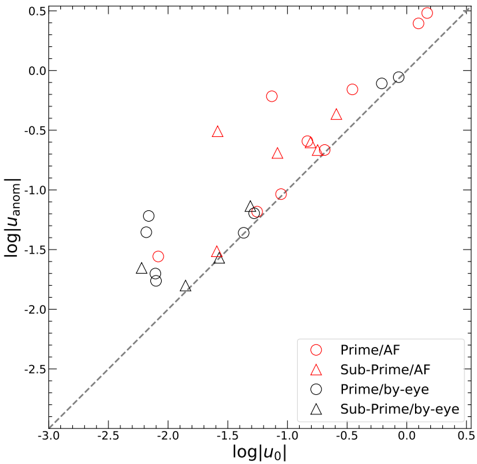
### Visual Description
## Scatter Plot: Log-Log Comparison of Anomaly and Initial Values
### Overview
The image is a scatter plot comparing the logarithm of the absolute value of an anomaly (log|u_anom|) against the logarithm of the absolute value of an initial value (log|u_0|). The plot displays four distinct data series, each represented by a different marker and color, corresponding to different experimental conditions: Prime/AF (red circles), Sub-Prime/AF (red triangles), Prime/by-eye (black circles), and Sub-Prime/by-eye (black triangles). A dashed gray line represents the identity line (y=x).
### Components/Axes
* **X-axis:** log|u_0| (logarithm of the absolute value of the initial value). Scale ranges from approximately -3.0 to 0.5, with tick marks at intervals of 0.5.
* **Y-axis:** log|u_anom| (logarithm of the absolute value of the anomaly). Scale ranges from approximately -3.0 to 0.5, with tick marks at intervals of 0.5.
* **Legend:** Located in the bottom-right corner, the legend identifies the four data series:
* Red circles: Prime/AF
* Red triangles: Sub-Prime/AF
* Black circles: Prime/by-eye
* Black triangles: Sub-Prime/by-eye
* **Identity Line:** A dashed gray line runs diagonally across the plot, representing the line y = x.
### Detailed Analysis
**1. Prime/AF (Red Circles):**
* Trend: The data points are scattered above the identity line.
* Data Points:
* (-1.0, -0.6)
* (-0.7, -0.6)
* (-0.5, -0.2)
* (-1.2, -0.7)
* (-1.5, -0.4)
* (-2.0, -1.5)
**2. Sub-Prime/AF (Red Triangles):**
* Trend: The data points are scattered around the identity line.
* Data Points:
* (-1.5, -1.5)
* (-1.7, -1.0)
* (-1.0, -0.8)
* (-0.8, -0.6)
* (-2.0, -1.6)
* (-0.2, 0.5)
**3. Prime/by-eye (Black Circles):**
* Trend: The data points are clustered below the identity line.
* Data Points:
* (-2.5, -1.3)
* (-2.3, -1.3)
* (-1.3, -1.2)
* (-1.0, -1.0)
* (-0.5, -0.1)
* (0.2, 0.0)
**4. Sub-Prime/by-eye (Black Triangles):**
* Trend: The data points are clustered near the identity line at lower values.
* Data Points:
* (-2.3, -1.7)
* (-1.7, -1.6)
* (-1.5, -1.5)
* (-1.2, -1.0)
### Key Observations
* The "Prime/AF" data series (red circles) generally exhibits higher anomaly values compared to the other series for a given initial value.
* The "Prime/by-eye" data series (black circles) generally exhibits lower anomaly values compared to the other series for a given initial value.
* The "Sub-Prime/AF" (red triangles) and "Sub-Prime/by-eye" (black triangles) data series are more closely aligned with the identity line, especially at lower values of log|u_0|.
* There is a noticeable clustering of "Prime/by-eye" data points (black circles) at the lower end of the anomaly values.
### Interpretation
The scatter plot visualizes the relationship between initial values and anomalies under different experimental conditions (Prime/Sub-Prime and AF/by-eye). The position of the data points relative to the identity line (y=x) indicates whether the anomaly is greater than, equal to, or less than the initial value (in log scale).
The "Prime/AF" condition tends to produce higher anomalies compared to the initial values, suggesting a greater sensitivity or amplification of the initial state. Conversely, the "Prime/by-eye" condition tends to result in lower anomalies, indicating a dampening or stabilization effect. The "Sub-Prime" conditions, regardless of "AF" or "by-eye", appear to have a more balanced relationship between initial values and anomalies, especially at lower initial values.
The clustering of "Prime/by-eye" data points at lower anomaly values might indicate a stable or predictable behavior under these specific conditions. The spread of "Prime/AF" data points above the identity line suggests a more variable and potentially less predictable response.
</details>
detected with | u 0 | 0 . 05 and | u anom | 0 . 07 . The roughly one-dex gap of the by-eye planets, at 0 . 05 | u 0 | 0 . 62 and 0 . 07 | u anom | 0 . 78 , is filled by the AnomalyFinder planets 3 .
However, there is no planet located at the left lower corner of Figure 15, with | u 0 , limit | = 0 . 0060 and | u anom , limit | = 0 . 0158 . Although six of the planets were detected in highmagnification events ( | u 0 | < 0 . 01 ), all the planetary signals occurred on the low- and median-magnification regions. This desert of high-magnification planetary signals could be caused by the insufficient observing cadences of the current KMTNet survey. High-magnification planetary signals for q < 10 -4 events are weak and thus require dense observations over the peak. There are three known q < 10 -4 events whose planetary signals occurred on the high-magnification regions ( | u anom | < 0 . 01 ). They are OGLE-2005-BLG-169 with u anom = 0 . 0012 (Gould et al. 2006), KMT-2021-BLG0171 with | u anom | = 0 . 0066 (Yang et al. 2022), and KMT2022-BLG-0440 with | u anom | = 0 . 0041 (Zhang et al. in
3 Although it might seem that the correlation could be with anomaly brightness rather than | u 0 | (because smaller | u 0 | implies a more highly magnified event), Jung et al. (2022) showed that there is no correlation with event brightness at the time of the anomaly between by-eye vs. AnomalyFinder detections. On the other hand, Hwang et al. (2022) and Zang et al. (2022a) have shown that AnomalyFinder is much better at finding anomalies with smaller ∆ χ 2 .
prep). The follow-up data played decisive roles in these detections and the combined cadences of survey and follow-up data are higher than 30 hr -1 , while the highest cadence of the current KMTNet survey is 8 hr -1 for about 0.4 deg 2 from the overlap of two Γ = 4 hr -1 fields.
However, we note that AnomalyFinder used the KMTNet end-of-year pipeline light curves, for which the photometric quality is not as good as that of TLC re-reductions. For the three follow-up planets, the planetary signals only have ∆ I < 0 . 05 mag. Thus, TLC re-reductions may be needed to recover such weak signals in the KMTNet data, and we cannot rule out the possibility that the desert may also be due to the imperfect KMTNet photometric quality. Each year there are about 20 events with | u 0 | < 0 . 01 observed by KMTNet with Γ ≥ 4 hr -1 . The current KMTNet quasi-automated TLC re-reductions pipeline takes < 1 hr of human effort for each event (H. Yang et al. in prep), so an optimized systematic search for q < 10 -4 planets in the KMTNet highmagnification events can be done very quickly. This search could have important implications for future space-based microlensing projects, because their tentative cadences are similar to or lower than Γ = 4 hr -1 (Penny et al. 2019; Ge et al. 2022; Yan & Zhu 2022). If this search demonstrates that high-magnification events need denser observations to capture the weak planetary signals for lowq planets, one could consider conducting (if feasible) ground-based followup projects for high-magnification events that are discovered by space-based telescopes. We also note that for the 2018 AnomalyFinder planets (Gould et al. 2022; Jung et al. 2022) and 2019 prime-field AnomalyFinder planets (Zang et al. 2022a), which are complete now, only one q > 10 -4 planet, KMT-2019-BLG-1953Lb, has | u anom | < | u anom , limit | . Future analysis of all the 2016-2019 KMTNet should check whether the desert is obvious for more massive planets.
## 6.4. Prime and sub-Prime Fields
In its 2015 commissioning season, KMTNet observed four fields at a cadence of Γ = 6 hr -1 . To support the 2016-2019 Spitzer microlensing campaign (Gould et al. 2013, 2014a, 2015a,b, 2016, 2018) and find more planets, KMTNet monitored a wider area, with a total of (3, 7, 11, 3) fields at cadences of Γ ∼ (4 , 1 , 0 . 4 , 0 . 2) hr -1 . The three fields with the highest cadence are the KMTNet prime fields and the other 21 are the KMTNet sub-prime fields. See Figure 12 of Kim et al. (2018a) for the field placement. As shown in Table 14 and Figure 15, the prime fields played the main role in the detection of q < 10 -4 planets, as predicted by Henderson et al. (2014), and 17 of 27 planets were detected therein. However, the sub-prime fields are also important and six of the ten lowestq planets were discovered therein.
For the six planets with | u 0 | < 0 . 01 , there is a clear bias in cadences, and only one of them was detected from the sub-
prime fields. For the prime and sub-prime fields, the current detection rates are 1.25 and 0.25 per year, respectively. Because ∼ 60% of the KMTNet microlensing events are located in the sub-prime fields, if the sub-prime-field events with | u 0 | < 0 . 01 can had the same cadence as the prime-field events from follow-up observations, each year there would be (1 . 25 × (60% / 40%) -0 . 25) = 1 . 6 more q < 10 -4 planets. Because follow-up observations can have higher cadences and capture the high-magnification planetary signals (e.g., Yang et al. 2022), the yield of a follow-up project can be at least two q < 10 -4 planets per year. The reward is not only enlarging the lowq planetary sample, but also an independent check of the statistical results from AnomalyFinder if the follow-up planets can form a homogeneous statistical sample (Gould et al. 2010). However, this reward requires that the KMTNet alert-finder system should alert new events before they reach the high-magnification regions (e.g., A > 20 ).
We appreciate the anonymous referee for helping to improve the paper. W.Zang, H.Y., S.M., J.Z., and W.Zhu acknowledge support by the National Science Foundation of China (Grant No. 12133005). W.Zang acknowledges the support from the Harvard-Smithsonian Center for Astrophysics through the CfA Fellowship. This research was supported by the Korea Astronomy and Space Science Institute under the R&D program (Project No. 2022-1-830-04) supervised by the Ministry of Science and ICT. This research has made use of the KMTNet system operated by the Korea Astronomy and Space Science Institute (KASI) and the data were obtained at three host sites of CTIO in Chile, SAAO in South Africa, and SSO in Australia. The authors acknowledge the Tsinghua Astrophysics High-Performance Computing platform at Tsinghua University for providing computational and data storage resources that have contributed to the research results reported within this paper. Work by J.C.Y. acknowledges support from N.S.F Grant No. AST2108414. Work by C.H. was supported by the grants of National Research Foundation of Korea (2019R1A2C2085965 and 2020R1A4A2002885). Y.S. acknowledges support from BSF Grant No. 2020740. W.Zhu acknowledges the science research grants from the China Manned Space Project with No. CMS-CSST-2021-A11. This research uses data obtained through the Telescope Access Program (TAP), which has been funded by the TAP member institutes. This research is supported by Tsinghua University Initiative Scientific Research Program (Program ID 2019Z07L02017). This research has made use of the NASA Exoplanet Archive, which is operated by the California Institute of Technology, under contract with the National Aeronautics and Space Administration under the Exoplanet Exploration Program.
## REFERENCES
- Adams, A. D., Boyajian, T. S., & von Braun, K. 2018, MNRAS, 473, 3608, doi: 10.1093/mnras/stx2367
- Bond, I. A., Bennett, D. P., Sumi, T., et al. 2017, MNRAS, 469, 2434, doi: 10.1093/mnras/stx1049
Alard, C., & Lupton, R. H. 1998, ApJ, 503, 325, doi: 10.1086/305984
- Albrow, M. D. 2017, Michaeldalbrow/Pydia: Initial Release On Github., v1.0.0, Zenodo, doi: 10.5281/zenodo.268049
- Albrow, M. D., Horne, K., Bramich, D. M., et al. 2009, MNRAS, 397, 2099, doi: 10.1111/j.1365-2966.2009.15098.x
- An, J. H., Albrow, M. D., Beaulieu, J.-P., et al. 2002, ApJ, 572, 521, doi: 10.1086/340191
- Batista, V., Gould, A., Dieters, S., et al. 2011, A&A, 529, A102, doi: 10.1051/0004-6361/201016111
- Beaulieu, J.-P., Bennett, D. P., Fouqu´ e, P., et al. 2006, Nature, 439, 437, doi: 10.1038/nature04441
- Bennett, D. P., Bond, I. A., Udalski, A., et al. 2008, ApJ, 684, 663, doi: 10.1086/589940
- Bensby, T., Yee, J. C., Feltzing, S., et al. 2013, A&A, 549, A147, doi: 10.1051/0004-6361/201220678
- Bhattacharya, A., Beaulieu, J. P., Bennett, D. P., et al. 2018, AJ, 156, 289, doi: 10.3847/1538-3881/aaed46
- Bond, I. A., Udalski, A., Jaroszy´ nski, M., et al. 2004, ApJL, 606, L155, doi: 10.1086/420928
Bozza, V. 2010, MNRAS, 408, 2188,
- doi: 10.1111/j.1365-2966.2010.17265.x
- Bozza, V., Bachelet, E., Bartoli´ c, F., et al. 2018, MNRAS, 479, 5157, doi: 10.1093/mnras/sty1791
Dominik, M. 1999, A&A, 349, 108
- Dong, S., Gould, A., Udalski, A., et al. 2009, ApJ, 695, 970, doi: 10.1088/0004-637X/695/2/970
- Foreman-Mackey, D., Hogg, D. W., Lang, D., & Goodman, J. 2013, PASP, 125, 306, doi: 10.1086/670067
Gaudi, B. S. 1998, ApJ, 506, 533, doi: 10.1086/306256
- Gaudi, B. S., & Gould, A. 1997, ApJ, 486, 85, doi: 10.1086/304491 Ge, J., Zhang, H., Zang, W., et al. 2022, arXiv e-prints, arXiv:2206.06693. https://arxiv.org/abs/2206.06693
- Gonzalez, O. A., Rejkuba, M., Zoccali, M., et al. 2012, A&A, 543, A13, doi: 10.1051/0004-6361/201219222
- Gould, A. 1992, ApJ, 392, 442, doi: 10.1086/171443
- -. 1996, ApJ, 470, 201, doi: 10.1086/177861
- -. 2000, ApJ, 542, 785, doi: 10.1086/317037
- -. 2004, ApJ, 606, 319, doi: 10.1086/382782
- Gould, A., Carey, S., & Yee, J. 2013, Spitzer Microlens Planets and Parallaxes, Spitzer Proposal
- -. 2014a, Galactic Distribution of Planets from Spitzer Microlens Parallaxes, Spitzer Proposal
- -. 2016, Galactic Distribution of Planets Spitzer Microlens Parallaxes, Spitzer Proposal
- Gould, A., & Loeb, A. 1992, ApJ, 396, 104, doi: 10.1086/171700
- Gould, A., Yee, J., & Carey, S. 2015a, Degeneracy Breaking for K2 Microlens Parallaxes, Spitzer Proposal
- -. 2015b, Galactic Distribution of Planets From High-Magnification Microlensing Events, Spitzer Proposal
- Gould, A., Yee, J., Carey, S., & Shvartzvald, Y. 2018, The Galactic Distribution of Planets via Spitzer Microlensing Parallax, Spitzer Proposal
- Gould, A., Udalski, A., An, D., et al. 2006, ApJL, 644, L37, doi: 10.1086/505421
- Gould, A., Dong, S., Gaudi, B. S., et al. 2010, ApJ, 720, 1073, doi: 10.1088/0004-637X/720/2/1073
- Gould, A., Udalski, A., Shin, I. G., et al. 2014b, Science, 345, 46, doi: 10.1126/science.1251527
- Gould, A., Ryu, Y.-H., Calchi Novati, S., et al. 2020, Journal of Korean Astronomical Society, 53, 9.
https://arxiv.org/abs/1906.11183
- Gould, A., Han, C., Zang, W., et al. 2022, A&A, 664, A13, doi: 10.1051/0004-6361/202243744
- Griest, K., & Safizadeh, N. 1998, ApJ, 500, 37, doi: 10.1086/305729
- Han, C., Udalski, A., Lee, C.-U., et al. 2021, A&A, 649, A90, doi: 10.1051/0004-6361/202039817
- Han, C., Gould, A., Albrow, M. D., et al. 2022a, A&A, 658, A62, doi: 10.1051/0004-6361/202142077
- Han, C., Kim, D., Gould, A., et al. 2022b, A&A, 664, A33, doi: 10.1051/0004-6361/202243484
- Hayashi, C. 1981, in Fundamental Problems in the Theory of Stellar Evolution, ed. D. Sugimoto, D. Q. Lamb, & D. N. Schramm, Vol. 93, 113-126
- Henderson, C. B., Gaudi, B. S., Han, C., et al. 2014, ApJ, 794, 52, doi: 10.1088/0004-637X/794/1/52
- Holtzman, J. A., Watson, A. M., Baum, W. A., et al. 1998, AJ, 115, 1946, doi: 10.1086/300336
- Hwang, K.-H., Choi, J.-Y., Bond, I. A., et al. 2013, ApJ, 778, 55, doi: 10.1088/0004-637X/778/1/55
- Hwang, K.-H., Udalski, A., Shvartzvald, Y., et al. 2018a, AJ, 155, 20, doi: 10.3847/1538-3881/aa992f
- Hwang, K. H., Kim, H. W., Kim, D. J., et al. 2018b, Journal of Korean Astronomical Society, 51, 197, doi: 10.5303/JKAS.2018.51.6.197
- Hwang, K.-H., Zang, W., Gould, A., et al. 2022, AJ, 163, 43, doi: 10.3847/1538-3881/ac38ad
- Ishitani Silva, S., Ranc, C., Bennett, D. P., et al. 2022, AJ, 164, 118, doi: 10.3847/1538-3881/ac82b8
- Jiang, G., DePoy, D. L., Gal-Yam, A., et al. 2004, ApJ, 617, 1307, doi: 10.1086/425678
- Jung, Y. K., Udalski, A., Yee, J. C., et al. 2017, AJ, 153, 129, doi: 10.3847/1538-3881/aa5d07
- Jung, Y. K., Udalski, A., Zang, W., et al. 2020, AJ, 160, 255, doi: 10.3847/1538-3881/abbe93
- Jung, Y. K., Zang, W., Han, C., et al. 2022, AJ, 164, 262, doi: 10.3847/1538-3881/ac9c5c
- Kennedy, G. M., & Kenyon, S. J. 2008, ApJ, 673, 502, doi: 10.1086/524130
- Kim, D.-J., Kim, H.-W., Hwang, K.-H., et al. 2018a, AJ, 155, 76, doi: 10.3847/1538-3881/aaa47b
- Kim, H.-W., Hwang, K.-H., Shvartzvald, Y., et al. 2018b, arXiv e-prints, arXiv:1806.07545. https://arxiv.org/abs/1806.07545
- Kim, S.-L., Lee, C.-U., Park, B.-G., et al. 2016, Journal of Korean Astronomical Society, 49, 37, doi: 10.5303/JKAS.2016.49.1.037
- Kondo, I., Yee, J. C., Bennett, D. P., et al. 2021, AJ, 162, 77, doi: 10.3847/1538-3881/ac00ba
- Mao, S., & Paczynski, B. 1991, ApJL, 374, L37, doi: 10.1086/186066
- Min, M., Dullemond, C. P., Kama, M., & Dominik, C. 2011, Icarus, 212, 416, doi: 10.1016/j.icarus.2010.12.002
- Muraki, Y., Han, C., Bennett, D. P., et al. 2011, ApJ, 741, 22, doi: 10.1088/0004-637X/741/1/22
- Nataf, D. M., Gould, A., Fouqu´ e, P., et al. 2013, ApJ, 769, 88, doi: 10.1088/0004-637X/769/2/88
- Nataf, D. M., Gonzalez, O. A., Casagrande, L., et al. 2016, MNRAS, 456, 2692, doi: 10.1093/mnras/stv2843
- Paczy´ nski, B. 1986, ApJ, 304, 1, doi: 10.1086/164140
- Penny, M. T., Gaudi, B. S., Kerins, E., et al. 2019, ApJS, 241, 3, doi: 10.3847/1538-4365/aafb69
- Poindexter, S., Afonso, C., Bennett, D. P., et al. 2005, ApJ, 633, 914, doi: 10.1086/468182
- Ranc, C., Bennett, D. P., Hirao, Y., et al. 2019, AJ, 157, 232, doi: 10.3847/1538-3881/ab141b
- Rota, P., Hirao, Y., Bozza, V., et al. 2021, AJ, 162, 59, doi: 10.3847/1538-3881/ac0155
- Ryu, Y.-H., Udalski, A., Yee, J. C., et al. 2020, AJ, 160, 183, doi: 10.3847/1538-3881/abaa3f
- Ryu, Y.-H., Kil Jung, Y., Yang, H., et al. 2022, AJ, 164, 180, doi: 10.3847/1538-3881/ac8d6c
- Sako, T., Sekiguchi, T., Sasaki, M., et al. 2008, Experimental Astronomy, 22, 51, doi: 10.1007/s10686-007-9082-5
- Shvartzvald, Y., Yee, J. C., Calchi Novati, S., et al. 2017, ApJL, 840, L3, doi: 10.3847/2041-8213/aa6d09
- Skowron, J., Udalski, A., Gould, A., et al. 2011, ApJ, 738, 87, doi: 10.1088/0004-637X/738/1/87
- Sumi, T., Bennett, D. P., Bond, I. A., et al. 2010, ApJ, 710, 1641, doi: 10.1088/0004-637X/710/2/1641
- Suzuki, D., Bennett, D. P., Sumi, T., et al. 2016, ApJ, 833, 145, doi: 10.3847/1538-4357/833/2/145
- Szyma´ nski, M. K., Udalski, A., Soszy´ nski, I., et al. 2011, AcA, 61, 83. https://arxiv.org/abs/1107.4008
- Tomaney, A. B., & Crotts, A. P. S. 1996, AJ, 112, 2872, doi: 10.1086/118228
- Udalski, A. 2003, AcA, 53, 291
Udalski, A., Szymanski, M., Kaluzny, J., et al. 1994, AcA, 44, 227
- Udalski, A., Szyma´ nski, M. K., & Szyma´ nski, G. 2015, AcA, 65, 1. https://arxiv.org/abs/1504.05966
- Udalski, A., Ryu, Y.-H., Sajadian, S., et al. 2018, AcA, 68, 1. https://arxiv.org/abs/1802.02582
- Wang, H., Zang, W., Zhu, W., et al. 2022, MNRAS, 510, 1778, doi: 10.1093/mnras/stab3581
- Wang, T., Calchi Novati, S., Udalski, A., et al. 2018, ApJ, 860, 25, doi: 10.3847/1538-4357/aabcd2
- Wozniak, P. R. 2000, AcA, 50, 421
- Yan, S., & Zhu, W. 2022, Research in Astronomy and Astrophysics, 22, 025006, doi: 10.1088/1674-4527/ac3c44
- Yang, H., Zang, W., Gould, A., et al. 2022, MNRAS, 516, 1894, doi: 10.1093/mnras/stac2023
- Yee, J. C., Zang, W., Udalski, A., et al. 2021, AJ, 162, 180, doi: 10.3847/1538-3881/ac1582
- Yoo, J., DePoy, D. L., Gal-Yam, A., et al. 2004, ApJ, 603, 139, doi: 10.1086/381241
- Zang, W., Han, C., Kondo, I., et al. 2021a, Research in Astronomy and Astrophysics, 21, 239, doi: 10.1088/1674-4527/21/9/239
- Zang, W., Hwang, K.-H., Udalski, A., et al. 2021b, AJ, 162, 163, doi: 10.3847/1538-3881/ac12d4
- Zang, W., Yang, H., Han, C., et al. 2022a, MNRAS, 515, 928, doi: 10.1093/mnras/stac1883
- Zang, W., Shvartzvald, Y., Udalski, A., et al. 2022b, MNRAS, 514, 5952, doi: 10.1093/mnras/stac1631
- Zhang, K., & Gaudi, B. S. 2022, ApJL, 936, L22, doi: 10.3847/2041-8213/ac8c2b
- Zhang, K., Gaudi, B. S., & Bloom, J. S. 2022, Nature Astronomy, 6, 782, doi: 10.1038/s41550-022-01671-6
- Zhu, W., Penny, M., Mao, S., Gould, A., & Gendron, R. 2014, ApJ, 788, 73, doi: 10.1088/0004-637X/788/1/73
- Zhu, W., Udalski, A., Calchi Novati, S., et al. 2017, AJ, 154, 210, doi: 10.3847/1538-3881/aa8ef1
Table 14 . Information of 2016-2019 KMTNet AnomalyFinder planetary sample with q < 10 -4 solutions
| Event Name | KMTNet Name | log q | s | | u 0 | | Method | ∆ χ 2 | Caustic-Crossing | Anomaly Type | Field |
|--------------|---------------|------------------------------|-------------------|---------------------|-----------|---------|--------------------|----------------|-----------|
| KB161105 1 | KB161105 | - 5 . 194 ± 0 . 248 | 1 . 143 ± 0 . 009 | 0.171 | Discovery | 0.0 | yes | bump | sub-prime |
| | | - 4 . 423 ± 0 . 197 | 1 . 136 ± 0 . 011 | 0.153 | | 2.3 | yes | | |
| | | - 4 . 184 ± 0 . 206 | 1 . 106 ± 0 . 013 | 0.154 | | 2.7 | no | | |
| | | - 5 . 027 ± 0 . 080 | 0 . 888 ± 0 . 007 | 0.148 | | 3.5 | no | | |
| | | - 4 . 069 ± 0 . 182 | 0 . 892 ± 0 . 005 | 0.154 | | 4.4 | yes | | |
| OB160007 2 | KB161991 | - 5 . 168 ± 0 . 131 | 2 . 829 ± 0 . 009 | 1.253 | Discovery | | yes | bump | prime |
| OB191053 3 | KB191504 | - 4 . 885 ± 0 . 035 | 1 . 406 ± 0 . 011 | 0.373 | Discovery | | yes | bump | prime |
| OB190960 4 | KB191591 | - 4 . 830 ± 0 . 041 | 1 . 029 ± 0 . 001 | 0.0061 | Recovery | 0.0 | yes | bump | sub-prime |
| | | - 4 . 896 ± 0 . 024 | 0 . 997 ± 0 . 001 | 0.0060 | | 1.0 | yes | | |
| | | - 4 . 896 ± 0 . 024 | 0 . 996 ± 0 . 001 | 0.0059 | | 1.9 | yes | | |
| | | - 4 . 845 ± 0 . 043 | 1 . 028 ± 0 . 001 | 0.0061 | | 2.1 | yes | | |
| KB180029 5 | KB180029 | - 4 . 737 ± 0 . 047 | 0 . 999 ± 0 . 002 | 0.027 | Recovery | 0.0 | yes | bump | sub-prime |
| | | - 4 . 746 ± 0 . 050 | 1 . 028 ± 0 . 002 | 0.027 | | 0.2 | yes | | |
| | | - 4 . 740 ± 0 . 045 | 0 . 999 ± 0 . 002 | 0.027 | | 2.1 | yes | | |
| | | - 4 . 736 ± 0 . 050 | 1 . 028 ± 0 . 002 | 0.027 | | 2.2 | yes | | |
| KB191806 1 | KB191806 | - 4 . 714 ± 0 . 116 | 1 . 035 ± 0 . 009 | 0.0255 | Discovery | 0.0 | no | dip | sub-prime |
| | | - 4 . 717 ± 0 . 117 | 1 . 034 ± 0 . 009 | 0.0257 | | 0.4 | no | | |
| | | - 4 . 724 ± 0 . 117 | 0 . 938 ± 0 . 007 | 0.0260 | | 0.7 | no | | |
| | | - 4 . 734 ± 0 . 109 | 0 . 938 ± 0 . 007 | 0.0251 | | 1.1 | no | | |
| OB170173 6 | KB171707 | - 4 . 606 ± 0 . 042 | 1 . 540 ± 0 . 031 | 0.867 | Recovery | 0.0 | yes | bump | prime |
| | | - 4 . 195 ± 0 . 068 | 1 . 532 ± 0 . 025 | 0.844 | | 3.5 | yes | | |
| KB171194 1 | KB171194 | - 4 . 582 ± 0 . 058 | 0 . 806 ± 0 . 010 | 0.256 | Discovery | | no | dip | sub-prime |
| | | - 4 . 759 +0 . 698 - 0 . 618 | | | | | | | |
| | | - 0 . 168 | 1 . 01 ± 0 . 05 | 0.014 | | 0.1 | no | | |
| KB190842 8 | KB190842 | - 4 . 389 ± 0 . 031 | 0 . 983 ± 0 . 013 | 0.0066 | Recovery | | no | bump | prime |
| KB190253 9 | KB190253 | - 4 . 387 ± 0 . 076 | 1 . 009 ± 0 . 009 | 0.0559 | Discovery | 0.0 | no | dip | prime |
| | | - 4 . 390 ± 0 . 080 | 0 . 929 ± 0 . 007 | 0.0555 | | 0.3 | no | | |
| OB180977 9 | KB180728 | - 4 . 382 ± 0 . 045 | 0 . 897 ± 0 . 007 | 0.147 | Discovery | | yes | dip | prime |
| KB171003 1 | KB171003 | - 4 . 373 ± 0 . 144 | 0 . 910 ± 0 . 005 | 0.179 | Discovery | 0.0 | no | dip | sub-prime |
| | | - 4 . 260 ± 0 . 152 | 0 . 889 ± 0 . 004 | 0.179 | | 0.2 | no | | |
| OB171806 1 | KB171021 | - 4 . 352 ± 0 . 171 | 0 . 857 ± 0 . 008 | 0.026 | Discovery | 0.0 | yes | bump | sub-prime |
| | | - 4 . 392 ± 0 . 180 | 0 . 861 ± 0 . 007 | 0.025 | | 0.2 | yes | | |
| | | - 4 . 441 ± 0 . 168 | 1 . 181 ± 0 . 011 | 0.026 | | 8.3 | yes | | |
| | | - 4 . 317 ± 0 . 126 | 1 . 190 ± 0 . 012 | 0.027 | | 8.4 | yes | | |
| OB161195 10 | KB160372 | - 4 . 325 ± 0 . 037 | 0 . 989 ± 0 . 004 | 0.0526 | Recovery | 0.0 | no | bump | prime |
| | | - 4 . 318 ± 0 . 038 | 1 . 079 ± 0 . 004 | 0.0526 | | 0.1 | no | | |
| OB170448 2 | KB170090 | - 4 . 296 ± 0 . 149 | 3 . 157 ± 0 . 022 | 1.482 | Discovery | | yes | bump | prime |
| | | - 2 . 705 ± 0 . 045 | 0 . 431 ± 0 . 004 | 1.486 | | 5.8 | yes | | |
| | | - 3 . 969 ± 0 . 086 | 3 . 593 ± 0 . 045 | 1.611 | | 9.7 | yes | | |
| KB191367 1 | KB191367 | - 4 . 303 ± 0 . 118 | 0 . 939 ± 0 . 007 | 0.083 | Discovery | 0.0 | no | dip | sub-prime |
| | | - 4 . 298 ± 0 . 103 | 0 . 976 ± 0 . 007 | 0.082 | | 0.2 | no | | |
| KB170428 1 | KB170428 | - 4 . 295 ± 0 . 072 | 0 . 882 ± 0 . 004 | 0.205 | Discovery | 0.0 | no | dip | prime |
| | | - 4 . 302 ± 0 . 075 | 0 . 915 ± 0 . 005 | 0.205 | | 0.1 | no | | |
| OB171434 11 | KB170016 | - 4 . 242 ± 0 . 011 | 0 . 979 ± 0 . 001 | 0.043 | Recovery | 0.0 | yes | dip | prime |
| | | - 4 . 251 ± 0 . 012 | 0 . 979 ± 0 . 001 | 0.043 | | 4.0 | yes | | |
| OB181185 12 | KB181024 | - 4 . 163 ± 0 . 014 | 0 . 963 ± 0 . 001 | 0.0069 | Recovery | | no | bump | prime |
| OB181126 13 | KB182064 | - 4 . 130 ± 0 . 280 | 0 . 852 ± 0 . 040 | 0.0083 | Discovery | 0.0 | no | dip | prime |
|---------------|------------|-----------------------|---------------------|----------|-------------|-------|------|-------|-----------|
| | | - 4 . 260 ± 0 . 290 | 1 . 154 ± 0 . 052 | 0.0082 | | 2.1 | no | | |
| OB180506 9 | KB180835 | - 4 . 117 ± 0 . 133 | 1 . 059 ± 0 . 021 | 0.0884 | Discovery | 0 | no | dip | prime |
| | | - 4 . 109 ± 0 . 126 | 0 . 861 ± 0 . 018 | 0.0884 | | 0.4 | no | | |
| KB181025 14 | KB181025 | - 4 . 081 ± 0 . 141 | 0 . 937 ± 0 . 021 | 0.0071 | Recovery | 0 | no | bump | prime |
| | | - 3 . 789 ± 0 . 133 | 0 . 883 ± 0 . 025 | 0.0086 | | 8.4 | no | | |
| OB171691 15 | KB170752 | - 4 . 013 ± 0 . 152 | 1 . 003 ± 0 . 014 | 0.0495 | Recovery | 0 | yes | bump | sub-prime |
| | | - 4 . 150 ± 0 . 141 | 1 . 058 ± 0 . 011 | 0.0483 | | 0.4 | yes | | |
| OB180532 16 | KB181161 | - 4 . 011 ± 0 . 053 | 1 . 013 ± 0 . 001 | 0.0082 | Recovery | 0 | yes | dip | prime |
| | | - 4 . 033 ± 0 . 047 | 1 . 011 ± 0 . 001 | 0.0071 | | 2 | yes | | |
| | | - 3 . 926 ± 0 . 049 | 1 . 013 ± 0 . 001 | 0.0089 | | 4.6 | yes | | |
| | | - 4 . 016 ± 0 . 076 | 1 . 011 ± 0 . 001 | 0.0074 | | 5.4 | yes | | |
| KB160625 2 | KB160625 | - 3 . 628 ± 0 . 226 | 0 . 741 ± 0 . 009 | 0.073 | Discovery | 0 | yes | bump | prime |
| | | - 4 . 138 ± 0 . 159 | 1 . 367 ± 0 . 018 | 0.075 | | 1 | yes | | |
| | | - 3 . 746 ± 0 . 291 | 0 . 741 ± 0 . 009 | 0.072 | | 1 | yes | | |
| | | - 4 . 499 ± 0 . 266 | 1 . 358 ± 0 . 015 | 0.076 | | 3.3 | yes | | |
| KB160212 17 | KB160212 | - 1 . 434 ± 0 . 072 | 0 . 829 ± 0 . 007 | 0.328 | Recovery | 0 | yes | bump | prime |
| | | - 4 . 310 ± 0 . 070 | 1 . 427 ± 0 . 014 | 0.615 | | 6.6 | yes | | |
| | | - 4 . 315 ± 0 . 099 | 1 . 434 ± 0 . 012 | 0.619 | | 8 | yes | | |
| | | - 4 . 082 ± 0 . 080 | 1 . 430 ± 0 . 015 | 0.617 | | 8.7 | yes | | |
NOTE: For each planet, we only consider the models that have ∆ χ 2 < 10 compared to the best-fit model. 'Discovery' represents that the planet was discovered using AnomlyFinder, and 'Recovery' means that the planet was first discovered from by-eye searches and then recovered by AnomlyFinder.
Reference: 1. This work; 2. in prep; 3. Zang et al. (2021b); 4. Yee et al. (2021); 5. Gould et al. (2020), Zhang et al. in prep;
6. Hwang et al. (2018a); 7. Han et al. (2022a); 8. Jung et al. (2020); 9. Hwang et al. (2022); 10. Shvartzvald et al. (2017), Bond et al. (2017), Zhang et al. in prep; 11. Udalski et al. (2018); 12. Kondo et al. (2021); 13. Gould et al. (2022); 14. Han et al. (2021); 15. Han et al. (2022b); 16. Ryu et al. (2020); 17. Hwang et al. (2018b).