## End-to-End DNN Inference on a Massively Parallel Analog In Memory Computing Architecture
Nazareno Bruschi , Giuseppe Tagliavini , Angelo Garofalo , Francesco Conti
Irem Boybat , Luca Benini , Davide Rossi
∗ ∗ ∗† ∗ , ‡ ∗† ∗
University of Bologna , Bologna, Italy, ETH , Zurich, Switzerland
∗ † ‡ IBM Research , Zurich, Switzerland
Abstract -The demand for computation resources and energy efficiency of Convolutional Neural Networks (CNN) applications requires a new paradigm to overcome the 'Memory Wall'. Analog In-Memory Computing (AIMC) is a promising paradigm since it performs matrix-vector multiplications, the critical kernel of many ML applications, in-place in the analog domain within memory arrays structured as crossbars of memory cells. However, several factors limit the full exploitation of this technology, including the physical fabrication of the crossbar devices, which constrain the memory capacity of a single array. Multi-AIMC architectures have been proposed to overcome this limitation, but they have been demonstrated only for tiny and custom CNNs or performing some layers off-chip. In this work, we present the full inference of an end-to-end ResNet-18 DNN on a 512-cluster heterogeneous architecture coupling a mix of AIMC cores and digital RISCV cores, achieving up to 20.2 TOPS. Moreover, we analyze the mapping of the network on the available non-volatile cells, compare it with state-of-the-art models, and derive guidelines for next-generation many-core architectures based on AIMC devices.
Index Terms -In-Memory Computing, Heterogenous systems, many-core architectures, Convolutional Neural Networks
## I. INTRODUCTION
Matrix-Vector Multiplication (MVM) is the critical operation in modern Deep Neural Networks (DNN), and its optimization has been tackled from different perspectives, from software kernels to hardware accelerators. In recent years, Analog InMemory Computing (AIMC) has been a widely studied computing paradigm since it promises outstanding performance and energy efficiency on MVM operations [1]. However, the largescale usage of AIMC in commercial products is limited by technological issues, especially in fabricating large arrays. AIMC can be employed using very different memory technologies, which can be classified as volatile and non-volatile.
The former has a more mature community, especially for SRAM technology, due to its robustness and viability for largescale integration in any CMOS node. Several SRAM-based chips have been developed targeting any DNN requirements [2]. However, they generally require moving network parameters among large off-chip memories to be temporarily stored in the on-chip computational memory, negatively impacting energy consumption [3].
Non-volatile AIMC (nvAIMC) instead merges parameter storage with computational memory. In this way, parameters do not need to be transferred from onor off-chip storage through the memory hierarchy. However, the limited writing access speed [4] of nvIMC devices introduces the need for a static mapping strategy to preserve the performance capability of such devices. Moreover, a further challenge is the fabricable size of nvIMC devices, which de-facto is limited to 1024 × 1024 with up to 8-bit equivalent memory cells [4].
During the last few years, the fabrication of several prototypes exploiting these technologies [5]-[7] demonstrated the feasibility of the approach, despite several open challenges related to the intrinsic variability of analog computing, the need for specialized training to address analog noise and nonidealities. On the other hand, most of these works aimed at demonstrating the technology rather than targeting end-to-end inference of deep neural networks. One of the limitations of nvAIMC cores is their little flexibility due to the ability to implement only MVMs.
For this reason, few recent works [8]-[10] proposed the integration of nvAIMC cores into digital System-on-Chips (SoC), exploiting a mix of nvAIMC cores and more flexible specialized and programmable digital processors. Thanks to this mix, they demonstrated remarkable performance on the full inference of neural networks in the mobile domain, such as MobileNetV2, time multiplexing computations on several nvAIMC cores [9], [10]. Indeed, in the mobile domain, it is common that only one sample is processed at a time, relaxing the requirements of layer pipelining. This constraint significantly limits the potential of nvAIMC since only one core can be active at a given time.
This constraint can be relaxed when leaving the mobile domain: high-performance inference of DNNs typically exploits batching due to the large number of images typically processed in HPC and data centers applications. Several recent works exploited this feature proposing many-core data-flow architectures. On the other hand, most of these works made strong assumptions about the characteristics of the networks to be processed to better fit the shape of the DNN on the proposed architectures. For example, Dazzi et al. [11] targeted a relatively small ResNet-like network targeting the CIFAR10 dataset, while Shafiee et al. [12] and Ankit et al. [13] target VGG-like networks featuring no residual layers, nicely fitting mapping on pipelined data-flow architectures. However, DNNs generally feature data flow graph loops (e.g., residual layers) that make a straightforward pipelining implementation much more challenging. Moreover, most of these architectures only feature specialized accelerators for implementing digital functions such as ReLU, and MaxPool, somehow limiting the flexibility of their approach.
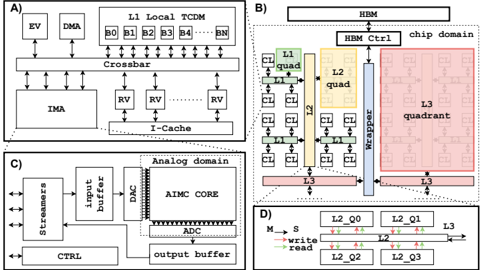
Fig. 1. A) Cluster architecture. B) Massively parallel system architecture. C) IMA subsystem. D) Router model.
<details>
<summary>Image 1 Details</summary>
### Visual Description
## Block Diagram: Computer Architecture Components
### Overview
The image presents four technical diagrams (A-D) illustrating components of a computer architecture system. Each section depicts distinct subsystems with labeled blocks, directional arrows, and color-coded regions.
### Components/Axes
**Section A (Top-Left):**
- **EV (Event Buffer)**, **DMA (Direct Memory Access)**, **Local TCDM (Tile Cache Data Memory)**, **Crossbar**, **IMA (Instruction Memory Array)**, **I-Cache**, and **RVs (Registers)**.
- Arrows indicate data flow between blocks (e.g., EV → DMA → Local TCDM → Crossbar → IMA/I-Cache → RVs).
- Labels: B0-BN (Local TCDM banks), "Crossbar" (central horizontal block).
**Section B (Top-Right):**
- **HBM (High Bandwidth Memory)**, **HBM Ctrl (Controller)**, **Chip Domain**, and **Quadrants (L1, L2, L3)**.
- Color-coded regions: L1 (green), L2 (yellow), L3 (pink), Chip Domain (blue).
- Vertical "Wrapper" connects L2 and L3 quadrants.
**Section C (Bottom-Left):**
- **Analog Domain** components: **Streamers**, **Input Buffer**, **DAC (Digital-to-Analog Converter)**, **AIMC Core (Analog Integrated Mixed-signal Core)**, **ADC (Analog-to-Digital Converter)**, **Output Buffer**, and **CTRL (Control Unit)**.
- Arrows show signal flow: Streamers → Input Buffer → DAC → AIMC Core → ADC → Output Buffer.
**Section D (Bottom-Right):**
- **Timing Diagram** with **L2_Q0-Q3** (memory banks) and **M→S (Memory to System)** line.
- Red arrows (write) and green arrows (read) indicate operations between L2 and L3.
### Detailed Analysis
**Section A:**
- Local TCDM (B0-BN) feeds into Crossbar, which distributes data to IMA and I-Cache.
- RVs (Registers) receive data from I-Cache, suggesting a cache-to-register pipeline.
**Section B:**
- HBM is connected to HBM Ctrl, which interfaces with the Chip Domain.
- Quadrants L1-L3 are spatially separated, with L3 spanning the entire width.
**Section C:**
- Analog Domain processes signals sequentially: digital inputs (Streamers) → analog conversion (DAC) → core processing (AIMC) → digital output (ADC).
**Section D:**
- Write operations (red) target L2_Q0-Q1, while read operations (green) access L2_Q2-Q3, indicating partitioned memory access.
### Key Observations
- **Color Coding:** Sections B and D use color to differentiate functional units (e.g., L1-L3 quadrants, write/read operations).
- **Flow Direction:** Arrows in A and C indicate unidirectional data flow, while D shows bidirectional memory access.
- **Hierarchical Structure:** Section B’s quadrants suggest a multi-level memory hierarchy.
### Interpretation
The diagrams collectively represent a **heterogeneous computing architecture**:
1. **Section A** illustrates a **data processing pipeline** with local caching (TCDM) and crossbar arbitration.
2. **Section B** depicts a **3D chip layout** with HBM integration and quadrant-based memory organization.
3. **Section C** highlights **analog-digital signal processing**, emphasizing mixed-signal integration.
4. **Section D** shows **memory timing protocols**, with partitioned access patterns for write/read operations.
The system appears optimized for **high-performance computing**, combining parallel data processing (Crossbar), hierarchical memory (HBM quadrants), and analog-digital co-design. The timing diagram (D) suggests optimized memory access strategies to reduce latency.
</details>
In this work, we tackle the problem from another perspective. We present a general-purpose system based on RISC-V cores for digital computations and nvAIMC cores for analogamenable operations, such as 2D convolutions. A scalable hierarchical network-on-chip interconnects the system to maximize on-chip bandwidth and reduce communication latency. We evaluate all the system inefficiencies, especially for the nonideal mappings and communication infrastructure bottleneck running a real-life network for state-of-the-art applications such as ResNet-18 inference on 256 × 256 image dataset. We perform an experimental assessment on an extended version of an opensource system-level simulator [14], resulting in up to 20.2 TOPS and 6.5 TOPS/W for the whole ResNet-18 inference of a batch of 16 256x256 images in 4.8 ms. The hardware and software described in this work are open-source, intending to support and boost an innovation ecosystem for next-generation computing platforms.
## II. MASSIVELY PARALLEL HETEROGENEOUS SYSTEM ARCHITECTURE
This section presents the proposed heterogeneous manycore SoC architecture. It consists of multiple heterogeneous (analog/digital) clusters communicating through a hierarchical AXI interconnect gathering data from a shared High-Bandwith Memory (HBM), as shown in Fig. 1B.
1) Cluster : The core of the proposed system architecture consists of heterogeneous analog/digital clusters (Fig. 1A). Each cluster contains a set of RISC-V cores (CORES) [15], a shared multi-bank scratchpad data memory (L1) enabling Single Program Multiple Data (SPMD) computations, a hardware synchronizer to accelerate common parallel programming primitives such as thread dispatching and barriers, and a DMA for the cluster to cluster and cluster to HBM communication. Each cluster also includes a nvAIMC Accelerator (IMA) sharing the same multi-banked memory as the CORES for efficient communication, similarly to the architecture presented in Garofalo et al. [9].
2) IMA : The IMA is built around a Phase-Change Memory (PCM) computational memory organised as a 2D array featuring horizontal word lines and vertical bit lines (Fig. 1C). In computational memory, the PCM cells are exploited as
TABLE I
## GVSOC ARCHITECTURE PARAMETERS
| Parameter | Value |
|---------------------------------------------|------------------------|
| Number of clusters | 512 |
| Number of IMA per cluster | 1 |
| Number of CORES per cluster | 16 |
| L1 memory size | 1 MB |
| HBM size | 1.5 GB |
| Operating frequency | 1 GHz |
| Number of streamers ports (read and write) | 16 |
| IMA crossbar size | 256 × 256 |
| Analog latency (MVM operation) | 130 ns |
| Quadrant factor (HBM link,wrapper,L3,L2,L1) | (1,8,4,4,4) |
| Data Width (HBM link,wrapper,L3,L2,L1) | (64,64,64,64,64) Bytes |
| Latency (HBM, link,wrapper,L3,L2,L1) | (100,4,4,4,4) cycles |
programmable resistors placed at the cross points between the word lines and the bit lines, which allows the implementation of MVM in the analog domain with high parallelism and efficiency. In this work, we assume an MVM to be executed in 130 ns as reported in Khaddam et al. [7]. At the beginning of each word lines and the end of each bit lines , Digital-toAnalog (DAC) and Analog-to-Digital converters (ADC) converters perform the conversion between analog and digital domains, respectively. ADCs and DACs connect to two digital buffers connected to the L1 memory through a set of streamers featuring programmable address generation.
- 3) Interconnect : The interconnect infrastructure connecting the clusters in the proposed many-core architecture consists of a highly parametrizable hierarchical network composed of a set of AXI4 nodes , as proposed in Kurth et al. [16]. The network topology specifies different regions called quadrants connecting groups of clusters: the Level 1 nodes connect N 1 quadrants (clusters), the Level 2 nodes connect N 2 Level 1 quadrants, and the Level Level N nodes connect N N Level N-1 quadrants, as shown in Fig. 1B. The Quadrant Factor for a given level N defines the number of quadrants (either clusters or level N-1 quadrants) connected to the AXI node for each level. Clusters feature a master and a slave port, which means that a transaction can either be initiated by the target cluster through its master port or by any other cluster through the target cluster's slave port. The same concept applies to the whole hierarchy of quadrants. In both cases, transactions can be either read or write transactions with full support for bursts according to AXI4 specifications. The last level of the interconnect architecture, called Wrapper, connects all the levels below to the off-chip HBM through an HBM controller.
## III. SIMULATION INFRASTRUCTURE
We modeled the proposed architecture by extending an opensource simulator named GVSOC [14] meant to simulate RISCV-based clustered multi-core architectures. It is a C++ eventbased simulator featuring a simulation speed of 25 MIPS and an accuracy of more than 90% compared to a cycle-accurate equivalent architecture when simulating a full DNN in a single cluster, as reported in Bruschi et al. [14].
The main components integrated into the simulator are the IMA and the interconnect infrastructure extending the capabili-
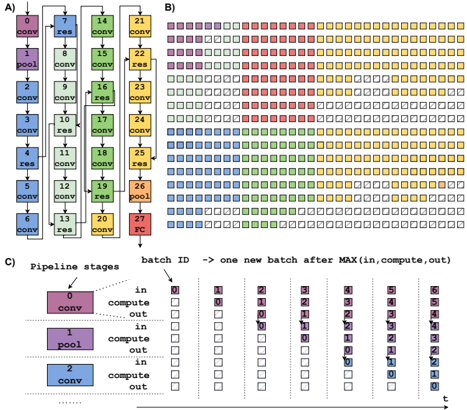
Fig. 2. A) Directed Acyclic Graph (DAG) of the ResNet-18 execution. B) Mapping example on 512 clusters. C) High-level description of pipelining computational model.
<details>
<summary>Image 2 Details</summary>
### Visual Description
## Diagram: Neural Network Pipeline Architecture and Processing Flow
### Overview
The image depicts a technical diagram of a neural network pipeline architecture, divided into three sections (A, B, C). It combines a vertical operation sequence (A), a heatmap-style grid (B), and a temporal pipeline visualization (C). The diagram uses color-coded elements to represent computational operations, activation maps, and batch processing timelines.
### Components/Axes
**Section A (Vertical Operation Sequence):**
- **Vertical Axis:** Labeled with sequential numbers 0-27, representing operation stages.
- **Horizontal Axis:** Unlabeled, but operations are stacked vertically.
- **Legend:**
- Purple = "conv" (convolution)
- Green = "res" (residual connection)
- Orange = "pool" (pooling)
- Red = "RC" (Receptive Field?)
- **Key Elements:**
- Operation blocks labeled with numbers (e.g., "conv 0", "res 1", "pool 6")
- Color-coded operations follow a pattern: conv → res → conv → res → pool → conv → res → RC
**Section B (Heatmap Grid):**
- **Grid Structure:** 28 columns (0-27) × 7 rows (0-6)
- **Color Coding:** Matches Section A's legend (purple=conv, green=res, orange=pool, red=RC)
- **Spatial Pattern:**
- Top rows dominated by purple/green (conv/res)
- Middle rows show orange/green (pool/res)
- Bottom rows feature red/orange (RC/pool)
- **Legend Position:** Right-aligned, matching Section A's color scheme
**Section C (Temporal Pipeline):**
- **Axes:**
- Vertical: Time steps (t=0 to t=6)
- Horizontal: Batch IDs (0-6)
- **Stages:**
- Purple = "conv" (input → compute → output)
- Green = "pool" (input → compute → output)
- Blue = "compute" (input → compute → output)
- **Batch Processing:**
- Each time step shows active stages for specific batches
- Example: At t=0, batch 0 is in "conv" stage
### Detailed Analysis
**Section A Trends:**
- Operation sequence follows: conv → res → conv → res → pool → conv → res → RC
- Numbers increase sequentially (0-27) with repeating patterns every 3 operations
- "pool" operations occur at positions 6, 12, 18, 24
- "RC" (Receptive Field?) appears only at position 27
**Section B Heatmap Patterns:**
- Color distribution suggests:
- Early stages (columns 0-6) dominated by conv/res operations
- Middle stages (columns 7-18) show increased pooling
- Later stages (columns 19-27) feature more RC operations
- Spatial correlation between Section A's operation sequence and B's column colors
**Section C Pipeline Dynamics:**
- Each time step processes multiple batches simultaneously
- Stages overlap temporally (e.g., conv stage active for batches 0-1 at t=0)
- Compute stages show delayed processing (batch 0 compute starts at t=1)
- Pooling stages have longer active periods (3 time steps per batch)
### Key Observations
1. **Operation Hierarchy:** Conv → res → pool → RC forms the core processing path
2. **Temporal Parallelism:** Multiple batches process through different stages simultaneously
3. **Receptive Field Timing:** RC operation occurs only at the final time step (t=6)
4. **Batch Processing Latency:** Each batch takes 6 time steps to complete full pipeline
5. **Color Consistency:** All sections use identical color coding for operations
### Interpretation
This diagram illustrates a convolutional neural network's processing pipeline with explicit temporal and spatial dimensions:
1. **Architectural Flow (A→B):** The vertical sequence in A maps directly to the heatmap columns in B, showing how operations propagate through the network
2. **Temporal Execution (C):** The pipeline visualization reveals how batches are processed through successive operations over time, with compute stages introducing latency
3. **Receptive Field Timing:** The delayed RC operation at t=6 suggests it aggregates features from all preceding operations
4. **Parallel Processing:** The grid in B demonstrates spatial activation patterns corresponding to the temporal pipeline in C
The diagram emphasizes both the computational graph structure (A) and its dynamic execution characteristics (C), with B serving as a spatial activation map correlating to the temporal pipeline. The consistent color coding across all sections enables cross-referencing of operations across spatial and temporal dimensions.
</details>
ties of the simulator towards many-core accelerators (i.e., up to 512 clusters and 8192 RISC-V cores). The IMA is integrated into the cluster as a master of the cluster crossbar. All the components of the IMA have been modeled, including the input and output buffers and the streamers. At the system level, the interconnect infrastructure has been modeled as a set of parametric router components with configurable data width, latency, and the number of master and slave ports combined together to create the topology described in Fig. 1D. Table I describes the configuration parameters of the platform used in this work. All the modules in the simulator have been calibrated using the cycle-accurate RTL and FPGA equivalent. 256 × 256 IMA size has been used since it has been demonstrated in more works and shows better technological feasibility at this time [7]. This infrastructure allows to simulate the execution of a full ResNet-18 on 512 instantiated clusters in less than 20 minutes on a 32 GB RAM, Intel(R) Core(TM) i7-2600 CPU @ 3.40GHz.
## IV. COMPUTATIONAL MODEL
This section presents the computational model of the proposed massively parallel heterogeneous architecture, detailing its main characteristics: Layer Mapping, IMA execution, Pipelining, Data Tiling, and Self-Timed Execution Flow.
- 1) Static Layer Mapping : According to the computational model of the proposed many-core architecture, each layer of a DNN is statically mapped to a certain number of clusters, while the input/output features maps (IFM/OFM) are streamed from producer to consumer clusters. Fig. 2B shows the mapping of the ResNet-18 on the architecture, where each node of the graph in Fig. 2A represents a CNN layer, grouped by color according to the IFM dimensions, and every layer is mapped on different clusters of the system, as shown in Fig. 2B. The number of clusters used to map a specific layer depends on the number of
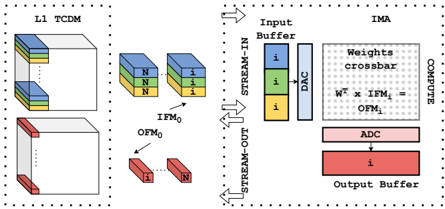
Fig. 3. IMA execution model.
<details>
<summary>Image 3 Details</summary>
### Visual Description
## Diagram: Neural Network Processing Pipeline with In-Memory Architecture (IMA)
### Overview
The diagram illustrates a two-stage neural network processing pipeline. On the left, a Layer 1 Temporal Convolutional Memory (TCDM) processes input data through two distinct pathways (top and bottom blocks). On the right, an In-Memory Architecture (IMA) handles data flow through a crossbar array, analog-to-digital conversion (ADC), and output buffering. The system emphasizes stream-in/stream-out data movement and computational efficiency.
---
### Components/Axes
#### Left Diagram (L1 TCDM)
- **Blocks**:
- Top block: Three layers labeled `N` (blue), `N` (green), `i` (yellow).
- Bottom block: Two layers labeled `i` (red), `N` (yellow).
- **Outputs**:
- `IFM₀` (Input Feature Map 0) from top block.
- `OFM₀` (Output Feature Map 0) from bottom block.
- **Legend**:
- Blue = `i` (input), Green = `N` (neuron/feature map), Yellow = `i`, Red = `i`.
#### Right Diagram (IMA)
- **Components**:
1. **Input Buffer**: Three layers labeled `i` (blue, green, yellow).
2. **DAC** (Digital-to-Analog Converter): Converts digital signals to analog.
3. **Weights Crossbar**: Matrix operation `Wᵀ × IFM₁ = OFM₁` (transposed weights multiplied by input feature map).
4. **ADC** (Analog-to-Digital Converter): Converts analog signals back to digital.
5. **Output Buffer**: Single layer labeled `i` (red).
- **Legend**:
- Blue = `i` (input), Green = `N` (neuron/feature map), Yellow = `i`, Pink = ADC, Red = Output Buffer.
---
### Detailed Analysis
#### Left Diagram (L1 TCDM)
- **Top Block**:
- Three sequential layers: Two `N` (neuron/feature map) layers followed by an `i` (input) layer.
- Outputs `IFM₀`, suggesting intermediate feature map generation.
- **Bottom Block**:
- Two layers: `i` (input) followed by `N` (neuron/feature map).
- Outputs `OFM₀`, indicating final feature map output.
- **Flow**: Data flows from top to bottom blocks via dotted lines, implying parallel processing.
#### Right Diagram (IMA)
- **Input Buffer**:
- Three `i` (input) layers, possibly representing raw data samples.
- **DAC**: Converts digital input to analog for crossbar processing.
- **Weights Crossbar**:
- Performs matrix multiplication (`Wᵀ × IFM₁`) to compute `OFM₁` (output feature map).
- Colors in crossbar align with legend: Blue (`i`), Green (`N`), Yellow (`i`).
- **ADC**: Converts analog output from crossbar to digital.
- **Output Buffer**: Stores final `i` (input) data in red.
---
### Key Observations
1. **Color-Label Mismatch**:
- The Input Buffer’s green layer is labeled `i` (input), conflicting with the legend’s green = `N` (neuron/feature map). This may indicate a labeling error or contextual reuse of `i`.
2. **Crossbar Computation**:
- The equation `Wᵀ × IFM₁ = OFM₁` suggests a linear algebra operation central to the IMA’s function.
3. **Stream-In/Stream-Out**:
- Arrows indicate bidirectional data flow, emphasizing real-time processing.
4. **Component Isolation**:
- Left diagram focuses on feature map generation; right diagram emphasizes analog/digital conversion and matrix operations.
---
### Interpretation
This diagram represents a hybrid neural network architecture combining temporal convolutional processing (L1 TCDM) with analog in-memory computing (IMA). The left side likely models sequential feature extraction, while the right side optimizes computation via crossbar arrays and analog-digital conversion. The color-coding (blue/green/yellow/red) differentiates data types (`i`, `N`, ADC, Output Buffer), though inconsistencies in labeling (e.g., green `i` vs. `N`) suggest potential ambiguities in the system’s design. The use of `Wᵀ × IFM₁` highlights the IMA’s role in efficient matrix multiplication, critical for deep learning workloads. The bidirectional flow arrows imply a focus on low-latency, real-time data processing.
</details>
parameters of the layer. For example, Layer 22 features 2.3M parameters, requiring 40 clusters for the mapping, assuming each 256x256 IMA can store 64K parameters.
- 2) IMA Execution : As described in Sec. II, the IMA subsystem communicates directly to the L1 of the cluster, acting as a master of the TCDM interconnect. Assuming DNN parameters of a specific layer are being pre-loaded to the nonvolatile array, IMA execution is composed of three distinct phases, as shown in Fig. 3. Stream-in fetches the IFM of the layer and moves them to the input buffer of the IMA. Compute performs the input data conversion by the DACs, the analog MVM execution on the crossbar, and the ADCs conversion. Stream-out moves the output digital MVM result from the output buffers to the L1 memory. Input and output buffers are duplicated to enable double buffering, completely overlapping the cost of transfers between the L1 and the buffers with the computation, maximizing the computational efficiency of the accelerator.
- 3) Pipelining : When the inference starts, the IFM of the first layer is streamed into the first set of clusters which process it generating the OFM, which is then passed to the second set of clusters and so on. Assuming the possibility of having large batches of images allows for the creation of the software pipeline described in Fig. 2C, where different chunks of data are processed by a different set of clusters simultaneously, fully overlapping the data movements (i.e., in charge of the DMA) with the computation (i.e., in charge of IMA and/or CORES). Ensuring that all pipeline stages execute in the same amount of time is essential when creating such a pipeline structure. Techniques to speed-up pipeline stages, such as parallelization and data-replication , will be discussed in Sec. V.
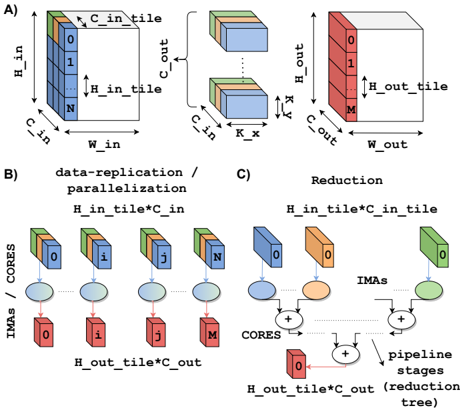
- 4) Data Tiling : To fit IFM/OFM of large DNN models within the limited memory resources of the clusters (1 MB of L1 memory is assumed in this work), we split IFM/OFM into smaller chunks of data called tiles , processed by the clusters as soon as the input data is transferred to the L1 memory. In particular, data tiling is always performed along the W in and W out dimensions for input and output, respectively. In this work, we assume a static tiling strategy, and W in/out implicitly defines the batching dimension. Therefore, the batches are composed of vertical slices of IFM/OFM. The other dimensions ( C in and H in ) are, when necessary, tiled in other clusters to fit the memory requirements (parameters mapping) or to speed up the computation ( parallelization ).
- 5) Self-Timed Execution : To implement the pipeline between the tiled structure described in IV-4, we exploit a dataflow self-timed execution model. Computation in a cluster can be performed by the CORES, IMA, or both in parallel. While software execution on the CORES is synchronous, IMA execution is managed asynchronously (like DMA transfers). A cluster can perform a certain computation whenever three conditions are satisfied: a) Chunk N+1 from the producers can be loaded to the L1 memory, b) the consumers are ready to accept the output data of chunk N-1, c) both IMA and CORES are free to compute chunk N. If all the conditions are satisfied, the new iteration can start with the following execution flow: 1) the CORE0 (i.e., master core) first waits for the events from the input and output DMA channels and IMA, 2) the CORE0 configures and triggers I/O DMA channels and IMA for computation of next tile 3) digital processing is performed in parallel on the CORES. 4) All the CORES go to sleep, waiting for the events described in point 1).
Fig. 4. A) Generic layer IFM, parameters and OFM. B) Data-replication and parallelization . C) Reduction operation.
<details>
<summary>Image 4 Details</summary>
### Visual Description
## Diagram: Parallel Processing Pipeline with Data Replication and Reduction
### Overview
The image depicts a technical diagram of a parallel processing pipeline divided into three sections (A, B, C). It illustrates data flow through a 3D grid structure, data replication/parallelization stages, and a reduction process. The diagram uses color-coded blocks and arrows to represent data transformations and computational stages.
### Components/Axes
**Section A (3D Grid Structure):**
- **Input Tile**:
- Dimensions: `H_in_tile` (height), `W_in_tile` (width), `N` (depth)
- Labels: `C_in_tile` (channel input), `H_in_tile` (height input)
- **Output Tile**:
- Dimensions: `H_out_tile` (height), `W_out_tile` (width), `M` (depth)
- Labels: `C_out_tile` (channel output), `H_out_tile` (height output)
- **Arrows**:
- Input → Output (transformation flow)
- Color-coded: Blue (input), Green (output)
**Section B (Data-Replication/Parallelization):**
- **Blocks**:
- Labeled `0` to `N` (parallel processing units)
- Each block contains:
- `H_in_tile*C_in` (input data)
- `H_out_tile*C_out` (output data)
- **IMA Blocks**:
- Connected in a pipeline (left to right)
- Color-coded: Blue (input), Green (output), Red (intermediate)
**Section C (Reduction):**
- **IMA Blocks**:
- Connected in a tree structure (top-down)
- Color-coded: Orange (input), Green (output), Red (intermediate), Blue (final)
- **Labels**:
- "IMAs" (Intermediate Processing Units)
- "Pipeline stages (reduction tree)"
**Legend**:
- **Colors**:
- Blue: Input data (`H_in_tile*C_in`)
- Green: Output data (`H_out_tile*C_out`)
- Red: Intermediate processing
- Orange: Reduction input
- Yellow: Reduction output
### Detailed Analysis
**Section A**:
- The 3D grid structure shows a transformation from input tiles (`H_in_tile`, `W_in_tile`, `N`) to output tiles (`H_out_tile`, `W_out_tile`, `M`).
- The `C_in_tile` and `C_out_tile` labels indicate channel dimensions, suggesting a convolutional or tensor-based operation.
**Section B**:
- Parallel processing units (`0` to `N`) replicate input data (`H_in_tile*C_in`) and produce output data (`H_out_tile*C_out`).
- The IMA blocks form a linear pipeline, with each stage passing data to the next.
**Section C**:
- The reduction process uses a tree structure to combine outputs from multiple IMA blocks.
- The final output (`H_out_tile*C_out`) is aggregated through hierarchical reduction stages.
### Key Observations
1. **Data Flow**:
- Input data is first processed in parallel (Section B), then reduced hierarchically (Section C).
2. **Dimensional Changes**:
- Input and output tiles have different spatial dimensions (`W_in_tile` vs. `W_out_tile`), indicating downsampling or upsampling.
3. **Color Consistency**:
- Legend colors match component labels (e.g., blue for input, green for output).
4. **Reduction Tree**:
- The tree structure in Section C suggests logarithmic complexity for combining results.
### Interpretation
This diagram represents a **parallel computing architecture** for tensor operations, likely in machine learning or signal processing. Key insights:
- **Parallelization**: Section B enables concurrent processing of data chunks, improving throughput.
- **Reduction Efficiency**: Section C’s tree structure minimizes communication overhead by aggregating results hierarchically.
- **Dimensional Adaptation**: The change in width (`W_in_tile` → `W_out_tile`) implies spatial transformation (e.g., pooling, striding).
- **Intermediate Stages**: Red and orange blocks represent computational steps (e.g., matrix multiplications, activation functions).
The diagram emphasizes **scalability** (via parallelization) and **efficiency** (via reduction), critical for high-dimensional data processing. The use of color-coding and explicit dimensional labels ensures clarity in tracking data flow and transformations.
</details>
## V. EVALUATION: RESNET-18
In this section, we present the mapping of the ResNet-18 on the proposed many-core architecture, providing insights on the adaptations required to the baseline mapping and execution model presented in Sec. IV to map all the layers and balance the pipeline optimally. The key operation of a ResNet-18 is a sequence of two 3x3 2D convolutions followed by a tensor addition (i.e., residual layer) between the OFM of the previous layer and the OFM of the previous residual layer. The first two layers are a 7x7 2D convolution followed by a MaxPool activation layer that starts propagating the residuals. The topology is shown in Fig. 2A.
- 1) Multi-cluster layers : When mapping a real-life network to the many-core architecture, the ideal condition would consist of perfectly matching the parameters of every layer with the size of the IMA. Unfortunately, this is not the case in the most
2. general case. Two types of situations might arise, depending on the dimension of the IFM/OFM. When the size of the input channels multiplied by the kernel size ( C in × K x × K y ) is greater than the number of rows of the IMA (i.e., 256), multiple IMAs are needed to compute the partial outputs. Then, a reduction among these partial outputs has to be performed to compute the OFM. On the other hand, while the size of the output channels is larger than the number of columns of the IMA (i.e., 256), the inputs need to be broadcasted to all the IMA involved (storing a different set of output channels parameters), and multiple IMAs compute part of the output channels at the same time. In some layers of ResNet-18, the two situations arise concurrently. This mapping approach has to be applied to all the layers computed in the analog domain, excluding Layer 0 .
- 2) Data-replication and Parallelization : In a pipelined computational model, the throughput of the whole pipeline is limited by the latency of the slowest stage. Hence, the pipeline has to be balanced as much as possible to achieve high throughput. Unbalancing might depend on many causes, and we will explain some of them in Sec. VI. A technique to speed up the execution of layers (i.e., one stage of the pipeline) executed in the analog domain (i.e., on the IMA) is data-replication . Data-replication increases the parallelism, replicating the parameters of a layer on different IMAs and computing at the same time multiple jobs on multiple chunks of the IFM. With this approach, the speed-up, net of overheads due to communication and data tiling, is theoretically equal to the number of replications at the cost of area, as the same layer parameters are stored on multiple IMAs (Fig. 4B). In this work, we extensively use this technique, especially for the first layers of the network. If the bottleneck of the pipeline is a layer executed in the digital domain (e.g., residual, reductions, pooling), one option is to parallelize the computation on the CORES over multiple clusters. A plain parallelization scheme is used for pooling and residual layers (i.e., Layers 1, 4, 7, 13, 19).
- 3) Reduction Management : A different approach has to be adopted for the reduction since this operation requires a hierarchical tree (Fig. 4C) featuring limited and decreasing parallelism. In particular, the level of parallelism of this operation is implicit in the structure of the network. In ResNet18, we might have to sum up the partial products of up to 20 clusters (i.e., Layers 20-21, 23-24) according to the multicluster mapping strategy described in Sec. V-1. In this context, the computation of the residuals might form a bottleneck for the pipeline since this operation has to be performed by the CORES in the digital domain. To accelerate these layers we split the hierarchical tree into several pipeline stages and assign each pipeline stage to a logarithmically decreasing number of clusters with well-balanced latency. This approach has been exploited in all reduction layers.
- 4) Residuals Management : In an ideal pipelined data flow, data are exchanged only among consecutive pipeline stages. On the other hand, in many modern DNNs such as ResNet18, this is not the case due to the presence of residual layers.
Fig. 5. ResNet-18 inference results. A) Throughput with different mapping optimizations. B) Execution time on every cluster in naive implementation. C) Execution time on every cluster in data-replication and parallelization implementation. D) Execution time on every cluster in final implementation.
<details>
<summary>Image 5 Details</summary>
### Visual Description
## Chart/Diagram Type: Technical Performance Analysis
### Overview
The image presents a multi-section technical analysis of system performance, including bar charts, stacked bar charts, and a line chart. It compares cluster performance, latency distribution, and overhead components across different configurations.
---
### Components/Axes
#### Section A: Bar Chart (Performance Comparison)
- **X-axis**: Cluster configurations labeled **B (261 clusters)**, **C (322 clusters)**, **D (324 clusters)**.
- **Y-axis**: Performance metric labeled **Performance (TOPS)**.
- **Legend**:
- **Red**: 261 clusters (B)
- **Orange**: 322 clusters (C)
- **Green**: 324 clusters (D)
- **Key Text**:
- "1.6x" (C vs. B)
- "1.9x" (D vs. B)
#### Section B: Stacked Bar Chart (Naive Configuration)
- **X-axis**: Unlabeled (likely cluster IDs or categories).
- **Y-axis**: Unlabeled (likely performance or resource usage).
- **Legend**:
- **Green**: EXEC (ANALOG BOUND)
- **Purple**: SYNCHRONIZATION OVERHEAD
- **Blue**: COMMUNICATION OVERHEAD
- **Yellow**: IDLE
- **Key Text**:
- "naive" (title)
#### Section C: Stacked Bar Chart (Data-Replication and Parallelization)
- **X-axis**: Unlabeled (likely cluster IDs or categories).
- **Y-axis**: Unlabeled (likely performance or resource usage).
- **Legend**:
- **Green**: EXEC (ANALOG BOUND)
- **Purple**: SYNCHRONIZATION OVERHEAD
- **Blue**: COMMUNICATION OVERHEAD
- **Yellow**: IDLE
- **Key Text**:
- "data-replication and parallelization" (title)
- "residual management" (title)
#### Section D: Line Chart (Latency Distribution)
- **X-axis**: Cluster IDs (16, 2, 56, 28, 53, 167).
- **Y-axis**: Latency (ms).
- **Legend**:
- **Green**: EXEC (ANALOG BOUND)
- **Purple**: SYNCHRONIZATION OVERHEAD
- **Blue**: COMMUNICATION OVERHEAD
- **Yellow**: IDLE
- **Key Text**:
- "LATENCY (ms)" (y-axis label)
---
### Detailed Analysis
#### Section A: Performance Comparison
- **Bar B (261 clusters)**: ~5 TOPS (red).
- **Bar C (322 clusters)**: ~8 TOPS (orange), 1.6x improvement over B.
- **Bar D (324 clusters)**: ~9.5 TOPS (green), 1.9x improvement over B.
#### Section B: Naive Configuration
- **Stacked Bars**:
- **Green (EXEC)**: Dominates the lower portion (e.g., ~3–4 units).
- **Purple (SYNCHRONIZATION)**: Middle portion (~1–2 units).
- **Blue (COMMUNICATION)**: Upper portion (~1–2 units).
- **Yellow (IDLE)**: Smallest segment (~0.5 units).
#### Section C: Data-Replication and Parallelization
- **Stacked Bars**:
- **Green (EXEC)**: Dominates (~3–4 units).
- **Purple (SYNCHRONIZATION)**: Middle (~1–2 units).
- **Blue (COMMUNICATION)**: Upper (~1–2 units).
- **Yellow (IDLE)**: Smallest (~0.5 units).
#### Section D: Latency Distribution
- **Lines**:
- **Green (EXEC)**: Lowest latency (~1–2 ms) across all clusters.
- **Purple (SYNCHRONIZATION)**: Moderate latency (~2–3 ms).
- **Blue (COMMUNICATION)**: Higher latency (~3–4 ms).
- **Yellow (IDLE)**: Highest latency (~4–5 ms).
- **Cluster IDs**:
- Cluster 16: Green line lowest, yellow highest.
- Cluster 167: Green line lowest, yellow highest.
---
### Key Observations
1. **Performance Scaling**: Increasing cluster count (B→D) improves performance (5→9.5 TOPS), but with diminishing returns (1.6x→1.9x).
2. **Overhead Breakdown**:
- **EXEC (ANALOG BOUND)** consistently dominates performance (green).
- **SYNCHRONIZATION OVERHEAD** and **COMMUNICATION OVERHEAD** are significant contributors to latency.
- **IDLE** time is minimal but present.
3. **Latency Trends**:
- **EXEC (ANALOG BOUND)** has the lowest latency, suggesting it is the most efficient component.
- **IDLE** time correlates with higher latency, indicating inefficiency.
---
### Interpretation
- **Performance vs. Overhead**: The system’s performance improves with more clusters, but the overhead (synchronization, communication) becomes a bottleneck. The "naive" configuration (B) shows high idle time, suggesting underutilization.
- **Latency Distribution**: The line chart (D) reveals that **EXEC (ANALOG BOUND)** is the most efficient, while **IDLE** time is the least efficient. This implies that optimizing synchronization and communication overhead could reduce latency.
- **Residual Management**: Section C’s "residual management" title suggests that unaccounted resources (e.g., idle time) are a focus for optimization.
The data highlights the trade-off between scaling cluster size and managing overhead, with **EXEC (ANALOG BOUND)** being the critical component for performance.
</details>
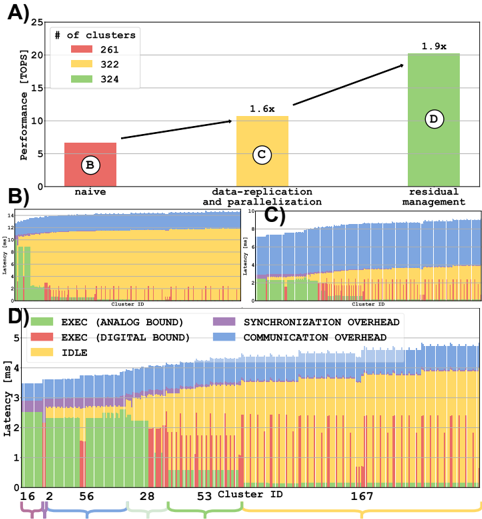
Unfortunately, with limited resources in terms of memory storage (1 MB per cluster), and considering the residual's data lifetime between when it is produced and when it is consumed, external temporary storage has to be used to store this temporary data. In particular, in our pipeline, ResNet-18 requires 1.6 MB to simultaneously store all the residuals of the whole network, where the minimum dimension can be calculated as C out ∗ H out . While a first intuitive approach to tackle this issue is to exploit the off-chip HBM memory due to its large capacity, exploiting such memory as temporary storage for residual blocks significantly increases the traffic towards this high-latency memory controller, forming a bottleneck for the whole pipeline reducing its overall performance. Instead, a better solution is to exploit the L1 memory of clusters not used for computations for residual storage, improving the performance compared to the baseline approach by 1.9 × .
## VI. RESULTS AND DISCUSSION
In this section, we analyze the results of ResNet-18 execution mapped on the proposed many-core heterogeneous architecture. To extract reliable physical implementation information from the architecture, we performed the physical implementation (down to ready for silicon layout) of the cluster in 22nm FDX technology from Global Foundries. We used Synopsys Design Compiler for physical synthesis, Cadence Innovus for Place&Route, Siemens Questasim for extracting the value change dump for activity annotation, and Synopsys PrimeTime for power analysis. Area, frequency, and power figures are
Fig. 6. Performance degradation considering non-idealities due to static mapping, network topology, and communication.
<details>
<summary>Image 6 Details</summary>
### Visual Description
## Bar Chart: Performance Degradation Across Different Mapping Strategies
### Overview
The chart illustrates the performance degradation of a system (measured in TOPS) across five categories: ideal, global mapping, local mapping, intra-layer unbalance, and communication. Performance decreases progressively from left to right, with multipliers indicating the relative reduction compared to the ideal scenario.
### Components/Axes
- **X-axis (Categories)**:
- ideal
- global mapping
- local mapping
- intra-layer unbalance
- communication
- **Y-axis (Performance)**: Labeled "Performance [TOPS]" with a scale from 0 to 500.
- **Legend**: Not explicitly visible, but bars are uniformly blue, suggesting a single data series.
- **Annotations**: Arrows point to each bar with multipliers (e.g., "1.6x", "3.0x") indicating performance reduction relative to the ideal.
### Detailed Analysis
- **Ideal**:
- Performance: 500 TOPS (baseline).
- No multiplier applied.
- **Global Mapping**:
- Performance: ~312.5 TOPS (500 / 1.6x).
- Multiplier: 1.6x (1.6 times worse than ideal).
- **Local Mapping**:
- Performance: ~166.7 TOPS (500 / 3.0x).
- Multiplier: 3.0x (3 times worse than ideal).
- **Intra-layer Unbalance**:
- Performance: ~100 TOPS (500 / 5.0x).
- Multiplier: 5.0x (5 times worse than ideal).
- **Communication**:
- Performance: ~21.0 TOPS (500 / 23.8x).
- Multiplier: 23.8x (23.8 times worse than ideal).
- **Note**: The bar is labeled "1.2x" in the image, conflicting with the 23.8x multiplier. This discrepancy suggests a potential error in labeling or annotation.
### Key Observations
1. **Progressive Degradation**: Performance drops sharply from ideal (500 TOPS) to communication (~21 TOPS), with each step introducing additional inefficiencies.
2. **Largest Drop**: The most significant performance loss occurs between "local mapping" (166.7 TOPS) and "intra-layer unbalance" (100 TOPS), a 40% reduction.
3. **Communication Anomaly**: The communication bar is labeled "1.2x" but corresponds to a 23.8x multiplier, indicating a possible labeling error. If accurate, this would imply a performance of ~416.7 TOPS (500 / 1.2x), contradicting the visual trend.
### Interpretation
- **System Bottlenecks**: The chart highlights that mapping strategies (global, local) and intra-layer unbalance significantly degrade performance, with communication being the most impactful factor.
- **Data Inconsistency**: The mismatch between the communication bar's label ("1.2x") and multiplier (23.8x) requires clarification. If the label is correct, the multiplier should be ~4.17x (500 / 120 ≈ 4.17), suggesting a possible typo in the image.
- **Design Implications**: The ideal scenario (500 TOPS) serves as a critical benchmark, emphasizing the need to optimize mapping and communication strategies to minimize performance loss.
## Additional Notes
- **Language**: All text is in English.
- **Spatial Grounding**:
- Bars are left-aligned with categories on the x-axis.
- Arrows and multipliers are positioned above each bar.
- Y-axis labels are on the left, with gridlines for reference.
- **Trend Verification**: The visual trend shows a consistent decline in bar height, aligning with the increasing multipliers (1.6x → 3.0x → 5.0x → 23.8x).
</details>
Fig. 7. Area efficiency per group of clusters as defined in Fig. 2 without communication inefficiencies.
<details>
<summary>Image 7 Details</summary>
### Visual Description
## Bar Chart: Area Efficiency by Layer Group and IFM Shape
### Overview
The chart compares area efficiency (measured in GOPS/mm²) across five Layer Groups (0–5) for six different IFM (Input Feature Map) shapes. Each Layer Group contains multiple colored bars representing distinct IFM configurations, with efficiency values ranging from ~0 to ~400 GOPS/mm².
### Components/Axes
- **Y-Axis (Layer Group)**: Discrete categories labeled 0 to 5, positioned vertically on the left.
- **X-Axis (Area Efficiency)**: Continuous scale from 0 to 400 GOPS/mm², with gridlines at 50-unit intervals.
- **Legend**: Located at the bottom-right, mapping six IFM shapes to colors:
- **Purple**: 256x256x3 (Layer 0), 128x128x64 (Layer 1)
- **Light Green**: 32x32x128 (Layer 3)
- **Blue**: 64x64x64 (Layer 2)
- **Green**: 16x16x256 (Layer 4)
- **Yellow**: 8x8x512 (Layer 5)
- **Dark Purple**: 128x128x64 (Layer 1, overlapping with purple)
### Detailed Analysis
1. **Layer 0**:
- Single dark purple bar (256x256x3) at ~150 GOPS/mm².
2. **Layer 1**:
- Two overlapping purple bars:
- 128x128x64 (~0 GOPS/mm², nearly invisible)
- 256x256x3 (~150 GOPS/mm², same as Layer 0).
3. **Layer 2**:
- Single blue bar (64x64x64) at ~210 GOPS/mm².
4. **Layer 3**:
- Single light green bar (32x32x128) spanning the full width (~400 GOPS/mm²).
5. **Layer 4**:
- Single green bar (16x16x256) at ~200 GOPS/mm².
6. **Layer 5**:
- Single yellow bar (8x8x512) at ~50 GOPS/mm².
### Key Observations
- **Layer 3** achieves the highest efficiency (~400 GOPS/mm²) with the 32x32x128 configuration.
- **Layer 5** has the lowest efficiency (~50 GOPS/mm²) with the 8x8x512 configuration.
- **Layer 1** shows conflicting data: two bars with the same dimensions (128x128x64) but vastly different efficiencies (0 vs. 150 GOPS/mm²), suggesting a potential error or mislabeling.
- **Layer 0 and 2** exhibit mid-range efficiencies (~150–210 GOPS/mm²) with larger IFM shapes (256x256x3 and 64x64x64).
### Interpretation
The chart demonstrates that area efficiency varies significantly across layers and IFM configurations. Larger spatial dimensions (e.g., 32x32x128 in Layer 3) correlate with higher efficiency, while smaller dimensions (e.g., 8x8x512 in Layer 5) result in lower efficiency. The anomaly in Layer 1—where identical dimensions (128x128x64) yield conflicting efficiencies—highlights a possible data inconsistency or misalignment in the legend. This suggests that efficiency is not solely determined by IFM size but may also depend on layer-specific optimizations or hardware constraints. The trend implies that balancing IFM dimensions with layer requirements is critical for maximizing computational efficiency.
</details>
then scaled to a 5nm tech node more suitable for modern HPC architectures. Fig. 5D shows the execution time of a batch of 16 256 × 256 images on the architecture. For each cluster, it shows the amount of time spent on computation, communication, synchronization, and sleeping. Since analog and digital computations are performed in parallel, execution bars are indicated in green when analog bound and in red when digital bound. We can note an expected increasing trend of latency with the cluster ID caused by the head and tail of the pipeline execution (i.e., idle times waiting for the first and the last batches are propagated through the pipeline).
Fig. 5A shows the performance gain achieved thanks to the techniques described in Sec. IV. Fig. 5B shows the latency breakdown of the clusters in a naive implementation, where all the network parameters are mapped into the architecture exploiting the multi-cluster technique described (Sec. V-1) but with no further optimizations. It is possible to note the large unbalance between the first layers and the deeper layers in the network. Fig. 5C shows the latency breakdown after datareplication and parallelization , better balancing the pipeline and improving performance by 1.6 × at the cost of utilising 61 more clusters. Reducing compute latency moves the bottleneck of the execution on communication due to large contentions on the HBM, mainly caused by residual management. Fig. 5d shows the optimized mapping of residual described in Sec. V-4 further improving performance by 1.9 × at the cost of 2 more clusters (to exploit 2 MB of available on-chip memory).
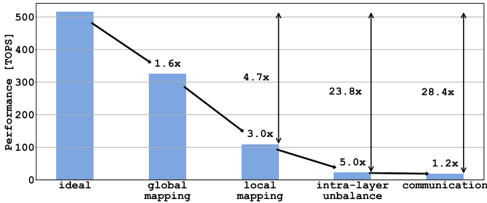
To provide insights into the sources of inefficiency highlighted in Fig. 5D, we analyze the mapping and latency breakdown of the Resnet-18 inference. The first source of inefficiency (global mapping) is caused by the fact that not all the clusters are used for mapping network parameters. In our mapping, 322 clusters out of 512 have been exploited. This is an intrinsic characteristic of all systolic architectures exploiting pipelining as a computational model, worsened by the constraints in terms of mapping imposed by IMA. However, this has only an effect on the area efficiency since, in such regular architecture, each cluster can be easily clock and power gated, minimizing the impact on energy efficiency. The second source of inefficiency (local mapping) is caused by the fact that even if a specific cluster is being used, the mapping on it might under-utilize the analog and digital resources. In some cases, parameters cannot fill the whole IMA; in other cases, the array is not used at all. The same happens for digital computing, e.g., in the case of purely digital layers. A possible solution to mitigate this degradation could be to integrate heterogeneous clusters configured to fit better all the possibilities, such as IMA and a single CORE (i.e., analog clusters) or 16 CORES without IMA (i.e., digital clusters).
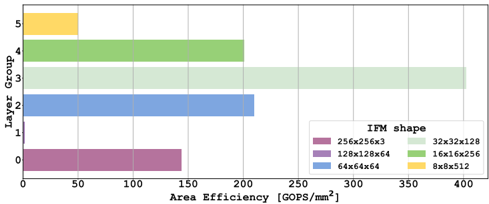
The third source of inefficiency is caused by the pipeline unbalance. Different layers feature different computational efficiency, as described in Fig. 7, where the layer groups are defined depending on the IFM dimension. Some layer groups feature significant area efficiency, thanks to large IFM/OFM implying high data reuse (i.e., several iterations over the same parameters statically mapped on the IMA). In particular, Layer 12 (i.e., group 3) is executed on 10 clusters, with datareplication factor of 2, leading to a peak of efficiency of 600 GOPS/mm 2 . Conversely, deeper layers in the network, because of the stride, feature analog layers with very poor parameters reuse interleaved with stages of reductions executed by the CORES. In particular, Layer 20, 21, 23, and 24 (i.e., group 5) are executed on 40 clusters each. This causes extremely low latency for the execution of the analog layers (less than 0.2 ms), which translates into lower area efficiency (50 GOPS/mm 2 ) compared to the first layers. A possible approach to tackle this inefficiency might lead to further exploiting heterogeneity by coupling IMA and CORES with a set of more compact specialized digital accelerators more suitable for low-data reuse layers, improving the silicon efficiency. Another approach could be to use larger IMA arrays [17]. However, this would require more data transfers per cluster.
Despite the analyzed sources of inefficiency, the proposed architecture delivers 20.2 TOPS (i.e., 3303 images/s) and 42 GOPS/mm 2 on the end-to-end inference of Resnet-18. Performing the inference in 9.2 ms and 15 mJ, which corresponds to an energy efficiency of 6.5 TOPS/W, paves the way for a new generation of general-purpose many-core architectures exploiting a mix of analog and digital computing.
## VII. CONCLUSION
In this work, we have proposed a general-purpose heterogeneous multi-core architecture based on a PULP cluster augmented with nvAIMC accelerators to efficiently execute real end-to-end networks, exploiting the throughput of such a paradigm. We have proposed a mapping based on the combination of pipelining execution flow and many techniques to increase the parallelism and split the workload among the nvAIMC cores. We have shown the results of the inference of a batch of 16 256 × 256 images on a ResNet-18, obtaining up to 20.2 TOPS and 6.5 TOPS/W for a 480 mm2 architecture. We have finally provided an exhaustive performance analysis, considering a real case of traffic and highlighting the criticisms when nvAIMC is used in real applications, providing several insights on how to mitigate this effect, to drive the design and the usage of nvAIMC architecture as a general-purpose platform for DNN acceleration.
## ACKNOWLEDGEMENT
This work was supported by the WiPLASH project (g.a. 863337), founded by the European Union's Horizon 2020 research and innovation program.
## REFERENCES
- [1] A. Sebastian et al. , 'Memory devices and applications for in-memory computing,' Nature nanotechnology , vol. 15, no. 7, pp. 529-544, 2020.
- [2] J.-s. Seo et al. , 'Digital Versus Analog Artificial Intelligence Accelerators: Advances, trends, and emerging designs,' IEEE Solid-State Circuits Magazine , vol. 14, no. 3, pp. 65-79, 2022.
- [3] J.-M. Hung et al. , 'Challenges and Trends of Nonvolatile In-MemoryComputation Circuits for AI Edge Devices,' IEEE Open Journal of the Solid-State Circuits Society , vol. 1, pp. 171-183, 2021.
- [4] S. Yu et al. , 'Compute-in-Memory Chips for Deep Learning: Recent Trends and Prospects,' IEEE Circuits and Systems Magazine , vol. 21, no. 3, pp. 31-56, 2021.
- [5] H. Jia et al. , '15.1 A Programmable Neural-Network Inference Accelerator Based on Scalable In-Memory Computing,' in 2021 IEEE International Solid- State Circuits Conference (ISSCC) , vol. 64, pp. 236238, 2021.
- [6] I. A. Papistas et al. , 'A 22 nm, 1540 TOP/s/W, 12.1 TOP/s/mm2 inMemory Analog Matrix-Vector-Multiplier for DNN Acceleration,' 2021 IEEE Custom Integrated Circuits Conference (CICC) , pp. 1-2, 2021.
- [7] R. Khaddam-Aljameh et al. , 'HERMES-Core-A 1.59-TOPS/mm2 PCM on 14-nm CMOS In-Memory Compute Core Using 300-ps/LSB Linearized CCO-Based ADCs,' IEEE Journal of Solid-State Circuits , vol. 57, no. 4, pp. 1027-1038, 2022.
- [8] H. Jia et al. , 'A Programmable Heterogeneous Microprocessor Based on Bit-Scalable In-Memory Computing,' IEEE Journal of Solid-State Circuits , vol. 55, no. 9, pp. 2609-2621, 2020.
- [9] A. Garofalo et al. , 'A Heterogeneous In-Memory Computing Cluster for Flexible End-to-End Inference of Real-World Deep Neural Networks,' IEEE Journal on Emerging and Selected Topics in Circuits and Systems , vol. 12, no. 2, pp. 422-435, 2022.
- [10] C. Zhou et al. , 'AnalogNets: ML-HW co-design of noise-robust TinyML models and always-on analog compute-in-memory accelerator,' arXiv preprint arXiv:2111.06503 , 2021.
- [11] M. Dazzi et al. , 'Efficient Pipelined Execution of CNNs Based on In-Memory Computing and Graph Homomorphism Verification,' IEEE Transactions on Computers , vol. 70, no. 6, pp. 922-935, 2021.
- [12] A. Shafiee et al. , 'ISAAC: A Convolutional Neural Network Accelerator with In-Situ Analog Arithmetic in Crossbars,' in 2016 ACM/IEEE 43rd Annual International Symposium on Computer Architecture (ISCA) , pp. 14-26, 2016.
- [13] A. Ankit et al. , 'PUMA: A Programmable Ultra-Efficient MemristorBased Accelerator for Machine Learning Inference,' in Proceedings of the Twenty-Fourth International Conference on Architectural Support for Programming Languages and Operating Systems , ASPLOS '19, (New York, NY, USA), p. 715-731, Association for Computing Machinery, 2019.
- [14] N. Bruschi et al. , 'GVSoC: A Highly Configurable, Fast and Accurate Full-Platform Simulator for RISC-V based IoT Processors,' in 2021 IEEE 39th International Conference on Computer Design (ICCD) , pp. 409-416, 2021.
- [15] M. Gautschi et al. , 'Near-Threshold RISC-V Core With DSP Extensions for Scalable IoT Endpoint Devices,' IEEE Transactions on Very Large Scale Integration (VLSI) Systems , vol. 25, no. 10, pp. 2700-2713, 2017.
- [16] A. Kurth et al. , 'An Open-Source Platform for High-Performance NonCoherent On-Chip Communication,' IEEE Transactions on Computers , pp. 1-1, 2021.
- [17] P. Narayanan et al. , 'Fully On-Chip MAC at 14 nm Enabled by Accurate Row-Wise Programming of PCM-Based Weights and Parallel VectorTransport in Duration-Format,' IEEE Transactions on Electron Devices , vol. 68, no. 12, pp. 6629-6636, 2021.