# Associated quarkonia production in a single boson e+e−superscript𝑒superscript𝑒e^{+}e^{-}italic_e start_POSTSUPERSCRIPT + end_POSTSUPERSCRIPT italic_e start_POSTSUPERSCRIPT - end_POSTSUPERSCRIPT annihilation
**Authors**: I. N. Belov, A. V. Berezhnoy, E. A. Leshchenko
> INFN, Sezione di Genova, Italy
> SINP MSU, Moscow, Russia
> Physics department of MSU, Moscow, Russia
nonumber
## Abstract
The production cross sections of charmonia, charmonium-bottomonium and bottomonia pairs in a single boson $e^{+}e^{-}$ annihilation have been studied in a wide range of energies, which will be achieved at future $e^{+}e^{-}$ colliders such as ILC and FCC. One loop QCD corrections to QCD and EW contributions as well as their interference are considered. The both intermediate bosons $\gamma$ and $Z$ are taken into account.
## 1 Introduction
Heavy quark physics have been remaining attractive for theorists and experimentalists throughout its long history. Nearly every year is now marked with discoveries in this field as a result of various experiments such as LHC, BELLE-II and the BES-III. The production of quarkonium pairs is a popular topic of discussions. One of the most intriguing researches is the observation of $J/\psi\,\eta_{c}$ pairs in the $e^{+}e^{-}$ annihilation where the experimental yield measured at BELLE and BaBar Abe et al. (2004); Aubert et al. (2005) was underestimated by the theoretical predictions Braaten and Lee (2003) by the order of magnitude. This event prompted the countless investigations Dong et al. (2012); Li and Wang (2014); Feng et al. (2019); Zhang et al. (2006); Gong and Wang (2008); Bondar and Chernyak (2005); Braguta et al. (2005); Berezhnoy and Likhoded (2007); Braguta et al. (2006); Bodwin et al. (2006); Ebert and Martynenko (2006); Berezhnoy (2008); Ebert et al. (2009); Braguta et al. (2008); Braguta (2009); Sun et al. (2010); Braguta et al. (2012); Sun et al. (2018), the results of which led to a decent level of data agreement. Another surge of interest to this topic occurred in 2020, when the LHCb Collaboration published article Aaij et al. (2020) about the observation of the structure in the $J/\psi\leavevmode\nobreak\ J/\psi$ spectrum at large statistics.
All these results have motivated us to study the processes of paired quarkonium production, specifically the production of $J/\psi\,\eta_{c}$ and $J/\psi\,J/\psi$ pairs and also $\Upsilon\,\eta_{b}$ and $\Upsilon\,\Upsilon$ pairs in the $e^{+}e^{-}$ annihilation. Proper observation of such processes is still impossible in the currently existing experiments due to low achieved collision energy. Nevertheless, current work may be of practical interest in terms of several discussed future projects, such as ILC and FCC with announced energy ranges as high as $\sqrt{s}\leavevmode\nobreak\ =\leavevmode\nobreak\ 90\div 400\leavevmode \nobreak\ \text{GeV}$ Koratzinos (2016) and $\sqrt{s}\leavevmode\nobreak\ =\leavevmode\nobreak\ 250\leavevmode\nobreak\ \text{GeV}$ Desch et al. (2019) correspondingly, aimed to investigations at the energies of the order of $Z$ -boson’s mass. As it was emphasised in the Conceptual Design Report Abada (2019), it is planned to obtain as much as $5\times 10^{12}$ decays of $Z$ bosons, with energies of about $\sqrt{s}\leavevmode\nobreak\ \approx\leavevmode\nobreak\ 91\leavevmode\nobreak \ \text{GeV}$ , which will result into the outstanding luminosity on the facility. And such enormous amount of statistics to be obtained on FCC makes it one of the most perspective successor of B-factories for heavy hadron research field, including charmonia and bottomonia investigations in a wide energy range. We also consider studied processes interesting in terms of the $Z$ -boson decays to the charmonia and the bottomonia, which may have a certain potential for the experiments at the LHC, see Sirunyan et al. (2019).
Our previous studies involved the investigation of the $B_{c}$ pair production Berezhnoy et al. (2017), the $J/\psi\,J/\psi$ and the $J/\psi\,\eta_{c}$ pair production Berezhnoy et al. (2021) around the $Z$ mass within the NLO approximation considering only QCD contribution, as well as the production of $J/\psi\,\eta_{b}$ and $\Upsilon\,\eta_{c}$ pairs considering QCD contribution within NLO approximation and EW contribution within LO accuracy Lesh (2021). The substantial conclusion from the listed researches is that the loop corrections for investigated processes essentially affect the cross section values. This result is consistent with findings by other research groups investigating the paired quarkonium production in the $e^{+}e^{-}$ annihilation. As an extension of this study we investigate the electroweak contribution in NLO approximation to these processes and implement the derived calculation technique for bottomonia case: the $\Upsilon\,\Upsilon$ and the $\Upsilon\,\eta_{b}$ pair production.
Thus, the following processes are studied in this paper: ${e^{+}e^{-}\xrightarrow{\gamma^{*},\ Z^{*}}\leavevmode\nobreak\ J/\psi\,\eta_{ c}}$ , ${e^{+}e^{-}\xrightarrow{Z^{*}}\leavevmode\nobreak\ J/\psi\,J/\psi}$ , ${e^{+}e^{-}\xrightarrow{\gamma^{*},\ Z^{*}}\leavevmode\nobreak\ \Upsilon\,\eta _{b}}$ and ${e^{+}e^{-}\xrightarrow{Z^{*}}\leavevmode\nobreak\ \Upsilon\,\Upsilon}$ .
## 2 Methods
The production features of quarkonia pairs in a single boson $e^{+}e^{-}$ annihilation are determined by the certain set of selection rules:
- The productions of both vector-vector pairs (VV) and pseudoscalar-pseudoscalar (PP) pairs through the intermediate photon and the vector part of $Z$ vertex are prohibited due to the charge parity conservation.
- The productions of vector-pseudoscalar (VP) pairs via the axial part of $Z$ vertex is prohibited for the very same reason.
- The PP pairs production via the axial part of $Z$ vertex is prohibited due to the combined $CP$ parity conservation.
These selection rules acted as additional verification criteria of calculations.
There are two production mechanisms for the investigated processes. The first one is the single gluon exchange, for which the tree level contribution is ${\cal O}(\alpha^{2}\alpha_{s}^{2})$ . The second production mechanism is the single photon or $Z$ boson exchange. In that case the tree level contribution is of order ${\cal O}(\alpha^{4})$ . In text we refer to this contributions as QCD LO and EW LO contributions correspondingly.
We also take into account QCD one-loop correction to both QCD LO and EW LO contributions, which are of orders ${\cal O}(\alpha^{2}\alpha_{s}^{3})$ and ${\cal O}(\alpha^{4}\alpha_{s})$ correspondingly. We refer to them as QCD NLO and EW NLO contributions.
Thus, when studying these processes, one should take into account 7 contributions to the total cross sections:
$$
|\mathcal{A}|^{2}=|\mathcal{A}^{LO}_{QCD}|^{2}+|\mathcal{A}^{LO}_{EW}|^{2}+2Re
(\mathcal{A}^{LO}_{QCD}\mathcal{A}^{LO*}_{EW})+\\
2Re(\mathcal{A}^{NLO}_{QCD}\mathcal{A}^{LO*}_{QCD})+2Re(\mathcal{A}^{NLO}_{QCD
}\mathcal{A}^{LO*}_{EW})+\\
2Re(\mathcal{A}^{NLO}_{EW}\mathcal{A}^{LO*}_{QCD})+2Re(\mathcal{A}^{NLO}_{EW}
\mathcal{A}^{LO*}_{EW})+\dots\ . \tag{1}
$$
To describe the double heavy quarkonia the Nonrelativistic QCD (NRQCD) Bodwin et al. (1995) is used. The NRQCD is based on the hierarchy of scales for the quarkonia: $m_{q}>>m_{q}v,m_{q}v^{2},\Lambda_{QCD}$ , where $m_{q}$ is the mass of the heavy quark and $v$ is the heavy quark velocity in the quarkonium. Such formalism allows to divide the investigated process into the hard subprocess of heavy quarks production and the soft fusion of heavy quarks into quarkonia.
In order to construct the bound states we put $v=0$ and replace the spinor products $v(p_{\bar{q}})\bar{u}(p_{q})$ by the appropriate covariant projectors for color-singlet spin-singlet and spin-triplet states:
$$
\displaystyle\Pi_{P}(Q_{q},m_{P})=\frac{\not{Q}-2m_{P}}{2\sqrt{2}}\gamma^{5}
\otimes\frac{\bm{1}}{\sqrt{N_{c}}}, \displaystyle\Pi_{V}(P_{q},m_{V})=\frac{\not{P}-2m_{V}}{2\sqrt{2}}\ \not{
\epsilon}^{V}\otimes\frac{\bm{1}}{\sqrt{N_{c}}}, \tag{2}
$$
where $Q_{q}$ , $m_{P}$ and $P_{q}$ , $m_{V}$ are momenta and masses of the pseudoscalar and vector final states correspondingly. Polarization $\epsilon^{V}$ of the vector meson satisfy the following constraints: $\epsilon^{V}\leavevmode\nobreak\ \cdot\leavevmode\nobreak\ {\epsilon^{V}}^{*} \leavevmode\nobreak\ =\leavevmode\nobreak\ -1$ , $\epsilon^{V}\leavevmode\nobreak\ \cdot\leavevmode\nobreak\ P_{q}\leavevmode \nobreak\ =\leavevmode\nobreak\ 0$ . These operators enclose the fermion lines into traces.
The renormalization procedure must be applied to the one-loop contribution. The so-called „On-shell“ scheme has been used for renormalization of masses and spinors and $\overline{MS}$ scheme has been adopted for coupling constant renormalization:
$$
\displaystyle Z_{m}^{OS}=1-\frac{\alpha_{s}}{4\pi}C_{F}C_{\epsilon}\left[\frac
{3}{\epsilon_{UV}}+4\right]+\mathcal{O}\left(\alpha_{s}^{2}\right), \displaystyle Z_{2}^{OS}=1-\frac{\alpha_{s}}{4\pi}C_{F}C_{\epsilon}\left[\frac
{1}{\epsilon_{UV}}+\frac{2}{\epsilon_{IR}}+4\right]+\mathcal{O}\left(\alpha_{s
}^{2}\right), \displaystyle Z_{g}^{\overline{MS}}=1-\frac{\beta_{0}}{2}\frac{\alpha_{s}}{4
\pi}\left[\frac{1}{\epsilon_{UV}}-\gamma_{E}+\ln{4\pi}\right]+\mathcal{O}\left
(\alpha_{s}^{2}\right), \tag{3}
$$
where $C_{\epsilon}=\left(\frac{4\pi\mu^{2}}{m^{2}}e^{-\gamma_{E}}\right)^{\epsilon}$ and $\gamma_{E}$ is the Euler constant.
The counter-terms are obtained from the leading order diagrams. The isolated singularities are then cancelled with the singular parts of the calculated counter-terms.
The FeynArts -package Hahn (2001) in Wolfram Mathematica is used to generate the diagrams and the accompanying analytical amplitudes.
In total 6 nonzero tree level EW, 10 nonzero one loop EW and 4 nonzero tree level QCD diagrams contribute to PV pair production ( $e^{+}e^{-}\leavevmode\nobreak\ \xrightarrow{\gamma^{*},Z^{*}}\leavevmode \nobreak\ J/\psi\,\eta_{c}$ and $e^{+}e^{-}\leavevmode\nobreak\ \xrightarrow{\gamma^{*},Z^{*}}\leavevmode \nobreak\ \Upsilon\,\eta_{b}$ ). The number of nonzero one-loop QCD diagrams depends on the intermediate boson type: 80 in case of virtual photon and 92 in case of virtual $Z$ boson. The VV pair production subprocesses $e^{+}e^{-}\leavevmode\nobreak\ \xrightarrow{Z^{*}}\leavevmode\nobreak\ J/\psi \,J/\psi$ and $e^{+}e^{-}\leavevmode\nobreak\ \xrightarrow{Z^{*}}\leavevmode\nobreak\ \Upsilon\,\Upsilon$ are described by 8 nonzero tree level EW diagrams, 4 nonzero tree QCD diagrams, 20 nonzero one loop EW diagrams and 86 nonzero one loop QCD diagrams.
To calculate the tree level amplitudes we use FeynArts Hahn (2001) and FeynCalc Shtabovenko et al. (2020) packages in Wolfram Mathematica, while the computation of loop amplitudes demands the following toolchain: $\texttt{FeynArts}\rightarrow\texttt{FeynCalc}(\texttt{TIDL})\xrightarrow{} \texttt{Apart\leavevmode\nobreak\ \cite[cite]{\@@bibref{Authors Phrase1YearPhr ase2}{Feng:2012iq}{\@@citephrase{(}}{\@@citephrase{)}}}}\rightarrow\texttt{ FIRE\leavevmode\nobreak\ \cite[cite]{\@@bibref{Authors Phrase1YearPhrase2}{ Smirnov:2008iw}{\@@citephrase{(}}{\@@citephrase{)}}}}\rightarrow\texttt{X \leavevmode\nobreak\ \cite[cite]{\@@bibref{Authors Phrase1YearPhrase2}{Patel:2 016fam}{\@@citephrase{(}}{\@@citephrase{)}}}}$ .
The FeynCalc package performs all required algebraic operations with Dirac and color matrices, in particular the trace evaluation. The Passarino-Veltman reduction is carried out with the implementation of TIDL library included in FeynCalc package. The Apart function performs the additional simplification providing the partial fractioning of IR-divergent integrals. The integrals produced in the above described phases are completely reduced to master integrals by the FIRE package. At last, by using the X -package the master integrals are evaluated by substituting their analytical expressions.
The NLO amplitudes are computed using the conventional dimensional regularization (CDR) approach with a $D$ -dimensional loop and external momenta.
The so-called „naive“ prescription for $\gamma^{5}$ was implemented: $\gamma^{5}$ anticommutes with all other $\gamma$ matrices, the remaining $\gamma^{5}$ in traces with an odd number of $\gamma^{5}$ matrices is shifted to the right and then replaced by
$$
\gamma^{5}=-\frac{i}{24}\varepsilon_{\alpha\beta\sigma\rho}\gamma^{\alpha}
\gamma^{\beta}\gamma^{\sigma}\gamma^{\rho}.
$$
The strong coupling constant was treated within the two loops accuracy:
$$
\alpha_{S}(\mu)=\frac{4\pi}{\beta_{0}L}\left(1-\frac{\beta_{1}\ln{L}}{\beta_{0
}^{2}L}\right),
$$
where $L=\ln{\mu^{2}/\Lambda^{2}}$ , $\beta_{0}=11-\frac{2}{3}N_{f}$ , $\beta_{1}=10-\frac{38}{3}N_{f}$ , and $\alpha_{S}(M_{Z})=0.1179$ . The renormalization and coupling constant scales are set to be equal: $\mu_{R}=\mu$ . The fine structure constant is fixed at the Thomson limit: $\alpha=1/137$ . $u$ -, $d$ - and $s$ -quarks are considered massless. The numerical values of other parameters are outlined in Table 1.
## 3 Results
### Analytical results
In this subsection we present some analytical results obtained for the discussed the amplitudes and cross sections.
The asymptotic behaviour of the amplitudes are presented below:
$$
\displaystyle\mathcal{A}^{LO}_{QCD}\sim\frac{1}{s^{2}}; \displaystyle\ \ \ \ \ \frac{\mathcal{A}^{NLO}_{QCD}}{\mathcal{A}^{LO}_{QCD}}
\sim\alpha_{s}\left(c^{QCD}_{2}\ln^{2}\left(\frac{s}{m^{2}_{q}}\right)+c^{QCD}
_{1}\ln\left(\frac{s}{m^{2}_{q}}\right)+c^{QCD}_{0}+c^{QCD}_{\mu}\ln\left(
\frac{\mu}{m_{q}}\right)\right); \displaystyle\mathcal{A}^{LO}_{EW}\sim\frac{1}{s}; \displaystyle\ \ \ \ \ \frac{\mathcal{A}^{NLO}_{EW}}{\mathcal{A}^{LO}_{EW}}
\sim\alpha_{s}\left(c^{EW}_{1}\ln\left(\frac{s}{m^{2}_{q}}\right)+c^{EW}_{0}
\right), \tag{4}
$$
where $c^{QCD}_{i}$ and $c^{EW}_{i}$ are coefficients independent of the collision energy, the quark masses and the chosen scale.
Since the tree-level amplitudes for the investigated processes have a trivial Lorentz structure, the analytical expressions for the appropriate cross sections are quite simple:
$$
\displaystyle\sigma^{LO}_{QCD}\left(VP\right) \displaystyle=\frac{131072\ \pi^{3}\alpha^{2}\alpha_{s}^{2}e_{q}^{2}{\cal O}_{
V}{\cal O}_{P}\left(s-16m_{q}^{2}\right)^{3/2}}{243\ s^{11/2}}\ \left(1+q_{
\gamma Z}+q_{Z}\right), \displaystyle\sigma^{LO}_{EW}\left(VP\right) \displaystyle=\frac{32\ \pi^{3}\alpha^{4}e_{q}^{6}{\cal O}_{V}{\cal O}_{P}
\left(s-16m_{q}^{2}\right)^{3/2}\left(s+\frac{16}{3}m_{q}^{2}\right)^{2}}{3\ m
_{q}^{4}s^{11/2}}\left(1+q_{\gamma Z}+q_{Z}\right), \displaystyle\sigma^{LO}_{QCD}\left(V_{1}V_{2}\right) \displaystyle=\frac{1}{2!}\frac{512\ \pi^{3}\alpha^{2}\alpha_{s}^{2}{\cal O}_{
V}^{2}\left(s-16m_{q}^{2}\right)^{5/2}}{243\ s^{9/2}}\frac{\sec^{4}{\theta_{w}
}\left(\csc^{4}{\theta_{w}}-4\csc^{2}{\theta_{w}}+8\right)}{\left(M_{Z}^{2}-s
\right)^{2}+\Gamma^{2}M_{Z}^{2}}, \displaystyle\sigma^{LO}_{EW}\left(V_{1}V_{2}\right) \displaystyle=\frac{1}{2!}\frac{\pi^{3}\alpha^{4}e_{q}^{4}{\cal O}_{V}^{2}
\left(s-16m_{q}^{2}\right)^{5/2}\left(s+\frac{8}{3}m_{q}^{2}\right)^{2}}{6\ m_
{q}^{4}s^{9/2}}\frac{\sec^{4}{\theta_{w}}\left(\csc^{4}{\theta_{w}}-4\csc^{2}{
\theta_{w}}+8\right)}{\left(M_{Z}^{2}-s\right)^{2}+\Gamma^{2}M_{Z}^{2}}, \tag{6}
$$
where $q_{\gamma Z}$ in (6) and (7) corresponds to the interference of photonic and $Z$ bosonic amplitudes, $q_{Z}$ corresponds to the $Z$ boson annihilation amplitude squared, and $1$ stands for the photon annihilation amplitude squared:
$$
\displaystyle q_{\gamma Z} \displaystyle=\frac{\tan^{2}{\theta_{w}}\left(\csc^{2}{\theta_{w}}-4\right)
\left(\csc^{2}{\theta_{w}}-4|e_{q}|\right)}{8\ |e_{q}|}\ \frac{s\left(s-M_{Z}^
{2}\right)}{(M_{Z}^{2}-s)^{2}+\Gamma^{2}M_{Z}^{2}}, \displaystyle q_{Z} \displaystyle=\frac{\tan^{4}{\theta_{w}}\left(\csc^{4}{\theta_{w}}-4\csc^{2}{
\theta_{w}}+8\right)\left(\csc^{2}{\theta_{w}}-4|e_{q}|\right)^{2}}{128\ e_{q}
^{2}}\ \frac{s^{2}}{\left(M_{Z}^{2}-s\right)^{2}+\Gamma^{2}M_{Z}^{2}}. \tag{10}
$$
The analytical expressions for the one-loop cross sections are cumbersome, and this is why we do not present them in the text.
### Numerical results
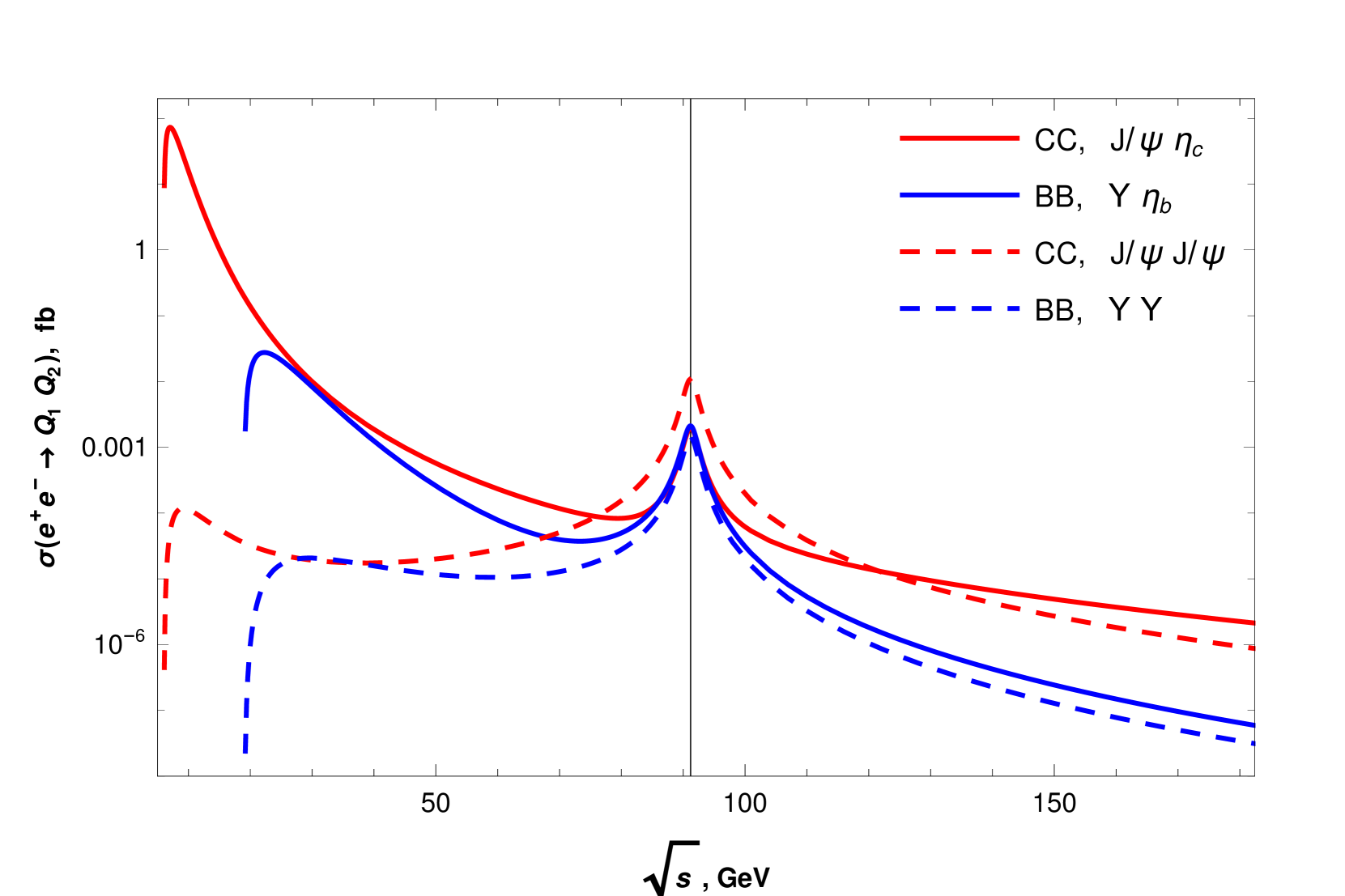
The numerical results are encapsulated in the Table 2.
As it is seen in Fig. 1, $J/\psi\,\eta_{c}$ pairs production smaller than $J/\psi\,J/\psi$ only near the $Z$ -pole, while $\Upsilon\,\eta_{b}$ pairs production greater than $\Upsilon\,\Upsilon$ at all investigated energies.
The relative QCD and EW contributions to the total cross sections are shown in Fig. 2. It is worth to note that in the charmonia production the QCD contribution is dominant up to energies of $\sim 25\leavevmode\nobreak\ \text{GeV}$ , while at higher energies the EW contribution dominates. As for the associated bottomonia production, at low energies the QCD mechanism appears to be dominant, while at energies above the $Z$ -boson threshold both contributions are comparable.
### K-factors
In order to estimate the contribution of NLO corrections to the cross section the K-factors were numerically calculated for each of the production mechanisms.
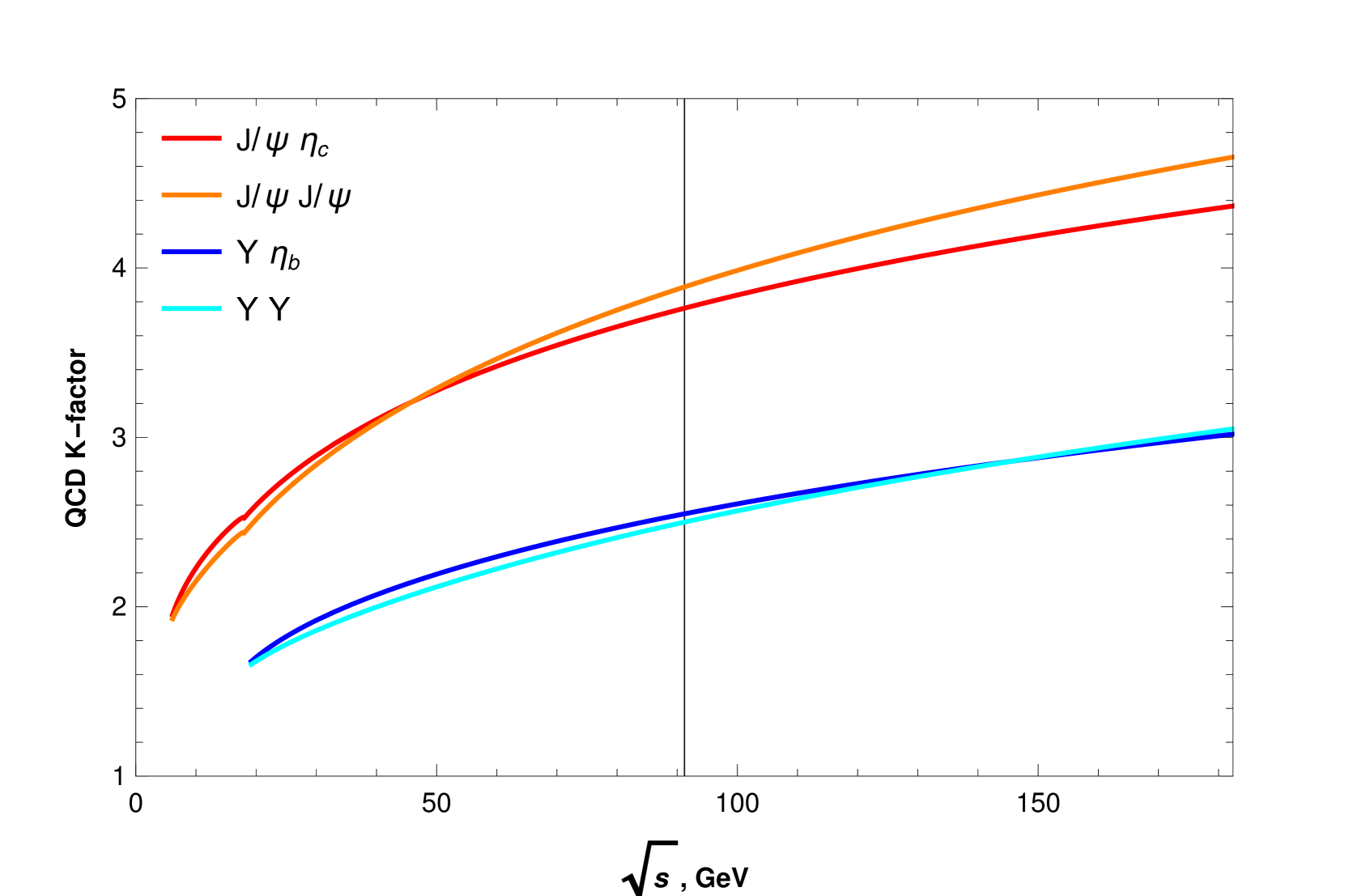
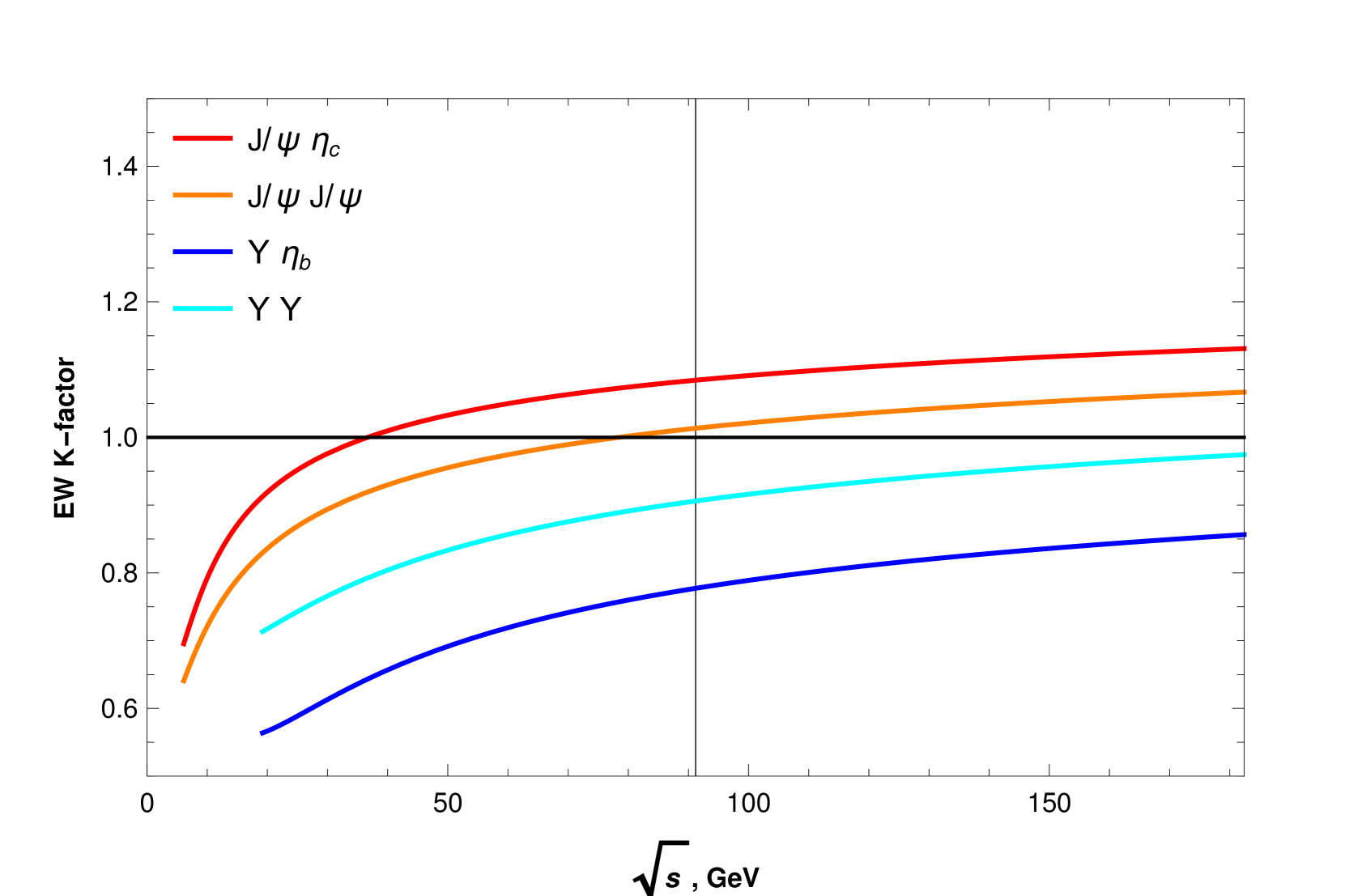
The K-factors dependencies on interaction energy are shown in Fig. 3 and Fig. 4. All K-factors increase with energy as expected from (4) and (5). The K-factors for the QCD mechanism are consimilar for PV and VV pairs production, whereas K-factors for the EW mechanism are sufficiently depend on quarkonia quantum numbers. The NLO corrections to QCD mechanism contribute positively to the cross section at all investigated energies. The NLO corrections to the EW charmonia production are negative at low energies and positive at high energies. The NLO corrections to the EW bottomonia production are negative at all energies.
The obtained results highlight the significance of NLO corrections to the both discussed mechanisms.
## 4 Conclusions
The exclusive production of charmonia and bottomonia pairs ( $J/\psi\,\eta_{c}$ , $J/\psi\,J/\psi$ , $\Upsilon\,\eta_{b}$ and $\Upsilon\,\Upsilon$ ) in a single boson $e^{+}e^{-}$ annihilation has been investigated at interaction energies from the production threshold to $2M_{Z}$ within the QCD NLO accuracy.
It has been shown that the both studied mechanisms, namely QCD and EW ones, significantly contribute to the cross section in a wide energy range. Analytical expressions for QCD and EW amplitudes and cross sections have been obtained and numerical results for cross sections have been presented. Also, the relative contributions of production mechanisms to the total cross section have been analysed. We believe that the presented results may be of considerable interest for experiments at future $e^{+}e^{-}$ colliders.
Authors are grateful to the organizing committee of ICPPA2022 for the opportunity to make this report. This study was conducted within the scientific program of the National Center for Physics and Mathematics, section #5 „Particle Physics and Cosmology“. Stage 2023-2025. I. Belov acknowledges the support from „BASIS“ Foundation, grant No. 20-2-2-2-1.
## References
- Abe et al. (2004) K. Abe, H. Aihara, Y. Asano, et al., Phys. Rev. D 70, 071102 (2004). https://doi.org/10.1103/PhysRevD.70.071102
- Aubert et al. (2005) B. Aubert, R. Barate, D. Boutigny, et al., Phys. Rev. D 72, 031101 (2005). https://doi.org/10.1103/PhysRevD.72.031101
- Braaten and Lee (2003) E. Braaten, and J. Lee, Phys. Rev. D 67, 054007, (2003). https://doi.org/10.1103/PhysRevD.67.054007 Erratum Phys. Rev. D 72, 099901 (2005). https://doi.org/10.1103/PhysRevD.72.099901
- Dong et al. (2012) H.-R. Dong, F. Feng, and Y. Jia, Phys. Rev. D 85, 114018 (2012). https://doi.org/10.1103/PhysRevD.85.114018
- Li and Wang (2014) X.-H. Li, and J.-X. Wang, Chin. Phys. C 38, 043101 (2014). https://doi.org/10.1088/1674-1137/38/4/043101
- Feng et al. (2019) F. Feng, Y. Jia, Z. Mo, W.-L. Sang, and J.-Y. Zhang, Next-to-next-to-leading-order QCD corrections to $e^{+}e^{-}\to J/\psi+\eta_{c}$ at $B$ factories. ArXiv, https://arxiv.org/abs/1901.08447, Accessed November 25, 2022. https://doi.org/10.48550/arXiv.1901.08447
- Zhang et al. (2006) Y.-J. Zhang, Y.-J. Gao, and K.-T. Chao, Phys. Rev. Lett. 96, 092001 (2006). https://doi.org/10.1103/PhysRevLett.96.092001
- Gong and Wang (2008) B. Gong, and J.-X. Wang, Phys. Rev. D 77, 054028 (2008). https://doi.org/10.1103/PhysRevD.77.054028
- Bondar and Chernyak (2005) A.E. Bondar, and V.L. Chernyak, Phys. Lett. B 612, 215-222 (2005). https://doi.org/10.1016/j.physletb.2005.03.021
- Braguta et al. (2005) V.V. Braguta, A.K. Likhoded, and A.V. Luchinsky, Phys. Rev. D 72, 074019 (2005). https://doi.org/10.1103/PhysRevD.72.074019
- Berezhnoy and Likhoded (2007) A.V. Berezhnoy, and A.K. Likhoded, Phys. Atom. Nucl. 70, 478-484 (2007). https://doi.org/10.1134/S1063778807030052
- Braguta et al. (2006) V.V. Braguta, A.K. Likhoded, and A.V. Luchinsky, Phys. Lett. B 635, 299-304 (2006). https://doi.org/10.1016/j.physletb.2006.03.005
- Bodwin et al. (2006) G.T. Bodwin, D. Kang, and J. Lee, Phys. Rev. D 74, 114028 (2006). https://doi.org/10.1103/PhysRevD.74.114028
- Ebert and Martynenko (2006) D. Ebert, and A.P. Martynenko, Phys. Rev. D 74, 054008 (2006). https://doi.org/10.1103/PhysRevD.74.054008
- Berezhnoy (2008) A.V. Berezhnoy, Phys. Atom. Nucl. 71, 1803-1806 (2008). https://doi.org/10.1134/S1063778808100141
- Ebert et al. (2009) D. Ebert, R.N. Faustov, V.O. Galkin, and A.P. Martynenko, Phys. Lett. B 672, 264-269 (2009). https://doi.org/10.1016/j.physletb.2009.01.029
- Braguta et al. (2008) V.V. Braguta, A.K. Likhoded, and A.V. Luchinsky, Phys. Rev. D 78, 074032 (2008). https://doi.org/10.1103/PhysRevD.78.074032
- Braguta (2009) V.V. Braguta, Phys. Rev. D 79, 074018 (2009). https://doi.org/10.1103/PhysRevD.79.074018
- Sun et al. (2010) Y.-J.Sun, X.-G. Wu, F. Zuo, and T. Huang, Eur. Phys. J. C 67, 117-123 (2010). https://doi.org/10.1140/epjc/s10052-010-1280-z
- Braguta et al. (2012) V.V. Braguta, A.K. Likhoded, and A.V. Luchinsky, Phys. Atom. Nucl. 75, 97-108 (2012). https://doi.org/10.1134/S1063778812010036
- Sun et al. (2018) Z. Sun, X.G. Wu, Y. Ma, and S.J. Brodsky, Phys. Rev. D 98, 094001 (2018). https://doi.org/10.1103/PhysRevD.98.094001
- Aaij et al. (2020) LHCb collaboration, Sci. Bull. 65, 1983-1993 (2020). https://doi.org/10.1016/j.scib.2020.08.032
- Koratzinos (2016) M. Koratzinos, Nucl. Part. Phys. Proc. 273-275, 2326-2328 (2016). https://doi.org/10.1016/j.nuclphysbps.2015.09.380
- Desch et al. (2019) K. Desch, A. Lankford , K. Mazumdar, et al., Recommendations on ILC Project Implementation. OSTI.GOV, https://www.osti.gov/biblio/1833577, Accessed September 25, 2019. https://doi.org/10.2172/1833577
- Abada (2019) A. Abada, M. Abbrescia, S.S. AbdusSalam, et al., Eur. Phys. J. C. 79, 474 (2019). https://doi.org/10.1140/epjc/s10052-019-6904-3
- Sirunyan et al. (2019) The CMS Collaboration, Phys. Lett. B 797, 134811 (2019). https://doi.org/10.1016/j.physletb.2019.134811
- Berezhnoy et al. (2017) A.V. Berezhnoy, A.K. Likhoded, A.I. Onishchenko, and S.V. Poslavsky, Nucl. Phys. B 915, 224-242 (2017). https://doi.org/10.1016/j.nuclphysb.2016.12.013
- Berezhnoy et al. (2021) A.V. Berezhnoy, I.N. Belov, S.V. Poslavsky, and Likhoded, A.K., Phys. Rev. D 104, 034029 (2021). https://doi.org/10.1103/PhysRevD.104.034029
- Lesh (2021) I.N. Belov , A.V. Berezhnoy, and E.A. Leshchenko, Symmetry 13(7), 1262 (2021). https://doi.org/10.3390/sym13071262
- Bodwin et al. (1995) G.T. Bodwin, E. Braaten, and G.P. Lepage, Phys. Rev. D 51, 1125-1171 (1995). https://doi.org/10.1103/PhysRevD.51.1125 Erratum Phys. Rev. D 55, 5853 (1997). https://doi.org/10.1103/PhysRevD.55.5853
- Hahn (2001) T. Hahn, Comput. Phys. Commun. 140, 418-431 (2001). https://doi.org/10.1016/S0010-4655(01)00290-9
- Shtabovenko et al. (2020) V. Shtabovenko, R. Mertig, and F. Orellana, Comput. Phys. Commun. 256, 107478 (2020). https://doi.org/10.1016/j.cpc.2020.107478
- Feng (2012) F. Feng, Comput. Phys. Commun. 183, 2158-2164 (2012). https://doi.org/10.1016/j.cpc.2012.03.025
- Smirnov (2008) A.V. Smirnov, JHEP 10, 107 (2008). https://doi.org/10.1088/1126-6708/2008/10/107
- Patel (2017) H.H. Patel, Comput. Phys. Commun. 218, 66-70 (2017). https://doi.org/10.1016/j.cpc.2017.04.015
5mm
<details>
<summary>x1.png Details</summary>
### Visual Description
## Line Graph: Cross-Section for e⁺e⁻ → Q₁Q₂ as a Function of √s (GeV)
### Overview
The graph depicts the cross-section (σ) for electron-positron annihilation into quark pairs (Q₁Q₂) as a function of the center-of-mass energy (√s, in GeV). Four theoretical predictions are plotted, differentiated by coupling mechanisms (CC for charm quarks, BB for bottom quarks) and interaction terms (single vs. double couplings). The y-axis uses a logarithmic scale (10⁻⁶ to 1 fb), while the x-axis spans 0–150 GeV.
---
### Components/Axes
- **X-axis**: √s (GeV), labeled with approximate markers at 0, 50, 100, and 150 GeV.
- **Y-axis**: σ(e⁺e⁻ → Q₁Q₂) in femtobarns (fb), logarithmic scale from 10⁻⁶ to 1 fb.
- **Legend**: Located in the top-right corner, with four entries:
- Solid red: CC, J/ψ η_c
- Solid blue: BB, Y η_b
- Dashed red: CC, J/ψ J/ψ
- Dashed blue: BB, Y Y
---
### Detailed Analysis
1. **Solid Red Line (CC, J/ψ η_c)**:
- **Trend**: Peaks sharply near √s ≈ 100 GeV (~1 fb), then declines steeply. At 0 GeV, σ ≈ 1 fb; at 150 GeV, σ ≈ 10⁻⁴ fb.
- **Key Points**:
- √s = 0 GeV: σ ≈ 1 fb
- √s = 100 GeV: σ ≈ 1 fb
- √s = 150 GeV: σ ≈ 10⁻⁴ fb
2. **Solid Blue Line (BB, Y η_b)**:
- **Trend**: Peaks at √s ≈ 100 GeV (~0.01 fb), lower than the red line. Declines gradually to ~10⁻⁵ fb at 150 GeV.
- **Key Points**:
- √s = 0 GeV: σ ≈ 10⁻³ fb
- √s = 100 GeV: σ ≈ 0.01 fb
- √s = 150 GeV: σ ≈ 10⁻⁵ fb
3. **Dashed Red Line (CC, J/ψ J/ψ)**:
- **Trend**: Peaks at √s ≈ 100 GeV (~0.001 fb), significantly lower than the solid red line. Declines to ~10⁻⁶ fb at 150 GeV.
- **Key Points**:
- √s = 0 GeV: σ ≈ 10⁻⁴ fb
- √s = 100 GeV: σ ≈ 0.001 fb
- √s = 150 GeV: σ ≈ 10⁻⁶ fb
4. **Dashed Blue Line (BB, Y Y)**:
- **Trend**: Peaks at √s ≈ 100 GeV (~0.0001 fb), the lowest among all lines. Declines to ~10⁻⁷ fb at 150 GeV.
- **Key Points**:
- √s = 0 GeV: σ ≈ 10⁻⁵ fb
- √s = 100 GeV: σ ≈ 0.0001 fb
- √s = 150 GeV: σ ≈ 10⁻⁷ fb
---
### Key Observations
- **Peak Resonance**: All lines peak near √s ≈ 100 GeV, suggesting a resonance or threshold effect at this energy.
- **Coupling Strength**:
- CC processes (red lines) exhibit higher cross-sections than BB (blue lines) for equivalent couplings.
- Double couplings (J/ψ J/ψ, Y Y) reduce cross-sections by 1–2 orders of magnitude compared to single couplings (J/ψ η_c, Y η_b).
- **Asymptotic Behavior**: All lines decay monotonically at √s > 100 GeV, with no secondary peaks observed.
---
### Interpretation
The data suggests that the cross-section for e⁺e⁻ → Q₁Q₂ is strongly dependent on both the center-of-mass energy and the quark coupling mechanism. The resonance at √s ≈ 100 GeV likely corresponds to a hypothetical or known particle (e.g., Z boson or a quarkonium state), with the peak magnitude reflecting the strength of the interaction. The suppression of double-coupling processes (dashed lines) implies that single couplings dominate the interaction dynamics. The disparity between CC and BB cross-sections may indicate differences in quark mass effects or decay channel availability. This graph could inform high-energy physics models by highlighting dominant interaction pathways at specific energy scales.
</details>
normal
Figure 1: The total cross sections dependence on the collision energy for the double charmonia and the double bottomonia production.
5mm $\begin{array}[]{cc}\includegraphics[page=1,width=216.81pt]{pictures/sigma/Fig2 .pdf}&\includegraphics[page=2,width=216.81pt]{pictures/sigma/Fig2.pdf}\\ (a)\leavevmode\nobreak\ J/\psi\,\eta_{c}&(b)\leavevmode\nobreak\ J/\psi\,J/ \psi\\ \includegraphics[page=3,width=216.81pt]{pictures/sigma/Fig2.pdf}& \includegraphics[page=4,width=216.81pt]{pictures/sigma/Fig2.pdf}\\ (c)\leavevmode\nobreak\ \Upsilon\,\eta_{b}&(d)\leavevmode\nobreak\ \Upsilon\, \Upsilon\end{array}$ normal
Figure 2: Relative contributions of different different mechanisms to the total cross section values as a function of collision energy: the QCD mechanism (red), the EW mechanism (blue), the interference of QCD and EW production mechanisms (green).
5mm
<details>
<summary>x6.png Details</summary>
### Visual Description
## Line Chart: QCD K-factor vs. Energy (√s, GeV)
### Overview
The image is a line chart depicting the relationship between the QCD K-factor and the collision energy (√s, in GeV). Four distinct data series are plotted, each representing different particle interactions. A vertical dashed line at √s = 100 GeV serves as a reference point. The chart emphasizes trends in K-factor values across energy scales, with clear divergences between series.
### Components/Axes
- **X-axis**: √s (Collision energy), labeled in GeV, ranging from 0 to 180 GeV.
- **Y-axis**: QCD K-factor, ranging from 1 to 5.
- **Legend**: Located on the right, with four entries:
- Red: J/ψ η_c
- Orange: J/ψ J/ψ
- Blue: Υ η_b
- Cyan: Υ Υ
- **Vertical Line**: Dashed black line at √s = 100 GeV.
### Detailed Analysis
1. **J/ψ η_c (Red Line)**:
- Starts at ~2.0 at √s = 0 GeV.
- Increases steadily, reaching ~4.5 at √s = 180 GeV.
- Crosses the 100 GeV vertical line at ~3.8.
2. **J/ψ J/ψ (Orange Line)**:
- Begins slightly below the red line at √s = 0 GeV (~1.9).
- Diverges upward, surpassing the red line after ~50 GeV.
- Reaches ~4.7 at √s = 180 GeV.
- Crosses the 100 GeV line at ~4.0.
3. **Υ η_b (Blue Line)**:
- Starts at ~1.6 at √s = 0 GeV.
- Rises gradually, reaching ~3.0 at √s = 180 GeV.
- Crosses the 100 GeV line at ~2.6.
4. **Υ Υ (Cyan Line)**:
- Begins at ~1.5 at √s = 0 GeV.
- Increases steadily, surpassing the blue line after ~50 GeV.
- Reaches ~3.1 at √s = 180 GeV.
- Crosses the 100 GeV line at ~2.7.
### Key Observations
- The **J/ψ J/ψ (orange)** and **J/ψ η_c (red)** lines dominate at higher energies, with the orange line consistently above the red.
- The **Υ Υ (cyan)** and **Υ η_b (blue)** lines show lower K-factors but converge near √s = 100 GeV.
- The vertical line at 100 GeV acts as a threshold, with all series showing accelerated growth beyond this point.
### Interpretation
The chart illustrates how QCD K-factors scale with collision energy for different particle interactions. The divergence between the J/ψ and Υ series suggests distinct QCD dynamics: J/ψ processes exhibit stronger scaling, while Υ processes show milder growth. The 100 GeV threshold may correspond to a phase transition or critical energy where QCD effects intensify. The orange line’s dominance at high energies implies that J/ψ J/ψ interactions are more sensitive to QCD corrections than other processes. This could reflect differences in gluon density or interaction mechanisms between charm (J/ψ) and bottom (Υ) quark systems.
</details>
normal
Figure 3: The total K-factor dependence on the collision energy in case of QCD production.
5mm
<details>
<summary>x7.png Details</summary>
### Visual Description
## Line Graph: Electroweak K-factor vs. Center-of-Mass Energy (√s)
### Overview
The graph illustrates the variation of the Electroweak (EW) K-factor as a function of the center-of-mass energy (√s, in GeV) for four distinct particle combinations. Four colored lines represent different particle pairs, with all trends showing an upward trajectory as √s increases. The K-factor quantifies corrections to electroweak interactions, with values exceeding 1.0 indicating enhanced effects.
### Components/Axes
- **X-axis**: √s (GeV), ranging from 0 to 200 GeV in logarithmic increments.
- **Y-axis**: EW K-factor, ranging from 0.6 to 1.4.
- **Legend**: Located in the top-right corner, mapping colors to particle pairs:
- **Red**: J/ψ η_c
- **Orange**: J/ψ J/ψ
- **Blue**: Υ η_b
- **Cyan**: Υ Υ
### Detailed Analysis
1. **Red Line (J/ψ η_c)**:
- Starts at ~0.65 at √s = 0 GeV.
- Rises steeply to ~1.1 at √s = 200 GeV.
- Maintains the highest K-factor across all energies.
2. **Orange Line (J/ψ J/ψ)**:
- Begins at ~0.6 at √s = 0 GeV.
- Increases gradually to ~1.05 at √s = 200 GeV.
- Crosses the red line near √s = 50 GeV, then remains below it.
3. **Blue Line (Υ η_b)**:
- Starts at ~0.55 at √s = 0 GeV.
- Rises slowly to ~0.85 at √s = 200 GeV.
- Remains the lowest K-factor throughout.
4. **Cyan Line (Υ Υ)**:
- Begins at ~0.7 at √s = 0 GeV.
- Increases modestly to ~0.95 at √s = 200 GeV.
- Outperforms the blue line but lags behind orange/red.
### Key Observations
- All K-factors increase with √s, but rates of growth differ significantly.
- J/ψ η_c (red) exhibits the steepest slope, suggesting the largest energy-dependent corrections.
- Υ η_b (blue) shows the weakest dependence on √s.
- No lines intersect after √s = 50 GeV; the hierarchy stabilizes with red > orange > cyan > blue.
### Interpretation
The data suggests that the J/ψ η_c system experiences the most pronounced electroweak corrections, potentially due to its unique quantum numbers or mass hierarchy. The Υ η_b system’s minimal K-factor implies weaker sensitivity to electroweak effects. The divergence between particle pairs highlights the importance of considering specific quantum states when modeling high-energy interactions. These trends could inform precision calculations in collider experiments, where K-factor corrections are critical for accurate cross-section predictions.
</details>
normal
Figure 4: The total K-factor dependence on the collision energy in case of EW production.
0mm flushleft $m_{c}$ = 1.5 GeV $m_{b}$ = 4.7 GeV $M_{Z}$ = 91.2 GeV $\Gamma_{Z}$ = 2.5 GeV $\langle O\rangle_{J/\psi}=\langle O\rangle_{\eta_{c}}=0.523\mbox{ GeV}^{3}$ $\langle O\rangle_{\Upsilon}=\langle O\rangle_{\eta_{b}}=2.797\mbox{ GeV}^{3}$ $\sin^{2}\theta_{w}$ = 0.23
Table 1: The cross section values in fb units at different collision energies.
0mm flushleft E, GeV 15 20 30 50 90 180 $\leavevmode\nobreak\ J/\psi\,\eta_{c}\leavevmode\nobreak\$ $1.15\cdot 10^{0}$ $1.38\cdot 10^{-1}$ $9.96\cdot 10^{-3}$ $5.71\cdot 10^{-4}$ $1.04\cdot 10^{-3}$ $2.25\cdot 10^{-6}$ $\leavevmode\nobreak\ J/\psi\,J/\psi\leavevmode\nobreak\$ $5.67\cdot 10^{-5}$ $3.23\cdot 10^{-5}$ $1.92\cdot 10^{-5}$ $2.00\cdot 10^{-5}$ $5.70\cdot 10^{-3}$ $9.37\cdot 10^{-7}$ $\leavevmode\nobreak\ \Upsilon\,\eta_{b}\leavevmode\nobreak\$ $-$ $1.40\cdot 10^{-2}$ $8.30\cdot 10^{-3}$ $2.59\cdot 10^{-4}$ $1.15\cdot 10^{-3}$ $6.47\cdot 10^{-8}$ $\leavevmode\nobreak\ \Upsilon\,\Upsilon\leavevmode\nobreak\$ $-$ $9.84\cdot 10^{-7}$ $2.07\cdot 10^{-5}$ $1.17\cdot 10^{-5}$ $7.65\cdot 10^{-4}$ $3.41\cdot 10^{-8}$
Table 2: The cross section values in fb units at different collision energies.