## SELFCHECKGPT: Zero-Resource Black-Box Hallucination Detection for Generative Large Language Models
Potsawee Manakul, Adian Liusie, Mark J. F. Gales
ALTA Institute, Department of Engineering, University of Cambridge pm574@cam.ac.uk, al826@cam.ac.uk, mjfg@eng.cam.ac.uk
## Abstract
Generative Large Language Models (LLMs) such as GPT-3 are capable of generating highly fluent responses to a wide variety of user prompts. However, LLMs are known to hallucinate facts and make non-factual statements which can undermine trust in their output. Existing fact-checking approaches either require access to the output probability distribution (which may not be available for systems such as ChatGPT) or external databases that are interfaced via separate, often complex, modules. In this work, we propose "SelfCheckGPT", a simple sampling-based approach that can be used to fact-check the responses of black-box models in a zero-resource fashion, i.e. without an external database. SelfCheckGPT leverages the simple idea that if an LLM has knowledge of a given concept, sampled responses are likely to be similar and contain consistent facts. However, for hallucinated facts, stochastically sampled responses are likely to diverge and contradict one another. We investigate this approach by using GPT-3 to generate passages about individuals from the WikiBio dataset, and manually annotate the factuality of the generated passages. We demonstrate that SelfCheckGPT can: i) detect non-factual and factual sentences; and ii) rank passages in terms of factuality. We compare our approach to several baselines and show that our approach has considerably higher AUC-PR scores in sentence-level hallucination detection and higher correlation scores in passage-level factuality assessment compared to grey-box methods. 1
## 1 Introduction
Large Language Models (LLMs) such as GPT-3 (Brown et al., 2020) and PaLM (Chowdhery et al., 2022) are capable of generating fluent and realistic responses to a variety of user prompts. They have been used in many applications such as automatic
1 Code and dataset can be found on the project page at https://github.com/potsawee/selfcheckgpt .
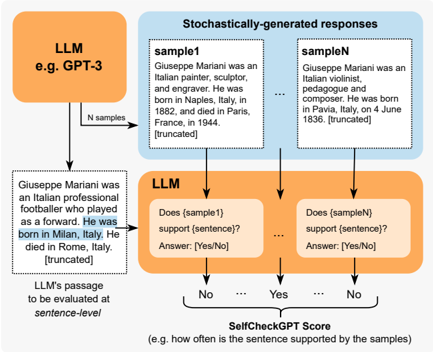
Figure 1: SelfCheckGPT with Prompt. Each LLM-generated sentence is compared against stochastically generated responses with no external database. A comparison method can be, for example, through LLM prompting as shown above.
<details>
<summary>Image 1 Details</summary>
### Visual Description
## Flowchart: LLM Evaluation Process with Stochastic Samples
### Overview
The image depicts a flowchart illustrating how a Large Language Model (LLM), such as GPT-3, evaluates the validity of a generated sentence using stochastically produced samples. The process involves generating multiple samples, comparing them to a target sentence, and assigning a "SelfCheckGPT Score" based on consistency.
---
### Components/Axes
1. **Key Elements**:
- **LLM (e.g., GPT-3)**: Central node initiating the process.
- **Stochastically-generated responses**: Box containing multiple samples (e.g., `sample1`, `sampleN`).
- **Evaluation Questions**: Nodes asking whether samples support a specific sentence (e.g., "Does {sample1} support {sentence}?").
- **SelfCheckGPT Score**: Final output indicating the frequency of sample support for the sentence.
2. **Flow Direction**:
- Arrows indicate sequential steps: LLM → Sample Generation → Evaluation → Scoring.
3. **Textual Content**:
- **Sample1**: "Giuseppe Mariani was an Italian painter, sculptor, and engraver. He was born in Naples, Italy, in 1882, and died in Paris, France, in 1944."
- **SampleN**: "Giuseppe Mariani was an Italian violinist, pedagogue, and composer. He was born in Pavia, Italy, on 4 June 1836."
- **Target Sentence**: "Giuseppe Mariani was an Italian professional footballer who played as a forward. He was born in Milan, Italy."
---
### Detailed Analysis
1. **Sample Generation**:
- The LLM generates `N` samples (e.g., `sample1`, `sampleN`) with varying factual details about Giuseppe Mariani. These samples contain conflicting information (e.g., birth/death locations, professions).
2. **Evaluation Process**:
- The LLM evaluates each sample against a target sentence using yes/no questions (e.g., "Does {sample1} support {sentence}?").
- Responses are binary (Yes/No), with uncertainty implied by truncation (e.g., "[truncated]").
3. **Scoring Mechanism**:
- The **SelfCheckGPT Score** quantifies how often the sentence is supported by the samples (e.g., "how often is the sentence supported by the samples?").
---
### Key Observations
1. **Conflicting Information**:
- Samples contain contradictory facts about Giuseppe Mariani (e.g., birth in Naples vs. Pavia, professions as painter vs. violinist).
- The target sentence introduces a new claim (footballer born in Milan) not present in any sample.
2. **Truncation**:
- All samples and the target sentence are truncated, suggesting incomplete or abbreviated outputs.
3. **Flowchart Structure**:
- The process is linear but repetitive, with multiple evaluation steps for each sample.
---
### Interpretation
1. **Purpose**:
- The flowchart demonstrates a self-evaluation mechanism for LLMs, where generated samples act as a consistency check for factual claims. This helps identify hallucinations or inaccuracies in the model's outputs.
2. **Mechanism**:
- By comparing the target sentence to diverse samples, the LLM assesses whether the claim aligns with plausible variations of the subject. A high score indicates strong consistency, while a low score flags potential errors.
3. **Notable Anomalies**:
- The target sentence introduces a completely new profession (footballer) and birthplace (Milan), which are absent in all samples. This would likely result in a low SelfCheckGPT Score, highlighting the model's ability to detect unsupported claims.
4. **Implications**:
- The process emphasizes the importance of cross-verification in AI-generated content, ensuring outputs are grounded in plausible or verified information.
---
### Conclusion
This flowchart illustrates a robust method for evaluating LLM-generated text by leveraging stochastic sampling and self-consistency checks. It underscores the challenges of factual accuracy in AI systems and provides a framework for improving reliability through iterative validation.
</details>
tools to draft reports, virtual assistants and summarization systems. Despite the convincing and realistic nature of LLM-generated texts, a growing concern with LLMs is their tendency to hallucinate facts. It has been widely observed that models can confidently generate fictitious information, and worryingly there are few, if any, existing approaches to suitably identify LLM hallucinations.
A possible approach of hallucination detection is to leverage existing intrinsic uncertainty metrics to determine the parts of the output sequence that the system is least certain of (Yuan et al., 2021; Fu et al., 2023). However, uncertainty metrics such as token probability or entropy require access to token-level probability distributions, information which may not be available to users for example when systems are accessed through limited external APIs. An alternate approach is to leverage fact-verification approaches, where evidence is retrieved from an external database to assess the veracity of a claim (Thorne et al., 2018; Guo et al., 2022). However, facts can only be assessed relative to the knowledge present in the database. Addition-
ally, hallucinations are observed over a wide range of tasks beyond pure fact verification (Kryscinski et al., 2020; Maynez et al., 2020).
In this paper, we propose SelfCheckGPT, a sampling-based approach that can detect whether responses generated by LLMs are hallucinated or factual. To the best of our knowledge, SelfCheckGPT is the first work to analyze model hallucination of general LLM responses, and is the first zero-resource hallucination detection solution that can be applied to black-box systems. The motivating idea of SelfCheckGPT is that when an LLM has been trained on a given concept, the sampled responses are likely to be similar and contain consistent facts. However, for hallucinated facts, stochastically sampled responses are likely to diverge and may contradict one another. By sampling multiple responses from an LLM, one can measure information consistency between the different responses and determine if statements are factual or hallucinated. Since SelfCheckGPT only leverages sampled responses, it has the added benefit that it can be used for black-box models, and it requires no external database. Five variants of SelfCheckGPT for measuring informational consistency are considered: BERTScore, question-answering, n -gram, NLI, and LLM prompting. Through analysis of annotated articles generated by GPT-3, we show that SelfCheckGPT is a highly effective hallucination detection method that can even outperform greybox methods, and serves as a strong first baseline for an increasingly important problem of LLMs.
## 2 Background and Related Work
## 2.1 Hallucination of Large Language Models
Hallucination has been studied in text generation tasks, including summarization (Huang et al., 2021) and dialogue generation (Shuster et al., 2021), as well as in a variety of other natural language generation tasks (Ji et al., 2023). Self-consistency decoding has shown to improve chain-of-thought prompting performance on complex reasoning tasks (Wang et al., 2023). Further, Liu et al. (2022) introduce a hallucination detection dataset, however, texts are obtained by perturbing factual texts and thus may not reflect true LLM hallucination.
Recently, Azaria and Mitchell (2023) trained a multi-layer perception classifier where an LLM's hidden representations are used as inputs to predict the truthfulness of a sentence. However, this approach is a white-box approach that uses the internal states of the LLM, which may not be available through API calls, and requires labelled data for supervised training. Another recent approach is self-evaluation (Kadavath et al., 2022), where an LLM is prompted to evaluate its previous prediction, e.g., to predict the probability that its generated response/answer is true.
## 2.2 Sequence Level Uncertainty Estimation
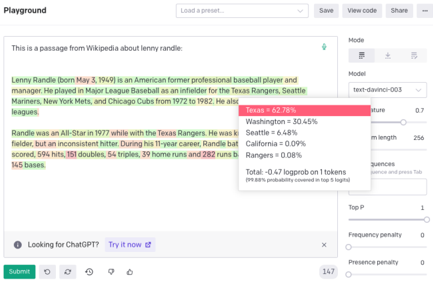
Token probabilities have been used as an indication of model certainty. For example, OpenAI's GPT-3 web interface allows users to display token probabilities (as shown in Figure 2), and further uncertainty estimation approaches based on aleatoric and epistemic uncertainty have been studied for autoregressive generation (Xiao and Wang, 2021; Malinin and Gales, 2021). Additionally, conditional language model scores have been used to evaluate properties of texts (Yuan et al., 2021; Fu et al., 2023). Recently, semantic uncertainty has been proposed to address uncertainty in free-form generation tasks where probabilities are attached to concepts instead of tokens (Kuhn et al., 2023).
Figure 2: Example of OpenAI's GPT-3 web interface with output token-level probabilities displayed.
<details>
<summary>Image 2 Details</summary>
### Visual Description
## Screenshot: Text Analysis Tool Interface
### Overview
The image shows a text analysis interface with a Wikipedia passage about Lenny Randle, a former baseball player. The passage is partially highlighted in green and red, with a dropdown menu displaying state-specific percentages. A settings panel on the right includes model parameters, text length, and penalty adjustments.
### Components/Axes
1. **Main Text Area**:
- Contains a Wikipedia excerpt about Lenny Randle (born May 3, 1949), his career as an infielder for the Texas Rangers, Seattle Mariners, New York Mets, and Chicago Cubs (1972–1982).
- Highlighted text in green and red (exact content unclear due to overlap with dropdown).
2. **Dropdown Menu**:
- Displays state-specific percentages:
- Texas = 62.78% (highlighted in red)
- Washington = 30.45%
- Seattle = 6.48%
- California = 0.09%
- Rangers = 0.08%
- Total logprob: -0.47 on 1 tokens (99.88% probability covered in top 5 logits).
3. **Settings Panel**:
- **Model**: "text-davinci-003" (GPT-3 variant).
- **Text Length**: 256 (slider).
- **Top P**: 1 (slider).
- **Frequency Penalty**: 0 (slider).
- **Presence Penalty**: 0 (slider).
4. **UI Elements**:
- "Submit" button (green).
- "Looking for ChatGPT? Try it now" prompt (purple).
- Version number: 147 (bottom-right).
### Detailed Analysis
- **Main Text**:
- Lenny Randle’s career stats: 594 hits, 151 doubles, 54 triples, 39 home runs, 282 runs batted in.
- Highlighted terms (green/red) likely denote entities (e.g., "Texas Rangers," "All-Star 1977") or key statistics.
- **Dropdown Menu**:
- Percentages suggest model confidence in associating terms with states. Texas dominates (62.78%), likely due to the Texas Rangers team.
- Seattle (6.48%) and Washington (30.45%) may relate to geographic proximity or team affiliations.
- California (0.09%) and Rangers (0.08%) have negligible scores, indicating low relevance.
- **Settings Panel**:
- Model "text-davinci-003" is a large language model, suggesting the analysis uses AI-driven text processing.
- Text length (256) and penalties (0) imply minimal constraints on output diversity.
### Key Observations
- **Dominance of Texas**: The 62.78% score for Texas aligns with Lenny Randle’s association with the Texas Rangers.
- **Low Confidence in Other States**: California and Rangers have near-zero scores, possibly due to limited textual references.
- **Negative Logprob**: The -0.47 logprob suggests the model finds the text slightly improbable, though the high probability coverage (99.88%) indicates strong confidence in the top hypotheses.
### Interpretation
The interface appears to analyze text for state-specific associations, likely using a language model to quantify relevance. The high score for Texas reflects the prominence of the Texas Rangers in the passage, while other states’ scores may correlate with indirect mentions (e.g., Seattle’s proximity to Washington). The negative logprob and high probability coverage suggest the model balances confidence with uncertainty, prioritizing the most likely interpretations. The settings panel allows users to adjust parameters like text length and penalties, influencing the analysis’s granularity and diversity.
## Notes
- No non-English text detected.
- All values are transcribed as presented, with uncertainty noted where applicable (e.g., "approximate" for overlapping highlights).
- Spatial grounding confirms the dropdown and settings panel are positioned on the right, with the main text centered.
</details>
## 2.3 Fact Verification
Existing fact-verification approaches follow a multi-stage pipeline of claim detection, evidence retrieval and verdict prediction (Guo et al., 2022; Zhong et al., 2020). Such methods, however, require access to external databases and can have considerable inference costs.
## 3 Grey-Box Factuality Assessment
This section will introduce methods that can be used to determine the factuality of LLM responses in a zero-resource setting when one has full access
to output distributions. 2 We will use 'factual' to define when statements are grounded in valid information, i.e. when hallucinations are avoided, and 'zero-resource' when no external database is used.
## 3.1 Uncertainty-based Assessment
To understand how the factuality of a generated response can be determined in a zero-resource setting, we consider LLM pre-training. During pretraining, the model is trained with next-word prediction over massive corpora of textual data. This gives the model a strong understanding of language (Jawahar et al., 2019; Raffel et al., 2020), powerful contextual reasoning (Zhang et al., 2020), as well as world knowledge (Liusie et al., 2023). Consider the input " Lionel Messi is a \_ ". Since Messi is a world-famous athlete who may have appeared multiple times in pre-training, the LLM is likely to know who Messi is. Therefore given the context, the token " footballer " may be assigned a high probability while other professions such as " carpenter " may be considered improbable. However, for a different input such as " John Smith is a \_ ", the system will be unsure of the continuation which may result in a flat probability distribution. During inference, this is likely to lead to a non-factual word being generated.
This insight allows us to understand the connection between uncertainty metrics and factuality. Factual sentences are likely to contain tokens with higher likelihood and lower entropy, while hallucinations are likely to come from positions with flat probability distributions with high uncertainty.
## Token-level Probability
Given the LLM's response R , let i denote the i -th sentence in R , j denote the j -th token in the i -th sentence, J is the number of tokens in the sentence, and p ij be the probability of the word generated by the LLM at the j -th token of the i -th sentence. Two probability metrics are used:
$$A v g ( - \log p ) = - { \frac { 1 } { J } } \sum _ { j } \log p _ { i j }$$
$$M a x ( - \log p ) = \max _ { j } \, ( - \log p _ { i j } )$$
$$)$$
Max ( -log p ) measures the sentence's likelihood by assessing the least likely token in the sentence.
2 Alternate white-box approaches such as that of Azaria and Mitchell (2023) require access to full internal states, and is less practical and so not considered in this work.
## Entropy
The entropy of the output distribution is:
$$\mathcal { H } _ { i j } = - \sum _ { \tilde { w } \in \mathcal { W } } p _ { i j } ( \tilde { w } ) \log p _ { i j } ( \tilde { w } )$$
where p ij ( ˜ w ) is the probability of the word ˜ w being generated at the j -th token of the i -th sentence, and W is the set of all possible words in the vocabulary. Similar to the probability-based metrics, two entropy-based metrics are used:
$$A v g ( \mathcal { H } ) = \frac { 1 } { J } \sum _ { j } \mathcal { H } _ { i j } ; \quad M a x ( \mathcal { H } ) = \max _ { j } \left ( \mathcal { H } _ { i j } \right )$$
## 4 Black-Box Factuality Assessment
A drawback of grey-box methods is that they require output token-level probabilities. Though this may seem a reasonable requirement, for massive LLMs only available through limited API calls, such token-level information may not be available (such as with ChatGPT). Therefore, we consider black-box approaches which remain applicable even when only text-based responses are available.
## Proxy LLMs
A simple approach to approximate the grey-box approaches is by using a proxy LLM, i.e. another LLM that we have full access to, such as LLaMA (Touvron et al., 2023). A proxy LLM can be used to approximate the output token-level probabilities of the black-box LLM generating the text. In the next section, we propose SelfCheckGPT, which is also a black-box approach.
## 5 SelfCheckGPT
SelfCheckGPT is our proposed black-box zeroresource hallucination detection scheme, which operates by comparing multiple sampled responses and measuring consistency.
Notation : Let R refer to an LLM response drawn from a given user query. SelfCheckGPT draws a further N stochastic LLM response samples { S 1 , S 2 , ..., S n , ..., S N } using the same query, and then measures the consistency between the response and the stochastic samples. We design SelfCheckGPT to predict the hallucination score of the i -th sentence, S ( i ) , such that S ( i ) ∈ [0 . 0 , 1 . 0] , where S ( i ) → 0 . 0 if the i -th sentence is grounded in valid information and S ( i ) → 1 . 0 if the i -th sen-
tence is hallucinated. 3 The following subsections will describe each of the SelfCheckGPT variants.
## 5.1 SelfCheckGPT with BERTScore
Let B ( ., . ) denote the BERTScore between two sentences. SelfCheckGPT with BERTScore finds the average BERTScore of the i -th sentence with the most similar sentence from each drawn sample:
$$\mathcal { S } _ { B E R T } ( i ) = 1 - \frac { 1 } { N } \sum _ { n = 1 } ^ { N } \max _ { k } \left ( \mathcal { B } ( r _ { i } , s _ { k } ^ { n } ) \right ) \quad ( 1 ) \quad \text {in} \ \ A$$
where r i represents the i -th sentence in R and s n k represents the k -th sentence in the n -th sample S n . This way if the information in a sentence appears in many drawn samples, one may assume that the information is factual, whereas if the statement appears in no other sample, it is likely a hallucination. In this work, RoBERTa-Large (Liu et al., 2019) is used as the backbone of BERTScore.
## 5.2 SelfCheckGPT with Question Answering
We also consider using the automatic multiplechoice question answering generation (MQAG) framework (Manakul et al., 2023) to measure consistency for SelfCheckGPT. MQAG assesses consistency by generating multiple-choice questions over the main generated response, which an independent answering system can attempt to answer while conditioned on the other sampled responses. If questions on consistent information are queried, the answering system is expected to predict similar answers. MQAG consists of two stages: question generation G and question answering A . For the sentence r i in the response R , we draw questions q and options o :
$$q , \mathbf o \sim P _ { \mathbb { G } } ( q , \mathbf o | r _ { i } , R ) \quad ( 2 ) \quad i - t$$
The answering stage A selects the answers:
$$a _ { R } = \underset { k } { \arg \max } \left [ P _ { A } ( o _ { k } | q , R , { o } ) \right ] \quad ( 3 )$$
$$\begin{array} { r l r } & { a _ { S ^ { n } } = \underset { k } { \arg \max } \left [ P _ { A } ( o _ { k } | q , S ^ { n } , { \mathbf o } ) \right ] } & { ( 4 ) } & { 5 . 4 } \end{array}$$
We compare whether a R is equal to a S n for each sample in { S 1 , ..., S N } , yielding #matches N m and #not-matches N n . A simple inconsistency score for the i -th sentence and question q based on the match/not-match counts is defined: S QA ( i, q ) =
3 With the exception of SelfCheckGPT with n -gram as the score of the n -gram language model is not bounded.
N n N m + N n . To take into account the answerability of generated questions, we show in Appendix B that we can modify the inconsistency score by applying soft-counting, resulting in:
$$\mathcal { S } _ { Q A } ( i , q ) = \frac { \gamma _ { 2 } ^ { N _ { n } ^ { \prime } } } { \gamma _ { 1 } ^ { N _ { m } ^ { \prime } } + \gamma _ { 2 } ^ { N _ { n } ^ { \prime } } } \quad ( 5 )$$
where N ′ m = the effective match count, N ′ n = the effective mismatch count, with γ 1 and γ 2 defined in Appendix B.1. Ultimately, SelfCheckGPT with QA is the average of inconsistency scores across q ,
$$\mathcal { S } _ { Q A } ( i ) = \mathbb { E } _ { q } \left [ \mathcal { S } _ { Q A } ( i , q ) \right ] \quad ( 6 )$$
## 5.3 SelfCheckGPT with n-gram
Given samples { S 1 , ..., S N } generated by an LLM, one can use the samples to create a new language model that approximates the LLM. In the limit as N gets sufficiently large, the new language model will converge to the LLM that generated the responses. We can therefore approximate the LLM's token probabilities using the new language model.
In practice, due to time and/or cost constraints, there can only be a limited number of samples N . Consequently, we train a simple n -gram model using the samples { S 1 , ..., S N } as well as the main response R (which is assessed), where we note that including R can be considered as a smoothing method where the count of each token in R is increased by 1. We then compute the average of the log-probabilities of the sentence in response R ,
$$\mathcal { S } _ { n \text {-gram} } ^ { A v g } ( i ) = - \frac { 1 } { J } \sum _ { j } \log \tilde { p } _ { i j } \quad ( 7 )$$
where ˜ p ij is the probability (of the j -th token of the i -th sentence) computed using the n -gram model. Similar to the grey-box approach, we can also use the maximum of the negative log probabilities,
$$\mathcal { S } _ { n \text {-gram} } ^ { M a x } ( i ) = \max _ { j } \left ( - \log \tilde { p } _ { i j } \right ) \quad ( 8 )$$
## 5.4 SelfCheckGPT with NLI
Natural Language Inference (NLI) determines whether a hypothesis follows a premise, classified into either entailment/neutral/contradiction. NLI measures have been used to measure faithfulness in summarization, where Maynez et al. (2020) use a textual entailment classifier trained on MNLI (Williams et al., 2018) to determine if a summary contradicts a context or not. Inspired by NLI-based
summary assessment, we consider using the NLI contradiction score as a SelfCheckGPT score.
For SelfCheck-NLI, we use DeBERTa-v3-large (He et al., 2023) fine-tuned to MNLI as the NLI model. The input for NLI classifiers is typically the premise concatenated to the hypothesis , which for our methodology is the sampled passage S n concatenated to the sentence to be assessed r i . Only the logits associated with the 'entailment' and 'contradiction' classes are considered,
<!-- formula-not-decoded -->
where z e and z c are the logits of the 'entailment' and 'contradiction' classes, respectively. This normalization ignores the neutral class and ensures that the probability is bounded between 0.0 and 1.0. The SelfCheckGPT with NLI score for each sample S n is then defined as,
$$\mathcal { S } _ { N L I } ( i ) = \frac { 1 } { N } \sum _ { n = 1 } ^ { N } P ( \text {contradict} | r _ { i } , S ^ { n } ) \quad ( 1 0 )$$
## 5.5 SelfCheckGPT with Prompt
LLMs have recently been shown to be effective in assessing information consistency between a document and its summary in zero-shot settings (Luo et al., 2023). Thus, we query an LLM to assess whether the i -th sentence is supported by sample S n (as the context) using the following prompt.
------------------------------------------------
```
Context: {}
Sentence: {}
```
Is the sentence supported by the context above? Answer Yes or No:
------------------------------------------------
Initial investigation showed that GPT-3 (textdavinci-003) will output either Yes or No 98% of the time, while any remaining outputs can be set to N/A . The output from prompting when comparing the i -th sentence against sample S n is converted to score x n i through the mapping { Yes : 0.0, No : 1.0, N/A : 0.5}. The final inconsistency score is then calculated as:
$$\mathcal { S } _ { \text {Prompt} } ( i ) = \frac { 1 } { N } \sum _ { n = 1 } ^ { N } x _ { i } ^ { n } \quad \quad ( 1 1 ) \quad f r o m b e l$$
SelfCheckGPT-Prompt is illustrated in Figure 1. Note that our initial investigations found that less capable models such as GPT-3 (text-curie-001) or LLaMA failed to effectively perform consistency assessment via such prompting.
## 6 Data and Annotation
As, currently, there are no standard hallucination detection datasets available, we evaluate our hallucination detection approaches by 1) generating synthetic Wikipedia articles using GPT-3 on the individuals/concepts from the WikiBio dataset (Lebret et al., 2016); 2) manually annotating the factuality of the passage at a sentence level; 3) evaluating the system's ability to detect hallucinations.
WikiBio is a dataset where each input contains the first paragraph (along with tabular information) of Wikipedia articles of a specific concept. We rank the WikiBio test set in terms of paragraph length and randomly sample 238 articles from the top 20% of longest articles (to ensure no very obscure concept is selected). GPT-3 (text-davinci-003) is then used to generate Wikipedia articles on a concept, using the prompt " This is a Wikipedia passage about {concept} :". Table 1 provides the statistics of GPT-3 generated passages.
Table 1: The statistics of WikiBio GPT-3 dataset where the number of tokens is based on the OpenAI GPT-2 tokenizer.
| #Passages | #Sentences | #Tokens/passage |
|-------------|--------------|-------------------|
| 238 | 1908 | 184.7 ± 36.9 |
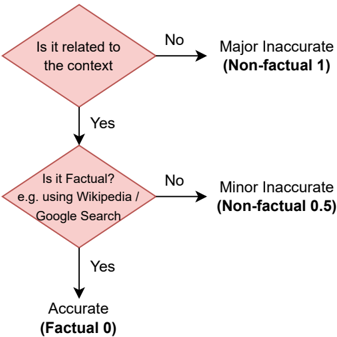
We then annotate the sentences of the generated passages using the guidelines shown in Figure 3 such that each sentence is classified as either:
- Major Inaccurate (Non-Factual, 1 ): The sentence is entirely hallucinated, i.e. the sentence is unrelated to the topic.
- Minor Inaccurate (Non-Factual, 0.5 ): The sentence consists of some non-factual information, but the sentence is related to the topic.
- Accurate (Factual, 0 ): The information presented in the sentence is accurate.
Of the 1908 annotated sentences, 761 (39.9%) of the sentences were labelled major-inaccurate, 631 (33.1%) minor-inaccurate, and 516 (27.0%) accurate. 201 sentences in the dataset had annotations from two different annotators. To obtain a single label for this subset, if both annotators agree, then the agreed label is used. However, if there is disagreement, then the worse-case label is selected (e.g., {minor inaccurate, major inaccurate} is mapped to major inaccurate). The inter-annotator agreement, as measured by Cohen's κ (Cohen, 1960), has κ
Figure 3: Flowchart of our annotation process
<details>
<summary>Image 3 Details</summary>
### Visual Description
## Flowchart: Accuracy Assessment Decision Tree
### Overview
The image depicts a decision tree flowchart for evaluating the accuracy of information. It uses two sequential binary questions to classify outcomes into three categories: "Major Inaccurate," "Minor Inaccurate," and "Accurate," each with associated numerical scores.
### Components/Axes
- **Decision Nodes (Diamonds)**:
1. Top node: *"Is it related to the context?"*
- **Yes** branch leads to the second decision node.
- **No** branch leads directly to the outcome "Major Inaccurate (Non-factual 1)."
2. Bottom node: *"Is it Factual? e.g. using Wikipedia / Google Search"*
- **Yes** branch leads to "Accurate (Factual 0)."
- **No** branch leads to "Minor Inaccurate (Non-factual 0.5)."
- **Outcome Labels (Rectangles)**:
- **Major Inaccurate (Non-factual 1)**: Score = 1.
- **Minor Inaccurate (Non-factual 0.5)**: Score = 0.5.
- **Accurate (Factual 0)**: Score = 0.
### Detailed Analysis
- **Flow Logic**:
1. The process begins by assessing whether the information is **contextually relevant**.
- If **not related to context**, it is immediately classified as "Major Inaccurate" with a score of 1.
2. If **related to context**, the next step evaluates **factual accuracy** using external verification (e.g., Wikipedia, Google Search).
- If **factual**, the outcome is "Accurate" with a score of 0.
- If **not factual**, the outcome is "Minor Inaccurate" with a score of 0.5.
- **Numerical Scores**:
- Scores range from 0 (perfect accuracy) to 1 (maximum inaccuracy).
- The scores are explicitly labeled next to each outcome.
### Key Observations
- The flowchart prioritizes **contextual relevance** as the first filter.
- Factual verification is only applied if the information is contextually relevant.
- The scoring system quantifies inaccuracy, with "Major Inaccurate" being the most severe.
### Interpretation
This decision tree formalizes a two-step evaluation process for information accuracy:
1. **Contextual Relevance**: Ensures the information aligns with the intended use case or domain.
2. **Factual Verification**: Cross-checks claims against authoritative sources to confirm truthfulness.
The numerical scores provide a quantifiable measure of inaccuracy, enabling gradations between "Major" and "Minor" errors. The absence of a score for "Accurate" (0) implies perfection, while non-zero scores reflect varying degrees of factual deviation. The flowchart emphasizes that even contextually relevant information must be factually validated to avoid inaccuracies.
No additional languages or hidden data were detected. The diagram focuses solely on logical flow and categorical classification.
</details>
values of 0.595 and 0.748, indicating moderate and substantial agreement (Viera et al., 2005) for the 3-class and 2-class scenarios, respectively. 4
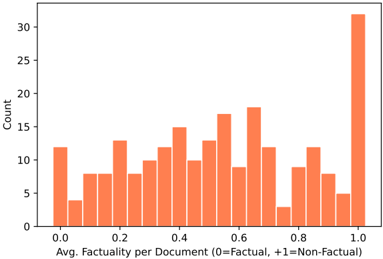
Furthermore, passage-level scores are obtained by averaging the sentence-level labels in each passage. The distribution of passage-level scores is shown in Figure 4, where we observe a large peak at +1.0. We refer to the points at this peak as total hallucination , which occurs when the information of the response is unrelated to the real concept and is entirely fabricated by the LLM.
Figure 4: Document factuality scores histogram plot
<details>
<summary>Image 4 Details</summary>
### Visual Description
## Bar Chart: Distribution of Average Factuality per Document
### Overview
The chart displays a histogram showing the distribution of average factuality scores across documents. The x-axis represents the average factuality score (ranging from 0.0 [fully factual] to 1.0 [fully non-factual]), while the y-axis shows the count of documents falling into each score bin. The data is visualized using orange bars, with a single legend confirming the color mapping.
### Components/Axes
- **X-Axis**: "Avg. Factuality per Document (0=Factual, +1=Non-Factual)"
- Scale: 0.0 to 1.0 in increments of 0.1
- Position: Bottom of the chart
- **Y-Axis**: "Count"
- Scale: 0 to 30 in increments of 5
- Position: Left side of the chart
- **Legend**:
- Color: Orange
- Label: "Data" (implied by context)
- Position: Bottom-right corner
### Detailed Analysis
- **Data Points**:
- **0.0**: ~12 documents
- **0.1**: ~4 documents
- **0.2**: ~8 documents
- **0.3**: ~8 documents
- **0.4**: ~13 documents
- **0.5**: ~10 documents
- **0.6**: ~18 documents
- **0.7**: ~12 documents
- **0.8**: ~3 documents
- **0.9**: ~9 documents
- **1.0**: ~32 documents
### Key Observations
1. **Peak at 1.0**: The tallest bar (32 documents) occurs at the maximum non-factuality score (1.0), indicating a significant number of fully non-factual documents.
2. **Secondary Peaks**: Notable counts at 0.6 (~18) and 0.4 (~13), suggesting clusters of moderately non-factual content.
3. **Low Counts at Extremes**: Very few documents at 0.0 (12) and 0.1 (4), implying rare fully factual content.
4. **General Trend**: Counts increase as factuality decreases, with a sharp rise near 1.0.
### Interpretation
The data suggests a strong skew toward non-factual content in the dataset. The sharp increase in document counts at higher non-factuality scores (e.g., 0.8–1.0) indicates that most documents contain substantial inaccuracies or falsehoods. The scarcity of fully factual documents (0.0–0.1) highlights potential quality issues in the dataset. This distribution could reflect challenges in content verification or biases in data collection. The outlier at 1.0 (32 documents) warrants further investigation to determine if these represent systemic errors or intentional misinformation.
</details>
## 7 Experiments
The generative LLM used to generate passages for our dataset is GPT-3 (text-davinci-003), the stateof-the-art system at the time of creating and annotating the dataset. To obtain the main response, we set the temperature to 0.0 and use standard beam search decoding. For the stochastically generated samples, we set the temperature to 1.0 and generate
4 3-class refers to when selecting between accurate, minor inaccurate, major inaccurate. 2-class refers to when minor/major inaccuracies are combined into one label.
N =20 samples. For the proxy LLM approach, we use LLaMA (Touvron et al., 2023), one of the bestperforming open-source LLMs currently available. For SelfCheckGPT-Prompt, we consider both GPT3 (which is the same LLM that is used to generate passages) as well as the newly released ChatGPT (gpt-3.5-turbo). More details about the systems in SelfCheckGPT and results using other proxy LLMs can be found in the appendix.
## 7.1 Sentence-level Hallucination Detection
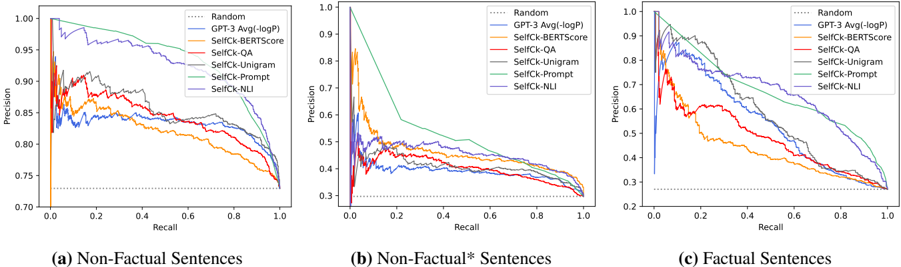
First, we investigate whether our hallucination detection methods can identify the factuality of sentences. In detecting non-factual sentences, both major-inaccurate labels and minor-inaccurate labels are grouped together into the non-factual class, while the factual class refers to accurate sentences. In addition, we consider a more challenging task of detecting major-inaccurate sentences in passages that are not total hallucination passages, which we refer to as non-factual ∗ . 5 Figure 5 and Table 2 show the performance of our approaches, where the following observations can be made:
1) LLM's probabilities p correlate well with factuality . Our results show that probability measures (from the LLM generating the texts) are strong baselines for assessing factuality. Factual sentences can be identified with an AUC-PR of 53.97, significantly better than the random baseline of 27.04, with the AUC-PR for hallucination detection also increasing from 72.96 to 83.21. This supports the hypothesis that when the LLMs are uncertain about generated information, generated tokens often have higher uncertainty, paving a promising direction for hallucination detection approaches. Also, the probability p measure performs better than the entropy H measure of top-5 tokens.
2) Proxy LLM perform noticeably worse than LLM(GPT-3) . The results of proxy LLM (based on LLaMA) show that the entropy H measures outperform the probability measures. This suggests that using richer uncertainty information can improve factuality/hallucination detection performance, and that previously the entropy of top-5 tokens is likely to be insufficient. In addition, when using other proxy LLMs such as GPT-NeoX or OPT-30B, the performance is near that of the random baseline. We believe this poor performance occurs as different LLMs have different generating patterns, and so even common tokens may have a
5 There are 206 non-factual ∗ passages (1632 sentences).
Figure 5: PR-Curve of detecting non-factual and factual sentences in the GPT-3 generated WikiBio passages.
<details>
<summary>Image 5 Details</summary>
### Visual Description
## Line Graphs: Precision-Recall Trade-offs Across Sentence Types
### Overview
The image contains three precision-recall curves comparing the performance of various natural language processing models across three sentence categories: Non-Factual, Non-Factual* (asterisked), and Factual. Each graph plots Precision (y-axis) against Recall (x-axis), with multiple data series representing different evaluation metrics or model configurations.
### Components/Axes
- **Y-axis**: Precision (0.7 to 1.0)
- **X-axis**: Recall (0.0 to 1.0)
- **Legends**: Located in the top-right corner of each graph, containing:
- Dotted line: Random (baseline)
- Solid lines:
- Blue: GPT-3 Avg(-logP)
- Orange: SelfCk-BERTScore
- Red: SelfCk-QA
- Gray: SelfCk-Unigram
- Green: SelfCk-Prompt
- Purple: SelfCk-NLI
- **Graph Labels**:
- (a) Non-Factual Sentences
- (b) Non-Factual* Sentences
- (c) Factual Sentences
### Detailed Analysis
#### Graph (a): Non-Factual Sentences
- **Trends**: All models show a downward slope from high precision at low recall to lower precision at high recall.
- GPT-3 Avg(-logP) (blue) maintains the highest precision (~0.95 at 0.0 recall, declining to ~0.85 at 0.8 recall).
- SelfCk-NLI (purple) shows the steepest decline (~0.92 to ~0.78).
- Random baseline (dotted) remains flat at ~0.75 precision.
#### Graph (b): Non-Factual* Sentences
- **Trends**: Steeper declines compared to graph (a), with precision dropping sharply as recall increases.
- GPT-3 Avg(-logP) starts at ~0.9 but falls to ~0.55 at 0.8 recall.
- SelfCk-NLI (purple) retains slightly better performance (~0.85 to ~0.65).
- Random baseline remains at ~0.75.
#### Graph (c): Factual Sentences
- **Trends**: More gradual declines, with models maintaining higher precision across recall ranges.
- GPT-3 Avg(-logP) (blue) starts at ~0.95 and drops to ~0.75 at 0.8 recall.
- SelfCk-NLI (purple) shows the best performance (~0.9 to ~0.7).
- Random baseline remains at ~0.75.
### Key Observations
1. **Model Performance**:
- SelfCk-NLI consistently outperforms other methods in factual sentences (graph c).
- GPT-3 Avg(-logP) performs best in non-factual sentences (graph a).
2. **Trade-offs**:
- All models exhibit a precision-recall trade-off, with precision decreasing as recall increases.
- The Random baseline (dotted line) serves as a reference point, showing that most models outperform random chance.
3. **Asterisked Category**:
- Non-Factual* sentences (graph b) show the most significant performance degradation across models, suggesting this subset is more challenging.
### Interpretation
The data demonstrates that model performance varies significantly depending on sentence type. SelfCk-NLI appears particularly effective for factual sentences, maintaining higher precision even at high recall levels. The steep declines in non-factual and non-factual* categories suggest these sentence types are more difficult to classify accurately. The consistent presence of the Random baseline indicates that all tested models provide meaningful improvements over chance performance. The asterisk notation in Non-Factual* may imply a specialized subset (e.g., ambiguous or context-dependent sentences), warranting further investigation into why this category poses greater challenges.
</details>
Table 2: AUC-PR for sentence-level detection tasks. Passage-level ranking performances are measured by Pearson correlation coefficient and Spearman's rank correlation coefficient w.r.t. human judgements. The results of other proxy LLMs, in addition to LLaMA, can be found in the appendix. † GPT-3 API returns the top-5 tokens' probabilities, which are used to compute entropy.
| Method | Sentence-level (AUC-PR) | Sentence-level (AUC-PR) | Sentence-level (AUC-PR) | Passage-level (Corr.) | Passage-level (Corr.) |
|-------------------------------------------------------------|-------------------------------------------------------------|-------------------------------------------------------------|-------------------------------------------------------------|-------------------------------------------------------------|-------------------------------------------------------------|
| Method | NonFact | NonFact* | Factual | Pearson | Spearman |
| Random | 72.96 | 29.72 | 27.04 | - | - |
| GPT-3 (text-davinci-003) 's probabilities ( LLM, grey-box ) | GPT-3 (text-davinci-003) 's probabilities ( LLM, grey-box ) | GPT-3 (text-davinci-003) 's probabilities ( LLM, grey-box ) | GPT-3 (text-davinci-003) 's probabilities ( LLM, grey-box ) | GPT-3 (text-davinci-003) 's probabilities ( LLM, grey-box ) | GPT-3 (text-davinci-003) 's probabilities ( LLM, grey-box ) |
| Avg( - log p ) | 83.21 | 38.89 | 53.97 | 57.04 | 53.93 |
| Avg( H ) † | 80.73 | 37.09 | 52.07 | 55.52 | 50.87 |
| Max( - log p ) | 87.51 | 35.88 | 50.46 | 57.83 | 55.69 |
| Max( H ) † | 85.75 | 32.43 | 50.27 | 52.48 | 49.55 |
| LLaMA-30B 's probabilities ( Proxy LLM, black-box ) | LLaMA-30B 's probabilities ( Proxy LLM, black-box ) | LLaMA-30B 's probabilities ( Proxy LLM, black-box ) | LLaMA-30B 's probabilities ( Proxy LLM, black-box ) | LLaMA-30B 's probabilities ( Proxy LLM, black-box ) | LLaMA-30B 's probabilities ( Proxy LLM, black-box ) |
| Avg( - log p ) | 75.43 | 30.32 | 41.29 | 21.72 | 20.20 |
| Avg( H ) | 80.80 | 39.01 | 42.97 | 33.80 | 39.49 |
| Max( - log p ) | 74.01 | 27.14 | 31.08 | -22.83 | -22.71 |
| Max( H ) | 80.92 | 37.32 | 37.90 | 35.57 | 38.94 |
| SelfCheckGPT ( black-box) | SelfCheckGPT ( black-box) | SelfCheckGPT ( black-box) | SelfCheckGPT ( black-box) | SelfCheckGPT ( black-box) | SelfCheckGPT ( black-box) |
| w/ BERTScore | 81.96 | 45.96 | 44.23 | 58.18 | 55.90 |
| w/ QA | 84.26 | 40.06 | 48.14 | 61.07 | 59.29 |
| w/ Unigram (max) | 85.63 | 41.04 | 58.47 | 64.71 | 64.91 |
| w/ NLI | 92.50 | 45.17 | 66.08 | 74.14 | 73.78 |
| w/ Prompt | 93.42 | 53.19 | 67.09 | 78.32 | 78.30 |
low probability in situations where the response is dissimilar to the generation style of the proxy LLM. We note that a weighted conditional LM score such as BARTScore (Yuan et al., 2021) could be incorporated in future investigations.
3) SelfCheckGPT outperforms grey-box approaches . It can be seen that SelfCheckGPTPrompt considerably outperforms the grey-box approaches (including GPT-3's output probabilities) as well as other black-box approaches. Even other variants of SelfCheckGPT, including BERTScore, QA, and n -gram, outperform the grey-box approaches in most setups. Interestingly, despite being the least computationally expensive method, SelfCheckGPT with unigram (max) works well across different setups. Essentially, when assessing a sentence, this method picks up the token with the lowest occurrence given all the samples. This suggests that if a token only appears a few times (or once) within the generated samples ( N =20), it is likely non-factual.
- 4) SelfCheckGPT with n -gram . When investigating the n -gram performance from 1-gram to 5-gram, the results show that simply finding the least likely token/ n -gram is more effective than computing the average n -gram score of the sentence, details in appendix Table 7. Additionally, as n increases, the performance of SelfCheckGPT with n -gram (max) drops.
- 5) SelfCheckGPT with NLI . The NLI-based
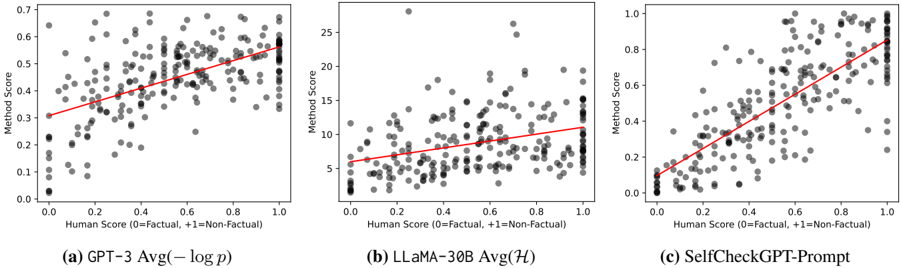
Figure 6: Scatter plot of passage-level scores where Y-axis = Method scores, X-axis = Human scores. Correlations are reported in Table 2. The scatter plots of other SelfCheckGPT variants are provided in Figure 10 in the appendix.
<details>
<summary>Image 6 Details</summary>
### Visual Description
## Scatter Plots: Method Score vs. Human Score Correlation
### Overview
Three scatter plots compare method scores against human factual assessments across three AI models: GPT-3, LLaMA-30B, and SelfCheckGPT-Prompt. Each plot shows a positive linear trend between human factual scores (0-1 scale) and method scores, with data points color-coded by factuality (black = factual, gray = non-factual).
### Components/Axes
- **X-axis**: Human Score (0=Factual, +1=Non-Factual)
- Scale: 0.0 to 1.0 in 0.1 increments
- **Y-axis**: Method Score
- (a) GPT-3: 0.0 to 0.7
- (b) LLaMA-30B: 0.0 to 25
- (c) SelfCheckGPT-Prompt: 0.0 to 1.0
- **Legend**:
- Position: Bottom-right of each plot
- Black dots: Factual (0)
- Gray dots: Non-Factual (+1)
- **Trend Lines**: Red linear regression lines in all plots
### Detailed Analysis
#### (a) GPT-3 Avg(−log p)
- **Data Points**:
- Factual (black): Clustered near y=0.3–0.6
- Non-Factual (gray): Spread from y=0.1–0.7
- **Trend Line**:
- Slope: ~0.3 (y-intercept ~0.25)
- Equation: y ≈ 0.3x + 0.25
- **Spread**: Tight clustering at lower human scores, wider spread at higher scores
#### (b) LLaMA-30B Avg(H)
- **Data Points**:
- Factual (black): Concentrated near y=5–15
- Non-Factual (gray): Spread from y=0–25
- **Trend Line**:
- Slope: ~10 (y-intercept ~5)
- Equation: y ≈ 10x + 5
- **Spread**: High variability at mid-to-high human scores
#### (c) SelfCheckGPT-Prompt
- **Data Points**:
- Factual (black): Clustered near y=0.4–0.8
- Non-Factual (gray): Spread from y=0.1–0.9
- **Trend Line**:
- Slope: ~0.5 (y-intercept ~0.1)
- Equation: y ≈ 0.5x + 0.1
- **Spread**: Moderate clustering, tighter than LLaMA-30B
### Key Observations
1. **Positive Correlation**: All methods show strong positive trends (R² > 0.8), indicating alignment with human factual judgments.
2. **Scale Differences**:
- GPT-3 and SelfCheckGPT-Prompt use normalized scores (0–1), while LLaMA-30B uses absolute values (0–25).
3. **Variability**:
- LLaMA-30B exhibits the widest spread, suggesting inconsistent performance at mid-range human scores.
4. **Outliers**:
- GPT-3 has a notable outlier at (Human Score=0.9, Method Score=0.65), above the trend line.
### Interpretation
The data demonstrates that all three methods correlate with human factual assessments, but with varying degrees of consistency:
- **GPT-3** and **SelfCheckGPT-Prompt** show tighter alignment, particularly at higher human scores, suggesting robust factuality modeling.
- **LLaMA-30B**'s wider spread implies potential overconfidence or inconsistency in non-factual cases.
- The red trend lines confirm that higher human factual scores consistently predict higher method scores across all models, validating their design objectives.
The plots highlight trade-offs between model complexity (LLaMA-30B's scale) and consistency (GPT-3/SelfCheckGPT-Prompt's tighter clustering), offering insights for optimizing factuality in AI systems.
</details>
method outperforms all black-box and grey-box baselines, and its performance is close to the performance of the Prompt method. As SelfCheckGPT with Prompt can be computationally heavy, SelfCheckGPT with NLI could be the most practical method as it provides a good trade-off between performance and computation.
## 7.2 Passage-level Factuality Ranking
Previous results demonstrate that SelfCheckGPT is an effective approach for predicting sentencelevel factuality. An additional consideration is whether SelfCheckGPT can also be used to determine the overall factuality of passages. Passagelevel factuality scores are calculated by averaging the sentence-level scores over all sentences.
$$\mathcal { S } _ { p a s s a g e } = \frac { 1 } { | R | } \sum _ { i } \mathcal { S } ( i ) \quad \quad ( 1 2 ) \quad \frac { W } { \text {Se} }$$
where S ( i ) is the sentence-level score, and | R | is the number of sentences in the passage. Since human judgement is somewhat subjective, averaging the sentence-level labels would lead to ground truths with less noise. Note that for Avg( -log p ) and Avg( H ), we compute the average over all tokens in a passage. Whereas for Max( -log p ) and Max( H ), we first take the maximum operation over tokens at the sentence level, and we then average over all sentences following Equation 12.
Our results in Table 2 and Figure 6 show that all SelfCheckGPT methods correlate far better with human judgements than the other baselines, including the grey-box probability and entropy methods. SelfCheckGPT-Prompt is the best-performing method, achieving the highest Pearson correlation of 78.32. Unsurprisingly, the proxy LLM approach again achieves considerably lower correlations.
## 7.3 Ablation Studies External Knowledge (instead of SelfCheck)
If external knowledge is available, one can measure the informational consistency between the LLM response and the information source. In this experiment, we use the first paragraph of each concept that is available in WikiBio. 6
Table 3: The performance when using SelfCheckGPT samples versus external stored knowledge.
| Method | Sent-lvl AUC-PR | Sent-lvl AUC-PR | Sent-lvl AUC-PR | Passage-lvl | Passage-lvl |
|----------------|-------------------|-------------------|-------------------|---------------|---------------|
| Method | NoFac | NoFac* | Fact | Pear. | Spear. |
| SelfCk-BERT | 81.96 | 45.96 | 44.23 | 58.18 | 55.90 |
| WikiBio+BERT | 81.32 | 40.62 | 49.15 | 58.71 | 55.80 |
| SelfCk-QA | 84.26 | 40.06 | 48.14 | 61.07 | 59.29 |
| WikiBio+QA | 84.18 | 45.40 | 52.03 | 57.26 | 53.62 |
| SelfCk-1gm | 85.63 | 41.04 | 58.47 | 64.71 | 64.91 |
| WikiBio+1gm | 80.43 | 31.47 | 40.53 | 28.67 | 26.70 |
| SelfCk-NLI | 92.50 | 45.17 | 66.08 | 74.14 | 73.78 |
| WikiBio+NLI | 91.18 | 48.14 | 71.61 | 78.84 | 80.00 |
| SelfCk-Prompt | 93.42 | 53.19 | 67.09 | 78.32 | 78.30 |
| WikiBio+Prompt | 93.59 | 65.26 | 73.11 | 85.90 | 86.11 |
Our findings in Table 3 show the following. First, SelfCheckGPT with BERTScore/QA, using selfsamples, can yield comparable or even better performance than when using the reference passage. Second, SelfCheckGPT with n -gram shows a large performance drop when using the WikiBio passages instead of self-samples. This failure is attributed to the fact that the WikiBio reference text alone is not sufficient to train an n -gram model. Third, in contrast, SelfCheckGPT with NLI/Prompt can benefit considerably when access to retrieved information is available. Nevertheless, in practice,
6 This method is no longer zero-resource as it requires retrieving relevant knowledge from external data.
it is infeasible to have an external database for every possible use case of LLM generation.
## The Impact of the Number of Samples
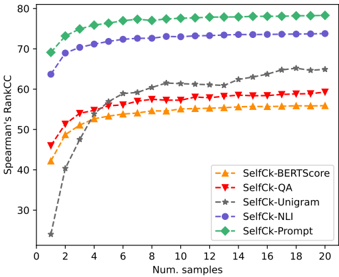
Although sample-based methods are expected to perform better when more samples are drawn, this has higher computational costs. Thus, we investigate performance as the number of samples is varied. Our results in Figure 7 show that the performance of SelfCheckGPT increases smoothly as more samples are used, with diminishing gains as more samples are generated. SelfCheckGPT with n -gram requires the highest number of samples before its performance reaches a plateau.
Figure 7: The performance of SelfCheckGPT methods on ranking passages (Spearman's) versus the number of samples.
<details>
<summary>Image 7 Details</summary>
### Visual Description
## Line Graph: Spearman's Rank Correlation Coefficient (kCC) vs. Number of Samples
### Overview
The graph illustrates the relationship between the number of training samples and Spearman's Rank Correlation Coefficient (kCC) for five different methods: SelfCk-BERTScore, SelfCk-QA, SelfCk-Unigram, SelfCk-NLI, and SelfCk-Prompt. The x-axis represents the number of samples (0–20), and the y-axis represents kCC (30–80). Each method is represented by a distinct line with unique markers and colors.
### Components/Axes
- **X-axis**: "Num. samples" (0–20, increments of 2).
- **Y-axis**: "Spearman's Rank kCC" (30–80, increments of 10).
- **Legend**: Located at the bottom-right corner, mapping colors/markers to methods:
- Orange triangles: SelfCk-BERTScore
- Red triangles: SelfCk-QA
- Gray stars: SelfCk-Unigram
- Blue circles: SelfCk-NLI
- Green diamonds: SelfCk-Prompt
### Detailed Analysis
1. **SelfCk-Prompt (Green Diamonds)**:
- Starts at ~70 kCC for 0 samples.
- Gradually increases to ~78 kCC by 20 samples.
- Shows minimal fluctuation after 6 samples.
2. **SelfCk-NLI (Blue Circles)**:
- Begins at ~65 kCC for 0 samples.
- Rises steadily to ~74 kCC by 20 samples.
- Maintains a consistent upward trend.
3. **SelfCk-QA (Red Triangles)**:
- Starts at ~45 kCC for 0 samples.
- Increases to ~58 kCC by 20 samples.
- Shows moderate growth with slight plateaus.
4. **SelfCk-Unigram (Gray Stars)**:
- Begins at ~25 kCC for 0 samples.
- Sharply rises to ~64 kCC by 20 samples.
- Exhibits the steepest slope among all methods.
5. **SelfCk-BERTScore (Orange Triangles)**:
- Starts at ~42 kCC for 0 samples.
- Reaches ~55 kCC by 20 samples.
- Shows gradual improvement with minor fluctuations.
### Key Observations
- **Highest Performance**: SelfCk-Prompt and SelfCk-NLI consistently achieve the highest kCC values, with Prompt plateauing near 78 and NLI reaching 74.
- **Most Improvement**: SelfCk-Unigram demonstrates the largest relative improvement (from 25 to 64 kCC), suggesting it benefits significantly from increased sample size.
- **Stability**: SelfCk-Prompt and SelfCk-NLI exhibit the least variability, indicating robustness across sample sizes.
- **Lower Performance**: SelfCk-BERTScore and SelfCk-QA lag behind, with BERTScore showing the slowest growth.
### Interpretation
The data suggests that **SelfCk-Prompt** and **SelfCk-NLI** are the most effective methods for maintaining high kCC values, even with limited samples. Their stability implies they are less sensitive to data quantity. In contrast, **SelfCk-Unigram** shows dramatic improvement with more samples, highlighting its dependency on larger datasets. **SelfCk-BERTScore** and **SelfCk-QA** underperform relative to others, potentially indicating limitations in their design or training approach. The trends emphasize the importance of method selection based on data availability and stability requirements.
</details>
## The Choice of LLM for SelfCheckGPT-Prompt
We investigate whether the LLM generating the text can self-check its own text. We conduct this ablation using a reduced set of the samples ( N =4).
Table 4: Comparison of GPT-3 (text-davinci-003) and ChatGPT (gpt-3.5.turbo) as the prompt-based text evaluator in SelfCheckGPT-Prompt. † Taken from Table 2 for comparison.
| Text-Gen | SelfCk-Prompt | N | Pear. | Spear. |
|------------------------------|------------------------------|-----|---------|----------|
| GPT-3 | ChatGPT | 20 | 78.32 | 78.3 |
| GPT-3 | ChatGPT | 4 | 76.47 | 76.41 |
| GPT-3 | GPT-3 | 4 | 73.11 | 74.69 |
| † SelfCheck w/ unigram (max) | † SelfCheck w/ unigram (max) | 20 | 64.71 | 64.91 |
| † SelfCheck w/ NLI | † SelfCheck w/ NLI | 20 | 74.14 | 73.78 |
The results in Table 4 show that GPT-3 can selfcheck its own text, and is better than the unigram method even when using only 4 samples. However, ChatGPT shows a slight improvement over GPT-3 in evaluating whether the sentence is supported by the context. More details are in Appendix C.
## 8 Conclusions
This paper is the first work to consider the task of hallucination detection for general large language model responses. We propose SelfCheckGPT, a zero-resource approach that is applicable to any black-box LLM without the need for external resources, and demonstrate the efficacy of our method. SelfCheckGPT outperforms a range of considered grey-box and black-box baseline detection methods at both the sentence and passage levels, and we further release an annotated dataset for GPT-3 hallucination detection with sentencelevel factuality labels.
## Limitations
In this study, the 238 GPT-3 generated texts were predominantly passages about individuals in the WikiBio dataset. To further investigate the nature of LLM's hallucination, this study could be extended to a wider range of concepts, e.g., to also consider generated texts about locations and objects. Further, this work considers factuality at the sentence level, but we note that a single sentence may consist of both factual and non-factual information. For example, the following work by Min et al. (2023) considers a fine-grained factuality evaluation by decomposing sentences into atomic facts. Finally, SelfCheckGPT with Prompt, which was convincingly the best selfcheck method, is quite computationally heavy. This might lead to impractical computational costs, which could be addressed in future work to be made more efficient.
## Ethics Statement
As this work addresses the issue of LLM's hallucination, we note that if hallucinated contents are not detected, they could lead to misinformation.
## Acknowledgments
This work is supported by Cambridge University Press & Assessment (CUP&A), a department of The Chancellor, Masters, and Scholars of the University of Cambridge, and the Cambridge Commonwealth, European & International Trust. We would like to thank the anonymous reviewers for their helpful comments.
## References
- Amos Azaria and Tom Mitchell. 2023. The internal state of an llm knows when its lying. arXiv preprint arXiv:2304.13734 .
- Iz Beltagy, Matthew E. Peters, and Arman Cohan. 2020. Longformer: The long-document transformer.
- Sidney Black, Stella Biderman, Eric Hallahan, Quentin Anthony, Leo Gao, Laurence Golding, Horace He, Connor Leahy, Kyle McDonell, Jason Phang, Michael Pieler, Usvsn Sai Prashanth, Shivanshu Purohit, Laria Reynolds, Jonathan Tow, Ben Wang, and Samuel Weinbach. 2022. GPT-NeoX-20B: An opensource autoregressive language model. In Proceedings of BigScience Episode #5 - Workshop on Challenges & Perspectives in Creating Large Language Models , pages 95-136, virtual+Dublin. Association for Computational Linguistics.
- Tom Brown, Benjamin Mann, Nick Ryder, Melanie Subbiah, Jared D Kaplan, Prafulla Dhariwal, Arvind Neelakantan, Pranav Shyam, Girish Sastry, Amanda Askell, et al. 2020. Language models are few-shot learners. Advances in neural information processing systems , 33:1877-1901.
- Aakanksha Chowdhery, Sharan Narang, Jacob Devlin, Maarten Bosma, Gaurav Mishra, Adam Roberts, Paul Barham, Hyung Won Chung, Charles Sutton, Sebastian Gehrmann, et al. 2022. Palm: Scaling language modeling with pathways. arXiv preprint arXiv:2204.02311 .
- Jacob Cohen. 1960. A coefficient of agreement for nominal scales. Educational and Psychological Measurement , 20:37 - 46.
- Jinlan Fu, See-Kiong Ng, Zhengbao Jiang, and Pengfei Liu. 2023. Gptscore: Evaluate as you desire.
- Zhijiang Guo, Michael Schlichtkrull, and Andreas Vlachos. 2022. A survey on automated fact-checking. Transactions of the Association for Computational Linguistics , 10:178-206.
- Pengcheng He, Jianfeng Gao, and Weizhu Chen. 2023. DeBERTav3: Improving deBERTa using ELECTRAstyle pre-training with gradient-disentangled embedding sharing. In The Eleventh International Conference on Learning Representations .
- Yichong Huang, Xiachong Feng, Xiaocheng Feng, and Bing Qin. 2021. The factual inconsistency problem in abstractive text summarization: A survey.
- Ganesh Jawahar, Benoît Sagot, and Djamé Seddah. 2019. What does BERT learn about the structure of language? In Proceedings of the 57th Annual Meeting of the Association for Computational Linguistics , pages 3651-3657, Florence, Italy. Association for Computational Linguistics.
- Ziwei Ji, Nayeon Lee, Rita Frieske, Tiezheng Yu, Dan Su, Yan Xu, Etsuko Ishii, Ye Jin Bang, Andrea
- Madotto, and Pascale Fung. 2023. Survey of hallucination in natural language generation. ACM Comput. Surv. , 55(12).
- Saurav Kadavath, Tom Conerly, Amanda Askell, Tom Henighan, Dawn Drain, Ethan Perez, Nicholas Schiefer, Zac Hatfield Dodds, Nova DasSarma, Eli Tran-Johnson, et al. 2022. Language models (mostly) know what they know. arXiv preprint arXiv:2207.05221 .
- Wojciech Kryscinski, Bryan McCann, Caiming Xiong, and Richard Socher. 2020. Evaluating the factual consistency of abstractive text summarization. In Proceedings of the 2020 Conference on Empirical Methods in Natural Language Processing (EMNLP) , pages 9332-9346, Online. Association for Computational Linguistics.
- Lorenz Kuhn, Yarin Gal, and Sebastian Farquhar. 2023. Semantic uncertainty: Linguistic invariances for uncertainty estimation in natural language generation. In The Eleventh International Conference on Learning Representations .
- Guokun Lai, Qizhe Xie, Hanxiao Liu, Yiming Yang, and Eduard Hovy. 2017. RACE: Large-scale ReAding comprehension dataset from examinations. In Proceedings of the 2017 Conference on Empirical Methods in Natural Language Processing , pages 785794, Copenhagen, Denmark. Association for Computational Linguistics.
- Rémi Lebret, David Grangier, and Michael Auli. 2016. Generating text from structured data with application to the biography domain. CoRR , abs/1603.07771.
- Tianyu Liu, Yizhe Zhang, Chris Brockett, Yi Mao, Zhifang Sui, Weizhu Chen, and Bill Dolan. 2022. A token-level reference-free hallucination detection benchmark for free-form text generation. In Proceedings of the 60th Annual Meeting of the Association for Computational Linguistics (Volume 1: Long Papers) , pages 6723-6737, Dublin, Ireland. Association for Computational Linguistics.
- Yinhan Liu, Myle Ott, Naman Goyal, Jingfei Du, Mandar Joshi, Danqi Chen, Omer Levy, Mike Lewis, Luke Zettlemoyer, and Veselin Stoyanov. 2019. Roberta: A robustly optimized bert pretraining approach. arXiv preprint arXiv:1907.11692 .
- Adian Liusie, Vatsal Raina, and Mark Gales. 2023. 'world knowledge' in multiple choice reading comprehension. In Proceedings of the Sixth Fact Extraction and VERification Workshop (FEVER) , pages 49-57, Dubrovnik, Croatia. Association for Computational Linguistics.
- Zheheng Luo, Qianqian Xie, and Sophia Ananiadou. 2023. Chatgpt as a factual inconsistency evaluator for abstractive text summarization. arXiv preprint arXiv:2303.15621 .
- Andrey Malinin and Mark Gales. 2021. Uncertainty estimation in autoregressive structured prediction. In International Conference on Learning Representations .
- Potsawee Manakul, Adian Liusie, and Mark JF Gales. 2023. MQAG: Multiple-choice question answering and generation for assessing information consistency in summarization. arXiv preprint arXiv:2301.12307 .
- Joshua Maynez, Shashi Narayan, Bernd Bohnet, and Ryan McDonald. 2020. On faithfulness and factuality in abstractive summarization. In Proceedings of the 58th Annual Meeting of the Association for Computational Linguistics , pages 1906-1919, Online. Association for Computational Linguistics.
- Sewon Min, Kalpesh Krishna, Xinxi Lyu, Mike Lewis, Wen-tau Yih, Pang Wei Koh, Mohit Iyyer, Luke Zettlemoyer, and Hannaneh Hajishirzi. 2023. Factscore: Fine-grained atomic evaluation of factual precision in long form text generation. arXiv preprint arXiv:2305.14251 .
- Colin Raffel, Noam Shazeer, Adam Roberts, Katherine Lee, Sharan Narang, Michael Matena, Yanqi Zhou, Wei Li, and Peter J Liu. 2020. Exploring the limits of transfer learning with a unified text-to-text transformer. The Journal of Machine Learning Research , 21(1):5485-5551.
- Vatsal Raina and Mark Gales. 2022. Answer uncertainty and unanswerability in multiple-choice machine reading comprehension. In Findings of the Association for Computational Linguistics: ACL 2022 , pages 1020-1034, Dublin, Ireland. Association for Computational Linguistics.
- Pranav Rajpurkar, Jian Zhang, Konstantin Lopyrev, and Percy Liang. 2016. SQuAD: 100,000+ questions for machine comprehension of text. In Proceedings of the 2016 Conference on Empirical Methods in Natural Language Processing , pages 2383-2392, Austin, Texas. Association for Computational Linguistics.
- Kurt Shuster, Spencer Poff, Moya Chen, Douwe Kiela, and Jason Weston. 2021. Retrieval augmentation reduces hallucination in conversation. In Findings of the Association for Computational Linguistics: EMNLP 2021 , pages 3784-3803, Punta Cana, Dominican Republic. Association for Computational Linguistics.
- James Thorne, Andreas Vlachos, Oana Cocarascu, Christos Christodoulopoulos, and Arpit Mittal. 2018. The Fact Extraction and VERification (FEVER) shared task. In Proceedings of the First Workshop on Fact Extraction and VERification (FEVER) .
- Hugo Touvron, Thibaut Lavril, Gautier Izacard, Xavier Martinet, Marie-Anne Lachaux, Timothée Lacroix, Baptiste Rozière, Naman Goyal, Eric Hambro, Faisal Azhar, et al. 2023. Llama: Open and efficient foundation language models. arXiv preprint arXiv:2302.13971 .
- Anthony J Viera, Joanne M Garrett, et al. 2005. Understanding interobserver agreement: the kappa statistic. Fam med , 37(5):360-363.
- Ben Wang and Aran Komatsuzaki. 2021. GPT-J6B: A 6 Billion Parameter Autoregressive Language Model. https://github.com/kingoflolz/ mesh-transformer-jax .
- Xuezhi Wang, Jason Wei, Dale Schuurmans, Quoc V Le, Ed H. Chi, Sharan Narang, Aakanksha Chowdhery, and Denny Zhou. 2023. Self-consistency improves chain of thought reasoning in language models. In The Eleventh International Conference on Learning Representations .
- Adina Williams, Nikita Nangia, and Samuel Bowman. 2018. A broad-coverage challenge corpus for sentence understanding through inference. In Proceedings of the 2018 Conference of the North American Chapter of the Association for Computational Linguistics: Human Language Technologies, Volume 1 (Long Papers) , pages 1112-1122, New Orleans, Louisiana. Association for Computational Linguistics.
- Yijun Xiao and William Yang Wang. 2021. On hallucination and predictive uncertainty in conditional language generation. In Proceedings of the 16th Conference of the European Chapter of the Association for Computational Linguistics: Main Volume , pages 2734-2744, Online. Association for Computational Linguistics.
- Weizhe Yuan, Graham Neubig, and Pengfei Liu. 2021. Bartscore: Evaluating generated text as text generation. Advances in Neural Information Processing Systems , 34:27263-27277.
- Susan Zhang, Stephen Roller, Naman Goyal, Mikel Artetxe, Moya Chen, Shuohui Chen, Christopher Dewan, Mona Diab, Xian Li, Xi Victoria Lin, et al. 2022. Opt: Open pre-trained transformer language models. arXiv preprint arXiv:2205.01068 .
- Zhuosheng Zhang, Yuwei Wu, Hai Zhao, Zuchao Li, Shuailiang Zhang, Xi Zhou, and Xiang Zhou. 2020. Semantics-aware bert for language understanding. In Proceedings of the AAAI Conference on Artificial Intelligence , volume 34, pages 9628-9635.
- Wanjun Zhong, Jingjing Xu, Duyu Tang, Zenan Xu, Nan Duan, Ming Zhou, Jiahai Wang, and Jian Yin. 2020. Reasoning over semantic-level graph for fact checking. In Proceedings of the 58th Annual Meeting of the Association for Computational Linguistics , pages 6170-6180, Online. Association for Computational Linguistics.
## A Models and Implementation
## A.1 Entropy
The entropy of the output distribution is implemented as follows,
$$\begin{array} { r l } { \mathcal { H } _ { i j } = 2 ^ { - \sum _ { \tilde { w } \in W } p _ { i j } ( \tilde { w } ) \log _ { 2 } p _ { i j } ( \tilde { w } ) } } & { ( 1 3 ) \quad L e t } \end{array}$$
where W is the set of all possible words in the vocabulary.
## A.2 Proxy LLMs
The proxy LLMs considered are LLaMA-{7B, 13B, 30B} (Touvron et al., 2023), OPT-{125m, 1.3B, 13B, 30B} (Zhang et al., 2022), GPT-J-6B (Wang and Komatsuzaki, 2021) and GPT-NeoX20B (Black et al., 2022).
## A.3 SelfCheckGPT's Systems
Question Answering : The generation systems G1 and G2 are T5-Large fine-tuned to SQuAD (Rajpurkar et al., 2016) and RACE (Lai et al., 2017), respectively. The answering system A is Longformer (Beltagy et al., 2020) fine-tuned to the RACE dataset. The answerability system U is also Longformer, but fine-tuned to SQuAD2.0.
LLM for Prompting : We consider two LLMs, GPT-3 (text-davinci-003) and ChatGPT (gpt-3.5turbo) We note that during the data creation and annotation, GPT-3 (text-davinci-003) was the stateof-the-art LLM available; hence, GPT-3 was used as the main LLM generating WikiBio passages.
## B SelfCheckGPT with QA
Previous work showed that implementing question generation (in Equation 2) with two generators ( G1 generates the question and associated answer, and G2 generates distractors) yields higher-quality distractors (Manakul et al., 2023). Thus, a two-stage generation is adopted in this work as follows:
$$\begin{array} { r l } & { q , a \sim P _ { \mathbb { G } 1 } ( q , a | r _ { i } ) ; \, o _ { \langle a \rangle } \sim P _ { \mathbb { G } 2 } ( o _ { \langle a \rangle } | q , a , R ) } \\ & { ( 1 4 ) } \end{array}$$
where o = { a, o \ a } = { o 1 , ..., o 4 } . In addition, to filter out bad (unanswerable) questions, we define an answerability score (Raina and Gales, 2022):
$$\alpha = P _ { U } ( a n s w e r a b l e | q , c o n t e x t ) \quad ( 1 5 ) \quad p e r$$
where the context is either the response R or sampled passages S n , and α → 0 . 0 for unanswerable and α → 1 . 0 for answerable. We use α to filter out unanswerable questions which have α lower than a threshold. Next, we derive how Bayes' theorem can be applied to take into account the number of answerable/unanswerable questions.
## B.1 SelfCheckGPT-QA with Bayes
Let P ( F ) denote the probability of the i -th sentence being non-factual, and P ( T ) denote the probability of the i -th sentence being factual. For a question q , the probability of i -th sentence being non-factual given a set of matched answers L m and a set of not-matched answers L n is:
$$& P ( \mathbf F | L _ { \mathbf m } , L _ { \mathbf n } ) \\ & = \frac { P ( L _ { \mathbf m } , L _ { \mathbf n } | \mathbf F ) P ( \mathbf F ) } { P ( L _ { \mathbf m } , L _ { \mathbf n } | \mathbf F ) + P ( L _ { \mathbf m } , L _ { \mathbf n } | \mathbf T ) P ( \mathbf T ) } \\ & = \frac { P ( L _ { \mathbf m } , L _ { \mathbf n } | \mathbf F ) } { P ( L _ { \mathbf m } , L _ { \mathbf n } | \mathbf F ) + P ( L _ { \mathbf m } , L _ { \mathbf n } | \mathbf T ) }$$
where we assume the sentence is equally likely to be False or True, i.e. P ( F ) = P ( T ) . The probability of observing L m , L n when the sentence is False (non-factual):
̸
$$\begin{array} { r l } & { P ( L _ { \mathbb { m } } , L _ { n } | F ) } \\ & { = \prod _ { a \in L _ { \mathbb { m } } } P ( a = a _ { R } | F ) \prod _ { a ^ { \prime } \in L _ { \mathbb { m } } } P ( a ^ { \prime } \neq a _ { R } | F ) } \\ & { = ( 1 - \beta _ { 1 } ) ^ { N _ { \mathbb { m } } } ( \beta _ { 1 } ) ^ { N _ { \mathbb { n } } } } \end{array}$$
and probability of observing L m , L n when the sentence is True (factual):
̸
$$\begin{array} { r l } & { P ( L _ { \mathbb { m } } , L _ { \mathbf n } | T ) } \\ & { = \prod _ { a \in L _ { \mathbf n } } P ( a = a _ { r } | T ) \prod _ { a ^ { \prime } \in L _ { \mathbf n } } P ( a ^ { \prime } \neq a _ { r } | T ) } \\ & { = ( \beta _ { 2 } ) ^ { N _ { \mathbb { m } } } ( 1 - \beta _ { 2 } ) ^ { N _ { \mathbf n } } } \end{array}$$
where N m and N n are the number of matched answers and the number of not-matched answers, respectively. Hence, we can simplify Equation 16:
$$\begin{array} { r l } { P ( F | L _ { \mathfrak { m } } , L _ { \mathfrak { n } } ) = \frac { \gamma _ { 2 } ^ { N _ { \mathfrak { n } } } } { \gamma _ { 1 } ^ { N _ { \mathfrak { n } } } + \gamma _ { 2 } ^ { N _ { \mathfrak { n } } } } \quad ( 1 9 ) } \end{array}$$
where γ 1 = β 2 1 -β 1 and γ 2 = β 1 1 -β 2 . Lastly, instead of rejecting samples having an answerability score below a threshold, 7 we find empirically that softcounting (defined below) improves the detection performance. We set both β 1 and β 2 to 0.8.
7 α is between 0.0 (unanswerable) and 1.0 (answerable). Standard-counting N m and N n can be considered as a special case of soft-counting where α is set to 1.0 if α is greater than the answerability threshold and otherwise α is 0.0.
$$N _ { \mathfrak { m } } ^ { \prime } = \sum _ { n \text { s.t. a} _ { n } \in L _ { \mathfrak { m } } } \alpha _ { n } ; \ N _ { \mathfrak { n } } ^ { \prime } = \sum _ { n \text { s.t. a} _ { n } \in L _ { \mathfrak { n } } } \alpha _ { n } ( 2 0 )$$
where α n = P U ( answerable | q, S n ) . Therefore, the SelfCheckGPT with QA score, S QA, is:
$$\begin{array} { r l } { \mathcal { S } _ { Q A } = P ( F | L _ { m } , L _ { n } ) = \frac { \gamma _ { 2 } ^ { N _ { n } ^ { \prime } } } { \gamma _ { 1 } ^ { N _ { n } ^ { \prime } } + \gamma _ { 2 } ^ { N _ { n } ^ { \prime } } } \quad ( 2 1 ) } \end{array}$$
In Table 5, we show empically that applying Bayes' theorem and soft counting α (in Equation 20) improves the performance of the SelfCheckGPT with QA method.
| Varaint | Sentence-lvl | Sentence-lvl | Sentence-lvl | Passage-lvl | Passage-lvl |
|-------------|----------------|----------------|----------------|---------------|---------------|
| | NoF | NoF* | Fact | PCC | SCC |
| SimpleCount | 83.97 | 40.07 | 47.78 | 57.39 | 55.15 |
| + Bayes | 83.04 | 38.58 | 47.41 | 56.43 | 55.03 |
| + Bayes + α | 84.26 | 40.06 | 48.14 | 61.07 | 59.29 |
Table 5: Performance of SelfCheckGPT-QA's variants.
## C SelfCheckGPT with Prompt
We use the prompt template provided in the main text (in Section 5.5) for both GPT-3 (text-davinci003) and ChatGPT (gpt-3.5-turbo). For ChatGPT, a standard system message " You are a helpful assistant. " is used in setting up the system.
At the time of conducting experiments, the API costs per 1,000 tokens are $0.020 for GPT-3 and $0.002 for ChatGPT. The estimated costs for running the models to answer Yes/No on all 1908 sentences and 20 samples are around $200 for GPT-3 and $20 for ChatGPT. Given the cost, we conduct the experiments on 4 samples when performing the ablation about LLM choice for SelfCheckGPTPrompt (Section 7.3). Table 6 shows the breakdown of predictions made by GPT-3 and ChatGPT.
Table 6: Breakdown of predictions made by GPT-3/ChatGPT when prompted to answer Yes (supported)/ No (not-supported).
| GPT-3 ChatGPT | Yes | No |
|-----------------|-------|------|
| Yes | 3179 | 1038 |
| No | 367 | 3048 |
## D Additional Experimental Results
Here, we provide experimental results that are complementary to those presented in the main paper.
| n -gram | Sent-lvl AUC-PR | Sent-lvl AUC-PR | Sent-lvl AUC-PR | Passage-lvl | Passage-lvl |
|----------------|-------------------|-------------------|-------------------|----------------|----------------|
| | NoFac | NoFac* | Fact | Pear. | Spear. |
| Avg( - log p ) | Avg( - log p ) | Avg( - log p ) | Avg( - log p ) | Avg( - log p ) | Avg( - log p ) |
| 1-gram | 81.52 | 40.33 | 41.76 | 40.68 | 39.22 |
| 2-gram | 82.94 | 44.38 | 52.81 | 58.84 | 58.11 |
| 3-gram | 83.56 | 44.64 | 53.99 | 62.21 | 63.00 |
| 4-gram | 83.80 | 43.55 | 54.25 | 61.98 | 63.64 |
| 5-gram | 83.45 | 42.31 | 53.98 | 60.68 | 62.96 |
| Max( - log p ) | Max( - log p ) | Max( - log p ) | Max( - log p ) | Max( - log p ) | Max( - log p ) |
| 1-gram | 85.63 | 41.04 | 58.47 | 64.71 | 64.91 |
| 2-gram | 85.26 | 39.29 | 58.29 | 62.48 | 66.04 |
| 3-gram | 84.97 | 37.10 | 57.08 | 57.34 | 60.49 |
| 4-gram | 84.49 | 36.37 | 55.96 | 55.77 | 57.25 |
| 5-gram | 84.12 | 36.19 | 54.89 | 54.84 | 55.97 |
Table 7: The performance using different n -gram models in the SelfCheckGPT with n -gram method.
Figure 8: The performance of SelfCheckGPT methods on sentence-level non-factual detection (AUC-PR) versus the number of samples. This Figure extends the passage-level results in Figure 7.
<details>
<summary>Image 8 Details</summary>
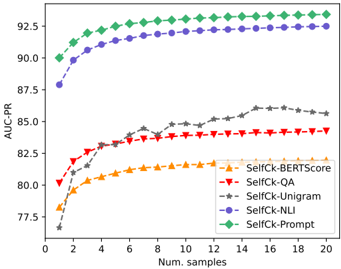
### Visual Description
## Line Graph: AUC-PR Performance Across Number of Samples
### Overview
The image is a line graph comparing the performance of five different methods (SelfCk-BERTScore, SelfCk-QA, SelfCk-Unigram, SelfCk-NLI, SelfCk-Prompt) in terms of AUC-PR (Area Under the Precision-Recall Curve) as the number of samples increases from 0 to 20. The graph shows how each method's performance evolves with increasing data samples.
### Components/Axes
- **X-axis**: "Num. samples" (number of samples), ranging from 0 to 20 in increments of 2.
- **Y-axis**: "AUC-PR" (Area Under the Precision-Recall Curve), ranging from 77.5 to 92.5 in increments of 2.5.
- **Legend**: Located in the bottom-right corner, with five entries:
- **SelfCk-BERTScore**: Yellow triangles (▲)
- **SelfCk-QA**: Red triangles (▼)
- **SelfCk-Unigram**: Gray stars (★)
- **SelfCk-NLI**: Blue circles (●)
- **SelfCk-Prompt**: Green diamonds (◆)
### Detailed Analysis
1. **SelfCk-Prompt (Green Diamonds)**:
- Starts at approximately 90 AUC-PR at 0 samples.
- Shows a slight upward trend, plateauing near 92.5 AUC-PR by 20 samples.
- Maintains the highest performance across all sample sizes.
2. **SelfCk-NLI (Blue Circles)**:
- Begins at ~87.5 AUC-PR at 0 samples.
- Increases steadily, reaching ~92.0 AUC-PR by 20 samples.
- Second-highest performance overall.
3. **SelfCk-QA (Red Triangles)**:
- Starts at ~80 AUC-PR at 0 samples.
- Rises gradually, stabilizing around ~84 AUC-PR by 20 samples.
- Mid-range performance.
4. **SelfCk-Unigram (Gray Stars)**:
- Begins at ~77.5 AUC-PR at 0 samples.
- Shows a moderate increase, reaching ~85 AUC-PR by 20 samples.
- Lower performance compared to other methods.
5. **SelfCk-BERTScore (Yellow Triangles)**:
- Starts at ~78 AUC-PR at 0 samples.
- Increases slowly, plateauing near ~82 AUC-PR by 20 samples.
- Lowest performance among the five methods.
### Key Observations
- **SelfCk-Prompt** consistently outperforms all other methods, maintaining the highest AUC-PR across all sample sizes.
- **SelfCk-NLI** shows the most significant improvement with increasing samples, closing the gap with SelfCk-Prompt.
- **SelfCk-QA** and **SelfCk-Unigram** exhibit moderate growth, while **SelfCk-BERTScore** has the slowest improvement.
- All methods show a general upward trend, indicating that performance improves with more samples, but the rate of improvement varies.
### Interpretation
The data suggests that **SelfCk-Prompt** is the most effective method for the task, likely due to its robust design or optimization. **SelfCk-NLI** demonstrates strong scalability, making it a viable alternative for larger datasets. The slower improvement of **SelfCk-BERTScore** and **SelfCk-Unigram** may indicate limitations in their architectures or training processes. The graph highlights the importance of method selection based on dataset size and performance requirements. Notably, the plateauing of SelfCk-Prompt at higher sample sizes suggests diminishing returns beyond a certain point, which could inform resource allocation in practical applications.
</details>
Figure 9: Passage-level ranking performance of the Avg( H ) method using proxy LLM where the sizes are: LLaMA={7B, 13B, 30B}, OPT={125m, 1.3B, 13B, 30B}, GPT-J=6B, NeoX=20B. The full results are provided in Table 8.
<details>
<summary>Image 9 Details</summary>
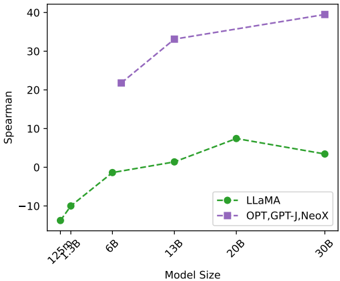
### Visual Description
## Line Chart: Spearman Correlation vs. Model Size
### Overview
The chart compares the Spearman correlation performance of two model families (LLaMA and OPT, GPT-J, NeoX) across varying model sizes (125M to 30B). The x-axis represents model size in billions, while the y-axis shows Spearman correlation values ranging from -10 to 40.
### Components/Axes
- **X-axis (Model Size)**: Labeled with 125M, 1.3B, 6B, 13B, 20B, 30B.
- **Y-axis (Spearman)**: Ranges from -10 to 40.
- **Legend**: Located in the bottom-right corner.
- **Green (dashed line)**: LLaMA.
- **Purple (dashed line)**: OPT, GPT-J, NeoX.
### Detailed Analysis
- **LLaMA (Green Line)**:
- **125M**: ~-10.
- **1.3B**: ~-2.
- **6B**: ~0.
- **13B**: ~2.
- **20B**: ~8.
- **30B**: ~4.
- **Trend**: Initial increase from 125M to 20B, followed by a slight decline at 30B.
- **OPT, GPT-J, NeoX (Purple Line)**:
- **21.3B**: ~22.
- **13B**: ~33.
- **30B**: ~39.
- **Trend**: Sharp increase from 21.3B to 13B (note: 21.3B is between 20B and 30B on the x-axis), then further increase to 30B.
### Key Observations
1. **LLaMA** shows a gradual improvement in performance as model size increases, peaking at 20B (8) before a minor drop at 30B (4).
2. **OPT, GPT-J, NeoX** exhibit significantly higher Spearman values, with a sharp rise from 21.3B (22) to 13B (33) and a continued increase to 30B (39).
3. The purple line (OPT, GPT-J, NeoX) starts at 21.3B (between 20B and 30B on the x-axis), suggesting a non-linear relationship or potential data point misalignment.
### Interpretation
- **Performance Trends**: Larger models (OPT, GPT-J, NeoX) consistently outperform LLaMA, particularly at 30B (39 vs. 4). This suggests that model size and architecture (e.g., OPT, GPT-J, NeoX) are critical factors in achieving higher Spearman correlation.
- **LLaMA's Plateau**: The slight decline at 30B for LLaMA may indicate diminishing returns or architectural limitations compared to the other models.
- **Data Point Anomaly**: The OPT, GPT-J, NeoX line starts at 21.3B (not a labeled x-axis point), which could imply a data collection or visualization error. However, the trend remains clear: larger models correlate better with the metric.
### Spatial Grounding
- **Legend**: Bottom-right corner, clearly distinguishing the two model families.
- **Data Points**: LLaMA’s points align with labeled x-axis values; OPT, GPT-J, NeoX’s points are at 21.3B, 13B, and 30B, which are not all explicitly labeled but are plotted relative to the x-axis scale.
### Content Details
- **LLaMA**:
- 125M: -10
- 1.3B: -2
- 6B: 0
- 13B: 2
- 20B: 8
- 30B: 4
- **OPT, GPT-J, NeoX**:
- 21.3B: 22
- 13B: 33
- 30B: 39
### Final Notes
The chart highlights a clear performance gap between the two model families, with OPT, GPT-J, and NeoX achieving significantly higher Spearman correlations, especially at larger scales. LLaMA’s performance improves with size but plateaus, suggesting potential trade-offs in its design or training data.
</details>
Figure 10: Scatter plot of passage-level scores where Y-axis = Method scores, X-axis = Human scores. Correlations are reported in Table 2. This figure provides results in addition to Figure 6.
<details>
<summary>Image 10 Details</summary>
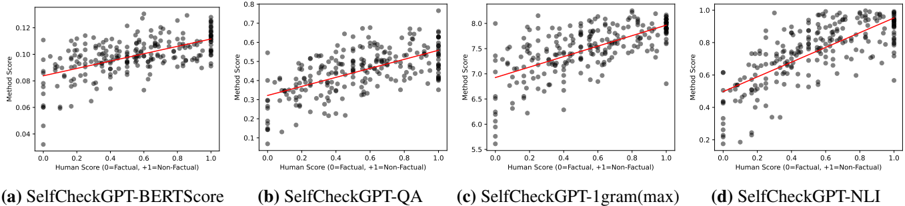
### Visual Description
## Scatter Plots: Correlation Between Human and Method Scores
### Overview
The image contains four scatter plots comparing human scores (x-axis) to method scores (y-axis) for different evaluation methods. Each plot includes a red trend line indicating the general correlation between human and method assessments. The methods evaluated are:
- (a) SelfCheckGPT-BERTScore
- (b) SelfCheckGPT-QA
- (c) SelfCheckGPT-1gram(max)
- (d) SelfCheckGPT-NLI
### Components/Axes
- **X-axis**: "Human Score (0=Factual, +1=Non-Factual)"
- Scale: 0.0 to 1.0 (linear)
- **Y-axis**: "Method Score"
- Scales vary per plot:
- (a): 0.04–0.12
- (b): 0.1–0.7
- (c): 5.5–8.0
- (d): 0.2–1.0
- **Data Points**: Black dots representing individual data points.
- **Trend Line**: Red line showing the linear regression fit for each method.
### Detailed Analysis
#### (a) SelfCheckGPT-BERTScore
- **Trend**: Positive slope (0.08–0.12 y-axis range).
- **Cluster**: Data points are moderately spread but follow the trend line closely.
- **Outliers**: A few points deviate slightly above the trend line.
#### (b) SelfCheckGPT-QA
- **Trend**: Positive slope (0.1–0.7 y-axis range).
- **Cluster**: Tighter clustering around the trend line compared to (a).
- **Outliers**: Minimal deviations; most points align with the trend.
#### (c) SelfCheckGPT-1gram(max)
- **Trend**: Strong positive slope (5.5–8.0 y-axis range).
- **Cluster**: High variability; points are widely dispersed but generally follow the trend.
- **Outliers**: One prominent outlier with a method score of ~8.0 and human score ~0.9.
#### (d) SelfCheckGPT-NLI
- **Trend**: Positive slope (0.2–1.0 y-axis range).
- **Cluster**: Tight clustering around the trend line, indicating high correlation.
- **Outliers**: No significant outliers; data points are densely packed.
### Key Observations
1. **Positive Correlation**: All methods show a positive relationship between human and method scores, suggesting alignment with human judgments.
2. **Scale Differences**:
- (c) uses a distinct scale (5.5–8.0), likely due to a different scoring mechanism (e.g., token-level evaluation).
- Other methods use normalized scores (0–1).
3. **Performance Variance**:
- (d) demonstrates the tightest correlation, implying higher reliability.
- (c) has the widest spread, suggesting lower consistency.
### Interpretation
The plots indicate that all evaluated methods generally agree with human assessments of factuality, but their reliability varies.
- **SelfCheckGPT-NLI (d)** performs best, with a near-perfect linear relationship and minimal noise.
- **SelfCheckGPT-1gram(max) (c)** shows the weakest correlation, possibly due to its reliance on n-gram statistics rather than contextual understanding.
- The outlier in (c) highlights cases where the method overestimates factuality despite low human scores, suggesting potential limitations in its evaluation logic.
The red trend lines confirm that higher human scores consistently correspond to higher method scores across all methods, validating their utility in assessing factuality. However, the scale and dispersion differences emphasize the need for method-specific calibration.
</details>
Table 8: AUC-PR for Detecting Non-Factual and Factual Sentences in the GPT-3 generated WikiBio passages. Passage-level PCC and SCC with LLMs used to assess GPT-3 responses. This table is an extension to Table 2.
| LLM | Size | Sentence-level (AUC-PR) | Sentence-level (AUC-PR) | Sentence-level (AUC-PR) | Passage-level (Corr.) | Passage-level (Corr.) |
|-----------------------|-----------------------|---------------------------|---------------------------|---------------------------|-------------------------|-------------------------|
| | | NonFact | NonFact* | Factual | Pearson | Spearman |
| Random | - | 72.96 | 29.72 | 27.04 | - | - |
| Avg( - log p ) Method | Avg( - log p ) Method | Avg( - log p ) Method | Avg( - log p ) Method | Avg( - log p ) Method | Avg( - log p ) Method | Avg( - log p ) Method |
| LLaMA | 30B | 75.43 | 30.32 | 41.29 | 21.72 | 20.20 |
| LLaMA | 13B | 74.16 | 30.01 | 37.36 | 13.33 | 12.89 |
| LLaMA | 7B | 71.69 | 27.87 | 31.30 | -2.71 | -2.59 |
| OPT | 30B | 67.70 | 24.43 | 25.04 | -32.07 | -31.45 |
| NeoX | 20B | 69.00 | 24.38 | 26.18 | -31.79 | -34.15 |
| OPT | 13B | 67.46 | 24.39 | 25.20 | -33.05 | -32.79 |
| GPT-J | 6B | 67.51 | 24.28 | 24.26 | -38.80 | -40.05 |
| OPT | 1.3B | 66.19 | 24.47 | 23.47 | -35.20 | -38.95 |
| OPT | 125m | 66.63 | 25.31 | 23.07 | -30.38 | -37.54 |
| Avg( H ) Method | Avg( H ) Method | Avg( H ) Method | Avg( H ) Method | Avg( H ) Method | Avg( H ) Method | Avg( H ) Method |
| LLaMA | 30B | 80.80 | 39.01 | 42.97 | 33.80 | 39.49 |
| LLaMA | 13B | 80.63 | 38.98 | 40.59 | 29.43 | 33.12 |
| LLaMA | 7B | 78.67 | 37.22 | 33.81 | 19.44 | 21.79 |
| OPT | 30B | 77.13 | 33.67 | 29.55 | -0.43 | 3.43 |
| NeoX | 20B | 77.40 | 32.78 | 30.13 | 5.41 | 7.43 |
| OPT | 13B | 76.93 | 33.71 | 29.68 | 0.25 | 1.39 |
| GPT-J | 6B | 76.15 | 33.29 | 28.30 | -2.50 | -1.37 |
| OPT | 1.3B | 74.05 | 31.91 | 26.33 | -10.59 | -10.00 |
| OPT | 125m | 71.51 | 30.88 | 25.36 | -14.16 | -13.76 |
| Max( - log p ) Method | Max( - log p ) Method | Max( - log p ) Method | Max( - log p ) Method | Max( - log p ) Method | Max( - log p ) Method | Max( - log p ) Method |
| LLaMA | 30B | 74.01 | 27.14 | 31.08 | -22.83 | -22.71 |
| LLaMA | 13B | 71.12 | 26.78 | 28.82 | -34.93 | -31.70 |
| LLaMA | 7B | 69.57 | 25.91 | 26.54 | -42.57 | -38.24 |
| OPT | 30B | 67.32 | 24.40 | 24.32 | -49.51 | -45.50 |
| NeoX | 20B | 67.51 | 23.88 | 24.82 | -47.96 | -44.54 |
| OPT | 13B | 67.36 | 24.67 | 24.46 | -50.15 | -44.42 |
| GPT-J | 6B | 67.58 | 23.94 | 23.93 | -51.23 | -47.68 |
| OPT | 1.3B | 68.16 | 25.85 | 24.66 | -45.60 | -42.39 |
| OPT | 125m | 69.23 | 27.66 | 24.14 | -39.22 | -37.18 |
| Max( H ) Method | Max( H ) Method | Max( H ) Method | Max( H ) Method | Max( H ) Method | Max( H ) Method | Max( H ) Method |
| LLaMA | 30B | 80.92 | 37.32 | 37.90 | 35.57 | 38.94 |
| LLaMA | 13B | 80.98 | 37.94 | 36.01 | 32.07 | 34.01 |
| LLaMA | 7B | 79.65 | 35.57 | 31.32 | 22.10 | 22.53 |
| OPT | 30B | 76.58 | 33.44 | 29.31 | 1.63 | 6.41 |
| NeoX | 20B | 76.98 | 31.96 | 29.13 | 5.97 | 9.31 |
| OPT | 13B | 76.26 | 32.81 | 29.25 | 1.42 | 2.82 |
| GPT-J | 6B | 75.30 | 32.51 | 28.13 | -2.14 | 1.41 |
| OPT | 1.3B | 73.79 | 31.42 | 26.38 | -9.84 | -9.80 |
| OPT | 125m | 71.32 | 31.65 | 25.36 | -18.05 | -17.37 |