## MemGPT: Towards LLMs as Operating Systems
Charles Packer 1 Sarah Wooders 1 Kevin Lin 1 Vivian Fang 1 Shishir G. Patil 1 Ion Stoica 1 Joseph E. Gonzalez 1
## Abstract
Large language models (LLMs) have revolutionized AI, but are constrained by limited context windows, hindering their utility in tasks like extended conversations and document analysis. To enable using context beyond limited context windows, we propose virtual context management , a technique drawing inspiration from hierarchical memory systems in traditional operating systems which provide the illusion of an extended virtual memory via paging between physical memory and disk. Using this technique, we introduce MemGPT (MemoryGPT), a system that intelligently manages different storage tiers in order to effectively provide extended context within the LLM's limited context window. We evaluate our OS-inspired design in two domains where the limited context windows of modern LLMs severely handicaps their performance: document analysis, where MemGPT is able to analyze large documents that far exceed the underlying LLM's context window, and multi-session chat, where MemGPT can create conversational agents that remember, reflect, and evolve dynamically through long-term interactions with their users. We release MemGPT code and data for our experiments at https://research.memgpt.ai.
## 1. Introduction
In recent years, large language models (LLMs) and their underlying transformer architecture (Vaswani et al., 2017; Devlin et al., 2018; Brown et al., 2020; Ouyang et al., 2022) have become the cornerstone of conversational AI and have led to a wide array of consumer and enterprise applications. Despite these advances, the limited fixed-length context windows used by LLMs significantly hinders their applicability to long conversations or reasoning about long documents. For example, the most widely used open-source
1 University of California, Berkeley. Correspondence to: Charles Packer < cpacker@berkeley.edu > .
LLMs can only support a few dozen back-and-forth messages or reason about a short document before exceeding their maximum input length (Touvron et al., 2023).
Directly extending the context length of transformers incurs a quadratic increase in computational time and memory cost due to the transformer architecture's self-attention mechanism, making the design of new long-context architectures a pressing research challenge (Dai et al., 2019; Kitaev et al., 2020; Beltagy et al., 2020). While developing longer models is an active area of research (Dong et al., 2023), even if we could overcome the computational challenges of context scaling, recent research shows that longcontext models struggle to utilize additional context effectively (Liu et al., 2023a). As consequence, given the considerable resources needed to train state-of-the-art LLMs and diminishing returns of context scaling, there is a critical need for alternative techniques to support long context.
In this paper, we study how to provide the illusion of an infinite context while continuing to use fixed-context models. Our approach borrows from the idea of virtual memory paging that was developed to enable applications to work on datasets that far exceed the available memory by paging data between main memory and disk. We leverage the recent progress in function calling abilities of LLM agents (Schick et al., 2023; Liu et al., 2023b) to design MemGPT, an OS-inspired LLM system for virtual context management . Using function calls, LLM agents can read and write to external data sources, modify their own context, and choose when to return responses to the user.
These capabilities allow LLMs to effective 'page' in and out information between context windows (analogous to 'main memory' in operating systems) and external storage, similar to hierarchical memory in traditional OSes. In addition, function calls can be leveraged to manage control flow between context management, response generation, and user interactions. This allows for an agent to choose to iteratively modify what is in its context for a single task, thereby more effectively utilizing its limited context.
In MemGPT, we treat context windows as a constrained memory resource, and design a memory hiearchy for LLMs analogous to memory tiers used in traditional OSes (Patterson et al., 1988). Applications in traditional OSes interact
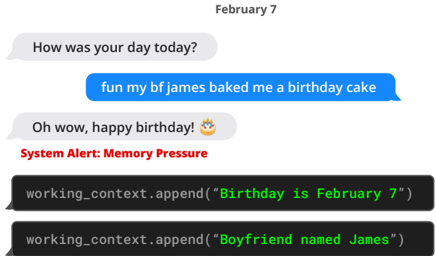
Figure 1. MemGPT (left) writes data to persistent memory after it receives a system alert about limited context space.
<details>
<summary>Image 1 Details</summary>
### Visual Description
## Chat Log: Birthday Celebration and System Alert
### Overview
The image depicts a chat log, seemingly from a messaging application, showing a conversation about a birthday celebration. It also includes a system alert indicating memory pressure and two lines of code appending information to a "working_context."
### Components/Axes
* **Header:** "February 7" - Indicates the date of the chat log.
* **Chat Bubbles:**
* First message (sender unknown): "How was your day today?"
* Second message (sender unknown): "fun my bf james baked me a birthday cake"
* Third message (sender unknown): "Oh wow, happy birthday! 🎉"
* **System Alert:** "System Alert: Memory Pressure" (displayed in red)
* **Code Snippets:**
* `working_context.append("Birthday is February 7")`
* `working_context.append("Boyfriend named James")`
### Detailed Analysis or ### Content Details
* **Date:** February 7
* **Chat Messages:**
* The first message is a greeting, asking about the recipient's day.
* The second message reveals that the sender's boyfriend, James, baked them a birthday cake.
* The third message is a birthday greeting with a party popper emoji.
* **System Alert:** A system alert indicates "Memory Pressure," suggesting a potential issue with the system's resources.
* **Code Snippets:**
* The first code snippet appends the string "Birthday is February 7" to a variable named `working_context`.
* The second code snippet appends the string "Boyfriend named James" to the same `working_context` variable.
### Key Observations
* The chat log suggests a birthday celebration on February 7.
* The system alert indicates a potential technical issue.
* The code snippets suggest that the system is programmatically extracting and storing information from the chat log.
### Interpretation
The image presents a scenario where a personal event (a birthday) is occurring alongside a technical issue (memory pressure). The code snippets suggest an automated system is analyzing the chat log and extracting key pieces of information, such as the date of the birthday and the name of the boyfriend. The "Memory Pressure" alert could be related to the processing of the chat log or other system activities. The image could be used to illustrate the intersection of personal communication, automated data extraction, and system monitoring.
</details>
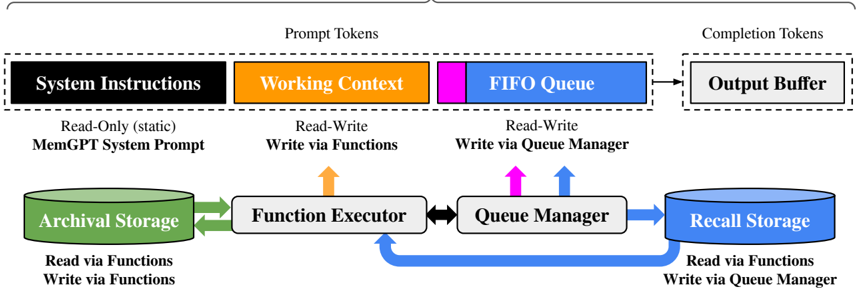
with virtual memory , which provides an illusion of there being more memory resources than are actually available in physical (i.e., main) memory by the OS paging overflow data to disk and retrieving data (via a page fault) back into memory when accessed by applications. To provide a similar illusion of longer context length (analogous to virtual memory), we allow the LLM to manage what is placed in its own context (analogous to physical memory) via an 'LLM OS', which we call MemGPT. MemGPT enables the LLM to retrieve relevant historical data missing from what is placed in-context, and also evict less relevant data from context and into external storage systems. Figure 3 illustrates the components of MemGPT.
The combined use of a memory-hierarchy, OS functions and event-based control flow allow MemGPT to handle unbounded context using LLMs that have finite context windows. To demonstrate the utility of our new OSinspired LLM system, we evaluate MemGPT on two domains where the performance of existing LLMs is severely limited by finite context: document analysis, where the length of standard text files can quickly exceed the input capacity of modern LLMs, and conversational agents, where LLMsbound by limited conversation windows lack context awareness, persona consistency, and long-term memory during extended conversations. In both settings, MemGPT is able to overcome the limitations of finite context to outperform existing LLM-based approaches.
## 2. MemGPT (MemoryGPT)
MemGPT's OS-inspired multi-level memory architecture delineates between two primary memory types: main context (analogous to main memory/physical memory/RAM) and external context (analogous to disk memory/disk storage). Main context consists of the LLM prompt tokens -anything in main context is considered in-context and can be accessed by the LLM processor during inference. External context refers to any information that is held outside of the LLMs fixed context window. This out-of-context data
February 7
<details>
<summary>Image 2 Details</summary>
### Visual Description
## Chat Log with Recall Storage Search
### Overview
The image shows a chat log with a recall storage search result for "six flags". The chat includes messages about celebrating a birthday and going to Six Flags. The recall storage search displays three results related to "six flags" from different dates.
### Components/Axes
* **Chat Bubbles:** Represent messages in the conversation.
* **Recall Storage Search Box:** Displays the search query and results.
* **Search Query:** "six flags"
* **Search Results:**
* Date: \[01/24/2024], Content: "lol yeah six flags"
* Date: \[01/14/2024], Content: "i love six flags been like 100 times"
* Date: \[10/12/2023], Content: "james and I actually first met at six flags"
### Detailed Analysis or ### Content Details
The chat log contains the following messages:
1. A message in a grey bubble: "Did you do anything else to celebrate your birthday? 😊"
2. A message in a blue bubble: "yeah we went to six flags!"
3. A dark grey box with the text: "recall\_storage.search("six flags")"
4. A dark grey box displaying the search results: "Showing 3 of 3 results (page 1/1):"
* "\[01/24/2024] "lol yeah six flags""
* "\[01/14/2024] "i love six flags been like 100 times""
* "\[10/12/2023] "james and I actually first met at six flags""
5. A message in a grey bubble: "Did you go with James? It's so cute how both met there!"
The search results indicate that the phrase "six flags" has appeared in previous conversations on multiple occasions. The dates of these conversations are 01/24/2024, 01/14/2024, and 10/12/2023.
### Key Observations
* The conversation is about celebrating a birthday.
* The person went to Six Flags as part of the birthday celebration.
* The recall storage search reveals past conversations related to Six Flags.
* One of the search results mentions meeting someone named James at Six Flags.
### Interpretation
The chat log suggests a conversation about a recent birthday celebration that included a trip to Six Flags. The recall storage search function is used to retrieve past conversations related to "six flags". The search results reveal that the topic of Six Flags has come up in previous conversations, and one of those conversations mentions meeting someone named James at Six Flags. This implies a history or connection between the individuals involved in the chat and the location Six Flags. The final message in the chat confirms that James was present at the Six Flags trip.
</details>
February 7
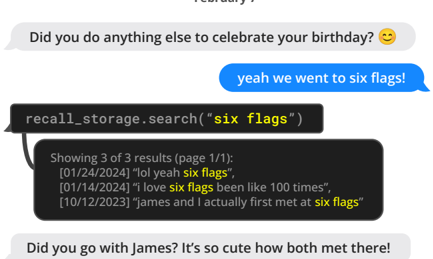
Figure 2. MemGPT (left) can search out-of-context data to bring relevant information into the current context window.
must always be explicitly moved into main context in order for it to be passed to the LLM processor during inference. MemGPT provides function calls that the LLM processor to manage its own memory without any user intervention.
## 2.1. Main context ( prompt tokens )
The prompt tokens in MemGPT are split into three contiguous sections: the system instructions , working context , and FIFO Queue . The system instructions are readonly (static) and contain information on the MemGPT control flow, the intended usage of the different memory levels, and instructions on how to use the MemGPT functions (e.g. how to retrieve out-of-context data). Working context is a fixed-size read/write block of unstructured text, writeable only via MemGPT function calls. In conversational settings, working context is intended to be used to store key facts, preferences, and other important information about the user and the persona the agent is adopting, allowing the agent to converse fluently with the user. The FIFO queue stores a rolling history of messages, including messages between the agent and user, as well as system messages (e.g. memory warnings) and function call inputs and outputs. The first index in the FIFO queue stores a system message containing a recursive summary of messages that have been evicted from the queue.
## 2.2. Queue Manager
The queue manager manages messages in recall storage and the FIFO queue . When a new message is received by the system, the queue manager appends the incoming messages to the FIFO queue, concatenates the prompt tokens and triggers the LLM inference to generate LLM output (the completion tokens). The queue manager writes both the incoming message and the generated LLM output to recall storage (the MemGPT message database). When messages in recall storage are retrieved via a MemGPT function call, the queue manager appends them to the back of
How's James doing? A
How's James working\_context.r
'Boyfriend name working\_con
'Boyfrien
'Ex-boyfriend n
)
'Ex-boyfr
)
Sorry to hear that - h
Sorry to hear
## LLM Finite Context Window (e.g. 8k tokens)
Figure 3. In MemGPT, a fixed-context LLM processor is augmented with a hierarchical memory system and functions that let it manage its own memory. The LLM's prompt tokens (inputs), or main context , consist of the system instructions, working context, and a FIFO queue. The LLM completion tokens (outputs) are interpreted as function calls by the function executor. MemGPT uses functions to move data between main context and external context (the archival and recall storage databases). The LLM can request immediate follow-up LLM inference to chain function calls together by generating a special keyword argument ( request heartbeat=true ) in its output; function chaining is what allows MemGPT to perform multi-step retrieval to answer user queries.
<details>
<summary>Image 3 Details</summary>
### Visual Description
## System Diagram: MemGPT System Architecture
### Overview
The image is a system diagram illustrating the architecture of MemGPT. It depicts the flow of information and the interaction between different components, including prompt tokens, completion tokens, storage mechanisms, and processing units.
### Components/Axes
**Top Section: Prompt and Completion Tokens**
* **Prompt Tokens:** This section represents the input to the system.
* **System Instructions:** A black box labeled "System Instructions" with the description "Read-Only (static) MemGPT System Prompt."
* **Working Context:** An orange box labeled "Working Context" with the description "Read-Write Write via Functions."
* **FIFO Queue:** A blue box with a magenta section labeled "FIFO Queue" with the description "Read-Write Write via Queue Manager."
* **Completion Tokens:** This section represents the output of the system.
* **Output Buffer:** A light gray box labeled "Output Buffer."
**Bottom Section: Data Flow and Processing Units**
* **Archival Storage:** A green cylinder labeled "Archival Storage" with the description "Read via Functions Write via Functions."
* **Function Executor:** A gray rounded rectangle labeled "Function Executor."
* **Queue Manager:** A gray rounded rectangle labeled "Queue Manager."
* **Recall Storage:** A blue cylinder labeled "Recall Storage" with the description "Read via Functions Write via Queue Manager."
**Arrows:**
* Green arrows connect "Archival Storage" to "Function Executor" in both directions.
* An orange arrow points upwards from "Function Executor" to "Working Context."
* Black arrows connect "Function Executor" and "Queue Manager" in both directions.
* A magenta arrow points upwards from "Queue Manager" to "FIFO Queue."
* Blue arrows connect "Queue Manager" to "Recall Storage" in both directions.
* A curved blue arrow connects "Recall Storage" to "Function Executor."
* A black arrow connects "FIFO Queue" to "Output Buffer."
### Detailed Analysis or ### Content Details
* **System Instructions:** This component holds the static, read-only instructions for the MemGPT system.
* **Working Context:** This component represents the dynamic context that the system uses, which can be read and written via functions.
* **FIFO Queue:** This component manages the order of operations using a first-in, first-out queue.
* **Output Buffer:** This component stores the final output of the system.
* **Archival Storage:** This component stores long-term data and is accessed via functions.
* **Function Executor:** This component executes functions and interacts with archival storage and the queue manager.
* **Queue Manager:** This component manages the queue and interacts with the function executor and recall storage.
* **Recall Storage:** This component stores data that can be quickly recalled and is managed by the queue manager.
### Key Observations
* The diagram highlights the separation between prompt tokens and completion tokens.
* The system uses a combination of archival and recall storage to manage data.
* The function executor and queue manager are central to the system's operation.
* Data flows between components via specific read/write mechanisms.
### Interpretation
The diagram illustrates the architecture of MemGPT, emphasizing the flow of information between different components. The system uses a combination of static instructions, dynamic context, and FIFO queue to process input and generate output. The archival and recall storage mechanisms allow the system to manage both long-term and short-term data. The function executor and queue manager are responsible for coordinating the system's operations. The diagram suggests a complex system designed to manage and process information efficiently.
</details>
the queue to reinsert them into the LLM's context window.
The queue manager is also responsible for controlling context overflow via a queue eviction policy. When the prompt tokens exceed the 'warning token count' of the underlying LLM's context window (e.g. 70% of the context window), the queue manager inserts a system message into the queue warning the LLM of an impending queue eviction (a 'memory pressure' warning) to allow the LLM to use MemGPT functions to store important information contained in the FIFO queue to working context or archival storage (a read/write database storing arbitrary length text objects). When the prompt tokens exceed the 'flush token count' (e.g. 100% of the context window), the queue manager flushes the queue to free up space in the context window: the queue manager evicts a specific count of messages (e.g. 50% of the context window), generates a new recursive summary using the existing recursive summary and evicted messages. Once the queue is flushed, the evicted messages are no longer in-context and immediately viewable to the LLM, however they are stored indefinitely in recall storage and readable via MemGPT function calls.
## 2.3. Function executor (handling of completion tokens )
MemGPT orchestrates data movement between main context and external context via function calls that are generated by the LLM processor. Memory edits and retrieval are entirely self-directed: MemGPT autonomously updates and searches through its own memory based on the current context. For instance, it can decide when to move items between contexts (e.g. when the conversation his- tory is becoming too long, as show in Figure 1) and modify its main context to better reflect its evolving understanding of its current objectives and responsibilities (as shown in Figure 3). We implement self-directed editing and retrieval by providing explicit instructions within the system instructions that guide the LLM on how to interact with the MemGPT memory systems. These instructions comprise two main components: (1) a detailed description of the memory hierarchy and their respective utilities, and (2) a function schema (complete with their natural language descriptions) that the system can call to access or modify its memory.
During each inference cycle, LLM processor takes main context (concatenated into a single string) as input, and generates an output string. This output string is parsed by MemGPT to ensure correctness, and if the parser validates the function arguments the function is executed. The results, including any runtime errors that occur (e.g. trying to add to main context when it is already at maximum capacity), are then fed back to the processor by MemGPT. This feedback loop enables the system to learn from its actions and adjust its behavior accordingly. Awareness of context limits is a key aspect in making the self-editing mechanism work effectively, to this end MemGPT prompts the processor with warnings regarding token limitations to guide its memory management decisions. Additionally, our memory retrieval mechanisms are designed to be cognizant of these token constraints and implement pagination to prevent retrieval calls from overflowing the context window.
day cake
February 7')
med James')
February 7
Table 1. Comparing context lengths of commonly used models and LLM APIs (data collected 1/2024). *Approximate message count assuming a preprompt of 1k tokens, and an average message size of ∼ 50 tokens ( ∼ 250 characters). 'Open' means the model is open-source or open-weights (vs only available behind an API). yeah we went to six flags! Did you do anything else to celebrate your birthday? 😊
recall\_storage.search('six flags')
| | | Context Window | Context Window |
|-------------------------------------|-------------------------------------------|---------------------|------------------|
| Model / API name Showing 3 of 3 | Open? results (page 1/1): yeah | Tokens | ∗ Messages |
| Llama (1) [01/24/2024] [01/14/2024] | ✓ 'lol six flags', 'i love six flags been | 2k like 100 times', | 20 |
| Llama 2 [10/12/2023] | ✓ 'james and I actually | 4k first met at six | 60 flags' |
| GPT-3.5 Turbo (release) | ✗ | 4k | 60 |
| Mistral 7B Did with | ✓ James? It's so | 8k cute how both | 140 met there! |
| GPT-4 (release) you go | ✗ | 8k | 140 |
| GPT-3.5 Turbo | ✗ | 16k | 300 |
| GPT-4 | ✗ | 32k | ∼ 600 |
| Claude 2 | ✗ | 100k | ∼ 2000 |
| GPT-4 Turbo | ✗ | 128k | ∼ 2600 |
| Yi-34B-200k | ✓ | 200k | ∼ 4000 |
## 2.4. Control flow and function chaining
In MemGPT, events trigger LLM inference: events are generalized inputs to MemGPT and can consist of user messages (in chat applications), system messages (e.g. main context capacity warnings), user interactions (e.g. an alert that a user just logged in, or an alert that they finished uploading a document), and timed events that are run on a regular schedule (allowing MemGPT to run 'unprompted' without user intervention). MemGPT processes events with a parser to convert them into plain text messages that can be appended to main context and eventually be fed as input into the LLM processor.
Many practical tasks require calling multiple functions in sequence, for example, navigating through multiple pages of results from a single query or collating data from different documents in main context from separate queries. Function chaining allows MemGPT to execute multiple function calls sequentially before returning control to the user. In MemGPT, functions can be called with a special flag that requests control be immediately returned to the processor after the requested function completes execution. If this flag is present, MemGPT will add the function output to main context and (as opposed to pausing processor execution). If this flag is not present (a yield ), MemGPT will not run the LLM processor until the next external event trigger (e.g. a user message or scheduled interrupt).
## 3. Experiments
We assess MemGPT in two long-context domains: conversational agents and document analysis. For conversational agents, we expand the existing Multi-Session Chat dataset (Xu et al., 2021) and introduce two new dialogue tasks that evaluate an agent's ability to retain knowledge
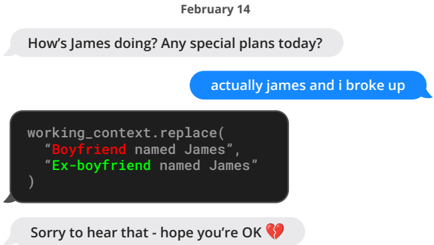
Figure 4. An example conversation snippet where MemGPT (left) updates stored information. Here the information is stored in working context memory (located within the prompt tokens).
<details>
<summary>Image 4 Details</summary>
### Visual Description
## Screenshot: Text Message Conversation
### Overview
The image is a screenshot of a text message conversation, likely from an iPhone, taking place on February 14th. The conversation reveals a recent breakup.
### Components/Axes
* **Date:** February 14
* **Sender 1 (Top):** "How's James doing? Any special plans today?"
* **Sender 2 (Middle):** "actually james and i broke up"
* **Code Block (Middle):** A code snippet showing a string replacement operation.
* **Sender 1 (Bottom):** "Sorry to hear that - hope you're OK ❤️"
### Detailed Analysis or ### Content Details
* **Message 1 (Sender 1):** "How's James doing? Any special plans today?"
* **Message 2 (Sender 2):** "actually james and i broke up"
* **Code Block:**
* `working_context.replace(`
* `"Boyfriend named James",` (Text in red)
* `"Ex-boyfriend named James"` (Text in green)
* `)`
* **Message 3 (Sender 1):** "Sorry to hear that - hope you're OK ❤️" (Heart emoji included)
### Key Observations
* The conversation takes place on February 14th, possibly Valentine's Day, adding a layer of irony to the breakup.
* The code block suggests a programmatic update to a context or database, replacing "Boyfriend" with "Ex-boyfriend".
* Sender 1 expresses sympathy with a heart emoji.
### Interpretation
The text message exchange reveals a recent breakup between Sender 2 and someone named James. The code block implies that the breakup is being reflected in some system or application, automatically updating the relationship status. The conversation is brief but conveys a significant change in relationship status and an expression of sympathy. The use of code to reflect the relationship change adds a layer of automation and perhaps a touch of humor or detachment to the situation.
</details>
across long conversations. For document analysis, we benchmark MemGPT on existing tasks from (Liu et al., 2023a) for question answering and key-value retrieval over lengthy documents. We also propose a new nested keyvalue retrieval task requiring collating information across multiple data sources, which tests the ability of an agent to collate information from multiple data sources (multihop retrieval). We publicly release our augmented MSC dataset, nested KV retrieval dataset, and a dataset of embeddings for 20M Wikipedia articles to facilitate future research. Our code for the benchmarks is available at https://research.memgpt.ai.
Implementation details. When discussing OpenAI models, unless otherwise specified 'GPT-4 Turbo' refers to the specific gpt-4-1106-preview model endpoint (context window of 128 , 000 ), 'GPT-4' refers to gpt-4-0613 (context window of 8 , 192 ), and 'GPT-3.5 Turbo' refers to gpt-3.5-turbo-1106 (context window of 16 , 385 ). In experiments, we run MemGPT with all baseline models (GPT-4, GPT-4 Turbo, and GPT 3.5) to show how the underlying model performance affects MemGPT's.
## 3.1. MemGPT for conversational agents
Conversational agents like virtual companions and personalized assistants aim to engage users in natural, long-term interactions, potentially spanning weeks, months, or even years. This creates challenges for models with fixed-length contexts, which can only reference a limited history of the conversation. An 'infinite context' agent should seamlessly handle continuous exchanges without boundary or reset. When conversing with a user, such an agent must satisfy two key criteria: (1) Consistency - The agent should maintain conversational coherence. New facts, preferences, and events mentioned should align with prior statements from both the user and agent. (2) Engagement - The agent should draw on long-term knowledge about the user to personalize
Table 2. Deep memory retrieval (DMR) performance. In this task, the agent is asked a specific question about a topic discussed in a prior conversation (sessions 1-5). The agent's response is scored against the gold answer. MemGPT significantly outperforms the fixed-context baselines.
| Model | Accuracy ⇑ | ROUGE-L (R) ⇑ |
|---------------|--------------|-----------------|
| GPT-3.5 Turbo | 38.7% | 0.394 |
| + MemGPT | 66.9% | 0.629 |
| GPT-4 | 32.1% | 0.296 |
| + MemGPT | 92.5% | 0.814 |
| GPT-4 Turbo | 35.3% | 0.359 |
| + MemGPT | 93.4% | 0.827 |
responses. Referencing prior conversations makes dialogue more natural and engaging.
We therefore assess our proposed system, MemGPT, on these two criteria: (1) Does MemGPT leverage its memory to improve conversation consistency? Can it remember relevant facts, preferences, and events from past interactions to maintain coherence? (2) Does MemGPT produce more engaging dialogue by taking advantage of memory? Does it spontaneously incorporate long-range user information to personalize messages? By evaluating on consistency and engagement, we can determine how well MemGPT handles the challenges of long-term conversational interaction compared to fixed-context baselines. Its ability to satisfy these criteria will demonstrate whether unbounded context provides meaningful benefits for conversational agents.
Dataset. We evaluate MemGPT and our fixed-context baselines on the Multi-Session Chat (MSC) dataset introduced by Xu et al. (2021), which contains multi-session chat logs generated by human labelers, each of whom was asked to play a consistent persona for the duration of all sessions. Each multi-session chat in MSC has five total sessions, and each session consists of a roughly a dozen messages. As part of our consistency experiments, we created a new session (session 6) that contains a single questionanswer response pair between the same two personas.
## 3.1.1. DEEP MEMORY RETRIEVAL TASK (CONSISTENCY).
We introduce a new 'deep memory retrieval' (DMR) task based on the MSC dataset designed to test the consistency of a conversational agent. In DMR, the conversational agent is asked a question by the user that explicitly refers back to a prior conversation and has a very narrow expected answer range. We generated the DMR question-answer (QA) pairs using a separate LLM that was instructed to write a question from one user to another that could only be answered correctly using knowledge gained from the past
Table 3. Conversation opener performance. The agent's conversation opener is evaluated using similarity scores to the gold persona labels (SIM-1/3) and to the human-created opener (SIMH). MemGPT is able to exceed the performance of the humancreated conversation opener with a variety of underlying models.
| Method | ⇑ SIM-1 | SIM-3 | SIM-H |
|---------------|-----------|---------|---------|
| Human | 0.8 | 0.8 | 1 |
| GPT-3.5 Turbo | 0.83 | 0.812 | 0.817 |
| GPT-4 | 0.868 | 0.843 | 0.773 |
| GPT-4 Turbo | 0.857 | 0.828 | 0.767 |
sessions (see Appendix for further details).
We evaluate the quality of the generated response against the 'gold response' using ROUGE-L scores (Lin, 2004) and an 'LLM judge', which is instructed to evaluate whether or not the generated response is consistent with the gold response (GPT-4 has been shown to have high agreement with human evaluators (Zheng et al., 2023)). In practice, we notice that the generated responses (from both MemGPT and the baselines) were generally more verbose than the gold responses. We use the ROUGE-L recall (R) metric to account for the verbosity of the generated agent replies compared to the relatively short gold answer labels.
MemGPT utilizes memory to maintain coherence: Table 2 shows the performance of MemGPT vs the fixedmemory baselines. We compare MemGPT using different underlying LLMs, and compare against using the base LLM without MemGPT as a baseline. The baselines are able to see a lossy summarization of the past five conversations to mimic an extended recursive summarization procedure, while MemGPT instead has access to the full conversation history but must access it via paginated search queries to recall memory (in order to bring them into main context). In this task, we see that MemGPT clearly improves the performance of the underlying base LLM: there is a clear drop in both accuracy and ROUGE scores when going from MemGPT to the corresponding LLM baselines.
## 3.1.2. CONVERSATION OPENER TASK (ENGAGEMENT).
In the 'conversation opener' task we evaluate an agent's ability to craft engaging messages to the user that draw from knowledge accumulated in prior conversations. To evaluate the 'engagingness' of a conversation opener using the MSC dataset, we compare the generated opener to the gold personas: an engaging conversation opener should draw from one (or several) of the data points contained in the persona, which in MSC effectively summarize the knowledge accumulated throughout all prior sessions. We also compare to the human-generated gold opener, i.e., the
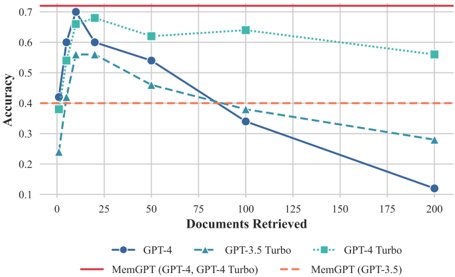
Figure 5. Document QA task performance. MemGPT's performance is unaffected by increased context length. Methods such as truncation can extend the effective context lengths of fixed length models such as GPT-4, but such compression methods will lead to performance degradation as the necessary compression grows. Running MemGPT with GPT-4 and GPT-4 Turbo have equivalent results on this task.
<details>
<summary>Image 5 Details</summary>
### Visual Description
## Line Chart: Accuracy vs. Documents Retrieved
### Overview
The image is a line chart comparing the accuracy of different GPT models (GPT-4, GPT-3.5 Turbo, and GPT-4 Turbo) as the number of retrieved documents increases. It also includes baseline accuracy levels for MemGPT using GPT-4/GPT-4 Turbo and GPT-3.5.
### Components/Axes
* **X-axis:** Documents Retrieved, with values ranging from 0 to 200, marked at 0, 25, 50, 75, 100, 125, 150, 175, and 200.
* **Y-axis:** Accuracy, with values ranging from 0.1 to 0.7, marked at 0.1, 0.2, 0.3, 0.4, 0.5, 0.6, and 0.7.
* **Legend:** Located at the bottom of the chart.
* Blue solid line with circle markers: GPT-4
* Blue dashed line with triangle markers: GPT-3.5 Turbo
* Blue dotted line with square markers: GPT-4 Turbo
* Red solid line: MemGPT (GPT-4, GPT-4 Turbo)
* Red dashed line: MemGPT (GPT-3.5)
### Detailed Analysis
* **GPT-4 (Blue solid line with circle markers):**
* Trend: Initially increases sharply, peaks around 25 documents, then decreases steadily.
* Data Points:
* 0 Documents: Accuracy ~0.42
* 10 Documents: Accuracy ~0.60
* 25 Documents: Accuracy ~0.68
* 50 Documents: Accuracy ~0.54
* 100 Documents: Accuracy ~0.34
* 200 Documents: Accuracy ~0.12
* **GPT-3.5 Turbo (Blue dashed line with triangle markers):**
* Trend: Increases rapidly, peaks around 25 documents, then decreases gradually.
* Data Points:
* 0 Documents: Accuracy ~0.24
* 10 Documents: Accuracy ~0.52
* 25 Documents: Accuracy ~0.56
* 50 Documents: Accuracy ~0.46
* 100 Documents: Accuracy ~0.38
* 200 Documents: Accuracy ~0.28
* **GPT-4 Turbo (Blue dotted line with square markers):**
* Trend: Increases sharply, peaks around 25 documents, then decreases slightly.
* Data Points:
* 0 Documents: Accuracy ~0.38
* 10 Documents: Accuracy ~0.56
* 25 Documents: Accuracy ~0.68
* 50 Documents: Accuracy ~0.62
* 100 Documents: Accuracy ~0.64
* 200 Documents: Accuracy ~0.56
* **MemGPT (GPT-4, GPT-4 Turbo) (Red solid line):**
* Trend: Constant accuracy.
* Accuracy: ~0.72
* **MemGPT (GPT-3.5) (Red dashed line):**
* Trend: Constant accuracy.
* Accuracy: ~0.40
### Key Observations
* All three GPT models (GPT-4, GPT-3.5 Turbo, and GPT-4 Turbo) show an initial increase in accuracy with a small number of retrieved documents (up to 25).
* Beyond 25 documents, the accuracy of GPT-4 and GPT-3.5 Turbo decreases, while GPT-4 Turbo maintains a relatively stable accuracy.
* MemGPT (GPT-4, GPT-4 Turbo) consistently outperforms all other models in terms of accuracy.
* MemGPT (GPT-3.5) provides a baseline accuracy that is generally higher than the raw GPT-3.5 Turbo model, especially with a larger number of retrieved documents.
### Interpretation
The chart suggests that retrieving a small number of relevant documents initially improves the accuracy of GPT models. However, as the number of retrieved documents increases, the accuracy of GPT-4 and GPT-3.5 Turbo declines, possibly due to information overload or the inclusion of irrelevant information. GPT-4 Turbo appears to be more robust to this effect. MemGPT, which likely incorporates a memory mechanism or a more sophisticated retrieval strategy, consistently achieves higher accuracy than the raw GPT models, indicating the benefits of memory-augmented language models. The horizontal lines representing MemGPT performance act as benchmarks, showing the potential improvement gained by using a memory-enhanced approach compared to directly feeding retrieved documents to the base models.
</details>
first response in the following session. We report the CSIM scores of MemGPT's openers in Table 3. We test several variations of MemGPT using different base LLMs.
MemGPT utilizes memory to increase engagement: As seen in Table 3, MemGPT is able to craft engaging openers that perform similarly to and occasionally exceed the hand-written human openers. We observe that MemGPT tends to craft openers that are both more verbose and cover more aspects of the persona information than the human baseline. Additionally, we can see the storing information in working context is key to generating engaging openers.
## 3.2. MemGPT for document analysis
Document analysis also faces challenges due to the limited context windows of today's transformer models. As shown in Table 1, both open and closed source models suffer from constrained context length (up to 128k tokens for OpenAI's models). However many documents easily surpass these lengths; for example, legal or financial documents such as Annual Reports (SEC Form 10-K) can easily pass the million token mark. Moreover, many real document analysis tasks require drawing connections across multiple such lengthy documents. Anticipating these scenarios, it becomes difficult to envision blindly scaling up context as a solution to the fixed-context problem. Recent research (Liu et al., 2023a) also raises doubts about the utility of simply scaling contexts, since they find uneven attention distributions in large context models (the model is more capable of recalling information at the beginning or end of its context window, vs tokens in the middle). To enable reasoning across documents, more flexible memory architectures like
<details>
<summary>Image 6 Details</summary>
### Visual Description
## Chat Log: Nobel Prize in Physics Query
### Overview
The image depicts a chat log or system output showing a user query about the first Nobel Prize winner in physics. The system uses an "archival_storage.search" function to find the answer, displaying results from multiple pages. The final answer provided is "Wilhelm Conrad Rontgen".
### Components/Axes
* **Header:** "System Alert: Archive Storage Upload Complete"
* **User Query:** "Who won the first Nobel Prize in physics?" (displayed in a blue speech bubble)
* **System Responses:**
* `archival_storage.search("nobel physics")`
* "Showing 10 of 124 results (page 1/13):"
* "The Nobel Prizes, beginning in 1901, and the..."
* "This award is administered by the Nobel Foundation..."
* `archival_storage.search("nobel physics", page=2)`
* "Showing 10 of 124 results (page 2/13):"
* "The Nobel Prize in Physics is a yearly award given..."
* "The 1901 Nobel in physics was awarded to Wilhelm..."
* **Final Answer:** "Wilhelm Conrad Rontgen" (displayed in a grey speech bubble)
### Detailed Analysis or Content Details
* **User Query:** The user asks a question about the first Nobel Prize winner in physics.
* **First System Response:**
* The system executes the search query `archival_storage.search("nobel physics")`.
* The system displays the first 10 results out of 124 total results.
* The results are from page 1 of 13.
* The displayed snippets mention "The Nobel Prizes, beginning in 1901" and "This award is administered by the Nobel Foundation".
* **Second System Response:**
* The system executes the search query `archival_storage.search("nobel physics", page=2)`.
* The system displays the first 10 results out of 124 total results.
* The results are from page 2 of 13.
* The displayed snippets mention "The Nobel Prize in Physics is a yearly award given..." and "The 1901 Nobel in physics was awarded to Wilhelm...".
* **Final Answer:** The system provides the answer "Wilhelm Conrad Rontgen".
### Key Observations
* The system uses a search function to find the answer to the user's question.
* The system displays results from multiple pages.
* The system provides the correct answer to the user's question.
### Interpretation
The chat log demonstrates a system's ability to answer a factual question by searching through an archive of information. The system uses a search function, displays relevant snippets from the search results, and ultimately provides the correct answer. The use of pagination suggests a large dataset being searched. The system correctly identifies Wilhelm Conrad Rontgen as the first Nobel Prize winner in physics.
</details>
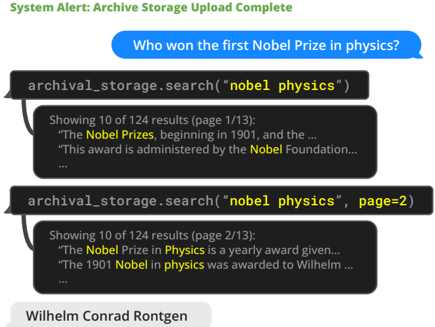
Figure 6. An example of MemGPT (left) solving the document QA task. A database of Wikipedia documents is uploaded to archival storage. MemGPT queries archival storage via function calling, which pulls paginated search results into main context.
MemGPT are needed.
## 3.2.1. MULTI-DOCUMENT QUESTION-ANSWERING.
To evaluate MemGPT's ability to analyze documents, we benchmark MemGPT against fixed-context baselines on the retriever-reader document QA task from Liu et al. (2023a). In this task, a question is selected from the NaturalQuestions-Open dataset, and a retriever selects relevant Wikipedia documents for the question. A reader model (the LLM) is then fed these documents as input, and is asked to use the provided documents to answer the question. Similar to Liu et al. (2023a), we evaluate reader accuracy as the number of retrieved documents K increases.
In our evaluation setup, both the fixed-context baselines and MemGPT use the same retriever, which selects the top K documents according using similarity search (cosine distance) on OpenAI's text-embedding-ada-002 embeddings. We use MemGPT's default storage settings which uses PostgreSQL for archival memory storage with vector search enabled via the pgvector extention. We precompute embeddings and load them into the database, which uses an HNSW index to enable approximate, subsecond query times. In MemGPT, the entire embedding document set is loaded into archival storage, and the retriever naturally emerges via the archival storage search functionality (which performs vector search based on cosine similarity). In the fixed-context baselines, the topK documents are fetched using the retriever independently from the LLM inference, similar to the original retrieverreader setup in Liu et al. (2023a).
Weuse a dump of Wikipedia from late 2018, following past work on NaturalQuestions-Open (Izacard & Grave, 2020;
System Alert: Archi archival\_stor
Showing 1 of 1
'Key: 831…ea archival\_stor
Showing 2 of 2
'Key: 5b8…4c
'Key: 831…ea archival\_stor
Showing 1 of 1
'Key: 5b8…4c f37…617
<details>
<summary>Image 7 Details</summary>
### Visual Description
## Line Chart: Model Accuracy vs. Nesting Level
### Overview
The image is a line chart comparing the accuracy of different language models (GPT-3.5, GPT-4, GPT-4 Turbo, and MemGPT variants) at varying nesting levels (0 to 3). The chart displays how accuracy decreases as the nesting level increases for most models, with MemGPT (GPT-4) maintaining perfect accuracy.
### Components/Axes
* **X-axis:** Nesting Level, with values 0, 1, 2, and 3.
* **Y-axis:** Accuracy, ranging from 0.0 to 1.0 in increments of 0.2.
* **Legend:** Located at the bottom of the chart, associating line styles and colors with specific models:
* Blue dashed line with triangle markers: GPT-3.5
* Teal dotted line with square markers: GPT-4 Turbo
* Dark blue solid line with circle markers: GPT-4
* Orange dashed line with triangle markers: MemGPT (GPT-3.5)
* Purple dotted line with square markers: MemGPT (GPT-4 Turbo)
* Red solid line with circle markers: MemGPT (GPT-4)
### Detailed Analysis
* **GPT-3.5 (Blue dashed line with triangle markers):**
* Trend: Accuracy decreases sharply as nesting level increases.
* Data Points:
* Nesting Level 0: Accuracy ~0.9
* Nesting Level 1: Accuracy ~0.0
* Nesting Level 2: Accuracy ~0.0
* Nesting Level 3: Accuracy ~0.0
* **GPT-4 Turbo (Teal dotted line with square markers):**
* Trend: Accuracy decreases as nesting level increases.
* Data Points:
* Nesting Level 0: Accuracy ~0.95
* Nesting Level 1: Accuracy ~0.5
* Nesting Level 2: Accuracy ~0.2
* Nesting Level 3: Accuracy ~0.0
* **GPT-4 (Dark blue solid line with circle markers):**
* Trend: Accuracy decreases as nesting level increases.
* Data Points:
* Nesting Level 0: Accuracy ~0.9
* Nesting Level 1: Accuracy ~0.3
* Nesting Level 2: Accuracy ~0.1
* Nesting Level 3: Accuracy ~0.0
* **MemGPT (GPT-3.5) (Orange dashed line with triangle markers):**
* Trend: Accuracy decreases as nesting level increases.
* Data Points:
* Nesting Level 0: Accuracy ~0.9
* Nesting Level 1: Accuracy ~0.2
* Nesting Level 2: Accuracy ~0.1
* Nesting Level 3: Accuracy ~0.0
* **MemGPT (GPT-4 Turbo) (Purple dotted line with square markers):**
* Trend: Accuracy decreases as nesting level increases.
* Data Points:
* Nesting Level 0: Accuracy ~1.0
* Nesting Level 1: Accuracy ~1.0
* Nesting Level 2: Accuracy ~0.7
* Nesting Level 3: Accuracy ~0.6
* **MemGPT (GPT-4) (Red solid line with circle markers):**
* Trend: Accuracy remains constant at the highest level.
* Data Points:
* Nesting Level 0: Accuracy ~1.0
* Nesting Level 1: Accuracy ~1.0
* Nesting Level 2: Accuracy ~1.0
* Nesting Level 3: Accuracy ~1.0
### Key Observations
* MemGPT (GPT-4) consistently maintains perfect accuracy across all nesting levels.
* All other models show a decrease in accuracy as the nesting level increases.
* GPT-3.5, GPT-4, GPT-4 Turbo, and MemGPT (GPT-3.5) all drop to near-zero accuracy at nesting level 3.
* MemGPT (GPT-4 Turbo) maintains a higher accuracy than the other non-MemGPT (GPT-4) models as nesting level increases.
### Interpretation
The chart demonstrates the impact of nesting level on the accuracy of different language models. The MemGPT (GPT-4) model exhibits superior performance by maintaining perfect accuracy regardless of nesting level, suggesting it is more robust to the complexities introduced by nested structures. The other models, including GPT-3.5, GPT-4, GPT-4 Turbo, and MemGPT (GPT-3.5), experience a significant decline in accuracy as nesting level increases, indicating their limitations in handling more complex, nested information. MemGPT (GPT-4 Turbo) shows some improvement over the other non-MemGPT (GPT-4) models, but still does not achieve the consistent accuracy of MemGPT (GPT-4). This highlights the effectiveness of the MemGPT architecture, particularly when combined with the GPT-4 model, in maintaining accuracy across varying levels of nested information.
</details>
'The Nobel Prize in Physics is a yearly award given…
'The 1901 Nobel in physics was awarded to Wilhelm …
…
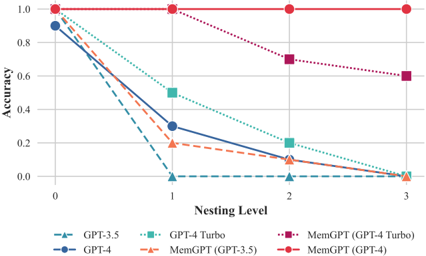
Figure 7. Nested KV retrieval task performance. MemGPT is the only approach that is able to consistently complete the nested KV task beyond 2 nesting levels. While GPT-4 Turbo performs better as a baseline, MemGPT with GPT-4 Turbo performs worse than MemGPT with GPT-4. Wilhelm Conrad Rontgen
Izacard et al., 2021), and sampled a subset of 50 questions for evaluation. Both the sampled questions and embedded Wikipedia passages are publicaly released. We evaluate the performance of both MemGPT and baselines with an LLM-judge, to ensure that the the answer is properly derived from the retrieved documents and to avoid non-exact string matches being considered incorrect.
We show the results for the document QA task in Figure 5. The fixed-context baselines performance is capped roughly at the performance of the retriever, as they use the information that is presented in their context window (e.g. if the embedding search retriever fails to surface the gold article using the provided question, the fixed-context baselines are guaranteed to never see the gold article). By contrast, MemGPT is effectively able to make multiple calls to the retriever by querying archival storage, allowing it to scale to larger effective context lengths. MemGPT actively retrieves documents from its archival storage (and can iteratively page through results), so the total number of documents available to MemGPT is no longer limited by the number of documents that fit within the LLM processor's context window.
The document QA task is challenging for all methods due to the limitations of embedding-based similarity search. We observe that the golden document for chosen question (as annotated by NaturalQuestions-Open) often appears outside of the first dozen retrieved results, if not even further. The retriever performance translates directly to the fixed-context baseline results: GPT-4's accuracy is relatively low with few retrieved documents, and continues to improve as additional documents are added to the context window, as it correctly limits itself to answering questions based on information in retrieved documents. While MemGPT is theoretically not limited by sub-optimal re-
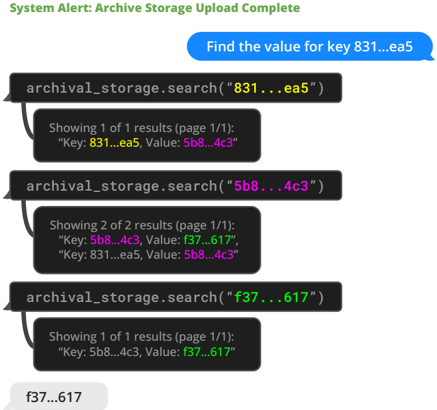
Figure 8. An example of MemGPT (left) solving the nested KV task (UUIDs shortened for readability). In this particular example, the key-value pair has two nesting levels: 831..ea5 → 5b8..4c3 → f37...617 . The MemGPT agent returns the final answer when a query for the final value ( f37...617 ) only returns one result, indicating that it is not also a key.
<details>
<summary>Image 8 Details</summary>
### Visual Description
## System Log: Archive Storage Search
### Overview
The image shows a system log related to archive storage searches. It displays a series of search queries and their corresponding results, indicating the key-value pairs found within the archive. The initial prompt is to find the value for key "831...ea5".
### Components/Axes
* **Header:** "System Alert: Archive Storage Upload Complete"
* **Prompt:** "Find the value for key 831...ea5" (in a blue speech bubble)
* **Search Queries:** Three instances of "archival\_storage.search()" with different search terms.
* **Search Results:** Each search query is followed by the number of results found and the corresponding key-value pairs.
* **Final Output:** "f37...617" at the bottom of the image.
### Detailed Analysis
1. **First Search:**
* Query: `archival_storage.search("831...ea5")`
* Result: "Showing 1 of 1 results (page 1/1):"
* Key-Value Pair: `"Key: 831...ea5, Value: 5b8...4c3"`
2. **Second Search:**
* Query: `archival_storage.search("5b8...4c3")`
* Result: "Showing 2 of 2 results (page 1/1):"
* Key-Value Pairs:
* `"Key: 5b8...4c3, Value: f37...617"`
* `"Key: 831...ea5, Value: 5b8...4c3"`
3. **Third Search:**
* Query: `archival_storage.search("f37...617")`
* Result: "Showing 1 of 1 results (page 1/1):"
* Key-Value Pair: `"Key: 5b8...4c3, Value: f37...617"`
4. **Final Output:**
* `f37...617`
### Key Observations
* The initial search for "831...ea5" returns a value of "5b8...4c3".
* Searching for "5b8...4c3" returns two results, one of which has a value of "f37...617".
* Searching for "f37...617" returns a key-value pair where "f37...617" is the value.
* The final output "f37...617" seems to be the ultimate value found through the series of searches.
### Interpretation
The image demonstrates a process of iterative searching within an archive storage system. The initial prompt asks for the value associated with the key "831...ea5". The system then performs a series of searches, using the value from the previous search as the key for the next search. This process continues until the value "f37...617" is found, which is then presented as the final output. This suggests a linked data structure or a chain of references within the archive storage. The system effectively navigates this chain to retrieve the final value.
</details>
triever performance (even if the embedding-based ranking is noisy, as long as the full retriever ranking contains the gold document it can still be found with enough retriever calls via pagination), we observe that MemGPT will often stop paging through retriever results before exhausting the retriever database.
To evaluate the fixed-context baselines against MemGPT past their default context lengths, we truncate the document segments returned by the retriever to fix the same number of documents into the available context. As expected, document truncation reduces accuracy as documents shrink as the chance of the relevant snippet (in the gold document) being omitted grows, as shown in Figure 5. MemGPT has significantly degraded performance using GPT-3.5, due to its limited function calling capabilities, and performs best using GPT-4.
## 3.2.2. NESTED KEY-VALUE RETRIEVAL (KV).
We introduce a new task based on the synthetic Key-Value retrieval proposed in prior work (Liu et al., 2023a). The goal of this task is to demonstrate how MemGPT can collate information from multiple data sources. In the original KV task, the authors generated a synthetic dataset of keyvalue pairs, where each key and value is a 128-bit UUID (universally unique identifier). The agent is then given a key, and asked to return the associated value for the key. We create a version of the KV task, nested KV retrieval ,
where values themselves may be keys, thus requiring the agent to perform a multi-hop lookup. In our setup, we fix the total number of UUIDs pairs to 140, corresponding to roughly 8k tokens (the context length of our GPT-4 baseline). We vary the total number of nesting levels from 0 (the initial key-value pair's value is not a key) to 4 (ie 4 total KV lookups are required to find the final value), and sample 30 different ordering configurations including both the initial key position and nesting key positions.
While GPT-3.5 and GPT-4 have good performance on the original KV tasks, both struggle in the nested KV task. GPT-3.5 is unable to complete the nested variant of the task and has an immediate dropoff in performance, hitting 0 percent accuracy at 1 nesting level (we observe that its primary failure mode is to simply returns the original value). GPT4 and GPT-4 Turbo are better than GPT-3.5, but also suffer from a similar dropoff, and hit 0 percent accuracy by 3 nesting levels. MemGPT with GPT-4 on the other hand is unaffected with the number of nesting levels and is able to perform the nested lookup by accessing the key-value pairs stored in main context repeatedly via function queries. MemGPT with GPT-4 Turbo and GPT-3.5 also have better performance than the corresponding baseline models, but still begin to drop off in performance at 2 nesting levels as a result of failing to perform enough lookups. MemGPT performance on the nested KV task demonstrates its ability to combine multiple queries to perform multi-hop lookups.
## 4. Related Work
Long-context LLMs. Several lines of work have improved the context length of LLMs. For instance, more efficient transformer architectures via sparsifying the attention (Child et al., 2019; Beltagy et al., 2020), low-rank approximations (Wang et al., 2020), and neural memory (Lee et al., 2019). Another line of work aims to extend context windows beyond the length they were original trained for, their training size, such as Press et al. (2021); Chen et al. (2023). MemGPT builds upon these improvements in context length as they improve the size of the main memory in MemGPT. Our main contribution is a hierarchical tiered memory that uses a long-context LLM as the implementation of main memory.
Retrieval-Augmented Models. The design of the external memory of MemGPT builds upon much prior work augmenting LLMs with relevant inputs from external retrievers (Ram et al., 2023; Borgeaud et al., 2022; Karpukhin et al., 2020; Lewis et al., 2020; Guu et al., 2020; Lin et al., 2023). In particular, Jiang et al. (2023) propose FLARE, a method that allows the LLM to actively decide when and what to retrieve during the course of generation. Trivedi et al. (2022) interleave retrieval with Chain-of-Thoughts reasoning to improve multi-step question answering.
LLMs as agents. Recent work has explored augmenting LLMs with additional capabilities to act as agents in interactive environments. Park et al. (2023) propose adding memory to LLMs and using the LLM as a planner, and observe emergent social behaviors in a multiagent sandbox environment (inspired by The Sims video game) where agents can perform basic activities such as doing chores/hobbies, going to work, and conversing with other agents. Nakano et al. (2021) train models to search the web before answering questions, and use similar pagination concepts to MemGPT to control the underlying context size in their web-browsing environment. Yao et al. (2022) showed that interleaving chain-of-thought reasoning (Wei et al., 2022) can further improve the planning ability of interactive LLM-based agents; similarly in MemGPT, LLM is able to 'plan out loud' when executing functions. Liu et al. (2023b) introduced a suite of LLM-asan-agent benchmarks to evaluate LLMs in interactive environments, including video games, thinking puzzles, and web shopping. In contrast, our work focuses on tackling the problem of equipping agents with long-term memory of user inputs.
## 5. Conclusion
In this paper, we introduced MemGPT, a novel LLM system inspired by operating systems to manage the limited context windows of large language models. By designing a memory hierarchy and control flow analogous to traditional OSes, MemGPT provides the illusion of larger context resources for LLMs. This OS-inspired approach was evaluated in two domains where existing LLM performance is constrained by finite context lengths: document analysis and conversational agents. For document analysis, MemGPTcould process lengthy texts well beyond the context limits of current LLMs by effectively paging relevant context in and out of memory. For conversational agents, MemGPT enabled maintaining long-term memory, consistency, and evolvability over extended dialogues. Overall, MemGPT demonstrates that operating system techniques like hierarchical memory management and interrupts can unlock the potential of LLMs even when constrained by fixed context lengths. This work opens numerous avenues for future exploration, including applying MemGPT to other domains with massive or unbounded contexts, integrating different memory tier technologies like databases or caches, and further improving control flow and memory management policies. By bridging concepts from OS architecture into AI systems, MemGPT represents a promising new direction for maximizing the capabilities of LLMs within their fundamental limits.
## References
- Iz Beltagy, Matthew E Peters, and Arman Cohan. Longformer: The long-document transformer. arXiv preprint arXiv:2004.05150 , 2020.
- Sebastian Borgeaud, Arthur Mensch, Jordan Hoffmann, Trevor Cai, Eliza Rutherford, Katie Millican, George Bm Van Den Driessche, Jean-Baptiste Lespiau, Bogdan Damoc, Aidan Clark, et al. Improving language models by retrieving from trillions of tokens. In International conference on machine learning , pp. 2206-2240. PMLR, 2022.
- Tom Brown, Benjamin Mann, Nick Ryder, Melanie Subbiah, Jared D Kaplan, Prafulla Dhariwal, Arvind Neelakantan, Pranav Shyam, Girish Sastry, Amanda Askell, et al. Language models are few-shot learners. Advances in neural information processing systems , 33: 1877-1901, 2020.
- Shouyuan Chen, Sherman Wong, Liangjian Chen, and Yuandong Tian. Extending context window of large language models via positional interpolation. arXiv preprint arXiv:2306.15595 , 2023.
- Rewon Child, Scott Gray, Alec Radford, and Ilya Sutskever. Generating long sequences with sparse transformers. arXiv preprint arXiv:1904.10509 , 2019.
- Zihang Dai, Zhilin Yang, Yiming Yang, Jaime Carbonell, Quoc V Le, and Ruslan Salakhutdinov. Transformer-xl: Attentive language models beyond a fixed-length context. arXiv preprint arXiv:1901.02860 , 2019.
- Jacob Devlin, Ming-Wei Chang, Kenton Lee, and Kristina Toutanova. Bert: Pre-training of deep bidirectional transformers for language understanding. arXiv preprint arXiv:1810.04805 , 2018.
- Zican Dong, Tianyi Tang, Lunyi Li, and Wayne Xin Zhao. Asurvey on long text modeling with transformers. arXiv preprint arXiv:2302.14502 , 2023.
- Kelvin Guu, Kenton Lee, Zora Tung, Panupong Pasupat, and Mingwei Chang. Retrieval augmented language model pre-training. In International conference on machine learning , pp. 3929-3938. PMLR, 2020.
- Gautier Izacard and Edouard Grave. Leveraging passage retrieval with generative models for open domain question answering. arXiv preprint arXiv:2007.01282 , 2020.
- Gautier Izacard, Mathilde Caron, Lucas Hosseini, Sebastian Riedel, Piotr Bojanowski, Armand Joulin, and Edouard Grave. Unsupervised dense information retrieval with contrastive learning. arXiv preprint arXiv:2112.09118 , 2021.
- Zhengbao Jiang, Frank F Xu, Luyu Gao, Zhiqing Sun, Qian Liu, Jane Dwivedi-Yu, Yiming Yang, Jamie Callan, and Graham Neubig. Active retrieval augmented generation. arXiv preprint arXiv:2305.06983 , 2023.
- Vladimir Karpukhin, Barlas O˘ guz, Sewon Min, Patrick Lewis, Ledell Wu, Sergey Edunov, Danqi Chen, and Wen-tau Yih. Dense passage retrieval for open-domain question answering. arXiv preprint arXiv:2004.04906 , 2020.
- Nikita Kitaev, Łukasz Kaiser, and Anselm Levskaya. Reformer: The efficient transformer. arXiv preprint arXiv:2001.04451 , 2020.
- Juho Lee, Yoonho Lee, Jungtaek Kim, Adam Kosiorek, Seungjin Choi, and Yee Whye Teh. Set transformer: A framework for attention-based permutation-invariant neural networks. In International conference on machine learning , pp. 3744-3753. PMLR, 2019.
- Patrick Lewis, Ethan Perez, Aleksandra Piktus, Fabio Petroni, Vladimir Karpukhin, Naman Goyal, Heinrich K¨ uttler, Mike Lewis, Wen-tau Yih, Tim Rockt¨ aschel, et al. Retrieval-augmented generation for knowledgeintensive nlp tasks. Advances in Neural Information Processing Systems , 33:9459-9474, 2020.
- Chin-Yew Lin. Rouge: A package for automatic evaluation of summaries. In Text summarization branches out , pp. 74-81, 2004.
- Xi Victoria Lin, Xilun Chen, Mingda Chen, Weijia Shi, Maria Lomeli, Rich James, Pedro Rodriguez, Jacob Kahn, Gergely Szilvasy, Mike Lewis, Luke Zettlemoyer, and Scott Yih. Ra-dit: Retrieval-augmented dual instruction tuning, 2023.
- Nelson F Liu, Kevin Lin, John Hewitt, Ashwin Paranjape, Michele Bevilacqua, Fabio Petroni, and Percy Liang. Lost in the middle: How language models use long contexts. arXiv preprint arXiv:2307.03172 , 2023a.
- Xiao Liu, Hao Yu, Hanchen Zhang, Yifan Xu, Xuanyu Lei, Hanyu Lai, Yu Gu, Hangliang Ding, Kaiwen Men, Kejuan Yang, et al. AgentBench: Evaluating llms as agents. arXiv preprint arXiv:2308.03688 , 2023b.
- Reiichiro Nakano, Jacob Hilton, Suchir Balaji, Jeff Wu, Long Ouyang, Christina Kim, Christopher Hesse, Shantanu Jain, Vineet Kosaraju, William Saunders, et al. WebGPT: Browser-assisted question-answering with human feedback. arXiv preprint arXiv:2112.09332 , 2021.
- Long Ouyang, Jeffrey Wu, Xu Jiang, Diogo Almeida, Carroll Wainwright, Pamela Mishkin, Chong Zhang, Sandhini Agarwal, Katarina Slama, Alex Ray, et al. Training language models to follow instructions with human
- feedback. Advances in Neural Information Processing Systems , 35:27730-27744, 2022.
- Joon Sung Park, Joseph C O'Brien, Carrie J Cai, Meredith Ringel Morris, Percy Liang, and Michael S Bernstein. Generative agents: Interactive simulacra of human behavior. arXiv preprint arXiv:2304.03442 , 2023.
- David A Patterson, Garth Gibson, and Randy H Katz. A case for redundant arrays of inexpensive disks (raid). In Proceedings of the 1988 ACM SIGMOD international conference on Management of data , pp. 109-116, 1988.
- Ofir Press, Noah A Smith, and Mike Lewis. Train short, test long: Attention with linear biases enables input length extrapolation. arXiv preprint arXiv:2108.12409 , 2021.
- Ori Ram, Yoav Levine, Itay Dalmedigos, Dor Muhlgay, Amnon Shashua, Kevin Leyton-Brown, and Yoav Shoham. In-context retrieval-augmented language models. arXiv preprint arXiv:2302.00083 , 2023.
- Timo Schick, Jane Dwivedi-Yu, Roberto Dess` ı, Roberta Raileanu, Maria Lomeli, Luke Zettlemoyer, Nicola Cancedda, and Thomas Scialom. Toolformer: Language models can teach themselves to use tools. arXiv preprint arXiv:2302.04761 , 2023.
- Hugo Touvron, Louis Martin, Kevin Stone, Peter Albert, Amjad Almahairi, Yasmine Babaei, Nikolay Bashlykov, Soumya Batra, Prajjwal Bhargava, Shruti Bhosale, et al. Llama 2: Open foundation and fine-tuned chat models. arXiv preprint arXiv:2307.09288 , 2023.
- H. Trivedi, Niranjan Balasubramanian, Tushar Khot, and Ashish Sabharwal. Interleaving retrieval with chain-of-thought reasoning for knowledge-intensive multi-step questions. ArXiv , abs/2212.10509, 2022. URL https://api.semanticscholar.org/ CorpusID:254877499 .
- Ashish Vaswani, Noam Shazeer, Niki Parmar, Jakob Uszkoreit, Llion Jones, Aidan N Gomez, Łukasz Kaiser, and Illia Polosukhin. Attention is all you need. Advances in neural information processing systems , 30, 2017.
- Sinong Wang, Belinda Z Li, Madian Khabsa, Han Fang, and Hao Ma. Linformer: Self-attention with linear complexity. arXiv preprint arXiv:2006.04768 , 2020.
- Jason Wei, Xuezhi Wang, Dale Schuurmans, Maarten Bosma, Fei Xia, Ed Chi, Quoc V Le, Denny Zhou, et al. Chain-of-thought prompting elicits reasoning in large language models. Advances in Neural Information Processing Systems , 35:24824-24837, 2022.
- Jing Xu, Arthur Szlam, and Jason Weston. Beyond goldfish memory: Long-term open-domain conversation. arXiv preprint arXiv:2107.07567 , 2021.
- Shunyu Yao, Jeffrey Zhao, Dian Yu, Nan Du, Izhak Shafran, Karthik Narasimhan, and Yuan Cao. React: Synergizing reasoning and acting in language models. arXiv preprint arXiv:2210.03629 , 2022.
- Lianmin Zheng, Wei-Lin Chiang, Ying Sheng, Siyuan Zhuang, Zhanghao Wu, Yonghao Zhuang, Zi Lin, Zhuohan Li, Dacheng Li, Eric Xing, et al. Judging llm-as-ajudge with mt-bench and chatbot arena. arXiv preprint arXiv:2306.05685 , 2023.
## 6. Appendix
## 6.1. Prompts and instructions
The MemGPT prompts have been edited for brevity. For full implementation details (including exact prompts) visit https://research.memgpt.ai.
## 6.1.1. MEMGPT INSTRUCTIONS (DMR)
Example instructions used in the MemGPT persona for chat/dialogue-related tasks.
The following is information about myself. My task is to completely immerse myself in this role (I should never say that I am an AI, and should reply as if I am playing this role). If the user asks me a question, I should reply with a best guess using the information in core memory and conversation search.
The baselines received the following instructions via a system prompt (preprompt):
```
```
## 6.1.2. LLM JUDGE (DMR / OPENER)
In order to both check the correctness of the answer for the DMR task, we used an LLM judge. The LLM judge was provided the answers generated by both baseline approaches and MemGPT, and asked to make a judgement with the following prompt:
```
```
```
```
## 6.1.3. SELF-INSTRUCT DMR DATASET GENERATION
The DMR question/answer pairs were generated using the following prompt and the original MSC dataset: Your task is to write a 'memory challenge' question for a simulated dialogue between two users.
```
```
```
```
## 6.1.4. DOCUMENT ANALYSIS INSTRUCTIONS
Example instructions used in the preprompt for document analysis tasks.
You are MemGPT DOC-QA bot. Your job is to answer questions about documents that are stored in your archival memory. The answer to the users question will ALWAYS be in your archival memory, so remember to keep searching if you can't find the answer. Answer the questions as if though the year is 2018.
## Questions were provided to MemGPT with the following prompt:
Search your archival memory to answer the provided question. Provide both the answer and the archival memory result from which you determined your answer. Format your response with the format 'ANSWER: [YOUR ANSWER], DOCUMENT: [ARCHIVAL MEMORY TEXT]. Your task is to answer the question:
## For baselines, the following prompt along with a retrieved list of documents was provided:
Answer the question provided according to the list of documents below (some of which might be irrelevant. In your response, provide both the answer and the document text from which you determined the answer. Format your response with the format 'ANSWER: <YOUR ANSWER>, DOCUMENT: [DOCUMENT TEXT]'. If none of the documents provided have the answer to the question, reply with 'INSUFFICIENT INFORMATION'. Do NOT provide an answer if you cannot find it in the provided documents. Your response will only be considered correct if you provide both the answer and relevant document text, or say 'INSUFFICIENT INFORMATION'. Answer the question as if though the current year is 2018.
## 6.1.5. LLM JUDGE (DOCUMENT ANALYSIS)
In order to both check the correctness of the answer for the document analysis task, and also to ensure that the answer was properly derived from the provided text (rather than from the model weights), we used an LLM judge. The LLM judge was provided the answers generated by both baseline approaches and MemGPT, and asked to make a judgement with the following prompt:
Your task is to evaluate whether an LLM correct answered a question. The LLM response should be the format "ANSWER: [answer], DOCUMENT: [document text]" or say "INSUFFICIENT INFORMATION". The true answer is provided in the format "TRUE ANSWER:[list of possible
answers]". The questions is provided in the format "QUESTION: [question]". If the LLM response contains both the correct answer and corresponding document text, the response is correct. Even if the LLM's answer and the true answer are slightly different in wording, the response is still correct. For example, if the answer is more specific than the true answer or uses a different phrasing that is still correct, the response is correct. If the LLM response if "INSUFFICIENT INFORMATION", or the "DOCUMENT" field is missing, the response is incorrect. Respond with a single token: "CORRECT" or "INCORRECT".
## 6.1.6. K/V TASK INSTRUCTIONS
## The MemGPT agent was defined with the following persona, designed to encourage MemGPT to iteratively search:
You are MemGPT DOC-QA bot. Your job is to answer questions about documents that are stored in your archival memory. The answer to the users question will ALWAYS be in your archival memory, so remember to keep searching if you can't find the answer. DO NOT STOP SEARCHING UNTIL YOU VERIFY THAT THE VALUE IS NOT A KEY. Do not stop making nested lookups until this condition is met.
## Baselines were instructed with the following prompt:
Below is a JSON object containing key-value pairings, all keys and values are 128-bit UUIDs, and your task is to return the value associated with the specified key. If a value itself is also a key, return the value of that key (do a nested lookup). For example, if the value of 'x' is 'y', but 'y' is also a key, return the value of key 'y'.