# Constructing Disjoint Steiner Trees in Sierpiński Graphs††thanks: Supported by the National Natural Science Foundation of China (Nos. 12201375, 12471329 and 12061059) and the Qinghai Key Laboratory of Internet of Things Project (2017-ZJ-Y21).
**Authors**:
- Chenxu Yang (School of Computer)
- Qinghai Normal University
- Xining
- Qinghai
- Ping Li (School of Mathematics and Statistics)
- Shaanxi Normal University
- Xi’an
- Shaanxi
- Yaping Mao
- Xining
- Qinghai
- Eddie Cheng (Department of Mathematics)
- Oakland University
- Rochester
- MI USA
- Ralf Klasing
- Université de Bordeaux
- Bordeaux INP
- CNRS
- LaBRI
- UMR
- Talence
> Corresponding author.
25 2 10.46298/fi.12478
## Abstract
Let $G$ be a graph and $S\subseteq V(G)$ with $|S|\geq 2$ . Then the trees $T_{1},T_{2},\cdots,T_{\ell}$ in $G$ connecting $S$ are internally disjoint Steiner trees (or $S$ -Steiner trees) if $E(T_{i})\cap E(T_{j})=\emptyset$ and $V(T_{i})\cap V(T_{j})=S$ for every pair of distinct integers $1\leq i,j\leq\ell$ . Similarly, if we only have the condition $E(T_{i})\cap E(T_{j})=\emptyset$ but without the condition $V(T_{i})\cap V(T_{j})=S$ , then they are edge-disjoint Steiner trees $S$ -Steiner trees. The generalized $k$ -connectivity, denoted by $\kappa_{k}(G)$ , of a graph $G$ , is defined as $\kappa_{k}(G)=\min\{\kappa_{G}(S)|S\subseteq V(G)\ \textrm{and}\ |S|=k\}$ , where $\kappa_{G}(S)$ is the maximum number of internally disjoint $S$ -Steiner trees. The generalized $k$ -edge-connectivity $\lambda_{k}(G)$ of $G$ is defined as $\lambda_{k}(G)=\min\{\lambda_{G}(S)\,|\,S\subseteq V(G)\ and\ |S|=k\}$ , where $\lambda_{G}(S)$ is the maximum number of edge-disjoint Steiner trees connecting $S$ in $G$ . These concepts are generalizations of the concepts of connectivity and edge-connectivity, and they can be used as measures of vulnerability of networks. It is, in general, difficult to compute these generalized connectivities. However, there are precise results for some special classes of graphs. In this paper, we obtain the exact value of $\lambda_{k}(S(n,\ell))$ for $3\leq k\leq\ell^{n}$ , and the exact value of $\kappa_{k}(S(n,\ell))$ for $3\leq k\leq\ell$ , where $S(n,\ell)$ is the Sierpiński graphs with order $\ell^{n}$ . As a direct consequence, these graphs provide additional interesting examples when $\lambda_{k}(S(n,\ell))=\kappa_{k}(S(n,\ell))$ . We also study the some network properties of Sierpiński graphs. Keywords: Steiner Tree; Generalized Connectivity; Sierpiński Graph. AMS subject classification 2010: 05C40, 05C85.
volume: 194 issue: 1
Constructing disjoint Steiner trees in Sierpiński graphs
## 1 Introduction
All graphs considered in this paper are undirected, finite and simple. We refer the readers to [1] for graph theoretical notation and terminology not described here. For a graph $G$ , let $V(G)$ and $E(G)$ denote the set of vertices and the set of edges of $G$ , respectively. The neighborhood set of a vertex $v\in V(G)$ is $N_{G}(v)=\{u\in V(G)\,|\,uv\in E(G)\}$ . The degree of a vertex $v$ in $G$ is denoted by $d(v)=|N_{G}(v)|$ . Denote by $\delta(G)$ ( $\Delta(G)$ ) the minimum degree (maximum degree) of the graph $G$ . For a vertex subset $S\subseteq V(G)$ , the subgraph induced by $S$ in $G$ is denoted by $G[S]$ and similarly $G[V\setminus S]$ for $G\setminus S$ or $G-S$ . Especially, $G-v$ is $G[V\setminus\{v\}]$ . Let $\overline{G}$ be the complement of $G$ . For a partition $\mathcal{P}=\{V_{1},V_{2},\ldots,V_{t}\}$ of $V(G)$ , let $G/\mathcal{P}$ be the graph obtained from $G$ by deleting $\bigcup_{i\in[t]}E(G[V_{i}])$ and then identifying each $V_{i}$ , respectively. For any positive integers $n$ , we always use the convenient notation $[n]$ to denote the set $\{1,2,\cdots,n\}$ .
### 1.1 Generalized (edge-)connectivity
Connectivity and edge-connectivity are two of the most basic concepts of graph-theoretic measures. Such concepts can be generalized, see, for example, [16]. For a graph $G=(V,E)$ and a set $S\subseteq V(G)$ of at least two vertices, an $S$ -Steiner tree or a Steiner tree connecting $S$ (or simply, an $S$ -tree) is a subgraph $T=(V^{\prime},E^{\prime})$ of $G$ that is a tree with $S\subseteq V^{\prime}$ . Note that when $|S|=2$ a minimal $S$ -Steiner tree is just a path connecting the two vertices of $S$ .
Let $G$ be a graph and $S\subseteq V(G)$ with $|S|\geq 2$ . Then the trees $T_{1},T_{2},\cdots,T_{\ell}$ in $G$ are internally disjoint $S$ -trees if $E(T_{i})\cap E(T_{j})=\emptyset$ and $V(T_{i})\cap V(T_{j})=S$ for every pair of distinct integers $i,j$ , $1\leq i,j\leq\ell$ . Similarly, if we only have the condition $E(T_{i})\cap E(T_{j})=\emptyset$ but without the condition $V(T_{i})\cap V(T_{j})=S$ , then they are edge-disjoint $S$ -trees (Note that while we do not have the condition $V(T_{i})\cap V(T_{j})=S$ , it is still true that $S\subseteq V(T_{i})\cap V(T_{j})$ as $T_{i}$ and $T_{j}$ are $S$ -trees.) The generalized $k$ -connectivity, denoted by $\kappa_{k}(G)$ , of a graph $G$ , is defined as $\kappa_{k}(G)=\min\{\kappa_{G}(S)|S\subseteq V(G)\ \textrm{and}\ |S|=k\}$ , where $\kappa_{G}(S)$ is the maximum number of internally disjoint $S$ -trees. The generalized local edge-connectivity $\lambda_{G}(S)$ is the maximum number of edge-disjoint $S$ -trees in $G$ . The generalized $k$ -edge-connectivity $\lambda_{k}(G)$ of $G$ is defined as $\lambda_{k}(G)=\min\{\lambda_{G}(S)\,|\,S\subseteq V(G)\ and\ |S|=k\}$ . Since internally disjoint $S$ -trees are edge-disjoint but not vice versa, it follows from the definitions that $\kappa_{k}(G)\leq\lambda_{k}(G)$ . There are many results on generalized (edge-)connectivity; see the book [15] by Li and Mao.
For a graph $G$ and two distinct vertices $x,y$ of $G$ , the local connectivity $p_{G}(x,y)$ of $x$ and $y$ is defined as the maximum number of pairwise internally disjoint paths between $x$ and $y$ , and the local edge-connectivity $\lambda_{G}(x,y)$ is defined as the maximum number of pairwise edge-disjoint paths between $x$ and $y$ . The connectivity of $G$ is defined as $\kappa(G)=\min\{p_{G}(x,y)\,|\,x,y\in V(G),\,x\neq y\}$ , and the edge-connectivity of $G$ is defined as $\lambda(G)=\min\{\lambda_{G}(x,y)\,|\,x,y\in V(G),\,x\neq y\}$ . It is clear that when $|S|=2$ , $\lambda_{2}(G)$ is just the standard edge-connectivity $\lambda(G)$ of $G$ , $\kappa_{2}(G)=\kappa(G)$ , that is, the standard connectivity of $G$ . Thus $\kappa_{k}(G)$ and $\lambda_{k}(G)$ are the generalized connectivity of $G$ and the generalized edge-connectivity of $G$ , respectively.
As it is well-known, for any graph $G$ , we have polynomial-time algorithms to find the classical connectivity $\kappa(G)$ and edge-connectivity $\lambda(G)$ . Given two fixed positive integers $k$ and $\ell$ , for any graph $G$ the problem of deciding whether $\lambda_{k}(G)\geq\ell$ can be solved by a polynomial-time algorithm. If $k\ (k\geq 3)$ is a fixed integer and $\ell\ (\ell\geq 2)$ is an arbitrary positive integer, the problem of deciding whether $\kappa(S)\geq\ell$ is $NP$ -complete. For any fixed integer $\ell\geq 3$ , given a graph $G$ and a subset $S$ of $V(G)$ , deciding whether there are $\ell$ internally disjoint Steiner trees connecting $S$ , namely deciding whether $\kappa(S)\geq\ell$ , is $NP$ -complete. For more details on the computational complexity of generalized connectivity and generalized edge-connectivity, we refer to the book [15].
In addition to being a natural combinatorial measure, generalized $k$ -connectivity can be motivated by its interesting interpretation in practice. For example, suppose that $G$ represents a network. If one wants to “connect” a pair of vertices of $G$ “minimally”, then a path is used to “connect” them. More generally, if one wants to “connect” a set $S$ of vertices of $G$ , with $|S|\geq 3$ , “minimally”, then it is desirable to use a tree to “connect” them. Such trees are precisely $S$ -trees, which are also used in computer communication networks (see [8]) and optical wireless communication networks (see [6]).
From a theoretical perspective, generalized edge-connectivity is related to Nash-Williams-Tutte theorem and Menger theorem; see [15]. The generalized edge-connectivity has applications in $VLSI$ circuit design. In this application, a Steiner tree is needed to share an electronic signal by a set of terminal nodes. Another application, which is our primary focus, arises in the Internet Domain. Imagine that a given graph $G$ represents a network. We arbitrarily choose $k$ vertices as nodes. Suppose one of the nodes in $G$ is a broadcaster, and all other nodes are either users or routers (also called switches). The broadcaster wants to broadcast as many streams of movies as possible, so that the users have the maximum number of choices. Each stream of movie is broadcasted via a tree connecting all the users and the broadcaster. So, in essence we need to find the maximum number Steiner trees connecting all the users and the broadcaster, namely, we want to get $\lambda(S)$ , where $S$ is the set of the $k$ nodes. Clearly, it is a Steiner tree packing problem. Furthermore, if we want to know whether for any $k$ nodes the network $G$ has above properties, then we need to compute $\lambda_{k}(G)=\min\{\lambda(S)\}$ in order to prescribe the reliability and the security of the network. For more details, we refer to the book [15].
### 1.2 Sierpiński graphs
In 1997, Klavžar and Milutinović introduced the concept of Sierpiński graph $S(n,\ell)$ in [11]. We denote $n$ -tuples $V^{n}$ by the set
$$
V^{n}=\{\langle u_{0}u_{1}\cdots u_{n-1}\rangle|\ u_{i}\in\{0,1,\ldots,\ell-1
\}\textrm{ and }i\in\{0,1,\ldots,n-1\}\}.
$$
A word $u$ of size $n$ are denoted by $\langle u_{0}u_{1},\cdots,u_{n-1}\rangle$ in which $u_{i}\in\{0,\ldots,\ell-1\}$ . The concatenation of two words $u=\langle u_{0}u_{1}\cdots u_{n-1}\rangle$ and $v=\langle v_{0}v_{1}\cdots v_{n-1}\rangle$ is denoted by $uv$ .
**Definition 1**
*The Sierpiński graph $S(n,\ell)$ is defined as below, for $n\geq 1$ and $\ell\geq 3$ , the vertex set of $S(n,\ell)$ consists of all $n$ -tuples of integers $0,1,\cdots,\ell-1$ . That is, $V(S(n,\ell))=V^{n}$ , where $uv=(u_{0}u_{1}\cdots u_{n-1},v_{0}v_{1}\cdots v_{n-1})$ is an edge of $E(S(n,\ell))$ if and only if there exists $d\in\{0,1,\ldots,\ell-1\}$ such that: $(1)$ $u_{j}=v_{j}$ , if $j<d$ ; $(2)$ $u_{d}\neq v_{d}$ ; $(3)$ $u_{j}=v_{d}$ and $v_{j}=u_{d}$ , if $j>d$ .*
<details>
<summary>x1.png Details</summary>
### Visual Description
\n
## Diagram: Network Topology
### Overview
The image depicts a network topology represented as a graph. The graph consists of nodes (represented by circles) and edges (represented by lines connecting the nodes). Each node is labeled with a two-digit number. The diagram appears to illustrate connections between different states or configurations within a system.
### Components/Axes
The diagram does not have traditional axes or a legend. It consists solely of nodes and edges. The nodes are labeled as follows: 00, 01, 02, 03, 10, 11, 12, 13, 20, 21, 22, 23, 30, 31, 32, 33. The edges represent connections between these nodes.
### Detailed Analysis or Content Details
The diagram shows the following connections:
* **00** is connected to 01, 02, and 03.
* **01** is connected to 00, 10, 02, and 03.
* **02** is connected to 00, 01, 20, and 21.
* **03** is connected to 00, 01, 30, and 31.
* **10** is connected to 01, 11, 12, and 13.
* **11** is connected to 10, 12, and 13.
* **12** is connected to 10, 11, and 21.
* **13** is connected to 10, 11, and 31.
* **20** is connected to 02, 21, and 22.
* **21** is connected to 02, 12, 20, and 23.
* **22** is connected to 20, 21, and 23.
* **23** is connected to 21, 22, and 32.
* **30** is connected to 03, 31, and 33.
* **31** is connected to 03, 13, 30, and 32.
* **32** is connected to 23, 31, and 33.
* **33** is connected to 30, 31, and 32.
The network appears to be structured around a central node **00**, with branching connections to nodes in the 10s, 20s, and 30s series.
### Key Observations
The diagram exhibits a symmetrical structure. The nodes 10, 20, and 30 appear to be "corner" nodes, each connected to three other nodes. The nodes 11, 22, and 33 are also central to their respective sections of the network. The connections are bidirectional, meaning the edges represent two-way communication or relationships.
### Interpretation
This diagram likely represents a state transition diagram or a network topology. The nodes could represent different states in a system, and the edges represent possible transitions between those states. The symmetrical structure suggests a balanced or regular system. The numbering scheme (00, 01, etc.) might indicate a binary representation or a systematic ordering of states.
The diagram could also represent a communication network, where nodes are devices and edges are communication links. The central node 00 could be a central server or hub. The connections suggest a fully connected or highly interconnected network.
Without further context, it's difficult to determine the exact meaning of the diagram. However, the structure and labeling suggest a well-defined and organized system.
</details>
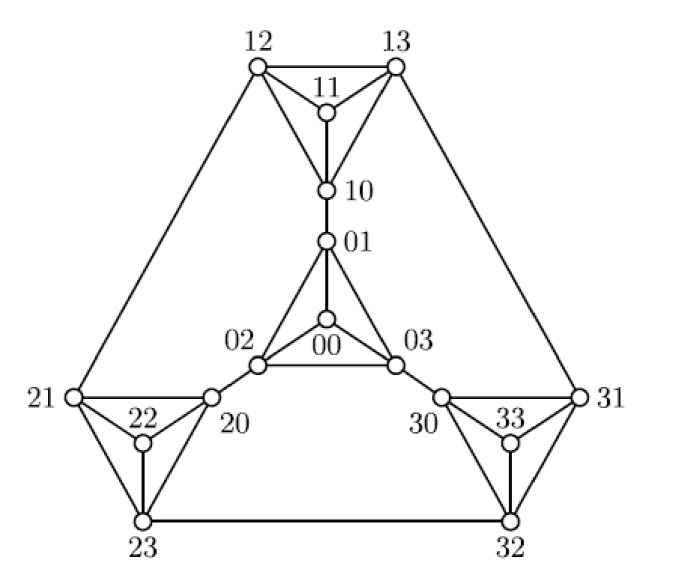
Figure 1: $S(2,4)$
Sierpiński graph $S(2,4)$ is shown in Figure 1. Note that $S(n,\ell)$ can be constructed recursively as follows: $S(1,\ell)$ is isomorphic to $K_{\ell}$ , which vertex set is 1-tuples set $\{0,\ldots,\ell-1\}$ . To construct $S(n,\ell)$ for $n>1$ , we take copies of $\ell$ times $S(n-1,\ell)$ and add the letter $i$ on the top of the vertices in $i$ -th copy of $S(n-1,\ell)$ , denoted by $S^{i}(n,\ell)$ . Note that there is exactly one edge (bridge edge) between $S^{i}(n,\ell)$ and $S^{j}(n,\ell)$ , $i\neq j$ , namely the edge between vertices $\langle ij\cdots j\rangle$ and $\langle ji\cdots i\rangle$ .
The vertices $(\underbrace{i,i,\cdots,i}_{n})$ , $i\in\{0,1,\ldots,\ell-1\}$ are the extreme vertices of $S(n,\ell)$ . Note that an extreme vertex $u$ of $S(n,\ell)$ has degree $d(u)=\ell-1$ . For $i\in\{0,\ldots,\ell-1\}$ and $n\geq 2$ , let $S^{i}(n-1,\ell)$ denote the subgraph of $S(n,\ell)$ induced by the vertices of the form $\{\langle iu_{1}\cdots u_{n-1}\rangle\,|\,0\leq u_{i}\leq\ell-1\}$ . The vertex set $V(S(n,\ell))$ can be partitioned into $\ell$ parts $V(S^{0}(n-1,\ell)),V(S^{1}(n-1,\ell)),\ldots,V(S^{\ell-1}(n-1,\ell))$ . For each $0\leq i\leq\ell-1$ , $S^{i}(n-1,\ell)$ is isomorphic to $S(n-1,\ell)$ . Note that $V(S(n,\ell))=V(S^{0}(n-1,\ell))\cup\cdots\cup V(S^{\ell-1}(n-1,\ell))$ and $S(n,\ell)$ is the graph obtained from $S^{0}(n-1,\ell),\ldots,S^{\ell-1}(n-1,\ell)$ by adding exactly one edge (bridge edge) between $S^{i}(n-1,\ell)$ and $S^{j}(n-1,\ell)$ , $i\neq j$ , and the bridge edge joins $\langle ij\cdots j\rangle$ and $\langle ji\cdots i\rangle$ (notices that $\langle ij\cdots j\rangle$ and $\langle ji\cdots i\rangle$ are extreme vertices of $S^{i}(n-1,\ell)$ and $S^{j}(n-1,\ell)$ , respectively, if we regard $S^{i}(n-1,\ell)$ and $S^{j}(n-1,\ell)$ as two copies of $S(n-1,\ell)$ ).
Sierpiński graphs generalize Hanoi graphs which can be viewed as “discrete” finite versions of a Sierpiński gasket [23, 10]. Xue considered the Hamiltionicity and path $t$ -coloring of Sierpiński-like graphs in [25]; furthermore, they proved that $Val(S(n,k))=Val(S[n,k])=\lfloor k/2\rfloor$ , where $Val(S(n,k))$ is the linear arboricity of Sierpiński graphs. We remark that although Sierpiński graphs are not regular, they are “almost” regular as the extreme vertices have degrees one less than the degrees of non-extreme vertices.
### 1.3 Preliminaries and our results
Chartrand et al. [4] and Li et al. [16] obtained the exact value of $\kappa_{k}(K_{n})$ .
**Theorem 1.1 ([16,4])**
*For every two integers $n$ and $k$ with $2\leq k\leq n$ ,
$$
\kappa_{k}(K_{n})=\lambda_{k}(K_{n})=n-\lceil k/2\rceil.
$$*
The following result is on the Hamiltonian decomposition of Sierpiński graphs.
**Theorem 1.2**
*[25] $(1)$ For even $\ell\geq 2$ , $S(n,\ell)$ can be decomposed into edge disjoint union of $\frac{\ell}{2}$ Hamiltonian paths of which the end vertices are extreme vertices. $(2)$ For odd $\ell\geq 3$ , there exist $\frac{\ell-1}{2}$ edge-disjoint Hamiltonian paths whose two end vertices are extreme vertices in $S(n,\ell)$ .*
In fact, Theorem 1.2 is used in the proof of Theorem 1.5, which give an lower bound for the generalized $k$ -edge connectivity of Sierpiński graphs $S(n,\ell)$ . We require the following result.
**Theorem 1.3 ([5,26])**
*Suppose that $G$ is a complete graph with $V(G)=\{v_{0},\cdots,v_{N-1}\}$ . If $N=2n$ , then $G$ can be decomposed into $n$ Hamiltonian paths
$$
\{i\in\{1,2,\ldots,n\}:\ L_{i}=v_{0+i}v_{1+i}v_{2n-1+i}v_{2+i}v_{2n-2+i}\cdots
v
_{n+1+i}v_{n+1}\},
$$
where the subscripts take modulo $2n$ . If $N=2n+1$ , then $G$ can be decomposed into $n$ Hamiltonian paths
$$
\{i\in\{1,2,\ldots,n\}:\ L_{i}=\ v_{0+i}v_{1+i}v_{2n+i}v_{2+i}v_{2n-1+i}\cdots
v
_{n+i}v_{n+1+i}\}
$$
and a matching $M=\{v_{n-i}v_{n+1}:\ i\in\{1,2,\ldots,n\}\}$ , where the subscripts take modulo $2n+1$ .*
The following result is derived from Theorem 1.3, and we will use it later.
**Corollary 1.4**
*Let $s$ be an integer with $s\leq\frac{N}{2}$ . Suppose that $G$ is the complete graph with $V(G)=\{v_{1},\cdots,v_{N}\}$ and $\mathcal{S}=\{\ \{v_{i_{1}},v_{i_{2}}\}:i\in\{1,2,\ldots,s\}\}$ is a collection of pairwise disjoint $2$ -subsets of $V(G)$ . Then there are $s$ edge-disjoint Hamiltonian paths $L_{1},\cdots,L_{s}$ such that $v_{i_{1}},v_{i_{2}}$ are endpoints of $L_{i}$ .*
Our main result is as follows.
**Theorem 1.5**
*$(i)$ For $3\leq k\leq\ell$ , we have
$$
\kappa_{k}(S(n,\ell))=\lambda_{k}(S(n,\ell))=\ell-\left\lceil k/2\right\rceil.
$$ $(ii)$ For $\ell+1\leq k\leq{\ell}^{n}$ , we have
$$
\kappa_{k}(S(n,\ell))\leq\left\lfloor\ell/2\right\rfloor\mbox{ and }\lambda_{k
}(S(n,\ell))=\left\lfloor\ell/2\right\rfloor.
$$*
## 2 Proof of Theorem 1.5
This section is organized as follows. We first introduce some notations, operations and auxiliary graphs that are used in the proof. Then we give a transitional theorem (Theorem 2.1), which is the main tool for the proof of Theorem 1.5. Theorem 2.1 will be proved by constructing an algorithm, and the proof takes up almost entire Section 2 (the proof is divided into two parts: the construction of algorithm and the proof of its correctness). Finally, we complete the proof of Theorem 1.5 by using Theorem 2.1.
### 2.1 Notations, operations and auxiliary graphs
For $1\leq s<n$ , by the definition of the Sierpiński graph $S(n,\ell)$ , we have that $G=S(n,\ell)$ consists of $\ell^{n-s}$ Sierpiński graphs $S(s,\ell)$ , and we call each such $S(s,\ell)$ an $s$ -atom of $G$ . Note that $\mathcal{P}=\{V(H):\ H\mbox{ is an }s\mbox{-atom of }G\}$ is a partition of $V(G)$ . We use $G_{s}$ to denote the graph $G/\mathcal{P}$ . It is obvious that $G_{s}$ is a simple graph and $G_{s}=S(n-s,\ell)$ . Note that $G_{n}$ is a single vertex and $G_{0}=G$ . For a vertex $u$ of $G_{s}$ , we use $A_{s,u}$ to denote the $s$ -atom of $G$ which is contracted into $u$ . See Figures 4, 4 and 4 for illustrations.
| Notation | Corresponding interpretation |
| --- | --- |
| $s$ -atom | A copy of $S(s,\ell)$ in $G=S(n,\ell)$ , where $0\leq s\leq n$ . |
| $G_{s}$ | The graph obtained from $G$ by contracting all $\ell^{n-s}$ $s$ -atoms in $G$ . |
| $A_{u,s}$ | The $s$ -atom in $G$ which is contracted into $u$ , where $u\in V(G_{s})$ . |
| $H^{u}$ | $G_{s-1}$ can be obtained form $G_{s}$ by expending each $u\in V(G_{s})$ to a complete graph $H^{u}=K_{\ell}$ . |
| $u^{e},v^{e}$ | If $e=uv$ is an edge of $G_{s}$ , then $e$ is also an edge of $G_{s-1}$ . let $u_{e},v_{e}$ denote endpoints of $e$ in $G_{s-1}$ such that $u_{e}\in H^{u}$ and $v_{e}\in H^{v}$ . |
| $U$ | The set of labelled vertices in $G$ ( $|U|=k$ ). |
| $U^{s}$ | The set of labelled vertices in $G_{s}$ . |
| $W^{u}$ | The set of labelled vertices in $H^{u}$ . |
Table 1: Notations for and their meanings.
Note that $G_{s-1}$ is the graph obtained from $G_{s}$ by replacing each vertex $u$ with a complete graph $K_{\ell}$ . We denote by $H^{u}$ the complete graph replacing $u$ (see Figures 4 and 4 for illustrations). For an edge $e=uv$ of $G_{s}$ , $e$ is also an edge of $G_{s-1}$ . We use $u_{e}$ and $v_{e}$ to denote the ends of $e$ in $G_{s-1}$ , respectively, such that $u_{e}\in V(H^{u})$ and $v_{e}\in V(H^{v})$ . (See Figure 5 for an illustration.)
Fix a subset $U$ of $V(G)$ arbitrary such that $|U|=k$ , where $3\leq k\leq\ell$ . For the graph $G_{s}$ , a vertex $u$ of $G_{s}$ is labelled if $V(A_{s,u})\cap U\neq\emptyset$ , and $u$ is unlabelled otherwise. We use $U^{s}$ to denote the set of labelled vertices of $G_{s}$ . For a labelled vertex $u$ of $G_{s}$ , let $W^{u}=V(H^{u})\cap U^{s-1}$ , that is, the set of labelled vertices in $H^{u}$ . See Figure 4 as an example, if $U=\{u_{000},u_{001},u_{013},u_{122}\}$ , then $U^{1}=\{u_{00},u_{01},u_{12}\}$ and $W^{u_{0}}=\{u_{00},u_{01}\}$ in Figure 4. For ease of reading, above notations and their meanings are summarized in Table 1.
We construct an out-branching $\overrightarrow{T}$ with vertex set $V(\overrightarrow{T})=\bigcup_{i\in\{0,1,\ldots,n\}}\{x:\ x\in V(G_{i})\}$ and arc set $A(\overrightarrow{T})=\{(x,y):\ y\in V(H^{x})\}$ . The root of $\overrightarrow{T}$ is denoted by $v_{root}$ (it is clear that $V(G_{n})=\{v_{root}\}$ ). For two different vertices $x,y$ of $V(\overrightarrow{T})$ , if there is a direct path from $x$ to $y$ , then we say that $x\prec y$ , and denote the directed path by $x\overrightarrow{T}y$ . The following result is straightforward.
**Fact 1**
*If $x_{i}\in V(\overrightarrow{T})$ for $i\in[p]$ and $x_{1}\prec x_{2}\prec\ldots\prec x_{p}$ , then $\sum_{i\in[p]}|W^{x_{i}}|\leq k+p-1$ .*
$u_{000}$ $u_{001}$ $u_{002}$ $u_{003}$ $u_{010}$ $u_{012}$ $u_{011}$ $u_{013}$ $u_{020}$ $u_{021}$ $u_{030}$ $u_{031}$ $u_{022}$ $u_{023}$ $u_{032}$ $u_{033}$ $u_{100}$ $u_{101}$ $u_{110}$ $u_{111}$ $u_{102}$ $u_{103}$ $u_{112}$ $u_{113}$ $u_{120}$ $u_{121}$ $u_{130}$ $u_{131}$ $u_{122}$ $u_{123}$ $u_{132}$ $u_{133}$ $u_{200}$ $u_{201}$ $u_{210}$ $u_{211}$ $u_{300}$ $u_{301}$ $u_{310}$ $u_{311}$ $u_{202}$ $u_{203}$ $u_{212}$ $u_{213}$ $u_{302}$ $u_{303}$ $u_{312}$ $u_{313}$ $u_{220}$ $u_{221}$ $u_{230}$ $u_{231}$ $u_{320}$ $u_{321}$ $u_{330}$ $u_{331}$ $u_{222}$ $u_{223}$ $u_{232}$ $u_{233}$ $u_{322}$ $u_{323}$ $u_{332}$ $u_{333}$ $A(2,u_{0})$ $A(2,u_{1})$
Figure 2: $G=G_{0}=S(3,4)$
$u_{00}$ $u_{01}$ $u_{02}$ $u_{03}$ $u_{10}$ $u_{11}$ $u_{12}$ $u_{13}$ $u_{20}$ $u_{21}$ $u_{30}$ $u_{31}$ $u_{22}$ $u_{23}$ $u_{32}$ $u_{33}$ $H^{u_{0}}$ $H^{u_{1}}$
Figure 3: The graph $G_{1}$
$u_{0}$ $u_{1}$ $u_{2}$ $u_{3}$
Figure 4: The graph $G_{2}$
### 2.2 A transitional theorem and its proof
In order to prove our main result (Theorem 1.5), we first prove the following transitional theorem by constructing $\ell-\left\lceil k/2\right\rceil$ internally disjoint $U$ -Steiner trees in $G$ .
**Theorem 2.1**
*Let $G=S(n,\ell)$ and $U\subseteq V(G)$ with $|U|=k$ ( $U$ is defined before), and let $c=\ell-\left\lceil k/2\right\rceil$ . For $0\leq s\leq n$ , $G_{s}$ has $c$ internally disjoint $U^{s}$ -Steiner trees $T_{1},\cdots,T_{c}$ such that the following statement holds.
1. For each $u\in U^{s}$ (say $u\in W^{v}$ and hence $v$ is a labelled vertex of $G_{s+1}$ if $s\neq n$ ) and $i\in[c]$ , $d_{T_{i}}(u)\leq 2$ .*
The rest part of this subsection is the proof of Theorem 2.1.
Proof of Theorem 2.1 Suppose that $s^{\prime}$ is the minimum integer such that $G_{s^{\prime}}$ has exactly one labelled vertex (note that $s^{\prime}$ exists since $G_{n}$ consists of a single labelled vertex). This means that $G_{s^{\prime}-1}$ has at least two labelled vertices. Let $v$ be the labelled vertex in $G_{s^{\prime}}$ . Then $U\subseteq A_{s^{\prime},v}$ . Thus, in order to find $c$ internally disjoint $U$ -Steiner trees of $G$ satisfying ( $\star$ ), we only need to find $c$ internally disjoint $U$ -Steiner trees in $A_{s^{\prime},v}$ satisfying ( $\star$ ). Hence, without loss of generality, we can assume that $G$ is a graph with
$$
|W^{v_{root}}|=|U^{n-1}|\geq 2. \tag{1}
$$
Therefore, $|U^{i}|\geq 2$ for each $i\leq n-1$ . $u_{11}$ $u_{12}$ $u_{13}$ $u_{24}$ $u_{21}$ $u_{22}$ $u_{23}$ $u_{24}$ $u_{31}$ $u_{32}$ $u_{41}$ $u_{42}$ $u_{33}$ $u_{34}$ $u_{43}$ $u_{44}$ $e$ $u_{e}$ $v_{e}$ $u$ $v$ $e$ $G_{1}$ $G_{2}$
Figure 5: From graph $G_{1}$ to $G_{2}$ by $u_{e}v_{e}$ contraction edge $uv$ .
The proof is technical and is via induction. Note that since $G_{n}$ is a single vertex and $G=G_{0}$ , the induction is from $G_{n}$ to $G_{0}$ . The basic idea is to use the $U^{s}$ -Steiner trees of $G_{s}$ to construct appropriate $U^{s-1}$ -Steiner trees of $G_{s-1}$ . Since each vertex in $G_{s}$ corresponds to a complete graph in $G_{s-1}$ , it is not a straightforward process to extend $U^{s}$ -Steiner trees of $G_{s}$ to $U^{s-1}$ -Steiner trees of $G_{s-1}$ .
If $s=n$ , then each $T_{i}$ in $G_{n}$ is the empty graph and the result holds. Thus, suppose $s\leq n-1$ . Hence, the labelled vertex $v$ of $G_{s+1}$ always exists. The following implies that the result holds for $s=n-1$ . Note that $U^{n-1}=W^{v_{root}}$ .
**Claim 1**
*If $s=n-1$ , then we can construct $c$ internally disjoint $U^{s}$ -Steiner trees, say $T_{1},\ldots,T_{c}$ , such that for each $i\in[c]$ and $u\in U^{s}$ , $d_{T_{i}}(u)\leq 2$ . Moreover,
1. $(i)$ If $|U^{s}|\leq\lceil k/2\rceil$ , then for each $i\in[c]$ and $u\in U^{s}$ , $d_{T_{i}}(u)=1$ ;
1. $(ii)$ otherwise, for each $u\in U^{s}$ , there are at most $|U^{s}|-\lceil k/2\rceil$ internally disjoint $U^{s}$ -Steiner trees $T_{i}$ such that $d_{T_{i}}(u)=2$ .*
* Proof*
Note that $G_{n-1}=S(1,\ell)=K_{\ell}$ . Suppose $|U^{n-1}|\leq\left\lceil k/2\right\rceil$ . Then $|V(G_{n-1})-U^{n-1}|\geq\ell-\left\lceil k/2\right\rceil=c$ and we can choose $c$ stars of $\{x\vee U^{n-1}:\ x\in V(G_{n-1})-U^{n-1}\}$ as internally disjoint $U^{n-1}$ -Steiner trees $T_{1},\ldots,T_{c}$ . It is easy to verify that $d_{T_{i}}(u)=1$ for $i\in[c]$ and $u\in U^{n-1}$ . Suppose $|U^{n-1}|\geq\lceil k/2\rceil$ . Since $|U^{n-1}|\leq k$ , it follows that $0\leq|U^{n-1}|-\left\lceil k/2\right\rceil\leq\lfloor|U^{n-1}|/2\rfloor$ . By Corollary 1.4, there are $|U^{n-1}|-\left\lceil k/2\right\rceil$ edge-disjoint Hamiltonian paths in $G_{n-1}[U^{n-1}]$ . So, we can choose $c$ internally disjoint $U^{n-1}$ -Steiner trees consisting of $|U^{n-1}|-\left\lceil k/2\right\rceil$ edge-disjoint Hamiltonian paths in $G_{n-1}[U^{n-1}]$ and $\ell-|U^{n-1}|$ stars $\{x\vee U^{n-1}:\ x\in V(G_{n-1})-U^{n-1}\}$ . It is easy to verify that $d_{T_{i}}(u)\leq 2$ for $i\in[c]$ and $u\in U^{n-1}$ , and there are at most $|U^{n-1}|-\left\lceil k/2\right\rceil$ internally disjoint $U^{n-1}$ -Steiner trees $T_{i}$ such that $d_{T_{i}}(u)=2$ . ∎
Our proof is a recursive process that the $c$ internally disjoint $U^{s}$ -Steiner trees of $G_{s}$ are constructed by using the $c$ internally disjoint $U^{s+1}$ -Steiner trees of $G_{s+1}$ . We will find some ways to construct the $c$ internally disjoint $U^{s}$ -Steiner trees such that $(\star)$ holds. In the finial step, the $c$ internally disjoint $U$ -Steiner trees in $G_{0}=G$ will be obtained. We have proved that the result holds for $s\in\{n,n-1\}$ . Now, suppose that we have constructed $c$ internally disjoint $U^{s+1}$ -Steiner trees, say $\mathcal{F}=\{F_{1},\ldots,F_{c}\}$ , and the trees satisfy ( $\star$ ), where $s\in\{0,\ldots,n-1\}$ . We need to construct $c$ internally disjoint $U^{s}$ -Steiner trees $\mathcal{T}=\{T_{1},\ldots,T_{c}\}$ of $G_{s}$ satisfying ( $\star$ ).
Recall that each edge of $G_{s+1}$ is also an edge of $G_{s}$ . In addition, let $E_{u,i}$ denote the set of edges in $F_{i}$ incident with the labelled vertex $u$ in $G_{s}$ and let $V_{u,i}=\{u_{e}:\ e\in E_{u,i}\}$ (recall that the edge $e=uw$ in $G_{s+1}$ is denoted by $e=u_{e}w_{e}$ in $G_{s}$ , where $u_{e}\in V(H^{u})$ and $w_{e}\in V(H^{w})$ ). Note that $E_{u,i}$ and $V_{u,i}$ are the subsets of $E(G_{s})$ and $V(G_{s})$ , respectively.
Our aim is to construct internally disjoint $U^{s}$ -Steiner trees $T_{1},\ldots,T_{c}$ that is obtained from $U^{s+1}$ -Steiner trees $F_{1},\ldots,F_{c}$ . So, we need to “blow” up each vertex $w$ of $G_{s+1}$ into $H^{w}$ and find internally disjoint $W^{w}$ -Steiner trees $F_{1}^{w},\ldots,F_{c}^{w}$ of $H^{w}$ ( $F_{i}^{w}$ may be the empty graph if $w$ is a unlabelled vertex) such that
$$
\mathcal{T}=\left\{T_{i}=F_{i}\cup\bigcup_{w\in V(G_{s+1})}F_{i}^{w}:\ i\in[c]
\right\}.
$$
Each $F_{i}^{w}$ can be constructed as follows.
- If $w$ is a labelled vertex of $G_{s+1}$ , then $w$ is in each $U^{s+1}$ -Steiner tree of $\mathcal{F}$ . We choose $c$ internally disjoint $W^{w}$ -Steiner trees $F_{1}^{w},\ldots,F_{c}^{w}$ of $H^{w}$ such that $V_{w,i}\subseteq V(F_{i}^{w})$ for each $i\in[c]$ .
- If $w$ is an unlabelled vertex, then $w$ is in at most one $U^{s+1}$ -Steiner tree of $\mathcal{F}$ . For each $i\in[c]$ , if $w\in V(F_{i})$ , then let $F_{i}^{w}$ be a spanning tree of $H^{w}$ ; if $w\notin V(F_{i})$ , then let $F_{i}^{w}$ be the empty graph.
For $i\in[c]$ , let $E_{i}=E(F_{i})\cup\bigcup_{w\in V(G_{s+1})}E(F_{i}^{w})$ and let $T_{i}=G_{s}[E_{i}]$ . It is obvious that $T_{1},\ldots,T_{c}$ are internally disjoint $U^{s}$ -Steiner trees. We need to ensure that each labelled vertex of $G^{s}$ satisfies ( $\star$ ).
In fact, without loss of generality, we only need to choose an arbitrary labelled vertex $u\in G_{s+1}$ and prove that each vertex of $W^{u}$ satisfies ( $\star$ ). This is because $F_{i}^{w}$ is clear when $w$ is an unlabelled vertex (in the case $F_{i}^{w}$ is either a spanning tree of $H^{w}$ or the empty graph). By Eq. (1) and Fact 1, $|W^{u}|\leq k-1$ since $u\neq v_{root}$ .
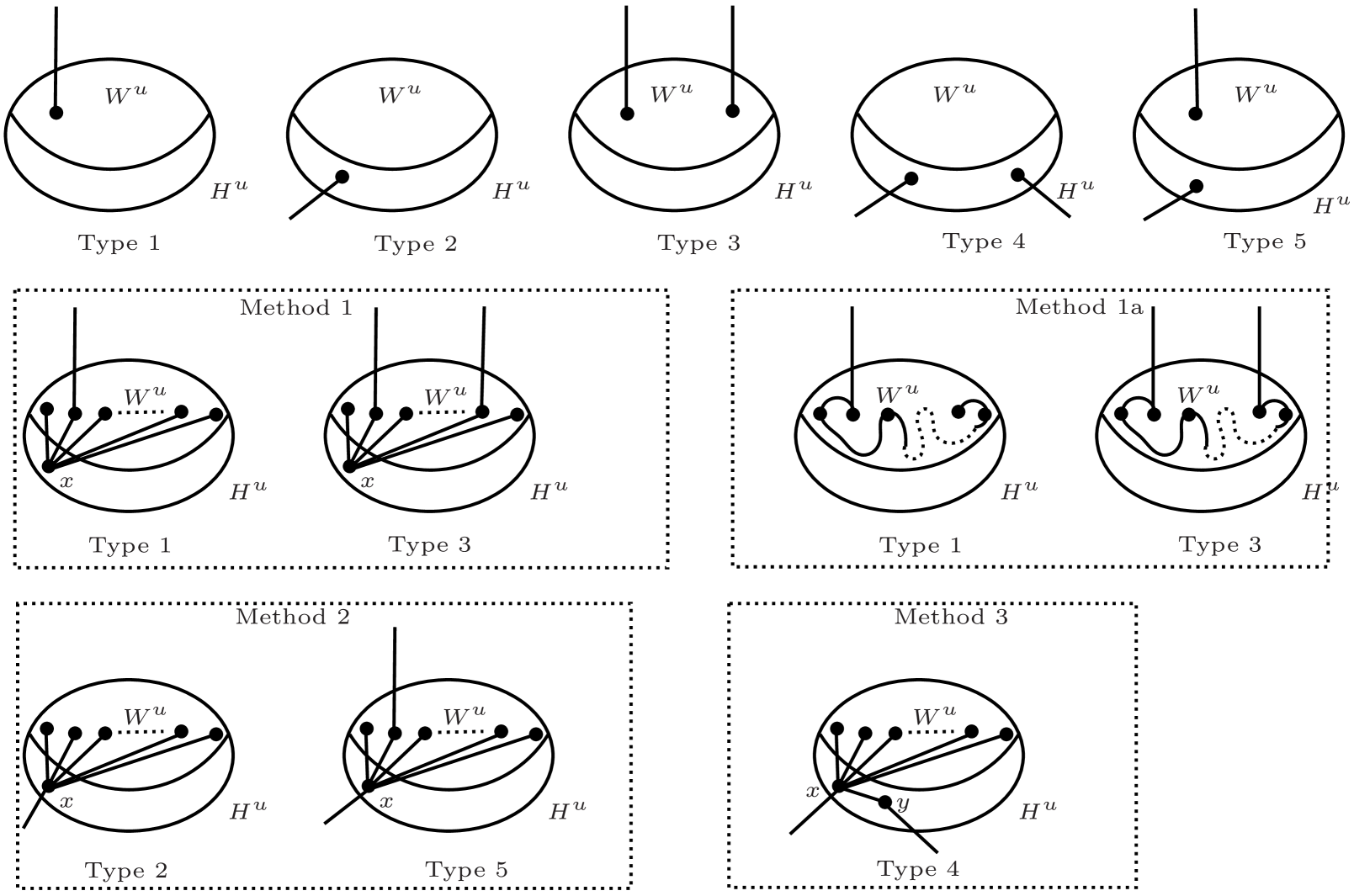
Since $d_{F_{i}}(u)\leq 2$ for each $i\in[c]$ and $u\in U^{s}$ , it follows that $|E_{u,i}|=|V_{u,i}|\leq 2$ . Therefore, we can divide $F_{1},\ldots,F_{c}$ into the following five types on $u$ :
Type 1: $|V_{u,i}|=1$ and $V_{u,i}\subseteq W^{u}$ .
Type 2: $|V_{u,i}|=1$ and $V_{u,i}\nsubseteq W^{u}$ .
Type 3: $|V_{u,i}|=2$ and $V_{u,i}\subseteq W^{u}$ .
Type 4: $|V_{u,i}|=2$ and $V_{u,i}\cap W^{u}=\emptyset$ .
Type 5: $|V_{u,i}|=2$ and $|V_{u,i}\cap W^{u}|=1$ .
If $F_{i}$ is a graph of Type $j\ (1\leq j\leq 5)$ on $u$ , then we also call $F_{i}^{u}$ a $W^{u}$ -Steiner tree of Type $j$ . Suppose there are $n_{j}(u)$ trees $F_{i}$ that belong to Type $j$ on $u$ for $j\in[5]$ . Then
$$
\displaystyle\sum_{i=1}^{5}n_{j}(u)=c. \tag{2}
$$
It is obvious that $n_{j}(v_{root})=0$ for each $j\in[5]$ . Let
$$
R(u)=V(H^{u})-W^{u}-\bigcup_{i\in[c]}V_{u,i}.
$$
Note that $R(u)$ is the set of unlabelled vertices in $G_{s}$ , which will be used to construct the $W^{u}$ -Steiner trees in $H^{u}$ . It is clear that
$$
|R(u)|=\ell-|W^{u}|-[n_{2}(u)+2n_{4}(u)+n_{5}(u)]. \tag{3}
$$
<details>
<summary>x2.png Details</summary>
### Visual Description
\n
## Diagram: Illustration of Different Types and Methods
### Overview
The image presents a diagram illustrating five different types and three methods related to a concept involving 'W<sup>u</sup>' and 'H<sup>u</sup>', likely representing unstable and stable manifolds in dynamical systems theory. The diagram uses circles to represent phase space, with arrows indicating trajectories and points marking specific locations. The diagram is organized into three main sections: a row of five types, and two rows of methods, each showing variations of the types.
### Components/Axes
The diagram consists of:
* Circles: Representing phase space.
* Arrows: Indicating trajectories or flow direction.
* Points: Labeled 'x' and 'y', marking specific locations within the phase space.
* Labels: 'W<sup>u</sup>' and 'H<sup>u</sup>' are consistently present, likely denoting unstable and stable manifolds.
* Type Labels: "Type 1", "Type 2", "Type 3", "Type 4", "Type 5"
* Method Labels: "Method 1", "Method 1a", "Method 2", "Method 3"
* Dotted Lines: Used to indicate approximate or less certain trajectories.
* Colored Regions: In Method 1a, red and green regions are used to highlight areas.
### Detailed Analysis or Content Details
**Top Row: Types**
* **Type 1:** A circle with 'W<sup>u</sup>' above and 'H<sup>u</sup>' below. A single arrow points downwards from 'W<sup>u</sup>' to 'H<sup>u</sup>'.
* **Type 2:** Similar to Type 1, but the arrow from 'W<sup>u</sup>' to 'H<sup>u</sup>' is curved.
* **Type 3:** Similar to Type 1, but the arrow from 'W<sup>u</sup>' to 'H<sup>u</sup>' is curved in the opposite direction.
* **Type 4:** Similar to Type 1, but the arrow from 'W<sup>u</sup>' to 'H<sup>u</sup>' is a short, straight line.
* **Type 5:** Similar to Type 1, but the arrow from 'W<sup>u</sup>' to 'H<sup>u</sup>' is curved and extends beyond the circle.
**Second Row: Method 1**
* **Method 1 - Type 1:** A circle with 'W<sup>u</sup>' above and 'H<sup>u</sup>' below. A dotted line connects a point 'x' on the circle to 'W<sup>u</sup>'. An arrow points downwards from 'W<sup>u</sup>' to 'H<sup>u</sup>'.
* **Method 1 - Type 3:** A circle with 'W<sup>u</sup>' above and 'H<sup>u</sup>' below. A dotted line connects a point 'x' on the circle to 'W<sup>u</sup>'. An arrow points downwards from 'W<sup>u</sup>' to 'H<sup>u</sup>'.
**Third Row: Method 1a**
* **Method 1a - Type 1:** A circle with 'W<sup>u</sup>' above and 'H<sup>u</sup>' below. A wavy dotted line connects 'W<sup>u</sup>' to 'H<sup>u</sup>'. A red region is shown near 'W<sup>u</sup>' and a green region near 'H<sup>u</sup>'.
* **Method 1a - Type 3:** A circle with 'W<sup>u</sup>' above and 'H<sup>u</sup>' below. A wavy dotted line connects 'W<sup>u</sup>' to 'H<sup>u</sup>'. A red region is shown near 'W<sup>u</sup>' and a green region near 'H<sup>u</sup>'.
**Fourth Row: Method 2**
* **Method 2 - Type 2:** A circle with 'W<sup>u</sup>' above and 'H<sup>u</sup>' below. Multiple curved arrows connect 'W<sup>u</sup>' to 'H<sup>u</sup>'. A dotted line connects a point 'x' on the circle to 'W<sup>u</sup>'.
* **Method 2 - Type 5:** A circle with 'W<sup>u</sup>' above and 'H<sup>u</sup>' below. Multiple curved arrows connect 'W<sup>u</sup>' to 'H<sup>u</sup>'. A dotted line connects a point 'x' on the circle to 'W<sup>u</sup>'.
**Fifth Row: Method 3**
* **Method 3 - Type 4:** A circle with 'W<sup>u</sup>' above and 'H<sup>u</sup>' below. Multiple curved arrows connect 'W<sup>u</sup>' to 'H<sup>u</sup>'. A dotted line connects a point 'x' on the circle to 'W<sup>u</sup>', and another dotted line connects a point 'y' on the circle to 'H<sup>u</sup>'.
### Key Observations
* The 'W<sup>u</sup>' and 'H<sup>u</sup>' labels are consistent throughout all diagrams, suggesting they represent fundamental elements of the system.
* The different types vary in the shape and direction of the arrows connecting 'W<sup>u</sup>' and 'H<sup>u</sup>', indicating different dynamical behaviors.
* The methods introduce additional elements like points 'x' and 'y', and dotted lines, potentially representing specific conditions or observations.
* Method 1a uses color-coding (red and green) to highlight regions, possibly indicating different stability or behavior.
### Interpretation
This diagram likely illustrates different scenarios in dynamical systems theory, specifically concerning the relationship between unstable ('W<sup>u</sup>') and stable ('H<sup>u</sup>') manifolds. The types represent different configurations of these manifolds, while the methods demonstrate how specific points or conditions ('x', 'y') influence their behavior.
The variations in arrow shapes and directions suggest different types of bifurcations or stability properties. The introduction of points 'x' and 'y' in Methods 1, 2, and 3 could represent saddle points or other critical points in the system. The color-coding in Method 1a might indicate regions of attraction or repulsion.
The diagram is a visual representation of theoretical concepts, and the specific meaning of each element would depend on the context of the dynamical system being studied. It appears to be a pedagogical tool for understanding the complex interplay between unstable and stable manifolds in different scenarios. The use of dotted lines suggests approximations or less certain trajectories, while solid lines represent more definite behaviors. The overall structure suggests a systematic exploration of different configurations and their implications.
</details>
Figure 6: Five types and methods 1, 1a, 2 and 3.
We have the following five methods to choose $F_{1}^{u},\ldots,F_{c}^{u}$ for the labelled vertex $u\in G_{s+1}$ (see Figure 6).
Method 1 If $F_{i}$ is a graph of Type 1 and $|W^{u}|\geq 2$ , or $F_{i}$ is a graph of Type 3, then let $F^{u}_{i}=x\vee W^{u}$ , where $x\in R(u)$ .
Method 1a If $F_{i}$ is a graph of Type 1 and $|W^{u}|\geq 2$ , then let $F^{u}_{i}$ be a Hamiltonian path of $H^{u}[W^{u}]$ such that the vertex in $V_{u,i}$ is an endpoint of this Hamiltonian path; if $F_{i}$ is a graph of Type 3, then let $F^{u}_{i}$ be a Hamiltonian path of $H^{u}[W^{u}]$ such that the endpoints of $F_{i}$ are two vertices in $V_{u,i}$ .
Method 2 If $F_{i}$ is a graph of Type 2 or Type 5, say $x$ is the only vertex of $V_{u,i}$ with $x\notin W^{u}$ , then let $F^{u}_{i}=x\vee W^{u}$ .
Method 3 If $F_{i}$ is a graph of Type 4, say $V_{u,i}=\{x,y\}$ , then let $F^{u}_{i}=xy\cup(x\vee W^{u})$ .
Method 4 If $F_{i}$ is a graph of Type 1 and $|W^{u}|=1$ , then let $F_{i}^{u}$ be the empty graph.
It is worth noting that the method is deterministic if $F_{i}^{u}$ is a graph of Types 2, 4 and 5, or $F_{i}^{u}$ is a graph of Type 1 and $|W^{u}|=1$ . So we firstly construct these $F_{i}^{u}$ s by using Methods 2, 3 and 4, respectively, and then construct $F^{u}_{i}$ s of Type 1 with $|W^{u}|\geq 2$ and construct $F^{u}_{i}$ s of Type 3 by using Method 1 or Method 1a.
The following is an algorithm constructing $c$ internally disjoint $U$ -Steiner trees of $G$ .
Input: $U$ , $c$ and $G=S(n,\ell)$ with $|W^{root}|\geq 2$
Output: $c$ internally disjoint $U$ -Steiner trees $T^{\prime}_{1},T^{\prime}_{2},\ldots,T^{\prime}_{c}$ of $G$
1 $T^{\prime}_{1},T^{\prime}_{2},\ldots,T^{\prime}_{c}$ are empty graphs;
2 $s=n$ //(* in initial step, $G^{n}$ is a single vertex*);
3 for $s\geq 1$ do
4 for each vertex $u$ of $G_{s}$ do
5 if $u$ is an unlabelled vertex then
6 for $1\leq i\leq c$ do
7 if $u$ is a vertex of $F_{i}$ then
8 $F_{i}^{u}$ is a spanning tree of $H^{u}$ ;
9 else
10 $\ F_{i}^{u}$ is is the empty graph;
11 end if
12 $T^{\prime}_{i}=T^{\prime}_{i}\cup F_{i}^{u}$ ;
13 $i=i+1$ ;
14
15 end for
16
17 end if
18
19 if $u$ is a labelled vertex then
20 $\mu=|R(u)|$ ;
21 for $1\leq i\leq c$ do
22
23 if $T^{\prime}_{i}$ is of Type 2 or Type 5 then
24 construct $F_{i}^{u}$ by using Method 2;
25
26 end if
27
28 if $T^{\prime}_{i}$ is of Type 4 then
29 construct $F_{i}^{u}$ by using Method 3;
30
31 end if
32
33 if $T^{\prime}_{i}$ is of Type 1 and $|W^{u}|=1$ then
34 construct $F_{i}^{u}$ by using Method 4;
35
36 end if
37
38 if either $T^{\prime}_{i}$ is of Type 1 and $|W^{u}|\geq 2$ , or $T^{\prime}_{i}$ is of Type 3 then
39 if $\mu>0$ then
40 construct $F_{i}^{u}$ by using Method 1;
41 $\mu=\mu-1$ ;
42
43 end if
44
45 if $\mu\leq 0$ then
46 construct $F_{i}^{u}$ by using Method 1a;
47
48 end if
49
50 end if
51
52 $T^{\prime}_{i}=T^{\prime}_{i}\cup F_{i}^{u}$ ;
53 $i=i+1$ ;
54
55 end for
56
57 end if
58
59 end for
60 $s=s-1$ ;
61
62 end for
Algorithm 1 The construction of $c$ internally disjoint $U$ -Steiner trees of $G$
Algorithm 1 is an algorithm for finding $c$ internally disjoint $U$ -Steiner trees of $G$ . For each step of $s$ , the algorithm will construct $c$ internally disjoint $U^{s-1}$ -steiner trees $T^{\prime}_{1},T^{\prime}_{2},\ldots,T^{\prime}_{c}$ . For convenience, we denote each $T_{i}^{\prime}$ by $T_{i}^{s}$ after the $s$ step of outer “for”, that is, $T_{1}^{s},T_{2}^{s},\ldots,T_{c}^{s}$ are $c$ internally disjoint $U^{s}$ -Steiner trees in $G^{s}$ generated in Algorithm 1. If Algorithm 1 is correct, then Lines 16–40 indicate that $d_{T^{\prime}_{i}}(x)\leq 2$ for any $x\in W^{u}$ , and hence ( $\star$ ) always holds.
We now check the correctness of the algorithm. Since $F_{i}^{u}$ is deterministic when $u$ is an unlabelled vertex (Lines 5–15 of Algorithm 1), and $F_{i}^{u}$ is deterministic if $u$ is a labelled vertex and either $F_{i}^{u}$ is a graph of Types 2, 4 and 5, or $F_{i}^{u}$ is a graph of Type 1 and $|W^{u}|=1$ (Lines 19–27 of Algorithm 1), we only need to talk about the labelled vertex $u$ with $|W^{u}|\geq 2$ and check the correctness of Lines 28–36 of Algorithm 1. That is, to ensure that there exist $n_{1}(u)$ $F_{i}^{u}$ s of Type 1 and $n_{3}(u)$ $F_{i}^{u}$ s of Type 3. If $F_{i}^{u}$ is constructed by Method 1, then $F_{i}^{u}$ is a star with center in $R(u)$ (say the center of the star is $a_{i}$ ); if $F_{i}^{u}$ is constructed by Method 1a, then $F_{i}^{u}$ is a Hamiltonian path of $H^{u}$ with endpoints in $V_{u,i}$ . Since $a_{i}$ s are pairwise differently and are contained in $R(u)$ , and $H^{u}$ has at most $\lfloor|W^{u}|/2\rfloor$ Hamiltonian paths to afford by Corollary 1.4, we only need to ensure that $|R(u)|+\lfloor|W^{u}|/2\rfloor\geq n_{1}(u)+n_{3}(u)$ . Thus, we only need to prove the following result.
**Lemma 2.1**
*For each labelled vertex $u\in V(G_{s})$ with $|W^{u}|\geq 2$ , Ineq.
$$
\displaystyle n_{1}(u)+n_{3}(u)-|R(u)|\leq\lfloor|W^{u}|/2\rfloor \tag{4}
$$
holds.*
* Proof*
By Eqs. (2) and (3),
| | $\displaystyle n_{1}(u)+n_{3}(u)-|R(u)|$ | $\displaystyle=n_{1}(u)+n_{3}(u)-[\ell-|W^{u}|-n_{2}(u)-2n_{4}(u)-n_{5}(u)]$ | |
| --- | --- | --- | --- |
Since $c=\ell-\lceil k/2\rceil$ , it follows that
$$
\displaystyle n_{1}(u)+n_{3}(u)-|R(u)|=n_{4}(u)+|W^{u}|-\lceil k/2\rceil. \tag{5}
$$ Before the proof of Lemma 2.1, we give a series of claims as preliminaries.
**Claim 2**
*Suppose that $a\in V(v_{root}\overrightarrow{T}u)$ is a labelled vertex with $a\in U^{\iota}$ , where $1\leq\iota\leq n$ . If $|W^{a}|=1$ (say $W^{a}=\{x\}$ ), then $n_{5}(a)\leq 1$ . Moreover,
1. if $n_{5}(a)=1$ , then $n_{4}(x)\leq 1$ ;
1. if $n_{5}(a)=0$ , then $n_{3}(x)=n_{4}(x)=n_{5}(x)=0$ .*
* Proof*
Note that $x\in U^{\iota-1}$ . in Algorithm 1 (Lines 18–39), if $T_{i}^{\iota}$ is not a tree of Type 5 on $a$ , then $F_{i}^{a}$ is chosen such that $d_{T_{i}^{\iota-1}}(x)=1$ (here $W^{a}=\{x\}$ ); if $T^{\iota}_{i}$ is a tree of Type 5 on $a$ , then $F_{i}^{a}$ is chosen such that $d_{T_{i}^{\iota-1}}(x)=2$ . Since $|W^{a}|=1$ , there is at most one $T^{\iota}_{i}$ of Type 5 on $a$ , and hence $n_{5}(a)\leq 1$ . Furthermore, if $n_{5}(a)=1$ , then there is exact one $T_{i}^{\iota-1}$ in $G^{\ell-1}$ such that $d_{T_{i}^{\iota-1}}(x)=2$ . Hence, $n_{4}(x)\leq 1$ . If $n_{5}(a)=0$ , then $d_{T_{i}^{\iota-1}}(x)=1$ for each $T_{i}^{\iota-1}$ . Therefore, $n_{3}(x)=n_{4}(x)=n_{5}(x)=0$ . ∎
**Claim 3**
*Suppose that $a,b$ are two labelled vertices of $v_{root}\overrightarrow{T}u$ and $a\in W^{b}$ , where $a\in U^{\iota}$ for some $\iota\in[n]$ . Then there are at most $\max\{1,n_{1}(b)+n_{3}(b)-|R(b)|+1\}$ $T_{i}^{\iota}$ s such that $d_{T_{i}^{\iota}}(a)=2$ . Furthermore, $n_{4}(a)\leq\max\{1,n_{1}(b)+n_{3}(b)-|R(b)|+1\}$ .*
* Proof*
Since $a\in W^{b}$ and $a\in U^{\iota}$ , it follows that $b\in U^{\iota+1}$ . For an $i\in[c]$ with $d_{T_{i}^{\iota}}(a)=2$ , we have that either $F_{i}^{b}$ is a Hamiltonian path of the clique $H^{b}[W^{b}]$ , or $a\in V_{b,i}\cap W^{b}$ for some $i\in[c]$ (recall that $V_{b,i}=\{z\in V(H^{b}):z\mbox{ is an end vertex of some edge in }E_{b,i}\}$ , where $E_{b,i}$ is the set of edges in $T_{i}^{\iota+1}$ incident with $b$ ). Hence, if there are $h$ edge-disjoint $F_{i}^{b}$ s that are constructed as Hamiltonian paths of $H^{b}[W^{b}]$ , then there are at most $h+1$ internally disjoint $U^{\iota}$ -Steiner trees $T_{i}^{\iota}$ such that $d_{T_{i}^{\iota}}(a)=2$ . By the definition of $n_{4}(a)$ , we have that $n_{4}(a)\leq h+1$ . In Algorithm 1 (Lines 28–36), if $n_{1}(b)+n_{3}(b)-|R(b)|>0$ , then there are at most $n_{1}(b)+n_{3}(b)-|R(b)|$ $F_{i}^{b}$ s that are constructed as Hamiltonian paths in $H^{b}[W^{b}]$ ; if $n_{1}(b)+n_{3}(b)-|R(b)|\leq 0$ , there is no $F_{i}^{b}$ that is constructed as a Hamiltonian path in $H^{b}[W^{b}]$ . Hence, $h\leq\max\{0,n_{1}(b)+n_{3}(b)-|R(b)|\}$ . Thus, there are at most $\max\{1,n_{1}(b)+n_{3}(b)-|R(b)|+1\}$ internally disjoint $U^{\iota}$ -Steiner trees $T_{i}^{\iota}$ such that $d_{T_{i}^{\iota}}(a)=2$ , and $n_{4}(a)\leq\max\{1,n_{1}(b)+n_{3}(b)-|R(b)|+1\}$ . ∎
**Claim 4**
*Let $a\in V(v_{root}\overrightarrow{T}u)$ be a labelled vertex, where $a\in U^{\iota}$ for some $\iota\in[n]$ . If $n_{4}(a)\leq 1$ and $2\leq|W^{a}|\leq\left\lceil k/2\right\rceil-1$ , then $n_{1}(a)+n_{3}(a)-|R(a)|\leq 0$ . Moreover, for each vertex $x\in W^{a}$ , there is at most one $T_{i}^{\iota-1}$ such that $d_{T_{i}^{\iota-1}}(x)=2$ .*
* Proof*
Since $n_{4}(a)\leq 1$ and $|W^{a}|\leq\left\lceil k/2\right\rceil-1$ , it follows from Eq. (5) that $n_{1}(a)+n_{3}(a)-|R(a)|=|W^{a}|-\left\lceil k/2\right\rceil+1\leq 0.$ By Claim 3, for each vertex $x\in W^{a}$ , there is at most one $T_{i}^{a}$ such that $d_{T_{i}^{\iota-1}}(x)\leq 2$ . ∎
**Claim 5**
*Let $a\in V(v_{root}\overrightarrow{T}u)$ be a labelled vertex, where $a\in U^{\iota}$ for some $\iota\in[n]$ . If $n_{4}(a)\leq 1$ and $\left\lceil k/2\right\rceil\leq|W^{a}|\leq k-1$ , then $n_{1}(a)+n_{3}(a)-|R(a)|\leq\lfloor|W^{a}|/2\rfloor$ . Moreover, for each $x\in W^{a}$ ,
1. if $n_{4}(a)=1$ , then there are at most $|W^{a}|-\left\lceil k/2\right\rceil+2$ internally disjoint $U^{\iota-1}$ -Steiner trees $T_{i}^{\iota-1}$ such that $d_{T_{i}^{\iota-1}}(x)=2$ ;
1. if $n_{4}(a)=0$ , then there are at most $|W^{a}|-\left\lceil k/2\right\rceil+1$ internally disjoint $U^{\iota-1}$ -Steiner trees $T_{i}^{\iota-1}$ such that $d_{T_{i}^{\iota-1}}(x)=2$ .*
* Proof*
Since $n_{4}(a)\leq 1$ , it follows from Eq. (5) that
| | $\displaystyle n_{1}(a)+n_{3}(a)-|R(a)|$ | $\displaystyle\leq|W^{a}|-\left\lceil k/2\right\rceil+n_{4}(a)$ | |
| --- | --- | --- | --- |
and the equality indicates $n_{4}(a)=1$ . If $|W^{a}|\leq k-2$ , then
$$
n_{1}(a)+n_{3}(a)-|R(a)|\leq|W^{a}|-\left\lceil(|W^{a}|+2)/2\right\rceil+1\leq
\left\lfloor|W^{a}|/2\right\rfloor;
$$
if $|W^{a}|=k-1$ and $k$ is even, then
$$
n_{1}(a)+n_{3}(a)-|R(a)|=|W^{a}|-\left\lceil(|W^{a}|+1)/2\right\rceil+1=\left
\lfloor(|W^{a}|+1)/2\right\rfloor=\left\lfloor|W^{a}|/2\right\rfloor;
$$
if $|W^{a}|=k-1$ and $k$ is odd, then
$$
n_{1}(a)+n_{3}(a)-|R(a)|=(k-1)-\left\lceil k/2\right\rceil+1\leq\left\lfloor k
/2\right\rfloor=\left\lfloor(k-1)/2\right\rfloor=\left\lfloor|W^{a}|/2\right\rfloor.
$$
Therefore, $n_{1}(a)+n_{3}(a)-|R(a)|\leq\left\lfloor|W^{a}|/2\right\rfloor$ . By Eq. (5) and Claim 3, if $n_{4}(a)=1$ , then for each vertex $x\in W^{a}$ , there are at most $n_{1}(a)+n_{3}(a)-|R(a)|+1=|W^{a}|-\left\lceil k/2\right\rceil+2$ internally disjoint $U^{\iota-1}$ -Steiner trees $T_{i}^{\iota-1}$ such that $d_{T_{i}^{\iota-1}}(x)=2$ ; if $n_{4}(a)=0$ , then for each vertex $x\in W^{a}$ , there are at most $n_{1}(a)+n_{3}(a)-|R(a)|+1=|W^{u}|-\left\lceil k/2\right\rceil+1$ internally disjoint $U^{\iota-1}$ -Steiner trees $T_{i}^{\iota-1}$ such that $d_{T_{i}^{\iota-1}}(x)=2$ . ∎
**Claim 6**
*Suppose $a,b\in V(\overrightarrow{T})$ , $a\prec b$ and $a\overrightarrow{T}b=az_{1}z_{2}\ldots z_{p}b$ , where $a\in U^{\iota}$ for some $\iota\in[n]$ . If $|W^{z_{i}}|\leq\lceil k/2\rceil-1$ for each $i\in[p]$ , and either $|W^{a}|=1$ or $2\leq|W^{a}|\leq\lceil k/2\rceil-1$ and $n_{4}(a)\leq 1$ , then $n_{4}(b)\leq 1$ .*
* Proof*
Since $a\in U^{\iota}$ , it follows that $z_{q}\in U^{\iota-q}$ for each $q\in[p]$ and $b\in U^{\iota-p-1}$ . Since $|W^{a}|=1$ or $2\leq|W^{a}|\leq\lceil k/2\rceil-1$ and $n_{4}(a)\leq 1$ , by Claims 2 and 4, there are at most one $T_{i}^{\iota-1}$ such that $d_{T_{i}^{\iota-1}}(z_{1})=2$ . Hence, $n_{4}(z_{1})\leq 1$ . Since $|W^{z_{1}}|\leq\lceil k/2\rceil-1$ and $n_{4}(z_{1})\leq 1$ , by Claims 2 and 4, there are at most one $T_{i}^{\iota-2}$ such that $d_{T_{i}^{\iota-2}}(z_{2})=2$ . Hence, $n_{4}(z_{2})\leq 1$ . Repeat this progress, we can get that $n_{4}(z_{p})\leq 1$ . Since $|W^{z_{p}}|\leq\lceil k/2\rceil-1$ and $n_{4}(z_{p})\leq 1$ , by Claims 2 and 4, there are at most one $T_{i}^{\iota-p-1}$ such that $d_{T_{i}^{\iota-p-1}}(b)=2$ . Hence, $n_{4}(b)\leq 1$ . ∎
**Claim 7**
*Suppose $|W^{v_{root}}|\leq\lceil k/2\rceil$ , $b\in V(\overrightarrow{T})$ and $v_{root}\overrightarrow{T}b=v_{root}z_{1}z_{2}\ldots z_{p}b$ . If $|W^{z_{i}}|=1$ for each $i\in[p]$ , then $n_{4}(b)=0$ .*
* Proof*
Since $|W^{v_{root}}|\leq\lceil k/2\rceil$ , by Claim 1, $d_{T_{i}^{n-1}}(z_{1})=1$ for each $U^{n-1}$ -Steiner tree $T_{i}^{n-1}$ . Hence, $n_{3}(z_{1})=n_{4}(z_{1})=n_{5}(z_{1})=0$ . Since $|W^{z_{1}}|=1$ and $n_{5}(z_{1})=0$ , by the second statement of Claim 2, $n_{3}(z_{2})=n_{4}(z_{2})=n_{5}(z_{2})=0$ . Since $|W^{z_{2}}|=1$ and $n_{5}(z_{2})=0$ , by the second statement of Claim 2, $n_{3}(z_{3})=n_{4}(z_{3})=n_{5}(z_{3})=0$ . Repeat this process, we get that $n_{4}(b)=0$ . ∎
**Claim 8**
*Suppose that $a,b$ are two labelled vertices and $a\in W^{b}$ , where $a\in U^{\iota}$ for some $\iota\in[n]$ . If $k$ is even and $|W^{b}|=|W^{a}|=k/2$ , then $n_{1}(a)+n_{3}(a)-|R(a)|\leq\lfloor|W^{a}|/2\rfloor$ and the following hold.
1. If $b=v_{root}$ , then for each vertex $x\in W^{a}$ , there is at most one $T_{i}^{\iota-1}$ such that $d_{T_{i}^{\iota-1}}(x)=2$ .
1. If $b\neq v_{root}$ , then for each vertex $x\in W^{a}$ , there are at most two $T_{i}^{\iota-1}$ s such that $d_{T_{i}^{\iota-1}}(x)=2$ .*
* Proof*
Suppose $b=v_{root}$ . Then by Claim 1, $n_{4}(a)=0$ . Thus,
$$
n_{1}(a)+n_{3}(a)-|R(a)|=n_{4}(a)+|W^{a}|-k/2=|W^{a}|-k/2=0.
$$
By Claim 3, for each vertex $x\in W^{a}$ , there is at most one $T_{i}^{\iota-1}$ such that $d_{T_{i}^{\iota-1}}(x)=2$ . Now assume that $b\neq v_{root}$ . Without loss of generality, suppose $v_{root}\overrightarrow{T}b=v_{root}v_{1}v_{2}\ldots v_{p}b$ . By Fact 1, we have that $|W^{root}|=2\leq k/2$ and $|W^{v_{i}}|=1$ for each $i\in[p]$ . By Claim 7, $n_{4}(b)=0$ . By Claim 3,
| | $\displaystyle n_{4}(a)$ | $\displaystyle\leq\max\{1,n_{1}(b)+n_{3}(b)-|R(b)|+1\}$ | |
| --- | --- | --- | --- |
By Claim 3 again, for each vertex $x\in W^{a}$ , there are at most two $T_{i}^{\iota-1}$ such that $d_{T_{i}^{\iota-1}}(x)=2$ . ∎
With the above preparations, we now prove Lemma 2.1. Recall that $u\in V(G_{s})$ is a labelled vertex with $|W^{u}|\geq 2$ . Then each vertex of $V(v_{root}\overrightarrow{T}u)$ is also a labelled vertex. Suppose that $v^{*}$ is the maximum vertex of $v_{root}\overrightarrow{T}u$ such that one of the following holds (if such vertex $v^{*}$ exists).
1. $|W^{v^{*}}|=1$ ,
1. $2\leq|W^{v^{*}}|\leq\lceil k/2\rceil-1$ and $n_{4}(v^{*})\leq 1$ .
We distinguish the following two cases to show this lemma, that is, to prove Ineq. (4) holds (recall that the Ineq. (4) is $n_{1}(u)+n_{3}(u)-|R(u)|\leq\lfloor|W^{u}|/2\rfloor$ ).
**Case 1**
*$v^{*}$ exists.*
Let $\overrightarrow{P}=v^{*}\overrightarrow{T}u=v^{*}z_{1}z_{2}\ldots z_{p}u$ . By the maximality of $v^{*}$ , we have that $|W^{z_{i}}|\geq 2$ for each $i\in[p]$ . If $|\overrightarrow{P}|=1$ , then $v^{*}=u$ . Since $|W^{u}|\geq 2$ , it follows from ( $ii$ ) that $2\leq|W^{u}|\leq\lceil k/2\rceil-1$ and $n_{4}(u)\leq 1$ . By Claim 4, we have that $n_{1}(u)+n_{3}(u)-|R(u)|\leq 0$ , and Ineq. (4) holds. Thus, we assume that $|\overrightarrow{P}|\geq 2$ below. By Claim 6, we have that
$$
\displaystyle n_{4}(z_{1})\leq 1. \tag{6}
$$
Thus, by the maximality of $v^{*}$ , we have that $|W^{z_{1}}|\geq\lceil k/2\rceil$ . Since $|W^{v_{root}}|+|W^{z_{1}}|\leq k+1$ (by Fact 1) and $|W^{v_{root}}|\geq 2$ , it follows that $|W^{z_{1}}|\leq k-1$ . Hence,
$$
\displaystyle\lceil k/2\rceil\leq|W^{z_{1}}|\leq k-1. \tag{7}
$$
**Subcase 1.1**
*$p=0$ .*
Then $\overrightarrow{P}=v^{*}\overrightarrow{T}u=v^{*}u$ and $z_{1}=u$ . Since $n_{4}(u)\leq 1$ and $\lceil k/2\rceil\leq|W^{u}|\leq k-1$ by Ineqs. (6) and (7), it follows from Claim 5 that $n_{1}(u)+n_{3}(u)-|R(u)|\leq\lfloor|W^{u}|/2\rfloor$ , Ineq. (4) holds.
**Subcase 1.2**
*$p=1$ .*
Then $\overrightarrow{P}=v^{*}\overrightarrow{T}u=v^{*}z_{1}u$ and $u=z_{2}$ . By Fact 1, we have that
$$
\displaystyle|W^{z_{1}}|+|W^{u}|+|W^{v_{root}}|-2\leq k. \tag{8}
$$
Hence $|W^{z_{1}}|+|W^{u}|\leq k$ . Recall that $|W^{z_{1}}|\geq\lceil k/2\rceil$ . If $|W^{u}|\geq\lceil k/2\rceil$ , then $k$ is even and $|W^{z_{1}}|=|W^{u}|=k/2$ . By Claim 8, we have that $n_{1}(u)+n_{3}(u)-|R(u)|\leq\lfloor|W^{u}|/2\rfloor$ . Therefore, Ineq. (4) holds. Now, we assume that $2\leq|W^{u}|\leq\lceil k/2\rceil-1$ . Since $n_{4}(z_{1})\leq 1$ and $k-1\geq|W^{z_{1}}|\geq\lceil k/2\rceil$ , by Claim 5, there are at most $|W^{z_{1}}|-\left\lceil k/2\right\rceil+2$ internally disjoint $U^{s}$ -Steiner trees $T_{i}^{s}$ such that $d_{T_{i}^{s}}(u)=2$ (note that $u\in G_{s}$ ). Hence, $n_{4}(u)\leq|W^{z_{1}}|-\left\lceil k/2\right\rceil+2$ . Thus, by Eq. (5),
$$
n_{1}(u)+n_{3}(u)-|R(u)|=n_{4}(u)+|W^{u}|-\left\lceil k/2\right\rceil\leq|W^{u
}|+|W^{z_{1}}|-2\left\lceil k/2\right\rceil+2.
$$
If $|W^{u}|+|W^{z_{1}}|\leq k-1$ or $k$ is odd, then $n_{1}(u)+n_{3}(u)-|R(u)|\leq 1\leq\lfloor|W^{u}|/2\rfloor$ , Ineq. (4) holds. Thus, assume that $|W^{u}|+|W^{z_{1}}|=k$ (recall that $|W^{u}|+|W^{z_{1}}|\leq k$ ) and $k$ is even below ( $k\geq 4$ ). Since $|W^{z_{1}}|\geq\lceil k/2\rceil$ , it follows that $|W^{u}|\leq k/2$ . Suppose that $v_{root}\overrightarrow{T}z_{p}=v_{root}w_{1}w_{2}\ldots w_{q}v^{*}z_{p}$ . Since $|W^{v_{root}}|\geq 2$ , it follows from Ineq. (8) and Fact 1 that $|W^{v_{root}}|=2\leq k/2$ and $|W^{w_{1}}|=\ldots=|W^{w_{q}}|=|W^{v^{*}}|=1$ . According to Claim 7, we have that $n_{4}(u)=0$ . Hence,
| | $\displaystyle n_{1}(u)+n_{3}(u)-|R(u)|$ | $\displaystyle=n_{4}(u)+|W^{u}|-\left\lceil k/2\right\rceil\leq 0\leq\lfloor|W^ {u}|/2\rfloor,$ | |
| --- | --- | --- | --- |
the Ineq. (4) holds.
**Subcase 1.3**
*$p\geq 2$ .*
Then $u\succeq z_{3}$ . Recall that $|W^{z_{i}}|\geq 2$ for each $i\in[p]$ . Since
$$
\displaystyle|W^{v_{root}}|+|W^{z_{1}}|+|W^{z_{2}}|+|W^{z_{3}}|-3\leq k \tag{9}
$$
and $|W^{z_{1}}|\geq\lceil k/2\rceil$ , it follows that $|W^{z_{2}}|,|W^{z_{3}}|\leq\lfloor k/2\rfloor-1$ and $|W^{z_{1}}|+|W^{z_{2}}|\leq k-1$ . On the other hand, since $|W^{z_{3}}|\geq 2$ , it follows that $k\geq 6$ . Without loss of generality, suppose $z_{2}\in U^{\iota}$ . Recall Ineqs. (6) and (7), and combine with Claim 5, there are at most $|W^{z_{1}}|-\left\lceil\frac{k}{2}\right\rceil+2$ internally disjoint $U^{\iota}$ -Steiner trees $T_{i}^{\iota}$ such that $d_{T_{i}^{\iota}}(z_{2})=2$ . Hence, $n_{4}(z_{2})\leq|W^{z_{1}}|-\left\lceil\frac{k}{2}\right\rceil+2$ . By Claim 3, $n_{4}(z_{3})\leq\max\{1,n_{4}(z_{2})+|W^{z_{2}}|-\lceil k/2\rceil+1\}$ . However, by the maximality of $v^{*}$ , we have that $n_{4}(z_{3})\geq 2$ . Hence,
$$
\displaystyle n_{4}(z_{3})\leq n_{4}(z_{2})+|W^{z_{2}}|-\lceil k/2\rceil+1\leq
|W^{z_{1}}|+|W^{z_{2}}|-2\lceil k/2\rceil+3. \tag{10}
$$
Since $|W^{z_{1}}|+|W^{z_{2}}|\leq k-1$ , it follows that if $k$ is odd or $|W^{z_{1}}|+|W^{z_{2}}|\leq k-2$ , then $n_{4}(z_{3})\leq 1$ , a contradiction. Hence, $k$ is even and $|W^{z_{1}}|+|W^{z_{2}}|=k-1$ . This implies that $|W^{z_{3}}|=n_{4}(z_{3})=2$ by Ineqs. (9) and (10). Since $k\geq 6$ , it follows that $n_{4}(z_{3})+|W^{z_{3}}|-\lceil k/2\rceil\leq 1\leq\lfloor|W^{z_{3}}|/2\rfloor$ . Recall that $u\succeq z_{3}$ . If $v_{3}=u$ , then
$$
n_{1}(u)+n_{3}(u)-|R(u)|=n_{4}(u)+|W^{u}|-\lceil k/2\rceil\leq\lfloor|W^{u}|/2\rfloor,
$$
Ineq. (4) holds. If $u\succ z_{3}$ , then since
| | $\displaystyle|W^{v_{root}}|+|W^{z_{1}}|+|W^{z_{2}}|+|W^{z_{3}}|+|W^{u}|-4\leq k,$ | |
| --- | --- | --- |
we have that
| | $\displaystyle|W^{u}|\leq k+4-(|W^{v_{root}}|+|W^{z_{1}}|+|W^{z_{2}}|+|W^{z_{3} }|)=1,$ | |
| --- | --- | --- |
a contradiction.
**Case 2**
*$v^{*}$ does not exist.*
Let $\overrightarrow{P}=v_{root}\overrightarrow{T}u=v_{root}z_{1}\ldots,z_{t}u$ . Since $v^{*}$ does not exist, for each vertex $z\in V(\overrightarrow{P})$ , either $2\leq|W^{z}|\leq\lceil k/2\rceil-1$ and $n_{4}(z)\geq 2$ , or $|W^{z}|\geq\lceil k/2\rceil$ . Since $n_{4}(v_{root})=0$ , it follows that $|W^{v_{root}}|\geq\lceil k/2\rceil$ . By Claim 1, $n_{4}(z_{1})\leq|W^{v_{root}}|-\lceil k/2\rceil$ .
**Subcase 2.1**
*$|W^{z_{1}}|\geq\lceil k/2\rceil$ .*
Since $|W^{v_{root}}|,|W^{z_{1}}|\geq\lceil k/2\rceil$ , we have that $t\leq 1$ . Otherwise,
$$
\sum_{z\in V(\overrightarrow{P})}|W^{z}|-(|\overrightarrow{P}|-1)>k,
$$
which contradicts Fact 1. Moreover, if $t=1$ , then $k$ is even, $|W^{v_{root}}|=|W^{z_{1}}|=k/2$ and $|W^{u}|=2$ . Suppose that $t=0$ . Then $u=z_{1}$ , and hence $n_{4}(u)\leq|W^{v_{root}}|-\lceil k/2\rceil$ . Thus
| | $\displaystyle n_{1}(u)+n_{3}(u)-|R(u)|$ | $\displaystyle=n_{4}(u)+|W^{u}|-\lceil k/2\rceil$ | |
| --- | --- | --- | --- |
Ineq. (4) holds. Suppose $t=1$ . Then $\overrightarrow{P}=v_{root}z_{1}u$ . Hence, $k$ is even ( $k\geq 4$ ), $|W^{v_{root}}|=|W^{z_{1}}|=k/2$ and $|W^{u}|=2$ . By the first statement of Claim 8 (here, we regard $v_{root}$ and $z_{1}$ as the vertices $b$ and $a$ in Claim 8, respectively, and then $u$ can be regarded as the vertex $x$ in Claim 8), we have that $n_{4}(u)\leq 1$ . Hence,
$$
n_{1}(u)+n_{3}(u)-|R(u)|=n_{4}(u)+|W^{u}|-\lceil k/2\rceil\leq 1\leq\lfloor|W^
{u}|/2\rfloor,
$$
Ineq. (4) holds.
**Subcase 2.2**
*$2\leq|W^{z_{1}}|\leq\lceil k/2\rceil-1$ .*
Recall that $n_{4}(z_{1})=|W^{v_{root}}|-\lceil k/2\rceil$ . Since $n_{4}(z_{1})\geq 2$ , $|W^{v_{root}}|\geq\lceil k/2\rceil+2$ . If $|W^{v_{root}}|+|W^{z_{1}}|=k+1$ , then $v=v_{root}$ , $u=z_{1}$ and
$$
n_{1}(u)+n_{3}(u)-|R(u)|=n_{4}(u)+|W^{u}|-\lceil k/2\rceil\leq 1\leq\lfloor|W^
{u}|/2\rfloor.
$$
Thus, suppose $|W^{v_{root}}|+|W^{z_{1}}|\leq k$ . Then
$$
n_{1}(z_{1})+n_{3}(z_{1})-|R(z_{1})|=n_{4}(z_{1})+|W^{z_{1}}|-\lceil k/2\rceil
\leq 0.
$$
If $z_{1}=u$ , then $n_{1}(u)+n_{3}(u)-|R(u)|\leq 0,$ Ineq. (4) holds. Now, assume that $z_{1}\neq u$ . Then $z_{2}$ exists. By Claim 3, $n_{4}(z_{2})\leq 1$ . Since $z_{2}$ is not a candidate of $v^{*}$ , it follows that $|W^{z_{2}}|\geq\lceil k/2\rceil$ . Since $|W^{v_{root}}|\geq\lceil k/2\rceil+2,|W^{z_{2}}|\geq\lceil k/2\rceil$ and $|W^{z_{1}}|\geq 2$ , it follows that $|W^{v_{root}}|+|W^{z_{1}}|+|W^{z_{2}}|-2\geq k+2$ , which contradicts Fact 1. ∎
With the conclusion of Lemma 2.1, the proof of Theorem 2.1 is completed.
### 2.3 Proof of Theorem 1.5
We first consider $3\leq k\leq\ell$ . The lower bound $\ell-\lceil k/2\rceil\leq\kappa_{k}(S(n,\ell))\leq\lambda_{k}(S(n,\ell))$ can be obtained from Theorem 2.1 directly. For the upper bounds of $\kappa_{k}(S(n,\ell))$ and $\lambda_{k}(S(n,\ell))$ , consider the graph $G_{n-1}$ . Let $V(G_{n-1})=\{u_{1},\ldots,u_{\ell}\}$ , $U=\{x_{1},\ldots,x_{k}\}$ and $x_{i}\in A_{n-1,u_{i}}$ , where $k\leq\ell$ . Suppose there are $p$ edge-disjoint $U$ -Steiner trees $T^{\prime}_{1},\ldots,T^{\prime}_{p}$ of $G=S(n,\ell)$ and $\mathcal{P}=\{A_{n-1,u}:u\in V(G_{n-1})\}$ . Let $T^{*}_{i}=T^{\prime}_{i}/\mathcal{P}$ for $i\in[p]$ . Then $T^{*}_{1},\ldots,T^{*}_{p}$ are edge-disjoint connected graphs of $G_{n-1}$ containing $\{u_{1},\ldots,u_{k}\}$ . Thus, $p\leq\lambda_{k}(G_{n-1})=\lambda_{k}(K_{\ell})=\ell-\lceil k/2\rceil$ . Therefore, $\kappa_{k}(S(n,\ell))\leq\lambda_{k}(S(n,\ell))\leq\ell-\lceil k/2\rceil$ , the upper bound follows.
Now consider the case $\ell+1\leq k\leq{\ell}^{n}$ . By Theorem 1.2, $\lambda_{k}(S(n,\ell))\geq\lfloor\ell/2\rfloor$ . Since $\lambda_{k}(S(n,\ell))\leq\lambda_{\ell}(S(n,\ell))=\lfloor\ell/2\rfloor$ , it follows that $\kappa_{k}(S(n,\ell))\leq\lambda_{k}(S(n,\ell))\leq\lfloor\ell/2\rfloor$ . Therefore, $\lambda_{k}(S(n,\ell))=\lfloor\ell/2\rfloor$ and $\kappa_{k}(S(n,\ell))\leq\lfloor\ell/2\rfloor$ . The proof is completed.
## 3 Some network properties
Generalized connectivity is a graph parameter to measure the stability of networks. In the following part, we will give the following other properties of Sierpiński graphs.
The Sierpiński graph(networks) is obtained after $t$ iteration as $S(t,\ell)$ that has $N_{t}$ nodes and $E_{t}$ edges, where $t=0,1,2,\cdots,T-1$ , and $T$ is the total number of iterations, and our generation process can be illustrated as follows.
<details>
<summary>x3.png Details</summary>
### Visual Description
\n
## Chart: Exponential Growth Comparison
### Overview
The image presents a line graph comparing the growth of two exponential functions: 3<sup>t</sup> and ½(3<sup>t+1</sup> - 3). The graph displays the functions' values across a range of 't' values, from approximately 1 to 15. The y-axis represents the function values, scaled in powers of ten, and the x-axis represents the variable 't'.
### Components/Axes
* **X-axis:** Represents the variable 't', with tick marks at integers from 2 to 14. No explicit label is present, but it is implied to be the independent variable.
* **Y-axis:** Represents the function values, labeled with scientific notation (e.g., 2.5 x 10<sup>6</sup>, 1.5 x 10<sup>6</sup>, 1.0 x 10<sup>6</sup>, 500 000). The scale is logarithmic-like, increasing in powers of ten.
* **Legend:** Located in the top-right corner, it identifies the two lines:
* Blue line: 3<sup>t</sup>
* Orange line: ½(3<sup>t+1</sup> - 3)
### Detailed Analysis
**Line 1: 3<sup>t</sup> (Blue)**
* **Trend:** The blue line exhibits exponential growth, starting at a low value around t=2 and rapidly increasing as t increases.
* **Data Points (approximate):**
* t = 2: y ≈ 9
* t = 4: y ≈ 81
* t = 6: y ≈ 729
* t = 8: y ≈ 6561
* t = 10: y ≈ 59049
* t = 12: y ≈ 531441
* t = 14: y ≈ 4782969
* The line is smooth and continuous.
**Line 2: ½(3<sup>t+1</sup> - 3) (Orange)**
* **Trend:** The orange line also demonstrates exponential growth, but it starts at a slightly higher value than the blue line for lower 't' values. The growth rate appears similar to the blue line for larger 't' values.
* **Data Points (approximate):**
* t = 2: y ≈ 18
* t = 4: y ≈ 162
* t = 6: y ≈ 729
* t = 8: y ≈ 6561
* t = 10: y ≈ 59049
* t = 12: y ≈ 531441
* t = 14: y ≈ 4782969
* The line is smooth and continuous.
### Key Observations
* Both functions exhibit exponential growth.
* The orange line starts with a higher value than the blue line at lower 't' values, but the difference diminishes as 't' increases.
* The two lines converge as 't' becomes larger, suggesting that the difference between the two functions becomes negligible for large values of 't'.
* The y-axis scale is not linear, making it difficult to visually assess the exact differences in growth rates without referring to the numerical values.
### Interpretation
The chart demonstrates the behavior of two related exponential functions. The function ½(3<sup>t+1</sup> - 3) can be seen as a scaled and shifted version of the function 3<sup>t</sup>. The initial offset (the "-3" term) causes the orange line to start higher, but the exponential nature of the growth quickly overshadows this initial difference. The convergence of the lines indicates that the scaling and shifting have a diminishing effect as 't' increases. This type of comparison is useful in understanding how modifications to a base exponential function affect its overall growth pattern. The chart effectively illustrates the dominant role of the exponential term in determining long-term growth.
</details>
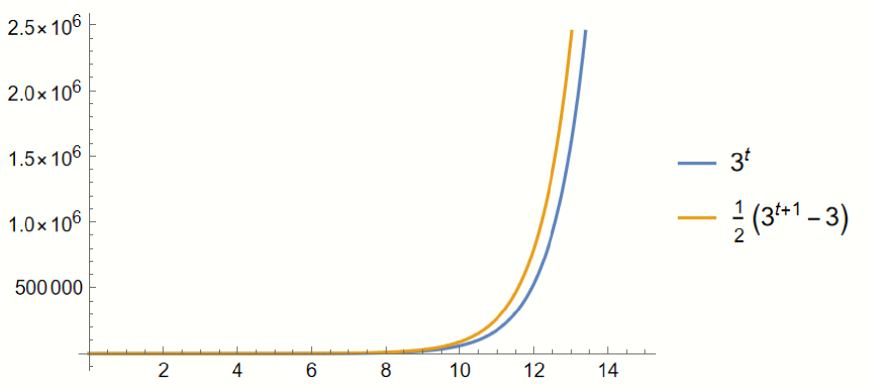
Figure 7: The Function of $E_{t}=3^{t}$ and $N_{t}=\frac{3^{t+1}-3}{2}$
Step 1: Initialization. Set $t=0$ , $G_{1}$ is a complete graph of order $\ell$ , and thus $N_{1}=\ell$ and $E_{1}=\binom{\ell}{2}$ . Set $G_{1}=S(1,\ell)$ .
Step 2: Generation of $G_{t+1}$ from $G_{t}$ . Let $S^{1}(t,\ell),S^{2}(t,\ell),\ldots,S^{\ell}(t,\ell)$ be all Sierpiński graphs added at Step $t$ , where $S^{i}(t,\ell)\cong S(t,\ell)$ ( $1\leq i\leq\ell$ ). At Step $t+1$ , we add one edge (bridge edge) between $S^{i}(t,\ell)$ and $S^{j}(t,\ell)$ , $i\neq j$ , namely the edge between vertices $\langle ij\cdots j\rangle$ and $\langle ji\cdots i\rangle$ .
For Sierpiński graphs $G_{t}=S(t,\ell)$ , its order and size are $N_{t}=\ell^{t}$ and $E_{t}=\frac{\ell^{t+1}-\ell}{2}$ , respectively; see Table 2 and Figure 7 (for $\ell=3$ ).
Table 2: The size and order of $G_{t}$ for $\ell=3$
| $t$ | 1 | 2 | 3 | 4 | 5 | 6 | t |
| --- | --- | --- | --- | --- | --- | --- | --- |
| $N_{t}$ | 3 | 9 | 27 | 81 | 242 | 729 | $\ell^{t}$ |
| $E_{t}$ | 3 | 12 | 39 | 120 | 363 | 1092 | $\frac{\ell^{t+1}-\ell}{2}$ |
The degree distribution for $t$ times are
$$
\left(\underbrace{\ell-1,\ell-1,\cdots,\ell-1}_{\ell},\underbrace{\ell,\ell,
\ell,\cdots,\ell}_{\ell^{t}-\ell}\right). \tag{11}
$$
From Equation 11, the instantaneous degree distribution is $P(\ell-1,t)=1/\ell^{t-1}$ for $t=2,\cdots,T$ and $P(\ell,t)=(\ell^{t}-\ell)/\ell^{t}$ for $t=2,\cdots,T$ . Note that the density of Sierpiński graphs is $\rho=E_{t}/\binom{N_{t}}{2}\rightarrow 0$ for $t\rightarrow+\infty$ . For large enough $\ell$ and any $1\leq k\leq\ell$ , we have $|\{v\in V(G)|d_{S(t,\ell)}(v)|\geq k\}\approx|V(S(t,\ell))|$ .
**Theorem 3.1**
*[11] If $n\in\mathbb{N}$ and $G$ is a graph, then $\kappa\left(S(n,G)\right)=\kappa(G)$ and $\lambda\left(S(n,G)\right)=\lambda(G)$ .*
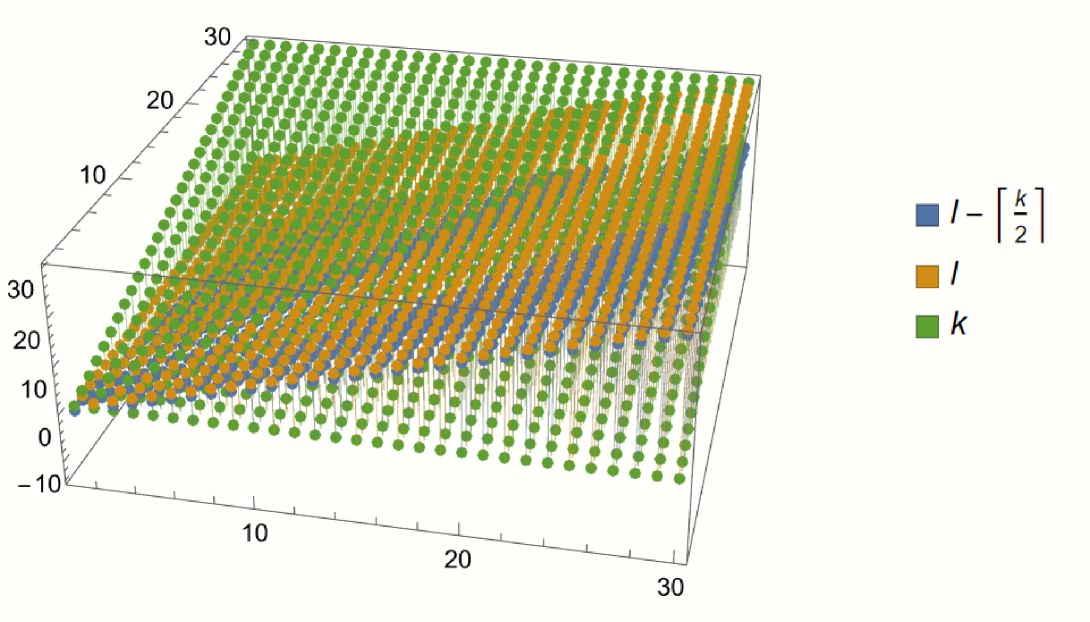
From Theorem 3.1, we have $\kappa\left(S(n,\ell)\right)=\kappa(K_{\ell})=\ell-1$ and $\lambda\left(S(n,\ell)\right)=\lambda(K_{\ell})=\ell-1$ . Note that $\lambda_{k}(S(n,\ell))=\ell-\left\lceil k/2\right\rceil$ and $\kappa_{k}(S(n,\ell))=\ell-\left\lceil k/2\right\rceil$ ; see Figure 8.
<details>
<summary>x4.png Details</summary>
### Visual Description
\n
## 3D Scatter Plot: Visualization of k, l, and | -[k/2] |
### Overview
The image depicts a 3D scatter plot with three distinct data series represented by different colors: green, orange, and blue. The plot appears to visualize relationships between three variables, with axes ranging from approximately -10 to 30 along each dimension. The data points are arranged in a grid-like pattern, suggesting a structured or discrete relationship between the variables.
### Components/Axes
* **X-axis:** Ranges from approximately -10 to 30.
* **Y-axis:** Ranges from approximately -10 to 30.
* **Z-axis:** Ranges from approximately 0 to 30.
* **Legend:** Located in the top-right corner.
* Blue: `l - [k/2]`
* Orange: `l`
* Green: `k`
### Detailed Analysis or Content Details
The plot consists of three distinct sets of points:
* **Green Points (k):** These points are distributed across the entire range of the x and y axes, with a relatively constant z-value around 10. They form a plane parallel to the x-y plane.
* **Orange Points (l):** These points also span the range of the x and y axes, but their z-values are generally higher than the green points, ranging from approximately 10 to 30. They also form a plane parallel to the x-y plane.
* **Blue Points (l - [k/2]):** These points are concentrated in a diagonal band, with their z-values ranging from approximately 0 to 10. They appear to be positioned between the green and orange points.
The data appears to be structured in a grid, with points spaced at regular intervals along each axis. The x and y coordinates seem to be identical for the green and orange points, while the blue points have coordinates related to both.
### Key Observations
* The green points (k) have the lowest z-values, followed by the blue points (l - [k/2]), and then the orange points (l).
* The blue points appear to be a function of both the green and orange points, as indicated by the legend.
* The data is not continuous; it consists of discrete points arranged in a grid.
* There is a clear separation between the three data series, with minimal overlap.
### Interpretation
The plot likely represents a relationship between three variables, `k`, `l`, and `l - [k/2]`. The consistent z-values for `k` and `l` suggest that these variables are independent of the x and y coordinates. The `l - [k/2]` variable appears to be a linear combination of `k` and `l`, and its position between the other two series indicates that its values are intermediate.
The grid-like structure of the data suggests that the variables are discrete or quantized. This could represent a simulation or a model with a limited number of states. The plot could be used to visualize the behavior of a system where `k` and `l` are inputs, and `l - [k/2]` is an output.
The plot does not provide any information about the units of the variables or the specific context of the data. However, it does suggest a clear and well-defined relationship between the three variables. The consistent spacing of the points indicates a regular pattern, which could be exploited for further analysis or prediction.
</details>
Figure 8: The generalized (edge-)connectivity of $S(n,\ell)$
The number of spanning tree of $G$ denoted by $\tau(G)$ . Let
$$
\rho(G)=\lim_{V(G)\longrightarrow\infty}\frac{\ln|\tau(G)|}{\left|V(G)\right|}, \tag{12}
$$
where $\rho(G)$ is called the entropy of spanning trees or the asymptotic complexity [2, 7].
As an application of generalized (edge-)connectivity, similarly to the Equation 12, it can describe the fault tolerance of a graph or network, a common metric is called the entropy of spanning trees.
we give the entropy of the $k$ -Steiner tree of a graph $G$ can be defined as
$$
\rho_{k}(G)=\lim_{|V(G)|\longrightarrow\infty}\frac{\ln|\kappa_{k}(G)|}{\left|
V(G)\right|}
$$
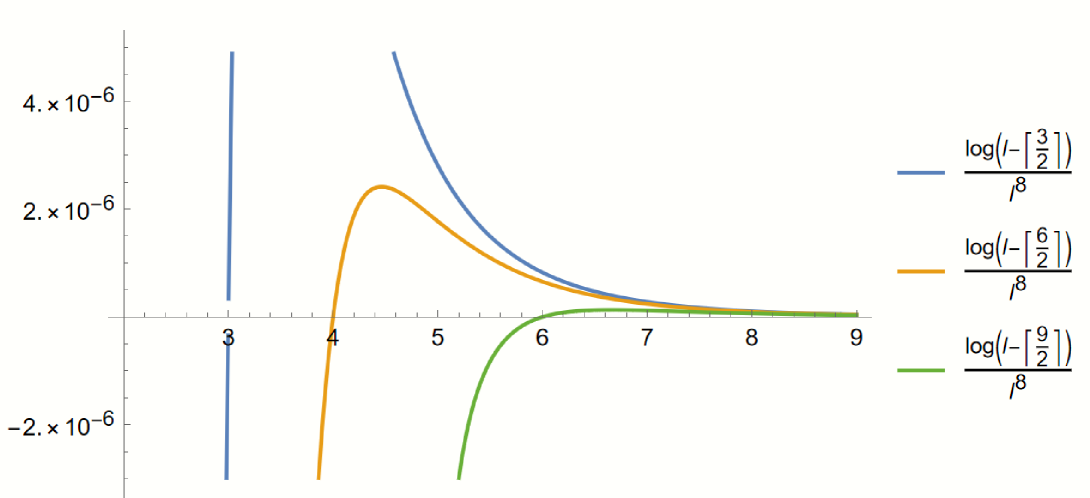
The entropy of the $3,6,9$ -Steiner tree of Sierpiński graph $S(8,\ell)$ can be seen in Figure 9.
<details>
<summary>x5.png Details</summary>
### Visual Description
## Chart: Logarithmic Functions
### Overview
The image displays a line graph plotting three logarithmic functions against a numerical x-axis. The y-axis represents the logarithmic value, and the x-axis ranges from approximately 3 to 9. Each function is represented by a different colored line, with corresponding labels in the top-right corner.
### Components/Axes
* **X-axis:** Labeled with numerical values from 3 to 9, with tick marks at integer values.
* **Y-axis:** Labeled with logarithmic values, ranging from approximately -2.0 x 10<sup>-6</sup> to 4.0 x 10<sup>-6</sup>. The scale is logarithmic.
* **Legend:** Located in the top-right corner, listing the three functions and their corresponding colors:
* Blue: log(-[3/2]<sup>3</sup>)/ρ<sup>8</sup>
* Orange: log(-[6/2]<sup>6</sup>)/ρ<sup>8</sup>
* Green: log(-[9/2]<sup>9</sup>)/ρ<sup>8</sup>
### Detailed Analysis
**Blue Line (log(-[3/2]<sup>3</sup>)/ρ<sup>8</sup>):**
The blue line starts at a very high positive value (approximately 3.8 x 10<sup>-6</sup>) at x=3, exhibiting a sharp vertical rise. It then rapidly decreases, approaching zero as x increases. The line is monotonically decreasing after the initial spike.
* At x = 3, y ≈ 3.8 x 10<sup>-6</sup>
* At x = 4, y ≈ 2.2 x 10<sup>-6</sup>
* At x = 5, y ≈ 1.2 x 10<sup>-6</sup>
* At x = 6, y ≈ 0.7 x 10<sup>-6</sup>
* At x = 7, y ≈ 0.4 x 10<sup>-6</sup>
* At x = 8, y ≈ 0.2 x 10<sup>-6</sup>
* At x = 9, y ≈ 0.1 x 10<sup>-6</sup>
**Orange Line (log(-[6/2]<sup>6</sup>)/ρ<sup>8</sup>):**
The orange line begins at a negative value, dips to a minimum around x=3.5, then increases to a peak around x=4.2, before decreasing again. It appears to be a bell-shaped curve.
* At x = 3, y ≈ -0.5 x 10<sup>-6</sup>
* At x = 3.5, y ≈ -1.5 x 10<sup>-6</sup>
* At x = 4, y ≈ 2.2 x 10<sup>-6</sup>
* At x = 4.5, y ≈ 1.8 x 10<sup>-6</sup>
* At x = 5, y ≈ 1.1 x 10<sup>-6</sup>
* At x = 6, y ≈ 0.5 x 10<sup>-6</sup>
* At x = 7, y ≈ 0.2 x 10<sup>-6</sup>
* At x = 8, y ≈ 0.1 x 10<sup>-6</sup>
* At x = 9, y ≈ 0.05 x 10<sup>-6</sup>
**Green Line (log(-[9/2]<sup>9</sup>)/ρ<sup>8</sup>):**
The green line starts at a negative value, and steadily increases, crossing the x-axis around x=5.5. It continues to increase, but at a decreasing rate.
* At x = 3, y ≈ -3.0 x 10<sup>-6</sup>
* At x = 4, y ≈ -2.0 x 10<sup>-6</sup>
* At x = 5, y ≈ -0.8 x 10<sup>-6</sup>
* At x = 6, y ≈ 0.4 x 10<sup>-6</sup>
* At x = 7, y ≈ 1.0 x 10<sup>-6</sup>
* At x = 8, y ≈ 1.5 x 10<sup>-6</sup>
* At x = 9, y ≈ 1.8 x 10<sup>-6</sup>
### Key Observations
* The blue line exhibits a sharp initial increase followed by a rapid decay.
* The orange line displays a peak, suggesting a maximum value within the plotted range.
* The green line shows a continuous increase, indicating a logarithmic growth pattern.
* All three functions share a common denominator of ρ<sup>8</sup> in their logarithmic expressions.
### Interpretation
The chart demonstrates the behavior of three different logarithmic functions. The functions are all dependent on a variable ρ, which is not defined in the image. The differing exponents and arguments within the logarithms result in distinct curves. The blue line's rapid decay could represent a quickly diminishing effect, while the orange line's peak suggests an optimal value or a point of maximum impact. The green line's continuous growth indicates a sustained increase. The shared denominator of ρ<sup>8</sup> suggests that all three functions are scaled by the same factor, potentially representing a constant physical property or parameter. The negative signs within the logarithms indicate that the arguments are negative, which is permissible for complex logarithms. The chart could be used to model a physical process where these logarithmic functions represent different components or stages.
</details>
Figure 9: Entropy of $S(n,\ell)$ for $n=8$ , $k=3,6,9$ and $\ell\rightarrow+\infty$
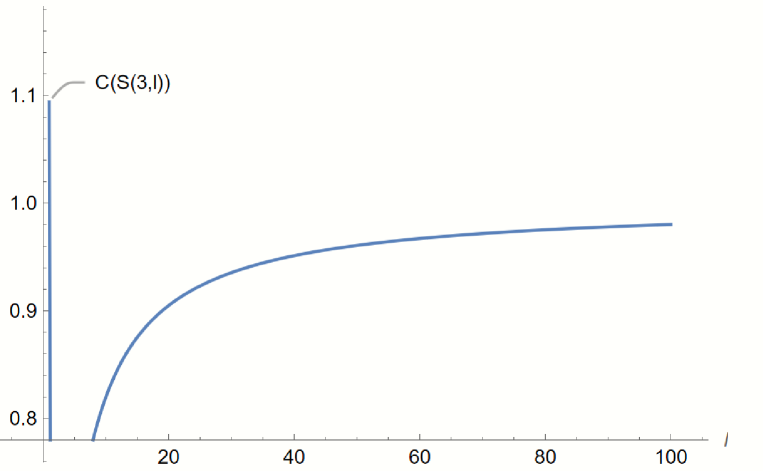
The definition of clustering coefficient can be found in [3]. Let $N_{v}(t)$ be the number of edges in $G_{t}$ among neighbors of $v$ , which is the number of triangles connected to the vertex $v$ . The clustering coefficient of a graph is based on a local clustering coefficient for each vertex
$$
C[v]=\frac{N_{v}(t)}{d_{G}(v)(d_{G}(v)-1)/2},
$$
If the degree of node $v$ is $0 0$ or $1$ , then we can set $C[v]=0$ . By definition, we have $0\leq C[v]\leq 1$ for $v\in V(G)$ .
The clustering coefficient for the whole graph $G$ is the average of the local values $C(v)$
$$
C(G)=\frac{1}{|V(G)|}\left(\sum_{v\in V(G)}C[v]\right).
$$
The clustering coefficient of a graph is closely related to the transitivity of a graph, as both measure the relative frequency of triangles [22, 24].
**Proposition 3.1**
*The clustering coefficient of generalized Sierpiński graph $S(n,\ell)$ is
$$
C(S(n,\ell))=\frac{\ell^{-n}\left(2\ell-2\ell^{n}+\ell^{n+1}\right)}{\ell}.
$$*
* Proof*
For any $v\in V(S(n,\ell))$ , if $v$ is a extremal vertex, then $d_{S(n,\ell)}(v)=\ell-1$ and $G[\{N(v)\}]\cong K_{\ell-1}$ , and hence
$$
C[v]=\frac{N_{v}(t)}{d_{G}(v)(d_{G}(v)-1)/2}={\binom{\ell-1}{2}}/{\binom{\ell-
1}{2}}=1.
$$
If $v$ is not a extremal vertex, then $d_{S(n,\ell)}(v)=\ell$ and $G[\{N(v)\}]\cong K_{\ell}+e$ , where $K_{\ell}+e$ is graph obtained from a complete graph $K_{\ell}$ by adding a pendent edge. Hence, we have $C[v]={\binom{\ell-1}{2}}/{\binom{\ell}{2}}=\frac{\ell-2}{\ell}$ . Since there exists $\ell$ extremal vertices in Sierpiński graph $S(n,\ell)$ , it follows that
$$
C(S(n,\ell))=\frac{1}{|V(G)|}\left(\sum_{v\in V(G)}C[v]\right)=\frac{1}{\ell^{
n}}\left({\ell\times 1+(\ell^{n}-\ell)\frac{\ell-2}{\ell}}\right)=\frac{\ell^{
-n}\left(2\ell-2\ell^{n}+\ell^{n+1}\right)}{\ell}
$$
∎
<details>
<summary>x6.png Details</summary>
### Visual Description
\n
## Chart: Function Plot - C(S(3,l))
### Overview
The image displays a plot of a function, labeled as C(S(3,l)), against an unnamed variable represented on the x-axis. The y-axis represents values ranging from approximately 0.8 to 1.1. The plot shows a curve that initially increases rapidly and then plateaus, approaching a horizontal asymptote.
### Components/Axes
* **X-axis:** Unlabeled, ranging from approximately 0 to 100. The axis is marked with tick marks at intervals of 10.
* **Y-axis:** Unlabeled, ranging from approximately 0.8 to 1.1. The axis is marked with tick marks at intervals of 0.1.
* **Curve:** A single blue line representing the function C(S(3,l)).
* **Label:** "C(S(3,l))" positioned at the top-left of the curve, indicating the function being plotted.
### Detailed Analysis
The curve starts at approximately y = 0.8 when x is near 0. It increases sharply until approximately x = 20, reaching a value of around y = 0.92. From x = 20 to x = 60, the curve continues to increase, but at a decreasing rate, reaching a maximum value of approximately y = 0.98 at x = 60. Beyond x = 60, the curve flattens out and approaches a horizontal asymptote around y = 0.99. At x = 100, the curve is at approximately y = 0.995.
Here's a reconstruction of approximate data points:
| X (approx.) | Y (approx.) |
|---|---|
| 0 | 0.8 |
| 10 | 0.88 |
| 20 | 0.92 |
| 30 | 0.95 |
| 40 | 0.965 |
| 50 | 0.975 |
| 60 | 0.98 |
| 70 | 0.985 |
| 80 | 0.99 |
| 90 | 0.992 |
| 100 | 0.995 |
### Key Observations
The function exhibits diminishing returns. The initial increase is substantial, but the rate of increase slows down significantly as the x-value increases. The curve appears to be approaching a limit, suggesting a saturation effect.
### Interpretation
The plot likely represents a function where the output (y-axis) is influenced by an input (x-axis), but with a decreasing marginal effect. The function C(S(3,l)) could model a system where increasing the input 'l' initially yields significant gains, but eventually, the gains become smaller and smaller, approaching a maximum capacity or limit. The 'S(3,l)' part of the function suggests a possible relationship involving a parameter '3' and the input 'l', potentially within a specific mathematical or physical context. Without further information about the context of this function, it's difficult to provide a more specific interpretation. The shape of the curve is characteristic of functions like logarithmic or hyperbolic functions, which often describe saturation phenomena.
</details>
Figure 10: The Function of $C_{S(3,l)}$
<details>
<summary>x7.png Details</summary>
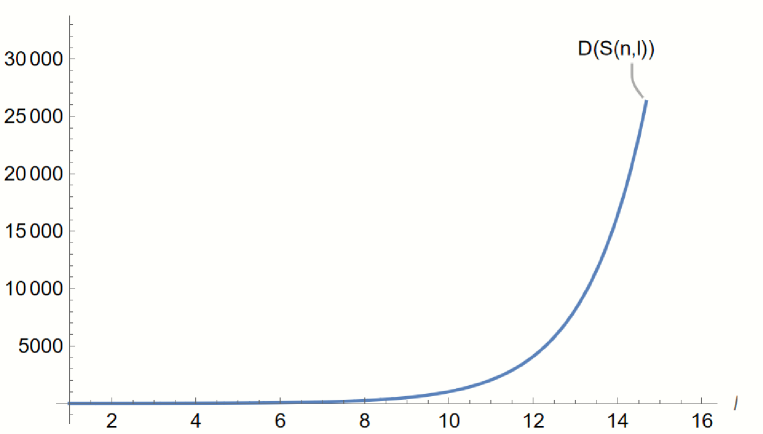
### Visual Description
\n
## Chart: D(S(n,l)) vs. n
### Overview
The image displays a line chart illustrating the relationship between a variable 'n' on the x-axis and the function D(S(n,l)) on the y-axis. The chart shows a very slow, almost flat, increase in D(S(n,l)) until approximately n=12, after which it experiences a rapid, exponential-like growth.
### Components/Axes
* **X-axis:** Labeled 'n', ranging from approximately 2 to 16. The scale is linear.
* **Y-axis:** Labeled with numerical values ranging from 0 to 30000. The scale is linear.
* **Data Series:** A single blue line representing the function D(S(n,l)).
* **Label:** "D(S(n,l))" is placed near the end of the line, indicating the function being plotted.
### Detailed Analysis
The blue line representing D(S(n,l)) remains relatively constant at a low value (approximately 100-200) from n=2 to n=12. Around n=12, the line begins to curve upwards sharply.
Here's an approximate reconstruction of data points:
* n = 2: D(S(n,l)) ≈ 100
* n = 4: D(S(n,l)) ≈ 150
* n = 6: D(S(n,l)) ≈ 180
* n = 8: D(S(n,l)) ≈ 200
* n = 10: D(S(n,l)) ≈ 250
* n = 12: D(S(n,l)) ≈ 400
* n = 14: D(S(n,l)) ≈ 10000
* n = 16: D(S(n,l)) ≈ 26000
The trend is nearly flat until n=12, then rapidly increases. The slope of the line becomes increasingly steep as 'n' increases beyond 12.
### Key Observations
The most striking feature is the dramatic change in the rate of increase of D(S(n,l)) around n=12. This suggests a threshold or critical point where the function's behavior changes significantly. The initial flat portion indicates a very slow or negligible change in D(S(n,l)) for small values of 'n'.
### Interpretation
The chart likely represents a function where a small change in 'n' has little effect on D(S(n,l)) until a certain point is reached. After that point, even a small change in 'n' leads to a substantial increase in D(S(n,l)). This could model phenomena exhibiting a delayed or threshold-dependent response.
The function D(S(n,l)) could represent a computational complexity, a growth rate, or a probability that is initially low but increases rapidly as 'n' exceeds a certain value. The 'S(n,l)' part of the function suggests that there are other parameters influencing the behavior, but their specific role isn't revealed by the chart alone. The rapid increase could indicate a phase transition, a cascading effect, or a point of instability. Without further context, it's difficult to determine the precise meaning of the function and its parameters.
</details>
Figure 11: The diameter of $S(n,\ell)$
**Theorem 3.2**
*[21] The diameter of $S(n,\ell)$ is $Diam(S(n,\ell))=2^{\ell}-1$ ;*
For network properties of Sierpiński graph $S(n,\ell)$ , the the diameter function can be seen in Figure 11 and its clustering coefficient is closely related to $1$ when $\ell\longrightarrow\infty$ ; see Figure 11, which implies that the Sierpiński graph $S(n,\ell)$ is a hight transitivity graph.
## 4 Acknowledgments
The authors would like to thank the anonymous referee for the careful reading of the manuscript and the numerous helpful suggestions and comments.
## References
- [1] J.A. Bondy, U.S.R. Murty, Graph Theory, GTM 244, Springer, 2008.
- [2] R. Burton, R. Pemantle, Local characteristics, entropy and limit theorems for spanning trees and domino tilings via transfer-impedances, Ann. Prob. 21 (1993), 1329–1371.
- [3] B. Bollobás, O.M. Riordan, Mathematical results on scale-free random graphs, in: S. Bornholdt, H.G. Schuster (Eds.), Handbook of Graphs and Networks: From the Genome to the Internet, Wiley-VCH, Berlin, 2003, 1–34.
- [4] G. Chartrand, F. Okamoto, P. Zhang, Rainbow trees in graphs and generalized connectivity, Networks 55(4) (2010), 360–367.
- [5] B.L. Chen, K.C. Huange, On the Line $k$ -arboricity of $K_{n}$ and $K_{n,n}$ , Discrete Math. 254 (2002), 83–87.
- [6] X. Cheng, D. Du, Steiner trees in Industry, Kluwer Academic Publisher, Dordrecht, 2001.
- [7] M. Dehmer, F. Emmert-Streib, Z. Chen, X. Li, and Y. Shi, Mathematical foundations and applications of graph entropy, John Wiley $\&$ Sons. (2017).
- [8] D. Du, X. Hu, Steiner tree problems in computer communication networks, World Scientific, 2008.
- [9] C. Hao, W. Yang, The generalized connectivity of data center networks. Parall. Proce. Lett. 29 (2019), 1950007.
- [10] J. Gu, J. Fan, Q. Ye, L. Xi, Mean geodesic distance of the level- $n$ Sierpiński gasket, J. Math. Anal. Appl. 508(1) (2022), 125853.
- [11] S. Klavžar, U. Milutinović, Graphs $S(n,k)$ and a variant of tower of hanoi problem, Czechoslovak Math. J. 122(47) (1997), 95–104.
- [12] H. Li, X. Li, and Y. Sun, The generalied $3$ -connectivity of Cartesian product graphs, Discrete Math. Theor. Comput. Sci. 14(1) (2012), 43–54.
- [13] H. Li, Y. Ma, W. Yang, Y. Wang, The generalized $3$ -connectivity of graph products, Appl. Math. Comput. 295 (2017), 77–83.
- [14] S. Li, J. Tu, C. Yu, The generalized $3$ -connectivity of star graphs and bubble-sort graphs, Appl. Math. Comput. 274(1) (2016), 41–46.
- [15] X. Li, Y. Mao, Generalized Connectivity of Graphs, Springer Briefs in Mathematics, Springer, Switzerland, 2016.
- [16] X. Li, Y. Mao, Y. Sun, On the generalized (edge-)connectivity of graphs, Australasian J. Combin. 58(2) (2014), 304–319.
- [17] Y. Li, Y. Mao, Z. Wang, Z. Wei, Generalized connectivity of some total graphs, Czechoslovak Math. J. 71 (2021), 623–640.
- [18] C. Li, S. Lin, S. Li, The $4$ -set tree connectivity of $(n,k)$ -star networks, Theor. Comput. Sci. 844 (2020), 81–86.
- [19] S. Lin, Q. Zhang, The generalized $4$ -connectivity of hypercubes. Discrete Appl. Math. 220 (2017), 60–67.
- [20] H. Li, X. Li, Y. Sun, The generalized $3$ -connectivity of Cartesian product graphs, Discrete Math. Theor. Comput. Sci. 14 (2012), 43–54.
- [21] D. Parisse, On some metric properties of the the Sierpiński graphs $S(n,\ell)$ , Ars Comb. 90 (2009), 145–160.
- [22] J. Reichardt, Structure in complex networks. Springer Science $\&$ Business Media, 2008.
- [23] A. Sahu, A. Priyadarshi, On the box-counting dimension of graphs of harmonic functions on the Sierpiński gasket. J. Math. Analy. Appl. 487(2) (2020), 124036.
- [24] X. Wang, X. LI, G. R.Chen, Introduction to Network Science. Beijing: Higher Education Press, 2012.
- [25] B. Xue, L. Zuo, G. Li, The hamiltonicity and path $t$ -coloring of Sierpiński-like graphs, Discrete Appl. Math. 160 (2012), 1822–836.
- [26] B. Xue, L. Zuo, On the linear $(n-1)$ -arboricity of $K_{n}$ , Discrete Appl. Math. 158 (2010) 1546–1550.
- [27] S. Zhao, R. Hao, L. Wu, The generalized connectivity of $(n,k)$ -bubble-sort graphs. The Comput. J. 62 (2019), 1277–1283.
- [28] S. Zhao, R. Hao, J. Wu, The generalized $3$ -connectivity of some regular networks, J. Parall. Distr. Comput. 133 (2019), 18–29.
- [29] S. Zhao, R. Hao, The generalized connectivity of alternating group graphs and $(n,k)$ -star graphs, Discrete Appl. Math. 251 (2018), 310–321.
- [30] S. Zhao, R. Hao, E. Cheng, Two kinds of generalized connectivity of dual cubes, Discrete Appl. Math. 257 (2019), 306–316.
- [31] S. Zhao, R. Hao, The generalized connectivity of alternating group graphs and $(n,k)$ -star graphs, Discrete Appl. Math. 251 (2018), 310–321.
- [32] S. Zhao, R. Hao, The generalized $4$ -connectivity of exchanged hypercubes, Applied Mathe. Comput. 347 (2019), 342–353.
- [33] S. Zhao, R. Hao, J. Wu, The generalized $4$ -connectivity of hierarchical cubic networks, Discrete Appl. Mathe., 289 (2021), 194–206.
- [34] S. Zhao, J. Chang, Z. Li, The generalized $4$ -connectivity of pancake graphs, Discrete Appl. Math. 327 (2023), 77–86.
- [35] S. Zhao, R. Hao, The generalized $4$ -connectivity of exchanged hypercubes. Appl. Math. Comput. 347 (2019), 342–353.