# LaRS: Latent Reasoning Skills for Chain-of-Thought Reasoning
> Majority of this work was done when Zifan Xu was an intern at Amazon Web Service during the summer 2023. A portion of this work has taken place in the Learning Agents Research
Group (LARG) at UT Austin. LARG research is supported in part by NSF
(FAIN-2019844, NRT-2125858), ONR (N00014-18-2243), ARO
(W911NF-23-2-0004, W911NF-17-2-0181), Lockheed Martin, and UT Austin’s
Good Systems grand challenge. Peter Stone serves as the Executive
Director of Sony AI America and receives financial compensation for
this work. The terms of this arrangement have been reviewed and
approved by the University of Texas at Austin in accordance with its
policy on objectivity in research.
Abstract
Chain-of-thought (CoT) prompting is a popular in-context learning (ICL) approach for large language models (LLMs), especially when tackling complex reasoning tasks. Traditional ICL approaches construct prompts using examples that contain questions similar to the input question. However, CoT prompting, which includes crucial intermediate reasoning steps (rationales) within its examples, necessitates selecting examples based on these rationales rather than the questions themselves. Existing methods require human experts or pre-trained LLMs to describe the skill, a high-level abstraction of rationales, to guide the selection. These methods, however, are often costly and difficult to scale. Instead, this paper introduces a new approach named La tent R easoning S kills (LaRS) that employs unsupervised learning to create a latent space representation of rationales, with a latent variable called a reasoning skill. Concurrently, LaRS learns a reasoning policy to determine the required reasoning skill for a given question. Then the ICL examples are selected by aligning the reasoning skills between past examples and the question. This approach is theoretically grounded and compute-efficient, eliminating the need for auxiliary LLM inference or manual prompt design. Empirical results demonstrate that LaRS consistently outperforms SOTA skill-based selection methods, processing example banks four times faster, reducing LLM inferences during the selection stage by half, and showing greater robustness to sub-optimal example banks. Our code is publicly available here.
LaRS: Latent Reasoning Skills for Chain-of-Thought Reasoning
Zifan Xu 1 thanks: Majority of this work was done when Zifan Xu was an intern at Amazon Web Service during the summer 2023. A portion of this work has taken place in the Learning Agents Research Group (LARG) at UT Austin. LARG research is supported in part by NSF (FAIN-2019844, NRT-2125858), ONR (N00014-18-2243), ARO (W911NF-23-2-0004, W911NF-17-2-0181), Lockheed Martin, and UT Austin’s Good Systems grand challenge. Peter Stone serves as the Executive Director of Sony AI America and receives financial compensation for this work. The terms of this arrangement have been reviewed and approved by the University of Texas at Austin in accordance with its policy on objectivity in research., Haozhu Wang 2, Dmitriy Bespalov 2, Xian Wu 2, Peter Stone 1,3, Yanjun Qi 2 1 The University of Texas at Austin, 2 Amazon Web Service, 3 Sony AI
1 Introduction
Large Language Models (LLMs) exhibit remarkable capabilities in solving various downstream tasks through in-context learning (ICL) Brown et al. (2020), even without being explicitly trained on the distribution of in-context examples Vaswani et al. (2017); Devlin et al. (2019); Rae et al. (2021); Chowdhery et al. (2022); Wei et al. (2022a). Using in-context learning, LLMs generate output for an input query by conditioning on a prompt that contains a few input-output demonstrations.
<details>
<summary>extracted/6556870/content/figures/similarity_based_selection.png Details</summary>
### Visual Description
## Diagram: Skill Mismatching in Language Models
### Overview
The image illustrates a scenario where a language model (LLM) fails to correctly answer a question due to a skill mismatch. The diagram shows the flow of information from an input query to the LLM, highlighting how a similar question from an example bank can lead to an incorrect response.
### Components/Axes
* **Input Query:** "2 toucans are sitting on a tree limb. 1 more toucan joins them. How many toucans in all?" A question mark icon is placed to the left of the query.
* **Select similar question:** A process step where a similar question is selected.
* **Example Bank:** A repository of example questions and their rationales, represented by a building icon.
* **Examples:** "Question: 2 toucans are sitting on a tree limb. 1 toucan left them. How many toucans left? Rationale: We subtract 2 from 1 and get 1."
* **CoT Prompt:** Chain-of-Thought prompt, represented by a dashed rounded rectangle containing a star-like icon and a question mark icon connected by a plus sign.
* **LLM:** Language Model, represented by a gear-like icon.
* **Rationale:** "We subtract 2 from 1 and get 1." A speech bubble icon is placed to the left of the rationale. A red "X" is superimposed on the word "from".
* **Skill Mismatching:** A red label oriented vertically between the "Example Bank" and the "LLM".
### Detailed Analysis
1. **Input Query:** The initial question presented to the system. The question is about adding toucans.
2. **Select similar question:** The system attempts to find a similar question from the "Example Bank."
3. **Example Bank:** Contains an example question that involves subtraction ("1 toucan left them").
4. **Examples:** The example question and its rationale are shown. The rationale incorrectly states "We subtract 2 from 1 and get 1."
5. **CoT Prompt:** The example question and the input query are combined to form a Chain-of-Thought prompt.
6. **LLM:** The LLM processes the CoT prompt and generates a response based on the incorrect rationale from the example.
7. **Rationale:** The LLM produces an incorrect rationale, mirroring the error in the example ("We subtract 2 from 1 and get 1").
8. **Skill Mismatching:** The core issue is that the example question involves subtraction, while the input query requires addition. This mismatch leads the LLM to apply the wrong operation.
### Key Observations
* The diagram highlights how selecting a superficially similar question with a different underlying operation can lead to errors.
* The incorrect rationale in the example question is propagated to the LLM's response.
* The "Skill Mismatching" label emphasizes the fundamental problem.
### Interpretation
The diagram illustrates a common pitfall in using example-based learning for language models. If the examples are not carefully chosen to match the required skills for the input query, the LLM can learn and apply incorrect patterns. In this case, the LLM incorrectly applies subtraction because it was exposed to an example question that involved subtraction, even though the input query required addition. This demonstrates the importance of ensuring that the training data and examples used for prompting are aligned with the desired task and skills. The diagram suggests that a more robust system would need a better mechanism for selecting relevant examples or a way to prevent the LLM from being misled by irrelevant information.
</details>
(a) Question-similarity-based selection.
<details>
<summary>extracted/6556870/content/figures/skill_based_selection.png Details</summary>
### Visual Description
## Diagram: Skill Matching Process
### Overview
The image illustrates a skill matching process, likely within a machine learning or AI context. It shows how an input query is processed to identify a relevant skill, find similar examples, and generate a Chain-of-Thought (CoT) prompt for a Large Language Model (LLM).
### Components/Axes
* **Input Query:** "2 toucans are sitting on a tree limb. 1 more toucan joins them. How many toucans in all?"
* **Inference Skill:**
* Skill abstraction: addition
* **Select similar skill**
* **Example Bank:** Represented by a building icon.
* **Examples:**
* Question: "Seven red apples and two green apples are in the basket. How many apples are in the basket?"
* Rationale: "We add 7 to 2 and get 9"
* **CoT Prompt:** Represented by a dashed blue rounded rectangle containing an apple icon, a plus sign, and a question mark icon.
* **LLM:** Represented by a gear-like icon with "LLM" written inside.
* **Rationale:** "We add 2 to 1 and get 3."
* **Skill Matching:** Text is oriented vertically.
### Detailed Analysis or ### Content Details
1. **Input Query:** The process begins with an input query: "2 toucans are sitting on a tree limb. 1 more toucan joins them. How many toucans in all?". A question mark icon is placed next to the text.
2. **Inference Skill:** The system infers the required skill, which is "addition". This is represented by a lightbulb icon.
3. **Select similar skill:** The system selects a similar skill.
4. **Example Bank:** The system accesses an example bank, represented by a building icon.
5. **Examples:** An example question and rationale are retrieved:
* Question: "Seven red apples and two green apples are in the basket. How many apples are in the basket?"
* Rationale: "We add 7 to 2 and get 9"
6. **CoT Prompt:** A Chain-of-Thought (CoT) prompt is generated, represented by a dashed blue rounded rectangle containing an apple icon, a plus sign, and a question mark icon.
7. **LLM:** The CoT prompt is fed into a Large Language Model (LLM), represented by a gear-like icon with "LLM" written inside.
8. **Rationale:** The LLM generates a rationale: "We add 2 to 1 and get 3." A green checkmark is placed next to the text.
9. **Skill Matching:** The process of skill matching is highlighted vertically.
### Key Observations
* The diagram illustrates a process of skill matching and reasoning using an LLM.
* The process involves identifying the required skill from an input query, finding similar examples, and generating a CoT prompt.
* The LLM uses the CoT prompt to generate a rationale for the answer.
### Interpretation
The diagram demonstrates a method for solving problems by leveraging the capabilities of a Large Language Model. By identifying the underlying skill required to solve a problem and providing relevant examples, the LLM can generate a step-by-step rationale leading to the correct answer. This approach is particularly useful for tasks that require reasoning and problem-solving skills. The use of a CoT prompt helps the LLM to break down the problem into smaller, more manageable steps, leading to a more accurate and reliable solution.
</details>
(b) Skill-based selection.
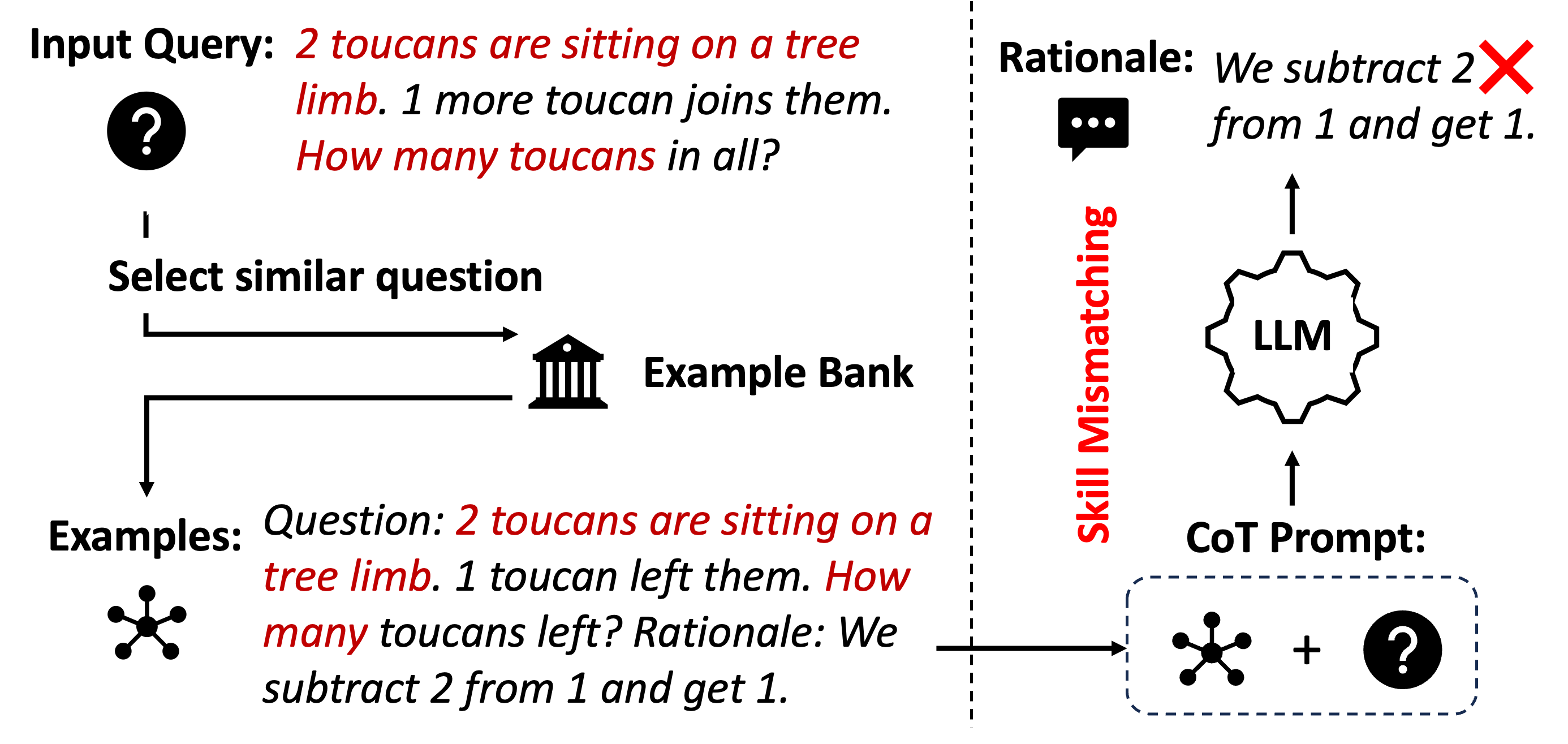
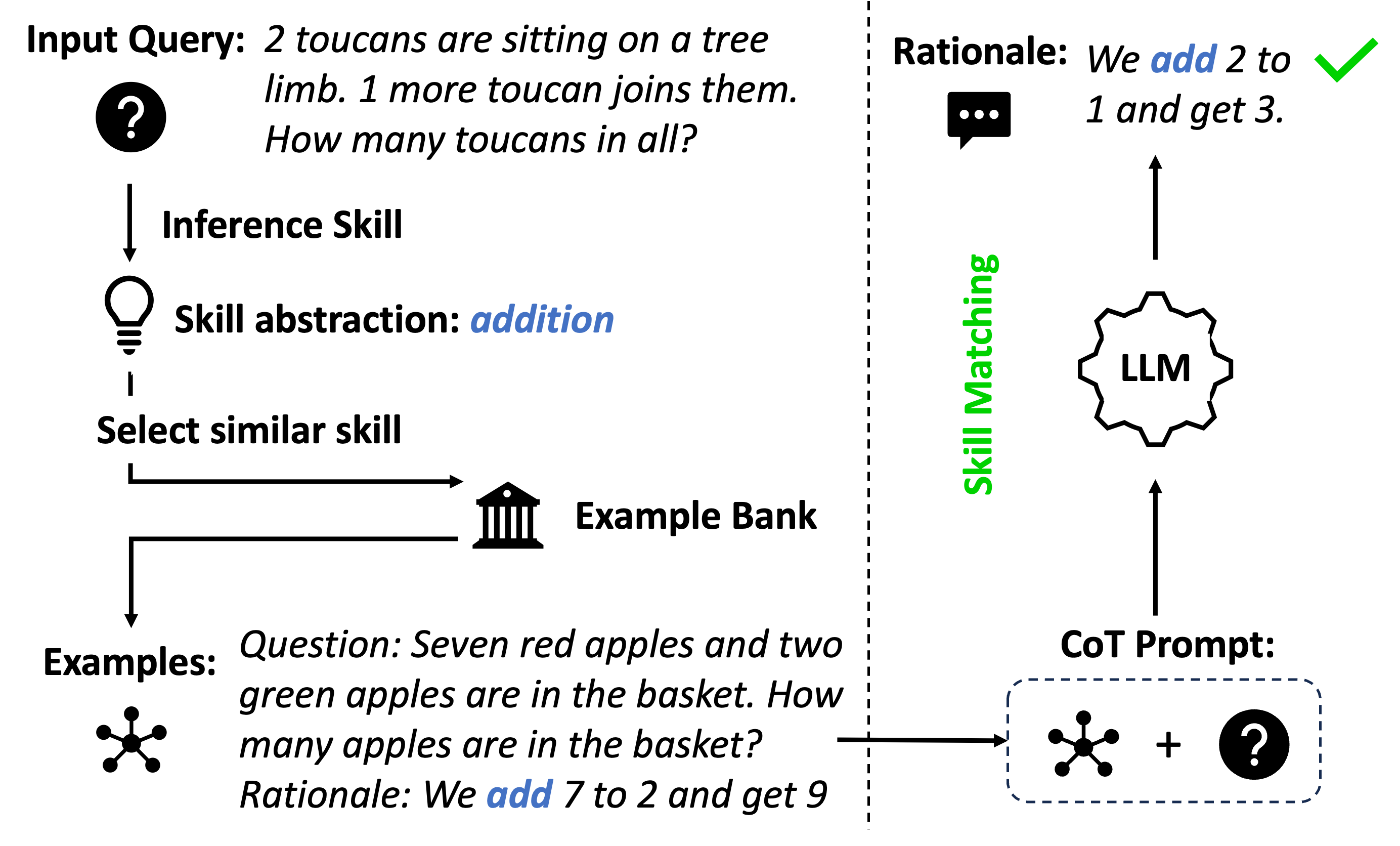
Figure 1: CoT prompting with examples selected by (a) similar questions and (b) similar skills that (mis)match the skills in their rationales.
<details>
<summary>extracted/6556870/content/figures/lars.png Details</summary>
### Visual Description
## Diagram: Reasoning Skills Selection Process
### Overview
The image presents a diagram illustrating a reasoning skills selection process. It is divided into two main sections: "Pre-Processing" on the left and "Selection" on the right, separated by a dashed vertical line. The diagram shows how an input question is processed, how relevant examples are retrieved, and how a reasoning policy is applied to select the appropriate reasoning skills.
### Components/Axes
**Pre-Processing (Left Side):**
* **Title:** "Pre-Processing" in a black box at the top-left.
* **Question (Q):** A blue box containing the question: "Q: Seven red apples and two green apples are in the basket. How many apples are in the basket?"
* **Response (R):** A yellow box containing the response: "R: We add 7 to 2 and get 9."
* **Example Bank:** A bank icon with a circle containing scattered dots labeled "Example Bank" below the response.
* **Off-the-Shelf Embedding Model:** A rounded rectangle labeled "Off-the-Shelf Embedding Model."
* **Reasoning Policy:** A lightbulb icon with the label "Reasoning Policy."
* **Reasoning Skills:** A red circle containing scattered dots with the label "Reasoning Skills."
* **Conditional Variational Auto-Encoder:** A dotted rectangle containing "Reasoning Skill Encoder," "Decoder," and a latent variable "z."
**Selection (Right Side):**
* **Title:** "Selection" in a black box at the top-right.
* **Input Query:** A question mark icon with the label "Input Query:".
* **Question (Q):** A blue box containing the question: "Q: 2 toucans are sitting on a tree limb. 1 more toucan joins them. How many toucans in all?"
* **Off-the-Shelf Embedding Model:** A rounded rectangle labeled "Off-the-Shelf Embedding Model."
* **Reasoning Policy:** A lightbulb icon with the label "Reasoning Policy."
* **Latent Variable (z):** A red box labeled "z."
* **Selected Examples:** A red box labeled "Selected examples" pointing to a red circle containing a few dots.
### Detailed Analysis or ### Content Details
**Pre-Processing Flow:**
1. The question (Q) and response (R) from the "Pre-Processing" section are fed into the "Off-the-Shelf Embedding Model."
2. The output of the embedding model for Q goes to a blue box labeled "Q" and then to the "Reasoning Policy" (lightbulb icon).
3. The output of the embedding model for R goes to a yellow box labeled "R" and then to the "Reasoning Skill Encoder" within the "Conditional Variational Auto-Encoder."
4. The "Reasoning Skill Encoder" encodes the information into a latent variable "z" (red box), which is then passed to the "Decoder."
5. The "Decoder" attempts to reconstruct the response, resulting in "R-hat" (yellow dashed box), which is compared to the original "R" (yellow box).
6. The "Reasoning Policy" also influences the selection of "Reasoning Skills" (red circle with dots).
**Selection Flow:**
1. The "Input Query" (question about toucans) is fed into the "Off-the-Shelf Embedding Model."
2. The output of the embedding model goes to a blue box labeled "Q" and then to the "Reasoning Policy" (lightbulb icon).
3. The "Reasoning Policy" selects a latent variable "z" (red box) and also selects "Selected examples" (red circle with a few dots) from a larger set of examples (red circle with many dots).
### Key Observations
* The diagram illustrates a process for selecting reasoning skills based on input questions and examples.
* The "Conditional Variational Auto-Encoder" is used to learn a latent representation of reasoning skills.
* The "Reasoning Policy" plays a crucial role in selecting both the latent variable "z" and the relevant examples.
* The "Pre-Processing" section uses a question about apples, while the "Selection" section uses a question about toucans, suggesting the system can handle different types of reasoning problems.
### Interpretation
The diagram presents a model for automated reasoning skill selection. The "Pre-Processing" section likely represents a training phase where the model learns to associate questions with appropriate reasoning strategies. The "Selection" section demonstrates how the trained model applies this knowledge to new, unseen questions. The use of a "Conditional Variational Auto-Encoder" suggests that the model aims to learn a compressed and structured representation of reasoning skills, allowing for efficient selection and application. The "Reasoning Policy" acts as a central control mechanism, guiding the selection process based on the input question and the learned latent representations. The selection of "Selected examples" indicates that the model also leverages relevant examples to improve its reasoning performance.
</details>
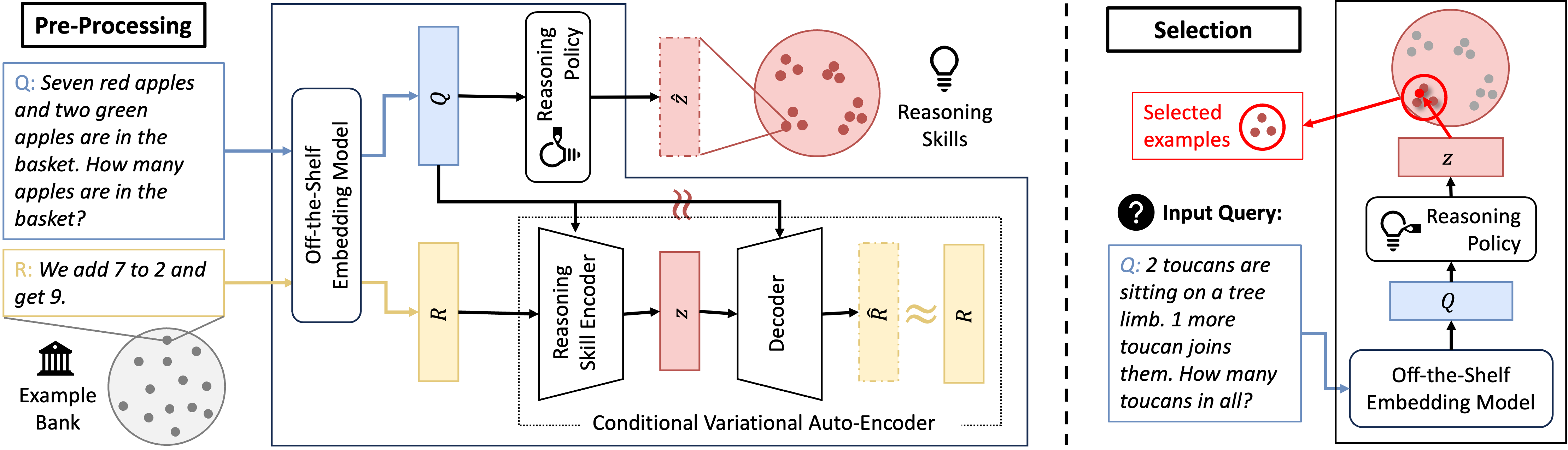
Figure 2: An overview of LaRS including a pre-processing stage (left) and a selection stage (right).
Reasoning tasks have proven to be particularly difficult for language models and NLP in general Rae et al. (2021); Bommasani et al. (2021); Nye et al. (2021). In the recent literature, chain-of-thought (CoT) prompting, an ICL method, has been proposed to improve LLMs on a wide spectrum of reasoning tasks by guiding LLMs to produce a sequence of intermediate steps (rationale) for generating a (better) final answer Cobbe et al. (2021a); Wei et al. (2022b); Suzgun et al. (2022). The prompts for CoT are composed of demonstrations that contain not only input and output, but also the rationales for why the output holds.
The core challenge for ICL lies in designing effective demonstrations to prompt LLMs. Much evidence has indicated the significant impact of demonstrations on the performance of ICL Lu et al. (2021); Liu et al. (2021). To form a prompt, one important setting considers selecting demonstrations from an existing example bank, termed demonstration selection Dong et al. (2022). While a variety of methods exist in the ICL literature for automating this process, CoT prompts are distinct in that they include not only questions and answers but also specially-designed rationales. This distinction highlights the importance of rationales in selecting demonstrations for CoT prompting. Specifically, CoT prompting should select demonstrations that illustrate relevant skills within their rationales to effectively address a given question. For instance, in solving math word problems (as depicted in Fig. 1), a useful rationale involves computing addition to get the correct answer. Selecting few-shot examples based on the question similarity (Fig. 1(a)) might lead to examples showcasing subtraction and generate incorrect rationales. However, skill-based selection (Fig. 1(b)) can align the skills between examples and the given question, which leads to correct answers guided by relevant rationales.
To achieve such a skill-based demonstration selection, An et al. (2023b) introduces Skill-KNN, which employs pre-trained LLMs to generate skill descriptions. Then, the few-shot examples are selected based on the embedding of the skill descriptions computed by another pre-trained embedding model. Although this approach is straightforward, the LLM-generated skill descriptions can be somewhat arbitrary, heavily relying on the manually crafted prompts. This reliance constrains its wider applicability across diverse reasoning tasks. Moreover, the approach requires to generate a unique skill description for each example, which limits its scalability to larger example banks.
Rather than relying on LLMs, we introduce La tent R easoning S kill Discovery (LaRS), a new skill-based demonstration selection method. This approach learns skills as latent space representations of rationales through unsupervised learning. The essence of LaRS lies in a unique formulation for the generation of rationales, which we term the latent skill model. This model, inspired by the principles of topic models Xie et al. (2021a), conditions the generation of a rationale on both a given question and a latent variable, called a reasoning skill. This latent variable embodies a high-level abstraction of the rationales, such as formats, equations, or knowledge.
<details>
<summary>extracted/6556870/content/figures/TSNE.png Details</summary>
### Visual Description
## Scatter Plot: Question Embedding vs. LaRS Skill Embedding
### Overview
The image presents two scatter plots, "Question Embedding" and "LaRS Skill Embedding," visualizing the distribution of data points representing different reasoning skills. Each data point is color-coded and shaped according to the type of reasoning skill it represents, as defined in the legend on the right. The plots aim to show how questions and skills are embedded in a vector space, potentially indicating relationships or clusters between different reasoning skills.
### Components/Axes
* **Titles:**
* Left Plot: "Question Embedding" (in a blue box)
* Right Plot: "LaRS Skill Embedding" (in a red box)
* Legend Title: "Reasoning skills"
* **Axes:** Neither plot has explicit axes labels or scales. The plots appear to be visualizations of embeddings in a two-dimensional space, where the axes represent abstract feature dimensions.
* **Legend (Right side of image):**
* Black Circle: Compute statistics
* Purple Down-pointing Triangle: Compute rate of change
* Light Blue X: Compute money cost
* Dark Blue Circle: Filter tree leaves
* Light Blue Down-pointing Triangle: Addition/subtraction
* Green X: Search minimum/maximum
* Green Circle: Multiplication
* Green Down-pointing Triangle: Filter table entries
* Light Green X: Compute probability
* Yellow Down-pointing Triangle: Shortage or surplus?
* Yellow Circle: Reason time schedule
* Red X: Compare numbers
* Red Circle: Others
### Detailed Analysis
**1. Question Embedding (Left Plot):**
* **Compute statistics (Black Circle):** Cluster in the top-right quadrant.
* **Compute rate of change (Purple Down-pointing Triangle):** Scattered near the top-left and top-right.
* **Compute money cost (Light Blue X):** Cluster in the center-left.
* **Filter tree leaves (Dark Blue Circle):** Cluster in the center-left.
* **Addition/subtraction (Light Blue Down-pointing Triangle):** Cluster in the center-left.
* **Search minimum/maximum (Green X):** Scattered in the center-left.
* **Multiplication (Green Circle):** Cluster in the center-left.
* **Filter table entries (Green Down-pointing Triangle):** Scattered in the center-left.
* **Compute probability (Light Green X):** Scattered in the center-left.
* **Shortage or surplus? (Yellow Down-pointing Triangle):** Cluster in the bottom-left.
* **Reason time schedule (Yellow Circle):** Scattered in the center-left.
* **Compare numbers (Red X):** Scattered in the top-left and center-left.
* **Others (Red Circle):** Single point in the top-left.
**2. LaRS Skill Embedding (Right Plot):**
* **Compute statistics (Black Circle):** Cluster in the top-left.
* **Compute rate of change (Purple Down-pointing Triangle):** Cluster in the top-left and center-left.
* **Compute money cost (Light Blue X):** Scattered in the top-right and center-left.
* **Filter tree leaves (Dark Blue Circle):** Cluster in the center-left.
* **Addition/subtraction (Light Blue Down-pointing Triangle):** Cluster in the center-left.
* **Search minimum/maximum (Green X):** Scattered in the center.
* **Multiplication (Green Circle):** Cluster in the bottom-right.
* **Filter table entries (Green Down-pointing Triangle):** Cluster in the bottom-left.
* **Compute probability (Light Green X):** Scattered in the center-left.
* **Shortage or surplus? (Yellow Down-pointing Triangle):** Cluster in the bottom-center.
* **Reason time schedule (Yellow Circle):** Single point in the center-left.
* **Compare numbers (Red X):** Scattered in the center.
* **Others (Red Circle):** Single point in the center.
### Key Observations
* In both plots, data points representing the same reasoning skill tend to cluster together, suggesting that the embedding process captures some similarity between skills.
* The "Question Embedding" plot shows a more distinct separation between clusters compared to the "LaRS Skill Embedding" plot.
* Some skills, like "Compute statistics" and "Filter tree leaves," form tight clusters, while others, like "Compute money cost" and "Compare numbers," are more dispersed.
### Interpretation
The scatter plots visualize the embeddings of questions and LaRS skills in a vector space. The clustering of data points suggests that the embedding process successfully captures relationships between different reasoning skills. The "Question Embedding" plot potentially represents how questions are mapped into this space based on the skills they require, while the "LaRS Skill Embedding" plot represents the skills themselves. The relative positions of the clusters may indicate which skills are more similar or related to each other. The differences in cluster tightness between the two plots could reflect variations in how questions and skills are represented or the inherent complexity of the skills themselves. The plots could be used to identify related skills, recommend skills to learn, or analyze the skill requirements of different questions.
</details>
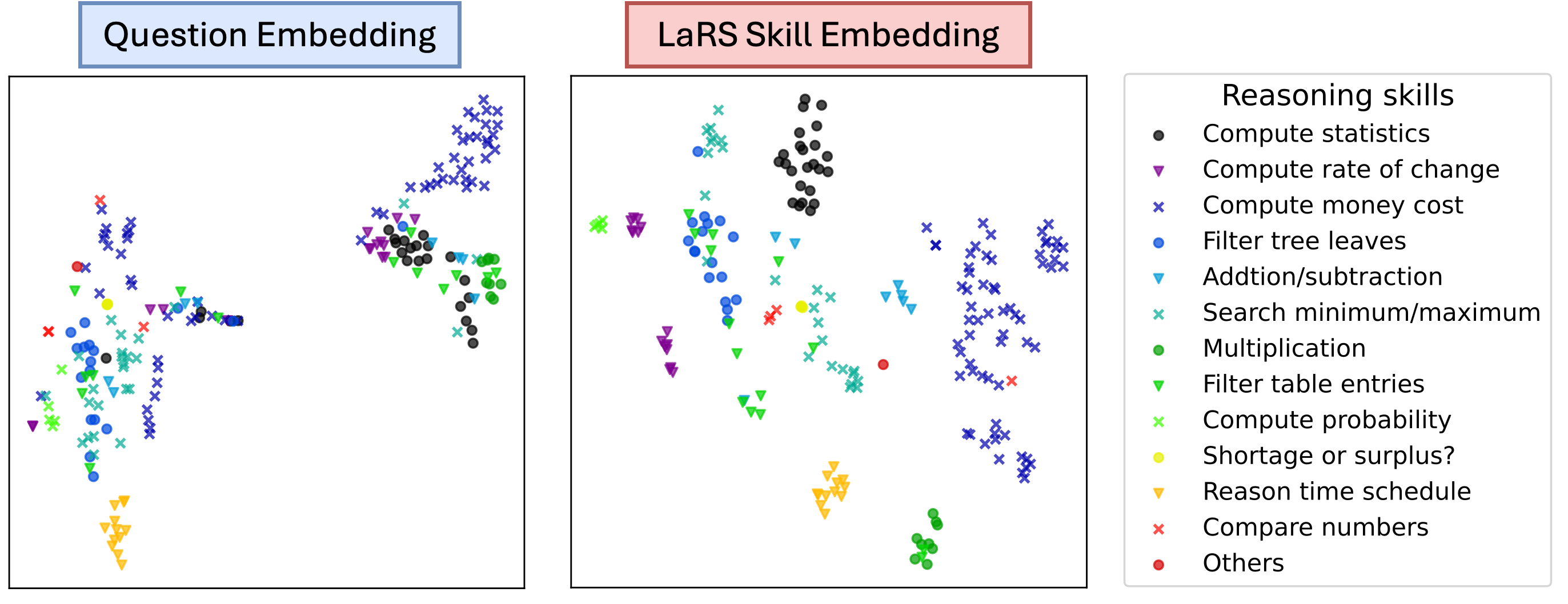
Figure 3: t-SNE projections of question embedding and LaRS reasoning skill embedding of the exmaples from TabMWP Lu et al. (2022) dataset. The 12 different colors correspond to 12 skill labels annotated by human.
Under the skill model formulation, LaRS utilizes a Conditional Variational Auto-encoder (CVAE) to approximate the generation of rationales on a small dataset from the example bank. As a result, two probabilistic models can be learned concurrently: (1) a reasoning skill encoder that maps an example to the actual reasoning skills demonstrated in the rationale; and (2) a reasoning policy that predicts the reasoning skills required for a particular question. This method of learning through a CVAE, especially when applied to a small dataset from the example bank, is both cost-efficient and fast compared to Skill-KNN. Fig. 2 presents an overview of LaRS. In addition, Figure 3 shows the learned reasoning skill embedding (right) that effectively separates examples with different skill labels, while the off-the-shelf question embedding does not.
The efficacy of LaRS is evaluated on four different benchmarks based on five backbone LLMs with varying scales. The method is also compared with baseline approaches, including an oracle method that assumes access to ground truth rationales. LaRS consistently outperforms Skill-KNN and also matches the oracle performance in almost half of the experiments. In addition, LaRS reduces half of the LLM inference, eliminates the need of human prompt design, and maintains better robustness to sub-optimal example banks. A summary of this paper’s contribution is as follows:
- We propose LaRS, a novel unsupervised demonstration selection approach for CoT prompting, and empirically verify its effectiveness through large scale experiments.
- We introduce the latent skill model, a plausible formulation for CoT reasoning, which has illuminated a deeper understanding of CoT prompting.
- We present theoretical analyses of the optimality of the latent-skill-based selection method.
<details>
<summary>extracted/6556870/content/figures/causal_graph.png Details</summary>
### Visual Description
## Diagram: Comparison of Reasoning Approaches
### Overview
The image presents a comparative diagram illustrating three different approaches to reasoning: Zero-shot/human, Zero-shot Chain-of-Thought (CoT), and Few-shot CoT. Each approach is represented as a directed graph, showing the flow of information between different components.
### Components/Axes
* **Titles:**
* Left: "Zero-shot/human"
* Center: "Zero-shot CoT"
* Right: "Few-shot CoT"
* **Nodes:**
* Q: Represented as a blue circle, likely representing the initial question or input.
* z: Represented as a red circle, likely representing intermediate reasoning steps or latent variables.
* R: Represented as a yellow circle, likely representing the final answer or result.
* **Edges:**
* Solid black arrows: Represent direct dependencies or flow of information.
* Dashed red arrows: Represent a different type of dependency or flow, possibly indicating a less direct or more complex relationship.
* **Boxes:**
* Blue rounded boxes: Represent input prompts or context provided to the model.
* "(prefix, Q)" in the Zero-shot CoT diagram.
* "(Q1, R1, ..., Qk, Rk, Q)" in the Few-shot CoT diagram.
### Detailed Analysis
**1. Zero-shot/human:**
* A blue circle labeled "Q" is at the top.
* A red dashed arrow points from "Q" to a red circle labeled "z".
* A black arrow points from "Q" to a yellow circle labeled "R".
* A black arrow points from "z" to "R".
* Trend: The question "Q" directly influences both the intermediate reasoning "z" and the final answer "R". The intermediate reasoning "z" also influences the final answer "R".
**2. Zero-shot CoT:**
* A blue rounded box labeled "(prefix, Q)" is at the top.
* A red arrow points from "(prefix, Q)" to a red circle labeled "z".
* A black arrow points from "(prefix, Q)" to a yellow circle labeled "R".
* A black arrow points from "z" to "R".
* Trend: The prompt "(prefix, Q)" influences both the intermediate reasoning "z" and the final answer "R". The intermediate reasoning "z" also influences the final answer "R".
**3. Few-shot CoT:**
* A blue rounded box labeled "(Q1, R1, ..., Qk, Rk, Q)" is at the top.
* A red arrow points from "(Q1, R1, ..., Qk, Rk, Q)" to a red circle labeled "z".
* A black arrow points from "z" to a yellow circle labeled "R".
* Trend: The prompt "(Q1, R1, ..., Qk, Rk, Q)" influences the intermediate reasoning "z", which in turn influences the final answer "R".
### Key Observations
* The "Zero-shot/human" approach shows a direct influence of the question "Q" on both the intermediate reasoning "z" and the final answer "R".
* The "Zero-shot CoT" approach introduces a prefix to the question, influencing both the intermediate reasoning and the final answer.
* The "Few-shot CoT" approach uses a more complex prompt with multiple question-answer pairs to influence the intermediate reasoning, which then leads to the final answer.
* The intermediate reasoning step "z" always influences the final answer "R" in all three approaches.
### Interpretation
The diagram illustrates how different reasoning approaches leverage intermediate reasoning steps to arrive at a final answer. The "Zero-shot/human" approach represents a more direct reasoning process, while the "Zero-shot CoT" and "Few-shot CoT" approaches introduce prompts to guide the reasoning process. The "Few-shot CoT" approach, in particular, uses examples to improve the reasoning process. The diagram highlights the importance of intermediate reasoning steps in achieving accurate and reliable results. The red arrows indicate the initial influence of the prompt on the reasoning process, while the black arrows indicate the subsequent flow of information. The absence of a direct link from the prompt to the final answer in the "Few-shot CoT" approach suggests that the model relies more heavily on the intermediate reasoning steps to arrive at the final answer.
</details>
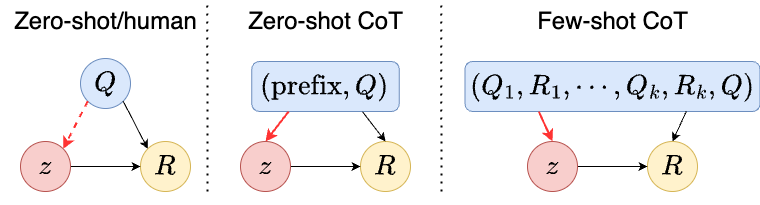
Figure 4: Causal graphs for prompting with zero-shot/human (left), zero-shot CoT (middle), and few-shot CoT (right) for generating rationales via skills. The dashed arrow from $Q$ to $z$ indicates possible sub-optimal inference of the reasoning skills from both human and zero-shot LLM generations.
2 Related Work
2.1 CoT Reasoning
CoT prompting is a special prompt design technique that encourages LLMs to generate intermediate rationales that guide them towards providing accurate final answers. These rationales can exhibit remarkable flexibility in their styles. For instance, the original work by Wei et al. (2022b) specially designs rationales in the in-context demonstrations to suit different reasoning tasks. Moreover, novel prompt designs that highlight diverse formats of the rationales have emerged to enhance CoT prompting. For example, Kojima et al. (2022) proposed Program of Thoughts (PoT) that disentangles textual reasoning from computation, with the latter specially handled through program generation.
In contrast to manual design, our method LaRS can be thought of as automatic discovery of diverse rationale styles from an example bank. This method can also dynamically select reasoning skills based on the specific questions. Worth noting, Chen et al. (2023) introduces SKills-in-Context (SKiC), which confines rationale generation to predefined “skills” within the prompt. Although sharing a similar motivation to LaRS, we emphasize two crucial distinctions: (1) while SKiC relies on manual “skills” design, LaRS automatically discovers them, (2) SKiC presents a full list of “skills” in the prompt, allowing LLMs to select from them, whereas LaRS learns the skill selection from the example bank, explicitly instructing LLMs on which skill to employ through in-context examples.
2.2 Demonstration Selection
Demonstration selection refers to a special setting, where the prompts are constructed by selecting examples from an example bank. In this context, our LaRS aligns with the paradigm of unsupervised demonstration selection, which involves designing heuristics for this selection process. A variety of heuristics have been explored, including similarity Gao et al. (2021); Hu et al. (2022), diversity Zhang et al. (2022), coverage Gupta et al. (2023), and uncertainty Diao et al. (2023). Among these, Skill-KNN (An et al. (2023b)) shares the closest resemblance to our approach. However, Skill-KNN relies on pre-trained LLMs to provide “skill” annotations, which could be arbitrary and resource-intensive, requiring extensive inferences of LLMs and human prompt design. In contrast, LaRS automatically discovers reasoning skills by learning a lightweight CVAE represented by two-layer MLPs and standard loss function. In addition, the selections based on these discovered reasoning skills are theoretically-grounded based on the latent skill model and the theoretical analyses presented in this paper.
3 Formulation
In this section, we formally describe the skill model, a new formulation for explaining the generation of rationales in CoT reasoning. In Section 3.1, the skill model is first introduced to describe the human-generated rationales. Then, Section 3.2 illustrates how the skill model can be adapted to LLM-generated rationales. Finally, leveraging the concept of reasoning skill as outlined in the skill model, a new latent-skill-based demonstration selection method is formally described in Section 3.3.
3.1 Skill Model
Let $\mathcal{X}$ be the set of all sequences of tokens, $\mathcal{Z}$ be the continuous vector space of latent reasoning skills, and $P_{H}$ denotes the probability distribution of real-world natural language. CoT reasoning is to generate a rationale $R∈\mathcal{X}$ given a question $Q∈\mathcal{X}$ , whose correctness For math word problems, whose answers are discrete labels, the correct rationale should contain the correct answer label as the final step. For code generation, the correct rationale should be the correct code. can be verified by an indicator function $\mathbb{1}(R,Q):=\mathbb{1}(R\text{ is the correct rationale for }Q)$ .
The skill model assumes that the real-world conditional distribution of $R$ given $Q$ can be described as follows:
where, $P_{H}(z\mid Q)$ is the posterior of selecting latent reasoning skills in human reasoning, called a reasoning policy. $P_{H}(R\mid z,Q)$ is the posterior distribution of generating $R$ given a question $Q$ and a reasoning skill $z$ . A causal graph illustrating such a generation process involving a latent reasoning skill $z$ is presented in Fig. 4 on the left.
Unlike Wang et al. (2023), this formulation considers a dependency of $z$ on $Q$ reflecting a preference for selecting particular reasoning skills to solve a given question. We justify this formulation as follows:
1. Rationales can exhibit remarkable flexibility, manifesting diverse formats, topics, and knowledge, which can naturally be abstracted into the high-level concepts of reasoning skills.
1. The selection of these skills is not bound by strict determinism. For instance, diverse reasoning paths and formats could all contribute toward finding the correct final answer. Therefore, real-world data is a mixture of diverse skills captured by a stochastic reasoning policy $P_{H}(z\mid Q)$ .
3.2 CoT prompting
LLMs are pre-trained conditional generators. Given an input query $X∈\mathcal{X}$ , the conditional distribution of an output $Y∈\mathcal{X}$ generated by LLMs can be written as $P_{M}(Y\mid X)$ . LLMs are usually trained on generic real-world data distribution such that $P_{M}(Y\mid X)≈ P_{H}(Y\mid X)$ .
Prior studies have presented an implicit topic model formulation in explaining the in-context learning mechanisms of LLMs Wang et al. (2023); Xie et al. (2021a). Similarly, we posit that LLMs can be viewed as implicit skill models for generating rationales. To elaborate, when generating rationales, LLMs’ conditional distribution $P_{M}(R\mid Q)$ can be extended as follows (with illustrations in Fig. 4 on the left):
This implicit skill model assumes that LLMs also infer reasoning skills $z$ , which resembles the real-world generation of rationales.
The above formulation only encompasses the zero-shot generation of rationales. In practice, prompts are commonly provided to guide LLMs’ generation. In general, two CoT prompting strategies exist: zero-shot CoT, employing a prompt comprising a short prefix and a test question, and few-shot CoT, employing a prompt containing pairs of questions and rationales. Denoting $pt∈\mathcal{X}$ as a prompt, a unified formulation for both prompting strategies can be derived as follows:
0-shot CoT: $pt=(\text{prefix},Q)\text{ or }(Q,\text{prefix})$ $k$ -shot CoT: $pt=(Q_{1},R_{1},·s,Q_{k},R_{k},Q)$
Here, the formulation is simplified such that the use of prompts only influences the probability distribution of $z$ . For instance, a prefix specifying the generation’s format can be interpreted as specifying the reasoning skill $z$ by shaping the distribution from $P_{M}(z\mid Q)$ to $P_{M}(z\mid pt)$ . This simplification aligns with empirical evidence suggesting that in-context examples serve as mere pointers to retrieve already-learned knowledge within LLMs Shin et al. (2020); Min et al. (2022); Wang et al. (2022).
Drawing upon this formulation, we can gain insight into the failure of zero-shot generation. In general, real-world data is inherently noisy, indicating that the reasoning policy $P_{H}(z\mid Q)$ may be sub-optimal, and the reasoning skills are not chosen to maximize the accuracy of answering a test question. Trained on this generic real-world data distribution, $P_{M}(z\mid Q)$ could also be sub-optimal, leading to the failure of zero-shot generation. On the other hand, CoT prompting improves the reasoning performance by shaping the distribution of reasoning skills using carefully-designed prompts that contain either prefix or few-shot examples.
3.3 Skill-Based Demonstration Selection
The analysis above suggests that the key to the success of CoT prompting is to design an effective prompt that improve upon the posterior distribution of human’s preference of reasoning skills $P_{H}(z\mid Q)$ . To design an effective prompt, the demonstration selection problem assumes access to an example bank of question-rationale pairs, denoted as $\mathcal{D}_{E}=\{(R,Q)\}$ . This example bank is usually specially-crafted and has a distribution different from the real-world distribution. Denoting $P_{E}$ as the distribution of the example bank, $R$ is distributed according to $P_{E}(R\mid Q)$ for all $(R,Q)∈\mathcal{D}_{E}$ .
Given $\mathcal{D}_{E}$ , the demonstration selection is to select a few question-rationale pairs from $\mathcal{D}_{E}$ . Assuming that each selected demonstration is i.i.d, a demonstration selection method can be uniquely defined as a probabilistic model $g(Q,R|Q_{\text{test}}):=\mathcal{X}\mapsto\Delta(\mathcal{X})$ that maps a test question $Q_{\text{test}}$ to a probability distribution of demonstrations. Then, we can formally define the skill-based demonstration selection method as follows:
**Definition 1**
*Skill-based demonstration selection is given by*
Intuitively, this selection method maximizes the probability of a selected demonstration showcasing the reasoning skill that is likely to be chosen according to $P_{E}(z\mid Q)$ . Since the example bank is usually specially-crafted and contains rationales showcasing “better” reasoning skills, the in-context examples that align with $P_{E}(z\mid Q)$ are intuitively more effective. In Section 4.3, we provide theoretical analysis of the optimality of this skill-based selection when conditioned on certain ideal assumptions of the example bank and LLMs.
4 Method
To enable the skill-based demonstration selection (Definition 1), we introduce our approach LaRS , which involves learning a conditional variational autoencoder (CVAE) to approximate $P_{E}$ using the data from the example bank $\mathcal{D}_{E}$ . We then outline a practical demonstration selection process aligning with the skill-based selection. The schematic overview of LaRS (right) and the corresponding demonstration selection process (left) are illustrated in Figure 2.
4.1 Latent Reasoning Skill Discovery
The conditional variational autoencoder (CVAE) has emerged as a popular approach for modeling probabilistic conditional generation. As one specific case, the skill model, introduced in this paper, can effectively be represented as a CVAE. Therefore, we introduce LaRS that employs a CVAE to approximate the generation of rationales using the data from the example bank $\mathcal{D}_{E}=\{(Q,R)\}$ .
In particular, this CVAE includes three coupled models: an encoder model, a decoder model, and a reasoning policy model, independently parameterized by $\omega$ , $\psi$ , and $\phi$ respectively. Drawing from the notations introduced in the skill model, the reasoning policy model is a conditional Bayesian network $\pi_{\phi}(z\mid Q)$ , determining the posterior distribution of latent reasoning skill $z$ given a question $Q$ . The decoder model is also a conditional Bayesian network $p_{\psi}(R\mid z,Q)$ that generates a rationale $R$ , conditioned on both $Q$ and $z$ , where $z$ is sampled from $\pi_{\phi}(z\mid Q)$ . Finally, the encoder model $q_{\omega}(z\mid Q,R)$ is another conditional Bayesian network, mapping a question-rationale pair to $z$ . In this paper, we train this CVAE using classical variational expectation maximization and the reparameterization trick.
Specifically, the classical variational expectation maximization optimizes a loss function as follows: $\displaystyle\mathcal{L}_{\text{CVAE}}(\phi,\omega,\psi)=\mathcal{L}_{\text{%
recon}}+\mathcal{L}_{\text{KL}}$ (4) $\displaystyle\mathcal{L}_{\text{recon}}=-\mathbb{E}_{(Q,R)\sim\mathcal{D}_{E},%
z\sim q_{\omega}(\mid Q,R)}[\log p_{\psi}(R|z,Q)]$ $\displaystyle\mathcal{L}_{\text{KL}}=~{}\mathbb{E}_{(Q,R)\sim\mathcal{D}_{E}}[%
\text{D}_{\text{KL}}(q_{\omega}(z\mid Q,R)\parallel\pi_{\phi}(z\mid Q))]$ By training to minimize this loss function, $q_{\omega}$ and $\pi_{\phi}$ can be learned to effectively approximate the conditional distributions $P_{E}(z\mid Q,R)$ and $P_{E}(z\mid Q)$ . It is worth noting that the decoder model acts an auxiliary model that only roughly reconstructs rationales for the purpose of training the encoder and the reasoning policy model, and is not deployed to generate rationales in the downstream tasks.
Ideally, all three models would be represented by language models, processing token sequences as input and generating token sequences as output. However, training full language models for demonstration selections can be computationally expensive. Instead, we adopt a pre-trained embedding model denoted as $f:\mathcal{X}\mapsto\Theta$ , which maps the token space $\mathcal{X}$ to an embedding space $\Theta$ . Consequently, the decoder model, encoder model, and reasoning policy model transform into $p_{\psi}(f(R)|z,f(Q))$ , $q_{\omega}(z|f(Q,R))$ , and $\pi_{\phi}(z|f(Q))$ , respectively. They now condition on and generate the embeddings instead of the original tokens. In the actual implementation, we use the same feed-forward neural network to represent both $\pi_{\phi}$ and $q_{\omega}$ , predicting the mean and variance of Gaussian distributions of latent reasoning skills. On the other hand, $p_{\psi}$ is a feed-forward neural network that deterministically predicts a value in the embedding space.
4.2 Demonstration Selection
Since the distribution $P_{E}(Q,R\mid z)$ in Definition 1 is practically intractable, we propose a selection process that effectively aligns with the skill-based selection using the learned $\pi_{\phi}$ and $q_{\omega}$ . For a given test question $Q_{\text{test}}$ , the desirable reasoning skill $z_{\text{test}}=\operatorname*{arg\,max}_{z}[\pi_{\phi}(z|f(Q_{\text{test}}))]$ can be computed using the reasoning policy. Subsequently, each example from the example bank can be scored based on the cosine similarity between $z_{\text{test}}$ and $z_{\text{post}}$ , where $z_{\text{post}}=\operatorname*{arg\,max}_{z}[q_{\omega}(z|Q,R))]$ represents the maximum likelihood skill of the current example. Finally, a CoT prompt can be constructed by selecting the top- $k$ examples according to the computed scores. The step-by-step procedure is outlined in Algorithm 1.
4.3 Theoretical Analysis
In this section, we provide a theoretical analysis of the optimality of the skill-based selection by Definition 1.
Let $P_{M}(R\mid Q,g)$ denotes LLMs’ conditional distribution of a rationale $R$ given a test question $Q$ under a demonstration selection method $g$ . $P_{M}(R\mid Q,g)$ can be extended as follows: $\displaystyle P_{M}(R\mid Q,g)$ $\displaystyle=∈t_{\mathcal{X}^{k}}P_{M}(R\mid pt)\Pi_{i=1}^{k}[g(Q_{i},R_{i}%
\mid Q)d(Q_{i},R_{i})]$ Here, each demonstrations $(Q_{i},R_{i})$ is independently sampled from $g(Q_{i},R_{i}\mid Q),∀ i=1,·s,k$ . These $k$ demonstrations form a prompt $pt=(Q_{1},R_{1},·s,Q_{k},R_{k},Q)$ .
We want to show that $P_{M}(R\mid Q,g)$ is the optimal conditional distribution that maximizes the accuracy of rationales if the selection follows skill-based selection method or $g=g_{skill}$ . We begin by defining the optimal conditional distribution as follows:
**Definition 2**
*Optimal conditional distribution of rationales given questions $P^{*}(R\mid Q)$ is given by: $P^{*}(R\mid Q)=\operatorname*{arg\,max}_{P(·\mid Q)∈\Delta(\mathcal{X})}%
∈t_{\mathcal{X}}\mathbb{1}(R,Q)P(R\mid Q)dR$ Here $\mathbb{1}(R,Q)$ is the indicator function of the correctness of $R$ given a question $Q$ (see Section 3.1).*
Then, we state two major assumptions as follows:
**Assumption 1**
*Example bank is sampled from the optimal conditional distribution, or $P_{E}(R\mid Q)=P^{*}(R\mid Q)$ .*
**Assumption 2**
*Humans and LLMs are expert rationale generators given reasoning skills and questions, meaning that $P_{H}(R\mid z,Q)=P_{E}(R\mid z,Q)=P_{M}(R\mid z,Q)$ .*
Assumption 1 is rooted in the fact that example banks are human-crafted that contains the most useful rationales for answering the questions. In Assumption 2, $P_{M}$ capturing $P_{H}$ is a common assumption in the literature studying LLMs Xie et al. (2021b); Saunshi et al. (2020); Wei et al. (2021). $P_{E}(R\mid z,Q)=P_{H}(R\mid z,Q)$ is based on the assumption that reasoning skills are shared across humans, and the generation of rationales is identical given the same reasoning skills and questions.
Based on the above definiton and two assumptions, we prove the following theorem.
**Theorem 1**
*A LLM gives the optimal conditional distribution of rationales given questions:
$$
P_{M}(R\mid Q,g_{skill})=P^{*}(R\mid Q)
$$
If (1) it is prompted by $k→∞$ in-context examples selected by the skill-based selection $g_{skill}$ defined by Definition 1, (2) Assumption 2 and Assumption 1 hold.*
Appendix E presents the proof for Theorem 1.
5 Experiments
This section describes the experimental settings, baselines, metrics, and main results.
5.1 Dataset
For benchmarking, the selection methods are evaluated on four challenging datasets, including two datasets of Math Word Problem (MWP): TabMWP, GSM8K, one text-to-SQL dataset: Spider, and one semantic parsing dataset: COGS.
Each dataset is split into a training set used to learn LaRS models and a test set used to evaluate the selection methods. While the training sets may potentially be large, we use randomly sampled 1K examples from the training set as the example bank, from which, the examples can be selected for CoT prompting. Detailed descriptions of the datasets and splitting are presented in Appendix B.
To measure the performances, we use the answer accuracy for TabMWP and GSM8K, with the answers extracted by searching the texts right after a prefix The answer is. For Spider, we use the official execution-with-values accuracy We use the official evaluation scripts for Spider in https://github.com/taoyds/test-suite-sql-eval.. For COGS, we report the exact-match accuracy for semantic parsing.
5.2 Selection Methods
Our method LaRS is compared with the following four baselines. All the hyper-parameters related to these methods are listed in Appendix B.
Skill-KNN
This baseline represents a state-of-the-art (SOTA) skill-based selection method. It employs pre-trained LLMs to generate skill descriptions for both the questions in the example bank and the test question. Then, the method selects examples whose skill descriptions most closely match that of the test question to form the prompt, using cosine similarity computed with a pre-trained embedding model. To examine the dependency on the LLMs’ ability to generate skill descriptions, we introduce two variations: Skill-KNN-large, which uses the larger LLM gpt-3.5-turbo, and Skill-KNN-small, which uses the smaller LLM Falcon-40B-instruct. Additionally, to evaluate the effect of human-annotated skill descriptions prompting the LLMs to generate new skills, we introduce Skill-KNN-zero, which uses gpt-3.5-turbo to generate skill descriptions in a zero-shot fashion. Skill-KNN-zero closely resembles the setting of LaRS , as it does not rely on human prompt design. Therefore, LaRS is primarily compared with Skill-KNN-zero.
Random
This baseline randomly selects $k$ in-context examples from the example bank. For each test question, the accuracy is reported as an average over three independent random selections.
Retrieval-Q
This baseline employs a pre-trained embedding model to encode a test question, and selects in-context examples based on the cosine similarity between embeddings from examples’ questions and the test question.
Retrieval-R (oracle)
This baseline employs a pre-trained embedding model to encode the ground-truth rationale of a test question, and selects in-context examples based on the cosine similarity between examples’ rationales and the ground-truth rationale.
5.3 Backbones and Hyper-parameters
In terms of the backbone models, the ICL is conducted by two OpenAI language models: gpt-4o and gpt-3.5-turbo, two Anthropic model: claude-3-sonnet and claude-3-haiku, and one smaller-scale Falcon-40B-Instruct Xu et al. (2023). All the embedding is computed by a pre-trained embedding model, Deberta-v2-xlarge He et al. (2021). We also investigate different choices of embedding model in Section C.
During inference, the temperature is set to 0 (i.e., greedy decoding) to reduce the variance. The CoT prompts contain $k=2,4,4,8$ in-context examples for TabMWP, GSM8K, Spider, and COGS, respectively.
5.4 Performance comparison results
Table 7 presents experiment result summary. Detailed descriptions are as follows:
| Method Backbone: gpt-3.5-turbo Random | TabMWP 62.4 +0.0 | GSM8K 75.7 +0.0 | Spider 46.8 +0.0 | COGS 67.5 +0.0 |
| --- | --- | --- | --- | --- |
| Retrieval-Q | 72.3 +9.9 | 75.6 –0.1 | 49.9 +3.1 | 88.5 +21.0 |
| Skill-KNN-zero | 77.7 +15.3 | 75.0 –0.7 | 49.0 +2.2 | 77.9 +10.8 |
| LaRS (ours) | 78.1 +15.7 | 76.8 +1.1 | 53.0 +6.2 | 94.8 +27.2 |
| Retrieval-R (oracle) | 77.4 +15.0 | 75.5 –0.2 | 64.4 +17.6 | 95.7 +28.2 |
| Backbone: gpt-4o | | | | |
| Random | 87.6 +0.0 | 78.1 +0.0 | 74.1 +0.0 | 73.0 +0.0 |
| Retrieval-Q | 85.9 –1.7 | 78.1 +0.0 | 75.9 +1.8 | 86.9 +16.9 |
| Skill-KNN-zero | 87.7 +0.1 | 78.6 –0.5 | 76.6 +2.5 | 78.1 +5.1 |
| LaRS (ours) | 87.9 +0.3 | 78.3 +0.2 | 77.2 +3.1 | 90.2 +17.2 |
| Retrieval-R (oracle) | 88.8 +1.2 | 77.1 –1.0 | 78.1 +4.0 | 92.8 +19.8 |
| Backbone: claude-3-sonnet | | | | |
| Random | 92.6 +0.0 | 93.3 +0.0 | 61.7 +0.0 | 79.2 +0.0 |
| Retrieval-Q | 93.1 +0.5 | 92.4 –0.9 | 61.8 +0.1 | 94.6 +15.4 |
| Skill-KNN-zero | 93.1 +0.5 | 92.1 –1.2 | 61.9 +0.2 | 86.6 +7.4 |
| LaRS (ours) | 93.7 +1.1 | 93.6 +0.3 | 62.2 +0.5 | 96.9 +17.7 |
| Retrieval-R (oracle) | 94.1 +1.5 | 92.8 –0.5 | 62.4 +0.7 | 97.6 +18.4 |
| Backbone: claude-3-haiku | | | | |
| Random | 88.6 +0.0 | 88.6 +0.0 | 60.2 +0.0 | 66.2 +0.0 |
| Retrieval-Q | 92.2 +3.6 | 88.6 +0.0 | 60.0 –0.2 | 88.5 +22.3 |
| Skill-KNN-zero | 93.3 +4.7 | 88.8 +0.2 | 61.0 +0.8 | 79.7 +13.5 |
| LaRS (ours) | 93.3 +4.7 | 87.6 –1.0 | 61.3 +1.1 | 89.9 +23.7 |
| Retrieval-R (oracle) | 92.4 +3.8 | 88.9 +0.3 | 61.2 +1.0 | 96.5 +30.3 |
| Backbone: Falcon-40B-Instruct | | | | |
| Random | 45.7 +0.0 | 38.8 +0.0 | 20.6 +0.0 | 45.1 +0.0 |
| Retrieval-Q | 51.9 +6.2 | 37.3 –1.5 | 22.1 +1.5 | 73.9 +28.8 |
| Skill-KNN-small | 51.4 +5.7 | 36.5 –2.3 | 20.3 –0.3 | 59.4 +14.3 |
| Skill-KNN-zero | 55.2 +9.5 | 38.7 –0.1 | 23.3 +2.7 | 82.1 +37.0 |
| LaRS (ours) | 57.7 +12.0 | 39.1 +0.3 | 24.8 +4.2 | 89.5 +44.4 |
| Retrieval-R (oracle) | 61.2 +15.5 | 40.4 +1.6 | 39.9 +19.3 | 90.3 +45.2 |
Table 1: Main results (%) across all backbone models and datasets. Numbers in bold represent the best results for each backbone model across all selection methods. The subscripted gray values indicate the relative improvement over Random selection.
LaRS matches SOTA skill-based selection methods with superior computational efficiency.
As shown in Table 7, across all four benchmarks and five backbone models tested, LaRS outperforms Skill-KNN-zero in 18 out of 20 experiments. This result highlights the effectiveness of the latent reasoning skills learned through unsupervised learning with small CVAE models, achieving comparable performance to the skill descriptions crafted by extensively pre-trained LLMs. Notably, Skill-KNN-zero uses the powerful LLM gpt-3.5-turbo for skill generations. However, in scenarios where only less capable LLMs are available, such as lacking an internet connection and requiring local inference, Skill-KNN-small, which uses the less capable LLM Falcon-40B-instruct, suffers significant performance drops across all four benchmarks. In contrast, LaRS does not require powerful LLMs and achieves similar performance boosts for smaller backbone models like Falcon-40B-Instruct compared to Skill-KNN-zero.
Furthermore, in Table 3, we present a comparison of computational overhead, including computing time, estimated cost for pre-processing the example bank, and cost for each input query during selection, among Retrieval-Q, LaRS, Skill-KNN-zero, and a supervised selection method PromptPG Lu et al. (2022). Our method achieves accuracy comparable to Skill-KNN-zero, requiring no LLM inferences (approximately $30 savings per 1k examples) and reducing computing time by 1.5 hours per 1k examples during pre-processing, along with more than 100% less cost per input query. Detailed experimental settings for estimating these costs can be found in Appendix B.
LaRS is more robust to sub-optimal example banks.
Skill-KNN selects examples based solely on the questions. For example, it selects examples whose questions require the same skills as the given question. However, sub-optimal example banks may include examples with incorrect or sub-optimal rationales, which should be avoided. In contrast, LaRS considers both questions and rationales when computing the reasoning skill embedding, enhancing its robustness to sub-optimality. Table 2 presents the answer accuracy of Skill-KNN-zero and LaRS on the TabMWP and COGS benchmark with sub-optimal example banks, where 10%, 20% and 30% of rationales are replaced by random rationales from the same example banks. Skill-KNN-zero suffers from a 3% and 11.7% performance drop at the replacement rate of 30%, while LaRS experiences only a 0.1% and 1.9% performance drop under the same conditions.
| Skill-KNN-zero LaRS Benchmark | 77.7 78.1 COGS | 77.0 –0.9% 78.1 –0.0% | 76.2 –1.9% 78.0 –0.1% | 75.4 –3.0% 77.9 –0.1% |
| --- | --- | --- | --- | --- |
| Replace Rate (%) | 0 | 0.1 | 0.2 | 0.3 |
| Skill-KNN-zero | 77.9 | 75.8 –2.7% | 73.8 –5.3% | 68.8 –11.7% |
| LaRS | 94.8 | 94.7 –0.1% | 93.3 –1.6% | 93.0 –1.9% |
Table 2: Answer accuracy (%) of Skill-KNN-zero and LaRS on TabMWP and COGS benchmark with 0%, 10%, 20%, and 30% of the rationales in the example bank being replaced with random rationales. The subscripted gray values indicate the percentage drop relative to optimal example banks.
| | Accuracy (%) $\uparrow$ Time (h/1k) $\downarrow$ | Pre-processing Cost ($/1k) $\downarrow$ | Selection Cost per query ($) $\downarrow$ | |
| --- | --- | --- | --- | --- |
| LaRS (ours) | 78.1 | 0.5 +0% | $0 | $0.02 +%0 |
| Skill-KNN-zero | 77.7 | 2 +300% | $30 | $0.05 +150% |
| PromptPG | 74.2 | 6 +1100% | $50 | $0.02 +0% |
| Retrieval-Q | 72.3 | 0 –100% | $0 | $0.02 +0% |
Table 3: Comparison of accuracy and computational overhead, including computing time, estimated cost for pre-processing an example bank of 1k, and average cost per input query during selection, among four selection methods on the TabMWP dataset. The grey percentages represent the increased cost ratio associated with each selection method.
6 Conclusions
This paper introduces LaRS, a novel demonstration selection method designed for CoT prompting. LaRS bases the selection on reasoning skills, which are latent representations discovered by unsupervised learning from rationales via a CVAE. Based on the experiments conducted across four LLMs and over four different reasoning tasks, LaRS manifests comparable performance on selecting effective few-shot examples for CoT reasoning while requiring no extra LLM inference and saving hours in pre-processing the example bank.
7 Limitations
Despite the success of LaRS, a few limitations and potential future directions are worth noting. First, the impact of the order of examples in the prompts is not considered. Introducing additional heuristics to sort the examples could potentially lead to better performances. Second, in the CVAE, the decoder is represented by an MLP neural network. However, it would be ideal to represent the decoder as a prompt-tuning module, which aligns better with the implicit skill model assumption. Finally, one single reasoning skill might not be sufficient to represent the entire rationale that might contain multiple steps of reasoning. Learning and selecting reasoning skills for each individual reasoning step is an interesting direction to explore.
References
- An et al. (2023a) Shengnan An, Zeqi Lin, Qiang Fu, B. Chen, Nanning Zheng, Jian-Guang Lou, and D. Zhang. 2023a. How do in-context examples affect compositional generalization? ArXiv, abs/2305.04835.
- An et al. (2023b) Shengnan An, Bo Zhou, Zeqi Lin, Qiang Fu, Bei Chen, Nanning Zheng, Weizhu Chen, and Jian-Guang Lou. 2023b. Skill-based few-shot selection for in-context learning. arXiv preprint arXiv:2305.14210.
- Bommasani et al. (2021) Rishi Bommasani, Drew A. Hudson, Ehsan Adeli, Russ Altman, Simran Arora, Sydney von Arx, Michael S. Bernstein, Jeannette Bohg, Antoine Bosselut, Emma Brunskill, Erik Brynjolfsson, S. Buch, Dallas Card, Rodrigo Castellon, Niladri S. Chatterji, Annie S. Chen, Kathleen A. Creel, Jared Davis, Dora Demszky, Chris Donahue, Moussa Doumbouya, Esin Durmus, Stefano Ermon, John Etchemendy, Kawin Ethayarajh, Li Fei-Fei, Chelsea Finn, Trevor Gale, Lauren E. Gillespie, Karan Goel, Noah D. Goodman, Shelby Grossman, Neel Guha, Tatsunori Hashimoto, Peter Henderson, John Hewitt, Daniel E. Ho, Jenny Hong, Kyle Hsu, Jing Huang, Thomas F. Icard, Saahil Jain, Dan Jurafsky, Pratyusha Kalluri, Siddharth Karamcheti, Geoff Keeling, Fereshte Khani, O. Khattab, Pang Wei Koh, Mark S. Krass, Ranjay Krishna, Rohith Kuditipudi, Ananya Kumar, Faisal Ladhak, Mina Lee, Tony Lee, Jure Leskovec, Isabelle Levent, Xiang Lisa Li, Xuechen Li, Tengyu Ma, Ali Malik, Christopher D. Manning, Suvir Mirchandani, Eric Mitchell, Zanele Munyikwa, Suraj Nair, Avanika Narayan, Deepak Narayanan, Benjamin Newman, Allen Nie, Juan Carlos Niebles, Hamed Nilforoshan, J. F. Nyarko, Giray Ogut, Laurel J. Orr, Isabel Papadimitriou, Joon Sung Park, Chris Piech, Eva Portelance, Christopher Potts, Aditi Raghunathan, Robert Reich, Hongyu Ren, Frieda Rong, Yusuf H. Roohani, Camilo Ruiz, Jack Ryan, Christopher R’e, Dorsa Sadigh, Shiori Sagawa, Keshav Santhanam, Andy Shih, Krishna Parasuram Srinivasan, Alex Tamkin, Rohan Taori, Armin W. Thomas, Florian Tramèr, Rose E. Wang, William Wang, Bohan Wu, Jiajun Wu, Yuhuai Wu, Sang Michael Xie, Michihiro Yasunaga, Jiaxuan You, Matei A. Zaharia, Michael Zhang, Tianyi Zhang, Xikun Zhang, Yuhui Zhang, Lucia Zheng, Kaitlyn Zhou, and Percy Liang. 2021. On the opportunities and risks of foundation models. ArXiv, abs/2108.07258.
- Brown et al. (2020) Tom B. Brown, Benjamin Mann, Nick Ryder, Melanie Subbiah, Jared Kaplan, Prafulla Dhariwal, Arvind Neelakantan, Pranav Shyam, Girish Sastry, Amanda Askell, Sandhini Agarwal, Ariel Herbert-Voss, Gretchen Krueger, T. J. Henighan, Rewon Child, Aditya Ramesh, Daniel M. Ziegler, Jeff Wu, Clemens Winter, Christopher Hesse, Mark Chen, Eric Sigler, Mateusz Litwin, Scott Gray, Benjamin Chess, Jack Clark, Christopher Berner, Sam McCandlish, Alec Radford, Ilya Sutskever, and Dario Amodei. 2020. Language models are few-shot learners. ArXiv, abs/2005.14165.
- Chen et al. (2023) Jiaao Chen, Xiaoman Pan, Dian Yu, Kaiqiang Song, Xiaoyang Wang, Dong Yu, and Jianshu Chen. 2023. Skills-in-context prompting: Unlocking compositionality in large language models. arXiv preprint arXiv:2308.00304.
- Chowdhery et al. (2022) Aakanksha Chowdhery, Sharan Narang, Jacob Devlin, Maarten Bosma, Gaurav Mishra, Adam Roberts, Paul Barham, Hyung Won Chung, Charles Sutton, Sebastian Gehrmann, Parker Schuh, Kensen Shi, Sasha Tsvyashchenko, Joshua Maynez, Abhishek Rao, Parker Barnes, Yi Tay, Noam M. Shazeer, Vinodkumar Prabhakaran, Emily Reif, Nan Du, Benton C. Hutchinson, Reiner Pope, James Bradbury, Jacob Austin, Michael Isard, Guy Gur-Ari, Pengcheng Yin, Toju Duke, Anselm Levskaya, Sanjay Ghemawat, Sunipa Dev, Henryk Michalewski, Xavier García, Vedant Misra, Kevin Robinson, Liam Fedus, Denny Zhou, Daphne Ippolito, David Luan, Hyeontaek Lim, Barret Zoph, Alexander Spiridonov, Ryan Sepassi, David Dohan, Shivani Agrawal, Mark Omernick, Andrew M. Dai, Thanumalayan Sankaranarayana Pillai, Marie Pellat, Aitor Lewkowycz, Erica Moreira, Rewon Child, Oleksandr Polozov, Katherine Lee, Zongwei Zhou, Xuezhi Wang, Brennan Saeta, Mark Díaz, Orhan Firat, Michele Catasta, Jason Wei, Kathleen S. Meier-Hellstern, Douglas Eck, Jeff Dean, Slav Petrov, and Noah Fiedel. 2022. Palm: Scaling language modeling with pathways. ArXiv, abs/2204.02311.
- Cobbe et al. (2021a) Karl Cobbe, Vineet Kosaraju, Mohammad Bavarian, Mark Chen, Heewoo Jun, Lukasz Kaiser, Matthias Plappert, Jerry Tworek, Jacob Hilton, Reiichiro Nakano, Christopher Hesse, and John Schulman. 2021a. Training verifiers to solve math word problems. ArXiv, abs/2110.14168.
- Cobbe et al. (2021b) Karl Cobbe, Vineet Kosaraju, Mohammad Bavarian, Mark Chen, Heewoo Jun, Lukasz Kaiser, Matthias Plappert, Jerry Tworek, Jacob Hilton, Reiichiro Nakano, et al. 2021b. Training verifiers to solve math word problems. arXiv preprint arXiv:2110.14168.
- Devlin et al. (2019) Jacob Devlin, Ming-Wei Chang, Kenton Lee, and Kristina Toutanova. 2019. Bert: Pre-training of deep bidirectional transformers for language understanding. ArXiv, abs/1810.04805.
- Diao et al. (2023) Shizhe Diao, Pengcheng Wang, Yong Lin, and Tong Zhang. 2023. Active prompting with chain-of-thought for large language models. ArXiv, abs/2302.12246.
- Dong et al. (2022) Qingxiu Dong, Lei Li, Damai Dai, Ce Zheng, Zhiyong Wu, Baobao Chang, Xu Sun, Jingjing Xu, and Zhifang Sui. 2022. A survey for in-context learning. arXiv preprint arXiv:2301.00234.
- Gao et al. (2021) Tianyu Gao, Adam Fisch, and Danqi Chen. 2021. Making pre-trained language models better few-shot learners. ArXiv, abs/2012.15723.
- Gupta et al. (2023) Shivanshu Gupta, Sameer Singh, and Matt Gardner. 2023. Coverage-based example selection for in-context learning. ArXiv, abs/2305.14907.
- He et al. (2021) Pengcheng He, Xiaodong Liu, Jianfeng Gao, and Weizhu Chen. 2021. Deberta: Decoding-enhanced bert with disentangled attention. In International Conference on Learning Representations.
- Hu et al. (2022) Yushi Hu, Chia-Hsuan Lee, Tianbao Xie, Tao Yu, Noah A. Smith, and Mari Ostendorf. 2022. In-context learning for few-shot dialogue state tracking. ArXiv, abs/2203.08568.
- Kim and Linzen (2020) Najoung Kim and Tal Linzen. 2020. Cogs: A compositional generalization challenge based on semantic interpretation. ArXiv, abs/2010.05465.
- Kojima et al. (2022) Takeshi Kojima, Shixiang Shane Gu, Machel Reid, Yutaka Matsuo, and Yusuke Iwasawa. 2022. Large language models are zero-shot reasoners. Advances in neural information processing systems, 35:22199–22213.
- Liu et al. (2021) Jiachang Liu, Dinghan Shen, Yizhe Zhang, Bill Dolan, Lawrence Carin, and Weizhu Chen. 2021. What makes good in-context examples for gpt-3? In Workshop on Knowledge Extraction and Integration for Deep Learning Architectures; Deep Learning Inside Out.
- Lu et al. (2022) Pan Lu, Liang Qiu, Kai-Wei Chang, Ying Nian Wu, Song-Chun Zhu, Tanmay Rajpurohit, Peter Clark, and A. Kalyan. 2022. Dynamic prompt learning via policy gradient for semi-structured mathematical reasoning. ArXiv, abs/2209.14610.
- Lu et al. (2021) Yao Lu, Max Bartolo, Alastair Moore, Sebastian Riedel, and Pontus Stenetorp. 2021. Fantastically ordered prompts and where to find them: Overcoming few-shot prompt order sensitivity. ArXiv, abs/2104.08786.
- Min et al. (2022) Sewon Min, Xinxi Lyu, Ari Holtzman, Mikel Artetxe, Mike Lewis, Hannaneh Hajishirzi, and Luke Zettlemoyer. 2022. Rethinking the role of demonstrations: What makes in-context learning work? arXiv preprint arXiv:2202.12837.
- Neelakantan et al. (2022) Arvind Neelakantan, Tao Xu, Raul Puri, Alec Radford, Jesse Michael Han, Jerry Tworek, Qiming Yuan, Nikolas Tezak, Jong Wook Kim, Chris Hallacy, et al. 2022. Text and code embeddings by contrastive pre-training. arXiv preprint arXiv:2201.10005.
- Nye et al. (2021) Maxwell Nye, Anders Andreassen, Guy Gur-Ari, Henryk Michalewski, Jacob Austin, David Bieber, David Dohan, Aitor Lewkowycz, Maarten Bosma, David Luan, Charles Sutton, and Augustus Odena. 2021. Show your work: Scratchpads for intermediate computation with language models. ArXiv, abs/2112.00114.
- Rae et al. (2021) Jack W. Rae, Sebastian Borgeaud, Trevor Cai, Katie Millican, Jordan Hoffmann, Francis Song, John Aslanides, Sarah Henderson, Roman Ring, Susannah Young, Eliza Rutherford, Tom Hennigan, Jacob Menick, Albin Cassirer, Richard Powell, George van den Driessche, Lisa Anne Hendricks, Maribeth Rauh, Po-Sen Huang, Amelia Glaese, Johannes Welbl, Sumanth Dathathri, Saffron Huang, Jonathan Uesato, John F. J. Mellor, Irina Higgins, Antonia Creswell, Nathan McAleese, Amy Wu, Erich Elsen, Siddhant M. Jayakumar, Elena Buchatskaya, David Budden, Esme Sutherland, Karen Simonyan, Michela Paganini, L. Sifre, Lena Martens, Xiang Lorraine Li, Adhiguna Kuncoro, Aida Nematzadeh, Elena Gribovskaya, Domenic Donato, Angeliki Lazaridou, Arthur Mensch, Jean-Baptiste Lespiau, Maria Tsimpoukelli, N. K. Grigorev, Doug Fritz, Thibault Sottiaux, Mantas Pajarskas, Tobias Pohlen, Zhitao Gong, Daniel Toyama, Cyprien de Masson d’Autume, Yujia Li, Tayfun Terzi, Vladimir Mikulik, Igor Babuschkin, Aidan Clark, Diego de Las Casas, Aurelia Guy, Chris Jones, James Bradbury, Matthew G. Johnson, Blake A. Hechtman, Laura Weidinger, Iason Gabriel, William S. Isaac, Edward Lockhart, Simon Osindero, Laura Rimell, Chris Dyer, Oriol Vinyals, Kareem W. Ayoub, Jeff Stanway, L. L. Bennett, Demis Hassabis, Koray Kavukcuoglu, and Geoffrey Irving. 2021. Scaling language models: Methods, analysis & insights from training gopher. ArXiv, abs/2112.11446.
- Reimers and Gurevych (2019) Nils Reimers and Iryna Gurevych. 2019. Sentence-bert: Sentence embeddings using siamese bert-networks. arXiv preprint arXiv:1908.10084.
- Saunshi et al. (2020) Nikunj Saunshi, Sadhika Malladi, and Sanjeev Arora. 2020. A mathematical exploration of why language models help solve downstream tasks. ArXiv, abs/2010.03648.
- Shin et al. (2020) Taylor Shin, Yasaman Razeghi, Robert L Logan IV, Eric Wallace, and Sameer Singh. 2020. Eliciting knowledge from language models using automatically generated prompts. In Conference on Empirical Methods in Natural Language Processing.
- Suzgun et al. (2022) Mirac Suzgun, Nathan Scales, Nathanael Scharli, Sebastian Gehrmann, Yi Tay, Hyung Won Chung, Aakanksha Chowdhery, Quoc V. Le, Ed Huai hsin Chi, Denny Zhou, and Jason Wei. 2022. Challenging big-bench tasks and whether chain-of-thought can solve them. In Annual Meeting of the Association for Computational Linguistics.
- Vaswani et al. (2017) Ashish Vaswani, Noam M. Shazeer, Niki Parmar, Jakob Uszkoreit, Llion Jones, Aidan N. Gomez, Lukasz Kaiser, and Illia Polosukhin. 2017. Attention is all you need. In NIPS.
- Wang et al. (2022) Boshi Wang, Sewon Min, Xiang Deng, Jiaming Shen, You Wu, Luke Zettlemoyer, and Huan Sun. 2022. Towards understanding chain-of-thought prompting: An empirical study of what matters. arXiv preprint arXiv:2212.10001.
- Wang et al. (2023) Xinyi Wang, Wanrong Zhu, and William Yang Wang. 2023. Large language models are implicitly topic models: Explaining and finding good demonstrations for in-context learning. arXiv preprint arXiv:2301.11916.
- Wei et al. (2021) Colin Wei, Sang Michael Xie, and Tengyu Ma. 2021. Why do pretrained language models help in downstream tasks? an analysis of head and prompt tuning. ArXiv, abs/2106.09226.
- Wei et al. (2022a) Jason Wei, Yi Tay, Rishi Bommasani, Colin Raffel, Barret Zoph, Sebastian Borgeaud, Dani Yogatama, Maarten Bosma, Denny Zhou, Donald Metzler, Ed Huai hsin Chi, Tatsunori Hashimoto, Oriol Vinyals, Percy Liang, Jeff Dean, and William Fedus. 2022a. Emergent abilities of large language models. Trans. Mach. Learn. Res., 2022.
- Wei et al. (2022b) Jason Wei, Xuezhi Wang, Dale Schuurmans, Maarten Bosma, Ed Huai hsin Chi, F. Xia, Quoc Le, and Denny Zhou. 2022b. Chain of thought prompting elicits reasoning in large language models. ArXiv, abs/2201.11903.
- Xie et al. (2021a) Sang Michael Xie, Aditi Raghunathan, Percy Liang, and Tengyu Ma. 2021a. An explanation of in-context learning as implicit bayesian inference. ArXiv, abs/2111.02080.
- Xie et al. (2021b) Sang Michael Xie, Aditi Raghunathan, Percy Liang, and Tengyu Ma. 2021b. An explanation of in-context learning as implicit bayesian inference. arXiv preprint arXiv:2111.02080.
- Xu et al. (2023) Canwen Xu, Daya Guo, Nan Duan, and Julian McAuley. 2023. Baize: An open-source chat model with parameter-efficient tuning on self-chat data. arXiv preprint arXiv:2304.01196.
- Yu et al. (2018) Tao Yu, Rui Zhang, Kai-Chou Yang, Michihiro Yasunaga, Dongxu Wang, Zifan Li, James Ma, Irene Z Li, Qingning Yao, Shanelle Roman, Zilin Zhang, and Dragomir R. Radev. 2018. Spider: A large-scale human-labeled dataset for complex and cross-domain semantic parsing and text-to-sql task. ArXiv, abs/1809.08887.
- Zhang et al. (2022) Zhuosheng Zhang, Aston Zhang, Mu Li, and Alexander J. Smola. 2022. Automatic chain of thought prompting in large language models. ArXiv, abs/2210.03493.
Appendix: LaRS: Latent Reasoning Skill for Chain-of-Thought Reasoning
Appendix A LaRS Demonstration Selection
A practical desmonstration selection process for LaRS that tackle the difficulty of sampling from an unknown distribution $P_{E}(Q,R\mid z)$ is described as follows. To begin with, LaRS learns reasoning skill encoder $\pi_{\phi}$ and reasoning policy $q_{\omega}$ . For a given test question $Q_{\text{test}}$ , the desirable reasoning skill $z_{\text{test}}=\operatorname*{arg\,max}_{z}[\pi_{\phi}(z|f(Q_{\text{test}}))]$ can be computed using the reasoning policy. Subsequently, each example from the example bank can be scored based on the cosine similarity between $z_{\text{test}}$ and $z_{\text{post}}$ , where $z_{\text{post}}=\operatorname*{arg\,max}_{z}[q_{\omega}(z|Q,R))]$ represents the maximum likelihood skill of the current example. Finally, a CoT prompt can be constructed by selecting the top- $k$ examples according to the computed scores. The step-by-step procedure is outlined in Algorithm 1.
Algorithm 1 Demonstration selection
Input: Test question $Q_{\text{test}}$ , a pre-trained embedding model $f$ , a reasoning policy $\pi_{\phi}(z|f(Q))$ , a reasoning skill encoder $q_{\omega}(z|f(Q,R))$ , and an example bank $\mathcal{D}_{E}=\{(Q^{j},R^{j})\}_{j}$ . Parameter: shot number $k$ Output: $(Q_{1},R_{1},Q_{2},R_{2},·s,Q_{k},R_{k})$
1: Compute $z_{\text{test}}←$ mean of $\pi(z|f(Q_{\text{test}}))$
2: for each $(Q^{j},R^{j})$ in $\mathcal{D}_{E}$ do
3: Compute $z^{j}_{\text{post}}←$ mean of $q_{\omega}(z|f(Q^{j},R^{j}))$
4: Compute $r^{j}=\frac{z_{\text{test}}·{z^{j}_{\text{post}}}^{∈tercal}}{|z_{\text{%
test}}|·|z^{j}_{\text{post}}|}$
5: end for
6: Select top- $k$ demonstrations with the largest $r^{j}$ and sort them in ascending order, denoted as $(Q_{1},R_{1},Q_{2},R_{2},·s,Q_{k},R_{k})$ .
7: return $(Q_{1},R_{1},Q_{2},R_{2},·s,Q_{k},R_{k})$
Appendix B Experimental Details
B.1 Dataset
We provide a detailed description of the dataset and the split of train and test set as follows:
TabMWP
Lu et al. (2022) This dataset consists of semi-structured mathematical reasoning problems, comprising 38,431 open-domain grade-level problems that require mathematical reasoning on both textual and tabular data. We use the train set, containing 23,059 examples, to train our LaRS models, and test1k set containing 1K examples to evaluate the selection methods.
Spider
Yu et al. (2018) Spider is a large-scale text-to-SQL dataset. It includes a train set with 7,000 examples and a dev set with 1,034 examples. We use the train set to train our LaRS models, and the dev set as the test set to evaluate the selection methods.
COGS
Kim and Linzen (2020) is a synthetic benchmark for testing compositional generalization in semantic parsing. We transform the output format in the same way as An et al. (2023a), and consider a mixture of two sub-tasks: primitive substitution (P.S.) and primitive structural alternation (P.A.). This results in a train set of 6916 examples to train our LaRS models and a test set of 1000 examples to evaluate the selection method.
GSM8k
Cobbe et al. (2021b) GSM8k is a dataset containing 8.5K high-quality, linguistically diverse grade school math word problems. It includes a train set of 7.5K problems and a test set of 1319 problems. We use the train set to train our LaRS models, and the test set to evaluate the selection methods.
B.2 LaRS Implementation Details
LaRS contains a encoder, a decoder, and a reasoning policy model. The reasoning skill is represented as a 128-dimensional continuous space. Both the encoder and the reasoning policy model are represented as a feed-forward multiple layer perception (MLP) with two 256-unit hidden layers, predicting the mean and variance of a multivariate Gaussian distribution in the latent space of reasoning skills. The decoder is a MLP with two 256-unit hidden layers that predicts a value in the embedding space deterministically. The dimension of the embedding space depends on the choice of pre-trained embedding models. The models are trained using the loss function in Equation 4 with a batch size of 256 and a learning rate of 0.0001 for 1000 epochs on a machine with 48 CPU cores and a Nvidia A40 GPU. Those hyper-parameters apply for all four datasets.
B.3 Skill-KNN Implementation Details
We used the same skill annotations as the original Skill-KNN implementation for COGS and Spider dataset. For TabMWP and GSM8K, we manually create skill annotations for 8 questions for each dataset. The new skill annotations are shown in Table 4 and 5.
| 1 2 3 | Name | Score Jackson | 32 Madelyn | 31 Gary | 36 Suzie | 33 Edgar | 31 Ben | 32 Felipe | 29 x | y 17 | 13 18 | 6 19 | 2 box of tissues | $0.90 of hand lotion | $0.94 tube of toothpaste | $0.84 package of dental floss | $0.85 box of bandages | $0.87 bottle of nail polish | $0.99 | Some friends played miniature golf and wrote down their scores. What is the range of the numbers? The table shows a function. Is the function linear or nonlinear? Sophie has $1.50. Does she have enough to buy a box of tissues and a package of dental floss? | To solve this problem, we need to find the greatest number and the least number. Then, subtract the least number from the greatest number. To solve this problem, we need to compare the rate of change between any two rows of the table. To solve this problem, we need to compute the total cost and compare it with the budget. |
| --- | --- | --- | --- |
| 4 | Day | Number of fan letters Monday | 3,985 Tuesday | 1,207 Wednesday | 6,479 Thursday | 2,715 Friday | 8,078 | An actor was informed how many fan letters he received each day. How many more fan letters were received on Friday than on Tuesday? | To solve the problem, we need to locate the two values in the table and do subtraction. |
| 5 | Stem | Leaf 3 | 1, 5, 7, 8 4 | 0, 3, 5, 5, 8 5 | 2, 4, 5, 7, 9 6 | 4, 5, 6 7 | 1, 1, 7, 8 8 | 9 | 0 | Daniel counted the number of silver beads on each bracelet at Lowell Jewelry, the store where he works. What is the largest number of silver beads? | To solve this problem, we need to locate the largest number from a stem-and-leaf plot. |
| 6 | Number of tanks | Number of tadpoles 1 | 10 2 | 20 3 | 30 4 | 40 5 | ? | Each tank has 10 tadpoles. How many tadpoles are in 5 tanks? | To solve this problem, we need to complete the table according to the tendency of the columns. |
| 7 | | Blue sticker | Green sticker Front door of the house | 2 | 4 Back door of the house | 3 | 3 | Lester keeps all his spare keys in a box under his bed. Recently, Lester decided the box was becoming unmanageable, as none of the keys were labeled. He set about labeling them with colored stickers that indicated what each key opened. What is the probability that a randomly selected key opens the front door of the house and is labeled with a green sticker? Simplify any fractions. | To solve this problem, we need to find the number of outcomes in the event and the total number of outcomes. Then compute the probability. |
| 8 | Sparrowtown | 8:00 A.M. | 2:00 P.M. | 4:45 P.M. Danville | 9:15 A.M. | 3:15 P.M. | 6:00 P.M. Princeton | 10:30 A.M. | 4:30 P.M. | 7:15 P.M. Westminster | 11:45 A.M. | 5:45 P.M. | 8:30 P.M. Oakdale | 1:30 P.M. | 7:30 P.M. | 10:15 P.M. | Look at the following schedule. Lee just missed the 4.30 P.M. train at Princeton. What time is the next train? | To solve this problem, we need to locate the entry from the table and read the next entry. |
Table 4: Skill description annotation for TabMWP dataset.
| 1 2 3 | Angela slept 6.5 hours every night in December. She decided she should get more sleep and began sleeping 8.5 hours a night in January. How much more sleep did Angela get in January? Edith is a receptionist at a local office and is organizing files into cabinets. She had 60 files and finished organizing half of them this morning. She has another 15 files to organize in the afternoon and the rest of the files are missing. How many files are missing? Rosalina receives gifts from three people on her wedding day. How many gifts did she get if Emilio gave 11 gifts, Jorge gave 6 gifts, and Pedro gave 4 gifts? | To solve this question, we need to do subtraction, inference the total number of days in a month, and do multiplication. To solve this question, we need to do division, addition, and subtraction. To solve this question, we need to do addition. |
| --- | --- | --- |
| 4 | A store puts out a product sample every Saturday. The last Saturday, the sample product came in boxes of 20. If they had to open 12 boxes, and they had five samples left over at the end of the day, how many customers tried a sample if the samples were limited to one per person? | To solve this question, we need to do multiplication and subtraction. |
| 5 | Billy is counting the rings in two trees. Weather fluctuations in this area mean that each tree’s rings are in groups of two fat rings and four thin rings. If Billy counts 70 ring groups in the first tree and 40 ring groups in the second tree, how much older is the first tree? (Trees grow 1 ring per year.) | To solve this question, we need to do addition, subtraction, and multiplication. |
| 6 | A group of six friends planned to buy a car. The cost of the car is $1700 and they plan to share the cost equally. They had a car wash to help raise funds, which would be taken out of the total cost. The remaining cost would be split between the six friends. At the car wash, they earn $500. However, Brad decided not to join in the purchase of the car. How much more does each friend have to pay now that Brad isn’t participating? | To solve this question, we need to do subtraction, division, and multiplication. |
| 7 | In Fifi’s closet, she hangs all of her clothes on colored plastic hangers. She has clothes hanging on 7 pink hangers, 4 green hangers, one less blue hanger than there are green hangers, and one less yellow hanger than there are blue hangers. What is the total number of colored hangers in Fifi’s closet? | To solve this question, we need to do subtraction and addition. |
| 8 | At the family reunion, everyone ate too much food and gained weight. Orlando gained 5 pounds. Jose gained two pounds more than twice what Orlando gained. Fernando gained 3 pounds less than half of what Jose gained. How much weight, in pounds, did the three family members gain at their reunion? | To solve this question, we need to do multiplication, addition, and subtraction. |
Table 5: Skill description annotation for GSM8K dataset.
For Skill-KNN-zero with zero-shot generation of the skill description, the prompts used for the four datasets are shown in Table 6.
| TabMWP | Describe the required skills to solve the following problems based on the data from the tables in one sentence |
| --- | --- |
| GSM8K | Describe the required skills to solve the following questions in one sentence |
| Spider | Describe the needed skills to solve the task on the database schema in one sentence. |
| COGS | Describe the required skills to parse the following sentences in one sentence. |
Table 6: Prompts for zero-shot skill generation.
Appendix C Analysis and Ablation
This section provides in-depth analysis and explains the reasoning of the success of LaRS .
Why reasoning skill is a better guidance for demonstration selection?
<details>
<summary>x1.png Details</summary>
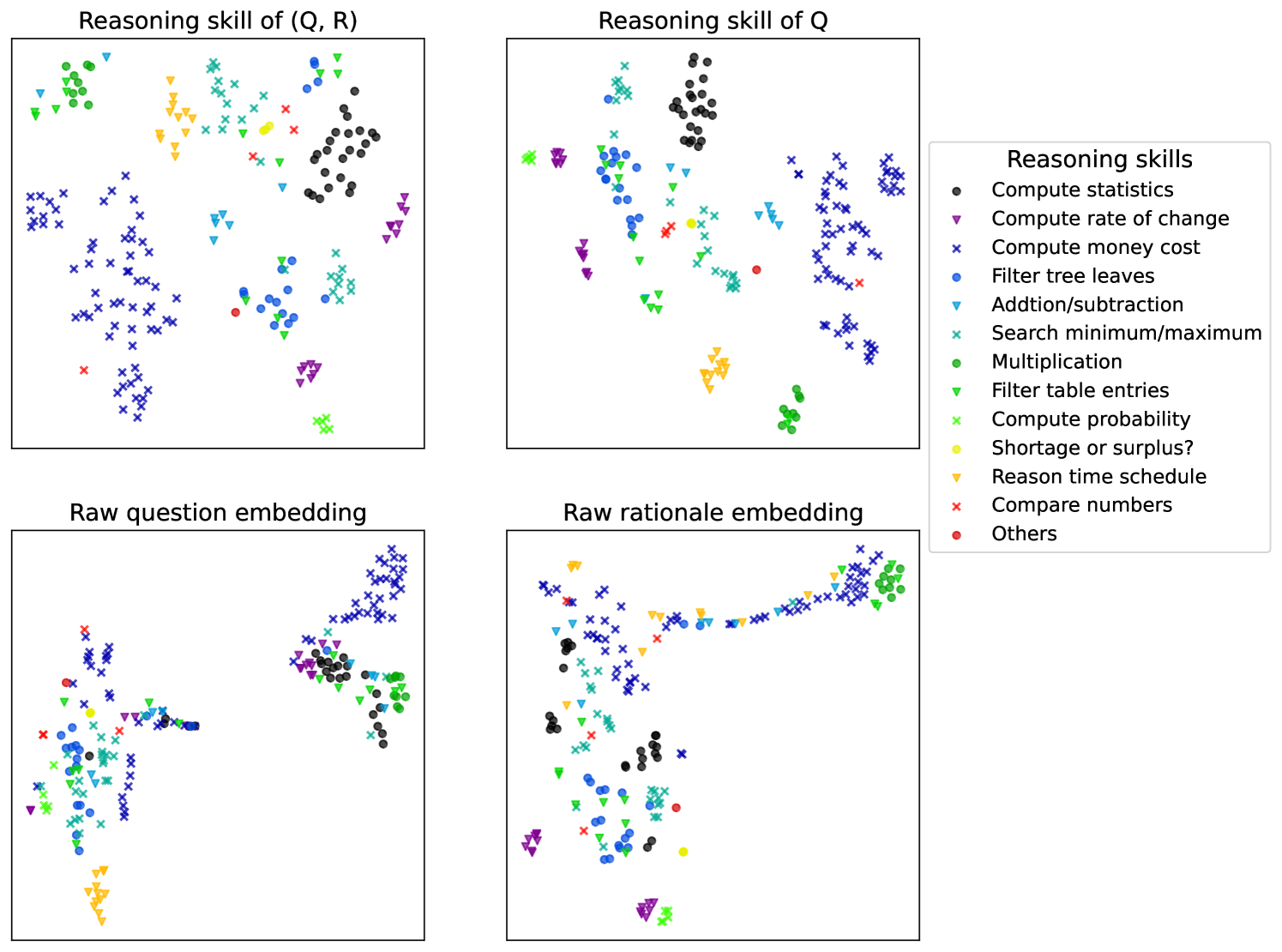
### Visual Description
## Scatter Plot: Reasoning Skill and Embeddings
### Overview
The image presents four scatter plots visualizing the distribution of different reasoning skills and embeddings. Each plot represents a different aspect: reasoning skill of (Q, R), reasoning skill of Q, raw question embedding, and raw rationale embedding. The points in each plot are color-coded and shaped according to the type of reasoning skill, as defined in the legend on the right.
### Components/Axes
* **Plots:** Four scatter plots arranged in a 2x2 grid.
* Top-left: "Reasoning skill of (Q, R)"
* Top-right: "Reasoning skill of Q"
* Bottom-left: "Raw question embedding"
* Bottom-right: "Raw rationale embedding"
* **Axes:** The axes are not explicitly labeled with scales or units. The plots appear to be projections of high-dimensional data into two dimensions, likely using a dimensionality reduction technique like t-SNE or PCA.
* **Legend (Right side of the image):**
* **Title:** "Reasoning skills"
* **Categories:**
* Black circle: Compute statistics
* Purple down-triangle: Compute rate of change
* Blue 'x': Compute money cost
* Teal 'x': Filter tree leaves
* Blue down-triangle: Addition/subtraction
* Teal 'x': Search minimum/maximum
* Green circle: Multiplication
* Green down-triangle: Filter table entries
* Light green 'x': Compute probability
* Yellow down-triangle: Shortage or surplus?
* Yellow 'x': Reason time schedule
* Red 'x': Compare numbers
* Red circle: Others
### Detailed Analysis
**1. Reasoning skill of (Q, R) [Top-Left]**
* **Compute statistics (Black circles):** Clustered in the top-right.
* **Compute rate of change (Purple down-triangles):** Scattered in the top-right and bottom-left.
* **Compute money cost (Blue 'x'):** Predominantly in the left half, forming a large cluster.
* **Filter tree leaves (Teal 'x'):** Scattered throughout the plot.
* **Addition/subtraction (Blue down-triangles):** Clustered in the center-right.
* **Search minimum/maximum (Teal 'x'):** Scattered throughout the plot.
* **Multiplication (Green circles):** Clustered in the top-left.
* **Filter table entries (Green down-triangles):** Clustered in the top-left.
* **Compute probability (Light green 'x'):** Clustered in the top-left.
* **Shortage or surplus? (Yellow down-triangles):** Clustered in the top-left.
* **Reason time schedule (Yellow 'x'):** Scattered in the top-left.
* **Compare numbers (Red 'x'):** Scattered in the left half.
* **Others (Red circle):** Located near the center.
**2. Reasoning skill of Q [Top-Right]**
* **Compute statistics (Black circles):** Clustered in the top-center.
* **Compute rate of change (Purple down-triangles):** Scattered in the top-left.
* **Compute money cost (Blue 'x'):** Predominantly in the right half, forming a large cluster.
* **Filter tree leaves (Teal 'x'):** Scattered throughout the plot.
* **Addition/subtraction (Blue down-triangles):** Clustered in the center.
* **Search minimum/maximum (Teal 'x'):** Scattered throughout the plot.
* **Multiplication (Green circles):** Clustered in the bottom-center.
* **Filter table entries (Green down-triangles):** Clustered in the top-left.
* **Compute probability (Light green 'x'):** Clustered in the top-left.
* **Shortage or surplus? (Yellow down-triangles):** Clustered in the bottom-center.
* **Reason time schedule (Yellow 'x'):** Scattered in the bottom-center.
* **Compare numbers (Red 'x'):** Scattered in the top-left.
* **Others (Red circle):** Located near the center.
**3. Raw question embedding [Bottom-Left]**
* **Compute statistics (Black circles):** Clustered in the center.
* **Compute rate of change (Purple down-triangles):** Scattered in the center-left.
* **Compute money cost (Blue 'x'):** Predominantly in the right half, forming a large cluster.
* **Filter tree leaves (Teal 'x'):** Scattered throughout the plot.
* **Addition/subtraction (Blue down-triangles):** Clustered in the center.
* **Search minimum/maximum (Teal 'x'):** Scattered throughout the plot.
* **Multiplication (Green circles):** Clustered in the center.
* **Filter table entries (Green down-triangles):** Clustered in the center.
* **Compute probability (Light green 'x'):** Clustered in the left.
* **Shortage or surplus? (Yellow down-triangles):** Clustered in the bottom-left.
* **Reason time schedule (Yellow 'x'):** Scattered in the bottom-left.
* **Compare numbers (Red 'x'):** Scattered in the left.
* **Others (Red circle):** Located near the left.
**4. Raw rationale embedding [Bottom-Right]**
* **Compute statistics (Black circles):** Clustered in the bottom-left.
* **Compute rate of change (Purple down-triangles):** Scattered in the bottom-left.
* **Compute money cost (Blue 'x'):** Predominantly in the top-right, forming a large cluster.
* **Filter tree leaves (Teal 'x'):** Scattered throughout the plot.
* **Addition/subtraction (Blue down-triangles):** Clustered in the top-center.
* **Search minimum/maximum (Teal 'x'):** Scattered throughout the plot.
* **Multiplication (Green circles):** Clustered in the top-right.
* **Filter table entries (Green down-triangles):** Clustered in the top-right.
* **Compute probability (Light green 'x'):** Clustered in the top-right.
* **Shortage or surplus? (Yellow down-triangles):** Clustered in the top-center.
* **Reason time schedule (Yellow 'x'):** Scattered in the top-center.
* **Compare numbers (Red 'x'):** Scattered in the bottom-left.
* **Others (Red circle):** Located near the bottom-left.
### Key Observations
* **Clustering:** Points representing the same reasoning skill tend to cluster together in each plot, suggesting that the embeddings capture some semantic similarity between questions requiring the same reasoning skill.
* **Distribution Differences:** The distribution of points varies across the four plots, indicating that the embeddings capture different aspects of the questions and rationales.
* **Compute Money Cost:** The "Compute money cost" skill (blue 'x') consistently forms a large, distinct cluster in the right half of the plots, suggesting it has a unique embedding signature.
* **Compute Statistics:** The "Compute statistics" skill (black circles) is clustered in all plots.
### Interpretation
The scatter plots visualize how different reasoning skills are represented in the embedding space of questions and rationales. The clustering of points with the same reasoning skill suggests that the embeddings are able to capture the semantic similarity between questions requiring the same type of reasoning. The differences in distribution across the four plots indicate that the embeddings capture different aspects of the questions and rationales, such as the reasoning skill required, the question content, and the rationale content.
The plot "Reasoning skill of (Q, R)" likely represents the combined embedding of the question (Q) and the rationale (R). Comparing this plot to "Reasoning skill of Q" shows how the inclusion of the rationale affects the representation of the reasoning skill. The "Raw question embedding" and "Raw rationale embedding" plots show the distribution of the question and rationale embeddings separately, providing insights into how each contributes to the overall representation of the reasoning skill.
The consistent clustering of "Compute money cost" suggests that this skill has a distinct embedding signature, possibly due to the presence of specific keywords or patterns in the questions and rationales related to money. The scattered distribution of other skills may indicate that they are more complex or have more diverse representations in the embedding space.
</details>
Figure 5: t-SNE projections of reasoning skills predicted from $(Q,R)$ (top-left), reasoning skills predicted from $Q$ (top-right), raw question embedding (bottom-left), and raw rationale embedding (bottom-right). The 12 different colors correspond to 12 skill labels provided by human.
In TabMWP dataset, 200 examples are labeled based on the skills being showcased out of 12 manually-crafted skills labels, including “compute statistics”, “compute rate of change”, “Reason time schedule”, “Compute probability”, et. al. We investigate how the unsupervisedly discovered reasoning skills by LaRS align with human’s understanding of skills. More specifically, a visualization of how human-labeled skills distribute based on the t-SNE projections of four different types of embedding is shown in Fig. 5. Both the reasoning skill encoder (reasoning skill of $(Q,R)$ ) and the reasoning policy (reasoning skill of $Q$ ) trained by LaRS demonstrate clear separation of the labeled 12 skills. At the mean time, the human-labeled skills are not well-separated by raw question embedding, and even raw rationale embeddings. This indicates that the discovered reasoning skills aligns well with human-labeled skills even without explicit labels being provided during the training. This sheds the light on why the demonstration selection based on similar reasoning skills can improve the CoT prompting.
<details>
<summary>extracted/6556870/content/figures/ablation_embedding_model.png Details</summary>
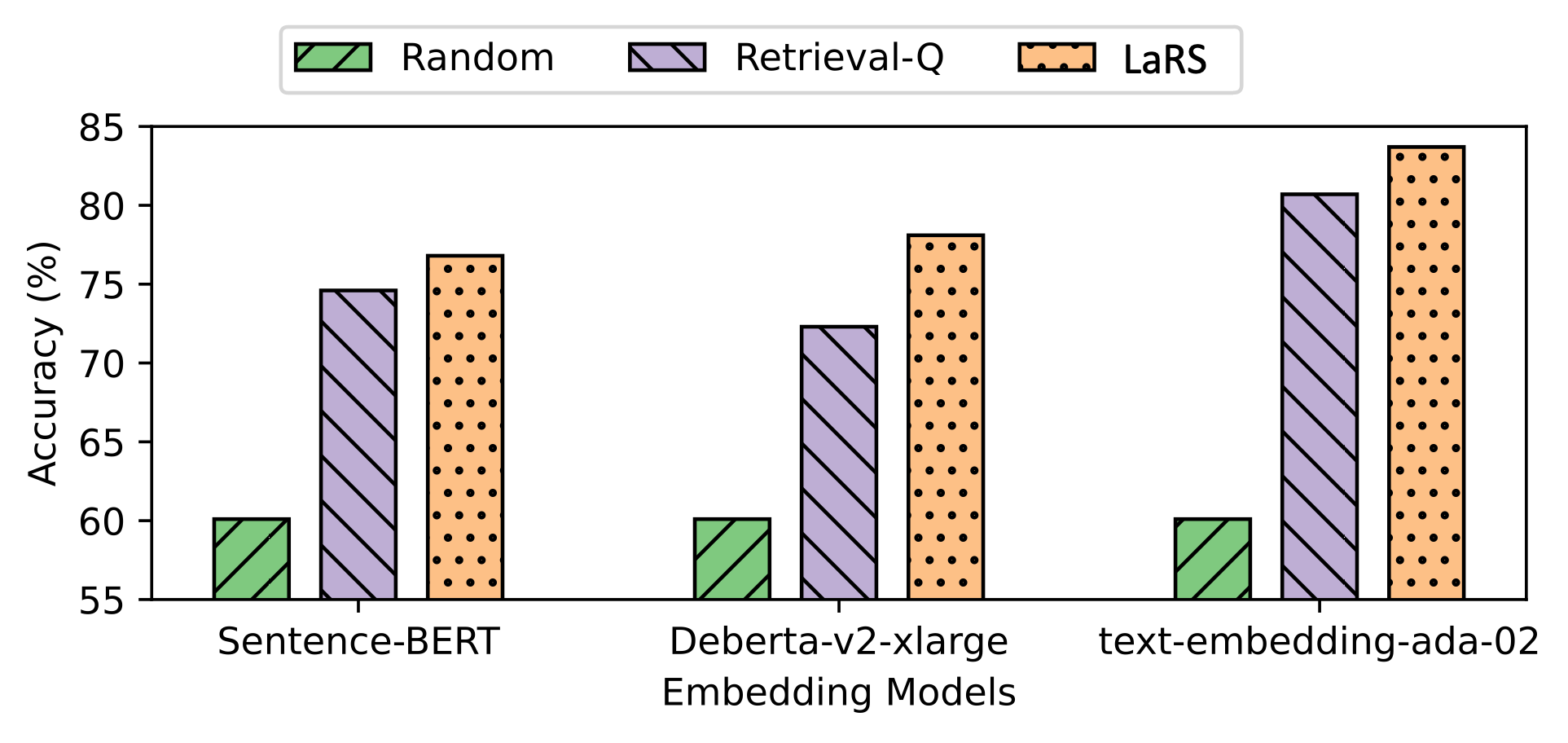
### Visual Description
## Bar Chart: Accuracy of Embedding Models
### Overview
The image is a bar chart comparing the accuracy of three embedding models (Sentence-BERT, Deberta-v2-xlarge, and text-embedding-ada-02) using three different methods: Random, Retrieval-Q, and LaRS. The chart displays accuracy in percentage on the y-axis and the embedding models on the x-axis.
### Components/Axes
* **Title:** There is no explicit title on the chart.
* **X-axis:** "Embedding Models" with categories: Sentence-BERT, Deberta-v2-xlarge, text-embedding-ada-02.
* **Y-axis:** "Accuracy (%)" with a scale from 55 to 85, incrementing by 5.
* **Legend:** Located at the top of the chart.
* Green: Random
* Lavender with diagonal lines: Retrieval-Q
* Peach with dots: LaRS
### Detailed Analysis
Here's a breakdown of the accuracy for each embedding model and method:
* **Sentence-BERT:**
* Random: Approximately 60%
* Retrieval-Q: Approximately 74.5%
* LaRS: Approximately 76.5%
* **Deberta-v2-xlarge:**
* Random: Approximately 60%
* Retrieval-Q: Approximately 72%
* LaRS: Approximately 78%
* **text-embedding-ada-02:**
* Random: Approximately 60%
* Retrieval-Q: Approximately 80.5%
* LaRS: Approximately 84%
### Key Observations
* For all three embedding models, the "Random" method consistently yields the lowest accuracy, hovering around 60%.
* "LaRS" generally provides the highest accuracy among the three methods for each embedding model.
* "text-embedding-ada-02" achieves the highest accuracy overall, particularly with the "LaRS" method.
### Interpretation
The chart demonstrates that the choice of method significantly impacts the accuracy of embedding models. The "Random" method serves as a baseline, showing the inherent accuracy without specific retrieval or learning strategies. "Retrieval-Q" and "LaRS" improve upon this baseline, with "LaRS" generally outperforming "Retrieval-Q." The "text-embedding-ada-02" model, when combined with the "LaRS" method, appears to be the most effective configuration for achieving high accuracy. The consistent low performance of the "Random" method suggests that targeted retrieval and learning strategies are crucial for maximizing the potential of these embedding models.
</details>
(a) The accuracy of Random, Retrieval-Q, and, LaRS based on three different pre-trained embedding models.
<details>
<summary>extracted/6556870/content/figures/ablation_num_example.png Details</summary>
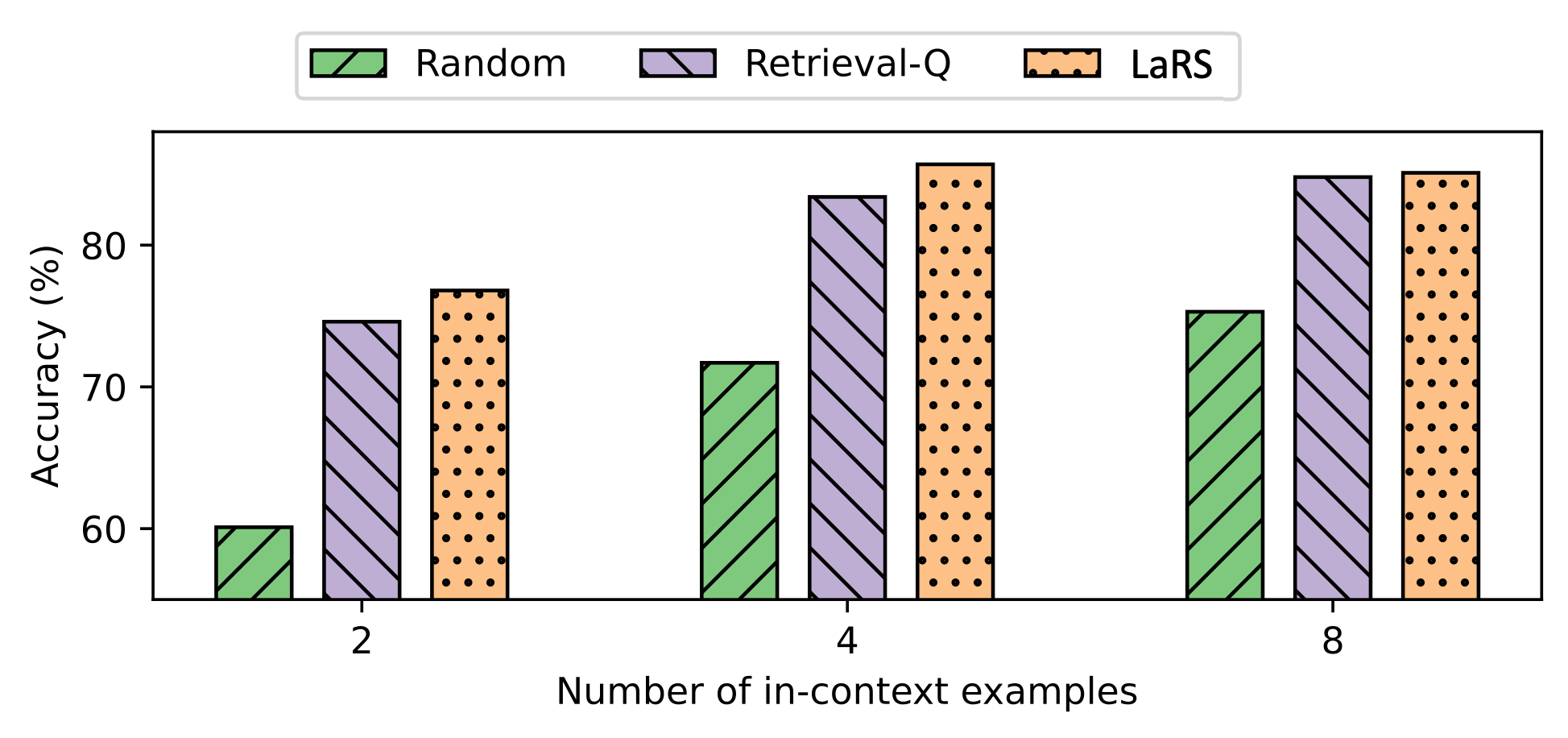
### Visual Description
## Bar Chart: Accuracy vs. Number of In-Context Examples
### Overview
The image is a bar chart comparing the accuracy (%) of three different methods (Random, Retrieval-Q, and LaRS) against the number of in-context examples (2, 4, and 8). The chart displays how the accuracy of each method changes as the number of in-context examples increases.
### Components/Axes
* **X-axis:** "Number of in-context examples" with values 2, 4, and 8.
* **Y-axis:** "Accuracy (%)" ranging from 60 to 80.
* **Legend (top-left):**
* Green: "Random"
* Lavender: "Retrieval-Q"
* Peach with black dots: "LaRS"
### Detailed Analysis
Here's a breakdown of the accuracy for each method at each number of in-context examples:
* **Random (Green):**
* 2 examples: Accuracy is approximately 60%.
* 4 examples: Accuracy is approximately 72%.
* 8 examples: Accuracy is approximately 74%.
* Trend: The accuracy of the Random method increases as the number of in-context examples increases, but the increase is smaller between 4 and 8 examples.
* **Retrieval-Q (Lavender):**
* 2 examples: Accuracy is approximately 75%.
* 4 examples: Accuracy is approximately 84%.
* 8 examples: Accuracy is approximately 86%.
* Trend: The accuracy of the Retrieval-Q method increases as the number of in-context examples increases.
* **LaRS (Peach with black dots):**
* 2 examples: Accuracy is approximately 76%.
* 4 examples: Accuracy is approximately 87%.
* 8 examples: Accuracy is approximately 87%.
* Trend: The accuracy of the LaRS method increases from 2 to 4 examples, but plateaus between 4 and 8 examples.
### Key Observations
* For all numbers of in-context examples, LaRS and Retrieval-Q outperform Random.
* The accuracy of all methods generally increases with the number of in-context examples, but the rate of increase varies.
* LaRS and Retrieval-Q have very similar performance, especially at 8 in-context examples.
### Interpretation
The data suggests that using in-context examples improves the accuracy of all three methods. Retrieval-Q and LaRS are significantly better than Random, indicating that these methods are more effective at leveraging in-context information. The plateauing of LaRS's accuracy between 4 and 8 examples might suggest a point of diminishing returns for this method, or that the method has reached its maximum potential accuracy.
</details>
(b) The accuracy of Random, Retrieval-Q, and LaRS using different number of in-context examples.
Figure 6: Performances of three different selection methods under (a) different pre-trained embedding models, and (b) different number of in-context examples.
Robustness to different pre-trained embedding models.
Fig. 6(a) compares the performances of Random, Retrieval-Q, and LaRS based on three pre-trained embedding models, including Sentence-BERT Reimers and Gurevych (2019), Deberta-v2-xlarge, and, text-embedding-ada-02 Neelakantan et al. (2022) from OpenAI. We observe that the performances of retrieval-based selection methods monotonously improve with more capable pre-trained embedding models. However, our LaRS shows consistent improvements over Retrieval-Q given the same embedding models.
Robustness to $k$ : the number of in-context examples.
This study compares three selection methods, including Random, Retrieval-Q, and LaRS under three different number of in-context examples 2, 4, and 8. The results are summarized in Fig. 6(b). While the accuracy monotonously improves with the increasing number of in-context examples, LaRS consistently outperforms Retrieval-Q.
How does Skill-KNN perform under stricter conditions?
| Method Backbone: gpt-3.5-turbo Skill-KNN-large | TabMWP 78.3 +15.9 | GSM8K 75.0 –0.7 | Spider 58.4 +11.6 | COGS 94.6 +27.2 |
| --- | --- | --- | --- | --- |
| Skill-KNN-small | 75.5 +13.2 | 74.9 –0.8 | 37.3 –9.5 | 79.9 +12.7 |
| Skill-KNN-zero | 77.7 +15.3 | 75.0 –0.7 | 49.0 +2.2 | 77.9 +10.8 |
| LaRS (ours) | 78.1 +15.7 | 76.8 +1.1 | 53.0 +6.2 | 94.8 +27.2 |
| Backbone: gpt-4o | | | | |
| Skill-KNN-large | 80.6 +11.3 | 62.0 –0.2 | 56.3 +9.8 | 96.8 +23.4 |
| Skill-KNN-small | 77.4 +8.1 | 62.3 +0.1 | 47.4 +0.3 | 79.4 +6.0 |
| Skill-KNN-zero | 87.7 +0.1 | 78.6 –0.5 | 76.6 +2.5 | 78.1 +5.1 |
| LaRS (ours) | 87.9 +0.3 | 78.3 +0.2 | 77.2 +3.1 | 90.2 +17.2 |
| Backbone: claude-3-sonnet | | | | |
| Skill-KNN-large | | 93.2 –0.1 | 25.9 +7.6 | 96.2 +17.0 |
| Skill-KNN-small | | 92.3 –1.0 | 18.2 –0.1 | 86.6 +7.4 |
| Skill-KNN-zero | 93.1 +0.5 | 92.1 –1.2 | 61.9 +0.2 | 86.6 +7.4 |
| LaRS (ours) | 93.7 +1.1 | 93.6 +0.3 | 62.2 +0.5 | 96.9 +17.7 |
| Backbone: claude-3-haiku | | | | |
| Skill-KNN-zero | 93.3 +4.7 | 88.8 +0.2 | 61.0 +0.8 | 79.7 +13.5 |
| LaRS (ours) | 93.3 +4.7 | 87.6 –1.0 | 61.3 +1.1 | 89.9 +23.7 |
| Backbone: Falcon-40B-Instruct | | | | |
| Skill-KNN-large | 55.9 +10.2 | 40.3 +1.5 | 23.7 +2.9 | 81.0 +35.9 |
| Skill-KNN-small | 51.4 +5.7 | 36.5 –2.3 | 20.3 –0.3 | 59.4 +14.3 |
| Skill-KNN-zero | 55.2 +9.5 | 38.7 –0.1 | 23.3 +2.7 | 82.1 +37.0 |
| LaRS (ours) | 57.7 +12.0 | 39.1 +0.3 | 24.8 +4.2 | 89.5 +44.4 |
Table 7: Skill-KNN-large, Skill-KNN-small, and Skill-KNN-zero compare with LaRS .
Appendix D Case Study
To explore the examples categorized as distinct skills within the learned latent reasoning skill representation, we employed K-means clustering on the latent reasoning skills of 1,000 examples from the TabMWP dataset. The centroids of these clusters are detailed in Table 8. The analysis presented in this table reveals that our method effectively discerns examples showcasing specific skills, such as “Searching minimum/maximum” and “Computing rate change”.
| 0 | [TITLE]: School play committees Committee | Boys | Girls Casting | 17 | 5 Set design | 14 | 17 Lighting | 20 | 20 Costume | 7 | 4 Music | 2 | 13 | Some students at Dayton Middle School signed up to help out with the school play. Which committee has the most boys? Options: (A) set design (B) lighting (C) casting (D) costume | Search minimum/maximum |
| --- | --- | --- | --- |
| 1 | [TITLE]: Pairs of shoes per store Stem | Leaf 1 | 9 2 | 3, 3 3 | 0, 2 4 | 2, 4 5 | 5, 7 6 | 2, 5 7 | 7 8 | 0, 2, 4, 4 9 | 0, 0 | Ivan counted the number of pairs of shoes for sale at each of the shoe stores in the mall. How many stores have exactly 23 pairs of shoes? | Search tree leaves |
| 2 | [TITLE]: None piece of licorice | $0.07 gum drop | $0.05 gumball | $0.08 cinnamon candy | $0.01 peppermint candy | $0.08 lemon drop | $0.07 | Derek has $0.06. Does he have enough to buy a piece of licorice and a cinnamon candy? Options: (A) yes (B) no | Compute money cost |
| 3 | [TITLE]: None Number of offices | Number of chairs 1 | 2 2 | 4 3 | 6 4 | 8 5 | ? | Each office has 2 chairs. How many chairs are in 5 offices? | Multiplication |
| 4 | [TITLE]: None popcorn balls | $1/kilogram coffee cake | $3/kilogram blueberry bars | $2/kilogram cream cheese bars | $2/kilogram lemon bars | $3/kilogram | Sarah went to the store and bought 2 kilograms of blueberry bars. How much did she spend? (Unit: $) | Compute money cost |
| 5 | [TITLE]: None x | y 12 | 19 13 | 9 14 | 2 | The table shows a function. Is the function linear or nonlinear? Options: (A) linear (B) nonlinear | Compute rate of change |
| 6 | [TITLE]: Tractors Farmer | Number of tractors Farmer Judy | 4 Farmer Joe | 7 Farmer Megan | 7 Farmer Rick | 4 Farmer Jane | 4 | Some farmers compared how many tractors they own. What is the mode of the numbers? | Compute statistics |
| 7 | [TITLE]: None pink sweater | $6.69 pair of brown pants | $9.66 plaid scarf | $2.45 pair of sandals | $7.69 white polo shirt | $4.86 | How much money does Heather need to buy a pair of brown pants and a plaid scarf? (Unit: $) | Compute money cost |
| 8 | [TITLE]: Tour bus schedule Location | Arrive | Depart the riverfront | 9:55 A.M. | 10:20 A.M. the zoo | 10:35 A.M. | 11:30 A.M. art museum | 12:05 P.M. | 12:30 P.M. science museum | 1:00 P.M. | 1:45 P.M. skyscraper | 1:50 P.M. | 2:20 P.M. governor’s mansion | 2:50 P.M. | 3:45 P.M. old building | 4:00 P.M. | 4:45 P.M. famous bridge | 5:15 P.M. | 5:40 P.M. the aquarium | 6:20 P.M. | 7:00 P.M. landmark sculpture | 7:45 P.M. | 8:20 P.M. | Look at the following schedule. Which stop does the bus depart from at 11.30 A.M.? Options: (A) zoo (B) riverfront (C) old building (D) science museum | Reason time schedule |
| 9 | [TITLE]: None poppyseed muffin | $2.31 bowl of yogurt | $1.35 blueberry pancakes | $7.28 hash browns | $4.56 bowl of granola | $2.97 bagel with cream cheese | $2.56 | Max has $13.33. How much money will Max have left if he buys a bagel with cream cheese and blueberry pancakes? (Unit: $) | Compute money cost |
| --- | --- | --- | --- |
| 10 | [TITLE]: Balloons sold Day | Number of balloons Wednesday | 568 Thursday | 586 Friday | 558 Saturday | 565 | The manager of a party supply store researched how many balloons it sold in the past 4 days. On which day did the store sell the most balloons? Options: (A) Wednesday (B) Thursday (C) Friday (D) Saturday | Search minimum/maximum |
| 11 | [TITLE]: None forklift | $9,987.00 dump truck | $9,543.00 race car | $8,370.00 crane | $6,996.00 bulldozer | $7,547.00 hydrofoil | $8,047.00 | How much more does a forklift cost than a dump truck? (Unit: $) | Compute money cost |
Table 8: The closest examples to the 12 cluster centers computed by K-Means clustering method on reasoning skill latent variables.
Appendix E Theoretical Analysis
To prove Theorem 1, we start with the equation of rationale generation via CoT prompting, employing the skill-based demonstration selection method denoted as $g_{skill}$ . The process can be formalized as follows:
$$
\displaystyle P_{M}( \displaystyle R\mid Q,g_{skill})=\int_{\mathcal{X}^{k}}P_{M}(R\mid pt)\Pi_{i=1%
}^{k}[g_{skill}(Q_{i},R_{i}\mid Q)d(Q_{i},R_{i})] \tag{5}
$$
where Equation 5 is integrated by substituting $pt=(Q_{1},R_{1},·s,Q_{k},R_{k},Q)$ as outlined in Equation 3, leading to:
$$
\displaystyle P_{M}( \displaystyle R\mid Q,g_{skill})=\int_{\mathcal{Z}}P_{M}(R\mid z,Q)P_{M}(z\mid
Q%
)\Pi_{i=1}^{k}[P_{skill}(z\mid Q)]dz \tag{6}
$$
In this context, $P_{skill}(z\mid Q)$ is defined as:
$$
\displaystyle P_{skill}(z\mid Q)=\int_{(Q^{\prime},R^{\prime})\in\mathcal{X}}P%
_{M}(z\mid Q^{\prime},R^{\prime})g_{skill}(Q^{\prime},R^{\prime}\mid Q)d(Q^{%
\prime},R^{\prime})dz^{\prime} \tag{7}
$$
Substituting the Definition 1 into Equation 7, leading to:
$$
\displaystyle P_{skill}(z\mid Q)=\int_{(Q^{\prime},R^{\prime})\in\mathcal{X}}%
\int_{z^{\prime}\in\mathcal{Z}}P_{M}(z\mid Q^{\prime},R^{\prime})P_{E}(Q^{%
\prime},R^{\prime}\mid z^{\prime})P_{E}(z^{\prime}\mid Q)dz^{\prime} \tag{8}
$$
Applying Assumption 2 into the above equation, replacing $P_{M}(z\mid Q^{\prime},R^{\prime})$ with $P_{E}(z\mid Q^{\prime},R^{\prime})$ :
$$
\displaystyle P_{skill}(z\mid Q) \displaystyle=\int_{(Q^{\prime},R^{\prime})\in\mathcal{X}}\int_{z^{\prime}\in%
\mathcal{Z}}P_{E}(z\mid Q^{\prime},R^{\prime})P_{E}(Q^{\prime},R^{\prime}\mid z%
^{\prime})P_{E}(z^{\prime}\mid Q)dz^{\prime} \displaystyle=\int_{z^{\prime}\in\mathcal{Z}}\delta(z=z^{\prime})P_{E}(z^{%
\prime}\mid Q)dz^{\prime} \displaystyle=P_{E}(z\mid Q) \tag{9}
$$
By reintegrating the derived expression for $P_{skill}(z\mid Q)$ back into Equation 6, we arrive at:
$$
\displaystyle P_{M}(R\mid Q,g_{skill})=\int_{\mathcal{Z}}P_{M}(R\mid z,Q)P_{M}%
(z\mid Q)\Pi_{i=1}^{k}[P_{E}(z\mid Q)]dz \tag{10}
$$
Take the limit of $k→∞$ , above equation siplifies to:
$$
\displaystyle P_{M}(R\mid Q,g_{skill})=\int_{\mathcal{Z}}P_{M}(R\mid z,Q)P_{E}%
(z\mid Q)dz \tag{11}
$$
Applying Assumption 2 into the above equation, replacing $P_{M}(R\mid z,Q)$ with $P_{E}(R\mid z,Q)$ :
$$
\displaystyle P_{M}(R\mid Q,g_{skill})=\int_{\mathcal{Z}}P_{E}(R\mid z,Q)P_{E}%
(z\mid Q)dz=P_{E}(R\mid Q) \tag{12}
$$
According to Assumption 1, the example bank can approximate expert rationale generation, or $P_{E}(R\mid Q)=P^{*}(R\mid Q)$ , we then conclude:
$$
\displaystyle P_{M}(R\mid Q,g_{skill})=P^{*}(R\mid Q) \tag{13}
$$
Equation 13 means that the CoT prompting under the skill-based demonstration selection method give the optimal conditional distribution of rationales given questions by Definition 2. This proves the Theorem 1 under Assumption 1 and Assumption 2.