# EvoR: Evolving Retrieval for Code Generation
**Authors**: Correspondence: hjsu@cs.hku.hk
## Abstract
Recently the retrieval-augmented generation (RAG) has been successfully applied in code generation. However, existing pipelines for retrieval-augmented code generation (RACG) employ static knowledge bases with a single source, limiting the adaptation capabilities of Large Language Models (LLMs) to domains they have insufficient knowledge of. In this work, we develop a novel pipeline, EvoR, that employs the synchronous evolution of both queries and diverse knowledge bases. On two realistic settings where the external knowledge is required to solve code generation tasks, we compile four new datasets associated with frequently updated libraries and long-tail programming languages, named EvoR-bench. Extensive experiments demonstrate that EvoR achieves two to four times of execution accuracy compared to other methods such as Reflexion Shinn et al. (2024), DocPrompting Zhou et al. (2023), etc. We demonstrate that EvoR is flexible and can be easily combined with them to achieve further improvement. Further analysis reveals that EvoR benefits from the synchronous evolution of queries and documents and the diverse information sources in the knowledge base. We hope that our studies will inspire more insights into the design of advanced RACG pipelines in future research. Our model, code, and data are available at https://arks-codegen.github.io.
EvoR: Evolving Retrieval for Code Generation
Hongjin Su 1, Shuyang Jiang 2, Yuhang Lai 2, Haoyuan Wu 1, Boao Shi 1, Che Liu 1, Qian Liu 3, Tao Yu 1, 1 The University of Hong Kong, 2 Fudan University, 3 Sea AI Lab, Correspondence: hjsu@cs.hku.hk
<details>
<summary>x1.png Details</summary>
### Visual Description
## Diagram: Iterative Code Generation Process with Knowledge Retrieval
### Overview
The image is a technical diagram illustrating an iterative, feedback-driven system for generating code (specifically Ponyc code) to solve a given programming query. The system incorporates a "Knowledge Soup" of external resources to inform and evolve the generated code. The overall process is cyclical, involving query input, code generation, execution, feedback, and retrieval of knowledge to improve subsequent iterations.
### Components/Axes
The diagram is divided into two primary sections:
1. **Top Flowchart (Process Loop):**
* **Title:** "Write ponyc code to print odd numbers from 0 to n (inclusive)"
* **Main Process Boxes (from left to right):**
* `Query` (light yellow box, top-left)
* `Feedback` (light yellow box, center-left)
* `Code` (light yellow box, center-right)
* `Generator` (light yellow box, top-right)
* **Arrows & Labels:**
* A downward arrow from the title points to the `Query` box.
* A curved, double-headed blue arrow labeled `Evolve` connects the `Query` and `Feedback` boxes.
* A dashed rectangle encloses the `Feedback` and `Code` boxes.
* A horizontal arrow labeled `Execute` points from `Code` to `Feedback`.
* A horizontal arrow labeled `Generate` points from `Generator` to `Code`.
* A vertical arrow labeled `Retrieve` points upward from the "Knowledge Soup" section to the `Generator` box.
* A curved, double-headed blue arrow labeled `Evolve` connects the dashed rectangle (Feedback/Code) to the "Knowledge Soup" below.
2. **Bottom Section ("Knowledge Soup"):**
* **Title:** `Knowledge Soup` (bold, top-left of the section)
* **Three Columns:**
* **Left Column: `Documentation`** (with a document icon 📄)
* Text Block 1: "The Pony for loop iterates over a collection of items using an iterator ..."
* Text Block 2: "The Pony if condition allows actions when a condition is true."
* Label at bottom: `Generate` (with an ellipsis `...`)
* **Center Column: `Code Snippet`** (with a code icon `</>`)
* Snippet 1:
```
for i in Range(1, n) do
a = a + 2 * i
end
```
* Snippet 2:
```
if n <= 0 then
n = -n
end
```
* Label at bottom: `...` (ellipsis)
* **Right Column: `Execution Feedback`** (with a play icon ▶️)
* Error Message: "main.pony:10:syntax error: unterminated if expression if (i % 2) != 0 then ^"
* **Sub-section: `Web Search`** (with a globe icon 🌐)
* Search Bar: Contains placeholder text "Write ponyc code to ..."
* Source Buttons: `StackOverflow`, `Github`, `...` (ellipsis)
### Detailed Analysis
The diagram details a closed-loop system for automated code generation and refinement.
* **Process Initiation:** The process begins with a natural language `Query` ("Write ponyc code to print odd numbers from 0 to n (inclusive)").
* **Core Generation Loop:** The `Generator` component produces `Code` based on the query and retrieved knowledge. This code is then `Execute`d, and the results (success or error) become `Feedback`. This feedback loop is enclosed in a dashed box, indicating a tight coupling. The `Evolve` arrow suggests that both the query understanding and the code/feedback pair are iteratively refined.
* **Knowledge Integration:** The `Generator` does not work in isolation. It actively `Retrieve`s information from the `Knowledge Soup`. This soup is a multi-modal repository containing:
* **Documentation:** Natural language explanations of Ponyc syntax (for loops, if conditions).
* **Code Snippets:** Concrete examples of Ponyc code structures.
* **Execution Feedback:** Specific error messages from previous code execution attempts (e.g., a syntax error on line 10 of `main.pony`).
* **Web Search:** A mechanism to fetch additional knowledge from external sources like StackOverflow and Github.
* **Evolution:** The system is designed to `Evolve`. The blue `Evolve` arrows indicate that knowledge from the soup informs the generator, and the outcomes of the code/feedback cycle can, in turn, update the knowledge soup itself (e.g., by adding a new learned code pattern or a resolved error case).
### Key Observations
1. **Iterative Refinement:** The system is fundamentally iterative, not a one-shot generator. It relies on execution feedback to improve.
2. **Multi-Source Knowledge:** The "Knowledge Soup" explicitly combines static documentation, executable code examples, runtime errors, and dynamic web search, creating a rich context for the generator.
3. **Error-Driven Learning:** The inclusion of a specific syntax error ("unterminated if expression") in the feedback column highlights that the system uses concrete failure cases to guide correction.
4. **Ambiguity in "Evolve":** The term `Evolve` is used in two contexts: 1) between Query and Feedback, and 2) between the core loop and the Knowledge Soup. This implies evolution happens at both the problem-understanding and solution-generation levels.
### Interpretation
This diagram represents a sophisticated **self-correcting code generation agent**. It moves beyond simple prompt-response models by incorporating a persistent, updatable memory (the Knowledge Soup) and a validation step (code execution).
* **What it demonstrates:** The system aims to solve the "hallucination" problem in code generation by grounding its output in verifiable execution results and curated knowledge. The flow shows a machine learning or AI agent that learns from its mistakes (feedback) and external resources to progressively generate correct code.
* **Relationships:** The `Generator` is the central actor, but it is entirely dependent on the `Knowledge Soup` for its capabilities and the `Feedback` loop for its validation. The `Query` is the driver, but it too can be evolved based on the process.
* **Notable Implications:** The presence of `Web Search` indicates the system's knowledge is not static; it can expand its context window dynamically. The specific Ponyc language example suggests this framework is language-agnostic and could be applied to any programming language where documentation, code, and execution feedback are available. The ultimate goal is to transform a high-level, possibly ambiguous query into correct, executable code through a process of retrieval, generation, execution, and evolution.
</details>
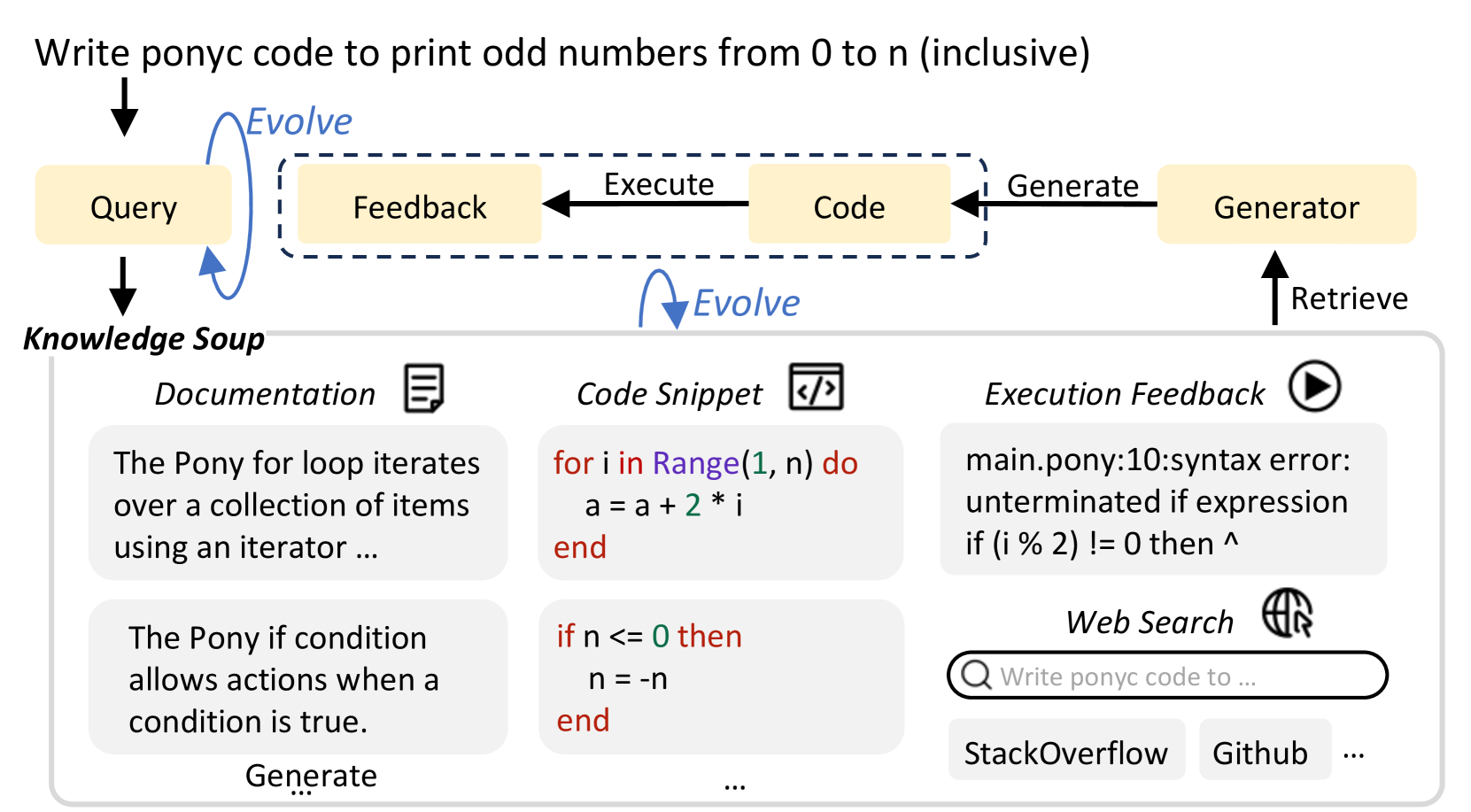
Figure 1: Instead of using a given query to retrieve from a static knowledge base, we design a novel pipeline to dynamically evolve both queries and knowledge soup in retrieval-augmented code generation.
## 1 Introduction
The retrieval-augmented generation (RAG) paradigm has raised significant attention due to its efficiency in adapting large language models (LLMs) without training (Guu et al., 2020; Karpukhin et al., 2020; Izacard et al., 2023; Borgeaud et al., 2022; Asai et al., 2023). Recent research has demonstrated its successful applications in code generation. They implement the retrieval-augmented code generation (RACG) pipelines either using a given query (Parvez et al., 2021b), or a rewritten version (Jiang et al., 2023b) to retrieve from a static knowledge base with a single type of information, e.g., syntax documentation (Zan et al., 2022; Zhou et al., 2023), code repositories (Zhang et al., 2023a; Shrivastava et al., 2023), etc.
However, more knowledge sources are potentially helpful to generalization, e.g., web content (Parvez et al., 2021a; Wang et al., 2022), code snippets generated by LLM (Zhang et al., 2023b), etc. This information is easily obtained and can enrich knowledge bases, which are shared among all instances of the same task. Furthermore, the unique characteristic of execution in code generation enables more information collected on-the-fly. For instance, if a code snippet generated by LLMs is successfully executed without reporting error messages, it is guaranteed to be syntactically correct and can serve as a concrete example to demonstrate the corresponding grammar or function usage.
In this work, we introduce EvoR, a novel pipeline that applies synchronous evolution of both queries and documents in RACG. In the traces of multi-round interactions among retrievers, LLMs and executors, both queries and knowledge bases are updated based on the execution feedback and LLM outputs in every iteration. This strategic refinement aims to facilitate the extraction of the most pertinent information. Apart from the given library documentation, we construct a diverse knowledge soup to further integrate the web search content, execution feedback, and code snippets generated by LLMs in the inference time.
To prevent the issue of data leakage associated with large language models pretrained on massive public datasets, and assess EvoR under a reliable generalization setting, we compile a new benchmark, EvoR-bench, comprising four datasets designed to simulate realistic scenarios in RACG. Specifically, two of these datasets focus on modifications made to widely-used Python libraries, Scipy and Tensorflow. The remaining two datasets simulate the introduction of new grammars, with the help of two less-common programming languages Ring and Pony. To conduct thorough experiments, we employ both proprietary models, such as ChatGPT (OpenAI, 2022), and open-source models like CodeLlama (Roziere et al., 2023). Experimental results across these four datasets demonstrate that our method yields a significant improvement in the average performance over existing code generation methods. For example, EvoR outperforms DocPrompting Zhou et al. (2023) by 18.6% on average using CodeLlama (§ 3). Further analysis unveils that both synchronous evolution and diverse sources in knowledge bases are critical to the success of EvoR (§ 4.1, § 4.2). We demonstrate that EvoR is flexible to integrate with many other code generation approaches including the agent-based one, e.g., swe-agent, offering further performance enhancement in both EvoR-bench and existing benchmarks (§ 4.3). Finally, we showcase EvoR is a more effective approach to using tokens, and demonstrates superior results in all levels of token consumption ranging from 4k to 24k (§ 4.4). In summary, our contributions are:
- We propose a novel pipeline, EvoR, highlighting the complementary strength of synchronous evolution of queries and diverse knowledge bases in RACG.
- We compile a new benchmark, EvoR-bench, on two realistic RACG settings related to frequently updated libraries and long-tail programming languages.
- We conduct extensive analyses and find that EvoR can be easily combined with existing code generation approaches including agent-based ones to provide further improvements.
## 2 Evolving Retrieval
Given a question $n$ in natural language, the objective of retrieval-augmented code generation is to first retrieve relevant information $K^{+}$ from external knowledge $K$ and then augment large language models to generate a program $p$ in the target library/programming language, which LLM $M$ is not familiar with. Distinct from the classical retrieval-augmented generation, which usually focuses on static knowledge bases, we propose synchronous evolution of both queries and diverse knowledge bases. Intuitively, this helps the retrieval model identify more relevant information and thus improves the quality of LLM generation Shao et al. (2023). In this section, we present the process of query evolution (§ 2.1), the knowledge base construction and evolution (§ 2.2), the EvoR pipeline (§ 2.3) and the collection of EvoR-bench (§ 2.4).
### 2.1 Query evolution
Starting from the given question $n$ , we first go through a warmup iteration $i_{0}$ where $q_{0}=n$ is used as the query in retrieval. Conditioned on both $n$ and the retrieved knowledge $K_{r}$ , LLM $M$ then generates a draft program $p^{0}$ . We apply the a compiler or interpreter to execute $p^{0}$ on LLM-generated inputs $I=[i_{1},i_{2},...,i_{n}]$ (more details on Appendix C), which provides execution feedback $F^{0}=[f^{0}_{1},f^{0}_{2},...,f^{0}_{n}]$ . Based on $n$ , $p^{0}$ , $I$ , and $F^{0}$ , we prompt an LLM $M_{q}$ to write a new query $q_{1}$ on what knowledge is currently required. In general, given $n$ , $p^{i}$ , $I$ , and $F^{i}$ in the iteration $i$ , $M_{q}$ writes $q_{i+1}$ , which is used for retrieval in the iteration $i+1$ .
### 2.2 Knowledge Soup
In this section, we first introduce the four components included in the construction of the knowledge soup $K$ and then describe the process of its evolution.
#### 2.2.1 Construction
We consider four types of knowledge as follows:
Web search
is a general and popular resource applied in traditional RAG applications. Human programmers frequently refer to it when they try to understand some syntax or fix a bug. It contains diverse information including blogs, tutorials, and community Q&A discussions relevant to solving coding problems. Intuitively, it is valuable as human programmers frequently rely on search engines to seek assistance when struggling with coding challenges. Previous work Nakano et al. (2021) has fine-tuned GPT-3 Brown et al. (2020) to answer long-form questions using a text-based web-browsing environment. In this study, we investigate the efficacy of LLMs in utilizing web search content to solve unfamiliar coding problems without further training. We use the Python API of Google search https://pypi.org/project/google/ to retrieve top-ranking websites and further convert the HTML page to markdown using the package html2text https://pypi.org/project/html2text/. In Appendix G, we include more discussions about the content in the web search.
Documentation
is commonly accessible upon the release of a new programming language or an updated library version. Official documentation serves to thoroughly elucidate the essential syntax and grammar required for coding. Zhou et al. (2022) demonstrated that language models can effectively leverage code documentation after finetuning. In this work, we focus on understanding the capability of LLMs in utilizing the documentation of updated libraries or long-tail programming languages in code generation, without making any parameter update.
Execution feedback
is a specific knowledge type for code generation. It exposes syntax mistakes and locates code errors, which are frequently referenced by human programmers to debug. While multiple types of execution can provide feedback (e.g., execution by LLMs), we focus on the compiler or interpreter execution in this work. Previous works Shinn et al. (2024) have demonstrated that LLMs are capable of repairing buggy code using the execution feedback. Instead of only leveraging the error messages obtained from executing the generated faulty programs, we further enrich the knowledge base by preparing sample code-error pairs. More details can be found in Appendix D.
Code snippets
are the short pieces of code that demonstrate sample usage of certain functions or syntax. Different from other types of knowledge that involve natural language, code snippets in programming language naturally align with the LLM generation objective and provide concrete examples of inputs, outputs, and parameters. Furthermore, they serve as a means to convey information about the programming language itself, providing crucial details such as bracket placement, utilization of special tokens, and other grammar. Before evaluation, we collect a set of code snippets verified to be free of syntax errors (more details in Appendix D). Additionally, we also accumulate code solutions generated by LLMs.
#### 2.2.2 Evolution
The evolution of knowledge bases is primarily contributed by the execution feedback and code snippets. In each iteration, we execute the generated program with sample inputs (Appendix C). If the execution successfully exits, we classify the code snippet as “syntax-correct”, which can serve as a demonstration for other instances to refer to. Otherwise, we add the (code snippet, error messages) pair to the knowledge base. Throughout the process of iterative generation, the knowledge base evolves to include increasingly rich information.
Algorithm 1 EvoR Pipeline
1: Input: $n$ : the coding problem description; $M$ : the LLM to generate the code answer; $M_{q}$ : the LLM to evolve queries; $M_{t}$ : the LLM to generate test inputs; $R$ : the retriever to output a list of relevant passages; $K$ : the knowledge base; $m$ : the maximum number of iterations; $E$ : the compiler or interpreter to execute programs
2: Initialization: $I=[]$ , $p=null$ .
3: for $i=0,\ldots,m$ do
4: if $i$ = 0 then
5: $q_{i}\leftarrow n$
6: else
7: $q_{i}\leftarrow M_{q}(n,p^{i-1},I,F^{i-1})$ $\triangleright$ Evolve query
8: end if
9: $K_{r}\leftarrow R(q_{i},K)$ $\triangleright$ Retrieve relevant knowledge
10: $p^{i}\leftarrow M(n,K_{r})$ $\triangleright$ Generate program
11: $p\leftarrow p^{i}$
12: $F^{i}=E(p^{i},I)$ $\triangleright$ Execute and get feedback
13: if $F^{i}$ is sucess then
14: $K\leftarrow K\cup\{p^{i}\}$ $\triangleright$ Evolve knowledge base
15: else
16: $K\leftarrow K\cup\{(p^{i},F^{i})\}$ $\triangleright$ Evolve knowledge base
17: end if
18: if $i$ = 0 then
19: $I\leftarrow M_{t}(n,p^{i})$ $\triangleright$ Generate test inputs
20: end if
21: if terminate condition is satisfied then
22: break
23: end if
24: end for
25: Return: $p$ : output code.
### 2.3 EvoR Pipeline
Algorithm 1 demonstrates the EvoR pipeline. In every iteration $i$ , we first formulate the query $q_{i}$ (§ 2.1), and use it to retrieve relevant information $K_{r}$ from the knowledge base $K$ . The program $p^{i}$ is then generated conditioned on both $n$ and $K_{r}$ . We get the execution feedback $F^{i}$ by executing $p^{i}$ on LLM-generated test inputs $I$ using the compiler or interpreter $E$ . The knowledge base $K$ is then evolved to include $p^{i}$ if the execution is successful, or the pair of ( $p^{i}$ , $F^{i}$ ) otherwise. The pipeline exits either upon reaching the termination condition or the maximum iteration steps. In the experiments, we set the maximum iterations to 30 and the termination condition to be the same execution feedback in consecutive 3 iterations, i.e., the algorithm exits if the program is successfully executed or results in the same error in consecutive 3 iterations.
### 2.4 Datasets
Since LLMs are extensively trained on public data, we curate a new benchmark to evaluate their generalization capability with EvoR. Specifically, we introduce four datasets where two focus on updated libraries and two are about long-tail programming languages.
We first modified two popular Python libraries, Scipy and Tensorflow, to simulate the real updates We do not use a real library update version because it is potentially exposed to LLM training data, which deviates from our purpose to evaluate LLMs’ generalization ability., and denote them as Scipy-M and Tensorflow-M respectively. We then collect problems of the Scipy and Tensorflow split from DS-1000 (Lai et al., 2023) and adapt them to our modified version. For the long-tail programming languages, we select Ring and Pony. They have little public data and are excluded from the StarCoder training set, which involves 88 mainstream programming languages Li et al. (2023b). We make use of the problems in LeetCode https://leetcode.com/problemset/ for these two datasets. For each problem in modified libraries or long-tail programming languages, we manually write the ground truth solution and annotate the oracle documentation based on it. We present the dataset statistics in Table 1. More details about our curation process can be found in Appendix A.
| Scipy-M | 142 | 3920 | 3.1 | 322.6 | 44.1 | 499.7 |
| --- | --- | --- | --- | --- | --- | --- |
| Tensor-M | 45 | 5754 | 4.1 | 234.5 | 39.0 | 517.6 |
| Ring | 107 | 577 | 18.2 | 108.3 | 98.3 | 334.0 |
| Pony | 113 | 583 | 18.4 | 116.9 | 129.8 | 3204.0 |
Table 1: Data statistics of four benchmarks. We report the number of problems (# P), the number of official documentation files (# D), the average number of test cases (A.T), the average problem length (A.P.L), the average solution length (A.S.L) and the average gold documentation length (A.D.L). Tensor-M refers to Tensorflow-M . Problem length, solution length and document length are calculated by the tiktoken (https://pypi.org/project/tiktoken/) package with model gpt-3.5-turbo-1106.
| Method | Model: ChatGPT Scipy-M Baseline | Tensor-M | Model: CodeLlama Ring | Pony | Avg. | | Scipy-M | Tensor-M | Ring | Pony | Avg. |
| --- | --- | --- | --- | --- | --- | --- | --- | --- | --- | --- | --- |
| Vanilla | 17.6 | 11.1 | 3.7 | 1.8 | 8.6 | | 11.3 | 17.8 | 0.0 | 0.0 | 7.3 |
| MPSC | 18.3 | 11.1 | 4.1 | 1.8 | 8.8 | | 11.6 | 17.8 | 0.0 | 0.0 | 7.4 |
| ExeDec | 22.5 | 17.8 | 4.5 | 3.6 | 12.1 | | 13.2 | 17.8 | 0.0 | 0.0 | 7.8 |
| Reflexion | 23.2 | 22.2 | 5.3 | 4.7 | 13.9 | | 14.5 | 20.0 | 0.0 | 0.9 | 8.9 |
| DocPrompting | 32.4 | 33.3 | 8.4 | 2.7 | 19.2 | | 16.9 | 37.8 | 4.7 | 4.4 | 16.0 |
| Ours | | | | | | | | | | | |
| EvoR | 37.9 | 53.3 | 36.6 | 13.5 | 35.3 | | 31.2 | 53.3 | 26.7 | 17.4 | 32.2 |
| EvoR + MPSC | 38.6 | 55.6 | 37.8 | 15.6 | 36.9 | | 33.6 | 55.6 | 27.3 | 18.4 | 33.7 |
| EvoR + ExeDec | 39.2 | 55.6 | 40.0 | 16.3 | 37.8 | | 34.1 | 57.8 | 27.9 | 19.1 | 34.7 |
| EvoR + Reflexion | 39.4 | 55.6 | 39.2 | 17.3 | 37.9 | | 35.3 | 55.6 | 28.6 | 18.8 | 34.6 |
Table 2: The performance of baseline methods, EvoR and their combinations in EvoR-bench. EvoR demonstrates significantly superior results, with further improvement when combined with other baseline methods.
## 3 Experiment
To verify the effectiveness of EvoR, we conduct extensive experiments with both the proprietary model ChatGPT (gpt-3.5-turbo-1106 https://platform.openai.com/docs/models/gpt-3-5-turbo) and the open-source model CodeLlama https://huggingface.co/codellama/CodeLlama-34b-Instruct-hf. In § 3.1, we describe 5 baseline settings of other code generation approaches and specify the default configuration of EvoR in § 3.2. In § 3.3, we compare the results of EvoR, existing code generation methods, as well as their combinations. By default, we use the execution accuracy (pass@1) as the metric throughout the paper.
### 3.1 Baselines
We compare EvoR to the vanilla generation and four recent methods that demonstrate significant performance improvement in code generation tasks:
Vanilla: we implement the vanilla generation baseline where we directly get the outputs from LLMs based on the coding question $n$ without augmenting external knowledge.
MPSC: Huang et al. (2023) proposed Multi-Perspective Self-Consistency (MPSC) incorporating both inter- and intra consistency. Following the original implementation, we prompt LLMs to generate diverse outputs from three perspectives: Solution, Specification and Test case, construct the 3-partite graph, and pick the optimal choice of solutions based on confidence scores.
ExeDec: Shi et al. (2023a) introduced a decomposition-based synthesis strategy, where they employ a subgoal model to predict the subgoal of the desired program state for the next part of the program and use another synthesizer model to generate the corresponding subprogram to achieve that subgoal. Subprograms are finally combined as the output answer to solve the original coding problem. In experiments, we use ChatGPT as the subgoal model and compare LLMs to synthesize programs following the subgoal predictions.
Reflexion: Shinn et al. (2024) uses a framework to reinforce LLMs through linguistic feedback. It employs an iterative optimization process. In each iteration, the actor model produces a trajectory conditioned on the instructions and memories. The evaluator model then evaluates the trajectory and calculates a scalar reward. Self-reflection model generates verbal experience feedback on the pairs of trajectories and rewards, which are stored in the memory. Throughout experiments, we use the compiler or interpreter as the evaluator model, which returns 0 upon execution errors, and 1 otherwise. By default, we use ChatGPT as the self-reflection model and compare the capabilities of LLMs to generate programs as actor models.
DocPrompting: Zhou et al. (2022) proposed to explicitly leverage code documentation by first retrieving the relevant documentation pieces given a natural language (NL) intent, and then generating code based on the NL intent and the retrieved documentation. It can be viewed as a degraded version of EvoR where neither queries nor knowledge bases evolve and the retrieval pool encompasses the documentation as a single source.
### 3.2 Default EvoR Configuration
By default, we incorporate the documentation, execution feedback, and code snippets in the knowledge soup $K$ for EvoR, as the content of web search contains large portions of noisy information (Appendix G) and only marginally improves the results (§ 4.2). We use ChatGPT for both $M_{q}$ to evolve queries and $M_{t}$ to generate test inputs, and vary $M$ between ChatGPT and CodeLlama to output code answers. We employ the INSTRUCTOR-xl Su et al. (2023) as the primary retrieval model (Appendix H) and allow a maximum context length of 4,096 for both ChatGPT and CodeLlama, as the further increase incurs a higher cost, but fails to provide additional improvements (Appendix I).
### 3.3 Results
Table 2 shows that existing code generation approaches perform poorly on EvoR-bench. With CodeLlama, the improvements of MPSC, ExeDec, and Reflexion are smaller than 2% on average, compared to the vanilla generation. In particular, the execution accuracy remains 0 in Ring across three methods. This indicates that, even though existing approaches excel in code generation tasks that do not require external knowledge (e.g., HumanEval Chen et al. (2021)), they cannot be directly applied to the setting of RACG without designing extra mechanisms to retrieve and utilize the external information. In contrast, by explicitly using documentation, DocPrompting significantly surpasses MPSC, ExeDec, and Reflexion by a large margin, further confirming that domain knowledge is critical to solving tasks in EvoR-bench.
Furthermore, EvoR achieves 16.1% and 16.2% absolute gain with ChatGPT and CodeLlama respectively on top of DocPrompting. This can be explained by the fact that DocPrompting only uses the documentation as a single retrieval source, without evolution in both queries and knowledge. By combining EvoR with MPSC, ExeDec, or Reflexion, we observe further performance increase by up to 2.6% on average with ChatGPT. This suggests that EvoR is flexible to be integrated with existing approaches to further push forward the boundary of LLM performance in RACG.
## 4 Analysis
| No evolution Evolve query | Model: ChatGPT 32.6 32.9 | 40.0 44.4 | 11.7 27.8 | 5.2 8.5 | 22.4 28.4 |
| --- | --- | --- | --- | --- | --- |
| Evolve knowledge | 33.5 | 42.2 | 13.5 | 6.1 | 23.8 |
| EvoR (Evolve both) | 37.9 | 53.3 | 36.6 | 13.5 | 35.3 |
| Model: CodeLlama | | | | | |
| No evolution | 23.9 | 42.2 | 8.2 | 7.3 | 20.4 |
| Evolve query | 26.6 | 44.4 | 11.7 | 12.8 | 23.9 |
| Evolve knowledge | 25.8 | 44.4 | 12.6 | 8.3 | 22.8 |
| EvoR (Evolve both) | 31.2 | 53.3 | 26.7 | 17.4 | 32.2 |
Table 3: The performance of ChatGPT and CodeLlama when neither queries nor knowledge evolves, only the query evolves, only the knowledge evolves and when both evolve (EvoR). Results show that evolving both is consistently better across all datasets.
### 4.1 Synchronous evolution
We investigate how the synchronous evolution of queries and knowledge influences the RACG performance of LLMs. We compare EvoR to the setting where we only evolve queries (skip line 13-20 in Algorithm 1), only evolve knowledge (skip line 7 in Algorithm 1), and evolve neither of them (skip line 7, 13-20 in Algorithm 1, and terminate in a single iteration). We adopt the default setting in § 3.2 except the specified changed in the algorithm. Table 3 shows evolving either queries or knowledge significantly enhances the results, highlighting that knowledge evolution also contributes to improving RACG in addition to the query rewriting. By applying the synchronous evolution of both queries and knowledge, EvoR consistently outperforms evolving either of them by large margins across all datasets in EvoR-bench. This suggests the complementary strength of synchronous evolution for eliciting the best performance of LLMs in RACG.
| Web Exec | Single Source Retrieval 9.7 11.7 | 7.5 7.4 | | 10.6 13.8 | 8.2 9.1 |
| --- | --- | --- | --- | --- | --- |
| Code | 15.6 | 16.2 | | 23.5 | 24.8 |
| Doc | 19.2 | 16.0 | | 28.9 | 20.5 |
| Knowledge Soup Retrieval | | | | | |
| Exec + Code | 18.3 | 15.9 | | 27.8 | 25.3 |
| Exec + Doc | 20.7 | 17.2 | | 32.4 | 23.0 |
| Code + Doc | 21.8 | 19.6 | | 33.5 | 31.2 |
| Exec + Code + Doc | 22.4 | 20.4 | | 35.3 | 32.2 |
Table 4: The average performance of ChatGPT and CodeLlama with different knowledge sources. Web refers to web search, Exec refers to execution feedback, Code refers to code snippets and Doc refers to documentation. The results show that diverse types of knowledge enhance RACG performance, where the improvement is larger under the setting with evolution.
### 4.2 Diverse Knowledge
To understand the influence of diverse knowledge sources on EvoR, we conduct an ablation study by constraining the types of knowledge in the retrieval pool. Specifically, we construct the knowledge soup $K$ with only one of web search, execution feedback, code snippets and documentation. We also consider the pairwise combination of execution feedback, code snippets and documentation, and the setting where all of them are included. For each constructed knowledge soup, we experiment with evolving neither queries nor knowledge, and evolving both of them. We skip line 14 in Algorithm 1 when the code snippets are not included in the knowledge soup and skip line 16 when the execution feedback is not incorporated. Exceptions occur when the knowledge soup consists solely of web search content or documentation, where we only evolve queries.
In Table 4, we present the average performance of ChatGPT and CodeLlama using different types of knowledge sources, under two settings where evolution is and is not involved. The results show that, when augmenting with code snippets or syntax documentation, the performance of ChatGPT and CodeLlama is significantly higher than those using the web search or execution feedback. In particular, both models achieve less than 1% improvement when only using the web search as the knowledge source without evolving queries. This indicates that the general web search may not provide the most effective information to adapt LLMs in RACG. Compared to single-source retrieval, LLMs consistently achieve better results when more types of knowledge are integrated. For example, without queries and knowledge evolution, ChatGPT archives 6.2% higher average performance by using both code snippets and documentation as the knowledge sources, compared to only employing the code snippets. This indicates the advantage of diverse knowledge soup in enhancing the RACG performance of LLMs.
On the other hand, by evolving both queries and knowledge or only evolving queries, both ChatGPT and CodeLlama achieve significantly larger improvements when the knowledge soup becomes more diverse. For example, when the documentation is further included in the knowledge soup on top of the execution feedback and the code snippets, CodeLlama enhances the average result from 15.9% to 20.4% (+4.5%) in the setting where queries and knowledge are not evolved, but enhances from 25.3% to 32.2% (+6.9%) when both are evolved. This suggests that synchronous evolution is critical to fully exploit the advantage of diverse knowledge soup in adapting LLMs in RACG.
### 4.3 Repo-level Code Generation
Apart from updated libraries and long-tail programming languages, repo-level code generation is also a natural and realistic scenario for RACG, where LLMs are instructed to solve issues with reference to the Github repository code. Different from the documentation in EvoR-bench, the repository code could be much more complex with intertwined variable dependencies, customized function calls, etc. To solve an issue, the LLM usually needs to act as an agent to explore directories, use tools, make decisions, and more. Recent efforts have demonstrated the success of such agent-based methods OpenDevin Team (2024); Yang et al. (2024).
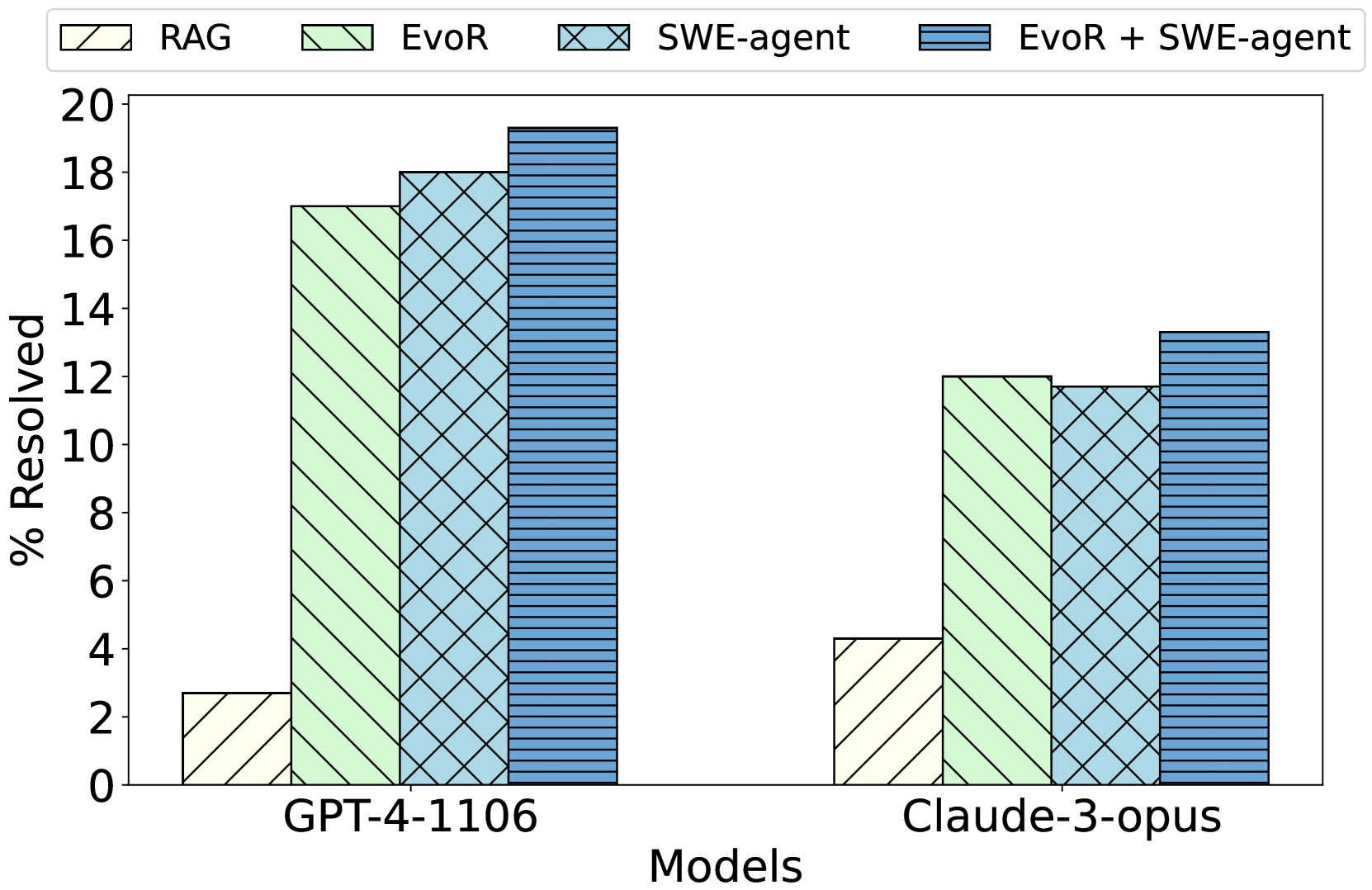
We explore the applicability of EvoR in this challenging setting. Specifically, we employ the popular SWE-bench-Lite Jimenez et al. (2023) as the testbed, use all the repository content as the documentation, and adopt the configuration in § 3.2. Due to the difficulty of the tasks, we experiment with two settings: (1) use GPT-4-1106 for all LLMs in Algorithm 1; (2) use Claude-3-opus. Figure 2 shows that EvoR outperforms the traditional RAG by a large margin, and is comparable with SWE-agent. This highlights the generalizability of EvoR with successful application in repo-level code generation.
Furthermore, we integrate EvoR with SWE-agent where we augment the search space of SWE-agent to include the execution feedback and code snippets without syntax errors, and dynamically update queries and the knowledge base in every iteration of generation. Figure 2 demonstrates additional performance improvements on top of both EvoR and SWE-agent, further proving EvoR ’s flexibility in its integration to agent-based approaches.
<details>
<summary>x2.png Details</summary>
### Visual Description
## Bar Chart: Performance Comparison of Methods Across Language Models
### Overview
This is a grouped bar chart comparing the performance of four different methods (RAG, EvoR, SWE-agent, and EvoR + SWE-agent) on two large language models (GPT-4-1106 and Claude-3-opus). The performance metric is the percentage of issues resolved ("% Resolved").
### Components/Axes
* **Y-Axis:** Labeled "% Resolved". The scale runs from 0 to 20 with major tick marks every 2 units (0, 2, 4, 6, 8, 10, 12, 14, 16, 18, 20).
* **X-Axis:** Labeled "Models". It contains two categorical groups: "GPT-4-1106" (left group) and "Claude-3-opus" (right group).
* **Legend:** Positioned at the top of the chart, centered horizontally. It defines four data series:
* **RAG:** Light yellow bar with a single diagonal hatch pattern (\\).
* **EvoR:** Light green bar with a single diagonal hatch pattern (\\).
* **SWE-agent:** Light blue bar with a cross-hatch pattern (X).
* **EvoR + SWE-agent:** Darker blue bar with a horizontal line pattern (-).
### Detailed Analysis
**Data Series & Approximate Values:**
**1. Model: GPT-4-1106 (Left Group)**
* **Trend:** Performance increases sequentially from RAG to EvoR + SWE-agent.
* **RAG (Yellow, Diagonal Hatch):** ~2.7% resolved.
* **EvoR (Green, Diagonal Hatch):** ~17.0% resolved.
* **SWE-agent (Light Blue, Cross-hatch):** ~18.0% resolved.
* **EvoR + SWE-agent (Dark Blue, Horizontal Lines):** ~19.3% resolved.
**2. Model: Claude-3-opus (Right Group)**
* **Trend:** Performance increases from RAG to EvoR, dips slightly for SWE-agent, then rises to the highest for EvoR + SWE-agent.
* **RAG (Yellow, Diagonal Hatch):** ~4.3% resolved.
* **EvoR (Green, Diagonal Hatch):** ~12.0% resolved.
* **SWE-agent (Light Blue, Cross-hatch):** ~11.7% resolved.
* **EvoR + SWE-agent (Dark Blue, Horizontal Lines):** ~13.3% resolved.
### Key Observations
1. **Method Hierarchy:** For both models, the combined "EvoR + SWE-agent" method achieves the highest resolution percentage. The standalone "RAG" method performs the worst by a significant margin.
2. **Model Comparison:** GPT-4-1106 consistently outperforms Claude-3-opus across all four methods. The performance gap is most pronounced for the EvoR and SWE-agent methods.
3. **Synergy Effect:** The combination of EvoR and SWE-agent yields a performance boost over either method alone for both models, suggesting a complementary relationship.
4. **Anomaly:** For Claude-3-opus, the SWE-agent method (~11.7%) performs slightly worse than the EvoR method (~12.0%), which is the opposite of the trend seen with GPT-4-1106.
### Interpretation
The data suggests that advanced agentic or retrieval-augmented methods (EvoR, SWE-agent) dramatically outperform a basic RAG approach for the task measured (likely software engineering or issue resolution, given the "SWE-agent" name). The consistent superiority of the combined "EvoR + SWE-agent" method indicates that integrating evolutionary retrieval with a software engineering agent creates a more robust system than either component in isolation.
The significant performance difference between GPT-4-1106 and Claude-3-opus implies that the underlying capabilities of the base model remain a critical factor, even when augmented with these specialized methods. The task may leverage specific strengths of the GPT-4 architecture. The slight underperformance of SWE-agent vs. EvoR on Claude-3-opus could indicate a less optimal integration or a mismatch between the agent's design and this model's particular response patterns. Overall, the chart demonstrates the value of methodological innovation and combination, while also highlighting the persistent influence of the foundational model's quality.
</details>
Figure 2: Performance of RAG, EvoR, SWE-agent (Agent) and combination of EvoR and SWE-agent.
### 4.4 Effective Token Usage
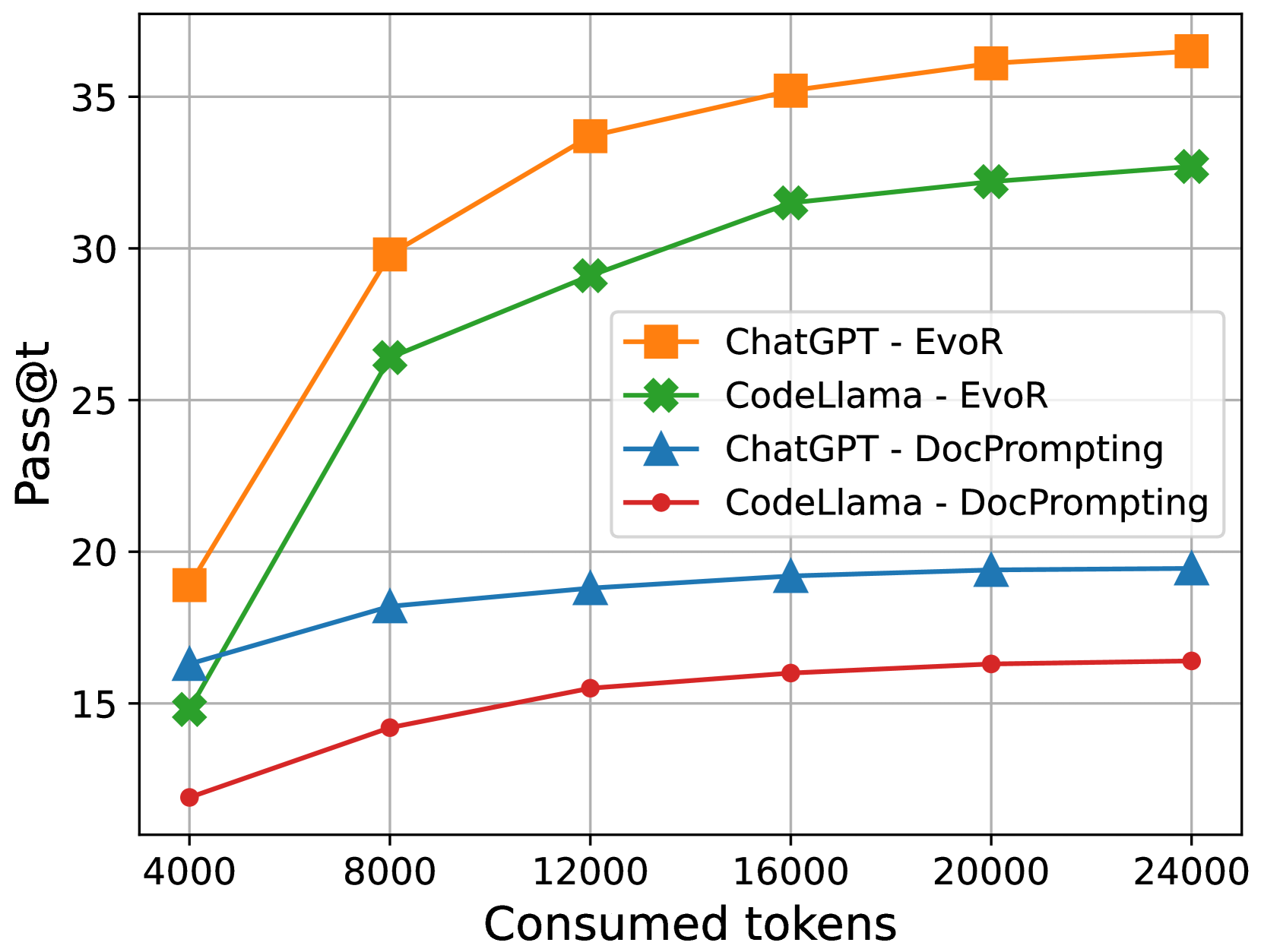
Olausson et al. (2023b) argues that iterative code generation, e.g., self-repair, may not yield higher pass rates when taking the cost into account. We conduct additional experiments to check the performance of EvoR at different levels of token budgets. In Algorithm 1, we adopt the termination condition as the limit of maximum token consumption, i.e., the algorithm exits when the tokens used by LLMs throughout iterations exceed a given threshold. Additionally, we compare EvoR to DocPrompting, the best baseline approach in Table 2. Following Olausson et al. (2023b), we sample LLMs multiple times until the token limit, using the concatenation of the given question $n$ and the retrieved documentation $K_{r}$ as the prompt. We calculate pass@t and set the token threshold to 4,000, 8,000, 12,000, 16,000, 20,000 and 24,000. Figure 3 shows that EvoR achieves significantly higher performance at all token levels for both ChatGPT and CodeLlama. With the increase of consumed tokens, EvoR demonstrates larger improvements compared to DocPromting, indicating the more effective token usage of EvoR in generalizing LLMs in RACG.
<details>
<summary>x3.png Details</summary>
### Visual Description
## Performance Comparison Line Chart: Pass@t vs. Consumed Tokens
### Overview
This image is a line chart comparing the performance of two large language models (ChatGPT and CodeLlama) using two different prompting methods (EvoR and DocPrompting). Performance is measured by the "Pass@t" metric as a function of the number of "Consumed tokens."
### Components/Axes
* **Chart Type:** Line chart with markers.
* **X-Axis (Horizontal):**
* **Label:** "Consumed tokens"
* **Scale:** Linear scale.
* **Markers/Ticks:** 4000, 8000, 12000, 16000, 20000, 24000.
* **Y-Axis (Vertical):**
* **Label:** "Pass@t"
* **Scale:** Linear scale.
* **Markers/Ticks:** 15, 20, 25, 30, 35.
* **Legend (Positioned center-right):**
* **Orange Square (■):** "ChatGPT - EvoR"
* **Green Cross (✖):** "CodeLlama - EvoR"
* **Blue Triangle (▲):** "ChatGPT - DocPrompting"
* **Red Circle (●):** "CodeLlama - DocPrompting"
### Detailed Analysis
The chart plots four distinct data series. The trend for each is described below, followed by approximate data points extracted from the visual markers.
**1. ChatGPT - EvoR (Orange line with square markers)**
* **Trend:** Shows the steepest initial increase and achieves the highest overall performance. The curve rises sharply from 4000 to 12000 tokens and then continues to increase at a slower, diminishing rate.
* **Approximate Data Points:**
* 4000 tokens: ~19
* 8000 tokens: ~30
* 12000 tokens: ~34
* 16000 tokens: ~35.5
* 20000 tokens: ~36.5
* 24000 tokens: ~37
**2. CodeLlama - EvoR (Green line with cross markers)**
* **Trend:** Follows a similar shape to ChatGPT-EvoR but consistently performs at a lower level. It also shows strong initial growth that tapers off.
* **Approximate Data Points:**
* 4000 tokens: ~15
* 8000 tokens: ~26.5
* 12000 tokens: ~29
* 16000 tokens: ~31.5
* 20000 tokens: ~32.5
* 24000 tokens: ~33
**3. ChatGPT - DocPrompting (Blue line with triangle markers)**
* **Trend:** Shows a moderate, steady increase that plateaus early. Performance is significantly lower than both EvoR methods.
* **Approximate Data Points:**
* 4000 tokens: ~16.5
* 8000 tokens: ~18
* 12000 tokens: ~19
* 16000 tokens: ~19.5
* 20000 tokens: ~19.5
* 24000 tokens: ~19.5
**4. CodeLlama - DocPrompting (Red line with circle markers)**
* **Trend:** Exhibits the lowest performance and the flattest growth curve. It increases slightly and then plateaus.
* **Approximate Data Points:**
* 4000 tokens: ~12
* 8000 tokens: ~14.5
* 12000 tokens: ~15.5
* 16000 tokens: ~16
* 20000 tokens: ~16.5
* 24000 tokens: ~16.5
### Key Observations
1. **Method Dominance:** The "EvoR" prompting method (orange and green lines) dramatically outperforms the "DocPrompting" method (blue and red lines) for both models across all token counts.
2. **Model Comparison:** When using the same prompting method, ChatGPT consistently outperforms CodeLlama. The performance gap is larger with EvoR than with DocPrompting.
3. **Diminishing Returns:** All four curves show diminishing returns. The most significant performance gains occur between 4000 and 12000 consumed tokens. After approximately 16000 tokens, the rate of improvement slows considerably for all series.
4. **Performance Hierarchy:** The final performance ranking at 24000 tokens is clear: 1) ChatGPT-EvoR, 2) CodeLlama-EvoR, 3) ChatGPT-DocPrompting, 4) CodeLlama-DocPrompting.
### Interpretation
The data suggests that the choice of prompting strategy (EvoR vs. DocPrompting) has a more significant impact on the Pass@t performance metric than the choice of base model (ChatGPT vs. CodeLlama) within this test. EvoR appears to be a far more effective technique for scaling performance with increased token consumption.
The chart demonstrates a clear positive correlation between consumed tokens and Pass@t score, but with a logarithmic-like curve, indicating that simply adding more tokens yields progressively smaller benefits. This implies there is an optimal token budget range (around 12000-16000 in this context) where performance is maximized relative to resource expenditure.
The consistent performance gap between models using the same method suggests underlying differences in model capability or how they interact with the specific prompting techniques. The fact that the gap between ChatGPT and CodeLlama is wider with EvoR might indicate that EvoR is better at leveraging the strengths of a more capable model like ChatGPT.
</details>
Figure 3: The pass rate of ChatGPT and CodeLlama at different token consumption levels. The results show that EvoR achieves a more significant increase compared to DocPrompting when the consumed tokens increase.
## 5 Related works
Since the focus of our work is to enhance code generation with retrieval, our work is closely related to code generation and retrieval-augmented code generation. Additionally, we are connected to the line of code execution since we also leverage it as an important retrieval source.
LLM-based Code Generation
LLMs that have been pre-trained on extensive code corpus have exhibited impressive abilities in the domain of code generation Li et al. (2022); Nijkamp et al. (2022); Li et al. (2023b); Roziere et al. (2023); Wei et al. (2023). Numerous techniques have been suggested to improve the coding capabilities of LLM without the need to adjust its parameters Chen et al. (2022); Huang et al. (2023); Li et al. (2023a); Zhang et al. (2023c); Chen et al. (2023); Key et al. (2022) However, most of these works set up the evaluation in scenarios LLMs are familiar with, e.g., HumanEval Chen et al. (2021), HumanEvalPack (Muennighoff et al., 2023) and MBPP Austin et al. (2021), where they are capable of demonstrating superior zero-shot performance by only utilizing internal knowledge. In this work, we focus on evaluating the capabilities of LLMs to incorporate external knowledge for the purpose of code generation in updated libraries or less-common programming languages. Our task reflects a more realistic yet challenging scenario for LLMs.
Retrieval-Augmented Generation
The retrieval-augmented generation (RAG) is an appealing paradigm that allows LLMs to efficiently utilize external knowledge Shi et al. (2023b); Izacard and Grave (2020); Xu et al. (2023a); Jiang et al. (2023c). Recent works have applied it to the code generation task Patel et al. (2023); Guo et al. (2023); Parvez et al. (2021a); Wang et al. (2023b). Specifically, Zhou et al. (2022) explored the natural-language-to-code generation approach that explicitly leverages code documentation. Zan et al. (2022) introduced a framework designed to adapt LLMs to private libraries, which first utilizes an APIRetriever to find useful APIs and then leverages an APICoder to generate code using these API docs. Zhang et al. (2023a) employed the iterative generate-retrieval procedure to do repository-level code completion. There are also recent efforts showing much enhanced performance by simply rewriting the queries Ma et al. (2023); Anand et al. (2023); Chan et al. (2024) To the best of our knowledge, we are the first to adopt the synchronous evolution of queries and diverse knowledge to explore the setting where LLMs need to incorporate external information in code generation.
Code Execution
Previous works have extensively employed executors (Interpreters/Compilers) in code-related tasks Wang et al. (2022); Liu et al. (2023a); Olausson et al. (2023a); Chen et al. (2023). Shi et al. (2022) introduced execution result– based minimum Bayes risk decoding for program selection. Yang et al. (2023) established an interactive coding benchmark by framing the code as actions and execution feedback as observations. Chen et al. (2023) use the execution result as feedback to help LLM refine the code. In this work, we utilize the executor to provide feedback and check code outputs on syntax errors, which contributes to evolve both queries and knowledge in RACG.
## 6 Conclusion
Much recent work illustrated the ability of LLMs to incorporate external knowledge with retrieval-augmented generation. We propose a novel pipeline, EvoR, which achieves two to four times execution accuracy compared to existing code generation methods. Extensive experiments demonstrate that EvoR can be easily combined with them to provide further improvements, including the agent-based ones to solve challenging tasks such as repo-level code generation. Through an in-depth analysis, we further show the complementary strength of synchronous evolution of queries and documents in RACG, which enhances the model performance by larger margins with more diverse knowledge sources. We hope that our findings will inspire researchers and practitioners to develop efficient and effective strategies in their customized code-generation tasks with LLMs.
## 7 Limitations
Despite the effectiveness of EvoR in RACG, one limitation is that it requires multiple rounds of interactions among retrievers, LLMs, and executors to output the code answer. This iterative process can lead to longer latency and increased energy consumption, which are critical concerns in real-time applications and energy-constrained environments. We hope that future work will design more efficient architectures or approaches to integrate LLMs seamlessly while maintaining or improving performance in RACG. Such advancements could significantly enhance the practicality and scalability of LLMs in realistic scenarios.
## 8 Potential Risk
The use of retrieval-augmented code generation with large language models introduces several potential risks, primarily centered around the quality and relevance of the retrieved code snippets. There is a risk of biased or incorrect information being retrieved, which could propagate errors or introduce vulnerabilities into generated code. Additionally, there are concerns about privacy and security if sensitive code snippets are inadvertently included in the retrieval process. Addressing these risks requires careful curation of retrieval sources, robust validation mechanisms, and continuous monitoring to ensure the integrity and safety of the generated code.
## References
- Anand et al. (2023) Abhijit Anand, Vinay Setty, Avishek Anand, et al. 2023. Context aware query rewriting for text rankers using llm. arXiv preprint arXiv:2308.16753.
- Asai et al. (2023) Akari Asai, Sewon Min, Zexuan Zhong, and Danqi Chen. 2023. Acl 2023 tutorial: Retrieval-based language models and applications. ACL 2023.
- Austin et al. (2021) Jacob Austin, Augustus Odena, Maxwell Nye, Maarten Bosma, Henryk Michalewski, David Dohan, Ellen Jiang, Carrie Cai, Michael Terry, Quoc Le, et al. 2021. Program synthesis with large language models. arXiv preprint arXiv:2108.07732.
- Borgeaud et al. (2022) Sebastian Borgeaud, Arthur Mensch, Jordan Hoffmann, Trevor Cai, Eliza Rutherford, Katie Millican, George van den Driessche, Jean-Baptiste Lespiau, Bogdan Damoc, Aidan Clark, Diego de Las Casas, Aurelia Guy, Jacob Menick, Roman Ring, Tom Hennigan, Saffron Huang, Loren Maggiore, Chris Jones, Albin Cassirer, Andy Brock, Michela Paganini, Geoffrey Irving, Oriol Vinyals, Simon Osindero, Karen Simonyan, Jack W. Rae, Erich Elsen, and Laurent Sifre. 2022. Improving language models by retrieving from trillions of tokens. In International Conference on Machine Learning, ICML 2022, 17-23 July 2022, Baltimore, Maryland, USA, volume 162 of Proceedings of Machine Learning Research, pages 2206–2240. PMLR.
- Brown et al. (2020) Tom Brown, Benjamin Mann, Nick Ryder, Melanie Subbiah, Jared D Kaplan, Prafulla Dhariwal, Arvind Neelakantan, Pranav Shyam, Girish Sastry, Amanda Askell, et al. 2020. Language models are few-shot learners. Advances in neural information processing systems, 33:1877–1901.
- Chan et al. (2024) Chi-Min Chan, Chunpu Xu, Ruibin Yuan, Hongyin Luo, Wei Xue, Yike Guo, and Jie Fu. 2024. Rq-rag: Learning to refine queries for retrieval augmented generation. arXiv preprint arXiv:2404.00610.
- Chen et al. (2022) Bei Chen, Fengji Zhang, Anh Nguyen, Daoguang Zan, Zeqi Lin, Jian-Guang Lou, and Weizhu Chen. 2022. Codet: Code generation with generated tests. arXiv preprint arXiv:2207.10397.
- Chen et al. (2021) Mark Chen, Jerry Tworek, Heewoo Jun, Qiming Yuan, Henrique Ponde de Oliveira Pinto, Jared Kaplan, Harri Edwards, Yuri Burda, Nicholas Joseph, Greg Brockman, et al. 2021. Evaluating large language models trained on code. arXiv preprint arXiv:2107.03374.
- Chen et al. (2023) Xinyun Chen, Maxwell Lin, Nathanael Schärli, and Denny Zhou. 2023. Teaching large language models to self-debug. arXiv preprint arXiv:2304.05128.
- Guo et al. (2023) Yucan Guo, Zixuan Li, Xiaolong Jin, Yantao Liu, Yutao Zeng, Wenxuan Liu, Xiang Li, Pan Yang, Long Bai, Jiafeng Guo, et al. 2023. Retrieval-augmented code generation for universal information extraction. arXiv preprint arXiv:2311.02962.
- Guu et al. (2020) Kelvin Guu, Kenton Lee, Zora Tung, Panupong Pasupat, and Ming-Wei Chang. 2020. REALM: retrieval-augmented language model pre-training. CoRR, abs/2002.08909.
- Huang et al. (2023) Baizhou Huang, Shuai Lu, Weizhu Chen, Xiaojun Wan, and Nan Duan. 2023. Enhancing large language models in coding through multi-perspective self-consistency. arXiv preprint arXiv:2309.17272.
- Izacard and Grave (2020) Gautier Izacard and Edouard Grave. 2020. Leveraging passage retrieval with generative models for open domain question answering. arXiv preprint arXiv:2007.01282.
- Izacard et al. (2023) Gautier Izacard, Patrick S. H. Lewis, Maria Lomeli, Lucas Hosseini, Fabio Petroni, Timo Schick, Jane Dwivedi-Yu, Armand Joulin, Sebastian Riedel, and Edouard Grave. 2023. Atlas: Few-shot learning with retrieval augmented language models. J. Mach. Learn. Res., 24:251:1–251:43.
- Jiang et al. (2023a) Albert Q Jiang, Alexandre Sablayrolles, Arthur Mensch, Chris Bamford, Devendra Singh Chaplot, Diego de las Casas, Florian Bressand, Gianna Lengyel, Guillaume Lample, Lucile Saulnier, et al. 2023a. Mistral 7b. arXiv preprint arXiv:2310.06825.
- Jiang et al. (2023b) Shuyang Jiang, Yuhao Wang, and Yu Wang. 2023b. Selfevolve: A code evolution framework via large language models. arXiv preprint arXiv:2306.02907.
- Jiang et al. (2023c) Zhengbao Jiang, Frank Xu, Luyu Gao, Zhiqing Sun, Qian Liu, Jane Dwivedi-Yu, Yiming Yang, Jamie Callan, and Graham Neubig. 2023c. Active retrieval augmented generation. In Proceedings of the 2023 Conference on Empirical Methods in Natural Language Processing, pages 7969–7992, Singapore. Association for Computational Linguistics.
- Jimenez et al. (2023) Carlos E Jimenez, John Yang, Alexander Wettig, Shunyu Yao, Kexin Pei, Ofir Press, and Karthik Narasimhan. 2023. Swe-bench: Can language models resolve real-world github issues? arXiv preprint arXiv:2310.06770.
- Karpukhin et al. (2020) Vladimir Karpukhin, Barlas Oguz, Sewon Min, Patrick Lewis, Ledell Wu, Sergey Edunov, Danqi Chen, and Wen-tau Yih. 2020. Dense passage retrieval for open-domain question answering. In Proceedings of the 2020 Conference on Empirical Methods in Natural Language Processing (EMNLP), pages 6769–6781, Online. Association for Computational Linguistics.
- Key et al. (2022) Darren Key, Wen-Ding Li, and Kevin Ellis. 2022. I speak, you verify: Toward trustworthy neural program synthesis. arXiv preprint arXiv:2210.00848.
- Lai et al. (2023) Yuhang Lai, Chengxi Li, Yiming Wang, Tianyi Zhang, Ruiqi Zhong, Luke Zettlemoyer, Wen-tau Yih, Daniel Fried, Sida Wang, and Tao Yu. 2023. Ds-1000: A natural and reliable benchmark for data science code generation. In International Conference on Machine Learning, pages 18319–18345. PMLR.
- Li et al. (2023a) Chengshu Li, Jacky Liang, Andy Zeng, Xinyun Chen, Karol Hausman, Dorsa Sadigh, Sergey Levine, Li Fei-Fei, Fei Xia, and Brian Ichter. 2023a. Chain of code: Reasoning with a language model-augmented code emulator. arXiv preprint arXiv:2312.04474.
- Li et al. (2023b) Raymond Li, Loubna Ben Allal, Yangtian Zi, Niklas Muennighoff, Denis Kocetkov, Chenghao Mou, Marc Marone, Christopher Akiki, Jia Li, Jenny Chim, et al. 2023b. Starcoder: may the source be with you! arXiv preprint arXiv:2305.06161.
- Li et al. (2022) Yujia Li, David Choi, Junyoung Chung, Nate Kushman, Julian Schrittwieser, Rémi Leblond, Tom Eccles, James Keeling, Felix Gimeno, Agustin Dal Lago, et al. 2022. Competition-level code generation with alphacode. Science, 378(6624):1092–1097.
- Liu et al. (2023a) Chenxiao Liu, Shuai Lu, Weizhu Chen, Daxin Jiang, Alexey Svyatkovskiy, Shengyu Fu, Neel Sundaresan, and Nan Duan. 2023a. Code execution with pre-trained language models. arXiv preprint arXiv:2305.05383.
- Liu et al. (2023b) Jiawei Liu, Chunqiu Steven Xia, Yuyao Wang, and Lingming Zhang. 2023b. Is your code generated by chatgpt really correct? rigorous evaluation of large language models for code generation. arXiv preprint arXiv:2305.01210.
- Liu et al. (2023c) Nelson F Liu, Kevin Lin, John Hewitt, Ashwin Paranjape, Michele Bevilacqua, Fabio Petroni, and Percy Liang. 2023c. Lost in the middle: How language models use long contexts. arXiv preprint arXiv:2307.03172.
- Ma et al. (2023) Xinbei Ma, Yeyun Gong, Pengcheng He, Hai Zhao, and Nan Duan. 2023. Query rewriting for retrieval-augmented large language models. arXiv preprint arXiv:2305.14283.
- Muennighoff et al. (2023) Niklas Muennighoff, Qian Liu, Armel Zebaze, Qinkai Zheng, Binyuan Hui, Terry Yue Zhuo, Swayam Singh, Xiangru Tang, Leandro von Werra, and Shayne Longpre. 2023. Octopack: Instruction tuning code large language models. CoRR, abs/2308.07124.
- Muennighoff et al. (2022) Niklas Muennighoff, Nouamane Tazi, Loïc Magne, and Nils Reimers. 2022. Mteb: Massive text embedding benchmark. arXiv preprint arXiv:2210.07316.
- Nakano et al. (2021) Reiichiro Nakano, Jacob Hilton, Suchir Balaji, Jeff Wu, Long Ouyang, Christina Kim, Christopher Hesse, Shantanu Jain, Vineet Kosaraju, William Saunders, et al. 2021. Webgpt: Browser-assisted question-answering with human feedback. arXiv preprint arXiv:2112.09332.
- Nijkamp et al. (2022) Erik Nijkamp, Bo Pang, Hiroaki Hayashi, Lifu Tu, Huan Wang, Yingbo Zhou, Silvio Savarese, and Caiming Xiong. 2022. Codegen: An open large language model for code with multi-turn program synthesis. arXiv preprint arXiv:2203.13474.
- Olausson et al. (2023a) Theo X Olausson, Jeevana Priya Inala, Chenglong Wang, Jianfeng Gao, and Armando Solar-Lezama. 2023a. Demystifying gpt self-repair for code generation. arXiv preprint arXiv:2306.09896.
- Olausson et al. (2023b) Theo X Olausson, Jeevana Priya Inala, Chenglong Wang, Jianfeng Gao, and Armando Solar-Lezama. 2023b. Is self-repair a silver bullet for code generation? In The Twelfth International Conference on Learning Representations.
- OpenAI (2022) OpenAI. 2022. Chatgpt: Optimizing language models for dialogue. Website. https://openai.com/blog/chatgpt.
- OpenDevin Team (2024) OpenDevin Team. 2024. OpenDevin: An Open Platform for AI Software Developers as Generalist Agents. https://github.com/OpenDevin/OpenDevin. Accessed: ENTER THE DATE YOU ACCESSED THE PROJECT.
- Parvez et al. (2021a) Md Rizwan Parvez, Wasi Ahmad, Saikat Chakraborty, Baishakhi Ray, and Kai-Wei Chang. 2021a. Retrieval augmented code generation and summarization. In Findings of the Association for Computational Linguistics: EMNLP 2021, pages 2719–2734, Punta Cana, Dominican Republic. Association for Computational Linguistics.
- Parvez et al. (2021b) Md Rizwan Parvez, Wasi Uddin Ahmad, Saikat Chakraborty, Baishakhi Ray, and Kai-Wei Chang. 2021b. Retrieval augmented code generation and summarization. arXiv preprint arXiv:2108.11601.
- Patel et al. (2023) Arkil Patel, Siva Reddy, Dzmitry Bahdanau, and Pradeep Dasigi. 2023. Evaluating in-context learning of libraries for code generation. arXiv preprint arXiv:2311.09635.
- Roziere et al. (2023) Baptiste Roziere, Jonas Gehring, Fabian Gloeckle, Sten Sootla, Itai Gat, Xiaoqing Ellen Tan, Yossi Adi, Jingyu Liu, Tal Remez, Jérémy Rapin, et al. 2023. Code llama: Open foundation models for code. arXiv preprint arXiv:2308.12950.
- Shao et al. (2023) Zhihong Shao, Yeyun Gong, Yelong Shen, Minlie Huang, Nan Duan, and Weizhu Chen. 2023. Enhancing retrieval-augmented large language models with iterative retrieval-generation synergy. arXiv preprint arXiv:2305.15294.
- Shi et al. (2022) Freda Shi, Daniel Fried, Marjan Ghazvininejad, Luke Zettlemoyer, and Sida I Wang. 2022. Natural language to code translation with execution. arXiv preprint arXiv:2204.11454.
- Shi et al. (2023a) Kensen Shi, Joey Hong, Manzil Zaheer, Pengcheng Yin, and Charles Sutton. 2023a. Exedec: Execution decomposition for compositional generalization in neural program synthesis. arXiv preprint arXiv:2307.13883.
- Shi et al. (2023b) Weijia Shi, Sewon Min, Michihiro Yasunaga, Minjoon Seo, Rich James, Mike Lewis, Luke Zettlemoyer, and Wen-tau Yih. 2023b. Replug: Retrieval-augmented black-box language models. arXiv preprint arXiv:2301.12652.
- Shinn et al. (2024) Noah Shinn, Federico Cassano, Ashwin Gopinath, Karthik Narasimhan, and Shunyu Yao. 2024. Reflexion: Language agents with verbal reinforcement learning. Advances in Neural Information Processing Systems, 36.
- Shrivastava et al. (2023) Disha Shrivastava, Denis Kocetkov, Harm de Vries, Dzmitry Bahdanau, and Torsten Scholak. 2023. Repofusion: Training code models to understand your repository. arXiv preprint arXiv:2306.10998.
- Su et al. (2023) Hongjin Su, Weijia Shi, Jungo Kasai, Yizhong Wang, Yushi Hu, Mari Ostendorf, Wen-tau Yih, Noah A. Smith, Luke Zettlemoyer, and Tao Yu. 2023. One embedder, any task: Instruction-finetuned text embeddings. In Findings of the Association for Computational Linguistics: ACL 2023, pages 1102–1121, Toronto, Canada. Association for Computational Linguistics.
- Wang et al. (2023a) Liang Wang, Nan Yang, Xiaolong Huang, Linjun Yang, Rangan Majumder, and Furu Wei. 2023a. Improving text embeddings with large language models. arXiv preprint arXiv:2401.00368.
- Wang et al. (2023b) Weishi Wang, Yue Wang, Shafiq Joty, and Steven CH Hoi. 2023b. Rap-gen: Retrieval-augmented patch generation with codet5 for automatic program repair. In Proceedings of the 31st ACM Joint European Software Engineering Conference and Symposium on the Foundations of Software Engineering, pages 146–158.
- Wang et al. (2022) Zhiruo Wang, Shuyan Zhou, Daniel Fried, and Graham Neubig. 2022. Execution-based evaluation for open-domain code generation. arXiv preprint arXiv:2212.10481.
- Wei et al. (2023) Yuxiang Wei, Zhe Wang, Jiawei Liu, Yifeng Ding, and Lingming Zhang. 2023. Magicoder: Source code is all you need. arXiv preprint arXiv:2312.02120.
- Xu et al. (2023a) Fangyuan Xu, Weijia Shi, and Eunsol Choi. 2023a. Recomp: Improving retrieval-augmented lms with compression and selective augmentation. arXiv preprint arXiv:2310.04408.
- Xu et al. (2023b) Peng Xu, Wei Ping, Xianchao Wu, Lawrence McAfee, Chen Zhu, Zihan Liu, Sandeep Subramanian, Evelina Bakhturina, Mohammad Shoeybi, and Bryan Catanzaro. 2023b. Retrieval meets long context large language models. arXiv preprint arXiv:2310.03025.
- Yang et al. (2024) John Yang, Carlos E Jimenez, Alexander Wettig, Kilian Lieret, Shunyu Yao, Karthik Narasimhan, and Ofir Press. 2024. Swe-agent: Agent-computer interfaces enable automated software engineering. arXiv preprint arXiv:2405.15793.
- Yang et al. (2023) John Yang, Akshara Prabhakar, Karthik Narasimhan, and Shunyu Yao. 2023. Intercode: Standardizing and benchmarking interactive coding with execution feedback. arXiv preprint arXiv:2306.14898.
- Zan et al. (2022) Daoguang Zan, Bei Chen, Zeqi Lin, Bei Guan, Yongji Wang, and Jian-Guang Lou. 2022. When language model meets private library. arXiv preprint arXiv:2210.17236.
- Zhang et al. (2023a) Fengji Zhang, Bei Chen, Yue Zhang, Jacky Keung, Jin Liu, Daoguang Zan, Yi Mao, Jian-Guang Lou, and Weizhu Chen. 2023a. RepoCoder: Repository-level code completion through iterative retrieval and generation. In Proceedings of the 2023 Conference on Empirical Methods in Natural Language Processing, pages 2471–2484, Singapore. Association for Computational Linguistics.
- Zhang et al. (2023b) Fengji Zhang, Bei Chen, Yue Zhang, Jacky Keung, Jin Liu, Daoguang Zan, Yi Mao, Jian-Guang Lou, and Weizhu Chen. 2023b. Repocoder: Repository-level code completion through iterative retrieval and generation. arXiv preprint arXiv:2303.12570.
- Zhang et al. (2023c) Kexun Zhang, Danqing Wang, Jingtao Xia, William Yang Wang, and Lei Li. 2023c. Algo: Synthesizing algorithmic programs with generated oracle verifiers. arXiv preprint arXiv:2305.14591.
- Zhou et al. (2022) Shuyan Zhou, Uri Alon, Frank F Xu, Zhengbao Jiang, and Graham Neubig. 2022. Docprompting: Generating code by retrieving the docs. In The Eleventh International Conference on Learning Representations.
- Zhou et al. (2023) Shuyan Zhou, Uri Alon, Frank F. Xu, Zhengbao Jiang, and Graham Neubig. 2023. Docprompting: Generating code by retrieving the docs. In The Eleventh International Conference on Learning Representations.
## Appendix A Dataset curation
We introduce more details about our dataset curation process for updated library (§ A.1) and long-tail programming languages (§ A.2). In § A.3, we describe our implementation of the test case construction for the dataset Ring and Pony.
### A.1 Library-oriented data collection
Following Zan et al. (2022), we use the synonyms of original API names and API arguments in the updated library, such as converting stack to pile. Additionally, we combine two similar APIs into one, with newly added arguments to distinguish the authentic functionalities, e.g., linear_interpoloate integrates two APIs, griddata and interp1d. Finally, we create new class objects and align methods with the original class. For instance, a new SparseMatrix object is created to include all sparse matrix objects in Scipy. We rewrite the ground truth solution for each example with new APIs.
To construct the documentation of the updated libraries, we first collect the original libraries https://docs.scipy.org/doc/, https://www.tensorflow.org/api_docs. We then replace the old documentation files with our modified version. For each question, we annotate the oracle documentation by checking the ground truth answer. We grasp the corresponding documentation pages and concatenate them to serve as the minimum documentation required for answering the problem. We reuse the test cases introduced in DS-1000 to evaluate LLM generalization performance.
### A.2 Language-oriented data collection
For each programming problem collected from LeetCode, we rewrite the function signatures to adapt them to the target programming language. We collect the whole documentation for Ring and Pony from their websites: https://ring-lang.github.io/doc1.19/ and https://www.ponylang.io/. For each question, we labeled the oracle documentation of the specific grammar used in the ground truth, such as data structures or branching syntax. We concatenate the document for each new syntax used in the ground truth to obtain a minimum document that contains the required syntaxes for answering the question.
### A.3 Test-case generation for language-oriented data
To accurately evaluate the performance of LLM in writing code of long-tail programming languages, we follow Liu et al. (2023b) to construct a comprehensive set of test cases for each problem. Specifically, we first prompt ChatGPT to write a validation script and solution script using Python. The validation script will check for the input constraints (e.g. single line of a positive integer, two binary strings, etc.) of the problem. The solution script is supposed to generate the correct answer given a valid input. We then manually check both scripts and modify them if necessary for all problems. Next, we prompt ChatGPT to create complex and corner cases until there are 20 test cases for each problem. We then apply mutation-based strategies to extend the number of test cases for each problem to 200. The mutation-based strategy works as follows. We first parse the input into the appropriate format and types (e.g. list of strings, tuple of integers, etc. ) We will then randomly mutate the test cases multiple times to create a new input based on the types. For instance, we may add 1 or subtract 1 from an integer to mutate it. All generated test cases added are checked by both the validation script and solution script. A test case is considered as valid if the following three conditions are met: (1). Both scripts do not report any error; (2). The solution script terminates within 1 second; (3). The answer returned by the solution script matches that in the test case.
The final step is to apply test-suite reduction which selects a subset of all input test cases while preserving the original test effectiveness (i.e. the reduced set of test cases marks a code solution as right/wrong if and only if the original set marks it as right/wrong). We employ the three strategies proposed by Liu et al. (2023b): code coverage, mutant killing, LLM sample killing. Code coverage evaluates how each test case covers different branch conditions in the solution script. Mutant killing employees a mutation testing tool for Python to create mutant codes from the solution script. LLM sample killing prompts llama-2-70b to generate several incorrect solutions to the problem. We run all test cases against these different codes to perform the test-suite reduction. Finally, we generate the answer using the solution scripts.
## Appendix B Prvate Library
We notice that Zan et al. (2022) crafted three benchmarks named TorchDataEval, MonkeyEval, and BeatNumEval to evaluate the capability of language models in code generation with private libraries. Their benchmarks share some similarities with our two datasets on updated libraries, where we both modified popular Python libraries to explore the setting for LLM generalization. Different from them, our datasets are built with increased complexity, where we not only use the simple synonym to update the API names, but additionally combine two APIs and create new class objects. This indicates that our datasets are likely to cover broader scenarios of library updates in real life.
Nonetheless, we also benchmark our system on their datasets with varied knowledge source. Table 5 shows that CodeLlama achieves exceptionally high score in all three datasets, with zero-shot accuracy 80.2% in Monkey. Since the three datasets were available in Github as early as 2022, which is well ahead of the time CodeLlama was released, we suspect that CodeLlama has been trained on the three datasets. Although our system still looks to be effective in their benchmarks with performance gain by including more knowledge sources, we are concerned that these datasets may not be able to reflect the generalization capabilities of LLM.
| Method | | Model: ChatGPT Monkey | BeatNum | Model: CodeLlama TorchData | Avg. | | Monkey | BeatNum | TorchData | Avg. |
| --- | --- | --- | --- | --- | --- | --- | --- | --- | --- | --- |
| Vanilla | | 38.6 | 27.7 | 42.0 | 36.1 | | 80.2 | 70.3 | 54.0 | 68.2 |
| EvoR | | 67.3 | 70.3 | 74.0 | 70.5 | | 93.1 | 90.1 | 92.0 | 91.7 |
Table 5: We evaluate the zero-shot ChatGPT and CodeLlama on three private libraries. Although we observe significant improvements of EvoR, the exceptionally high accuracy of CodeLlama Vanilla (zero-shot) performance suggests the risk of data leakage, making it less reliable to assess model generalization capabilities.
## Appendix C LLM-generated program inputs
| Scipy-M | Tensor-M | Ring | Pony | | Scipy-M | Tensor-M | Ring | Pony |
| --- | --- | --- | --- | --- | --- | --- | --- | --- |
| 89.2 | 93.3 | 100.0 | 100.0 | | 86.8 | 91.1 | 95.6 | 96.8 |
Table 6: The accuracy of ChatGPT (left) and CodeLlama (right) in generating valid program inputs. Although LLMs cannot guarantee to write accurate test cases, their performance in generating only program inputs is exceptionally high.
To verify the syntax of the generated program, one effective way is to execute it with test cases. To simulate the scenario where no test case is available, we investigate whether it is possible to generate program inputs with LLMs. Specifically, we prompt ChatGPT and CodeLlama to generate 5 test cases for each problem, and only save the inputs for evaluating the syntax of other programs. As an ablation study, we execute the gold program of each problem with the generated inputs and count a generated input as valid if no error is reported during execution. We calculate the accuracy as the percentage of examples where all the generated test inputs are valid. Table 6 shows that both ChatGPT and CodeLlama exhibit superior performance in generating test inputs. This indicates that LLM-generated test inputs serve as good resources as syntax verifiers.
## Appendix D Sample code snippets and execution feedback
We collect sample code snippets and execution feedback in constructing the knowledge base. Specifically, we prompt LLMs to write short scripts of sample usage of each function in the documentation corpus. We then execute those scripts. If the execution of a code snippet reports errors, we include it as a pair of (code, error); otherwise, we regard it as a code snippet that could demonstrate the syntax and function usage.
## Appendix E Cost Analysis
| Model | Retrieval | Scipy-M Acc | Tensorflow-M Tokens | Ring Acc | Pony Tokens | Average Acc | Tokens | Acc | Tokens | Acc | Tokens |
| --- | --- | --- | --- | --- | --- | --- | --- | --- | --- | --- | --- |
| ChatGPT | Vanilla | 17.6 | 423 | 11.1 | 322 | 3.7 | 206 | 1.8 | 222 | 8.6 | 293 |
| DocPrompting | 32.4 | 3687 | 33.3 | 3728 | 8.4 | 3826 | 2.7 | 3763 | 19.2 | 3751 | |
| RK | 32.6 | 4826 | 40.0 | 4924 | 11.7 | 4528 | 5.2 | 4584 | 22.4 | 4716 | |
| EvoR | 37.9 | 13631 | 53.3 | 12568 | 36.6 | 24987 | 13.5 | 13819 | 35.3 | 16251 | |
| CodeLlama | Vanilla | 11.3 | 476 | 17.8 | 381 | 0.0 | 263 | 0.0 | 314 | 7.3 | 386 |
| DocPrompting | 16.9 | 3923 | 37.8 | 4012 | 4.7 | 4050 | 4.4 | 3978 | 16.0 | 3991 | |
| RK | 23.9 | 5124 | 42.2 | 5023 | 8.2 | 4987 | 7.3 | 4823 | 20.4 | 4989 | |
| EvoR | 31.2 | 14564 | 53.3 | 12323 | 26.7 | 29384 | 17.4 | 14592 | 32.2 | 17716 | |
Table 7: The comparison of LLM performance and consumed tokens per example without retrieval (Vanilla), retrieval without evolution from only documentation (DocPrompting), retrieval without evolution from knowledge soup (RK) and EvoR retrieval. By default, we use INSTRUCTOR-xl as the embedding model. The results in the table demonstrate the association between superior results and the massively processed tokens, which implies the trade-off between the performance and the cost.
Despite significant enhancement of EvoR in the generalization results, the iterative process that involves multiple LLM generations incurs large costs. In this section, we discuss the trade-off between the cost and the performance. To measure the cost, we count the total tokens processed by LLM throughout the process in each example.
From Table 7, we can see that, the exceptional performance is linked to the extensive processing of tokens. Compared to employing Single-time-Q, which simulates the traditional RAG pipeline and directly uses the question as the query to retrieve documentation, ChatGPT and CodeLlama achieve 2.9% and 4.1% performance gain in average execution accuracy by using Single-time, which formulates the query as the explained code and retrieves from diverse knowledge soup. This enhancement is at the expense of around 25% more processed tokens for both models. With active retrieval, the average performance further increases by 15.4% and 15.1% for ChatGPT and CodeLlama respectively. However, the processed tokens increase by more than 2 times for both models. With a notable increase in both cost and performance, there arises a trade-off for practitioners to carefully weigh and adjust according to their specific requirements.
## Appendix F More Experimental Setting
In all settings, we leave a length of 400 for generation and adopt ChatGPT as the LLM to explain the code, i.e., all the code is fairly translated into the explained code. In every iteration of active retrieval and LLM generation, we add the examples with correct syntax (judged by executors with sample inputs) to the set of code snippets and only rectify the code with syntax error.
For each of the knowledge sources considered in this paper, we adopt the following principles if it is included in the prompt for LLM generation: (1). For web search content, include it until the maximum allowed length, e.g., 4,096, as we do not merge it without other knowledge sources; (2). For execution feedback, include the error message and the line of the code that leads to the error; (3). For code snippets, allocate a maximum length of 300 to them, as they are usually short; (4). For documentation, always include other types of knowledge first, and include documentation to fill in the rest length. For example, if we want to include both documentation and code snippets as the knowledge source and the maximum context length is 4,096, we will allocate a maximum length of 300 to code snippets and a maximum length of 4,096-300-400=3,396 to the documentation.
## Appendix G Web Search
As the artificially modified libraries are not available online, we replace the documentation returned by web search with our modified version. In addition, we heuristically update the content from web search based on our modifications, e.g., map keywords to the synonyms we use.
In Figure 4, we present an example of the top-3 web search results returned by Google search to the query "In the programming language Pony, checks if the current element is less than the previous element in the nums array". Due to the infrequent usage of the programming language Pony, there is little available resource online. The web search fails to identify the relevant knowledge piece. Even the specific instruction "programming language Pony" is given in the query, a guidance to solve the problem in C++ is included. In addition, the returned texts are long, complex, and diverse, mixing various types of knowledge sources including tutorials, blogs, and community Q&A discussions. LLMs may find it challenging to process and effectively utilize all of the information simultaneously. Finally, although we empirically remove some unrelated information, e.g., remove the line that starts with $*$ that is likely to be an irrelevant item listing, there is more that is hard to remove with just heuristics. This poses a great challenge to LLMs as they are burdened to filter the unrelated content and avoid getting distracted by it.
<details>
<summary>x4.png Details</summary>
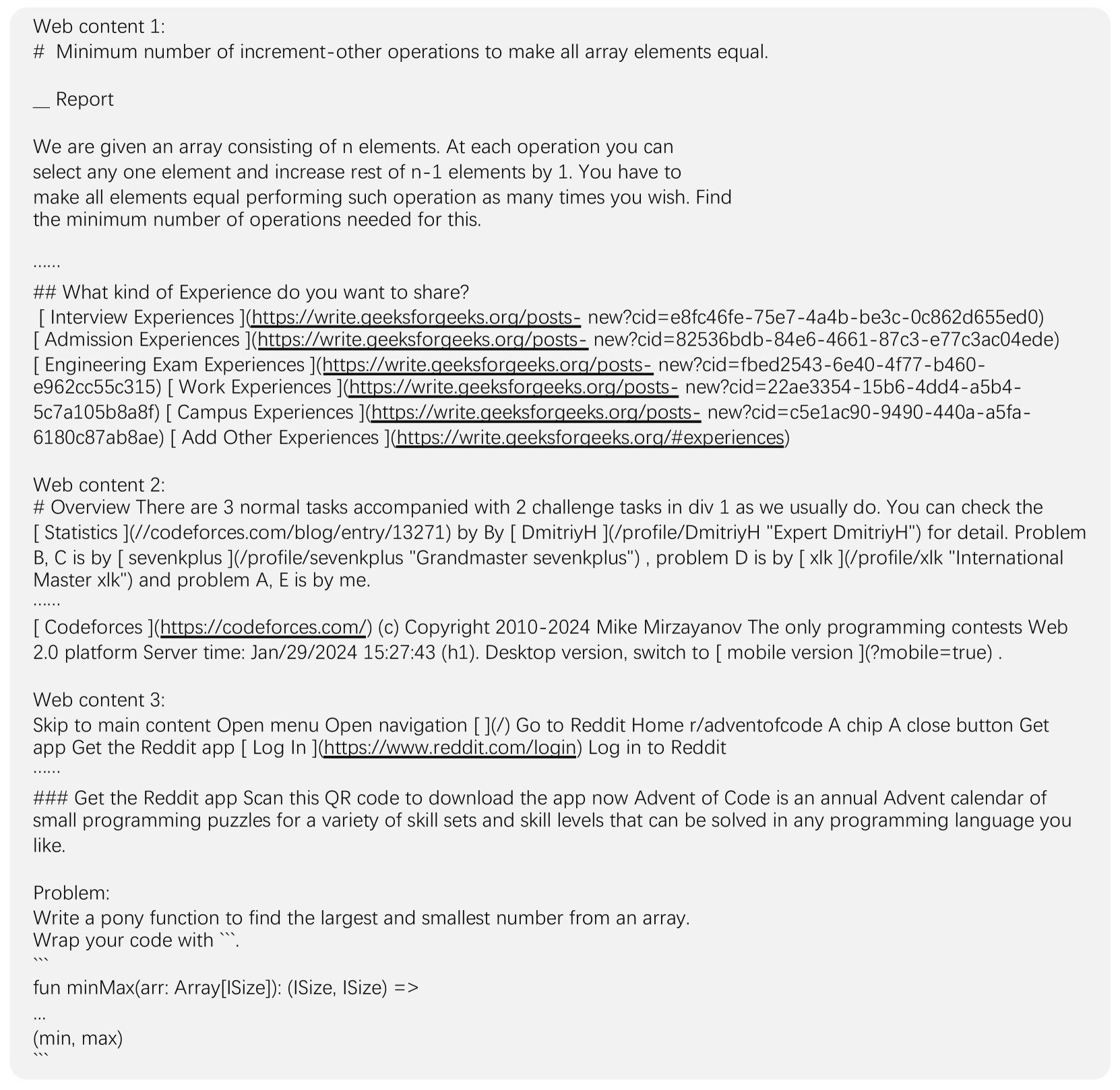
### Visual Description
## Web Content Screenshot: Technical Document Extraction
### Overview
The image is a screenshot containing three distinct blocks of text, labeled as "Web content 1," "Web content 2," and "Web content 3." The content appears to be extracted from various programming and technology-related websites. The primary language is English. The text includes problem statements, hyperlinks, platform metadata, and a code snippet.
### Content Details
#### **Web content 1**
* **Title/Header:** `# Minimum number of increment-other operations to make all array elements equal.`
* **Sub-header:** `__ Report`
* **Problem Statement:** "We are given an array consisting of n elements. At each operation you can select any one element and increase rest of n-1 elements by 1. You have to make all elements equal performing such operation as many times you wish. Find the minimum number of operations needed for this."
* **Section Header:** `## What kind of Experience do you want to share?`
* **List of Links (Experience Categories):**
* `[ Interview Experiences ](https://write.geeksforgeeks.org/posts-new?cid=e8fc46fe-75e7-4a4b-be3c-0c862d655ed0)`
* `[ Admission Experiences ](https://write.geeksforgeeks.org/posts-new?cid=82536bdb-84e6-4661-87c3-e77c3ac04ede)`
* `[ Engineering Exam Experiences ](https://write.geeksforgeeks.org/posts-new?cid=fbed2543-6e40-4f77-b460-e962cc55c315)`
* `[ Work Experiences ](https://write.geeksforgeeks.org/posts-new?cid=22ae3354-15b6-4dd4-a5b4-5c7a105b8a8f)`
* `[ Campus Experiences ](https://write.geeksforgeeks.org/posts-new?cid=c5e1ac90-9490-440a-a5fa-6180c87ab8ae)`
* `[ Add Other Experiences ](https://write.geeksforgeeks.org/#experiences)`
#### **Web content 2**
* **Title/Header:** `# Overview`
* **Contest Description:** "There are 3 normal tasks accompanied with 2 challenge tasks in div 1 as we usually do. You can check the [ Statistics ](//codeforces.com/blog/entry/13271) by By [ DmitriyH ](/profile/DmitriyH "Expert DmitriyH") for detail. Problem B, C is by [ sevenkplus ](/profile/sevenkplus "Grandmaster sevenkplus") , problem D is by [ xlk ](/profile/xlk "International Master xlk") and problem A, E is by me."
* **Platform Footer:**
* `[ Codeforces ](https://codeforces.com/)`
* `(c) Copyright 2010-2024 Mike Mirzayanov`
* `The only programming contests Web 2.0 platform`
* `Server time: Jan/29/2024 15:27:43 (h1).`
* `Desktop version, switch to [ mobile version ](?mobile=true) .`
#### **Web content 3**
* **Navigation/UI Text:** "Skip to main content Open menu Open navigation [ ](/) Go to Reddit Home r/adventofcode A chip A close button Get app Get the Reddit app [ Log In ](https://www.reddit.com/login) Log in to Reddit"
* **Promotional Text:** `### Get the Reddit app Scan this QR code to download the app now`
* **Community Description:** "Advent of Code is an annual Advent calendar of small programming puzzles for a variety of skill sets and skill levels that can be solved in any programming language you like."
* **Problem Statement:** "Problem: Write a pony function to find the largest and smallest number from an array. Wrap your code with ```."
* **Code Snippet:**
```
fun minMax(arr: Array[ISize]): (ISize, ISize) =>
...
(min, max)
```
### Key Observations
1. **Content Sources:** The three snippets originate from distinct platforms: a technical article/problem site (likely GeeksforGeeks), a competitive programming platform (Codeforces), and a social forum (Reddit's r/adventofcode).
2. **Common Theme:** All content is related to programming: algorithmic problem-solving, contest organization, and community-driven coding challenges.
3. **Hyperlink Structure:** Links are presented in Markdown format `[Link Text](URL)`. Some URLs are relative (e.g., `/profile/DmitriyH`), indicating they are internal to the source website.
4. **Metadata:** Web content 2 provides specific temporal metadata (Server time: Jan/29/2024 15:27:43) and copyright information.
5. **Code Language:** The code snippet in Web content 3 is specified to be in the "Pony" programming language.
### Interpretation
This image captures a snapshot of the diverse textual information encountered in the software development and computer science ecosystem. It demonstrates:
* **Problem-Solving Focus:** The core of each snippet is a challenge—whether it's an algorithmic puzzle (Content 1 & 3) or the logistical details of a programming contest (Content 2).
* **Community and Knowledge Sharing:** The links in Content 1 facilitate sharing professional experiences, while Content 2 credits individual contributors (problem setters) and Content 3 describes a community event (Advent of Code). This highlights the collaborative nature of the field.
* **Platform Diversity:** The content showcases different web platforms (article hosts, contest systems, forums) that serve specific niches within the broader tech community, each with its own UI conventions and metadata.
* **Temporal Context:** The server timestamp in Content 2 (January 2024) provides a precise point-in-time reference for that platform's state, which is valuable for understanding the context of the contest being described.
The extracted text is purely informational and contains no charts, diagrams, or visual data representations requiring numerical trend analysis. The primary value lies in the precise transcription of the problem statements, links, and platform-specific details.
</details>
Figure 4: A web content example covering tutorials (web content 1), blogs (web content 2) and Q&A discussions (web content 3). We show the top-3 results returned by google search and cut each webpage for brevity.
<details>
<summary>x5.png Details</summary>
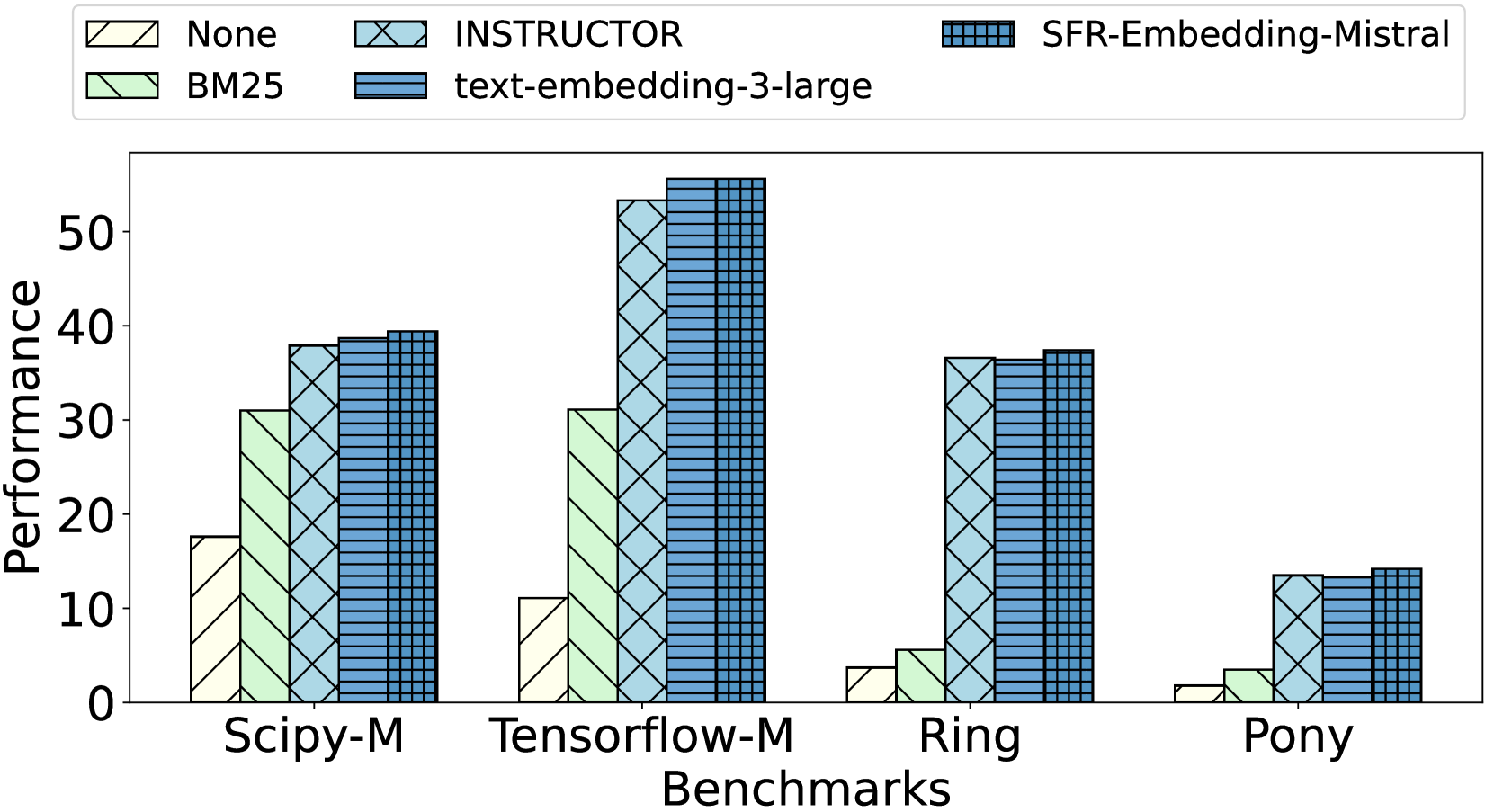
### Visual Description
## Grouped Bar Chart: Performance Comparison of Embedding Methods Across Benchmarks
### Overview
This image is a grouped bar chart comparing the performance of five different information retrieval or embedding methods across four distinct benchmarks. The chart visually demonstrates how each method performs relative to the others within each benchmark category.
### Components/Axes
* **Chart Type:** Grouped Bar Chart.
* **X-Axis (Horizontal):** Labeled "Benchmarks". It contains four categorical groups:
1. `Scipy-M`
2. `Tensorflow-M`
3. `Ring`
4. `Pony`
* **Y-Axis (Vertical):** Labeled "Performance". It is a linear scale with major tick marks at intervals of 10, ranging from 0 to 50.
* **Legend:** Positioned at the top of the chart, above the plot area. It defines five data series, each with a unique color and hatch pattern:
* **None:** Light yellow/cream fill with diagonal hatching (`\`).
* **BM25:** Light green fill with diagonal hatching (`\`).
* **INSTRUCTOR:** Light blue fill with cross-hatching (`X`).
* **text-embedding-3-large:** Medium blue fill with horizontal hatching (`-`).
* **SFR-Embedding-Mistral:** Dark blue fill with a grid/checkered hatch pattern (`+`).
### Detailed Analysis
Performance values are approximate, estimated from the bar heights relative to the y-axis.
**1. Benchmark: Scipy-M**
* **None:** ~18
* **BM25:** ~31
* **INSTRUCTOR:** ~38
* **text-embedding-3-large:** ~39
* **SFR-Embedding-Mistral:** ~40
* *Trend:* Performance increases progressively from "None" to "SFR-Embedding-Mistral".
**2. Benchmark: Tensorflow-M**
* **None:** ~11
* **BM25:** ~31
* **INSTRUCTOR:** ~53
* **text-embedding-3-large:** ~56
* **SFR-Embedding-Mistral:** ~56
* *Trend:* A significant performance jump occurs between "BM25" and the three advanced embedding models ("INSTRUCTOR", "text-embedding-3-large", "SFR-Embedding-Mistral"), which perform very similarly at the top.
**3. Benchmark: Ring**
* **None:** ~4
* **BM25:** ~6
* **INSTRUCTOR:** ~37
* **text-embedding-3-large:** ~36
* **SFR-Embedding-Mistral:** ~38
* *Trend:* "None" and "BM25" show very low performance. The three advanced models show a dramatic increase and cluster closely together in the high 30s.
**4. Benchmark: Pony**
* **None:** ~2
* **BM25:** ~4
* **INSTRUCTOR:** ~14
* **text-embedding-3-large:** ~14
* **SFR-Embedding-Mistral:** ~15
* *Trend:* All methods show their lowest performance on this benchmark. The relative pattern holds: "None" and "BM25" are very low, while the three advanced models are higher and similar to each other.
### Key Observations
1. **Consistent Hierarchy:** Across all four benchmarks, the performance order is consistent: `None` < `BM25` < `INSTRUCTOR` ≈ `text-embedding-3-large` ≈ `SFR-Embedding-Mistral`.
2. **Performance Clustering:** The three advanced embedding models (`INSTRUCTOR`, `text-embedding-3-large`, `SFR-Embedding-Mistral`) consistently form a high-performing cluster, with minimal differences between them in most benchmarks.
3. **Benchmark Difficulty:** The benchmarks appear to have varying levels of difficulty. `Tensorflow-M` yields the highest absolute performance scores for the top models, while `Pony` yields the lowest scores for all methods.
4. **Baseline Performance:** The `None` and `BM25` methods serve as baselines. `BM25` consistently outperforms `None`, but both are significantly outperformed by the neural embedding models, especially on the `Ring` and `Pony` benchmarks.
### Interpretation
This chart provides a clear comparative analysis of retrieval/embedding techniques. The data suggests that modern neural embedding models (`INSTRUCTOR`, `text-embedding-3-large`, `SFR-Embedding-Mistral`) offer a substantial and consistent performance advantage over traditional lexical methods (`BM25`) and a no-retrieval baseline (`None`) across diverse technical domains (implied by benchmarks named after libraries like Scipy and Tensorflow).
The near-identical performance of the three top models indicates a potential performance ceiling or convergence in capability for this specific evaluation task. The significant drop in scores for the `Pony` benchmark suggests it may represent a more challenging or out-of-domain task for all evaluated methods. The chart effectively argues for the adoption of advanced embedding models over traditional baselines for the tasks represented by these benchmarks.
</details>
Figure 5: Comparison of ChatGPT generalization performance when the sparse retriever (BM25), or the dense retriever (INSTRUCTOR, text-embedding-3-large, SFR-Embedding-Mistral) is employed. The results show that dense retrievers significantly outperform their sparse counterpart, BM25. In general, ChatGPT achieves the best performance when SFR-Embedding-Mistral is used as the retrieval model.
## Appendix H Retrieval Model
We experiment with a representative sparse retriever, BM25, and several competitive dense retrievers using the default setting of EvoR, except for changing the retrieval model. INSTRUCTOR-xl Su et al. (2023) is an 1.3B embedding model fine-tuned to follow instructions for efficient adaptation. text-embedding-3-large https://platform.openai.com/docs/guides/embeddings is OpenAI’s latest embedding model, showcasing competitive performance. SFR-Embedding-Mistral is trained on top of E5-mistral-7b-instruct Wang et al. (2023a) and Mistral-7B-v0.1 Jiang et al. (2023a) and achieves state-of-the-art performance in MTEB leaderboard Muennighoff et al. (2022).
As shown in Figure 5, across four datasets, when utilizing dense retrievers, ChatGPT significantly enhances the performance achieved with a sparse retriever. Aligned with the results in the retrieval benchmark (MTEB), ChatGPT consistently achieves the best performance when using SFR-Embedding-Mistral as the retrieval model. However, the gap between different dense retrievers is not significant. After considering both the performance and the cost, we opt for INSTRUCTOR-xl for efficient and cost-effective development of EvoR.
<details>
<summary>x6.png Details</summary>
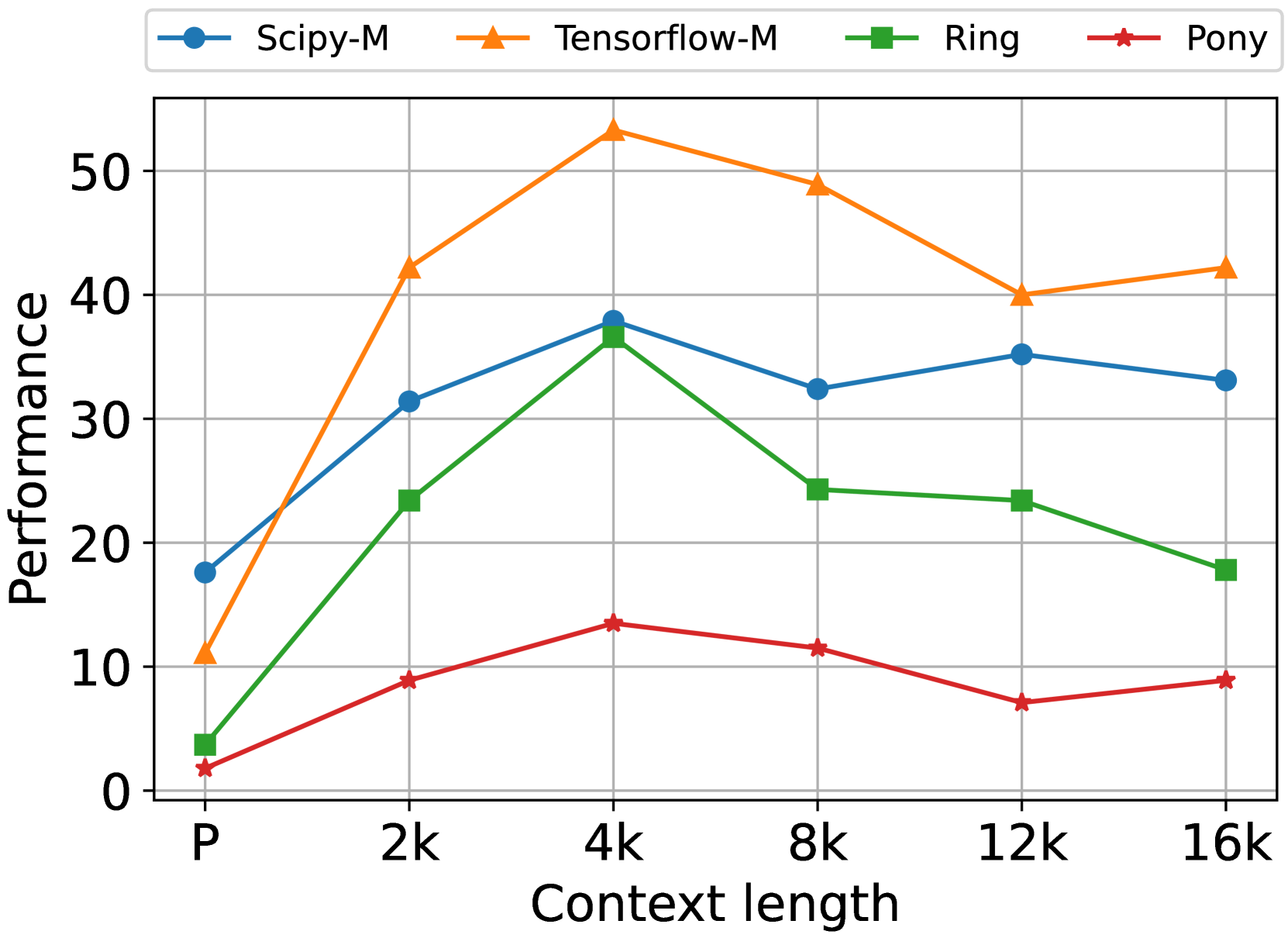
### Visual Description
## Line Chart: Performance vs. Context Length
### Overview
The image is a line chart comparing the performance of four different systems or methods (Scipy-M, Tensorflow-M, Ring, Pony) across varying context lengths. The chart plots "Performance" on the y-axis against "Context length" on the x-axis. The data suggests an evaluation of how these systems scale or handle increasing context sizes, with performance peaking at a mid-range context length for most systems.
### Components/Axes
* **Chart Type:** Line chart with markers.
* **X-Axis (Horizontal):**
* **Label:** "Context length"
* **Categories/Markers:** P, 2k, 4k, 8k, 12k, 16k. (Note: 'P' likely stands for a baseline or 'Prompt' length, while 'k' denotes thousands).
* **Y-Axis (Vertical):**
* **Label:** "Performance"
* **Scale:** Linear, ranging from 0 to approximately 55. Major gridlines are at intervals of 10 (0, 10, 20, 30, 40, 50).
* **Legend:** Located at the top-center of the chart, above the plot area. It defines four data series:
1. **Scipy-M:** Blue line with circle markers.
2. **Tensorflow-M:** Orange line with upward-pointing triangle markers.
3. **Ring:** Green line with square markers.
4. **Pony:** Red line with star (pentagram) markers.
### Detailed Analysis
**Trend Verification & Data Point Extraction (Approximate Values):**
1. **Tensorflow-M (Orange, Triangle):**
* **Trend:** Shows the highest overall performance. It rises sharply from P to 4k, peaks at 4k, then gradually declines with a slight uptick at 16k.
* **Data Points:**
* P: ~11
* 2k: ~42
* 4k: ~53 (Peak)
* 8k: ~49
* 12k: ~40
* 16k: ~42
2. **Scipy-M (Blue, Circle):**
* **Trend:** Rises from P to 4k, dips at 8k, then recovers and stabilizes. It maintains the second-highest performance for most context lengths.
* **Data Points:**
* P: ~18
* 2k: ~31
* 4k: ~38
* 8k: ~32
* 12k: ~35
* 16k: ~33
3. **Ring (Green, Square):**
* **Trend:** Increases from P to a peak at 4k, then experiences a consistent decline as context length increases further.
* **Data Points:**
* P: ~4
* 2k: ~23
* 4k: ~37 (Peak)
* 8k: ~24
* 12k: ~23
* 16k: ~18
4. **Pony (Red, Star):**
* **Trend:** Shows the lowest performance overall. It has a modest peak at 4k and remains relatively flat and low across all context lengths.
* **Data Points:**
* P: ~2
* 2k: ~9
* 4k: ~13 (Peak)
* 8k: ~11
* 12k: ~7
* 16k: ~9
### Key Observations
* **Universal Peak at 4k:** All four systems achieve their maximum measured performance at the "4k" context length.
* **Performance Hierarchy:** A clear and consistent hierarchy is visible for context lengths of 2k and beyond: Tensorflow-M > Scipy-M > Ring > Pony. At the baseline 'P', Scipy-M starts highest.
* **Sensitivity to Scale:** Tensorflow-M and Ring show the most pronounced performance drop after their 4k peak, suggesting they may be less optimized for very long contexts (8k-16k). Scipy-M demonstrates more stable performance across the 8k-16k range.
* **Pony's Low Baseline:** The Pony system starts at a very low performance level and shows minimal improvement, indicating it may be unsuitable for the task being measured or represents a different class of method.
### Interpretation
This chart likely benchmarks the efficiency or accuracy of different computational methods (possibly related to machine learning, numerical computing, or data processing) as the size of the input data (context length) grows.
* **What the data suggests:** There is a "sweet spot" for performance around a context length of 4k for all tested methods. Beyond this point, the overhead of managing larger contexts appears to degrade performance, with varying degrees of resilience across systems.
* **Relationship between elements:** The systems can be grouped by their response to scaling. Tensorflow-M is the high-performance but potentially volatile choice. Scipy-M offers a robust, middle-ground performance. Ring scales poorly beyond mid-length contexts. Pony is consistently outperformed, suggesting it may be a baseline, a legacy system, or designed for a different primary constraint (e.g., minimal memory usage).
* **Notable Anomalies:** The universal peak at 4k is the most striking pattern. It implies a common bottleneck or optimal operational point in the underlying hardware, software stack, or algorithmic complexity for this specific task. The slight recovery of Tensorflow-M and Pony at 16k after a dip at 12k is curious and could indicate a secondary optimization or measurement noise.
</details>
Figure 6: ChatGPT performance with various maximum allowed context lengths. P refers to the baseline where no external knowledge is included. Although the model supports the context length up to 16k, the results reveal that the execution accuracy ceases to enhance when the context window is expanded from 4k to 16k. This suggests that augmenting ChatGPT with external knowledge beyond the 4k context does not yield further improvement in the generalization performance.
## Appendix I Long-context Model
Besides the retrieval-based pipelines, long-context models are another alternative for LLMs to incorporate massive external knowledge. The context window of Claude 2.1 https://www.anthropic.com/news/claude-2-1 and GPT-4 https://platform.openai.com/docs/models/gpt-4-and-gpt-4-turbo have reached 200k and 128k tokens respectively, which questions the necessity to adopt RACG, where only a small portion of knowledge is retrieved and exposed to LLMs. Intuitively, LLMs benefit from larger context windows, as they can utilize more external knowledge to enhance their coding. However, our experiments do not imply the case.
We adopt the default setting of EvoR, but only change the maximum context length of LLMs to 2k, 4k, 8k, 12k, and 16k tokens. Figure 6 indicates that ChatGPT achieves the best performance when only using external knowledge of 4k tokens. This aligns with the findings in Xu et al. (2023b). With extended context lengths, i.e., more retrieved content is included in the prompt, the performance does not further increase.
The potential reasons to explain this situation include: (1). Only a few documents are required to answer a specific question. As shown in Table 1, the length of gold documentation, i.e., minimum required syntax descriptions, never surpasses 4k, which does not even surpass 1k in Scipy-M , Tensorflow-M and Ring. This implies that the retriever has a good chance to include the gold documentation within 4k context length; (2). LLMs have low attention in the middle of long contexts Liu et al. (2023c). With long contexts, LLMs may fail to identify the relevant content in the middle that can help solve the problem.
We leave it to future research to design a more delicate retrieval system that can appropriately regulate the content utilized for LLM generation.
## Appendix J Personally Identifying Infomation
We collect data from the domain of code generation. We authors carefully reviewed all the collected data, and confirm that the data that was collected/used does not contain any information that names or uniquely identifies individual people or offensive content.
## Appendix K Intended use
EvoR is an advanced pipeline for RACG, and it is expected to be applied in customized code generation. EvoR-bench consists of four realistic benchmarks for RACG, and is expected to be used as an evaluation benchmark to evaluate RACG systems.
## Appendix L License
Our code and data will be released under Apache-2.0 license.
## Appendix M Data Documentation
EvoR-bench is collected from LeetCode and adapted from DS-1000 Lai et al. (2023), which was originally collected from StackOverflow. The data in EvoR-bench is all in English.
## Appendix N Machines
We run all experiments on Nvidia A100 GPUs. It takes around 1 hour to finish one dataset in EvoR-bench. To complete all the experiments in the paper, it tasks around 24 hours.
## Appendix O Packages
For all the packages we use in the code, we employ the pip or conda implementation in the latest version.
## Appendix P Instructions for Human Annotators
- Write the code in the corresponding programming languages to the problem
- Find the documentation of the syntax used in the code.
## Appendix Q Data Consent
We adapt data from DS1000 Lai et al. (2023), which is released under CC-BY-SA-4.0 license. Some of the data is collected from LeetCode, which is a public platform for practicing coding skills. By the copyright law 107: Notwithstanding the provisions of sections 106 and 106A, the fair use of a copyrighted work, including such use by reproduction in copies or phonorecords or by any other means specified by that section, for purposes such as criticism, comment, news reporting, teaching (including multiple copies for classroom use), scholarship, or research, is not an infringement of copyright. In determining whether the use made of a work in any particular case is a fair use the factors to be considered shall include— (1)the purpose and character of the use, including whether such use is of a commercial nature or is for nonprofit educational purposes; (2)the nature of the copyrighted work; (3)the amount and substantiality of the portion used in relation to the copyrighted work as a whole; and (4)the effect of the use upon the potential market for or value of the copyrighted work. https://copyright.gov/fair-use/
We should be eligible to use the data.