# Enhancing Chain of Thought Prompting in Large Language Models via Reasoning Patterns
**Authors**: Yufeng Zhang, Xuepeng Wang, Lingxiang Wu1, Jinqiao Wang
> Corresponding authors.
Abstract
Chain of Thought (CoT) prompting can encourage language models to engage in multi-step logical reasoning. The quality of the provided demonstrations significantly influences the success of downstream inference tasks. Current unsupervised CoT methods primarily select examples based on the semantics of the questions, which can introduce noise and lack interpretability. In this paper, we propose leveraging reasoning patterns to enhance CoT prompting effectiveness. Reasoning patterns represent the process by which language models arrive at their final results. By utilizing prior knowledge and prompt-based methods from large models, we first construct task-specific pattern sets. We then select diverse demonstrations based on different reasoning patterns. This approach not only mitigates the impact of noise but also provides explicit interpretability to help us understand the mechanisms of CoT. Extensive experiments demonstrate that our method is more robust and consistently leads to improvements across various reasoning tasks.
Introduction
Large Language Models (LLMs) have demonstrated exceptional performance across a wide range of language tasks. In general question-answering tasks (Kwiatkowski et al. 2019), LLMs hold a distinct advantage over other language models due to their robust writing capabilities. However, when it comes to more advanced tasks such as logical reasoning, mathematical computation, and symbolic reasoning, LLMs often fall short (Qiao et al. 2023; Huang and Chang 2023).
<details>
<summary>extracted/6276112/figures/pcot_ver1.png Details</summary>
### Visual Description
## Flowchart: Mathematical Problem-Solving Process with Correctness Evaluation
### Overview
The image depicts a multi-step flowchart illustrating mathematical problem-solving with correctness feedback. It contains three primary question-answer pairs, color-coded correctness indicators (✓/×), and directional arrows showing logical flow. Two robotic avatars (blue and green) provide visual evaluation of answer accuracy.
### Components/Axes
1. **Question Blocks**:
- Purple dashed borders with "Q:" prefix
- Contains three distinct mathematical problems
2. **Answer Blocks**:
- Blue dashed borders with "A:" prefix
- Contains step-by-step solutions with highlighted numerical values
3. **Directional Arrows**:
- Red (↓): Incorrect path
- Green (↓): Correct path
- Blue (↓): Neutral transition
4. **Robotic Evaluators**:
- Blue robot (×): Incorrect answer evaluation
- Green robot (✓): Correct answer evaluation
5. **Highlighted Values**:
- Yellow background with red text for critical numerical results
### Detailed Analysis
#### Prompt 1 (Top Left)
- **Question**: Mark's remaining money after purchasing books
- **Calculation**:
- Initial amount: $85
- Total spent: 10 × $5 = $50 (highlighted)
- Remaining: $85 - $50 = 35 (highlighted)
- **Flow**: Blue arrow → Prompt 2
#### Prompt 2 (Top Right)
- **Question**: Nancy's lemonade savings in dollars
- **Calculation**:
- 4900 cents ÷ 100 = 49 dollars (highlighted)
- **Flow**: Green arrow → Vehicle Value Question
#### Vehicle Value Question (Bottom)
- **Question**: Sport utility vehicle value last year
- **Calculation**:
- Incorrect path (Red robot): 16,000 × 0.8 = 12,800 (highlighted)
- Correct path (Green robot): 16,000 ÷ 0.8 = 20,000 (highlighted)
- **Flow**:
- Red arrow from Prompt 1 → Incorrect evaluation
- Green arrow from Prompt 2 → Correct evaluation
### Key Observations
1. **Unit Conversion**: Prompt 2 demonstrates cents-to-dollars conversion (÷100)
2. **Percentage Relationships**: Vehicle value question tests inverse percentage calculation (÷0.8 vs ×0.8)
3. **Correctness Indicators**:
- Blue robot (×) marks incorrect multiplication approach
- Green robot (✓) validates division method for percentage reversal
4. **Highlighted Values**: All critical numerical results are emphasized in yellow boxes
### Interpretation
The flowchart demonstrates a structured approach to mathematical problem-solving with embedded error checking. The correct solution to the vehicle value question (20,000) requires understanding that a current value being 80% of a previous value necessitates division by 0.8 rather than multiplication. This contrasts with the incorrect approach shown by the blue robot, which mistakenly applies direct multiplication. The green robot's validation confirms the importance of inverse operations in percentage-based problems. The flowchart's color-coded arrows and robotic evaluators create a visual scaffolding for logical progression and error detection in mathematical reasoning.
</details>
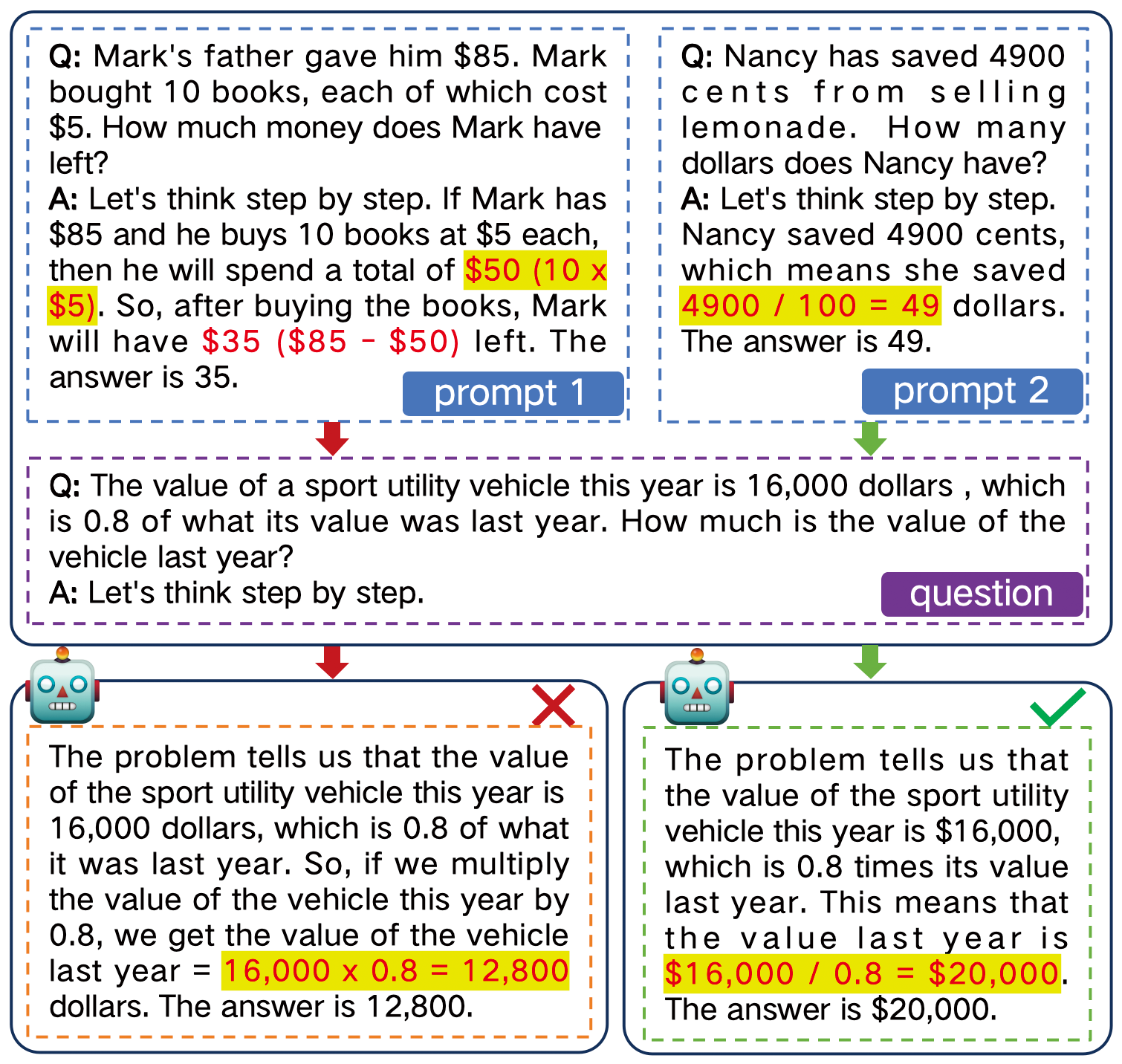
Figure 1: Example of the chain-of-thought prompting. The prompt influences how LLMs arrive at the final answer.
One effective approach to addressing these challenges is Chain of Thought (CoT) prompting (Wei et al. 2022b). By providing several demonstration examples that include a problem, intermediate reasoning steps, and an answer, CoT prompting serves as a contextual guide for downstream tasks. This approach encourages LLMs to generate multi-step logical reasoning, thereby maximizing the likelihood of producing more plausible answers. The advantage of this method lies in its simplicity and efficiency; unlike fine-tuning, it does not require extensive gradient updates or alter the model’s inherent capabilities. Instead, it acts as an external augmentation of knowledge. For different reasoning tasks, we can route the model to the appropriate context, and then easily switch the demonstration sets to activate the relevant knowledge and abilities in the corresponding domain.
However, we argue that existing unsupervised CoT prompting methods have two major shortcomings. First, there remains a significant gap between the selected demonstration sets and the reasoning targets. Although extensive research (Zhang et al. 2023; Levy, Bogin, and Berant 2023; Yang et al. 2023; Shum, Diao, and Zhang 2023a) has explored ways to provide CoT demonstrations to enhance LLMs’ reasoning capabilities, these methods largely rely on the semantic features of the problem or the answer. Such features introduce irrelevant noise on a global scale, which can obscure the logical information needed for reasoning. Consequently, the constructed demonstration sets do not effectively represent the domain-specific logical knowledge, and struggle to adequately trigger correct reasoning in LLMs. Second, some demonstration selection methods lack interpretability and scalability. These methods are primarily based on heuristic design (Wang et al. 2022; Zheng et al. 2023) or leverage the model itself to generate additional demonstrations (Zhong et al. 2024; Yasunaga et al. 2024). The demonstration sets chosen through these means inherently lack clear explanations, making it challenging to assess their effectiveness or determine the direction for further optimization. This limitation can be particularly problematic in scenarios where interpretability is crucial.
To better select a demonstration subset for a reasoning task, we believe that considering the logical patterns of reasoning is essential. Inspired by the work of (Min et al. 2022) and (Madaan, Hermann, and Yazdanbakhsh 2023), we observe that LLMs are more influenced by the templates and patterns in the context than by the correctness of the demonstrations themselves. Building on this insight, we investigate the selection of demonstrations based on Reasoning Patterns. This approach offers a dual benefit. First, it helps to eliminate bias introduced by irrelevant information, thereby reducing the gap between the demonstration set and the reasoning task. Second, it provides explicit interpretability, allowing us to gain a deeper understanding of how CoT prompting functions. This interpretability can also serve as a clue for attribution analysis and visualization.
In this work, we propose Pattern-CoT https://github.com/Magicat128/Pattern-CoT., a CoT demonstration selection method based on reasoning patterns. Unlike previous approaches that focus on overall semantics, our method targets finer-grained logical reasoning operations. For instance, in mathematical reasoning, addition and multiplication represent distinct operations, while multiple sequential operators may indicate more complex operational patterns, as shown in Figure 1. Inspired by recent studies (Yang et al. 2023), a diverse range of these patterns should be incorporated into CoT. Specifically, for a given reasoning task, we first obtain a set of seed demonstrations with rationale (intermediate reasoning steps). These examples can be sourced from the training set or generated using a zero-shot approach. We then obtain specific operation tokens tailored to different task types, which help us extract reasoning patterns from the rationales. Here, we incorporate prior knowledge and guide the LLMs in generating these operation tokens. Based on the extracted reasoning patterns, we apply clustering techniques to merge similar patterns and design metrics to automatically assess the number of demonstration categories. Finally, we select representative demonstrations from each category to enrich the diversity and construct context prompts for LLMs. Notably, by incorporating task-specific knowledge, our method improves interpretability and facilitates further scalability.
Our contributions can be summarized as follows:
- We introduce the use of diverse reasoning patterns to enhance CoT prompting and design a demonstration selection method to reduce the gap between the demonstration set and the task.
- Our method strengthens the interpretability of CoT in unsupervised scenarios, and can be utilized for further attribution analysis.
- Extensive experiments demonstrate that our method consistently enhances performance across multiple reasoning tasks and various models.
Related Work
Chain-of-Thought Prompting
Large language models have demonstrated significant ability in comprehending context and responding to prompts (Brown et al. 2020; Ouyang et al. 2022). Recent studies highlight that LLMs can achieve improved task completion without fine-tuning, particularly on reasoning tasks, when provided with few-shot demonstrations (Wei et al. 2022b). For instance, when presented with an example like Q: Mary has 9 yellow marbles. John has 3 yellow marbles. How many yellow marbles do they have in all? A: They have 9 + 3 = 12 yellow marbles. The answer is 12, LLMs are expected to emulate such a format, deconstruct the question, engage in multi-step reasoning, and refrain from generating random answers in subsequent tasks. This process is commonly referred to as chain-of-thought prompting or in-context learning (Wei et al. 2022a; Xie et al. 2022). However, implementing this practice often involves the manual design of prompts at a labour cost. Consequently, researchers are exploring more efficient example selection strategies to streamline this process.
Demonstration Selection and Refinement
Several CoT studies are directed towards automating the generation of demonstrations, such as retrieval-based (Rubin, Herzig, and Berant 2022), zero-shot (Kojima et al. 2022), clustering-based (Zhang et al. 2023), and self-prompt (Shao et al. 2023; Yasunaga et al. 2024). However, many of these approaches encounter challenges in achieving performance comparable to Manual-CoT, primarily due to the absence of supervision in example selection. In another branch of research, efforts are focused on enhancing the quality of CoT demonstrations. They incorporate elements such as knowledge-infusion (Zhao et al. 2023; Weng et al. 2023; Li et al. 2024), self-consistency (Wang et al. 2023a), complexity-based (Fu et al. 2022), contrastive-based (Chia et al. 2023), and progressive-hint (Zheng et al. 2023). The primary goal of these strategies is to ensure that LLMs adhere to the correct prompt and avoid being misled.
<details>
<summary>extracted/6276112/figures/main.png Details</summary>
### Visual Description
## Flowchart: LLM Reasoning Process for Mathematical Problem Solving
### Overview
The image depicts a multi-stage flowchart illustrating how a Large Language Model (LLM) processes and solves mathematical problems through pattern recognition, contextual reasoning, and step-by-step deduction. The diagram integrates text, symbolic representations, and visual metaphors to demonstrate the model's cognitive pipeline.
### Components/Axes
1. **Left Column (Input/Context)**
- **Dataset**: Contains three question-answer pairs (Q1, Q2, Qn) with contextual information about ages, savings, and soccer games.
- **Pattern Wise Context**: Shows reasoning patterns (e.g., division for currency conversion, multiplication for counting objects).
- **Seed Demonstrations**: Step-by-step solution for an age-related problem involving Liam and Vince.
2. **Center Column (Processing)**
- **K-Clustering & Adaptive K**: Symbolic representations of clustering algorithms with mathematical operations (√x, x).
- **Embeddings**: Boxes labeled "twice," "x," "divide," "=", and "+" representing mathematical operations.
- **Pattern Discovery**: Combines prior knowledge (globe icon) and LLM prompting (robot icon) to identify reasoning patterns.
3. **Right Column (Output)**
- **Downstream Task**: Presents a vehicle value problem with contextual information.
- **Final Answer**: Solution to the vehicle value problem ($20,000) with a green checkmark.
### Detailed Analysis
1. **Dataset Section**
- Q1: Liam's current age (16) and age two years ago.
- Q2: Three individuals (Melanie, Sally, Jessica) with unspecified quantities.
- Qn: Total soccer games (6) with unspecified distribution.
2. **Pattern Wise Context**
- Q1: Nancy's savings (4900 cents) converted to dollars (4900/100 = 49).
- Q2: Tom's beach visit duration (5 days) multiplied by seashells per day (7×5=35).
- Qk: Cat kittens problem with subtraction (9-3=6).
3. **Seed Demonstrations**
- Step-by-step solution for Liam's age problem:
- Current age: 16
- Two years ago: 16-2=14
- Equation: 14 = 2×Vince's age two years ago
- Solution: Vince's current age = 9
4. **Embeddings & Task Patterns**
- Mathematical operations visualized as boxes:
- "twice" (multiplication)
- "divide" (division)
- "=" (equality)
- "+" (addition)
- Task Patterns list:
- "twice the age of"
- "divide both sides"
- "7+2=9 years old"
5. **Final Answer**
- Vehicle value problem:
- Current value: $16,000 (0.8×last year's value)
- Calculation: $16,000 / 0.8 = $20,000
### Key Observations
1. The flowchart demonstrates hierarchical reasoning, moving from raw data (Dataset) to abstract patterns (Pattern Discovery) and finally to concrete solutions (Final Answer).
2. Mathematical operations are visually represented through labeled boxes in the Embeddings section.
3. The robot icon in LLM Prompting suggests anthropomorphic representation of the model's reasoning process.
4. The globe icon in Prior Knowledge implies integration of external information sources.
### Interpretation
This diagram illustrates how LLMs transform unstructured problems into structured reasoning chains. The Embeddings section acts as a symbolic representation of mathematical operations, while Task Patterns show the model's ability to identify and apply reasoning templates. The Final Answer demonstrates successful application of these patterns to solve novel problems, highlighting the model's capacity for:
- Pattern recognition across different problem types
- Contextual adaptation (e.g., unit conversion in Pattern Wise Context)
- Step-by-step logical deduction (Seed Demonstrations)
- Integration of prior knowledge with new information (Pattern Discovery)
The visual metaphors (robot, globe) suggest personification of the model's cognitive processes, while the mathematical operations emphasize the algorithmic nature of the reasoning. The flowchart effectively communicates the LLM's problem-solving methodology through a combination of textual examples and symbolic representations.
</details>
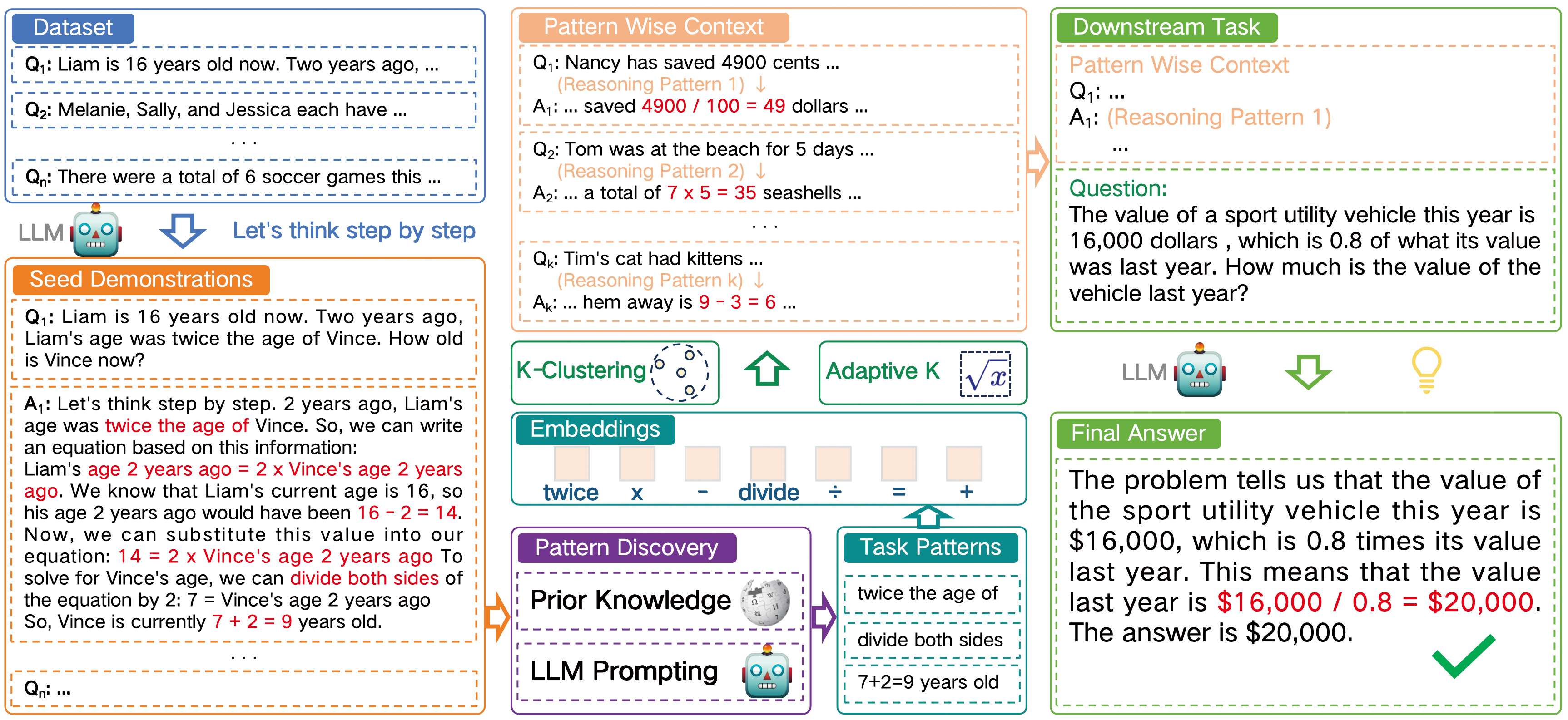
Figure 2: Illustration of our proposed framework. We first extract different patterns from the original rationales. Then clustering is used to produce a group of demonstrations. This enables LLMs to perceive diverse reasoning patterns and to select a proper solution path. It avoids LLMs being biased by monotonous reasoning mode.
Role of In-Context Patterns
To understand the underlying mechanism of ICL, (Min et al. 2022) and (Madaan, Hermann, and Yazdanbakhsh 2023) employ counterfactual prompting methods. These methods involve substituting question-answer mapping, token distributions, answer patterns, and many other factors. Their findings consistently show that the correctness of examples is not the most crucial factor, but rather the distribution or pattern (e.g. equations, templates, sentence structure) of the examples. In this paper, we continue to uncover the power of CoT patterns and show how they can improve the reasoning process.
Methodology
We now explore the impact of diverse demonstration reasoning patterns on chain-of-thought prompting. According to (Min et al. 2022), the precision of demonstrations is not crucial when LLMs engage in ICL. Even if all the demonstrations provided are incorrect, it would only marginally impede performance. This aligns with the insight derived from Auto-CoT (Zhang et al. 2023): clustering zero-shot question-answer pairs without emphasizing accuracy can still yield valuable examples. Consequently, our focus shifts to a more nuanced factor - the underlying reasoning pattern that harbours more informative content (Madaan, Hermann, and Yazdanbakhsh 2023) - to evaluate its potential benefits for the CoT process. The entire process is summarized in Figure 2 and Algorithm 1.
Seed Demonstration Collection
For a given task $Q=\{q_{1},q_{2},...,q_{N}\}$ with $N$ questions, we first need to obtain their rationales and answers $\{q_{i},r_{i},a_{i}\}$ that can be used as context for CoT prompting. For data from existing training sets, we can directly use the training data. However, in practical applications, complete training sets may not always be available. In such cases, we refer to methods like (Zhang et al. 2023; Shum, Diao, and Zhang 2023b) and leverage the zero-shot (Kojima et al. 2022) capabilities of LLMs to generate the corresponding rationales. It is important to note that we do not require the answers to be correct or labelled; our focus is on whether the generated rationales contain meaningful reasoning patterns.
Pattern Discovery
Based on the rationale set $Ra=\{r_{1},r_{2},...,r_{N}\}$ that we have obtained, we next identify the reasoning operations $T$ associated with the task. For tasks with a relatively limited action space, we can define reasoning operations using prior knowledge, as these operations represent the fundamental units of reasoning tasks. For example, in arithmetic problems, we refer to a glossary of possible operators from sources like Wikipedia The glossary of arithmetic operators refers to the Wikipedia: https://en.wikipedia.org/wiki/Glossary_of_mathematical_symbols, including basic arithmetic operations, square roots, comparison symbols, etc. For tasks with less clearly defined operations, we adapt definitions from arithmetic problems to guide LLMs in generating the corresponding reasoning operations. We design the prompt as: ‘Similar to operators used in arithmetic such as (+, -, *, /), which operators do you think best represent the [TASK]? Example of [TASK]: …’
For each rationale $r_{i}∈ Ra$ , we extract the reasoning operation tokens or phrases $t_{j}∈ T$ to form its reasoning pattern:
$$
p_{i}=f(r_{i},T)=\{t_{i1},t_{i2},...,t_{ij}\} \tag{1}
$$
where $f$ denotes the function used to extract the reasoning path. In this context, $p_{i}$ represents how LLMs apply these operations step-by-step to reach the final result, and $t_{ij}$ can repeated.
Algorithm 1 Pattern-CoT Demonstration Selection
0: A set of task questions $Q$
0: Demonstration list $d=[d_{1},d_{2},...,d_{k}]$
1: Acquire operation token set $T$ with LLMs prompting or domain knowledge based on $Q$
2: for $q_{i}∈ Q$ do
3: Generate rationale $r_{i}$ with Zero-Shot-CoT
4: $p_{i}=[]$
5: for each token $t_{ij}∈ r_{i}$ do
6: if $t_{ij}∈ T$ then
7: Update $p_{i}$ with $t_{ij}$
8: end if
9: end for
10: $\widetilde{p}_{i}=\mathrm{encode}(p_{i})$
11: end for
12: Select proper $k$
13: Cluster all $[\widetilde{p}_{1},\widetilde{p}_{2},...,\widetilde{p}_{i}]$ into $k$ clusters
14: Sample $d=[d_{1},d_{2},...,d_{k}]$ from each cluster
15: return $d$
Pattern Wise Demonstration Selection
Once we have identified the task-relevant patterns, we use them to select better demonstration sets. Following (Zhang et al. 2023), we cluster all the $p_{i}$ patterns while preserving diversity. Although $p_{i}$ is a simplified sequence of tokens, it still contains substantial semantic information that can be used to uncover underlying similarities. For instance, a sequence of addition operations is likely to be closer to a single addition operation than to a single multiplication operation. To leverage this, we use a language model to encode these patterns. We then apply the $k$ -means clustering algorithm to generate $k$ clusters and sample from each cluster:
$$
\widetilde{p}_{i}=\mathrm{encode}(p_{i}) \tag{2}
$$
$$
c_{1},c_{2},...,c_{k}=\mathrm{cluster}(\widetilde{p}_{1},\widetilde{p}_{2},...%
,\widetilde{p}_{i}) \tag{3}
$$
$$
d=\{{q_{m},r_{m},a_{m}}|\widetilde{p}_{m}\in c_{m},m=1,2,...,k\} \tag{4}
$$
where $d$ denotes the demonstration set, $c_{k}$ denotes the $k$ -th cluster. Specifically, we use patterns primarily to select demonstrations rather than directly as context for downstream tasks. We utilize the original problem $q_{k}$ and rationale $r_{k}$ corresponding to the $p_{k}$ patterns as the CoT input.
Number of Demonstrations
Since previous methods lack knowledge-based guidance, the choice of $k$ is often based on heuristic values. However, having too many demonstrations does not proportionally enhance the performance (Wei et al. 2022b; Agarwal et al. 2024), while too few may fail to adequately capture the task’s characteristics. By incorporating reasoning operations, we can use the number of these operations to inform a more reasonable choice for $k$ :
$$
k=\lceil\frac{1}{2}\times n\times(1+\mathrm{log}(N))\rceil \tag{5}
$$
where $n$ denotes the number of identified operations, and $\lceil\rceil$ represents the ceiling function that rounds up to the nearest integer. This formula empirically takes into account the impact of the number of operation types on the number of demonstrations and further adjusts based on the sample size.
Experiments
In this section, our objective is to evaluate the effectiveness of our proposed method and answer the following research questions:
- RQ1: Does incorporating reasoning patterns enhance the effectiveness of CoT prompting?
- RQ2: How do the reasoning patterns influence the outputs of LLMs?
- RQ3: Is our method robust and scalable to other models?
| Dataset | Samples | Operation Tokens |
| --- | --- | --- |
| GSM8K | 1319 | $+,-,×,/$ |
| ‘more’, ‘less’, ‘twice’, ‘half’ | | |
| AQuA | 254 | $+,-,×,/,\pi,\sqrt{x},x^{n},x^{\circ},log$ |
| MultiArith | 600 | $+,-,×,/$ |
| AddSub | 395 | |
| SingleEq | 508 | |
| SVAMP | 1000 | |
| Coin | 500 | ‘heads up’, ‘tails up’ |
| Date | 369 | ‘day’, ‘week’, |
| ‘month’, ‘year’ | | |
| ‘yesterday’, ‘tomorrow’ | | |
Table 1: The number of samples and operation tokens.
Experimental Setup
Datasets.
We adopt eight representative datasets for our reasoning tasks: MultiArith (Roy and Roth 2015), GSM8K (Cobbe et al. 2021), AddSub (Hosseini et al. 2014), AQUA-RAT (Ling et al. 2017), SingleEq (Koncel-Kedziorski et al. 2015), SVAMP (Patel, Bhattamishra, and Goyal 2021), Coin-Flip (Wei et al. 2022b), and BIG-bench Date Understanding (Srivastava et al. 2023). They require certain reasoning steps and are commonly used for CoT method comparisons (Wei et al. 2022b; Kojima et al. 2022; Zhang et al. 2023; Wang et al. 2023b; Fu et al. 2022).
For tasks MultiArith, AddSub, SingleEq, and SVAMP, we define the set of operation tokens based on a glossary from Wikipedia, as the operations involved are relatively straightforward. For tasks GSM8K and AQUA, we expand the operation token vocabulary manually based on data distribution. For tasks Coin-Flip and BIG-bench Date Understanding, we prompt GPT-4 to generate the corresponding operation tokens. The specific details of the datasets can be found in Table 1.
| LLaMA-2 Model 7b-chat-hf (+ SC) | MultiArith Zero-Shot-CoT 79.83 | GSM8K 72.33 27.14 | AddSub 21.00 62.78 | AQuA 57.97 21.65 | SingleEq 24.01 68.11 | SVAMP 57.67 47.60 | Coin 41.90 52.80 | Date 44.60 40.37 | 39.29 |
| --- | --- | --- | --- | --- | --- | --- | --- | --- | --- |
| Random-CoT | 76.16 | 24.41 | 65.59 | 22.44 | 66.14 | 46.59 | 48.00 | 44.44 | |
| Auto-CoT | 76.00 | 26.99 | 58.48 | 24.01 | 64.96 | 43.80 | 51.20 | 44.71 | |
| Auto-CoT-RA | 74.83 | 26.76 | 63.29 | 23.80 | 66.92 | 45.19 | 48.00 | 43.08 | |
| Ours | 79.66 | 27.45 | 65.06 | 28.34 | 71.85 | 48.50 | 59.40 | 45.79 | |
| Ours (Adaptive $k$ ) | 79.66* | 28.05 | 67.08 | 29.13 | 71.85* | 48.50* | 58.40 | 46.34 | |
| 13b-chat-hf | Zero-Shot-CoT | 77.50 | 34.49 | 60.75 | 15.74 | 69.29 | 49.40 | 47.40 | 46.07 |
| Auto-CoT | 82.16 | 36.77 | 63.03 | 25.19 | 70.67 | 55.50 | 54.20 | 53.93 | |
| Auto-CoT-RA | 82.16 | 37.04 | 62.08 | 27.74 | 66.14 | 52.10 | 62.80 | 54.47 | |
| Ours | 83.16 | 37.68 | 65.82 | 26.37 | 74.80 | 56.39 | 57.40 | 56.91 | |
| Ours (Adaptive $k$ ) | 83.16* | 38.44 | 64.81 | 31.49 | 74.80* | 56.39* | 67.80 | 60.97 | |
Table 2: Accuracy (%) on eight reasoning datasets. We present the mean value obtained from five runs. * denotes the situation where $k$ does not change, and results are copied from above. For the Random-CoT method, we report the best result since we are concerned about the potential of CoT. For the self-consistency method, we set the number of paths as 5 (Wang et al. 2023a).
Language Models.
To facilitate subsequent interpretability analysis, we select open-source models as our reasoning engine. Specifically, we use models from the LLaMA-2 family due to their foundational logical reasoning capabilities and support for CoT prompting. These models are deployed on our local server, which is equipped with 8 RTX 3090 GPUs, each with 24GB of memory. Due to hardware constraints, we test only the 7B and 13B models. Experiments with larger models or those from other families are discussed in subsequent sections.
We use the inference functions of these models, and the process does not involve training or fine-tuning. Additionally, we set the hyperparameters with a temperature of 0.4 and top_p of 0.9 to manage the model’s randomness (Xu et al. 2022). To maintain consistency with (Zhang et al. 2023), we use Sentence-BERT (Reimers and Gurevych 2019) as our encoder and select the ‘all-MiniLM-L6-v2’ model for semantic vector representation. This model has also been proven effective in our experiments.
Baselines.
We primarily compare our methods with unsupervised methods including Zero-Shot-CoT (Kojima et al. 2022), Random-CoT, Auto-CoT (Zhang et al. 2023), and Self-Consistency (Wang et al. 2023a). Building on Auto-CoT, we introduce an additional variant, Auto-CoT-RA, which replaces the original question embedding with the rationale embedding for clustering. The purpose of this modification is to investigate whether this subtle shift can implicitly uncover the underlying patterns in reasoning. Unless otherwise specified, our method uses the same $k$ value as the baseline in experiments. Additionally, we conduct experiments using our method with the adaptive $k$ value that we designed.
Main Results (RQ1)
Table 2 presents the overall performance of various methods on the 7B and 13B models. Since our primary goal is to evaluate whether focusing on diverse patterns provides more benefit to reasoning than semantic information, we are not concerned with identifying which model achieves state-of-the-art performance. Based on these results, we make the following observations:
- Overall, our method consistently outperforms the baseline approaches. This stable improvement indicates that by introducing diverse reasoning patterns, we can identify more representative demonstration sets, where each example embodies a different reasoning strategy. Using these diverse examples as context for LLMs can further enhance their ability to solve downstream tasks.
- We observe that for arithmetic problems with a limited set of operation tokens, such as MultiArith, AddSub, SingleEq, and SVAMP, our method achieves more significant improvements compared to methods based on semantic information. This suggests that the demonstration sets we construct can effectively cover the majority of reasoning paths, thereby providing comprehensive guidance for LLMs to select appropriate reasoning patterns.
- For datasets with a relatively broader action space, like GSM8K and AQuA, the improvements are less significant. This implies that a limited number of examples do not fully capture the diversity of reasoning patterns. However, when we recalculate the number of clusters using adaptive $k$ and expand the demonstration set, we observe additional gains on these two datasets.
- Surprisingly, we find that for datasets like Coin and Date, where the operation patterns are not explicitly defined, our method actually lead to greater improvements. We hypothesize that this is because the questions in these datasets are quite similar, making it difficult to distinguish them based on semantic features alone. In contrast, leveraging reasoning patterns allows us to identify representative examples from a different dimension. Additionally, both of these datasets show further performance improvements when using adaptive $k$ .
<details>
<summary>extracted/6276112/figures/subset.png Details</summary>
### Visual Description
## Bar Chart: The Accuracy of Different Operation Sets
### Overview
The chart compares the accuracy of three operation sets ("basic operation subset," "supplemental subset," and "full set") across two datasets ("GSM8K" and "AQuA"). Accuracy is measured on a scale from 23 to 30, with the "full set" consistently achieving the highest performance.
### Components/Axes
- **X-axis (Dataset)**: Two categories: "GSM8K" (left) and "AQuA" (right).
- **Y-axis (Accuracy)**: Numerical scale from 23 to 30, labeled "Accuracy."
- **Legend**:
- Gray: "basic operation subset"
- Blue: "supplemental subset"
- Orange: "full set"
- **Bar Groups**: Each dataset has three adjacent bars corresponding to the three operation sets.
### Detailed Analysis
- **GSM8K Dataset**:
- Basic operation subset: ~25.3 (gray bar)
- Supplemental subset: ~25.6 (blue bar)
- Full set: ~27.5 (orange bar)
- **AQuA Dataset**:
- Basic operation subset: ~25.1 (gray bar)
- Supplemental subset: ~27.7 (blue bar)
- Full set: ~28.3 (orange bar)
### Key Observations
1. The "full set" operation achieves the highest accuracy in both datasets, with a ~2.2-point advantage over the "supplemental subset" in GSM8K and a ~0.6-point advantage in AQuA.
2. The "supplemental subset" outperforms the "basic operation subset" in both datasets (~0.3 points in GSM8K, ~2.1 points in AQuA).
3. AQuA shows higher overall accuracy than GSM8K for all operation sets, with the largest gap in the "supplemental subset" (~2.1 points).
### Interpretation
The data suggests that expanding the operation set from "basic" to "full" significantly improves accuracy, particularly in the AQuA dataset. The "supplemental subset" bridges much of the performance gap between basic and full sets, indicating that additional operations contribute meaningfully to results. The consistent superiority of the "full set" implies that comprehensive operation coverage is critical for high-accuracy performance, with AQuA's complexity potentially amplifying this effect. The smaller improvement from "supplemental" to "full" in AQuA (~0.6 points) versus GSM8K (~2.2 points) may reflect diminishing returns in more complex tasks or dataset-specific operational efficiencies.
</details>
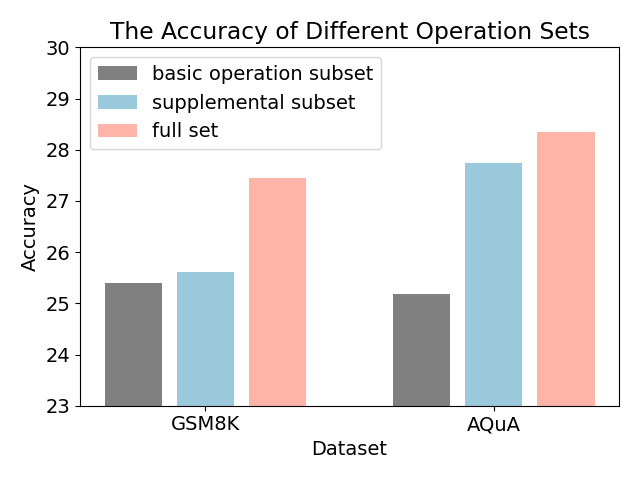
Figure 3: Comparison of different operation sets.
| Q: Mark’s father gave him $85. Mark bought 10 books, each of which cost $5. How much money does Mark have left? A: Let’s think step by step. If Mark has $85 and he buys 10 books at $5 each, then he will spend a total of $50 (10 x $5). So, after buying the books, Mark will have $35 ($85 - $50) left. The answer is 35. | Q: Tom was at the beach for 5 days and found 7 seashells every day. How many seashells did Tom find during the beach trip? A: Let’s think step by step. If Tom found 7 seashells every day, then he found a total of 7 x 5 = 35 seashells during his entire beach trip. The answer is 35. |
| --- | --- |
| Q: Mike has 48 books. Alyssa has 8 times more books than Mike. How many dozen books does Alyssa have? A: Let’s think step by step. If Mike has 48 books, then Alyssa has 8 times that number = 8 x 48 = 384 books. So Alyssa has 384 books. The answer is 384. | Q: Nancy has saved 4900 cents from selling lemonade. How many dollars does Nancy have? A: Let’s think step by step. Nancy saved 4900 cents, which means she saved 4900 / 100 = 49 dollars. The answer is 49. |
| Q: The value of a sport utility vehicle this year is 16,000 dollars , which is 0.8 of what its value was last year. How much is the value of the vehicle last year? | Q: The value of a sport utility vehicle this year is 16,000 dollars , which is 0.8 of what its value was last year. How much is the value of the vehicle last year? |
| A: Let’s think step by step. The problem tells us that the value of the sport utility vehicle this year is 16,000 dollars, which is 0.8 of what it was last year. So, if we multiply the value of the vehicle this year by 0.8, we get the value of the vehicle last year = 16,000 x 0.8 = 12,800 dollars. The answer is 12,800. | A: Let’s think step by step. The problem tells us that the value of the sport utility vehicle this year is $16,000, which is 0.8 times its value last year. This means that the value last year is $16,000 / 0.8 = $20,000. The answer is $20,000. |
Table 3: Case study of Auto-CoT and our method for demonstration selection and downstream inference. The upper questions and answers are demonstrations constructed by two methods, and the lower part contains how LLMs solve the inference task.
| MultiArith | 8 | 2 | 25.0% |
| --- | --- | --- | --- |
| GSM8K | 8 | 5 | 62.5% |
| AddSub | 8 | 3 | 37.5% |
| AQuA | 4 | 4 | 100% |
| SingleEq | 8 | 2 | 25.0% |
| SVAMP | 8 | 6 | 75% |
| Coin | 8 | 3 | 37.5% |
| Date | 8 | 1 | 12.5% |
Table 4: The number of demonstrations and their error rate for each dataset.
There are several additional observations. For instance, in some cases, Auto-CoT-RA outperforms Auto-CoT, while in others it does not. This suggests that simply shifting from question semantics to rationale semantics does not necessarily narrow the gap between demonstrations and the reasoning task. Deeper reasoning patterns can still be obscured by irrelevant information. Moreover, in certain situations, using a random demonstration set can also surpass Auto-CoT, although this improvement is inconsistent. This indirectly highlights that other factors, such as underlying reasoning patterns, can influence the effectiveness of examples. Our method, in most cases, demonstrates a more stable ability to uncover these factors.
Impact of Operation Tokens (RQ1)
To further assess the impact of reasoning patterns, we conduct additional experiments. Given that GSM8K and AQuA datasets utilize additional operation tokens, we removed some of these tokens to determine their influence. Specifically, we categorize the expanded operation tokens into a basic operation subset, such as $\{+,-,×,/\}$ , similar to other arithmetic tasks, and the remaining tokens as supplementary subsets. These subsets represent only a portion of the reasoning patterns within these two datasets.
Figure 3 shows the results of using different subsets on the 7B model. The experimental results demonstrate that using operation subsets as reasoning pattern tokens can degrade overall performance. The primary reason for this is that these subsets do not sufficiently cover the task’s logical scope. It leads to a lack of diversity. However, when the full set of operations is utilized, a broader range of scenarios can be activated, allowing the model to better adapt to the task.
Case Study (RQ2)
To gain a deeper understanding of CoT prompting, we perform a case study. Table 3 presents a typical instance analysis. We observe that Auto-CoT, due to its introduction of numerous irrelevant patterns, tends to distort the reasoning results of LLMs. In contrast, our method, which includes a diverse set of reasoning pattern templates, enables the model to generate correct responses.
<details>
<summary>extracted/6276112/figures/Figure_case1.png Details</summary>
### Visual Description
## Heatmap: Token Attribution Analysis
### Overview
The image is a heatmap visualizing token attribution values across multiple categories. The data is organized in a grid with rows and columns labeled with mathematical expressions, numerical ranges, and currency values. A color scale on the right maps values from -1.0 (red) to 1.0 (green), with yellow representing near-zero values. The heatmap contains numerical values in each cell, indicating the magnitude and direction of token attribution.
---
### Components/Axes
#### Row Labels (Left):
- **—** (Row 1)
- **1** (Row 2)
- **6** (Row 3)
- **x** (Row 4)
- **—** (Row 5)
- **—** (Row 6)
- **8** (Row 7)
- **—** (Row 8)
- **=** (Row 9)
#### Column Labels (Top):
- **8 x 48 = 384** (Column 1)
- **3 x 4 = 12** (Column 2)
- **6 - 4 = 2** (Column 3)
- **50(10x5)** (Column 4)
- **$35 ($85 - $50)** (Column 5)
#### Legend (Right):
- **Color Scale**:
- **Green** (positive values, 0.0–1.0)
- **Yellow** (near-zero values, -0.5 to 0.5)
- **Red** (negative values, -1.0 to -0.5)
---
### Detailed Analysis
#### Row 1 (—):
- **8 x 48 = 384**: 0.3452
- **3 x 4 = 12**: 0.2580
- **6 - 4 = 2**: 0.5823
- **50(10x5)**: 0.0161
- **$35 ($85 - $50)**: -0.0472
#### Row 2 (1):
- **8 x 48 = 384**: 0.0811
- **3 x 4 = 12**: -0.0066
- **6 - 4 = 2**: -0.0037
- **50(10x5)**: 0.3934
- **$35 ($85 - $50)**: -0.0356
#### Row 3 (6):
- **8 x 48 = 384**: 0.0234
- **3 x 4 = 12**: 0.0145
- **6 - 4 = 2**: 0.0512
- **50(10x5)**: 0.0243
- **$35 ($85 - $50)**: 0.0135
#### Row 4 (x):
- **8 x 48 = 384**: 1.3714
- **3 x 4 = 12**: 0.6865
- **6 - 4 = 2**: 0.1771
- **50(10x5)**: 0.6837
- **$35 ($85 - $50)**: -0.3675
#### Row 5 (—):
- **8 x 48 = 384**: -0.0009
- **3 x 4 = 12**: -0.0009
- **6 - 4 = 2**: -0.0016
- **50(10x5)**: -0.0211
- **$35 ($85 - $50)**: -0.0011
#### Row 6 (—):
- **8 x 48 = 384**: 0.0000
- **3 x 4 = 12**: 0.0000
- **6 - 4 = 2**: -0.0000
- **50(10x5)**: 0.0000
- **$35 ($85 - $50)**: -0.0001
#### Row 7 (8):
- **8 x 48 = 384**: 0.0001
- **3 x 4 = 12**: 0.0002
- **6 - 4 = 2**: 0.0002
- **50(10x5)**: -0.0001
- **$35 ($85 - $50)**: -0.0002
#### Row 8 (—):
- **8 x 48 = 384**: 0.0009
- **3 x 4 = 12**: 0.0013
- **6 - 4 = 2**: 0.0023
- **50(10x5)**: -0.0061
- **$35 ($85 - $50)**: -0.0099
#### Row 9 (=):
- **8 x 48 = 384**: -0.0005
- **3 x 4 = 12**: 0.0008
- **6 - 4 = 2**: 0.0012
- **50(10x5)**: 0.0025
- **$35 ($85 - $50)**: 0.0016
---
### Key Observations
1. **Highest Positive Value**: 1.3714 in Row 4 (x) under "8 x 48 = 384".
2. **Highest Negative Value**: -0.3675 in Row 4 (x) under "$35 ($85 - $50)".
3. **Zeros in Middle Rows**: Rows 5–6 (—) show near-zero values, indicating minimal attribution.
4. **Mixed Trends**: Row 4 (x) has both extreme positive and negative values, suggesting strong opposing relationships.
5. **Small Magnitudes**: Most values are below 0.1 in absolute terms, except for Row 4.
---
### Interpretation
The heatmap reveals that token attribution varies significantly across categories. The "x" row (Row 4) exhibits the strongest attribution, with a high positive value (1.3714) for "8 x 48 = 384" and a notable negative value (-0.3675) for "$35 ($85 - $50)". This suggests a critical relationship between the "x" category and the mathematical expression "8 x 48 = 384", while the currency-based category "$35 ($85 - $50)" shows a moderate negative attribution.
The middle rows (Rows 5–6) with near-zero values indicate minimal or no attribution, possibly reflecting neutral or irrelevant factors. The color scale confirms that positive values (green) and negative values (red) are distributed unevenly, with the "x" row being the most dynamic. The data may represent a model's sensitivity to specific inputs, where "x" acts as a key variable influencing outcomes. The presence of both high positive and negative values in Row 4 highlights potential contradictions or trade-offs in the system being analyzed.
</details>
<details>
<summary>extracted/6276112/figures/Figure_case2.png Details</summary>
### Visual Description
## Heatmap: Token Attribution Values Across Symbolic Equations
### Overview
The image displays a heatmap visualizing token attribution values for symbolic equations. The grid contains numerical values ranging from -1.5 to 1.5, with a color gradient from red (negative) to green (positive). The y-axis lists symbolic tokens (e.g., $, 1, 6, ., /, -, _, 0, 8, =), while the x-axis labels represent arithmetic operations (e.g., 9+3=12, 7x5=35). The heatmap reveals patterns in how tokens contribute to equation solutions.
### Components/Axes
- **Y-Axis (Rows)**: Symbolic tokens:
`$`, `1`, `6`, `.`, `/`, `-`, `_`, `0`, `.`, `8`, `=`
- **X-Axis (Columns)**: Arithmetic operations:
`9+3=12`, `7x5=35`, `4900/100=49`, `9-3=6`, `6-6=0`
- **Legend**: Color scale from red (-1.5) to green (1.5), labeled "Token Attribution"
- **Grid Values**: Numerical values in each cell (e.g., -0.0756, 1.9074)
### Detailed Analysis
#### Row-by-Row Breakdown
1. **Row `$`**:
Values: `-0.0756`, `0.0216`, `0.0065`, `0.0144`, `-0.0691`
Trend: Mixed small positive/negative values, no dominant pattern.
2. **Row `1`**:
Values: `0.0198`, `-0.0041`, `-0.0987`, `0.0141`, `-0.0096`
Trend: Small magnitudes, slight negative bias in middle columns.
3. **Row `6`**:
Values: `0.0001`, `0.0000`, `-0.0004`, `0.0000`, `-0.0000`
Trend: Near-zero values, suggesting minimal attribution.
4. **Row `.`**:
Values: `0.0017`, `-0.0041`, `-0.0351`, `-0.0060`, `-0.0070`
Trend: Small negative values, concentrated in middle columns.
5. **Row `/`**:
Values: `3.8820`, `0.0909`, `1.9074`, `0.6336`, `0.6902`
Trend: **Dominant positive values**, especially in `7x5=35` (1.9074) and `6-6=0` (0.6902).
6. **Row `-`**:
Values: `0.0005`, `0.0006`, `-0.0048`, `-0.0003`, `-0.0002`
Trend: Near-zero values with minor negative fluctuations.
7. **Row `_`**:
Values: `0.0003`, `0.0005`, `-0.0004`, `0.0000`, `0.0001`
Trend: Near-zero values, no significant pattern.
8. **Row `0`**:
Values: `0.0058`, `0.0362`, `0.0022`, `0.0116`, `0.0091`
Trend: Small positive values, consistent across columns.
9. **Row `.` (second instance)**:
Values: `0.0005`, `0.0006`, `0.0000`, `0.0002`, `0.0002`
Trend: Near-zero values, negligible attribution.
10. **Row `8`**:
Values: `0.0014`, `0.0003`, `0.0012`, `0.0001`, `0.0002`
Trend: Tiny positive values, no clear trend.
11. **Row `=`**:
Values: `0.0017`, `0.0026`, `0.0024`, `0.0007`, `0.0021`
Trend: Small positive values, consistent across columns.
#### Color-Legend Correlation
- **Dark Green**: High positive values (e.g., `1.9074` in `/` row, `7x5=35` column).
- **Light Green/Yellow**: Moderate positive values (e.g., `0.6902` in `/` row, `6-6=0` column).
- **Red**: Negative values (e.g., `-0.0987` in `1` row, `7x5=35` column).
- **Near-White**: Values close to zero (e.g., `0.0000` in `6` row).
### Key Observations
1. **Dominance of `/` Token**:
The `/` row exhibits the highest attribution values, particularly in `7x5=35` (1.9074) and `6-6=0` (0.6902). This suggests the `/` token plays a critical role in these equations.
2. **Zero Contribution of `6` Token**:
The `6` row contains near-zero values, indicating it has minimal impact on equation solutions.
3. **Negative Attributions**:
Negative values (e.g., `-0.0987`, `-0.0756`) suggest inhibitory effects in specific contexts, such as the `1` row interacting with `7x5=35`.
4. **Consistency in `=` Token**:
The `=` row shows uniformly small positive values, implying a stable role in equation resolution.
### Interpretation
The heatmap highlights the `/` token as a key contributor to arithmetic operations, particularly in multiplication (`7x5=35`) and subtraction (`6-6=0`). The near-zero values for `6` and `_` suggest these tokens are less critical in this context. Negative attributions (e.g., in the `1` row) may reflect contextual dependencies or cancellations in symbolic reasoning. The `=` token’s consistent positive values underscore its foundational role in equation structure. This pattern aligns with expectations for a model trained on arithmetic tasks, where division and equality operations are central to problem-solving.
</details>
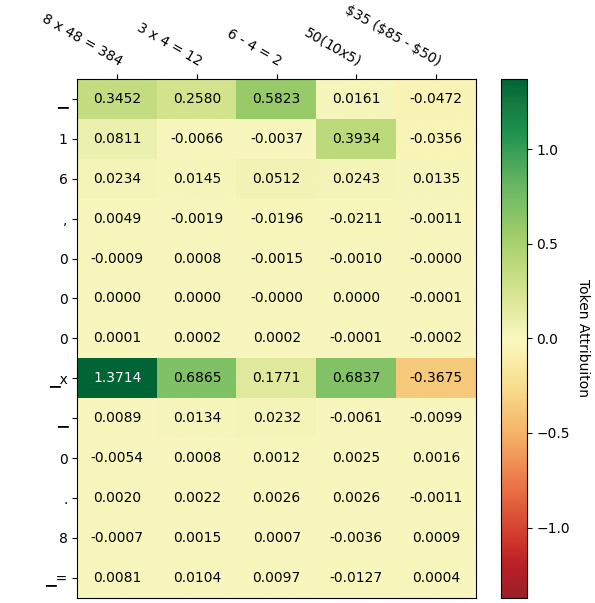
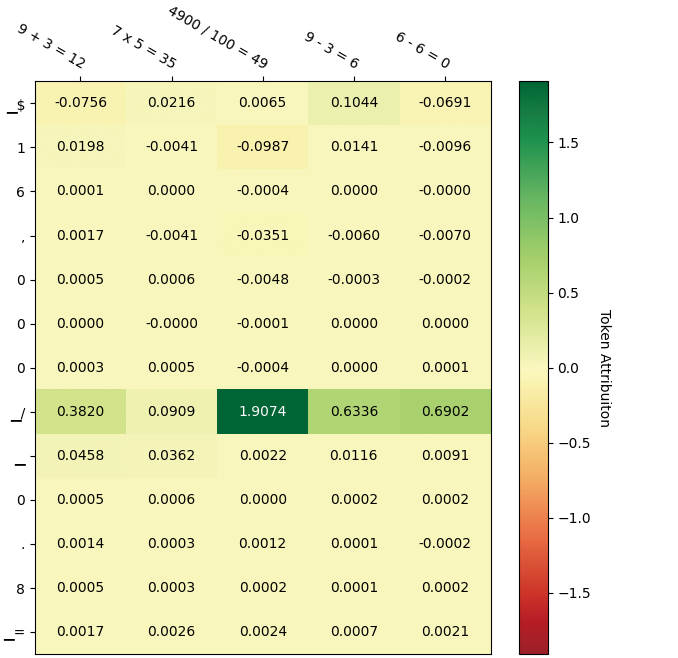
Figure 4: Visualization of token attribution for the case study. The left part stands for the score matrix of patterns from Auto-CoT, and the right part stands for the score matrix from our method. The upper column denotes each individual prompt, and the row denotes the generated token sequence. Higher scores (positive) indicate that the input has a greater impact on the output.
Feature Attribution (RQ2)
Following the previous case study, we seek to understand why different contextual reasoning patterns alter the output of LLMs. Specifically, we employ a perturbation-based feature attribution analysis method (Winter 2002) to aid in this understanding. Traditional attention-based analysis methods have been criticized for their inability to identify the most significant features (Wiegreffe and Pinter 2019; Zhao et al. 2024), which is why we turned to this perturbation-based approach. By masking portions of the input tokens, we recompute the generation probabilities for each output token to assess the input’s attribution impact on these output tokens. We use Captum (Miglani et al. 2023) to achieve this visualization. Figure 4 presents the attribution analysis matrix for the case study. According to the visualization results, we find that when a particular pattern is overly dense in the examples, the model tends to activate related knowledge, which can lead to biased reasoning processes. Conversely, when these patterns are more diverse, the model is more likely to activate the correct reasoning pathways. Our method, by enhancing the diversity of patterns in the demonstrations, effectively reduces the distance to the reasoning task objectives.
| GPT-3.5 Auto-CoT Ours | Zero-Shot 81.26 83.54 | 83.29 58.66 62.38 | 59.44 91.53 93.11 | 90.55 |
| --- | --- | --- | --- | --- |
| Qwen | Zero-Shot | 54.93 | 35.03 | 69.07 |
| Auto-CoT | 62.53 | 30.31 | 80.31 | |
| Ours | 67.59 | 33.46 | 82.08 | |
Table 5: Result of GPT-3.5-turbo-0125 and Qwen-7b-chat model on different datasets.
Error Robustness (RQ3)
It is worth mentioning that we do not impose supervision on the labels of the demonstrations. Therefore, we proceed to count the number of incorrect instances within the selected set, as shown in Table 4. It is intriguing to notice that the majority of our provided demonstrations are imperfect, with AQuA even exhibiting a 100% error rate. This phenomenon suggests that LLMs struggle to discern incorrect instances from correct ones. Instead, they learn from how the example approaches problem-solving, which we refer to as ‘pattern’. Our method encourages LLMs to follow the most probable reasoning chain towards the final answer and thus leads to a significant improvement.
Results on Other Models (RQ3)
To determine whether our method is applicable to different models, we test it on various LLM branches. Specifically, we select the GPT series to represent larger and more advanced models, and Qwen to represent multilingual models. For the sake of hardware resources and budget constraints, we experiment with the GPT-3.5-turbo and Qwen-7B models. Table 5 presents the performance of several methods on these models. Notably, the experiments show that Auto-CoT, in some cases, underperforms compared to direct answering on these models. We attribute this to the inherent noise in semantics-based methods. Our approach mitigates this noise, resulting in more consistent performance improvements.
Conclusion
This paper aims to address the noise issue inherent in unsupervised semantic-based CoT methods and proposes a reasoning pattern-based approach for CoT demonstration selection. Our method explicitly enhances the interpretability of reasoning processes and illustrates how LLMs can be guided toward generating accurate answers. Extensive experiments validate the effectiveness, robustness, and compatibility of our approach.
Acknowledgements
This work was supported by the National Key R&D Program of China (Grant No.2023ZD0120400), Beijing Natural Science Foundation (L247028), National Natural Science Foundation of China (No. 62276260, 62076235), Beijing Municipal Science and Technology Project (Z231100007423004). We sincerely thank all reviewers and ACs for their insightful comments, time and efforts.
References
- Agarwal et al. (2024) Agarwal, R.; Singh, A.; Zhang, L. M.; Bohnet, B.; Rosias, L.; Chan, S.; Zhang, B.; Anand, A.; Abbas, Z.; Nova, A.; Co-Reyes, J. D.; Chu, E.; Behbahani, F.; Faust, A.; and Larochelle, H. 2024. Many-Shot In-Context Learning. arXiv:2404.11018.
- Brown et al. (2020) Brown, T.; Mann, B.; Ryder, N.; Subbiah, M.; Kaplan, J. D.; Dhariwal, P.; Neelakantan, A.; Shyam, P.; Sastry, G.; Askell, A.; et al. 2020. Language models are few-shot learners. Advances in Neural Information Processing Systems, 33: 1877–1901.
- Chia et al. (2023) Chia, Y. K.; Chen, G.; Tuan, L. A.; Poria, S.; and Bing, L. 2023. Contrastive Chain-of-Thought Prompting. arXiv:2311.09277.
- Cobbe et al. (2021) Cobbe, K.; Kosaraju, V.; Bavarian, M.; Chen, M.; Jun, H.; Kaiser, L.; Plappert, M.; Tworek, J.; Hilton, J.; Nakano, R.; Hesse, C.; and Schulman, J. 2021. Training Verifiers to Solve Math Word Problems. arXiv:2110.14168.
- Fu et al. (2022) Fu, Y.; Peng, H.; Sabharwal, A.; Clark, P.; and Khot, T. 2022. Complexity-based prompting for multi-step reasoning. arXiv preprint arXiv:2210.00720.
- Hosseini et al. (2014) Hosseini, M. J.; Hajishirzi, H.; Etzioni, O.; and Kushman, N. 2014. Learning to Solve Arithmetic Word Problems with Verb Categorization. In Moschitti, A.; Pang, B.; and Daelemans, W., eds., Proceedings of the 2014 Conference on Empirical Methods in Natural Language Processing (EMNLP), 523–533. Doha, Qatar: Association for Computational Linguistics.
- Huang and Chang (2023) Huang, J.; and Chang, K. C.-C. 2023. Towards Reasoning in Large Language Models: A Survey. In Rogers, A.; Boyd-Graber, J.; and Okazaki, N., eds., Findings of the Association for Computational Linguistics: ACL 2023, 1049–1065. Toronto, Canada: Association for Computational Linguistics.
- Kojima et al. (2022) Kojima, T.; Gu, S. S.; Reid, M.; Matsuo, Y.; and Iwasawa, Y. 2022. Large language models are zero-shot reasoners. Advances in Neural Information Processing Systems, 35: 22199–22213.
- Koncel-Kedziorski et al. (2015) Koncel-Kedziorski, R.; Hajishirzi, H.; Sabharwal, A.; Etzioni, O.; and Ang, S. D. 2015. Parsing Algebraic Word Problems into Equations. Transactions of the Association for Computational Linguistics, 3: 585–597.
- Kwiatkowski et al. (2019) Kwiatkowski, T.; Palomaki, J.; Redfield, O.; Collins, M.; Parikh, A.; Alberti, C.; Epstein, D.; Polosukhin, I.; Devlin, J.; Lee, K.; et al. 2019. Natural questions: a benchmark for question answering research. Transactions of the Association for Computational Linguistics, 7: 453–466.
- Levy, Bogin, and Berant (2023) Levy, I.; Bogin, B.; and Berant, J. 2023. Diverse Demonstrations Improve In-context Compositional Generalization. In Rogers, A.; Boyd-Graber, J.; and Okazaki, N., eds., Proceedings of the 61st Annual Meeting of the Association for Computational Linguistics (Volume 1: Long Papers), 1401–1422. Toronto, Canada: Association for Computational Linguistics.
- Li et al. (2024) Li, X.; Zhao, R.; Chia, Y. K.; Ding, B.; Joty, S.; Poria, S.; and Bing, L. 2024. Chain-of-Knowledge: Grounding Large Language Models via Dynamic Knowledge Adapting over Heterogeneous Sources. In International Conference on Learning Representations ICLR 2024.
- Ling et al. (2017) Ling, W.; Yogatama, D.; Dyer, C.; and Blunsom, P. 2017. Program Induction by Rationale Generation: Learning to Solve and Explain Algebraic Word Problems. In Barzilay, R.; and Kan, M.-Y., eds., Proceedings of the 55th Annual Meeting of the Association for Computational Linguistics (ACL), 158–167. Vancouver, Canada: Association for Computational Linguistics.
- Madaan, Hermann, and Yazdanbakhsh (2023) Madaan, A.; Hermann, K.; and Yazdanbakhsh, A. 2023. What Makes Chain-of-Thought Prompting Effective? A Counterfactual Study. In Findings of the Association for Computational Linguistics: EMNLP 2023, 1448–1535.
- Miglani et al. (2023) Miglani, V.; Yang, A.; Markosyan, A. H.; Garcia-Olano, D.; and Kokhlikyan, N. 2023. Using Captum to Explain Generative Language Models. arXiv:2312.05491.
- Min et al. (2022) Min, S.; Lyu, X.; Holtzman, A.; Artetxe, M.; Lewis, M.; Hajishirzi, H.; and Zettlemoyer, L. 2022. Rethinking the Role of Demonstrations: What Makes In-Context Learning Work? In Goldberg, Y.; Kozareva, Z.; and Zhang, Y., eds., Proceedings of the 2022 Conference on Empirical Methods in Natural Language Processing, 11048–11064. Abu Dhabi, United Arab Emirates: Association for Computational Linguistics.
- Ouyang et al. (2022) Ouyang, L.; Wu, J.; Jiang, X.; Almeida, D.; Wainwright, C.; Mishkin, P.; Zhang, C.; Agarwal, S.; Slama, K.; Ray, A.; et al. 2022. Training language models to follow instructions with human feedback. Advances in Neural Information Processing Systems, 35: 27730–27744.
- Patel, Bhattamishra, and Goyal (2021) Patel, A.; Bhattamishra, S.; and Goyal, N. 2021. Are NLP Models really able to Solve Simple Math Word Problems? In Proceedings of the 2021 Conference of the North American Chapter of the Association for Computational Linguistics: Human Language Technologies, 2080–2094. Online: Association for Computational Linguistics.
- Qiao et al. (2023) Qiao, S.; Ou, Y.; Zhang, N.; Chen, X.; Yao, Y.; Deng, S.; Tan, C.; Huang, F.; and Chen, H. 2023. Reasoning with Language Model Prompting: A Survey. In Rogers, A.; Boyd-Graber, J.; and Okazaki, N., eds., Proceedings of the 61st Annual Meeting of the Association for Computational Linguistics (Volume 1: Long Papers), 5368–5393. Toronto, Canada: Association for Computational Linguistics.
- Reimers and Gurevych (2019) Reimers, N.; and Gurevych, I. 2019. Sentence-BERT: Sentence Embeddings using Siamese BERT-Networks. In Proceedings of the 2019 Conference on Empirical Methods in Natural Language Processing (EMNLP). Association for Computational Linguistics.
- Roy and Roth (2015) Roy, S.; and Roth, D. 2015. Solving General Arithmetic Word Problems. In Màrquez, L.; Callison-Burch, C.; and Su, J., eds., Proceedings of the 2015 Conference on Empirical Methods in Natural Language Processing (EMNLP), 1743–1752. Lisbon, Portugal: Association for Computational Linguistics.
- Rubin, Herzig, and Berant (2022) Rubin, O.; Herzig, J.; and Berant, J. 2022. Learning To Retrieve Prompts for In-Context Learning. In Carpuat, M.; de Marneffe, M.-C.; and Meza Ruiz, I. V., eds., Proceedings of the 2022 Conference of the North American Chapter of the Association for Computational Linguistics: Human Language Technologies, 2655–2671. Seattle, United States: Association for Computational Linguistics.
- Shao et al. (2023) Shao, Z.; Gong, Y.; Shen, Y.; Huang, M.; Duan, N.; and Chen, W. 2023. Synthetic prompting: Generating chain-of-thought demonstrations for large language models. arXiv preprint arXiv:2302.00618.
- Shum, Diao, and Zhang (2023a) Shum, K.; Diao, S.; and Zhang, T. 2023a. Automatic Prompt Augmentation and Selection with Chain-of-Thought from Labeled Data. In Bouamor, H.; Pino, J.; and Bali, K., eds., Findings of the Association for Computational Linguistics: EMNLP 2023, 12113–12139. Singapore: Association for Computational Linguistics.
- Shum, Diao, and Zhang (2023b) Shum, K.; Diao, S.; and Zhang, T. 2023b. Automatic Prompt Augmentation and Selection with Chain-of-Thought from Labeled Data. In Bouamor, H.; Pino, J.; and Bali, K., eds., Findings of the Association for Computational Linguistics: EMNLP 2023, 12113–12139. Singapore: Association for Computational Linguistics.
- Srivastava et al. (2023) Srivastava, A.; Rastogi, A.; Rao, A.; Shoeb, A. A. M.; Abid, A.; Fisch, A.; Brown, A. R.; Santoro, A.; Gupta, A.; Garriga-Alonso, A.; et al. 2023. Beyond the Imitation Game: Quantifying and extrapolating the capabilities of language models. Transactions on Machine Learning Research.
- Wang et al. (2023a) Wang, X.; Wei, J.; Schuurmans, D.; Le, Q.; Chi, E.; Narang, S.; Chowdhery, A.; and Zhou, D. 2023a. Self-Consistency Improves Chain of Thought Reasoning in Language Models. In The Eleventh International Conference on Learning Representations ICLR 2023.
- Wang et al. (2022) Wang, X.; Wei, J.; Schuurmans, D.; Le, Q.; Chi, E.; and Zhou, D. 2022. Rationale-Augmented Ensembles in Language Models. arXiv:2207.00747.
- Wang et al. (2023b) Wang, X.; Zhu, W.; Saxon, M.; Steyvers, M.; and Wang, W. Y. 2023b. Large language models are latent variable models: Explaining and finding good demonstrations for in-context learning. In Thirty-seventh Conference on Neural Information Processing Systems.
- Wei et al. (2022a) Wei, J.; Tay, Y.; Bommasani, R.; Raffel, C.; Zoph, B.; Borgeaud, S.; Yogatama, D.; Bosma, M.; Zhou, D.; Metzler, D.; Chi, E. H.; Hashimoto, T.; Vinyals, O.; Liang, P.; Dean, J.; and Fedus, W. 2022a. Emergent Abilities of Large Language Models. Transactions on Machine Learning Research. Survey Certification.
- Wei et al. (2022b) Wei, J.; Wang, X.; Schuurmans, D.; Bosma, M.; Xia, F.; Chi, E.; Le, Q. V.; Zhou, D.; et al. 2022b. Chain-of-thought prompting elicits reasoning in large language models. Advances in Neural Information Processing Systems, 35: 24824–24837.
- Weng et al. (2023) Weng, Y.; Zhu, M.; Xia, F.; Li, B.; He, S.; Liu, S.; Sun, B.; Liu, K.; and Zhao, J. 2023. Large Language Models are Better Reasoners with Self-Verification. In Bouamor, H.; Pino, J.; and Bali, K., eds., Findings of the Association for Computational Linguistics: EMNLP 2023, 2550–2575. Singapore: Association for Computational Linguistics.
- Wiegreffe and Pinter (2019) Wiegreffe, S.; and Pinter, Y. 2019. Attention is not not Explanation. In Inui, K.; Jiang, J.; Ng, V.; and Wan, X., eds., Proceedings of the 2019 Conference on Empirical Methods in Natural Language Processing and the 9th International Joint Conference on Natural Language Processing (EMNLP-IJCNLP), 11–20. Hong Kong, China: Association for Computational Linguistics.
- Winter (2002) Winter, E. 2002. The shapley value. Handbook of game theory with economic applications, 3: 2025–2054.
- Xie et al. (2022) Xie, S. M.; Raghunathan, A.; Liang, P.; and Ma, T. 2022. An Explanation of In-context Learning as Implicit Bayesian Inference. In International Conference on Learning Representations ICLR 2022.
- Xu et al. (2022) Xu, F. F.; Alon, U.; Neubig, G.; and Hellendoorn, V. J. 2022. A systematic evaluation of large language models of code. In Proceedings of the 6th ACM SIGPLAN International Symposium on Machine Programming, 1–10.
- Yang et al. (2023) Yang, Z.; Zhang, Y.; Sui, D.; Liu, C.; Zhao, J.; and Liu, K. 2023. Representative Demonstration Selection for In-Context Learning with Two-Stage Determinantal Point Process. In Proceedings of the 2023 Conference on Empirical Methods in Natural Language Processing, 5443–5456.
- Yasunaga et al. (2024) Yasunaga, M.; Chen, X.; Li, Y.; Pasupat, P.; Leskovec, J.; Liang, P.; Chi, E. H.; and Zhou, D. 2024. Large Language Models as Analogical Reasoners. In International Conference on Learning Representations ICLR 2024.
- Zhang et al. (2023) Zhang, Z.; Zhang, A.; Li, M.; and Smola, A. 2023. Automatic Chain of Thought Prompting in Large Language Models. In The Eleventh International Conference on Learning Representations ICLR 2023.
- Zhao et al. (2024) Zhao, H.; Chen, H.; Yang, F.; Liu, N.; Deng, H.; Cai, H.; Wang, S.; Yin, D.; and Du, M. 2024. Explainability for large language models: A survey. ACM Transactions on Intelligent Systems and Technology, 15(2): 1–38.
- Zhao et al. (2023) Zhao, R.; Li, X.; Joty, S.; Qin, C.; and Bing, L. 2023. Verify-and-Edit: A Knowledge-Enhanced Chain-of-Thought Framework. In Rogers, A.; Boyd-Graber, J.; and Okazaki, N., eds., Proceedings of the 61st Annual Meeting of the Association for Computational Linguistics (ACL), 5823–5840. Toronto, Canada: Association for Computational Linguistics.
- Zheng et al. (2023) Zheng, C.; Liu, Z.; Xie, E.; Li, Z.; and Li, Y. 2023. Progressive-Hint Prompting Improves Reasoning in Large Language Models. arXiv:2304.09797.
- Zhong et al. (2024) Zhong, Q.; Wang, K.; Xu, Z.; Liu, J.; Ding, L.; Du, B.; and Tao, D. 2024. Achieving 97% on GSM8K: Deeply Understanding the Problems Makes LLMs Better Solvers for Math Word Problems. arXiv:2404.14963.