# Improve Mathematical Reasoning in Language Models by Automated Process Supervision
**Authors**: Liangchen Luo, Yinxiao Liu, Rosanne Liu, Samrat Phatale, Meiqi Guo, Harsh Lara, Yunxuan Li, Lei Shu, Yun Zhu, Lei Meng, Jiao Sun, Abhinav Rastogi
> Google DeepMind
> Google
Corresponding author:
see the cls
Abstract
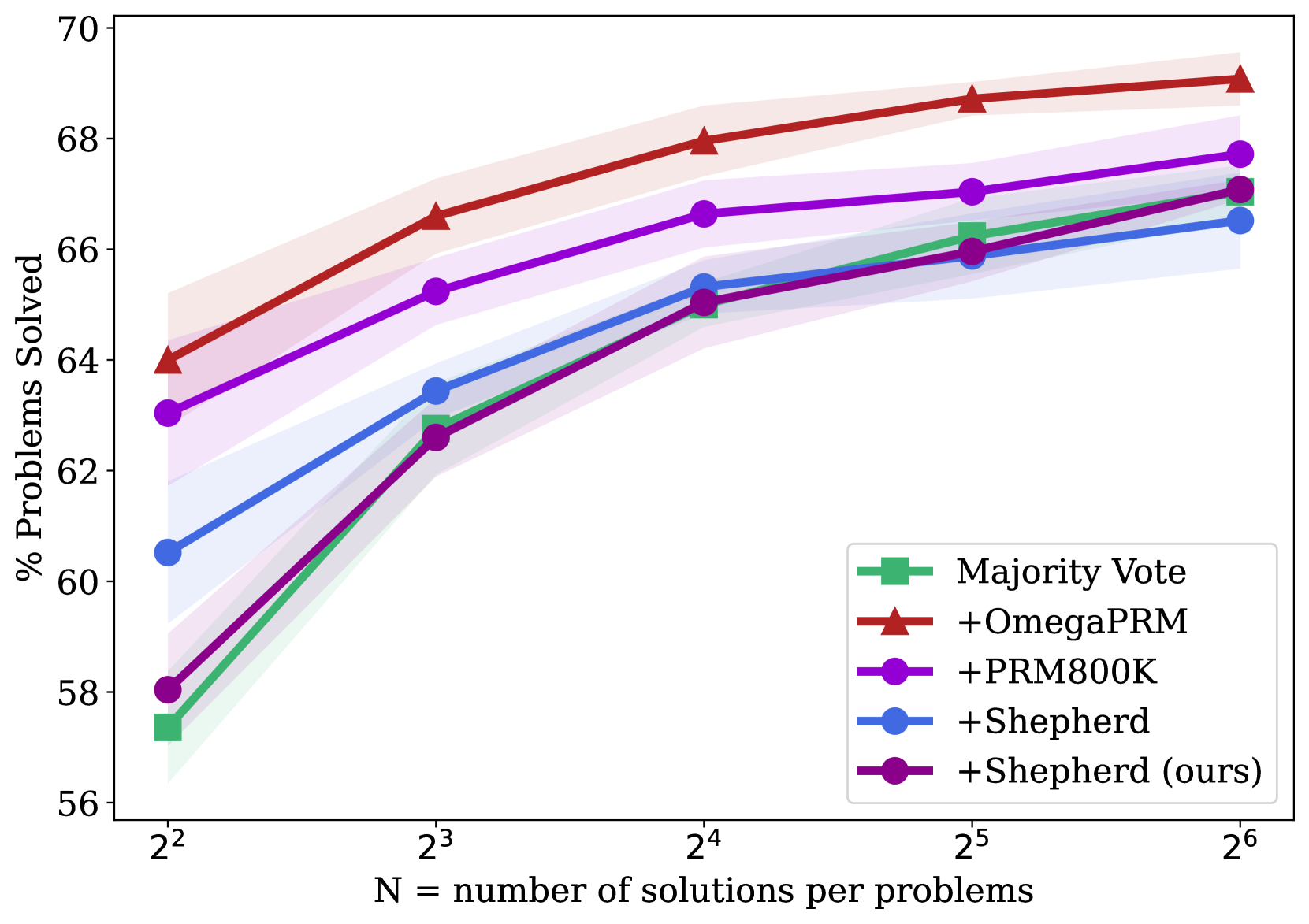
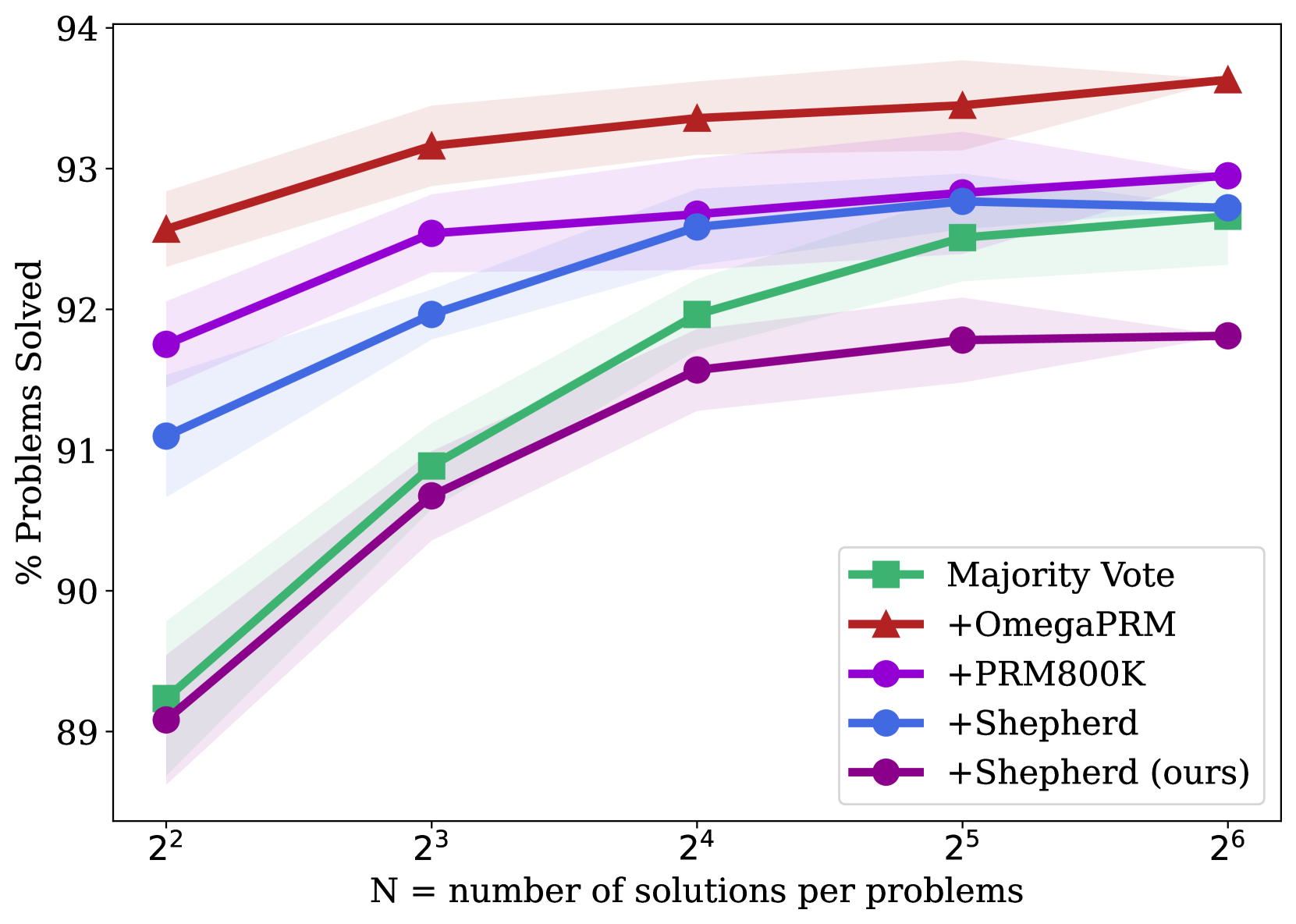
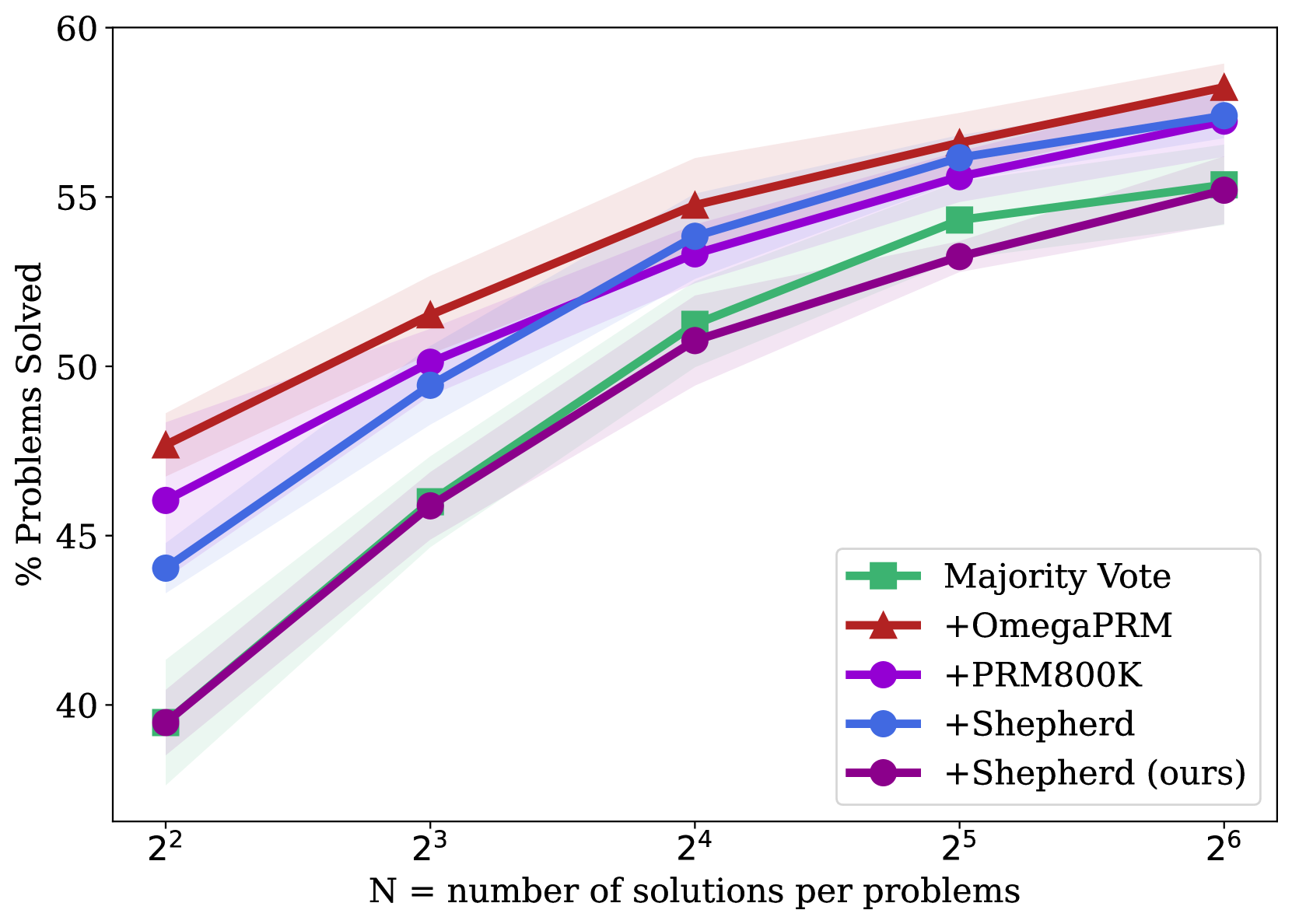
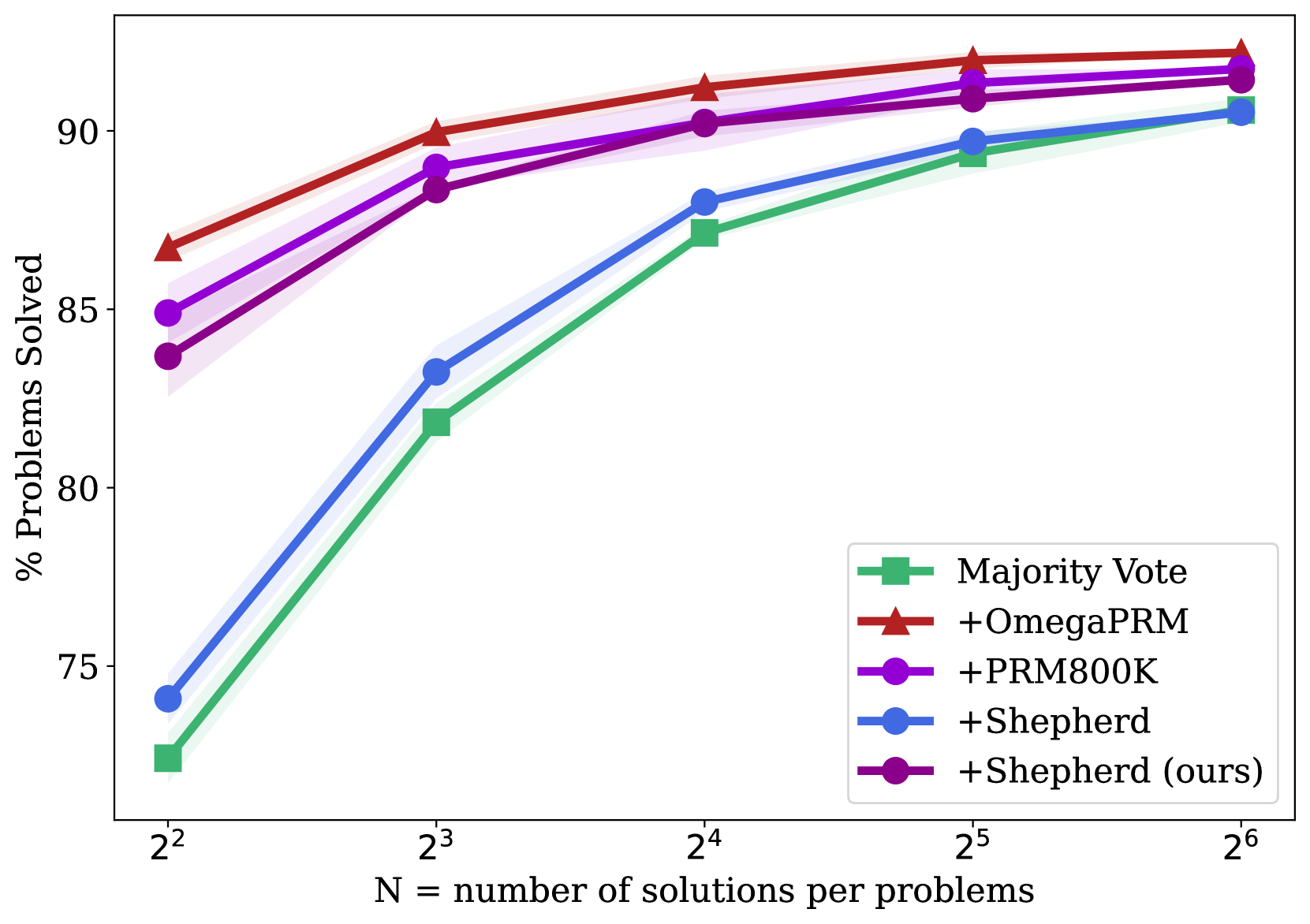
Complex multi-step reasoning tasks, such as solving mathematical problems or generating code, remain a significant hurdle for even the most advanced large language models (LLMs). Verifying LLM outputs with an Outcome Reward Model (ORM) is a standard inference-time technique aimed at enhancing the reasoning performance of LLMs. However, this still proves insufficient for reasoning tasks with a lengthy or multi-hop reasoning chain, where the intermediate outcomes are neither properly rewarded nor penalized. Process supervision addresses this limitation by assigning intermediate rewards during the reasoning process. To date, the methods used to collect process supervision data have relied on either human annotation or per-step Monte Carlo estimation, both prohibitively expensive to scale, thus hindering the broad application of this technique. In response to this challenge, we propose a novel divide-and-conquer style Monte Carlo Tree Search (MCTS) algorithm named OmegaPRM for the efficient collection of high-quality process supervision data. This algorithm swiftly identifies the first error in the Chain of Thought (CoT) with binary search and balances the positive and negative examples, thereby ensuring both efficiency and quality. As a result, we are able to collect over 1.5 million process supervision annotations to train Process Reward Models (PRMs). This fully automated process supervision alongside the weighted self-consistency algorithm is able to enhance LLMs’ math reasoning performances. We improved the success rates of the instruction-tuned Gemini Pro model from 51% to 69.4% on MATH500 and from 86.4% to 93.6% on GSM8K. Similarly, we boosted the success rates of Gemma2 27B from 42.3% to 58.2% on MATH500 and from 74.0% to 92.2% on GSM8K. The entire process operates without any human intervention or supervision, making our method both financially and computationally cost-effective compared to existing methods.
1 Introduction
Despite the impressive advancements achieved by scaling Large Language Models (LLMs) on established benchmarks (Wei et al., 2022a), cultivating more sophisticated reasoning capabilities, particularly in domains like mathematical problem-solving and code generation, remains an active research area. Chain-of-thought (CoT) generation is crucial for these reasoning tasks, as it decomposes complex problems into intermediate steps, mirroring human reasoning processes. Prompting LLMs with CoT examples (Wei et al., 2022b) and fine-tuning them on question-CoT solution pairs (Perez et al., 2021; Ouyang et al., 2022) have proven effective, with the latter demonstrating superior performance. Furthermore, the advent of Reinforcement Learning with Human Feedback (RLHF; Ouyang et al., 2022) has enabled the alignment of LLM behaviors with human preferences through reward models, significantly enhancing model capabilities.
<details>
<summary>extracted/6063103/figures/tree.png Details</summary>
### Visual Description
## Tree Diagram: Hierarchical Structure
### Overview
The image is a tree diagram illustrating a hierarchical structure. It consists of nodes (represented as teal circles with numbers inside) connected by lines (either light orange or light purple). The numbers on the nodes appear to represent levels or identifiers within the hierarchy. The numbers on the lines appear to represent weights or distances between the nodes.
### Components/Axes
* **Nodes:** Teal circles, each containing a unique number from 0 to 48. These represent individual elements within the hierarchical structure.
* **Edges:** Lines connecting the nodes, representing relationships between them. The edges are either light orange or light purple.
* **Edge Weights:** Numbers displayed along the edges, indicating the "cost" or "distance" between connected nodes.
### Detailed Analysis
Here's a breakdown of the connections and weights, tracing the tree from the root:
* **Node 0:** Top-center of the diagram.
* Connected to Node 1 (left) with weight 2 (light purple).
* Connected to Node 2 (right) with weight 3 (light orange).
* **Node 1:**
* Connected to Node 3 with weight 7 (light purple).
* **Node 2:**
* Connected to Node 7 with weight 14 (light orange).
* **Node 3:**
* Connected to Node 4 with weight 7 (light purple).
* Connected to Node 5 with weight 8 (light purple).
* Connected to Node 6 with weight 11 (light orange).
* **Node 7:**
* Connected to Node 8 with weight 16 (light purple).
* Connected to Node 9 with weight 17 (light purple).
* Connected to Node 10 with weight 18 (light orange).
* **Node 10:**
* Connected to Node 11 with weight 20 (light orange).
* Connected to Node 18 with weight 32 (light orange).
* Connected to Node 31 with weight 57 (light orange).
* **Node 11:**
* Connected to Node 12 with weight 21 (light purple).
* Connected to Node 13 with weight 22 (light purple).
* Connected to Node 23 with weight 42 (light orange).
* Connected to Node 24 with weight 43 (light orange).
* **Node 12:**
* Connected to Node 14 with weight 25 (light purple).
* **Node 13:**
* Connected to Node 15 with weight 26 (light purple).
* Connected to Node 25 with weight 46 (light orange).
* Connected to Node 26 with weight 47 (light orange).
* **Node 15:**
* Connected to Node 16 with weight 29 (light purple).
* Connected to Node 17 with weight 30 (light orange).
* **Node 18:**
* Connected to Node 19 with weight 34 (light purple).
* Connected to Node 20 with weight 35 (light purple).
* Connected to Node 29 with weight 54 (light orange).
* Connected to Node 30 with weight 55 (light orange).
* **Node 19:**
* Connected to Node 21 with weight 38 (light purple).
* Connected to Node 22 with weight 39 (light purple).
* **Node 31:**
* Connected to Node 32 with weight 59 (light purple).
* Connected to Node 33 with weight 60 (light purple).
* Connected to Node 45 with weight 78 (light orange).
* Connected to Node 46 with weight 79 (light orange).
* **Node 32:**
* No further connections.
* **Node 33:**
* Connected to Node 34 with weight 61 (light orange).
* **Node 34:**
* Connected to Node 35 with weight 63 (light orange).
* **Node 35:**
* Connected to Node 36 with weight 64 (light purple).
* Connected to Node 37 with weight 65 (light purple).
* Connected to Node 38 with weight 67 (light orange).
* Connected to Node 39 with weight 68 (light orange).
* **Node 40:**
* Connected to Node 41 with weight 70 (light orange).
* **Node 40:**
* Connected to Node 41 with weight 71 (light purple).
* Connected to Node 42 with weight 72 (light orange).
* **Node 41:**
* Connected to Node 43 with weight 74 (light purple).
* **Node 42:**
* Connected to Node 44 with weight 75 (light purple).
* Connected to Node 47 with weight 81 (light orange).
* Connected to Node 48 with weight 82 (light orange).
### Key Observations
* The tree structure is not perfectly balanced. Some branches are deeper than others.
* The edge weights vary significantly, suggesting different levels of "cost" or "distance" between nodes.
* The colors of the edges (light orange and light purple) might represent different types of relationships or categories, but this is not explicitly defined.
### Interpretation
The tree diagram visually represents a hierarchical relationship between different elements (nodes). The edge weights could represent the strength of the relationship, the cost of transitioning between elements, or some other relevant metric. The diagram could be used to model various systems, such as organizational structures, decision trees, or network topologies. Without further context, the specific meaning of the nodes, edges, and weights remains ambiguous. The two different colors of edges could represent different types of relationships, but this is not explicitly stated.
</details>
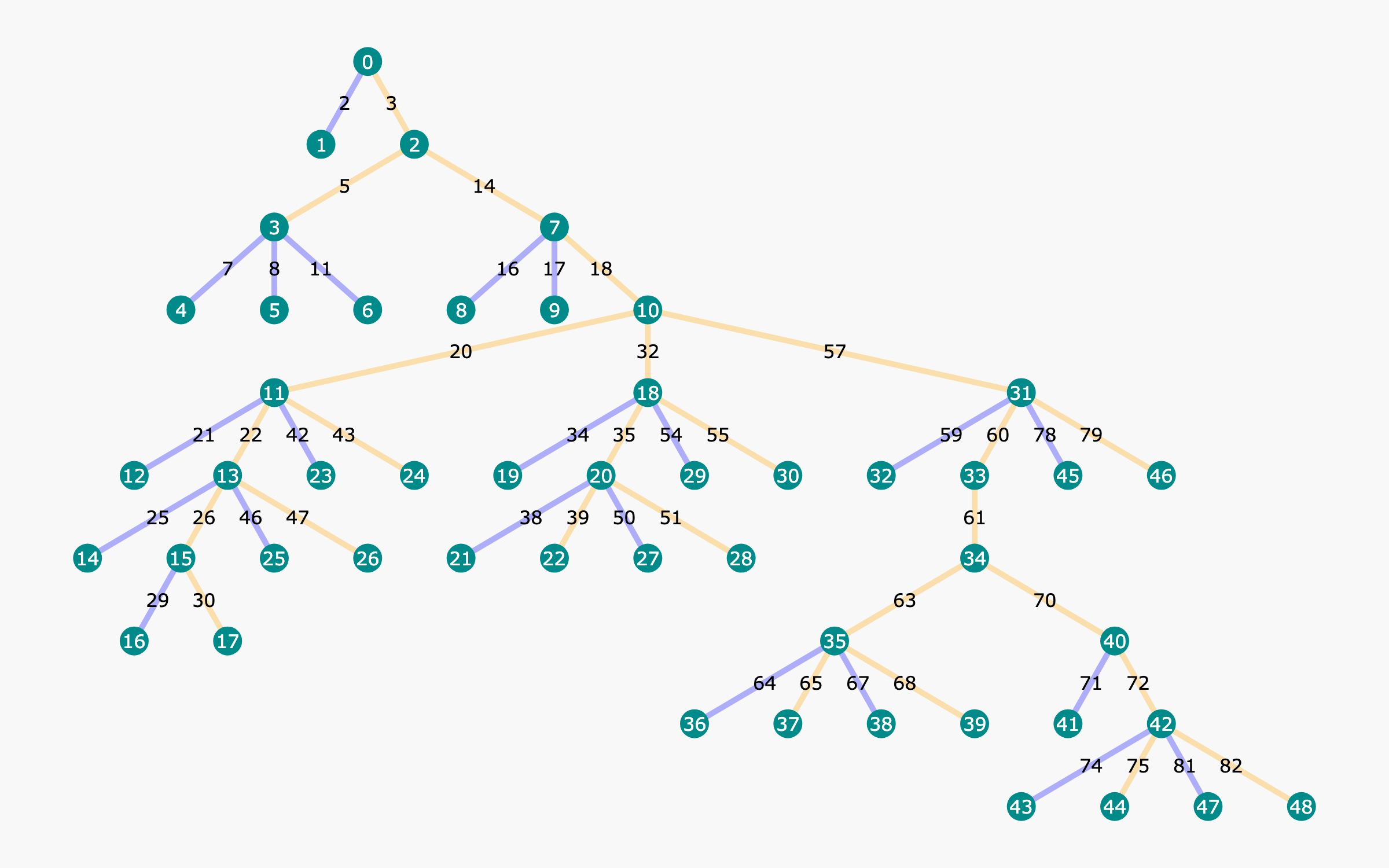
Figure 1: Example tree structure built with our proposed OmegaPRM algorithm. Each node in the tree indicates a state of partial chain-of-thought solution, with information including accuracy of rollouts and other statistics. Each edge indicates an action, i.e., a reasoning step, from the last state. Yellow edges are correct steps and blue edges are wrong.
Beyond prompting and further training, developing effective decoding strategies is another crucial avenue for improvement. Self-consistency decoding (Wang et al., 2023) leverages multiple reasoning paths to arrive at a voted answer. Incorporating a verifier, such as an off-the-shelf LLM (Huang et al., 2022; Luo et al., 2023), can further guide LLMs in reasoning tasks by providing a feedback loop to verify final answers, identify errors, and suggest corrections. However, the gain of such approaches remains limited for complex multi-step reasoning problems. Reward models offer a promising alternative to verifiers, enabling the reranking of candidate outcomes based on reward signals to ensure higher accuracy. Two primary types of reward models have emerged: Outcome Reward Models (ORMs; Yu et al., 2024; Cobbe et al., 2021), which provide feedback only at the end of the problem-solving process, and Process Reward Models (PRMs; Li et al., 2023; Uesato et al., 2022; Lightman et al., 2023), which offer granular feedback at each reasoning step. PRMs have demonstrated superior effectiveness for complex reasoning tasks by providing such fine-grained supervision.
The primary bottleneck in developing PRMs lies in obtaining process supervision signals, which require supervised labels for each reasoning step. Current approaches rely heavily on costly and labor-intensive human annotation (Uesato et al., 2022; Lightman et al., 2023). Automating this process is crucial for scalability and efficiency. While recent efforts using per-step Monte Carlo estimation have shown promise (Wang et al., 2024a, b), their efficiency remains limited due to the vast search space. To address this challenge, we introduce OmegaPRM, a novel divide-and-conquer Monte Carlo Tree Search (MCTS) algorithm inspired by AlphaGo Zero (Silver et al., 2017) for automated process supervision data collection. For each question, we build a Monte Carlo Tree, as shown in Fig. 1, with the details explained in Section 3.3. This algorithm enables efficient collection of over 1.5 million high-quality process annotations without human intervention. Our PRM, trained on this dataset and combined with weighted self-consistency decoding, significantly improves the performance of instruction-tuned Gemini Pro from 51% to 69.4% on MATH500 (Lightman et al., 2023) and from 86.4% to 93.6% on GSM8K (Cobbe et al., 2021). We also boosted the success rates of Gemma2 27B from 42.3% to 58.2% on MATH500 and from 74.0% to 92.2% on GSM8K.
Our main contributions are as follows:
- We propose a novel divide-and-conquer style Monte Carlo Tree Search algorithm for automated process supervision data generation.
- The algorithm enables the efficient generation of over 1.5 million process supervision annotations, representing the largest and highest quality dataset of its kind to date. Additionally, the entire process operates without any human annotation, making our method both financially and computationally cost-effective.
- We combine our verifier with weighted self-consistency to further boost the performance of LLM reasoning. We significantly improves the success rates from 51% to 69.4% on MATH500 and from 86.4% to 93.6% on GSM8K for instruction-tuned Gemini Pro. For Gemma2 27B, we also improved the success rates of from 42.3% to 58.2% on MATH500 and from 74.0% to 92.2% on GSM8K.
2 Related Work
Improving mathematical reasoning ability of LLMs.
Mathematical reasoning poses significant challenges for LLMs, and it is one of the key tasks for evaluating the reasoning ability of LLMs. With a huge amount of math problems in pretraining datasets, the pretrained LLMs (OpenAI, 2023; Gemini Team et al., 2024; Touvron et al., 2023) are able to solve simple problems, yet struggle with more complicated reasoning. To overcome that, the chain-of-thought (Wei et al., 2022b; Fu et al., 2023) type prompting algorithms were proposed. These techniques were effective in improving the performance of LLMs on reasoning tasks without modifying the model parameters. The performance was further improved by supervised fine-tuning (SFT; Cobbe et al., 2021; Liu et al., 2024; Yu et al., 2023) with high quality question-response pairs with full CoT reasoning steps.
Application of reward models in mathematical reasoning of LLMs.
To further improve the LLM’s math reasoning performance, verifiers can help to rank and select the best answer when multiple rollouts are available. Several works (Huang et al., 2022; Luo et al., 2023) have shown that using LLM as verifier is not suitable for math reasoning. For trained verifiers, two types of reward models are commonly used: Outcome Reward Model (ORM) and Process Reward Model (PRM). Both have shown performance boost on math reasoning over self-consistency (Cobbe et al., 2021; Uesato et al., 2022; Lightman et al., 2023), yet evidence has shown that PRM outperforms ORM (Lightman et al., 2023; Wang et al., 2024a). Generating high quality process supervision data is the key for training PRM, besides expensive human annotation (Lightman et al., 2023), Math-Shepherd (Wang et al., 2024a) and MiPS (Wang et al., 2024b) explored Monte Carlo estimation to automate the data collection process with human involvement, and both observed large performance gain. Our work shared the essence with MiPS and Math-Shepherd, but we explore further in collecting the process data using MCTS.
Monte Carlo Tree Search (MCTS).
MCTS (Świechowski et al., 2021) has been widely adopted in reinforcement learning (RL). AlphaGo (Silver et al., 2016) and AlphaGo Zero (Silver et al., 2017) were able to achieve great performance with MCTS and deep reinforcement learning. For LLMs, there are planning algorithms that fall in the category of tree search, such as Tree-of-Thought (Yao et al., 2023) and Reasoning-via-Planing (Hao et al., 2023). Recently, utilizing tree-like decoding to find the best output during the inference-time has become a hot topic to explore as well, multiple works (Feng et al., 2023; Ma et al., 2023; Zhang et al., 2024; Tian et al., 2024; Feng et al., 2024; Kang et al., 2024) have observed improvements in reasoning tasks.
3 Methods
3.1 Process Supervision
Process supervision is a concept proposed to differentiate from outcome supervision. The reward models trained with these objectives are termed Process Reward Models (PRMs) and Outcome Reward Models (ORMs), respectively. In the ORM framework, given a query $q$ (e.g., a mathematical problem) and its corresponding response $x$ (e.g., a model-generated solution), an ORM is trained to predict the correctness of the final answer within the response. Formally, an ORM takes $q$ and $x$ and outputs the probability $p=\mathrm{ORM}(q,x)$ that the final answer in the response is correct. With a training set of question-answer pairs available, an ORM can be trained by sampling outputs from a policy model (e.g., a pretrained or fine-tuned LLM) using the questions and obtaining the correctness labels by comparing these outputs with the golden answers.
In contrast, a PRM is trained to predict the correctness of each intermediate step $x_{t}$ in the solution. Formally, $p_{t}=\mathrm{PRM}([q,x_{1:t-1}],x_{t})$ , where $x_{1:i}=[x_{1},...,x_{i}]$ represents the first $i$ steps in the solution. This provides more precise and fine-grained feedback than ORMs, as it identifies the exact location of errors. Process supervision has also been shown to mitigate incorrect reasoning in the domain of mathematical problem solving. Despite these advantages, obtaining the intermediate signal for each step’s correctness to train such a PRM is non-trivial. Previous work (Lightman et al., 2023) has relied on hiring domain experts to manually annotate the labels, which is and difficult to scale.
3.2 Process Annotation with Monte Carlo Method
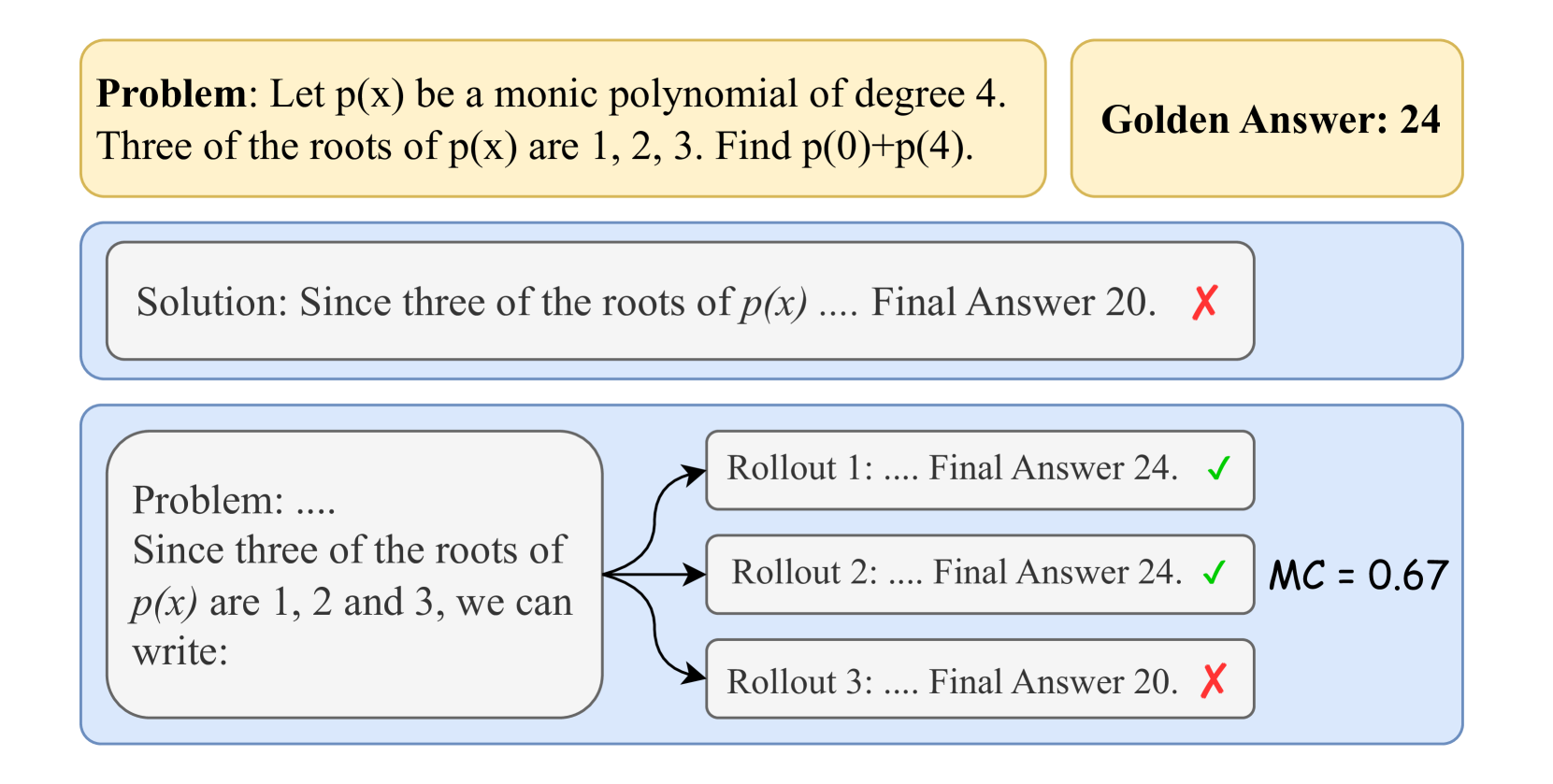
In two closely related works, Math-Shepherd (Wang et al., 2024a) and MiPS (Wang et al., 2024b), the authors propose an automatic annotation approach to obtain process supervision signals using the Monte Carlo method. Specifically, a “completer” policy is established that can take a question $q$ and a prefix solution comprising the first $t$ steps $x_{1:t}$ and output the completion — often referred to as a “rollout” in reinforcement learning — of the subsequent steps until the final answer is reached. As shown in Fig. 2 (a), for any step of a solution, the completer policy can be used to randomly sample $k$ rollouts from that step. The final answers of these rollouts are compared to the golden answer, providing $k$ labels of answer correctness corresponding to the $k$ rollouts. Subsequently, the ratio of correct rollouts to total rollouts from the $t$ -th step, as represented in Eq. 1, estimates the “correctness level” of the prefix steps up to $t$ . Regardless of false positives, $x_{1:t}$ should be considered correct as long as any of the rollouts is correct in the logical reasoning scenario.
$$
c_{t}=\mathrm{MonteCarlo}(q,x_{1:t})=\frac{\mathrm{num}(\text{correct rollouts%
from $t$-th step})}{\mathrm{num}(\text{total rollouts from $t$-th step})} \tag{1}
$$
Taking a step forward, a straightforward strategy to annotate the correctness of intermediate steps in a solution is to perform rollouts for every step from the beginning to the end, as done in both Math-Shepherd and MiPS. However, this brute-force approach requires a large number of policy calls. To optimize annotation efficiency, we propose a binary-search-based Monte Carlo estimation.
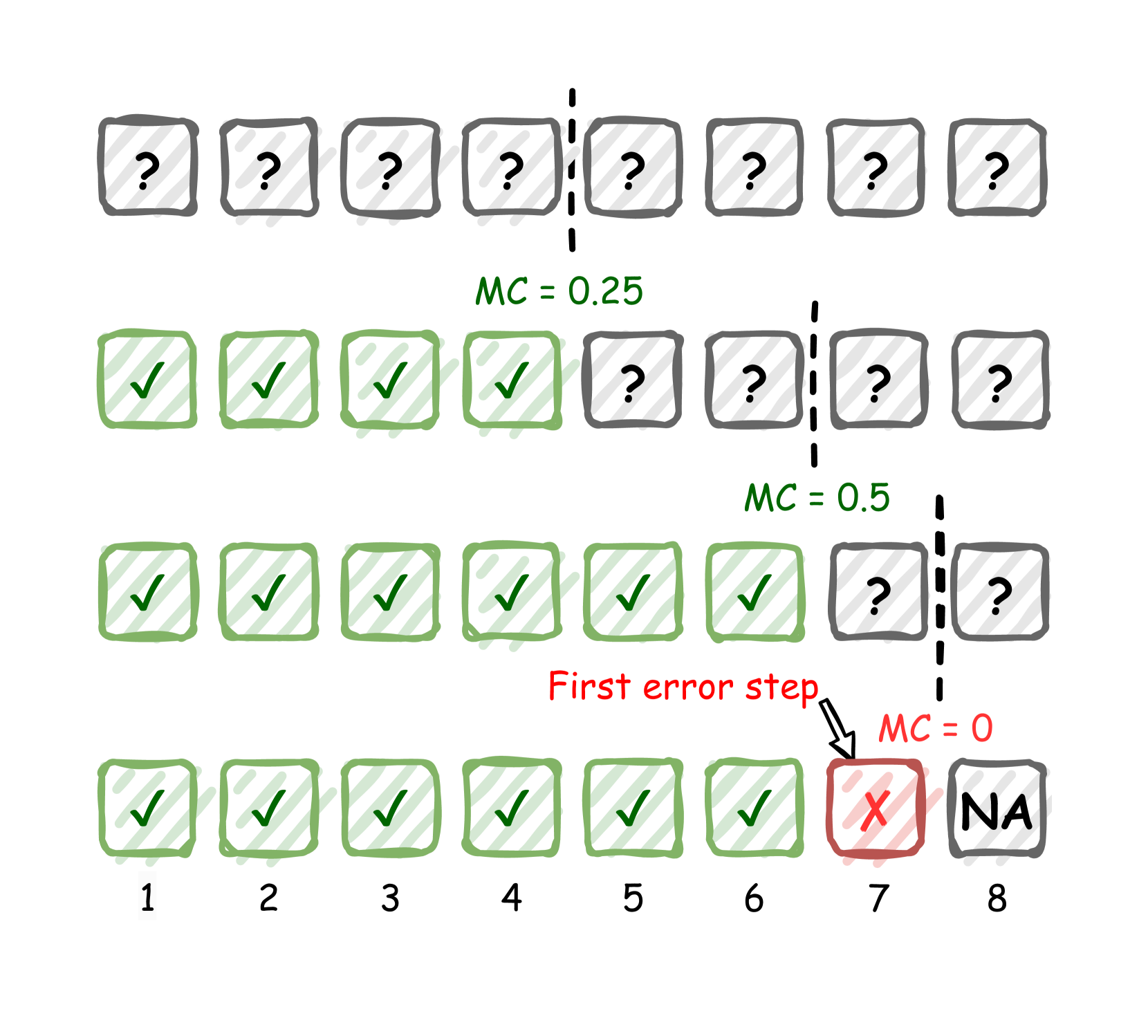
Monte Carlo estimation using binary search. As suggested by Lightman et al. (2023), supervising up to the first incorrect step in a solution is sufficient to train a PRM. Therefore, our objective is locating the first error in an efficient way. We achieve this by repeatedly dividing the solution and performing rollouts. Assuming no false positives or negatives, we start with a solution with potential errors and split it at the midpoint $m$ . We then perform rollouts for $s_{1:m}$ with two possible outcomes: (1) $c_{m}>0$ , indicating that the first half of the solution is correct, as at least one correct answer can be rolled out from $m$ -th step, and thus the error is in the second half; (2) $c_{m}=0$ , indicating the error is very likely in the first half, as none of the rollouts from $m$ -th step is correct. This process narrows down the error location to either the first or second half of the solution. As shown in Fig. 2 (b), by repeating this process on the erroneous half iteratively until the partial solution is sufficiently small (i.e., short enough to be considered as a single step), we can locate the first error with a time complexity of $O(k\log M)$ rather than $O(kM)$ in the brute-force setting, where $M$ is the total number of steps in the original solution.
3.3 Monte Carlo Tree Search
Although binary search improves the efficiency of locating the first error in a solution, we are still not fully utilizing policy calls as rollouts are simply discarded after stepwise Monte Carlo estimation. In practice, it is necessary to collect multiple PRM training examples (a.k.a., triplets of question, partial solution and correctness label) for a question (Lightman et al., 2023; Wang et al., 2024a). Instead of starting from scratch each time, we can store all rollouts during the process and conduct binary searches from any of these rollouts whenever we need to collect a new example. This approach allows for triplets with the same solution prefix but different completions and error locations. Such reasoning structures can be represented as a tree, as described in previous work like Tree of Thought (Yao et al., 2023).
Formally, consider a state-action tree representing detailed reasoning paths for a question, where a state $s$ contains the question and all preceding reasoning steps, and an action $a$ is a potential subsequent step from a specific state. The root state is the question without any reasoning steps: $r_{\text{root}}=q$ . The policy can be directly modeled by a language model as $\pi(a|s)=\mathrm{LM}(a|s)$ , and the state transition function is simply the concatenation of the preceding steps and the action step, i.e., $s^{\prime}=\mathrm{Concatenate}(s,a)$ .
Collecting PRM training examples for a question can now be formulated as constructing such a state-action tree. This reminds us the classic Monte Carlo Tree Search (MCTS) algorithm, which has been successful in many deep reinforcement learning applications (Silver et al., 2016, 2017). However, there are some key differences when using a language model as the policy. First, MCTS typically handles an environment with a finite action space, such as the game of Go, which has fewer than $361$ possible actions per state (Silver et al., 2017). In contrast, an LM policy has an infinite action space, as it can generate an unlimited number of distinct actions (sequences of tokens) given a prompt. In practice, we use temperature sampling to generate a fix number of $k$ completions for a prompt, treating the group of $k$ actions as an approximate action space. Second, an LM policy can sample a full rollout until the termination state (i.e., reaching the final answer) without too much overhead than generating a single step, enabling the possibility of binary search. Consequently, we propose an adaptation of the MCTS algorithm named OmegaPRM, primarily based on the one introduced in AlphaGo (Silver et al., 2016), but with modifications to better accommodate the scenario of PRM training data collection. We describe the algorithm details as below.
Tree Structure.
Each node $s$ in the tree contains the question $q$ and prefix solution $x_{1:t}$ , together with all previous rollouts $\{(s,r_{i})\}_{i=1}^{k}$ from the state. Each edge $(s,a)$ is either a single step or a sequence of consecutive steps from the node $s$ . The nodes also store a set of statistics,
$$
\{N(s),\mathrm{MC}(s),Q(s,r)\},
$$
where $N(s)$ denotes the visit count of a state, $\mathrm{MC}(s)$ represents the Monte Carlo estimation of a state as specified in Eq. 1, and $Q(s,r)$ is a state-rollout value function that is correlated to the chance of selecting a rollout during the selection phase of tree traversal. Specifically,
<details>
<summary>x1.png Details</summary>
### Visual Description
## Problem Solving Diagram: Polynomial Roots
### Overview
The image presents a problem involving a monic polynomial of degree 4, given three of its roots, and asks for the value of p(0) + p(4). It shows an initial incorrect solution, followed by a more detailed approach with three "rollout" attempts, two of which are correct. The diagram also indicates a "Golden Answer" and a "MC" value, likely representing Model Confidence.
### Components/Axes
* **Problem Statement (Top-Left):** "Problem: Let p(x) be a monic polynomial of degree 4. Three of the roots of p(x) are 1, 2, 3. Find p(0)+p(4)."
* **Golden Answer (Top-Right):** "Golden Answer: 24"
* **Initial Solution (Middle):** "Solution: Since three of the roots of p(x) .... Final Answer 20. X" (Marked with a red 'X', indicating incorrectness)
* **Detailed Solution Setup (Bottom-Left):** "Problem: .... Since three of the roots of p(x) are 1, 2 and 3, we can write:"
* **Rollout Attempts (Bottom-Right):**
* "Rollout 1: .... Final Answer 24. ✓" (Marked with a green checkmark, indicating correctness)
* "Rollout 2: .... Final Answer 24. ✓" (Marked with a green checkmark, indicating correctness)
* "Rollout 3: .... Final Answer 20. X" (Marked with a red 'X', indicating incorrectness)
* **Model Confidence (Bottom-Right):** "MC = 0.67"
* **Flow Arrows:** Arrows connect the "Detailed Solution Setup" to each of the "Rollout Attempts".
### Detailed Analysis or ### Content Details
* The initial solution arrives at an incorrect answer of 20.
* The detailed solution setup branches into three rollout attempts.
* Rollout 1 and Rollout 2 both arrive at the correct answer of 24.
* Rollout 3 arrives at the incorrect answer of 20.
* The model confidence (MC) is 0.67, suggesting a moderate level of confidence in the overall solution process.
### Key Observations
* The problem involves finding the value of p(0) + p(4) for a monic polynomial of degree 4, given three roots.
* The "Golden Answer" of 24 is the target value.
* Two out of three rollout attempts successfully reach the "Golden Answer".
* The initial solution is incorrect.
### Interpretation
The diagram illustrates a problem-solving process where an initial attempt fails, leading to a more detailed approach with multiple solution paths ("rollouts"). The fact that two out of three rollouts arrive at the correct answer suggests that the detailed approach is more reliable. The "Model Confidence" score of 0.67 indicates that the model has a reasonable, but not extremely high, level of certainty in the correctness of the solution. The diagram highlights the iterative nature of problem-solving and the importance of exploring multiple approaches to arrive at the correct answer.
```
</details>
(a) Monte Carlo estimation of a prefix solution.
<details>
<summary>x2.png Details</summary>
### Visual Description
## Diagram: Error Propagation
### Overview
The image depicts a diagram illustrating error propagation across a series of steps. Each step is represented by a square, and the diagram shows how errors accumulate as the process progresses. The diagram consists of four rows of squares, each representing a different stage of the process. The squares contain either a checkmark (indicating a correct step), a question mark (indicating an unknown step), an "X" (indicating an error), or "NA" (indicating not applicable). The diagram also includes labels indicating the "MC" (presumably "Misclassification Count") at different stages.
### Components/Axes
* **Rows:** Four rows representing different stages of the process.
* **Columns:** Eight columns representing individual steps within each stage, numbered 1 through 8.
* **Squares:** Each square represents a step and contains either a checkmark, question mark, "X", or "NA".
* **Labels:** "MC = 0.25", "MC = 0.5", "MC = 0", "First error step".
* **Symbols:** Checkmark (green), Question Mark (grey), X (red), NA (grey).
### Detailed Analysis
* **Row 1:** All eight squares contain question marks.
* **Row 2:** The first four squares contain green checkmarks. The remaining four squares contain question marks. A dashed vertical line separates the fourth and fifth squares, with the label "MC = 0.25" positioned between rows 1 and 2, aligned with the dashed line.
* **Row 3:** The first six squares contain green checkmarks. The last two squares contain question marks. A dashed vertical line separates the sixth and seventh squares, with the label "MC = 0.5" positioned between rows 2 and 3, aligned with the dashed line.
* **Row 4:** The first six squares contain green checkmarks. The seventh square contains a red "X". The eighth square contains "NA". An arrow points from the text "First error step" to the seventh square. A dashed vertical line separates the seventh and eighth squares, with the label "MC = 0" positioned between rows 3 and 4, aligned with the dashed line.
* **Column Labels:** The columns are labeled 1 through 8 along the bottom of the diagram.
### Key Observations
* The process starts with all steps unknown (question marks).
* The process progresses with increasing numbers of correct steps (checkmarks).
* The "MC" value increases as more steps are unknown or incorrect.
* The first error occurs in step 7, as indicated by the red "X".
* The "NA" in step 8 suggests that this step is not applicable after the error in step 7.
### Interpretation
The diagram illustrates how errors can propagate through a multi-step process. Initially, all steps are unknown. As the process progresses, steps are correctly executed (indicated by checkmarks), and the misclassification count (MC) increases as more steps are unknown. The diagram highlights the point at which the first error occurs, leading to a misclassification count of 0. After the error, the subsequent step is deemed not applicable. The diagram demonstrates the importance of error detection and correction in multi-step processes to prevent further errors and ensure accurate results. The increasing MC values suggest a cumulative effect of uncertainty as the process advances.
</details>
(b) Error locating using binary search.
<details>
<summary>x3.png Details</summary>
### Visual Description
## Diagram: Binary Tree Operations
### Overview
The image illustrates three binary tree operations: Select, Binary Search, and Maintain. Each operation is represented by a binary tree diagram showing nodes and connections. The diagrams highlight different aspects of how these operations might traverse or modify the tree structure.
### Components/Axes
* **Nodes:** Represented by teal circles, each containing a numerical value.
* **Edges:** Represented by lines connecting the nodes. Solid blue lines indicate a direct connection, while dashed yellow lines indicate a potential path or selection.
* **Labels:**
* Titles: "Select", "Binary Search", "Maintain" are placed above their respective diagrams.
* Node Values: Integers from 0 to 6 are used to label the nodes.
* Annotations: "Selected" with an arrow in the "Select" diagram, "N++" near node 0 in the "Maintain" diagram, and "MC, Q" near nodes 4, 5, and 6 in the "Maintain" diagram.
### Detailed Analysis
**1. Select (Left Diagram)**
* **Structure:** A binary tree with nodes labeled 0, 1, 2, and 3.
* **Connections:**
* Node 0 is connected to nodes 1 and 3 with solid blue lines.
* Node 1 is connected to node 2 with a solid blue line.
* Dotted lines extend from nodes 1, 2, and 3, indicating potential further branches.
* **Selection:** A dashed yellow line connects node 0 to node 1. A red arrow points to this connection, labeled "Selected".
**2. Binary Search (Middle Diagram)**
* **Structure:** A binary tree with nodes labeled 0, 1, 2, 3, 4, 5, and 6.
* **Connections:**
* Node 0 is connected to nodes 1 and 3 with solid blue lines.
* Node 1 is connected to node 2 with a solid blue line.
* Node 0 is connected to node 4 with a dashed yellow line.
* Node 4 is connected to node 5 with a dashed yellow line.
* Node 5 is connected to node 6 with a solid blue line.
**3. Maintain (Right Diagram)**
* **Structure:** A binary tree with nodes labeled 0, 1, 2, 3, 4, 5, and 6.
* **Connections:**
* Node 0 is connected to nodes 1 and 3 with dashed yellow lines.
* Node 1 is connected to node 2 with a solid blue line.
* Node 3 is connected to node 0 with a solid blue line.
* Node 0 is connected to node 4 with a dashed yellow line.
* Node 4 is connected to node 5 with a dashed yellow line.
* Node 5 is connected to node 6 with a solid blue line.
* **Annotations:**
* "N++" is located near node 0.
* "MC, Q" is located near nodes 4, 5, and 6.
### Key Observations
* The "Select" diagram focuses on choosing a specific path within the tree.
* The "Binary Search" diagram illustrates a search path through the tree.
* The "Maintain" diagram shows a tree structure with additional annotations, possibly indicating maintenance operations or metadata.
### Interpretation
The diagrams provide a high-level overview of three binary tree operations. The "Select" operation highlights the process of choosing a specific node or path. The "Binary Search" operation demonstrates how a search algorithm might traverse the tree. The "Maintain" operation suggests modifications or updates to the tree structure, possibly involving metadata or queue management ("MC, Q"). The "N++" annotation might indicate an increment operation on a node counter or identifier. The use of dashed yellow lines versus solid blue lines likely indicates a distinction between potential paths (yellow) and confirmed connections (blue).
</details>
(c) Three stages in an iteration of the MCTS process.
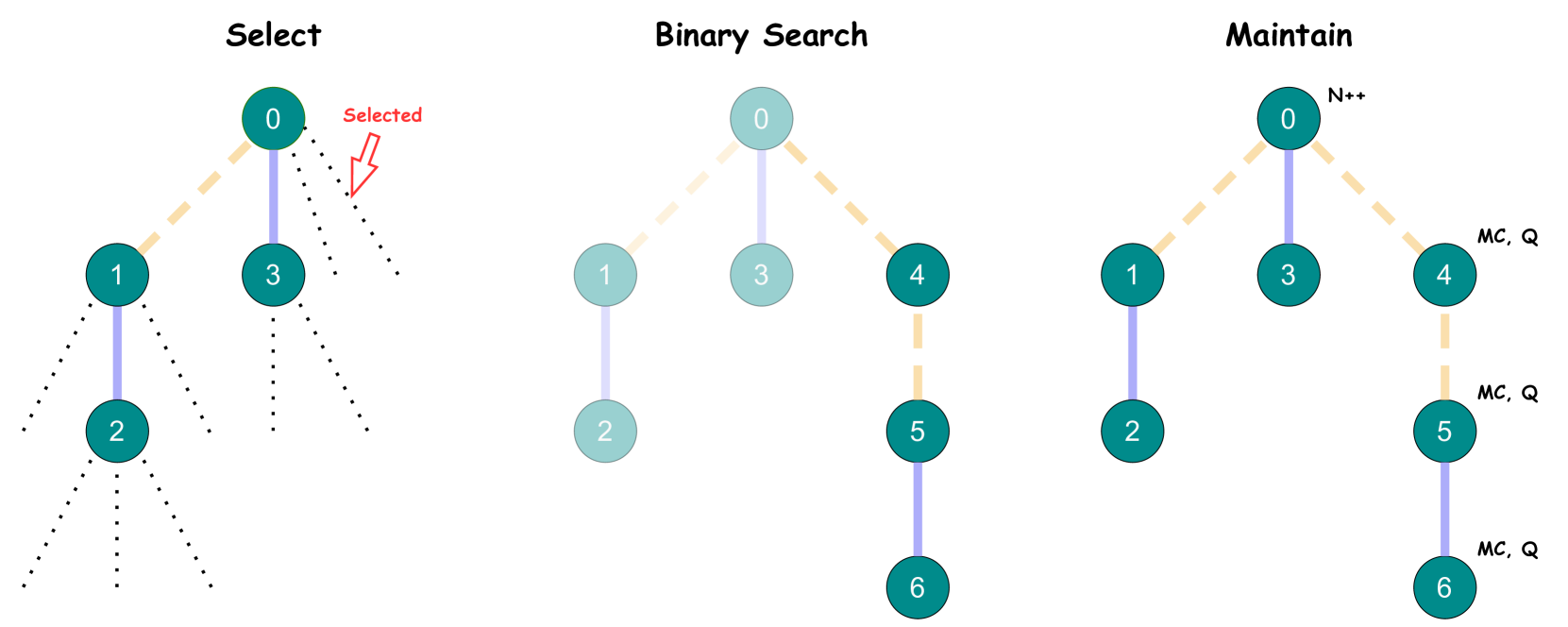
Figure 2: Illustration of the process supervision rollouts, Monte Carlo estimation using binary search and the MCTS process. (a) An example of Monte Carlo estimation of a prefix solution. Two out of the three rollouts are correct, producing the Monte Carlo estimation $\mathrm{MC}(q,x_{1:t})=2/3≈ 0.67$ . (b) An example of error locating using binary search. The first error step is located at the $7^{\text{th}}$ step after three divide-and-rollouts, where the rollout positions are indicated by the vertical dashed lines. (c) The MCTS process. The dotted lines in Select stage represent the available rollouts for binary search. The bold colored edges represent steps with correctness estimations. The yellow color indicates a correct step, i.e., with a preceding state $s$ that $\mathrm{MC}(s)>0$ and the blue color indicates an incorrect step, i.e., with $\mathrm{MC}(s)=0$ . The number of dashes in each colored edge indicates the number of steps.
$$
Q(s,r)=\alpha^{1-\mathrm{MC}(s)}\cdot\beta^{\frac{\mathrm{len}(r)}{L}}, \tag{2}
$$
where $\alpha,\beta∈(0,1]$ and $L>0$ are constant hyperparameters; while $\mathrm{len}(r)$ denotes the length of a rollout in terms of number of tokens. $Q$ is supposed to indicate how likely a rollout will be chosen for each iteration and our goal is to define a heuristic that selects the most valuable rollout to search with. The most straightforward strategy is uniformly choosing rollout candidates generated by the policy in previous rounds; however, this is obviously not an effective way. Lightman et al. (2023) suggests surfacing the convincing wrong-answer solutions for annotators during labeling. Inspired by this, we propose to prioritize supposed-to-be-correct wrong-answer rollouts during selection. We use the term supposed-to-be-correct to refer to the state with a Monte Carlo estimation $\mathrm{MC}(s)$ closed to $1$ ; and use wrong-answer to refer that the specific rollout $r$ has a wrong final answer. The rollout contains mistakes made by the policy that should have been avoided given its high $\mathrm{MC}(s)$ . We expect a PRM that learns to detect errors in such rollouts will be more useful in correcting the mistakes made by the policy. The first component in Eq. 2, $\alpha^{1-\mathrm{MC}(s)}$ , has a larger value as $\mathrm{MC}(s)$ is closer to $1$ . Additionally, we incorporate a length penalty factor $\beta^{\frac{\mathrm{len}(r)}{L}}$ , to penalize excessively long rollouts.
Select.
The selection phase in our algorithm is simpler than that of AlphaGo (Silver et al., 2016), which involves selecting a sequence of actions from the root to a leaf node, forming a trajectory with multiple states and actions. In contrast, we maintain a pool of all rollouts $\{(s_{i},r^{i}_{j})\}$ from previous searches that satisfy $0<\mathrm{MC}(s_{i})<1$ . During each selection, a rollout is popped and selected according to tree statistics, $(s,r)=\operatorname*{arg\,max}_{(s,r)}[Q(s,r)+U(s)]$ , using a variant of the PUCT (Rosin, 2011) algorithm,
$$
U(s)=c_{\text{puct}}\frac{\sqrt{\sum_{i}N(s_{i})}}{1+N(s)}, \tag{3}
$$
where $c_{\text{puct}}$ is a constant determining the level of exploration. This strategy initially favors rollouts with low visit counts but gradually shifts preference towards those with high rollout values.
Binary Search.
We perform a binary search to identify the first error location in the selected rollout, as detailed in Section 3.2. The rollouts with $0<\mathrm{MC}(s)<1$ during the process are added to the selection candidate pool. All divide-and-rollout positions before the first error become new states. For the example in Fig. 2 (b), the trajectory $s[q]→ s[q,x_{1:4}]→ s[q,x_{1:6}]→ s[q,x_{1:7}]$ is added to the tree after the binary search. The edges $s[q]→ s[q,x_{1:4}]$ and $s[q,x_{1:4}]→ s[q,x_{1:6}]$ are correct, with $\mathrm{MC}$ values of $0.25$ and $0.5$ , respectively; while the edge $s[q,x_{1:6}]→ s[q,x_{1:7}]$ is incorrect with $\mathrm{MC}$ value of $0 0$ .
Maintain.
After the binary search, the tree statistics $N(s)$ , $\mathrm{MC}(s)$ , and $Q(s,r)$ are updated. Specifically, $N(s)$ is incremented by $1$ for the selected $(s,r)$ . Both $\mathrm{MC}(s)$ and $Q(s,r)$ are updated for the new rollouts sampled from the binary search. This phase resembles the backup phase in AlphaGo but is simpler, as it does not require recursive updates from the leaf to the root.
Tree Construction.
By repeating the aboved process, we can construct a state-action tree as the example illustrated in Fig. 1. The construction ends either when the search count reaches a predetermined limit or when no additional rollout candidates are available in the pool.
3.4 PRM Training
Each edge $(s,a)$ with a single-step action in the constructed state-action tree can serve as a training example for the PRM. It can be trained using the standard classification loss
$$
\mathcal{L}_{\text{pointwise}}=\sum_{i=1}^{N}\hat{y}_{i}\log y_{i}+(1-\hat{y}_%
{i})\log(1-y_{i}), \tag{4}
$$
where $\hat{y}_{i}$ represents the correctness label and $y_{i}=\mathrm{PRM}(s,a)$ is the prediction score of the PRM. Wang et al. (2024b) have used the Monte Carlo estimation as the correctness label, denoted as $\hat{y}=\mathrm{MC}(s)$ . Alternatively, Wang et al. (2024a) have employed a binary labeling approach, where $\hat{y}=\mathbf{1}[\mathrm{MC}(s)>0]$ , assigning $\hat{y}=1$ for any positive Monte Carlo estimation and $\hat{y}=0$ otherwise. We refer the former option as pointwise soft label and the latter as pointwise hard label. In addition, considering there are many cases where a common solution prefix has multiple single-step actions, we can also minimize the cross-entropy loss between the PRM predictions and the normalized pairwise preferences following the Bradley-Terry model (Christiano et al., 2017). We refer this training method as pairwise approach, and the detailed pairwise loss formula can be found in Section Appendix B.
We use the pointwise soft label when evaluating the main results in Section 4.1, and a comparion of the three objectives are discussed in Section 4.3.
4 Experiments
Data Generation.
We conduct our experiments on the challenging MATH dataset (Hendrycks et al., 2021). We use the same training and testing split as described in Lightman et al. (2023), which consists of $12$ K training examples and a subset with $500$ holdout representative problems from the original $5$ K testing examples introduced in Hendrycks et al. (2021). We observe similar policy performance on the full test set and the subset. For creating the process annotation data, we use the questions from the training split and set the search limit to $100$ per question, resulting $1.5$ M per-step process supervision annotations. To reduce the false positive and false negative noise, we filtered out questions that are either too hard or too easy for the model. Please refer to Appendix A for details. We use $\alpha=0.5$ , $\beta=0.9$ and $L=500$ for calculating $Q(s,r)$ in Eq. 2; and $c_{\text{puct}}=0.125$ in Eq. 3. We sample $k=8$ rollouts for each Monte Carlo estimation.
Models.
In previous studies (Lightman et al., 2023; Wang et al., 2024a, b), both proprietary models such as GPT-4 (OpenAI, 2023) and open-source models such as Llama2 (Touvron et al., 2023) were explored. In our study, we perform experiments with both proprietary Gemini Pro (Gemini Team et al., 2024) and open-source Gemma2 (Gemma Team et al., 2024) models. For Gemini Pro, we follow Lightman et al. (2023); Wang et al. (2024a) to initially fine-tune it on math instruction data, achieving an accuracy of approximately $51$ % on the MATH test set. The instruction-tuned model is then used for solution sampling. For open-source models, to maximize reproducibility, we directly use the pretrained Gemma2 27B checkpoint with the 4-shot prompt introduced in Gemini Team et al. (2024). The reward models are all trained from the pretrained checkpoints.
Metrics and baselines.
We evaluate the PRM-based majority voting results on GSM8K (Cobbe et al., 2021) and MATH500 (Lightman et al., 2023) using PRMs trained on different process supervision data. We choose the product of scores across all steps as the final solution score following Lightman et al. (2023), where the performance difference between product and minimum of scores was compared and the study showed the difference is minor. Baseline process supervision data include PRM800K (Lightman et al., 2023) and Math-Shepherd (Wang et al., 2024a), both publicly available. Additionally, we generate a process annotation dataset with our Gemini policy model using the brute-force approach described in Wang et al. (2024a, b), referred to as Math-Shepherd (our impl) in subsequent sections.
4.1 Main Results
<details>
<summary>x4.png Details</summary>
### Visual Description
## Chart: Problem Solving Performance vs. Number of Solutions
### Overview
The image is a line chart comparing the performance of different problem-solving methods as the number of solutions per problem increases. The y-axis represents the percentage of problems solved, and the x-axis represents the number of solutions per problem, expressed as powers of 2. The chart includes data for "Majority Vote", "+OmegaPRM", "+PRM800K", "+Shepherd", and "+Shepherd (ours)". Each line is accompanied by a shaded region, presumably indicating the confidence interval or standard deviation.
### Components/Axes
* **Title:** Implicit, but the chart depicts the relationship between problem-solving performance and the number of solutions.
* **X-axis:**
* Label: "N = number of solutions per problems"
* Scale: 2<sup>2</sup>, 2<sup>3</sup>, 2<sup>4</sup>, 2<sup>5</sup>, 2<sup>6</sup>
* **Y-axis:**
* Label: "% Problems Solved"
* Scale: 56, 58, 60, 62, 64, 66, 68, 70
* **Legend:** Located on the right side of the chart.
* Green square: Majority Vote
* Red triangle: +OmegaPRM
* Purple circle: +PRM800K
* Blue circle: +Shepherd
* Dark Purple circle: +Shepherd (ours)
### Detailed Analysis
**1. Majority Vote (Green):**
* Trend: The line slopes upward, indicating improved performance with more solutions.
* Data Points:
* 2<sup>2</sup>: ~57.5%
* 2<sup>3</sup>: ~62.8%
* 2<sup>4</sup>: ~65.2%
* 2<sup>5</sup>: ~66%
* 2<sup>6</sup>: ~66.5%
**2. +OmegaPRM (Red):**
* Trend: The line slopes upward, indicating improved performance with more solutions. It consistently outperforms the other methods.
* Data Points:
* 2<sup>2</sup>: ~64%
* 2<sup>3</sup>: ~67%
* 2<sup>4</sup>: ~68%
* 2<sup>5</sup>: ~68.8%
* 2<sup>6</sup>: ~69.2%
**3. +PRM800K (Purple):**
* Trend: The line slopes upward, indicating improved performance with more solutions.
* Data Points:
* 2<sup>2</sup>: ~63.2%
* 2<sup>3</sup>: ~65.3%
* 2<sup>4</sup>: ~66.6%
* 2<sup>5</sup>: ~67%
* 2<sup>6</sup>: ~67.8%
**4. +Shepherd (Blue):**
* Trend: The line slopes upward, indicating improved performance with more solutions.
* Data Points:
* 2<sup>2</sup>: ~60.5%
* 2<sup>3</sup>: ~63.5%
* 2<sup>4</sup>: ~63.5%
* 2<sup>5</sup>: ~66%
* 2<sup>6</sup>: ~66.5%
**5. +Shepherd (ours) (Dark Purple):**
* Trend: The line slopes upward, indicating improved performance with more solutions.
* Data Points:
* 2<sup>2</sup>: ~58%
* 2<sup>3</sup>: ~62.5%
* 2<sup>4</sup>: ~65%
* 2<sup>5</sup>: ~66%
* 2<sup>6</sup>: ~67%
### Key Observations
* +OmegaPRM consistently achieves the highest percentage of problems solved across all values of N.
* All methods show improved performance as the number of solutions per problem (N) increases.
* The performance difference between the methods appears to decrease as N increases, with the exception of +OmegaPRM.
* The shaded regions around each line suggest some variability in the results, but the overall trends are clear.
### Interpretation
The chart demonstrates that increasing the number of solutions per problem generally improves the performance of problem-solving methods. +OmegaPRM consistently outperforms the other methods, suggesting it is a more effective approach. The diminishing returns observed as N increases suggest that there may be a point beyond which adding more solutions provides little additional benefit. The comparison between "+Shepherd" and "+Shepherd (ours)" might indicate the impact of a specific modification or optimization made to the Shepherd method. The shaded regions indicate the statistical uncertainty in the measurements, which should be considered when drawing conclusions.
</details>
(a) Gemini Pro on MATH500.
<details>
<summary>x5.png Details</summary>
### Visual Description
## Line Chart: Percentage of Problems Solved vs. Number of Solutions
### Overview
The image is a line chart comparing the performance of different problem-solving methods based on the percentage of problems solved, plotted against the number of solutions per problem. The chart includes five different methods, each represented by a distinct colored line with corresponding markers. Shaded regions around each line indicate the uncertainty or variance in the data.
### Components/Axes
* **Y-axis:** "% Problems Solved". The scale ranges from 89 to 94, with tick marks at each integer value.
* **X-axis:** "N = number of solutions per problems". The scale is logarithmic, with values 2<sup>2</sup>, 2<sup>3</sup>, 2<sup>4</sup>, 2<sup>5</sup>, and 2<sup>6</sup>.
* **Legend:** Located in the bottom-right corner, the legend identifies each method by color and name:
* Green: Majority Vote (square markers)
* Red: +OmegaPRM (triangle markers)
* Purple: +PRM800K (circle markers)
* Blue: +Shepherd (circle markers)
* Dark Purple: +Shepherd (ours) (circle markers)
### Detailed Analysis
**1. Majority Vote (Green Line):**
* Trend: Generally increasing, with a steeper initial slope.
* Data Points:
* 2<sup>2</sup>: Approximately 89%
* 2<sup>3</sup>: Approximately 91%
* 2<sup>4</sup>: Approximately 92%
* 2<sup>5</sup>: Approximately 92.5%
* 2<sup>6</sup>: Approximately 92.7%
**2. +OmegaPRM (Red Line):**
* Trend: Relatively flat, with a slight upward slope.
* Data Points:
* 2<sup>2</sup>: Approximately 92.6%
* 2<sup>3</sup>: Approximately 93%
* 2<sup>4</sup>: Approximately 93.3%
* 2<sup>5</sup>: Approximately 93.4%
* 2<sup>6</sup>: Approximately 93.7%
**3. +PRM800K (Purple Line):**
* Trend: Increasing, then flattening out.
* Data Points:
* 2<sup>2</sup>: Approximately 91.8%
* 2<sup>3</sup>: Approximately 92.5%
* 2<sup>4</sup>: Approximately 92.7%
* 2<sup>5</sup>: Approximately 92.8%
* 2<sup>6</sup>: Approximately 92.8%
**4. +Shepherd (Blue Line):**
* Trend: Increasing, then slightly decreasing.
* Data Points:
* 2<sup>2</sup>: Approximately 91.2%
* 2<sup>3</sup>: Approximately 92%
* 2<sup>4</sup>: Approximately 92.6%
* 2<sup>5</sup>: Approximately 92.9%
* 2<sup>6</sup>: Approximately 92.7%
**5. +Shepherd (ours) (Dark Purple Line):**
* Trend: Increasing, then flattening out.
* Data Points:
* 2<sup>2</sup>: Approximately 89%
* 2<sup>3</sup>: Approximately 90.7%
* 2<sup>4</sup>: Approximately 91.6%
* 2<sup>5</sup>: Approximately 91.8%
* 2<sup>6</sup>: Approximately 91.8%
### Key Observations
* +OmegaPRM consistently achieves the highest percentage of problems solved across all solution counts.
* +Shepherd (ours) starts with the lowest performance but shows a significant initial increase.
* The performance of all methods tends to plateau as the number of solutions increases, suggesting diminishing returns.
* The shaded regions indicate the variability in performance for each method, with some methods showing more consistent results than others.
### Interpretation
The chart illustrates the trade-off between the number of solutions considered and the percentage of problems successfully solved by different methods. +OmegaPRM appears to be the most effective method overall, achieving the highest success rate. The other methods show varying degrees of improvement as the number of solutions increases, but their performance eventually plateaus. This suggests that there is a limit to the benefits of simply increasing the number of solutions, and that the effectiveness of the problem-solving method itself plays a crucial role. The uncertainty regions highlight the robustness of each method, with narrower regions indicating more consistent performance.
</details>
(b) Gemini Pro on GSM8K.
<details>
<summary>x6.png Details</summary>
### Visual Description
## Line Chart: Performance Comparison of Different Solution Methods
### Overview
The image is a line chart comparing the performance of five different solution methods for a set of problems. The y-axis represents the percentage of problems solved, while the x-axis represents the number of solutions per problem (N), expressed as powers of 2. The chart displays the performance of each method as N increases from 2^2 to 2^6. Each line has a shaded region around it, representing the uncertainty or variance in the data.
### Components/Axes
* **Title:** There is no explicit title on the chart.
* **X-Axis:**
* Label: "N = number of solutions per problems"
* Scale: 2^2, 2^3, 2^4, 2^5, 2^6
* **Y-Axis:**
* Label: "% Problems Solved" (rotated 90 degrees counter-clockwise)
* Scale: 40, 45, 50, 55, 60
* **Legend:** Located in the bottom-right corner.
* Green square: Majority Vote
* Red triangle: +OmegaPRM
* Purple circle: +PRM800K
* Blue circle: +Shepherd
* Dark Purple circle: +Shepherd (ours)
### Detailed Analysis
**1. Majority Vote (Green Line):**
* Trend: The line slopes upward, indicating improved performance with more solutions.
* Data Points:
* 2^2: ~39%
* 2^3: ~46%
* 2^4: ~52%
* 2^5: ~55%
* 2^6: ~55%
**2. +OmegaPRM (Red Line):**
* Trend: The line slopes upward, indicating improved performance with more solutions.
* Data Points:
* 2^2: ~48%
* 2^3: ~50%
* 2^4: ~55%
* 2^5: ~57%
* 2^6: ~58%
**3. +PRM800K (Purple Line):**
* Trend: The line slopes upward, indicating improved performance with more solutions.
* Data Points:
* 2^2: ~46%
* 2^3: ~50%
* 2^4: ~53%
* 2^5: ~56%
* 2^6: ~57%
**4. +Shepherd (Blue Line):**
* Trend: The line slopes upward, indicating improved performance with more solutions.
* Data Points:
* 2^2: ~44%
* 2^3: ~49%
* 2^4: ~53%
* 2^5: ~56%
* 2^6: ~57%
**5. +Shepherd (ours) (Dark Purple Line):**
* Trend: The line slopes upward, indicating improved performance with more solutions.
* Data Points:
* 2^2: ~39%
* 2^3: ~46%
* 2^4: ~53%
* 2^5: ~53%
* 2^6: ~55%
### Key Observations
* +OmegaPRM generally performs the best across all values of N.
* Majority Vote performs the worst across all values of N.
* All methods show improved performance as the number of solutions per problem (N) increases.
* The performance difference between the methods appears to decrease as N increases, suggesting a convergence in performance.
* The shaded regions around each line indicate the variability in the performance of each method.
### Interpretation
The chart demonstrates the impact of increasing the number of solutions per problem on the performance of different solution methods. The results suggest that increasing the number of solutions generally improves the percentage of problems solved for all methods. +OmegaPRM consistently outperforms the other methods, while Majority Vote lags behind. The convergence in performance at higher values of N suggests that there may be diminishing returns to increasing the number of solutions beyond a certain point. The shaded regions highlight the variability in the performance of each method, which could be due to factors such as the specific problem set or the inherent randomness of the algorithms. The "Shepherd (ours)" method is being compared to the original "Shepherd" method, and the results show that the "ours" version performs similarly.
</details>
(c) Gemma2 27B on MATH500.
<details>
<summary>x7.png Details</summary>
### Visual Description
## Line Chart: Performance Comparison of Different Solution Methods
### Overview
The image is a line chart comparing the performance of five different solution methods for solving problems. The chart plots the percentage of problems solved against the number of solutions per problem. The methods being compared are Majority Vote, +OmegaPRM, +PRM800K, +Shepherd, and +Shepherd (ours).
### Components/Axes
* **X-axis:** N = number of solutions per problems. The x-axis is on a log base 2 scale, with markers at 2<sup>2</sup>, 2<sup>3</sup>, 2<sup>4</sup>, 2<sup>5</sup>, and 2<sup>6</sup>. These correspond to 4, 8, 16, 32, and 64 solutions per problem.
* **Y-axis:** % Problems Solved. The y-axis ranges from 75% to 90% in increments of 5%.
* **Legend:** Located on the bottom-right of the chart, the legend identifies each line by color and label:
* Green: Majority Vote
* Red: +OmegaPRM
* Purple: +PRM800K
* Blue: +Shepherd
* Dark Purple: +Shepherd (ours)
* Each line has a shaded region around it, representing the uncertainty or variance in the data.
### Detailed Analysis
Here's a breakdown of each data series:
* **Majority Vote (Green):** The line starts at approximately 72% at 2<sup>2</sup> (4 solutions), increases to approximately 82% at 2<sup>3</sup> (8 solutions), then to approximately 87% at 2<sup>4</sup> (16 solutions), then to approximately 89% at 2<sup>5</sup> (32 solutions), and finally reaches approximately 91% at 2<sup>6</sup> (64 solutions). The trend is upward, with diminishing returns as the number of solutions increases.
* **+OmegaPRM (Red):** The line starts at approximately 87% at 2<sup>2</sup> (4 solutions), increases to approximately 90% at 2<sup>3</sup> (8 solutions), then to approximately 92% at 2<sup>4</sup> (16 solutions), then to approximately 93% at 2<sup>5</sup> (32 solutions), and finally reaches approximately 93% at 2<sup>6</sup> (64 solutions). The trend is upward, with diminishing returns as the number of solutions increases.
* **+PRM800K (Purple):** The line starts at approximately 84% at 2<sup>2</sup> (4 solutions), increases to approximately 88% at 2<sup>3</sup> (8 solutions), then to approximately 90% at 2<sup>4</sup> (16 solutions), then to approximately 92% at 2<sup>5</sup> (32 solutions), and finally reaches approximately 92% at 2<sup>6</sup> (64 solutions). The trend is upward, with diminishing returns as the number of solutions increases.
* **+Shepherd (Blue):** The line starts at approximately 74% at 2<sup>2</sup> (4 solutions), increases to approximately 83% at 2<sup>3</sup> (8 solutions), then to approximately 87% at 2<sup>4</sup> (16 solutions), then to approximately 89% at 2<sup>5</sup> (32 solutions), and finally reaches approximately 91% at 2<sup>6</sup> (64 solutions). The trend is upward, with diminishing returns as the number of solutions increases.
* **+Shepherd (ours) (Dark Purple):** The line starts at approximately 84% at 2<sup>2</sup> (4 solutions), increases to approximately 88% at 2<sup>3</sup> (8 solutions), then to approximately 90% at 2<sup>4</sup> (16 solutions), then to approximately 92% at 2<sup>5</sup> (32 solutions), and finally reaches approximately 92% at 2<sup>6</sup> (64 solutions). The trend is upward, with diminishing returns as the number of solutions increases.
### Key Observations
* +OmegaPRM consistently outperforms the other methods across all numbers of solutions.
* Majority Vote and +Shepherd have similar performance, with Majority Vote slightly outperforming +Shepherd.
* +PRM800K and +Shepherd (ours) have similar performance.
* All methods show diminishing returns as the number of solutions increases, indicating that there is a limit to the improvement gained by increasing the number of solutions.
### Interpretation
The data suggests that +OmegaPRM is the most effective method for solving the problems in this context. The performance of all methods improves as the number of solutions increases, but the rate of improvement decreases as the number of solutions gets larger. This indicates that there is a point of diminishing returns where increasing the number of solutions does not significantly improve the percentage of problems solved. The "ours" version of +Shepherd does not appear to offer a significant advantage over the original +Shepherd or +PRM800K.
</details>
(d) Gemma2 27B on GSM8K.
Figure 3: A comparison of PRMs trained with different process supervision datasets, evaluated by their ability to search over many test solutions using a PRM-weighted majority voting. We visualize the variance across many sub-samples of the $128$ solutions we generated in total per problem.
Table 1: The performance comparison of PRMs trained with different process supervision datasets. The numbers represent the percentage of problems solved using PRM-weighted majority voting with $k=64$ .
| MajorityVote@64 + Math-Shepherd + Math-Shepherd (our impl) | 67.2 67.2 67.2 | 54.7 57.4 55.2 | 92.7 92.7 91.8 | 90.6 90.5 91.4 |
| --- | --- | --- | --- | --- |
| + PRM800K | 67.6 | 57.2 | 92.9 | 91.7 |
| + OmegaPRM | 69.4 | 58.2 | 93.6 | 92.2 |
Table 1 and Fig. 3 presents the performance comparison of PRMs trained on various process annotation datasets. OmegaPRM consistently outperforms the other process supervision datasets. Specifically, the fine-tuned Gemini Pro achieves $69.4$ % and $93.6$ % accuracy on MATH500 and GSM8K, respectively, using OmegaPRM-weighted majority voting. For the pretrained Gemma2 27B, it also performs the best with $58.2$ % and $92.2$ % accuracy on MATH500 and GSM8K, respectively. It shows superior performance comparing to both human annotated PRM800K but also automatic annotated Math-Shepherd. More specifically, when the number of samples is small, almost all the PRM models outperforme the majority vote. However, as the number of samples increases, the performance of other PRMs gradually converges to the same level of the majority vote. In contrast, our PRM model continues to demonstrate a clear margin of accuracy.
4.2 Step Distribution
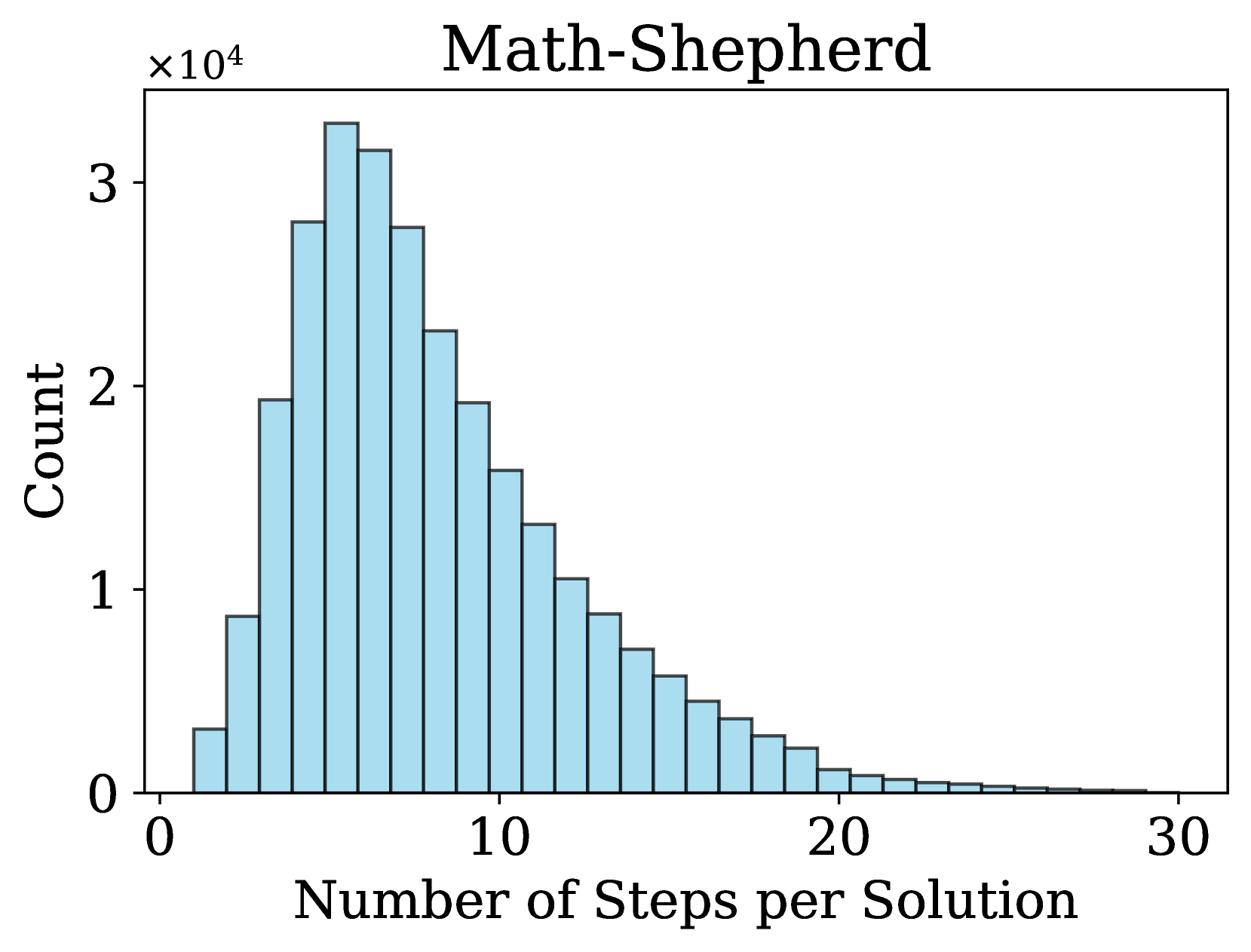
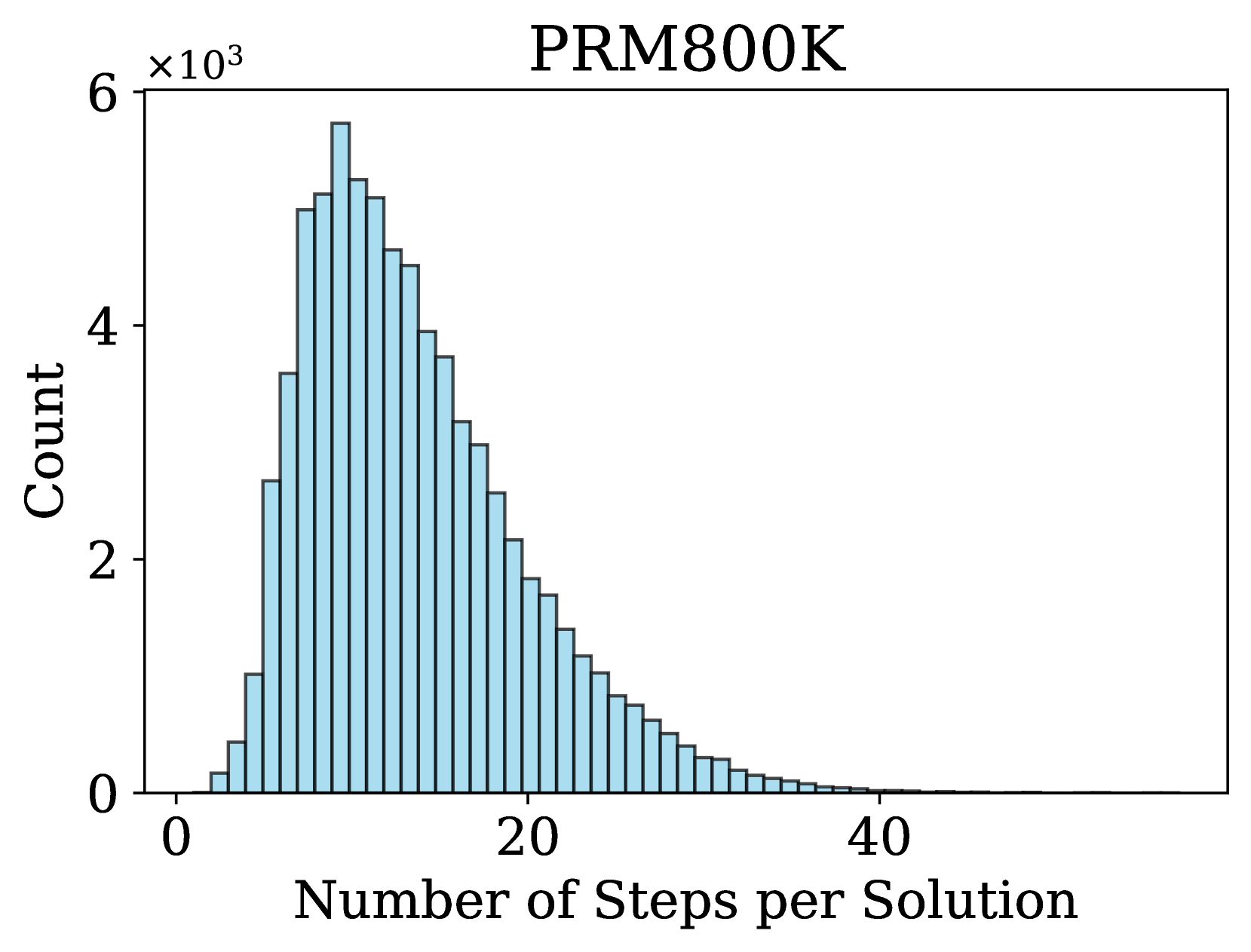
An important factor in process supervision is the number of steps in a solution and the length of each step. Previous works (Lightman et al., 2023; Wang et al., 2024a, b) use rule-based strategies to split a solution into steps, e.g., using newline as delimiters. In contrast, we propose a more flexible method for step division, treating any sequence of consecutive tokens in a solution as a valid step. We observe that many step divisions in Math-Shepherd lack semantic coherence to some extent. Therefore, we hypothesize that semantically explicit cutting is not necessary for training a PRM.
<details>
<summary>x8.png Details</summary>
### Visual Description
## Histogram: Math-Shepherd
### Overview
The image is a histogram titled "Math-Shepherd". It displays the distribution of the number of steps per solution. The x-axis represents the "Number of Steps per Solution", ranging from 0 to 30. The y-axis represents the "Count", scaled by a factor of 10^4, ranging from 0 to 3. The histogram consists of light blue bars with dark outlines, showing the frequency of solutions for each step count.
### Components/Axes
* **Title:** Math-Shepherd
* **X-axis:**
* Label: Number of Steps per Solution
* Scale: 0 to 30, with tick marks at intervals of 10 (0, 10, 20, 30)
* **Y-axis:**
* Label: Count
* Scale: 0 to 3, multiplied by 10^4 (indicated by "x10^4" at the top of the y-axis), with tick marks at intervals of 1 (0, 1, 2, 3)
* **Bars:** Light blue with dark outlines, representing the frequency of each step count.
### Detailed Analysis
The histogram shows a distribution where the count is highest for a relatively small number of steps and decreases as the number of steps increases.
* **Step 0:** Count is approximately 0.3 x 10^4 = 3000
* **Step 1:** Count is approximately 0.9 x 10^4 = 9000
* **Step 2:** Count is approximately 1.9 x 10^4 = 19000
* **Step 3:** Count is approximately 2.8 x 10^4 = 28000
* **Step 4:** Count is approximately 3.2 x 10^4 = 32000
* **Step 5:** Count is approximately 3.3 x 10^4 = 33000
* **Step 6:** Count is approximately 3.1 x 10^4 = 31000
* **Step 7:** Count is approximately 2.8 x 10^4 = 28000
* **Step 8:** Count is approximately 2.4 x 10^4 = 24000
* **Step 9:** Count is approximately 2.2 x 10^4 = 22000
* **Step 10:** Count is approximately 1.9 x 10^4 = 19000
* **Step 11:** Count is approximately 1.7 x 10^4 = 17000
* **Step 12:** Count is approximately 1.5 x 10^4 = 15000
* **Step 13:** Count is approximately 1.3 x 10^4 = 13000
* **Step 14:** Count is approximately 1.1 x 10^4 = 11000
* **Step 15:** Count is approximately 0.9 x 10^4 = 9000
* **Step 16:** Count is approximately 0.7 x 10^4 = 7000
* **Step 17:** Count is approximately 0.6 x 10^4 = 6000
* **Step 18:** Count is approximately 0.5 x 10^4 = 5000
* **Step 19:** Count is approximately 0.4 x 10^4 = 4000
* **Step 20:** Count is approximately 0.3 x 10^4 = 3000
* **Step 21:** Count is approximately 0.2 x 10^4 = 2000
* **Step 22:** Count is approximately 0.15 x 10^4 = 1500
* **Step 23:** Count is approximately 0.1 x 10^4 = 1000
* **Step 24:** Count is approximately 0.08 x 10^4 = 800
* **Step 25:** Count is approximately 0.06 x 10^4 = 600
* **Step 26:** Count is approximately 0.04 x 10^4 = 400
* **Step 27:** Count is approximately 0.03 x 10^4 = 300
* **Step 28:** Count is approximately 0.02 x 10^4 = 200
* **Step 29:** Count is approximately 0.01 x 10^4 = 100
* **Step 30:** Count is approximately 0.005 x 10^4 = 50
### Key Observations
* The distribution is right-skewed (positive skew).
* The peak of the distribution occurs around 5 steps per solution.
* The count decreases significantly as the number of steps increases beyond 5.
* There are very few solutions that require more than 20 steps.
### Interpretation
The histogram suggests that the "Math-Shepherd" algorithm or process typically finds solutions in a relatively small number of steps. The right-skewed distribution indicates that while most solutions are found quickly, there are some cases that require a significantly larger number of steps. This could be due to the complexity of certain problems or the algorithm's search strategy. The data implies that the algorithm is generally efficient, but its performance can vary depending on the specific problem it is solving.
</details>
<details>
<summary>x9.png Details</summary>
### Visual Description
## Histogram: PRM800K
### Overview
The image is a histogram showing the distribution of the number of steps per solution for an algorithm named PRM800K. The x-axis represents the number of steps, and the y-axis represents the count (frequency) of solutions. The histogram bars are light blue with dark outlines.
### Components/Axes
* **Title:** PRM800K
* **X-axis:** Number of Steps per Solution
* Scale: 0 to 40, with tick marks at intervals of 20.
* **Y-axis:** Count (x10^3)
* Scale: 0 to 6 (x10^3), with tick marks at intervals of 2 (x10^3).
### Detailed Analysis
The histogram shows a distribution that is skewed to the right. The count increases rapidly from 0 steps to a peak around 8 steps, and then decreases gradually as the number of steps increases.
* **Peak:** The highest count occurs around 8 steps. The count at 8 steps is approximately 5.8 x 10^3.
* **Tail:** The tail of the distribution extends to the right, indicating that some solutions require a significantly larger number of steps. The count approaches zero around 40 steps.
### Key Observations
* The majority of solutions require a relatively small number of steps (less than 20).
* There is a significant number of solutions that require a larger number of steps, as indicated by the long tail of the distribution.
### Interpretation
The histogram suggests that the PRM800K algorithm typically finds solutions efficiently, with most solutions requiring a small number of steps. However, there are instances where the algorithm requires significantly more steps to find a solution. This could be due to the complexity of the problem or the presence of obstacles in the search space. The distribution indicates that the algorithm's performance varies, with some solutions being found quickly and others requiring more extensive search.
</details>
Figure 4: Number of steps distribution.
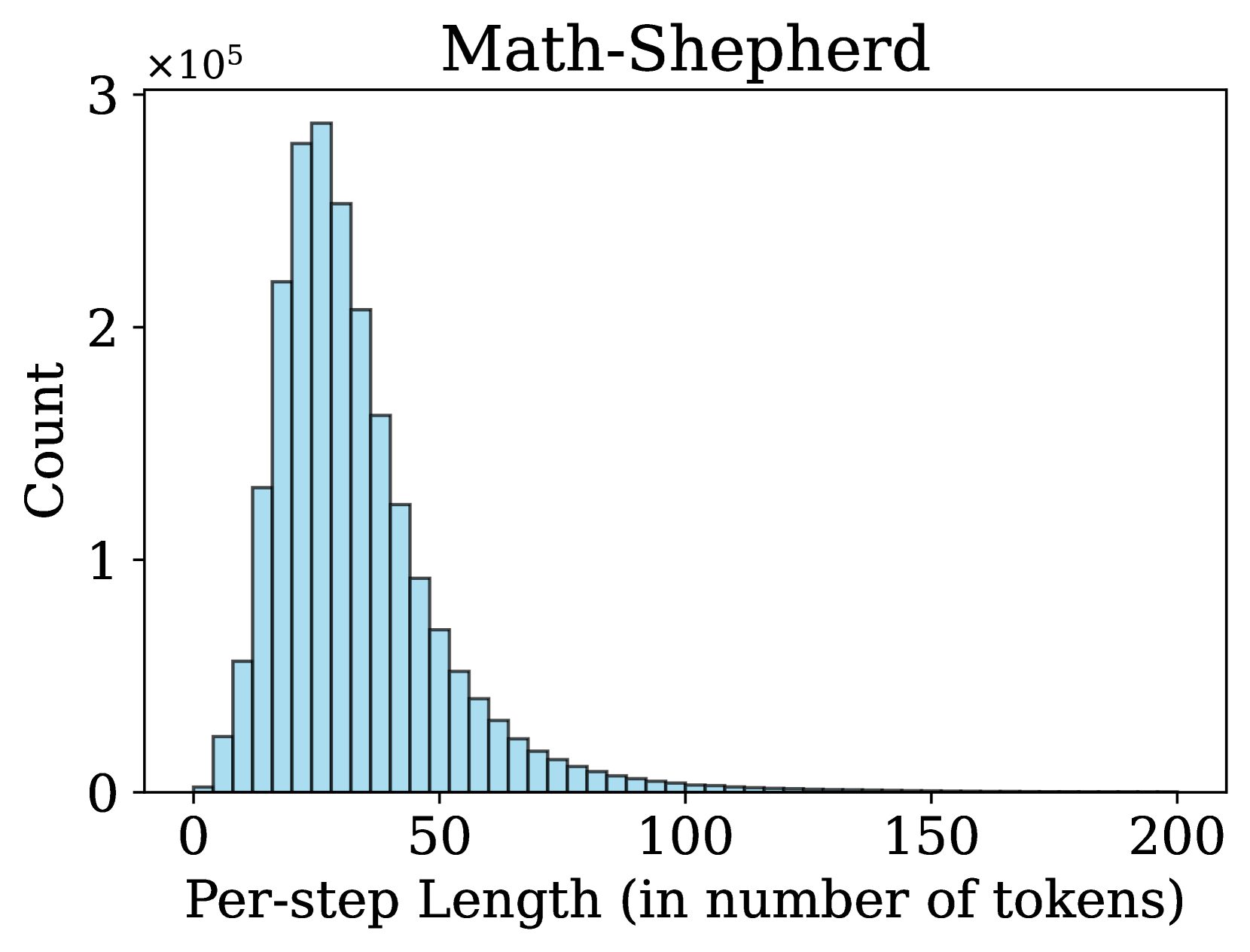
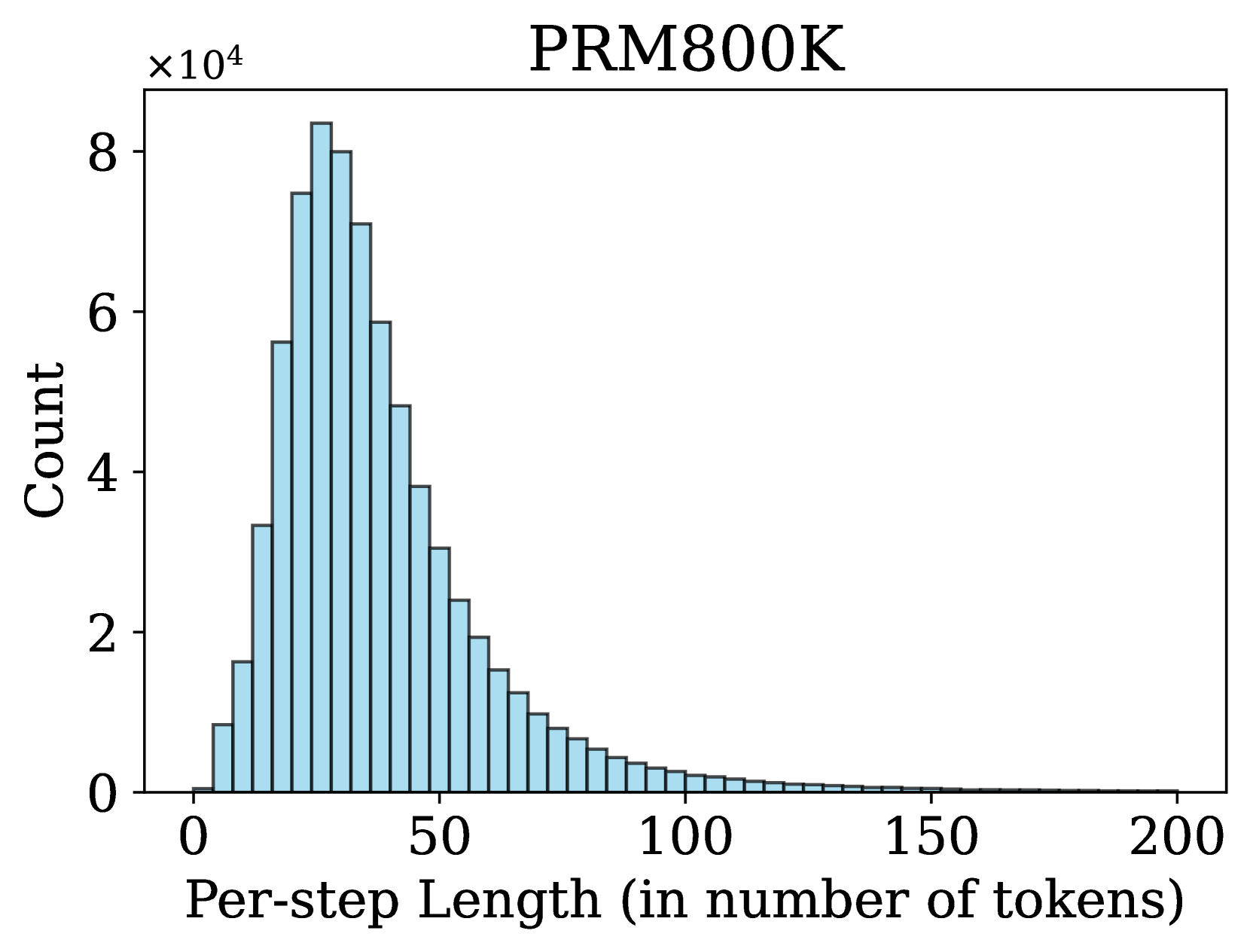
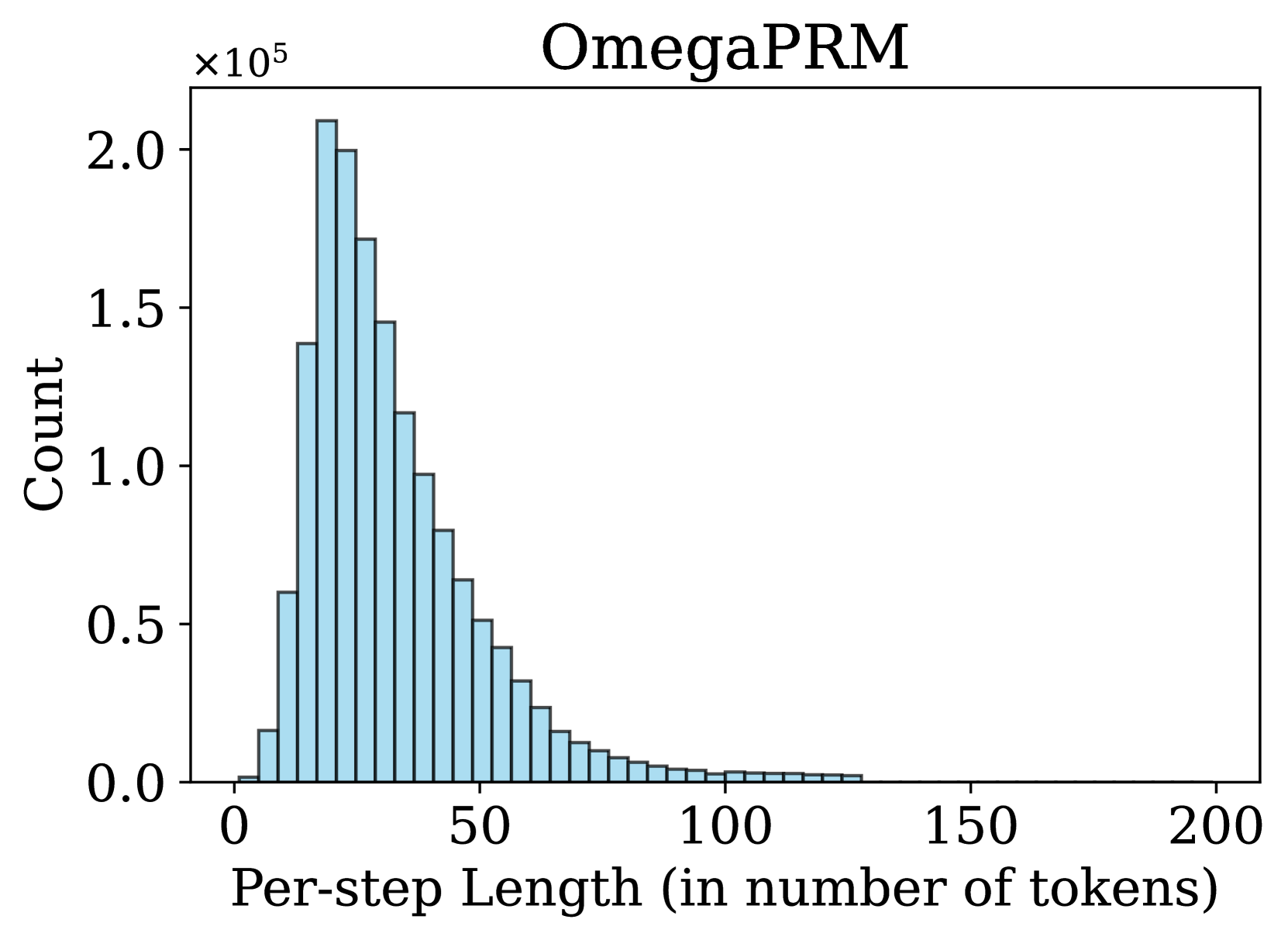
In practice, we first examine the distribution of the number of steps per solution in PRM800K and Math-Shepherd, as shown in Fig. 4, noting that most solutions have less than $20$ steps. During binary search, we aim to divide a full solution into $16$ pieces. To calculate the expected step length, we divide the average solution length by $16$ . The binary search terminates when a step is shorter than this value. The resulting distributions of step lengths for OmegaPRM and the other two datasets are shown in Fig. 5. This flexible splitting strategy produces a step length distribution similar to that of the rule-based strategy.
<details>
<summary>x10.png Details</summary>
### Visual Description
## Histogram: Math-Shepherd Per-step Length Distribution
### Overview
The image is a histogram showing the distribution of "Per-step Length (in number of tokens)" for "Math-Shepherd". The x-axis represents the per-step length, and the y-axis represents the count, scaled by 10^5. The histogram shows a right-skewed distribution, with the highest count occurring at lower per-step lengths.
### Components/Axes
* **Title:** Math-Shepherd
* **X-axis:** Per-step Length (in number of tokens)
* Scale: 0 to 200, with tick marks at 0, 50, 100, 150, and 200.
* **Y-axis:** Count
* Scale: 0 to 3 x 10^5, with tick marks at 0, 1 x 10^5, 2 x 10^5, and 3 x 10^5.
* **Bars:** The histogram bars are light blue with dark gray outlines.
### Detailed Analysis
The histogram bars represent the frequency of each per-step length. The distribution is right-skewed, meaning that there are more instances of shorter per-step lengths than longer ones.
* The highest count occurs around a per-step length of approximately 25 tokens, with a count of approximately 2.8 x 10^5.
* The count decreases as the per-step length increases.
* At a per-step length of 50 tokens, the count is approximately 1.3 x 10^5.
* At a per-step length of 100 tokens, the count is approximately 0.1 x 10^5.
* Beyond 150 tokens, the count is very low, approaching zero.
### Key Observations
* The distribution is heavily skewed towards shorter per-step lengths.
* The peak of the distribution is around 25 tokens.
* Longer per-step lengths are relatively rare.
### Interpretation
The histogram suggests that the "Math-Shepherd" model predominantly uses shorter per-step lengths. The right-skewed distribution indicates that while longer per-step lengths are possible, they are significantly less frequent. This could be due to the nature of the mathematical tasks being performed, or the way the model is designed to process information. The concentration of counts around 25 tokens suggests that this length is optimal or most common for the model's operations.
</details>
<details>
<summary>x11.png Details</summary>
### Visual Description
## Histogram: PRM800K Per-step Length Distribution
### Overview
The image is a histogram displaying the distribution of "Per-step Length (in number of tokens)" for a dataset labeled "PRM800K". The x-axis represents the per-step length, and the y-axis represents the count, scaled by a factor of 10^4. The histogram shows a right-skewed distribution, with a peak around 20-30 tokens and a long tail extending to the right.
### Components/Axes
* **Title:** PRM800K
* **X-axis:**
* Label: Per-step Length (in number of tokens)
* Scale: 0 to 200, with major ticks at 0, 50, 100, 150, and 200.
* **Y-axis:**
* Label: Count
* Scale: 0 to 8, multiplied by 10^4. Major ticks at 0, 2, 4, 6, and 8.
* **Bars:** The histogram bars are light blue with dark outlines.
### Detailed Analysis
The histogram bars represent the frequency of different per-step lengths. The height of each bar indicates the count (scaled by 10^4) of steps with that particular length.
* **Peak:** The highest bar is located around 20-30 tokens. The count at this peak is approximately 8 x 10^4.
* **Distribution:** The distribution is right-skewed, meaning that there are more shorter sequences than longer ones.
* **Tail:** The tail extends to the right, indicating that there are some sequences with lengths up to 200 tokens, but their frequency is much lower.
* **Specific Data Points (Approximate):**
* At 10 tokens, the count is approximately 5.7 x 10^4.
* At 40 tokens, the count is approximately 4.0 x 10^4.
* At 60 tokens, the count is approximately 2.0 x 10^4.
* At 80 tokens, the count is approximately 0.8 x 10^4.
* At 100 tokens, the count is approximately 0.3 x 10^4.
* At 150 tokens, the count is approximately 0.05 x 10^4.
### Key Observations
* The distribution of per-step lengths is heavily skewed towards shorter sequences.
* The most frequent per-step length is around 20-30 tokens.
* Longer sequences (above 100 tokens) are relatively rare.
### Interpretation
The histogram provides insights into the typical length of steps in the PRM800K dataset. The right-skewed distribution suggests that the dataset primarily consists of shorter sequences, with a smaller number of longer sequences. This information could be useful for optimizing algorithms or models that process this data, as it indicates that they should be designed to efficiently handle shorter sequences while still being able to process longer ones when necessary. The peak around 20-30 tokens could be a target for optimization efforts.
</details>
<details>
<summary>x12.png Details</summary>
### Visual Description
## Histogram: OmegaPRM Per-step Length Distribution
### Overview
The image is a histogram displaying the distribution of "Per-step Length (in number of tokens)" for a process labeled "OmegaPRM". The x-axis represents the per-step length, and the y-axis represents the count, scaled by 10^5. The histogram shows a right-skewed distribution, with the highest frequency of per-step lengths occurring at lower values.
### Components/Axes
* **Title:** OmegaPRM
* **X-axis:**
* Label: Per-step Length (in number of tokens)
* Scale: 0 to 200, with major ticks at 0, 50, 100, 150, and 200.
* **Y-axis:**
* Label: Count
* Scale: 0.0 to 2.0, scaled by x10^5, with major ticks at 0.0, 0.5, 1.0, 1.5, and 2.0.
* **Bars:** The histogram bars are light blue with dark gray outlines.
### Detailed Analysis
The histogram bars represent the frequency of each per-step length. The distribution is heavily skewed to the right, indicating that shorter per-step lengths are much more common than longer ones.
* **Peak:** The highest bar appears to be around a per-step length of approximately 20 tokens, with a count of approximately 2.1 x 10^5.
* **Decline:** The count decreases rapidly as the per-step length increases from 20 to 50 tokens.
* **Tail:** The distribution has a long tail extending to the right, indicating that while less frequent, per-step lengths can reach up to 200 tokens.
* **Specific Values (Approximate):**
* Per-step length = 0: Count ≈ 0.01 x 10^5
* Per-step length = 20: Count ≈ 2.1 x 10^5
* Per-step length = 50: Count ≈ 0.2 x 10^5
* Per-step length = 100: Count ≈ 0.02 x 10^5
* Per-step length = 150: Count ≈ 0.005 x 10^5
* Per-step length = 200: Count ≈ 0.001 x 10^5
### Key Observations
* The distribution is strongly right-skewed.
* The majority of per-step lengths are relatively short.
* There is a significant drop in count as the per-step length increases.
* The tail of the distribution extends to higher per-step lengths, indicating the presence of some longer steps.
### Interpretation
The histogram suggests that the OmegaPRM process typically involves short steps, as indicated by the high frequency of low per-step lengths. The right skew indicates that while short steps are the norm, longer steps do occur, albeit much less frequently. This could be due to the nature of the process, where most steps are simple and direct, but occasionally, more complex or circuitous steps are required. The data implies that the OmegaPRM process is optimized for efficiency, favoring shorter steps whenever possible.
</details>
Figure 5: Step length distribution in terms of number of tokens.
4.3 PRM Training Objectives
Table 2: Comparison of different training objectives for PRMs.
| PRM Accuracy (%) | Soft Label 70.1 | Hard Label 63.3 | Pairwise 64.2 |
| --- | --- | --- | --- |
As outlined in Section 3.4, PRMs can be trained using multiple objectives. We construct a small process supervision test set using the problems from the MATH test split. We train PRMs using pointwise soft label, pointwise hard label and pairwise loss respectively, and evaluate how accurately they can classify the per-step correctness. Table 2 presents the comparison of different objectives, and the pointwise soft label is the best among them with $70.1$ % accuracy.
4.4 Algorithm Efficiency
As described in Section Section 3.2 and Section 3.3, we utilize binary search and Monte Carlo Tree Search to improve the efficiency of OmegaPRM process supervision data collection by effectively identifying the first incorrect step and reusing rollouts in Monte Carlo estimation. To quantitatively measure the efficiency of OmegaPRM, we collected process supervision data using both brute-force-style method (Wang et al., 2024a, b) and OmegaPRM with the same computational budget. As a result, we were able to generate $200$ K data points using the brute-force algorithm compared to $15$ million data points with OmegaPRM, demonstrating a $75$ -times efficiency improvement. In practice, we randomly down-sampled OmegaPRM data to $1.5$ million for PRM training.
5 Limitations
There are some limitations with our paper, which we reserve for future work:
Automatic process annotation is noisy.
Our method for automatic process supervision annotation introduces noise in the form of false positives and negatives, but experiments indicate that it can still effectively train a PRM. The PRM trained on our dataset performs better than one trained on the human-annotated PRM800K dataset. The precise impact of noise on PRM performance remains uncertain. For future research, a comprehensive comparison of human and automated annotations should be conducted. One other idea is to integrate human and automated annotations, which could result in more robust and efficient process supervision.
Human supervision is still necessary.
Unlike the work presented in AlphaGo Zero (Silver et al., 2017), our method requires the question and golden answer pair. The question is necessary for LLM to start the MCTS and the golden answer is inevitable for the LLM to compare its rollouts with and determine the correctness of the current step. This will limit the method to the tasks with such question and golden answer pairs. Therefore, we need to adapt the current method further to make it suitable for open-ended tasks.
6 Conclusion
In conclusion, we introduce OmegaPRM, a divide-and-conquer Monte Carlo Tree Search algorithm, designed to automate the process supervision data collection for LLMs. By efficiently pinpointing the first error in the Chain-of-Thought and balancing data quality, OmegaPRM addresses the shortcomings of existing methods. Our automated approach enables the collection of over 1.5 million process supervision annotations, which are used to train a PRM. Leveraging this automated process supervision with the weighted self-consistency algorithm, we improve LLM mathematical reasoning performance, achieving a 69.4% success rate on the MATH benchmark — a 18.4% absolute increase over the base model which amounts to a relative improvement of 36%. Additionally, our method significantly reduces data collection costs compared to human annotation and brute force Monte-Carlo sampling. These findings highlight OmegaPRM’s potential to enhance LLM capabilities in complex multi-step reasoning tasks.
7 Acknowledgements
We would like to express our deepest gratitude to Matt Barnes, Jindong Chen and Rif A. Saurous, for their support and helpful feedback to our work. We also thank Peiyi Wang for clarifying the details in Math-Shepherd and providing insightful suggestions.
References
- Christiano et al. (2017) P. Christiano, J. Leike, T. B. Brown, M. Martic, S. Legg, and D. Amodei. Deep reinforcement learning from human preferences. arXiv preprint arXiv:1706.03741, 2017.
- Cobbe et al. (2021) K. Cobbe, V. Kosaraju, M. Bavarian, M. Chen, H. Jun, L. Kaiser, M. Plappert, J. Tworek, J. Hilton, R. Nakano, C. Hesse, and J. Schulman. Training verifiers to solve math word problems. arXiv preprint arXiv:2110.14168, 2021.
- Feng et al. (2023) X. Feng, Z. Wan, M. Wen, S. M. McAleer, Y. Wen, W. Zhang, and J. Wang. Alphazero-like tree-search can guide large language model decoding and training. arXiv preprint arXiv:2309.17179, 2023.
- Feng et al. (2024) X. Feng, Z. Wan, M. Wen, S. M. McAleer, Y. Wen, W. Zhang, and J. Wang. Alphazero-like tree-search can guide large language model decoding and training. arXiv preprint arXiv:2309.17179, 2024.
- Fu et al. (2023) Y. Fu, H. Peng, A. Sabharwal, P. Clark, and T. Khot. Complexity-based prompting for multi-step reasoning. In Proceedings of the 11th International Conference on Learning Representations (ICLR), May 2023.
- Gemini Team et al. (2024) Gemini Team, M. Reid, N. Savinov, D. Teplyashin, Dmitry, Lepikhin, T. Lillicrap, J. baptiste Alayrac, R. Soricut, A. Lazaridou, O. Firat, J. Schrittwieser, I. Antonoglou, R. Anil, S. Borgeaud, A. Dai, K. Millican, E. Dyer, M. Glaese, T. Sottiaux, B. Lee, F. Viola, M. Reynolds, Y. Xu, J. Molloy, J. Chen, M. Isard, P. Barham, T. Hennigan, R. McIlroy, M. Johnson, J. Schalkwyk, E. Collins, E. Rutherford, E. Moreira, K. Ayoub, M. Goel, C. Meyer, G. Thornton, Z. Yang, H. Michalewski, Z. Abbas, N. Schucher, A. Anand, R. Ives, J. Keeling, K. Lenc, S. Haykal, S. Shakeri, P. Shyam, A. Chowdhery, R. Ring, S. Spencer, E. Sezener, L. Vilnis, O. Chang, N. Morioka, G. Tucker, C. Zheng, O. Woodman, N. Attaluri, T. Kocisky, E. Eltyshev, X. Chen, T. Chung, V. Selo, S. Brahma, P. Georgiev, A. Slone, Z. Zhu, J. Lottes, S. Qiao, B. Caine, S. Riedel, A. Tomala, M. Chadwick, J. Love, P. Choy, S. Mittal, N. Houlsby, Y. Tang, M. Lamm, L. Bai, Q. Zhang, L. He, Y. Cheng, P. Humphreys, Y. Li, S. Brin, A. Cassirer, Y. Miao, L. Zilka, T. Tobin, K. Xu, L. Proleev, D. Sohn, A. Magni, L. A. Hendricks, I. Gao, S. Ontanon, O. Bunyan, N. Byrd, A. Sharma, B. Zhang, M. Pinto, R. Sinha, H. Mehta, D. Jia, S. Caelles, A. Webson, A. Morris, B. Roelofs, Y. Ding, R. Strudel, X. Xiong, M. Ritter, M. Dehghani, R. Chaabouni, A. Karmarkar, G. Lai, F. Mentzer, B. Xu, Y. Li, Y. Zhang, T. L. Paine, A. Goldin, B. Neyshabur, K. Baumli, A. Levskaya, M. Laskin, W. Jia, J. W. Rae, K. Xiao, A. He, S. Giordano, L. Yagati, J.-B. Lespiau, P. Natsev, S. Ganapathy, F. Liu, D. Martins, N. Chen, Y. Xu, M. Barnes, R. May, A. Vezer, J. Oh, K. Franko, S. Bridgers, R. Zhao, B. Wu, B. Mustafa, S. Sechrist, E. Parisotto, T. S. Pillai, C. Larkin, C. Gu, C. Sorokin, M. Krikun, A. Guseynov, J. Landon, R. Datta, A. Pritzel, P. Thacker, F. Yang, K. Hui, A. Hauth, C.-K. Yeh, D. Barker, J. Mao-Jones, S. Austin, H. Sheahan, P. Schuh, J. Svensson, R. Jain, V. Ramasesh, A. Briukhov, D.-W. Chung, T. von Glehn, C. Butterfield, P. Jhakra, M. Wiethoff, J. Frye, J. Grimstad, B. Changpinyo, C. L. Lan, A. Bortsova, Y. Wu, P. Voigtlaender, T. Sainath, S. Gu, C. Smith, W. Hawkins, K. Cao, J. Besley, S. Srinivasan, M. Omernick, C. Gaffney, G. Surita, R. Burnell, B. Damoc, J. Ahn, A. Brock, M. Pajarskas, A. Petrushkina, S. Noury, L. Blanco, K. Swersky, A. Ahuja, T. Avrahami, V. Misra, R. de Liedekerke, M. Iinuma, A. Polozov, S. York, G. van den Driessche, P. Michel, J. Chiu, R. Blevins, Z. Gleicher, A. Recasens, A. Rrustemi, E. Gribovskaya, A. Roy, W. Gworek, S. M. R. Arnold, L. Lee, J. Lee-Thorp, M. Maggioni, E. Piqueras, K. Badola, S. Vikram, L. Gonzalez, A. Baddepudi, E. Senter, J. Devlin, J. Qin, M. Azzam, M. Trebacz, M. Polacek, K. Krishnakumar, S. yiin Chang, M. Tung, I. Penchev, R. Joshi, K. Olszewska, C. Muir, M. Wirth, A. J. Hartman, J. Newlan, S. Kashem, V. Bolina, E. Dabir, J. van Amersfoort, Z. Ahmed, J. Cobon-Kerr, A. Kamath, A. M. Hrafnkelsson, L. Hou, I. Mackinnon, A. Frechette, E. Noland, X. Si, E. Taropa, D. Li, P. Crone, A. Gulati, S. Cevey, J. Adler, A. Ma, D. Silver, S. Tokumine, R. Powell, S. Lee, K. Vodrahalli, S. Hassan, D. Mincu, A. Yang, N. Levine, J. Brennan, M. Wang, S. Hodkinson, J. Zhao, J. Lipschultz, A. Pope, M. B. Chang, C. Li, L. E. Shafey, M. Paganini, S. Douglas, B. Bohnet, F. Pardo, S. Odoom, M. Rosca, C. N. dos Santos, K. Soparkar, A. Guez, T. Hudson, S. Hansen, C. Asawaroengchai, R. Addanki, T. Yu, W. Stokowiec, M. Khan, J. Gilmer, J. Lee, C. G. Bostock, K. Rong, J. Caton, P. Pejman, F. Pavetic, G. Brown, V. Sharma, M. Lučić, R. Samuel, J. Djolonga, A. Mandhane, L. L. Sjösund, E. Buchatskaya, E. White, N. Clay, J. Jiang, H. Lim, R. Hemsley, Z. Cankara, J. Labanowski, N. D. Cao, D. Steiner, S. H. Hashemi, J. Austin, A. Gergely, T. Blyth, J. Stanton, K. Shivakumar, A. Siddhant, A. Andreassen, C. Araya, N. Sethi, R. Shivanna, S. Hand, A. Bapna, A. Khodaei, A. Miech, G. Tanzer, A. Swing, S. Thakoor, L. Aroyo, Z. Pan, Z. Nado, J. Sygnowski, S. Winkler, D. Yu, M. Saleh, L. Maggiore, Y. Bansal, X. Garcia, M. Kazemi, P. Patil, I. Dasgupta, I. Barr, M. Giang, T. Kagohara, I. Danihelka, A. Marathe, V. Feinberg, M. Elhawaty, N. Ghelani, D. Horgan, H. Miller, L. Walker, R. Tanburn, M. Tariq, D. Shrivastava, F. Xia, Q. Wang, C.-C. Chiu, Z. Ashwood, K. Baatarsukh, S. Samangooei, R. L. Kaufman, F. Alcober, A. Stjerngren, P. Komarek, K. Tsihlas, A. Boral, R. Comanescu, J. Chen, R. Liu, C. Welty, D. Bloxwich, C. Chen, Y. Sun, F. Feng, M. Mauger, X. Dotiwalla, V. Hellendoorn, M. Sharman, I. Zheng, K. Haridasan, G. Barth-Maron, C. Swanson, D. Rogozińska, A. Andreev, P. K. Rubenstein, R. Sang, D. Hurt, G. Elsayed, R. Wang, D. Lacey, A. Ilić, Y. Zhao, A. Iwanicki, A. Lince, A. Chen, C. Lyu, C. Lebsack, J. Griffith, M. Gaba, P. Sandhu, P. Chen, A. Koop, R. Rajwar, S. H. Yeganeh, S. Chang, R. Zhu, S. Radpour, E. Davoodi, V. I. Lei, Y. Xu, D. Toyama, C. Segal, M. Wicke, H. Lin, A. Bulanova, A. P. Badia, N. Rakićević, P. Sprechmann, A. Filos, S. Hou, V. Campos, N. Kassner, D. Sachan, M. Fortunato, C. Iwuanyanwu, V. Nikolaev, B. Lakshminarayanan, S. Jazayeri, M. Varadarajan, C. Tekur, D. Fritz, M. Khalman, D. Reitter, K. Dasgupta, S. Sarcar, T. Ornduff, J. Snaider, F. Huot, J. Jia, R. Kemp, N. Trdin, A. Vijayakumar, L. Kim, C. Angermueller, L. Lao, T. Liu, H. Zhang, D. Engel, S. Greene, A. White, J. Austin, L. Taylor, S. Ashraf, D. Liu, M. Georgaki, I. Cai, Y. Kulizhskaya, S. Goenka, B. Saeta, Y. Xu, C. Frank, D. de Cesare, B. Robenek, H. Richardson, M. Alnahlawi, C. Yew, P. Ponnapalli, M. Tagliasacchi, A. Korchemniy, Y. Kim, D. Li, B. Rosgen, K. Levin, J. Wiesner, P. Banzal, P. Srinivasan, H. Yu, Çağlar Ünlü, D. Reid, Z. Tung, D. Finchelstein, R. Kumar, A. Elisseeff, J. Huang, M. Zhang, R. Aguilar, M. Giménez, J. Xia, O. Dousse, W. Gierke, D. Yates, K. Jalan, L. Li, E. Latorre-Chimoto, D. D. Nguyen, K. Durden, P. Kallakuri, Y. Liu, M. Johnson, T. Tsai, A. Talbert, J. Liu, A. Neitz, C. Elkind, M. Selvi, M. Jasarevic, L. B. Soares, A. Cui, P. Wang, A. W. Wang, X. Ye, K. Kallarackal, L. Loher, H. Lam, J. Broder, D. Holtmann-Rice, N. Martin, B. Ramadhana, M. Shukla, S. Basu, A. Mohan, N. Fernando, N. Fiedel, K. Paterson, H. Li, A. Garg, J. Park, D. Choi, D. Wu, S. Singh, Z. Zhang, A. Globerson, L. Yu, J. Carpenter, F. de Chaumont Quitry, C. Radebaugh, C.-C. Lin, A. Tudor, P. Shroff, D. Garmon, D. Du, N. Vats, H. Lu, S. Iqbal, A. Yakubovich, N. Tripuraneni, J. Manyika, H. Qureshi, N. Hua, C. Ngani, M. A. Raad, H. Forbes, J. Stanway, M. Sundararajan, V. Ungureanu, C. Bishop, Y. Li, B. Venkatraman, B. Li, C. Thornton, S. Scellato, N. Gupta, Y. Wang, I. Tenney, X. Wu, A. Shenoy, G. Carvajal, D. G. Wright, B. Bariach, Z. Xiao, P. Hawkins, S. Dalmia, C. Farabet, P. Valenzuela, Q. Yuan, A. Agarwal, M. Chen, W. Kim, B. Hulse, N. Dukkipati, A. Paszke, A. Bolt, K. Choo, J. Beattie, J. Prendki, H. Vashisht, R. Santamaria-Fernandez, L. C. Cobo, J. Wilkiewicz, D. Madras, A. Elqursh, G. Uy, K. Ramirez, M. Harvey, T. Liechty, H. Zen, J. Seibert, C. H. Hu, A. Khorlin, M. Le, A. Aharoni, M. Li, L. Wang, S. Kumar, N. Casagrande, J. Hoover, D. E. Badawy, D. Soergel, D. Vnukov, M. Miecnikowski, J. Simsa, P. Kumar, T. Sellam, D. Vlasic, S. Daruki, N. Shabat, J. Zhang, G. Su, J. Zhang, J. Liu, Y. Sun, E. Palmer, A. Ghaffarkhah, X. Xiong, V. Cotruta, M. Fink, L. Dixon, A. Sreevatsa, A. Goedeckemeyer, A. Dimitriev, M. Jafari, R. Crocker, N. FitzGerald, A. Kumar, S. Ghemawat, I. Philips, F. Liu, Y. Liang, R. Sterneck, A. Repina, M. Wu, L. Knight, M. Georgiev, H. Lee, H. Askham, A. Chakladar, A. Louis, C. Crous, H. Cate, D. Petrova, M. Quinn, D. Owusu-Afriyie, A. Singhal, N. Wei, S. Kim, D. Vincent, M. Nasr, C. A. Choquette-Choo, R. Tojo, S. Lu, D. de Las Casas, Y. Cheng, T. Bolukbasi, K. Lee, S. Fatehi, R. Ananthanarayanan, M. Patel, C. Kaed, J. Li, S. R. Belle, Z. Chen, J. Konzelmann, S. Põder, R. Garg, V. Koverkathu, A. Brown, C. Dyer, R. Liu, A. Nova, J. Xu, A. Walton, A. Parrish, M. Epstein, S. McCarthy, S. Petrov, D. Hassabis, K. Kavukcuoglu, J. Dean, and O. Vinyals. Gemini 1.5: Unlocking multimodal understanding across millions of tokens of context. arXiv preprint arXiv:2403.05530, 2024.
- Gemma Team et al. (2024) Gemma Team, M. Riviere, S. Pathak, P. G. Sessa, C. Hardin, S. Bhupatiraju, L. Hussenot, T. Mesnard, B. Shahriari, A. Ramé, J. Ferret, P. Liu, P. Tafti, A. Friesen, M. Casbon, S. Ramos, R. Kumar, C. L. Lan, S. Jerome, A. Tsitsulin, N. Vieillard, P. Stanczyk, S. Girgin, N. Momchev, M. Hoffman, S. Thakoor, J.-B. Grill, B. Neyshabur, O. Bachem, A. Walton, A. Severyn, A. Parrish, A. Ahmad, A. Hutchison, A. Abdagic, A. Carl, A. Shen, A. Brock, A. Coenen, A. Laforge, A. Paterson, B. Bastian, B. Piot, B. Wu, B. Royal, C. Chen, C. Kumar, C. Perry, C. Welty, C. A. Choquette-Choo, D. Sinopalnikov, D. Weinberger, D. Vijaykumar, D. Rogozińska, D. Herbison, E. Bandy, E. Wang, E. Noland, E. Moreira, E. Senter, E. Eltyshev, F. Visin, G. Rasskin, G. Wei, G. Cameron, G. Martins, H. Hashemi, H. Klimczak-Plucińska, H. Batra, H. Dhand, I. Nardini, J. Mein, J. Zhou, J. Svensson, J. Stanway, J. Chan, J. P. Zhou, J. Carrasqueira, J. Iljazi, J. Becker, J. Fernandez, J. van Amersfoort, J. Gordon, J. Lipschultz, J. Newlan, J. yeong Ji, K. Mohamed, K. Badola, K. Black, K. Millican, K. McDonell, K. Nguyen, K. Sodhia, K. Greene, L. L. Sjoesund, L. Usui, L. Sifre, L. Heuermann, L. Lago, L. McNealus, L. B. Soares, L. Kilpatrick, L. Dixon, L. Martins, M. Reid, M. Singh, M. Iverson, M. Görner, M. Velloso, M. Wirth, M. Davidow, M. Miller, M. Rahtz, M. Watson, M. Risdal, M. Kazemi, M. Moynihan, M. Zhang, M. Kahng, M. Park, M. Rahman, M. Khatwani, N. Dao, N. Bardoliwalla, N. Devanathan, N. Dumai, N. Chauhan, O. Wahltinez, P. Botarda, P. Barnes, P. Barham, P. Michel, P. Jin, P. Georgiev, P. Culliton, P. Kuppala, R. Comanescu, R. Merhej, R. Jana, R. A. Rokni, R. Agarwal, R. Mullins, S. Saadat, S. M. Carthy, S. Perrin, S. M. R. Arnold, S. Krause, S. Dai, S. Garg, S. Sheth, S. Ronstrom, S. Chan, T. Jordan, T. Yu, T. Eccles, T. Hennigan, T. Kocisky, T. Doshi, V. Jain, V. Yadav, V. Meshram, V. Dharmadhikari, W. Barkley, W. Wei, W. Ye, W. Han, W. Kwon, X. Xu, Z. Shen, Z. Gong, Z. Wei, V. Cotruta, P. Kirk, A. Rao, M. Giang, L. Peran, T. Warkentin, E. Collins, J. Barral, Z. Ghahramani, R. Hadsell, D. Sculley, J. Banks, A. Dragan, S. Petrov, O. Vinyals, J. Dean, D. Hassabis, K. Kavukcuoglu, C. Farabet, E. Buchatskaya, S. Borgeaud, N. Fiedel, A. Joulin, K. Kenealy, R. Dadashi, and A. Andreev. Gemma 2: Improving open language models at a practical size. arXiv preprint arXiv:2408.00118, 2024.
- Hao et al. (2023) S. Hao, Y. Gu, H. Ma, J. J. Hong, Z. Wang, D. Z. Wang, and Z. Hu. Reasoning with language model is planning with world model. arXiv preprint arXiv:2305.14992, 2023.
- Hendrycks et al. (2021) D. Hendrycks, C. Burns, S. Kadavath, A. Arora, S. Basart, E. Tang, D. Song, and J. Steinhardt. Measuring mathematical problem solving with the math dataset. NeurIPS, 2021.
- Huang et al. (2022) J. Huang, S. S. Gu, L. Hou, Y. Wu, X. Wang, H. Yu, and J. Han. Large language models can self-improve. arXiv preprint arXiv:2210.11610, 2022.
- Kang et al. (2024) J. Kang, X. Z. Li, X. Chen, A. Kazemi, Q. Sun, B. Chen, D. Li, X. He, Q. He, F. Wen, J. Hao, and J. Yao. Mindstar: Enhancing math reasoning in pre-trained llms at inference time. arXiv preprint arXiv:2405.16265, 2024.
- Li et al. (2023) Y. Li, Z. Lin, S. Zhang, Q. Fu, B. Chen, J.-G. Lou, and W. Chen. Making large language models better reasoners with step-aware verifier. arXiv preprint arXiv:2206.02336, 2023.
- Lightman et al. (2023) H. Lightman, V. Kosaraju, Y. Burda, H. Edwards, B. Baker, T. Lee, J. Leike, J. Schulman, I. Sutskever, and K. Cobbe. Let’s verify step by step. arXiv preprint arXiv:2305.20050, 2023.
- Liu et al. (2024) H. Liu, Y. Zhang, Y. Luo, and A. C.-C. Yao. Augmenting math word problems via iterative question composing. arXiv preprint arXiv:2401.09003, 2024.
- Luo et al. (2023) L. Luo, Z. Lin, Y. Liu, L. Shu, Y. Zhu, J. Shang, and L. Meng. Critique ability of large language models. arXiv preprint arXiv:2310.04815, 2023.
- Ma et al. (2023) Q. Ma, H. Zhou, T. Liu, J. Yuan, P. Liu, Y. You, and H. Yang. Let’s reward step by step: Step-level reward model as the navigators for reasoning. arXiv preprint arXiv:2310.10080, 2023.
- OpenAI (2023) OpenAI. GPT-4 technical report. arXiv preprint arXiv:2303.08774, 2023.
- Ouyang et al. (2022) L. Ouyang, J. Wu, X. Jiang, D. Almeida, C. L. Wainwright, P. Mishkin, C. Zhang, S. Agarwal, K. Slama, A. Ray, J. Schulman, J. Hilton, F. Kelton, L. Miller, M. Simens, A. Askell, P. Welinder, P. Christiano, J. Leike, and R. Lowe. Training language models to follow instructions with human feedback. arXiv preprint arXiv:2203.02155, 2022.
- Perez et al. (2021) E. Perez, D. Kiela, and K. Cho. True few-shot learning with language models. arXiv preprint arXiv:2105.11447, 2021.
- Rosin (2011) C. D. Rosin. Multi-armed bandits with episode context. Annals of Mathematics and Artificial Intelligence, 61(3):203–230, 2011.
- Silver et al. (2016) D. Silver, A. Huang, C. J. Maddison, A. Guez, L. Sifre, G. van den Driessche, J. Schrittwieser, I. Antonoglou, V. Panneershelvam, M. Lanctot, S. Dieleman, D. Grewe, J. Nham, N. Kalchbrenner, I. Sutskever, T. Lillicrap, M. Leach, K. Kavukcuoglu, T. Graepel, and D. Hassabis. Mastering the game of go with deep neural networks and tree search. Nature, 2016. URL https://doi.org/10.1038/nature16961.
- Silver et al. (2017) D. Silver, J. Schrittwieser, K. Simonyan, I. Antonoglou, A. Huang, A. Guez, T. Hubert, L. Baker, M. Lai, A. Bolton, Y. Chen, T. Lillicrap, F. Hui, L. Sifre, G. van den Driessche, T. Graepel, and D. Hassabis. Mastering the game of go without human knowledge. nature, 550(7676):354–359, 2017.
- Tian et al. (2024) Y. Tian, B. Peng, L. Song, L. Jin, D. Yu, H. Mi, and D. Yu. Toward self-improvement of llms via imagination, searching, and criticizing. arXiv preprint arXiv:2404.12253, 2024.
- Touvron et al. (2023) H. Touvron, L. Martin, K. Stone, P. Albert, A. Almahairi, Y. Babaei, N. Bashlykov, S. Batra, P. Bhargava, S. Bhosale, D. Bikel, L. Blecher, C. C. Ferrer, M. Chen, G. Cucurull, D. Esiobu, J. Fernandes, J. Fu, W. Fu, B. Fuller, C. Gao, V. Goswami, N. Goyal, A. Hartshorn, S. Hosseini, R. Hou, H. Inan, M. Kardas, V. Kerkez, M. Khabsa, I. Kloumann, A. Korenev, P. S. Koura, M.-A. Lachaux, T. Lavril, J. Lee, D. Liskovich, Y. Lu, Y. Mao, X. Martinet, T. Mihaylov, P. Mishra, I. Molybog, Y. Nie, A. Poulton, J. Reizenstein, R. Rungta, K. Saladi, A. Schelten, R. Silva, E. M. Smith, R. Subramanian, X. E. Tan, B. Tang, R. Taylor, A. Williams, J. X. Kuan, P. Xu, Z. Yan, I. Zarov, Y. Zhang, A. Fan, M. Kambadur, S. Narang, A. Rodriguez, R. Stojnic, S. Edunov, and T. Scialom. LLaMA 2: Open foundation and fine-tuned chat models. arXiv preprint arXiv:2307.09288, 2023.
- Uesato et al. (2022) J. Uesato, N. Kushman, R. Kumar, F. Song, N. Siegel, L. Wang, A. Creswell, G. Irving, and I. Higgins. Solving math word problems with process-and outcome-based feedback. arXiv preprint arXiv:2211.14275, 2022.
- Wang et al. (2024a) P. Wang, L. Li, Z. Shao, R. X. Xu, D. Dai, Y. Li, D. Chen, Y. Wu, and Z. Sui. Math-Shepherd: Verify and reinforce LLMs step-by-step without human annotations. arXiv preprint arXiv:2312.08935, 2024a.
- Wang et al. (2023) X. Wang, J. Wei, D. Schuurmans, Q. Le, E. Chi, S. Narang, A. Chowdhery, and D. Zhou. Self-consistency improves chain of thought reasoning in language models. In Proceedings of the 11th International Conference on Learning Representations (ICLR), May 2023.
- Wang et al. (2024b) Z. Wang, Y. Li, Y. Wu, L. Luo, L. Hou, H. Yu, and J. Shang. Multi-step problem solving through a verifier: An empirical analysis on model-induced process supervision. arXiv preprint arXiv:2402.02658, 2024b.
- Wei et al. (2022a) J. Wei, Y. Tay, R. Bommasani, C. Raffel, B. Zoph, S. Borgeaud, D. Yogatama, M. Bosma, D. Zhou, D. Metzler, E. H. Chi, T. Hashimoto, O. Vinyals, P. Liang, J. Dean, and W. Fedus. Emergent abilities of large language models, 2022a.
- Wei et al. (2022b) J. Wei, X. Wang, D. Schuurmans, M. Bosma, F. Xia, E. Chi, Q. V. Le, and D. Zhou. Chain-of-thought prompting elicits reasoning in large language models. In Proceedings of the 36th Conference on Neural Information Processing Systems (NeurIPS), Dec 2022b.
- Yao et al. (2023) S. Yao, D. Yu, J. Zhao, I. Shafran, T. L. Griffiths, Y. Cao, and K. Narasimhan. Tree of thoughts: Deliberate problem solving with large language models. arXiv preprint arXiv:2305.10601, 2023.
- Yu et al. (2024) F. Yu, A. Gao, and B. Wang. Ovm, outcome-supervised value models for planning in mathematical reasoning. arXiv preprint arXiv:2311.09724, 2024.
- Yu et al. (2023) L. Yu, W. Jiang, H. Shi, J. Yu, Z. Liu, Y. Zhang, J. T. Kwok, Z. Li, A. Weller, and W. Liu. MetaMath: Bootstrap your own mathematical questions for large language models. arXiv preprint arXiv:2309.12284, 2023.
- Zhang et al. (2024) D. Zhang, S. Zhoubian, Z. Hu, Y. Yue, Y. Dong, and J. Tang. Rest-mcts*: Llm self-training via process reward guided tree search. arXiv preprint arXiv:2406.03816, 2024.
- Świechowski et al. (2021) M. Świechowski, K. Godlewski, B. Sawicki, and J. Mańdziuk. Monte carlo tree search: A review of recent modifications and applications. arXiv preprint arXiv:2103.04931, 2021.
Appendix
Appendix A Question Filtering
During the evaluation of partial solution correctness using MC estimation, false negative noise may be introduced when a question is too hard for the model, thus no correct rollout can be found even with correct partial solution. Or false positive noise may be introduced when a question is too easy, that model can conclude in correct answer given partial solution with wrong step. It is not possible to exclude such noise completely, but we can reduce the chance by filtering out questions that are either too hard or too easy for the model. Specifically, we ran a $k=32$ rollouts for each question in the 12K training data, and filter out the questions that with no correct answer (too hard) or no wrong answer (too easy) in the 32 rollouts.
Appendix B Pairwise Loss Formula
When training with pairwise labels, the Bradley-Terry model (people typically use this objective to train reward models in RLHF) generally accepts two probability scalars summing up to 1. When we select the two actions as a pair, there are two cases. The first case is that one sample with a zero MC value, and the other sample with a positive MC value. The second case is that both samples are with positive MC values. The first case is straight-forward, and a normalization step is required for the second case.
Assume the two MC values are $p$ and $q$ , and they follow the Bernoulli distribution: $P(X=1)=p$ and $P(Y=1)=q$ . We need to calculate the probability that action X is preferred over action Y and vice versa.
$$
\begin{split}P(X>Y)&=P(X=1,Y=0)=p(1-q),\\
P(X<Y)&=P(X=0,Y=1)=(1-p)q,\\
P(X=Y)&=P(X=0,Y=0)+P(X=1,Y=1)=(1-p)(1-q)+pq.\end{split} \tag{5}
$$
For the tied situation, each action has half the chance of being preferred. Thus,
$$
\begin{split}P(\text{action X is preferred})=P(X>Y)+1/2*P(X=Y)=1/2*(1+p-q),\\
P(\text{action Y is preferred})=P(X<Y)+1/2*P(X=Y)=1/2*(1+q-p).\end{split} \tag{6}
$$
Now the MC values are normalized and we can train with the pairwise loss.