# Step-DPO: Step-wise Preference Optimization for Long-chain Reasoning of LLMs
Abstract
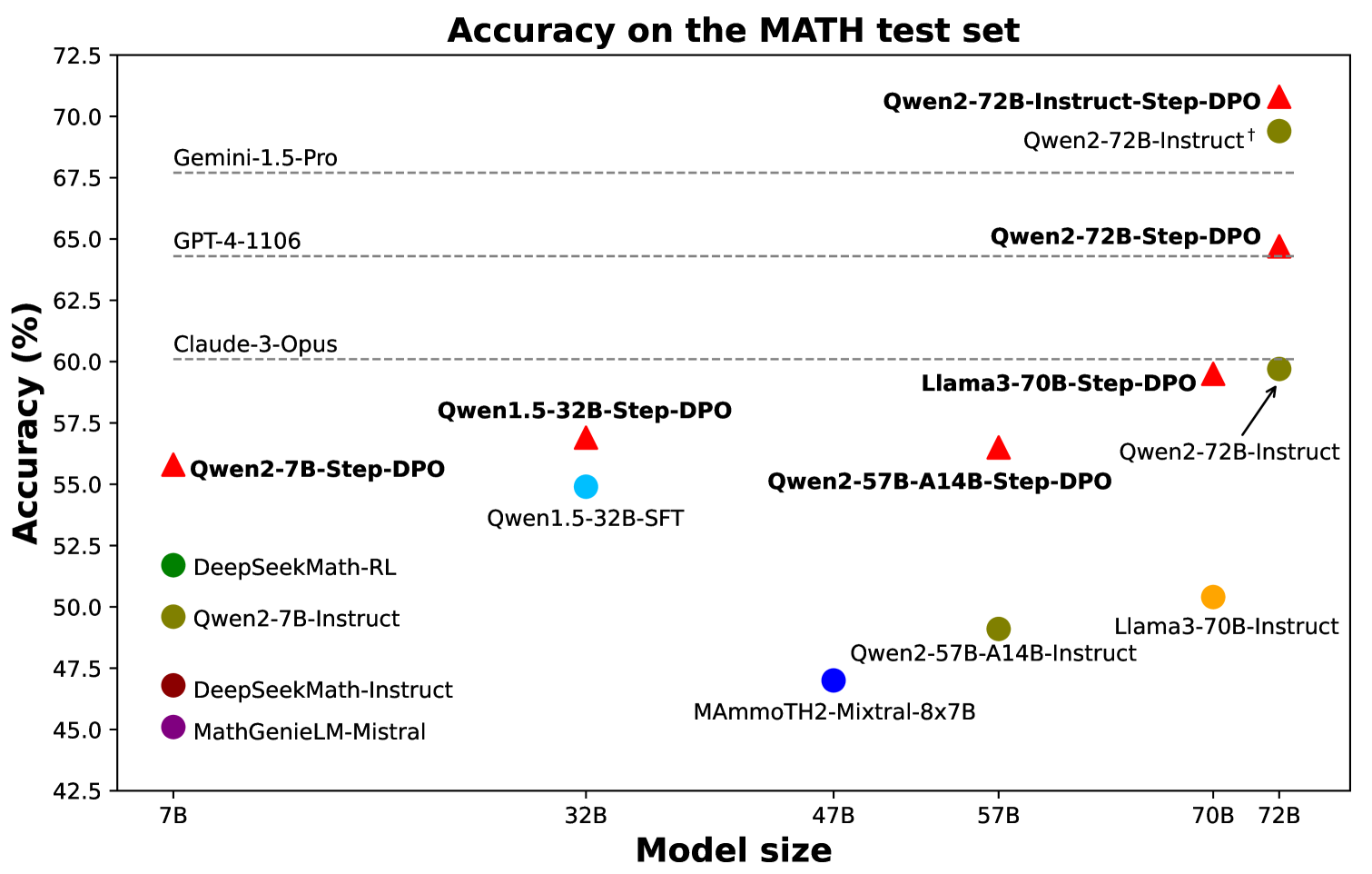
Mathematical reasoning presents a significant challenge for Large Language Models (LLMs) due to the extensive and precise chain of reasoning required for accuracy. Ensuring the correctness of each reasoning step is critical. To address this, we aim to enhance the robustness and factuality of LLMs by learning from human feedback. However, Direct Preference Optimization (DPO) has shown limited benefits for long-chain mathematical reasoning, as models employing DPO struggle to identify detailed errors in incorrect answers. This limitation stems from a lack of fine-grained process supervision. We propose a simple, effective, and data-efficient method called Step-DPO, which treats individual reasoning steps as units for preference optimization rather than evaluating answers holistically. Additionally, we have developed a data construction pipeline for Step-DPO, enabling the creation of a high-quality dataset containing 10K step-wise preference pairs. We also observe that in DPO, self-generated data is more effective than data generated by humans or GPT-4, due to the latter’s out-of-distribution nature. Our findings demonstrate that as few as 10K preference data pairs and fewer than 500 Step-DPO training steps can yield a nearly 3% gain in accuracy on MATH for models with over 70B parameters. Notably, Step-DPO, when applied to Qwen2-72B-Instruct, achieves scores of 70.8% and 94.0% on the test sets of MATH and GSM8K, respectively, surpassing a series of closed-source models, including GPT-4-1106, Claude-3-Opus, and Gemini-1.5-Pro. Our code, data, and models are available at https://github.com/dvlab-research/Step-DPO.
1 Introduction
<details>
<summary>x1.png Details</summary>
### Visual Description
## Scatter Plot: Accuracy on the MATH test set
### Overview
The image is a scatter plot comparing the accuracy of various language models on the MATH test set against their model size. The plot displays model size on the x-axis and accuracy percentage on the y-axis. Each point represents a different model, with its name displayed next to the point. Some models are marked with a red triangle, while others are marked with a green, blue, purple, or orange circle. Horizontal dashed lines indicate the accuracy of some prominent models for reference.
### Components/Axes
* **Title:** Accuracy on the MATH test set
* **X-axis:** Model size, with markers at 7B, 32B, 47B, 57B, 70B, and 72B.
* **Y-axis:** Accuracy (%), with markers from 42.5% to 72.5% in 2.5% increments.
* **Horizontal Dashed Lines (Top to Bottom):**
* Gemini-1.5-Pro (at approximately 67.5% accuracy)
* GPT-4-1106 (at approximately 64.5% accuracy)
* Claude-3-Opus (at approximately 60.5% accuracy)
* **Data Points:** Each point represents a model, with its name displayed next to it. The points are colored differently, but there is no explicit legend provided to explain the color coding.
### Detailed Analysis or Content Details
Here's a breakdown of the models and their approximate positions on the plot:
* **Models with Red Triangle Markers:**
* Qwen2-7B-Step-DPO: Located at approximately (7B, 55.5%)
* Qwen1.5-32B-Step-DPO: Located at approximately (32B, 57.0%)
* Qwen2-57B-A14B-Step-DPO: Located at approximately (57B, 56.0%)
* Llama3-70B-Step-DPO: Located at approximately (70B, 59.5%)
* Qwen2-72B-Step-DPO: Located at approximately (72B, 64.0%)
* Qwen2-72B-Instruct-Step-DPO: Located at approximately (72B, 71.0%)
* **Models with Green Circle Markers:**
* DeepSeekMath-RL: Located at approximately (7B, 52.0%)
* Qwen2-7B-Instruct: Located at approximately (7B, 48.5%)
* Qwen2-72B-Instruct†: Located at approximately (72B, 69.0%)
* **Models with Blue Circle Markers:**
* Qwen1.5-32B-SFT: Located at approximately (32B, 54.0%)
* Qwen2-57B-A14B-Instruct: Located at approximately (57B, 48.5%)
* **Models with Orange Circle Markers:**
* Llama3-70B-Instruct: Located at approximately (70B, 49.5%)
* **Models with Purple Circle Markers:**
* MathGenieLM-Mistral: Located at approximately (7B, 45.0%)
* **Models with Dark Blue Circle Markers:**
* MAmmoTH2-Mixtral-8x7B: Located at approximately (47B, 47.0%)
### Key Observations
* The accuracy generally tends to increase with model size, but there are exceptions.
* Models with "Step-DPO" in their name tend to have higher accuracy than their counterparts without it, especially for larger models like Qwen2-72B.
* The Gemini-1.5-Pro model has the highest accuracy among the models indicated by horizontal lines.
* The Qwen2-72B-Instruct-Step-DPO model achieves the highest accuracy among all models plotted.
* The smallest models (7B) show a wide range of accuracy, suggesting that factors other than size significantly impact performance at this scale.
### Interpretation
The scatter plot illustrates the relationship between model size and accuracy on the MATH test set for various language models. The general trend suggests that larger models tend to perform better, but the specific architecture, training method (e.g., Step-DPO), and other factors play a crucial role in determining the final accuracy. The horizontal lines provide a benchmark against well-known models like Gemini-1.5-Pro and GPT-4-1106. The clustering of points indicates that certain model families (e.g., Qwen, Llama) have different performance characteristics. The presence of outliers suggests that some models are either particularly effective or ineffective for their size. The plot highlights the importance of both model size and training techniques in achieving high accuracy on complex tasks like the MATH test set.
</details>
Figure 1: Accuracy on the MATH test set across models fine-tuned by Step-DPO and other state-of-the-art models. †: reproduced result using our prompt.
<details>
<summary>x2.png Details</summary>
### Visual Description
## Line Chart: Accuracy of judging preferred and undesirable outputs
### Overview
The image is a line chart comparing the accuracy of judging preferred and undesirable outputs for different models (Qwen2-72B and Qwen2-7B) using two different training methods (Step-DPO and DPO) over a range of training steps. The chart plots accuracy (in percentage) on the y-axis against training steps on the x-axis.
### Components/Axes
* **Title:** Accuracy of judging preferred and undesirable outputs
* **X-axis:** Training steps
* Scale: 50, 100, 150, 200, 250
* **Y-axis:** Accuracy (%)
* Scale: 64, 66, 68, 70, 72, 74, 76, 78, 80, 82, 84
* **Legend:**
* Purple triangles: Qwen2-72B-Step-DPO
* Purple squares: Qwen2-72B-DPO
* Orange triangles: Qwen2-7B-Step-DPO
* Orange squares: Qwen2-7B-DPO
### Detailed Analysis
* **Qwen2-72B-Step-DPO (Purple triangles):** The line starts at approximately 76% accuracy at 25 training steps, rises sharply to approximately 81% at 50 training steps, plateaus around 81% until 100 training steps, peaks at approximately 82% at 125 training steps, and then drops to approximately 82% at 150 training steps.
* **Qwen2-72B-DPO (Purple squares):** The line starts at approximately 69.5% accuracy at 25 training steps, rises to approximately 74% at 50 training steps, and then plateaus around 73% from 75 training steps onwards.
* **Qwen2-7B-Step-DPO (Orange triangles):** The line starts at approximately 66% accuracy at 25 training steps, rises to approximately 76% at 50 training steps, plateaus around 76% until 100 training steps, and then fluctuates between 75% and 77% from 100 training steps onwards.
* **Qwen2-7B-DPO (Orange squares):** The line starts at approximately 67% accuracy at 25 training steps, rises to approximately 69% at 50 training steps, plateaus around 69% until 100 training steps, and then fluctuates between 69% and 71% from 100 training steps onwards.
### Key Observations
* The Qwen2-72B-Step-DPO model (purple triangles) achieves the highest accuracy overall.
* The Qwen2-72B-Step-DPO model (purple triangles) shows a rapid increase in accuracy in the initial training steps.
* The Qwen2-72B-DPO model (purple squares) has a lower overall accuracy compared to the Qwen2-72B-Step-DPO model.
* The Qwen2-7B-Step-DPO model (orange triangles) shows a higher accuracy than the Qwen2-7B-DPO model (orange squares).
* All models show a plateauing or fluctuating accuracy after a certain number of training steps.
### Interpretation
The chart demonstrates the impact of different model sizes (72B vs. 7B) and training methods (Step-DPO vs. DPO) on the accuracy of judging preferred and undesirable outputs. The Qwen2-72B model trained with Step-DPO consistently outperforms the other models, suggesting that both larger model size and the Step-DPO training method contribute to higher accuracy in this task. The plateauing of accuracy after a certain number of training steps may indicate a point of diminishing returns or the need for further optimization strategies.
</details>
<details>
<summary>x3.png Details</summary>
### Visual Description
## Line Chart: Reward margin between preferred and undesirable outputs
### Overview
The image is a line chart comparing the reward margin between preferred and undesirable outputs for different models (Qwen2-7B-Step-DPO, Qwen2-72B-Step-DPO, Qwen2-7B-DPO, and Qwen2-72B-DPO) over training steps. The chart displays the margin on the y-axis and training steps on the x-axis.
### Components/Axes
* **Title:** Reward margin between preferred and undesirable outputs
* **X-axis:** Training steps
* Scale: 0 to 250, with markers at 50, 100, 150, 200, and 250.
* **Y-axis:** Margin
* Scale: 0.1 to 2.1, with markers at 0.1, 0.5, 0.9, 1.3, 1.7, and 2.1.
* **Legend:**
* Qwen2-7B-Step-DPO (Orange, Triangle Marker)
* Qwen2-72B-Step-DPO (Purple, Triangle Marker)
* Qwen2-7B-DPO (Orange, Square Marker)
* Qwen2-72B-DPO (Purple, Square Marker)
### Detailed Analysis
* **Qwen2-7B-Step-DPO (Orange, Triangle Marker):**
* Trend: Initially increases rapidly, then plateaus at a high margin.
* Data Points:
* At 20 training steps, margin is approximately 0.2.
* At 50 training steps, margin is approximately 0.7.
* At 100 training steps, margin is approximately 1.4.
* At 150 training steps, margin is approximately 1.9.
* At 200 training steps, margin is approximately 2.0.
* At 250 training steps, margin is approximately 2.1.
* **Qwen2-72B-Step-DPO (Purple, Triangle Marker):**
* Trend: Initially increases rapidly, then plateaus at a high margin.
* Data Points:
* At 20 training steps, margin is approximately 0.3.
* At 50 training steps, margin is approximately 1.1.
* At 100 training steps, margin is approximately 1.6.
* At 150 training steps, margin is approximately 1.8.
* At 200 training steps, margin is approximately 1.8.
* At 250 training steps, margin is approximately 2.0.
* **Qwen2-7B-DPO (Orange, Square Marker):**
* Trend: Starts low, increases slightly, then plateaus at a low margin.
* Data Points:
* At 20 training steps, margin is approximately 0.1.
* At 50 training steps, margin is approximately 0.6.
* At 100 training steps, margin is approximately 0.7.
* At 150 training steps, margin is approximately 0.7.
* At 200 training steps, margin is approximately 0.7.
* At 250 training steps, margin is approximately 0.7.
* **Qwen2-72B-DPO (Purple, Square Marker):**
* Trend: Starts low, increases slightly, then plateaus at a low margin.
* Data Points:
* At 20 training steps, margin is approximately 0.4.
* At 50 training steps, margin is approximately 0.8.
* At 100 training steps, margin is approximately 0.8.
* At 150 training steps, margin is approximately 0.8.
* At 200 training steps, margin is approximately 0.8.
* At 250 training steps, margin is approximately 0.8.
### Key Observations
* The "Step-DPO" models (Qwen2-7B-Step-DPO and Qwen2-72B-Step-DPO) achieve significantly higher reward margins than the "DPO" models (Qwen2-7B-DPO and Qwen2-72B-DPO).
* The reward margins for the "Step-DPO" models increase rapidly in the initial training steps and then plateau.
* The reward margins for the "DPO" models increase slightly and then plateau at a much lower level.
* The 72B models have a slightly higher margin than the 7B models.
### Interpretation
The data suggests that the "Step-DPO" training method is more effective at maximizing the reward margin between preferred and undesirable outputs compared to the "DPO" method. This could indicate that the "Step-DPO" method is better at learning to distinguish between desirable and undesirable outputs, leading to a higher margin. The plateauing of the reward margins suggests that the models may have reached a point of diminishing returns with the given training data and architecture. The 72B models have a slightly higher margin, suggesting that larger models may perform better.
</details>
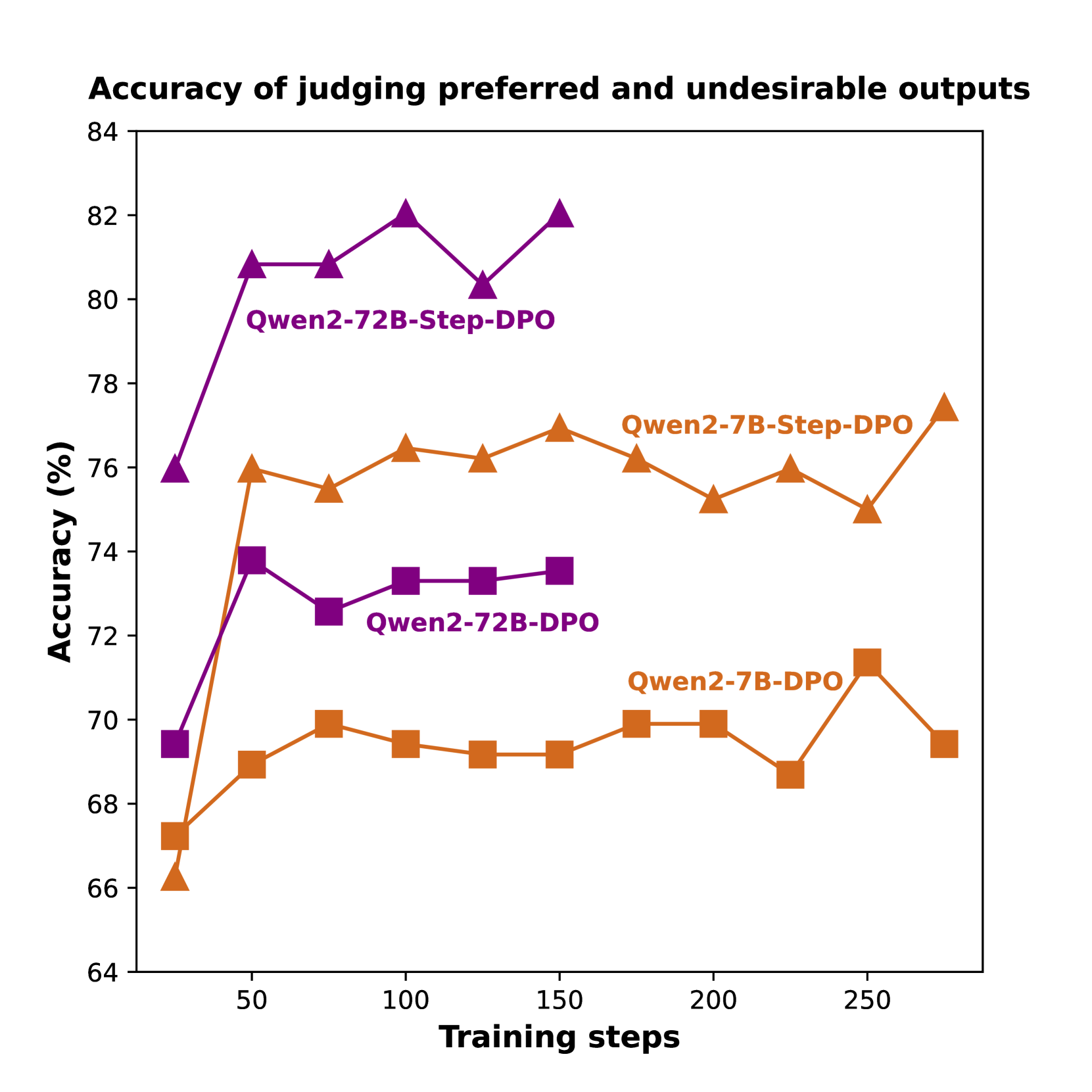
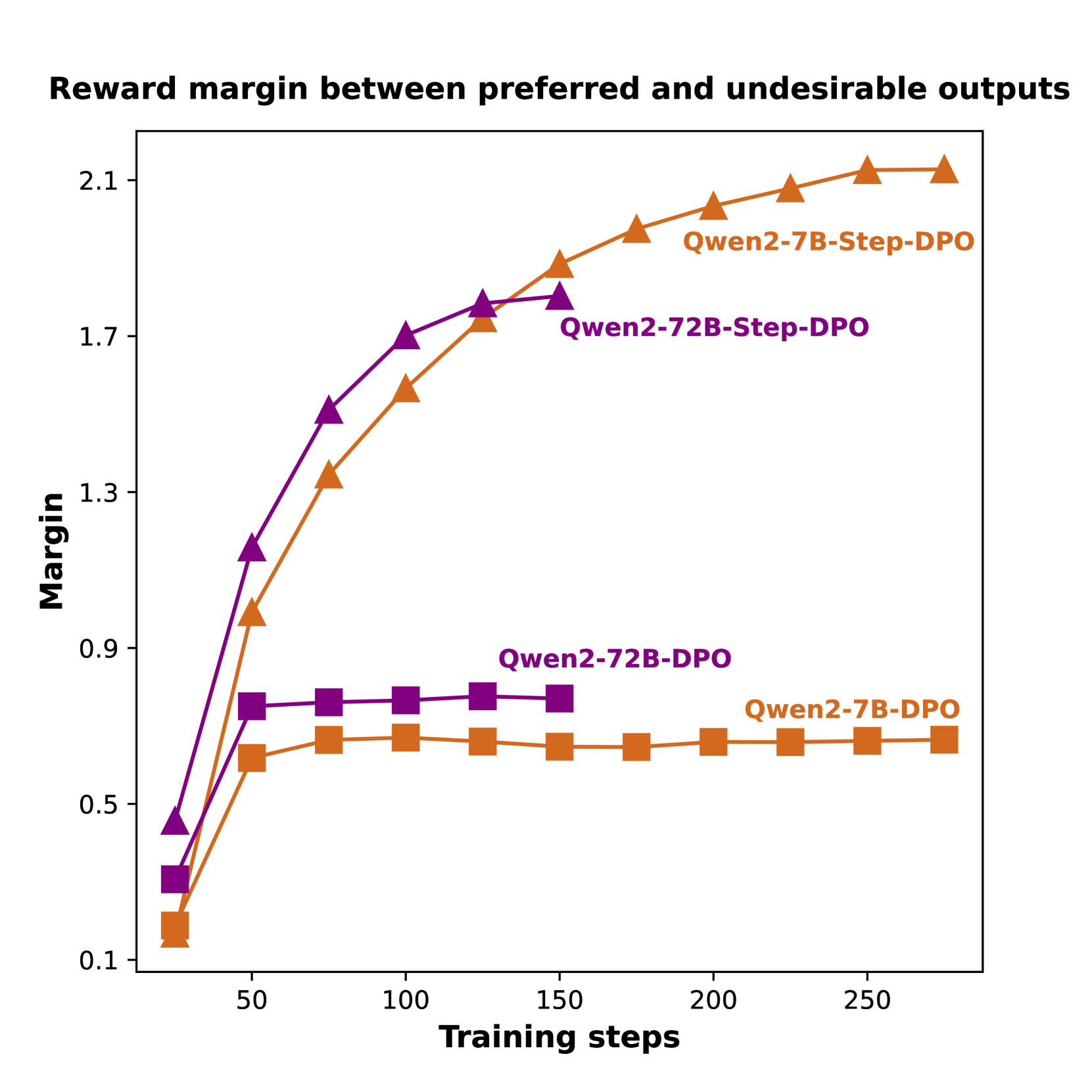
Figure 2: Left: Accuracy of judging preferred or undesirable outputs on the validation set during training. Right: Reward margins between preferred and undesirable outputs on the validation set during training. More details about these experiments are given in the appendix.
Mathematical reasoning is recognized as a critical long-chain reasoning ability in Large Language Models (LLMs). This task is particularly challenging due to the often extensive chain of thought required, which can include numerous reasoning steps. Any error in these steps can lead to an incorrect final answer.
Numerous studies (Yu et al., 2023; Luo et al., 2023; Yue et al., 2023; Liu & Yao, 2024; Lu et al., 2024; Li et al., 2024; Shao et al., 2024; Xin et al., 2024; Yue et al., 2024; Tang et al., 2024) have proposed various data augmentation techniques during the supervised fine-tuning (SFT) stage to enhance alignment. However, models in the SFT process are prone to hallucinations, resulting in saturated performance. A potential reason for this, as highlighted in Hong et al. (2024), is that as the probability of preferred outputs increases, so does the probability of undesirable ones. This phenomenon makes the model more likely to make errors in long-chain reasoning. Therefore, it is essential to develop methods to suppress the likelihood of undesirable outputs.
Recently, Direct Preference Optimization (DPO) (Rafailov et al., 2024) has been proposed for alignment using pair-wise preference data and is popular due to its simplicity. Despite its effectiveness in chat benchmarks (Tunstall et al., 2023; Zheng et al., 2024), DPO offers minimal benefits for long-chain mathematical reasoning. As shown in Fig. 2 (left), models using vanilla DPO perform poorly in distinguishing between preferred and undesirable outputs, failing to identify errors in rejected answers. Additionally, Fig. 2 (right) shows that the reward margin (i.e., the gap between the rewards of preferred and undesirable outputs) is limited for models using vanilla DPO and plateaus with further training. These findings indicate that models fine-tuned with vanilla DPO cannot pinpoint detailed errors in incorrect answers, hindering the improvement of reasoning abilities.
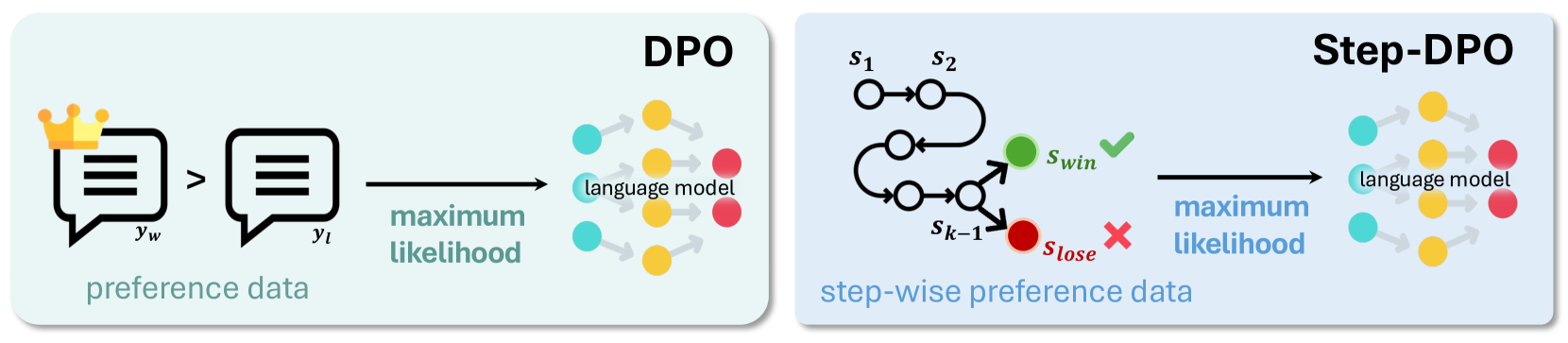
In this work, we introduce Step-DPO, where each intermediate reasoning step is treated as the basic unit for preference optimization. As illustrated in Fig. 3, unlike vanilla DPO, which only considers preference optimization between complete answers (i.e., $p(y_{win}|x)$ and $p(y_{lose}|x)$ ), Step-DPO examines the step-by-step answer (i.e., $y=s_{1},...,s_{n}$ ) and specifically targets the first erroneous reasoning step. Step-DPO aims to select a correct reasoning step and reject an incorrect one, given a math problem and several initial correct reasoning steps (i.e., maximize $p(s_{win}|x;s_{1},s_{2},...,s_{k-1})$ and minimize $p(s_{lose}|x;s_{1},s_{2},...,s_{k-1})$ ). This transition allows the model to easily locate erroneous tokens for effective optimization, significantly enhancing long-chain reasoning.
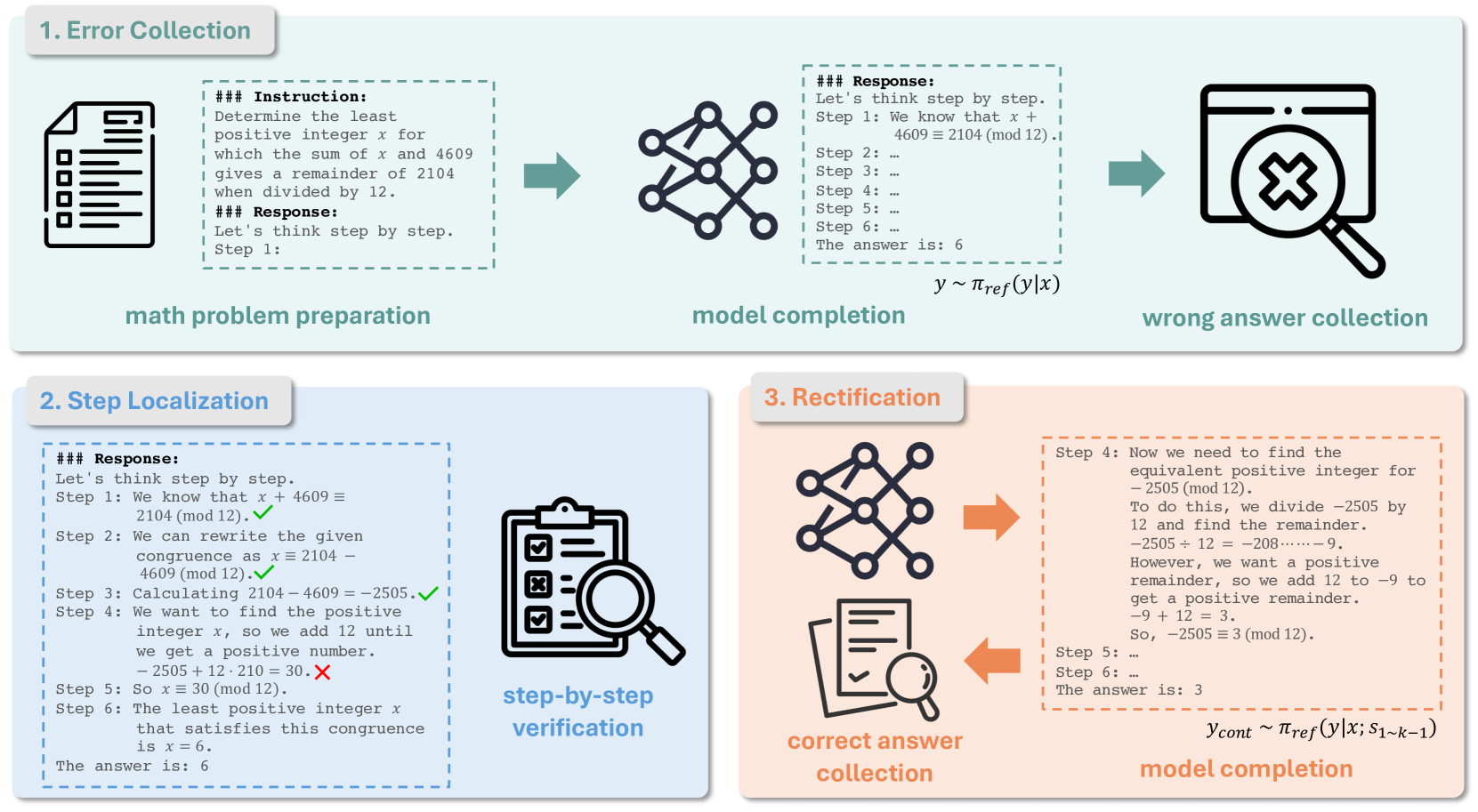
Moreover, we present an effective and economical pipeline to collect pair-wise preference data, resulting in a high-quality dataset for Step-DPO. This dataset contains approximately 10K samples, each consisting of: 1) a mathematical problem, 2) prior reasoning steps, 3) the chosen step, and 4) the rejected step. Our three-step pipeline for dataset construction includes: 1) Error collection, 2) Step localization, and 3) Rectification. Notably, the chosen reasoning step is generated by the model itself, as we find that in-distribution data (i.e., self-generated data) is more effective than out-of-distribution data (e.g., data written by humans or GPT-4) for Step-DPO, as shown in Table 4.
With this curated dataset, mathematical reasoning performance can be significantly boosted with only hundreds of training steps, as demonstrated in Fig. 6. For instance, fine-tuning Qwen-72B-Instruct with Step-DPO results in a model achieving 70.8% accuracy on MATH and 94.0% on GSM8K, surpassing a series of closed-source models, including GPT-4-1106, Claude-3-Opus, and Gemini-1.5-Pro.
<details>
<summary>x4.png Details</summary>
### Visual Description
## Diagram: DPO vs. Step-DPO
### Overview
The image presents two diagrams illustrating the Direct Preference Optimization (DPO) and Step-wise Direct Preference Optimization (Step-DPO) methods. Both diagrams depict a process involving preference data, maximum likelihood estimation, and a language model. The Step-DPO diagram includes a state transition diagram with winning and losing states.
### Components/Axes
**Left Diagram (DPO):**
* **Title:** DPO (top-right)
* **Input:** Preference data, represented by two speech bubbles. The left bubble is labeled with a crown icon and "yw", and the right bubble is labeled "yl". An arrow points from the left bubble to the right bubble.
* **Process:** "maximum likelihood" (below the right speech bubble)
* **Output:** "language model" (right side), represented by a series of interconnected colored circles (cyan, yellow, red).
**Right Diagram (Step-DPO):**
* **Title:** Step-DPO (top-right)
* **Input:** Step-wise preference data, represented by a state transition diagram. States are labeled s1, s2, and sk-1. A green circle labeled "Swin" with a green checkmark indicates a winning state. A red circle labeled "Slose" with a red cross indicates a losing state.
* **Process:** "maximum likelihood" (below the state transition diagram)
* **Output:** "language model" (right side), represented by a series of interconnected colored circles (cyan, yellow, red).
### Detailed Analysis
**Left Diagram (DPO):**
* The preference data consists of two options, yw and yl, where yw is preferred over yl.
* The maximum likelihood step optimizes the language model based on this preference data.
* The language model is represented by a network of nodes, suggesting a transformation or processing step.
**Right Diagram (Step-DPO):**
* The step-wise preference data is represented as a state transition diagram.
* The diagram shows transitions between states s1, s2, and sk-1, eventually leading to either a winning state (Swin) or a losing state (Slose).
* The maximum likelihood step optimizes the language model based on the outcome of the state transitions.
* The language model is represented by a network of nodes, similar to the DPO diagram.
### Key Observations
* Both DPO and Step-DPO aim to optimize a language model based on preference data.
* DPO uses direct preference data, while Step-DPO uses step-wise preference data represented as a state transition diagram.
* The state transition diagram in Step-DPO introduces the concept of winning and losing states, which are used to guide the optimization process.
### Interpretation
The diagrams illustrate two different approaches to optimizing language models based on preference data. DPO directly uses pairwise preferences, while Step-DPO uses a step-wise approach that models the decision-making process as a series of state transitions. The Step-DPO method may be useful in scenarios where the preference data is not directly available but can be inferred from a sequence of actions or decisions. The use of winning and losing states in Step-DPO allows for a more nuanced optimization process that takes into account the sequential nature of the data.
</details>
Figure 3: Comparison between DPO and Step-DPO.
2 Related Works
2.1 Mathematical Reasoning
Large Language Models (LLMs) have exhibited substantial reasoning capabilities, primarily due to their auto-regressive nature, which allows them to predict the next token based on contextual information. However, these models still struggle with long-chain reasoning tasks, particularly in mathematical contexts. Several prior studies (Yao et al., 2024; Chen et al., 2024; Yoran et al., 2023; Li et al., 2023; Tong et al., 2024; Fu et al., 2022; Zhou et al., 2022) have attempted to enhance the Chain-of-Thought (CoT) inference framework (Wei et al., 2022) to address this issue. While these efforts have led to significant improvements in certain tasks, they have not fully mitigated common hallucinations and have limited generalizability across all reasoning tasks.
Another research direction (Yu et al., 2023; Luo et al., 2023; Yue et al., 2023; Liu & Yao, 2024; Lu et al., 2024; Xu et al., 2024; Li et al., 2024; Shao et al., 2024; Xin et al., 2024; Zhou et al., 2024; Liu et al., 2023; Ying et al., 2024; Yue et al., 2024; Tang et al., 2024; Mitra et al., 2024; Yuan et al., 2023) focuses on various data augmentation techniques, such as rephrasing, extension, and evolution, for supervised fine-tuning (SFT). These methods have significantly enhanced the reasoning abilities of LLMs, but their performance plateaus once the data reaches a certain volume. Additionally, methods like those proposed by Wang et al. (2023a); Liao et al. (2024); Toshniwal et al. (2024); Gou et al. (2023) employ external tools, such as Python, to substantially reduce calculation errors.
Other approaches (Azerbayev et al., 2023; Shao et al., 2024; Lin et al., 2024; Ying et al., 2024; Wang et al., 2023c) involve continued pre-training on extensive, high-quality math-related datasets, which markedly improve mathematical reasoning capabilities. Recent studies (Xu et al., 2024; Ying et al., 2024) have explored reinforcement learning to mitigate hallucinations in mathematical reasoning. Works like Lightman et al. (2023); Shao et al. (2024); Wang et al. (2023b) emphasize the importance of step-by-step verification in reinforcement learning for mathematical problems. However, these methods still rely on the quality of the reward model and require the complex training pipelines of RLHF. Building on this line of research, we propose Step-DPO, a simpler, more effective, and more efficient method.
2.2 Reinforcement Learning from Human Feedback
Supervised fine-tuning (SFT) can align models with human preferences. However, as the probability of preferred outputs increases, so does the likelihood of undesirable ones, leading to hallucinations. To generate more reliable outputs, Reinforcement Learning from Human Feedback (RLHF) (Christiano et al., 2017; Ouyang et al., 2022) has been introduced for LLM alignment. This approach involves training a reward model with comparison data and then using this reward model to optimize the policy model. The final performance heavily depends on the quality of the reward model, and the training pipeline is quite complex.
To simplify this process, Direct Preference Optimization (DPO) (Rafailov et al., 2024) was proposed, which directly uses pair-wise preference data for model optimization. This transition significantly streamlines the training pipeline. While DPO has proven effective in chat benchmarks, it offers only marginal benefits for mathematical reasoning. Inheriting the principles of DPO, Step-DPO is specifically designed for long-chain reasoning and has shown significant performance improvements in solving math word problems.
3 Step-DPO
In this section, we elaborate on the proposed Step-DPO. First, we present step-wise formulation in Sec. 3.1, a novel approach designed to enhance long-chain reasoning abilities by building on DPO. Next, in Sec. 3.2, we illustrate a pipeline for constructing the step-wise preference dataset for Step-DPO. Both components are essential for achieving the desired performance improvements.
3.1 Step-wise Formulation
Preliminary.
Reinforcement Learning from Human Feedback (RLHF) (Christiano et al., 2017) is an effective approach for enhancing the robustness, factuality, and safety of LLMs (Ouyang et al., 2022). RLHF consists of two training phases: 1) reward model training, and 2) policy model training. However, the final performance of RLHF is highly sensitive to various hyperparameters in both phases, necessitating meticulous tuning.
To avoid this complex training pipeline, Rafailov et al. (2024) proposed Direct Preference Optimization (DPO), which directly uses pair-wise preference data to optimize the policy model with an equivalent optimization objective. Specifically, given an input prompt $x$ , and a preference data pair $(y_{win},y_{lose})$ , DPO aims to maximize the probability of the preferred output $y_{win}$ and minimize that of the undesirable output $y_{lose}$ . The optimization objective is formulated as:
$$
\displaystyle\begin{aligned} \mathcal{L}_{DPO}(\theta)=-\mathbb{E}_{(x,y_{win}%
,y_{lose})\sim D}[\log\sigma(\beta\log\frac{\pi_{\theta}(y_{win}|x)}{\pi_{ref}%
(y_{win}|x)}-\beta\log\frac{\pi_{\theta}(y_{lose}|x)}{\pi_{ref}(y_{lose}|x)})]%
,\end{aligned} \tag{1}
$$
where $D$ is the pair-wise preference dataset, $\sigma$ is the sigmoid function, $\pi_{\theta}(·|x)$ is the policy model to be optimized, $\pi_{ref}(·|x)$ is the reference model kept unchanged during training, and the hyperparameter $\beta$ controls the distance from the reference model.
Our Solution.
While DPO has proven effective in chat benchmarks, it brings only marginal improvements for long-chain reasoning tasks such as mathematical problems, as shown in Fig. 2 and Table 3. This limitation arises because most undesirable answers in these tasks do not contain errors initially; the first error often appears midway through the reasoning process. Rejecting an entire undesirable answer in DPO may also discard preceding correct reasoning steps, introducing significant noise and negatively impacting training.
Analogous to how teachers correct students by pinpointing specific errors rather than dismissing entire answers, our proposed Step-DPO provides more detailed supervision by identifying the specific erroneous reasoning step. This granular focus allows the model to swiftly locate, rectify, and avoid erroneous steps.
Specifically, the answer $y$ can be decomposed into a sequence of reasoning steps $y=s_{1},...,s_{n}$ , where $s_{i}$ is the $i$ -th reasoning step. As illustrated in Fig. 3, given a prompt $x$ and a series of initial correct reasoning steps $s_{1\sim k-1}=s_{1},...,s_{k-1}$ , Step-DPO aims to maximize the probability of the correct next reasoning step $s_{win}$ and minimize the probability of the incorrect one $s_{lose}$ . This objective can be formulated as:
$$
\displaystyle\begin{aligned} \mathcal{L}(\theta)=-\mathbb{E}_{(x,s_{1\sim k-1}%
,s_{win},s_{lose})\sim D}[\log\sigma(\beta\log\frac{\pi_{\theta}(s_{win}|x;s_{%
1\sim k-1})}{\pi_{ref}(s_{win}|x;s_{1\sim k-1})}-\beta\log\frac{\pi_{\theta}(s%
_{lose}|x;s_{1\sim k-1})}{\pi_{ref}(s_{lose}|x;s_{1\sim k-1})})].\end{aligned} \tag{2}
$$
3.2 In-distribution Data Construction
<details>
<summary>x5.png Details</summary>
### Visual Description
## Workflow Diagram: Error Correction and Rectification
### Overview
The image presents a workflow diagram illustrating a process involving error collection, step localization, and rectification. It outlines the steps taken to solve a mathematical problem, identify errors, and correct them. The diagram is divided into three main sections: Error Collection, Step Localization, and Rectification, each represented by a distinct colored box. Arrows indicate the flow of the process.
### Components/Axes
* **Titles:**
* 1. Error Collection (Top-left, light blue box)
* 2. Step Localization (Bottom-left, light blue box)
* 3. Rectification (Bottom-right, light orange box)
* **Sub-titles:**
* math problem preparation (under "Error Collection")
* step-by-step verification (under "Step Localization")
* correct answer collection (under "Rectification")
* wrong answer collection (top-right, light blue box)
* **Arrows:** Teal arrows indicate the flow of the process from left to right.
* **Icons:** Each section includes an icon representing the process:
* Error Collection: A document with check boxes.
* Step Localization: A checklist with a magnifying glass.
* Rectification: A network diagram above a document with a magnifying glass.
* Wrong answer collection: A magnifying glass over a computer screen with an X.
* **Text Boxes:** Each section contains a text box with the problem-solving steps and responses.
### Detailed Analysis or ### Content Details
**1. Error Collection (Top-left)**
* **Icon:** A document with four checkboxes.
* **Text Box:**
* `### Instruction:`
* "Determine the least positive integer x for which the sum of x and 4609 gives a remainder of 2104 when divided by 12."
* `### Response:`
* "Let's think step by step."
* "Step 1:"
* **Process Description:** This section represents the initial problem setup and the beginning of the solution process.
**Model Completion (Top-center)**
* **Icon:** A network diagram.
* **Text Box:**
* `### Response:`
* "Let's think step by step."
* "Step 1: We know that x + 4609 = 2104 (mod 12)."
* "Step 2: ..."
* "Step 3: ..."
* "Step 4: ..."
* "Step 5: ..."
* "Step 6: ..."
* "The answer is: 6"
* `y ~ π_ref(y|x)`
**Wrong Answer Collection (Top-right)**
* **Icon:** A magnifying glass over a computer screen with an X.
* **Process Description:** This section represents the collection of incorrect answers.
**2. Step Localization (Bottom-left)**
* **Icon:** A checklist with a magnifying glass.
* **Text Box:**
* `### Response:`
* "Let's think step by step."
* "Step 1: We know that x + 4609 = 2104 (mod 12)." (Green checkmark)
* "Step 2: We can rewrite the given congruence as x = 2104 - 4609 (mod 12)." (Green checkmark)
* "Step 3: Calculating 2104 - 4609 = -2505." (Green checkmark)
* "Step 4: We want to find the positive integer x, so we add 12 until we get a positive number. -2505 + 12 * 210 = 30." (Red X)
* "Step 5: So x = 30 (mod 12)."
* "Step 6: The least positive integer x that satisfies this congruence is x = 6."
* "The answer is: 6"
* **Process Description:** This section focuses on verifying each step of the solution and identifying the step where the error occurred (Step 4).
**3. Rectification (Bottom-right)**
* **Icon:** A network diagram above a document with a magnifying glass.
* **Text Box:**
* "Step 4: Now we need to find the equivalent positive integer for -2505 (mod 12). To do this, we divide -2505 by 12 and find the remainder. -2505 ÷ 12 = -208 ... -9. However, we want a positive remainder, so we add 12 to -9 to get a positive remainder. -9 + 12 = 3. So, -2505 ≡ 3 (mod 12)."
* "Step 5: ..."
* "Step 6: ..."
* "The answer is: 3"
* `y_cont ~ π_ref(y|x; s_1~k-1)`
* **Process Description:** This section describes the process of correcting the error and finding the correct answer.
### Key Observations
* The workflow progresses from problem setup to error identification and finally to error correction.
* The green checkmarks indicate correct steps, while the red X indicates the step with the error.
* The "Step Localization" section is crucial for pinpointing the exact location of the error.
* The "Rectification" section provides the corrected solution.
### Interpretation
The diagram illustrates a systematic approach to problem-solving, emphasizing the importance of step-by-step verification and error correction. It demonstrates how to identify and rectify errors in a mathematical solution, leading to the correct answer. The use of icons and color-coding enhances the clarity and understanding of the process. The diagram highlights the iterative nature of problem-solving, where errors are identified and corrected to arrive at the desired outcome.
</details>
Figure 4: Data construction pipeline for Step-DPO.
<details>
<summary>x6.png Details</summary>
### Visual Description
## Math Problem Solution
### Overview
The image presents a step-by-step solution to a modular arithmetic problem. It includes the problem statement ("prompt"), the initial reasoning steps, the chosen solution step, and a rejected solution step.
### Components/Axes
The image is structured into four distinct sections:
1. **prompt:** The problem statement.
2. **initial\_reasoning\_steps:** The initial steps taken to solve the problem.
3. **chosen\_step:** The chosen method to solve the problem.
4. **rejected\_step:** An alternative method that was rejected.
### Detailed Analysis or ### Content Details
**prompt:**
* "Determine the least positive integer x for which the sum of x and 4609 gives a remainder of 2104 when divided by 12."
**initial\_reasoning\_steps:**
* "Let's think step by step."
* "Step 1: We know that x + 4609 ≡ 2104 (mod 12)."
* "Step 2: We can rewrite the given congruence as x ≡ 2104 - 4609 (mod 12)."
* "Step 3: Calculating 2104 - 4609 = -2505."
* "Step 4:" (This step is left incomplete)
**chosen\_step:**
* "Now we need to find the equivalent positive integer for -2505 (mod 12)."
* "To do this, we divide -2505 by 12 and find the remainder. -2505 ÷ 12 = -208 remainder -9."
* "However, we want a positive remainder, so we add 12 to -9 to get a positive remainder. -9 + 12 = 3."
* "So, -2505 ≡ 3 (mod 12)."
**rejected\_step:**
* "We want to find the positive integer x, so we add 12 until we get a positive number. -2505 + 12 * 210 = 30."
### Key Observations
* The "initial\_reasoning\_steps" correctly sets up the modular arithmetic problem.
* The "chosen\_step" correctly finds the equivalent positive remainder of -2505 (mod 12), which is 3.
* The "rejected\_step" attempts to find a positive integer by repeatedly adding 12, but it incorrectly concludes that -2505 + 12 * 210 = 30. The correct calculation is -2505 + 2520 = 15.
### Interpretation
The image demonstrates the process of solving a modular arithmetic problem. The "chosen\_step" provides a correct method for finding the equivalent positive remainder. The "rejected\_step" shows an alternative approach that, while conceptually valid, contains an arithmetic error. The solution implies that x ≡ 3 (mod 12), and the "rejected\_step" attempts to find a positive integer solution for x. The problem asks for the *least* positive integer x. Since x ≡ 3 (mod 12), the least positive integer x is 3.
</details>
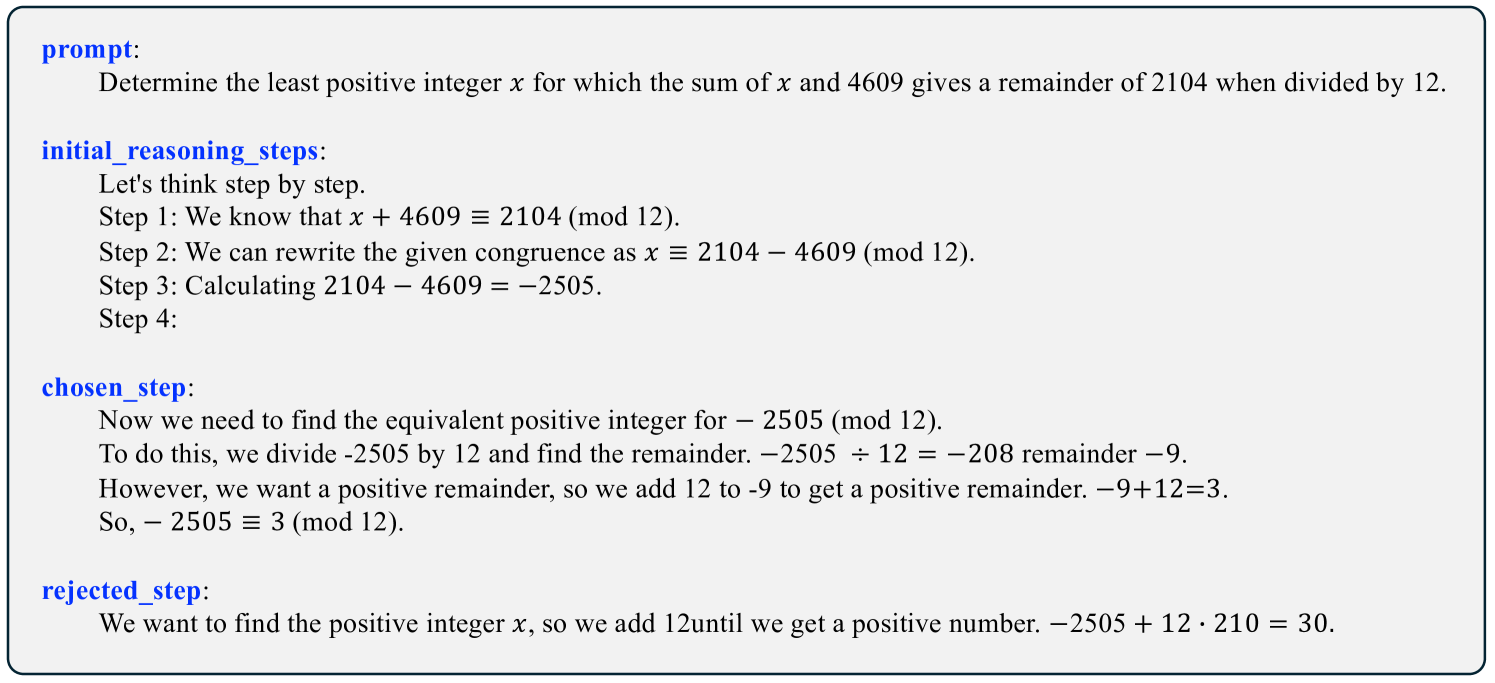
Figure 5: An example of preference data sample for Step-DPO.
According to the optimization target of Step-DPO, we need to create a corresponding high-quality pair-wise preference dataset. Each data sample should comprise four entries: 1) prompt $x$ ; 2) initial reasoning steps $s_{1\sim k-1}=s_{1},...,s_{k-1}$ ; 3) preferred reasoning step $s_{win}$ ; 4) undesirable reasoning step $s_{lose}$ , as shown in Fig. 5. To obtain a high-quality dataset, we propose a data construction pipeline illustrated in Fig. 4, which includes the following three steps.
Error collection.
First, we collect a set $D_{0}=\{(x,\hat{y})\}$ of mathematical problems $x$ with ground-truth answers $\hat{y}$ . Each mathematical problem $x$ is then used as a prompt to infer answers using the initial model $\pi_{ref}$ . Before inference, we add the step-wise Chain-of-Thought (CoT) prefix for prompting, i.e., "Let’s think step by step. Step 1:". This ensures that the model’s inference results are structured into multiple reasoning steps, with each step explicitly starting with "Step i:". Upon completion of inference, we obtain the model answers $y$ for each mathematical problem $x$ . We then select instances where the final answer $y$ differs from the ground truth $\hat{y}$ , resulting in a dataset of erroneous inference results, denoted as $D_{1}=\{(x,\hat{y},y)|x∈ D_{0}\}$ .
Step localization.
Given that each erroneous inference result is explicitly presented as a sequence of reasoning steps $y=s_{1},s_{2},...,s_{n}$ , we proceed to verify the correctness of each reasoning step until we find the first error and record its step number $k$ . This process can be done manually or using GPT-4. We select $s_{k}$ as the erroneous reasoning step $s_{lose}$ , resulting in a dataset that contains the erroneous steps, denoted as $D_{2}=\{(x,\hat{y},s_{1\sim k-1},s_{lose})|x∈ D_{1}\}$ .
Rectification.
To obtain the corresponding correct reasoning step for each sample in $D_{2}$ , we need to sample multiple outputs $y_{cont}$ by inferring the model $\pi_{ref}$ with the prompt $x$ and the preceding correct reasoning steps $s_{1\sim k-1}$ . This process is formulated as:
$$
\displaystyle\begin{aligned} y_{cont}\sim\pi_{ref}(y|x;s_{1\sim k-1}).\end{aligned} \tag{3}
$$
We retain those outputs where the final answer matches the ground truth. Among the remaining outputs, we select the first reasoning step in $y_{cont}$ as $s_{win}$ , resulting in the final dataset $D=\{(x,s_{1\sim k-1},s_{lose},s_{win})|x∈ D_{2}\}$ . An example of a resulting data sample is shown in Fig. 5.
Notably, some cases may have correct final answers but erroneous intermediate reasoning steps. Therefore, we may need to further filter out samples where $s_{win}$ is incorrect, which can be done manually or by GPT-4. We omit this process in the notations for simplicity, and more details are provided in the appendix.
It is important to note that the data pipeline is user-friendly. In this data pipeline, humans or GPT-4 are only required to locate errors and rank answers, and they do not need to write answers or rectifications by themselves.
We also note that the use of in-distribution data is crucial. When selecting $s_{win}$ , we use outputs generated by the model $\pi_{ref}$ rather than answers rectified by humans or GPT-4. Since human or GPT-4 rectified answers $s_{win}^{ood}$ are out-of-distribution (OOD) regarding the model $\pi_{ref}$ , the log-probability of outputting $s_{win}^{ood}$ (i.e., $\log\pi_{ref}(s_{win}^{ood}|x)$ ) is significantly lower than that of an in-distribution (ID) output $\log\pi_{ref}(s_{win}^{id}|x)$ . Moreover, it is challenging for the policy model $\pi_{\theta}$ to learn to increase the probability of $s_{win}^{ood}$ due to gradient decay issues (detailed in the appendix). Consequently, adopting self-generated in-distribution data as the preferred answer proves to be a more effective way of aligning with human preferences.
4 Experiments
In this section, we first introduce the experimental setup in Sec. 4.1. Then, we present the main results in Sec. 4.2, which include an exhaustive performance comparison. Moreover, we conduct an extensive ablation study in Sec. 4.3. Finally, a few demonstrations are shown in Sec. 4.4 to further understand Step-DPO.
4.1 Experimental Setup
Network Architecture.
Our experiments are based on various base models, including the Qwen2 and Qwen1.5 series (Bai et al., 2023), Meta-Llama-3-70B (Touvron et al., 2023), and deepseek-math-7b-base (Shao et al., 2024).
Table 1: Math reasoning performance comparison on MATH and GSM8K across various models. general: general-purpose model. open: open-source.
- $\;\;{}^{\dagger}$ Supervised fine-tuned models with our 299K SFT data based on the open-source base model.
- $\;\;{}^{\ddagger}$ Reproduced using our prompt
Table 2: Math reasoning performance comparison on compitition-level math problems, i.e., AIME 2024 and Odyssey-MATH. Note that the training data for Step-DPO is the same as before.
| Model | size | open | AIME | Odyssey-MATH (%) |
| --- | --- | --- | --- | --- |
| Gemini-1.5-Pro (Reid et al., 2024) | - | ✗ | 2 / 30 | 45.0 |
| Claude-3-Opus | - | ✗ | 2 / 30 | 40.6 |
| GPT-4-1106 (Achiam et al., 2023) | - | ✗ | 1 / 30 | 49.1 |
| GPT-4-Turbo-0409 (Achiam et al., 2023) | - | ✗ | 3 / 30 | 46.8 |
| GPT-4o-0513 | - | ✗ | 2 / 30 | 53.2 |
| DeepSeek-Coder-V2-Lite-Instruct (Zhu et al., 2024) | 16B | ✓ | 0 / 30 | 44.4 |
| Llama-3-70B-Instruct (Touvron et al., 2023) | 70B | ✓ | 1 / 30 | 27.9 |
| DeepSeek-Coder-V2-Instruct (Zhu et al., 2024) | 236B | ✓ | 4 / 30 | 53.7 |
| Qwen2-72B-SFT † | 72B | ✓ | 1 / 30 | 44.2 |
| Qwen2-72B-SFT + Step-DPO | 72B | ✓ | 3 / 30 | 47.0 (+2.8) |
| Qwen2-72B-Instruct (Bai et al., 2023) | 72B | ✓ | 5 / 30 | 47.0 |
| Qwen2-72B-Instruct + Step-DPO | 72B | ✓ | 4 / 30 | 50.1 (+3.1) |
- $\;\;{}^{\dagger}$ Supervised fine-tuned models with our 299K SFT data based on the open-source base model.
Datasets.
In supervised fine-tuning (SFT), we use augmented mathematical problems from MetaMath (Yu et al., 2023) and MMIQC (Liu & Yao, 2024) to infer step-by-step responses with DeepSeekMath, as the SFT data used in DeepSeekMath (Shao et al., 2024) is not publicly available. After filtering out responses with erroneous final answers, we obtain 374K SFT data. Of these, 299K are used for SFT, and the remainder is used for further Step-DPO training.
In the Step-DPO phase, alongside the remaining SFT data, we also incorporate a subset of AQuA (Ling et al., 2017). These datasets are processed as described in Sec. 3.2, resulting in 10K pair-wise preference data for Step-DPO.
For evaluation, we use the widely adopted MATH (Hendrycks et al., 2021) and GSM8K (Cobbe et al., 2021) datasets. Accuracy in these datasets serves as the evaluation metric. The MATH test set contains 5000 mathematical problems spanning 5 difficulty levels and 7 subjects, including algebra, counting and probability, geometry, intermediate algebra, number theory, prealgebra, and precalculus. The GSM8K test set includes 1319 mathematical problems, each with a step-by-step solution and a ground-truth answer. The problems in GSM8K are generally easier than those in MATH. Besides, we also use completition-level problems in American Invitational Mathematics Examination (AIME) (MAA, 2024) and Odyssey-MATH (Netmind.AI, 2024) to evaluate the math reasoning capabilities in solving hard problems.
Implementation Details.
First, we use the 299K SFT data for supervised fine-tuning on the base models, obtaining the SFT models. We train 7B models for 3 epochs and models larger than 30B for 2 epochs. The global batch size is set to 256, and the learning rate is set to 5e-6. We use the AdamW optimizer with a linear decay learning rate scheduler, setting the warmup ratio to 0.03. DeepSpeed ZeRO3 with CPU offload is used to reduce GPU memory usage during training.
Next, we perform Step-DPO based on the SFT models. For Step-DPO, we train 7B models for 8 epochs and models larger than 30B for 4 epochs. The global batch size is set to 128, and the learning rate is set to 5e-7. The hyperparameter $\beta$ is set to 0.5 for the 72B model and 0.4 for others. We use the AdamW optimizer and a cosine learning rate scheduler, with the warmup ratio set to 0.1.
4.2 Results
Table 3: Performance comparison between DPO and Step-DPO. We use only 5K data for training in this ablation study.
| Model MATH (%) Model | Qwen2-7B-SFT 54.8 Qwen2-72B-SFT | Qwen2-7B-SFT + DPO (5K) 55.0 Qwen2-72B-SFT + DPO (5K) | Qwen2-7B-SFT + Step-DPO (5K) 55.8 Qwen2-72B-SFT + Step-DPO (5K) |
| --- | --- | --- | --- |
| MATH (%) | 61.7 | 62.5 | 64.1 |
Table 4: Performance comparison between out-of-distribution and in-distribution data. OOD: out-of-distribution data. ID: in-distribution data.
| MATH (%) | 54.8 | 55.1 | 55.8 |
| --- | --- | --- | --- |
Applying on open-source instruct models.
Table 1 presents a comprehensive comparison of various models, encompassing both open-source and closed-source models. Notably, Step-DPO can be directly integrated into open-source instruction models, such as DeepSeekMath-RL and Qwen2-72B-Instruct, leading to significant performance enhancements even after their prior RLHF training phase. This indicates that Step-DPO complements RLHF effectively. Specifically, when applied to Qwen2-72B-Instruct, Step-DPO achieves scores of 70.8% and 94.0% on the MATH and GSM8K test sets, respectively, surpassing a series of closed-source models, including GPT-4-1106, Claude-3-Opus, and Gemini-1.5-Pro.
Applying on SFT models.
To further substantiate the efficacy of Step-DPO, we applied it to SFT models. Initially, we performed supervised fine-tuning on the 299K SFT dataset mentioned in Sec. 4.1, resulting in models such as DeepSeekMath-Base-SFT, Qwen2-7B-SFT, Qwen1.5-32B-SFT, Llama3-70B-SFT, and Qwen2-72B-SFT. Step-DPO proved highly effective, yielding significant improvements across various model sizes. Particularly, for models exceeding 70B parameters (i.e., Llama-3-70B-SFT and Qwen-2-72B-SFT), Step-DPO achieved approximately a 3% performance boost on the MATH test set.
Interestingly, larger models exhibited greater performance gains from Step-DPO. We hypothesize that larger models have untapped potential that Step-DPO can exploit. If the performance ceiling is not reached through supervised fine-tuning (SFT), Step-DPO can help models approach their optimal performance.
Results on math competition problems.
To further illustrate the superiority of Step-DPO in mathematical reasoning, we evaluated the models on competition-level math problems, specifically AIME 2024 and Odyssey-MATH, as shown in Fig. 2. Despite the increased difficulty of these problems compared to MATH and GSM8K, Step-DPO significantly enhanced performance. On Odyssey-MATH, Step-DPO applied to Qwen2-72B-Instruct achieved 50.1% accuracy, narrowing the performance gap with GPT-4o.
Notably, the models used the same Step-DPO training data for these competition-level problems as for problems of normal difficulty, highlighting Step-DPO’s robust generalization capability.
4.3 Ablation Study
To validate the effectiveness of Step-DPO and its data construction process, we conducted an extensive ablation study.
DPO vs. Step-DPO.
As discussed in Sec. 3.1, models utilizing vanilla DPO struggle to accurately identify errors in incorrect answers, providing only marginal benefits to mathematical reasoning performance. To verify this, we compared vanilla DPO and Step-DPO in terms of both accuracy in judging preferred versus undesirable outputs (left side of Fig. 2) and the reward margin between them (right side of Fig. 2). We also reported the final mathematical reasoning performance on the MATH test set in Table 3. The results indicated that the benefits of DPO are limited and significantly less than those of Step-DPO. In this experiment, we used only 5K Step-DPO training data and 3K for evaluation in Fig. 2.
Out-of-Distribution vs. In-Distribution Data.
The importance of in-distribution data was emphasized in Sec. 3.2. To illustrate its effectiveness, we compared out-of-distribution and in-distribution data in Table 4. Out-of-distribution data was generated by using GPT-4 to correct erroneous reasoning steps in incorrect answers, whereas in-distribution data was generated through the pipeline described in Sec. 3.2. The results in Table 4 underscore the critical role of in-distribution data in enhancing performance.
4.4 Demonstrations
<details>
<summary>x7.png Details</summary>
### Visual Description
## Text Comparison: Problem Solving Approaches
### Overview
The image presents two different approaches to solving a mathematical problem. The problem asks for the number of integer values of 't' that satisfy the condition where the square root of 't' is greater than 2 and less than 3.5. The left side shows a solution using "Qwen2-72B-Instruct," while the right side uses "Qwen2-72B-Instruct + Step-DPO." The key difference lies in how the integer values are handled at the upper bound of the inequality.
### Components/Axes
* **Problem Statement:** Defines the mathematical problem to be solved.
* **Solution Method 1:** "Qwen2-72B-Instruct" - A step-by-step approach to solving the problem.
* **Solution Method 2:** "Qwen2-72B-Instruct + Step-DPO" - A slightly different step-by-step approach.
* **Steps:** Both solutions break down the problem into numbered steps.
* **Inequalities:** Mathematical expressions representing the problem's constraints.
* **Integer Values:** Lists of integers that satisfy the derived inequalities.
* **Final Answer:** The total number of integer values that satisfy the condition.
### Detailed Analysis or ### Content Details
**Left Side: Qwen2-72B-Instruct**
1. **Problem:** The square root of t is greater than 2 and less than 3.5. How many integer values of t satisfy this condition?
2. **Qwen2-72B-Instruct:** To find the integer values of t that satisfy the condition that the square root of t is greater than 2 and less than 3.5, we can follow these steps.
3. **Step 1: Translate the condition into inequalities:** 2 < √t < 3.5
4. **Step 2: Square all parts of the inequality to eliminate the square root:** (2)² < t < (3.5)²
5. **Step 3: Calculate the squares:** 4 < t < 12.25
6. **Step 4: Determine the integer values of t that satisfy the inequality:** The integers that fall strictly between 4 and 12.25 are 5, 6, 7, 8, 9, 10, 11, 12. However, since t must be strictly less than 12.25, 12 is not included in the solution set because it is not strictly less than 12.25.
7. **Step 5: Count the integer values:** The integers that satisfy the condition are 5, 6, 7, 8, 9, 10, 11, which gives us a total of 7 integer values of t.
**Right Side: Qwen2-72B-Instruct + Step-DPO**
1. **Qwen2-72B-Instruct + Step-DPO:** To find the integer values of t that satisfy the condition that the square root of t is greater than 2 and less than 3.5, we can follow these steps.
2. **Step 1: Translate the inequality into mathematical terms:** The given condition can be written as: 2 < √t < 3.5.
3. **Step 2: Square all parts of the inequality to eliminate the square root:** Squaring all parts of the inequality gives: (2)² < t < (3.5)² which simplifies to 4 < t < 12.25
4. **Step 3: Find the integer values of t that satisfy the inequality:** The inequality 4 < t < 12.25 means that t is greater than 4 and less than 12.25. Since t must be an integer, the possible values of t are 5, 6, 7, 8, 9, 10, 11, 12. However, since t must be strictly less than 12.25, the value 12 is included in the range.
5. **Step 4: Count the integer values:** The integers that satisfy the condition are 5, 6, 7, 8, 9, 10, 11, 12. There are 8 integer values of t that satisfy the given condition.
### Key Observations
* Both methods correctly translate the problem into an inequality and square it to find the range for 't'.
* The critical difference is in the interpretation of the upper bound (12.25). The left side excludes 12, while the right side includes it.
* The left side arrives at a final answer of 7, while the right side arrives at 8.
### Interpretation
The difference in the final answers stems from the interpretation of whether the integer 12 should be included in the solution set. The left side ("Qwen2-72B-Instruct") explicitly excludes 12 because 't' must be *strictly* less than 12.25. The right side ("Qwen2-72B-Instruct + Step-DPO") includes 12, implying a slightly different interpretation of the inequality or a different rounding/inclusion rule.
The "Step-DPO" addition seems to allow for the inclusion of the integer 12, even though the inequality is strict. This could be due to a specific design choice in the "Step-DPO" algorithm to handle such boundary cases differently.
</details>
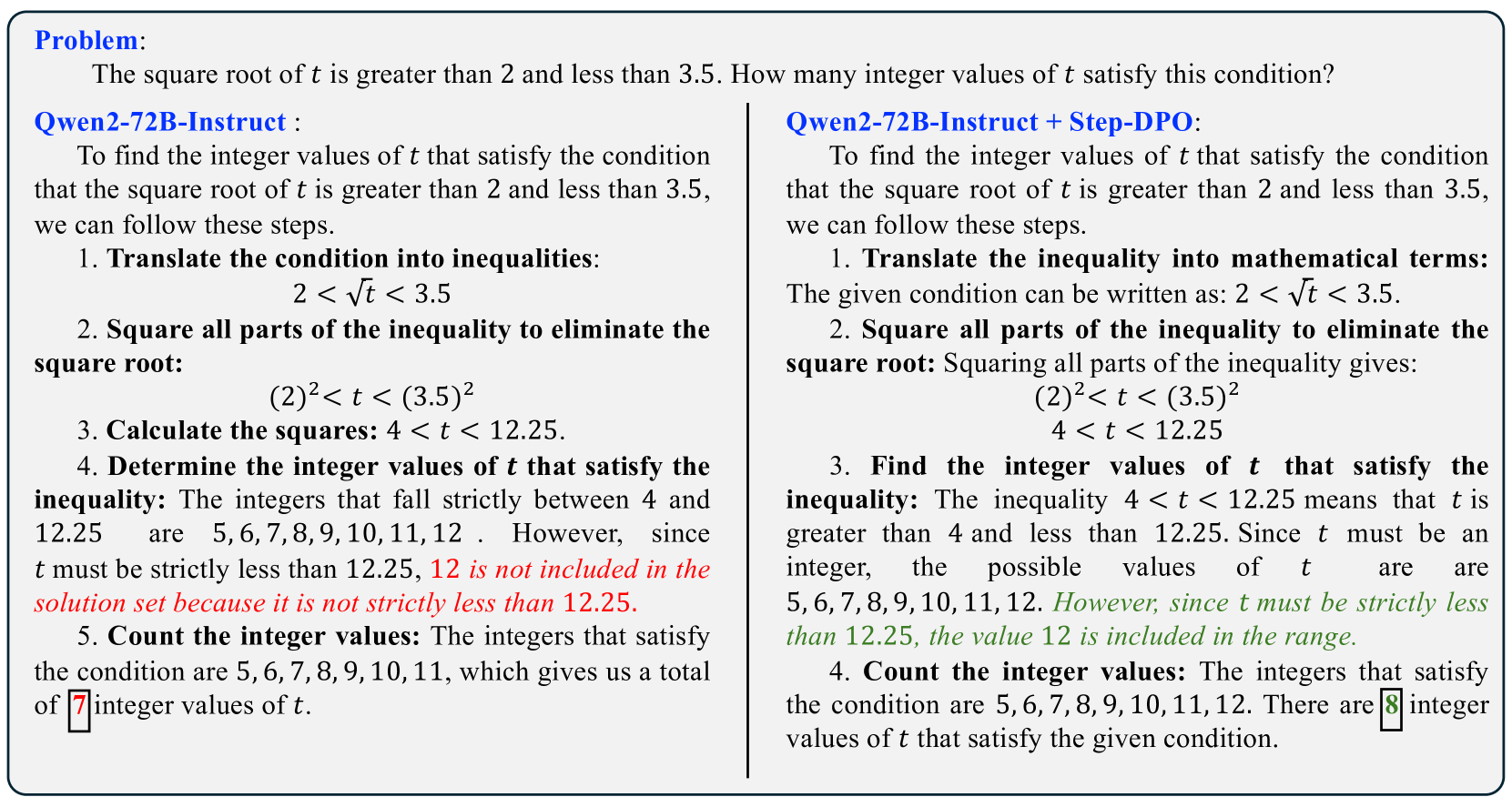
Figure 6: An example of comparison between Qwen2-72B-Instruct and Qwen2-72B-Instruct-Step-DPO.
As shown in Fig. 6, we demonstrate an example of comparison between Qwen2-72B-Instruct and Qwen2-72B-Instruct-Step-DPO. It turns out that Step-DPO does well in correcting minor mistakes in previous models. More comparisons are provided in the appendix.
5 Conclusion
In this work, we proposed a simple, effective, and data-efficient method called Step-DPO. Unlike DPO, which compares preferences between holistic answers, Step-DPO uses a single reasoning step as the fundamental unit for preference comparison. This transition enables fine-grained process supervision for LLMs, facilitating the quick localization of errors within incorrect answers. Additionally, we introduced a data construction pipeline for Step-DPO, creating a dataset with 10K preference data pairs. Our results demonstrate the significant improvements achieved by Step-DPO and the 10K dataset, particularly for large models. We hope that Step-DPO will provide new insights into model alignment for long-chain reasoning problems.
References
- Achiam et al. (2023) Josh Achiam, Steven Adler, Sandhini Agarwal, Lama Ahmad, Ilge Akkaya, Florencia Leoni Aleman, Diogo Almeida, Janko Altenschmidt, Sam Altman, Shyamal Anadkat, et al. Gpt-4 technical report. arXiv:2303.08774, 2023.
- Azerbayev et al. (2023) Zhangir Azerbayev, Hailey Schoelkopf, Keiran Paster, Marco Dos Santos, Stephen McAleer, Albert Q Jiang, Jia Deng, Stella Biderman, and Sean Welleck. Llemma: An open language model for mathematics. arXiv:2310.10631, 2023.
- Bai et al. (2023) Jinze Bai, Shuai Bai, Yunfei Chu, Zeyu Cui, Kai Dang, Xiaodong Deng, Yang Fan, Wenbin Ge, Yu Han, Fei Huang, Binyuan Hui, Luo Ji, Mei Li, Junyang Lin, Runji Lin, Dayiheng Liu, Gao Liu, Chengqiang Lu, Keming Lu, Jianxin Ma, Rui Men, Xingzhang Ren, Xuancheng Ren, Chuanqi Tan, Sinan Tan, Jianhong Tu, Peng Wang, Shijie Wang, Wei Wang, Shengguang Wu, Benfeng Xu, Jin Xu, An Yang, Hao Yang, Jian Yang, Shusheng Yang, Yang Yao, Bowen Yu, Hongyi Yuan, Zheng Yuan, Jianwei Zhang, Xingxuan Zhang, Yichang Zhang, Zhenru Zhang, Chang Zhou, Jingren Zhou, Xiaohuan Zhou, and Tianhang Zhu. Qwen technical report. arXiv:2309.16609, 2023.
- Chen et al. (2024) Guoxin Chen, Minpeng Liao, Chengxi Li, and Kai Fan. Alphamath almost zero: process supervision without process. arXiv:2405.03553, 2024.
- Christiano et al. (2017) Paul F Christiano, Jan Leike, Tom Brown, Miljan Martic, Shane Legg, and Dario Amodei. Deep reinforcement learning from human preferences. NeurIPS, 2017.
- Cobbe et al. (2021) Karl Cobbe, Vineet Kosaraju, Mohammad Bavarian, Mark Chen, Heewoo Jun, Lukasz Kaiser, Matthias Plappert, Jerry Tworek, Jacob Hilton, Reiichiro Nakano, et al. Training verifiers to solve math word problems. arXiv:2110.14168, 2021.
- Fu et al. (2022) Yao Fu, Hao Peng, Ashish Sabharwal, Peter Clark, and Tushar Khot. Complexity-based prompting for multi-step reasoning. In ICLR, 2022.
- Gou et al. (2023) Zhibin Gou, Zhihong Shao, Yeyun Gong, Yujiu Yang, Minlie Huang, Nan Duan, Weizhu Chen, et al. Tora: A tool-integrated reasoning agent for mathematical problem solving. arXiv:2309.17452, 2023.
- Hendrycks et al. (2021) Dan Hendrycks, Collin Burns, Saurav Kadavath, Akul Arora, Steven Basart, Eric Tang, Dawn Song, and Jacob Steinhardt. Measuring mathematical problem solving with the math dataset. arXiv:2103.03874, 2021.
- Hong et al. (2024) Jiwoo Hong, Noah Lee, and James Thorne. Orpo: Monolithic preference optimization without reference model. arXiv:2403.07691, 2024.
- Li et al. (2024) Chen Li, Weiqi Wang, Jingcheng Hu, Yixuan Wei, Nanning Zheng, Han Hu, Zheng Zhang, and Houwen Peng. Common 7b language models already possess strong math capabilities. arXiv:2403.04706, 2024.
- Li et al. (2023) Guohao Li, Hasan Hammoud, Hani Itani, Dmitrii Khizbullin, and Bernard Ghanem. Camel: Communicative agents for” mind” exploration of large language model society. NeurIPS, 2023.
- Liao et al. (2024) Minpeng Liao, Wei Luo, Chengxi Li, Jing Wu, and Kai Fan. Mario: Math reasoning with code interpreter output–a reproducible pipeline. arXiv:2401.08190, 2024.
- Lightman et al. (2023) Hunter Lightman, Vineet Kosaraju, Yura Burda, Harri Edwards, Bowen Baker, Teddy Lee, Jan Leike, John Schulman, Ilya Sutskever, and Karl Cobbe. Let’s verify step by step. arXiv:2305.20050, 2023.
- Lin et al. (2024) Zhenghao Lin, Zhibin Gou, Yeyun Gong, Xiao Liu, Yelong Shen, Ruochen Xu, Chen Lin, Yujiu Yang, Jian Jiao, Nan Duan, et al. Rho-1: Not all tokens are what you need. arXiv:2404.07965, 2024.
- Ling et al. (2017) Wang Ling, Dani Yogatama, Chris Dyer, and Phil Blunsom. Program induction by rationale generation: Learning to solve and explain algebraic word problems. arXiv:1705.04146, 2017.
- Liu & Yao (2024) Haoxiong Liu and Andrew Chi-Chih Yao. Augmenting math word problems via iterative question composing. arXiv:2401.09003, 2024.
- Liu et al. (2023) Yixin Liu, Avi Singh, C Daniel Freeman, John D Co-Reyes, and Peter J Liu. Improving large language model fine-tuning for solving math problems. arXiv:2310.10047, 2023.
- Lu et al. (2024) Zimu Lu, Aojun Zhou, Houxing Ren, Ke Wang, Weikang Shi, Junting Pan, Mingjie Zhan, and Hongsheng Li. Mathgenie: Generating synthetic data with question back-translation for enhancing mathematical reasoning of llms. arXiv:2402.16352, 2024.
- Luo et al. (2023) Haipeng Luo, Qingfeng Sun, Can Xu, Pu Zhao, Jianguang Lou, Chongyang Tao, Xiubo Geng, Qingwei Lin, Shifeng Chen, and Dongmei Zhang. Wizardmath: Empowering mathematical reasoning for large language models via reinforced evol-instruct. arXiv:2308.09583, 2023.
- MAA (2024) MAA. American invitational mathematics examination, 2024. URL https://maa.org/math-competitions/american-invitational-mathematics-examination-aime.
- Mitra et al. (2024) Arindam Mitra, Hamed Khanpour, Corby Rosset, and Ahmed Awadallah. Orca-math: Unlocking the potential of slms in grade school math. arXiv:2402.14830, 2024.
- Netmind.AI (2024) Netmind.AI. Odyssey-math. https://github.com/protagolabs/odyssey-math/tree/main, 2024. Accessed: April 22, 2024.
- Ouyang et al. (2022) Long Ouyang, Jeffrey Wu, Xu Jiang, Diogo Almeida, Carroll Wainwright, Pamela Mishkin, Chong Zhang, Sandhini Agarwal, Katarina Slama, Alex Ray, et al. Training language models to follow instructions with human feedback. NeurIPS, 2022.
- Rafailov et al. (2024) Rafael Rafailov, Archit Sharma, Eric Mitchell, Christopher D Manning, Stefano Ermon, and Chelsea Finn. Direct preference optimization: Your language model is secretly a reward model. NeurIPS, 2024.
- Reid et al. (2024) Machel Reid, Nikolay Savinov, Denis Teplyashin, Dmitry Lepikhin, Timothy Lillicrap, Jean-baptiste Alayrac, Radu Soricut, Angeliki Lazaridou, Orhan Firat, Julian Schrittwieser, et al. Gemini 1.5: Unlocking multimodal understanding across millions of tokens of context. arXiv:2403.05530, 2024.
- Roziere et al. (2023) Baptiste Roziere, Jonas Gehring, Fabian Gloeckle, Sten Sootla, Itai Gat, Xiaoqing Ellen Tan, Yossi Adi, Jingyu Liu, Tal Remez, Jérémy Rapin, et al. Code llama: Open foundation models for code. arXiv:2308.12950, 2023.
- Shao et al. (2024) Zhihong Shao, Peiyi Wang, Qihao Zhu, Runxin Xu, Junxiao Song, Mingchuan Zhang, YK Li, Y Wu, and Daya Guo. Deepseekmath: Pushing the limits of mathematical reasoning in open language models. arXiv:2402.03300, 2024.
- Tang et al. (2024) Zhengyang Tang, Xingxing Zhang, Benyou Wan, and Furu Wei. Mathscale: Scaling instruction tuning for mathematical reasoning. arXiv:2403.02884, 2024.
- Tong et al. (2024) Yongqi Tong, Dawei Li, Sizhe Wang, Yujia Wang, Fei Teng, and Jingbo Shang. Can llms learn from previous mistakes? investigating llms’ errors to boost for reasoning. arXiv:2403.20046, 2024.
- Toshniwal et al. (2024) Shubham Toshniwal, Ivan Moshkov, Sean Narenthiran, Daria Gitman, Fei Jia, and Igor Gitman. Openmathinstruct-1: A 1.8 million math instruction tuning dataset. arXiv:2402.10176, 2024.
- Touvron et al. (2023) Hugo Touvron, Thibaut Lavril, Gautier Izacard, Xavier Martinet, Marie-Anne Lachaux, Timothée Lacroix, Baptiste Rozière, Naman Goyal, Eric Hambro, Faisal Azhar, et al. Llama: Open and efficient foundation language models. arXiv:2302.13971, 2023.
- Tunstall et al. (2023) Lewis Tunstall, Edward Beeching, Nathan Lambert, Nazneen Rajani, Kashif Rasul, Younes Belkada, Shengyi Huang, Leandro von Werra, Clémentine Fourrier, Nathan Habib, et al. Zephyr: Direct distillation of lm alignment. arXiv:2310.16944, 2023.
- Wang et al. (2023a) Ke Wang, Houxing Ren, Aojun Zhou, Zimu Lu, Sichun Luo, Weikang Shi, Renrui Zhang, Linqi Song, Mingjie Zhan, and Hongsheng Li. Mathcoder: Seamless code integration in llms for enhanced mathematical reasoning. arXiv:2310.03731, 2023a.
- Wang et al. (2023b) Peiyi Wang, Lei Li, Zhihong Shao, RX Xu, Damai Dai, Yifei Li, Deli Chen, Y Wu, and Zhifang Sui. Math-shepherd: Verify and reinforce llms step-by-step without human annotations. CoRR, abs/2312.08935, 2023b.
- Wang et al. (2023c) Zengzhi Wang, Rui Xia, and Pengfei Liu. Generative ai for math: Part i–mathpile: A billion-token-scale pretraining corpus for math. arXiv:2312.17120, 2023c.
- Wei et al. (2022) Jason Wei, Xuezhi Wang, Dale Schuurmans, Maarten Bosma, Fei Xia, Ed Chi, Quoc V Le, Denny Zhou, et al. Chain-of-thought prompting elicits reasoning in large language models. NeurIPS, 2022.
- Xin et al. (2024) Huajian Xin, Daya Guo, Zhihong Shao, Zhizhou Ren, Qihao Zhu, Bo Liu, Chong Ruan, Wenda Li, and Xiaodan Liang. Deepseek-prover: Advancing theorem proving in llms through large-scale synthetic data. arXiv:2405.14333, 2024.
- Xu et al. (2024) Yifan Xu, Xiao Liu, Xinghan Liu, Zhenyu Hou, Yueyan Li, Xiaohan Zhang, Zihan Wang, Aohan Zeng, Zhengxiao Du, Wenyi Zhao, et al. Chatglm-math: Improving math problem-solving in large language models with a self-critique pipeline. arXiv:2404.02893, 2024.
- Yao et al. (2024) Shunyu Yao, Dian Yu, Jeffrey Zhao, Izhak Shafran, Tom Griffiths, Yuan Cao, and Karthik Narasimhan. Tree of thoughts: Deliberate problem solving with large language models. NeurIPS, 2024.
- Ying et al. (2024) Huaiyuan Ying, Shuo Zhang, Linyang Li, Zhejian Zhou, Yunfan Shao, Zhaoye Fei, Yichuan Ma, Jiawei Hong, Kuikun Liu, Ziyi Wang, et al. Internlm-math: Open math large language models toward verifiable reasoning. arXiv:2402.06332, 2024.
- Yoran et al. (2023) Ori Yoran, Tomer Wolfson, Ben Bogin, Uri Katz, Daniel Deutch, and Jonathan Berant. Answering questions by meta-reasoning over multiple chains of thought. arXiv:2304.13007, 2023.
- Yu et al. (2023) Longhui Yu, Weisen Jiang, Han Shi, Jincheng Yu, Zhengying Liu, Yu Zhang, James T Kwok, Zhenguo Li, Adrian Weller, and Weiyang Liu. Metamath: Bootstrap your own mathematical questions for large language models. arXiv:2309.12284, 2023.
- Yuan et al. (2023) Zheng Yuan, Hongyi Yuan, Chengpeng Li, Guanting Dong, Chuanqi Tan, and Chang Zhou. Scaling relationship on learning mathematical reasoning with large language models. arXiv:2308.01825, 2023.
- Yue et al. (2023) Xiang Yue, Xingwei Qu, Ge Zhang, Yao Fu, Wenhao Huang, Huan Sun, Yu Su, and Wenhu Chen. Mammoth: Building math generalist models through hybrid instruction tuning. arXiv:2309.05653, 2023.
- Yue et al. (2024) Xiang Yue, Tuney Zheng, Ge Zhang, and Wenhu Chen. Mammoth2: Scaling instructions from the web. arXiv:2405.03548, 2024.
- Zheng et al. (2024) Lianmin Zheng, Wei-Lin Chiang, Ying Sheng, Siyuan Zhuang, Zhanghao Wu, Yonghao Zhuang, Zi Lin, Zhuohan Li, Dacheng Li, Eric Xing, et al. Judging llm-as-a-judge with mt-bench and chatbot arena. NeurIPS, 2024.
- Zhou et al. (2022) Denny Zhou, Nathanael Schärli, Le Hou, Jason Wei, Nathan Scales, Xuezhi Wang, Dale Schuurmans, Claire Cui, Olivier Bousquet, Quoc Le, et al. Least-to-most prompting enables complex reasoning in large language models. arXiv:2205.10625, 2022.
- Zhou et al. (2024) Kun Zhou, Beichen Zhang, Jiapeng Wang, Zhipeng Chen, Wayne Xin Zhao, Jing Sha, Zhichao Sheng, Shijin Wang, and Ji-Rong Wen. Jiuzhang3. 0: Efficiently improving mathematical reasoning by training small data synthesis models. arXiv:2405.14365, 2024.
- Zhu et al. (2024) Qihao Zhu, Daya Guo, Zhihong Shao, Dejian Yang, Peiyi Wang, Runxin Xu, Y Wu, Yukun Li, Huazuo Gao, Shirong Ma, et al. Deepseek-coder-v2: Breaking the barrier of closed-source models in code intelligence. arXiv:2406.11931, 2024.