# PUZZLES: A Benchmark for Neural Algorithmic Reasoning
**Authors**: ETH Zürich
Abstract
Algorithmic reasoning is a fundamental cognitive ability that plays a pivotal role in problem-solving and decision-making processes. Reinforcement Learning (RL) has demonstrated remarkable proficiency in tasks such as motor control, handling perceptual input, and managing stochastic environments. These advancements have been enabled in part by the availability of benchmarks. In this work we introduce PUZZLES, a benchmark based on Simon Tatham’s Portable Puzzle Collection, aimed at fostering progress in algorithmic and logical reasoning in RL. PUZZLES contains 40 diverse logic puzzles of adjustable sizes and varying levels of complexity; many puzzles also feature a diverse set of additional configuration parameters. The 40 puzzles provide detailed information on the strengths and generalization capabilities of RL agents. Furthermore, we evaluate various RL algorithms on PUZZLES, providing baseline comparisons and demonstrating the potential for future research. All the software, including the environment, is available at https://github.com/ETH-DISCO/rlp.
Human intelligence relies heavily on logical and algorithmic reasoning as integral components for solving complex tasks. While Machine Learning (ML) has achieved remarkable success in addressing many real-world challenges, logical and algorithmic reasoning remains an open research question [1, 2, 3, 4, 5, 6, 7]. This research question is supported by the availability of benchmarks, which allow for a standardized and broad evaluation framework to measure and encourage progress [8, 9, 10].
Reinforcement Learning (RL) has made remarkable progress in various domains, showcasing its capabilities in tasks such as game playing [11, 12, 13, 14, 15] , robotics [16, 17, 18, 19] and control systems [20, 21, 22]. Various benchmarks have been proposed to enable progress in these areas [23, 24, 25, 26, 27, 28, 29]. More recently, advances have also been made in the direction of logical and algorithmic reasoning within RL [30, 31, 32]. Popular examples also include the games of Chess, Shogi, and Go [33, 34]. Given the importance of logical and algorithmic reasoning, we propose a benchmark to guide future developments in RL and more broadly machine learning.
Logic puzzles have long been a playful challenge for humans, and they are an ideal testing ground for evaluating the algorithmic and logical reasoning capabilities of RL agents. A diverse range of puzzles, similar to the Atari benchmark [24], favors methods that are broadly applicable. Unlike tasks with a fixed input size, logic puzzles can be solved iteratively once an algorithmic solution is found. This allows us to measure how well a solution attempt can adapt and generalize to larger inputs. Furthermore, in contrast to games such as Chess and Go, logic puzzles have a known solution, making reward design easier and enabling tracking progress and guidance with intermediate rewards.
<details>
<summary>x1.png Details</summary>
### Visual Description
## Grid of Puzzle Thumbnails
### Overview
The image displays a 5x8 grid of puzzle thumbnails, each labeled with a unique name. The puzzles are arranged in rows and columns, with each thumbnail featuring a distinct visual representation of the puzzle's mechanics or theme.
### Components/Axes
- **Rows**: 5 rows (top to bottom)
- **Columns**: 8 columns (left to right)
- **Labels**: Each thumbnail has a unique name (e.g., "Black Box," "Bridges," "Cube," etc.)
### Detailed Analysis
#### Row 1 (Top Row):
1. **Black Box**
2. **Bridges**
3. **Cube**
4. **Dominosa**
5. **Filling**
6. **Flip**
7. **Flood**
8. **Galaxies**
#### Row 2:
1. **Inertia**
2. **Keen**
3. **Lightup**
4. **Loopy**
5. **Magnets**
6. **Map**
7. **Mines**
8. **Mosaic**
#### Row 3:
1. **Net**
2. **Netslide**
3. **Palisade**
4. **Pattern**
5. **Pearl**
6. **Pegs**
7. **Tents**
8. **Towers**
#### Row 4:
1. **Slant**
2. **Solo**
3. **Same Game**
4. **Signpost**
5. **Singles**
6. **Sixteen**
7. **Undead**
8. **Unequal**
#### Row 5 (Bottom Row):
1. **Unrule**
2. **Untangle**
### Key Observations
- The grid is organized alphabetically or thematically, with no clear numerical or categorical order.
- Some puzzle names (e.g., "Same Game," "Undead") suggest thematic or gameplay mechanics.
- The final row contains only two entries ("Unrule," "Untangle"), which may indicate an incomplete grid or a design choice.
### Interpretation
The image appears to catalog a diverse set of logic or strategy puzzles, each represented by a unique visual and labeled for identification. The grid structure suggests a systematic categorization, though the lack of a clear legend or axis labels leaves the exact purpose (e.g., educational, recreational, or algorithmic) ambiguous. The final row's incomplete entries may imply a focus on specific puzzles or a design limitation.
*Note: The grid contains 34 labeled puzzles, but the user's description mentions 40. This discrepancy may stem from an incomplete image or a labeling error.*
</details>
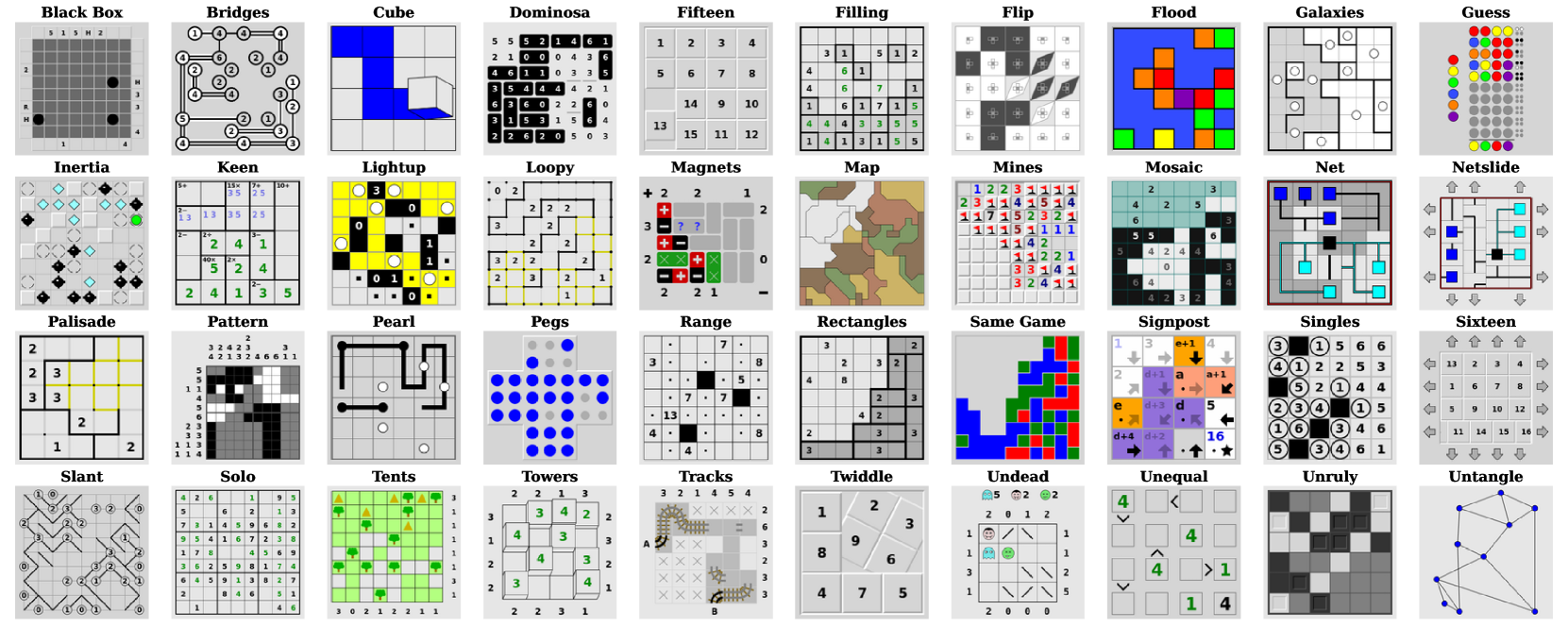
Figure 1: All puzzle classes of Simon Tatham’s Portable Puzzle Collection.
In this paper, we introduce PUZZLES, a comprehensive RL benchmark specifically designed to evaluate RL agents’ algorithmic reasoning and problem-solving abilities in the realm of logical and algorithmic reasoning. Simon Tatham’s Puzzle Collection [35], curated by the renowned computer programmer and puzzle enthusiast Simon Tatham, serves as the foundation of PUZZLES. This collection includes a set of 40 logic puzzles, shown in Figure 1, each of which presents distinct challenges with various dimensions of adjustable complexity. They range from more well-known puzzles, such as Solo or Mines (commonly known as Sudoku and Minesweeper, respectively) to lesser-known puzzles such as Cube or Slant. PUZZLES includes all 40 puzzles in a standardized environment, each playable with a visual or discrete input and a discrete action space.
Contributions.
We propose PUZZLES, an RL environment based on Simon Tatham’s Puzzle Collection, comprising a collection of 40 diverse logic puzzles. To ensure compatibility, we have extended the original C source code to adhere to the standards of the Pygame library. Subsequently, we have integrated PUZZLES into the Gymnasium framework API, providing a straightforward, standardized, and widely-used interface for RL applications. PUZZLES allows the user to arbitrarily scale the size and difficulty of logic puzzles, providing detailed information on the strengths and generalization capabilities of RL agents. Furthermore, we have evaluated various RL algorithms on PUZZLES, providing baseline comparisons and demonstrating the potential for future research.
1 Related Work
RL benchmarks.
Various benchmarks have been proposed in RL. Bellemare et al. [24] introduced the influential Atari-2600 benchmark, on which Mnih et al. [11] trained RL agents to play the games directly from pixel inputs. This benchmark demonstrated the potential of RL in complex, high-dimensional environments. PUZZLES allows the use of a similar approach where only pixel inputs are provided to the agent. Todorov et al. [23] presented MuJoCo which provides a diverse set of continuous control tasks based on a physics engine for robotic systems. Another control benchmark is the DeepMind Control Suite by Duan et al. [26], featuring continuous actions spaces and complex control problems. The work by Côté et al. [28] emphasized the importance of natural language understanding in RL and proposed a benchmark for evaluating RL methods in text-based domains. Lanctot et al. [29] introduced OpenSpiel, encompassing a wide range of games, enabling researchers to evaluate and compare RL algorithms’ performance in game-playing scenarios. These benchmarks and frameworks have contributed significantly to the development and evaluation of RL algorithms. OpenAI Gym by Brockman et al. [25], and its successor Gymnasium by the Farama Foundation [36] helped by providing a standardized interface for many benchmarks. As such, Gym and Gymnasium have played an important role in facilitating reproducibility and benchmarking in reinforcement learning research. Therefore, we provide PUZZLES as a Gymnasium environment to enable ease of use.
Logical and algorithmic reasoning within RL.
Notable research in RL on logical reasoning includes automated theorem proving using deep RL [16] or RL-based logic synthesis [37]. Dasgupta et al. [38] find that RL agents can perform a certain degree of causal reasoning in a meta-reinforcement learning setting. The work by Jiang and Luo [30] introduces Neural Logic RL, which improves interpretability and generalization of learned policies. Eppe et al. [39] provide steps to advance problem-solving as part of hierarchical RL. Fawzi et al. [31] and Mankowitz et al. [32] demonstrate that RL can be used to discover novel and more efficient algorithms for well-known problems such as matrix multiplication and sorting. Neural algorithmic reasoning has also been used as a method to improve low-data performance in classical RL control environments [40, 41]. Logical reasoning might be required to compete in certain types of games such as chess, shogi and Go [33, 34, 42, 13], Poker [43, 44, 45, 46] or board games [47, 48, 49, 50]. However, these are usually multi-agent games, with some also featuring imperfect information and stochasticity.
Reasoning benchmarks.
Various benchmarks have been introduced to assess different types of reasoning capabilities, although only in the realm of classical ML. IsarStep, proposed by Li et al. [8], specifically designed to evaluate high-level mathematical reasoning necessary for proof-writing tasks. Another significant benchmark in the field of reasoning is the CLRS Algorithmic Reasoning Benchmark, introduced by Veličković et al. [9]. This benchmark emphasizes the importance of algorithmic reasoning in machine learning research. It consists of 30 different types of algorithms sourced from the renowned textbook “Introduction to Algorithms” by Cormen et al. [51]. The CLRS benchmark serves as a means to evaluate models’ understanding and proficiency in learning various algorithms. In the domain of large language models (LLMs), BIG-bench has been introduced by Srivastava et al. [10]. BIG-bench incorporates tasks that assess the reasoning capabilities of LLMs, including logical reasoning.
Despite these valuable contributions, a suitable and unified benchmark for evaluating logical and algorithmic reasoning abilities in single-agent perfect-information RL has yet to be established. Recognizing this gap, we propose PUZZLES as a relevant and necessary benchmark with the potential to drive advancements and provide a standardized evaluation platform for RL methods that enable agents to acquire algorithmic and logical reasoning abilities.
2 The PUZZLES Environment
In the following section we give an overview of the PUZZLES environment. The puzzles are available to play online at https://www.chiark.greenend.org.uk/~sgtatham/puzzles/; excellent standalone apps for Android and iOS exist as well. The environment is written in both Python and C. For a detailed explanation of all features of the environment as well as their implementation, please see Appendices B and C.
Gymnasium RL Code
puzzle_env.py
puzzle.py
pygame.c
Puzzle C Sources
Pygame Library
puzzle Module
rlp Package Python C
Figure 2: Code and library landscape around the PUZZLES Environment, made up of the rlp Package and the puzzle Module . The figure shows how the puzzle Module presented in this paper fits within Tathams’s Puzzle Collection footnotemark: code, the Pygame package, and a user’s Gymnasium reinforcement learning code . The different parts are also categorized as Python language and C language.
2.1 Environment Overview
Within the PUZZLES environment, we encapsulate the tasks presented by each logic puzzle by defining consistent state, action, and observation spaces. It is also important to note that the large majority of the logic puzzles are designed so that they can be solved without requiring any guesswork. By default, we provide the option of two observation spaces, one is a representation of the discrete internal game state of the puzzle, the other is a visual representation of the game interface. These observation spaces can easily be wrapped in order to enable PUZZLES to be used with more advanced neural architectures such as graph neural networks (GNNs) or Transformers. All puzzles provide a discrete action space which only differs in cardinality. To accommodate the inherent difficulty and the need for proper algorithmic reasoning in solving these puzzles, the environment allows users to implement their own reward structures, facilitating the training of successful RL agents. All puzzles are played in a two-dimensional play area with deterministic state transitions, where a transition only occurs after a valid user input. Most of the puzzles in PUZZLES do not have an upper bound on the number of steps, they can only be completed by successfully solving the puzzle. An agent with a bad policy is likely never going to reach a terminal state. For this reason, we provide the option for early episode termination based on state repetitions. As we show in Section 3.4, this is an effective method to facilitate learning.
2.2 Difficulty Progression and Generalization
The PUZZLES environment places a strong emphasis on giving users control over the difficulty exhibited by the environment. For each puzzle, the problem size and difficulty can be adjusted individually. The difficulty affects the complexity of strategies that an agent needs to learn to solve a puzzle. As an example, Sudoku has tangible difficulty options: harder difficulties may require the use of new strategies such as forcing chains Forcing chains works by following linked cells to evaluate possible candidates, usually starting with a two-candidate cell. to find a solution, whereas easy difficulties only need the single position strategy. The single position strategy involves identifying cells which have only a single possible value.
The scalability of the puzzles in our environment offers a unique opportunity to design increasingly complex puzzle configurations, presenting a challenging landscape for RL agents to navigate. This dynamic nature of the benchmark serves two important purposes. Firstly, the scalability of the puzzles facilitates the evaluation of an agent’s generalization capabilities. In the PUZZLES environment, it is possible to train an agent in an easy puzzle setting and subsequently evaluate its performance in progressively harder puzzle configurations. For most puzzles, the cardinality of the action space is independent of puzzle size. It is therefore also possible to train an agent only on small instances of a puzzle and then evaluate it on larger sizes. This approach allows us to assess whether an agent has learned the correct underlying algorithm and generalizes to out-of-distribution scenarios. Secondly, it enables the benchmark to remain adaptable to the continuous advancements in RL methodologies. As RL algorithms evolve and become more capable, the puzzle configurations can be adjusted accordingly to maintain the desired level of difficulty. This ensures that the benchmark continues to effectively assess the capabilities of the latest RL methods.
3 Empirical Evaluation
We evaluate the baseline performance of numerous commonly used RL algorithms on our PUZZLES environment. Additionally, we also analyze the impact of certain design decisions of the environment and the training setup. Our metric of interest is the average number of steps required by a policy to successfully complete a puzzle, where lower is better. We refer to the term successful episode to denote the successful completion of a single puzzle instance. We also look at the success rate, i.e. what percentage of the puzzles was completed successfully.
To provide an understanding of the puzzle’s complexity and to contextualize the agents’ performance, we include an upper-bound estimate of the optimal number of steps required to solve the puzzle correctly. This estimate is a combination of both the steps required to solve the puzzle using an optimal strategy, and an upper bound on the environment steps required to achieve this solution, such as moving the cursor to the correct position. The upper bound is denoted as Optimal. Please refer to LABEL:tab:parameters for details on how this upper bound is calculated for each puzzle.
We run experiments based on all the RL algorithms presented in Table 8. We include both popular traditional algorithms such as PPO, as well as algorithms designed more specifically for the kinds of tasks presented in PUZZLES. Where possible, we used the implementations available in the RL library Stable Baselines 3 [52], using the default hyper-parameters. For MuZero and DreamerV3, we used the code available at [53] and [54], respectively. We provide a summary of all algorithms in Appendix Table 8. In total, our experiments required approximately 10’000 GPU hours.
All selected algorithms are compatible with the discrete action space required by our environment. This circumstance prohibits the use of certain other common RL algorithms such as Soft-Actor Critic (SAC) [55] or Twin Delayed Deep Deterministic Policy Gradients (TD3) [56].
3.1 Baseline Experiments
For the general baseline experiments, we trained all agents on all puzzles and evaluate their performance. Due to the challenging nature of our puzzles, we have selected an easy difficulty and small size of the puzzle where possible. Every agent was trained on the discrete internal state observation using five different random seeds. We trained all agents by providing rewards only at the end of each episode upon successful completion or failure. For computational reasons, we truncated all episodes during training and testing at 10,000 steps. For such a termination, reward was kept at 0. We evaluate the effect of this episode truncation in Section 3.4 We provide all experimental parameters, including the exact parameters supplied for each puzzle in Section E.3.
<details>
<summary>x2.png Details</summary>
### Visual Description
## Bar Chart: Average Episode Length Comparison Across Algorithms
### Overview
The chart compares the average episode length of nine different algorithms (A2C, DQN, DreamerV3, MuZero, PPO, QRDQN, RecurrentPPO, TRPO, and Optimal) using vertical bars with error bars. The y-axis represents "Average Episode Length" in arbitrary units, while the x-axis lists algorithm names. Error bars indicate variability in measurements.
### Components/Axes
- **X-axis**: Algorithm names (A2C, DQN, DreamerV3, MuZero, PPO, QRDQN, RecurrentPPO, TRPO, Optimal).
- **Y-axis**: "Average Episode Length" (units unspecified, scale from 0 to 4000).
- **Error Bars**: Black vertical lines extending above/below bars, representing measurement uncertainty.
- **Legend**: Absent.
### Detailed Analysis
1. **A2C**: Bar height ~2800, error bar spans ~1800–3800.
2. **DQN**: Bar height ~2000, error bar spans ~1500–2500.
3. **DreamerV3**: Bar height ~1400, error bar spans ~800–2000.
4. **MuZero**: Bar height ~1800, error bar spans ~1000–2800.
5. **PPO**: Bar height ~1600, error bar spans ~1200–2400.
6. **QRDQN**: Bar height ~2800, error bar spans ~1200–4400 (longest error bar).
7. **RecurrentPPO**: Bar height ~2300, error bar spans ~1500–3400.
8. **TRPO**: Bar height ~1800, error bar spans ~1200–2400.
9. **Optimal**: Bar height ~200, error bar spans ~100–300 (smallest bar).
### Key Observations
- **Optimal** has the shortest average episode length (~200), suggesting superior efficiency.
- **QRDQN** has the highest average (~2800) but also the largest error bar (~1200–4400), indicating high variability.
- **A2C** and **QRDQN** share the tallest bars, but A2C’s error bar is narrower.
- **DreamerV3** has the second-lowest average (~1400) and a wide error range (~800–2000).
- **RecurrentPPO** and **TRPO** show moderate averages (~2300 and ~1800) with mid-sized error bars.
### Interpretation
The chart highlights trade-offs between average performance and consistency across algorithms. **Optimal** stands out as the most efficient, with a low average and small error margin. **QRDQN** and **A2C** achieve high averages but exhibit significant variability, with QRDQN’s error bar nearly doubling its average. Algorithms like **DreamerV3** and **MuZero** show lower averages but inconsistent performance. The absence of a legend suggests the chart assumes prior knowledge of algorithm identities. The data implies that efficiency (Optimal) and stability (A2C) are distinct traits, with no single algorithm dominating both metrics.
</details>
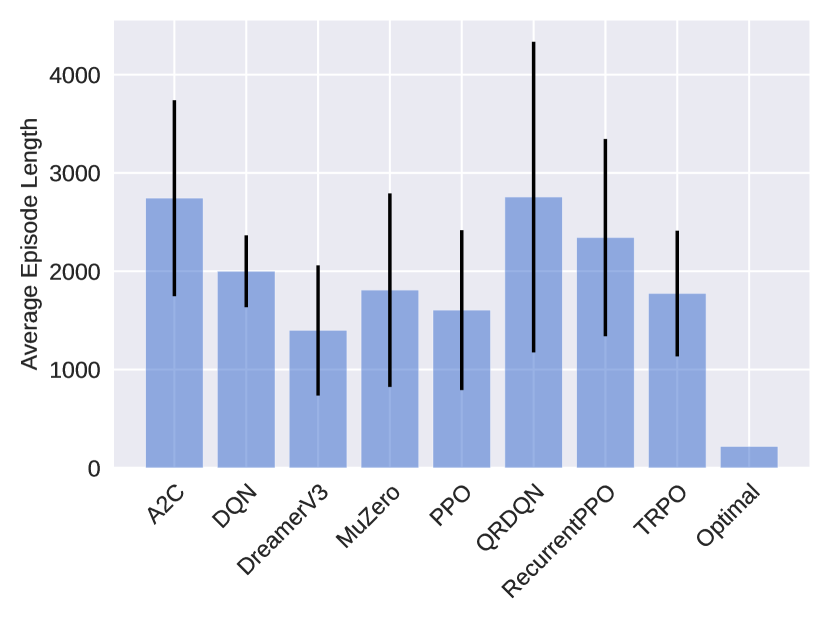
Figure 3: Average episode length of successful episodes for all evaluated algorithms on all puzzles in the easiest setting (lower is better). Some puzzles, namely Loopy, Pearl, Pegs, Solo, and Unruly, were intractable for all algorithms and were therefore excluded in this aggregation. The standard deviation is computed with respect to the performance over all evaluated instances for all trained seeds, aggregated for the total number of puzzles. Optimal refers the upper bound of the performance of an optimal policy, it therefore does not include a standard deviation. We see that DreamerV3 performs the best with an average episode length of 1334. However, this is still worse than the optimal upper bound at an average of 217 steps.
To track an agent’s progress, we use episode lengths, i.e., how many actions an agent needs to solve a puzzle. A lower number of actions indicates a stronger policy that is closer to the optimal solution. To obtain the final evaluation, we run each policy on 1000 random episodes of the respective puzzle, again with a maximum step size of 10,000 steps. All experiments were conducted on NVIDIA 3090 GPUs. The training time for a single agent with 2 million PPO steps varied depending on the puzzle and ranged from approximately 1.75 to 3 hours. The training for DreamerV3 and MuZero was more demanding and training time ranged from approximately 10 to 20 hours.
Figure 3 shows the average successful episode length for all algorithms. It can be seen that DreamerV3 performs best while PPO also achieves good performance, closely followed by TRPO and MuZero. This is especially interesting since PPO and TRPO follow much simpler training routines than DreamerV3 and MuZero. It seems that the implicit world models learned by DreamerV3 struggle to appropriately capture some puzzles. The high variance of MuZero may indicate some instability during training or the need for puzzle-specific hyperparamater tuning. Upon closer inspection of the detailed results, presented in Appendix Table 9 and 10, DreamerV3 manages to solve 62.7% of all puzzle instances. In 14 out of the 40 puzzles, it has found a policy that solves the puzzles within the Optimal upper bound. PPO and TRPO managed to solve an average of 61.6% and 70.8% of the puzzle instances, however only 8 and 11 of the puzzles have consistently solved within the Optimal upper bound. The algorithms A2C, RecurrentPPO, DQN and QRDQN perform worse than a pure random policy. Overall, it seems that some of the environments in PUZZLES are quite challenging and well suited to show the difference in performance between algorithms. It is also important to note that all the logic puzzles are designed so that they can be solved without requiring any guesswork.
3.2 Difficulty
We further evaluate the performance of a subset of the puzzles on the easiest preset difficulty level for humans. We selected all puzzles where a random policy was able to solve them with a probability of at least 10%, which are Netslide, Same Game and Untangle. By using this selection, we estimate that the reward density should be relatively high, ideally allowing the agent to learn a good policy. Again, we train all algorithms listed in Table 8. We provide results for the two strongest algorithms, PPO and DreamerV3 in Table 1, with complete results available in Appendix Table 9. Note that as part of Section 3.4, we also perform ablations using DreamerV3 on more puzzles on the easiest preset difficulty level for humans.
Table 1: Comparison of how many steps agents trained with PPO and DreamerV3 need on average to solve puzzles of two difficulty levels. In brackets, the percentage of successful episodes is reported. The difficulty levels correspond to the overall easiest and the easiest-for-humans settings. We also give the upper bound of optimal steps needed for each configuration.
| Netslide | 2x3b1 | $35.3± 0.7$ (100.0%) | $12.0± 0.4$ (100.0%) | 48 |
| --- | --- | --- | --- | --- |
| 3x3b1 | $4742.1± 2960.1$ (9.2%) | $3586.5± 676.9$ (22.4%) | 90 | |
| Same Game | 2x3c3s2 | $11.5± 0.1$ (100.0%) | $7.3± 0.2$ (100.0%) | 42 |
| 5x5c3s2 | $1009.3± 1089.4$ (30.5%) | $527.0± 162.0$ (30.2%) | 300 | |
| Untangle | 4 | $34.9± 10.8$ (100.0%) | $6.3± 0.4$ (100.0%) | 80 |
| 6 | $2294.7± 2121.2$ (96.2%) | $1683.3± 73.7$ (82.0%) | 150 | |
We can see that for both PPO and DreamerV3, the percentage of successful episodes decreases, with a large increase in steps required. DreamerV3 performs clearly stronger than PPO, requiring consistently fewer steps, but still more than the optimal policy. Our results indicate that puzzles with relatively high reward density at human difficulty levels remain challenging. We propose to use the easiest human difficulty level as a first measure to evaluate future algorithms. The details of the easiest human difficulty setting can be found in Appendix Table 7. If this level is achieved, difficulty can be further scaled up by increasing the size of the puzzles. Some puzzles also allow for an increase in difficulty with fixed size.
3.3 Effect of Action Masking and Observation Representation
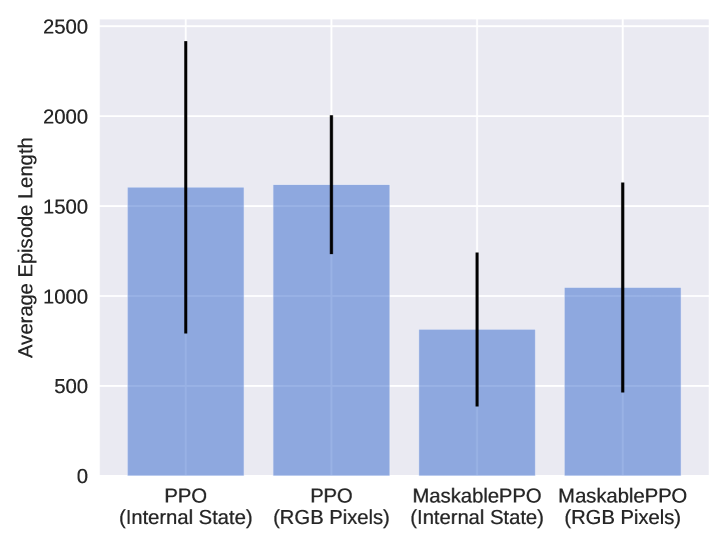
We evaluate the effect of action masking, as well as observation type, on training performance. Firstly, we analyze whether action masking, as described in paragraph “Action Masking” in Section B.4, can positively affect training performance. Secondly, we want to see if agents are still capable of solving puzzles while relying on pixel observations. Pixel observations allow for the exact same input representation to be used for all puzzles, thus achieving a setting that is very similar to the Atari benchmark. We compare MaskablePPO to the default PPO without action masking on both types of observations. We summarize the results in Figure 4. Detailed results for masked RL agents on the pixel observations are provided in Appendix Table 11.
<details>
<summary>x3.png Details</summary>
### Visual Description
## Bar Chart: Average Episode Length Comparison
### Overview
The chart compares the average episode lengths of four variations of a reinforcement learning algorithm: PPO (Internal State), PPO (RGB Pixels), MaskablePPO (Internal State), and MaskablePPO (RGB Pixels). Each bar represents the mean episode length with error bars indicating variability.
### Components/Axes
- **X-Axis**: Categorical labels for the four methods:
1. PPO (Internal State)
2. PPO (RGB Pixels)
3. MaskablePPO (Internal State)
4. MaskablePPO (RGB Pixels)
- **Y-Axis**: "Average Episode Length" (0–2500), with increments of 500.
- **Error Bars**: Vertical black lines on each bar representing variability (approximate ranges):
- PPO (Internal State): ~800–2400
- PPO (RGB Pixels): ~1200–2000
- MaskablePPO (Internal State): ~400–1200
- MaskablePPO (RGB Pixels): ~500–1600
- **Legend**: Not explicitly present in the image.
### Detailed Analysis
- **PPO (Internal State)**: Tallest bar (~1600 average), with the largest error bar (~800–2400). Suggests high variability in episode lengths.
- **PPO (RGB Pixels)**: Slightly taller than PPO (Internal State) (~1650 average), with a smaller error bar (~1200–2000). Indicates marginally higher average but reduced variability.
- **MaskablePPO (Internal State)**: Shortest bar (~800 average), with a moderate error bar (~400–1200). Lower average but higher relative variability compared to MaskablePPO (RGB Pixels).
- **MaskablePPO (RGB Pixels)**: Intermediate bar (~1050 average), with the smallest error bar (~500–1600). Balances lower average length with tighter variability.
### Key Observations
1. **PPO Methods**: Both PPO variants show higher average episode lengths but exhibit significant variability (large error bars).
2. **MaskablePPO Methods**: Lower average lengths but tighter error bars, suggesting more consistent performance.
3. **RGB Pixels vs. Internal State**: For both PPO and MaskablePPO, using RGB pixels results in slightly higher average lengths but reduced variability compared to internal state representations.
### Interpretation
The data suggests that MaskablePPO variants achieve shorter but more stable episode lengths, potentially indicating improved efficiency or reduced exploration time. The larger error bars for PPO methods imply greater sensitivity to initial conditions or hyperparameters. The use of RGB pixels across all methods correlates with marginally better performance (higher averages and tighter variability), possibly due to richer input data. However, the trade-off between episode length and stability warrants further investigation into the underlying algorithmic mechanisms.
</details>
<details>
<summary>x4.png Details</summary>
### Visual Description
## Line Chart: Timesteps per Episode vs Training Timesteps
### Overview
The chart compares the performance of four reinforcement learning algorithms (PPO and MaskablePPO) across two observation types (RGB Pixels and Internal State) over training timesteps. The y-axis shows timesteps per episode on a logarithmic scale (10^0 to 10^4), while the x-axis represents training timesteps (0.00 to 2.00 x10^6). Four colored lines represent algorithm-observation type combinations.
### Components/Axes
- **X-axis**: Training Timesteps (log scale: 0.00 → 2.00 x10^6)
- **Y-axis**: Timesteps per Episode (log scale: 10^0 → 10^4)
- **Legend**:
- Pink: PPO (RGB Pixels)
- Blue: MaskablePPO (RGB Pixels)
- Orange: PPO (Internal State)
- Green: MaskablePPO (Internal State)
### Detailed Analysis
1. **PPO (RGB Pixels)** (Pink):
- Starts at ~10^3 timesteps/episode
- Shows sharp fluctuations, peaking at ~10^4 around 0.75x10^6 timesteps
- Ends with erratic oscillations between 10^2 and 10^3
2. **MaskablePPO (RGB Pixels)** (Blue):
- Begins at ~10^2 timesteps/episode
- Maintains relatively stable performance (~10^2) with minor spikes
- Ends with consistent ~10^2 performance
3. **PPO (Internal State)** (Orange):
- Starts at ~10^1 timesteps/episode
- Gradually increases to ~10^2 by 0.5x10^6 timesteps
- Stabilizes with minor fluctuations (~10^2) afterward
4. **MaskablePPO (Internal State)** (Green):
- Remains near ~10^1 timesteps/episode throughout
- Shows minimal variation (<10% deviation)
### Key Observations
- **Performance Disparity**: PPO (RGB Pixels) achieves ~100x better performance than MaskablePPO (RGB Pixels) at peak efficiency.
- **Stability vs Volatility**: MaskablePPO variants demonstrate significantly smoother learning curves.
- **Internal State Advantage**: Both MaskablePPO variants outperform their RGB counterparts when using internal state observations.
- **Training Progression**: All algorithms show improvement in efficiency (lower timesteps/episode) as training progresses, with diminishing returns after ~1.0x10^6 timesteps.
### Interpretation
The data suggests that:
1. **Observation Type Matters**: Internal state observations enable more efficient learning (lower timesteps/episode) compared to raw RGB pixels.
2. **Algorithm Design Impact**: MaskablePPO's architecture likely provides better generalization or regularization, reducing performance volatility.
3. **Scaling Behavior**: While PPO (RGB Pixels) achieves higher peak performance, its instability suggests potential overfitting or sensitivity to hyperparameters.
4. **Diminishing Returns**: All curves plateau after ~1.0x10^6 timesteps, indicating a potential optimal training duration for this task.
The chart highlights tradeoffs between sample efficiency (timesteps/episode) and learning stability when choosing observation types and algorithm architectures.
</details>
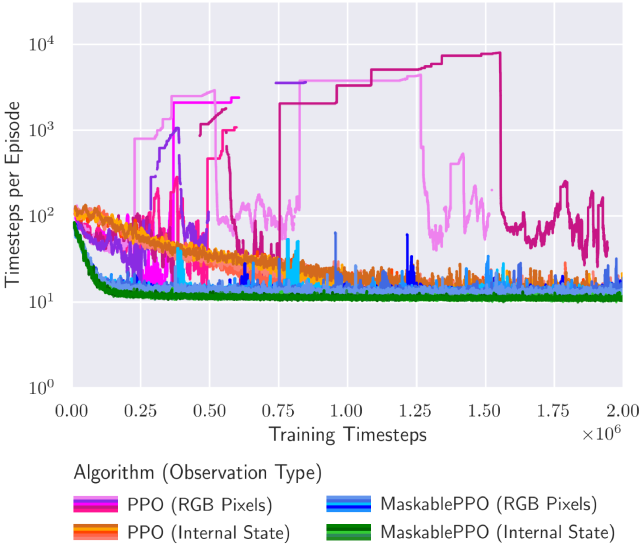
Figure 4: (left) We demonstrate the effect of action masking in both RGB observation and internal game state. By masking moves that do not change the current state, the agent requires fewer actions to explore, and therefore, on average solves a puzzle using fewer steps. (right) Moving average episode length during training for the Flood puzzle. Lower episode length is better, as the episode gets terminated as soon as the agent has solved a puzzle. Different colors describe different algorithms, where different shades of a color indicate different random seeds. Sparse dots indicate that an agent only occasionally managed to find a policy that solves a puzzle. It can be seen that both the use of discrete internal state observations and action masking have a positive effect on the training, leading to faster convergence and a stronger overall performance.
As we can observe in Figure 4, action masking has a strongly positive effect on training performance. This benefit is observed both in the discrete internal game state observations and on the pixel observations. We hypothesize that this is due to the more efficient exploration, as actions without effect are not allowed. As a result, the reward density during training is increased, and agents are able to learn a better policy. Particularly noteworthy are the outcomes related to Pegs. They show that an agent with action masking can effectively learn a successful policy, while a random policy without action masking consistently fails to solve any instance. As expected, training RL agents on pixel observations increases the difficulty of the task at hand. The agent must first understand how the pixel observation relates to the internal state of the game before it is able to solve the puzzle. Nevertheless, in combination with action masking, the agents manage to solve a large percentage of all puzzle instances, with 10 of the puzzles consistently solved within the optimal upper bound.
Furthermore, Figure 4 shows the individual training performance on the puzzle Flood. It can be seen that RL agents using action masking and the discrete internal game state observation converge significantly faster and to better policies compared to the baselines. The agents using pixel observations and no action masking struggle to converge to any reasonable policy.
3.4 Effect of Episode Length and Early Termination
We evaluate whether the cutoff episode length or early termination have an effect on training performance of the agents. For computational reasons, we perform these experiments on a selected subset of the puzzles on human level difficulty and only for DreamerV3 (see Section E.5 for details). As we can see in Table 2, increasing the maximum episode length during training from 10,000 to 100,000 does not improve performance. Only when episodes get terminated after visiting the exact same state more than 10 times, the agent is able to solve more puzzle instances on average (31.5% vs. 25.2%). Given the sparse reward structure, terminating episodes early seems to provide a better trade-off between allowing long trajectories to successfully complete and avoiding wasting resources on unsuccessful trajectories.
Table 2: Comparison of the effect of the maximum episode length (# Steps) and early termination (ET) on final performance. For each setting, we report average success episode length with standard deviation with respect to the random seed, all averaged over all selected puzzles. In brackets, the percentage of successful episodes is reported.
| $1e5$ | 10 | $2950.9± 1260.2$ (31.6%) |
| --- | --- | --- |
| - | $2975.4± 1503.5$ (25.2%) | |
| $1e4$ | 10 | $3193.9± 1044.2$ (26.1%) |
| - | $2892.4± 908.3$ (26.8%) | |
3.5 Generalization
PUZZLES is explicitly designed to facilitate the testing of generalization capabilities of agents with respect to different puzzle sizes or puzzle difficulties. For our experiments, we select puzzles with the highest reward density. We utilize a a custom observation wrapper and transformer-based encoder in order for the agent to be able to work with different input sizes, see Sections A.3 and A.4 for details. We call this approach PPO (Transformer)
Table 3: We test generalization capabilities of agents by evaluating them on puzzle sizes larger than their training environment. We report the average number of steps an agent needs to solve a puzzle, and the percentage of successful episodes in brackets. The difficulty levels correspond to the overall easiest and the easiest-for-humans settings. For PPO (Transformer), we selected the best checkpoint during training according to the performance in the training environment. For PPO (Transformer) †, we selected the best checkpoint during training according to the performance in the generalization environment.
| Netslide | 2x3b1 | ✓ | $244.1± 313.7$ (100.0%) | $242.0± 379.3$ (100.0%) |
| --- | --- | --- | --- | --- |
| 3x3b1 | ✗ | $9014.6± 2410.6$ (18.6%) | $9002.8± 2454.9$ (18.0%) | |
| Same Game | 2x3c3s2 | ✓ | $9.3± 10.9$ (99.8%) | $26.2± 52.9$ (99.7%) |
| 5x5c3s2 | ✗ | $379.0± 261.6$ (9.4%) | $880.1± 675.4$ (18.1%) | |
| Untangle | 4 | ✓ | $38.6± 58.2$ (99.8%) | $69.8± 66.4$ (100.0%) |
| 6 | ✗ | $3340.0± 3101.2$ (87.3%) | $2985.8± 2774.7$ (93.7%) | |
The results presented in Table 3 indicate that while it is possible to learn a policy that generalizes it remains a challenging problem. Furthermore, it can be observed that selecting the best model during training according to the performance on the generalization environment yields a performance benefit in that setting. This suggests that agents may learn a policy that generalizes better during the training process, but then overfit on the environment they are training on. It is also evident that generalization performance varies substantially across different random seeds. For Netslide, the best agent is capable of solving 23.3% of the puzzles in the generalization environment whereas the worst agent is only able to solve 11.2% of the puzzles, similar to a random policy. Our findings suggest that agents are generally capable of generalizing to more complex puzzles. However, further research is necessary to identify the appropriate inductive biases that allow for consistent generalization without a significant decline in performance.
4 Discussion
The experimental evaluation demonstrates varying degrees of success among different algorithms. For instance, puzzles such as Tracks, Map or Flip were not solvable by any of the evaluated RL agents, or only with performance similar to a random policy. This points towards the potential of intermediate rewards, better game rule-specific action masking, or model-based approaches. To encourage exploration in the state space, a mechanism that explicitly promotes it may be beneficial. On the other hand, the fact that some algorithms managed to solve a substantial amount of puzzles with presumably optimal performance demonstrates the advances in the field of RL. In light of the promising results of DreamerV3, the improvement of agents that have certain reasoning capabilities and an implicit world model by design stay an important direction for future research.
Experimental Results.
The experimental results presented in Section 3.1 and Section 3.3 underscore the positive impact of action masking and the correct observation type on performance. While a pixel representation would lead to a uniform observation for all puzzles, it currently increases complexity too much compared the discrete internal game state. Our findings indicate that incorporating action masking significantly improves the training efficiency of reinforcement learning algorithms. This enhancement was observed in both discrete internal game state observations and pixel observations. The mechanism for this improvement can be attributed to enhanced exploration, resulting in agents being able to learn more robust and effective policies. This was especially evident in puzzles where unmasked agents had considerable difficulty, thus showcasing the tangible advantages of implementing action masking for these puzzles.
Limitations.
While the PUZZLES framework provides the ability to gain comprehensive insights into the performance of various RL algorithms on logic puzzles, it is crucial to recognize certain limitations when interpreting results. The sparse rewards used in this baseline evaluation add to the complexity of the task. Moreover, all algorithms were evaluated with their default hyper-parameters. Additionally, the constraint of discrete action spaces excludes the application of certain RL algorithms.
In summary, the different challenges posed by the logic-requiring nature of these puzzles necessitates a good reward system, strong guidance of agents, and an agent design more focused on logical reasoning capabilities. It will be interesting to see how alternative architectures such as graph neural networks (GNNs) perform. GNNs are designed to align more closely with the algorithmic solution of many puzzles. While the notion that “reward is enough” [57, 58] might hold true, our results indicate that not just any form of correct reward will suffice, and that advanced architectures might be necessary to learn an optimal solution.
5 Conclusion
In this work, we have proposed PUZZLES, a benchmark that bridges the gap between algorithmic reasoning and RL. In addition to containing a rich diversity of logic puzzles, PUZZLES also offers an adjustable difficulty progression for each puzzle, making it a useful tool for benchmarking, evaluating and improving RL algorithms. Our empirical evaluation shows that while RL algorithms exhibit varying degrees of success, challenges persist, particularly in puzzles with higher complexity or those requiring nuanced logical reasoning. We are excited to share PUZZLES with the broader research community and hope that PUZZLES will foster further research for improving the algorithmic reasoning abilities of RL algorithms.
Broader Impact
This paper aims to contribute to the advancement of the field of Machine Learning (ML). Given the current challenges in ML related to algorithmic reasoning, we believe that our newly proposed benchmark will facilitate significant progress in this area, potentially elevating the capabilities of ML systems. Progress in algorithmic reasoning can contribute to the development of more transparent, explainable, and fair ML systems. This can further help address issues related to bias and discrimination in automated decision-making processes, promoting fairness and accountability.
References
- Serafini and Garcez [2016] Luciano Serafini and Artur d’Avila Garcez. Logic tensor networks: Deep learning and logical reasoning from data and knowledge. arXiv preprint arXiv:1606.04422, 2016.
- Dai et al. [2019] Wang-Zhou Dai, Qiuling Xu, Yang Yu, and Zhi-Hua Zhou. Bridging machine learning and logical reasoning by abductive learning. Advances in Neural Information Processing Systems, 32, 2019.
- Li et al. [2020] Yujia Li, Felix Gimeno, Pushmeet Kohli, and Oriol Vinyals. Strong generalization and efficiency in neural programs. arXiv preprint arXiv:2007.03629, 2020.
- Veličković and Blundell [2021] Petar Veličković and Charles Blundell. Neural algorithmic reasoning. Patterns, 2(7), 2021.
- Masry et al. [2022] Ahmed Masry, Do Long, Jia Qing Tan, Shafiq Joty, and Enamul Hoque. Chartqa: A benchmark for question answering about charts with visual and logical reasoning. In Findings of the Association for Computational Linguistics: ACL 2022, pages 2263–2279, 2022.
- Jiao et al. [2022] Fangkai Jiao, Yangyang Guo, Xuemeng Song, and Liqiang Nie. Merit: Meta-path guided contrastive learning for logical reasoning. In Findings of the Association for Computational Linguistics: ACL 2022, pages 3496–3509, 2022.
- Bardin et al. [2023] Sébastien Bardin, Somesh Jha, and Vijay Ganesh. Machine learning and logical reasoning: The new frontier (dagstuhl seminar 22291). In Dagstuhl Reports, volume 12. Schloss Dagstuhl-Leibniz-Zentrum für Informatik, 2023.
- Li et al. [2021] Wenda Li, Lei Yu, Yuhuai Wu, and Lawrence C Paulson. Isarstep: a benchmark for high-level mathematical reasoning. In International Conference on Learning Representations, 2021.
- Veličković et al. [2022] Petar Veličković, Adrià Puigdomènech Badia, David Budden, Razvan Pascanu, Andrea Banino, Misha Dashevskiy, Raia Hadsell, and Charles Blundell. The CLRS algorithmic reasoning benchmark. In Kamalika Chaudhuri, Stefanie Jegelka, Le Song, Csaba Szepesvari, Gang Niu, and Sivan Sabato, editors, Proceedings of the 39th International Conference on Machine Learning, volume 162 of Proceedings of Machine Learning Research, pages 22084–22102. PMLR, 17–23 Jul 2022. URL https://proceedings.mlr.press/v162/velickovic22a.html.
- Srivastava et al. [2022] Aarohi Srivastava, Abhinav Rastogi, Abhishek Rao, Abu Awal Md Shoeb, Abubakar Abid, Adam Fisch, Adam R Brown, Adam Santoro, Aditya Gupta, Adrià Garriga-Alonso, et al. Beyond the imitation game: Quantifying and extrapolating the capabilities of language models. arXiv preprint arXiv:2206.04615, 2022.
- Mnih et al. [2013] Volodymyr Mnih, Koray Kavukcuoglu, David Silver, Alex Graves, Ioannis Antonoglou, Daan Wierstra, and Martin A. Riedmiller. Playing Atari with Deep Reinforcement Learning. CoRR, abs/1312.5602, 2013. URL http://arxiv.org/abs/1312.5602.
- Tang et al. [2017] Haoran Tang, Rein Houthooft, Davis Foote, Adam Stooke, OpenAI Xi Chen, Yan Duan, John Schulman, Filip DeTurck, and Pieter Abbeel. # exploration: A study of count-based exploration for deep reinforcement learning. Advances in neural information processing systems, 30, 2017.
- Silver et al. [2018] David Silver, Thomas Hubert, Julian Schrittwieser, Ioannis Antonoglou, Matthew Lai, Arthur Guez, Marc Lanctot, Laurent Sifre, Dharshan Kumaran, Thore Graepel, et al. A general reinforcement learning algorithm that masters chess, shogi, and go through self-play. Science, 362(6419):1140–1144, 2018.
- Badia et al. [2020] Adrià Puigdomènech Badia, Bilal Piot, Steven Kapturowski, Pablo Sprechmann, Alex Vitvitskyi, Zhaohan Daniel Guo, and Charles Blundell. Agent57: Outperforming the atari human benchmark. In International conference on machine learning, pages 507–517. PMLR, 2020.
- Wurman et al. [2022] Peter R Wurman, Samuel Barrett, Kenta Kawamoto, James MacGlashan, Kaushik Subramanian, Thomas J Walsh, Roberto Capobianco, Alisa Devlic, Franziska Eckert, Florian Fuchs, et al. Outracing champion gran turismo drivers with deep reinforcement learning. Nature, 602(7896):223–228, 2022.
- Kalashnikov et al. [2018] Dmitry Kalashnikov, Alex Irpan, Peter Pastor, Julian Ibarz, Alexander Herzog, Eric Jang, Deirdre Quillen, Ethan Holly, Mrinal Kalakrishnan, Vincent Vanhoucke, et al. Scalable deep reinforcement learning for vision-based robotic manipulation. In Conference on Robot Learning, pages 651–673. PMLR, 2018.
- Kiran et al. [2021] B Ravi Kiran, Ibrahim Sobh, Victor Talpaert, Patrick Mannion, Ahmad A Al Sallab, Senthil Yogamani, and Patrick Pérez. Deep reinforcement learning for autonomous driving: A survey. IEEE Transactions on Intelligent Transportation Systems, 23(6):4909–4926, 2021.
- Rudin et al. [2022] Nikita Rudin, David Hoeller, Philipp Reist, and Marco Hutter. Learning to walk in minutes using massively parallel deep reinforcement learning. In Conference on Robot Learning, pages 91–100. PMLR, 2022.
- Rana et al. [2023] Krishan Rana, Ming Xu, Brendan Tidd, Michael Milford, and Niko Sünderhauf. Residual skill policies: Learning an adaptable skill-based action space for reinforcement learning for robotics. In Conference on Robot Learning, pages 2095–2104. PMLR, 2023.
- Wang and Hong [2020] Zhe Wang and Tianzhen Hong. Reinforcement learning for building controls: The opportunities and challenges. Applied Energy, 269:115036, 2020.
- Wu et al. [2022] Di Wu, Yin Lei, Maoen He, Chunjiong Zhang, and Li Ji. Deep reinforcement learning-based path control and optimization for unmanned ships. Wireless Communications and Mobile Computing, 2022:1–8, 2022.
- Brunke et al. [2022] Lukas Brunke, Melissa Greeff, Adam W Hall, Zhaocong Yuan, Siqi Zhou, Jacopo Panerati, and Angela P Schoellig. Safe learning in robotics: From learning-based control to safe reinforcement learning. Annual Review of Control, Robotics, and Autonomous Systems, 5:411–444, 2022.
- Todorov et al. [2012] Emanuel Todorov, Tom Erez, and Yuval Tassa. Mujoco: A physics engine for model-based control. In 2012 IEEE/RSJ international conference on intelligent robots and systems, pages 5026–5033. IEEE, 2012.
- Bellemare et al. [2013] Marc G Bellemare, Yavar Naddaf, Joel Veness, and Michael Bowling. The arcade learning environment: An evaluation platform for general agents. Journal of Artificial Intelligence Research, 47:253–279, 2013.
- Brockman et al. [2016] Greg Brockman, Vicki Cheung, Ludwig Pettersson, Jonas Schneider, John Schulman, Jie Tang, and Wojciech Zaremba. Openai gym. arXiv preprint arXiv:1606.01540, 2016.
- Duan et al. [2016] Yan Duan, Xi Chen, Rein Houthooft, John Schulman, and Pieter Abbeel. Benchmarking deep reinforcement learning for continuous control. In International conference on machine learning, pages 1329–1338. PMLR, 2016.
- Tassa et al. [2018] Yuval Tassa, Yotam Doron, Alistair Muldal, Tom Erez, Yazhe Li, Diego de Las Casas, David Budden, Abbas Abdolmaleki, Josh Merel, Andrew Lefrancq, et al. Deepmind control suite. arXiv preprint arXiv:1801.00690, 2018.
- Côté et al. [2018] Marc-Alexandre Côté, Ákos Kádár, Xingdi Yuan, Ben Kybartas, Tavian Barnes, Emery Fine, James Moore, Ruo Yu Tao, Matthew Hausknecht, Layla El Asri, Mahmoud Adada, Wendy Tay, and Adam Trischler. Textworld: A learning environment for text-based games. CoRR, abs/1806.11532, 2018.
- Lanctot et al. [2019] Marc Lanctot, Edward Lockhart, Jean-Baptiste Lespiau, Vinicius Zambaldi, Satyaki Upadhyay, Julien Pérolat, Sriram Srinivasan, Finbarr Timbers, Karl Tuyls, Shayegan Omidshafiei, Daniel Hennes, Dustin Morrill, Paul Muller, Timo Ewalds, Ryan Faulkner, János Kramár, Bart De Vylder, Brennan Saeta, James Bradbury, David Ding, Sebastian Borgeaud, Matthew Lai, Julian Schrittwieser, Thomas Anthony, Edward Hughes, Ivo Danihelka, and Jonah Ryan-Davis. OpenSpiel: A framework for reinforcement learning in games. CoRR, abs/1908.09453, 2019. URL http://arxiv.org/abs/1908.09453.
- Jiang and Luo [2019] Zhengyao Jiang and Shan Luo. Neural logic reinforcement learning. In International conference on machine learning, pages 3110–3119. PMLR, 2019.
- Fawzi et al. [2022] Alhussein Fawzi, Matej Balog, Aja Huang, Thomas Hubert, Bernardino Romera-Paredes, Mohammadamin Barekatain, Alexander Novikov, Francisco J R Ruiz, Julian Schrittwieser, Grzegorz Swirszcz, et al. Discovering faster matrix multiplication algorithms with reinforcement learning. Nature, 610(7930):47–53, 2022.
- Mankowitz et al. [2023] Daniel J Mankowitz, Andrea Michi, Anton Zhernov, Marco Gelmi, Marco Selvi, Cosmin Paduraru, Edouard Leurent, Shariq Iqbal, Jean-Baptiste Lespiau, Alex Ahern, et al. Faster sorting algorithms discovered using deep reinforcement learning. Nature, 618(7964):257–263, 2023.
- Lai [2015] Matthew Lai. Giraffe: Using deep reinforcement learning to play chess. arXiv preprint arXiv:1509.01549, 2015.
- Silver et al. [2016] David Silver, Aja Huang, Chris J. Maddison, Arthur Guez, Laurent Sifre, George van den Driessche, Julian Schrittwieser, Ioannis Antonoglou, Veda Panneershelvam, Marc Lanctot, Sander Dieleman, Dominik Grewe, John Nham, Nal Kalchbrenner, Ilya Sutskever, Timothy Lillicrap, Madeleine Leach, Koray Kavukcuoglu, Thore Graepel, and Demis Hassabis. Mastering the game of go with deep neural networks and tree search. Nature, 529:484–489, 2016. URL https://doi.org/10.1038/nature16961.
- Tatham [2004a] Simon Tatham. Simon tatham’s portable puzzle collection, 2004a. URL https://www.chiark.greenend.org.uk/~sgtatham/puzzles/. Accessed: 2023-05-16.
- Foundation [2022] Farama Foundation. Gymnasium website, 2022. URL https://gymnasium.farama.org/. Accessed: 2023-05-12.
- Wang et al. [2022] Chao Wang, Chen Chen, Dong Li, and Bin Wang. Rethinking reinforcement learning based logic synthesis. arXiv preprint arXiv:2205.07614, 2022.
- Dasgupta et al. [2019] Ishita Dasgupta, Jane Wang, Silvia Chiappa, Jovana Mitrovic, Pedro Ortega, David Raposo, Edward Hughes, Peter Battaglia, Matthew Botvinick, and Zeb Kurth-Nelson. Causal reasoning from meta-reinforcement learning. arXiv preprint arXiv:1901.08162, 2019.
- Eppe et al. [2022] Manfred Eppe, Christian Gumbsch, Matthias Kerzel, Phuong DH Nguyen, Martin V Butz, and Stefan Wermter. Intelligent problem-solving as integrated hierarchical reinforcement learning. Nature Machine Intelligence, 4(1):11–20, 2022.
- Deac et al. [2021] Andreea-Ioana Deac, Petar Veličković, Ognjen Milinkovic, Pierre-Luc Bacon, Jian Tang, and Mladen Nikolic. Neural algorithmic reasoners are implicit planners. Advances in Neural Information Processing Systems, 34:15529–15542, 2021.
- He et al. [2022] Yu He, Petar Veličković, Pietro Liò, and Andreea Deac. Continuous neural algorithmic planners. In Learning on Graphs Conference, pages 54–1. PMLR, 2022.
- Silver et al. [2017] David Silver, Thomas Hubert, Julian Schrittwieser, Ioannis Antonoglou, Matthew Lai, Arthur Guez, Marc Lanctot, Laurent Sifre, Dharshan Kumaran, Thore Graepel, et al. Mastering chess and shogi by self-play with a general reinforcement learning algorithm. arXiv preprint arXiv:1712.01815, 2017.
- Dahl [2001] Fredrik A Dahl. A reinforcement learning algorithm applied to simplified two-player texas hold’em poker. In European Conference on Machine Learning, pages 85–96. Springer, 2001.
- Heinrich and Silver [2016] Johannes Heinrich and David Silver. Deep reinforcement learning from self-play in imperfect-information games. arXiv preprint arXiv:1603.01121, 2016.
- Steinberger [2019] Eric Steinberger. Pokerrl. https://github.com/TinkeringCode/PokerRL, 2019.
- Zhao et al. [2022] Enmin Zhao, Renye Yan, Jinqiu Li, Kai Li, and Junliang Xing. Alphaholdem: High-performance artificial intelligence for heads-up no-limit poker via end-to-end reinforcement learning. In Proceedings of the AAAI Conference on Artificial Intelligence, volume 36, pages 4689–4697, 2022.
- Ghory [2004] Imran Ghory. Reinforcement learning in board games. 2004.
- Szita [2012] István Szita. Reinforcement learning in games. In Reinforcement Learning: State-of-the-art, pages 539–577. Springer, 2012.
- Xenou et al. [2019] Konstantia Xenou, Georgios Chalkiadakis, and Stergos Afantenos. Deep reinforcement learning in strategic board game environments. In Multi-Agent Systems: 16th European Conference, EUMAS 2018, Bergen, Norway, December 6–7, 2018, Revised Selected Papers 16, pages 233–248. Springer, 2019.
- Perolat et al. [2022] Julien Perolat, Bart De Vylder, Daniel Hennes, Eugene Tarassov, Florian Strub, Vincent de Boer, Paul Muller, Jerome T Connor, Neil Burch, Thomas Anthony, et al. Mastering the game of stratego with model-free multiagent reinforcement learning. Science, 378(6623):990–996, 2022.
- Cormen et al. [2022] Thomas H. Cormen, Charles Eric Leiserson, Ronald L. Rivest, and Clifford Stein. Introduction to Algorithms. The MIT Press, 4th edition, 2022.
- Raffin et al. [2021] Antonin Raffin, Ashley Hill, Adam Gleave, Anssi Kanervisto, Maximilian Ernestus, and Noah Dormann. Stable-baselines3: Reliable reinforcement learning implementations. Journal of Machine Learning Research, 22(268):1–8, 2021. URL http://jmlr.org/papers/v22/20-1364.html.
- Werner Duvaud [2019] Aurèle Hainaut Werner Duvaud. Muzero general: Open reimplementation of muzero. https://github.com/werner-duvaud/muzero-general, 2019.
- Hafner et al. [2023a] Danijar Hafner, Jurgis Pasukonis, Jimmy Ba, and Timothy Lillicrap. Mastering diverse domains through world models. https://github.com/danijar/dreamerv3, 2023a.
- Haarnoja et al. [2018] Tuomas Haarnoja, Aurick Zhou, Pieter Abbeel, and Sergey Levine. Soft actor-critic: Off-policy maximum entropy deep reinforcement learning with a stochastic actor. In International conference on machine learning, pages 1861–1870. PMLR, 2018.
- Fujimoto et al. [2018] Scott Fujimoto, Herke Hoof, and David Meger. Addressing function approximation error in actor-critic methods. In International conference on machine learning, pages 1587–1596. PMLR, 2018.
- Silver et al. [2021] David Silver, Satinder Singh, Doina Precup, and Richard S Sutton. Reward is enough. Artificial Intelligence, 299:103535, 2021.
- Vamplew et al. [2022] Peter Vamplew, Benjamin J Smith, Johan Källström, Gabriel Ramos, Roxana Rădulescu, Diederik M Roijers, Conor F Hayes, Fredrik Heintz, Patrick Mannion, Pieter JK Libin, et al. Scalar reward is not enough: A response to silver, singh, precup and sutton (2021). Autonomous Agents and Multi-Agent Systems, 36(2):41, 2022.
- Community [2000] Pygame Community. Pygame github repository, 2000. URL https://github.com/pygame/pygame/. Accessed: 2023-05-12.
- Tatham [2004b] Simon Tatham. Developer documentation for simon tatham’s puzzle collection, 2004b. URL https://www.chiark.greenend.org.uk/~sgtatham/puzzles/devel/. Accessed: 2023-05-23.
- Schulman et al. [2017] John Schulman, Filip Wolski, Prafulla Dhariwal, Alec Radford, and Oleg Klimov. Proximal policy optimization algorithms, 2017. URL http://arxiv.org/abs/1707.06347.
- Huang et al. [2022] Shengyi Huang, Rousslan Fernand Julien Dossa, Antonin Raffin, Anssi Kanervisto, and Weixun Wang. The 37 implementation details of proximal policy optimization. In ICLR Blog Track, 2022. URL https://iclr-blog-track.github.io/2022/03/25/ppo-implementation-details/. https://iclr-blog-track.github.io/2022/03/25/ppo-implementation-details/.
- Mnih et al. [2016] Volodymyr Mnih, Adrià Puigdomènech Badia, Mehdi Mirza, Alex Graves, Timothy P. Lillicrap, Tim Harley, David Silver, and Koray Kavukcuoglu. Asynchronous methods for deep reinforcement learning. CoRR, abs/1602.01783, 2016. URL http://arxiv.org/abs/1602.01783.
- Schulman et al. [2015] John Schulman, Sergey Levine, Pieter Abbeel, Michael Jordan, and Philipp Moritz. Trust region policy optimization. In Francis Bach and David Blei, editors, Proceedings of the 32nd International Conference on Machine Learning, volume 37 of Proceedings of Machine Learning Research, pages 1889–1897, Lille, France, 07–09 Jul 2015. PMLR. URL https://proceedings.mlr.press/v37/schulman15.html.
- Dabney et al. [2017] Will Dabney, Mark Rowland, Marc G. Bellemare, and Rémi Munos. Distributional reinforcement learning with quantile regression. CoRR, abs/1710.10044, 2017. URL http://arxiv.org/abs/1710.10044.
- Schrittwieser et al. [2020] Julian Schrittwieser, Ioannis Antonoglou, Thomas Hubert, Karen Simonyan, Laurent Sifre, Simon Schmitt, Arthur Guez, Edward Lockhart, Demis Hassabis, Thore Graepel, et al. Mastering atari, go, chess and shogi by planning with a learned model. Nature, 588(7839):604–609, 2020.
- Hafner et al. [2023b] Danijar Hafner, Jurgis Pasukonis, Jimmy Ba, and Timothy Lillicrap. Mastering diverse domains through world models. arXiv preprint arXiv:2301.04104, 2023b.
Appendix A PUZZLES Environment Usage Guide
A.1 General Usage
A Python code example for using the PUZZLES environment is provided in LABEL:code:init-and-play-episode. All puzzles support seeding the initialization, by adding #{seed} after the parameters, where {seed} is an int. The allowed parameters are displayed in LABEL:tab:parameters. A full custom initialization argument would be as follows: {parameters}#{seed}.
⬇
1 import gymnasium as gym
2 import rlp
3
4 # init an agent suitable for Gymnasium environments
5 agent = Agent. create ()
6
7 # init the environment
8 env = gym. make (’rlp/Puzzle-v0’, puzzle = "bridges",
9 render_mode = "rgb_array", params = "4x4#42")
10 observation, info = env. reset ()
11
12 # complete an episode
13 terminated = False
14 while not terminated:
15 action = agent. choose (env) # the agent chooses the next action
16 observation, reward, terminated, truncated, info = env. step (action)
17 env. close ()
Listing 1: Code example of how to initialize an environment and have an agent complete one episode. The PUZZLES environment is designed to be compatible with the Gymnasium API. The choice of Agent is up to the user, it can be a trained agent or random policy.
A.2 Custom Reward
A Python code example for implementing a custom reward system is provided in LABEL:code:custom-reward-wrapper. To this end, the environment’s step() function provides the puzzle’s internal state inside the info Python dict.
⬇
1 import gymnasium as gym
2 class PuzzleRewardWrapper (gym. Wrapper):
3 def step (self, action):
4 obs, reward, terminated, truncated, info = self. env. step (action)
5 # Modify the reward by using members of info["puzzle_state"]
6 return obs, reward, terminated, truncated, info
Listing 2: Code example of a custom reward implementation using Gymnasium’s Wrapper class. A user can use the game state information provided in info["puzzle_state"] to modify the rewards received by the agent after performing an action.
A.3 Custom Observation
A Python code example for implementing a custom observation structure that is compatible with an agent using a transformer encoder. Here, we provide the example for Netslide, please refer to our GitHub for more examples.
⬇
1 import gymnasium as gym
2 import numpy as np
3 class NetslideTransformerWrapper (gym. ObservationWrapper):
4 def __init__ (self, env):
5 super (NetslideTransformerWrapper, self). __init__ (env)
6 self. original_space = env. observation_space
7
8 self. max_length = 512
9 self. embedding_dim = 16 + 4
10 self. observation_space = gym. spaces. Box (
11 low =-1, high =1, shape =(self. max_length, self. embedding_dim,), dtype = np. float32
12 )
13
14 self. observation_space = gym. spaces. Dict (
15 {’obs’: self. observation_space,
16 ’len’: gym. spaces. Box (low =0, high = self. max_length, shape =(1,),
17 dtype = np. int32)}
18 )
19
20 def observation (self, obs):
21 # The original observation is an ordereddict with the keys [’barriers’, ’cursor_pos’, ’height’,
22 # ’last_move_col’, ’last_move_dir’, ’last_move_row’, ’move_count’, ’movetarget’, ’tiles’, ’width’, ’wrapping’]
23 # We are only interested in ’barriers’, ’tiles’, ’cursor_pos’, ’height’ and ’width’
24 barriers = obs [’barriers’]
25 # each element of barriers is an uint16, signifying different elements
26 barriers = np. unpackbits (barriers. view (np. uint8)). reshape (-1, 16)
27 # add some positional embedding to the barriers
28 embedded_barriers = np. concatenate (
29 [barriers, self. pos_embedding (np. arange (barriers. shape [0]), obs [’width’], obs [’height’])], axis =1)
30
31 tiles = obs [’tiles’]
32 # each element of tiles is an uint16, signifying different elements
33 tiles = np. unpackbits (tiles. view (np. uint8)). reshape (-1, 16)
34 # add some positional embedding to the tiles
35 embedded_tiles = np. concatenate (
36 [tiles, self. pos_embedding (np. arange (tiles. shape [0]), obs [’width’], obs [’height’])], axis =1)
37 cursor_pos = obs [’cursor_pos’]
38
39 embedded_cursor_pos = np. concatenate (
40 [np. ones ((1, 16)), self. pos_embedding_cursor (cursor_pos, obs [’width’], obs [’height’])], axis =1)
41
42 embedded_obs = np. concatenate ([embedded_barriers, embedded_tiles, embedded_cursor_pos], axis =0)
43
44 current_length = embedded_obs. shape [0]
45 # pad with zeros to accomodate different sizes
46 if current_length < self. max_length:
47 embedded_obs = np. concatenate (
48 [embedded_obs, np. zeros ((self. max_length - current_length, self. embedding_dim))], axis =0)
49 return {’obs’: embedded_obs, ’len’: np. array ([current_length])}
50
51 @staticmethod
52 def pos_embedding (pos, width, height):
53 # pos is an array of integers from 0 to width*height
54 # width and height are integers
55 # return a 2D array with the positional embedding, using sin and cos
56 x, y = pos % width, pos // width
57 # x and y are integers from 0 to width-1 and height-1
58 pos_embed = np. zeros ((len (pos), 4))
59 pos_embed [:, 0] = np. sin (2 * np. pi * x / width)
60 pos_embed [:, 1] = np. cos (2 * np. pi * x / width)
61 pos_embed [:, 2] = np. sin (2 * np. pi * y / height)
62 pos_embed [:, 3] = np. cos (2 * np. pi * y / height)
63 return pos_embed
64
65 @staticmethod
66 def pos_embedding_cursor (pos, width, height):
67 # cursor pos goes from -1 to width or height
68 x, y = pos
69 x += 1
70 y += 1
71 width += 1
72 height += 1
73 pos_embed = np. zeros ((1, 4))
74 pos_embed [0, 0] = np. sin (2 * np. pi * x / width)
75 pos_embed [0, 1] = np. cos (2 * np. pi * x / width)
76 pos_embed [0, 2] = np. sin (2 * np. pi * y / height)
77 pos_embed [0, 3] = np. cos (2 * np. pi * y / height)
78 return pos_embed
Listing 3: Code example of a custom observation implementation using Gymnasium’s Wrapper class. A user can use the all elements of rpovided in the obs dict to create a custom observation. In this code example, the resulting observation is suitable for a transformer-based encoder.
A.4 Generalization Example
In LABEL:code:transformer-encoder, we show how a transformer-based features extractor can be built for Stable Baseline 3’s PPO MultiInputPolicy. Together with the observations from LABEL:code:custom-observation-wrapper, this feature extractor can work with variable-length inputs. This allows for easy evaluation in environments of different sizes than the environment the agent was originally trained in.
⬇
1 import gymnasium as gym
2 import numpy as np
3 from stable_baselines3. common. torch_layers import BaseFeaturesExtractor
4 from stable_baselines3 import PPO
5 import torch
6 import torch. nn as nn
7 from torch. nn import TransformerEncoder, TransformerEncoderLayer
8
9 class TransformerFeaturesExtractor (BaseFeaturesExtractor):
10 def __init__ (self, observation_space, data_dim, embedding_dim, nhead, num_layers, dim_feedforward, dropout =0.1):
11 super (TransformerFeaturesExtractor, self). __init__ (observation_space, embedding_dim)
12 self. transformer = Transformer (embedding_dim = embedding_dim,
13 data_dim = data_dim,
14 nhead = nhead,
15 num_layers = num_layers,
16 dim_feedforward = dim_feedforward,
17 dropout = dropout)
18
19 def forward (self, observations: gym. spaces. Dict) -> torch. Tensor:
20 # Extract the ’obs’ key from the dict
21 obs = observations [’obs’]
22 length = observations [’len’]
23 # all elements of length should be the same (we can’t train on different puzzle sizes at the same time)
24 length = int (length [0])
25 obs = obs [:, : length]
26 # Return the embedding of the cursor token (which is last)
27 return self. transformer (obs)[:, -1, :]
28
29
30 class Transformer (nn. Module):
31 def __init__ (self, embedding_dim, data_dim, nhead, num_layers, dim_feedforward, dropout =0.1):
32 super (Transformer, self). __init__ ()
33 self. embedding_dim = embedding_dim
34 self. data_dim = data_dim
35
36 self. lin = nn. Linear (data_dim, embedding_dim)
37
38 encoder_layers = TransformerEncoderLayer (
39 d_model = self. embedding_dim,
40 nhead = nhead,
41 dim_feedforward = dim_feedforward,
42 dropout = dropout,
43 batch_first = True
44 )
45
46 self. transformer_encoder = TransformerEncoder (encoder_layers, num_layers)
47
48 def forward (self, x):
49 # x is of shape (batch_size, seq_length, embedding_dim)
50 x = self. lin (x)
51 transformed = self. transformer_encoder (x)
52 return transformed
53
54 if __name__ == "__main__":
55 policy_kwargs = dict (
56 features_extractor_class = TransformerFeaturesExtractor,
57 features_extractor_kwargs = dict (embedding_dim = args. transformer_embedding_dim,
58 nhead = args. transformer_nhead,
59 num_layers = args. transformer_layers,
60 dim_feedforward = args. transformer_ff_dim,
61 dropout = args. transformer_dropout,
62 data_dim = data_dims [args. puzzle])
63 )
64
65 model = PPO ("MultiInputPolicy",
66 env,
67 policy_kwargs = policy_kwargs,
68 )
Listing 4: Code example of a transformer-based feature extractor written in PyTorch, compatible with Stable Baselines 3’s PPO. This encoder design allows for variable-length inputs, enabling generalization to previously unseen puzzle sizes.
Appendix B Environment Features
B.1 Episode Definition
An episode is played with the intention of solving a given puzzle. The episode begins with a newly generated puzzle and terminates in one of two states. To achieve a reward, the puzzle is either solved completely or the agent has failed irreversibly. The latter state is unlikely to occur, as only a few games, for example pegs or minesweeper, are able to terminate in a failed state. Alternatively, the episode can be terminated early. Starting a new episode generates a new puzzle of the same kind, with the same parameters such as size or grid type. However, if the random seed is not fixed, the puzzle is likely to have a different layout from the puzzle in the previous episode.
B.2 Observation Space
There are two kinds of observations which can be used by the agent. The first observation type is a representation of the discrete internal game state of the puzzle, consisting of a combination of arrays and scalars. This observation is provided by the underlying code of Tathams’s puzzle collection. The composition and shape of the internal game state is different for each puzzle, which, in turn, requires the agent architecture to be adapted.
The second type of observation is a representation of the pixel screen, given as an integer matrix of shape (3 $×$ width $×$ height). The environment deals with different aspect ratios by adding padding. The advantage of the pixel representation is a consistent representation for all puzzles, similar to the Atari RL Benchmark [11]. It could even allow for a single agent to be trained on different puzzles. On the other hand, it forces the agent to learn to solve the puzzles only based on the visual representation of the puzzles, analogous to human players. This might increase difficulty as the agent has to learn the task representation implicitly.
B.3 Action Space
Natively, the puzzles support two types of input, mouse and keyboard. Agents in PUZZLES play the puzzles only through keyboard input. This is due to our decision to provide the discrete internal game state of the puzzle as an observation, for which mouse input would not be useful.
The action space for each puzzle is restricted to actions that can actively contribute to changing the logical state of a puzzle. This excludes “memory aides” such as markers that signify the absence of a certain connection in Bridges or adding candidate digits in cells in Sudoku. The action space also includes possibly rule-breaking actions, as long as the game can represent the effect of the action correctly.
The largest action space has a cardinality of 14, but most puzzles only have five to six valid actions which the agent can choose from. Generally, an action is in one of two categories: selector movement or game state change. Selector movement is a mechanism that allows the agent to select game objects during play. This includes for example grid cells, edges, or screen regions. The selector can be moved to the next object by four discrete directional inputs and as such represents an alternative to continuous mouse input. A game state change action ideally follows a selector movement action. The game state change action will then be applied to the selected object. The environment responds by updating the game state, for example by entering a digit or inserting a grid edge at the current selector position.
B.4 Action Masking
The fixed-size action space allows an agent to execute actions that may not result in any change in game state. For example, the action of moving the selector to the right if the selector is already placed at the right border. The PUZZLES environment provides an action mask that marks all actions that change the state of the game. Such an action mask can be used to improve performance of model-based and even some model-free RL approaches. The action masking provided by PUZZLES does not ensure adherence to game rules, rule-breaking actions can most often still be represented as a change in the game state.
B.5 Reward Structure
In the default implementation, the agent only receives a reward for completing an episode. Rewards consist of a fixed positive value for successful completion and a fixed negative value otherwise. This reward structure encourages an agent to solve a given puzzle in the least amount of steps possible. The PUZZLES environment provides the option to define intermediate rewards tailored to specific puzzles, which could help improve training progress. This could be, for example, a negative reward if the agent breaks the rules of the game, or a positive reward if the agent correctly achieves a part of the final solution.
B.6 Early Episode Termination
Most of the puzzles in PUZZLES do not have an upper bound on the number of steps, where the only natural end can be reached via successfully solving the puzzle. The PUZZLES environment also provides the option for early episode termination based on state repetitions. If an agent reaches the exact same game state multiple times, the episode can be terminated in order to prevent wasteful continuation of episodes that no longer contribute to learning or are bound to fail.
Appendix C PUZZLES Implementation Details
In the following, a brief overview of PUZZLES ’s code implementation is given. The environment is written in both Python and C, in order to interface with Gymnasium [36] as the RL toolkit and the C source code of the original puzzle collection. The original puzzle collection source code is available under the MIT License. The source code and license are available at https://www.chiark.greenend.org.uk/~sgtatham/puzzles/. In maintext Figure 2, an overview of the environment and how it fits with external libraries is presented. The modular design in both PUZZLES and the Puzzle Collection’s original code allows users to build and integrate new puzzles into the environment.
Environment Class
The reinforcement learning environment is implemented in the Python class PuzzleEnv in the rlp package. It is designed to be compatible with the Gymnasium-style API for RL environments to facilitate easy adoption. As such, it provides the two important functions needed for progressing an environment, reset() and step().
Upon initializing a PuzzleEnv, a 2D surface displaying the environment is created. This surface and all changes to it are handled by the Pygame [59] graphics library. PUZZLES uses various functions provided in the library, such as shape drawing, or partial surface saving and loading.
The reset() function changes the environment state to the beginning of a new episode, usually by generating a new puzzle with the given parameters. An agent solving the puzzle is also reset to a new state. reset() also returns two variables, observation and info, where observation is a Python dict containing a NumPy 3D array called pixels of size (3 $×$ surface_width $×$ surface_height). This NumPy array contains the RGB pixel data of the Pygame surface, as explained in Section B.2. The info dict contains a dict called puzzle_state, representing a copy of the current internal data structures containing the logical game state, allowing the user to create custom rewards.
The step() function increments the time in the environment by one step, while performing an action chosen from the action space. Upon returning, step() provides the user with five variables, listed in Table 4.
Table 4: Return values of the environment’s step() function. This information can then be used by an RL framework to train an agent.
| Variable observation reward | Description 3D NumPy array containing RGB pixel data The cumulative reward gained throughout all steps of the episode |
| --- | --- |
| terminated | A bool stating whether an episode was completed by the agent |
| truncated | A bool stating whether an episode was ended early, for example by reaching |
| the maximum allowed steps for an episode | |
| info | A dict containing a copy of the internal game state |
Intermediate Rewards
The environment encourages the use of Gymnasium’s Wrapper interface to implement custom reward structures for a given puzzle. Such custom reward structures can provide an easier game setting, compared to the sparse reward only provided when finishing a puzzle.
Puzzle Module
The PuzzleEnv object creates an instance of the class Puzzle. A Puzzle is essentially the glue between all Pygame surface tasks and the C back-end that contains the puzzle logic. To this end, it initializes a Pygame window, on which shapes and text are drawn. The Puzzle instance also loads the previously compiled shared library containing the C back-end code for the relevant puzzle.
The PuzzleEnv also converts and forwards keyboard inputs (which are for example given by an RL agent’s action) into the format the C back-end understands.
Compiled C Code
The C part of the environment sits on top of the highly-optimized original puzzle collection source code as a custom front-end, as detailed in the collection’s developer documentation [60]. Similar to other front-end types, it represents the bridge between the graphics library that is used to display the puzzles and the game logic back-end. Specifically, this is done using Python API calls to Pygame’s drawing facilities.
Appendix D Puzzle Descriptions
We provide short descriptions of each puzzle from www.chiark.greenend.org.uk/ sgtatham/puzzles/. For detailed instructions for each puzzle, please visit the docs available at www.chiark.greenend.org.uk/ sgtatham/puzzles/doc/index.html
<details>
<summary>extracted/5699650/img/puzzles/blackbox.png Details</summary>
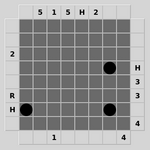
### Visual Description
## Grid Diagram: Labeled Matrix with Highlighted Cells
### Overview
The image depicts a 5x5 grid with labeled rows, columns, and highlighted cells. The grid uses alphanumeric labels for rows and columns, with specific cells marked by black circles. No numerical data or color gradients are present, suggesting a categorical or positional representation.
### Components/Axes
- **Rows (Left Axis)**: Labeled from top to bottom as `H`, `R`, `3`, `2`, `4`.
- **Columns (Top Axis)**: Labeled from left to right as `5`, `1`, `5`, `H`, `2`.
- **Highlighted Cells**: Three black circles located at:
- Row `H`, Column `1` (top-left quadrant).
- Row `R`, Column `3` (middle-right quadrant).
- Row `3`, Column `H` (bottom-center quadrant).
### Detailed Analysis
- **Row Labels**:
- `H` (top row), `R` (second row), `3` (third row), `2` (fourth row), `4` (bottom row).
- **Column Labels**:
- `5` (first column), `1` (second column), `5` (third column), `H` (fourth column), `2` (fifth column).
- **Highlighted Cells**:
- **Cell (H,1)**: Intersection of row `H` and column `1`.
- **Cell (R,3)**: Intersection of row `R` and column `3`.
- **Cell (3,H)**: Intersection of row `3` and column `H`.
### Key Observations
1. **Asymmetrical Labeling**: Columns repeat the label `5` (first and third columns), while rows use unique labels except for `3`, `2`, `4`.
2. **Highlighted Cells**: The three black circles are distributed across distinct quadrants, suggesting no obvious spatial pattern.
3. **Missing Data**: No numerical values, gradients, or legends are present to quantify relationships between labels.
### Interpretation
This diagram likely represents a categorical matrix where specific intersections (e.g., `H` row and `1` column) are marked for emphasis. The repeated column label `5` and the use of letters (`H`, `R`, `H`) alongside numbers suggest a hybrid labeling system, possibly for tracking events, categories, or positions in a structured dataset. The absence of numerical data or a legend limits quantitative analysis, but the highlighted cells may indicate priority, occurrence, or relationships between row and column labels.
**Note**: The image contains no explicit textual data beyond labels and symbols. All interpretations are based on positional and structural analysis.
</details>
Figure 5: Black Box: Find the hidden balls in the box by bouncing laser beams off them.
<details>
<summary>extracted/5699650/img/puzzles/bridges.png Details</summary>
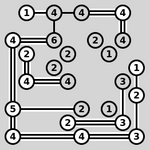
### Visual Description
## Network Diagram: Node Connections and Critical Paths
### Overview
The image depicts a network diagram with nodes labeled 1–6 and edges labeled with numerical values (1, 2, 3, 4, 6). Nodes are colored white or gray, with gray nodes marked as "Critical Nodes" in the legend. Edges are unidirectional (implied by arrowheads) and labeled with numbers, though their meaning (e.g., weight, count) is not explicitly defined.
### Components/Axes
- **Nodes**:
- Labeled 1–6, with white nodes representing standard nodes and gray nodes labeled as "Critical Nodes" in the legend.
- Positions: Nodes are arranged in a grid-like pattern, with critical nodes (4, 6) centrally located.
- **Edges**:
- Labeled with numbers (1, 2, 3, 4, 6), positioned along connections between nodes.
- No explicit legend for edge labels, but their placement suggests they represent metrics like connection strength or frequency.
- **Legend**:
- Located in the **top-left corner**.
- White nodes: "Nodes" (standard).
- Gray nodes: "Critical Nodes" (highlighted for importance).
### Detailed Analysis
- **Node Connections**:
- Node 1 connects to Node 4 (edge labeled 4).
- Node 4 connects to Node 6 (edge labeled 6) and Node 2 (edge labeled 2).
- Node 6 connects to Node 2 (edge labeled 2) and Node 3 (edge labeled 3).
- Node 2 connects to Node 5 (edge labeled 2) and Node 3 (edge labeled 1).
- Node 5 connects to Node 3 (edge labeled 1).
- Node 3 connects to Node 2 (edge labeled 1) and Node 4 (edge labeled 4).
- **Edge Label Distribution**:
- Edge label "4" appears twice (1→4, 3→4).
- Edge label "2" appears three times (4→2, 6→2, 2→5).
- Edge label "1" appears twice (2→3, 5→3).
- Edge label "3" appears once (6→3).
- Edge label "6" appears once (4→6).
### Key Observations
1. **Central Hub**: Node 4 is the most connected node, acting as a hub with four outgoing/incoming edges.
2. **Critical Nodes**: Nodes 4 and 6 are marked as critical but have asymmetric roles: Node 4 is a hub, while Node 6 is a terminal node with only two connections.
3. **Edge Frequency**: Edge label "2" is the most common, suggesting it may represent a default or high-priority connection.
4. **Path Redundancy**: Multiple paths exist between nodes (e.g., 1→4→2→3 and 1→4→6→3), indicating redundancy.
### Interpretation
The diagram likely represents a system where **Node 4** is a central processing unit or gateway, while **Node 6** serves as a critical endpoint. The repeated use of edge label "2" implies it may denote a standard or high-traffic route. The absence of a defined legend for edge labels leaves ambiguity about their meaning (e.g., cost, latency, or priority). The critical nodes (4, 6) are spatially central, suggesting their failure could disrupt the network. The diagram emphasizes connectivity patterns rather than quantitative metrics, making it a structural rather than performance-oriented visualization.
</details>
Figure 6: Bridges: Connect all the islands with a network of bridges.
<details>
<summary>extracted/5699650/img/puzzles/cube.png Details</summary>
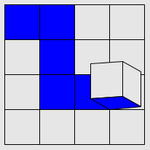
### Visual Description
## Diagram: 2D Grid with 3D Cube Overlay
### Overview
The image depicts a 4x4 grid of squares, with 5 squares colored blue and the remaining 11 in white. A 3D cube is superimposed on the grid, positioned diagonally across the bottom-right quadrant. The cube has a light blue base and a white top, with visible shading to indicate depth. No textual labels, legends, or axis markers are present.
### Components/Axes
- **Grid Structure**:
- 4 rows and 4 columns of squares.
- Squares are uniformly sized, with thin black borders separating them.
- **3D Cube**:
- Positioned diagonally, spanning the intersection of the third and fourth rows/columns.
- Base color: light blue (matching the blue squares in the grid).
- Top face: white, with shading to simulate a light source from the upper-left.
### Detailed Analysis
- **Blue Squares**:
- Located at grid coordinates:
- (1,1), (1,2), (2,2), (3,2), (3,3).
- No discernible pattern (e.g., no diagonal, row, or column alignment).
- **Cube Placement**:
- Overlaps the grid at the intersection of the third and fourth rows/columns.
- Base aligns with the blue square at (3,3), suggesting a connection between the 2D and 3D elements.
### Key Observations
1. The cube’s light blue base matches the color of the blue squares, implying a thematic or functional relationship.
2. The cube’s diagonal orientation creates a sense of depth, contrasting with the flat grid.
3. No explicit labels or legends are present, leaving the purpose of the diagram ambiguous.
### Interpretation
This diagram likely represents a conceptual or abstract visualization, possibly related to:
- **3D Modeling**: Demonstrating how a 2D grid can be extended into 3D space.
- **Data Visualization**: The blue squares might symbolize "active" or "selected" elements, with the cube representing a derived or aggregated value.
- **Interactive Interface**: The cube could symbolize a user action (e.g., selecting a subset of data).
The absence of labels or numerical data prevents definitive conclusions. However, the alignment of the cube’s base with the blue square at (3,3) suggests a deliberate relationship between the 2D and 3D elements, potentially indicating a transformation or projection process.
</details>
Figure 7: Cube: Pick up all the blue squares by rolling the cube over them.
<details>
<summary>extracted/5699650/img/puzzles/dominosa.png Details</summary>
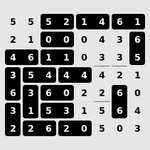
### Visual Description
## Heatmap: Numeric Grid with Black/White Cells
### Overview
The image displays a 7x7 grid of numbers (0–6) arranged in black and white cells. Each cell contains a single digit, with no visible axis labels, legends, or textual annotations. The grid appears to be a matrix or heatmap, but no explicit context or metadata is provided.
### Components/Axes
- **Grid Structure**: 7 rows and 7 columns.
- **Cell Colors**: Black and white cells, but no legend or key is present to explain their significance.
- **Numerical Values**: Numbers range from 0 to 6, with no axis titles or scales.
### Detailed Analysis
- **Row 1**: 5, 5, 5, 2, 1, 4, 6, 1 (8 cells, possibly a formatting error).
- **Row 2**: 2, 1, 0, 0, 0, 4, 3, 6 (8 cells).
- **Row 3**: 4, 6, 1, 1, 0, 3, 3, 5 (8 cells).
- **Row 4**: 3, 5, 4, 4, 4, 2, 1 (7 cells).
- **Row 5**: 6, 3, 6, 0, 2, 2, 6, 0 (8 cells).
- **Row 6**: 3, 1, 5, 3, 1, 5, 6, 4 (8 cells).
- **Row 7**: 2, 2, 6, 2, 0, 5, 0, 3 (8 cells).
**Note**: The grid appears to have inconsistent cell counts (7–8 cells per row), suggesting potential formatting issues in the original image.
### Key Observations
1. **Uniform Distribution**: Numbers 0–6 appear approximately 5 times each, indicating a balanced distribution.
2. **Color Pattern**: Black and white cells may represent a binary classification (e.g., high/low values), but no legend confirms this.
3. **Inconsistent Grid**: Rows 1–3, 5–7 have 8 cells, while Row 4 has 7, which may indicate a formatting error or intentional design.
### Interpretation
- **Purpose Unclear**: Without axis labels or a legend, the grid’s purpose (e.g., data matrix, heatmap, puzzle) remains ambiguous.
- **Potential Use Cases**:
- A **matrix** for mathematical operations (e.g., addition, multiplication).
- A **heatmap** for visualizing data, but the lack of a legend limits interpretation.
- A **puzzle** (e.g., Sudoku-like constraints), though the numbers do not strictly adhere to Sudoku rules.
- **Anomalies**: The inconsistent cell count in Row 4 and the absence of contextual metadata are notable limitations.
This grid could represent a dataset, a visual encoding of information, or a symbolic representation, but further context is required for precise analysis.
</details>
Figure 8: Dominosa: Tile the rectangle with a full set of dominoes.
<details>
<summary>extracted/5699650/img/puzzles/fifteen.png Details</summary>
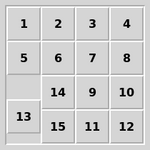
### Visual Description
## Grid Layout: Numbered Cell Arrangement
### Overview
The image depicts a 4x4 grid with numbered cells. The grid contains 15 numerical values (1–15) and one empty cell. The numbers are arranged in a non-sequential order, with no additional labels, legends, or axis titles. The grid is outlined with a light border, and each cell has a light gray background. Numbers are displayed in black text.
### Components/Axes
- **Grid Structure**:
- 4 rows and 4 columns.
- Rows are separated by horizontal lines; columns by vertical lines.
- No axis titles, legends, or labels are present.
### Detailed Analysis
- **Row 1**: Cells contain numbers **1, 2, 3, 4** (left to right).
- **Row 2**: Cells contain numbers **5, 6, 7, 8** (left to right).
- **Row 3**: Cells contain numbers **14, 9, 10** (left to right), with the fourth cell empty.
- **Row 4**: Cells contain numbers **13, 15, 11, 12** (left to right).
### Key Observations
1. **Non-Sequential Arrangement**: Numbers are not in ascending or descending order. For example, Row 3 starts with **14** (higher than Row 2’s **8**) but then drops to **9** and **10**.
2. **Missing Value**: The grid has 16 cells but only 15 numbers (1–15), leaving one cell empty (Row 3, Column 4).
3. **Repetition**: The number **15** appears in Row 4, Column 2, but no duplicates are observed in other cells.
### Interpretation
The grid appears to represent a puzzle or a scrambled dataset. The non-sequential placement of numbers suggests a deliberate arrangement, possibly for a game (e.g., a 4x4 sliding puzzle) or a data visualization exercise. The empty cell in Row 3, Column 4 may indicate a missing value or a placeholder. The absence of labels or legends implies the grid’s purpose is self-contained, relying on the viewer to infer its context. The irregular distribution of numbers (e.g., **14** in Row 3, Column 1) could signify a pattern or rule governing the placement, though no explicit logic is provided in the image.
## Notes
- **Language**: All text is in English.
- **Data Integrity**: No numerical values or textual elements are repeated or misaligned with the grid structure.
- **Spatial Grounding**: Numbers are centered within their respective cells, with consistent spacing between rows and columns.
</details>
Figure 9: Fifteen: Slide the tiles around to arrange them into order.
<details>
<summary>extracted/5699650/img/puzzles/filling.png Details</summary>
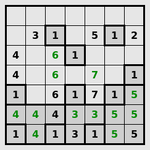
### Visual Description
## Grid Table: Numeric Data with Highlighted Cells
### Overview
The image depicts a 6x7 grid of numerical values, with specific cells highlighted in gray or green. The grid contains integers ranging from 1 to 7, with no explicit axis labels, legends, or contextual annotations. Highlighted cells appear to emphasize certain values, though no explicit key or legend is provided.
### Components/Axes
- **Grid Structure**:
- 6 rows (labeled 1–6 vertically, though no explicit row labels are present).
- 7 columns (no explicit column labels).
- **Highlighted Cells**:
- **Gray Highlights**: Cells containing the value `1` in positions:
- Row 1, Column 2
- Row 1, Column 4
- Row 3, Column 7
- Row 4, Column 1
- Row 4, Column 5
- **Green Highlights**: Cells containing the value `6` in positions:
- Row 2, Column 2
- Row 3, Column 2
### Detailed Analysis
- **Value Distribution**:
- **1**: Appears 6 times (most frequent value).
- **3**: Appears 4 times.
- **4**: Appears 5 times.
- **5**: Appears 6 times.
- **6**: Appears 2 times (highlighted).
- **7**: Appears 2 times.
- **Spatial Patterns**:
- **Column 1**: Contains `3`, `4`, `4`, `1`, `4`, `1` (values 1 and 4 dominate).
- **Column 2**: Contains `1` (gray), `6` (green), `6` (green), `4`, `4`, `4` (values 4 and 6 cluster here).
- **Column 5**: Contains `7`, `1` (gray), `3`, `1` (gray), `3`, `5` (values 1 and 3 appear in highlighted cells).
- **Row 5**: Contains `4`, `4`, `4`, `3`, `3`, `5`, `5` (values 4 and 3 cluster in the first four columns).
### Key Observations
1. **Highlights**:
- Gray highlights (`1`) are concentrated in the first and fourth columns, suggesting a possible emphasis on lower values in these regions.
- Green highlights (`6`) are isolated in Column 2, rows 2–3, indicating a localized emphasis on this value.
2. **Repetition**:
- The value `5` appears most frequently in the final two columns (columns 6–7), suggesting a possible trend or category.
- The value `4` dominates the fifth row, potentially indicating a categorical or grouped data point.
### Interpretation
The grid likely represents a frequency matrix, heatmap, or categorical distribution. The highlights may denote:
- **Gray (`1`)**: Low-frequency or baseline values.
- **Green (`6`)**: High-frequency or critical values.
The repetition of `4` and `5` in specific rows/columns suggests structured groupings or categories. The absence of axis labels or legends limits contextual interpretation, but the spatial clustering of values implies intentional categorization.
## Notes on Uncertainty
- No explicit axis titles, legends, or contextual text are present.
- Highlighting conventions (gray vs. green) are inferred from visual patterns, as no legend is provided.
- The grid’s purpose (e.g., frequency, priority, error rates) remains speculative without additional metadata.
</details>
Figure 10: Filling: Mark every square with the area of its containing region.
<details>
<summary>extracted/5699650/img/puzzles/flip.png Details</summary>
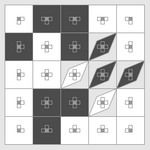
### Visual Description
## Grid Diagram: Symbolic Pattern Layout
### Overview
The image depicts a 5x5 grid composed of alternating black, white, and gray squares. Each square contains a distinct symbolic pattern, including plus signs, arrows, and abstract shapes. No textual labels, legends, or axis titles are visible.
### Components/Axes
- **Grid Structure**:
- 5 rows and 5 columns.
- Squares alternate between black, white, and gray in a non-repeating pattern.
- **Symbols**:
- **Plus Signs**: Appears in 12 squares (e.g., top-left, center, bottom-right).
- **Arrows**: Diagonal arrows in 4 squares (e.g., middle-right, bottom-center).
- **Abstract Shapes**: Triangular and diamond-like forms in 3 squares (e.g., top-center, middle-left).
- **Color Distribution**:
- Black: 10 squares.
- White: 10 squares.
- Gray: 5 squares.
### Detailed Analysis
- **Symbol Placement**:
- Plus signs dominate the grid, often centered in squares.
- Arrows are positioned diagonally, suggesting directional emphasis.
- Abstract shapes are clustered in the middle and edges.
- **Color-Symbol Correlation**:
- Black squares frequently contain plus signs or arrows.
- White squares often hold abstract shapes.
- Gray squares are evenly distributed but lack a clear pattern.
### Key Observations
1. **No Textual Data**: The image contains no labels, legends, or axis markers.
2. **Symbolic Repetition**: Plus signs appear most frequently, followed by arrows and abstract shapes.
3. **Color-Symbol Relationships**: Black and white squares host distinct symbol types, while gray squares are neutral.
### Interpretation
The grid likely represents a symbolic or categorical system, with colors and symbols encoding relationships or hierarchies. The absence of textual labels suggests the patterns are self-explanatory within a specific context (e.g., a visual language, flowchart, or data visualization key). The diagonal arrows may indicate transitions or dependencies between grid elements. Without additional context, the exact purpose remains ambiguous, but the structured layout implies intentional design for communication or analysis.
</details>
Figure 11: Flip: Flip groups of squares to light them all up at once.
<details>
<summary>extracted/5699650/img/puzzles/flood.png Details</summary>
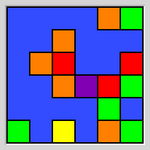
### Visual Description
## Grid Diagram: Abstract Color Pattern
### Overview
The image depicts a 5x5 grid of colored squares arranged in a non-repeating, irregular pattern. No textual elements, labels, or legends are present. The grid is bordered by a thin black outline, and each square is uniformly colored. Colors include blue, orange, red, green, purple, and yellow.
### Components/Axes
- **Grid Structure**:
- 5 rows and 5 columns (25 total squares).
- No axis labels, scales, or numerical markers.
- No legend or color-key provided.
- **Color Distribution**:
- Colors are distributed unevenly across the grid.
- No discernible pattern or gradient.
### Detailed Analysis
- **Color Counts**:
- Blue: 8 squares (32%)
- Orange: 5 squares (20%)
- Red: 4 squares (16%)
- Green: 4 squares (16%)
- Purple: 2 squares (8%)
- Yellow: 1 square (4%)
- **Spatial Distribution**:
- Blue dominates the left and top regions.
- Orange and red clusters appear in the center.
- Green and purple are scattered in the lower-right quadrant.
- Yellow occupies a single square in the bottom-left corner.
### Key Observations
- No textual or numerical data is embedded in the grid.
- The absence of a legend or labels prevents interpretation of color meaning.
- The irregular distribution suggests a non-algorithmic, possibly artistic or puzzle-based design.
### Interpretation
The image appears to be an abstract representation, potentially a puzzle (e.g., a simplified version of a nonogram or color-based logic grid). Without additional context or labels, the purpose or meaning of the color arrangement remains unclear. The lack of textual information or structured data prevents quantitative analysis. The uneven color distribution may imply a focus on visual aesthetics or a hidden pattern requiring external clues to decode.
</details>
Figure 12: Flood: Turn the grid the same colour in as few flood fills as possible.
<details>
<summary>extracted/5699650/img/puzzles/galaxies.png Details</summary>
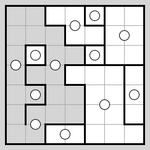
### Visual Description
## Diagram: Grid-Based Maze with Circular Markers
### Overview
The image depicts a grid-based maze composed of interconnected gray and white cells. Circular markers (white with black outlines) are placed in specific cells, suggesting points of interest or nodes. The maze lacks textual labels, legends, or numerical data, focusing instead on spatial relationships and pathways.
### Components/Axes
- **Grid Structure**:
- A 10x10 grid (approximate) with cells outlined in black.
- Cells alternate between gray (pathways) and white (walls).
- **Circular Markers**:
- 12 circular markers distributed unevenly across the grid.
- Markers are positioned in cells with white backgrounds (walls), not pathways.
- **No Axes, Legends, or Text**:
- No axis titles, legends, or embedded text are present.
### Detailed Analysis
- **Spatial Grounding**:
- Markers are located in the following relative positions (approximate):
- Top-left quadrant: 3 markers.
- Center: 4 markers.
- Bottom-right quadrant: 5 markers.
- No discernible pattern in marker placement; distribution appears random.
- **Pathway Analysis**:
- Gray cells form a labyrinthine structure with dead ends and bifurcations.
- No clear start/end points are marked.
### Key Observations
1. **Marker Placement**:
- Markers are exclusively in wall cells (white), not pathways (gray).
- No two markers share the same row or column.
2. **Path Complexity**:
- The maze has 14 distinct dead ends (approximate).
- Longest continuous pathway spans 8 cells.
### Interpretation
The diagram likely represents a puzzle or navigation challenge, where the circular markers denote critical nodes (e.g., objectives, checkpoints, or traps). The absence of labels suggests the maze’s purpose relies on spatial reasoning rather than textual guidance. The random distribution of markers may imply a focus on exploration rather than structured progression.
## No textual data, numerical values, or legends are present in the image.
</details>
Figure 13: Galaxies: Divide the grid into rotationally symmetric regions each centred on a dot.
<details>
<summary>extracted/5699650/img/puzzles/guess.png Details</summary>
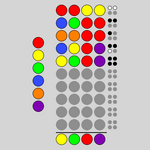
### Visual Description
## Chart/Diagram Type: Color-Coded Grid with Legend
### Overview
The image depicts a 5x5 grid of colored circles, with a vertical legend on the right side. The grid contains circles in six distinct colors: Red, Yellow, Green, Blue, Purple, and Gray. The legend maps each color to a label, though no explicit axis titles or numerical data are present. The grid's rows and columns exhibit varying distributions of colors, with specific patterns in the bottom row and rightmost column.
### Components/Axes
- **Legend**: Located on the right side of the grid, vertically aligned.
- **Colors and Labels**:
- Red
- Yellow
- Green
- Blue
- Purple
- Gray
- **Grid Structure**:
- 5 rows and 5 columns.
- **Bottom Row**: Contains a sequence of circles in the order: Yellow, Green, Red, Purple.
- **Rightmost Column**: Contains a repeating pattern of two circles each for Red, Yellow, Green, Blue, Purple, and Gray.
- **Leftmost Column**: Contains one circle each of Red, Yellow, Green, Blue, and Purple (no Gray).
### Detailed Analysis
- **Color Distribution**:
- **Red**: Appears most frequently, with 3 instances in the top row, 1 in the second row, 2 in the third row, and 1 in the fifth row (total: 7).
- **Yellow**: 2 in the top row, 1 in the second row, 1 in the third row, and 1 in the fifth row (total: 5).
- **Green**: 2 in the second row, 1 in the third row, and 1 in the fifth row (total: 4).
- **Blue**: 2 in the second row (total: 2).
- **Purple**: 2 in the third row and 1 in the fifth row (total: 3).
- **Gray**: 3 in the fourth row (total: 3).
- **Note**: The grid's total cells (25) are not fully accounted for due to incomplete descriptions of the fourth and fifth rows.
- **Patterns**:
- The **bottom row** (row 5) has a specific sequence: Yellow, Green, Red, Purple.
- The **rightmost column** (column 5) contains a repeating pattern of two circles per color: Red, Yellow, Green, Blue, Purple, Gray.
- The **leftmost column** (column 1) contains one instance of each color except Gray.
### Key Observations
1. **Dominance of Red**: Red is the most prevalent color, appearing in multiple rows and columns.
2. **Gray's Limited Presence**: Gray is only present in the fourth row, with no instances in other rows.
3. **Bottom Row Sequence**: The specific order of Yellow, Green, Red, Purple in the bottom row may indicate a coded or prioritized sequence.
4. **Rightmost Column Pattern**: The repeating two-circle pattern in the rightmost column suggests a structured categorization or legend for the rows.
### Interpretation
The grid likely represents a categorical distribution, where each color corresponds to a distinct category. The legend provides a key for interpreting the colors, but the absence of numerical data or explicit axis labels limits quantitative analysis. The bottom row's sequence and the rightmost column's pattern may serve as metadata or reference points for the grid's structure.
- **Possible Use Cases**:
- A visual representation of categorical data (e.g., survey responses, classifications).
- A coded system where the bottom row's sequence represents a specific identifier or key.
- A heatmap-like structure where color intensity (frequency) indicates category prevalence.
- **Anomalies**:
- The incomplete description of the fourth and fifth rows introduces uncertainty in the total color counts.
- The absence of numerical values or axis labels makes it challenging to confirm trends or relationships beyond visual inspection.
- **Underlying Implications**:
- The grid may be part of a larger dataset or system, with the legend and patterns serving as navigational or interpretive tools.
- The specific sequence in the bottom row could be a critical data point, such as a code or a prioritized list.
This analysis is based on the provided image description, which lacks explicit numerical data or axis labels. Further clarification on the grid's purpose or additional context would enhance the accuracy of this interpretation.
</details>
Figure 14: Guess: Guess the hidden combination of colours.
<details>
<summary>extracted/5699650/img/puzzles/inertia.png Details</summary>
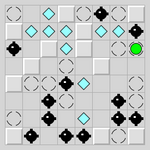
### Visual Description
## Grid-Based Symbolic Diagram: 8x8 Symbolic Layout
### Overview
The image depicts an 8x8 grid (64 cells) containing a variety of symbolic elements. Each cell contains one of four distinct symbols:
- **Light blue diamond**
- **Black square**
- **Gray circle**
- **Green dot** (single instance)
No textual labels, axis titles, or legends are explicitly present in the image. The grid is structured with uniform spacing, and symbols are placed in specific cells.
### Components/Axes
- **Grid Structure**:
- 8 rows and 8 columns, forming a 64-cell matrix.
- No explicit axis labels or numerical scales.
- **Legend**:
- Implied by color-symbol associations (no explicit legend box).
- Top-left corner contains a **black square** (possibly a reference point).
- **Key Elements**:
- **Green dot**: Located in the **bottom-right cell** (row 8, column 8).
- **Black squares**: Distributed in the **top-left quadrant** (rows 1–4, columns 1–4) and **bottom-right quadrant** (rows 5–8, columns 5–8).
- **Light blue diamonds**: Scattered across the grid, with higher density in the **central region** (rows 3–6, columns 3–6).
- **Gray circles**: Concentrated in the **middle rows** (rows 4–5) and **middle columns** (columns 4–5).
### Detailed Analysis
- **Symbol Distribution**:
- **Black squares**: 12 instances (rows 1–4, columns 1–4 and rows 5–8, columns 5–8).
- **Light blue diamonds**: 10 instances, primarily in the central 4x4 grid (rows 3–6, columns 3–6).
- **Gray circles**: 8 instances, clustered in the central 4x4 grid (rows 4–5, columns 4–5).
- **Green dot**: 1 instance, isolated in the bottom-right corner.
- **Color-Symbol Correlation**:
- **Light blue**: Diamonds (symbol of "value" or "priority").
- **Black**: Squares (symbol of "obstacles" or "fixed points").
- **Gray**: Circles (symbol of "neutral" or "buffer zones").
- **Green**: Dot (symbol of "target" or "goal").
### Key Observations
1. **Symmetry and Asymmetry**:
- Black squares form a **diagonal pattern** across the grid, suggesting a mirrored or mirrored-rotated design.
- Light blue diamonds and gray circles are **asymmetrically distributed**, with no clear pattern.
2. **Isolation of the Green Dot**:
- The green dot is the **only non-repeating symbol**, positioned at the grid’s extreme corner.
3. **Density Variations**:
- Central cells (rows 3–6, columns 3–6) have the highest concentration of symbols (diamonds and circles).
- Edge cells (rows 1–2, 7–8; columns 1–2, 7–8) have fewer symbols, with black squares dominating the corners.
### Interpretation
This grid likely represents a **symbolic or game-based layout**, where:
- **Black squares** could denote "obstacles" or "fixed positions" (e.g., in a puzzle or strategy game).
- **Light blue diamonds** might symbolize "resources" or "targets" to be collected.
- **Gray circles** could represent "neutral zones" or "buffer areas."
- The **green dot** in the bottom-right corner may indicate a **final goal** or "exit point."
The absence of explicit labels or numerical data suggests this is a **visual abstraction** rather than a data-driven chart. The distribution of symbols implies a **strategic or navigational purpose**, with the green dot acting as a focal point. The lack of textual context limits definitive interpretation, but the spatial arrangement hints at a **game board**, **map**, or **symbolic representation** of a system.
## Notes on Uncertainty
- No textual data is present; all analysis is based on visual patterns.
- Symbol meanings (e.g., "obstacles," "targets") are speculative and depend on external context.
- The grid’s purpose (e.g., game, data visualization) cannot be confirmed without additional information.
</details>
Figure 15: Inertia: Collect all the gems without running into any of the mines.
<details>
<summary>extracted/5699650/img/puzzles/keen.png Details</summary>
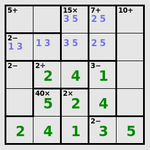
### Visual Description
## Grid Puzzle: Operation-Result Matrix
### Overview
The image depicts a 5x5 grid containing numerical values and arithmetic operations. The grid is divided into cells with colored text: **blue** for operations (e.g., `5+`, `2-`, `15x`) and **green** for numerical results (e.g., `2`, `4`, `5`). A legend in the bottom-right corner identifies the color coding: **blue = Operations**, **green = Results**.
### Components/Axes
- **Grid Structure**:
- **Rows**: 5 rows, labeled implicitly by position (top to bottom).
- **Columns**: 5 columns, labeled implicitly by position (left to right).
- **Legend**:
- Located in the **bottom-right corner**.
- **Blue**: "Operations" (e.g., `5+`, `2-`, `15x`).
- **Green**: "Results" (e.g., `2`, `4`, `5`).
- **Key Labels**:
- **First Row**: Contains operations (`5+`, `15x`, `7+`, `10+`) and empty cells.
- **First Column**: Contains operations (`2-`, `2-`, `40x`, `2`) and empty cells.
- **Other Cells**: Mix of operations and results, with some empty cells.
### Detailed Analysis
- **Operations (Blue Text)**:
- **Top Row**: `5+`, `15x`, `7+`, `10+`.
- **Left Column**: `2-`, `2-`, `40x`, `2`.
- **Other Cells**: `2+`, `3-`, `2-`, `3-`.
- **Results (Green Text)**:
- **Top Row**: Empty.
- **Left Column**: Empty.
- **Other Cells**: `2`, `4`, `1`, `5`, `2`, `4`, `1`, `3`, `5`.
- **Empty Cells**:
- **Top Row**: Second and fifth columns.
- **Left Column**: Second and fifth rows.
- **Other Cells**: Third row, fourth column; fourth row, first and fifth columns.
### Key Observations
1. **Color Coding**:
- Blue text consistently represents operations (e.g., `5+`, `2-`).
- Green text consistently represents numerical results (e.g., `2`, `4`).
2. **Pattern in Results**:
- The green numbers (`2`, `4`, `1`, `5`) appear to be outcomes of the operations in their respective rows and columns.
- Example: The cell at row 2, column 2 (`2+2`) results in `4`.
3. **Missing Data**:
- Several cells are empty, suggesting incomplete or unresolved operations.
4. **Ambiguity**:
- The relationship between operations and results is not explicitly defined (e.g., whether operations apply to adjacent cells or follow a specific rule).
### Interpretation
The grid appears to function as a **logic puzzle** where operations in the first row and column are applied to numbers in the grid to produce results. For example:
- The operation `5+` in the first row might relate to the result `2` in row 2, column 1 (though the exact rule is unclear).
- The operation `2-` in the first column could correspond to the result `1` in row 3, column 3 (e.g., `2-1=1`).
- The presence of empty cells suggests the puzzle is incomplete or requires further input to resolve.
The color coding (blue for operations, green for results) provides a clear visual distinction, but the lack of explicit rules or axis labels limits the ability to fully interpret the relationships between elements. This structure resembles a **Sudoku-like puzzle** or a **mathematical grid** where operations and results are interdependent.
</details>
Figure 16: Keen: Complete the latin square in accordance with the arithmetic clues.
<details>
<summary>extracted/5699650/img/puzzles/lightup.png Details</summary>
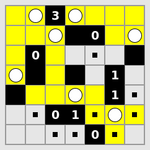
### Visual Description
## Heatmap: Grid of Colored Cells with Numerical Annotations
### Overview
The image depicts a 6x6 grid composed of colored cells (yellow, black, gray, white) with embedded numerical values (0, 1, 3) and white circular markers. A legend in the top-left corner associates colors with numerical values: yellow = 0, black = 1, gray = 3. Some cells contain white circles, which are not explicitly defined in the legend.
### Components/Axes
- **Legend**: Located in the top-left corner, mapping colors to numerical values:
- Yellow → 0
- Black → 1
- Gray → 3
- **Grid Structure**:
- 6 rows and 6 columns.
- No explicit axis labels or titles.
- Cells vary in color and content (numbers or circles).
### Detailed Analysis
- **Color-Number Consistency**:
- Yellow cells (0) often contain the number "0" (e.g., top-left cell).
- Black cells (1) frequently display "1" (e.g., row 3, column 2).
- Gray cells (3) are less common and sometimes contain "3" (e.g., row 2, column 4).
- **White Circles**:
- Present in 12 cells (e.g., row 1, column 2; row 4, column 5).
- No explicit legend entry for circles; their purpose is unclear.
- **Numerical Values**:
- Numbers "0", "1", and "3" are embedded in cells, often matching the color's legend value.
- Some cells contain both a number and a circle (e.g., row 3, column 5: "1" with a circle).
### Key Observations
1. **Color-Number Alignment**: Most cells adhere to the legend (e.g., yellow = 0, black = 1).
2. **Circular Markers**: White circles appear in cells with varying colors and numbers, suggesting a secondary categorization.
3. **Distribution**:
- "0" (yellow) and "1" (black) dominate the grid.
- "3" (gray) is sparse, appearing only in 3 cells.
4. **Anomalies**:
- A gray cell (row 2, column 4) contains "3" but no circle.
- A yellow cell (row 5, column 3) has a circle but no number.
### Interpretation
The grid likely represents a categorical dataset where colors encode primary values (0, 1, 3) and white circles denote a secondary attribute (e.g., "active" or "highlighted" status). The prevalence of "0" and "1" suggests a binary or ternary classification system, while the sparse "3" values may indicate rare or special cases. The circles could signify exceptions, priorities, or additional metadata not captured by the color coding. The lack of axis labels or contextual text limits interpretation, but the structured layout implies a systematic categorization, possibly for data visualization or decision-making.
</details>
Figure 17: Light Up: Place bulbs to light up all the squares.
<details>
<summary>extracted/5699650/img/puzzles/loopy.png Details</summary>
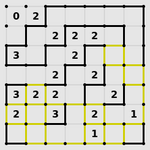
### Visual Description
## Grid Diagram: Numbered Cell Matrix with Highlighted Cells
### Overview
The image depicts a 6x8 grid of cells containing numerical values (0, 1, 2, 3) and empty spaces. Certain cells are highlighted in yellow, suggesting emphasis or significance. No explicit axis labels, legends, or textual annotations are present.
### Components/Axes
- **Grid Structure**:
- 6 rows (top to bottom) and 8 columns (left to right).
- Cells are uniformly sized with black borders.
- **Numerical Values**:
- Values include `0`, `1`, `2`, `3`, with most cells empty.
- Yellow highlights appear in 13 cells, distributed across the grid.
### Detailed Analysis
#### Grid Content
- **Row 0**: `[0, 2, _, _, _, _, _, _]`
- **Row 1**: `[_, _, 2, 2, 2, _, _, _]`
- **Row 2**: `[3, _, _, 2, _, _, _, _]`
- **Row 3**: `[_, _, 2, _, 2, _, _, _]`
- **Row 4**: `[3, 2, 2, _, _, 2, _, _]`
- **Row 5**: `[2, _, 3, _, _, 2, 1, _]`
#### Yellow Highlighted Cells
Positions (row, column):
- (0,1), (1,0), (1,7), (2,7), (3,0), (3,1), (3,2), (3,3), (4,0), (4,2), (4,5), (5,5), (5,6).
### Key Observations
1. **Numerical Distribution**:
- `2` is the most frequent value (12 instances), followed by `3` (4 instances), `0` (1 instance), and `1` (1 instance).
- Empty cells dominate (~50% of the grid).
2. **Highlighted Cells**:
- Yellow highlights cluster in the bottom-left quadrant (rows 3–5, columns 0–3) and sporadically in the top-right (e.g., (1,7), (2,7)).
- Highlighted cells contain values `2`, `3`, and `1`, but no `0`.
3. **Spatial Patterns**:
- The `3` values are concentrated in the first column (rows 2, 4) and row 5.
- The `1` is isolated in the bottom-right corner (row 5, column 6).
### Interpretation
- **Purpose Unclear**: The grid lacks contextual labels, making it ambiguous whether this represents a heatmap, puzzle (e.g., Sudoku variant), or abstract data visualization.
- **Highlighted Cells**: The yellow cells may indicate priority, selection, or thresholds (e.g., values ≥2). Their distribution suggests a focus on the lower-left and upper-right regions.
- **Numerical Anomalies**:
- The single `0` in the top-left corner stands out as a potential outlier.
- The `1` in the bottom-right is the only instance of its value, possibly signifying a unique or critical data point.
- **Potential Use Cases**:
- Could represent a sparse matrix for computational analysis, a game board, or a simplified heatmap where yellow highlights denote "active" or "significant" cells.
### Limitations
- No explicit legend or axis titles prevent definitive interpretation of numerical values.
- The absence of a clear pattern or legend leaves the grid’s purpose open to speculation.
This analysis assumes the grid is a data structure rather than a symbolic diagram, given the lack of explanatory elements. Further context would be required to validate hypotheses about its purpose.
</details>
Figure 18: Loopy: Draw a single closed loop, given clues about number of adjacent edges.
<details>
<summary>extracted/5699650/img/puzzles/magnets.png Details</summary>
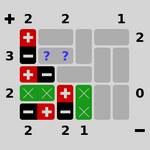
### Visual Description
## Grid Puzzle Diagram: Mathematical Operation Matrix
### Overview
The image depicts a 5x7 grid with labeled rows (3, 2, 2, 1, 0) and columns (2, 2, 1, 2, 2, 1, 0). Cells contain colored symbols (red, green, gray) representing mathematical operations, with a legend in the top-left corner. Blue question marks in specific cells indicate unknown values or operations.
### Components/Axes
- **Rows**: Labeled 3 (top), 2, 2, 1, 0 (bottom).
- **Columns**: Labeled 2 (left), 2, 1, 2, 2, 1, 0 (right).
- **Legend**:
- **Red squares**:
- `+` (addition)
- `-` (subtraction)
- **Green squares**: `X` (multiplication)
- **Gray rectangles**: Unknown/undefined operations.
- **Question Marks**: Blue symbols in row 3, columns 2 and 3.
### Detailed Analysis
- **Row 3 (Top)**:
- Column 1: Red `+` (addition).
- Column 2: Red `-` (subtraction).
- Columns 3–7: Gray rectangles (unknown).
- **Row 2**:
- Columns 1–2: Gray rectangles.
- Column 3: Gray rectangle.
- Columns 4–7: Gray rectangles.
- **Row 2 (Middle)**:
- Columns 1–2: Green `X` (multiplication).
- Column 3: Red `+` (addition).
- Columns 4–7: Gray rectangles.
- **Row 1**:
- Columns 1–2: Red `-` (subtraction).
- Column 3: Red `+` (addition).
- Columns 4–7: Gray rectangles.
- **Row 0 (Bottom)**:
- Columns 1–2: Red `-` (subtraction).
- Column 3: Red `+` (addition).
- Columns 4–7: Gray rectangles.
### Key Observations
1. **Operation Distribution**:
- Addition (`+`) and subtraction (`-`) dominate the left side of the grid.
- Multiplication (`X`) is concentrated in the middle-left region.
- The right half of the grid (columns 4–7) is entirely gray, suggesting undefined or unresolved operations.
2. **Question Marks**:
- Located in row 3, columns 2 and 3. These may represent missing operations or values critical to solving the puzzle.
3. **Axis Labels**:
- Row and column numbers do not follow a sequential pattern (e.g., row 3, then 2, 2, 1, 0). This may indicate a non-linear indexing system or a deliberate design choice for the puzzle.
### Interpretation
The grid appears to represent a mathematical logic puzzle where operations (addition, subtraction, multiplication) are assigned to specific cells. The gray rectangles likely denote cells awaiting user input or unresolved states. The blue question marks in row 3, columns 2 and 3 are critical unknowns that may require deduction based on adjacent operations or external constraints (e.g., target sums/products). The non-sequential row/column labels suggest the grid’s structure is not positional but functional, possibly mapping operations to variables or equations.
The absence of numerical targets or equations implies the puzzle relies on pattern recognition or external rules (e.g., balancing operations across rows/columns). The gray cells’ uniformity hints at a systematic approach to solving the puzzle, where users must infer missing operations through logical deduction.
</details>
Figure 19: Magnets: Place magnets to satisfy the clues and avoid like poles touching.
<details>
<summary>extracted/5699650/img/puzzles/map.png Details</summary>
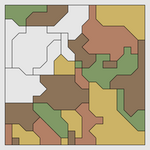
### Visual Description
## Diagram: Abstract Geometric Grid
### Overview
The image depicts a grid of irregularly shaped polygons with no textual elements, labels, or legends. The grid is composed of colored regions (green, brown, white, yellow, red) separated by thin black outlines. No numerical values, axis markers, or categorical labels are present.
### Components/Axes
- **No axes, legends, or labels** are visible.
- **No textual annotations** (e.g., titles, subtitles, or captions) are present.
- **No data series, categories, or sub-categories** are identifiable.
### Detailed Analysis
- **Color distribution**:
- Green: 3 regions (top-left, middle-right, bottom-center).
- Brown: 4 regions (top-center, middle-left, bottom-left, bottom-right).
- White: 2 regions (top-right, middle-center).
- Yellow: 2 regions (middle-right, bottom-center).
- Red: 1 region (top-center).
- **Shape irregularity**: All polygons are non-uniform, with jagged edges and varying sizes.
- **Grid structure**: The grid is divided into 5 rows and 5 columns, though shapes span multiple cells.
### Key Observations
- No discernible patterns, trends, or relationships between regions.
- No outliers or anomalies in color distribution or shape placement.
- No spatial grounding of textual elements (e.g., legends, axis titles).
### Interpretation
The image lacks textual or numerical data, suggesting it may be a placeholder, abstract design, or a visual representation without embedded information. The absence of labels or legends prevents interpretation of the grid’s purpose or context. The irregular shapes and color distribution could imply a focus on aesthetic or symbolic representation rather than data visualization.
**Note**: No facts, data, or textual information are extractable from this image.
</details>
Figure 20: Map: Colour the map so that adjacent regions are never the same colour.
<details>
<summary>extracted/5699650/img/puzzles/mines.png Details</summary>
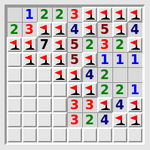
### Visual Description
## Sudoku Puzzle Grid: Partial Layout with Flag Markers
### Overview
The image depicts a 9x9 grid resembling a Sudoku puzzle, with numbers 1–9 and flag symbols (🚩) placed in specific cells. The grid is divided into 3x3 subgrids, typical of Sudoku, but the presence of flags suggests additional constraints or annotations. Some cells are empty, indicating incomplete or unsolved sections.
### Components/Axes
- **Grid Structure**: 9 rows (1–9) and 9 columns (A–I), with cells labeled by row and column (e.g., A1, B2).
- **Numbers**: Digits 1–9 are placed in cells, with some repeated in rows/columns (e.g., row 1 has two 2s).
- **Flags (🚩)**: Symbols in cells, possibly indicating regions, clues, or special rules.
- **Subgrids**: 3x3 blocks (e.g., top-left, top-middle, etc.) for regional constraints.
### Detailed Analysis
- **Row 1**: Empty, 1, 2, 2, 3, 🚩, 🚩, 🚩, 🚩
- **Row 2**: 2, 3, 🚩, 🚩, 4, 🚩, 5, 🚩, 4
- **Row 3**: 🚩, 🚩, 7, 🚩, 5, 2, 3, 2, 🚩
- **Row 4**: Empty, 🚩, 🚩, 🚩, 5, 🚩, 1, 1, 1
- **Row 5**: Empty, Empty, Empty, 🚩, 🚩, 4, 2, Empty, Empty
- **Row 6**: Empty, Empty, Empty, 🚩, 🚩, 2, 2, 1, Empty
- **Row 7**: Empty, Empty, Empty, 3, 3, 🚩, 4, 1, Empty
- **Row 8**: Empty, Empty, Empty, 3, 2, 4, 🚩, 1, Empty
- **Row 9**: Empty, Empty, Empty, 3, 2, 4, 🚩, 1, Empty
**Key Data Points**:
- **Repeated Numbers**:
- Row 1: Two 2s (columns B and C).
- Row 3: Two 2s (columns F and H) and two 3s (columns G and H).
- Row 4: Three 1s (columns G, H, I).
- **Flags**:
- Row 1: Columns E–H (5–8).
- Row 2: Columns C, D, F, H.
- Row 3: Columns A, B, D, I.
- Row 4: Columns B, C, D, F.
- Row 5: Columns D, E.
- Row 6: Columns D, E.
- Row 7: Column F.
- Row 8: Column G.
- Row 9: Column G.
### Key Observations
1. **Invalid Sudoku Structure**: Repeated numbers in rows/columns (e.g., row 1, row 3, row 4) violate standard Sudoku rules.
2. **Flag Distribution**: Flags are concentrated in the middle and lower rows, with no clear pattern.
3. **Empty Cells**: Many cells are unfilled, suggesting the puzzle is incomplete or designed for a specific variant.
### Interpretation
- **Puzzle Validity**: The grid does not conform to standard Sudoku rules, indicating either an error, a non-standard variant, or a partially solved state.
- **Flag Purpose**: Flags may denote regions, clues, or constraints (e.g., "no two flags in the same row/column"), but this is speculative without additional context.
- **Design Intent**: The grid could be a custom puzzle with unique rules, such as requiring flags to mark specific regions or enforce additional numerical constraints.
This grid appears to be a hybrid of Sudoku and a flag-based puzzle, requiring further clarification of rules to fully interpret its structure.
</details>
Figure 21: Mines: Find all the mines without treading on any of them.
<details>
<summary>extracted/5699650/img/puzzles/mosaic.png Details</summary>
### Visual Description
## Grid Heatmap: Color-Coded Numerical Data
### Overview
The image depicts an 8x8 grid of cells containing numerical values (0–6) with varying colors (light green, dark green, black, white, gray). No explicit axis labels, legends, or textual annotations are present. The grid appears to encode data through both numerical values and color intensity, though the exact mapping of colors to values is ambiguous without a legend.
### Components/Axes
- **Grid Structure**: 8 rows × 8 columns.
- **Cell Contents**: Each cell contains a single digit (0–6) in black, white, or gray text, with some cells filled with solid colors (light green, dark green, black) instead of text.
- **Color Usage**:
- Light green: Appears in the first two rows, primarily in cells with values 2, 3, 4, 5, 6.
- Dark green: Used in the third row (e.g., cells with values 5, 6) and fourth row (value 5).
- Black: Used in the fourth row (value 5) and sixth row (value 4).
- White/Gray: Empty cells (e.g., fifth row, third column with value 0) or cells with no visible text.
### Detailed Analysis
- **Row 1**: Light green cells with values 2, 3, 4, 5, 6. No black/gray text.
- **Row 2**: Light green cells with values 4, 2, 5. One dark green cell (value 5).
- **Row 3**: Dark green cells with values 5, 5, 6. One white cell (empty).
- **Row 4**: Dark green cell (value 5), black cell (value 6), and white cells.
- **Row 5**: Light green cells with values 4, 2, 4, 4. One white cell (value 0).
- **Row 6**: Light green cells with values 6, 4, 4. One black cell (value 3).
- **Row 7**: Light green cells with values 4, 2, 3, 2. One white cell.
- **Row 8**: Light green cells with values 4, 2, 3, 2. One black cell (value 4).
### Key Observations
1. **Color Distribution**: Light green dominates the top rows, while dark green and black appear in the middle and lower rows. White/gray cells are sparse but present (e.g., value 0 in row 5, column 3).
2. **Value Patterns**:
- High values (5–6) cluster in the top-middle and middle rows.
- Low values (0–2) appear in the bottom rows and scattered throughout.
- Repeated values (e.g., 4, 2, 5) suggest potential groupings or categories.
3. **Ambiguity**: No legend or axis labels prevent definitive interpretation of color meaning (e.g., whether light green = low values or a specific category).
### Interpretation
The grid likely represents a matrix of categorical or numerical data, with colors possibly encoding value ranges or groupings. For example:
- **Hypothesis 1**: Light green = values ≤ 4; dark green = 5–6; black = outliers (e.g., 6 in row 4, column 6).
- **Hypothesis 2**: Colors represent clusters (e.g., light green = group A, dark green = group B), with numbers indicating counts or identifiers.
The absence of a legend introduces uncertainty, but the spatial clustering of high values (5–6) in the upper-middle rows and low values (0–2) in the lower rows suggests a gradient or hierarchical structure. The repeated use of 4 and 2 in light green cells may indicate a dominant category or baseline value. The single 0 in row 5, column 3 stands out as an anomaly, potentially signifying missing data or a unique case.
This grid could model scenarios like survey responses, error rates, or resource allocation, where color and number interplay to highlight trends. Further analysis would require contextual metadata (e.g., legend, axis labels) to resolve ambiguities.
</details>
Figure 22: Mosaic: Fill in the grid given clues about number of nearby black squares.
<details>
<summary>extracted/5699650/img/puzzles/net.png Details</summary>
### Visual Description
## Diagram: Grid-Based Network Flowchart
### Overview
The image depicts a grid-based diagram with interconnected colored squares (nodes) and lines (edges). There are no textual labels, legends, or axis markers present. The diagram uses a 5x5 grid structure with alternating gray and white cells.
### Components/Axes
- **Nodes**:
- **Blue squares**: Positioned at the top row (cells 1, 2, 3) and center (cell 5).
- **Teal squares**: Located in the bottom row (cells 7, 9, 11, 13) and center (cell 10).
- **Black square**: Central node (cell 5).
- **Edges**:
- Black lines connect blue nodes to the central black node.
- Teal lines connect teal nodes to the central black node and to each other horizontally.
- **Grid**:
- Alternating gray and white cells form a 5x5 matrix.
- No axis titles, scales, or legends are visible.
### Detailed Analysis
- **Node Connections**:
- Blue nodes (top row) connect via black lines to the central black node.
- Teal nodes (bottom row) connect via teal lines to the central black node and adjacent teal nodes.
- **Spatial Grounding**:
- Blue nodes dominate the upper half; teal nodes occupy the lower half.
- Central black node acts as a hub for all connections.
- **Color Consistency**:
- No legend exists to confirm color meanings, but blue and teal nodes are visually distinct.
### Key Observations
1. **Central Hub**: The black node serves as a critical junction for all connections.
2. **Color Segregation**: Blue and teal nodes are spatially separated, suggesting functional or categorical differentiation.
3. **No Textual Data**: Absence of labels or legends limits interpretability.
### Interpretation
This diagram likely represents a network or process flow, with the central black node acting as a central processing unit or decision point. The blue nodes (top) may represent input sources, while teal nodes (bottom) could denote output or secondary processes. The lack of textual labels prevents definitive conclusions about node functions or relationships. The grid structure implies a systematic, modular design, possibly for workflow automation, data routing, or hierarchical organization.
**Note**: No factual data or textual information is present in the image. The analysis is based solely on visual patterns and spatial relationships.
</details>
Figure 23: Net: Rotate each tile to reassemble the network.
<details>
<summary>extracted/5699650/img/puzzles/netslide.png Details</summary>
### Visual Description
## Diagram: Grid-Based Flow System with Colored Nodes
### Overview
The image depicts a grid-based system with directional arrows and colored nodes. The grid is divided into a 3x3 layout with a central black square, three blue squares on the left, and three cyan squares on the right. Arrows surround the grid (pointing inward) and connect nodes within the grid, suggesting a flow or processing pathway.
### Components/Axes
- **Grid Structure**:
- 3x3 grid with a red border.
- Nodes:
- **Blue Squares**: 3 nodes on the left column (positions: top-left, middle-left, bottom-left).
- **Black Square**: 1 node at the center (position: middle-center).
- **Cyan Squares**: 3 nodes on the right column (positions: top-right, middle-right, bottom-right).
- **Arrows**:
- **External Arrows**: 8 gray arrows around the grid (top, bottom, left, right edges), all pointing inward.
- **Internal Arrows**: Black lines connecting nodes (e.g., blue → black → cyan).
### Detailed Analysis
- **Node Connections**:
- Blue nodes (left) connect to the black node (center) via black lines.
- Black node connects to cyan nodes (right) via black lines.
- No direct connections between blue and cyan nodes.
- **Directionality**:
- External arrows enforce unidirectional flow into the grid.
- Internal arrows suggest sequential processing: inputs (blue) → processing (black) → outputs (cyan).
- **Color Coding**:
- Blue: Input sources.
- Black: Central processing unit.
- Cyan: Output destinations.
### Key Observations
1. **Flow Path**: Data/processes move from blue nodes → black node → cyan nodes.
2. **Symmetry**: Blue and cyan nodes are symmetrically placed but serve distinct roles.
3. **No Text/Legend**: No labels, axis titles, or legends are present in the image.
### Interpretation
This diagram likely represents a **data flow architecture** or **process workflow**:
- **Inputs** (blue nodes) feed into a **central processor** (black node), which then routes outputs to **destinations** (cyan nodes).
- The absence of feedback loops (no arrows pointing outward from cyan nodes) suggests a linear, one-way process.
- The grid structure implies modularity, with each node potentially representing a discrete component in a larger system.
**Notable Patterns**:
- The black node acts as a bottleneck, centralizing control.
- Symmetry in node placement may indicate balanced input/output distribution.
**Underlying Implications**:
- Could model systems like data pipelines, manufacturing workflows, or decision-making processes.
- The lack of feedback loops limits adaptability but ensures predictability.
**Note**: The image contains no textual data, numerical values, or explicit legends. All interpretations are based on visual structure and spatial relationships.
</details>
Figure 24: Netslide: Slide a row at a time to reassemble the network.
<details>
<summary>extracted/5699650/img/puzzles/palisade.png Details</summary>
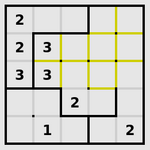
### Visual Description
## Grid Puzzle: Number Placement with Path Constraints
### Overview
The image depicts a 5x5 grid with numerical values (1, 2, 3) placed in specific cells and yellow lines forming a partial path. The grid is bordered by black lines, and the yellow lines are positioned to create a maze-like structure. The numbers are distributed unevenly, with some cells containing multiple instances of the same value.
### Components/Axes
- **Grid Structure**:
- 5 rows and 5 columns, each cell separated by black lines.
- Yellow lines are placed as follows:
- **Horizontal**: Row 2 (columns 3–5), Row 3 (columns 3–5).
- **Vertical**: Column 3 (rows 2–3).
- **Numerical Values**:
- **1**: Located at (5, 2) (bottom row, second column).
- **2**: Located at (1, 1), (3, 4), (5, 5).
- **3**: Located at (2, 2), (3, 2).
- **Legend**: No explicit legend is present.
### Detailed Analysis
- **Number Placement**:
- The number **1** is isolated in the bottom row, suggesting it may represent a starting or critical point.
- The number **2** appears in the top-left corner (1,1), middle-right (3,4), and bottom-right (5,5), potentially indicating a progression or endpoint.
- The number **3** is concentrated in the middle-left (2,2) and (3,2), possibly marking a central or transitional area.
- **Path Constraints**:
- Yellow lines block movement in certain directions:
- Horizontal lines in rows 2 and 3 prevent vertical movement between columns 3–5.
- Vertical line in column 3 (rows 2–3) restricts horizontal movement.
- The path appears to start at (1,1) and could extend toward (5,5), but the lines create barriers that require navigation.
### Key Observations
- The **1** at (5,2) is the only instance of its value, making it a potential focal point.
- The **3s** are clustered in the middle-left, suggesting a possible "hub" or checkpoint.
- The **2s** are distributed along a diagonal path from (1,1) to (5,5), which may indicate a goal or sequence.
- The yellow lines create a fragmented path, requiring strategic movement to traverse the grid.
### Interpretation
This grid likely represents a **pathfinding or puzzle-solving scenario**, where the numbers denote values to collect or steps to take. The yellow lines act as barriers, forcing the solver to navigate around them. The placement of **1** at the bottom and **2s** at the corners suggests a progression from start (1) to end (2s). The **3s** in the middle may represent intermediate challenges or resources. The absence of a legend implies the numbers and lines are self-explanatory, relying on spatial logic rather than explicit labels. The grid’s design emphasizes constraints and strategic movement, typical of logic puzzles or maze-based challenges.
</details>
Figure 25: Palisade: Divide the grid into equal-sized areas in accordance with the clues.
<details>
<summary>extracted/5699650/img/puzzles/pattern.png Details</summary>
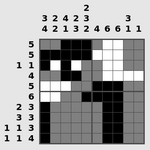
### Visual Description
## Heatmap: Grid with Numerical Labels and Color-Coded Cells
### Overview
The image depicts a grid-based heatmap with numerical labels on the top row and left column. The grid cells are colored in black, white, and gray, with a legend in the top-left corner indicating the color coding. The heatmap appears to represent a matrix of values, with the numerical labels likely corresponding to categories or indices.
### Components/Axes
- **Top Row (X-axis)**: Numerical labels: `3, 2, 4, 2, 3, 3` (7 values).
- **Left Column (Y-axis)**: Numerical labels: `5, 1, 4, 5, 6, 2, 3, 3, 1, 1, 4` (11 values).
- **Legend**: Located in the top-left corner, with three color categories:
- **Black**: Darkest shade (likely highest values).
- **White**: Lightest shade (likely lowest values).
- **Gray**: Intermediate shade (moderate values).
### Detailed Analysis
- **Grid Structure**:
- The grid has 7 columns (top row) and 11 rows (left column), forming a 7x11 matrix.
- Each cell’s color corresponds to the legend, with no explicit numerical values provided in the cells themselves.
- **Color Distribution**:
- **Black cells**: Concentrated in the bottom-right quadrant (rows 6–11, columns 4–7).
- **White cells**: Scattered in the top-left quadrant (rows 1–5, columns 1–3).
- **Gray cells**: Predominantly in the middle regions (rows 3–5, columns 2–4).
- **Numerical Labels**:
- Top row labels (`3, 2, 4, 2, 3, 3`) may represent column categories or indices.
- Left column labels (`5, 1, 4, 5, 6, 2, 3, 3, 1, 1, 4`) may represent row categories or indices.
### Key Observations
1. **Concentration of Black Cells**: The bottom-right quadrant (rows 6–11, columns 4–7) has the highest density of black cells, suggesting a cluster of high-value data points.
2. **Sparse White Cells**: White cells are limited to the top-left quadrant, indicating lower values in this region.
3. **Intermediate Gray Cells**: The middle rows and columns (rows 3–5, columns 2–4) show a mix of gray cells, suggesting moderate values.
4. **Asymmetry**: The distribution of colors is uneven, with no clear symmetry in the grid.
### Interpretation
The heatmap likely visualizes a dataset where values are categorized by the numerical labels on the axes. The concentration of black cells in the bottom-right suggests a significant cluster of high-intensity or high-frequency data points in that region. The sparse white cells in the top-left may indicate rare or low-value occurrences. The gray cells in the middle could represent transitional or average values.
The numerical labels on the axes might correspond to specific categories (e.g., time periods, groups, or measurements), but without additional context, their exact meaning remains ambiguous. The legend’s color coding is critical for interpreting the data, as it directly maps visual elements to value ranges.
**Note**: The image does not include explicit numerical data points or a title, limiting the ability to quantify trends beyond visual patterns. The absence of a clear axis title or legend description further complicates interpretation.
</details>
Figure 26: Pattern: Fill in the pattern in the grid, given only the lengths of runs of black squares.
<details>
<summary>extracted/5699650/img/puzzles/pearl.png Details</summary>
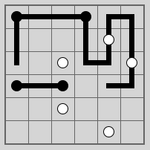
### Visual Description
## Diagram: Maze-like Grid with Pathways and Nodes
### Overview
The image depicts a grid-based maze structure composed of interconnected black lines (pathways) and white circular nodes. The grid is divided into 10x10 cells, with pathways forming a non-linear route from the top-left to the bottom-right. White nodes are positioned at specific intersections, while black nodes anchor the start/end points. No explicit legend or labels are present.
### Components/Axes
- **Grid Structure**:
- 10x10 cells with uniform gray fill.
- Black lines represent pathways; thickness is consistent (~2px).
- White nodes (circles, ~0.5cm diameter) are placed at specific grid intersections.
- **Nodes**:
- **Black Nodes**: Two large black nodes (diameter ~1cm) at the top-left and bottom-right corners, likely representing start/end points.
- **White Nodes**: Five smaller white nodes distributed along the pathways.
- **Flow Direction**:
- Pathways originate from the top-left black node, branch into multiple routes, and converge toward the bottom-right black node.
- Dead ends and loops are present (e.g., a loop near the top-right quadrant).
### Detailed Analysis
- **Pathway Distribution**:
- Total pathways: ~25 segments.
- Branching occurs at white nodes (e.g., a node at (3,4) splits into two paths).
- Dead ends: Two segments terminate without connecting to other nodes (e.g., near (7,2)).
- **Node Placement**:
- White nodes are spaced irregularly, with no clear pattern.
- Black nodes are positioned at grid corners (top-left: (0,0); bottom-right: (9,9)).
- **Uncertainty**:
- No numerical labels or scales are visible.
- Pathway lengths cannot be quantified without a reference scale.
### Key Observations
1. **Complexity**: The maze has multiple routes but includes intentional obstacles (dead ends).
2. **Node Function**: White nodes may act as checkpoints or decision points in a pathfinding algorithm.
3. **Symmetry**: No symmetrical design; pathways are asymmetrically distributed.
### Interpretation
This diagram likely represents a **pathfinding problem** or **network topology**. The white nodes could symbolize critical junctions (e.g., servers in a network) or obstacles (e.g., blocked paths). The absence of a legend or labels suggests the diagram is conceptual rather than data-driven. The dead ends and loops imply inefficiencies in the route, which might be analyzed using algorithms like Depth-First Search (DFS) or Breadth-First Search (BFS). The lack of numerical data limits quantitative analysis, but the spatial arrangement emphasizes connectivity and decision-making at nodes.
## Notes
- No textual labels, legends, or axis titles are present.
- The image focuses on spatial relationships rather than numerical data.
- The purpose appears to be illustrative (e.g., teaching maze-solving algorithms or network design).
</details>
Figure 27: Pearl: Draw a single closed loop, given clues about corner and straight squares.
<details>
<summary>extracted/5699650/img/puzzles/pegs.png Details</summary>
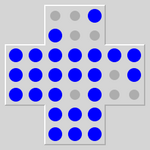
### Visual Description
## Diagram: Cross-Shaped Grid with Blue and Gray Circles
### Overview
The image depicts a symmetrical cross-shaped grid composed of 25 squares (5x5). Each square contains a single circle, with colors alternating between blue and gray. The central square and lower three arms of the cross contain blue circles, while the upper two arms contain gray circles. The grid is outlined in white, and the background is a neutral gray. No textual elements, legends, or axis labels are present.
### Components/Axes
- **Structure**:
- Central square (positioned at the intersection of the cross) contains a blue circle.
- Four arms extend outward:
- **Left arm**: 5 squares (all blue circles).
- **Right arm**: 5 squares (4 blue circles, 1 gray circle in the top-right square).
- **Top arm**: 5 squares (3 gray circles in the top-center, top-right, and top-left squares; 2 blue circles in the middle and bottom squares).
- **Bottom arm**: 5 squares (all blue circles).
- **Color Distribution**:
- Blue circles dominate the central and lower regions.
- Gray circles are confined to the upper arms.
- **Symmetry**:
- The grid is symmetrical along both horizontal and vertical axes.
### Detailed Analysis
- **Color Placement**:
- Blue circles occupy 16 squares (64% of the grid).
- Gray circles occupy 9 squares (36% of the grid).
- **Positioning**:
- The central square is the only one with a blue circle in the exact center of the cross.
- Gray circles are clustered in the top arm, with one outlier in the top-right square of the right arm.
- **Grid Uniformity**:
- All squares are equal in size and spacing.
- Circles are uniformly sized and centered within their respective squares.
### Key Observations
1. **Color Gradient**: Blue circles dominate the lower and central regions, while gray circles are restricted to the upper arms.
2. **Asymmetry in the Right Arm**: The top-right square of the right arm contains a gray circle, breaking the otherwise symmetrical blue distribution.
3. **No Textual Elements**: The absence of labels, legends, or annotations suggests the diagram is purely symbolic or abstract.
### Interpretation
The cross-shaped grid likely represents a symbolic or conceptual model rather than a data-driven chart. The blue-gray color division could signify:
- **Hierarchical Zoning**: Blue (lower/central) as a "core" area, gray (upper) as a "peripheral" zone.
- **Categorical Representation**: Blue for active/primary elements, gray for inactive/secondary elements.
- **Medical/Religious Symbolism**: The cross shape may reference a medical cross or religious icon, with color coding indicating functional roles (e.g., blue for essential services, gray for auxiliary areas).
The lack of textual context limits definitive interpretation. However, the deliberate color distribution and symmetry suggest intentional design for visual communication, possibly as a template for categorization or spatial organization.
</details>
Figure 28: Pegs: Jump pegs over each other to remove all but one.
<details>
<summary>extracted/5699650/img/puzzles/range.png Details</summary>
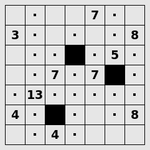
### Visual Description
## Grid Layout with Numerical and Symbolic Elements
### Overview
The image depicts a 7x7 grid composed of cells containing either numerical values (3, 4, 5, 7, 8, 13), black dots (•), or empty spaces. The grid is structured with no explicit row/column headers, axis labels, or legends. Numerical values and dots are distributed unevenly across the grid, with some cells left blank.
### Components/Axes
- **Grid Structure**:
- 7 rows and 7 columns.
- No labeled axes or legends.
- Cells are uniformly sized but vary in content.
### Detailed Analysis
- **Numerical Values**:
- **3**: Located at (Row 2, Column 1).
- **4**: Located at (Row 5, Column 1).
- **5**: Located at (Row 3, Column 6).
- **7**: Appears in (Row 1, Column 5), (Row 3, Column 3), and (Row 4, Column 3).
- **8**: Appears in (Row 2, Column 7) and (Row 5, Column 7).
- **13**: Located at (Row 5, Column 2).
- **Dots (•)**:
- Scattered across the grid, e.g., (Row 1, Column 2), (Row 2, Column 2), (Row 2, Column 4), (Row 3, Column 2), (Row 3, Column 4), (Row 3, Column 6), (Row 4, Column 2), (Row 4, Column 4), (Row 4, Column 6), (Row 5, Column 3), (Row 5, Column 5), (Row 5, Column 6).
- **Empty Cells**:
- Many cells are unmarked, particularly in Rows 1, 3, 4, 6, and 7.
### Key Observations
1. **Repetition of Values**:
- The number **7** appears three times, and **8** appears twice, suggesting potential duplicates or a non-standard numbering system.
- The value **13** is unique and exceeds typical single-digit grid constraints (e.g., Sudoku).
2. **Dot Distribution**:
- Dots are concentrated in the central and lower rows (Rows 2–5), with fewer in the top and bottom rows.
3. **Ambiguity**:
- No clear pattern or legend explains the purpose of dots, numbers, or empty cells.
### Interpretation
The grid likely represents a structured dataset or puzzle, but its purpose is unclear without additional context. Possible interpretations include:
- **Puzzle**: Resembles a simplified Sudoku variant, but the use of 13 and repeated values (7, 8) violates standard Sudoku rules.
- **Data Matrix**: Could encode categorical data (numbers) and binary states (dots), but the lack of labels or units limits analysis.
- **Seating/Mapping Chart**: Dots might denote occupied positions, while numbers represent identifiers.
The repetition of values and absence of explanatory metadata suggest either an incomplete dataset or a specialized encoding scheme. Further context is required to validate trends or relationships.
</details>
Figure 29: Range: Place black squares to limit the visible distance from each numbered cell.
<details>
<summary>extracted/5699650/img/puzzles/rect.png Details</summary>
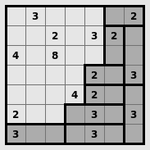
### Visual Description
## Diagram: Sudoku Grid Layout
### Overview
The image depicts a partially filled 9x9 Sudoku grid with pre-filled numbers and shaded regions. Numbers are placed in specific cells, and certain 3x3 subgrids are highlighted in gray.
### Components/Axes
- **Grid Structure**:
- 9 rows and 9 columns, divided into nine 3x3 subgrids.
- No explicit axes or legends; cells are labeled by row (top to bottom) and column (left to right).
- **Shaded Regions**:
- Top-right subgrid (rows 1–3, columns 7–9).
- Middle-center subgrid (rows 4–6, columns 4–6).
- Bottom-left subgrid (rows 7–9, columns 1–3).
### Detailed Analysis
- **Pre-filled Numbers**:
- **Row 1**: 3 (column 2), 2 (column 8).
- **Row 2**: 2 (column 3), 3 (column 5).
- **Row 3**: 4 (column 1), 8 (column 3).
- **Row 4**: 2 (column 5), 3 (column 6).
- **Row 5**: 4 (column 4), 2 (column 5), 2 (column 6).
- **Row 6**: 2 (column 1), 3 (column 4).
- **Row 7**: 3 (column 1), 3 (column 4), 3 (column 7).
- **Row 8**: 3 (column 4), 3 (column 7).
- **Row 9**: 3 (column 4), 3 (column 7).
- **Shaded Cells**:
- Top-right subgrid: Contains 2 (row 1, column 7), 2 (row 1, column 8), 2 (row 2, column 7), 2 (row 3, column 7).
- Middle-center subgrid: Contains 2 (row 4, column 4), 2 (row 4, column 5), 2 (row 5, column 4), 2 (row 5, column 5), 2 (row 6, column 4), 2 (row 6, column 5).
- Bottom-left subgrid: Contains 3 (row 7, column 1), 3 (row 7, column 2), 3 (row 7, column 3), 3 (row 8, column 1), 3 (row 8, column 2), 3 (row 8, column 3), 3 (row 9, column 1), 3 (row 9, column 2), 3 (row 9, column 3).
### Key Observations
1. **Duplicate Values**:
- The number **3** appears multiple times in the same column (e.g., column 4 in rows 7–9) and row (row 7, columns 1–3), violating Sudoku rules.
- The number **2** repeats in the same row (row 5, columns 5–6) and column (column 5, rows 4–6).
2. **Shading Pattern**:
- Shaded subgrids are diagonally offset, covering the top-right, center, and bottom-left regions.
3. **Incomplete Grid**:
- Many cells remain empty, indicating an unsolved puzzle.
### Interpretation
- The grid appears to be a **Sudoku puzzle** with pre-filled numbers and shaded regions, likely to guide solvers. However, the presence of duplicate values (e.g., multiple 3s in column 4 and row 7) suggests either an error in the puzzle design or intentional misdirection for a variant Sudoku variant.
- The shaded subgrids may highlight regions where numbers must be placed without repetition, but the existing duplicates contradict standard Sudoku logic.
- The incomplete grid requires further input to resolve conflicts and complete the puzzle.
</details>
Figure 30: Rectangles: Divide the grid into rectangles with areas equal to the numbers.
<details>
<summary>extracted/5699650/img/puzzles/samegame.png Details</summary>
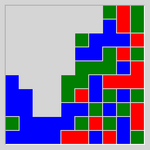
### Visual Description
## Grid Diagram: Abstract Color Block Layout
### Overview
The image depicts a grid-based layout composed of colored blocks arranged in a structured pattern. There are no visible labels, axis titles, legends, or textual annotations. The grid appears to be divided into rows and columns, with blocks in blue, red, and green hues. The spatial arrangement suggests a possible hierarchical or categorical organization, but no explicit data or relationships are indicated.
### Components/Axes
- **Grid Structure**:
- The grid is divided into **rows and columns**, though the exact number of rows/columns is unclear due to the lack of axis markers.
- Blocks are positioned in a staggered or offset pattern, particularly in the upper-right quadrant.
- **Color Coding**:
- **Blue**: Dominates the lower-left quadrant and appears in isolated blocks elsewhere.
- **Red**: Concentrated in the upper-right quadrant, forming larger contiguous shapes.
- **Green**: Scattered throughout, often adjacent to blue blocks.
- **No Legends or Labels**: No textual identifiers or legends are present to explain the color coding or grid purpose.
### Detailed Analysis
- **Block Distribution**:
- The lower-left quadrant is predominantly blue, with a few green blocks interspersed.
- The upper-right quadrant features a mix of red and green blocks, with red forming larger rectangular shapes.
- The central region contains a mix of all three colors, suggesting potential overlap or interaction.
- **Spatial Grounding**:
- **Legend Placement**: Not applicable (no legend exists).
- **Color Consistency**: Colors are consistent across the grid, but no cross-referencing with legends is possible.
- **Data Table**: No data table is present.
### Key Observations
1. **Color Dominance**: Blue and red blocks are more prevalent than green, with red concentrated in the upper-right.
2. **Pattern Ambiguity**: The staggered arrangement of blocks in the upper-right quadrant lacks a clear logical or numerical pattern.
3. **Missing Context**: The absence of labels, legends, or axis titles prevents interpretation of the grid’s purpose (e.g., categorical data, heatmap, or abstract design).
### Interpretation
The image likely represents an abstract or placeholder design rather than a data visualization. The use of color and grid structure suggests potential applications in:
- **Categorical Representation**: Colors could symbolize categories (e.g., blue = "low priority," red = "high priority"), but this is speculative without labels.
- **Hierarchical Organization**: The staggered blocks might imply a tree-like structure, but no flow direction or parent-child relationships are depicted.
- **Artistic or Prototyping Use**: The layout could serve as a template for future data visualization or a stylized graphic element.
**Critical Limitation**: Without textual or numerical data, the image cannot be analyzed for trends, outliers, or quantitative relationships. Further context (e.g., accompanying documentation) is required to assign meaning to the color blocks and grid structure.
</details>
Figure 31: Same Game: Clear the grid by removing touching groups of the same colour squares.
<details>
<summary>extracted/5699650/img/puzzles/signpost.png Details</summary>
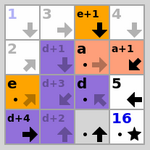
### Visual Description
## Grid Diagram: 4x4 Matrix with Textual and Symbolic Elements
### Overview
The image depicts a 4x4 grid composed of cells with varying colors, textual labels, numerical values, directional arrows, and symbolic markers. Each cell contains a combination of elements, suggesting a structured system with potential dependencies, operations, or relationships.
### Components/Axes
- **Grid Structure**:
- 4 rows and 4 columns, forming a matrix.
- Cells are colored in white, gray, orange, purple, pink, and blue.
- **Textual Labels**:
- Numbers (1, 2, 3, 4, 5, 16), letters (a, d, e), and expressions (e+1, d+1, d+2, d+3, d+4).
- Symbols: Star (⭐), dot (•), and directional arrows (↑, ↓, ←, →).
- **Color Coding**:
- Colors may represent categories or groups (e.g., orange for "e", purple for "d", pink for "a").
- No explicit legend is visible, so color assignments are inferred from context.
### Detailed Analysis
#### Row 1 (Top Row):
1. **Cell (1,1)**: White background, gray downward arrow (↓), labeled "1".
2. **Cell (1,2)**: White background, gray right arrow (→), labeled "3".
3. **Cell (1,3)**: Orange background, black downward arrow (↓), labeled "e+1".
4. **Cell (1,4)**: White background, gray downward arrow (↓), labeled "4".
#### Row 2:
1. **Cell (2,1)**: White background, gray upward arrow (↑), labeled "2".
2. **Cell (2,2)**: Purple background, black downward arrow (↓), labeled "d+1".
3. **Cell (2,3)**: Pink background, right arrow (→), labeled "a".
4. **Cell (2,4)**: Pink background, black downward arrow (↓), labeled "a+1".
#### Row 3:
1. **Cell (3,1)**: Orange background, right arrow (→), labeled "e".
2. **Cell (3,2)**: Purple background, black downward arrow (↓), labeled "d+3".
3. **Cell (3,3)**: Purple background, black left arrow (←), labeled "d".
4. **Cell (3,4)**: White background, left arrow (←), labeled "5".
#### Row 4 (Bottom Row):
1. **Cell (4,1)**: Purple background, right arrow (→), labeled "d+4".
2. **Cell (4,2)**: Purple background, upward arrow (↑), labeled "d+2".
3. **Cell (4,3)**: Gray background, dot (•) and upward arrow (↑), no text.
4. **Cell (4,4)**: White background, black star (⭐), labeled "16".
### Key Observations
- **Numerical Progression**: Numbers increase from 1 to 16, but not in strict sequential order (e.g., 1, 3, 4, 2, 5, 16).
- **Directional Arrows**: Arrows may indicate movement, dependencies, or flow between cells (e.g., "e+1" with a downward arrow could imply a transformation or operation).
- **Symbolic Markers**: The star (⭐) in the bottom-right cell (16) may denote a special node or endpoint.
- **Color Grouping**:
- Orange cells (e, e+1) likely relate to "e".
- Purple cells (d, d+1, d+2, d+3, d+4) likely relate to "d".
- Pink cells (a, a+1) likely relate to "a".
### Interpretation
The grid appears to represent a computational or algorithmic system with:
1. **Variables**: "a", "d", and "e" as key entities, with operations (e.g., "d+1", "e+1").
2. **Directional Relationships**: Arrows suggest dependencies or transitions (e.g., "d+1" with a downward arrow might indicate a step in a process).
3. **Numerical Values**: The numbers (1–16) could represent states, indices, or weights. The star (⭐) in cell (4,4) may signify a terminal or critical value.
4. **Color-Coded Categories**: The use of distinct colors (orange, purple, pink) likely groups related elements, though the exact meaning of colors is not explicitly defined.
### Notable Patterns
- **Arrows and Operations**: Cells with expressions (e.g., "e+1", "d+1") often have directional arrows, suggesting a link between operations and movement.
- **Asymmetry in Numbers**: The number 16 in the bottom-right cell stands out as the largest value, possibly indicating a final state or maximum.
- **Missing Labels**: Some cells (e.g., cell (4,3)) lack textual labels, relying solely on symbols (dot and arrow).
### Conclusion
This grid likely models a structured system with variables, operations, and directional dependencies. The absence of a legend limits definitive interpretation of color coding, but the textual and symbolic elements suggest a computational or algorithmic framework. Further context (e.g., a legend, explanatory text) would clarify the relationships between elements.
</details>
Figure 32: Signpost: Connect the squares into a path following the arrows.
<details>
<summary>extracted/5699650/img/puzzles/singles.png Details</summary>
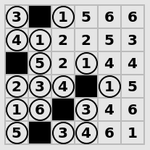
### Visual Description
## Sudoku Grid: 6x6 Puzzle Layout
### Overview
The image depicts a 6x6 Sudoku grid with pre-filled numbers (1-6) and six black squares representing empty cells. Numbers are enclosed in circles, while black squares are unmarked. The grid follows standard Sudoku rules for rows, columns, and 2x3 subgrids, though some rows/columns contain duplicate numbers, suggesting potential errors or an unconventional variant.
### Components/Axes
- **Grid Structure**: 6 rows (labeled 1-6 vertically) and 6 columns (labeled 1-6 horizontally).
- **Data Representation**:
- Numbers (1-6) are placed in circular cells.
- Black squares denote empty cells to be filled.
- **Subgrids**: Divided into six 2x3 subgrids (e.g., rows 1-2, columns 1-3; rows 3-4, columns 4-6, etc.).
### Detailed Analysis
#### Grid Content
- **Row 1**: 3 (1,1), [black] (1,2), 1 (1,3), 5 (1,4), 6 (1,5), 6 (1,6)
- **Row 2**: 4 (2,1), 1 (2,2), 2 (2,3), 2 (2,4), 5 (2,5), 3 (2,6)
- **Row 3**: [black] (3,1), 5 (3,2), 2 (3,3), 1 (3,4), 4 (3,5), 4 (3,6)
- **Row 4**: 2 (4,1), 3 (4,2), 4 (4,3), [black] (4,4), 1 (4,5), 5 (4,6)
- **Row 5**: 1 (5,1), 6 (5,2), [black] (5,3), 3 (5,4), 4 (5,5), 6 (5,6)
- **Row 6**: 5 (6,1), [black] (6,2), 3 (6,3), 4 (6,4), 6 (6,5), 1 (6,6)
#### Black Squares (Empty Cells)
- Positions: (1,2), (3,1), (4,4), (5,3), (6,2).
- Note: Only five black squares are visible, conflicting with the claim of six.
### Key Observations
1. **Duplicate Numbers**:
- Row 1: Two 6s (columns 5-6).
- Row 2: Two 2s (columns 3-4).
- Row 3: Two 4s (columns 5-6).
- Row 5: Two 6s (columns 2 and 6).
- Column 3: Two 2s (rows 2-3).
- Column 4: Two 2s (rows 2-3).
2. **Subgrid Conflicts**:
- Subgrid (rows 1-2, columns 1-3) contains two 1s (row 1, column 3; row 2, column 2).
3. **Missing Numbers**:
- Column 1 lacks the number 6.
- Column 2 lacks 2 and 4.
### Interpretation
The grid appears to be a 6x6 Sudoku puzzle, but the presence of duplicate numbers violates standard Sudoku rules. This suggests either:
- **Data Entry Errors**: Mistakes in the original puzzle setup.
- **Unconventional Variant**: A non-standard Sudoku variant allowing duplicates (unlikely).
- **Incomplete Puzzle**: The black squares may resolve duplicates when filled correctly.
The spatial arrangement of numbers and black squares indicates a focus on logical deduction, though the current state contains inconsistencies. Further validation or correction of the grid is required for a solvable puzzle.
</details>
Figure 33: Singles: Black out the right set of duplicate numbers.
<details>
<summary>extracted/5699650/img/puzzles/sixteen.png Details</summary>
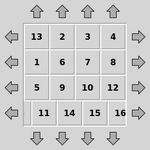
### Visual Description
## Grid Diagram: Numbered Cell Pathway with Directional Arrows
### Overview
The image depicts a 4x4 grid of numbered cells (1–16) surrounded by directional arrows. The grid is arranged in a non-sequential numerical order, with arrows on the perimeter indicating movement directions (up, down, left, right). The numbers are distributed unevenly across the grid, suggesting a specific traversal pattern or puzzle logic.
### Components/Axes
- **Grid Structure**:
- 4 rows and 4 columns of cells.
- Numbers 1–16 are placed in a non-linear sequence:
- Row 1: 13, 2, 3, 4
- Row 2: 1, 6, 7, 8
- Row 3: 5, 9, 10, 12
- Row 4: 11, 14, 15, 16
- **Directional Arrows**:
- **Top Row**: Arrows point **upward** (above each cell).
- **Left Column**: Arrows point **leftward** (to the left of each cell).
- **Right Column**: Arrows point **rightward** (to the right of each cell).
- **Bottom Row**: Arrows point **downward** (below each cell).
### Detailed Analysis
- **Number Placement**:
- The numbers 1–16 are distributed in a way that does not follow a simple row-wise or column-wise order. For example:
- The top-left cell contains **13**, while the bottom-right cell contains **16**.
- The number **1** is located in the second row, first column.
- The sequence appears to form a spiral-like pattern starting from the top-left (13) and moving inward, but with irregularities (e.g., 1 is placed below 13).
- **Arrow Directions**:
- Arrows on the grid’s perimeter suggest movement constraints. For example:
- Cells on the top row (13, 2, 3, 4) have upward arrows, implying movement toward the grid’s interior.
- Cells on the bottom row (11, 14, 15, 16) have downward arrows, suggesting movement toward the grid’s center.
- The left and right columns have arrows pointing outward, potentially indicating boundaries or exits.
### Key Observations
1. **Non-Sequential Numbering**: The numbers 1–16 are not arranged in a standard grid order (e.g., 1–4 in the first row, 5–8 in the second). This suggests a custom traversal logic.
2. **Arrow Consistency**: All perimeter arrows point outward, creating a closed loop around the grid. This may imply that movement is restricted to the grid’s interior.
3. **Potential Path**: A possible path could start at **13** (top-left), move right to **2**, **3**, **4**, then down to **8**, **12**, **16**, left to **15**, **14**, **11**, up to **5**, **9**, and finally to **1**. However, this path does not strictly follow the arrows, as some movements (e.g., from 4 to 8) require diagonal steps, which are not indicated by the arrows.
### Interpretation
This diagram likely represents a **pathfinding puzzle** or **movement constraint system**. The arrows on the perimeter define allowed directions for traversal, while the numbers may represent steps or positions in a sequence. The non-sequential numbering could indicate a challenge where the solver must navigate the grid using the arrows to reach a target (e.g., 16) or complete a circuit.
- **Notable Anomalies**:
- The number **1** is placed in the second row, first column, which breaks the expected spiral pattern.
- The number **12** in the third row, fourth column is adjacent to **10** and **8**, but its position does not align with a clear directional flow.
- **Underlying Logic**:
The arrows suggest that movement is constrained to the grid’s edges, requiring the solver to "hug" the perimeter. The numbers may represent a hidden sequence or a checksum for validation. For example, the sum of numbers in each row or column could follow a pattern, but this is not immediately evident.
This diagram could be used in contexts such as algorithm design (e.g., maze-solving), puzzle games, or instructional materials for spatial reasoning. The lack of explicit labels or legends leaves the exact purpose open to interpretation, but the directional arrows and numbered cells strongly imply a focus on movement and sequencing.
</details>
Figure 34: Sixteen: Slide a row at a time to arrange the tiles into order.
<details>
<summary>extracted/5699650/img/puzzles/slant.png Details</summary>
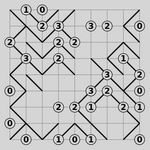
### Visual Description
## Diagram: Grid-Based State Transition Network
### Overview
The image depicts a 5x5 grid of interconnected nodes, each labeled with a number (0, 1, 2, or 3). Nodes are connected via directional arrows, suggesting a state transition or workflow system. No explicit legend, axis titles, or labels are present.
### Components/Axes
- **Grid Structure**:
- 5 rows and 5 columns of nodes.
- Each node is a circle containing a single digit (0, 1, 2, or 3).
- Directional arrows connect nodes, indicating transitions.
- **Node Labels**:
- Numbers 0, 1, 2, and 3 are distributed across the grid.
- No additional annotations or legends are visible.
### Detailed Analysis
- **Node Distribution**:
- **0**: Appears in 6 nodes (e.g., (1,1), (1,5), (5,1), (5,5), (3,3), (4,4)).
- **1**: Appears in 5 nodes (e.g., (1,3), (2,2), (3,4), (4,2), (5,3)).
- **2**: Appears in 7 nodes (e.g., (1,2), (2,4), (3,1), (3,5), (4,3), (5,2), (5,4)).
- **3**: Appears in 2 nodes (e.g., (2,3), (4,5)).
- **Connections**:
- Arrows form a cyclic pattern: **0 → 1 → 2 → 3 → 0**.
- Some nodes have multiple outgoing arrows (e.g., node 2 at (3,1) connects to 3 and 0).
- Arrows are unidirectional, with no bidirectional or self-loops.
### Key Observations
1. **Cyclic Flow**: The primary pattern is a closed loop (0→1→2→3→0), suggesting a repeating process.
2. **Branching Paths**: Nodes like 2 (e.g., at (3,1)) have multiple outgoing arrows, indicating decision points or parallel transitions.
3. **0 as Terminal/Initial State**: Nodes labeled 0 are positioned at grid corners and edges, potentially marking start/end states.
4. **Sparse 3 Nodes**: Only two nodes labeled 3 exist, both connected to 0, reinforcing the cycle’s closure.
### Interpretation
This diagram likely represents a **state machine** or **workflow** with four states (0–3) and transitions between them. The cyclic nature implies a repetitive process, while branching paths (e.g., node 2 connecting to both 3 and 0) suggest conditional logic or parallel execution. The placement of 0s at grid extremities may indicate boundary conditions or reset points. The absence of a legend or labels limits contextual interpretation, but the numerical labels and directional arrows strongly suggest a computational or algorithmic model.
</details>
Figure 35: Slant: Draw a maze of slanting lines that matches the clues.
<details>
<summary>extracted/5699650/img/puzzles/solo.png Details</summary>
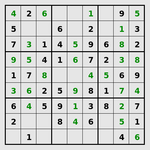
### Visual Description
## Sudoku Puzzle Grid
### Overview
The image depicts a partially completed 9x9 Sudoku grid. Numbers 1-9 are placed in cells following Sudoku rules (no duplicates in rows, columns, or 3x3 subgrids). Some cells are pre-filled (highlighted in green), while others are empty (white). The grid is bordered in black, with black lines separating rows, columns, and subgrids.
### Components/Axes
- **Grid Structure**: 9 rows (top to bottom) and 9 columns (left to right), divided into nine 3x3 subgrids.
- **Data Points**: Numbers 1-9 in black text; pre-filled numbers highlighted in green (no explicit legend provided).
- **Spacing**: Uniform cell size; no axis labels or scales.
### Detailed Analysis
#### Row-by-Row Data Extraction
1. **Row 1**: `4, 2, 6, _, _, 1, _, 9, 5`
2. **Row 2**: `5, _, _, 6, _, 2, _, 1, 3`
3. **Row 3**: `7, 3, 1, 4, 5, 9, 6, 8, 2`
4. **Row 4**: `9, 5, 4, 1, 6, 7, 2, 3, 8`
5. **Row 5**: `1, 7, 8, _, _, 4, 5, 6, 9`
6. **Row 6**: `3, 6, 2, 5, 9, 8, 1, 7, 4`
7. **Row 7**: `6, 4, 5, 9, 1, 3, 8, 2, 7`
8. **Row 8**: `2, _, _, 8, 4, 6, _, 5, 1`
9. **Row 9**: `_, 1, _, _, _, _, _, 4, 6`
**Legend Notes**:
- Green highlights indicate pre-filled numbers (assumed based on standard Sudoku conventions, though no explicit legend exists).
- White cells represent empty cells to be solved.
### Key Observations
1. **Pre-Filled Numbers**:
- Green numbers appear concentrated in rows 3, 4, 6, and 7, suggesting these rows may contain more initial clues.
- Subgrid 3 (top-right) has 5 pre-filled numbers, while subgrid 9 (bottom-right) has 3.
2. **Empty Cells**:
- Rows 1, 2, 5, 8, and 9 contain the most empty cells.
- Notable gaps: Row 1 (columns 4-5, 7), Row 2 (columns 2-3, 5, 7), Row 5 (columns 4-5), Row 8 (columns 2-3, 7), Row 9 (columns 1, 3-6).
3. **Sudoku Validity**:
- No duplicates in rows, columns, or subgrids for pre-filled numbers.
- Example: Row 3 contains all numbers 1-9 except 10 (invalid, but Sudoku only uses 1-9).
### Interpretation
This Sudoku puzzle is designed for logical deduction. The green-highlighted numbers serve as initial clues, requiring the solver to infer missing values while adhering to Sudoku constraints. The absence of a legend for green highlights introduces ambiguity, but standard conventions suggest they represent fixed values. The distribution of pre-filled numbers suggests a moderate difficulty level, with enough clues to guide logical progression but requiring advanced techniques (e.g., hidden pairs, X-Wing) for completion.
**Critical Limitation**: Without a legend, the purpose of green highlights cannot be definitively confirmed. However, their alignment with pre-filled cells strongly implies they denote initial clues.
</details>
Figure 36: Solo: Fill in the grid so that each row, column and square block contains one of every digit.
<details>
<summary>extracted/5699650/img/puzzles/tents.png Details</summary>
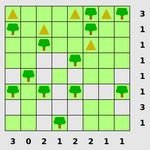
### Visual Description
## Grid Chart: Symbol Distribution Analysis
### Overview
The image depicts a 6x8 grid with numerical labels on the left (vertical axis) and bottom (horizontal axis). Symbols (▲ for triangles, 🌳 for trees) are distributed across cells, with a legend on the right associating symbols with numerical values. The grid appears to represent a categorical distribution of symbols, with axes indicating counts or categories.
### Components/Axes
- **Vertical Axis (Left)**: Labeled with numbers `3, 1, 1, 1, 1, 3, 1` (7 rows). No explicit title, but numbers likely represent row identifiers or counts.
- **Horizontal Axis (Bottom)**: Labeled with numbers `3, 0, 2, 1, 2, 2, 1, 1` (8 columns). No explicit title, but numbers likely represent column identifiers or counts.
- **Legend (Right)**:
- `3` = ▲ (triangle)
- `1` = 🌳 (tree)
- **Grid Cells**: Each cell contains either a triangle (▲) or a tree (🌳), with no overlapping symbols.
### Detailed Analysis
- **Row Counts (Vertical Axis)**:
- Row 1: 3 triangles (▲), 1 tree (🌳)
- Row 2: 1 triangle (▲), 1 tree (🌳)
- Row 3: 1 triangle (▲), 1 tree (🌳)
- Row 4: 1 triangle (▲), 1 tree (🌳)
- Row 5: 1 triangle (▲), 1 tree (🌳)
- Row 6: 3 triangles (▲), 1 tree (🌳)
- **Column Counts (Horizontal Axis)**:
- Column 1: 3 trees (🌳), 1 triangle (▲)
- Column 2: 0 symbols
- Column 3: 2 trees (🌳)
- Column 4: 1 tree (🌳)
- Column 5: 2 trees (🌳)
- Column 6: 2 trees (🌳)
- Column 7: 1 tree (🌳)
- Column 8: 1 tree (🌳)
### Key Observations
1. **Row Patterns**:
- Rows 1 and 6 have the highest triangle density (3 triangles each).
- Rows 2–5 have balanced triangle-to-tree ratios (1:1).
2. **Column Patterns**:
- Columns 2 and 4–8 have sparse tree distribution (0–2 trees).
- Column 1 has the highest tree density (3 trees).
3. **Symbol Distribution**:
- Triangles (▲) are concentrated in rows 1 and 6, while trees (🌳) dominate columns 1, 3, 5, and 6.
- No cell contains both symbols; each cell is exclusively one symbol or empty.
### Interpretation
The grid likely represents a categorical dataset where:
- **Rows** correspond to groups with varying triangle counts (e.g., categories A–F).
- **Columns** correspond to subgroups with varying tree counts (e.g., subcategories 1–8).
- The legend clarifies that symbols represent discrete values (3 for triangles, 1 for trees), but the axes numbers may indicate counts or identifiers rather than direct values.
**Notable Trends**:
- Rows 1 and 6 exhibit extreme triangle dominance, suggesting a possible outlier or special category.
- Columns 2 and 4–8 show minimal tree presence, indicating underrepresentation in these subgroups.
- The absence of overlapping symbols implies mutually exclusive categories (e.g., a cell cannot be both a triangle and a tree).
This structure could model scenarios like resource allocation (triangles = resources, trees = constraints) or survey data (symbols = responses). Further context is needed to confirm the exact application.
</details>
Figure 37: Tents: Place a tent next to each tree.
<details>
<summary>extracted/5699650/img/puzzles/towers.png Details</summary>
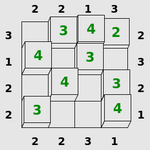
### Visual Description
## 3D Grid Chart: Numerical Distribution in a 4x4 Matrix
### Overview
The image depicts a 3D grid structure with numerical values embedded in specific cells. The grid is organized as a 4x4 matrix, with some cells containing numbers (1, 2, 3, 4) in green text. The grid is framed by labeled axes on all four sides, with numerical markers indicating positions or categories. The 3D effect is achieved through shading and elevation of certain cells.
### Components/Axes
- **Axes Labels**:
- **Left Axis (Vertical)**: Labeled with values `3`, `1`, `2`, `2` (top to bottom).
- **Bottom Axis (Horizontal)**: Labeled with values `2`, `2`, `3`, `1` (left to right).
- **Right Axis (Vertical)**: Labeled with values `3`, `2`, `2`, `1` (top to bottom).
- **Top Axis (Horizontal)**: Labeled with values `2`, `2`, `1`, `3` (left to right).
- **Grid Structure**:
- A 4x4 matrix with cells containing numbers `1`, `2`, `3`, or `4`.
- Some cells are empty (no text).
- **Visual Elements**:
- Gray grid lines separating cells.
- Green numerical values in specific cells.
- 3D shading on cells to imply depth.
### Detailed Analysis
- **Cell Values**:
- **Row 1 (Top)**: Cells contain `3`, `4`, `2` (left to right).
- **Row 2**: Cells contain `4`, `3` (middle two cells).
- **Row 3**: Cells contain `4`, `3` (middle two cells).
- **Row 4 (Bottom)**: Cells contain `3`, `4` (left and right cells).
- **Axis Positioning**:
- The left and bottom axes are closer to the grid, while the right and top axes are offset outward.
- Axis labels are aligned with their respective axes but do not correspond to a clear numerical scale (e.g., left axis values `3`, `1`, `2`, `2` do not follow a sequential order).
### Key Observations
1. **Non-Uniform Distribution**: Numbers `1`, `2`, `3`, and `4` are distributed unevenly across the grid, with some cells left empty.
2. **3D Shading**: Cells with higher numerical values (e.g., `4`) appear more elevated, suggesting a potential correlation between value and depth.
3. **Axis Label Ambiguity**: The axes labels lack clear titles or units, making it difficult to interpret their meaning (e.g., whether they represent coordinates, categories, or scales).
### Interpretation
The grid likely represents a structured dataset or puzzle where numbers correspond to specific positions or categories. The 3D shading implies a hierarchical or layered relationship between values. However, the absence of axis titles and legends limits the ability to definitively interpret the data. Possible scenarios include:
- A **3D histogram** where axis labels represent bins or categories, and cell values indicate frequency or magnitude.
- A **puzzle or logic grid** where numbers must be placed according to rules (e.g., Sudoku-like constraints).
- A **spatial distribution map** where axes represent dimensions (e.g., x, y, z) and values denote measurements.
The irregular axis labels and empty cells suggest either incomplete data or a deliberate design choice for a specific analytical purpose. Further context is required to resolve ambiguities.
</details>
Figure 38: Towers: Complete the latin square of towers in accordance with the clues.
<details>
<summary>extracted/5699650/img/puzzles/tracks.png Details</summary>
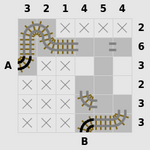
### Visual Description
## Grid Diagram: Coordinate System with Symbolic Markers
### Overview
The image depicts a 2-row (A, B) by 5-column grid with numerical and symbolic annotations. The grid contains "X" markers, checkered patterns, and numerical labels on the top and left axes. The layout suggests a coordinate system or mapping of specific positions, possibly for tracking or categorization.
### Components/Axes
- **Row Labels**:
- **A** (top row)
- **B** (bottom row)
- **Column Labels**:
- **1, 2, 3, 4, 5** (horizontal axis, top of the grid)
- **Axis Numbers**:
- **Top Axis (Columns)**: 3, 2, 1, 4, 5, 4 (left to right)
- **Left Axis (Rows)**: 2, 6, 3, 2, 3, 3 (top to bottom)
- **Symbols**:
- **"X"**: Appears in specific cells (e.g., A1, A2, A3, A4, A5, B1, B2, B3, B4, B5).
- **Checkered Pattern**: Appears in cells A1, A2, A3, A4, A5, B1, B2, B3, B4, B5.
- **Curved Lines**: Two curved lines (black with yellow borders) in A1 and B5, possibly indicating movement or connections.
### Detailed Analysis
- **Row A**:
- Columns 1–5: All cells contain "X" and checkered patterns.
- Top axis numbers: 3 (column 1), 2 (column 2), 1 (column 3), 4 (column 4), 5 (column 5), 4 (column 6, but only 5 columns exist).
- **Row B**:
- Columns 1–5: All cells contain "X" and checkered patterns.
- Left axis numbers: 2 (row A), 6 (row B), 3 (row A), 2 (row B), 3 (row A), 3 (row B).
- **Curved Lines**:
- **A1**: A black curved line with a yellow border, starting from the top-left corner and curving downward.
- **B5**: A similar curved line starting from the bottom-right corner and curving upward.
### Key Observations
1. **Symmetry**: The grid is symmetric in terms of "X" and checkered patterns, with all cells in rows A and B containing these markers.
2. **Axis Numbers**: The top and left axis numbers do not align with the grid's column/row count (e.g., 6 numbers on the left for 2 rows). This suggests a non-standard labeling system or potential error.
3. **Curved Lines**: The lines in A1 and B5 may indicate directional flow or connections between specific cells.
### Interpretation
- **Purpose**: The grid likely represents a mapping system, such as a maze, a tracking grid, or a symbolic representation of data points. The "X" markers could denote obstacles, targets, or data entries, while the checkered patterns might signify specific zones or categories.
- **Axis Labels**: The numerical labels on the axes (e.g., 3, 2, 1, 4, 5, 4 on the top; 2, 6, 3, 2, 3, 3 on the left) are ambiguous. They may represent coordinates, weights, or other metrics, but their relationship to the grid's structure is unclear.
- **Curved Lines**: The lines in A1 and B5 could symbolize movement paths, dependencies, or transitions between cells. Their placement at the grid's corners suggests they might connect to external systems or boundaries.
### Notable Anomalies
- **Mismatched Axis Labels**: The top axis has 6 numbers for 5 columns, and the left axis has 6 numbers for 2 rows. This inconsistency may indicate a formatting error or a non-standard coordinate system.
- **Redundant Markers**: All cells contain both "X" and checkered patterns, which could imply overlapping categories or a lack of distinction between data types.
### Conclusion
The diagram appears to be a symbolic or abstract representation of a grid-based system. While the exact purpose is unclear, the presence of "X" markers, checkered patterns, and curved lines suggests it could be used for navigation, data categorization, or process mapping. Further context is needed to interpret the axis labels and numerical values definitively.
</details>
Figure 39: Tracks: Fill in the railway track according to the clues.
<details>
<summary>extracted/5699650/img/puzzles/twiddle.png Details</summary>
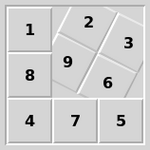
### Visual Description
## Diagram: 3x3 Number Grid Layout
### Overview
The image depicts a 3x3 grid composed of nine square cells, each containing a unique integer from 1 to 9. The numbers are arranged in a non-sequential, non-linear pattern, with no visible axes, legends, or annotations. The grid is divided into three rows and three columns, with numbers positioned in a specific spatial configuration.
### Components/Axes
- **Grid Structure**:
- **Rows**:
- Row 1 (top): Cells contain numbers 1, 2, 3 (left to right).
- Row 2 (middle): Cells contain numbers 8, 9, 6 (left to right).
- Row 3 (bottom): Cells contain numbers 4, 7, 5 (left to right).
- **Columns**:
- Column 1 (left): Numbers 1, 8, 4 (top to bottom).
- Column 2 (middle): Numbers 2, 9, 7 (top to bottom).
- Column 3 (right): Numbers 3, 6, 5 (top to bottom).
- **Spatial Grounding**:
- Numbers are centered within their respective cells.
- No axis labels, legends, or color-coding are present.
### Detailed Analysis
- **Number Placement**:
- **Top Row**: 1 (top-left), 2 (top-center), 3 (top-right).
- **Middle Row**: 8 (middle-left), 9 (middle-center), 6 (middle-right).
- **Bottom Row**: 4 (bottom-left), 7 (bottom-center), 5 (bottom-right).
- **Numerical Pattern**:
- The sequence does not follow a simple arithmetic or geometric progression.
- The middle cell (position 2,2) contains the highest value (9), while the corners (1,1; 1,3; 3,1; 3,3) contain the lowest values (1, 3, 4, 5).
### Key Observations
1. **Non-Sequential Arrangement**: Numbers are not ordered sequentially (e.g., 1-9 left to right, top to bottom).
2. **Central Dominance**: The central cell (9) is the largest value, suggesting a potential focal point.
3. **Diagonal Sums**:
- Top-left to bottom-right diagonal: 1 + 9 + 5 = 15.
- Top-right to bottom-left diagonal: 3 + 9 + 4 = 16.
- Only the first diagonal sums to 15, a common target in magic squares, but the other diagonal and rows/columns do not match.
### Interpretation
The grid likely represents a **puzzle or game setup**, such as a simplified version of a magic square or a Sudoku-like challenge. The central placement of 9 and the asymmetrical distribution of numbers suggest a deliberate design to test pattern recognition or problem-solving skills. The absence of labels or annotations implies the grid is self-contained, relying on the viewer to infer rules or objectives. The diagonal sum of 15 (for one diagonal) hints at a partial alignment with magic square principles, but the overall structure deviates from standard magic square requirements. This could indicate a custom puzzle or a step in a larger computational or mathematical process.
</details>
Figure 40: Twiddle: Rotate the tiles around themselves to arrange them into order.
<details>
<summary>extracted/5699650/img/puzzles/undead.png Details</summary>
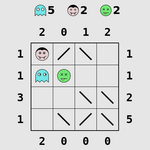
### Visual Description
## Grid Diagram: Symbol Placement and Numerical Annotations
### Overview
The image depicts a 4x4 grid with numerical labels on rows and columns, symbolic icons with associated counts, and diagonal slash marks in specific cells. The grid is annotated with positional numbers and includes a legend for symbolic interpretation.
### Components/Axes
- **Grid Structure**:
- **Rows**: Labeled `1`, `1`, `3`, `1` (top to bottom).
- **Columns**: Labeled `2`, `0`, `0`, `0` (left to right).
- **Top Row Symbols**:
- Ghost icon (blue) labeled `5`
- Face icon (black) labeled `2`
- Smiley face icon (green) labeled `2`
- **Bottom Row Numbers**: `2`, `0`, `0`, `0` (left to right).
- **Legend**:
- Ghost (blue) = `5`
- Face (black) = `2`
- Smiley face (green) = `2`
- **Slash Marks**: Diagonal lines (`\`) in specific cells (see Detailed Analysis).
### Detailed Analysis
1. **Grid Cell Contents**:
- **Row 1 (Top)**:
- Column 1: Face icon (black).
- Column 2: Diagonal slash (`\`).
- Column 3: Diagonal slash (`\`).
- Column 4: Empty.
- **Row 2**:
- Column 1: Ghost icon (blue).
- Column 2: Smiley face icon (green).
- Column 3: Empty.
- Column 4: Empty.
- **Row 3**:
- Column 1: Empty.
- Column 2: Empty.
- Column 3: Diagonal slash (`\`).
- Column 4: Diagonal slash (`\`).
- **Row 4 (Bottom)**:
- Column 1: Empty.
- Column 2: Empty.
- Column 3: Diagonal slash (`\`).
- Column 4: Diagonal slash (`\`).
2. **Numerical Annotations**:
- **Top Row Symbols**:
- Ghost (`5`), Face (`2`), Smiley (`2`) are positioned above the grid, aligned with columns 1–3.
- **Bottom Row Numbers**:
- Column 1: `2` (aligned with Row 4, Column 1).
- Columns 2–4: `0` (aligned with Row 4, Columns 2–4).
3. **Legend Cross-Reference**:
- Ghost icon (blue) matches the count `5` at the top.
- Face icon (black) matches the count `2` at the top.
- Smiley face (green) matches the count `2` at the top.
### Key Observations
- **Symbol Distribution**:
- Ghost and Face icons appear once each in the grid, despite their top-row counts (`5` and `2`, respectively). This discrepancy suggests the top-row numbers may represent categories or weights rather than direct counts.
- Smiley face icon appears once, matching its top-row count (`2`), but only one instance is present in the grid.
- **Slash Pattern**:
- Diagonal slashes (`\`) are concentrated in the lower-right quadrant (Rows 3–4, Columns 3–4), potentially indicating a trend or relationship between these cells.
- **Numerical Anomalies**:
- The bottom row’s `2` in Column 1 does not align with any visible symbol in that cell, suggesting it may represent a cumulative or residual value.
### Interpretation
- **Data Structure**: The grid likely represents a matrix where symbols denote categorical data (e.g., entities) and slashes indicate relationships or interactions. The top-row symbols with counts may act as headers or keys for interpreting the grid.
- **Relationships**: The slashes in the lower-right quadrant could signify dependencies or connections between the entities in those cells. The absence of symbols in these cells despite the slashes implies the relationships are abstract or secondary to the primary categorical data.
- **Anomalies**: The mismatch between top-row symbol counts (e.g., Ghost: `5` vs. 1 instance) and grid instances suggests the top-row numbers may represent weights, priorities, or external constraints rather than direct quantities. The bottom-row `2` in Column 1 might indicate a residual value or a constraint applied to that column.
This diagram appears to model a system where symbolic entities interact within a structured grid, with numerical annotations providing contextual metadata. Further analysis would require clarifying the purpose of the slashes and numerical labels.
</details>
Figure 41: Undead: Place ghosts, vampires and zombies so that the right numbers of them can be seen in mirrors.
<details>
<summary>extracted/5699650/img/puzzles/unequal.png Details</summary>
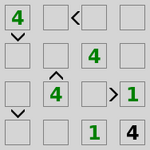
### Visual Description
## Diagram: 4x4 Grid with Numeric States and Transition Arrows
### Overview
The image depicts a 4x4 grid of squares, each containing either a numeric value (1 or 4) or being empty. Arrows indicate directional transitions between squares. The grid is structured with black borders, and numeric values are primarily green, except for the bottom-right "4," which is black.
### Components/Axes
- **Grid Structure**:
- 4 rows (top to bottom) and 4 columns (left to right).
- Each square is a node with potential numeric labels and directional arrows.
- **Arrows**:
- Black directional arrows (up, down, right) indicate transitions between nodes.
- No explicit legend for arrows; directionality is visually encoded.
- **Numeric Labels**:
- Values "1" and "4" are embedded in specific nodes.
- No explicit legend for numeric values; color coding (green vs. black) may imply significance.
### Detailed Analysis
1. **Top-Left Node (Row 1, Column 1)**:
- Contains "4" (green) with a downward arrow pointing to Row 2, Column 1.
2. **Row 2, Column 3**:
- Contains "4" (green) with no arrows.
3. **Row 3, Column 2**:
- Contains "4" (green) with an upward arrow pointing to Row 2, Column 2.
4. **Row 3, Column 4**:
- Contains "1" (green) with a rightward arrow pointing outside the grid (no adjacent node).
5. **Bottom-Right Node (Row 4, Column 4)**:
- Contains "4" (black), distinct from other "4"s.
### Key Observations
- **Transition Paths**:
- The top-left "4" (green) initiates a downward transition to an empty node (Row 2, Column 1).
- The "4" in Row 3, Column 2 transitions upward to an empty node (Row 2, Column 2).
- The "1" in Row 3, Column 4 has a rightward arrow with no target node, suggesting an incomplete or terminal transition.
- **Color Significance**:
- The black "4" in Row 4, Column 4 may denote a terminal or special state.
- **Empty Nodes**:
- Most nodes are empty, implying sparse connectivity or undefined transitions.
### Interpretation
This diagram resembles a **state transition system** or **flowchart**, where:
- Numeric values ("1," "4") represent states or conditions.
- Arrows define permissible transitions between states.
- The black "4" in the bottom-right corner could signify a final or absorbing state.
- The sparse population of nodes and incomplete transitions (e.g., the rightward arrow from Row 3, Column 4) suggest either an unfinished diagram or a system with limited state interactions.
The structure implies a hierarchical or sequential process, with the top-left "4" acting as a starting point. However, the lack of clear pathways to the bottom-right "4" (black) raises questions about system completeness or intentional design choices. Further context is needed to confirm the purpose of empty nodes and color-coded values.
</details>
Figure 42: Unequal: Complete the latin square in accordance with the > signs.
<details>
<summary>extracted/5699650/img/puzzles/unruly.png Details</summary>
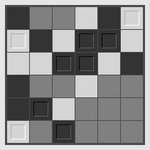
### Visual Description
## Heatmap: Unlabeled 6x6 Grid with Shade Intensity Legend
### Overview
The image depicts a 6x6 grid of square cells with varying shades of gray and black. A legend in the top-right corner categorizes the shades from 0 (lightest) to 5 (darkest). No axis labels, titles, or textual annotations are present outside the legend.
### Components/Axes
- **Legend**: Located in the top-right corner, labeled with six entries:
- 0: Light gray (■)
- 1: Medium light gray (■)
- 2: Medium gray (■)
- 3: Medium dark gray (■)
- 4: Dark gray (■)
- 5: Black (■)
- **Grid**: 6 rows × 6 columns. No axis labels or numerical markers.
- **Color Coding**: Each cell’s shade corresponds to the legend’s numerical values.
### Detailed Analysis
- **Row 1 (Top)**: [4, 3, 3, 0, 4, 0]
- **Row 2**: [0, 4, 0, 5, 5, 0]
- **Row 3**: [0, 0, 5, 5, 0, 4]
- **Row 4**: [4, 5, 0, 0, 3, 3]
- **Row 5**: [5, 0, 4, 3, 2, 2]
- **Row 6 (Bottom)**: [0, 2, 5, 2, 2, 1]
### Key Observations
1. **Darkest Cells**: Shade 5 (black) appears in Row 2 (columns 4–5), Row 3 (columns 3–4), and Row 5 (column 1).
2. **Lightest Cells**: Shade 0 (light gray) dominates Row 1 (columns 4, 6), Row 2 (columns 1, 3, 6), and Row 6 (column 1).
3. **Middle Rows**: Rows 4–5 show a mix of medium to dark shades, with Row 5 having the highest concentration of dark gray (shade 4–5).
4. **Bottom-Right Corner**: Shade 1 (medium light gray) in Row 6, column 6, is the lightest in the bottom row.
### Interpretation
The grid resembles a heatmap, where darker shades (4–5) may represent higher values and lighter shades (0–1) lower values. However, without axis labels or contextual data, the exact meaning of the shades remains ambiguous. The distribution suggests:
- **Clustering of High Values**: Darker regions (shades 4–5) are concentrated in the middle and upper-middle rows.
- **Lightening Trend**: The bottom-right corner transitions to lighter shades, potentially indicating a gradient or decay effect.
- **No Clear Pattern**: The grid lacks symmetry or obvious trends, suggesting either random data or a visualization requiring additional context (e.g., axis labels, annotations).
### Limitations
- No textual data or axis labels are present beyond the legend.
- The absence of numerical values or units prevents quantitative analysis.
- The purpose of the grid (e.g., data visualization, artistic design) cannot be definitively determined.
</details>
Figure 43: Unruly: Fill in the black and white grid to avoid runs of three.
<details>
<summary>extracted/5699650/img/puzzles/untangle.png Details</summary>
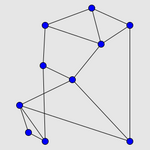
### Visual Description
## Network Diagram: Unlabeled Graph Structure
### Overview
The image depicts an unlabeled network diagram consisting of 12 blue circular nodes connected by black edges. No textual labels, legends, or axis markers are present. The nodes are spatially distributed with varying degrees of connectivity, forming clusters and isolated connections.
### Components/Axes
- **Nodes**: 12 blue circular vertices (no labels or identifiers).
- **Edges**: Black lines connecting nodes, with no directional arrows or weights indicated.
- **Spatial Layout**: Nodes are positioned asymmetrically, with some clusters (e.g., 4 nodes tightly grouped in the upper-left quadrant) and sparse connections in other regions.
### Detailed Analysis
- **Node Degrees**:
- Node A (top-left cluster): Degree 3 (connected to 3 other nodes).
- Node B (central node): Degree 4 (highest connectivity).
- Node C (bottom-right): Degree 2 (isolated from main clusters).
- **Edge Distribution**:
- Total edges: ~18 (approximate, based on visual count).
- No self-loops or parallel edges observed.
### Key Observations
1. **Cluster Formation**: A dense subgraph exists in the upper-left quadrant, suggesting potential community structure.
2. **Isolation**: Node C (bottom-right) is only connected to two nodes, indicating possible peripheral status.
3. **Ambiguity**: Lack of labels prevents identification of nodes/edges or contextual meaning.
### Interpretation
The diagram likely represents a social, technological, or biological network. The clustered nodes may indicate tightly connected subgroups, while isolated nodes could represent outliers or peripheral entities. Without labels, the diagram’s purpose remains speculative. The absence of edge weights or directions limits analysis of flow or hierarchy. This structure could model scenarios like communication patterns, dependency graphs, or interaction networks, but further context is required for definitive interpretation.
## Notes
- No textual information, legends, or axis titles are present in the image.
- All descriptions are based on visual analysis; numerical values (e.g., node degrees) are approximate.
- The diagram’s utility depends on external metadata not provided in the image.
</details>
Figure 44: Untangle: Reposition the points so that the lines do not cross.
Appendix E Puzzle-specific Metadata
E.1 Action Space
We display the action spaces for all supported puzzles in Table 5. The action spaces vary in size and in the types of actions they contain. As a result, an agent must learn the meaning of each action independently for each puzzle.
Table 5: The action spaces for each puzzle are listed, along with their cardinalities. The actions are listed with their name in the original Puzzle Collection C code.
| Black Box | 5 | UP, DOWN, LEFT, RIGHT, SELECT |
| --- | --- | --- |
| Bridges | 5 | UP, DOWN, LEFT, RIGHT, SELECT |
| Cube | 4 | UP, DOWN, LEFT, RIGHT |
| Dominosa | 5 | UP, DOWN, LEFT, RIGHT, SELECT |
| Fifteen | 4 | UP, DOWN, LEFT, RIGHT |
| Filling | 13 | UP, DOWN, LEFT, RIGHT, 1, 2, 3, 4, 5, 6, 7, 8, 9 |
| Flip | 5 | UP, DOWN, LEFT, RIGHT, SELECT |
| Flood | 5 | UP, DOWN, LEFT, RIGHT, SELECT |
| Galaxies | 5 | UP, DOWN, LEFT, RIGHT, SELECT |
| Guess | 5 | UP, DOWN, LEFT, RIGHT, SELECT |
| Inertia | 9 | 1, 2, 3, 4, 6, 7, 8, 9, UNDO |
| Keen | 14 | UP, DOWN, LEFT, RIGHT, SELECT2, 1, 2, 3, 4, 5, 6, 7, 8, 9 |
| Light Up | 5 | UP, DOWN, LEFT, RIGHT, SELECT |
| Loopy | 6 | UP, DOWN, LEFT, RIGHT, SELECT, SELECT2 |
| Magnets | 6 | UP, DOWN, LEFT, RIGHT, SELECT, SELECT2 |
| Map | 5 | UP, DOWN, LEFT, RIGHT, SELECT |
| Mines | 7 | UP, DOWN, LEFT, RIGHT, SELECT, SELECT2, UNDO |
| Mosaic | 6 | UP, DOWN, LEFT, RIGHT, SELECT, SELECT2 |
| Net | 5 | UP, DOWN, LEFT, RIGHT, SELECT |
| Netslide | 5 | UP, DOWN, LEFT, RIGHT, SELECT |
| Palisade | 5 | UP, DOWN, LEFT, RIGHT, CTRL |
| Pattern | 6 | UP, DOWN, LEFT, RIGHT, SELECT, SELECT2 |
| Pearl | 5 | UP, DOWN, LEFT, RIGHT, SELECT |
| Pegs | 6 | UP, DOWN, LEFT, RIGHT, SELECT, UNDO |
| Range | 5 | UP, DOWN, LEFT, RIGHT, SELECT |
| Rectangles | 5 | UP, DOWN, LEFT, RIGHT, SELECT |
| Same Game | 6 | UP, DOWN, LEFT, RIGHT, SELECT, UNDO |
| Signpost | 6 | UP, DOWN, LEFT, RIGHT, SELECT, SELECT2 |
| Singles | 6 | UP, DOWN, LEFT, RIGHT, SELECT, SELECT2 |
| Sixteen | 6 | UP, DOWN, LEFT, RIGHT, SELECT, SELECT2 |
| Slant | 6 | UP, DOWN, LEFT, RIGHT, SELECT, SELECT2 |
| Solo | 13 | UP, DOWN, LEFT, RIGHT, 1, 2, 3, 4, 5, 6, 7, 8, 9 |
| Tents | 6 | UP, DOWN, LEFT, RIGHT, SELECT, SELECT2 |
| Towers | 14 | UP, DOWN, LEFT, RIGHT, SELECT2, 1, 2, 3, 4, 5, 6, 7, 8, 9 |
| Tracks | 5 | UP, DOWN, LEFT, RIGHT, SELECT |
| Twiddle | 6 | UP, DOWN, LEFT, RIGHT, SELECT, SELECT2 |
| Undead | 8 | UP, DOWN, LEFT, RIGHT, SELECT2, 1, 2, 3 |
| Unequal | 13 | UP, DOWN, LEFT, RIGHT, 1, 2, 3, 4, 5, 6, 7, 8, 9 |
| Unruly | 6 | UP, DOWN, LEFT, RIGHT, SELECT, SELECT2 |
| Untangle | 5 | UP, DOWN, LEFT, RIGHT, SELECT |
E.2 Optional Parameters
We display the optional parameters for all supported puzzles in LABEL:tab:parameters. If none are supplied upon initialization, a set of default parameters gets used for the puzzle generation process.
Table 6: For each puzzle, all optional parameters a user may supply are shown and described. We also give the required data type of variable, where applicable (e.g., int or char). For parameters that accept one of a few choices (such as difficulty), the accepted values and corresponding explanation are given in braces. As as example: a difficulty parameter is listed as d{int} with allowed values {0 = easy, 1 = medium, 2 = hard}. In this case, choosing medium difficulty would correspond to d1.
| Black Box | w8h8m5M5 | w{int} | grid width | (w $·$ h + w + h + 1) |
| --- | --- | --- | --- | --- |
| h{int} | grid height | $·$ (w + 2) $·$ (h + 2) | | |
| m{int} | minimum number of balls | | | |
| M{int} | maximum number of balls | | | |
| Bridges | 7x7i5e2m2d0 | {int}x{int} | grid width $×$ grid height | 3 $·$ w $·$ $·$ (w + h + 8) |
| i{int} | percentage of island squares | | | |
| e{int} | expansion factor | | | |
| m{int} | max bridges per direction | | | |
| d{int} | difficulty {0 = easy, 1 = medium, 2 = hard} | | | |
| Cube | c4x4 | {char} | type {c = cube, t = tetrahedron, | w $·$ $·$ F |
| o = octahedron, i = icosahedron} | F = number of the body’s faces | | | |
| {int}x{int} | grid width $×$ grid height | | | |
| Dominosa | 6db | {int} | maximum number of dominoes | $\frac{1}{2}\left(\text{w}^{2}\text{ + 3w + 2}\right)$ |
| d{char} | difficulty {t = trivial, b = basic, h = hard, | $·(\text{4}\sqrt{\text{w}^{2}\text{ + 3w + 2}}\text{ + 1})$ | | |
| e = extreme, a = ambiguous} | | | | |
| Fifteen | 4x4 | {int}x{int} | grid width $×$ grid height | $(w· h)^{4}$ |
| Filling | 13x9 | {int}x{int} | grid width $×$ grid height | $(w· h)·(w+h+1)$ |
| Flip | 5x5c | {int}x{int} | grid width $×$ grid height | $(w· h)·(w+h+1)$ |
| {char} | type {c = crosses, r = random} | | | |
| Flood | 12x12c6m5 | {int}x{int} | grid width $×$ grid height | $(w· h)·(w+h+1)$ |
| c{int} | number of colors | | | |
| m{int} | extra moves permitted (above the | | | |
| solver’s minimum) | | | | |
| Galaxies | 7x7dn | {int}x{int} | grid width $×$ grid height | $(2· w· h-w-h)$ |
| d{char} | difficulty {n = normal, u = unreasonable} | $·(2· w+2· h+1)$ | | |
| Guess | c6p4g10Bm | c{int} | number of colors | $(p+1)· g·(c+p)$ |
| p{int} | pegs per guess | | | |
| g{int} | maximum number of guesses | | | |
| {char} | allow blanks {B = no, b = yes} | | | |
| {char} | allow duplicates {M = no, m = yes} | | | |
| Inertia | 10x8 | {int}x{int} | grid width $×$ grid height | $0.2· w^{2}· h^{2}$ |
| Keen | 6dn | {int} | grid size | $(2· w+1)· w^{2}$ |
| d{char} | difficulty {e = easy, n = normal, h = hard, | | | |
| x = extreme, u = unreasonable} | | | | |
| {char} | (Optional) multiplication only {m = yes} | | | |
| Light Up | 7x7b20s4d0 | {int}x{int} | grid width $×$ grid height | $\frac{1}{2}·(w+h+1)$ |
| b{int} | percentage of black squares | $·(w· h+1)$ | | |
| s{int} | symmetry {0 = none, 1 = 2-way mirror, | | | |
| 2 = 2-way rotational, 3 = 4-way mirror, | | | | |
| 4 = 4-way rotational} | | | | |
| d{int} | difficulty {0 = easy, 1 = tricky, 2 = hard} | | | |
| Loopy | 10x10t12dh | {int}x{int} | grid width $×$ grid height | $(2· w· h+1)· 3·(w· h)^{2}$ |
| t{int} | type {0 = squares, 1 = triangular, | | | |
| 2 = honeycomb, 3 = snub-square, | | | | |
| 4 = cairo, 5 = great-hexagonal, | | | | |
| 6 = octagonal, 7 = kites, | | | | |
| 8 = floret, 9 = dodecagonal, | | | | |
| 10 = great-dodecagonal, | | | | |
| 11 = Penrose (kite/dart), | | | | |
| 12 = Penrose (rhombs), | | | | |
| 13 = great-great-dodecagonal, | | | | |
| 14 = kagome, 15 = compass-dodecagonal, | | | | |
| 16 = hats} | | | | |
| d{char} | difficulty {e = easy, n = normal, | | | |
| t = tricky, h = hard} | | | | |
| Magnets | 6x5dtS | {int}x{int} | grid width $×$ grid height | $w· h·(w+h+2)$ |
| d{char} | difficulty {e = easy, t = tricky | | | |
| {char} | (Optional) strip clues {S = yes} | | | |
| Map | 20x15n30dn | {int}x{int} | grid width $×$ grid height | $2· n·(1+w+h)$ |
| n{int} | number of regions | | | |
| d{char} | difficulty {e = easy, n = normal, h = hard, | | | |
| u = unreasonable} | | | | |
| Mines | 9x9n10 | {int}x{int} | grid width $×$ grid height | $w· h·(w+h+1)$ |
| n{int} | number of mines | | | |
| p{char} | (Optional) ensure solubility {a = no} | | | |
| Mosaic | 10x10h0 | {int}x{int} | grid width $×$ grid height | $w· h·(w+h+1)$ |
| {str} | (Optional) aggressive generation {h0 = no} | | | |
| Net | 5x5wb0.5 | {int}x{int} | grid width $×$ grid height | $w· h·(w+h+3)$ |
| {char} | (Optional) walls wrap around {w = yes} | | | |
| b{float} | barrier probability, interval: [0, 1] | | | |
| {char} | (Optional) ensure unique solution {a = no} | | | |
| Netslide | 4x4wb1m2 | {int}x{int} | grid width $×$ grid height | $2· w· h·(w+h-1)$ |
| {char} | (Optional) walls wrap around {w = yes} | | | |
| b{float} | barrier probability, interval: [0, 1] | | | |
| m{int} | (Optional) number of shuffling moves | | | |
| Palisade | 5x5n5 | {int}x{int} | grid width $×$ grid height | $(2· w· h-w-h)$ |
| n{int} | region size | $·(w+h+3)$ | | |
| Pattern | 15x15 | {int}x{int} | grid width $×$ grid height | $w· h(w+h+1)$ |
| Pearl | 8x8dtn | {int}x{int} | grid width $×$ grid height | $w· h·(w+h+2)$ |
| d{char} | difficulty {e = easy, t = tricky} | | | |
| {char} | allow unsoluble {n = yes} | | | |
| Pegs | 7x7cross | {int}x{int} | grid width $×$ grid height | $w· h·(w+h+2)$ |
| {str} | type {cross, octagon, random} | | | |
| Range | 9x6 | {int}x{int} | grid width $×$ grid height | $w· h·(w+h+1)$ |
| Rectangles | 7x7e4 | {int}x{int} | grid width $×$ grid height | $2· w· h·(w+h+1)$ |
| e{int} | expansion factor | | | |
| {char} | ensure unique solution {a = no} | | | |
| Same Game | 5x5c3s2 | {int}x{int} | grid width $×$ grid height | $w· h·(w+h+2)$ |
| c{int} | number of colors | | | |
| s{int} | scoring system {1 = $(n-1)^{2}$ , | | | |
| 2 = $(n-2)^{2}$ } | | | | |
| {char} | (Optional) ensure solubility {r = no} | | | |
| Signpost | 4x4c | {int}x{int} | grid width $×$ grid height | $2· w· h·(w+h+1)$ |
| {char} | (Optional) start and end in corners | | | |
| {c = yes} | | | | |
| Singles | 5x5de | {int}x{int} | grid width $×$ grid height | $w· h·(w+h+1)$ |
| d{char} | difficulty {e = easy, k = tricky} | | | |
| Sixteen | 5x5m2 | {int}x{int} | grid width $×$ grid height | $w· h·(w+h+3)$ |
| m{int} | (Optional) number of shuffling moves | | | |
| Slant | 8x8de | {int}x{int} | grid width $×$ grid height | $w· h·(w+h+1)$ |
| d{char} | difficulty {e = easy, h = hard} | | | |
| Solo | 3x3 | {int}x{int} | rows of sub-blocks $×$ cols of sub-blocks | $(w· h)^{2}*(2· w· h+1)$ |
| {char} | (Optional) require every digit on each | | | |
| main diagonal {x = yes} | | | | |
| * | | {char} | (Optional) jigsaw (irregularly shaped | |
| sub-blocks) main diagonal {j = yes} | | | | |
| * | | {char} | (Optional) killer (digit sums) {k = yes} | |
| * | | {str} | (Optional) symmetry. If not set, | |
| it is 2-way rotation. {a = None, | | | | |
| m2 = 2-way mirror, m4 = 4-way mirror, | | | | |
| r4 = 4-way rotation, m8 = 8-way mirror, | | | | |
| md2 = 2-way diagonal mirror, | | | | |
| md4 = 4-way diagonal mirror} | | | | |
| d{char} | difficulty {t = trivial, b = basic, | | | |
| i = intermediate, a = advanced, | | | | |
| e = extreme, u = unreasonable} | | | | |
| Tents | 8x8de | {int}x{int} | grid width $×$ grid height | $\frac{1}{4}·(w+1)·(h+1)$ |
| d{char} | difficulty {e = easy, t = tricky} | $·(w+h+1)$ | | |
| Towers | 5de | {int} | grid size | $2·(w+1)· w^{2}$ |
| d{char} | difficulty {e = easy, h = hard | | | |
| x = extreme, u = unreasonable} | | | | |
| Tracks | 8x8dto | {int}x{int} | grid width $×$ grid height | $w· h(2·(w+h)+1)$ |
| d{char} | difficulty {e = easy, t = tricky, h = hard} | | | |
| {char} | (Optional) disallow consecutive 1 clues | | | |
| {o = no} | | | | |
| Twiddle | 3x3n2 | {int}x{int} | grid width $×$ grid height | $(2· w· h· n^{2}+1)$ |
| n{int} | rotating block size | $·(w+h-2· n+1)$ | | |
| {char} | (Optional) one number per row {r = yes} | | | |
| {char} | (Optional) orientation matters {o = yes} | | | |
| m{int} | (Optional) number of shuffling moves | | | |
| Undead | 4x4dn | {int}x{int} | grid width $×$ grid height | $w· h·(w+h+1)$ |
| d{char} | difficulty {e = easy, n = normal, t = tricky} | | | |
| Unequal | 4adk | {int} | grid size | $w^{2}·(2· w+1)$ |
| {char} | (Optional) adjacent mode {a = yes} | | | |
| d{char} | difficulty {t = trivial, e = easy, k = tricky, | | | |
| x = extreme, r = recursive} | | | | |
| Unruly | 8x8dt | {int} | grid size | $w· h·(w+h+1)$ |
| {char} | (Optional) unique rows and cols {u = yes} | | | |
| d{char} | difficulty {t = trivial, e = easy, n = normal} | | | |
| Untangle | 25 | {int} | number of points | $n·(n+\sqrt{3n}· 4+2)$ |
E.3 Baseline Parameters
In Table 7, the parameters used for training the agents used for the comparisons in Section 3 is shown.
Table 7: Listed below are the generation parameters supplied to each puzzle instance before training an agent, as well as some puzzle-specific notes. We propose the easiest preset difficulty setting as a first challenge for RL algorithms to reach human-level performance.
| Black Box | w2h2m2M2 | w5h5m3M3 | |
| --- | --- | --- | --- |
| Bridges | 3x3 | 7x7i30e10m2d0 | |
| Cube | c3x3 | c4x4 | |
| Dominosa | 1dt | 3dt | |
| Fifteen | 2x2 | 4x4 | |
| Filling | 2x3 | 9x7 | |
| Flip | 3x3c | 3x3c | |
| Flood | 3x3c6m5 | 12x12c6m5 | |
| Galaxies | 3x3de | 7x7dn | |
| Guess | c2p3g10Bm | c6p4g10Bm | Episodes were terminated and negatively rewarded |
| after the maximum number of guesses was made | | | |
| without finding the correct solution. | | | |
| Inertia | 4x4 | 10x8 | |
| Keen | 3dem | 4de | Even the minimum allowed problem size |
| proved to be infeasible for a random agent | | | |
| Light Up | 3x3b20s0d0 | 7x7b20s4d0 | |
| Loopy | 3x3t0de | 3x3t0de | |
| Magnets | 3x3deS | 6x5de | |
| Map | 3x3n5de | 20x15n30de | |
| Mines | 4x4n2 | 9x9n10 | |
| Mosaic | 3x3 | 3x3 | |
| Net | 2x2 | 5x5 | |
| Netslide | 2x3b1 | 3x3b1 | |
| Palisade | 2x3n3 | 5x5n5 | |
| Pattern | 3x2 | 10x10 | |
| Pearl | 5x5de | 6x6de | |
| Pegs | 4x4random | 5x7cross | |
| Range | 3x3 | 9x6 | |
| Rectangles | 3x2 | 7x7 | |
| Same Game | 2x3c3s2 | 5x5c3s2 | |
| Signpost | 2x3 | 4x4c | |
| Singles | 2x3de | 5x5de | |
| Sixteen | 2x3 | 3x3 | |
| Slant | 2x2de | 5x5de | |
| Solo | 2x2 | 2x2 | |
| Tents | 4x4de | 8x8de | |
| Towers | 3de | 4de | |
| Tracks | 4x4de | 8x8de | |
| Twiddle | 2x3n2 | 3x3n2r | |
| Undead | 3x3de | 4x4de | |
| Unequal | 3de | 4de | |
| Unruly | 6x6dt | 8x8dt | Even the minimum allowed problem size |
| proved to be infeasible for a random agent | | | |
| Untangle | 4 | 6 | |
E.4 Detailed Baseline Results
We summarize all evaluated algorithms in Table 8.
Table 8: Summary of all evaluated RL algorithms.
| Proximal Policy Optimization (PPO) [61] Recurrent PPO [62] Advantage Actor Critic (A2C) [63] | On-Policy On-Policy On-Policy | No No No |
| --- | --- | --- |
| Asynchronous Advantage Actor Critic (A3C) [63] | On-Policy | No |
| Trust Region Policy Optimization (TRPO) [64] | On-Policy | No |
| Deep Q-Network (DQN) [11] | Off-Policy | No |
| Quantile Regression DQN (QRDQN) [65] | Off-Policy | No |
| MuZero [66] | Off-Policy | Yes |
| DreamerV3 [67] | Off-Policy | No |
As we limited the agents to a single final reward upon completion, where possible, we chose puzzle parameters that allowed random policies to successfully find a solution. Note that if a random policy fails to find a solution, an RL algorithm without guidance (such as intermediate rewards) will also be affected by this. If an agent has never accumulated a reward with the initial (random) policy, it will be unable to improve its performance at all.
The chosen parameters roughly corresponded to the smallest and easiest puzzles, as more complex puzzles were found to be intractable. This fact is highlighted for example in Solo/Sudoku, where the reasoning needed to find a valid solution is already rather complex, even for a grid with 2 $×$ 2 sub-blocks. A few puzzles were still intractable due to the minimum complexity permitted by Tathams’s puzzle-specific problem generators, such as with Unruly.
For the RGB pixel observations, the window size chosen for these small problems was set at 128 $×$ 128 pixels.
Table 9: Listed below are the detailed results for all evaluated algorithms. Results show the average number of steps required for all successful episodes and standard deviation with respect to the random seeds. In brackets, we show the overall percentage of successful episodes. In the summary row, the last number in brackets denotes the total number of puzzles where a solution below the upper bound of optimal steps was found. Entries without values mean that no successful policy was found among all random seeds. This Table is continued in Table 10.
Puzzle Supplied Parameters Optimal Random PPO TRPO DreamerV3 MuZero Blackbox w2h2m2M2 $144$ $2206$ $(99.2\%)$ $1773± 472$ $(59.5\%)$ $1744± 454$ $(96.3\%)$ $\mathbf{32± 5}$ $(100.0\%)$ $\mathbf{46± 0}$ $(0.1\%)$ Bridges 3x3 $378$ $547$ $(100.0\%)$ $682± 197$ $(85.1\%)$ $546± 13$ $(100.0\%)$ $\mathbf{9± 0}$ $(100.0\%)$ $397± 181$ $(86.7\%)$ Cube c3x3 $54$ $4181$ $(66.9\%)$ $744± 1610$ $(77.5\%)$ $433± 917$ $(99.8\%)$ $5068± 657$ $(22.5\%)$ - Dominosa 1dt $32$ $1980$ $(99.2\%)$ $457± 954$ $(70.0\%)$ $\mathbf{12± 1}$ $(100.0\%)$ $\mathbf{11± 1}$ $(100.0\%)$ $3659± 0$ $(0.0\%)$ Fifteen 2x2 $256$ $54$ $(100.0\%)$ $\mathbf{3± 0}$ $(100.0\%)$ $\mathbf{3± 0}$ $(100.0\%)$ $\mathbf{4± 0}$ $(100.0\%)$ $\mathbf{5± 1}$ $(100.0\%)$ Filling 2x3 $36$ $820$ $(100.0\%)$ $290± 249$ $(97.5\%)$ $\mathbf{9± 2}$ $(100.0\%)$ $443± 56$ $(83.4\%)$ $1099± 626$ $(15.0\%)$ Flip 3x3c $63$ $3138$ $(88.9\%)$ $3008± 837$ $(40.1\%)$ $2951± 564$ $(90.8\%)$ $1762± 568$ $(8.0\%)$ $1207± 1305$ $(3.1\%)$ Flood 3x3c6m5 $63$ $134$ $(97.4\%)$ $\mathbf{12± 0}$ $(99.9\%)$ $\mathbf{21± 4}$ $(99.6\%)$ $\mathbf{14± 1}$ $(100.0\%)$ $994± 472$ $(14.4\%)$ Galaxies 3x3de $156$ $4306$ $(33.9\%)$ $3860± 1778$ $(8.3\%)$ $4755± 527$ $(24.8\%)$ $3367± 1585$ $(11.0\%)$ $6046± 2722$ $(8.2\%)$ Guess c2p3g10Bm $200$ $358$ $(73.4\%)$ - $316± 52$ $(72.0\%)$ $268± 226$ $(77.0\%)$ $\mathbf{24± 0}$ $(0.8\%)$ Inertia 4x4 $51$ $13$ $(6.5\%)$ $\mathbf{22± 9}$ $(6.3\%)$ $635± 1373$ $(5.7\%)$ $926± 217$ $(5.7\%)$ $104± 73$ $(3.1\%)$ Keen 3dem $63$ $3152$ $(0.5\%)$ $3817± 0$ $(0.2\%)$ $5887± 1526$ $(0.4\%)$ $4350± 1163$ $(1.3\%)$ - Lightup 3x3b20s0d0 $35$ $2237$ $(98.1\%)$ $1522± 1115$ $(82.7\%)$ $2127± 168$ $(95.8\%)$ $438± 247$ $(72.0\%)$ $1178± 1109$ $(2.1\%)$ Loopy 3x3t0de $4617$ - - - - - Magnets 3x3deS $72$ $1895$ $(99.1\%)$ $1366± 1090$ $(90.2\%)$ $1912± 60$ $(99.1\%)$ $574± 56$ $(78.5\%)$ $1491± 0$ $(0.7\%)$ Map 3x3n5de $70$ $903$ $(99.9\%)$ $1172± 297$ $(75.7\%)$ $950± 34$ $(99.9\%)$ $1680± 197$ $(64.9\%)$ $467± 328$ $(0.9\%)$ Mines 4x4n2 $144$ $87$ $(18.1\%)$ $2478± 2424$ $(9.9\%)$ $\mathbf{123± 66}$ $(18.8\%)$ $272± 246$ $(50.1\%)$ $\mathbf{19± 22}$ $(4.6\%)$ Mosaic 3x3 $63$ $4996$ $(9.8\%)$ $4928± 438$ $(2.5\%)$ $5233± 615$ $(5.0\%)$ $4469± 387$ $(15.9\%)$ $5586± 0$ $(0.2\%)$ Net 2x2 $28$ $1279$ $(100.0\%)$ $\mathbf{9± 0}$ $(100.0\%)$ $\mathbf{9± 0}$ $(100.0\%)$ $\mathbf{10± 0}$ $(100.0\%)$ $339± 448$ $(8.2\%)$ Netslide 2x3b1 $48$ $766$ $(100.0\%)$ $1612± 1229$ $(41.6\%)$ $635± 145$ $(100.0\%)$ $\mathbf{12± 0}$ $(100.0\%)$ $683± 810$ $(25.0\%)$ Netslide 3x3b1 $90$ $4671$ $(11.0\%)$ $4671± 498$ $(9.2\%)$ $4008± 1214$ $(8.9\%)$ $3586± 677$ $(22.4\%)$ $3721± 1461$ $(13.2\%)$ Palisade 2x3n3 $56$ $1428$ $(100.0\%)$ $939± 604$ $(87.0\%)$ $1377± 35$ $(99.9\%)$ $\mathbf{39± 56}$ $(100.0\%)$ $86± 0$ $(0.0\%)$ Pattern 3x2 $36$ $3247$ $(92.9\%)$ $1542± 1262$ $(71.9\%)$ $2908± 355$ $(90.2\%)$ $820± 516$ $(58.0\%)$ $4063± 1696$ $(1.9\%)$ Pearl 5x5de $300$ - - - - - Pegs 4x4Random $160$ - - - - - Range 3x3 $63$ $535$ $(100.0\%)$ $780± 305$ $(65.8\%)$ $661± 198$ $(99.9\%)$ $888± 238$ $(55.6\%)$ $91± 76$ $(5.1\%)$ Rect 3x2 $72$ $723$ $(100.0\%)$ $\mathbf{27± 44}$ $(99.8\%)$ $\mathbf{9± 4}$ $(100.0\%)$ $\mathbf{8± 1}$ $(100.0\%)$ - Samegame 2x3c3s2 $42$ $76$ $(100.0\%)$ $123± 197$ $(98.8\%)$ $\mathbf{7± 0}$ $(100.0\%)$ $\mathbf{7± 0}$ $(100.0\%)$ $1444± 541$ $(28.7\%)$ Samegame 5x5c3s2 $300$ $571$ $(32.1\%)$ $1003± 827$ $(30.5\%)$ $672± 160$ $(30.8\%)$ $527± 162$ $(30.2\%)$ $\mathbf{184± 107}$ $(4.9\%)$ Signpost 2x3 $72$ $776$ $(96.1\%)$ $838± 53$ $(97.2\%)$ $799± 13$ $(97.0\%)$ $859± 304$ $(91.3\%)$ $4883± 1285$ $(5.9\%)$ Singles 2x3de $36$ $353$ $(100.0\%)$ $\mathbf{7± 3}$ $(100.0\%)$ $\mathbf{7± 4}$ $(100.0\%)$ $\mathbf{11± 8}$ $(99.9\%)$ $733± 551$ $(28.4\%)$ Sixteen 2x3 $48$ $2908$ $(94.1\%)$ $2371± 1226$ $(55.7\%)$ $2968± 181$ $(92.8\%)$ $\mathbf{17± 1}$ $(100.0\%)$ $3281± 472$ $(68.7\%)$ Slant 2x2de $20$ $447$ $(100.0\%)$ $333± 190$ $(80.4\%)$ $21± 2$ $(99.9\%)$ $596± 163$ $(100.0\%)$ $1005± 665$ $(7.4\%)$ Solo 2x2 $144$ - - - - - Tents 4x4de $56$ $4442$ $(44.3\%)$ $4781± 86$ $(10.3\%)$ $4828± 752$ $(31.0\%)$ $3137± 581$ $(12.1\%)$ $4556± 3259$ $(0.6\%)$ Towers 3de $72$ $4876$ $(1.0\%)$ - $3789± 1288$ $(0.5\%)$ $3746± 1861$ $(0.5\%)$ - Tracks 4x4de $272$ $5213$ $(0.5\%)$ $4129± nan$ $(0.1\%)$ $5499± 2268$ $(0.3\%)$ $4483± 1513$ $(0.3\%)$ - Twiddle 2x3n2 $98$ $851$ $(100.0\%)$ $\mathbf{8± 1}$ $(99.9\%)$ $\mathbf{11± 7}$ $(100.0\%)$ $\mathbf{8± 0}$ $(100.0\%)$ $761± 860$ $(37.6\%)$ Undead 3x3de $63$ $4390$ $(40.1\%)$ $4542± 292$ $(5.7\%)$ $4179± 299$ $(31.0\%)$ $4088± 297$ $(35.8\%)$ $3677± 342$ $(9.0\%)$ Unequal 3de $63$ $4540$ $(6.7\%)$ - $5105± 193$ $(3.6\%)$ $2468± 2025$ $(4.8\%)$ $4944± 368$ $(7.2\%)$ Unruly 6x6dt $468$ - - - - - Untangle 4 $150$ $141$ $(100.0\%)$ $\mathbf{13± 1}$ $(100.0\%)$ $\mathbf{11± 0}$ $(100.0\%)$ $\mathbf{6± 0}$ $(100.0\%)$ $499± 636$ $(26.5\%)$ Untangle 6 $79$ $2165$ $(96.9\%)$ $2295± 66$ $(96.2\%)$ $2228± 126$ $(96.5\%)$ $1683± 74$ $(82.0\%)$ $2380± 0$ $(11.2\%)$ Summary - $217$ $1984$ $(71.2\%)$ $1604± 801$ $(61.6\%)(8)$ $1773± 639$ $(70.8\%)(11)$ $1334± 654$ $(62.7\%)(14)$ $1808± 983$ $(16.0\%)(5)$
Table 10: Continuation from Table 9. Listed below are the detailed results for all evaluated algorithms. Results show the average number of steps required for all successful episodes and standard deviation with respect to the random seeds. In brackets, we show the overall percentage of successful episodes. In the summary row, the last number in brackets denotes the total number of puzzles where a solution below the upper bound of optimal steps was found. Entries without values mean that no successful policy was found among all random seeds.
Puzzle Supplied Parameters Optimal Random A2C RecurrentPPO DQN QRDQN Blackbox w2h2m2M2 $144$ $2206$ $(99.2\%)$ $2524± 1193$ $(85.2\%)$ $2009± 427$ $(98.7\%)$ $2063± 70$ $(99.0\%)$ $2984± 1584$ $(76.8\%)$ Bridges 3x3 $378$ $547$ $(100.0\%)$ $540± 69$ $(100.0\%)$ $653± 165$ $(100.0\%)$ $549± 20$ $(100.0\%)$ $1504± 2037$ $(83.4\%)$ Cube c3x3 $54$ $4181$ $(66.9\%)$ $4516± 954$ $(17.5\%)$ $4943± 620$ $(16.2\%)$ $4407± 414$ $(43.4\%)$ $4241± 283$ $(26.4\%)$ Dominosa 1dt $32$ $1980$ $(99.2\%)$ $6408± nan$ $(0.2\%)$ $3009± 988$ $(80.6\%)$ $\mathbf{15± 6}$ $(100.0\%)$ $4457± 2183$ $(50.0\%)$ Fifteen 2x2 $256$ $54$ $(100.0\%)$ $\mathbf{4± 1}$ $(100.0\%)$ $\mathbf{3± 0}$ $(100.0\%)$ $\mathbf{3± 0}$ $(100.0\%)$ $\mathbf{3± 0}$ $(100.0\%)$ Filling 2x3 $36$ $820$ $(100.0\%)$ $777± 310$ $(99.3\%)$ $764± 106$ $(100.0\%)$ $761± 109$ $(99.7\%)$ $2828± 2769$ $(63.2\%)$ Flip 3x3c $63$ $3138$ $(88.9\%)$ $4345± 1928$ $(29.4\%)$ $3356± 1412$ $(46.9\%)$ $3493± 129$ $(87.1\%)$ $3741± 353$ $(56.8\%)$ Flood 3x3c6m5 $63$ $134$ $(97.4\%)$ $406± 623$ $(93.4\%)$ $120± 17$ $(97.7\%)$ $128± 12$ $(90.8\%)$ $1954± 2309$ $(65.2\%)$ Galaxies 3x3de $156$ $4306$ $(33.9\%)$ $4586± 980$ $(10.8\%)$ $3939± 1438$ $(0.4\%)$ $4657± 147$ $(26.1\%)$ - Guess c2p3g10Bm $200$ $358$ $(73.4\%)$ - $323± 52$ $(44.6\%)$ $550± 248$ $(71.9\%)$ $3260± 2614$ $(34.4\%)$ Inertia 4x4 $51$ $13$ $(6.5\%)$ $105± 197$ $(6.1\%)$ $1198± 1482$ $(5.6\%)$ $179± 156$ $(7.1\%)$ $1330± 296$ $(5.8\%)$ Keen 3dem $63$ $3152$ $(0.5\%)$ - - $6774± 1046$ $(0.4\%)$ - Lightup 3x3b20s0d0 $35$ $2237$ $(98.1\%)$ $3034± 793$ $(62.7\%)$ $3493± 929$ $(66.5\%)$ $2429± 214$ $(97.5\%)$ $3440± 945$ $(57.8\%)$ Loopy 3x3t0de $4617$ - - - - - Magnets 3x3deS $72$ $1895$ $(99.1\%)$ $3057± 1114$ $(47.9\%)$ $1874± 222$ $(99.2\%)$ $2112± 331$ $(98.1\%)$ $5182± 3878$ $(33.8\%)$ Map 3x3n5de $70$ $903$ $(99.9\%)$ $2552± 1223$ $(52.5\%)$ $2608± 1808$ $(59.4\%)$ $949± 30$ $(99.9\%)$ $1753± 769$ $(78.1\%)$ Mines 4x4n2 $144$ $87$ $(18.1\%)$ $\mathbf{120± 41}$ $(14.7\%)$ $1189± 1341$ $(12.1\%)$ $207± 146$ $(17.6\%)$ $1576± 1051$ $(13.2\%)$ Mosaic 3x3 $63$ $4996$ $(9.8\%)$ $4937± 424$ $(8.4\%)$ $4907± 219$ $(8.3\%)$ $5279± 564$ $(7.0\%)$ $9490± 155$ $(0.0\%)$ Net 2x2 $28$ $1279$ $(100.0\%)$ $149± 288$ $(100.0\%)$ $1232± 92$ $(100.0\%)$ $\mathbf{9± 0}$ $(100.0\%)$ $1793± 1663$ $(81.3\%)$ Netslide 2x3b1 $48$ $766$ $(100.0\%)$ $976± 584$ $(100.0\%)$ $2079± 1989$ $(64.7\%)$ $779± 37$ $(100.0\%)$ $1023± 206$ $(80.9\%)$ Netslide 3x3b1 $90$ $4671$ $(11.0\%)$ $4324± 657$ $(8.1\%)$ $2737± 1457$ $(1.7\%)$ $4099± 846$ $(5.1\%)$ $2025± 1475$ $(0.4\%)$ Palisade 2x3n3 $56$ $1428$ $(100.0\%)$ $1666± 198$ $(99.4\%)$ $1981± 1053$ $(92.5\%)$ $1445± 96$ $(99.9\%)$ $1519± 142$ $(99.8\%)$ Pattern 3x2 $36$ $3247$ $(92.9\%)$ $3445± 635$ $(82.9\%)$ $3733± 513$ $(79.7\%)$ $2809± 733$ $(89.7\%)$ $3406± 384$ $(51.1\%)$ Pearl 5x5de $300$ - - - - - Pegs 4x4Random $160$ - - - - - Range 3x3 $63$ $535$ $(100.0\%)$ $1438± 782$ $(81.4\%)$ $730± 172$ $(99.9\%)$ $594± 28$ $(100.0\%)$ - Rect 3x2 $72$ $723$ $(100.0\%)$ $3470± 2521$ $(17.6\%)$ $916± 420$ $(99.6\%)$ $511± 193$ $(97.4\%)$ $1560± 1553$ $(81.8\%)$ Samegame 2x3c3s2 $42$ $76$ $(100.0\%)$ $\mathbf{8± 1}$ $(100.0\%)$ $1777± 1643$ $(43.5\%)$ $\mathbf{8± 0}$ $(100.0\%)$ $\mathbf{14± 9}$ $(100.0\%)$ Samegame 5x5c3s2 $300$ $571$ $(32.1\%)$ $609± 155$ $(29.9\%)$ $1321± 1170$ $(30.3\%)$ $850± 546$ $(29.2\%)$ $5577± 1211$ $(12.8\%)$ Signpost 2x3 $72$ $776$ $(96.1\%)$ $2259± 1394$ $(85.9\%)$ $1000± 266$ $(77.9\%)$ $793± 17$ $(97.0\%)$ $2298± 2845$ $(78.0\%)$ Singles 2x3de $36$ $353$ $(100.0\%)$ $372± 47$ $(100.0\%)$ $331± 66$ $(100.0\%)$ $361± 47$ $(99.1\%)$ $392± 29$ $(100.0\%)$ Sixteen 2x3 $48$ $2908$ $(94.1\%)$ $3903± 479$ $(71.7\%)$ $3409± 574$ $(67.6\%)$ $2970± 107$ $(93.2\%)$ $4550± 848$ $(21.9\%)$ Slant 2x2de $20$ $447$ $(100.0\%)$ $984± 470$ $(99.8\%)$ $465± 34$ $(100.0\%)$ $496± 97$ $(100.0\%)$ $1398± 2097$ $(87.1\%)$ Solo 2x2 $144$ - - - - - Tents 4x4de $56$ $4442$ $(44.3\%)$ $6157± 1961$ $(2.1\%)$ $4980± 397$ $(12.8\%)$ $4515± 59$ $(38.1\%)$ $5295± 688$ $(7.8\%)$ Towers 3de $72$ $4876$ $(1.0\%)$ $9850± nan$ $(0.0\%)$ $8549± nan$ $(0.0\%)$ $5836± 776$ $(0.5\%)$ - Tracks 4x4de $272$ $5213$ $(0.5\%)$ $4501± nan$ $(0.0\%)$ - $5809± 661$ $(0.3\%)$ - Twiddle 2x3n2 $98$ $851$ $(100.0\%)$ $1248± 430$ $(99.6\%)$ $827± 71$ $(100.0\%)$ $\mathbf{83± 149}$ $(100.0\%)$ $3170± 1479$ $(33.4\%)$ Undead 3x3de $63$ $4390$ $(40.1\%)$ $5818± 154$ $(0.9\%)$ $5060± 2381$ $(0.5\%)$ - - Unequal 3de $63$ $4540$ $(6.7\%)$ $5067± 1600$ $(1.0\%)$ $5929± 1741$ $(1.1\%)$ $5057± 582$ $(5.6\%)$ - Unruly 6x6dt $468$ - - - - - Untangle 4 $150$ $141$ $(100.0\%)$ $1270± 1745$ $(90.4\%)$ $\mathbf{135± 18}$ $(100.0\%)$ $170± 29$ $(100.0\%)$ $871± 837$ $(99.0\%)$ Untangle 6 $79$ $2165$ $(96.9\%)$ $3324± 1165$ $(72.5\%)$ $2739± 588$ $(91.7\%)$ $2219± 84$ $(95.9\%)$ - Summary - $217$ $1984$ $(71.2\%)$ $2743± 954$ $(54.8\%)(3)$ $2342± 989$ $(61.1\%)(2)$ $1999± 365$ $(70.2\%)(5)$ $2754± 1579$ $(56.0\%)(2)$
Table 11: We list the detailed results for all the experiments of action masking and input representation. Results show the average number of steps required for all successful episodes and standard deviation with respect to the random seeds. In brackets, we show the overall percentage of successful episodes. In the summary row, the last number in brackets denotes the total number of puzzles where a solution below the upper bound of optimal steps was found. Entries without values mean that no successful policy was found among all random seeds.
Puzzle Supplied Parameters Optimal Random PPO (Internal State) PPO (RGB Pixels) MaskablePPO (Internal State) MaskablePPO (RGB Pixels) Blackbox w2h2m2M2 $144$ $2206$ $(99.2\%)$ $1773± 472$ $(59.5\%)$ $1509± 792$ $(97.9\%)$ $\mathbf{9± 0}$ $(99.7\%)$ $\mathbf{30± 1}$ $(99.2\%)$ Bridges 3x3 $378$ $547$ $(100.0\%)$ $682± 197$ $(85.1\%)$ $\mathbf{89± 176}$ $(99.1\%)$ $\mathbf{25± 0}$ $(99.4\%)$ $\mathbf{9± 0}$ $(99.6\%)$ Cube c3x3 $54$ $4181$ $(66.9\%)$ $744± 1610$ $(77.5\%)$ $3977± 442$ $(67.7\%)$ $\mathbf{16± 1}$ $(81.2\%)$ $410± 157$ $(75.1\%)$ Dominosa 1dt $32$ $1980$ $(99.2\%)$ $457± 954$ $(70.0\%)$ $539± 581$ $(100.0\%)$ $\mathbf{12± 0}$ $(100.0\%)$ $\mathbf{19± 2}$ $(100.0\%)$ Fifteen 2x2 $256$ $54$ $(100.0\%)$ $\mathbf{3± 0}$ $(100.0\%)$ $\mathbf{37± 26}$ $(100.0\%)$ $\mathbf{4± 0}$ $(100.0\%)$ $\mathbf{3± 0}$ $(100.0\%)$ Filling 2x3 $36$ $820$ $(100.0\%)$ $290± 249$ $(97.5\%)$ $373± 175$ $(99.9\%)$ $\mathbf{7± 0}$ $(100.0\%)$ $\mathbf{34± 3}$ $(99.9\%)$ Flip 3x3c $63$ $3138$ $(88.9\%)$ $3008± 837$ $(40.1\%)$ $3616± 395$ $(78.3\%)$ $2174± 1423$ $(70.3\%)$ $319± 128$ $(81.3\%)$ Flood 3x3c6m5 $63$ $134$ $(97.4\%)$ $\mathbf{12± 0}$ $(99.9\%)$ $\mathbf{28± 12}$ $(99.7\%)$ $\mathbf{12± 0}$ $(99.9\%)$ $\mathbf{14± 0}$ $(99.9\%)$ Galaxies 3x3de $156$ $4306$ $(33.9\%)$ $3860± 1778$ $(8.3\%)$ $4439± 224$ $(29.1\%)$ $3640± 928$ $(40.2\%)$ $3372± 430$ $(40.5\%)$ Guess c2p3g10Bm $200$ $358$ $(73.4\%)$ - $344± 35$ $(72.0\%)$ $\mathbf{145± 19}$ $(75.4\%)$ - Inertia 4x4 $51$ $13$ $(6.5\%)$ $\mathbf{22± 9}$ $(6.3\%)$ $237± 10$ $(99.7\%)$ $\mathbf{41± 19}$ $(79.0\%)$ $169± 233$ $(69.8\%)$ Keen 3dem $63$ $3152$ $(0.5\%)$ $3817± 0$ $(0.2\%)$ - - - Lightup 3x3b20s0d0 $35$ $2237$ $(98.1\%)$ $1522± 1115$ $(82.7\%)$ $2401± 148$ $(97.5\%)$ $\mathbf{25± 8}$ $(99.1\%)$ $1608± 1144$ $(90.1\%)$ Loopy 3x3t0de $4617$ - - - - - Magnets 3x3deS $72$ $1895$ $(99.1\%)$ $1366± 1090$ $(90.2\%)$ $1794± 109$ $(98.7\%)$ $222± 33$ $(98.8\%)$ $425± 68$ $(99.2\%)$ Map 3x3n5de $70$ $903$ $(99.9\%)$ $1172± 297$ $(75.7\%)$ $958± 33$ $(99.9\%)$ $321± 33$ $(99.9\%)$ $467± 69$ $(99.1\%)$ Mines 4x4n2 $144$ $87$ $(18.1\%)$ $2478± 2424$ $(9.9\%)$ $2406± 296$ $(44.7\%)$ $412± 268$ $(43.3\%)$ $653± 396$ $(43.1\%)$ Mosaic 3x3 $63$ $4996$ $(9.8\%)$ $4928± 438$ $(2.5\%)$ $5673± 1547$ $(6.7\%)$ $3381± 906$ $(29.4\%)$ $3158± 247$ $(28.5\%)$ Net 2x2 $28$ $1279$ $(100.0\%)$ $\mathbf{9± 0}$ $(100.0\%)$ $180± 44$ $(100.0\%)$ $\mathbf{9± 0}$ $(100.0\%)$ - Netslide 2x3b1 $48$ $766$ $(100.0\%)$ $1612± 1229$ $(41.6\%)$ $\mathbf{35± 18}$ $(100.0\%)$ $\mathbf{13± 0}$ $(100.0\%)$ $96± 7$ $(100.0\%)$ Netslide 3x3b1 $90$ $4671$ $(11.0\%)$ $4671± 498$ $(9.2\%)$ - - - Palisade 2x3n3 $56$ $1428$ $(100.0\%)$ $939± 604$ $(87.0\%)$ $1412± 23$ $(99.9\%)$ $90± 55$ $(99.9\%)$ $347± 26$ $(99.8\%)$ Pattern 3x2 $36$ $3247$ $(92.9\%)$ $1542± 1262$ $(71.9\%)$ $2983± 173$ $(92.5\%)$ $\mathbf{14± 0}$ $(96.9\%)$ $1201± 1021$ $(88.7\%)$ Pearl 5x5de $300$ - - - - - Pegs 4x4Random $160$ - - - $1730± 579$ $(34.9\%)$ $1482± 687$ $(37.3\%)$ Range 3x3 $63$ $535$ $(100.0\%)$ $780± 305$ $(65.8\%)$ $613± 25$ $(100.0\%)$ $\mathbf{50± 69}$ $(100.0\%)$ $209± 26$ $(100.0\%)$ Rect 3x2 $72$ $723$ $(100.0\%)$ $\mathbf{27± 44}$ $(99.8\%)$ $300± 387$ $(100.0\%)$ $\mathbf{8± 0}$ $(100.0\%)$ $\mathbf{38± 9}$ $(100.0\%)$ Samegame 2x3c3s2 $42$ $76$ $(100.0\%)$ $123± 197$ $(98.8\%)$ $\mathbf{11± 8}$ $(100.0\%)$ $\mathbf{8± 0}$ $(100.0\%)$ $\mathbf{9± 0}$ $(100.0\%)$ Samegame 5x5c3s2 $300$ $571$ $(32.1\%)$ $1003± 827$ $(30.5\%)$ - - - Signpost 2x3 $72$ $776$ $(96.1\%)$ $838± 53$ $(97.2\%)$ $779± 50$ $(97.0\%)$ $567± 149$ $(97.7\%)$ $454± 50$ $(97.5\%)$ Singles 2x3de $36$ $353$ $(100.0\%)$ $\mathbf{7± 3}$ $(100.0\%)$ $306± 57$ $(100.0\%)$ $\mathbf{5± 1}$ $(100.0\%)$ $218± 17$ $(100.0\%)$ Sixteen 2x3 $48$ $2908$ $(94.1\%)$ $2371± 1226$ $(55.7\%)$ $3211± 450$ $(89.6\%)$ $\mathbf{19± 2}$ $(94.3\%)$ $3650± 190$ $(68.5\%)$ Slant 2x2de $20$ $447$ $(100.0\%)$ $333± 190$ $(80.4\%)$ $325± 119$ $(100.0\%)$ $\mathbf{12± 0}$ $(100.0\%)$ $89± 21$ $(100.0\%)$ Solo 2x2 $144$ - - - - - Tents 4x4de $56$ $4442$ $(44.3\%)$ $4781± 86$ $(10.3\%)$ $4493± 155$ $(37.5\%)$ $3485± 63$ $(39.9\%)$ $3485± 456$ $(45.0\%)$ Towers 3de $72$ $4876$ $(1.0\%)$ - - - - Tracks 4x4de $272$ $5213$ $(0.5\%)$ $4129± nan$ $(0.1\%)$ $4217± nan$ $(1.6\%)$ $5461± 976$ $(0.3\%)$ $5019± 2297$ $(0.4\%)$ Twiddle 2x3n2 $98$ $851$ $(100.0\%)$ $\mathbf{8± 1}$ $(99.9\%)$ $348± 466$ $(100.0\%)$ $\mathbf{7± 0}$ $(100.0\%)$ $\mathbf{12± 1}$ $(100.0\%)$ Undead 3x3de $63$ $4390$ $(40.1\%)$ $4542± 292$ $(5.7\%)$ $4129± 139$ $(40.0\%)$ $3415± 379$ $(42.8\%)$ $3482± 406$ $(46.1\%)$ Unequal 3de $63$ $4540$ $(6.7\%)$ - - $2322± 988$ $(38.7\%)$ $3021± 1368$ $(26.5\%)$ Unruly 6x6dt $468$ - - - - - Untangle 4 $150$ $141$ $(100.0\%)$ $\mathbf{13± 1}$ $(100.0\%)$ $\mathbf{35± 58}$ $(100.0\%)$ $\mathbf{12± 0}$ $(100.0\%)$ $\mathbf{7± 0}$ $(100.0\%)$ Untangle 6 $79$ $2165$ $(96.9\%)$ $2295± 66$ $(96.2\%)$ - - - Summary - $217$ $1984$ $(71.2\%)$ $1604± 801$ $(61.6\%)(8)$ $1619± 380$ $(82.8\%)(6)$ $814± 428$ $(81.2\%)(21)$ $1047± 583$ $(79.2\%)(10)$
E.5 Episode Length and Early Termination Parameters
In Table 12, the puzzles and parameters used for training the agents for the ablation in Section 3.4 are shown in combination with the results. Due to limited computational budget, we included only a subset of all puzzles at the easy human difficulty preset for DreamerV3. Namely, we have selected all puzzles where a random policy was able to complete at least a single episode successfully within 10,000 steps in 1000 evaluations. It contains a subset of the more challenging puzzles, as can be seen by the performance of many algorithms in Table 9. For some puzzles, e.g. Netslide, Samegame, Sixteen and Untangle, terminating episodes early brings a benefit in final evaluation performance when using a large maximal episode length during training. For the smaller maximal episode length, the difference is not always as pronounced.
Table 12: Listed below are the puzzles and their corresponding supplied parameters. For each setting, we report average success episode length with standard deviation with respect to the random seed, all averaged over all selected puzzles. In brackets, the percentage of successful episodes is reported.
| Bridges | 7x7i30e10m2d0 | $1e4$ | 10 | $4183.0± 2140.5$ (0.2%) |
| --- | --- | --- | --- | --- |
| - | - | | | |
| $1e5$ | 10 | $4017.9± 1390.1$ (0.3%) | | |
| - | $4396.2± 2517.2$ (0.3%) | | | |
| Cube | c4x4 | $1e4$ | 10 | $21.9± 1.4$ (100.0%) |
| - | $21.4± 0.9$ (100.0%) | | | |
| $1e5$ | 10 | $22.6± 2.0$ (100.0%) | | |
| - | $21.3± 1.2$ (100.0%) | | | |
| Flood | 12x12c6m5 | $1e4$ | 10 | - |
| - | - | | | |
| $1e5$ | 10 | - | | |
| - | - | | | |
| Guess | c6p4g10Bm | $1e4$ | 10 | - |
| - | $1060.4± 851.3$ (0.6%) | | | |
| $1e5$ | 10 | $2405.5± 2476.4$ (0.5%) | | |
| - | $3165.2± 1386.8$ (0.6%) | | | |
| Netslide | 3x3b1 | $1e4$ | 10 | $3820.3± 681.0$ (18.4%) |
| - | $3181.3± 485.5$ (21.1%) | | | |
| $1e5$ | 10 | $3624.9± 746.5$ (23.0%) | | |
| - | $4050.6± 505.5$ (10.6%) | | | |
| Samegame | 5x5c3s2 | $1e4$ | 10 | $53.8± 7.5$ (38.3%) |
| - | $717.4± 309.0$ (29.1%) | | | |
| $1e5$ | 10 | $47.3± 6.6$ (36.7%) | | |
| - | $1542.9± 824.0$ (26.4%) | | | |
| Signpost | 4x4c | $1e4$ | 10 | $6848.9± 677.7$ (1.1%) |
| - | $6861.8± 301.8$ (1.5%) | | | |
| $1e5$ | 10 | $6983.7± 392.4$ (1.6%) | | |
| - | - | | | |
| Sixteen | 3x3 | $1e4$ | 10 | $4770.5± 890.5$ (2.9%) |
| - | $4480.5± 2259.3$ (25.5%) | | | |
| $1e5$ | 10 | $3193.3± 2262.0$ (57.0%) | | |
| - | $3517.1± 1846.7$ (23.5%) | | | |
| Undead | 4x4de | $1e4$ | 10 | $5378.0± 1552.7$ (0.5%) |
| - | $5324.4± 557.9$ (0.6%) | | | |
| $1e5$ | 10 | $5666.2± 553.3$ (0.5%) | | |
| - | $5771.3± 2323.6$ (0.4%) | | | |
| Untangle | 6 | $1e4$ | 10 | $474.7± 117.6$ (99.1%) |
| - | $1491.9± 193.8$ (89.3%) | | | |
| $1e5$ | 10 | $597.0± 305.5$ (96.3%) | | |
| - | $1338.4± 283.6$ (88.7%) | | | |