# Towards Collaborative Intelligence: Propagating Intentions and Reasoning for Multi-Agent Coordination with Large Language Models
**Authors**: Xihe Qiu, Haoyu Wang, Xiaoyu Tan, Chao Qu, Yujie Xiong, Yuan Cheng, Yinghui Xu, Wei Chu, Yuan Qi
## Abstract
Effective collaboration in multi-agent systems requires communicating goals and intentions between agents. Current agent frameworks often suffer from dependencies on single-agent execution and lack robust inter-module communication, frequently leading to suboptimal multi-agent reinforcement learning (MARL) policies and inadequate task coordination. To address these challenges, we present a framework for training large language models (LLMs) as collaborative agents to enable coordinated behaviors in cooperative MARL. Each agent maintains a private intention consisting of its current goal and associated sub-tasks. Agents broadcast their intentions periodically, allowing other agents to infer coordination tasks. A propagation network transforms broadcast intentions into teammate-specific communication messages, sharing relevant goals with designated teammates. The architecture of our framework is structured into planning, grounding, and execution modules. During execution, multiple agents interact in a downstream environment and communicate intentions to enable coordinated behaviors. The grounding module dynamically adapts comprehension strategies based on emerging coordination patterns, while feedback from execution agents influnces the planning module, enabling the dynamic re-planning of sub-tasks. Results in collaborative environment simulation demonstrate intention propagation reduces miscoordination errors by aligning sub-task dependencies between agents. Agents learn when to communicate intentions and which teammates require task details, resulting in emergent coordinated behaviors. This demonstrates the efficacy of intention sharing for cooperative multi-agent RL based on LLMs.
Towards Collaborative Intelligence: Propagating Intentions and Reasoning for Multi-Agent Coordination with Large Language Models
## 1 Introduction
With the recent advancements of large language models (LLMs), developing intelligent agents that can perform complex reasoning and long-horizon planning has attracted increasing research attention Sharan et al. (2023); Huang et al. (2022). A variety of agent frameworks have been proposed, such as ReAct Yao et al. (2022), LUMOS Yin et al. (2023), Chameleon Lu et al. (2023) and BOLT Chiu et al. (2024). These frameworks typically consist of modules for high-level planning, grounding plans into executable actions, and interacting with environments or tools to execute actions Rana et al. (2023).
Despite their initial success, existing agent frameworks may experience some limitations. Firstly, most of them rely on a single agent for execution Song et al. (2023); Hartmann et al. (2022). However, as tasks become more complex, the action dimension can be increased exponentially, and it poses significant challenges for a single agent to handle all execution functionalities Chebotar et al. (2023); Wen et al. (2023). Secondly, existing frameworks lack inter-module communication mechanisms. Typically, the execution results are directly used as input in the planning module without further analysis or coordination Zeng et al. (2023); Wang et al. (2024b). When execution failures occur, the agent may fail to adjust its strategies accordingly Chaka (2023). Thirdly, the grounding module in existing frameworks operates statically, without interactions with downstream modules. It grounds plans independently without considering feedback or states of the execution module Xi et al. (2023). LLMs struggle to handle emergent coordination behaviors and lack common grounding on shared tasks. Moreover, existing multi-agent reinforcement learning (MARL) methods often converge on suboptimal policies that fail to exhibit a certain level of cooperation Gao et al. (2023); Yu et al. (2023).
How can the agents with LLMs effectively communicate and collaborate with each other? we propose a novel approach, Re cursive M ulti- A gent L earning with I ntention S haring (ReMALIS The code can be accessed at the following URL: https://github.com/AnonymousBoy123/ReMALIS.) to address the limitations of existing cooperative artificial intelligence (AI) multi-agent frameworks with LLMs. ReMALIS employs intention propagation between LLM agents to enable a shared understanding of goals and tasks. This common grounding allows agents to align intentions and reduce miscoordination. Additionally, we introduce bidirectional feedback loops between downstream execution agents and upstream planning and grounding modules. This enables execution coordination patterns to guide adjustments in grounding strategies and planning policies, resulting in more flexible emergent behaviors Topsakal and Akinci (2023). By integrating these mechanisms, ReMALIS significantly improves the contextual reasoning and adaptive learning capabilities of LLM agents during complex collaborative tasks. The execution module utilizes specialized agents that collaboratively execute actions, exchange information, and propagate intentions via intention networks. These propagated intentions reduce miscoordination errors and guide grounding module adjustments to enhance LLM comprehension based on coordination patterns Dong et al. (2023). Furthermore, execution agents can provide feedback to prompt collaborative re-planning in the planning module when necessary.
Compared to single-agent frameworks, the synergistic work of multiple specialized agents enhances ReMALIS ’s collective intelligence and leads to emerging team-level behaviors Wang et al. (2023). The collaborative design allows for dealing with more complex tasks that require distributed knowledge and skills. We demonstrate that:
- Intention propagation between execution agents enables emergent coordination behaviors and reduces misaligned sub-tasks.
- Grounding module strategies adjusted by intention sharing improve LLM scene comprehension.
- Planning module re-planning guided by execution feedback increases goal-oriented coordination.
Compared to various single-agent baselines and existing state-of-the-art MARL Hu and Sadigh (2023); Zou et al. (2023) methods using LLMs, our ReMALIS framework demonstrates improved performance on complex collaborative tasks, utilizing the publicly available large-scale traffic flow prediction (TFP) dataset and web-based activities dataset. This demonstrates its effectiveness in deploying LLMs as collaborative agents capable of intention communication, strategic adjustments, and collaborative re-planning Du et al. (2023).
## 2 Preliminary
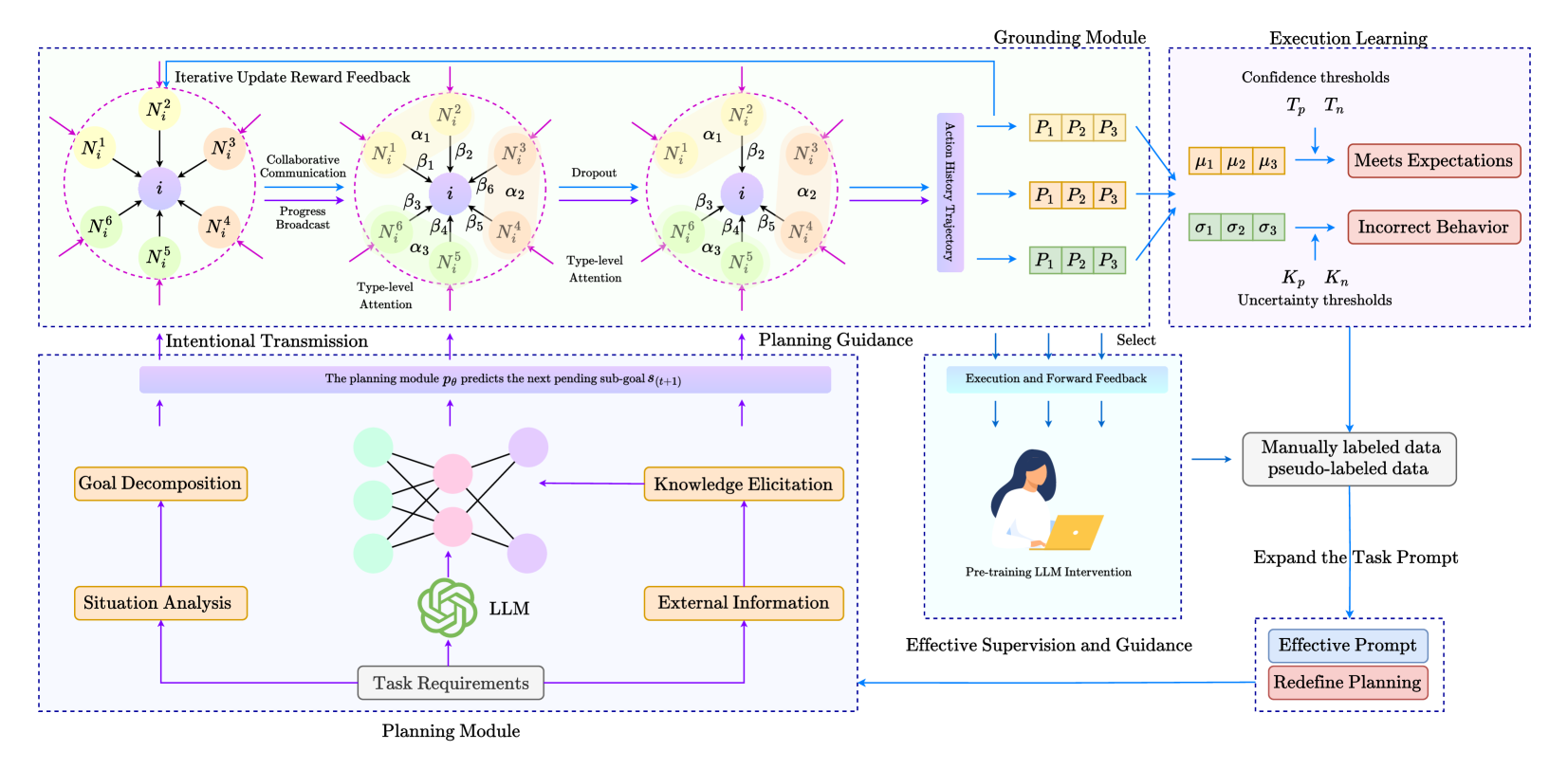
In this section, we introduce the methods of the proposed ReMALIS framework in detail. As illustrated in Figure 1, ReMALIS consists of four key components:
<details>
<summary>x1.png Details</summary>
### Visual Description
## System Architecture Diagram: Multi-Agent Planning and Execution Learning Framework
### Overview
This image is a technical system architecture diagram illustrating a multi-component framework for AI agent planning, grounding, execution learning, and human-in-the-loop supervision. The diagram is divided into four primary modules connected by data and feedback flows. The overall aesthetic uses a clean, academic style with color-coded components (orange, green, purple, blue) and directional arrows to indicate information flow.
### Components/Axes
The diagram is segmented into four major dashed-line boxes, each representing a core module:
1. **Top-Left Module: Grounding Module**
* **Sub-components:** Three circular diagrams representing iterative communication and attention among agent nodes.
* **Labels within circles:** Nodes labeled `N_i^1`, `N_i^2`, `N_i^3`, `N_i^4`, `N_i^5`, `N_i^6` surrounding a central node `i`.
* **Connection Labels:** Greek letters `α₁`, `α₂`, `α₃`, `β₁`, `β₂`, `β₃`, `β₄`, `β₅`, `β₆` on the connecting lines between nodes.
* **Process Labels:** "Iterative Update Reward Feedback", "Collaborative Communication", "Progress Broadcast", "Dropout", "Type-level Attention".
* **Output:** An "Action History Trajectory" block leading to three sets of `P₁ P₂ P₃` blocks (colored orange, yellow, green).
2. **Top-Right Module: Execution Learning**
* **Inputs:** The three `P₁ P₂ P₃` blocks from the Grounding Module.
* **Key Elements:**
* "Confidence thresholds" labeled `Tₚ`, `Tₙ`.
* "Uncertainty thresholds" labeled `Kₚ`, `Kₙ`.
* A set of orange boxes labeled `μ₁`, `μ₂`, `μ₃`.
* A set of green boxes labeled `σ₁`, `σ₂`, `σ₃`.
* **Decision Blocks:** "Meets Expectations" (orange outline) and "Incorrect Behavior" (green outline).
* **Flow:** Arrows indicate that the `P` blocks are evaluated against thresholds to produce either expectation-meeting or incorrect behavior outputs.
3. **Bottom-Left Module: Planning Module**
* **Central Element:** A green "LLM" icon (resembling the OpenAI logo) connected to a neural network diagram.
* **Input Blocks:** "Task Requirements" (grey), "Situation Analysis" (orange), "Goal Decomposition" (orange).
* **Process Blocks:** "Knowledge Elicitation" (orange), "External Information" (orange).
* **Core Function Text:** A purple bar states: "The planning module `p_θ` predicts the next pending sub-goal `s_(t+1)`".
* **Output:** Labeled "Intentional Transmission" and "Planning Guidance", with arrows pointing up to the Grounding Module.
4. **Bottom-Right Module: Effective Supervision and Guidance**
* **Central Element:** An illustration of a person at a laptop, labeled "Pre-training LLM Intervention".
* **Input:** "Execution and Forward Feedback" from the Execution Learning module.
* **Data Sources:** "Manually labeled data" and "pseudo-labeled data".
* **Process:** "Expand the Task Prompt".
* **Output Blocks:** "Effective Prompt" (blue) and "Redefine Planning" (red).
* **Feedback Loop:** A blue arrow labeled "Select" feeds back into the Execution Learning module. Another arrow feeds back into the Planning Module.
### Detailed Analysis
**Flow and Connections:**
1. The **Planning Module** receives "Task Requirements" and uses an LLM to perform situation analysis, goal decomposition, and knowledge elicitation. It predicts the next sub-goal (`s_(t+1)`) and sends "Intentional Transmission" and "Planning Guidance" to the Grounding Module.
2. The **Grounding Module** processes this guidance through a multi-agent communication protocol. Three stages are shown:
* Stage 1: Initial collaborative communication and progress broadcast among nodes (`N_i^1` to `N_i^6`).
* Stage 2: Application of "Type-level Attention" (weights `α` and `β`).
* Stage 3: A "Dropout" operation, resulting in a refined attention state.
* This process generates an "Action History Trajectory" which outputs three sequences of actions (`P₁ P₂ P₃`).
3. The **Execution Learning** module evaluates these action sequences. It uses confidence (`Tₚ`, `Tₙ`) and uncertainty (`Kₚ`, `Kₙ`) thresholds. The evaluation produces metrics (`μ` series, `σ` series) and classifies outcomes as "Meets Expectations" or "Incorrect Behavior".
4. The **Effective Supervision and Guidance** module takes the execution feedback. A human-in-the-loop ("Pre-training LLM Intervention") uses manually and pseudo-labeled data to "Expand the Task Prompt". This generates an "Effective Prompt" and helps "Redefine Planning", creating a feedback loop that refines both the Execution Learning selection criteria and the Planning Module itself.
**Spatial Grounding:**
* The **Legend/Color Code** is implicit but consistent:
* **Orange:** Associated with planning, goals, and positive outcomes ("Meets Expectations").
* **Green:** Associated with the core LLM and negative outcomes ("Incorrect Behavior").
* **Purple:** Associated with core predictive functions and attention mechanisms.
* **Blue:** Associated with feedback, supervision, and prompt engineering.
* The **Execution Learning** module is positioned in the top-right quadrant.
* The **Planning Module** is in the bottom-left quadrant.
* The **Grounding Module** spans the top-left and top-center.
* The **Supervision** module is in the bottom-right quadrant.
### Key Observations
1. **Closed-Loop System:** The diagram explicitly shows a closed-loop system where execution outcomes directly inform and refine the planning and prompting strategies.
2. **Human-in-the-Loop:** The inclusion of "Pre-training LLM Intervention" and manual data labeling indicates a hybrid system that combines automated learning with human oversight.
3. **Multi-Agent Attention:** The Grounding Module details a sophisticated attention mechanism (`α`, `β` weights) among multiple nodes (`N_i`), suggesting a distributed or ensemble approach to action selection.
4. **Threshold-Based Evaluation:** Execution success is not binary but is evaluated against continuous confidence and uncertainty thresholds (`T`, `K`), allowing for nuanced performance assessment.
5. **Prompt Engineering as a Control Lever:** The system uses "Expand the Task Prompt" and "Effective Prompt" as key mechanisms for supervision, highlighting the central role of prompt design in guiding the LLM's behavior.
### Interpretation
This diagram outlines a comprehensive framework for building more reliable and adaptable LLM-based agents. The core innovation appears to be the integration of three critical layers:
1. **Strategic Planning (Planning Module):** Where high-level goals are decomposed using an LLM.
2. **Tactical Grounding (Grounding Module):** Where plans are translated into coordinated actions through a multi-agent attention mechanism, adding robustness.
3. **Operational Learning (Execution Learning & Supervision):** Where actions are evaluated against real-world outcomes, and failures are used to systematically improve the system—either by adjusting internal thresholds or by refining the prompts that guide the core LLM.
The framework addresses key challenges in LLM deployment: the "grounding problem" (connecting plans to executable actions) and the "alignment problem" (ensuring actions meet expectations). By creating a feedback loop from execution failure back to prompt and plan redefinition, the system aims for continuous, supervised improvement. The presence of both manual and pseudo-labeled data suggests a practical approach to scaling supervision. This architecture would be relevant for complex, multi-step tasks where initial LLM plans require validation and iterative refinement in a dynamic environment.
</details>
Figure 1: This framework introduces a multi-agent learning strategy designed to enhance the capabilities of LLMs through cooperative coordination. It enables agents to collaborate and share intentions for effective coordination, and utilizes recursive reasoning to model and adapt to each other’s strategies.
Planning Module $p_θ$ predicts the next pending sub-goal $s_t+1$ , given the current sub-goal $s_t$ and other inputs $s_t+1=p_θ(s_t,I_t,e_t,f_t),$ where $I_t$ is the current intention, $e_t$ is the grounded embedding, and $f_t$ is agent feedback. $p_θ$ first encode information through encoding layers $h_t=Encoder(s_t,I_t,e_t,f_t)$ and subsequently predict the sub-goal through $s_t+1=Softmax(T_θ(h_t))$ , where $T_θ$ utilizes the graph neural network (GNN) architecture.
The module is trained to maximize the likelihood of all sub-goals along the decision sequences given the current information on time step $t$ . This allows the dynamic re-planning of sub-task dependencies based on agent feedback.
$$
θ^*=\arg\max_θ∏_t=1^Tp_θ(s_t+1|s_t,I_t,e_t
,f_t). \tag{1}
$$
Grounding Module $g_φ$ contextualizes symbol embeddings $e_t=g_φ(s_t,I_t,f_1:t)$ , where $s_t$ , $I_t$ , and $f_1:t$ represent the states, intention, and feedback up to time step $t$ , respectively. These embeddings are processed by encoders $h_t=Encoder(s_t,I_t,f_1:t)$ and then by cross-attention layers and convolutional feature extractors: $e_t=Conv(Attn(h_t,V))+P_t$ over vocabulary $V$ . Here, $P_t$ includes agent feedback to enhance grounding accuracy based on coordination signals for more accurate contextual understanding. The module maps language symbols to physical environment representations through:
$$
g(x)=f_θ≤ft(∑_i=1^Nw_ig(x_i)\right), \tag{2}
$$
where $g(x)$ is the grounded embeddings of policy set $x$ and $g(x_i)$ represents its individual action embedding on agent $i$ , respectively, and $w_i$ are learnable weights. The grounding function $f_θ$ utilizes a GNN architecture for structural composition. Additionally, we employ an uncertainty modeling module that represents ambiguities in grounding:
$$
q_φ(z|x)=Normal\big{(}z;μ_φ(x),σ^2_φ(x)\big{)}, \tag{3}
$$
where $z$ is a latent variable modeled as a normal distribution, enabling the capture of multimodal uncertainties in grounding.
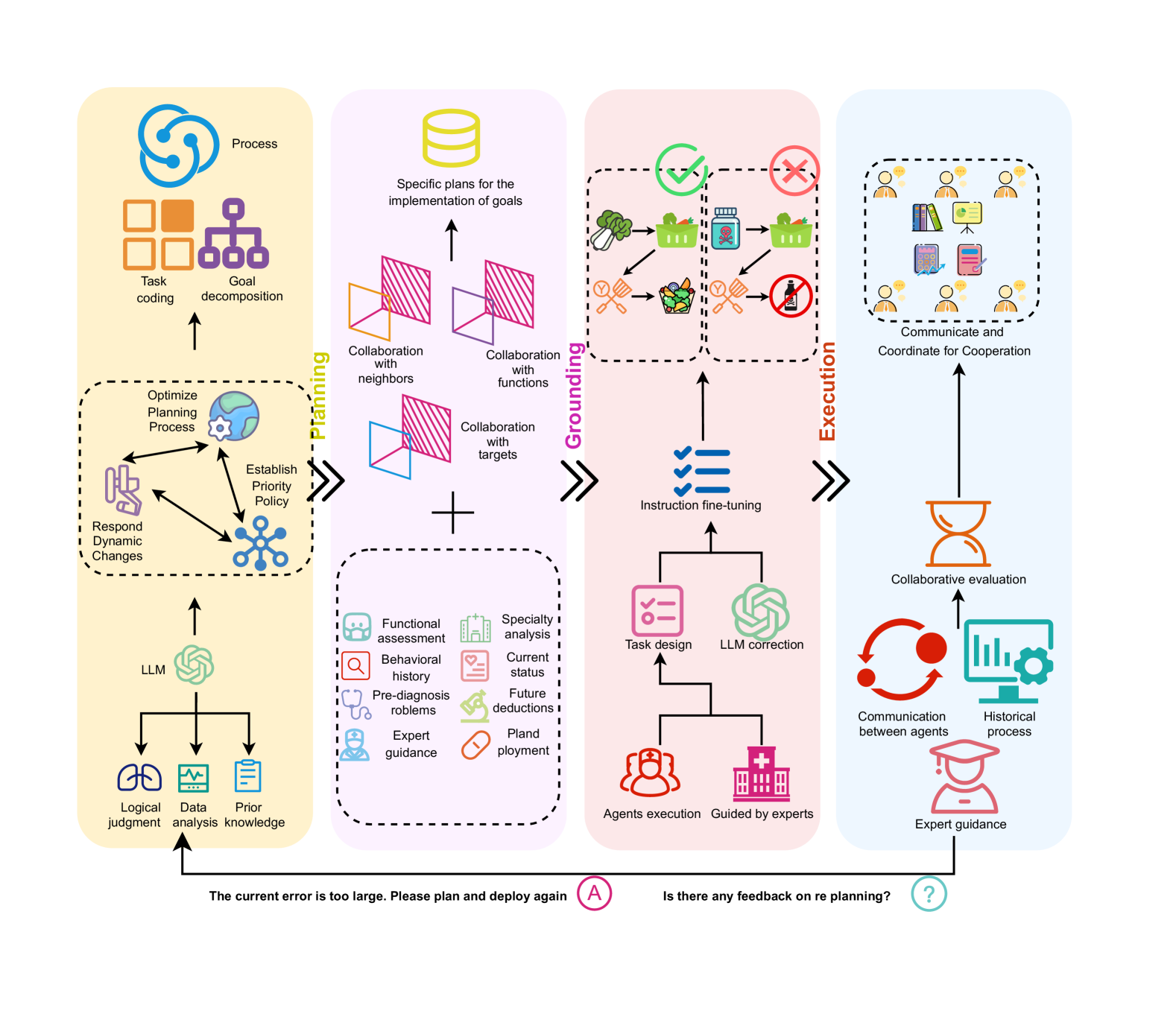
Cooperative Execution Module comprises $N$ specialized agents $\{A_1,...,A_N\}$ . This architecture avoids using a single agent to handle all tasks. Instead, each agent is dedicated to a distinct semantic domain, cultivating expertise specific to that domain. For instance, agents $A_1,A_2,$ and $A_3$ may be dedicated to query processing, information retrieval, and arithmetic operations, respectively. This specialization promotes an efficient distribution of tasks and reduces overlap in capabilities.
Decomposing skills into specialized agents risks creating isolated capabilities that lack coordination. To address this, it is essential that agents not only excel individually but also comprehend the capacities and limitations of their peers. We propose an integrated training approach where specialized agents are trained simultaneously to foster collaboration and collective intelligence. We represent the parameters of agent $A_i$ as $θ_i$ . Each agent’s policy, denoted as $y_i∼π_θ_{i}(·|s)$ , samples an output $y_i$ from a given input state $s$ . The training objective for our system is defined by the following equation:
$$
L_exe=∑_i=1^NE_(s,y^⋆)∼D{\ell(π_
θ_{i}(y_i|s),y^⋆)}, \tag{4}
$$
where $\ell(·)$ represents the task-specific loss function, comparing the agent-generated output $y_i$ with the ground-truth label $y^⋆$ . $D$ denotes the distribution of training data. By optimizing this objective collectively across all agents, each agent not only improves its own output accuracy but also enhances the overall team’s ability to produce coherent and well-coordinated results.
During training, we adjust the decomposition of grounding tasks to enhance collaboration, which is represented by the soft module weights $\{w_1,...,w_N\}$ . These weights indicate how the distribution of grounding commands can be optimized to better utilize the capabilities of different agents. The objective of this training is defined by the following loss function: $L_com=\ell(d,w^⋆)$ , where $\ell$ represents the loss function, $d$ is expressed as subgoal task instruction data, and $w^⋆$ signifies the optimal set of weights.
<details>
<summary>x2.png Details</summary>
### Visual Description
## Process Flow Diagram: Multi-Agent Collaborative Planning and Execution System
### Overview
The image is a detailed process flow diagram illustrating a four-stage, cyclical system for collaborative task planning, grounding, execution, and evaluation. The system appears designed for complex problem-solving, potentially in a medical or expert-guided domain, involving Large Language Models (LLMs), human experts, and multiple specialized agents. The flow moves from left to right through the stages, with a feedback loop at the bottom indicating iterative refinement.
### Components/Axes
The diagram is organized into four vertical, color-coded sections, each representing a major phase. The flow between phases is indicated by large, black, right-pointing chevrons (`>>`).
1. **Phase 1: Planning (Yellow Background, Leftmost)**
* **Top Cluster:** Icons and labels for "Process," "Task coding," and "Goal decomposition."
* **Middle Dashed Box:** A sub-process labeled "Optimize Planning Process" containing three interconnected elements: "Respond Dynamic Changes," "Establish Priority Policy," and an icon of a globe with a gear.
* **Bottom Cluster:** An "LLM" icon (resembling the OpenAI logo) feeds into three outputs: "Logical judgment," "Data analysis," and "Prior knowledge."
2. **Phase 2: Grounding (Light Purple Background, Center-Left)**
* **Top:** A database icon labeled "Specific plans for the implementation of goals."
* **Middle:** Three collaboration models represented by overlapping colored shapes: "Collaboration with neighbors," "Collaboration with functions," and "Collaboration with targets."
* **Bottom Dashed Box:** A list of assessment and analysis types, each with an icon: "Functional assessment," "Behavioral history," "Pre-diagnosis problems," "Expert guidance," "Specialty analysis," "Current status," "Future deductions," and "Planned deployment."
3. **Phase 3: Execution (Light Pink Background, Center-Right)**
* **Top Dashed Box:** A decision-making flowchart with icons. A green checkmark leads to a path involving vegetables, a basket, and a pot. A red "X" leads to a path involving a medicine bottle and a "no" symbol over a bottle, suggesting validation and rejection of actions.
* **Middle:** An "Instruction fine-tuning" element (blue checklist icon) receives input from the decision flowchart.
* **Bottom:** A branching structure showing "Task design" and "LLM correction" feeding into "Agents execution" and "Guided by experts."
4. **Phase 4: Evaluation & Coordination (Light Blue Background, Rightmost)**
* **Top Dashed Box:** A group of people icons surrounding various documents and charts, labeled "Communicate and Coordinate for Cooperation."
* **Middle:** An hourglass icon labeled "Collaborative evaluation."
* **Bottom:** A cycle showing "Communication between agents" (red circular arrows) and "Historical process" (monitor with gear), both informed by "Expert guidance" (graduation cap icon).
5. **Feedback Loop (Bottom of Diagram):**
* A black arrow runs from the bottom of the Execution/Evaluation phases back to the start of the Planning phase.
* Two text annotations are placed along this arrow:
* Left side: "The current error is too large. Please plan and deploy again" next to a circled "A".
* Right side: "Is there any feedback on re-planning?" next to a circled question mark.
### Detailed Analysis
* **Process Flow:** The system initiates in **Planning**, where an LLM uses prior knowledge and data to decompose goals and create tasks. This plan is then **Grounded** through collaboration models and detailed assessments. The grounded plan moves to **Execution**, where instructions are fine-tuned, tasks are designed, and agents (potentially AI or human) carry out actions, sometimes with expert guidance. Finally, the process enters **Evaluation & Coordination**, where outcomes are assessed collaboratively, communication occurs, and historical data is logged.
* **Key Relationships:**
* The LLM is a core component in the Planning phase, providing foundational judgment and analysis.
* Expert guidance is a recurring input, appearing in the Grounding (assessment list) and Execution (guided by experts) phases, and is a final output in the Evaluation phase.
* The "Instruction fine-tuning" step in Execution acts as a bridge between the high-level decision flowchart and the actual task execution.
* The feedback loop is critical, triggered by large errors or a need for re-planning, sending the process back to the initial Planning stage.
### Key Observations
* **Cyclical Nature:** The diagram is not linear but a continuous cycle, emphasizing iterative improvement based on evaluation and error feedback.
* **Hybrid Intelligence:** The system explicitly combines artificial intelligence (LLM, agents) with human intelligence (experts, collaboration, coordination).
* **Medical/Expert Context Clues:** Icons like a medicine bottle, stethoscope ("Pre-diagnosis problems"), and hospital ("Guided by experts") strongly suggest an application in healthcare or a similar expert-intensive field.
* **Structured Collaboration:** The Grounding phase breaks down collaboration into specific, structured models (with neighbors, functions, targets), indicating a sophisticated multi-agent framework.
### Interpretation
This diagram outlines a robust framework for deploying AI agents in complex, real-world tasks that require planning, validation, and expert oversight. It represents a **Peircean investigative cycle**:
1. **Abduction (Planning):** The LLM and planning process generate hypotheses (plans) based on available data and knowledge.
2. **Deduction (Grounding):** The plan is refined and tested against specific collaboration models and assessment criteria to predict outcomes.
3. **Induction (Execution):** Actions are taken in the real world (or a simulated environment), and results are observed.
4. **Evaluation & Feedback:** The outcomes are evaluated against the original goals. The explicit feedback loop ("error is too large") is the mechanism for **retroduction**—questioning the initial assumptions and plans when they fail to match reality, thus driving the next cycle of inquiry.
The system's value lies in its structured approach to mitigating the risks of autonomous AI by embedding human expertise, rigorous grounding, and continuous evaluation. It is designed not just to execute tasks, but to learn and adapt through collaboration and error correction, making it suitable for high-stakes domains where precision and accountability are paramount.
</details>
Figure 2: Overview of the proposed ReMALIS: This framework comprises a planning module, grounding module, cooperative execution module, and intention coordination channels.
## 3 Approach
The collaborative MARL of ReMALIS focuses on three key points: intention propagation for grounding, bidirectional coordination channels, and integration with recursive reasoning agents. Detailed parameter supplements and pseudocode details can be found in Appendix C and Appendix F.
### 3.1 Planning with Intention Propagation
We formulate a decentralized, partially observable Markov game for multi-agent collaboration. Each agent $i$ maintains a private intention $I_i$ encoded as a tuple $I_i=(γ_i,Σ_i,π_i,δ_i)$ , where $γ_i$ is the current goal, $Σ_i=\{σ_i1,σ_i2,…\}$ is a set of related sub-goals, $π_i(σ)$ is a probability distribution over possible next sub-goals, and $δ_i(σ)$ is the desired teammate assignment for sub-goal $σ$ .
Intentions are propagated through a communication channel $f_Λ$ parameterized by $Λ$ . For a received message $m_ij$ from agent $j$ , agent $i$ infers a belief over teammate $j$ ’s intention $b_i(I_j|m_ij)=f_Λ(m_ij)$ , where $Λ$ is a recurrent neural network. The channel $f_θ$ is trained in an end-to-end manner to maximize the coordination reward function $R_c$ . This propagates relevant sub-task dependencies to enhance common grounding on collaborative goals.
$$
Λ^*=\arg\max_ΛE_I,m∼ f_Λ[R_c
(I,m)]. \tag{5}
$$
At each time-step $t$ , the LLM witll processinputs comprising the agent’s state $s_t$ , the intention $I_t$ , and the feedback $f_1:t$ .
### 3.2 Grounding with Bidirectional Coordination Channels
The execution agent policies, denoted by $π_ξ(a_i|s_i,I_i)$ , are parameterized by $ξ$ and conditioned on the agent’s state $s_i$ and intention $I_i$ . Emergent coordination patterns are encoded in a summary statistic $c_t$ and passed to upstream modules to guide planning and grounding adjustments. For example, frequent miscoordination on sub-goal $σ$ indicates the necessity to re-plan $σ$ dependencies in $I$ .
This bidirectional feedback aligns low-level execution with high-level comprehension strategies. In addition to the downstream propagation of intents, execution layers provide bidirectional feedback signals $ψ(t)$ to upstream modules $ψ(t)=Φ(h^exec_t)$ :
$$
h^exec_t=[φ_1(o_1),…,φ_N(o_N)], \tag{6}
$$
where $Φ(·)$ aggregates agent encodings to summarize emergent coordination, and $φ_i(·)$ encodes the observation $o_i$ for agent $i$ .
Execution agents generate feedback $f_t$ to guide upstream LLM modules through: $f_t=g_θ(τ_1:t)$ , where $g_θ$ processes the action-observation history $τ_1:t$ . These signals include coordination errors $E_t$ which indicate misalignment of sub-tasks; grounding uncertainty $U_t$ , measured as entropy over grounded symbol embeddings; and re-planning triggers $R_t$ , which flag the need for sub-task reordering. These signals can reflect inconsistencies between sub-task objectives, the ambiguity of symbols in different contexts, and the need to adjust previous sub-task sequencing.
Algorithm 1 ReMALIS: Recursive Multi-Agent Learning with Intention Sharing
1: Initialize LLM parameters $θ,φ,ω$
2: Initialize agent policies $π_ξ$ , communication channel $f_θ$
3: Initialize grounding confusion matrix $C$ , memory $M$
4: for each episode do
5: for each time step $t$ do
6: Observe states $s_t$ and feedback $f_1:t$ for all agents
7: Infer intentions $I_t$ from $s_t,f_1:t$ using $LLM_θ$
8: Propagate intentions $I_t$ through channel $f_θ$
9: Compute grounded embeddings $e_t=g_φ(s_t,I_t,f_1:t)$
10: Predict sub-tasks $Σ_t+1=p_θ(I_t,e_t,f_1:t)$
11: Generate actions $a_t=a_ω(e_t,Σ_t+1,f_1:t)$
12: Execute actions $a_t$ and observe rewards $r_t$ , new states $s_t+1$
13: Encode coordination patterns $c_t=Φ(h^exec_t)$
14: Update grounding confusion $C_t,M_t$ using $c_t$
15: Update policies $π_ξ$ using $R$ and auxiliary loss $L_aux$
16: Update LLM $θ,φ,ω$ using $L_RL,L_confusion$
17: end for
18: end for
### 3.3 Execution: Integration with Reasoning Agents
#### 3.3.1 Agent Policy Generation
We parameterize agent policies $π_θ(a_t|s_t,I_t,c_1:t)$ using an LLM with weights $θ$ . At each time step, the LLM takes as input the agent’s state $s_t$ , intention $I_t$ , and coordination feedback $c_1:t$ . The output is a distribution over the next actions $a_t$ :
$$
π_θ(a_t|s_t,I_t,c_1:t)=LLM_θ(s_t,
I_t,c_1:t). \tag{7}
$$
To leverage agent feedback $f_1:t$ , we employ an auxiliary regularization model $\hat{π}_φ(a_t|s_t,f_1:t)$ :
$$
L_aux(θ;s_t,f_1:t)=MSE(π_θ(s_t),
\hat{π}_φ(s_t,f_1:t)), \tag{8}
$$
where $\hat{π}_φ$ is a feedback-conditioned policy approximation. The training loss to optimize $θ$ is:
$$
L(θ)=L_RL(θ)+λL_
aux(θ), \tag{9}
$$
where $L_RL$ is the reinforcement learning objective and $λ$ a weighting factor.
#### 3.3.2 Grounding Strategy Adjustment
We model action dependencies using a graph neural policy module $h_t^a=GNN(s_t,a)$ , where $h_t^a$ models interactions between action $a$ and the state $s_t$ . The policy is then given by $π_θ(a_t|s_t)=∏_i=1^|A|h_t^a_i$ . This captures the relational structure in the action space, enabling coordinated action generation conditioned on agent communication.
The coordination feedback $c_t$ is used to guide adjustments in the grounding module’s strategies. We define a grounding confusion matrix $C_t$ , where $C_t(i,j)$ represents grounding errors between concepts $i$ and $j$ . The confusion matrix constrains LLM grounding as:
$$
f_φ(s_t,I_t)=LLM_φ(s_t,I_t)\odot
λ C_t \tag{10}
$$
where $\odot$ is element-wise multiplication and $λ$ controls the influence of $C_t$ , reducing uncertainty on error-prone concept pairs.
We propose a modular regularization approach, with the grounding module $g_φ$ regularized by a coordination confusion estimator:
$$
L_confusion=\frac{1}{N}∑_i,jA_ψ(c_i,c_j)·
Conf(c_i,c_j) \tag{11}
$$
where $L_task$ is the task reward, $Conf(c_i,c_j)$ measures confusion between concepts $c_i$ and $c_j$ , and $A_ψ(c_i,c_j)$ are attention weights assigning importance based on grounding sensitivity.
An episodic confusion memory $M_t$ accumulates long-term grounding uncertainty statistics:
$$
M_t(i,j)=M_t-1(i,j)+I(Confuse(c_i,c_j)_t), \tag{12}
$$
where $I(·)$ are indicator functions tracking confusion events. By regularizing with a coordination-focused confusion estimator and episodic memory, the grounding module adapts to avoid miscoordination.
### 3.4 Collective Learning and Adaptation
The coordination feedback signals $c_t$ and interpretability signals $E_t,U_t,R_t$ play a crucial role in enabling the LLM agents to adapt and learn collectively. By incorporating these signals into the training process, the agents can adjust their strategies and policies to better align with the emerging coordination patterns and requirements of the collaborative tasks.
The collective learning process can be formalized as an optimization problem, where the goal is to minimize the following objective function $L(η,γ,ζ,ξ)=E_s_{t,I_t,f_1:t} ≤ft[αU_t+βE_t-R\right]+Ω( η,γ,ζ,ξ)$ . Here, $α$ and $β$ are weighting factors that balance the contributions of the grounding uncertainty $U_t$ and coordination errors $E_t$ , respectively. The team reward $R$ is maximized to encourage collaborative behavior. The term $Ω(η,γ,ζ,ξ)$ represents regularization terms or constraints on the model parameters to ensure stable and robust learning.
The objective function $L$ is defined over the current state $s_t$ , the interpretability signals $I_t=\{E_t,U_t,R_t\}$ , and the trajectory of feedback signals $f_1:t=\{c_1,I_1,…,c_t,I_t\}$ up to the current time step $t$ . The expectation $E_s_{t,I_t,f_1:t}[·]$ is taken over the distribution of states, interpretability signals, and feedback signal trajectories encountered during training.
| Method | Web | TFP | | | | | | |
| --- | --- | --- | --- | --- | --- | --- | --- | --- |
| Easy | Medium | Hard | All | Easy | Medium | Hard | Hell | |
| GPT-3.5-Turbo | | | | | | | | |
| CoT | 65.77 | 51.62 | 32.45 | 17.36 | 81.27 | 68.92 | 59.81 | 41.27 |
| Zero-Shot Plan | 57.61 | 52.73 | 28.92 | 14.58 | 82.29 | 63.77 | 55.39 | 42.38 |
| Llama2-7B | | | | | | | | |
| CoT | 59.83 | 54.92 | 30.38 | 15.62 | 82.73 | 65.81 | 57.19 | 44.58 |
| ReAct | 56.95 | 41.86 | 27.59 | 13.48 | 81.15 | 61.65 | 53.97 | 43.25 |
| ART | 62.51 | 52.34 | 33.81 | 18.53 | 81.98 | 63.23 | 51.78 | 46.83 |
| ReWOO | 63.92 | 53.17 | 34.95 | 19.37 | 82.12 | 71.38 | 61.23 | 47.06 |
| AgentLM | 62.14 | 46.75 | 30.84 | 15.98 | 82.96 | 66.03 | 57.16 | 43.91 |
| FireAct | 64.03 | 50.68 | 32.78 | 17.49 | 83.78 | 68.19 | 58.94 | 45.06 |
| LUMOS | 66.27 | 53.81 | 35.37 | 19.53 | 84.03 | 71.75 | 62.57 | 51.49 |
| Llama3-8B | | | | | | | | |
| Code-Llama (PoT) | 64.85 | 49.49 | 32.16 | 17.03 | 83.34 | 68.47 | 59.15 | 52.64 |
| AgentLM | 66.77 | 51.45 | 31.59 | 16.58 | 85.26 | 71.81 | 58.68 | 53.39 |
| FiReAct | 68.92 | 53.27 | 32.95 | 17.64 | 84.11 | 72.15 | 58.63 | 51.65 |
| DGN | 69.15 | 54.78 | 33.63 | 18.17 | 83.42 | 71.08 | 62.34 | 53.57 |
| LToS | 68.48 | 55.03 | 33.06 | 17.71 | 85.77 | 74.61 | 59.37 | 54.81 |
| AUTOACT | 67.62 | 56.25 | 31.84 | 16.79 | 87.89 | 76.29 | 58.94 | 52.87 |
| ReMALIS(Ours) | 73.92 | 58.64 | 38.37 | 21.42 | 89.15 | 77.62 | 64.53 | 55.37 |
Table 1: Comparative analysis of the ReMALIS framework against single-agent baselines and contemporary methods across two datasets
## 4 Experiments
### 4.1 Datasets
To assess the performance of our models, we conducted evaluations using two large-scale real-world datasets: the traffic flow prediction (TFP) dataset and the web-based activities dataset.
TFP dataset comprises 100,000 traffic scenarios, each accompanied by corresponding flow outcomes. Each example is detailed with descriptions of road conditions, vehicle count, weather, and traffic control measures, and is classified as traffic flow: smooth, congested, or jammed. The raw data was sourced from traffic cameras, incident reports, and simulations, and underwent preprocessing to normalize entities and eliminate duplicates.
Web activities dataset contains over 500,000 examples of structured web interactions such as booking flights, scheduling appointments, and making reservations. Each activity follows a template with multiple steps like searching, selecting, filling forms, and confirming. User utterances and system responses were extracted to form the input-output pairs across 150 domains, originating from real anonymized interactions with chatbots, virtual assistants, and website frontends.
### 4.2 Implementation Details
To handle the computational demands of training our framework with LLMs, we employ 8 Nvidia A800-80G GPUs Chen et al. (2024) under the DeepSpeed Aminabadi et al. (2022) training framework, which can effectively accommodate the extensive parameter spaces and activations required by our framework’s LLM components and multi-agent architecture Rasley et al. (2020).
For the TFP dataset, we classified the examples into four difficulty levels: “Easy”, “Medium”, “Hard”, and “Hell”. The “Easy” level comprises small grid networks with low, stable vehicle arrival rates. The “Medium” level includes larger grids with variable arrival rates. “Hard” tasks feature large, irregular networks with highly dynamic arrival rates and complex intersection configurations. The “Hell” level introduces challenges such as partially observable states, changing road conditions, and fully decentralized environments.
For the web activities dataset, we divided the tasks into “Easy”, “Medium”, “Hard”, and “All” levels. “Easy” tasks required basic single-click or short phrase interactions. “Medium” involved complex multi-page sequences like form submissions. “Hard” tasks demanded significant reasoning through ambiguous, dense websites. The “All” level combined tasks across the full difficulty spectrum.
The dataset was divided into 80% for training, 10% for validation, and 10% for testing, with examples shuffled. These large-scale datasets offer a challenging and naturalistic benchmark to evaluate our multi-agent framework on complex, real-world prediction and interaction tasks.
### 4.3 Results and Analysis
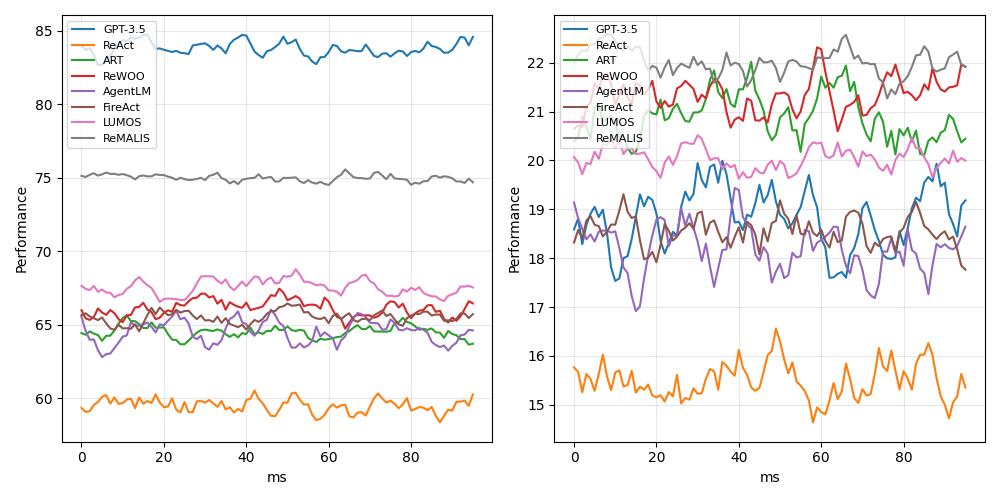
Table 1 displays the principal experimental results of our ReMALIS framework in comparison with various single-agent baselines and contemporary methods using the web activities dataset. We evaluated the models across four levels of task difficulty: “Easy”, “Medium”, “Hard”, and “All”.
The results from our comparative analysis indicate that ReMALIS (7B), equipped with a 7B parameter LLM backbone, significantly outperforms competing methods. On the comprehensive “All” difficulty level, which aggregates tasks across a range of complexities, ReMALIS achieved a notable score of 55.37%, surpassing the second-highest scoring method, LUMOS, which scored 51.49%. Additionally, ReMALIS (7B) also excelled against AUTOACT, which utilizes a larger 13B parameter model, by achieving a score that is over 3 percentage points higher at 52.87%. These findings highlight the efficacy of ReMALIS ’s parameter-efficient design and its advanced multi-agent collaborative training approach, which allow it to outperform larger single-agent LLMs significantly.
Notably, ReMALIS (7B) also exceeded the performance of GPT-3.5 (Turbo), a substantially larger foundation model, across all difficulty levels. On “Hard” tasks, ReMALIS ’s 21.42% surpassed GPT-3.5’s 17.36% by over 4 points. This indicates that ReMALIS ’s coordination mechanisms transform relatively modest LLMs into highly capable collaborative agents.
Despite their larger sizes, single-agent approaches like GPT-3.5 CoT, ReAct, and AgentLM significantly underperformed. Notably, even the advanced single-agent method LUMOS (13B) could not rival the performance of ReMALIS (7B). The superiority of ReMALIS, attributed to its specialized multi-agent design and novel features such as intention propagation, bidirectional feedback, and recursive reasoning, was particularly evident. On complex “Hard” tasks that required extensive reasoning, ReMALIS achieved a notable performance of 21.42%, surpassing LUMOS by over 2 percentage points, thus highlighting the benefits of its multi-agent architecture and collaborative learning mechanisms.
The exceptional performance of our proposed ReMALIS framework on the Traffic Flow Prediction (TFP) dataset can also be attributed to its innovative design and the effective integration of advanced techniques. On the "Easy" difficulty level, ReMALIS achieved an impressive accuracy of 89.15%, outperforming the second-best method, AUTOACT, by a substantial margin of 1.26%. In the "Medium" category, ReMALIS secured an accuracy of 77.62%, surpassing AUTOACT’s 76.29% by 1.33%. Even in the most challenging "Hard" and "Hell" levels, ReMALIS maintained its lead with accuracies of 64.53% and 55.37%, respectively, outperforming the next best methods, DGN (62.34%) and LToS (54.81%), by 2.19% and 0.56%.
### 4.4 Ablation Studies
1)The Impact on Improving Multi-Agent Coordination Accuracy We conduct ablation studies to evaluate the impact of each component within the ReMALIS framework. The observations can be found in Table 2. Excluding intention propagation results in a decrease in accuracy by over 6% across both datasets, highlighting difficulties in achieving common grounding among agents without shared local beliefs This highlights the importance of intention sharing for emergent team behaviors.
The absence of bidirectional coordination channels leads to a 4.37% decline in performance across various metrics, illustrating the importance of execution-level signals in shaping planning and grounding strategies. Without feedback coordination, agents become less responsive to new scenarios that require re-planning.
Table 2: Ablation studies on Traffic and Web datasets
| Traffic | Single Agent Baseline | 42.5% | 0.217 | 0.384 |
| --- | --- | --- | --- | --- |
| Intention Propagation | 47.3% | 0.251 | 0.425 | |
| Bidirectional Feedback | 49.8% | 0.278 | 0.461 | |
| Recursive Reasoning | 53.2% | 0.311 | 0.503 | |
| ReMALIS (Full) | 58.7% | 0.342 | 0.538 | |
| Web | Single Agent Baseline | 38.9% | 0.255 | 0.416 |
| Intention Propagation | 42.7% | 0.283 | 0.453 | |
| Bidirectional Feedback | 46.3% | 0.311 | 0.492 | |
| Recursive Reasoning | 50.6% | 0.345 | 0.531 | |
| ReMALIS (Full) | 55.4% | 0.379 | 0.567 | |
Substituting recursive reasoning with convolutional and recurrent neural networks reduces contextual inference accuracy by 5.86%. Non-recursive agents display short-sighted behavior compared to the holistic reasoning enabled by recursive transformer modeling. This emphasizes that recursive architectures are vital for complex temporal dependencies.
<details>
<summary>extracted/5737747/m1.png Details</summary>
### Visual Description
\n
## Line Charts: Model Performance Comparison (Two Metrics)
### Overview
The image displays two side-by-side line charts comparing the performance of eight different AI models or methods over time (measured in milliseconds). The charts share the same legend and x-axis but have different y-axis scales, suggesting they measure two distinct performance metrics. The data appears noisy, with frequent fluctuations for all series.
### Components/Axes
* **Chart Layout:** Two distinct line charts arranged horizontally.
* **Legend:** Located in the top-left corner of each chart. Contains eight entries with corresponding line colors:
* GPT-3.5 (Blue)
* ReAct (Orange)
* ART (Green)
* ReWOO (Red)
* AgentLM (Purple)
* FireAct (Brown)
* LLMOS (Pink)
* ReMALIS (Gray)
* **X-Axis (Both Charts):**
* **Label:** `ms` (milliseconds)
* **Scale:** Linear, from 0 to approximately 95.
* **Major Ticks:** 0, 20, 40, 60, 80.
* **Y-Axis (Left Chart):**
* **Label:** `Performance`
* **Scale:** Linear, from 60 to 85.
* **Major Ticks:** 60, 65, 70, 75, 80, 85.
* **Y-Axis (Right Chart):**
* **Label:** `Performance`
* **Scale:** Linear, from 15 to 22.
* **Major Ticks:** 15, 16, 17, 18, 19, 20, 21, 22.
### Detailed Analysis
**Left Chart (Performance Range ~60-85):**
* **Trend Verification & Data Points (Approximate Ranges):**
* **GPT-3.5 (Blue):** Consistently the highest. Trends slightly upward from ~83 to ~85. Range: ~82-85.
* **ReMALIS (Gray):** Second highest, very stable. Hovers around 75. Range: ~74-76.
* **LLMOS (Pink):** Third highest, moderate fluctuation. Range: ~67-69.
* **ReWOO (Red):** Fluctuates in the middle of the pack. Range: ~65-68.
* **FireAct (Brown):** Similar range to ReWOO, often intertwined. Range: ~64-67.
* **ART (Green):** Lower-middle range. Range: ~63-66.
* **AgentLM (Purple):** Lower-middle range, often the lowest in this cluster. Range: ~62-65.
* **ReAct (Orange):** Consistently the lowest by a significant margin. Range: ~58-61.
**Right Chart (Performance Range ~15-22):**
* **Trend Verification & Data Points (Approximate Ranges):**
* **ReMALIS (Gray):** Consistently the highest. Shows high volatility. Range: ~21-22.5.
* **ReWOO (Red):** Second highest, also volatile. Range: ~20.5-22.
* **ART (Green):** Third highest, volatile. Range: ~20-21.5.
* **LLMOS (Pink):** Middle range, less volatile than the top three. Range: ~19.5-20.5.
* **GPT-3.5 (Blue):** Middle range, highly volatile. Range: ~17.5-20.
* **FireAct (Brown):** Middle range, volatile. Range: ~18-19.5.
* **AgentLM (Purple):** Lower-middle range, volatile. Range: ~17-19.
* **ReAct (Orange):** Consistently the lowest, with notable dips. Range: ~14.5-16.5.
### Key Observations
1. **Performance Inversion:** The ranking of models is drastically different between the two metrics. GPT-3.5, which leads the left chart, is in the middle of the pack on the right chart. Conversely, ReMALIS is a top performer on both charts but leads the right chart.
2. **Volatility Contrast:** The data in the right chart (lower performance scale) exhibits significantly higher volatility (larger, more frequent swings) for all models compared to the relatively smoother lines in the left chart.
3. **Consistent Outlier:** ReAct is the lowest-performing model on both metrics by a clear margin.
4. **Clustering:** On the left chart, six of the eight models (excluding GPT-3.5 and ReMALIS) form a tight cluster between 62-69. On the right chart, the models are more spread out across the 15-22 range.
### Interpretation
The two charts likely represent two different evaluation metrics for the same set of AI agent frameworks or reasoning methods. The left chart's higher scale (60-85) suggests a metric like **accuracy, success rate, or a normalized score**, where GPT-3.5 (a base model) performs best, and specialized methods like ReMALIS are competitive. The right chart's lower, more volatile scale (15-22) could represent a metric like **efficiency, speed (inverse latency), or a cost-sensitive score**, where specialized methods (ReMALIS, ReWOO, ART) outperform the base GPT-3.5, but with less stability.
The stark difference in rankings implies a **trade-off** between the two measured qualities. A model excelling in raw performance (left chart) may not be the most efficient or cost-effective (right chart). The high volatility in the right chart suggests that the efficiency metric is more sensitive to run-to-run variation or specific task conditions. ReAct's consistently poor performance on both metrics indicates it may be a less effective approach for the tasks evaluated here. The analysis suggests that model selection should be guided by which metric (performance vs. efficiency) is prioritized for the specific application.
</details>
Figure 3: Comparative performance evaluation across varying task difficulty levels for the web activities dataset, which indicates the accuracy scores achieved by ReMALIS and several state-of-the-art baselines.
Table 3: Ablation on agent coordination capabilities
| No Communication | 31% | 23% | 17% | 592 | 873 | 1198 |
| --- | --- | --- | --- | --- | --- | --- |
| REACT | 42% | 34% | 29% | 497 | 732 | 984 |
| AgentLM | 48% | 39% | 32% | 438 | 691 | 876 |
| FiReAct | 58% | 47% | 37% | 382 | 569 | 745 |
| Basic Propagation | 68% | 53% | 41% | 314 | 512 | 691 |
| Selective Propagation | 79% | 62% | 51% | 279 | 438 | 602 |
| Full Intention Sharing | 91% | 71% | 62% | 248 | 386 | 521 |
2)The Impact on Improving Multi-Agent Coordination Capability As presented in Table 3, on aligned sub-task percentage, the proposed Basic Propagation, Selective Propagation, and Full Intention Sharing methods consistently outperform baseline models like REACT and AgentLM across varying difficulty levels (“easy”, “medium”, and “hard”). For example, Full Intention Sharing achieves alignment of 91%, 71%, and 62% across these levels, respectively. These results are substantially higher compared to scenarios with no communication (31%, 23%, and 17%).
Similarly, coordination time metrics exhibit major efficiency gains from intention propagation. On “Hard” tasks, Full Intention Sharing reduces coordination time to 521 ms, 57% faster than the 1198 ms for No Communication. As task complexity increases from easy to hard, the coordination time savings compared to baselines grows from 138 ms to 677 ms. This reveals that intention sharing mitigates growing coordination delays for difficult scenarios.
The highlighted propagation mechanisms also demonstrate clear incremental performance improvements over increasingly selective information sharing. As agents propagate more precise intentions to relevant teammates, both sub-task alignment and coordination efficiency improve. Moving from Basic to Selective to Full sharing provides gains on top of gains.
## 5 Conclusion
In this paper, we introduce a novel framework, ReMALIS, designed to enhance collaborative capabilities within multi-agent systems using LLMs. Our approach incorporates three principal innovations: intention propagation for establishing a shared understanding among agents, bidirectional coordination channels to adapt reasoning processes in response to team dynamics, and recursive reasoning architectures that provide agents with advanced contextual grounding and planning capabilities necessary for complex coordination tasks. Experimental results indicate that ReMALIS significantly outperforms several baseline methods, underscoring the efficacy of cooperative multi-agent AI systems. By developing frameworks that enable LLMs to acquire cooperative skills analogous to human team members, we advance the potential for LLM agents to manage flexible coordination in complex collaborative environments effectively.
## 6 Limitiation
While ReMALIS demonstrates promising results in collaborative multi-agent tasks, our framework relies on a centralized training paradigm, which may hinder scalability in fully decentralized environments. The current implementation does not explicitly handle dynamic agent arrival or departure during execution, which could impact coordination in real-world applications, the recursive reasoning component may struggle with long-term dependencies and planning horizons beyond a certain time frame.
## References
- Aminabadi et al. (2022) Reza Yazdani Aminabadi et al. 2022. Deepspeed-inference: Enabling efficient inference of transformer models at unprecedented scale. In SC22: International Conference for High Performance Computing, Networking, Storage and Analysis.
- Chaka (2023) Chaka Chaka. 2023. Generative ai chatbots-chatgpt versus youchat versus chatsonic: Use cases of selected areas of applied english language studies. International Journal of Learning, Teaching and Educational Research, 22(6):1–19.
- Chebotar et al. (2023) Yevgen Chebotar et al. 2023. Q-transformer: Scalable offline reinforcement learning via autoregressive q-functions. In Conference on Robot Learning. PMLR.
- Chen et al. (2023) Baian Chen et al. 2023. Fireact: Toward language agent fine-tuning. arXiv preprint arXiv:2310.05915.
- Chen et al. (2024) Yushuo Chen et al. 2024. Towards coarse-to-fine evaluation of inference efficiency for large language models. arXiv preprint arXiv:2404.11502.
- Chiu et al. (2024) Yu Ying Chiu et al. 2024. A computational framework for behavioral assessment of llm therapists. arXiv preprint arXiv:2401.00820.
- Dong et al. (2023) Yihong Dong et al. 2023. Codescore: Evaluating code generation by learning code execution. arXiv preprint arXiv:2301.09043.
- Du et al. (2023) Yali Du et al. 2023. A review of cooperation in multi-agent learning. arXiv preprint arXiv:2312.05162.
- Fan et al. (2020) Cheng Fan et al. 2020. Statistical investigations of transfer learning-based methodology for short-term building energy predictions. Applied Energy, 262:114499.
- Foerster et al. (2018) Jakob Foerster et al. 2018. Counterfactual multi-agent policy gradients. In Proceedings of the AAAI conference on artificial intelligence, volume 32.
- Gao et al. (2023) Yunfan Gao et al. 2023. Retrieval-augmented generation for large language models: A survey. arXiv preprint arXiv:2312.10997.
- Hartmann et al. (2022) Valentin N. Hartmann et al. 2022. Long-horizon multi-robot rearrangement planning for construction assembly. IEEE Transactions on Robotics, 39(1):239–252.
- He et al. (2021) Junxian He et al. 2021. Towards a unified view of parameter-efficient transfer learning. arXiv preprint arXiv:2110.04366.
- Hu and Sadigh (2023) Hengyuan Hu and Dorsa Sadigh. 2023. Language instructed reinforcement learning for human-ai coordination. arXiv preprint arXiv:2304.07297.
- Huang et al. (2022) Baichuan Huang, Abdeslam Boularias, and Jingjin Yu. 2022. Parallel monte carlo tree search with batched rigid-body simulations for speeding up long-horizon episodic robot planning. In 2022 IEEE/RSJ International Conference on Intelligent Robots and Systems (IROS). IEEE.
- Khamparia et al. (2021) Aditya Khamparia et al. 2021. An internet of health things-driven deep learning framework for detection and classification of skin cancer using transfer learning. Transactions on Emerging Telecommunications Technologies, 32(7):e3963.
- Lee and Perret (2022) Irene Lee and Beatriz Perret. 2022. Preparing high school teachers to integrate ai methods into stem classrooms. In Proceedings of the AAAI Conference on Artificial Intelligence, volume 36.
- Li et al. (2020) Chuan Li et al. 2020. A systematic review of deep transfer learning for machinery fault diagnosis. Neurocomputing, 407:121–135.
- Li et al. (2022) Weihua Li et al. 2022. A perspective survey on deep transfer learning for fault diagnosis in industrial scenarios: Theories, applications and challenges. Mechanical Systems and Signal Processing, 167:108487.
- Loey et al. (2021) Mohamed Loey et al. 2021. A hybrid deep transfer learning model with machine learning methods for face mask detection in the era of the covid-19 pandemic. Measurement, 167:108288.
- Lotfollahi et al. (2022) Mohammad Lotfollahi et al. 2022. Mapping single-cell data to reference atlases by transfer learning. Nature biotechnology, 40(1):121–130.
- Lu et al. (2023) Pan Lu et al. 2023. Chameleon: Plug-and-play compositional reasoning with large language models. arXiv preprint arXiv:2304.09842.
- Lyu et al. (2021) Xueguang Lyu et al. 2021. Contrasting centralized and decentralized critics in multi-agent reinforcement learning. arXiv preprint arXiv:2102.04402.
- Mao et al. (2022) Weichao Mao et al. 2022. On improving model-free algorithms for decentralized multi-agent reinforcement learning. In International Conference on Machine Learning. PMLR.
- Martini et al. (2021) Franziska Martini et al. 2021. Bot, or not? comparing three methods for detecting social bots in five political discourses. Big data & society, 8(2):20539517211033566.
- Miao et al. (2023) Ning Miao, Yee Whye Teh, and Tom Rainforth. 2023. Selfcheck: Using llms to zero-shot check their own step-by-step reasoning. arXiv preprint arXiv:2308.00436.
- Qiu et al. (2024) Xihe Qiu et al. 2024. Chain-of-lora: Enhancing the instruction fine-tuning performance of low-rank adaptation on diverse instruction set. IEEE Signal Processing Letters.
- Raman et al. (2022) Shreyas Sundara Raman et al. 2022. Planning with large language models via corrective re-prompting. In NeurIPS 2022 Foundation Models for Decision Making Workshop.
- Rana et al. (2023) Krishan Rana et al. 2023. Sayplan: Grounding large language models using 3d scene graphs for scalable task planning. arXiv preprint arXiv:2307.06135.
- Rashid et al. (2020) Tabish Rashid et al. 2020. Weighted qmix: Expanding monotonic value function factorisation for deep multi-agent reinforcement learning. In Advances in neural information processing systems 33, pages 10199–10210.
- Rasley et al. (2020) Jeff Rasley et al. 2020. Deepspeed: System optimizations enable training deep learning models with over 100 billion parameters. In Proceedings of the 26th ACM SIGKDD International Conference on Knowledge Discovery & Data Mining.
- Saber et al. (2021) Abeer Saber et al. 2021. A novel deep-learning model for automatic detection and classification of breast cancer using the transfer-learning technique. IEEE Access, 9:71194–71209.
- Schroeder de Witt et al. (2019) Christian Schroeder de Witt et al. 2019. Multi-agent common knowledge reinforcement learning. In Advances in Neural Information Processing Systems 32.
- Schuchard and Crooks (2021) Ross J. Schuchard and Andrew T. Crooks. 2021. Insights into elections: An ensemble bot detection coverage framework applied to the 2018 us midterm elections. Plos one, 16(1):e0244309.
- Schumann et al. (2024) Raphael Schumann et al. 2024. Velma: Verbalization embodiment of llm agents for vision and language navigation in street view. In Proceedings of the AAAI Conference on Artificial Intelligence, volume 38.
- Shanahan et al. (2023) Murray Shanahan, Kyle McDonell, and Laria Reynolds. 2023. Role play with large language models. Nature, 623(7987):493–498.
- Sharan et al. (2023) S. P. Sharan, Francesco Pittaluga, and Manmohan Chandraker. 2023. Llm-assist: Enhancing closed-loop planning with language-based reasoning. arXiv preprint arXiv:2401.00125.
- Shen et al. (2020) Sheng Shen et al. 2020. Deep convolutional neural networks with ensemble learning and transfer learning for capacity estimation of lithium-ion batteries. Applied Energy, 260:114296.
- Singh et al. (2023) Ishika Singh et al. 2023. Progprompt: Generating situated robot task plans using large language models. In 2023 IEEE International Conference on Robotics and Automation (ICRA). IEEE.
- Song et al. (2023) Chan Hee Song et al. 2023. Llm-planner: Few-shot grounded planning for embodied agents with large language models. In Proceedings of the IEEE/CVF International Conference on Computer Vision.
- Topsakal and Akinci (2023) Oguzhan Topsakal and Tahir Cetin Akinci. 2023. Creating large language model applications utilizing langchain: A primer on developing llm apps fast. In International Conference on Applied Engineering and Natural Sciences, volume 1.
- Valmeekam et al. (2022) Karthik Valmeekam et al. 2022. Large language models still can’t plan (a benchmark for llms on planning and reasoning about change). arXiv preprint arXiv:2206.10498.
- Wang et al. (2024a) Haoyu Wang et al. 2024a. Carbon-based molecular properties efficiently predicted by deep learning-based quantum chemical simulation with large language models. Computers in Biology and Medicine, page 108531.
- Wang et al. (2024b) Haoyu Wang et al. 2024b. Subequivariant reinforcement learning framework for coordinated motion control. arXiv preprint arXiv:2403.15100.
- Wang et al. (2023) Lei Wang et al. 2023. A survey on large language model based autonomous agents. arXiv preprint arXiv:2308.11432.
- Wang et al. (2020) Tonghan Wang et al. 2020. Roma: Multi-agent reinforcement learning with emergent roles. arXiv preprint arXiv:2003.08039.
- Wen et al. (2023) Hao Wen et al. 2023. Empowering llm to use smartphone for intelligent task automation. arXiv preprint arXiv:2308.15272.
- Xi et al. (2023) Zhiheng Xi et al. 2023. The rise and potential of large language model based agents: A survey. arXiv preprint arXiv:2309.07864.
- Yao et al. (2022) Shunyu Yao et al. 2022. React: Synergizing reasoning and acting in language models. arXiv preprint arXiv:2210.03629.
- Yin et al. (2023) Da Yin et al. 2023. Lumos: Learning agents with unified data, modular design, and open-source llms. arXiv preprint arXiv:2311.05657.
- Yu et al. (2023) Shengcheng Yu et al. 2023. Llm for test script generation and migration: Challenges, capabilities, and opportunities. In 2023 IEEE 23rd International Conference on Software Quality, Reliability, and Security (QRS). IEEE.
- Zeng et al. (2023) Fanlong Zeng et al. 2023. Large language models for robotics: A survey. arXiv preprint arXiv:2311.07226.
- Zhang and Gao (2023) Xuan Zhang and Wei Gao. 2023. Towards llm-based fact verification on news claims with a hierarchical step-by-step prompting method. arXiv preprint arXiv:2310.00305.
- Zhao et al. (2024) Andrew Zhao et al. 2024. Expel: Llm agents are experiential learners. In Proceedings of the AAAI Conference on Artificial Intelligence, volume 38.
- Zhu et al. (2023) Zhuangdi Zhu et al. 2023. Transfer learning in deep reinforcement learning: A survey. IEEE Transactions on Pattern Analysis and Machine Intelligence.
- Zhuang et al. (2020) Fuzhen Zhuang et al. 2020. A comprehensive survey on transfer learning. Proceedings of the IEEE, 109(1):43–76.
- Zimmer et al. (2021a) Matthieu Zimmer et al. 2021a. Learning fair policies in decentralized cooperative multi-agent reinforcement learning. In International Conference on Machine Learning. PMLR.
- Zimmer et al. (2021b) Matthieu Zimmer et al. 2021b. Learning fair policies in decentralized cooperative multi-agent reinforcement learning. In International Conference on Machine Learning. PMLR.
- Zou et al. (2023) Hang Zou et al. 2023. Wireless multi-agent generative ai: From connected intelligence to collective intelligence. arXiv preprint arXiv:2307.02757.
## Appendix A Related Work
### A.1 Single Agent Frameworks
Early agent frameworks such as Progprompt Singh et al. (2023) directly prompt large language models (LLMs) to plan, execute actions, and process feedback in a chained manner within one model Song et al. (2023). Despite its conceptual simplicity Valmeekam et al. (2022), an integrated framework imposes a substantial burden on a single LLM, leading to challenges in managing complex tasks Raman et al. (2022); Wang et al. (2024a).
To reduce the reasoning burden, recent works explore modular designs by separating high-level planning and low-level execution into different modules. For example, LUMOS Yin et al. (2023) consists of a planning module, a grounding module, and an execution module. The planning and grounding modules break down complex tasks into interpretable sub-goals and executable actions. FiReAct Chen et al. (2023) introduces a similar hierarchical structure, with a focus on providing step-by-step explanations Zhang and Gao (2023). Although partitioning into modules specializing for different skills is reasonable, existing modular frameworks still rely on a single agent for final action execution Miao et al. (2023); Qiu et al. (2024). Our work pushes this idea further by replacing the single execution agent with a cooperative team of multiple agents.
### A.2 Multi-Agent Reinforcement Learning
Collaborative multi-agent reinforcement learning has been studied to solve complex control or game-playing tasks. Representative algorithms include COMA Foerster et al. (2018), QMIX Rashid et al. (2020) and ROMA Wang et al. (2020). These methods enable decentralized execution of different agents but allow centralized training by sharing experiences or parameters Lyu et al. (2021). Drawing on this concept, our ReMALIS framework places greater emphasis on integrating modular LLMs to address complex language tasks. In ReMALIS, each execution agent specializes in specific semantic domains such as query, computation, or retrieval, and is coordinated through a communication module Mao et al. (2022).
The concept of multi-agent RL has recently influenced the design of conversational agents Zimmer et al. (2021a); Schumann et al. (2024). EnsembleBot Schuchard and Crooks (2021) utilizes multiple bots trained on distinct topics, coordinated by a routing model. However, this approach primarily employs a divide-and-conquer strategy with independent skills Martini et al. (2021), and communication within EnsembleBot predominantly involves one-way dispatching rather than bidirectional coordination. In contrast, our work focuses on fostering a more tightly integrated collaborative system for addressing complex problems Schroeder de Witt et al. (2019); Zimmer et al. (2021b).
### A.3 Integrated & Collaborative Learning
Integrated learning techniques originate from transfer learning Zhuang et al. (2020); Zhu et al. (2023), aiming to improve a target model by incorporating additional signals from other modalities Lotfollahi et al. (2022); Shanahan et al. (2023). For multi-agent systems, Li et al. (2022); Zhao et al. (2024) find joint training of multiple agents simultaneously boosts performance over separately trained independent agents Lee and Perret (2022). Recently, integrated learning has been used in single agent frameworks like Shen et al. (2020) and Loey et al. (2021), where auxiliary losses of interpretable outputs facilitate main model training through multi-tasking Khamparia et al. (2021); Saber et al. (2021).
Our work adopts integrated learning to train specialized execution agents that are semantically consistent. At the team level, a communication module learns to attentively aggregate and propagate messages across agents, which indirectly coordinates their strategies and behaviors Fan et al. (2020). The integrated and collaborative learning synergizes individual skills and leads to emerged collective intelligence, enhancing the overall reasoning and planning capabilities when dealing with complex tasks He et al. (2021); Li et al. (2020).
## Appendix B Methodology and Contributions
Based on the motivations and inspirations above, we propose recursive multi-agent learning with intention sharing framework (ReMALIS), an innovative multi-agent framework empowered by integrated learning for communication and collaboration. The main contributions are:
1. We design a cooperative execution module with multiple agents trained by integrated learning. Different execution agents specialize in different semantic domains while understanding peer abilities, which reduces redundant capacities and improves efficient division of labor.
2. We propose an attentive communication module that propagates informative cues across specialized agents. The module coordinates agent execution strategies without explicit supervision, acting as the role of team leader.
3. The collaborative design allows ReMALIS to handle more complex tasks compared to single-agent counterparts. Specialized agents focus on their specialized domain knowledge while collaborating closely through communicative coordination, leading to strong emergent team intelligence.
4. We enable dynamic feedback loops from communication to the grounding module and re-planning of the planning module, increasing adaptability when execution difficulties arise.
We expect the idea of integrating specialized collaborative agents with dynamic coordination mechanisms to inspire more future research toward developing intelligent collaborative systems beyond conversational agents.
## Appendix C Key variables and symbols
Table 4: Key variables and symbols in the proposed recursive multi-agent learning framework.
| $p_θ$ $s_t$ $I_t$ | Planning module parameterized by $θ$ Current sub-goal at time $t$ Current intention at time $t$ |
| --- | --- |
| $e_t$ | Grounded embedding at time $t$ |
| $f_t$ | Agent feedback at time $t$ |
| $g_φ$ | Grounding module parameterized by $φ$ |
| $π_ξ_{i}$ | Execution policy of agent $i$ parameterized by $ξ_i$ |
| $f_Λ$ | Intention propagation channel parameterized by $Λ$ |
| $m_ij$ | Message sent from agent $j$ to agent $i$ |
| $b_i(I_j|m_ij)$ | Agent $i$ ’s belief over teammate $j$ ’s intention $I_j$ given message $m_ij$ |
| $R_c$ | Coordination reward |
| $π_ξ(a_i|s_i,I_i)$ | Execution agent policy conditioned on state $s_i$ and intention $I_i$ |
| $a_i$ | Action of agent $i$ |
| $s_i$ | State of agent $i$ |
| $I_i=(γ_i,Σ_i,π_i,δ_i)$ | Intention of agent $i$ |
| $γ_i$ | Current goal of agent $i$ |
| $Σ_i=\{σ_i1,σ_i2,…\}$ | Set of sub-goals for agent $i$ |
| $π_i(σ)$ | Probability distribution over possible next sub-goals for agent $i$ |
| $δ_i(σ)$ | Desired teammate assignment for sub-goal $σ$ of agent $i$ |
Table 4 summarizes the key variables and symbols used in the proposed recursive multi-agent learning framework called ReMALIS. It includes symbols representing various components like the planning module, grounding module, execution policies, intentions, goals, sub-goals, and the intention propagation channel.
Table 5: Comparison of Traffic Network Complexity Levels
| Difficulty Level | Grid Size | Intersections | Arrival Rates | Phases per Intersection |
| --- | --- | --- | --- | --- |
| Easy | 3x3 | 9 | Low and stable (0.5 vehicles/s) | Less than 10 |
| Medium | 5x5 | 25 | Fluctuating (0.5-2 vehicles/s) | 10-15 |
| Hard | 8x8 | 64 | Highly dynamic (0.1 to 3 vehicles/s) | More than 15 |
| Hell | Irregular | 100+ | Extremely dynamic with spikes | $>$ 25 |
Table 6: Training hyperparameters and configurations
| Hyperparameter/Configuration Language Model Size Optimizer | ReMALIS 7B AdamW | LUMOS 13B Adam | AgentLM 6B AdamW | GPT-3.5 175B Adam |
| --- | --- | --- | --- | --- |
| Learning Rate | 1e-4 | 2e-5 | 1e-4 | 2e-5 |
| Batch Size | 32 | 64 | 32 | 64 |
| Dropout | 0 | 0.1 | 0 | 0.1 |
| Number of Layers | 12 | 8 | 6 | 48 |
| Model Dimension | 768 | 512 | 768 | 1024 |
| Number of Heads | 12 | 8 | 12 | 16 |
| Training Epochs | 15 | 20 | 10 | 20 |
| Warmup Epochs | 1 | 2 | 1 | 2 |
| Weight Decay | 0.01 | 0.001 | 0.01 | 0.001 |
| Network Architecture | GNN | Transformer | Transformer | Transformer |
| Planning Module | GNN, 4 layers, 512 hidden size | 2-layer GNN, 1024 hidden size | - | - |
| Grounding Module | 6-layer Transformer, $d_model=768$ | 4-layer Transformer, $d_model=512$ | - | - |
| Execution Agents | 7 specialized, integrated training | Single agent | 8 agent | 4 agent |
| Intention Propagation | 4-layer GRU, 256 hidden size | - | - | - |
| Coordination Feedback | GAT, 2 heads, $α=0.2$ | - | - | - |
| Trainable Parameters | 5.37B | 6.65B | 4.61B | 17.75B |
## Appendix D Tasks Setup
### D.1 Traffic Control
We define four levels of difficulty for our traffic control tasks: Easy, Medium, Hard, and Hell in Table 5.
### D.2 Web Tasks
Similarly, we categorize the web tasks in our dataset into four levels of difficulty: Easy, Medium, Hard, and All.
Easy: The easy web tasks involve basic interactions like clicking on a single link or typing a short phrase. They require navigating simple interfaces with clear options to reach the goal.
Medium: The medium-difficulty tasks demand more complex sequences of actions across multiple pages, such as selecting filters or submitting forms. They test the agent’s ability to understand the site structure and flow.
Hard: The hard web tasks feature more open-ended exploration through dense sites with ambiguity. Significant reasoning is needed to chain obscure links and controls to achieve aims.
All: The all-level combines tasks across the spectrum of difficulty. Both simple and complex interactions are blended to assess generalized web agent skills. The performance here correlates to readiness for real-world web use cases.
## Appendix E Experimental Setups
In this study, we compare the performance of several state-of-the-art language models, including ReMALIS, LUMOS, AgentLM, and GPT-3.5. These models vary in size, architecture, and training configurations, reflecting the diversity of approaches in the field of natural language processing in Table 6.
ReMALIS is a 7 billion parameter model trained using the AdamW optimizer with a learning rate of 1e-4, a batch size of 32, and no dropout. It has 12 layers, a model dimension of 768, and 12 attention heads. The model was trained for 15 epochs with a warmup period of 1 epoch and a weight decay of 0.01. ReMALIS employs a Graph Neural Network (GNN) architecture, which is particularly suited for modeling complex relationships and structures.
LUMOS, a larger model with 13 billion parameters, was trained using the Adam optimizer with a learning rate of 2e-5, a batch size of 64, and a dropout rate of 0.1. It has 8 layers, a model dimension of 512, and 8 attention heads. The model was trained for 20 epochs with a warmup period of 2 epochs and a weight decay of 0.001. LUMOS follows a Transformer architecture, which has proven effective in capturing long-range dependencies in sequential data.
AgentLM, a 6 billion parameter model, was trained using the AdamW optimizer with a learning rate of 1e-4, a batch size of 32, and no dropout. It has 6 layers, a model dimension of 768, and 12 attention heads. The model was trained for 10 epochs with a warmup period of 1 epoch and a weight decay of 0.01. AgentLM also uses a Transformer architecture.
GPT-3.5, the largest model in this study with 175 billion parameters, was trained using the Adam optimizer with a learning rate of 2e-5, a batch size of 64, and a dropout rate of 0.1. It has 48 layers, a model dimension of 1024, and 16 attention heads. The model was trained for 20 epochs with a warmup period of 2 epochs and a weight decay of 0.001. GPT-3.5 follows the Transformer architecture, which has been widely adopted for large language models.
In addition to the base language models, the table provides details on the specialized modules and configurations employed by ReMALIS and LUMOS. ReMALIS incorporates a planning module with a 4-layer GNN and a 512 hidden size, a grounding module with a 6-layer Transformer and a model dimension of 768, 7 specialized and integrated execution agents, a 4-layer Gated Recurrent Unit (GRU) with a 256 hidden size for intention propagation, and a Graph Attention Network (GAT) with 2 heads and an alpha value of 0.2 for coordination feedback.
LUMOS, on the other hand, employs a 2-layer GNN with a 1024 hidden size for planning, a 4-layer Transformer with a model dimension of 512 for grounding, and a single integrated execution agent.
## Appendix F Pseudo-code
This algorithm 2 presents the hierarchical planning and grounding processes in the proposed recursive multi-agent learning framework. The planning module $p_θ$ takes the current sub-goal $s_t$ , intention $I_t$ , grounded embedding $e_t$ , and feedback $f_t$ as inputs, and predicts the next sub-goal $s_t+1$ . It first encodes the inputs using an encoder, and then passes the encoded representation through a graph neural network $T_θ$ parameterized by $θ$ . The output of $T_θ$ is passed through a softmax layer to obtain the probability distribution over the next sub-goal.
The grounding module $g_φ$ takes the current state $s_t$ , intention $I_t$ , and feedback trajectory $f_1:t$ as inputs, and produces the grounded embedding $e_t$ . It encodes the inputs using an encoder, and then applies cross-attention over the vocabulary $V$ , followed by a convolutional feature extractor. The output is combined with agent feedback $P_t$ to enhance the grounding accuracy. The grounding module is parameterized by $φ$ .
This algorithm 3 describes the intention propagation mechanism in the proposed recursive multi-agent learning framework. The goal is for each agent $i$ to infer a belief $b_i(I_j|m_ij)$ over the intention $I_j$ of a teammate $j$ , given a message $m_ij$ received from $j$ .
Algorithm 2 Hierarchical Planning and Grounding
1: Input: Current sub-goal $s_t$ , intention $I_t$ , grounded embedding $e_t$ , feedback $f_t$
2: Output: Next sub-goal $s_t+1$
3: $h_t=Encoder(s_t,I_t,e_t,f_t)$ {Encode inputs}
4: $s_t+1=Softmax(T_θ(h_t))$ {Predict next sub-goal}
5: $T_θ$ is a graph neural network parameterized by $θ$ {Planning module $p_θ$ }
6: Input: Current state $s_t$ , intention $I_t$ , feedback $f_1:t$
7: Output: Grounded embedding $e_t$
8: $h_t=Encoder(s_t,I_t,f_1:t)$ {Encode inputs}
9: $e_t=Conv(Attn(h_t,V))+P_t$ {Grounded embedding}
10: $Attn(·,·)$ is a cross-attention layer over vocabulary $V$
11: $Conv(·)$ is a convolutional feature extractor
12: $P_t$ includes agent feedback to enhance grounding accuracy
13: $g_φ$ is the grounding module parameterized by $φ$
It initializes an intention propagation channel $f_Λ$ , parameterized by $Λ$ , which is implemented as a recurrent neural network.
The intention inference process works as follows:
1. The received message $m_ij$ is encoded using an encoder to obtain a representation $h_ij$ .
1. The encoded message $h_ij$ is passed through the propagation channel $f_Λ$ to infer the belief $b_i(I_j|m_ij)$ over teammate $j$ ’s intention $I_j$ .
The objective is to train the parameters $Λ$ of the propagation channel $f_Λ$ to maximize the coordination reward $R_c$ over sampled intentions $I$ and messages $m$ from the distribution defined by $f_Λ$ .
Algorithm 3 Intention Propagation Mechanism
0: Current intention $I_i$ of agent $i$ , message $m_ij$ from teammate $j$
0: Belief $b_i(I_j|m_ij)$ over teammate $j$ ’s intention $I_j$
1: Initialization:
2: Intention propagation channel $f_Λ$ parameterized by $Λ$
3: $f_Λ$ is a recurrent neural network
4: Intention Inference:
5: Encode message: $h_ij←Encoder(m_ij)$
6: Infer intention belief: $b_i(I_j|m_ij)← f_Λ(m_ij)$
7: Objective:
8: Sample intentions $I$ and messages $m$ from $f_Λ$
9: Maximize coordination reward $R_c$ over intentions and messages:
10: $Λ^*←\arg\max_ΛE_I,m∼ f_{Λ}[R_c( I,m)]$
Algorithm 4 Bidirectional Coordination
0: Experience tuples $(s_t,a_t,r_t,s_t+1)$ for all agents
0: Execution policies $π_ξ_{i}(a_i|s_i,I_i)$ and coordination feedback $c_t$
1: Execution Policy:
2: for each agent $i$ do
3: Get agent state $s_i,t$ and intention $I_i,t$
4: $a_i,t∼π_ξ_{i}(a_i|s_i,t,I_i,t)$ {Execution policy}
5: end for
6: Coordination Feedback:
7: Collect execution encodings $h^exec_t=[φ_1(o_1),…,φ_N(o_N)]$ {Encode observations}
8: $c_t←Φ(h^exec_t)$ {Summarize coordination patterns}
9: Objective:
10: Maximize team reward $R$ and auxiliary loss $L_aux$ :
11: $ξ^*←\arg\max_ξE_(s,a)∼π_{ξ}[R+λ L_ aux]$
This algorithm 4 describes the bidirectional coordination mechanism in the proposed recursive multi-agent learning framework. It involves executing actions based on the agents’ policies and generating coordination feedback from the execution experiences.
Our algorithm takes experience tuples $(s_t,a_t,r_t,s_t+1)$ for all agents as input, where $s_t$ is the state, $a_t$ is the action taken, $r_t$ is the reward received, and $s_t+1$ is the next state.
The execution policy part works as follows:
1. For each agent $i$ , get the agent’s state $s_i,t$ and intention $I_i,t$ .
1. Sample an action $a_i,t$ from the execution policy $π_ξ_{i}(a_i|s_i,t,I_i,t)$ , parameterized by $ξ_i$ .
The coordination feedback part works as follows:
1. Collect execution encodings $h^exec_t=[φ_1(o_1),…,φ_N(o_N)]$ by encoding the observations $o_i$ of each agent $i$ using an encoder $φ_i$ .
1. Summarize the coordination patterns $c_t$ from the execution encodings $h^exec_t$ using a function $Φ$ .
The objective is to maximize the team reward $R$ and an auxiliary loss $L_aux$ by optimizing the execution policy parameters $ξ$ . The auxiliary loss $L_aux$ is used to incorporate additional regularization or constraints.
The bidirectional coordination mechanism allows execution agents to act based on their policies and intentions, while also generating coordination feedback $c_t$ that summarizes the emerging coordination patterns. This feedback can be used to guide the planning and grounding modules in the recursive multi-agent learning framework.
## Appendix G Discussion
The results demonstrate the efficacy of the proposed ReMALIS framework in enabling coordinated multi-agent collaboration for complex tasks. By propagating intentions between agents, establishing bidirectional feedback channels, and integrating recursive reasoning architectures, ReMALIS outperformed single-agent baselines and concurrent methods across difficulty levels on both the traffic flow prediction and web activities datasets.
The performance gains highlight the importance of fostering a shared understanding of goals and sub-tasks among agents through intention propagation. Communicating local beliefs allows agents to align their actions towards common objectives, leading to emergent coordinated behaviors that reduce misaligned sub-tasks and miscoordination errors. Furthermore, the bidirectional feedback channels play a crucial role in shaping the reasoning strategies of the planning and grounding modules based on the coordination patterns observed during execution. This adaptability enables the agents to adjust their comprehension and planning policies dynamically, resulting in more flexible and responsive behaviors.
The integration of recursive reasoning architectures also contributes to the superior performance of ReMALIS. By modeling the intentions and strategies of other agents, the execution agents can engage in more contextual and holistic reasoning, enhancing their ability to handle complex temporal dependencies and long-term planning horizons. This recursive reasoning capability further amplifies the benefits of intention propagation and bidirectional feedback, as agents can better interpret and leverage the shared information and coordination signals.
It is important to note that while ReMALIS demonstrates substantial improvements over single-agent frameworks, there are still limitations and potential areas for further research. For instance, the current implementation relies on a centralized training paradigm, which may hinder scalability in fully decentralized environments. Additionally, the framework does not explicitly handle dynamic agent arrival or departure during execution, which could impact coordination in real-world applications with fluid team compositions.
Future work could explore decentralized training approaches that maintain the benefits of multi-agent collaboration while addressing scalability concerns. Moreover, developing mechanisms to adaptively handle changes in the agent team during execution could enhance the robustness and flexibility of the framework in dynamic environments.
## Appendix H Supplementary application description of the overall framework
To further illustrate the practical applicability and versatility of our proposed ReMALIS framework, we present a supplementary application scenario. Figure 2 depicts a high-level overview of how ReMALIS can be employed in a real-world setting to tackle complex, multi-step tasks that require orchestrating multiple agents with diverse capabilities. This exemplary use case demonstrates the framework’s ability to decompose intricate problems into manageable sub-tasks, dynamically allocate appropriate agents, and seamlessly coordinate their actions to achieve the overarching goal efficiently and effectively.
Planning Module (Figure 4): 1.
Analyze the current traffic conditions, including vehicle counts, road incidents, and construction zones. 2.
Identify intersections experiencing congestion and potential bottlenecks. 3.
Formulate high-level goals to alleviate congestion and optimize traffic flow. 4.
Break down the goals into a sequence of subgoals and subtasks. 5.
Determine the dependencies and coordination needs between subtasks. 6.
Plan the assignment of subtasks to specialized execution agents based on their expertise.
<details>
<summary>extracted/5737747/11.png Details</summary>
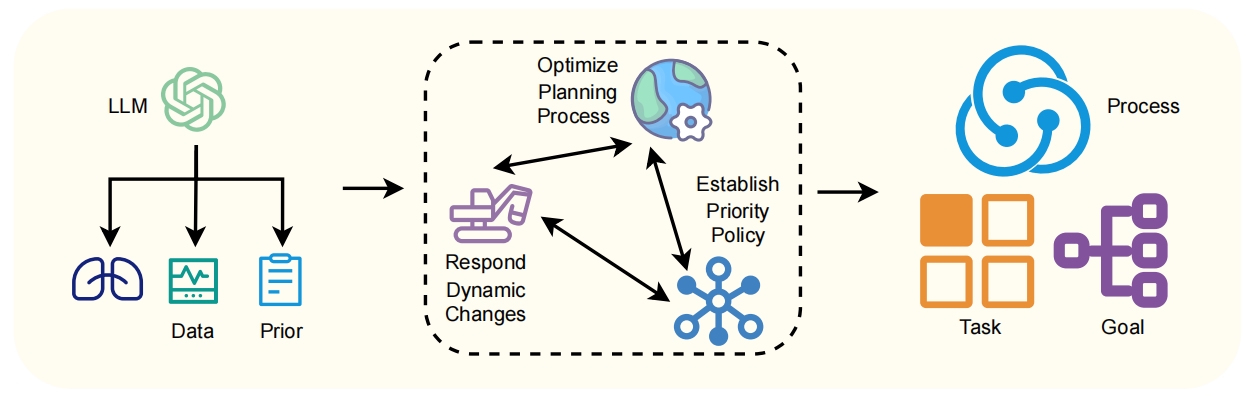
### Visual Description
## Diagram: LLM-Driven Planning and Task Execution System
### Overview
The image is a conceptual diagram illustrating a workflow or system architecture where a Large Language Model (LLM) serves as the initial input source, feeding into a dynamic planning process, which ultimately produces structured outputs for task execution and goal achievement. The diagram flows from left to right, with a central, iterative processing loop.
### Components/Axes
The diagram is divided into three primary regions:
1. **Left Region (Input Source):**
* **Central Icon:** A green, stylized brain or network icon labeled **"LLM"**.
* **Outputs:** Three arrows point downward from the LLM icon to three distinct icons:
* **Left Icon:** A dark blue icon resembling lungs or a branching structure. No text label is directly attached.
* **Middle Icon:** A teal icon depicting a line chart on a monitor, labeled **"Data"**.
* **Right Icon:** A light blue clipboard icon, labeled **"Prior"**.
2. **Middle Region (Core Processing Loop):**
* This entire section is enclosed within a dashed, rounded rectangle, indicating a bounded process or system.
* **Three Interconnected Components:** Arrows form a triangular, bidirectional flow between three labeled items:
* **Top Component:** An icon of a globe with a gear, labeled **"Optimize Planning Process"**.
* **Bottom-Right Component:** A blue network or hub icon, labeled **"Establish Priority Policy"**.
* **Bottom-Left Component:** A purple icon of a person at a desk with a monitor, labeled **"Respond Dynamic Changes"**.
* **Flow:** A single arrow enters this dashed box from the left (from the LLM outputs). A single arrow exits to the right.
3. **Right Region (Output/Execution):**
* **Top Icon:** A large, blue, circular process icon (three interconnected nodes), labeled **"Process"**.
* **Bottom Icons:** Two icons sit side-by-side below the "Process" icon:
* **Left:** A 2x2 grid of orange squares, labeled **"Task"**.
* **Right:** A purple flowchart or decision tree icon, labeled **"Goal"**.
### Detailed Analysis
* **Spatial Grounding:** The legend/labels are placed directly adjacent to their corresponding icons. The "LLM" label is above its icon. "Data" and "Prior" are below theirs. The three process labels ("Optimize...", "Establish...", "Respond...") are positioned to the right of their respective icons within the central dashed box. "Process", "Task", and "Goal" are placed to the right of their icons.
* **Component Isolation & Flow:**
* **Input Stage:** The LLM provides foundational inputs categorized as an unlabeled resource (lungs icon), structured "Data", and existing "Prior" knowledge or policies.
* **Processing Stage:** These inputs feed into a dynamic, iterative loop. The system must "Optimize Planning Process" while simultaneously "Establish[ing] Priority Policy" and being able to "Respond [to] Dynamic Changes". The bidirectional arrows indicate continuous feedback and adjustment between these three activities.
* **Output Stage:** The refined output of this loop is a defined "Process" (the overarching method), which is then used to execute specific "Task"s (the grid) in service of achieving a defined "Goal" (the flowchart).
### Key Observations
1. **Iterative Core:** The central dashed box is not a linear step but a continuous, interconnected loop. Planning, policy, and response are not sequential but co-dependent and mutually informing.
2. **From Unstructured to Structured:** The flow moves from the broad, potentially unstructured intelligence of the LLM (left) through a refining, policy-driven process (middle) to produce concrete, actionable outputs: a process, tasks, and a goal (right).
3. **Role of "Prior":** The inclusion of "Prior" as a direct input from the LLM suggests the system explicitly incorporates pre-existing rules, knowledge, or constraints into the planning loop.
4. **Visual Metaphors:** Icons are used metaphorically: lungs for "vital input" or "branching possibilities," a globe with a gear for "global optimization," and a flowchart for a "goal" as a decision path.
### Interpretation
This diagram represents a sophisticated framework for autonomous or semi-autonomous agent operation. It posits that an LLM alone is insufficient for complex action; its output must be filtered through a dedicated, adaptive planning system.
* **The LLM as a Foundation, Not a Director:** The LLM provides raw material (data, priors, and another unlabeled resource, possibly "context" or "options"), but the actual decision-making logic resides in the middle loop. This separates generative capability from executive function.
* **The Necessity of Dynamic Policy:** The system's intelligence lies in the tension between optimization (efficiency), priority policy (rules/ethics), and dynamic response (adaptability). This triad ensures actions are both effective and compliant with changing conditions and constraints.
* **Actionable Outputs:** The ultimate purpose is not conversation but execution. The final outputs are operational: a defined process, discrete tasks, and a clear goal. This frames the entire system as a bridge between language understanding and real-world action.
* **Implied Feedback:** While not explicitly drawn, the "Respond Dynamic Changes" component implies a feedback loop from the execution of tasks and goals back into the planning process, creating a closed-loop system for continuous operation.
In essence, the diagram argues for an architecture where an LLM's capabilities are harnessed and governed by a separate, robust planning and policy engine to reliably achieve concrete objectives.
</details>
Figure 4: Overview of the proposed ReMALIS Planning Module for predicting sub-goals based on current goals, intentions, grounded embeddings, and agent feedback.
<details>
<summary>extracted/5737747/22.png Details</summary>
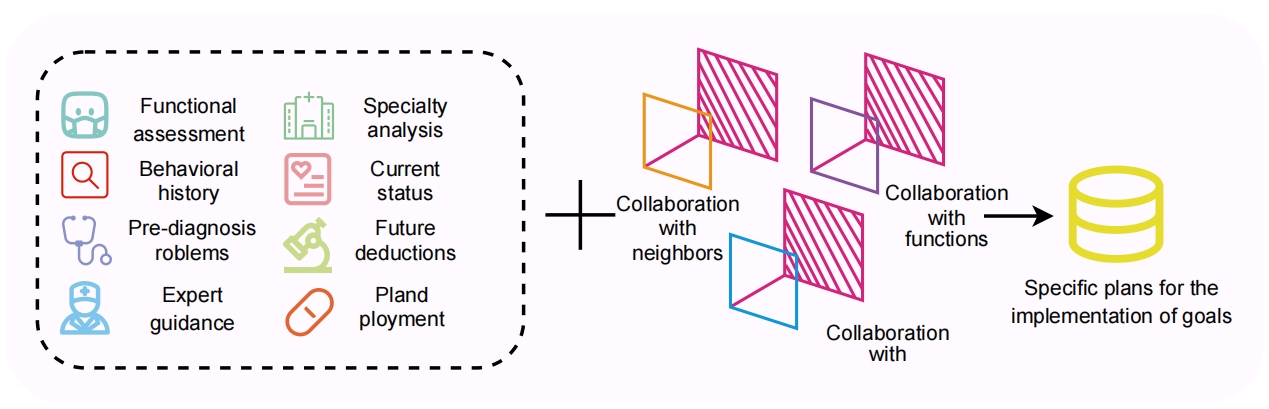
### Visual Description
## Diagram: Healthcare Assessment and Planning Process
### Overview
The image is a conceptual diagram illustrating a multi-step process for developing specific implementation plans in a healthcare or clinical context. It shows how various assessment inputs are combined through collaborative processes to generate actionable plans. The diagram flows from left to right, starting with data collection, moving through integration, and ending with output.
### Components/Axes
The diagram is divided into three main spatial regions:
1. **Left Region (Input Data):** A dashed-line box containing eight icon-label pairs arranged in two columns.
2. **Center Region (Integration Process):** A plus sign (`+`) followed by a cluster of overlapping geometric shapes with associated labels.
3. **Right Region (Output):** An arrow pointing to a cylindrical icon with a final label.
### Detailed Analysis
**1. Left Region - Input Data (within dashed box):**
This section lists eight categories of information or assessment inputs. Each is represented by a colored icon and a text label.
* **Column 1 (Left):**
* Icon: Teal robot face. Label: `Functional assessment`
* Icon: Red magnifying glass. Label: `Behavioral history`
* Icon: Blue stethoscope. Label: `Pre-diagnosis roblems` (Note: Likely a typo for "problems").
* Icon: Blue doctor silhouette. Label: `Expert guidance`
* **Column 2 (Right):**
* Icon: Green hospital building. Label: `Specialty analysis`
* Icon: Pink heart with a document. Label: `Current status`
* Icon: Green microscope. Label: `Future deductions`
* Icon: Orange pill. Label: `Pland ployment` (Note: Likely a typo for "Planned placement").
**2. Center Region - Integration Process:**
A large plus sign (`+`) indicates the combination or addition of the left-side inputs to the following collaborative processes.
* **Visual Element:** Three sets of overlapping, outlined geometric shapes (appearing as squares or diamonds). Each set consists of a colored outline (orange, purple, blue) overlapping a pink, diagonally hatched square.
* **Labels (positioned near the shapes):**
* `Collaboration with neighbors` (positioned near the orange-outlined shape).
* `Collaboration with functions` (positioned near the purple-outlined shape).
* `Collaboration with` (positioned near the blue-outlined shape; the label appears incomplete, ending with "with").
**3. Right Region - Output:**
* A black arrow points from the central collaborative cluster to the final element.
* **Visual Element:** A yellow, cylindrical icon resembling a database or storage drum.
* **Label:** `Specific plans for the implementation of goals`
### Key Observations
* **Process Flow:** The diagram explicitly shows a linear, additive workflow: Inputs + Collaboration = Output Plans.
* **Typographical Errors:** Two labels contain apparent typos: "roblems" and "Pland ployment."
* **Incomplete Label:** The label "Collaboration with" is grammatically incomplete, suggesting either a cut-off or an implied object (e.g., "systems," "teams").
* **Visual Metaphor:** The overlapping shapes in the center visually represent the integration and intersection of different collaborative domains. The hatched pink squares may symbolize a common framework or goal that these collaborations act upon.
* **Color Coding:** Icons in the input section use distinct colors (teal, red, blue, green, pink, orange), but these colors do not have a clear, explicit mapping to the colors used in the central collaborative shapes (orange, purple, blue outlines).
### Interpretation
This diagram outlines a structured methodology for generating targeted action plans in a healthcare setting. It suggests that effective implementation plans cannot be created from raw data alone. The process requires a critical intermediate step of **collaboration**.
The eight inputs on the left represent a comprehensive patient or system assessment, covering functional, behavioral, diagnostic, expert, specialty, current, future, and logistical (placement) dimensions. The core argument of the diagram is that these diverse data streams must be synthesized through collaborative engagement with different entities ("neighbors," "functions," and an unspecified third group). This collaborative synthesis is the transformative step that converts assessment information into concrete, goal-oriented plans.
The final output, "Specific plans for the implementation of goals," stored in a database-like cylinder, implies that the end product is a structured, actionable, and likely digital set of instructions or protocols. The diagram advocates for a collaborative, integrative approach to care planning, moving beyond siloed data analysis.
</details>
Figure 5: Framework of the proposed ReMALIS Grounding Module that contextualizes symbol embeddings using the current state, intentions, and feedback signals.
Grounding Module (Figure 5): 1.
Contextualize the abstract traffic concepts and symbols into grounded representations. 2.
Map entities like intersections, vehicles, and signal phases to their physical counterparts. 3.
Resolve ambiguities and uncertainties in grounding based on the current traffic context. 4.
Adjust grounding strategies based on feedback from execution agents and emerging coordination patterns. 5.
Provide grounded embeddings to inform the execution agents’ decision-making.
<details>
<summary>extracted/5737747/33.png Details</summary>
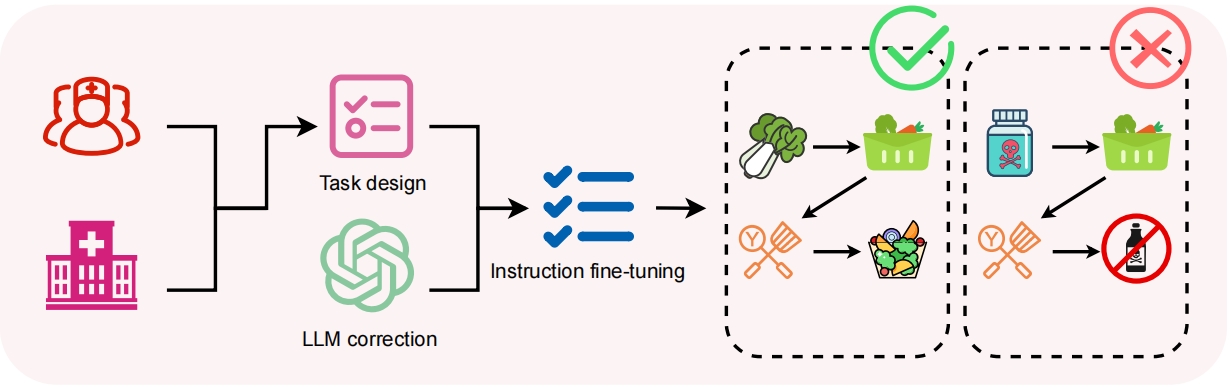
### Visual Description
## Diagram: Healthcare Data Processing and Instruction Fine-Tuning Workflow
### Overview
The image is a process flow diagram illustrating a workflow for refining data or instructions, likely for a machine learning model, using inputs from healthcare sources. The flow moves from left to right, starting with data sources, moving through processing steps, and culminating in two distinct outcome pathways—one marked as correct and the other as incorrect.
### Components/Axes
The diagram is composed of several icon-based components connected by directional arrows, indicating the flow of information or process steps. There are no traditional chart axes. The components are arranged in a horizontal sequence.
**Left Section (Inputs):**
1. **Icon 1 (Top-Left):** A red outline icon depicting a group of three people, with the central figure wearing a medical cross on their head. This likely represents **healthcare professionals** or **medical staff**.
2. **Icon 2 (Bottom-Left):** A pink icon of a hospital building with a medical cross. This represents a **hospital** or **medical institution**.
* *Spatial Grounding:* These two icons are vertically aligned on the far left. Arrows from both converge into a single path.
**Middle Section (Processing Steps):**
3. **Icon 3 (Top-Middle):** A pink icon of a document with a checkmark and lines, labeled **"Task design"** below it.
4. **Icon 4 (Bottom-Middle):** A green, intricate, knot-like or brain-like icon, labeled **"LLM correction"** below it.
* *Spatial Grounding:* These two icons are vertically aligned. The converging arrow from the inputs splits to point to both of them. Arrows from both "Task design" and "LLM correction" then converge into the next step.
5. **Icon 5 (Center):** A blue icon showing three horizontal lines with checkmarks, labeled **"Instruction fine-tuning"** below it. This is the central processing node.
**Right Section (Outcomes):**
The flow from "Instruction fine-tuning" splits into two distinct, dashed-border boxes, each representing a different outcome pathway.
* **Left Outcome Box (Correct Pathway):**
* **Top Icon:** A green checkmark inside a circle.
* **Flow Sequence:**
1. An icon of **broccoli and a carrot** (raw vegetables).
2. An arrow points to an icon of a **green shopping basket** containing vegetables.
3. An arrow points from the basket to an icon of **cooking utensils** (spatula and fork).
4. An arrow points from the utensils to an icon of a **bowl of prepared salad**.
* *Interpretation of Flow:* This sequence depicts a correct process: selecting fresh ingredients, placing them in a basket, preparing/cooking them, resulting in a healthy prepared meal.
* **Right Outcome Box (Incorrect Pathway):**
* **Top Icon:** A red "X" inside a circle.
* **Flow Sequence:**
1. An icon of a **blue jar with a skull and crossbones** (representing poison or harmful substance).
2. An arrow points to an icon of a **green shopping basket** containing vegetables (same basket icon as the correct path).
3. An arrow points from the basket to the same **cooking utensils** icon.
4. An arrow points from the utensils to an icon of a **bottle with a red prohibition circle over it** (likely representing alcohol or a banned substance).
* *Interpretation of Flow:* This sequence depicts an incorrect or dangerous process: selecting a harmful substance, placing it in the same basket as food, using the same preparation tools, resulting in a prohibited or unsafe final product.
### Detailed Analysis
The diagram is a conceptual flowchart, not a data chart. Therefore, it contains no numerical data points, trends, or statistical distributions. The "analysis" involves tracing the logical connections between the symbolic components.
* **Process Flow:** The workflow is linear until the "Instruction fine-tuning" step, after which it bifurcates into two parallel, contrasting outcome scenarios.
* **Component Relationships:** The inputs (healthcare professionals, hospital) feed into two complementary processes: "Task design" (creating the structure) and "LLM correction" (refining via a Large Language Model). Their outputs are combined for "Instruction fine-tuning," which is the core training or adjustment phase.
* **Outcome Contrast:** The two final boxes are visually parallel but semantically opposite. They use identical icons for intermediate steps (shopping basket, cooking utensils) but different starting points (vegetables vs. poison) and end points (salad vs. prohibited bottle) to highlight the critical importance of the initial input and the fine-tuning process in determining the safety and correctness of the output.
### Key Observations
1. **Metaphorical Language:** The diagram uses a cooking/food preparation metaphor to explain a technical process (likely data processing or AI training). The "correct" path yields a healthy meal (good outcome), while the "incorrect" path yields a dangerous product (bad outcome).
2. **Color Coding:** Colors are used symbolically: red/pink for medical/healthcare inputs, green for correction and "good" outcomes, blue for the central fine-tuning process, and red for the "incorrect" outcome marker.
3. **Critical Junction:** The "Instruction fine-tuning" step is the pivotal point where the process can diverge toward success or failure, emphasizing its importance.
4. **Shared Intermediate Steps:** The fact that both the correct and incorrect paths use the same basket and utensil icons suggests that the *process steps* themselves may be neutral; the outcome depends entirely on the *content* (ingredients) fed into them and the quality of the initial fine-tuning.
### Interpretation
This diagram illustrates a framework for developing safe and effective AI systems, particularly in a sensitive domain like healthcare. It argues that raw data from medical sources must be carefully processed through deliberate task design and LLM-based correction before undergoing instruction fine-tuning.
The core message is that the fine-tuning phase is decisive. Properly tuned instructions lead to beneficial, safe outputs (represented by the healthy salad). Improperly tuned instructions, even when using the same procedural steps, can lead to harmful or prohibited outcomes (represented by the poisoned bottle). The metaphor warns that without careful oversight and correction ("LLM correction") at the design stage, the AI system might learn to process dangerous inputs correctly in a procedural sense, leading to dangerously confident but harmful results.
The diagram advocates for a rigorous, multi-stage pipeline where human expertise (healthcare professionals, task design) and automated correction (LLM correction) are integrated before final model training, to ensure the system's outputs are aligned with safety and correctness.
</details>
Figure 6: Overview of our ReMALIS Cooperative Execution Module consisting of specialized agents that collaboratively execute actions and propagate intentions.
Execution Module (Figure 6, 7): 1.
Specialized agents monitor their respective domains (vehicle counts, road conditions, signal timings, etc.). 2.
Agents communicate their local intentions and goals to relevant teammates. 3.
Agents align their actions based on shared intentions and the coordinated plans. 4.
Agents execute their assigned subtasks (adjusting signal phases, routing emergency vehicles, etc.). 5.
Agents observe the impact of their actions and provide feedback on emerging coordination patterns. 6.
Agents adapt their strategies dynamically based on the feedback and changing traffic conditions. 7.
Agents continuously monitor and respond to fluctuations in vehicle arrival rates and traffic patterns. 8.
Agents collaborate and coordinate their efforts to collectively alleviate congestion and optimize traffic flow.
<details>
<summary>extracted/5737747/44.png Details</summary>
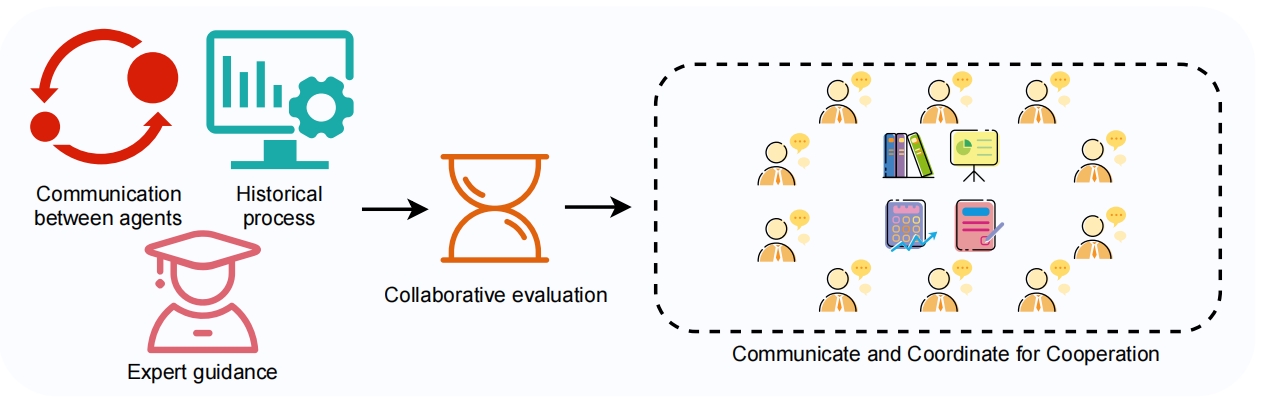
### Visual Description
\n
## Process Diagram: Collaborative Agent Coordination Framework
### Overview
The image is a conceptual process diagram illustrating a workflow for multi-agent collaboration. It depicts how three distinct input elements feed into a central evaluation phase, which then enables a coordinated group activity. The diagram uses stylized icons and directional arrows to show the flow of information or influence.
### Components/Axes
The diagram is organized into three main spatial regions:
1. **Input Region (Left Side):** Contains three distinct input components.
* **Top-Left:** A red circular icon with two arrows forming a cycle around two red circles. Label: **"Communication between agents"**.
* **Top-Center:** A teal icon of a computer monitor displaying a bar chart and a gear. Label: **"Historical process"**.
* **Bottom-Left:** A pink icon of a person wearing a graduation cap. Label: **"Expert guidance"**.
2. **Processing Region (Center):**
* An orange hourglass icon. Label: **"Collaborative evaluation"**.
* Two black arrows point from the three input components towards this hourglass, and one arrow points from the hourglass towards the right-side region.
3. **Output/Action Region (Right Side):**
* A large, dashed-line rectangular box containing a network of icons.
* **Central Cluster:** Within the box, there is a central cluster of four resource icons: a bookshelf, a presentation chart, a calculator with an upward trend, and a document with a pen.
* **Agent Network:** Surrounding the central cluster are ten identical icons of people with speech bubbles, arranged in a circular formation. This entire group is labeled: **"Communicate and Coordinate for Cooperation"**.
### Detailed Analysis
* **Flow Direction:** The process flows unidirectionally from left to right. The three inputs (agent communication, historical data, expert guidance) are processed through "Collaborative evaluation," which results in the final state of agents communicating and coordinating around shared resources.
* **Component Relationships:** The diagram suggests that effective coordination (right) is not a starting point but an outcome. It is enabled by a structured evaluation process that synthesizes ongoing agent interactions, past process data, and external expert input.
* **Visual Metaphors:**
* The **hourglass** for "Collaborative evaluation" implies a process that requires time and involves filtering or refining inputs.
* The **dashed box** around the final group signifies a defined collaborative space or system boundary.
* The **circular arrangement** of agents around central resources suggests equality, continuous interaction, and a shared focus.
### Key Observations
1. **No Quantitative Data:** The diagram is purely conceptual and contains no numerical data, charts, or graphs. It illustrates a model or framework, not measured outcomes.
2. **Symmetry and Equality:** The ten agent icons in the final stage are visually identical and symmetrically placed, implying a non-hierarchical structure where all agents have equal standing in the coordination process.
3. **Resource-Centric Coordination:** The coordination is explicitly centered around shared informational resources (books, charts, data, documents), not just interpersonal communication.
4. **Multi-Source Foundation:** The model explicitly values three distinct pillars for enabling cooperation: dynamic interaction (communication), empirical data (history), and authoritative knowledge (experts).
### Interpretation
This diagram presents a **Peircean investigative model** for understanding how robust multi-agent systems can be designed. It argues that successful cooperation is not spontaneous but is the product of a deliberate, structured process.
* **The "Why":** The framework suggests that for agents (which could be AI models, human teams, or organizational units) to cooperate effectively, they must move beyond simple interaction. They require a dedicated phase of **evaluation** that synthesizes their own communications, learns from historical patterns, and incorporates higher-level expert guidance.
* **Reading Between the Lines:** The placement of "Expert guidance" as a foundational input is significant. It implies that purely data-driven or emergent systems may be insufficient; they benefit from injected, structured knowledge. The final state—agents coordinating around shared resources—highlights that the goal of cooperation is often **collective problem-solving or knowledge work**, not just task completion.
* **Anomaly/Notable Design Choice:** The "Historical process" is represented by a computer with a chart and gear, blending data (chart) with mechanism (gear). This implies that history is not just a passive record but an active, mechanistic part of the system that informs current evaluation.
In essence, the diagram is a blueprint for building cooperative intelligence, emphasizing that evaluation is the critical transformative step that turns raw inputs into coordinated action.
</details>
Figure 7: Overview of the collaborative evaluation setup in the proposed ReMALIS framework.