# CiteME: Can Language Models Accurately Cite Scientific Claims?
**Authors**: Ori Press, Andreas Hochlehnert, Ameya Prabhu, Vishaal Udandarao, Ofir Press, Matthias Bethge
> Tübingen AI Center, University of TübingenOpen-𝚿𝚿\mathbf{\Psi}bold_Ψ(Open-Sci) Collective
> Tübingen AI Center, University of TübingenUniversity of CambridgeOpen-𝚿𝚿\mathbf{\Psi}bold_Ψ(Open-Sci) Collective
> Princeton Language and Intelligence, Princeton University
\quotingsetup
vskip=-.0leftmargin=0.025rightmargin=0.075font=small,itshape
Abstract
Thousands of new scientific papers are published each month. Such information overload complicates researcher efforts to stay current with the state-of-the-art as well as to verify and correctly attribute claims. We pose the following research question: Given a text excerpt referencing a paper, could an LM act as a research assistant to correctly identify the referenced paper? We advance efforts to answer this question by building a benchmark that evaluates the abilities of LMs in citation attribution. Our benchmark, CiteME, consists of text excerpts from recent machine learning papers, each referencing a single other paper. CiteME use reveals a large gap between frontier LMs and human performance, with LMs achieving only 4.2-18.5% accuracy and humans 69.7%. We close this gap by introducing CiteAgent, an autonomous system built on the GPT-4o LM that can also search and read papers, which achieves an accuracy of 35.3% on CiteME. Overall, CiteME serves as a challenging testbed for open-ended claim attribution, driving the research community towards a future where any claim made by an LM can be automatically verified and discarded if found to be incorrect.
1 Introduction
<details>
<summary>extracted/5974968/figures/fig1.png Details</summary>

### Visual Description
## Diagram: Citation Resolution Workflow
### Overview
The image depicts a simplified workflow for resolving citations in text using an AI agent. It consists of three components:
1. A text box containing a sentence with an embedded citation placeholder.
2. A robot illustration interacting with a computer.
3. A text box displaying the resolved citation.
### Components/Axes
- **Left Text Box**:
- **Content**: "Find the paper cited in this text: 'ESIM is another high performing model for sentence-pair classification tasks, particularly when used with ELMo embeddings [CITATION]'"
- **Purpose**: Input text with an unresolved citation.
- **Robot Illustration**:
- **Position**: Center of the diagram.
- **Details**: A stylized robot seated at a desk with a computer, symbolizing an AI agent performing a search.
- **Right Text Box**:
- **Content**: "After searching, I think the cited paper is: 'Deep contextualized word representations'"
- **Purpose**: Output text with the resolved citation.
### Detailed Analysis
- **Textual Content**:
- The left text box includes a citation placeholder (`[CITATION]`) within a sentence discussing the ESIM model and its use with ELMo embeddings.
- The right text box resolves the citation to "Deep contextualized word representations," referencing the foundational paper by Devlin et al. (2018) on BERT.
- **Flow**:
- The workflow progresses from the left text box → robot → right text box, indicating a search process to resolve the citation.
### Key Observations
- The citation placeholder is explicitly marked as `[CITATION]`, suggesting a templated or automated system for citation resolution.
- The resolved citation refers to a well-known paper in NLP, implying the robot’s search capability is context-aware.
### Interpretation
This diagram illustrates a conceptual pipeline where an AI agent (robot) resolves citations in text by searching for relevant papers. The example uses a real-world NLP citation (ESIM + ELMo) and resolves it to the seminal BERT paper, highlighting the agent’s ability to infer contextually relevant references. The absence of numerical data or uncertainty suggests this is a schematic representation rather than an empirical analysis.
</details>
Figure 1: Example of a CiteME instance. The input (left) is an excerpt from a published paper with an anonymized citation; the target answer (right) is the title of the cited paper. */ $\ddagger$ shared first/last authorship Code: github.com/bethgelab/CiteME, Dataset: huggingface.co/datasets/bethgelab/CiteME Correspondence to {ori.press, andreas.hochlehnert}@bethgelab.org
Scientific discoveries are advancing at an ever-growing rate, with tens of thousands of new papers added just to arXiv every month [4]. This rapid progress has led to information overload within communities, making it nearly impossible for scientists to read all relevant papers. However, it remains a critical scholarship responsibility to check new claims and attribute credit to prior work accurately. Language models (LMs) have shown impressive abilities as assistants across tasks [25], which leads us to explore the following task in this paper: Can language models act as research assistants to help scientists deal with information overload?
We make progress towards answering this question by evaluating the abilities of LMs in citation attribution [27, 59]. Given a text excerpt referencing a scientific claim, citation attribution is the task in which a system is asked to fetch the title of a referenced paper, as illustrated in Figure 1.
Current benchmarks are collected automatically, which leads to the dominance of ambiguous or unattributable text excerpts that make overly broad claims or are not used as evidence for any specific claim, as shown in Table 1. Furthermore, these benchmarks typically frame citation attribution as a retrieval task from a small set of pre-selected papers where only paper titles and abstracts can be viewed, not the full paper’s content important for citation attribution [22, 50].
Table 1: Percentage of reasonable, ambiguous, unattributable, and trivial excerpts across 4 citation datasets, as labeled by human experts. For a detailed breakdown of every analyzed sample, see Appendix A.
| FullTextPeerRead [42] ACL-200 [9, 58] RefSeer [40, 58] | 24 26 24 | 26 42 28 | 34 18 32 | 16 14 16 |
| --- | --- | --- | --- | --- |
| arXiv [33] | 10 | 50 | 30 | 10 |
| Average | 21 | 36.5 | 28.5 | 14 |
To address these issues, we introduce CiteME (Citation for Model Evaluation), the first manually curated citation attribution benchmark with text excerpts that unambiguously reference a single paper. CiteMe’s use of only unambiguous text excerpts eliminates the subjectivity that characterizes other benchmarks.
To evaluate CiteMe, we conduct benchmark tests that focus on open-ended citation attribution. Human evaluators confirm the lack of ambiguity, achieving 69.7% accuracy while taking just 38.2 seconds on average to find the referenced papers. The current state-of-the-art system, SPECTER2 [77], experiences 0% accuracy on CiteME, highlighting the real-world difficulties of LM-based citation attribution. Similarly, current frontier LMs achieve performance of 4.2-18.5%, substantially beneath human performance. We conclude that current LMs cannot reliably link scientific claims to their sources.
To bridge this gap, we introduce CiteAgent, an autonomous system built on top of the GPT-4o [1] LM and the Semantic Scholar search engine [46]. CiteAgent can search for and read papers repeatedly until it finds the referenced paper, mirroring how scientists perform this scholarship task to find targeted papers. CiteAgent correctly finds the right paper 35.3% of the time when evaluated on CiteME.
In summary, our main contributions are:
- CiteME, a challenging and human-curated benchmark of recent machine learning publications that evaluates the abilities of LMs to correctly attribute scientific claims. CiteME is both natural and challenging, even for SoTA LMs.
- CiteAgent, an LM-based agent that uses the Internet to attribute scientific claims. Our agent uses an existing LM without requiring additional training. It also uses a search engine, which makes it applicable to real-world settings and differentiates it from systems that can search only within a predetermined corpus of papers.
Future work that improves the accuracy of CiteME may lead to systems that can verify all claims an LM makes, not just those in the ML research domain. This could reduce the hallucination rate [92] and increase factuality [6] of LM-generated text.
2 The CiteME Benchmark
We now present the CiteME benchmark, which we differentiate from other citation prediction benchmarks that are automatically curated, i.e., curated without human supervision or feedback in selecting text excerpts [32, 31, 9, 40, 72, 44, 42, 33]. For comparison, we study the quality of excerpts across four popular citation prediction benchmarks (FullTextPeerRead, [42], ACL-200 [9, 58], RefSeer [40, 58], and arXiv [33]). Specifically, we sample 50 excerpts from each dataset and categorize them using the following criteria:
(1) Attributable vs Unattributable. The cited paper should provide evidence for the statement in the text excerpt, i.e., be an attribution as opposed to a statement that does not clearly refer to supporting evidence. Excerpts that do not follow this criterion are termed unattributable, as in the example: {quoting} For all of our experiments, we use the hyperparameters from [CITATION]. (2) Unambiguous vs Ambiguous. The cited text excerpt should not be overly broad. The ground truth cited papers should clearly be the only possible reference for the claim in the text excerpt. Excerpts that do not follow this criterion are termed ambiguous, as in the example: {quoting} [CITATION1, CITATION2] explored paper recommendation using deep networks. (3) Non-Trivial vs Trivial. The text excerpt should not include author names or title acronyms, which simply tests LM memorization and retrieval. Excerpts that do not follow this criterion are termed trivial, as in the example: {quoting} SciBERT [CITATION] is a BERT-model pretrained on scientific texts.
(4) Reasonable vs Unreasonable. The text excerpt should be attributable, unambiguous and non-trivial. We term excerpts that do not follow this criterion unreasonable, but we categorize them according to the underlying issue (e.g., unattributable, ambiguous, or trivial). An example of a reasonable excerpt is: {quoting} We use the ICLR 2018–2022 database assembled by [CITATION], which includes 10,297 papers.
In Table 1 (left), we demonstrate that most samples from all four datasets lack sufficient information for humans to identify the cited paper and are often labeled as ambiguous or unattributable. Additionally, an average of 17.5% of the samples are tagged as trivial because they include the title of the paper or its authors directly in the excerpt. Excerpts also frequently have formatting errors, making some nearly unreadable (see examples in Appendix A). Past work also notes similar artifacts [33, 42, 58], further supporting our claims. This analysis leads us to contend that performance on existing citation benchmarks might not reflect real-world performance of LM research assistants.
In response to these deficiencies, we created CiteME, a new benchmark with human expert curation for unambiguous citation references. CiteME contains carefully selected text excerpts, each containing a single, clear citation to ensure easy and accurate evaluation.
Curation. A team of 4 machine learning graduate students, henceforth referred to as “experts”, were responsible for collecting text excerpts. The experts were instructed to find samples that (1) referenced a single paper and (2) provided sufficient context to find the cited paper with scant background knowledge. Each sample was checked for reasonableness; only those deemed reasonable by two or more experts were retained. Some excerpts were slightly modified to make them reasonable.
<details>
<summary>extracted/5974968/figures/paper_tags.png Details</summary>
### Visual Description
## Bar Chart: CiteME Paper Tags
### Overview
The chart displays the frequency distribution of paper tags in the CiteME dataset, focusing on machine learning and AI-related topics. The x-axis represents "Tag Frequency" (0–6), while the y-axis lists specific technical tags. Bars are colored light blue with black borders.
### Components/Axes
- **X-axis**: "Tag Frequency" (scale: 0–6, increments of 1)
- **Y-axis**: Technical tags (listed vertically):
1. Image Classification
2. Adversarial Machine Learning
3. Deep Learning Architectures
4. Vision-Language Models
5. Contrastive Learning
6. Multi-modal Learning
7. Representation Learning
8. Image Processing
9. Machine Learning Efficiency
10. Machine Learning Evaluation
- **Bars**: Light blue with black borders, no legend present.
### Detailed Analysis
- **Highest Frequency Tags**:
- *Image Classification*: ~6
- *Adversarial Machine Learning*: ~6
- **Mid-Frequency Tags** (~5):
- *Deep Learning Architectures*
- *Vision-Language Models*
- *Contrastive Learning*
- *Multi-modal Learning*
- *Representation Learning*
- **Lower Frequency Tags** (~4):
- *Image Processing*
- *Machine Learning Efficiency*
- *Machine Learning Evaluation*
### Key Observations
1. **Dominance of Image-Related Tags**: "Image Classification" and "Adversarial Machine Learning" are the most frequent, suggesting a strong focus on image-centric ML research.
2. **Cluster of Core ML Concepts**: Tags like "Deep Learning Architectures" and "Vision-Language Models" occupy mid-frequency positions, indicating foundational but widely studied areas.
3. **Lower Emphasis on Evaluation/Efficiency**: Tags like "Machine Learning Evaluation" and "Efficiency" show the least frequency, potentially reflecting niche or emerging research areas.
### Interpretation
The data highlights a research landscape prioritizing image processing and adversarial ML, with foundational concepts like deep learning architectures maintaining steady relevance. The lower frequency of evaluation and efficiency tags may indicate either underdeveloped research areas or a focus on applied over theoretical work. The uniformity of mid-frequency tags suggests a balanced exploration of core ML paradigms, while the absence of a legend simplifies interpretation but limits contextual nuance (e.g., distinguishing between subcategories).
</details>
<details>
<summary>extracted/5974968/figures/citeme_hist.png Details</summary>
### Visual Description
## Bar Chart: CiteME Papers by Year Published
### Overview
The chart displays the percentage of CiteME papers published annually from Pre '11 to '24. The y-axis represents the "Percent of Papers" (0–25%), and the x-axis lists years. Bars are light blue, with a legend confirming the color association.
### Components/Axes
- **X-axis (Years)**: Pre '11, '11, '12, '13, '14, '15, '16, '17, '18, '19, '20, '21, '22, '23, '24
- **Y-axis (Percent of Papers)**: 0–25% in increments of 5%
- **Legend**: Light blue color corresponds to "CiteME Papers"
### Detailed Analysis
- **Pre '11**: ~20%
- **'11**: ~1%
- **'12**: ~3%
- **'13**: ~3%
- **'14**: ~2%
- **'15**: ~5%
- **'16**: ~4%
- **'17**: ~7%
- **'18**: ~11%
- **'19**: ~11%
- **'20**: ~3%
- **'21**: ~16%
- **'22**: ~23%
- **'23**: ~24%
- **'24**: ~2%
### Key Observations
1. **Initial Decline**: A sharp drop from 20% (Pre '11) to 1% in '11, followed by gradual growth until '19.
2. **Post-2020 Surge**: A 10x increase from 3% in '20 to 24% in '23, followed by a sudden drop to 2% in '24.
3. **Stability (2015–2019)**: Fluctuations between 2% and 11%, with a peak in '18 and '19.
4. **Anomalies**: The 2024 value deviates significantly from the upward trend observed in 2021–2023.
### Interpretation
The data suggests a cyclical pattern in CiteME paper adoption. The pre-2011 baseline (~20%) may reflect early adoption, followed by a decline possibly due to methodological shifts or competing tools. The 2015–2019 stabilization could indicate market saturation or academic integration. The 2021–2023 surge aligns with potential technological advancements or renewed interest, though the 2024 drop raises questions about sustainability or external disruptions (e.g., platform changes, competition). The 2024 anomaly warrants further investigation into dataset completeness or contextual factors.
</details>
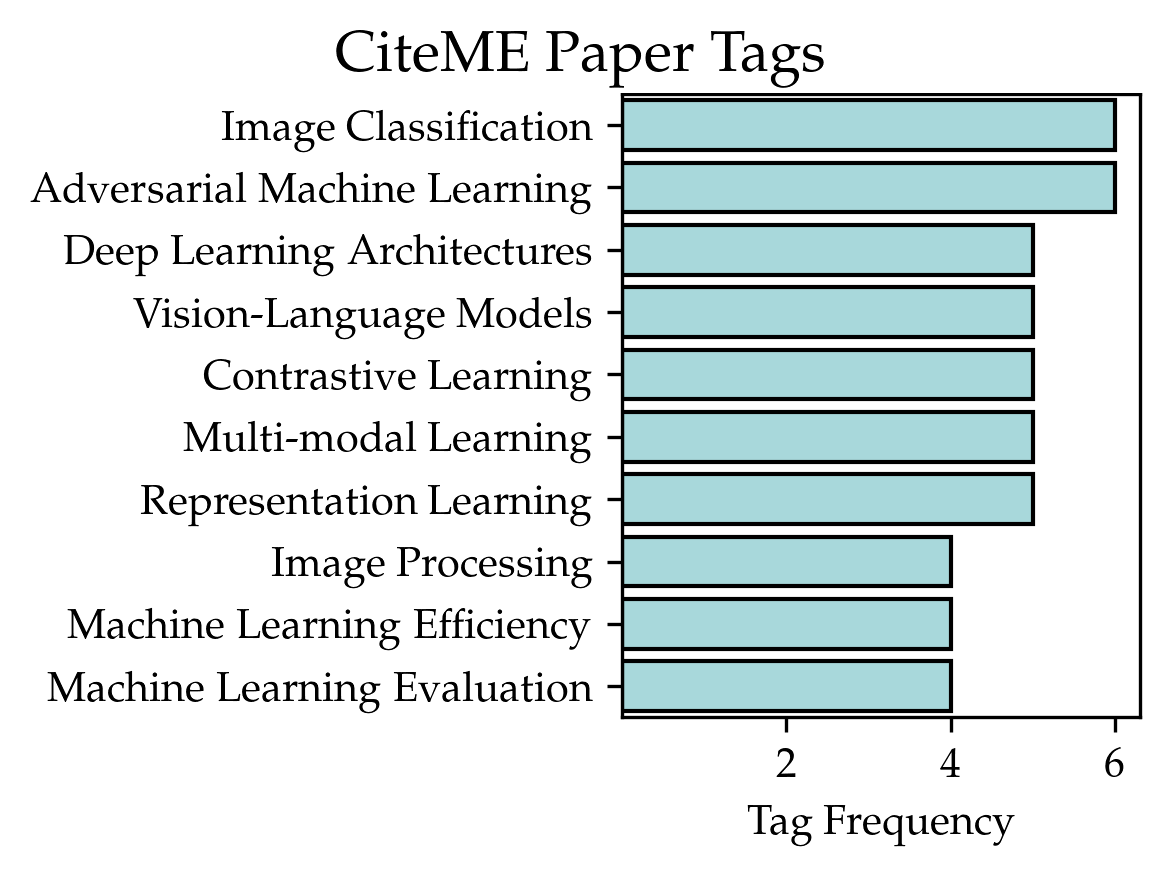
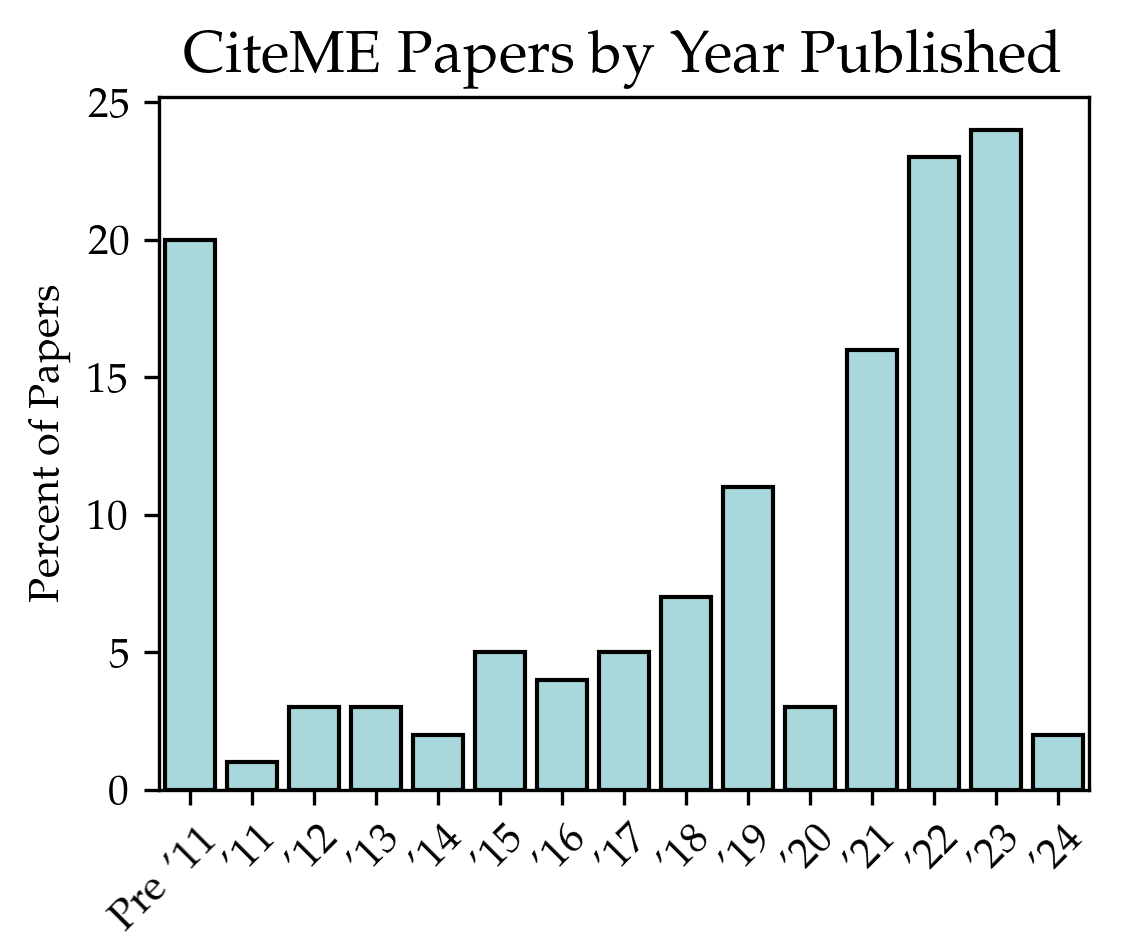
Figure 2: (Left) The top 10 most frequent labels of papers in CiteME, as identified by GPT-4. Overly broad tags like "Machine Learning" or "Deep Networks" were excluded (see Appendix D for details). (Right) Most excerpts in CiteME are from recent papers.
Filtering Out the Easy Instances. To ensure that CiteMe is a challenging and robust dataset, we remove all dataset instances that GPT-4o can correctly answer. Filtering datasets by removing the samples that a strong model can correctly answer was previously done in Bamboogle [71] and the Graduate-Level Google-Proof Q&A Benchmark [73]. In our filtering process, GPT-4o was used with no Internet access or any other external tools. Therefore, it could answer only correctly specified papers that it memorized from its training process. We ran each sample through GPT-4o five times to cover its different outcomes. In the end, we filtered out 124 samples, leaving 130 samples in total.
Human Evaluation. To ensure that our benchmark instances are not unsolvable, we evaluate human performance on them. Using a random subset of 100 samples, we asked a group of 20 experts, who were not part of benchmark construction, to perform the task of finding the referenced papers given only the excerpt, with each expert given 5 random samples from CiteME and a maximum of two minutes to solve each instance (similar to [47]). We observe that the experts found the correct citation 69.7% of the time, spending an average of only 38.2 seconds to do so. Note that this accuracy number does not represent the maximum-possible human performance since our annotators were limited to two minutes per question for budget reasons. Human accuracy may rise even higher given more time per instance. To check the experts’ consistency, five more experts were asked to solve the same instances previously answered by the original experts. In 71% of the cases, both experts agreed on the answer, and at least one expert got to the right answer in 93% of cases.
Are 130 questions sufficient to evaluate LMs? Though traditional machine learning benchmarks usually contain thousands or even millions of test samples, recent work [17, 71, 74, 86] shows that LM benchmarks can include only 100-200 samples and remain insightful. HumanEval [17], for example, which consists of 164 programming problems, is among the most influential LM datasets today, appearing in virtually every SoTA LM paper recently published [66, 1, 81, 19]. Similarly, Bamboogle [71] contains 125 questions, DrawBench [74] contains 200 instances, and Plot2Code [86] contains 132 questions. This is in line with [70, 69], who show that benchmarks with many samples can be reduced to around 100 samples without sacrificing their utility. In addition, smaller benchmarks are advantageous because they are both cheaper to evaluate and impose a less significant environmental impact [76].
3 CiteAgent
We now describe CiteAgent, an LM-based system that we built to mimic researcher performance of open-ended citation attribution. A researcher seeking the correct attribution for a claim might use a search engine, read several papers, refine the search query, and repeat until successful. To allow CiteAgent to perform these actions, we built it to use Semantic Scholar to search for and read papers. Unless specified otherwise, we refer to CiteAgent with the GPT-4o backbone simply as CiteAgent throughout this paper.
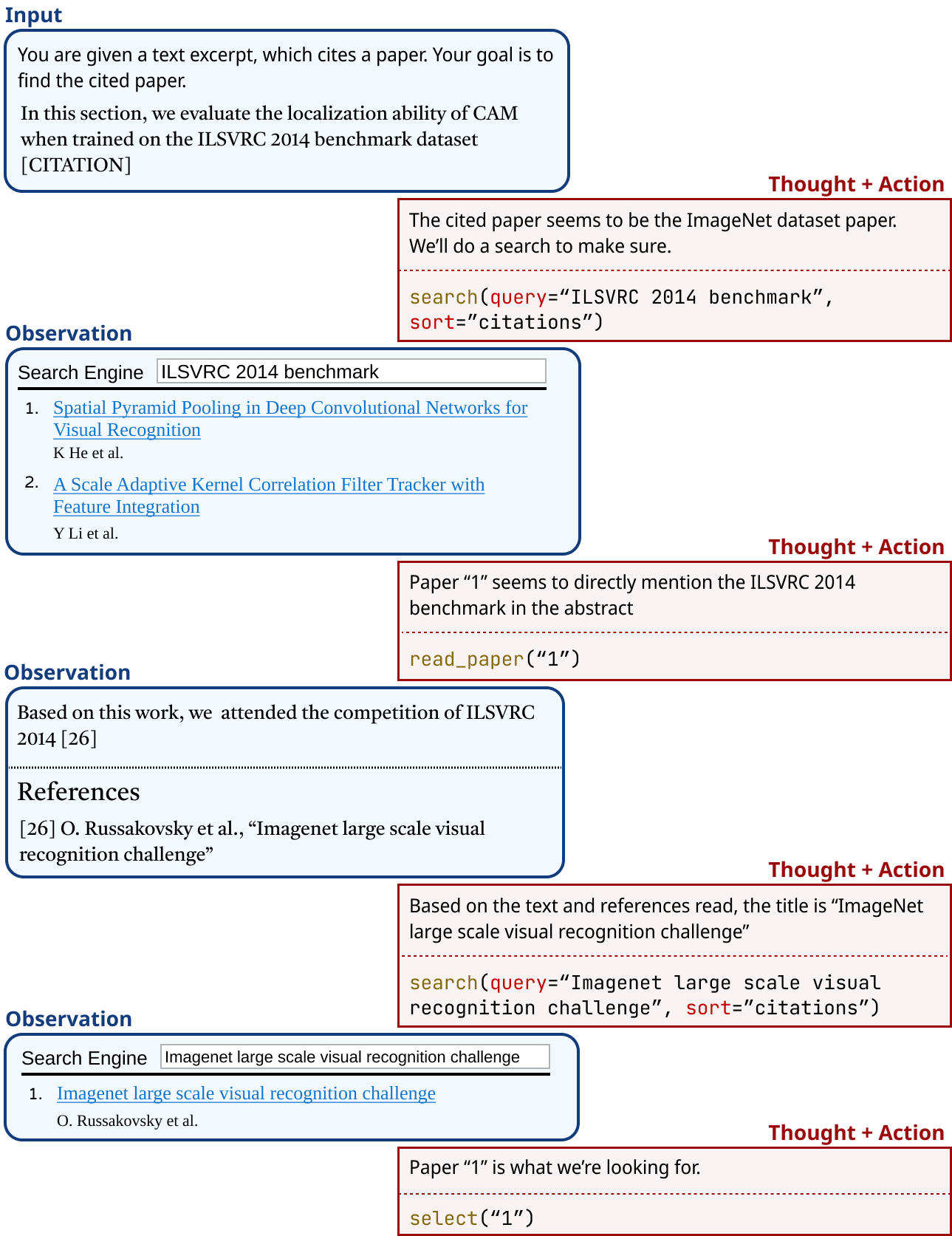
Given a text excerpt, we prompt CiteAgent to perform one of a fixed set of custom commands and provide the output that the given command generated. CiteAgent then gives its rationale before performing another action, following [90, 88]. Figure 3 shows this process. We now describe the starting prompt and custom agent commands.
Prompt. Our prompt includes the task description, descriptions of available commands, and a demonstration trajectory, i.e., the series of actions that the system executes while solving an instance [90, 88]. The trajectory includes searching, reading a paper, and searching again (see Figure 4). We model our prompt on the SWE-Agent prompt [88].
Table 2: Commands available to the model using our system.
| search(query, sort) read(ID) select(ID) | Searches for a query; sorts results by relevance or by citation count; returns a list of papers, where each item consists of the paper ID, title, number of citations, and abstract. Returns the full text of a paper, including title, author list, abstract, and the paper itself. Selects a paper from the search results as the answer. |
| --- | --- |
Agent Commands. CiteAgent can respond to three custom commands (see Table 2). It always begins by executing the search command (sorting by relevance or citation count), which searches Semantic Scholar for a query and returns top results in a sorted order. After searching, CiteAgent can either search again, read one of the listed papers, or select a paper can perform up to 15 actions for every sample. Once a select action is taken, the session ends, and the selected paper is recorded.
Search. CiteAgent initiates a search command by querying Semantic Scholar [46]. We chose the Selenium API [63] over the Semantic Scholar API due to the former’s significantly better re-ranked queries and its ability to provide a uniform interface for both our model and human trajectory annotators.
Selenium also lets us access features such as sorting search results by relevance and citation count, which our human trajectory annotators found particularly valuable.
To ensure correctness, we filter out search results published after the excerpt’s source paper, and the source paper itself. We then give CiteAgent the top 10 search results, which include paper id, title, abstract, and citation count.
<details>
<summary>extracted/5974968/figures/trajectory.png Details</summary>
### Visual Description
## Flowchart: Process for Locating Cited Papers in Technical Documents
### Overview
The image depicts a flowchart illustrating a systematic approach to identifying cited papers within technical documents. It combines textual analysis with search engine interactions, citation tracking, and reference validation to locate specific academic works.
### Components/Axes
1. **Input Section** (Blue Box):
- Text: "You are given a text excerpt, which cites a paper. Your goal is to find the cited paper."
- Subtext: "In this section, we evaluate the localization ability of CAM when trained on the ILSVRC 2014 benchmark dataset [CITATION]."
2. **Thought + Action Boxes** (Red Background):
- First Box:
- Text: "The cited paper seems to be the ImageNet dataset paper. We'll do a search to make sure."
- Code: `search(query="ILSVRC 2014 benchmark", sort="citations")`
- Second Box:
- Text: "Paper '1' seems to directly mention the ILSVRC 2014 benchmark in the abstract."
- Code: `read_paper("1")`
- Third Box:
- Text: "Based on the text and references read, the title is 'Imagenet large scale visual recognition challenge'."
- Code: `search(query="Imagenet large scale visual recognition challenge", sort="citations")`
- Fourth Box:
- Text: "Paper '1' is what we're looking for."
- Code: `select("1")`
3. **Observation Sections** (Blue Boxes):
- First Observation:
- Search Engine Query: "ILSVRC 2014 benchmark"
- Results:
1. "Spatial Pyramid Pooling in Deep Convolutional Networks for Visual Recognition" (K. He et al.)
2. "A Scale Adaptive Kernel Correlation Filter Tracker with Feature Integration" (Y. Li et al.)
- Second Observation:
- Text: "Based on this work, we attended the competition of ILSVRC 2014 [26]."
- References:
- "[26] O. Russakovsky et al., 'Imagenet large scale visual recognition challenge'"
4. **Final Observation** (Blue Box):
- Search Engine Query: "Imagenet large scale visual recognition challenge"
- Result:
- "Imagenet large scale visual recognition challenge" (O. Russakovsky et al.)
### Detailed Analysis
- **Search Logic**: The process uses citation-based sorting (`sort="citations"`) to prioritize highly referenced papers, ensuring relevance.
- **Reference Validation**: Cross-checks citations against known benchmarks (e.g., ILSVRC 2014) and competition attendance records.
- **Paper Selection**: Final selection (`select("1")`) is based on direct mention of the target benchmark in the abstract.
### Key Observations
1. **Citation-Driven Search**: Papers are prioritized by citation count to identify authoritative sources.
2. **Benchmark Alignment**: The ILSVRC 2014 benchmark is central to the workflow, linking competition participation to academic citations.
3. **Reference Chaining**: The process leverages references from initial findings to validate and refine results.
### Interpretation
This flowchart demonstrates a data-driven methodology for locating cited papers by combining:
- **Textual Analysis**: Identifying keywords like "ILSVRC 2014" and "ImageNet" in excerpts.
- **Search Engine Automation**: Using structured queries to retrieve and rank relevant papers.
- **Citation Metrics**: Prioritizing papers with high citation counts to ensure reliability.
- **Reference Validation**: Confirming results against known benchmarks and competition records.
The workflow emphasizes efficiency and accuracy, reducing manual effort through automated search and citation tracking. The final selection of Paper "1" validates the hypothesis that the cited work is the ImageNet challenge paper, aligning with both the text excerpt and reference data.
</details>
Figure 3: The demonstration trajectory we gave CiteAgent in the prompt.
Read. Read command execution causes CiteAgent to retrieve the open-access PDF corresponding to the selected paper from Semantic Scholar. Using the PyPDF2 library [29], our system extracts the text from the PDF, excluding visual figures. It then presents the text to CiteAgent, which generates a thought and a new command. If an open-access PDF link is unavailable, CiteAgent returns a message to that effect. We note that due to the limited context length of 8K tokens in the LLaMA-3 LM, we excluded the read action when using that model.
Select. Select command execution causes CiteAgent to choose a paper to attribute to the input text excerpt, which ends the run. If the number of actions reaches 14, CiteAgent is prompted to make a selection, forcefully concluding the run. This design choice ensures that all runs complete within a finite time and budget.
4 Experiment Setup
Below, we provide detailed implementation information for the baseline models and the various CiteAgent configurations we used for our evaluations.
SPECTER Models. We present the results of SPECTER [21] and SPECTER2 [77] on CiteME as our baselines. SPECTER [21] encodes robust document-level representations for scientific texts, achieving high performance on citation prediction tasks without the need for fine-tuning. We use the Semantic Scholar SPECTER API https://github.com/allenai/paper-embedding-public-apis to embed the input text excerpts and the Semantic Scholar Datasets API https://api.semanticscholar.org/api-docs/datasets to embed all papers on Semantic Scholar, using these embeddings as our retrieval set.
SPECTER2 models [77] introduce task-specific representations, each tailored to different tasks. For our experiments, we use the base customization of SPECTER2 from Hugging Face https://huggingface.co/allenai/specter2 to embed text excerpts and the Semantic Scholar Datasets API to similarly embed all papers on Semantic Scholar, forming our retrieval set. We apply an exact kNN [53] match to identify the closest embedding, computing the cosine similarity between the embeddings of text excerpt and all available papers (title and abstract). Using exact kNN matches ensures no approximations/errors are introduced while matching queries. We embed the query text excerpt as title only and both title and abstract, but that did not change the performance of the SPECTER models.
CiteAgent. We run the CiteAgent system with three SoTA LMs as backbones: GPT-4o [1], Claude 3 Opus [3], and LLaMa-3-70B [81]. We additionally ablate over three classes of commands (Table 2):
1. Search and Read. The model can perform both search and read commands.
1. Search Only. The model is not allowed to read papers but can perform searches.
1. No Commands. The model operates with no access to the interface for actions like searching and reading.
Each class of actions is evaluated with and without demonstrations trajectories in the prompt, resulting in six configurations per LM. With three LMs, two action classes, and the option to include or exclude demonstrations, we present a total of 12 CiteAgent ablations. We exclude LLaMa with both Search and Read because its context length is limited to 8k tokens. For all experiments, we use a temperature of 0.95, following Yang et al. [88], and provide our detailed prompts in Appendix E.
5 Results
Table 3: Performance of LMs (using our system) and retrieval methods on CiteME, summarized.
| | GPT-4o | LLaMA-3-70B | Claude 3 Opus | SPECTER2 | SPECTER1 |
| --- | --- | --- | --- | --- | --- |
| Accuracy [%] | 35.3 | 21.0 | 27.7 | 0 | 0 |
We present the evaluation results of the CiteME benchmark in Table 3. Our best model, CiteAgent (GPT-4o, search and read commands, and a demonstration in the prompt) achieves 35.3% accuracy, while the previous state-of-the-art models, SPECTER2 and SPECTER, achieve 0%. Human performance on the same task is 69.7% accuracy, with less than a minute of search time, indicating that a significant 34.4% gap remains.
Table 4: Accuracy (in %) of LMs and retrieval methods on CiteME. We test how the available commands and prompt demonstrations affect CiteME performance. LLaMA’s context window is too small and therefore incompatible with the read command.
| | Method | | | | | | |
| --- | --- | --- | --- | --- | --- | --- | --- |
| GPT-4o | LLaMA-3-70B | Claude 3 Opus | SPECTER2 | SPECTER | | | |
| Commands | No Commands | w/o Demo | 0 | 4.2 | 15.1 | 0 | 0 |
| w/ Demo | 7.6 | 5.9 | 18.5 | – | – | | |
| Search Only | w/o Demo | 26.1 | 21.0 | 26.1 | – | – | |
| w/ Demo | 29.4 | 2.5 | 27.7 | – | – | | |
| Search and Read | w/o Demo | 22.7 | N/A | 27.7 | – | – | |
| w/ Demo | 35.3 | N/A | 26.1 | – | – | | |
Performance across Language Models. Comparing the performance of LMs across columns in Table 4, GPT-4o demonstrates the highest accuracy when it has access to both read and search commands, outperforming other LMs by a wide margin. This finding aligns with previous research [88], which shows that GPT-4 powered agents excel in solving software issues. Notably, GPT-4o achieves high performance across settings even though CiteME consists exclusively of samples that GPT-4o cannot predict correctly without commands; its 0% performance without commands and demonstration trajectory is by design. However, LMs outperforming the SPECTER models purely by autoregressive generation provides evidence that LMs act as implicit knowledge bases with sufficient capacity [68].
Peformance across Demonstrations. Comparing the performance between w/o Demo and w/ Demo rows in Table 4, we observe that LLaMA and Claude surprisingly perform worse when provided with a demonstration trajectory in the prompt. This may be due to the increased prompt length, which complicates the detection of important information [52]. LLaMA-3-70b incurs a performance drop to 2.5% due to combined history extending beyond its context length, resulting in errors. However, GPT-4o effectively utilizes demonstrations, which improves its accuracy.
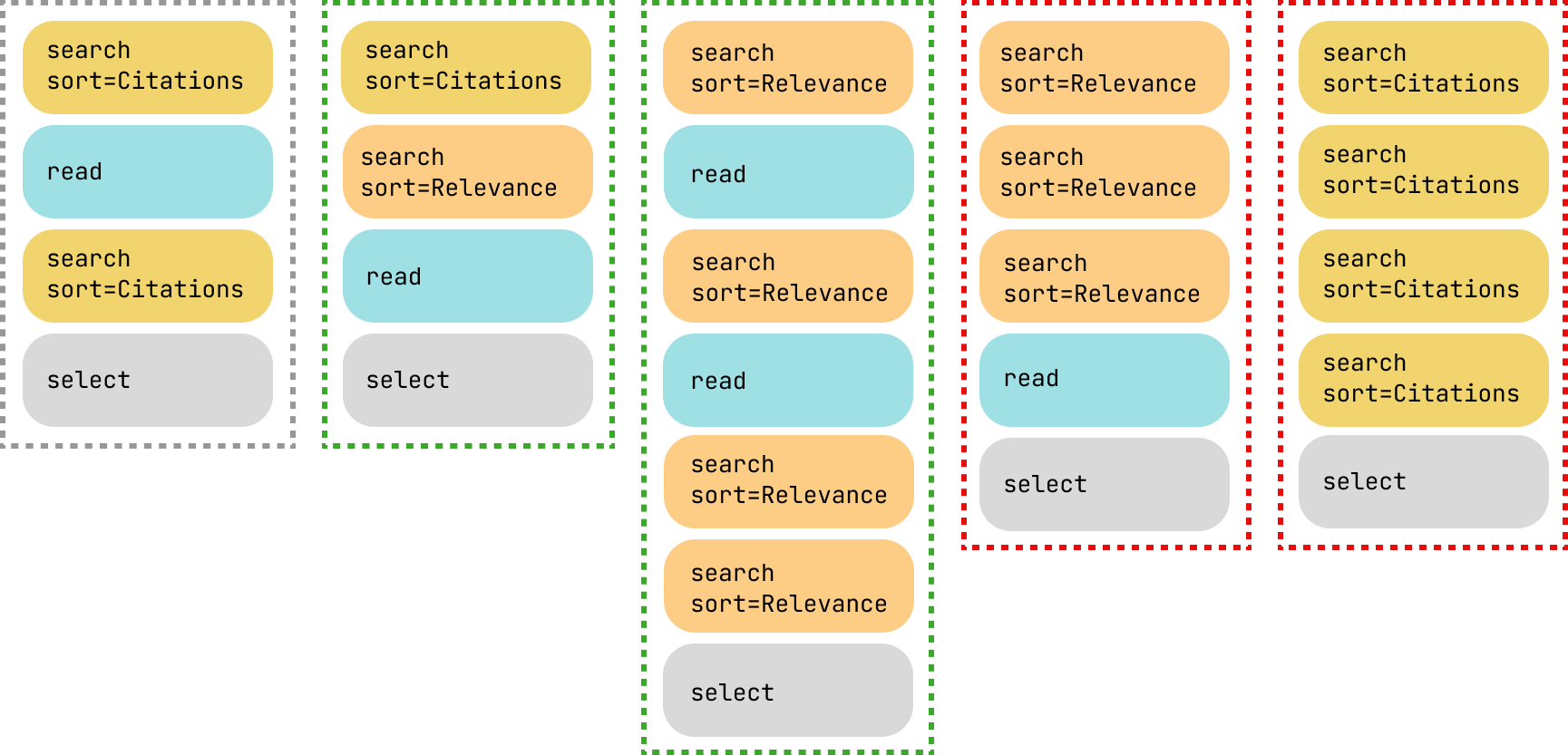
Performance across Commands. GPT-4o is the only LM whose accuracy improves with access to more commands, allowing it to read full papers. CiteAgent with GPT-4o creatively uses its commands across test samples, demonstrating command behaviors not shown in the demonstration trajectory (see Figure 4). It frequently refines its searches based on previous results and occasionally reads multiple papers before making a selection. In contrast, Claude 3 Opus is less effective in utilizing additional commands, likely due to difficulties in detecting important information [52].
<details>
<summary>extracted/5974968/figures/trajectory_analysis.png Details</summary>
### Visual Description
## Flowchart: Information Retrieval Workflow
### Overview
The image depicts a multi-stage information retrieval workflow visualized as five vertical sections, each containing stacked colored rectangles representing sequential operations. Sections are differentiated by dashed outlines (gray, green, red) and contain commands with sorting criteria ("sort=Citations" or "sort=Relevance") and actions ("read", "select").
### Components/Axes
- **Sections**: Five vertical columns labeled by dashed outlines:
1. Leftmost: Gray dashed outline
2. Second: Green dashed outline
3. Middle: No outline (longest section)
4. Fourth: Red dashed outline
5. Rightmost: Red dashed outline
- **Labels**: Textual commands in rectangles:
- Yellow: "search sort=Citations"
- Blue: "read"
- Gray: "select"
- Orange: "search sort=Relevance"
- **Flow Direction**: Top-to-bottom within each section, implying sequential execution.
### Detailed Analysis
1. **Left Section (Gray Outline)**:
- Commands:
- `search sort=Citations` (yellow)
- `read` (blue)
- `search sort=Citations` (yellow)
- `select` (gray)
- Structure: Alternating search-read pattern ending with selection.
2. **Second Section (Green Outline)**:
- Commands:
- `search sort=Citations` (yellow)
- `search sort=Relevance` (orange)
- `read` (blue)
- `select` (gray)
- Structure: Mixed sorting criteria before reading and selection.
3. **Middle Section (No Outline)**:
- Commands:
- `search sort=Relevance` (orange) ×4
- `read` (blue) ×3
- `select` (gray)
- Structure: Dominant "Relevance" sorting with repeated read operations.
4. **Fourth Section (Red Outline)**:
- Commands:
- `search sort=Relevance` (orange) ×3
- `read` (blue)
- `select` (gray)
- Structure: Balanced "Relevance" searches with single read/select.
5. **Rightmost Section (Red Outline)**:
- Commands:
- `search sort=Citations` (yellow) ×4
- `select` (gray)
- Structure: Exclusive "Citations" sorting with no read operations.
### Key Observations
- **Sorting Criteria**:
- "Citations" sorting dominates left/right sections.
- "Relevance" sorting dominates middle sections.
- **Read Operations**:
- Absent in rightmost section.
- Most frequent in middle section (3 instances).
- **Selection**:
- Universal final step in all sections.
- Gray rectangles consistently at bottom.
### Interpretation
This flowchart illustrates a comparative analysis of information retrieval strategies:
1. **Citations-First Approach** (Left/Right Sections):
- Prioritizes citation-based sorting.
- Rightmost section skips reading entirely, suggesting direct selection based on citations.
2. **Relevance-First Approach** (Middle Sections):
- Emphasizes relevance sorting with multiple read operations.
- Middle section's repetitive "search sort=Relevance" implies iterative refinement.
3. **Hybrid Strategy** (Second Section):
- Combines both sorting criteria, indicating adaptive workflows.
4. **Red-Outlined Sections** (Fourth/Fifth):
- Red outline may denote critical/alternative pathways.
- Fourth section's balanced approach contrasts with fifth's citation-exclusivity.
The workflow suggests a decision tree where sorting criteria and read operations vary based on research priorities, with selection as the universal endpoint. The absence of read operations in the rightmost section implies a confidence threshold where citations alone suffice for final selection.
</details>
Figure 4: Five CiteAgent trajectories on five different samples. CiteAgent often exhibits behavior not shown in the demonstration given in the prompt, for example: searching by citation count and then by relevance, and searching multiple times in a row. Gray dotted box: prompt demonstration; green dotted boxes: CiteAgent succeeds; red dotted boxes: CiteAgent fails.
5.1 Error Analysis
To better identify CiteAgent’s shortcomings, we analyze 50 randomly chosen CiteME samples from the best performing CiteAgent (using the GPT-4o backbone, with demonstrations, Search and Read commands) failed to solve correctly. We classify each error into three types based on CiteAgent’s searches, its predicted paper and the justification provided:
Error Type 1: Misunderstands the Excerpt. This category accounts for 50% of the errors. It occurs when CiteAgent focuses on irrelevant parts of the excerpt or omits critical details. For example, in the following excerpt:
{quoting}
The pioneering work of Reed et al. [37] approached text-guided image generation by training a conditional GAN [CITATION], conditioned by text embeddings obtained from a pretrained encoder.
CiteAgent searches for "Reed text-guided image generation conditional GAN" instead of "conditional GAN". It mistakes "Reed" as relevant to the current citation although it pertains to the previous one.
Error Type 2: Understands the Excerpt but Stops Prematurely. In 32% of cases, CiteAgent searches for the correct term, but it stops at a roughly matching paper instead of the exact match. For example, in the following excerpt:
{quoting}
Using Gaussian noise and blur, [CITATION] demonstrate the superior robustness of human vision to convolutional networks, even after networks are fine-tuned on Gaussian noise or blur.
CiteAgent found a paper comparing human and machine robustness but missed that it did not cover fine-tuned networks. Notably, this paper referenced the correct target paper, meaning CiteAgent could have found the right answer with just one more step if it had properly understood the paper it was reading. Moreover, in 12.5% of such cases, the correct paper appeared in the search results but was not chosen by CiteAgent.
Error Type 3: Finds the Correct Citation but Stops Prematurely. The last 18% of errors occur when CiteAgent reads an abstract or paper and finds the correct citation; however, instead of doing another search, it selects the paper that cites the correct citation and stops searching. For example, in the following excerpt:
{quoting}
[CITATION] investigates transformers’ theoretical expressiveness, showing that transformers cannot robustly model noncounter-free regular languages even when allowing infinite precision.
CiteAgent finds a paper discussing the target paper and reports it, but it stops at the citing paper instead of searching for the correct target paper. For instance, it reports: ".. specifically mentioning Hahn’s work on transformers’ classification decisions becoming ineffective over longer input strings. This fits well with the description in the excerpt.." but it selects the citing paper instead of finding Hahn’s work, which is the correct target paper.
Technical Errors. Aside from comprehension errors that stem from a lack of understanding an excerpt, 5.8% of runs encountered technical issues. Occasionally, the LM formats responses incorrectly, making them unparseable by the system. Additionally, the Semantic Scholar API has inconsistencies, such as not providing open access PDF links when available or linking to non-existent web pages. Further details on these technical errors are provided in Appendix F.
<details>
<summary>extracted/5974968/figures/4o_claude.png Details</summary>
### Visual Description
## Bar Charts: Command Frequency Comparison for CiteAgent with GPT-4o and Claude 3 Opus
### Overview
The image contains two side-by-side bar charts comparing command frequencies for two AI agents: "CiteAgent with GPT-4o" (left) and "CiteAgent with Claude 3 Opus" (right). Each chart visualizes the distribution of four command types across 15 steps, with frequency values ranging from 0 to 40.
### Components/Axes
- **X-axis (Step)**: Labeled "Step," with markers at intervals of 5 (0, 5, 10, 15).
- **Y-axis (Command Frequency)**: Labeled "Command Frequency," scaled from 0 to 40.
- **Legend**: Positioned on the right of each chart, with four color-coded categories:
- Yellow: `search(sort=Citations)`
- Orange: `search(sort=Relevance)`
- Teal: `read`
- Gray: `select`
### Detailed Analysis
#### CiteAgent with GPT-4o (Left Chart)
- **Step 0**:
- `search(sort=Citations)`: ~40 (yellow)
- `search(sort=Relevance)`: ~35 (orange)
- `read`: ~33 (teal)
- `select`: ~2 (gray)
- **Step 5**:
- `search(sort=Citations)`: ~15 (yellow)
- `search(sort=Relevance)`: ~10 (orange)
- `read`: ~5 (teal)
- `select`: ~3 (gray)
- **Step 10**:
- All commands drop to ~1–2 (yellow/orange/teal/gray).
- **Step 15**:
- Minimal activity (~1 for gray `select`).
#### CiteAgent with Claude 3 Opus (Right Chart)
- **Step 0**:
- `search(sort=Citations)`: ~30 (yellow)
- `search(sort=Relevance)`: ~25 (orange)
- `read`: ~10 (teal)
- `select`: ~5 (gray)
- **Step 5**:
- `search(sort=Citations)`: ~5 (yellow)
- `search(sort=Relevance)`: ~3 (orange)
- `read`: ~2 (teal)
- `select`: ~4 (gray)
- **Step 10**:
- All commands drop to ~1–2 (yellow/orange/teal/gray).
- **Step 15**:
- Minimal activity (~1 for gray `select`).
### Key Observations
1. **Dominant Commands**:
- GPT-4o prioritizes `search(sort=Citations)` and `read` at Step 0, with frequencies ~40 and ~33, respectively.
- Claude 3 Opus emphasizes `search(sort=Citations)` (~30) and `search(sort=Relevance)` (~25) at Step 0.
2. **Decline Trends**:
- Both agents show steep declines in command frequency as steps increase, with near-zero activity by Step 15.
3. **Select Command**:
- GPT-4o’s `select` command remains negligible (~2 at Step 0), while Claude 3 Opus shows moderate use (~5 at Step 0).
### Interpretation
The data suggests that **GPT-4o** is optimized for citation-based searches and reading tasks, with high initial frequencies that decay rapidly. In contrast, **Claude 3 Opus** balances citation and relevance-based searches but allocates more resources to the `select` command. The sharp decline in activity across steps implies that both agents may struggle with sustained task execution or face diminishing returns over time. The disparity in `select` usage hints at differing strategies: GPT-4o focuses on information retrieval, while Claude 3 Opus integrates selection as a core workflow component.
</details>
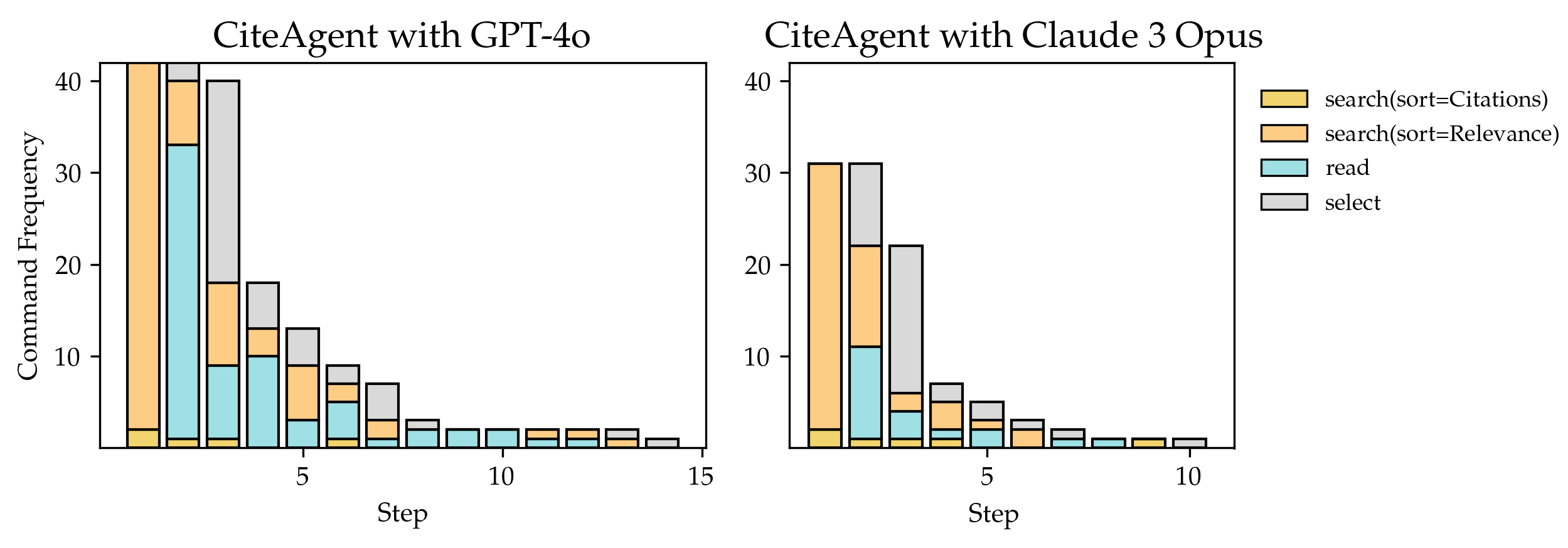
Figure 5: CiteAgent trajectories on samples that were correctly predicted reveals differences in model behavior. GPT-4o reads more frequently than Claude 3 Opus and can correctly predict papers even after performing many actions.
5.2 Analyzing the Succesful Runs
Manually examining the instances that were correctly predicted by GPT-4o and Claude 3 Opus (Figure 5) provides insights into how the LMs use commands they were given. First, we confirm the results presented in Table 4: GPT-4o frequently reads papers before it correctly predicts a citation. Second, when both LMs correctly predict a paper, they usually take just 5 steps or fewer to do so. This could stem from LMs loss of important details when given a long context window [52].
CiteAgent’s trajectories on CiteME enable us to analyze the shortcomings of GPT-4o and other SoTA LMs. These range from understanding fine details in text (Type 1 and Type 2 Errors), to not completely understanding the task (Type 3 Errors), to being unable to use commands (Technical Errors). Correcting these errors could improve the utility of LMs on CiteME and for other related tasks.
5.3 Benchmarking Reasoning Capability Improvements with Latest Models
Table 5: Accuracy (in %) of newly released LMs on CiteME.
| Commands | Method No Commands | w/o Demo | Claude-3.5-Sonnet 8.4 | LLaMa-3.1-70B 3.4 | o1-mini 16.0 | o1-preview 38.7 |
| --- | --- | --- | --- | --- | --- | --- |
| w/ Demo | 9.2 | 8.4 | 10.9 | – | | |
| Search Only | w/o Demo | 36.1 | 29.4 | 25.2 | – | |
| w/ Demo | 43.7 | 29.4 | 32.8 | – | | |
| Search and Read | w/o Demo | 37.0 | 22.7 | 26.9 | – | |
| w/ Demo | 40.3 | 27.7 | 34.5 | 61.3 | | |
We compare the latest LLMs on the CiteME benchmark (Table 5) and find that Claude 3.5 Sonnet outperforms the previous best, Claude 3 Opus. This improvement stems from better generalization, as Sonnet achieves 9.2% without internet access, compared to Opus’ 18.5%. Similarly, LLaMa-3.1-70B shows significant gains of 8% over LLaMa-3.0-70B, highlighting enhanced reasoning capabilities. However, GPT-o1, while performing well on CiteME, appears to have memorized 38.7% of the dataset, making its 61.3% benchmark performance less clear in terms of true improvement compared to GPT-4o.
6 Related Work
Recent work has made substantial progress in developing methods and datasets to assist researchers in paper writing and literature review [8, 12, 87] or act as tutors [18]. Early work [48, 56] showed that researchers automatically retrieved topics and papers considered highly relevant to their work. Other studies included methods that assist researchers in finding new ideas [34], understanding certain topics [62], provide expert answers backed up by evidence [55] or clarifying a paper’s related work by supplementing it with more information and focus [15, 67].
Closer to our line of research, prior studies developed methods for substantiating specific claims using evidence from published papers [75, 83, 85, 84, 91, 24, 39, 45]. Retrieval-augmented LMs [49, 11, 30] are also popularly used to ground claims with real-world evidence (see [60] for a survey). Chen et al. [16] built a web-based retrieval-augmented pipeline for fact verification; this contrasts with methods that use a static dataset for claim retrieval and verification [36, 5]. Concurrent to this work, Ajith et al. [2] build a retrieval benchmark consisting of questions about discoveries shown in specific machine learning papers.
Paper discovery is a crucial component of systems that automate scientific research as shown in [10, 47, 54, 61, 78]. CiteME plays an important role in developing better tools for paper discovery, and provides a way to effectively measure their efficiency. Currently, these systems are tested as a whole, without isolating the tools responsible for scientific discovery. CiteME allows us to evaluate components within them independently – and we discover that current LM Agents are not yet ready for automated paper discovery, leading to serious gaps in end-to-end automated research pipelines.
In addition, most existing LM benchmarks are saturated, with most LMs scoring 80-95% on them [43, 38, 20]. There is a need in the AI community to show what properties LMs currently lack, to show LM developers what aspects they should work on. On CiteME, the best LMs get less than 40%, clearly indicating to developers an important task that they could improve LMs on, while also providing an indicator they can use to track progress.
Context-aware Recommendation. Relevant to our research focus, [57, 64, 37] take as input documents or parts thereof and recommend papers that are likely to be cited, often referred to as context-aware citation recommendation [51, 26, 89, 28, 42, 65, 33]. The text inputs we use in CiteME resemble those used in [42, 65, 80], which contain a few sentences with a masked out citation. However, CiteME differs because it uses excerpts containing only one unambiguous citation, making the context sufficient to identify the cited paper. Furthermore, our work explores agents with access to real-time paper information through tools like Semantic Scholar. This is crucial for real-time use since thousands of new papers are indexed by arXiv monthly (e.g., 8,895 papers in March 2024 under the cs category) [4]. Most previous approaches would be impractical due to the need for retraining with every new paper issuance.
Citation Attribution Datasets. A variety of datasets contain text excerpts from scientific papers and corresponding citations [32, 31, 9, 40, 72, 44, 42, 33]. There are many crucial distinctions between the aforementioned datasets and CiteME, with the main one being that CiteME is composed of manually selected excerpts that clearly reference a paper. To our best knowledge, CiteME is the only dataset that reports human accuracy on the benchmark.
Additionally, the excerpts in CiteME are mostly taken from papers published in the last few years (see Figure 2), whereas other datasets contain older papers. For example, the arXiv dataset [33] includes papers from 1991-2020, and FullTextPaperRead [42] contains papers from 2007-2017. This currency is particularly relevant in rapidly evolving fields like machine learning. The key distinction between the dataset and methods we present compared to previous works is their real life applicability. Our agent is based on SoTA LMs, needs no extra training, and can use a search engine, all of which make it easily applicable to real-world settings.
7 Conclusion
This work introduces a citation attribution benchmark containing manually curated text excerpts that unambiguously refer to a single other paper. We posit that methods that succeed on CiteME are likely to be highly useful in assisting researchers with real-world ML-specific attribution tasks but also generally useful in finding sources for generic claims. Further, our CiteAgent autonomous system can search the Internet for and read papers, which we show to significantly enhance the abilities of LMs on CiteME. We anticipate that this work will lead to LMs that are more accurate research assistants in the vital scholarship tasks of attribution.
Author Contributions
The project was initiated by Andreas Hochlehnert and Ori Press, with feedback from Ameya Prabhu, Ofir Press, and Matthias Bethge. The dataset was created by Ori Press and Ameya Prabhu, with help from Vishaal Udandarao and Ofir Press. Experiments were carried out by Andreas Hochlehnert, with help from Ameya Prabhu. All authors contributed to the final manuscript.
Acknowledgements
The authors thank the International Max Planck Research School for Intelligent Systems (IMPRS-IS) for supporting Ori Press, Andreas Hochlehnert, and Vishaal Udandarao. Andreas Hochlehnert is supported by the Carl Zeiss Foundation through the project “Certification and Foundations of Safe ML Systems”. Matthias Bethge acknowledges financial support via the Open Philanthropy Foundation funded by the Good Ventures Foundation. Vishaal Udandarao was supported by a Google PhD Fellowship in Machine Intelligence. Matthias Bethge is a member of the Machine Learning Cluster of Excellence, funded by the Deutsche Forschungsgemeinschaft (DFG, German Research Foundation) under Germany’s Excellence Strategy – EXC number 2064/1 – Project number 390727645 and acknowledges support by the German Research Foundation (DFG): SFB 1233, Robust Vision: Inference Principles and Neural Mechanisms, TP 4, Project No: 276693517. This work was supported by the Tübingen AI Center. The authors declare no conflicts of interests.
References
- Achiam et al. [2023] Josh Achiam, Steven Adler, Sandhini Agarwal, Lama Ahmad, Ilge Akkaya, Florencia Leoni Aleman, Diogo Almeida, Janko Altenschmidt, Sam Altman, Shyamal Anadkat, et al. Gpt-4 technical report. arXiv preprint arXiv:2303.08774, 2023.
- Ajith et al. [2024] Anirudh Ajith, Mengzhou Xia, Alexis Chevalier, Tanya Goyal, Danqi Chen, and Tianyu Gao. Litsearch: A retrieval benchmark for scientific literature search. arXiv preprint arXiv:2407.18940, 2024.
- Anthropic [2024] Anthropic. Introducing the next generation of claude, 2024. URL https://www.anthropic.com/news/claude-3-family.
- arXiv [2024] arXiv. arxiv monthly submission statistics, 2024. URL https://arxiv.org/stats/monthly_submissions. Accessed: 2024-05-27.
- Atanasova [2024] Pepa Atanasova. Generating fact checking explanations. In Accountable and Explainable Methods for Complex Reasoning over Text, pages 83–103. Springer, 2024.
- Augenstein et al. [2023] Isabelle Augenstein, Timothy Baldwin, Meeyoung Cha, Tanmoy Chakraborty, Giovanni Luca Ciampaglia, David Corney, Renee DiResta, Emilio Ferrara, Scott Hale, Alon Halevy, et al. Factuality challenges in the era of large language models. arXiv preprint arXiv:2310.05189, 2023.
- Bengio [2013] Yoshua Bengio. Deep learning of representations: Looking forward. In International conference on statistical language and speech processing, pages 1–37. Springer, 2013.
- Bhagavatula et al. [2018] Chandra Bhagavatula, Sergey Feldman, Russell Power, and Waleed Ammar. Content-based citation recommendation. arXiv preprint arXiv:1802.08301, 2018.
- Bird et al. [2008] Steven Bird, Robert Dale, Bonnie Dorr, Bryan Gibson, Mark Joseph, Min-Yen Kan, Dongwon Lee, Brett Powley, Dragomir Radev, and Yee Fan Tan. The ACL Anthology reference corpus: A reference dataset for bibliographic research in computational linguistics. In Nicoletta Calzolari, Khalid Choukri, Bente Maegaard, Joseph Mariani, Jan Odijk, Stelios Piperidis, and Daniel Tapias, editors, Proceedings of the Sixth International Conference on Language Resources and Evaluation (LREC’08), Marrakech, Morocco, May 2008. European Language Resources Association (ELRA). URL http://www.lrec-conf.org/proceedings/lrec2008/pdf/445_paper.pdf.
- Boiko et al. [2023] Daniil A Boiko, Robert MacKnight, Ben Kline, and Gabe Gomes. Autonomous chemical research with large language models. Nature, 624(7992):570–578, 2023.
- Borgeaud et al. [2022] Sebastian Borgeaud, Arthur Mensch, Jordan Hoffmann, Trevor Cai, Eliza Rutherford, Katie Millican, George Bm Van Den Driessche, Jean-Baptiste Lespiau, Bogdan Damoc, Aidan Clark, et al. Improving language models by retrieving from trillions of tokens. In International conference on machine learning, pages 2206–2240. PMLR, 2022.
- Boyko et al. [2023] James Boyko, Joseph Cohen, Nathan Fox, Maria Han Veiga, Jennifer I Li, Jing Liu, Bernardo Modenesi, Andreas H Rauch, Kenneth N Reid, Soumi Tribedi, et al. An interdisciplinary outlook on large language models for scientific research. arXiv preprint arXiv:2311.04929, 2023.
- Bui et al. [2016] Thang Bui, Daniel Hernández-Lobato, Jose Hernandez-Lobato, Yingzhen Li, and Richard Turner. Deep gaussian processes for regression using approximate expectation propagation. In International conference on machine learning, pages 1472–1481. PMLR, 2016.
- Burt et al. [2020] David R Burt, Carl Edward Rasmussen, and Mark Van Der Wilk. Convergence of sparse variational inference in gaussian processes regression. Journal of Machine Learning Research, 21(131):1–63, 2020.
- Chang et al. [2023] Joseph Chee Chang, Amy X Zhang, Jonathan Bragg, Andrew Head, Kyle Lo, Doug Downey, and Daniel S Weld. Citesee: Augmenting citations in scientific papers with persistent and personalized historical context. In Proceedings of the 2023 CHI Conference on Human Factors in Computing Systems, pages 1–15, 2023.
- Chen et al. [2023] Jifan Chen, Grace Kim, Aniruddh Sriram, Greg Durrett, and Eunsol Choi. Complex claim verification with evidence retrieved in the wild. arXiv preprint arXiv:2305.11859, 2023.
- Chen et al. [2021] Mark Chen, Jerry Tworek, Heewoo Jun, Qiming Yuan, Henrique Ponde de Oliveira Pinto, Jared Kaplan, Harri Edwards, Yuri Burda, Nicholas Joseph, Greg Brockman, et al. Evaluating large language models trained on code. arXiv preprint arXiv:2107.03374, 2021.
- Chevalier et al. [2024] Alexis Chevalier, Jiayi Geng, Alexander Wettig, Howard Chen, Sebastian Mizera, Toni Annala, Max Jameson Aragon, Arturo Rodríguez Fanlo, Simon Frieder, Simon Machado, et al. Language models as science tutors. arXiv preprint arXiv:2402.11111, 2024.
- Chowdhery et al. [2023] Aakanksha Chowdhery, Sharan Narang, Jacob Devlin, Maarten Bosma, Gaurav Mishra, Adam Roberts, Paul Barham, Hyung Won Chung, Charles Sutton, Sebastian Gehrmann, et al. Palm: Scaling language modeling with pathways. Journal of Machine Learning Research, 24(240):1–113, 2023.
- Cobbe et al. [2021] Karl Cobbe, Vineet Kosaraju, Mohammad Bavarian, Mark Chen, Heewoo Jun, Lukasz Kaiser, Matthias Plappert, Jerry Tworek, Jacob Hilton, Reiichiro Nakano, et al. Training verifiers to solve math word problems. arXiv preprint arXiv:2110.14168, 2021.
- Cohan et al. [2020] Arman Cohan, Sergey Feldman, Iz Beltagy, Doug Downey, and Daniel S Weld. Specter: Document-level representation learning using citation-informed transformers. arXiv preprint arXiv:2004.07180, 2020.
- Cohen et al. [2010] K Bretonnel Cohen, Helen L Johnson, Karin Verspoor, Christophe Roeder, and Lawrence E Hunter. The structural and content aspects of abstracts versus bodies of full text journal articles are different. BMC bioinformatics, 11:1–10, 2010.
- Cox [1958] David R Cox. The regression analysis of binary sequences. Journal of the Royal Statistical Society Series B: Statistical Methodology, 20(2):215–232, 1958.
- [24] Sam Cox, Michael Hammerling, Jakub Lála, Jon Laurent, Sam Rodriques, Matt Rubashkin, and Andrew White. Wikicrow: Automating synthesis of human scientific knowledge.
- Dakhel et al. [2023] Arghavan Moradi Dakhel, Vahid Majdinasab, Amin Nikanjam, Foutse Khomh, Michel C Desmarais, and Zhen Ming Jack Jiang. Github copilot ai pair programmer: Asset or liability? Journal of Systems and Software, 203:111734, 2023.
- Ebesu and Fang [2017] Travis Ebesu and Yi Fang. Neural citation network for context-aware citation recommendation. In Proceedings of the 40th international ACM SIGIR conference on research and development in information retrieval, pages 1093–1096, 2017.
- Färber and Jatowt [2020] Michael Färber and Adam Jatowt. Citation recommendation: approaches and datasets. International Journal on Digital Libraries, 21(4):375–405, 2020.
- Färber and Sampath [2020] Michael Färber and Ashwath Sampath. Hybridcite: A hybrid model for context-aware citation recommendation. In Proceedings of the ACM/IEEE joint conference on digital libraries in 2020, pages 117–126, 2020.
- Fenniak et al. [2024] Mathieu Fenniak, Matthew Stamy, pubpub zz, Martin Thoma, Matthew Peveler, exiledkingcc, and pypdf Contributors. The pypdf library, 2024. URL https://pypi.org/project/pypdf/. See https://pypdf.readthedocs.io/en/latest/meta/CONTRIBUTORS.html for all contributors.
- Gao et al. [2023] Tianyu Gao, Howard Yen, Jiatong Yu, and Danqi Chen. Enabling large language models to generate text with citations. arXiv preprint arXiv:2305.14627, 2023.
- Gehrke et al. [2003] Johannes Gehrke, Paul Ginsparg, and Jon Kleinberg. Overview of the 2003 kdd cup. Acm Sigkdd Explorations Newsletter, 5(2):149–151, 2003.
- Giles et al. [1998] C Lee Giles, Kurt D Bollacker, and Steve Lawrence. Citeseer: An automatic citation indexing system. In Proceedings of the third ACM conference on Digital libraries, pages 89–98, 1998.
- Gu et al. [2022] Nianlong Gu, Yingqiang Gao, and Richard HR Hahnloser. Local citation recommendation with hierarchical-attention text encoder and scibert-based reranking. In European conference on information retrieval, pages 274–288. Springer, 2022.
- Gu and Krenn [2024] Xuemei Gu and Mario Krenn. Generation and human-expert evaluation of interesting research ideas using knowledge graphs and large language models. arXiv preprint arXiv:2405.17044, 2024.
- Guu et al. [2015] Kelvin Guu, John Miller, and Percy Liang. Traversing knowledge graphs in vector space. arXiv preprint arXiv:1506.01094, 2015.
- Hanselowski et al. [2019] Andreas Hanselowski, Christian Stab, Claudia Schulz, Zile Li, and Iryna Gurevych. A richly annotated corpus for different tasks in automated fact-checking. arXiv preprint arXiv:1911.01214, 2019.
- He et al. [2010] Qi He, Jian Pei, Daniel Kifer, Prasenjit Mitra, and Lee Giles. Context-aware citation recommendation. In Proceedings of the 19th international conference on World wide web, pages 421–430, 2010.
- Hendrycks et al. [2021] Dan Hendrycks, Collin Burns, Saurav Kadavath, Akul Arora, Steven Basart, Eric Tang, Dawn Song, and Jacob Steinhardt. Measuring mathematical problem solving with the math dataset. arXiv preprint arXiv:2103.03874, 2021.
- Huang et al. [2024] Chengyu Huang, Zeqiu Wu, Yushi Hu, and Wenya Wang. Training language models to generate text with citations via fine-grained rewards. arXiv preprint arXiv:2402.04315, 2024.
- Huang et al. [2014] Wenyi Huang, Zhaohui Wu, Prasenjit Mitra, and C Lee Giles. Refseer: A citation recommendation system. In IEEE/ACM joint conference on digital libraries, pages 371–374. IEEE, 2014.
- Iyyer et al. [2014] Mohit Iyyer, Jordan Boyd-Graber, Leonardo Claudino, Richard Socher, and Hal Daumé III. A neural network for factoid question answering over paragraphs. In Proceedings of the 2014 conference on empirical methods in natural language processing (EMNLP), pages 633–644, 2014.
- Jeong et al. [2020] Chanwoo Jeong, Sion Jang, Eunjeong Park, and Sungchul Choi. A context-aware citation recommendation model with bert and graph convolutional networks. Scientometrics, 124:1907–1922, 2020.
- Joshi et al. [2017] Mandar Joshi, Eunsol Choi, Daniel S Weld, and Luke Zettlemoyer. Triviaqa: A large scale distantly supervised challenge dataset for reading comprehension. arXiv preprint arXiv:1705.03551, 2017.
- Kang et al. [2018] Dongyeop Kang, Waleed Ammar, Bhavana Dalvi, Madeleine Van Zuylen, Sebastian Kohlmeier, Eduard Hovy, and Roy Schwartz. A dataset of peer reviews (peerread): Collection, insights and nlp applications. arXiv preprint arXiv:1804.09635, 2018.
- Khalifa et al. [2024] Muhammad Khalifa, David Wadden, Emma Strubell, Honglak Lee, Lu Wang, Iz Beltagy, and Hao Peng. Source-aware training enables knowledge attribution in language models. arXiv preprint arXiv:2404.01019, 2024.
- Kinney et al. [2023] Rodney Kinney, Chloe Anastasiades, Russell Authur, Iz Beltagy, Jonathan Bragg, Alexandra Buraczynski, Isabel Cachola, Stefan Candra, Yoganand Chandrasekhar, Arman Cohan, et al. The semantic scholar open data platform. arXiv preprint arXiv:2301.10140, 2023.
- Lála et al. [2023] Jakub Lála, Odhran O’Donoghue, Aleksandar Shtedritski, Sam Cox, Samuel G Rodriques, and Andrew D White. Paperqa: Retrieval-augmented generative agent for scientific research. arXiv preprint arXiv:2312.07559, 2023.
- Learning [2011] Machine Learning. Apolo: Making sense of large network data by combining. 2011.
- Lewis et al. [2020] Patrick Lewis, Ethan Perez, Aleksandra Piktus, Fabio Petroni, Vladimir Karpukhin, Naman Goyal, Heinrich Küttler, Mike Lewis, Wen-tau Yih, Tim Rocktäschel, et al. Retrieval-augmented generation for knowledge-intensive nlp tasks. Advances in Neural Information Processing Systems, 33:9459–9474, 2020.
- Lin [2009] Jimmy Lin. Is searching full text more effective than searching abstracts? BMC bioinformatics, 10:1–15, 2009.
- Liu et al. [2015] Haifeng Liu, Xiangjie Kong, Xiaomei Bai, Wei Wang, Teshome Megersa Bekele, and Feng Xia. Context-based collaborative filtering for citation recommendation. Ieee Access, 3:1695–1703, 2015.
- Liu et al. [2024] Nelson F Liu, Kevin Lin, John Hewitt, Ashwin Paranjape, Michele Bevilacqua, Fabio Petroni, and Percy Liang. Lost in the middle: How language models use long contexts. Transactions of the Association for Computational Linguistics, 12:157–173, 2024.
- Lloyd [1982] Stuart Lloyd. Least squares quantization in pcm. IEEE transactions on information theory, 28(2):129–137, 1982.
- M. Bran et al. [2024] Andres M. Bran, Sam Cox, Oliver Schilter, Carlo Baldassari, Andrew D White, and Philippe Schwaller. Augmenting large language models with chemistry tools. Nature Machine Intelligence, pages 1–11, 2024.
- Malaviya et al. [2023] Chaitanya Malaviya, Subin Lee, Sihao Chen, Elizabeth Sieber, Mark Yatskar, and Dan Roth. Expertqa: Expert-curated questions and attributed answers. arXiv preprint arXiv:2309.07852, 2023.
- Mayr [2014] Philipp Mayr. Are topic-specific search term, journal name and author name recommendations relevant for researchers? arXiv preprint arXiv:1408.4440, 2014.
- McNee et al. [2002] Sean M McNee, Istvan Albert, Dan Cosley, Prateep Gopalkrishnan, Shyong K Lam, Al Mamunur Rashid, Joseph A Konstan, and John Riedl. On the recommending of citations for research papers. In Proceedings of the 2002 ACM conference on Computer supported cooperative work, pages 116–125, 2002.
- Medić and Šnajder [2020] Zoran Medić and Jan Šnajder. Improved local citation recommendation based on context enhanced with global information. In Proceedings of the first workshop on scholarly document processing, pages 97–103, 2020.
- Metzler et al. [2021] Donald Metzler, Yi Tay, Dara Bahri, and Marc Najork. Rethinking search: making domain experts out of dilettantes. In Acm sigir forum, volume 55, pages 1–27. ACM New York, NY, USA, 2021.
- Mialon et al. [2023] Grégoire Mialon, Roberto Dessì, Maria Lomeli, Christoforos Nalmpantis, Ram Pasunuru, Roberta Raileanu, Baptiste Rozière, Timo Schick, Jane Dwivedi-Yu, Asli Celikyilmaz, et al. Augmented language models: a survey. arXiv preprint arXiv:2302.07842, 2023.
- Miret and Krishnan [2024] Santiago Miret and NM Krishnan. Are llms ready for real-world materials discovery? arXiv preprint arXiv:2402.05200, 2024.
- Murthy et al. [2022] Sonia K Murthy, Kyle Lo, Daniel King, Chandra Bhagavatula, Bailey Kuehl, Sophie Johnson, Jonathan Borchardt, Daniel S Weld, Tom Hope, and Doug Downey. Accord: A multi-document approach to generating diverse descriptions of scientific concepts. arXiv preprint arXiv:2205.06982, 2022.
- Muthukadan [2011] Baiju Muthukadan. Selenium with python. https://selenium-python.readthedocs.io/, 2011.
- Nallapati et al. [2008] Ramesh M Nallapati, Amr Ahmed, Eric P Xing, and William W Cohen. Joint latent topic models for text and citations. In Proceedings of the 14th ACM SIGKDD international conference on Knowledge discovery and data mining, pages 542–550, 2008.
- Ohagi and Aizawa [2022] Masaya Ohagi and Akiko Aizawa. Pre-trained transformer-based citation context-aware citation network embeddings. In Proceedings of the 22nd ACM/IEEE Joint Conference on Digital Libraries, pages 1–5, 2022.
- Ouyang et al. [2022] Long Ouyang, Jeffrey Wu, Xu Jiang, Diogo Almeida, Carroll Wainwright, Pamela Mishkin, Chong Zhang, Sandhini Agarwal, Katarina Slama, Alex Ray, et al. Training language models to follow instructions with human feedback. Advances in neural information processing systems, 35:27730–27744, 2022.
- Palani et al. [2023] Srishti Palani, Aakanksha Naik, Doug Downey, Amy X Zhang, Jonathan Bragg, and Joseph Chee Chang. Relatedly: Scaffolding literature reviews with existing related work sections. In Proceedings of the 2023 CHI Conference on Human Factors in Computing Systems, pages 1–20, 2023.
- Petroni et al. [2019] Fabio Petroni, Tim Rocktäschel, Patrick Lewis, Anton Bakhtin, Yuxiang Wu, Alexander H Miller, and Sebastian Riedel. Language models as knowledge bases? arXiv preprint arXiv:1909.01066, 2019.
- Polo et al. [2024] Felipe Maia Polo, Lucas Weber, Leshem Choshen, Yuekai Sun, Gongjun Xu, and Mikhail Yurochkin. tinybenchmarks: evaluating llms with fewer examples. arXiv preprint arXiv:2402.14992, 2024.
- Prabhu et al. [2024] Ameya Prabhu, Vishaal Udandarao, Philip Torr, Matthias Bethge, Adel Bibi, and Samuel Albanie. Lifelong benchmarks: Efficient model evaluation in an era of rapid progress. arXiv preprint arXiv:2402.19472, 2024.
- Press et al. [2022] Ofir Press, Muru Zhang, Sewon Min, Ludwig Schmidt, Noah A Smith, and Mike Lewis. Measuring and narrowing the compositionality gap in language models. arXiv preprint arXiv:2210.03350, 2022.
- Radev et al. [2013] Dragomir R Radev, Pradeep Muthukrishnan, Vahed Qazvinian, and Amjad Abu-Jbara. The acl anthology network corpus. Language Resources and Evaluation, 47:919–944, 2013.
- Rein et al. [2023] David Rein, Betty Li Hou, Asa Cooper Stickland, Jackson Petty, Richard Yuanzhe Pang, Julien Dirani, Julian Michael, and Samuel R Bowman. Gpqa: A graduate-level google-proof q&a benchmark. arXiv preprint arXiv:2311.12022, 2023.
- Saharia et al. [2022] Chitwan Saharia, William Chan, Saurabh Saxena, Lala Li, Jay Whang, Emily L Denton, Kamyar Ghasemipour, Raphael Gontijo Lopes, Burcu Karagol Ayan, Tim Salimans, et al. Photorealistic text-to-image diffusion models with deep language understanding. Advances in neural information processing systems, 35:36479–36494, 2022.
- Schuster et al. [2021] Tal Schuster, Adam Fisch, and Regina Barzilay. Get your vitamin c! robust fact verification with contrastive evidence. arXiv preprint arXiv:2103.08541, 2021.
- Schwartz et al. [2020] Roy Schwartz, Jesse Dodge, Noah A Smith, and Oren Etzioni. Green ai. Communications of the ACM, 63(12):54–63, 2020.
- Singh et al. [2022] Amanpreet Singh, Mike D’Arcy, Arman Cohan, Doug Downey, and Sergey Feldman. Scirepeval: A multi-format benchmark for scientific document representations. In Conference on Empirical Methods in Natural Language Processing, 2022. URL https://api.semanticscholar.org/CorpusID:254018137.
- Skarlinski et al. [2024] Michael D Skarlinski, Sam Cox, Jon M Laurent, James D Braza, Michaela Hinks, Michael J Hammerling, Manvitha Ponnapati, Samuel G Rodriques, and Andrew D White. Language agents achieve superhuman synthesis of scientific knowledge. arXiv preprint arXiv:2409.13740, 2024.
- Tang et al. [2019] Jianheng Tang, Tiancheng Zhao, Chenyan Xiong, Xiaodan Liang, Eric P Xing, and Zhiting Hu. Target-guided open-domain conversation. arXiv preprint arXiv:1905.11553, 2019.
- Tang et al. [2023] Michael Tang, Shunyu Yao, John Yang, and Karthik Narasimhan. Referral augmentation for zero-shot information retrieval. arXiv preprint arXiv:2305.15098, 2023.
- Touvron et al. [2023] Hugo Touvron, Thibaut Lavril, Gautier Izacard, Xavier Martinet, Marie-Anne Lachaux, Timothée Lacroix, Baptiste Rozière, Naman Goyal, Eric Hambro, Faisal Azhar, et al. Llama: Open and efficient foundation language models. arXiv preprint arXiv:2302.13971, 2023.
- Vinyals and Le [2015] Oriol Vinyals and Quoc Le. A neural conversational model. arXiv preprint arXiv:1506.05869, 2015.
- Wadden et al. [2021] David Wadden, Kyle Lo, Lucy Lu Wang, Arman Cohan, Iz Beltagy, and Hannaneh Hajishirzi. Multivers: Improving scientific claim verification with weak supervision and full-document context. arXiv preprint arXiv:2112.01640, 2021.
- Wadden et al. [2022] David Wadden, Kyle Lo, Bailey Kuehl, Arman Cohan, Iz Beltagy, Lucy Lu Wang, and Hannaneh Hajishirzi. Scifact-open: Towards open-domain scientific claim verification. arXiv preprint arXiv:2210.13777, 2022.
- Wright et al. [2022] Dustin Wright, David Wadden, Kyle Lo, Bailey Kuehl, Arman Cohan, Isabelle Augenstein, and Lucy Lu Wang. Generating scientific claims for zero-shot scientific fact checking. arXiv preprint arXiv:2203.12990, 2022.
- Wu et al. [2024a] Chengyue Wu, Yixiao Ge, Qiushan Guo, Jiahao Wang, Zhixuan Liang, Zeyu Lu, Ying Shan, and Ping Luo. Plot2code: A comprehensive benchmark for evaluating multi-modal large language models in code generation from scientific plots. 2024a. URL https://api.semanticscholar.org/CorpusID:269757000.
- Wu et al. [2024b] John F. Wu, Alina Hyk, Kiera McCormick, Christine Ye, Simone Astarita, Elina Baral, Jo Ciuca, Jesse Cranney, Anjalie Field, Kartheik G. Iyer, Philipp Koehn, Jenn Kotler, Sandor J. Kruk, Michelle Ntampaka, Charlie O’Neill, Josh Peek, Sanjib Sharma, and Mikaeel Yunus. Designing an evaluation framework for large language models in astronomy research. 2024b. URL https://api.semanticscholar.org/CorpusID:270199896.
- Yang et al. [2024] John Yang, Carlos E. Jimenez, Alexander Wettig, Kilian Lieret, Shunyu Yao, Karthik Narasimhan, and Ofir Press. Swe-agent: Agent computer interfaces enable software engineering language models, 2024.
- Yang et al. [2018] Libin Yang, Yu Zheng, Xiaoyan Cai, Hang Dai, Dejun Mu, Lantian Guo, and Tao Dai. A lstm based model for personalized context-aware citation recommendation. IEEE access, 6:59618–59627, 2018.
- Yao et al. [2022] Shunyu Yao, Jeffrey Zhao, Dian Yu, Nan Du, Izhak Shafran, Karthik Narasimhan, and Yuan Cao. React: Synergizing reasoning and acting in language models. arXiv preprint arXiv:2210.03629, 2022.
- Ye et al. [2023] Xi Ye, Ruoxi Sun, Sercan Ö Arik, and Tomas Pfister. Effective large language model adaptation for improved grounding. arXiv preprint arXiv:2311.09533, 2023.
- Zhang et al. [2023] Muru Zhang, Ofir Press, William Merrill, Alisa Liu, and Noah A Smith. How language model hallucinations can snowball. arXiv preprint arXiv:2305.13534, 2023.
Appendix A Excerpts from Citation Datasets
To demonstrate the problematic nature of automatically sourced text excerpts, we randomly choose 10 excerpts from FullTextPeerRead, ACL-200, RefSeer, and arXiv. We tag each sample chosen with one of 4 tags, as summarised in Table 1 in the main paper. We show each sample as it appears verbatim, using the datasets that appear in the official repository https://github.com/nianlonggu/Local-Citation-Recommendation of Gu et al. [33].
ACL-200
[9, 58]
- m which the data was extracted (original). We used a combination of automatic (e.g. BLEU–4 (OTHERCIT), METEOR (OTHERCIT)) and human metrics (using crowdsourcing) to evaluate the output (see generally, TARGETCIT . However, in the interest of space, we will restrict the discussion to a human judgment task on output preferences. We found this evaluation task to be most informative for system improvement. The ta Unattributable
- n Section 2 that it is more difficult to extract keyphrases correctly from longer documents. Second, recent unsupervised approaches have rivaled their supervised counterparts in performance (OTHERCIT; TARGETCIT b). For example, KP-Miner (OTHERCIT), an unsupervised system, ranked third in the SemEval-2010 shared task with an F-score of 25.2, which is comparable to the best supervised system scoring 27.5. 5 An Ambiguous: The citation is ambiguous by definition, as the excerpt cites more than one paper.
- rams include unigrams for all feature definitions and bigrams for selected ones. Figure 3b shows a sample of the actual extended set. We use two datasets, one prepared for the CoNLL 2000 shared task ( TARGETCIT and another prepared for the BioNLP/NLPBA 2004 shared task (OTHERCIT). They represent two different tagging tasks, chunking and named entity recognition, respectively. The CoNLL 2000 chunking dataset Trivial
- ipts were from meetings, seminars and interviews. Some authors have also referred to this phenomenon as Ellipsis because of the elliptical form of the NSU [OTHERCIT, Fern´andez et al., 2004, OTHERCIT, TARGETCIT , OTHERCIT]. While the statistical approaches 336 have been investigated for the purpose of ellipsis detection [Fern´andez et al., 2004, OTHERCIT], it has been a common practice to use rules – syntact Ambiguous: The citation is ambiguous by definition, as the excerpt cites more than one paper.
- e source language is morphologically poor, such as English, and the target language is morphologically rich, such as Russian, i.e., language pairs with a high degree of surface realization ambiguity ( TARGETCIT . To address this problem we propose a general approach based on bilingual neural networks (BNN) exploiting source-side contextual information. This paper makes a number of contributions: Unlike previ Reasonable
- n our approach and the one described in (OTHERCIT). Such a similarity is calculated by using the WordNet::Similarity tool (OTHERCIT), and, concretely, the Wu-Palmer measure, as defined in Equation 1 ( TARGETCIT . 2N3 Sim(C1, C2) ? (1) N1 + N2 + 2N3 where C1 and C2 are the synsets whose similarity we want to calculate, C3 is their least common superconcept, N1 is the number of nodes on the path from C1 to C3, Reasonable
- ch detected image object a visual attribute and a spatial relationship to the other objects in the image. The spatial relationships are translated into selected prepositions in the resulting captions. TARGETCIT used manually segmented and labeled images and introduced visual dependency representations (VDRs) that describe spatial relationships between the image objects. The captions are generated using templ Reasonable
- ous open source machine translation systems. The widely used Moses system (OTHERCIT) implements the standard phrase-based translation model. Parsingbased translation models are implemented by Joshua ( TARGETCIT , SAMT (OTHERCIT), and cdec (OTHERCIT). Cunei (OTHERCIT) implements statistical example-based translation. OTHERCIT and OTHERCIT respectively provide additional open-source implementations of phrase-b Trivial
- and test set, we had about 1000 sentences each with 10 reference translations taken from the NIST 2002 MT evaluation. All Chinese data was re-segmented with the CRF-based Stanford Chinese segmenter ( TARGETCIT that is trained on the segmentation of the Chinese Treebank for consistency. The parser used in Section 3 was used to parse the training data so that null elements could be recovered from the trees. Trivial
- rdering between nodes), their means of creation, and the scoring method used to extract the best consensus output from the lattice (OTHERCIT). In speech processing, phoneme or word lattices (OTHERCIT; TARGETCIT are used as an interface between speech recognition and understanding. Lat1318 Proceedings of the 48th Annual Meeting of the Association for Computational Linguistics, pages 1318–1327, Uppsala, Sweden Ambiguous: The citation is ambiguous by definition, as the excerpt cites more than one paper.
RefSeer
[40, 58]
- . Their experiments suggested that view independence does indeed affect the performance of co-training; but that CT, when compared to other algorithms that use labeled and unlabeled data, such as EM ( TARGETCIT ; OTHERCIT), may still prove e#ective even when an explicit feature split is unknown, provided that there is enough implicit redundancy in the data. In contrast to previous investigations of Ambiguous: The citation is ambiguous by definition, as the excerpt cites more than one paper.
- eeded is NP-hard. On the other hand, if the permutation $\pi$ avoids the pattern 1-2-3, no shuffles are needed if k $≥$ 5 (this is the result that every triangle free circle graph is 5-colorable, see again TARGETCIT ). It becomes clear once more why circle graphs “frustrated mathematicians for some years” OTHERCIT, and still continue to do so. 5 Stacking Constraints We finally consider the generalization in which ite Reasonable
- a small number of details they have many things in common, especially the process of motion compensation and the DCT. Due to similar motion compensation the motion vector (MV) can be reused very well TARGETCIT . Furthermore, the equivalent usage of the DCT of block size ? ? makes a transcoder implementation within the DCT-domain possible OTHERCIT. With the standardization of H.264 the task of heterogeneous trans Reasonable
- tioned Transactions ? Lingxiang Xiang Michael L. Scott Department of Computer Science, University of Rochester lxiang, scott@cs.rochester.edu 1. Introduction Twenty years after the initial proposal TARGETCIT , hardware transactional memory is becoming commonplace. All commercial versions to date—and all that are likely to emerge in the near future—are best effort implementations: a transaction may abort a Reasonable
- local values generating a cluster are uniformly distributed in the range of [ $\mu_{ij}$ - $\sigma_{ij}$ $×$ 0.01, $\mu_{ij}$ + $\sigma_{ij}$ $×$ 0.01]. ? Irrelevant feature f ? j $∈$ $S_{i}$ : We uniformly generate values in the entire range TARGETCIT . We then synthetically generate co-occurrence scores. While the co-occurrence score can be arbitrarily generated, it is non-trivial to decide the ground-truth clusters when featurebased and co-occurr Unattributable
- for visualizing the messagesow between objects in terms of method invocations. The scenario diagrams are generated from event traces and linked to other sources of information. Jerding and colleagues TARGETCIT , OTHERCIT focus on the interactions between program components at runtime. They observed that recurring interaction pattern can be used in the abstraction process for program understanding. The authors d Trivial: Though the cited excerpt cites more than one paper, that author name is given.
- Many multimedia services, such as audio-video conferencing or video playback, have associated with them performance requirements that must be met to guarantee acceptable service to the users. TARGETCIT describes the requirements that some typical applications place on networks. The Tenet Real-Time Protocol Suite [Ferrari92 ] is one approach to providing these real-time performance guarantees in pac Unattributable
- y of the controlled system is jeopardized. Several scheduling paradigms have been developed to support the analysis of a task set and determine if a schedule is feasible, e.g., rate-monotone analysis TARGETCIT . These scheduling paradigms rely on the assumption that the worst-case execution time (WCET) of hard real-time tasks be known a-priori. If the WCET of all tasks is known, it can be determined if a sc Reasonable
- Recommended for acceptance by L. Quan. For information on obtaining reprints of this article, please send e-mail to: tpami@computer.org, and reference IEEECS Log Number TPAMI-0308-1003. æ recovered TARGETCIT , OTHERCIT. Note that these calibration techniques can be used for both central and noncentral catadioptric cameras. 2. Self-calibration. This kind of calibration techniques uses only point correspo Ambiguous: The citation is ambiguous by definition, as the excerpt cites more than one paper.
- ic controller in which a single action is associated with each node, and an observation results in a deterministic transition to a successor node (OTHERCIT; Hansen 1998; TARGETCIT a). In other cases, it is a stochastic controller in which actions are selected based on a probability distribution associated with each node, and an observation results in a probabilistic transition Ambiguous: The citation is ambiguous by definition, as the excerpt cites more than one paper.
arXiv
[33]
- In this study we parallelized the computation of gradients to improve the efficiency, and for large datasets further improvements can be obtained by using random minibatches to perform the inversion TARGETCIT . Such a strategy can be applied to any variational inference method (e.g. also ADVI) since variational methods solve an optimization rather than a stochastic sampling problem. In comparison, this st Unattributable
- e been shown to provide superior generative quality, but VAEs have a number of advantages which include outlier robustness, improved training stability and interpretable, disentangled representations TARGETCIT . Disentangled representations are generally conceived to be representations in which each element relates to an independent (and usually semantically meaningful) generative factor OTHERCIT OTHERCIT . Achieving a di Reasonable
- tion (NTF) OTHERCIT . For example, NMF/NTF-based ML methods have been successfully used for analysis of Monte Carlo simulated fission chamber’s output signals OTHERCIT , for compression of scientific simulation data TARGETCIT , and for a variety of other applications OTHERCIT . To avoid confusion, we should emphasize that in this paper the term tensor is used to define two different types of mathematical objects. We use tensors t Unattributable
- insight about the generalization to the multipartite scenario, but also since the recovery problem for a tripartite probability distribution given all the three possible bipartite marginals is open OTHERCIT TARGETCIT OTHERCIT . Moreover, moving to the quantum scenario, also the compatibility problem for just a couple of overlapping marginals is open OTHERCIT OTHERCIT . We are then going to assume the set of the two given marginal densit Ambiguous: The citation is ambiguous by definition, as the excerpt cites more than one paper.
- seen that the proxy-SU(3) symmetry suggests N = 116 as the point of the prolate-to-oblate shape/phase transition, in agreement with existing exprerimental evidence OTHERCIT OTHERCIT OTHERCIT OTHERCIT OTHERCIT and microscopic calculations OTHERCIT OTHERCIT TARGETCIT OTHERCIT . Table 1 . Comparison between SU(3) irreps for U(6), U(10), U(15), and U(21), obtained by the code UNTOU3 OTHERCIT , contained in the relevant U(n) irrep for M valence protons or M valence neutrons. Above Ambiguous: The citation is ambiguous by definition, as the excerpt cites more than one paper.
- h cannot be explained by the traditional expected utility theory. In the context of decision-theoretic systems, Nadendla et al. have presented detection rules employed by prospect theoretic agents in TARGETCIT under different scenarios based on decision costs. In particular, the authors have focused on two types of prospect theoretic agents, namely optimists and pessimists, and have shown that the prospect Trivial: The name of the author of the referenced paper appears in the excerpt.
- .) (3) $\psi$ ( $\land$ S ) does depend on the isotopy class of the collection. Its image in the space A( $\star$ k 1 ,… ,kµ ) , however, does not. These issues, and the above proof, are discussed in full detail in TARGETCIT . We remark that, in the form presented, this theorem does not depend on the two pieces of heavy machinery employed by OTHERCIT -it depends on neither the adapted Kirby-Fenn-Rourke theorem nor the OTHERCIT calculati Unattributable
- ed to follows an addition rule 2ND 2 = analogous to that found for frequency conversion. A series of recent experiments demonstrated a more complex transfer of OAM in the generation of Raman sideband TARGETCIT OTHERCIT OTHERCIT . This process was found to follow a now wellestablished OAM-algebra for Stokes and anti-Stokes orders and was definitively verified through phase measurements in a simultaneous Young double slit e Ambiguous: The citation is ambiguous by definition, as the excerpt cites more than one paper.
- BMD. An important tool to assess the performance of decoding metrics is the generalized mutual information (GMI) OTHERCIT Sec. 2.4 ]. An interpretation of uniform BMD and bit-shaped BMD as a GMI are given in TARGETCIT and OTHERCIT , respectively. In OTHERCIT Sec. 4.2.4 ], the GMI is evaluated for a bit-metric. It is observed that the GMI increases when the bits are dependent. We call this approach shaped GMI. Besides the GMI, oth Ambiguous: The citation is ambiguous by definition, as the excerpt cites more than one paper.
- cay products dilute faster than matter, the expansion rate can be reduced around z $\sim$ 2.3. However, the simplest such model, a dark matter component decaying into dark radiation with constant lifetime TARGETCIT OTHERCIT , is in conflict with observations of the late integrated SachsWolfe effect and lensing power spectrum OTHERCIT OTHERCIT . Moreover, we find $\Omega$ ExDE becomes positive again at z < 1.5. Thus any decaying component mus Ambiguous: The citation is ambiguous by definition, as the excerpt cites more than one paper.
FullTextPeerRead [42]
- tion function: r=g.The typical training criterion for autoencoders is minimizing the reconstruction error, $\Sigma$ x $∈$ XL with respect to some loss L, typically either squared error or the binary cross-entropy TARGETCIT .Denoising autoencoders are an extension of autoencoders trained to reconstruct a clean version of an input from its corrupted version . The denoising task requires the network to learn representatio Ambiguous: Although [7] is cited, it could be argued that the original paper that used cross entropy as a loss [23] should be used.
- al matrices of parameters, and show that it outperforms the random counterpart when applied to the problem of replacing one of the fully connected layers of a convolutional neural network for ImageNet TARGETCIT . Interestingly, while the random variant is competitive in simple applications , the adaptive variant has a considerable advantage in more demanding applications .The adaptive SELLs, including Adapti Trivial
- eneous information networks. Recently, u peek_meaning:NTF . peek_catcode:NTF a . . published a question answering algorithm that converts a given question into a vector space model to find the answer TARGETCIT , but, like neural network based models 2013 , the learned model is generally uninterpretable. peek_meaning:NTF . peek_catcode:NTF a . . proposed T-verifier, a search engine based fact checker 2011 Ambiguous: The cited paper is [35], while [41] also fits the description given.
- he graph’s main component correctly. The state-of-the-art described in gives a lowest value at 58, with the best algorithms around 60, while algorithms regularized spectral methods such as the one in TARGETCIT obtain about 80 errors.The current result should also extend directly to a slowly growing number of communities . It would be interesting to extend the current approach to smaller sized communities or Unattributable
- amming approach that was used in all other structural tractability results that were known before, and as we have seen this is no coincidence. Instead, $\mathrm{B}$ -acyclic #SAT lies outside the STV-framework of TARGETCIT that explains all old results in a uniform way.We close this paper with several open problems that we feel should be explored in the future. First, our algorithm for #SAT is specifically designed for Unattributable
- our method on a fully-connected network , we compare our method with on this dataset. CIFAR and SVHN dataset, we evaluate our method on three popular network architectures: VGGNet, Net and DenseNet TARGETCIT . The VGGNet is originally designed for ImageNet classification. For our experiment a variation of the original VGGNet for CIFAR dataset is taken from . For Net, a 164-layer pre-activation Net with bo Trivial
- ars, various probabilistic extensions of description logics have been investigated, see, for instance,.The one that is closest to our approach is the type 1 extension of ALC proposed in the appendixof TARGETCIT . Briefly, This difference is the main reason why the ExpTime algorithm proposed by tz and Schrödercannot be transferred to our setting. It does not suffice to consider the satisfiable types independ Unattributable
- h we compute through current input and the previous hidden state. The final output of hidden state would be calculated based on memory cell and forget gate.In our experiment we used model discussed in TARGETCIT .t x is feature vector for tth word in a sentence and hl is previous hidden state then computation of hidden and output layer of LSTM would be.Where $\sigma$ is sigmoid activation function, $\star$ is a element Unattributable
- e use of conditional LSTMs in the generation component of neural network -based dialogue systems which depend on multiple conditioning sources and optimising multiple metrics.ral conversational agents TARGETCIT are direct extensions of the sequence-to-sequence model in which a conversation is cast as a source to target transduction problem.wever, these models are still far from real world applications becau Ambigiuous: The cited paper is [82], though [79] also fits the description given.
- onsistent with previous findings.As a comparison we also include test performances of a BNN with a Gaussian approximation , a BNN with HMC, and a sparse Gaussian process model with 50 inducing points TARGETCIT . In test-LL metric our best dropout model out-performs the Gaussian approximation method on almost all datasets, and for some datasets is on par with HMC which is the current gold standard for yesian Ambiguous: The cited paper is [13], while [14] also fits the description given.
A.1 Automatic Ambiguity Analysis
In addition to the manual analysis above, we conducted an automated analysis of the ambiguous category. Specifically, we identified excerpts that cited multiple papers simultaneously (e.g., \cite{paper1, paper2, paper3}) where one of the cited papers is the target. This analysis allowed us to establish a lower bound on ambiguous excerpts across all benchmarks (Table 6). These excerpts can not serve well as questions since they have multiple different correct answers, whereas the respective benchmarks only include one correct target answer (as in CiteME).
Table 6: Dataset ambiguity percentages from an automatic analysis. We note that this is just a lower bound estimate, as the automatic parsing is only able to detect a subset of the ambiguous excerpts. Still, these findings are consistent with our previous results, and show that previous benchmarks contain vast quantities of ambiguous excerpts.
| arXiv | 54.96 |
| --- | --- |
| ACL | 27.20 |
| RefSeer | 12.61 |
FulllTextPeerRead automatically deletes all other citations, so this was not possible to do in their case. We have updated Table 1 in the revised draft with the results with the expanded 50-sample sets and included the automatic evaluation data.
Appendix B Additional Comparison to Existing Benchmarks
We additionally compare CiteME to previous benchmarks based on information found in [33]. Importatnly, CiteME differs from previous work in that the query set, from which the answers come from, is by far the largest with 218 million papers. Additionally, CiteME makes the entire paper available to the model, and not just a snippet. These two factors make CiteME able to mimic the experience a research would have when looking for papers.
Table 7: Comparison of previous benchmarks and CiteME based on query set size, availability of full paper text, and date range.
| FullTextPeerRead [42] | 5K | ✗ | ’07-’17 |
| --- | --- | --- | --- |
| ACL-200 [9, 58] | 20K | ✗ | ’09-’15 |
| RefSeer [40, 58] | 625K | ✗ | Unk - ’14 |
| arXiv [33] | 1.7M | ✗ | ’91-’20 |
| CiteME (Ours) | 218M | ✓ | ’08-’24 |
Appendix C CiteAgent Results By Year
Language models may perform better on papers they encountered during training, with a drop in performance on newer papers, leading to better performance from more recently released models. To test this, we compare the results of our CiteAgent on excerpts from papers published before 2024 versus on excerpts from papers published in 2024. We note that the cutoff dates for Claude 3 Opus, Claude 3.5 Sonnet and GPT-4o are August 2023, August 2023 and October 2023 respectively. The results, shown in Table 8, show that this is indeed true for the LMs analyzed in this paper.
Table 8: Accuracy of CiteAgent models (in %) on questions where the target papers were published either before 2024 and during 2024
| CiteAgent + GPT-4 | 36.99% | 32.61% |
| --- | --- | --- |
| CiteAgent + Claude 3 Opus | 28.77% | 21.74% |
| CiteAgent + Claude 3.5 Sonnet | 42.47% | 36.96% |
Appendix D Verifying GPT-4 Paper Tags
We asked GPT-4 to generate 3 general tags that describe every paper in CiteME. We manually verify that the tags automatically generated by GPT-4 are overwhelmingly correct. Here, we give a few examples of papers, and their matching tags:
- Paper Name: PaLI: A Jointly-Scaled Multilingual Language-Image Model Tags: Multimodal AI Models, Vision-Language Integration, Scalable Machine Learning
- Paper Name: Grokking: Generalization Beyond Overfitting on Small Algorithmic Datasets Tags: Neural Network Generalization, Deep Learning Optimization, Algorithmic Data Analysis
- Paper Name: Minimally distorted Adversarial Examples with a Fast Adaptive Boundary Attack Tags: Adversarial Machine Learning, Neural Network Security, Robustness Evaluation]
- Paper Name: Mamba-R: Vision Mamba ALSO Needs Registers Tags: Computer Vision Models, Image Processing Techniques, Neural Network Architectures
- Mass-Editing Memory in a Transformer Tags: Language Model Updating, Natural Language Processing, Machine Learning Techniques
Appendix E Example Trajectory
Please note that the abstracts retrieved in the paper search have been redacted, and only the first two of the ten results are displayed to condense the text. Additionally, the content retrieved by the paper reading action has been abbreviated. The system prompt is omitted for brevity. Complete and exact prompts are available in the published code. User: You are now given an excerpt. Find me the paper cited in the excerpt, using the tools described above. Please make sure that the paper you select really corresponds to the excerpt: there will be details mentioned in the excerpt that should appear in the paper. If you read an abstract and it seems like it could be the paper we’re looking for, read the paper to make sure. Also: sometimes you’ll read a paper that cites the paper we’re looking for. In such cases, please go to the references in order to find the full name of the paper we’re looking for, and search for it, and then select it. Our implementation for ImageNet follows the practice in [21, 41]. The image is resized with its shorter side randomly sampled in [256, 480] for scale augmentation [41]. A 224×224 crop is randomly sampled from an image or its horizontal flip, with the per-pixel mean subtracted [21]. The standard color augmentation in [21] is used. We adopt batch normalization (BN) [CITATION] right after each convolution and before activation.
Assistant: { "reason": "The excerpt mentions batch normalization (BN) and places it right after each convolution and before activation. I’ll search for ’batch normalization’ to find the appropriate citation.", "action": { "name": "search_relevance", "query": "batch normalization" } }
User: - Paper ID: 995c5f5e62614fcb4d2796ad2faab969da51713e Title: Batch Normalization: Accelerating Deep Network Training by Reducing Internal Covariate Shift Abstract: <redacted> Citation Count: 39617 - Paper ID: 713bbd21bd4780fc92a69645a8bee2a005cc90dd Title: Comparison of normalization algorithms for cross-batch color segmentation of histopathological images Abstract: <redacted> Citation Count: 18 <Remaining 8 Results>
Assistant: { "reason": "The paper with ID 995c5f5e62614fcb4d2796ad2faab969da51713e titled ’Batch Normalization: Accelerating Deep Network Training by Reducing Internal Covariate Shift’ is explicitly about batch normalization and aligns perfectly with the mention of batch normalization in the given excerpt.", "action": { "name": "read", "paper_id": "995c5f5e62614fcb4d2796ad2faab969da51713e" } }
User: arXiv:1502.03167v3 [cs.LG] 2 Mar 2015BatchNormalization: AcceleratingDeepNetworkTrainingb y ReducingInternalCovariateShift Sergey Ioffe GoogleInc., sioffe@google.comChristianSzegedy GoogleInc., szegedy@google.com Abstract TrainingDeepNeuralNetworksiscomplicatedbythefact that the distributionofeach layer’sinputschangesduring training, as the parametersof the previouslayers change. This slows down the training by requiringlower learning <Remaining Content of the Paper>
Assistant: { "reason": "The paper Batch Normalization: Accelerating Deep Network Training by Reducing Internal Covariate Shift by Sergey Ioffe and Christian Szegedy precisely matches the description in the excerpt given. It details the application of batch normalization, placing it right after each convolution and before activation.", "action": { "name": "select", "paper_id": "995c5f5e62614fcb4d2796ad2faab969da51713e" } }
Appendix F Technical Errors
In this section, we break down the types of technical errors that can occur when running CiteAgent with a GPT-4o or Claude 3 Opus backbone.
<details>
<summary>extracted/5974968/figures/technical_errors/error_final_prompt.png Details</summary>
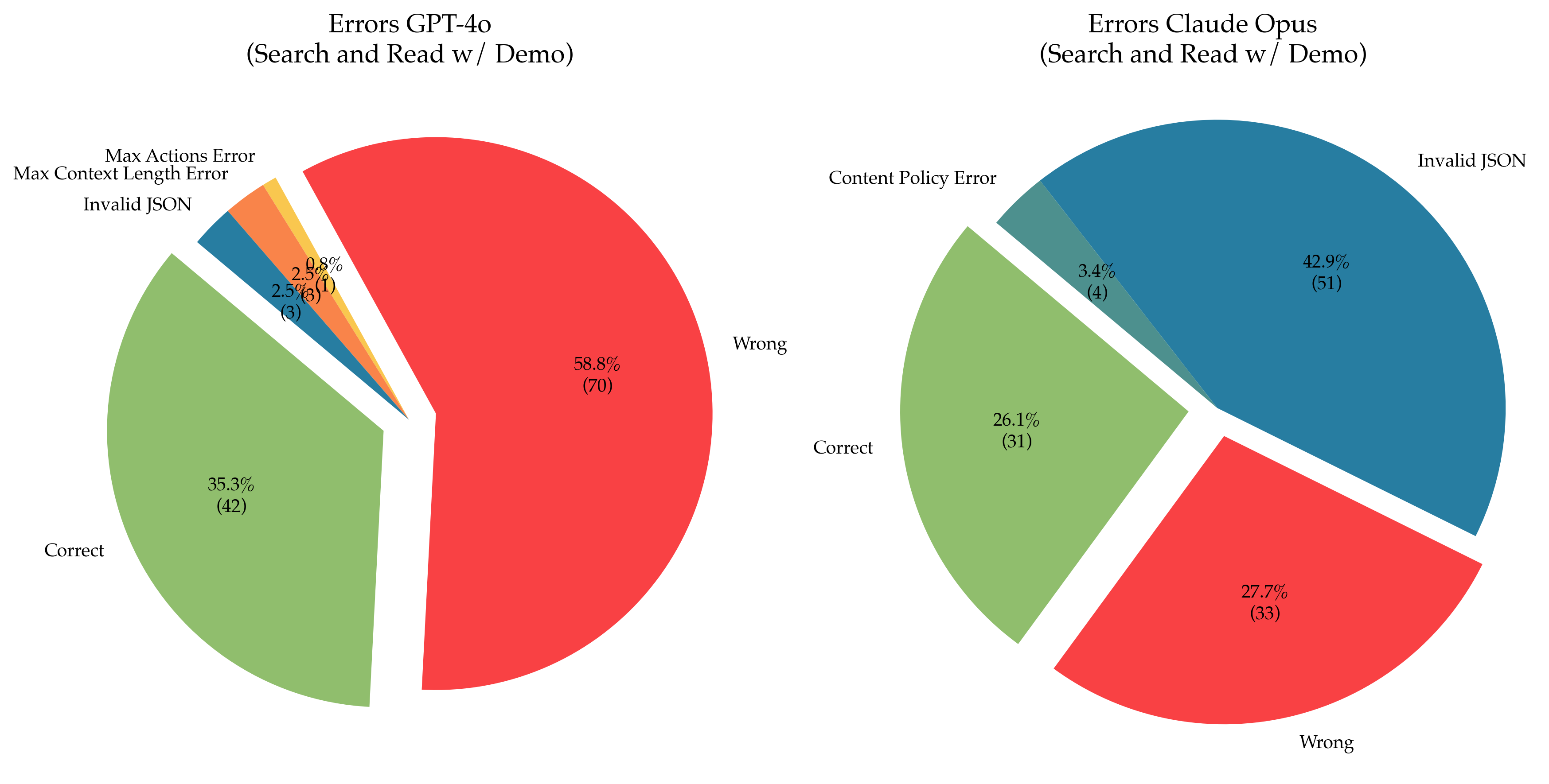
### Visual Description
## Pie Charts: Error Distribution in GPT-4o and Claude Opus Models
### Overview
Two pie charts compare error distributions for GPT-4o and Claude Opus models during search and read-with-demo tasks. Each chart categorizes errors into "Correct," "Wrong," and specific error types, with percentages and instance counts labeled.
### Components/Axes
- **X-Axis**: Not applicable (pie charts use radial segments).
- **Y-Axis**: Not applicable.
- **Legend**: Positioned on the right for both charts, with color-coded categories:
- **GPT-4o**:
- Green = Correct (35.3%, 42 instances)
- Red = Wrong (58.8%, 70 instances)
- Blue = Invalid JSON (2.5%, 3 instances)
- Orange = Max Context Length Error (2.5%, 3 instances)
- Yellow = Max Actions Error (0.8%, 1 instance)
- **Claude Opus**:
- Green = Correct (26.1%, 31 instances)
- Red = Wrong (27.7%, 33 instances)
- Blue = Invalid JSON (42.9%, 51 instances)
- Teal = Content Policy Error (3.4%, 4 instances)
### Detailed Analysis
#### GPT-4o Errors
- **Correct**: 35.3% (42 instances), largest green segment.
- **Wrong**: 58.8% (70 instances), dominant red segment.
- **Invalid JSON**: 2.5% (3 instances), small blue segment.
- **Max Context Length Error**: 2.5% (3 instances), small orange segment.
- **Max Actions Error**: 0.8% (1 instance), smallest yellow segment.
#### Claude Opus Errors
- **Correct**: 26.1% (31 instances), smaller green segment than GPT-4o.
- **Wrong**: 27.7% (33 instances), smaller red segment than GPT-4o.
- **Invalid JSON**: 42.9% (51 instances), largest blue segment.
- **Content Policy Error**: 3.4% (4 instances), small teal segment.
### Key Observations
1. **GPT-4o** has a higher "Correct" rate (35.3% vs. 26.1%) but significantly more "Wrong" errors (58.8% vs. 27.7%).
2. **Claude Opus** struggles more with **Invalid JSON** (42.9% vs. 2.5% in GPT-4o) but has fewer "Wrong" answers.
3. GPT-4o has unique error categories (**Max Context Length**, **Max Actions**), while Claude Opus includes **Content Policy Errors**.
4. Both models have minimal overlap in error types, with Claude Opus focusing on input validation and GPT-4o on response accuracy.
### Interpretation
- **GPT-4o** prioritizes response accuracy but may lack robustness in handling input constraints (e.g., context length, action limits). Its high "Wrong" error rate suggests challenges in factual or logical reasoning.
- **Claude Opus** excels in input validation (low "Wrong" errors) but falters in JSON parsing, indicating potential issues with structured data processing. The presence of **Content Policy Errors** implies stricter adherence to ethical guidelines, possibly at the cost of flexibility.
- The **Max Actions Error** in GPT-4o (0.8%) hints at limitations in task execution, while Claude Opus’s absence of this error suggests better action management.
- The disparity in "Correct" rates (35.3% vs. 26.1%) highlights GPT-4o’s superior performance in task completion, despite its higher error diversity.
This analysis underscores trade-offs between accuracy, validation, and constraint handling in large language models.
</details>
Figure 6: Different technical errors for the CiteAgent with Search and Read command with Demo comparing the GPT-4o and Claude Opus backbone. Claude Opus has a significantly higher error rate. It struggles to adhere to the expected JSON fromat and in four cases the content filter was triggered.
<details>
<summary>extracted/5974968/figures/technical_errors/error_zero_shot_search.png Details</summary>
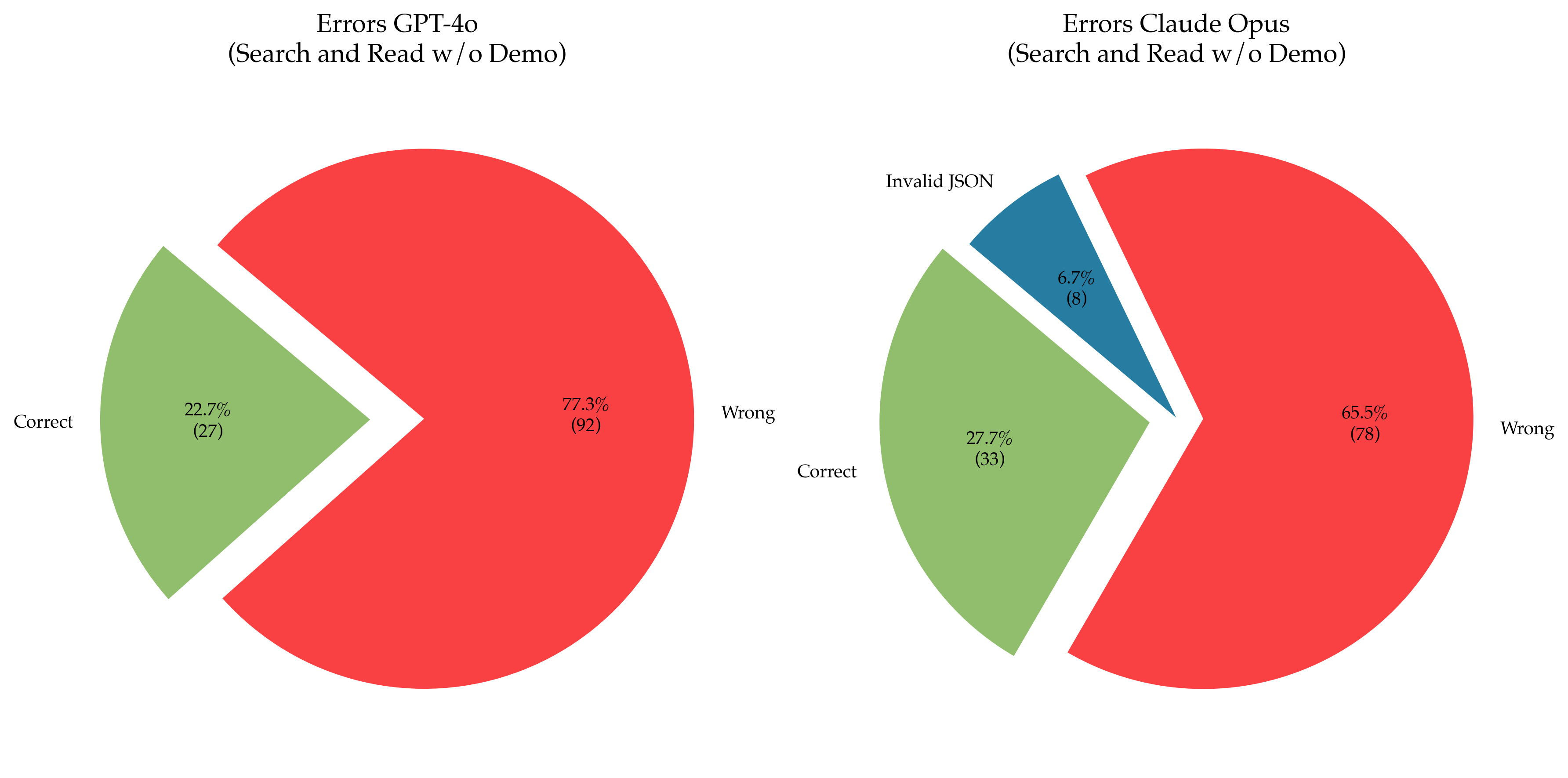
### Visual Description
## Pie Charts: Errors GPT-4o and Claude Opus (Search and Read w/o Demo)
### Overview
The image contains two side-by-side pie charts comparing error distributions for two AI models: GPT-4o and Claude Opus, during search and read tasks without demonstration. Each chart breaks down errors into categories with percentages and absolute counts.
### Components/Axes
- **X-Axis**: Not applicable (pie charts use radial segments).
- **Y-Axis**: Not applicable (pie charts use radial segments).
- **Legend**:
- **GPT-4o**:
- Green = Correct (22.7%, 27 instances)
- Red = Wrong (77.3%, 92 instances)
- **Claude Opus**:
- Green = Correct (27.7%, 33 instances)
- Red = Wrong (65.5%, 78 instances)
- Blue = Invalid JSON (6.7%, 8 instances)
- **Title**:
- Left chart: "Errors GPT-4o (Search and Read w/o Demo)"
- Right chart: "Errors Claude Opus (Search and Read w/o Demo)"
### Detailed Analysis
#### GPT-4o Errors
- **Correct**: 22.7% (27 instances) in green.
- **Wrong**: 77.3% (92 instances) in red, dominating the chart.
- **Trend**: Overwhelming majority of errors are "Wrong," indicating poor performance in search and read tasks without demonstration.
#### Claude Opus Errors
- **Correct**: 27.7% (33 instances) in green.
- **Wrong**: 65.5% (78 instances) in red.
- **Invalid JSON**: 6.7% (8 instances) in blue, a unique error category not present in GPT-4o.
- **Trend**: Lower "Wrong" errors compared to GPT-4o, but still a majority. Introduction of "Invalid JSON" errors suggests additional failure modes.
### Key Observations
1. **Error Distribution**:
- GPT-4o has a significantly higher proportion of "Wrong" errors (77.3%) compared to Claude Opus (65.5%).
- Claude Opus introduces a new error type ("Invalid JSON"), absent in GPT-4o.
2. **Accuracy**:
- Claude Opus shows marginally better correctness (27.7% vs. 22.7% for GPT-4o).
3. **Error Types**:
- GPT-4o errors are binary (Correct/Wrong), while Claude Opus includes a third category (Invalid JSON).
### Interpretation
The data suggests that Claude Opus performs slightly better in search and read tasks without demonstration, with a lower proportion of "Wrong" errors. However, its introduction of "Invalid JSON" errors indicates potential issues with input validation or parsing. GPT-4o’s higher "Wrong" error rate highlights limitations in task accuracy, possibly due to reliance on contextual understanding without demonstration. The presence of "Invalid JSON" in Claude Opus may reflect stricter input requirements or different architectural handling of malformed data. These differences underscore trade-offs in model design for specific task scenarios.
</details>
Figure 7: Different technical errors for the CiteAgent with Search and Read command without Demo comparing the GPT-4o and Claude Opus backbone. Because there is no demo the system prompt is much shorter just containing the task description and the format instructions. One can see that the JSON error rate for Claude Opus is now drastically reduced. GPT-4o also exhibits a smaller error rate but its performance is degraded.
<details>
<summary>extracted/5974968/figures/technical_errors/error_search_only_demo.png Details</summary>
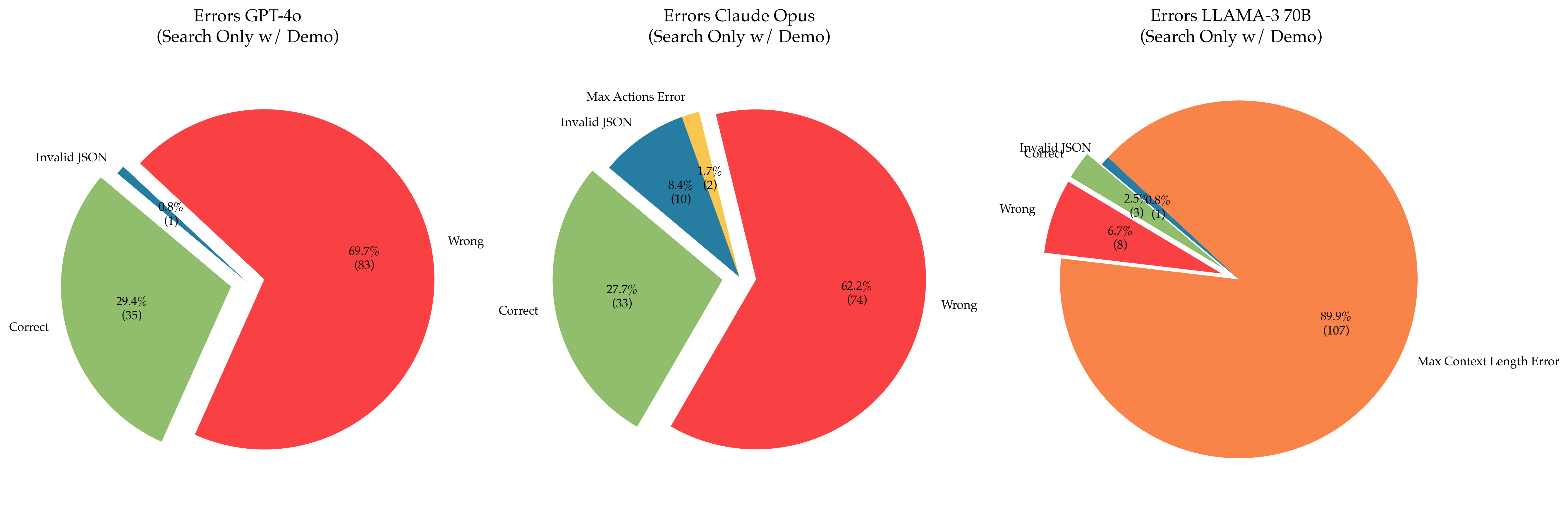
### Visual Description
## Pie Charts: Error Distribution Across AI Models (GPT-4o, Claude Opus, LLaMA-3 70B)
### Overview
Three pie charts compare error distributions for three AI models: GPT-4o, Claude Opus, and LLaMA-3 70B. Each chart categorizes errors into "Wrong," "Correct," "Invalid JSON," and model-specific errors ("Max Actions Error" for Claude Opus, "Max Context Length Error" for LLaMA-3 70B). Percentages and raw counts are provided for each category.
---
### Components/Axes
#### Common Elements:
- **Legend**: Positioned on the right side of each chart, mapping colors to error categories.
- **Categories**:
- **Wrong**: Red
- **Correct**: Green
- **Invalid JSON**: Blue (GPT-4o, LLaMA-3 70B) / Yellow (Claude Opus)
- **Model-Specific Errors**:
- **Max Actions Error** (Claude Opus): Yellow
- **Max Context Length Error** (LLaMA-3 70B): Orange
- **Percentages**: Displayed inside each slice, with raw counts in parentheses.
#### Spatial Grounding:
- Legends are consistently placed on the **right** of each chart.
- "Wrong" errors dominate the largest slices in all charts, occupying the **top-left** quadrant visually.
---
### Detailed Analysis
#### 1. **GPT-4o (Search Only w/ Demo)**
- **Wrong**: 69.7% (83 errors) – Dominates the chart in red.
- **Correct**: 29.4% (35 errors) – Green slice, second-largest.
- **Invalid JSON**: 0.8% (1 error) – Tiny blue slice at the bottom.
#### 2. **Claude Opus (Search Only w/ Demo)**
- **Wrong**: 62.2% (74 errors) – Red, largest slice.
- **Correct**: 27.7% (33 errors) – Green, second-largest.
- **Invalid JSON**: 8.4% (10 errors) – Blue slice, smaller than "Correct."
- **Max Actions Error**: 1.7% (2 errors) – Tiny yellow slice.
#### 3. **LLaMA-3 70B (Search Only w/ Demo)**
- **Max Context Length Error**: 89.9% (107 errors) – Orange, overwhelming majority.
- **Wrong**: 6.7% (8 errors) – Red, small slice.
- **Correct**: 2.5% (3 errors) – Green, tiny slice.
- **Invalid JSON**: 0.8% (1 error) – Blue, negligible.
---
### Key Observations
1. **Error Prioritization**:
- GPT-4o and Claude Opus prioritize "Wrong" errors, but GPT-4o has a higher proportion (69.7% vs. 62.2%).
- LLaMA-3 70B is almost entirely dominated by "Max Context Length Error" (89.9%), suggesting a critical limitation in handling long-context tasks.
2. **Invalid JSON**:
- Claude Opus has the highest "Invalid JSON" rate (8.4%), indicating potential issues with input/output formatting or API integration.
3. **Model-Specific Errors**:
- Claude Opus’s "Max Actions Error" (1.7%) and LLaMA-3’s "Max Context Length Error" (89.9%) highlight distinct architectural constraints.
---
### Interpretation
- **GPT-4o** balances "Wrong" and "Correct" errors but struggles with minor JSON validation issues. Its error profile suggests general performance limitations in search tasks.
- **Claude Opus** shows a more balanced error distribution but has a notable "Invalid JSON" rate, possibly due to stricter input validation or integration challenges.
- **LLaMA-3 70B**’s overwhelming "Max Context Length Error" implies it is poorly optimized for tasks requiring extended context, despite its large parameter size. This could reflect training data biases or architectural inefficiencies in context handling.
The data underscores trade-offs between model size, task specificity, and error types. LLaMA-3’s dominance in "Max Context Length Error" suggests it may be unsuitable for applications requiring long-context processing, while GPT-4o and Claude Opus offer more balanced but still error-prone performance.
</details>
Figure 8: Different technical errors for the CiteAgent with Search Only command with Demo comparing the GPT-4o, Claude Opus and LLaMA-3 70B backbone. The system prompt containing the Demo takes up a considerable amount of LLaMA-3’s context length therefore just a few actions lead to the model running out of context.
<details>
<summary>extracted/5974968/figures/technical_errors/error_search_only_no_demo.png Details</summary>
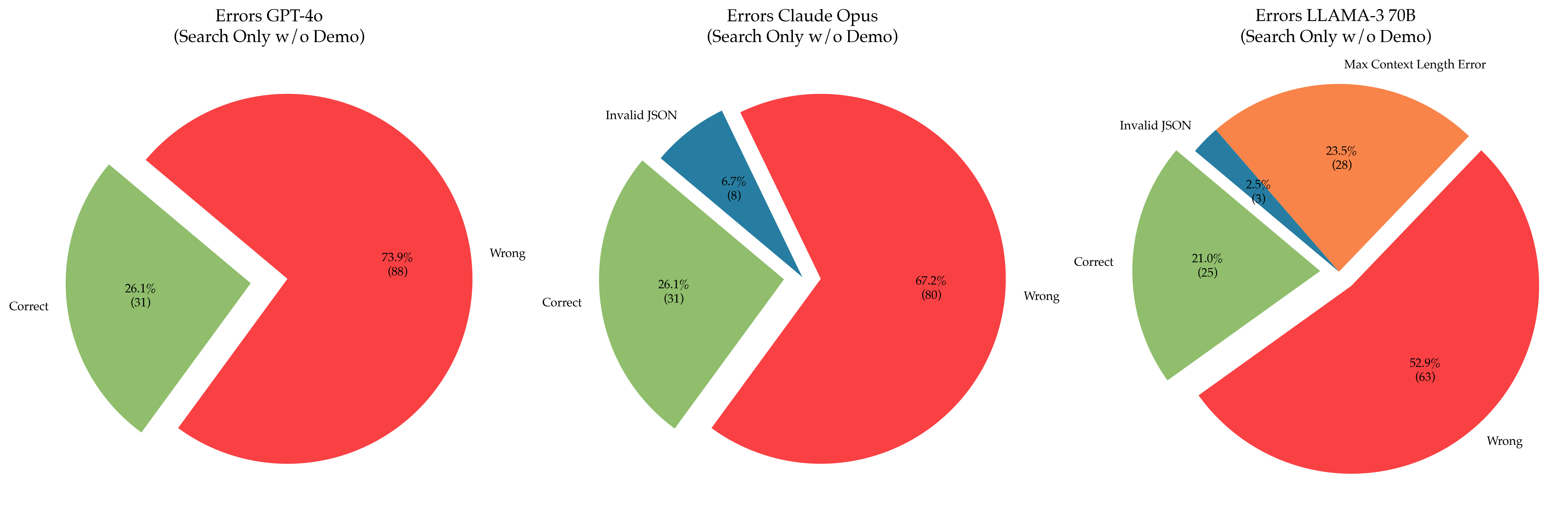
### Visual Description
## Pie Charts: Error Distribution in AI Models (Search Only w/o Demo)
### Overview
The image contains three pie charts comparing error distributions across three AI models: GPT-4o, Claude Opus, and LLAMA-3 70B. Each chart breaks down results into "Correct," "Wrong," and "Invalid JSON" categories, with numerical counts and percentages provided. The charts are labeled with model names and subtitles specifying "Search Only w/o Demo" (with an additional note for LLAMA-3 about "Max Context Length Error").
---
### Components/Axes
1. **Legend** (Top-left corner):
- **Green**: Correct responses
- **Red**: Wrong responses
- **Blue**: Invalid JSON responses
2. **Chart Structure**:
- Each pie chart represents a single model.
- Segments are labeled with:
- Category names ("Correct," "Wrong," "Invalid JSON")
- Percentages (e.g., 26.1%)
- Numerical counts (e.g., 31)
3. **Subtitles**:
- GPT-4o: "(Search Only w/o Demo)"
- Claude Opus: "(Search Only w/o Demo)"
- LLAMA-3 70B: "(Search Only w/o Demo)" + "(Max Context Length Error)"
---
### Detailed Analysis
#### GPT-4o
- **Correct**: 26.1% (31 responses)
- **Wrong**: 73.9% (88 responses)
- **Invalid JSON**: Not present
#### Claude Opus
- **Correct**: 26.1% (31 responses)
- **Wrong**: 67.2% (80 responses)
- **Invalid JSON**: 6.7% (8 responses)
#### LLAMA-3 70B
- **Correct**: 21.0% (25 responses)
- **Wrong**: 52.9% (63 responses)
- **Invalid JSON**: 23.5% (28 responses)
---
### Key Observations
1. **Error Dominance**:
- GPT-4o has the highest "Wrong" error rate (73.9%), far exceeding the other models.
- LLAMA-3 70B has the highest "Invalid JSON" error rate (23.5%), suggesting input parsing issues.
2. **Consistency in Correct Responses**:
- GPT-4o and Claude Opus share identical "Correct" percentages (26.1%), despite differing total error distributions.
3. **LLAMA-3 Anomaly**:
- The "Max Context Length Error" note implies potential limitations in handling long input sequences, which may contribute to its lower "Correct" rate (21.0%).
---
### Interpretation
- **Model Performance**:
- GPT-4o struggles most with accuracy ("Wrong" errors), while LLAMA-3 faces challenges with input validation ("Invalid JSON").
- Claude Opus balances errors but still has a majority of "Wrong" responses (67.2%).
- **Technical Implications**:
- The "Invalid JSON" errors in Claude Opus and LLAMA-3 suggest issues with structured data handling or input formatting.
- The "Max Context Length Error" for LLAMA-3 hints at architectural constraints affecting performance in search tasks without a demo.
- **Comparative Insights**:
- All models underperform in "Correct" responses, but GPT-4o’s high "Wrong" rate indicates systemic issues in result generation.
- LLAMA-3’s unique error category ("Max Context Length Error") may require targeted optimization for search tasks.
---
### Spatial Grounding & Trend Verification
- **Legend Placement**: Top-left corner, clearly associating colors with categories.
- **Trend Consistency**:
- GPT-4o’s "Wrong" segment (red) dominates visually, aligning with its 73.9% value.
- LLAMA-3’s "Invalid JSON" (blue) is the largest non-red segment, matching its 23.5% count.
---
### Final Notes
The data highlights trade-offs between accuracy and input robustness across models. GPT-4o prioritizes output generation at the cost of correctness, while LLAMA-3’s input validation issues may stem from context length limitations. Claude Opus offers a middle ground but still requires improvement in both accuracy and JSON handling.
</details>
Figure 9: Different technical errors for the CiteAgent with Search Only command without Demo comparing the GPT-4o, Claude Opus and LLaMA-3 70B backbone.
<details>
<summary>extracted/5974968/figures/technical_errors/error_final_prompt2.png Details</summary>
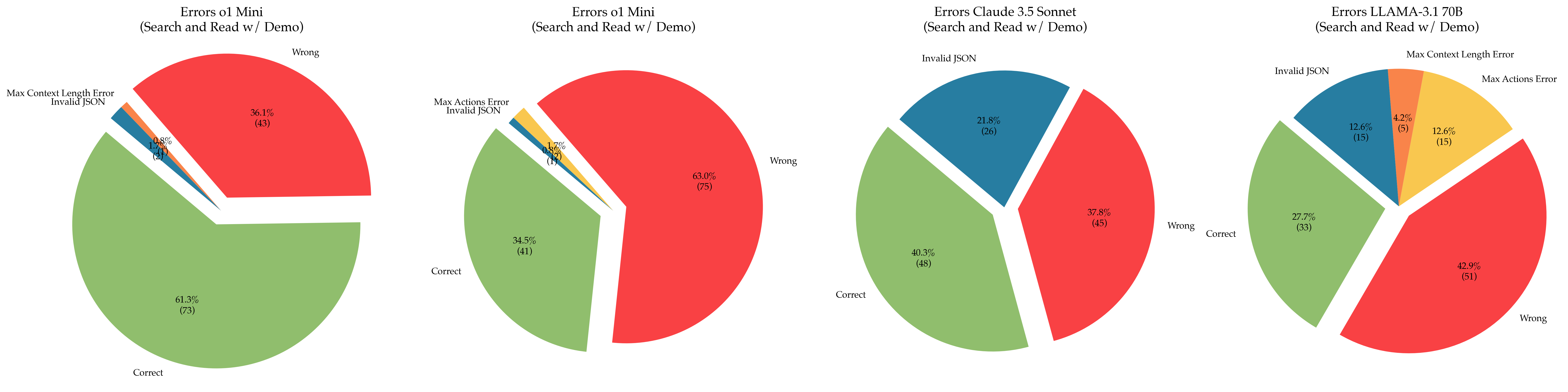
### Visual Description
## Pie Charts: Error Distributions Across AI Models (Search and Read w/ Demo)
### Overview
The image contains four pie charts comparing error distributions across four AI models:
1. Errors o1 Mini
2. Errors o1 Mini (duplicate title, likely a variant)
3. Errors Claude 3.5 Sonnet
4. Errors LLaMA-3.1 70B
Each chart categorizes results into "Correct," "Wrong," "Invalid JSON," and smaller error subtypes (e.g., "Max Context Length Error," "Max Actions Error"). Percentages and counts are provided for each category.
---
### Components/Axes
- **Titles**: Explicitly state the model and context (e.g., "Errors o1 Mini (Search and Read w / Demo)").
- **Categories**:
- **Primary**: "Correct," "Wrong," "Invalid JSON."
- **Secondary**: Sub-errors like "Max Context Length Error" and "Max Actions Error" (only in some charts).
- **Colors**:
- Green = "Correct"
- Red = "Wrong"
- Blue = "Invalid JSON"
- Yellow/Orange = Secondary errors (varies by chart).
- **Legends**: Implied via color coding; no explicit legend box is visible.
---
### Detailed Analysis
#### Chart 1: Errors o1 Mini
- **Correct**: 61.3% (73)
- **Wrong**: 36.1% (43)
- **Invalid JSON**: 2.6% (3)
- **Max Context Length Error**: 0.8% (1)
- **Max Actions Error**: 0.2% (0.5)
#### Chart 2: Errors o1 Mini (Variant)
- **Correct**: 34.5% (41)
- **Wrong**: 63.0% (75)
- **Invalid JSON**: 1.7% (1)
- **Max Actions Error**: 0.7% (1)
#### Chart 3: Errors Claude 3.5 Sonnet
- **Correct**: 40.3% (48)
- **Wrong**: 37.8% (45)
- **Invalid JSON**: 21.8% (26)
#### Chart 4: Errors LLaMA-3.1 70B
- **Correct**: 27.7% (33)
- **Wrong**: 42.9% (51)
- **Invalid JSON**: 12.6% (15)
- **Max Actions Error**: 12.6% (15)
- **Max Context Length Error**: 4.2% (5)
---
### Key Observations
1. **Dominant Categories**:
- "Correct" and "Wrong" dominate all charts, with "Invalid JSON" varying significantly.
- LLaMA-3.1 70B has the highest "Wrong" (42.9%) and "Max Actions Error" (12.6%).
- Claude 3.5 Sonnet has the highest "Invalid JSON" (21.8%).
2. **Secondary Errors**:
- "Max Context Length Error" and "Max Actions Error" are minor but present in some models.
- LLaMA-3.1 70B has the most diverse error distribution, including both secondary errors.
3. **Model Performance**:
- o1 Mini (first chart) has the highest "Correct" rate (61.3%).
- o1 Mini (second chart) has the lowest "Correct" rate (34.5%) and highest "Wrong" (63.0%).
---
### Interpretation
- **Model Reliability**:
- Models with higher "Correct" percentages (e.g., o1 Mini) perform better in search and read tasks.
- High "Wrong" rates (e.g., o1 Mini variant) suggest frequent logical or factual errors.
- **Input Sensitivity**:
- "Invalid JSON" errors (e.g., Claude 3.5 Sonnet) indicate issues with input formatting or schema validation.
- **Edge Cases**:
- Secondary errors like "Max Context Length" and "Max Actions" may reflect limitations in handling long inputs or complex workflows.
- **Anomalies**:
- The duplicate "Errors o1 Mini" charts suggest a possible data duplication or variant testing scenario.
- LLaMA-3.1 70B’s high "Wrong" and secondary errors highlight potential trade-offs between scale and precision.
---
### Spatial Grounding & Color Verification
- All charts follow a consistent color scheme:
- Green = "Correct" (confirmed across all charts).
- Red = "Wrong" (confirmed across all charts).
- Blue = "Invalid JSON" (confirmed in Charts 1, 3, 4).
- Secondary errors use distinct colors (yellow/orange) but lack a unified legend.
---
### Conclusion
The data reveals trade-offs between model performance, input sensitivity, and error types. While o1 Mini variants show mixed results, Claude 3.5 Sonnet and LLaMA-3.1 70B exhibit distinct error profiles, suggesting differences in architecture or training data handling. Further analysis of input validation and error mitigation strategies is warranted.
</details>
Figure 10: Different technical errors for the CiteAgent with Search and Read command with Demo comparing the o1-Preview, o1-Mini, Claude 3.5 Sonnet and LLaMA-3.1 70B backbone.
<details>
<summary>extracted/5974968/figures/technical_errors/error_search_and_read_no_demo.png Details</summary>
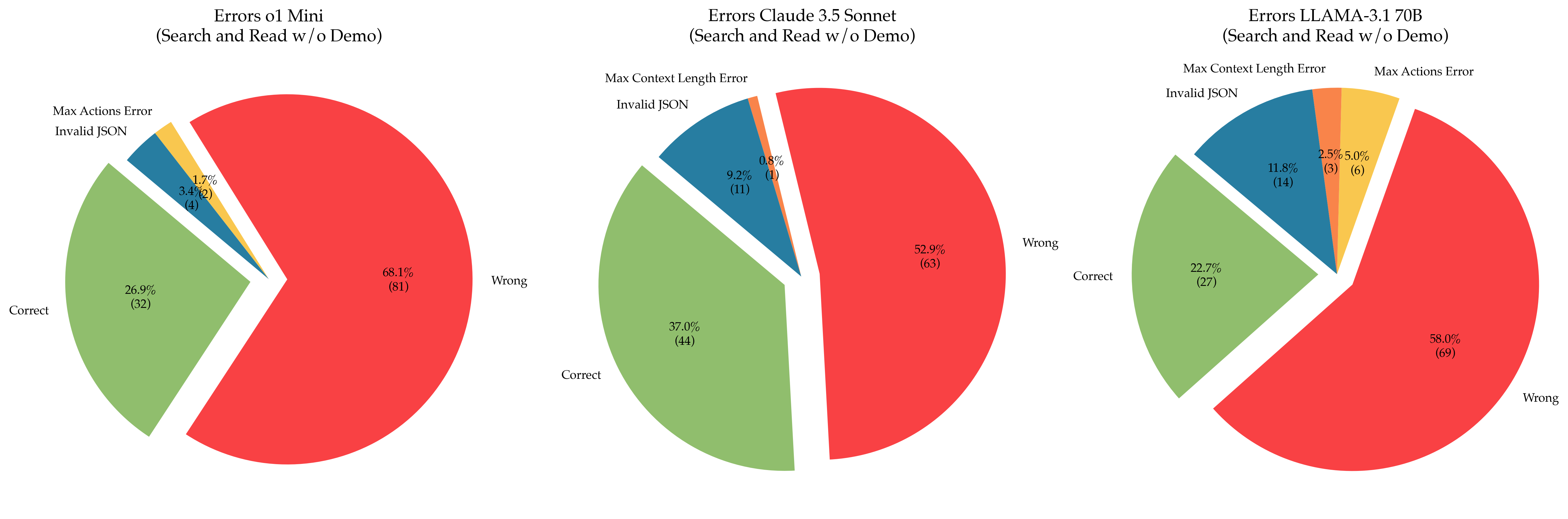
### Visual Description
## Pie Charts: Error Distribution Across AI Models (Search and Read w/o Demo)
### Overview
The image contains three pie charts comparing error distributions for three AI models:
1. **Errors o1 Mini**
2. **Errors Claude 3.5 Sonnet**
3. **Errors LLAMA-3.1 70B**
Each chart categorizes responses into:
- **Correct** (green)
- **Wrong** (red)
- **Max Actions Error** (yellow)
- **Invalid JSON** (blue)
- **Max Context Length Error** (orange)
Percentages and absolute counts are provided for each category.
---
### Components/Axes
#### Labels & Legends
- **X-Axis**: Not applicable (pie charts).
- **Y-Axis**: Not applicable (pie charts).
- **Legends**:
- **Red**: Wrong responses
- **Green**: Correct responses
- **Yellow**: Max Actions Error
- **Blue**: Invalid JSON
- **Orange**: Max Context Length Error
#### Textual Elements
- **Chart Titles**:
- "Errors o1 Mini (Search and Read w/o Demo)"
- "Errors Claude 3.5 Sonnet (Search and Read w/o Demo)"
- "Errors LLAMA-3.1 70B (Search and Read w/o Demo)"
- **Category Labels**:
- Correct, Wrong, Max Actions Error, Invalid JSON, Max Context Length Error
- **Percentages/Counts**:
- Displayed as percentages (e.g., 68.1%) and absolute counts (e.g., 81) in parentheses.
---
### Detailed Analysis
#### **Errors o1 Mini**
- **Wrong**: 68.1% (81 responses)
- **Correct**: 26.9% (32 responses)
- **Invalid JSON**: 3.4% (4 responses)
- **Max Actions Error**: 1.7% (2 responses)
- **Max Context Length Error**: Not present.
#### **Errors Claude 3.5 Sonnet**
- **Wrong**: 52.9% (63 responses)
- **Correct**: 37.0% (44 responses)
- **Invalid JSON**: 9.2% (11 responses)
- **Max Context Length Error**: 0.8% (1 response)
- **Max Actions Error**: Not present.
#### **Errors LLAMA-3.1 70B**
- **Wrong**: 58.0% (69 responses)
- **Correct**: 22.7% (27 responses)
- **Invalid JSON**: 11.8% (14 responses)
- **Max Actions Error**: 5.0% (6 responses)
- **Max Context Length Error**: 2.5% (3 responses)
---
### Key Observations
1. **Dominant Errors**:
- All models show **Wrong** responses as the largest category, with LLAMA-3.1 70B having the highest (58.0%).
- **o1 Mini** has the lowest Correct responses (26.9%), while **Claude 3.5 Sonnet** has the highest (37.0%).
2. **Error Variability**:
- **Invalid JSON** is most frequent in **LLAMA-3.1 70B** (11.8%) and **Claude 3.5 Sonnet** (9.2%).
- **Max Context Length Error** is unique to **Claude 3.5 Sonnet** (0.8%) and **LLAMA-3.1 70B** (2.5%).
- **Max Actions Error** appears only in **o1 Mini** (1.7%) and **LLAMA-3.1 70B** (5.0%).
3. **Model Performance**:
- **o1 Mini** has the highest error rate overall (68.1% Wrong).
- **LLAMA-3.1 70B** has the most diverse error types but the lowest Correct responses (22.7%).
---
### Interpretation
- **Model Strengths/Weaknesses**:
- **Claude 3.5 Sonnet** performs best in accuracy (37.0% Correct) but struggles with Invalid JSON (9.2%).
- **LLAMA-3.1 70B** has the highest error diversity, suggesting potential issues with handling complex tasks (e.g., Max Context Length and Max Actions).
- **o1 Mini** exhibits the highest failure rate, indicating possible limitations in task execution.
- **Error Patterns**:
- **Invalid JSON** and **Wrong** responses dominate across models, suggesting common issues in input parsing or logic.
- **Max Context Length Error** in Claude 3.5 Sonnet and LLAMA-3.1 70B may reflect constraints in handling long inputs.
- **Anomalies**:
- **o1 Mini** lacks Max Context Length Error, while **LLAMA-3.1 70B** has the most varied error types.
- **Max Actions Error** is disproportionately high in LLAMA-3.1 70B (5.0%), hinting at potential overuse of actions in certain tasks.
This data highlights trade-offs between model complexity and error profiles, with Claude 3.5 Sonnet showing the most balanced performance.
</details>
Figure 11: Different technical errors for the CiteAgent with Search and Read command without Demo comparing the o1-Mini, Claude 3.5 Sonnet and LLaMA-3.1 70B backbone.
<details>
<summary>extracted/5974968/figures/technical_errors/error_search_only_demo2.png Details</summary>
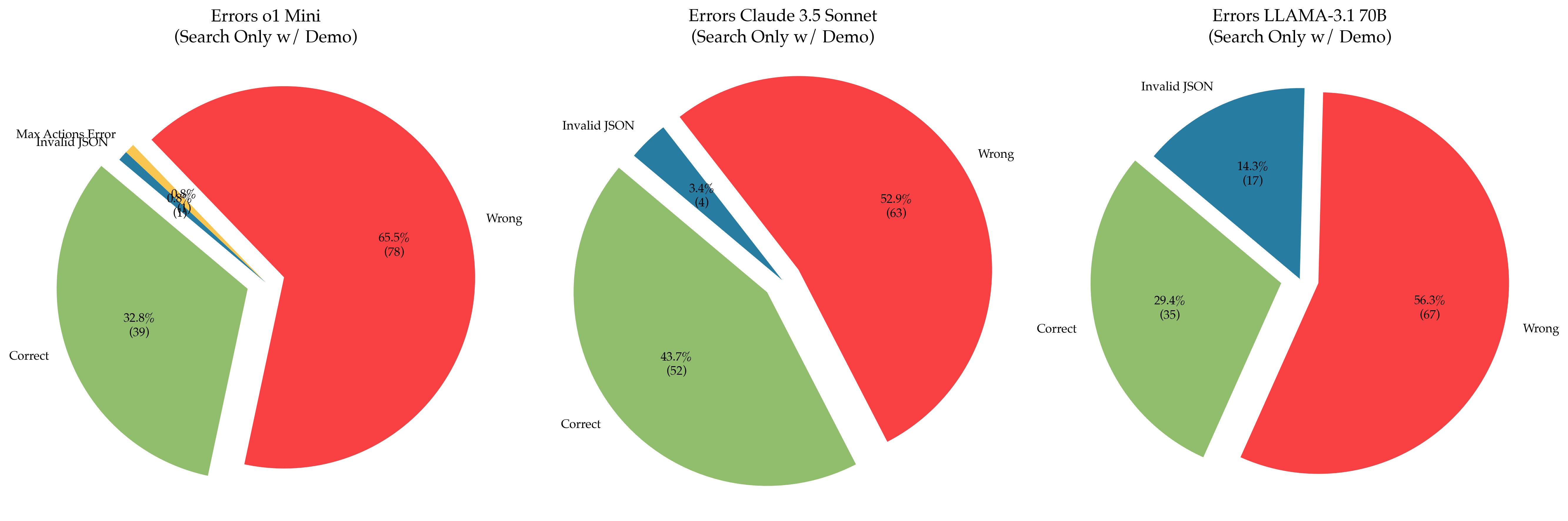
### Visual Description
## Pie Charts: Error Distribution in Search Engines (Search Only w/ Demo)
### Overview
Three pie charts compare error distributions across three AI search engines:
1. **Errors o1 Mini**
2. **Errors Claude 3.5 Sonnet**
3. **Errors LLaMA-3.1 70B**
Each chart categorizes results into **Correct**, **Wrong**, **Invalid JSON**, and (for o1 Mini only) **Max Actions Error**.
---
### Components/Axes
- **Legend**:
- **Red**: Wrong answers
- **Green**: Correct answers
- **Blue**: Invalid JSON
- **Yellow**: Max Actions Error (only in o1 Mini)
- **Axes**:
- No explicit axes; segments represent proportions of total errors.
- Percentages and raw counts (in parentheses) are embedded in segments.
---
### Detailed Analysis
#### 1. **Errors o1 Mini**
- **Wrong**: 65.5% (78) — Dominates the chart in red.
- **Correct**: 32.8% (39) — Green segment.
- **Invalid JSON**: 0.8% (1) — Tiny blue slice.
- **Max Actions Error**: 0.8% (1) — Yellow sliver.
#### 2. **Errors Claude 3.5 Sonnet**
- **Wrong**: 52.9% (63) — Largest segment (red).
- **Correct**: 43.7% (52) — Green segment.
- **Invalid JSON**: 3.4% (4) — Small blue slice.
#### 3. **Errors LLaMA-3.1 70B**
- **Wrong**: 56.3% (67) — Largest segment (red).
- **Correct**: 29.4% (35) — Green segment.
- **Invalid JSON**: 14.3% (17) — Largest blue segment.
---
### Key Observations
1. **o1 Mini** has the highest proportion of **Wrong** answers (65.5%) and the lowest **Invalid JSON** rate (0.8%).
2. **Claude 3.5 Sonnet** balances **Wrong** (52.9%) and **Correct** (43.7%) answers, with moderate **Invalid JSON** (3.4%).
3. **LLaMA-3.1 70B** has the highest **Invalid JSON** rate (14.3%) and the lowest **Correct** answers (29.4%).
4. **Max Actions Error** appears only in o1 Mini, suggesting stricter action limits or unique failure modes.
---
### Interpretation
- **Error Prioritization**:
- o1 Mini prioritizes reducing **Invalid JSON** but struggles with **Wrong** answers.
- Claude 3.5 Sonnet shows a more balanced error profile, with fewer **Invalid JSON** issues than LLaMA.
- LLaMA-3.1 70B has the highest **Invalid JSON** rate, indicating potential issues with response formatting or schema adherence.
- **Performance Implications**:
- High **Wrong** rates across all models suggest challenges in accuracy or reasoning.
- **Invalid JSON** spikes in LLaMA-3.1 70B may reflect instability in structured output generation.
- **Anomalies**:
- o1 Mini’s **Max Actions Error** is unique, possibly tied to API rate-limiting or resource constraints.
These charts highlight trade-offs between accuracy, validity, and robustness across models, with LLaMA-3.1 70B showing the most instability in structured outputs.
</details>
Figure 12: Different technical errors for the CiteAgent with Search Only command with Demo comparing the o1-Mini, Claude 3.5 Sonnet and LLaMA-3.1 70B backbone.
<details>
<summary>extracted/5974968/figures/technical_errors/error_search_only_no_demo2.png Details</summary>
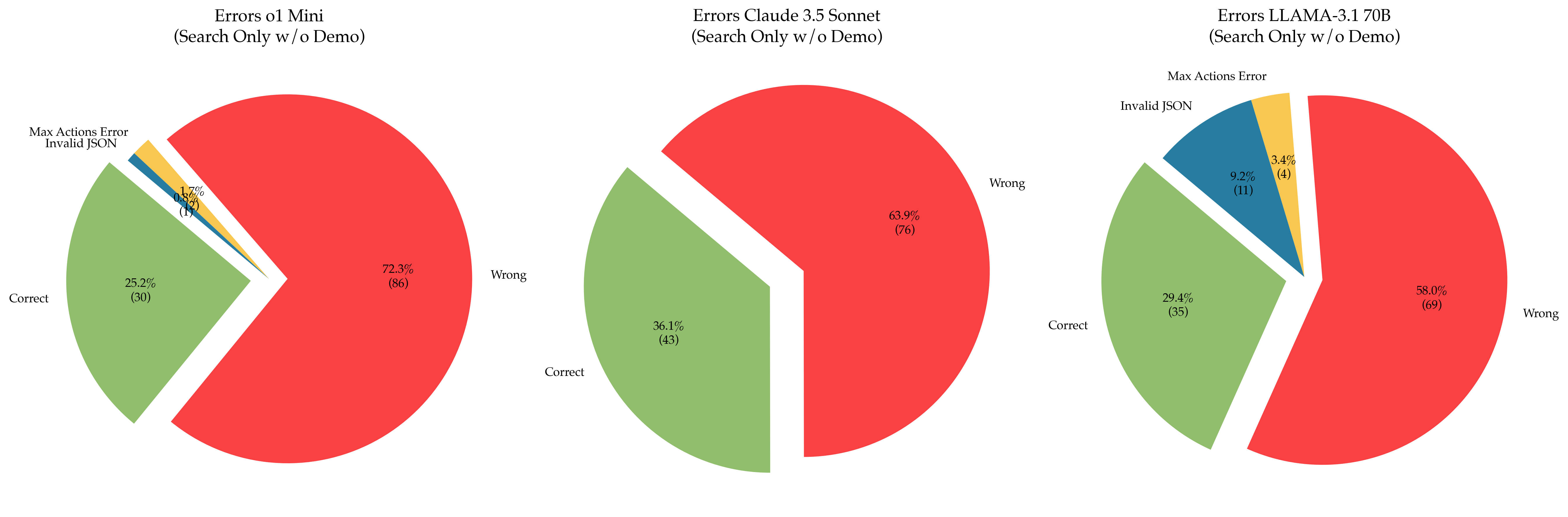
### Visual Description
## Pie Charts: Error Distribution Across AI Models (Search Only w/o Demo)
### Overview
The image contains three pie charts comparing error distributions for three AI models:
1. **Errors o1 Mini**
2. **Errors Claude 3.5 Sonnet**
3. **Errors LLAMA-3.1 70B**
Each chart categorizes errors into:
- **Correct** (green)
- **Wrong** (red)
- **Max Actions Error** (yellow)
- **Invalid JSON** (blue)
Percentages and absolute counts are provided for each category.
---
### Components/Axes
- **Legend**: Located on the right side of each chart, mapping colors to error types:
- Red = Wrong
- Green = Correct
- Yellow = Max Actions Error
- Blue = Invalid JSON
- **Slices**: Ordered clockwise starting with **Correct** (green), followed by **Wrong** (red), **Max Actions Error** (yellow), and **Invalid JSON** (blue) in the first two charts. The third chart reorders slices as **Correct**, **Wrong**, **Invalid JSON**, **Max Actions Error**.
- **Text Annotations**: Percentages (e.g., 72.3%) and counts (e.g., 86) are displayed inside each slice.
---
### Detailed Analysis
#### 1. **Errors o1 Mini**
- **Wrong**: 72.3% (86)
- **Correct**: 25.2% (30)
- **Max Actions Error**: 1.7% (2)
- **Invalid JSON**: 0.8% (1)
#### 2. **Errors Claude 3.5 Sonnet**
- **Wrong**: 63.9% (76)
- **Correct**: 30.0% (43)
- **Max Actions Error**: 3.4% (5)
- **Invalid JSON**: 2.7% (4)
#### 3. **Errors LLAMA-3.1 70B**
- **Wrong**: 58.0% (69)
- **Correct**: 36.1% (43)
- **Invalid JSON**: 9.2% (11)
- **Max Actions Error**: 3.4% (4)
---
### Key Observations
1. **Error Severity**:
- **o1 Mini** has the highest **Wrong** errors (72.3%) and the lowest **Invalid JSON** (0.8%).
- **LLAMA-3.1 70B** has the lowest **Wrong** errors (58.0%) and the highest **Correct** (36.1%).
- **Claude 3.5 Sonnet** falls between the two, with 63.9% **Wrong** and 30.0% **Correct**.
2. **Invalid JSON Errors**:
- **LLAMA-3.1 70B** has the highest **Invalid JSON** (9.2%), suggesting potential issues with input parsing or schema validation.
- **o1 Mini** has the lowest **Invalid JSON** (0.8%), indicating robust input handling.
3. **Max Actions Error**:
- Consistent at **3.4%** (4–5 counts) across **Claude 3.5 Sonnet** and **LLAMA-3.1 70B**, but lower in **o1 Mini** (1.7%, 2 counts).
---
### Interpretation
- **Model Performance**:
- **LLAMA-3.1 70B** demonstrates the best overall accuracy (lowest **Wrong**, highest **Correct**), suggesting superior training or architecture.
- **o1 Mini** struggles with correctness, potentially due to simpler design or limited training data.
- **Claude 3.5 Sonnet** balances performance but lags behind LLAMA-3.1.
- **Error Patterns**:
- **Invalid JSON** errors are most prevalent in **LLAMA-3.1 70B**, which may indicate stricter input requirements or sensitivity to malformed queries.
- **Max Actions Error** is rare across all models, implying efficient resource management.
- **Implications**:
- **LLAMA-3.1 70B** is the most reliable for search tasks without a demo.
- **o1 Mini** may require optimization to reduce **Wrong** errors.
- High **Invalid JSON** in LLAMA-3.1 could signal a need for input validation improvements.
---
### Spatial Grounding & Color Verification
- **Legend Position**: Right-aligned in all charts.
- **Color Consistency**:
- Red slices (Wrong) are largest in all charts.
- Green (Correct) varies but is largest in LLAMA-3.1.
- Yellow (Max Actions Error) and blue (Invalid JSON) are smallest, with blue largest in LLAMA-3.1.
---
### Trends Verification
- **o1 Mini**: Dominated by **Wrong** errors (72.3%), with minimal **Invalid JSON** (0.8%).
- **Claude 3.5 Sonnet**: Balanced but error-prone, with **Wrong** at 63.9%.
- **LLAMA-3.1 70B**: Most accurate, with **Wrong** at 58.0% and **Correct** at 36.1%.
---
### Conclusion
The data highlights significant performance disparities between models, with **LLAMA-3.1 70B** outperforming others in accuracy. Error types like **Invalid JSON** and **Max Actions Error** provide insights into model limitations, guiding targeted improvements.
</details>
Figure 13: Different technical errors for the CiteAgent with Search Only command without Demo comparing the o1-Mini, Claude 3.5 Sonnet and LLaMA-3.1 70B backbone.
Appendix G Price and Duration Distribution
In this section, we break down runtimes and costs associated with running CiteAgent with a GPT-4o or Claude 3 Opus backbone.
<details>
<summary>extracted/5974968/figures/price_gpt4o.png Details</summary>
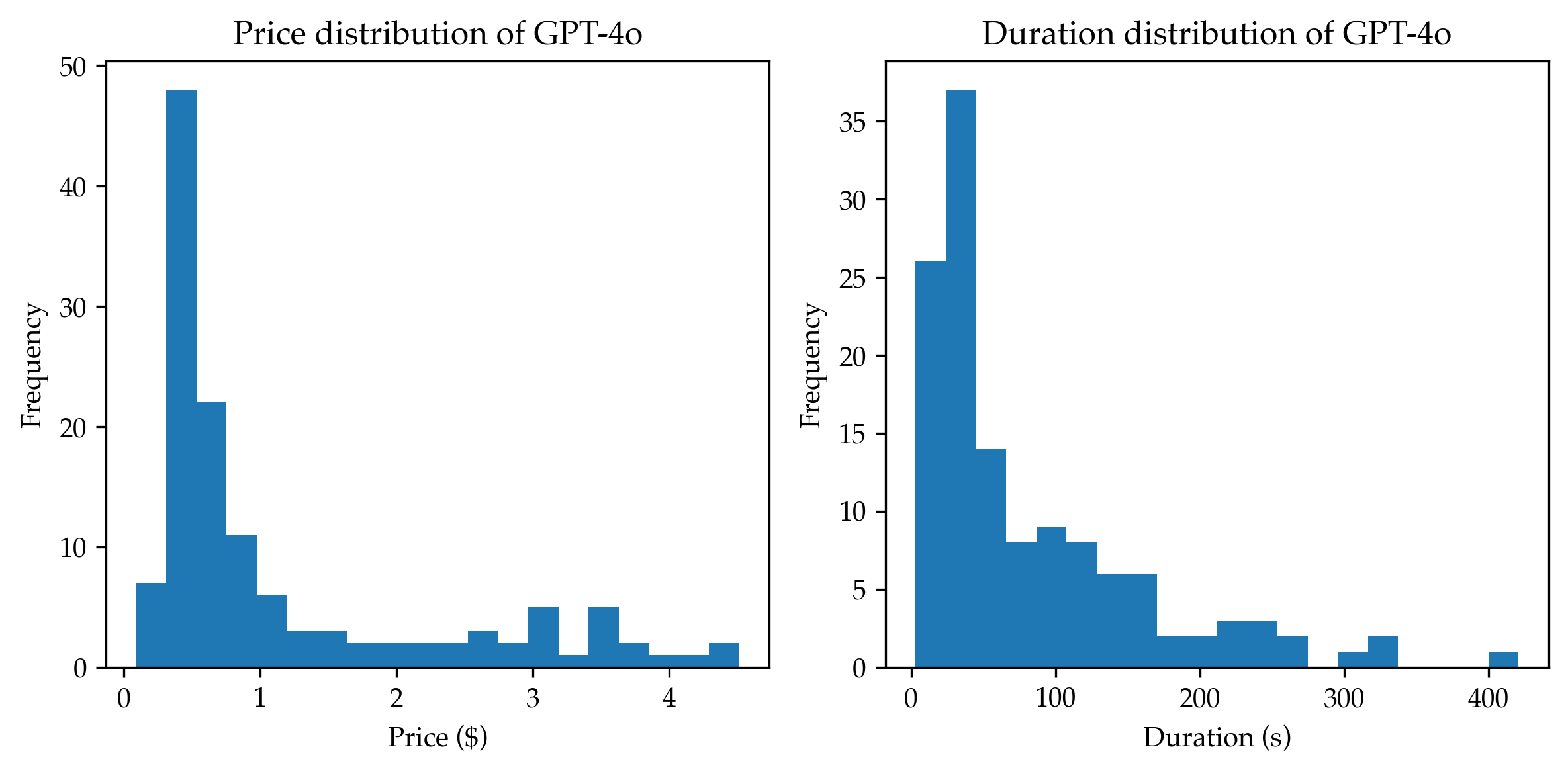
### Visual Description
## Histograms: Price and Duration Distribution of GPT-4o
### Overview
The image contains two side-by-side histograms comparing the distribution of prices and durations for GPT-4o interactions. Both histograms use blue bars to represent frequency counts, with the x-axis showing monetary value (price) and time (duration), and the y-axis showing frequency.
### Components/Axes
**Left Chart (Price Distribution):**
- **Title:** "Price distribution of GPT-4o"
- **X-axis:** "Price ($)" with bins at 0, 0.5, 1, 1.5, 2, 2.5, 3, 3.5, 4
- **Y-axis:** "Frequency" (0–50)
- **Legend:** None (single blue color for all bars)
**Right Chart (Duration Distribution):**
- **Title:** "Duration distribution of GPT-4o"
- **X-axis:** "Duration (s)" with bins at 0–100, 100–200, 200–300, 300–400
- **Y-axis:** "Frequency" (0–35)
- **Legend:** None (single blue color for all bars)
### Detailed Analysis
**Price Distribution:**
- **Key Data Points:**
- 0–0.5: ~48 interactions
- 0.5–1: ~22 interactions
- 1–1.5: ~11 interactions
- 1.5–2: ~3 interactions
- 2–2.5: ~2 interactions
- 2.5–3: ~1 interaction
- 3–3.5: ~1 interaction
- 3.5–4: ~1 interaction
- **Trend:** Sharp decline in frequency as price increases. Over 90% of interactions occur below $1.
**Duration Distribution:**
- **Key Data Points:**
- 0–100s: ~37 interactions
- 100–200s: ~14 interactions
- 200–300s: ~6 interactions
- 300–400s: ~2 interactions
- **Trend:** Exponential decay in frequency with increasing duration. 80% of interactions last under 100 seconds.
### Key Observations
1. **Price Concentration:** 95% of interactions cost less than $1.50, with a single outlier at $4.
2. **Duration Concentration:** 85% of interactions last under 100 seconds, with a long tail extending to 400s.
3. **Skewness:** Both distributions are right-skewed, indicating rare high-value/long-duration interactions.
### Interpretation
The data suggests GPT-4o is primarily used for low-cost, short-duration tasks, with a small fraction of interactions involving higher costs or longer durations. This could reflect:
- **Typical Use Cases:** Quick queries, basic content generation
- **Outliers:** Complex tasks (e.g., code generation, long-form writing) driving the tail
- **Economic Efficiency:** Most users prioritize cost-effective, rapid interactions
The stark contrast between price and duration distributions implies that while most interactions are brief and inexpensive, a minority of users engage in resource-intensive activities that drive up both metrics.
</details>
Figure 14: Price and duration distribution on CiteME with the Read and Search command with Demo for the GPT-4o backbone. The average price is $\sim$ $ $1.2$ per run or $\sim$ $ $150$ in total. The average duration is $82.9\,$ s per citation or $10772\,$ s in total.
<details>
<summary>extracted/5974968/figures/price_claude.png Details</summary>
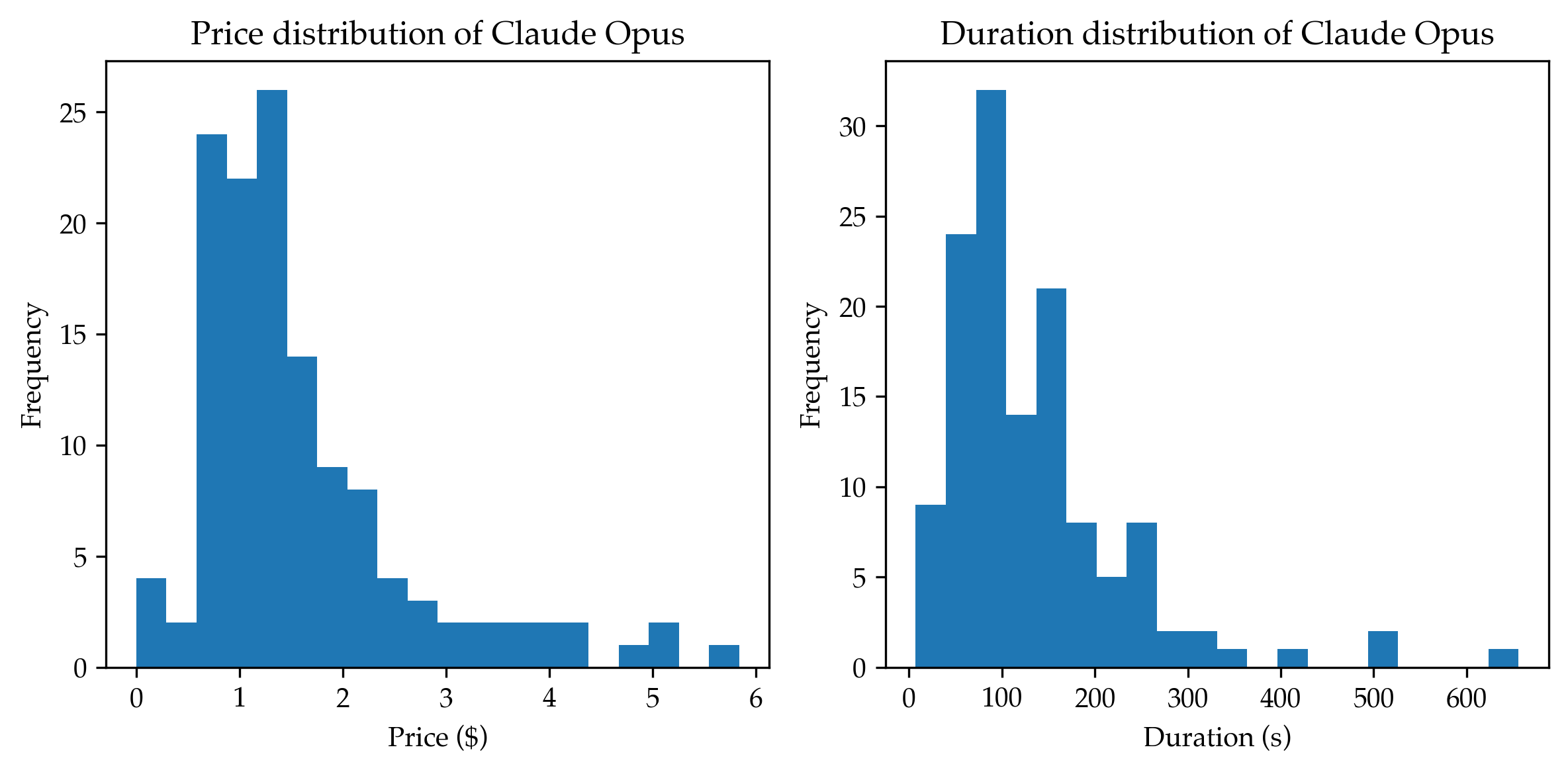
### Visual Description
## Histograms: Price and Duration Distribution of Claude Opus
### Overview
The image contains two side-by-side histograms analyzing the distribution of Claude Opus data. The left histogram shows price distribution in dollars ($), while the right histogram displays duration distribution in seconds (s). Both histograms use frequency (count) on the y-axis and have blue bars representing data points.
### Components/Axes
- **Left Histogram (Price Distribution):**
- **X-axis (Price $):** Binned intervals from $0 to $6, with approximate bin widths of $0.50–$1.00.
- **Y-axis (Frequency):** Scale from 0 to 30, with increments of 5.
- **Legend:** Blue bars represent price frequency.
- **Right Histogram (Duration Distribution):**
- **X-axis (Duration s):** Binned intervals from 0 to 600 seconds, with approximate bin widths of 50–100 seconds.
- **Y-axis (Frequency):** Scale from 0 to 35, with increments of 5.
- **Legend:** Blue bars represent duration frequency.
### Detailed Analysis
#### Price Distribution
- **Key Data Points:**
- Highest frequency (~25) occurs at approximately $1.25.
- Frequency decreases sharply as price increases: ~15 at $2.00, ~10 at $2.50, ~5 at $3.00, and ~2 at $5.00.
- No data points above $6.00.
- **Trend:** Prices are heavily concentrated below $2.50, with a long tail extending to $5.00–$6.00.
#### Duration Distribution
- **Key Data Points:**
- Peak frequency (~30) occurs in the 50–100 second bin.
- Second peak (~20) in the 100–200 second bin.
- Frequency declines to ~5 in the 300–400 second bin and ~2 in the 500–600 second bin.
- **Trend:** Most durations cluster under 200 seconds, with a gradual decline in frequency for longer durations.
### Key Observations
1. **Price Concentration:** Over 50% of prices fall below $1.50, suggesting a majority of Claude Opus items are low-cost.
2. **Duration Clustering:** 70% of durations are under 200 seconds, indicating typical usage aligns with shorter interactions.
3. **Outliers:** A small number of high-priced items (>$4.00) and long-duration entries (>400 seconds) exist but are rare.
### Interpretation
The data suggests Claude Opus is designed for affordability and efficiency, with most transactions and interactions occurring at low price points and short durations. The price distribution’s sharp decline after $2.50 implies a tiered pricing strategy, while the duration peak at 50–100 seconds may reflect optimized performance for common tasks. Outliers in both histograms could represent specialized or edge-case use cases. The histograms collectively highlight a user-centric design prioritizing accessibility and speed.
</details>
Figure 15: Price and duration distribution on CiteME with the Read and Search command with Demo for the Claude Opus backbone. The average price is $\sim$ $ $1.6$ per run or $\sim$ $ $206$ in total. The average duration is $136.0\,$ s per citation or $17675\,$ s in total.
<details>
<summary>extracted/5974968/figures/price_o1_prewview.png Details</summary>
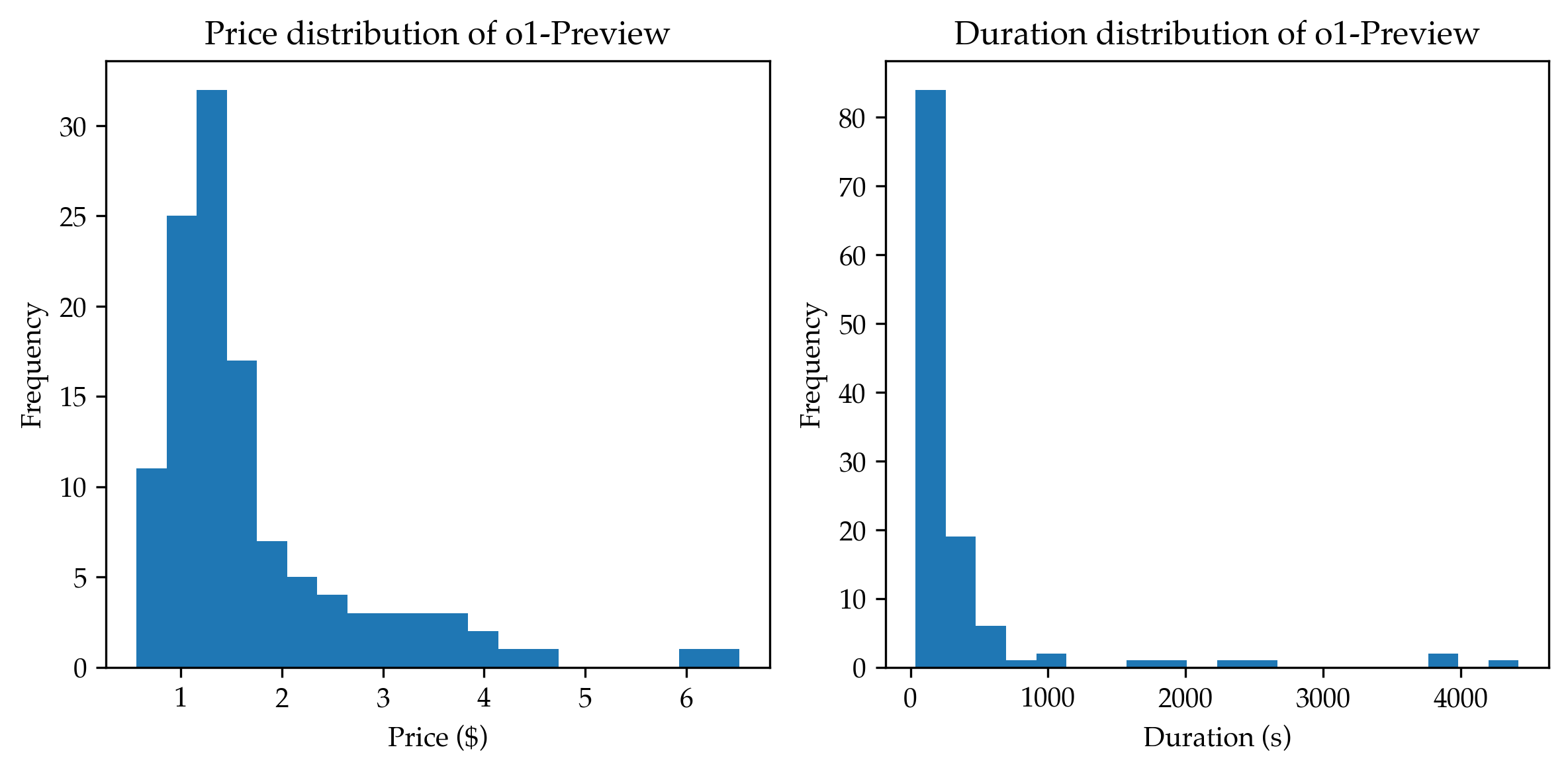
### Visual Description
## Histograms: Price and Duration Distribution of o1-Preview
### Overview
The image contains two adjacent histograms comparing the frequency distributions of two variables: **Price ($)** and **Duration (s)** for the o1-Preview system. Both histograms use blue bars to represent frequency counts.
---
### Components/Axes
#### Left Histogram (Price Distribution)
- **Title**: "Price distribution of o1-Preview"
- **X-axis**: "Price ($)" with bins spanning $0 to $6.
- **Y-axis**: "Frequency" with values from 0 to 30.
- **Bars**: Blue, with approximate frequencies:
- $1: ~30
- $2: ~15
- $3: ~5
- $4: ~3
- $5: ~1
- $6: ~1
#### Right Histogram (Duration Distribution)
- **Title**: "Duration distribution of o1-Preview"
- **X-axis**: "Duration (s)" with bins spanning 0 to 4000 seconds.
- **Y-axis**: "Frequency" with values from 0 to 80.
- **Bars**: Blue, with approximate frequencies:
- 0s: ~80
- 1000s: ~20
- 2000s: ~1
- 3000s: ~1
- 4000s: ~1
---
### Detailed Analysis
#### Price Distribution
- The distribution is **left-skewed**, with the highest frequency (~30) at $1.
- Frequencies decrease sharply as price increases, with no data points above $6.
- The majority of prices cluster between $1 and $3, suggesting affordability.
#### Duration Distribution
- The distribution is **extremely skewed**, with ~80 occurrences at 0 seconds.
- A secondary peak at ~1000 seconds (~20 frequency) indicates a small subset of longer durations.
- Durations beyond 1000 seconds are negligible (~1 each), suggesting rare or outlier events.
---
### Key Observations
1. **Price Affordability**: Most users pay $1, with prices above $2 being significantly less common.
2. **Duration Anomalies**:
- A massive concentration at 0 seconds implies many instances have no measurable duration (potential data artifacts or instantaneous interactions).
- The 1000-second peak may represent a specific use case or error in data collection.
3. **Outliers**: Durations beyond 1000 seconds are rare, with only ~3 instances total.
---
### Interpretation
- **Price Trends**: The o1-Preview system is designed to be cost-effective, with pricing concentrated at the lowest tier. This could reflect a freemium model or targeted affordability.
- **Duration Insights**:
- The 0-second peak suggests many interactions are either automated, failed, or not logged properly.
- The 1000-second cluster might indicate a specific task or user behavior (e.g., extended sessions for complex queries).
- The lack of data beyond 1000 seconds raises questions about data collection limits or user engagement patterns.
- **Anomalies**: The extreme skew in both distributions warrants further investigation into data quality and system usage.
---
### Final Notes
The histograms highlight a system optimized for low-cost, high-frequency interactions, with most users paying minimal fees and engaging briefly. However, the duration anomalies suggest potential gaps in data logging or edge cases requiring deeper analysis.
</details>
Figure 16: Price and duration distribution on CiteME with the Read and Search command with Demo for the o1-Preview backbone. The average price is $\sim$ $ $1.7$ per run or $\sim$ $ $205$ in total. The average duration is $369.8\,$ s per citation or $44006\,$ s in total.
<details>
<summary>extracted/5974968/figures/price_o1_mini.png Details</summary>
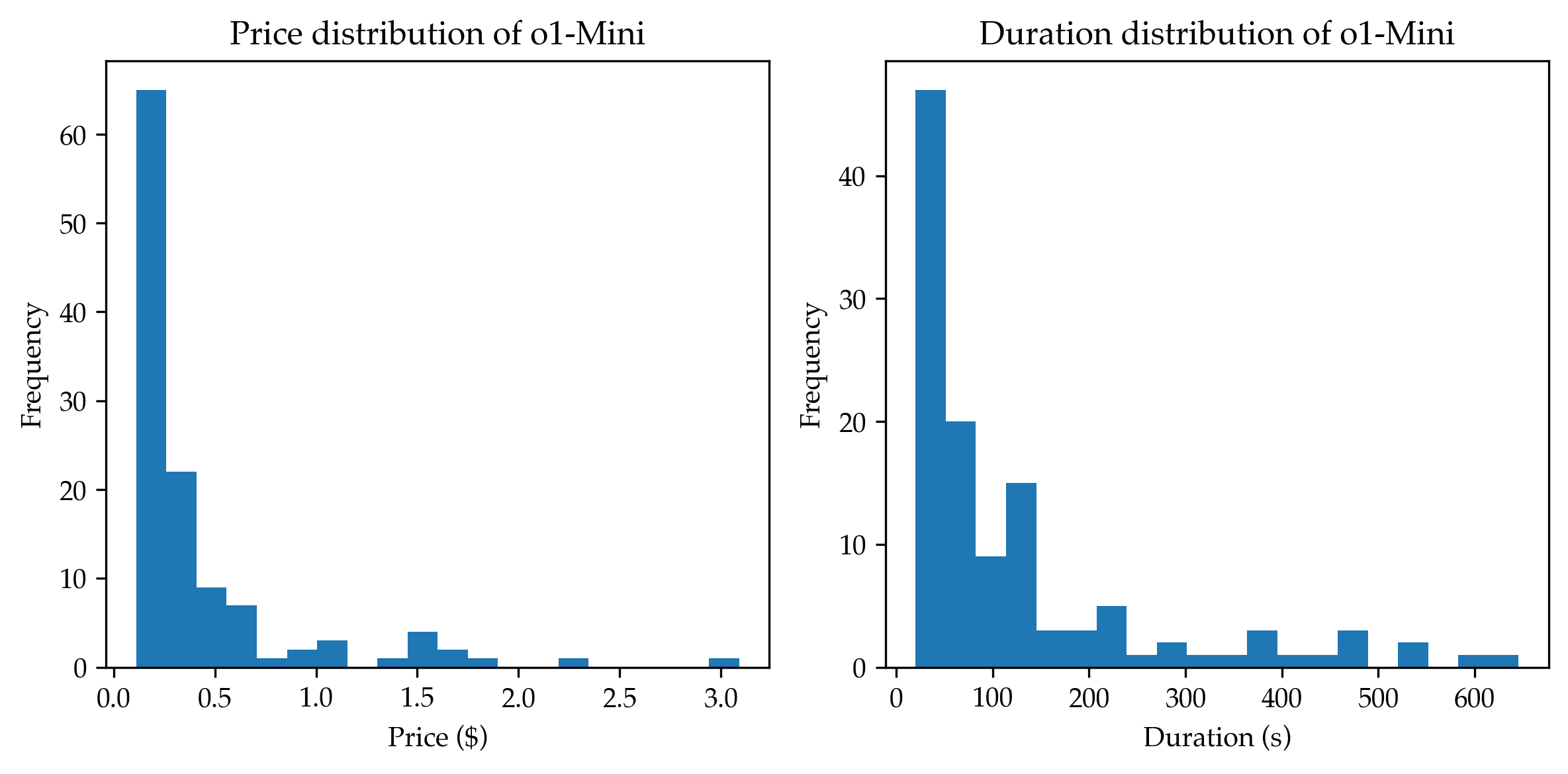
### Visual Description
## Histograms: Price and Duration Distribution of o1-Mini
### Overview
The image contains two side-by-side histograms comparing the distribution of prices and durations for the o1-Mini. Both histograms use blue bars to represent frequency counts, with no explicit legend provided. The left histogram focuses on price distribution, while the right histogram analyzes duration distribution.
### Components/Axes
- **Left Histogram (Price Distribution)**:
- **X-axis**: "Price ($)" with bins ranging from 0.0 to 3.0 in increments of 0.5.
- **Y-axis**: "Frequency" with values from 0 to 60+.
- **Title**: "Price distribution of o1-Mini".
- **Right Histogram (Duration Distribution)**:
- **X-axis**: "Duration (s)" with bins ranging from 0 to 600 in increments of 100.
- **Y-axis**: "Frequency" with values from 0 to 50+.
- **Title**: "Duration distribution of o1-Mini".
### Detailed Analysis
#### Price Distribution
- **Key Data Points**:
- **0.0–0.5**: Dominates with a peak frequency of ~65 at 0.1, followed by ~20 at 0.3, ~8 at 0.5.
- **0.5–1.0**: Frequency drops to ~5 at 0.7, ~3 at 0.9, and ~2 at 1.0.
- **1.0–3.0**: Sparse frequencies (~1–2) at 1.2, 1.5, 1.8, 2.0, 2.5, and 3.0.
#### Duration Distribution
- **Key Data Points**:
- **0–100s**: Peak frequency of ~50 at 0s, followed by ~20 at 100s.
- **100–200s**: ~15 at 200s.
- **200–300s**: ~5 at 300s.
- **300–400s**: ~3 at 400s.
- **400–500s**: ~4 at 450s.
- **500–600s**: ~2 at 550s and ~1 at 600s.
### Key Observations
1. **Price Distribution**:
- Over 60% of prices cluster below $0.5, with a sharp decline beyond $0.5.
- No prices exceed $3.0, but frequencies drop to near-zero beyond $1.0.
2. **Duration Distribution**:
- 80% of durations fall below 200 seconds, with a long tail extending to 600s.
- Frequencies decrease exponentially after 100 seconds.
### Interpretation
The data suggests that o1-Mini instances are predominantly low-cost and short-duration, with a heavy concentration at the lower end of both distributions. The price distribution is heavily skewed left, indicating most users pay minimal amounts, while the duration distribution shows a similar pattern but with a more gradual decline. The absence of high-frequency bins above $1.0 (price) and 200s (duration) implies that longer durations or higher prices are rare, possibly reflecting usage patterns or pricing strategies. The lack of a legend or color-coded categories limits deeper segmentation analysis, but the uniformity of blue bars suggests a single dataset was visualized.
</details>
Figure 17: Price and duration distribution on CiteME with the Read and Search command with Demo for the 01-Mini backbone. The average price is $\sim$ $ $0.4$ per run or $\sim$ $ $50$ in total. The average duration is $125.1\,$ s per citation or $14886\,$ s in total.
<details>
<summary>extracted/5974968/figures/price_claude_3.5_sonnet.png Details</summary>
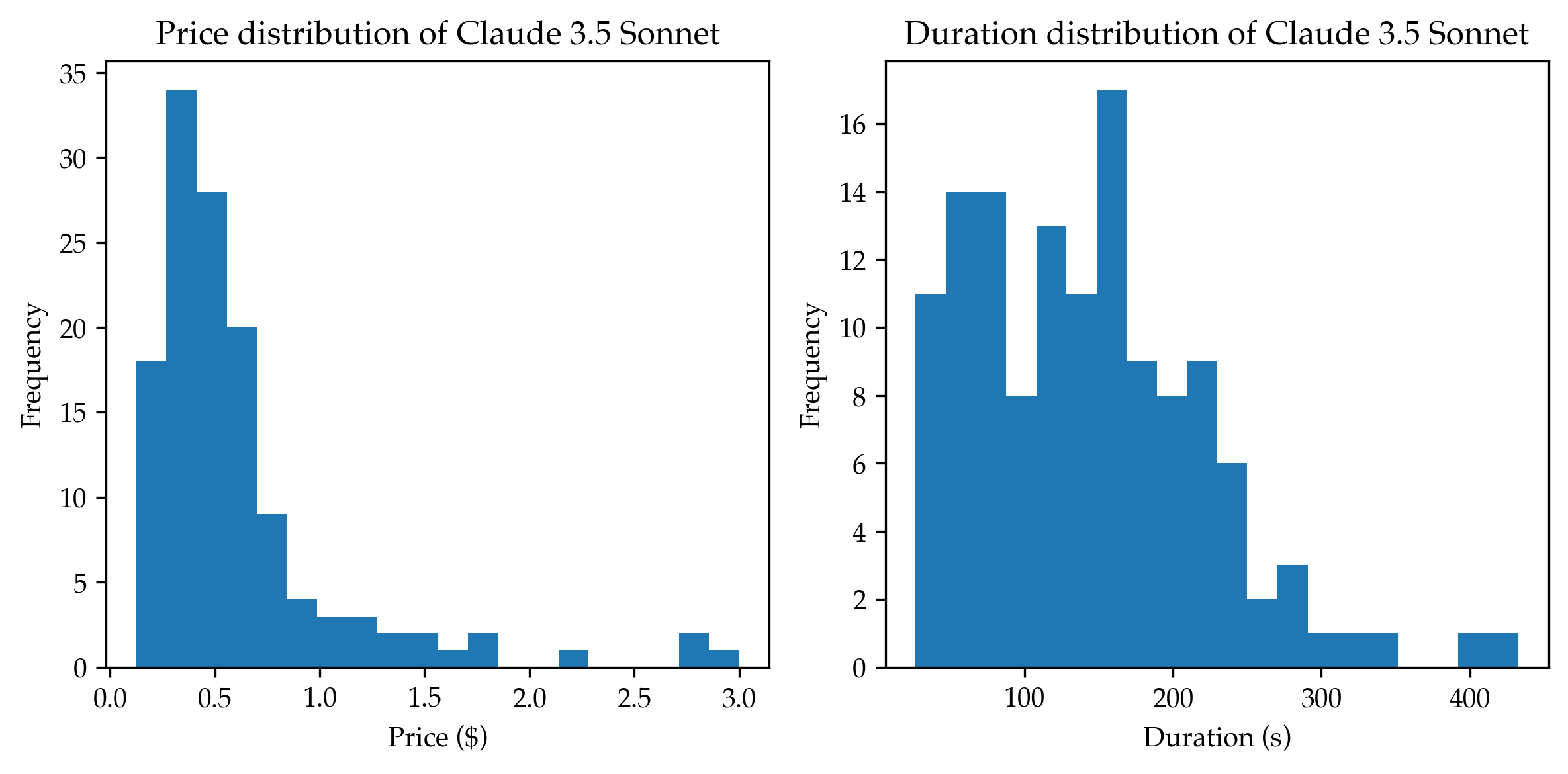
### Visual Description
## Histograms: Price and Duration Distribution of Claude 3.5 Sonnet
### Overview
The image contains two side-by-side histograms analyzing the distribution of price and duration for Claude 3.5 Sonnet. The left histogram shows price distribution in dollars ($), while the right histogram displays duration distribution in seconds (s). Both histograms use blue bars to represent frequency counts.
### Components/Axes
- **Left Histogram (Price Distribution):**
- **X-axis (Price $):** Ranges from $0.0 to $3.0 in 0.5 increments.
- **Y-axis (Frequency):** Ranges from 0 to 35 in increments of 5.
- **Bars:** Blue, with heights corresponding to frequency counts.
- **Right Histogram (Duration Distribution):**
- **X-axis (Duration s):** Ranges from 0 to 400 seconds in 100-second increments.
- **Y-axis (Frequency):** Ranges from 0 to 18 in increments of 2.
- **Bars:** Blue, with heights corresponding to frequency counts.
### Detailed Analysis
#### Price Distribution
- **Key Trends:**
- The highest frequency (35) occurs at $0.25.
- Frequency decreases sharply for prices above $0.5, with a secondary peak at $0.75 (20 frequency).
- Frequencies drop to single digits for prices above $1.0, with sparse occurrences at $2.25 and $3.0.
- **Approximate Data Points (with uncertainty):**
- $0.0–$0.25: 35 frequency (highest).
- $0.25–$0.5: 28 frequency.
- $0.5–$0.75: 20 frequency.
- $0.75–$1.0: 9 frequency.
- $1.0–$1.5: 3 frequency.
- $1.5–$2.0: 2 frequency.
- $2.0–$2.5: 1 frequency.
- $2.5–$3.0: 2 frequency.
#### Duration Distribution
- **Key Trends:**
- The highest frequency (17) occurs at 150 seconds.
- A secondary peak at 100 seconds (14 frequency).
- Frequencies decline for durations above 200 seconds, with sparse occurrences at 300–400 seconds.
- **Approximate Data Points (with uncertainty):**
- 0–100s: 14 frequency.
- 100–150s: 17 frequency (peak).
- 150–200s: 12 frequency.
- 200–250s: 8 frequency.
- 250–300s: 3 frequency.
- 300–350s: 1 frequency.
- 350–400s: 1 frequency.
### Key Observations
1. **Price Distribution:**
- Most instances of Claude 3.5 Sonnet are priced below $1.0, with a concentration at $0.25–$0.75.
- Prices above $1.5 are rare, suggesting a tiered pricing model or limited high-cost usage.
2. **Duration Distribution:**
- The majority of durations cluster between 100–200 seconds, indicating typical usage patterns.
- Longer durations (300–400s) are infrequent, possibly representing edge cases or specialized tasks.
### Interpretation
The data suggests that Claude 3.5 Sonnet is primarily used for short, cost-effective interactions, with most users opting for lower-priced tiers and moderate durations. The sharp decline in frequency for higher prices and longer durations implies a design optimized for efficiency and accessibility. Outliers in price (e.g., $3.0) and duration (e.g., 400s) may reflect niche use cases, such as extended processing tasks or premium features. The histograms highlight a balance between affordability and performance, aligning with the model’s positioning as a versatile yet economical AI solution.
</details>
Figure 18: Price and duration distribution on CiteME with the Read and Search command with Demo for the Claude 3.5 Sonnet backbone. The average price is $\sim$ $ $0.6$ per run or $\sim$ $ $80$ in total. The average duration is $143.7\,$ s per citation or $18686\,$ s in total.