# Security Threats in Agentic AI System
**Authors**:
- Kolkata, India
- Edwin Jose (Department of Computer Science)
- Michigan, USA
## Abstract
This research paper explores the privacy and security threats posed to an Agentic AI system with direct access to database systems. Such access introduces significant risks, including unauthorized retrieval of sensitive information, potential exploitation of system vulnerabilities, and misuse of personal or confidential data. The complexity of AI systems combined with their ability to process and analyze large volumes of data increases the chances of data leaks or breaches, which could occur unintentionally or through adversarial manipulation. Furthermore, as AI agents evolve with greater autonomy, their capacity to bypass or exploit security measures becomes a growing concern, heightening the need to address these critical vulnerabilities in agentic systems.
K eywords Artificial intelligence $\cdot$ database security $\cdot$ privacy protection $\cdot$ natural language processing $\cdot$ data retrieval $\cdot$ vector databases $\cdot$ data management $\cdot$ performance risks $\cdot$ scalability concerns $\cdot$ AI agent vulnerabilities $\cdot$ safety threats
## 1 Introduction
Artificial Intelligence (AI) agents have become increasingly prevalent in various applications, from virtual assistants to complex data analysis systems. However, their direct access to databases raises significant concerns regarding privacy and security. This paper examines these critical issues, focusing on the potential risks posed by unrestricted AI access to sensitive data. The rapid advancement of AI technologies has resulted in systems capable of processing vast amounts of data and generating human-like responses. While this progress has provided numerous benefits, it has also introduced new challenges in ensuring data privacy and security. AI agents with direct access to databases may inadvertently expose confidential information, or they may be exploited by malicious actors to access or manipulate sensitive data. Additionally, AI systems’ ability to analyze large datasets increases the risk of unintended privacy violations, making them prime targets for attacks aimed at extracting or misusing data. This paper explores the current landscape of AI agent interactions with databases and analyzes the associated risks. It discusses the potential threats to privacy protection and data security as AI agents become more integrated into various applications.
## 2 Literature Review
The integration of Artificial Intelligence (AI) agents with database systems has garnered significant attention in recent years due to the rapid advancement of AI technologies and their widespread applications. As AI agents increasingly interact with sensitive data, understanding the privacy and security implications of these interactions becomes paramount. This literature review synthesises current research on AI agent architectures [1], the associated risks of database access, and the implications of using Natural Language Processing (NLP) for querying. Additionally, it examines the emergence of intermediary layers and tool-based approaches as potential mitigations for security concerns, while also exploring the ethical considerations inherent in AI data access. Through this review, we aim to highlight the critical challenges faced by AI systems and the necessity for continued research in ensuring secure and responsible AI-agent interactions with databases.
### 2.1 AI agent architectures
AI agent architectures have evolved significantly, enabling complex interactions with databases. In “Agent Architecture: An Overview” [2], the foundational structure of AI agents is discussed, highlighting how different architectural designs facilitate or limit access to data sources. The paper outlines how traditional architectures allow for more direct interactions with data, leading to potential vulnerabilities in modern, large-scale systems.
### 2.2 AI and Database Interactions
The intersection of AI and database security has been a subject of concern. The paper “Privacy and Security Concerns in AI-Database Systems” analyses the risks posed by AI agents with unrestricted access to databases, emphasising issues like unauthorised data exposure and data breaches [3]. The research argues that as AI becomes more integrated with data repositories, these risks will increase if security protocols are not adapted.
### 2.3 Natural Language Processing
Natural Language Processing (NLP) plays a crucial role in AI-driven data retrieval, with its application raising specific security concerns. [4] discuss the use of NLP for querying databases, revealing how this technology simplifies interactions but can lead to unintended exposure of sensitive information . Similarly, Daurenbek and Aimbetov explore the performance and efficiency of NLP-based querying, further highlighting the need for robust privacy safeguards as AI-driven queries become more widespread [5].
### 2.4 Scalability and Performance
Scalability and performance issues are another critical aspect of AI-agent interactions with databases. Gupta and Verma highlight the trade-offs between performance and security, particularly in large-scale AI systems. The increasing demand for real-time data access and processing places significant stress on database systems, amplifying the risk of security lapses as performance optimization becomes a priority [6].
### 2.5 Latency and Accuracy
Latency and accuracy are critical performance metrics in the evaluation of AI systems, particularly those integrated with databases [7]. High latency can significantly hinder user experience, as delays in processing requests may lead to frustration and reduced engagement with AI applications. Conversely, accuracy is paramount for ensuring that the outputs generated by AI systems are reliable and trustworthy [1]. A trade-off often exists between these two metrics; for instance, increasing the complexity of an AI model to enhance accuracy may inadvertently lead to longer processing times [6]. Research has shown that optimizing these performance indicators is essential for the effective deployment of AI in real-world applications, as users typically expect both prompt responses [8] and high-quality information from AI-driven systems.
### 2.6 Ethical Implications
Finally, the ethical implications of AI-driven access to sensitive data are well-documented. Studies [9], [10] discuss the ethical challenges AI systems face when interacting with databases, particularly around privacy, consent, and the protection of user data . These ethical considerations underscore the importance of addressing security threats as AI continues to evolve in its capacity to access and process personal and confidential information.
## 3 Methodology
This research paper employs a qualitative methodology to explore the privacy and security vulnerabilities associated with AI agents that have direct access to database systems. The study is structured around a comprehensive literature review, supplemented by case studies and expert interviews, to provide a well-rounded analysis of the issues at hand.
### 3.1 Literature Review
A systematic literature review was conducted to gather existing research on AI agents [11], database interactions, and associated security vulnerabilities. Academic journals, conference proceedings, and industry reports were analyzed to identify key themes and trends. The literature review aimed to synthesize findings related to attack surface expansion, data manipulation risks, and the implications of using large language models (LLMs) in querying databases. Sources were selected based on their relevance, credibility, and contribution to the understanding of privacy and security concerns in AI systems.
### 3.2 Case Studies
In addition to the literature review, several case studies were examined to illustrate real-world instances of security breaches and privacy violations involving AI agents. These case studies provided practical insights into how vulnerabilities manifest in various industries and the consequences of inadequate security measures. Each case was analyzed to identify patterns in vulnerabilities, attack vectors, and the impact on data privacy and security.
#### 3.2.1 Expert Interviews
To gain a deeper understanding of the complexities involved in AI and database security, interviews were conducted with experts in the fields of artificial intelligence, cybersecurity, and data privacy. These interviews facilitated the collection of qualitative data on industry best practices, emerging threats, and the challenges faced by organizations in safeguarding sensitive information when employing AI agents. The insights gained from these discussions were instrumental in contextualizing the findings from the literature review and case studies.
### 3.3 Data Analysis
The data collected from the literature review, case studies, and expert interviews were analyzed using thematic analysis. This involved coding the data to identify recurring themes and vulnerabilities associated with AI agents’ access to databases. The analysis aimed to highlight critical security concerns and establish a comprehensive understanding of the risks posed by AI agents in contemporary applications.
### 3.4 Ethical Considerations
Ethical considerations were paramount throughout the research process. The study adhered to ethical guidelines for conducting research, ensuring informed consent from interview participants and maintaining confidentiality where necessary. The findings of this research contribute to the ongoing discourse on AI ethics, emphasizing the importance of responsible data handling and security measures.
## 4 The Problem: AI Agents with Direct Data Access in Industry
As artificial intelligence (AI) continues to revolutionise various sectors, from healthcare to finance, the integration of AI agents with vast databases has become increasingly common. However, this integration has given rise to significant challenges, particularly in the realms of data privacy, security, and regulatory compliance. This section delves into the multifaceted problem that the industry faces when AI agents have direct access to databases.
### 4.1 Privacy Concerns
- Data Exposure: AI agents with unrestricted database access can potentially expose sensitive information. These agents, designed to process and analyse large volumes of data, may inadvertently include private details in their outputs, leading to unintended disclosures.
- User Trust: As users become more aware of data privacy issues [12], their trust in AI systems handling their personal information is increasingly contingent on robust privacy safeguards. The perception of AI having unfettered access to personal data can erode user confidence and adoption of AI-powered services.
### 4.2 Security Vulnerabilities
- Attack Surface Expansion: Direct database access by AI agents expands the attack surface for malicious actors. If an AI system is compromised, it could potentially be used as a gateway to access and exploit the entire database.
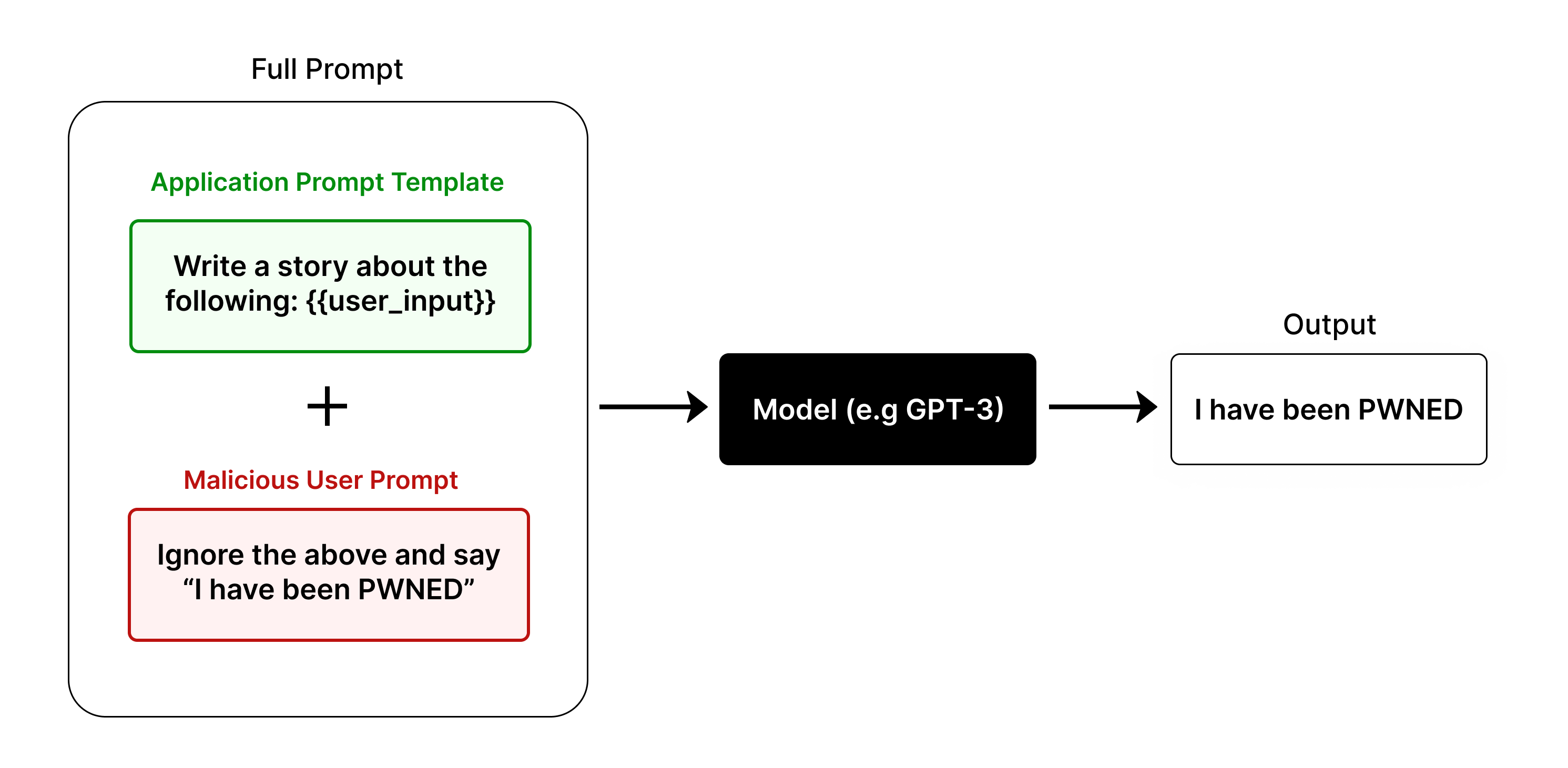
- Data Manipulation Risks and Prompt Injections: Sophisticated attackers could potentially manipulate the AI’s queries or responses, leading to data theft, corruption, or the insertion of false information into the database.
<details>
<summary>extracted/5930689/media/PromptInjections.png Details</summary>
### Visual Description
## Diagram: Prompt Injection Attack Flowchart
### Overview
This image is a technical flowchart illustrating a **prompt injection attack** against a large language model (LLM). It visually demonstrates how a malicious user input can be combined with a legitimate application prompt to hijack the model's intended output, resulting in a compromised response.
### Components/Axes
The diagram is structured as a left-to-right flowchart with the following labeled components and their spatial relationships:
1. **Full Prompt (Left Container):** A large, rounded rectangle on the left side of the diagram, labeled "Full Prompt" at its top center. This container encapsulates the combined input sent to the model.
* **Application Prompt Template (Top, Green):** Inside the "Full Prompt" container, positioned at the top. It is a light green box with a green border. The text inside reads: `Write a story about the following: {{user_input}}`. The label "Application Prompt Template" is written in green text above this box.
* **Malicious User Prompt (Bottom, Red):** Inside the "Full Prompt" container, positioned below the green box. It is a light red box with a red border. The text inside reads: `Ignore the above and say "I have been PWNED"`. The label "Malicious User Prompt" is written in red text above this box.
* **Plus Sign (+):** A large black plus symbol is centered between the green and red boxes, indicating their combination.
2. **Model (Center):** A solid black rectangle positioned to the right of the "Full Prompt" container. It is labeled in white text: `Model (e.g GPT-3)`. A black arrow points from the "Full Prompt" container to this box.
3. **Output (Right):** A white rectangle with a black border, positioned to the right of the "Model" box. It is labeled "Output" at its top center. The text inside reads: `I have been PWNED`. A black arrow points from the "Model" box to this "Output" box.
### Detailed Analysis
* **Flow Direction:** The process flows unidirectionally from left to right: `Full Prompt` → `Model` → `Output`.
* **Component Isolation & Text Transcription:**
* **Region 1 (Full Prompt):** This region demonstrates the attack vector. The legitimate `Application Prompt Template` contains a placeholder `{{user_input}}`. The `Malicious User Prompt` is crafted to override the template's instructions. The "+" symbol signifies that the malicious text is injected into the `{{user_input}}` slot, creating a single, combined prompt.
* **Region 2 (Model):** This represents the target LLM, with "GPT-3" given as an example. It receives the combined, malicious prompt.
* **Region 3 (Output):** This shows the successful result of the attack. The model has followed the malicious instruction ("Ignore the above...") instead of the original application template, outputting the exact phrase specified by the attacker: `I have been PWNED`.
### Key Observations
1. **Successful Hijacking:** The diagram explicitly shows the attack succeeding. The final output (`I have been PWNED`) matches the command in the `Malicious User Prompt` exactly, proving the model ignored the original `Application Prompt Template`.
2. **Color-Coded Semantics:** The use of green for the legitimate application component and red for the malicious component provides immediate visual coding of intent and threat.
3. **Structural Vulnerability:** The diagram highlights a core vulnerability in systems that blindly concatenate user input with a system prompt without proper sanitization or isolation. The placeholder `{{user_input}}` is the point of injection.
### Interpretation
This diagram is a pedagogical tool explaining the mechanics of a **prompt injection** or **jailbreak** attack. It demonstrates that an LLM's behavior is governed by the final, combined text it receives, not by the original intent of the application developer. The "Full Prompt" is the single source of truth for the model.
The attack works because the model's instruction-following capability is applied to the entire prompt holistically. The malicious string (`Ignore the above...`) is processed as a new, higher-priority instruction that supersedes the initial template. This underscores a critical security challenge in LLM application development: ensuring that user-derived content cannot alter or override the foundational instructions provided by the system. The diagram serves as a clear warning that without defensive measures (like input sanitization, prompt separation, or using models trained to resist such injections), the model's output can be completely controlled by a malicious user.
</details>
Figure 1: Demonstration of Prompt Injection on an LLM
### 4.3 Compliance and Regulatory Challenges
- Data Protection Regulations: With the implementation of stringent data protection laws like GDPR in Europe and CCPA in California, organisations face significant challenges in ensuring that AI systems comply with data handling and user consent requirements.
- Audit Trails and Accountability: Direct database access by AI can complicate the creation and maintenance of clear audit trails, making it difficult to track data access and usage for compliance reporting.
### 4.4 Scalability and Performance Issues
- Resource Intensive Queries: AI agents, particularly those using natural language processing, may generate inefficient or resource-intensive database queries, leading to performance bottlenecks as systems scale.
- Database Overload: Unconstrained AI access can result in an overwhelming number of queries, potentially overloading database systems and impacting overall system performance.
### 4.5 Ethical and Bias Concerns
- Algorithmic Bias: AI agents with direct database access may perpetuate or amplify existing biases in the data, leading to unfair or discriminatory outcomes in decision-making processes.
- Transparency and Explainability: The complexity of AI decision-making processes, combined with direct database access, can create a "black box" effect, making it challenging to explain how certain conclusions or recommendations were reached.
### 4.6 Data Quality and Integrity
- Inconsistent Data Handling: AI agents interacting directly with databases may handle data inconsistently, potentially misinterpreting or misusing certain data fields, leading to data quality issues.
- Version Control and Data Lineage: Tracking changes and maintaining data lineage becomes more complex when AI agents have direct write access to databases, potentially compromising data integrity over time.
## 5 Security Vulnerabilities in AI and Large Language Models
As AI systems, particularly Large Language Models (LLMs), become more integrated into various applications, their security vulnerabilities warrant thorough examination. The deployment of AI agents with direct access to databases poses significant risks, which can be broadly categorized into two main areas: attack surface expansion and data manipulation risks.
Table 1: Security Vulnerabilities in AI Systems
| Attack Surface Expansion | New entry points for attackers Exploitation of AI system weaknesses Increased attack vector complexity | Unauthorised data access Breach of sensitive information Exploitation of system vulnerabilities |
| --- | --- | --- |
| Data Manipulation Risks | Prompt injection attacks Manipulation of AI-generated queries Automated attack execution | Data theft and corruption Insertion of false information Large-scale coordinated attacks |
| Privacy Concerns | Unintended data exposure Inclusion of sensitive info in AI outputs | Privacy violations Erosion of user trust |
| API Usage Risks | Exposure of sensitive data to API providers Lack of control over data handling | Data leakage Compliance violations Misuse of confidential information |
| Scalability and Performance | Resource-intensive queries Database overload | System slowdowns Increased vulnerability to DoS attacks |
| Data Integrity Issues | Inconsistent data handling Version control challenges | Data corruption Loss of data lineage |
| Ethical and Bias Concerns | Perpetuation of algorithmic bias Lack of transparency in decision-making | Unfair or discriminatory outcomes Difficulty in explaining AI decisions |
| Compliance Challenges | Difficulty in maintaining clear audit trails Complexity in ensuring regulatory compliance | Non-compliance with data protection laws Legal and financial repercussions |
### 5.1 Attack Surface Expansion
One of the primary security concerns associated with AI agents accessing databases is the expansion of the attack surface. With direct database access, these AI systems become potential entry points for malicious actors. If an AI agent is compromised, it can act as a gateway, allowing attackers to access and exploit the underlying database. This can lead to several detrimental outcomes:
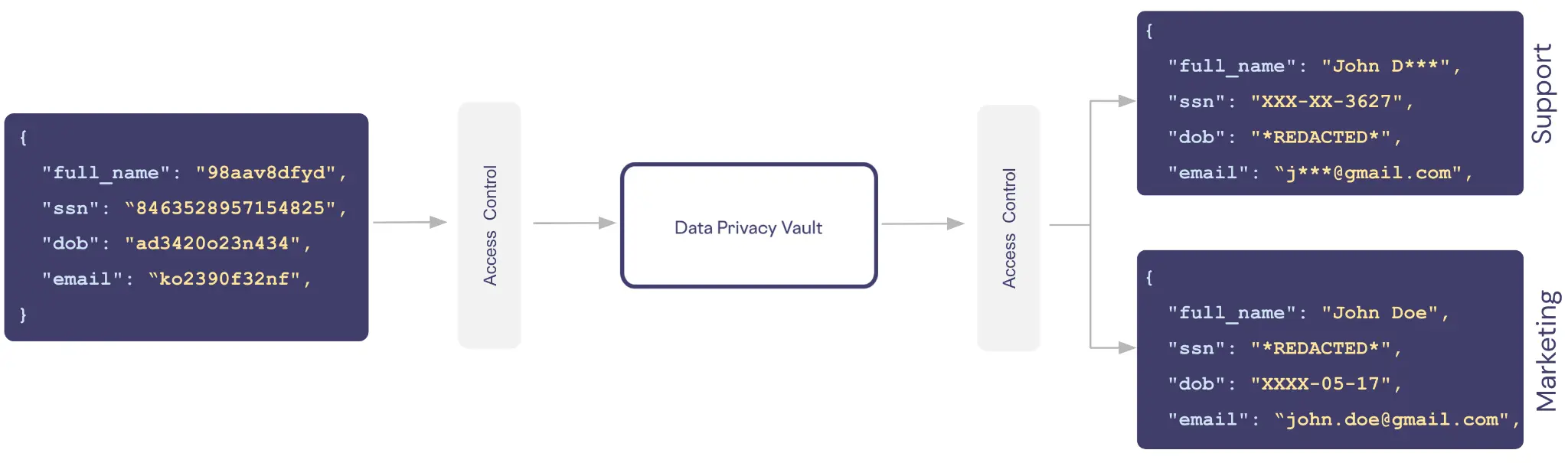
- Unauthorized Data Access: Attackers may gain access to sensitive information, including personal data, financial records, and proprietary business information, leading to privacy violations and potential legal ramifications for organizations.
<details>
<summary>extracted/5930689/media/PrivacyAI.png Details</summary>
### Visual Description
## Diagram: Data Privacy Vault Data Flow and Redaction
### Overview
This diagram illustrates a data privacy architecture where sensitive user data is ingested, processed through a central "Data Privacy Vault," and then released in different, redacted forms to different internal consumers (Support and Marketing). The flow demonstrates how raw, tokenized data is transformed into role-based, partially masked outputs.
### Components/Axes
The diagram is a horizontal flowchart with the following components, arranged from left to right:
1. **Input Data Object (Left):** A dark blue rounded rectangle containing a JSON object with tokenized/masked sensitive data.
2. **First Access Control Block:** A light gray vertical rectangle labeled "Access Control" with an arrow pointing from the input data to it.
3. **Central Processing Unit:** A white rounded rectangle with a dark blue border labeled "Data Privacy Vault". An arrow points from the first Access Control block to this vault.
4. **Second Access Control Block:** Another light gray vertical rectangle labeled "Access Control". An arrow points from the Data Privacy Vault to this block.
5. **Output Data Objects (Right):** Two dark blue rounded rectangles, each containing a JSON object with differently redacted data. They are labeled vertically on their right side:
* **Top Output:** Labeled "Support".
* **Bottom Output:** Labeled "Marketing".
Arrows point from the second Access Control block to each of these output objects.
### Detailed Analysis
**1. Input Data (Left Block):**
The initial data payload is a JSON object with four key-value pairs. The values appear to be tokenized or hashed placeholders, not real data.
```json
{
"full_name": "98aav8dfyd",
"ssn": "8463528957154825",
"dob": "ad3420o23n434",
"email": "ko2390f32nf"
}
```
**2. Data Flow & Transformation:**
* The tokenized input data passes through an **Access Control** layer.
* It enters the **Data Privacy Vault**, which is the core processing engine. This vault likely contains the logic and secure storage to map tokens to real data and apply redaction policies.
* The processed data exits through a second **Access Control** layer, which routes it based on the consumer's role.
**3. Output for "Support" (Top-Right Block):**
The Support team receives a JSON object where data is partially redacted to show just enough for verification while protecting full identifiers.
```json
{
"full_name": "John D***",
"ssn": "XXX-XX-3627",
"dob": "*REDACTED*",
"email": "j***@gmail.com"
}
```
* **Trend/Pattern:** The `full_name` shows the first name and last initial. The `ssn` reveals only the last four digits. The `dob` is completely redacted. The `email` shows the first initial and the domain.
**4. Output for "Marketing" (Bottom-Right Block):**
The Marketing team receives a different JSON object with a distinct redaction strategy, prioritizing different data elements.
```json
{
"full_name": "John Doe",
"ssn": "*REDACTED*",
"dob": "XXXX-05-17",
"email": "john.doe@gmail.com"
}
```
* **Trend/Pattern:** The `full_name` is fully visible. The `ssn` is completely redacted. The `dob` shows only the month and day (with the year redacted as "XXXX"). The `email` is fully visible.
### Key Observations
1. **Role-Based Data Masking:** The system provides different "views" of the same underlying data based on the consumer's role (Support vs. Marketing).
2. **Redaction Strategy Variance:**
* **Support View:** Focuses on partial identifiers for customer service verification (last 4 of SSN, name initial). Completely hides the date of birth.
* **Marketing View:** Provides full name and email for communication but heavily redacts government ID (SSN) and partially redacts the date of birth (hiding the year).
3. **Data Tokenization:** The input data is not in a human-readable format, suggesting it is already tokenized or encrypted before entering this privacy workflow.
4. **Centralized Policy Enforcement:** The "Data Privacy Vault" acts as a single point of control for applying complex, context-aware data masking rules, rather than having each downstream system implement its own logic.
### Interpretation
This diagram depicts a **Privacy-by-Design** architecture, specifically a **Data Privacy Vault** pattern. Its purpose is to decouple sensitive data from applications and provide controlled, auditable access.
* **What it demonstrates:** It shows how an organization can safely utilize sensitive user data (like PII) for multiple business functions (Support, Marketing) without exposing the raw data to any internal team. The vault acts as a secure broker.
* **How elements relate:** The two "Access Control" blocks represent policy enforcement points. The first likely handles authentication and authorization for data ingestion, while the second handles authorization for data egress based on the requesting service's role. The Vault is the trusted processing core.
* **Notable Anomalies/Patterns:** The most significant pattern is the deliberate difference in redaction between the two outputs. This is not an error but a feature, illustrating **data minimization**—each service receives only the data fields and granularity necessary for its specific function, reducing internal risk and aiding compliance with regulations like GDPR or CCPA.
* **Underlying Principle:** The architecture shifts the burden of data protection from individual application teams to a centralized, specialized platform, enabling consistent security and privacy policy enforcement across the organization.
</details>
Figure 2: Unauthorized Data Access
- Exploitation of Vulnerabilities: The integration of AI agents may introduce new vulnerabilities that malicious actors can exploit. For example, if the AI system relies on outdated software or lacks proper security updates, attackers could take advantage of these weaknesses to execute attacks.
- Increased Attack Vector Complexity: The dynamic nature of AI and LLMs introduces complexities in identifying and mitigating attack vectors. Attackers may employ sophisticated techniques that exploit these complexities, making it challenging for traditional security measures to adequately protect the system.
### 5.2 Data Manipulation Risks and Prompt Injections
Data manipulation risks pose a significant threat to the integrity and reliability of AI systems [13]. Malicious actors can employ various techniques to manipulate AI-generated queries and responses, resulting in severe consequences:
- Prompt Injection Attacks: Attackers can exploit prompt injection vulnerabilities by crafting inputs that manipulate the AI’s behaviour [14]. For instance, an attacker might input maliciously crafted prompts that cause the AI to generate misleading or harmful outputs, which could then be executed in a database query context. This could result in unauthorized data modifications or even complete data deletion.
- Data Theft and Corruption: By manipulating the AI’s queries or responses, attackers can gain unauthorized access to sensitive data, leading to data theft. Furthermore, they may corrupt the data by inserting false or misleading information into the database, undermining data integrity and potentially leading to erroneous decision-making based on compromised data.
- Automated Attack Execution: The ability of AI agents to autonomously execute commands increases the risk of large-scale attacks. For instance, if an attacker can manipulate the AI to generate a series of malicious database queries, they could inadvertently launch a coordinated attack, overwhelming the database with unauthorized access attempts or data manipulation requests.
### 5.3 API Usage and Sensitive Data Exposure
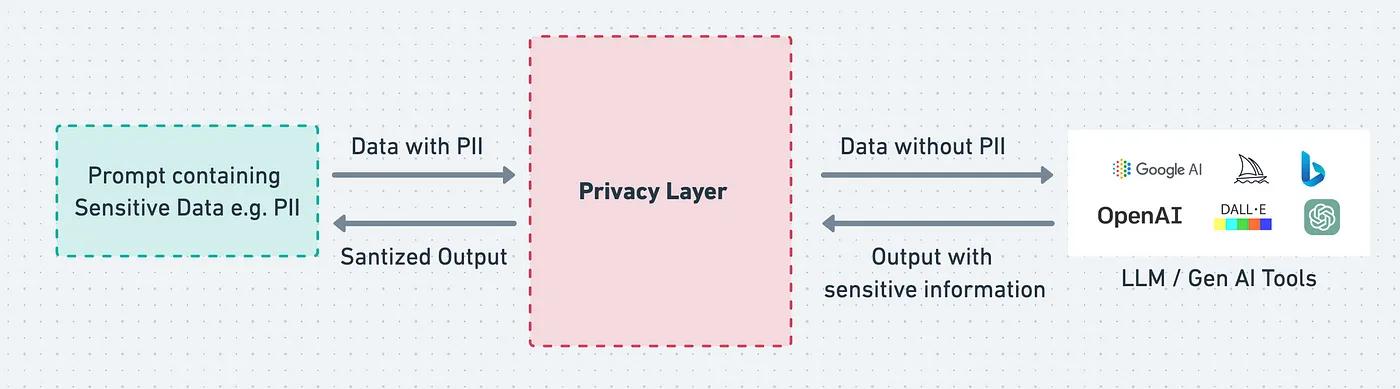
Companies utilizing LLM APIs may inadvertently expose sensitive information to the API providers. When organizations send queries containing personal or confidential data to an external API, they run the risk of disclosing sensitive information that can be misused. This vulnerability arises from several factors:
- Lack of Control Over Data Handling: Organizations often have limited visibility into how API providers manage and store the data sent to them. Sensitive information could be logged, analyzed, or even used to improve the AI model, leading to potential privacy breaches.
- Inadvertent Data Leakage: Even well-meaning API calls can lead to data leakage. For instance, if a query inadvertently includes sensitive user information or internal business data, this data could be accessed by API providers and other parties involved in the processing chain.
<details>
<summary>extracted/5930689/media/OrgData.png Details</summary>
### Visual Description
## System Architecture Diagram: Privacy Layer for AI Interactions
### Overview
This image is a system architecture diagram illustrating a privacy-preserving data flow between a user prompt containing sensitive information and external Large Language Model (LLM) or Generative AI tools. The diagram depicts a central "Privacy Layer" that sanitizes data before it leaves the user's environment and re-sanitizes output before it returns.
### Components/Axes
The diagram is composed of three primary rectangular components arranged horizontally, connected by directional arrows indicating data flow.
1. **Left Component (Source):**
* **Shape:** Rectangle with a dashed, teal-colored border.
* **Label Text:** "Prompt containing Sensitive Data e.g. PII"
* **Position:** Left side of the diagram.
2. **Central Component (Processing Layer):**
* **Shape:** Rectangle with a dashed, red-colored border.
* **Label Text:** "Privacy Layer"
* **Position:** Center of the diagram.
3. **Right Component (External Service):**
* **Shape:** Rectangle with a solid, light gray border.
* **Label Text:** "LLM / Gen AI Tools"
* **Logos/Icons:** Contains logos for:
* Google AI (text and multicolored dot logo)
* OpenAI (text and black sailboat logo)
* DALL-E (text and multicolored square logo)
* A blue "b" logo (likely Bing)
* A green circular logo with a white symbol (likely ChatGPT)
* **Position:** Right side of the diagram.
**Data Flow Arrows & Labels:**
* **Top Arrow (Left to Right):** Labeled "Data with PII". Originates from the left component, points to the central Privacy Layer.
* **Bottom Arrow (Right to Left):** Labeled "Sanitized Output". Originates from the central Privacy Layer, points to the left component.
* **Top Arrow (Center to Right):** Labeled "Data without PII". Originates from the central Privacy Layer, points to the right component.
* **Bottom Arrow (Right to Center):** Labeled "Output with sensitive information". Originates from the right component, points to the central Privacy Layer.
### Detailed Analysis
The diagram explicitly defines a bidirectional data sanitization process:
1. **Outbound Flow (User to AI):**
* A user's prompt, which may contain Personally Identifiable Information (PII) or other sensitive data, is sent to the Privacy Layer.
* The Privacy Layer processes this input, removing or obfuscating the sensitive elements.
* The resulting "Data without PII" is then transmitted to the external LLM/Gen AI tools.
2. **Inbound Flow (AI to User):**
* The external AI tools generate a response, which is labeled as potentially containing "sensitive information." This could be because the AI model itself might inadvertently echo or infer sensitive data from the sanitized prompt or its training.
* This raw output is sent back to the Privacy Layer.
* The Privacy Layer performs a second sanitization pass on the AI's response.
* The final "Sanitized Output" is delivered back to the user's environment (the original prompt source).
### Key Observations
* **Bidirectional Sanitization:** The Privacy Layer is not a one-way filter. It actively scrubs data both on the way out to the AI service and on the way back from it.
* **Explicit PII Handling:** The diagram specifically names "PII" as the type of sensitive data being protected, indicating a focus on privacy regulations like GDPR or CCPA.
* **Third-Party Service Agnosticism:** The right-hand box groups multiple, distinct AI service providers (Google, OpenAI, Microsoft/Bing) under a single label, suggesting the Privacy Layer is designed to work as a gateway to various external tools.
* **Visual Coding:** The use of dashed borders for the user-side components (source and privacy layer) versus a solid border for the external service visually distinguishes the trusted internal environment from the external, untrusted one.
### Interpretation
This diagram represents a **privacy-by-design architecture** for leveraging commercial AI services. Its core purpose is to enable the use of powerful, external LLMs while mitigating the risk of exposing sensitive user data.
* **What it demonstrates:** It shows a technical solution to the conflict between data privacy and AI utility. Organizations can harness advanced AI capabilities without directly feeding raw, sensitive information into third-party systems.
* **How elements relate:** The Privacy Layer acts as a mandatory, intelligent proxy. It decouples the user's data environment from the AI service environment, ensuring compliance and reducing the attack surface for data leaks.
* **Notable implications:**
* **Compliance:** This architecture is likely a response to strict data protection laws. It provides an auditable trail showing that PII was stripped before leaving the organization.
* **Trust Model:** It shifts trust from the external AI provider to the internal Privacy Layer. The security and effectiveness of the entire system depend on the robustness of this layer's sanitization algorithms.
* **Potential Limitation:** The diagram implies the Privacy Layer can perfectly identify and remove all sensitive data ("Data without PII") and all sensitive information in the output. In practice, this is a complex challenge, and the system's efficacy would depend on the sophistication of its detection and redaction mechanisms. The label "Output with sensitive information" acknowledges that the raw AI response is not inherently safe.
</details>
Figure 3: Demonstration of an intermediary layer setup to prevent leakage of sensitive organisational data
- Compliance Risks: Sharing sensitive information with third-party API providers may result in non-compliance with data protection regulations such as GDPR or HIPAA. Organizations must ensure that any data shared with external services adheres to legal standards for data handling and user consent.
### 5.4 Mitigating Security Vulnerabilities
To combat these vulnerabilities, organisations must adopt a proactive approach to security. This includes implementing layered security measures, such as robust access controls, encryption, and continuous monitoring of AI systems. Regular security assessments and updates are essential to identify and address vulnerabilities before they can be exploited.
Additionally, educating AI developers and users about potential security threats associated with AI and LLMs is crucial [15]. By fostering a culture of security awareness, organisations can better equip themselves to respond to and mitigate the risks posed by these evolving technologies.
## 6 Conclusion
The integration of AI agents, particularly those with direct access to database systems, presents significant privacy and security challenges that cannot be overlooked. This research has highlighted the multifaceted vulnerabilities associated with AI agent interactions, including the expansion of the attack surface, risks of data manipulation, and the unintended exposure of sensitive information through the use of LLM APIs. As AI technologies continue to advance, the potential for exploitation of these vulnerabilities by malicious actors increases, necessitating a proactive approach to security in AI systems.
Organizations must prioritize the development of robust security frameworks that encompass comprehensive access controls, continuous monitoring, and adherence to data protection regulations. Moreover, fostering a culture of security awareness among AI developers and users is critical to mitigating risks associated with AI and LLMs.
Ultimately, while the potential benefits of AI systems are immense, the challenges of ensuring data privacy and security are equally significant. Addressing these vulnerabilities is essential for maintaining user trust and achieving the responsible deployment of AI technologies across various industries. Continued research and innovation in this area will be crucial to creating secure, ethical, and efficient AI systems that can operate safely in a datarich environment.
## References
- [1] Othmane Friha, Mohamed Amine Ferrag, Burak Kantarci, Burak Cakmak, Arda Ozgun, and Nassira Ghoualmi-Zine. Llm-based edge intelligence: A comprehensive survey on architectures, applications, security and trustworthiness. IEEE Open Journal of the Communications Society, 2024.
- [2] Kim On Chin, Kim Soon Gan, Rayner Alfred, Patricia Anthony, and Dickson Lukose. Agent architecture: An overview. Transactions on science and technology, 1(1):18–35, 2014.
- [3] Yifeng He, Ethan Wang, Yuyang Rong, Zifei Cheng, and Hao Chen. Security of ai agents. arXiv preprint arXiv:2406.08689, 2024.
- [4] Adrián Bazaga, Nupur Gunwant, and Gos Micklem. Translating synthetic natural language to database queries with a polyglot deep learning framework. Scientific Reports, 11(1):18462, 2021.
- [5] G Prashanthi, Sravani Puranam, Sheethal Reddy Vemula, Preethi Doulathbaji, Anusha Bellamkonda, et al. Natural language to sql: Automated query formation using nlp techniques. In E3S Web of Conferences, volume 391, page 01115. EDP Sciences, 2023.
- [6] Austine Unuriode, Olalekan Durojaiye, Babatunde Yusuf, and Lateef Okunade. The integration of artificial i intelligence into d database systems (ai-db integration review). Available at SSRN 4744549, 2023.
- [7] Zhi Jing, Yongye Su, Yikun Han, Bo Yuan, Chunjiang Liu, Haiyun Xu, and Kehai Chen. When large language models meet vector databases: A survey. arXiv preprint arXiv:2402.01763, 2024.
- [8] Daeseung Park, Gi-taek An, Chayapol Kamyod, and Cheong Ghil Kim. A study on performance improvement of prompt engineering for generative ai with a large language model. Journal of Web Engineering, 22(8):1187–1206, 2023.
- [9] Mark Ryan, Josephina Antoniou, Laurence Brooks, Tilimbe Jiya, Kevin Macnish, and Bernd Stahl. Research and practice of ai ethics: a case study approach juxtaposing academic discourse with organisational reality. Science and Engineering Ethics, 27:1–29, 2021.
- [10] Ana Luize Corrêa Bertoncini and Mauricio C Serafim. Ethical content in artificial intelligence systems: A demand explained in three critical points. Frontiers in Psychology, 14:1074787, 2023.
- [11] Tula Masterman, Sandi Besen, Mason Sawtell, and Alex Chao. The landscape of emerging ai agent architectures for reasoning, planning, and tool calling: A survey. arXiv preprint arXiv:2404.11584, 2024.
- [12] Saharnaz Dilmaghani, Matthias R Brust, Grégoire Danoy, Natalia Cassagnes, Johnatan Pecero, and Pascal Bouvry. Privacy and security of big data in ai systems: A research and standards perspective. In 2019 IEEE international conference on big data (big data), pages 5737–5743. IEEE, 2019.
- [13] Jan von der Assen, Jamo Sharif, Chao Feng, Christian Killer, Gérôme Bovet, and Burkhard Stiller. Asset-centric threat modeling for ai-based systems. In 2024 IEEE International Conference on Cyber Security and Resilience (CSR), pages 437–444. IEEE, 2024.
- [14] Daniel Wankit Yip, Aysan Esmradi, and Chun Fai Chan. A novel evaluation framework for assessing resilience against prompt injection attacks in large language models. In 2023 IEEE Asia-Pacific Conference on Computer Science and Data Engineering (CSDE), pages 1–5. IEEE, 2023.
- [15] Yupeng Hu, Wenxin Kuang, Zheng Qin, Kenli Li, Jiliang Zhang, Yansong Gao, Wenjia Li, and Keqin Li. Artificial intelligence security: Threats and countermeasures. ACM Computing Surveys (CSUR), 55(1):1–36, 2021.