# CLaMP 3: Universal Music Information Retrieval Across Unaligned Modalities and Unseen Languages
## Abstract
CLaMP 3 is a unified framework developed to address challenges of cross-modal and cross-lingual generalization in music information retrieval. Using contrastive learning, it aligns all major music modalities–including sheet music, performance signals, and audio recordings–with multilingual text in a shared representation space, enabling retrieval across unaligned modalities with text as a bridge. It features a multilingual text encoder adaptable to unseen languages, exhibiting strong cross-lingual generalization. Leveraging retrieval-augmented generation, we curated M4-RAG, a web-scale dataset consisting of 2.31 million music-text pairs. This dataset is enriched with detailed metadata that represents a wide array of global musical traditions. To advance future research, we release WikiMT-X, a benchmark comprising 1,000 triplets of sheet music, audio, and richly varied text descriptions. Experiments show that CLaMP 3 achieves state-of-the-art performance on multiple MIR tasks, significantly surpassing previous strong baselines and demonstrating excellent generalization in multimodal and multilingual music contexts.
CLaMP 3: Universal Music Information Retrieval Across Unaligned Modalities and Unseen Languages
Shangda Wu Zhancheng Guo Ruibin Yuan Junyan Jiang Seungheon Doh Gus Xia Juhan Nam Xiaobing Li Feng Yu Maosong Sun Details of authors, correspondence, and affiliations are on Page 9 https://sanderwood.github.io/clamp3
## 1 Introduction
Music Information Retrieval (MIR) is a field that aims at developing computational tools for processing, organizing, and accessing music data. A core challenge in MIR is retrieving musical content—whether sheet music, performance signals, or audio recordings—based on natural language queries (“a fast-paced classical piano piece”). This connection enables applications such as automatic music tagging, where models assign genres (“jazz,” “folk”) or descriptive attributes (“melancholic,” “upbeat”), facilitating music organization, search, and recommendation. By integrating NLP methodologies, MIR enables more intuitive access to musical content, making it more interpretable and searchable through text.
<details>
<summary>x1.png Details</summary>
### Visual Description
## Diagram: Multilingual Performance Signal Processing System
### Overview
The diagram illustrates a multilingual system architecture connecting three core components: Performance Signal (piano), Sheet Music, and Audio Recording. A central cluster of overlapping language bubbles represents linguistic processing capabilities, with directional arrows indicating data flow and alignment relationships.
### Components/Axes
1. **Performance Signal** (Top)
- Icon: Piano with waveform
- Arrows: Dashed lines connecting to central language cluster
- Legend: "Emergent Alignment" (dashed arrows)
2. **Central Language Cluster**
- Languages represented: English, Español, Français, 中文, Русский, العربية, Ελληνικά, and others
- Visual: Overlapping colored bubbles with language names in native scripts
- Notable: "Unseen Language" (dashed circle) encompassing some bubbles
3. **Sheet Music** (Bottom Left)
- Icon: Musical notes with staff
- Arrows: Solid lines from language cluster
- Legend: "Supervised Alignment" (solid arrows)
4. **Audio Recording** (Bottom Right)
- Icon: Headphones with waveform
- Arrows: Solid lines from language cluster
- Legend: "Supervised Alignment" (solid arrows)
5. **Legend** (Top Right)
- Supervised Alignment: Solid arrows
- Emergent Alignment: Dashed arrows
- Unseen Language: Dashed circle
### Detailed Analysis
- **Language Cluster Composition**:
- 8 primary languages explicitly labeled (English, Español, Français, 中文, Русский, العربية, Ελληνικά, and one untranslated script)
- 12 smaller bubbles representing additional languages/scripts
- Overlapping bubbles suggest shared processing pathways
- **Alignment Relationships**:
- Performance Signal → Language Cluster: Emergent Alignment (dashed arrows)
- Language Cluster → Sheet Music: Supervised Alignment (solid arrows)
- Language Cluster → Audio Recording: Supervised Alignment (solid arrows)
- **Unseen Language Pattern**:
- 3 bubbles partially enclosed by dashed "Unseen Language" circle
- Positioned at cluster periphery, suggesting emerging language support
### Key Observations
1. **Alignment Strategy**:
- Emergent Alignment dominates input processing (Performance Signal)
- Supervised Alignment governs output generation (Sheet Music/Audio)
2. **Language Coverage**:
- Balanced representation of Indo-European, East Asian, and Semitic languages
- Unseen Language component implies zero-shot translation capability
3. **System Flow**:
- Top-down processing from Performance Signal to multilingual processing
- Divergent paths to specialized output modalities
### Interpretation
This architecture demonstrates a hybrid alignment approach where:
- **Emergent Alignment** enables initial language processing without explicit training
- **Supervised Alignment** ensures precise output generation for known languages
- The "Unseen Language" component suggests the system can handle novel languages through cross-lingual transfer learning
The multilingual cluster's overlapping design implies shared phonetic/grammatical features being leveraged across languages. The bidirectional arrows between Performance Signal and language processing indicate potential feedback loops for performance analysis.
The system appears optimized for music-related applications requiring:
1. Multilingual sheet music generation
2. Cross-lingual audio processing
3. Adaptive handling of emerging languages
</details>
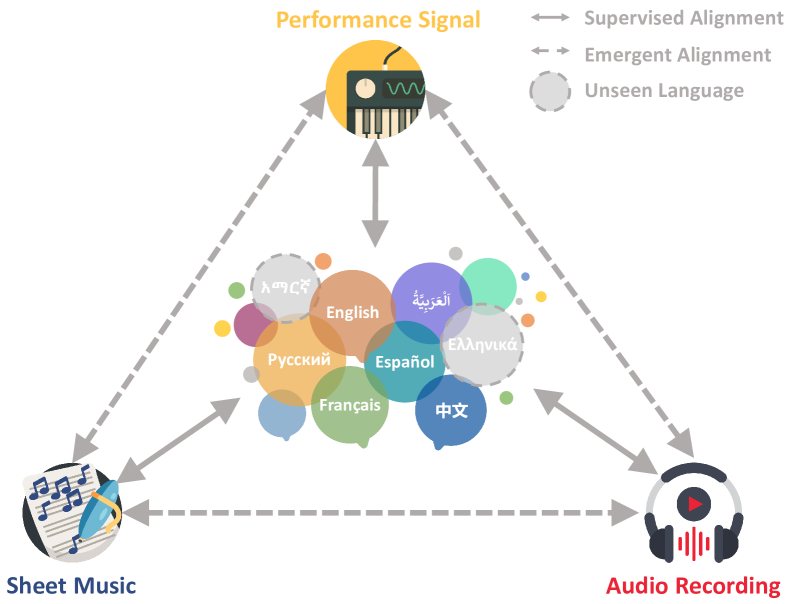
Figure 1: CLaMP 3 demonstrates robust cross-modal and cross-lingual generalization. Supervised alignment (solid arrows) links paired modalities, while emergent alignment (dashed arrows) bridges unaligned ones. A multilingual text encoder enables retrieval in languages unseen (grayed-out bubbles) during alignment.
These capabilities position MIR as a critical bridge between music and language, supporting various applications beyond retrieval and annotation. For instance, cross-modal representations enable text-to-music generation models Agostinelli et al. (2023); Chen et al. (2024) to create music based on text descriptions. MIR also aids in the automatic evaluation of these models by assessing how closely the generated music aligns with text descriptions or resembles the ground truth Copet et al. (2023); Retkowski et al. (2024).
Despite these advancements, MIR faces significant challenges in addressing the complexities of multimodality and multilinguality. Music exists in many forms: sheet music offers human-readable representations for theoretical analysis and education; performance signals (e.g., MIDI) capture timing and dynamics for precise digital editing; and audio recordings serve as the primary medium for listening. While these modalities complement each other, their heterogeneous representational structures complicate unified computational processing.
Adding to this complexity, as a universal medium, music is described in numerous languages, crossing cultural and linguistic boundaries. Musical terminology, descriptions, and cultural references vary significantly between linguistic communities, each bringing its own rich vocabulary and cultural context. To build global and accessible MIR systems, it is essential to process and understand these diverse expressions effectively.
<details>
<summary>x2.png Details</summary>
### Visual Description
## Flowchart: Multimodal Music Processing System Architecture
### Overview
The diagram illustrates a technical architecture for a multimodal music processing system. It shows the flow of data through four interconnected components: Symbolic Music Encoder, Multilingual Text Encoder, Audio Music Encoder, and Audio Feature Extractor. The system integrates symbolic notation, textual descriptions, and audio features through trainable and frozen components.
### Components/Axes
1. **Symbolic Music Encoder (Green)**
- Inputs: Musical notation (S₁-S₆) with time signatures, key signatures, and track metadata
- Output: Grid of encoded symbolic representations (S₁-S₆)
- Notable: Contains trainable components (fire icon)
2. **Multilingual Text Encoder (Blue)**
- Inputs: Textual descriptions in Chinese (e.g., "身着银装" - "Body language")
- Output: Grid of encoded text representations (T₁-T₆)
- Notable: Contains trainable components (fire icon)
3. **Audio Music Encoder (Purple)**
- Inputs: Audio features (A₁-A₆)
- Output: Processed audio representations (A₁-A₆)
- Notable: Contains trainable components (fire icon)
4. **Audio Feature Extractor (Red)**
- Inputs: Audio features (A₁-A₆)
- Output: Extracted audio features (A₁ᵀ-A₆ᵀ)
- Notable: Contains frozen components (snowflake icon)
### Detailed Analysis
- **Symbolic Music Encoder Grid**:
- S₁: Contains musical notation with time signature 3/4, key signature G
- S₂: Contains musical notation with time signature 4/4, key signature G
- S₃: Contains musical notation with time signature 8/8, key signature G
- S₄: Contains musical notation with time signature 3/4, key signature G
- S₅: Contains musical notation with time signature 4/4, key signature G
- S₆: Contains musical notation with time signature 8/8, key signature G
- **Multilingual Text Encoder Grid**:
- T₁: Contains text "身着银装" (Body language)
- T₂: Contains text "传统爱尔兰歌曲" (Traditional Irish song)
- T₃: Contains text "迪翁·布希高勒" (Dionne-Bishighler)
- T₄: Contains text "民谣" (Folk song)
- T₅: Contains text "The music features a lilting melody..."
- T₆: Contains text "nostalgia and..."
- **Audio Music Encoder Grid**:
- A₁: Audio feature representation
- A₂: Audio feature representation
- A₃: Audio feature representation
- A₄: Audio feature representation
- A₅: Audio feature representation
- A₆: Audio feature representation
- **Audio Feature Extractor**:
- A₁ᵀ: Transposed audio feature
- A₂ᵀ: Transposed audio feature
- A₃ᵀ: Transposed audio feature
- A₄ᵀ: Transposed audio feature
- A₅ᵀ: Transposed audio feature
- A₆ᵀ: Transposed audio feature
### Key Observations
1. The system processes three modalities: symbolic notation, textual descriptions, and audio features
2. Components are color-coded (green, blue, purple, red) for easy identification
3. Trainable components (fire icon) appear in all encoders except the Audio Feature Extractor
4. The Audio Feature Extractor contains frozen components (snowflake icon)
5. Textual inputs include both Chinese characters and English descriptions
6. The system shows a clear data flow from input modalities to final feature extraction
### Interpretation
This architecture demonstrates a multimodal approach to music analysis, combining:
- Symbolic representation (musical notation)
- Textual analysis (multilingual descriptions)
- Audio processing (feature extraction)
The use of trainable components in the first three encoders suggests active learning capabilities, while the frozen components in the Audio Feature Extractor likely represent pre-trained models for audio processing. The integration of Chinese text indicates multilingual support, potentially for cross-lingual music analysis.
The system's design implies that symbolic and textual inputs are processed through separate encoders before being combined with audio features in the final stage. This separation allows for specialized processing of each modality while maintaining the ability to integrate them for comprehensive music analysis.
</details>
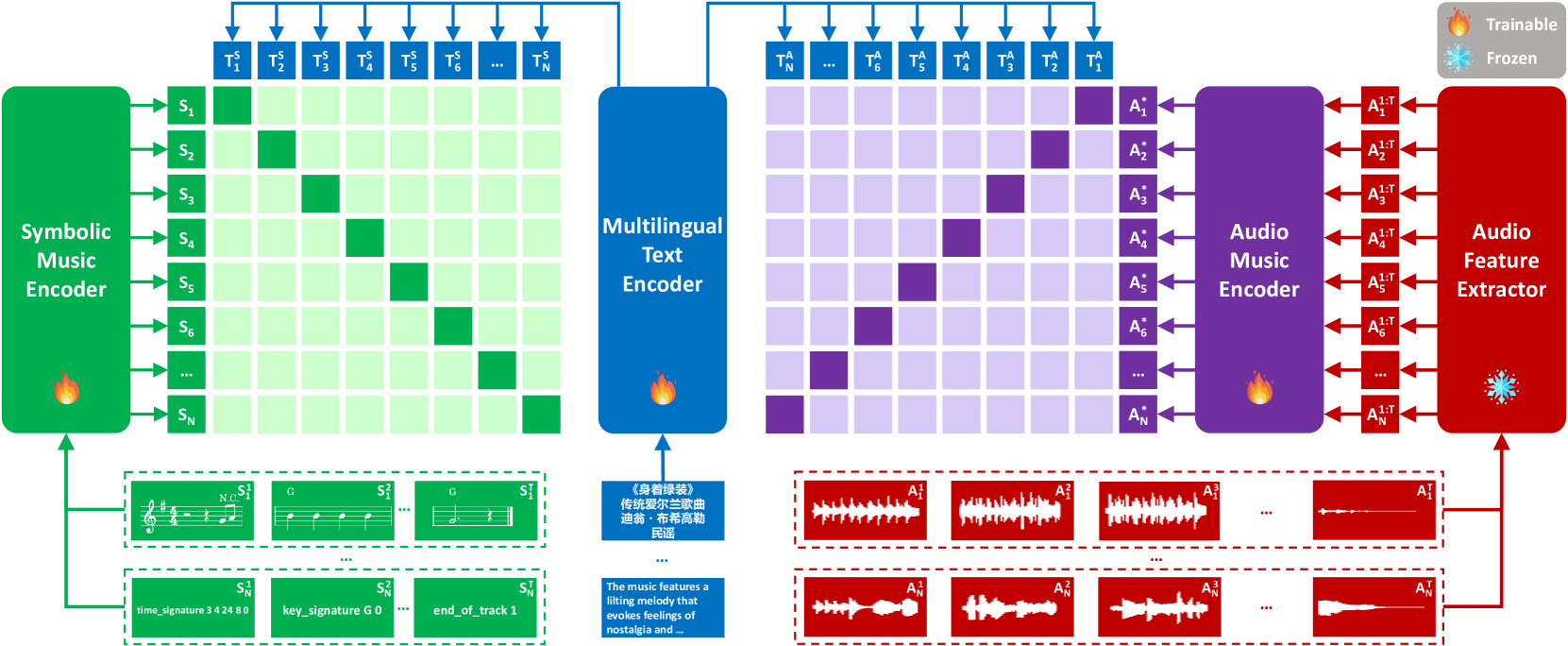
Figure 2: CLaMP 3 uses contrastive learning to align features across modalities. Sheet music and performance signals are segmented into units (bars or MIDI messages) and processed by the symbolic music encoder, while audio is segmented into 5-second clips and processed through the audio feature extractor and audio music encoder. Both symbolic and audio representations are aligned with text representations from the multilingual text encoder.
Unfortunately, the development of MIR is limited not only by the lack of music-text pairs but also by the general scarcity of paired data across different musical modalities. As a result, most research focuses on retrieval between specific modality pairs, such as text and audio Huang et al. (2022); Doh et al. (2024); Zhu et al. (2025) or text and sheet music Wu et al. (2023a). This narrow focus restricts the potential for cross-modal interactions, preventing a more comprehensive understanding of music. Additionally, existing text data is often short-form, like tags, with few long-form descriptions Wu et al. (2023b), leading to shallow semantics. These datasets are also predominantly in English Doh et al. (2023b), with limited representation of other languages, neglecting music’s global and multilingual nature.
To tackle these challenges, a unified framework is crucial for aligning musical modalities and bridging linguistic gaps, particularly in the absence of paired training data. Large Language Models (LLMs) present a promising solution by addressing the limitations of text semantics and the scarcity of linguistic diversity in music-text datasets. These models excel at transforming basic metadata into fluent and contextually rich descriptions Doh et al. (2023a); Bai et al. (2024). Furthermore, their multilingual capabilities allow them to support a wide array of languages Wu et al. (2024), enhancing semantic depth and enabling more inclusive access across diverse linguistic and cultural contexts.
In this paper, we introduce CLaMP 3, a universal MIR framework that processes music and text while aligning them into a shared representation space. It covers all major music modalities: 1) sheet music, 2) performance signals, and 3) audio recordings, along with 4) multilingual text. Each modality is encoded through its respective feature extractor. To unify these representations, we employ contrastive learning Sohn (2016), aligning both musical and textual features. This enables seamless cross-modal retrieval and integration across diverse musical formats and languages.
To address the shortage of paired music-text data, we use Retrieval-Augmented Generation (RAG) Lewis et al. (2020) to create M4-RAG, a dataset of 2.31 million music-text pairs covering various musical modalities. Starting with basic metadata like song titles and artist names, we retrieve relevant web documents and use an LLM to generate detailed annotations. These annotations include short tags, long descriptions, and multilingual translations, providing rich and diverse information.
In addition, we present WikiMT-X, the first benchmark to align text, audio, and sheet music. It includes 1,000 triplets with diverse text annotations, such as genre labels and detailed long-form descriptions, including background context, musical analysis, general descriptions, and scene depictions. WikiMT-X facilitates evaluation across modalities and semantic perspectives, providing a holistic framework to assess models’ ability to align and interpret musical content.
Experiments demonstrate that CLaMP 3 achieves state-of-the-art performance on various MIR tasks, including text-to-audio and text-to-symbolic music retrieval, significantly surpassing all baselines. It also excels in multilingual retrieval, generalizing to languages not present during alignment. By leveraging text as a bridge, CLaMP 3 enables emergent cross-modal retrieval, connecting musical modalities without paired training data.
Overall, this work contributes:
- CLaMP 3 unifies musical modalities and languages in a shared representation space, achieving strong performance on a wide range of MIR tasks and generalizing to unseen languages with emergent cross-modal alignment.
- We curate M4-RAG, a dataset of 2.31 million music-text pairs with diverse annotations, spanning 27 languages and 194 countries, addressing a critical gap in high-quality training data for music and language tasks.
- WikiMT-X links text, audio, and sheet music with 1,000 triplets, offering a first-of-its-kind resource to evaluate models holistically across different modalities and semantic aspects.
To support future research, we have publicly released the complete codebase, pre-trained weights of CLaMP 3, 1.56 million audio-text training pairs, and the WikiMT-X benchmark https://github.com/sanderwood/clamp3.
## 2 Model
### 2.1 Training Objective
CLaMP 3’s optimization objective is to minimize the InfoNCE loss Oord et al. (2018), aligning embeddings using contrastive learning:
$$
\begin{split}L_CL=-\frac{1}{N}∑_i=1^N\log\frac{\exp(sim(z_i^t,z_i^m)/τ)}{∑_j=1^N\exp(sim(z_i^t,z_j^m)/τ)
},\end{split} \tag{1}
$$
where $z_i^t$ and $z_i^m$ are text and music embeddings, $sim(·,·)$ is the similarity function (e.g., dot product), and $τ$ is the temperature parameter. Positive pairs are aligned text-music samples, while negatives are unrelated samples from the same batch.
Inspired by ImageBind Girdhar et al. (2023), we adopt a multi-stage strategy using text as a bridge to address the lack of paired music data:
Stage 1: The text encoder is first trained to align with one music encoder (e.g., symbolic encoder).
Stage 2: It is then aligned with another music encoder (e.g., audio encoder), freezing the text encoder to prevent representation drift.
Stage 3: The text encoder is unfrozen to refine its alignment with the music encoder from Stage 2.
Stage 4: The text encoder is frozen again to prevent shifts while re-aligning with the Stage 1 music encoder to fix alignment drift from Stage 3.
This strategy minimizes modality interference while mapping all modalities into a shared representation space for effective cross-modal transfer.
### 2.2 Core Components
CLaMP 3 consists of several transformer-based encoders Vaswani et al. (2017) for each modality:
Multilingual Text Encoder: The text encoder in CLaMP 3 is based on XLM-R-base Conneau et al. (2020), a model pre-trained on 2.5 TB of CommonCrawl data across 100 languages. It has 12 layers and a hidden size of 768, enabling strong cross-lingual generalization to unseen languages.
Symbolic Music Encoder: CLaMP 3 uses M3 Wu et al. (2024), a self-supervised model for encoding symbolic music, including multi-track voice-interleaved ABC notation and lossless MIDI encoding via MIDI Text Format (MTF). M3 segments ABC into bars and MIDI into messages, treating each segment as a patch. The model has 12 encoder layers, a hidden size of 768, and processes up to 512 patches or 32,768 characters per input.
Audio Music Encoder: It is a 12-layer transformer with a 768-dimensional hidden size, trained from scratch for audio processing. This encoder leverages pre-trained features from MERT-v1-95M Li et al. (2024), where MERT serves as a frozen audio feature extractor. Each 5-second clip is represented by a single embedding, obtained by averaging across all MERT layers and time steps. CLaMP 3 processes up to 128 such embeddings, covering 640 seconds of audio, allowing it to capture high-level audio patterns over extended durations.
All encoders process their outputs through a linear layer, followed by average pooling, to generate a single global semantic feature for each input.
## 3 Dataset
In this section, we introduce the M4-RAG dataset for training CLaMP 3 and the WikiMT-X benchmark for evaluation. We start with data sources, followed by the metadata curation process. Then, we summarize dataset statistics like scale and diversity. Finally, we elaborate on the details of the WikiMT-X benchmark.
### 3.1 Data Sources
The training data for CLaMP 3 is built from both symbolic and audio music datasets, ensuring a rich and diverse foundation for multimodal learning.
The symbolic music data is sourced from WebMusicText (WebMT) Wu et al. (2023a) with 1.4 million ABC notation files and the Million MIDI Dataset (MMD) Zeng et al. (2021) with 1.5 million MIDI files. Since symbolic music formats use discrete symbols to represent music, they can be converted into one another, albeit with some information loss. To fully utilize the data, these datasets were unified by converting MMD to ABC and WebMT to MIDI. This process yields 3 million symbolic music files, offering diverse and comprehensive training coverage.
The audio data is collected from online sources, comprising 160 thousand hours of audio from 1.8 million tracks. As CLaMP 3 directly utilizes pre-extracted features, the training data exclusively consists of these precomputed features, leading to substantial savings in both computational resources and time.
Table 1: Metadata overview for M4-RAG, grouped into basic information, annotations, and translations. In Annotations, Region and Language are written in English; other fields follow the Language specification.
| Category | Field | Content | Avg Bytes |
| --- | --- | --- | --- |
| Basic | Title | Music Title | 20.04 |
| Artists | Artist names | 21.97 | |
| Annotations | Region | Country of origin | 20.69 |
| Language | Document language | 7.02 | |
| Genres | Genre list | 21.83 | |
| Tags | Keywords/playlists | 51.91 | |
| Background | Background context | 531.79 | |
| Analysis | Musical analysis | 770.29 | |
| Description | General description | 591.86 | |
| Scene | Scene depiction | 750.92 | |
| Translations | Language | Translation language | 6.38 |
| Background | Translated background | 819.76 | |
| Analysis | Translated analysis | 1130.47 | |
| Description | Translated description | 888.86 | |
| Scene | Translated scene | 1077.07 | |
### 3.2 Metadata Curation
Music titles often serve as unique identifiers, enabling the retrieval of rich and detailed descriptions from diverse online sources. When paired with artist names, they further refine searches, pinpointing specific versions or performances and reducing ambiguities caused by covers or adaptations. This distinctive property makes music titles a reliable basis for generating annotations, even in the absence of paired music-text datasets.
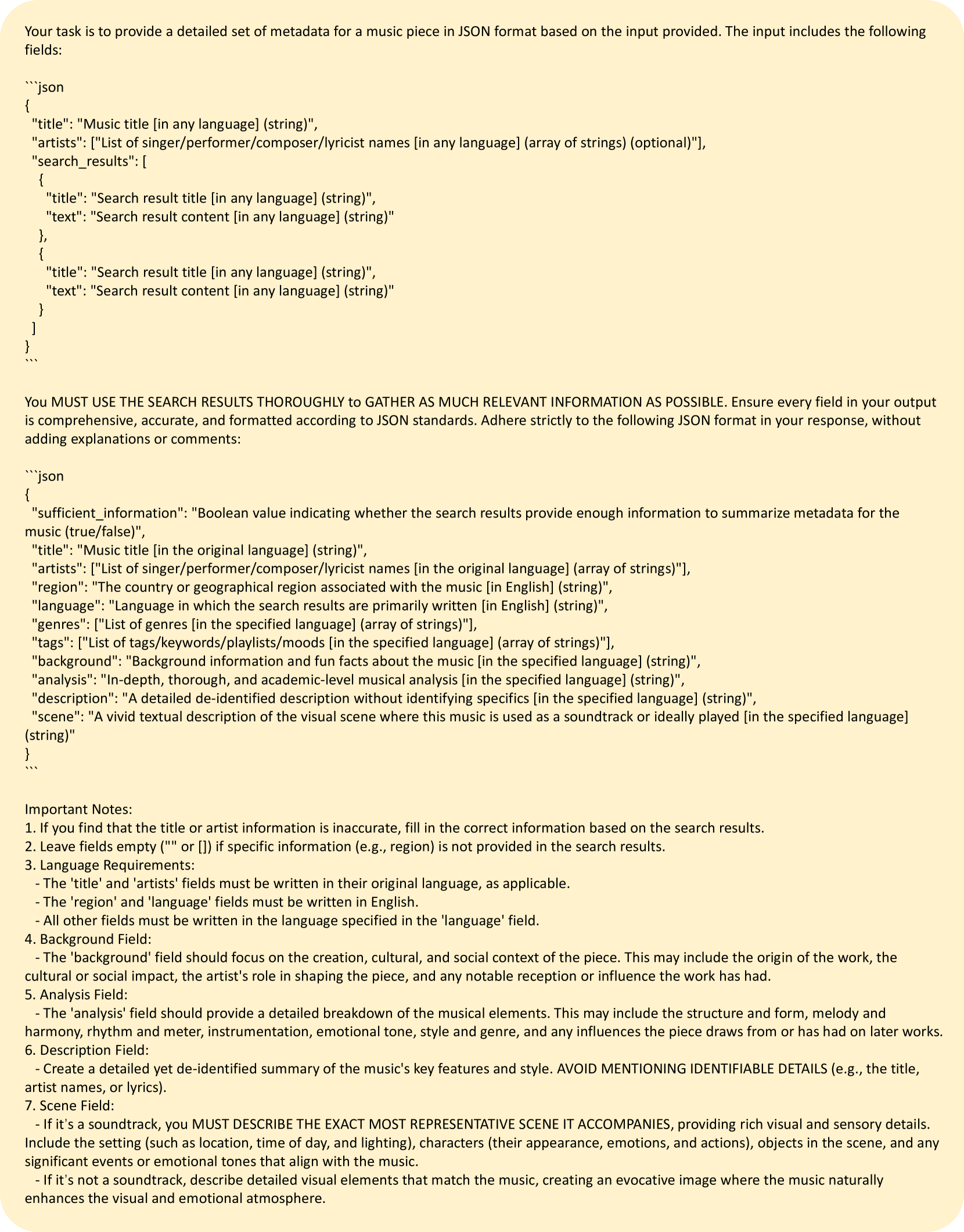
To leverage this, we curated M4-RAG (Million-scale Multilingual Music Metadata), a dataset comprising 2.31 million metadata entries. The curation process involved several key steps:
Title Filtering: Entries without titles were excluded, as titles are essential for retrieving meaningful information from the web.
Web Search: Google searches were conducted using titles and, where available, artist names. For each entry, the top 10 search results were collected to ensure diverse and reliable sources.
RAG: Using Qwen2.5-72B Yang et al. (2024), we generated annotations from the retrieved documents and basic metadata (titles and artist names). The annotations covered the fields in Table 1 under Annotations, with an additional Boolean field indicating if the source material had sufficient information for generating meaningful annotations.
Quality Filtering: Entries were discarded if flagged by the Boolean field for insufficient information, if their format failed to meet the standards outlined in Table 1, or if any fields were left empty.
Postprocessing: To address inconsistencies in the generated annotations, Region fields were mapped to recognized countries, while Description fields were refined using Qwen to remove identifiable details such as titles and lyrics. Language consistency across long-form fields (Background, Analysis, Description, Scene) was verified with fastText Joulin et al. (2017). Entries with inconsistent languages or languages unsupported by either XLM-R or Qwen were removed, and valid detected languages were recorded in the Language field.
Multilingual Translation: To enhance linguistic diversity, a random language supported by both XLM-R and Qwen—different from the original—was selected for each entry, and long-form annotations were translated into it using Qwen.
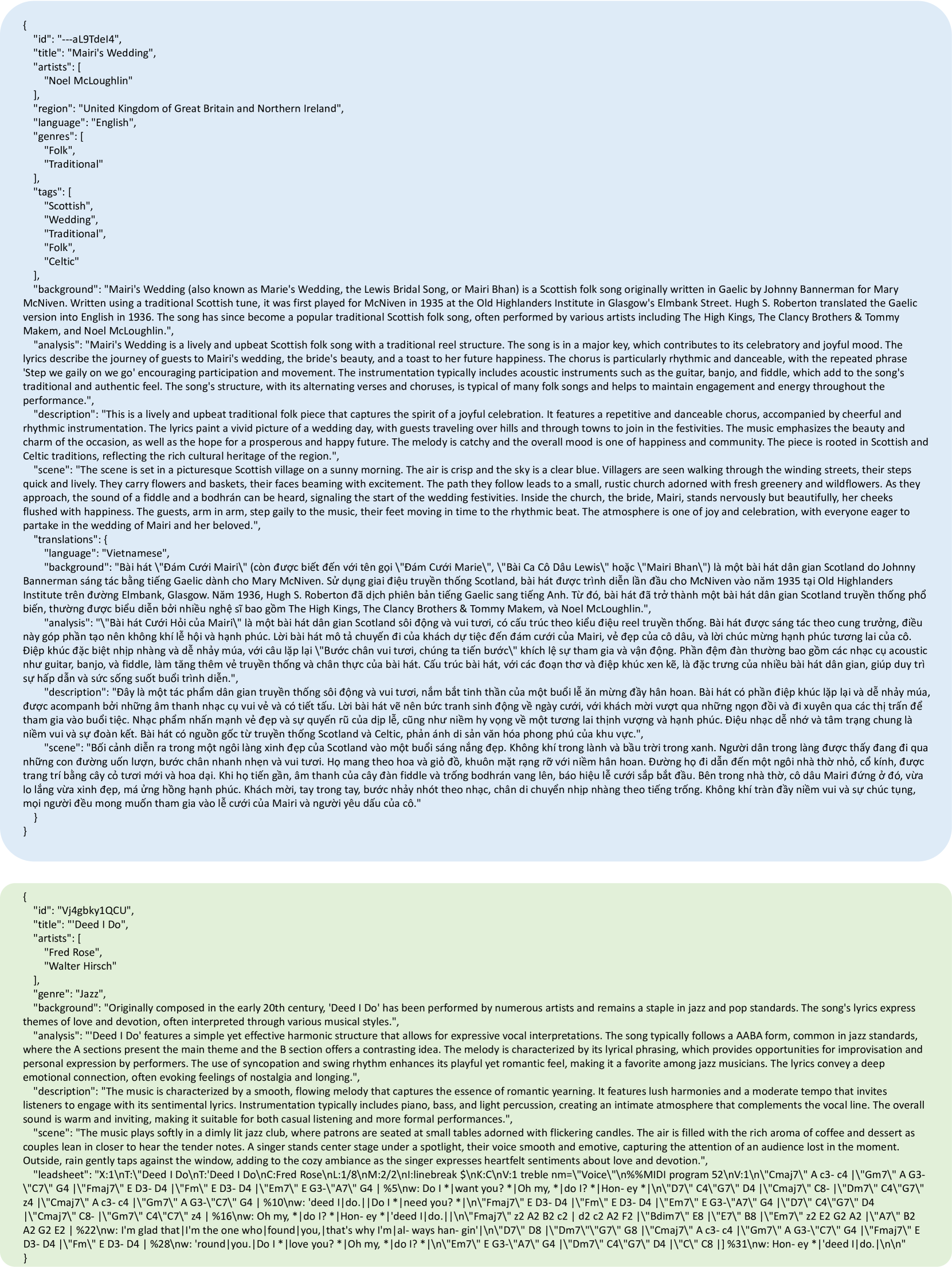
Prompt and examples of generated annotations are provided in Appendix A.
<details>
<summary>x3.png Details</summary>
### Visual Description
## Bar Chart: Country Data Distribution by Original and Translated Counts
### Overview
The image is a vertical bar chart comparing two data series across 26 country codes (e.g., EN, ES, FR). The y-axis uses a logarithmic scale (10⁰ to 10⁶) to represent counts, while the x-axis lists country codes in alphabetical order. Two data series are distinguished by color: green for "Original Data" and blue for "Translated Data." The legend is positioned in the top-right corner.
### Components/Axes
- **X-axis**: Country codes (EN, ES, FR, DE, PT, JA, IT, ZH, KO, RU, VI, NL, PL, TR, AR, ID, FA, HE, CS, TH, HI, LO, BN, KM, UR, MY, MS).
- **Y-axis**: Counts on a logarithmic scale (10⁰ to 10⁶).
- **Legend**: Top-right corner, with green labeled "Original Data" and blue labeled "Translated Data."
- **Bars**: Green bars represent Original Data; blue bars represent Translated Data.
### Detailed Analysis
1. **Original Data (Green)**:
- Starts at ~10⁶ for EN (highest value).
- Declines steadily across countries, reaching ~10¹ for MY and MS.
- Notable drops: EN (~10⁶) → ES (~10⁵) → FR (~10⁴) → DE (~10⁴) → PT (~10⁴) → JA (~10⁴) → IT (~10⁴) → ZH (~10³) → KO (~10³) → RU (~10³) → VI (~10³) → NL (~10³) → PL (~10³) → TR (~10³) → AR (~10³) → ID (~10³) → FA (~10³) → HE (~10³) → CS (~10³) → TH (~10³) → HI (~10²) → LO (~10²) → BN (~10¹) → KM (~10¹) → UR (~10¹) → MY (~10¹) → MS (~10¹).
2. **Translated Data (Blue)**:
- Starts at ~10⁵ for EN (second-highest value).
- Increases progressively across countries, peaking at ~10⁶ for MS.
- Notable rises: EN (~10⁵) → ES (~10⁴) → FR (~10⁴) → DE (~10⁴) → PT (~10⁴) → JA (~10⁴) → IT (~10⁴) → ZH (~10³) → KO (~10³) → RU (~10³) → VI (~10³) → NL (~10³) → PL (~10³) → TR (~10³) → AR (~10³) → ID (~10³) → FA (~10³) → HE (~10³) → CS (~10³) → TH (~10³) → HI (~10³) → LO (~10³) → BN (~10³) → KM (~10³) → UR (~10³) → MY (~10³) → MS (~10⁶).
### Key Observations
- **EN Dominance**: EN has the highest Original Data (~10⁶) and second-highest Translated Data (~10⁵).
- **Translated Data Growth**: Translated Data increases exponentially from EN to MS, with MS showing the largest Translated Data (~10⁶).
- **Original Data Decline**: Original Data decreases by ~5 orders of magnitude from EN to MS.
- **Log Scale Impact**: The logarithmic y-axis emphasizes exponential differences (e.g., EN Original Data is 10× larger than ES).
### Interpretation
- **Language Prevalence**: The data suggests Original Data is concentrated in English-speaking countries (EN, ES, FR), while Translated Data grows in non-English countries (e.g., MS, MY).
- **Translation Demand**: Translated Data surpasses Original Data in later countries (e.g., MS), indicating higher reliance on translation in these regions.
- **Data Skew**: The log scale reveals stark disparities (e.g., EN Original Data is 10× larger than ES, despite similar bar heights).
- **MS Anomaly**: MS has the lowest Original Data (~10¹) but the highest Translated Data (~10⁶), suggesting a critical need for translation in this region.
### Spatial Grounding
- Legend: Top-right corner, clearly associating green with Original Data and blue with Translated Data.
- Bar Alignment: Country codes are evenly spaced on the x-axis; bars are grouped by country, with green and blue bars stacked vertically.
### Trend Verification
- Original Data: Consistent downward slope (logarithmic decline).
- Translated Data: Steady upward slope (logarithmic growth), with a sharp increase in MS.
### Content Details
- **EN**: Original Data ~10⁶, Translated Data ~10⁵.
- **MS**: Original Data ~10¹, Translated Data ~10⁶.
- **Intermediate Countries**: Original Data ~10³–10⁴; Translated Data ~10³–10⁴.
### Final Notes
The chart highlights a stark contrast between Original and Translated Data distributions, likely reflecting language-specific data generation or translation requirements. The logarithmic scale is critical for visualizing the exponential scale of counts.
</details>
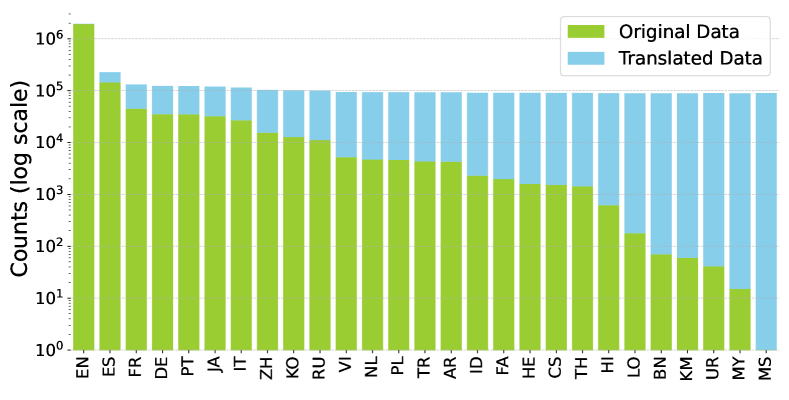
Figure 3: Language distribution of original and translated entries in M4-RAG, covering 27 languages.
<details>
<summary>x4.png Details</summary>
### Visual Description
## Heatmap: Global Distribution of Music Tracks
### Overview
The image is a world map heatmap visualizing the distribution of music tracks across countries. Countries are shaded in gradients of red, with darker red indicating higher numbers of music tracks. A logarithmic scale (10⁰ to 10⁶) is used to represent the data, emphasizing disparities in magnitude.
### Components/Axes
- **Legend**: Positioned vertically on the right side of the map.
- **Title**: "Numbers of Music Tracks"
- **Scale**: Logarithmic (10⁰ = 1, 10¹ = 10, 10² = 100, 10³ = 1,000, 10⁴ = 10,000, 10⁵ = 100,000, 10⁶ = 1,000,000)
- **Color Gradient**: Dark red (highest values) to light pink (lowest values).
- **Map**: Countries are colored based on their music track counts. No explicit axes or gridlines are present.
### Detailed Analysis
- **Color Correspondence**:
- **Darkest Red (10⁵–10⁶)**: United States, Canada, parts of Europe (e.g., UK, Germany), Australia.
- **Medium Red (10³–10⁴)**: Brazil, Mexico, parts of South America, Russia, India.
- **Light Red (10¹–10²)**: Most of Africa, Southeast Asia, Central Asia, and smaller island nations.
- **Lightest Pink (10⁰–10¹)**: Sparse regions, likely countries with minimal or no recorded music tracks.
- **Notable Patterns**:
- The United States dominates with the highest concentration of music tracks (~10⁶).
- Canada and Western Europe follow, with values in the 10⁵ range.
- Africa and parts of South Asia show the lowest values (~10¹–10²).
- Logarithmic scaling highlights exponential differences (e.g., the U.S. has ~10× more tracks than Canada).
### Key Observations
1. **Geographic Concentration**: Music tracks are heavily concentrated in North America, Western Europe, and Oceania.
2. **Disparities**: The gap between the U.S. (~10⁶) and the next tier (Canada/Europe, ~10⁵) is an order of magnitude.
3. **Low-Value Regions**: Africa and parts of Asia exhibit minimal music track counts, suggesting underrepresentation or data gaps.
4. **Outliers**: Small island nations (e.g., in the Pacific) appear as isolated light pink dots, indicating negligible track counts.
### Interpretation
The data suggests a strong correlation between economic development, cultural infrastructure, and music production. The U.S. leads due to its dominant music industry, while regions with lower values may face barriers such as limited resources, smaller markets, or less digitized cultural output. The logarithmic scale underscores the vast inequality in global music distribution, with the U.S. alone accounting for ~1% of the total tracks represented (assuming the scale maxes at 10⁶). This visualization highlights the need for equitable cultural and technological investment in underrepresented regions.
</details>
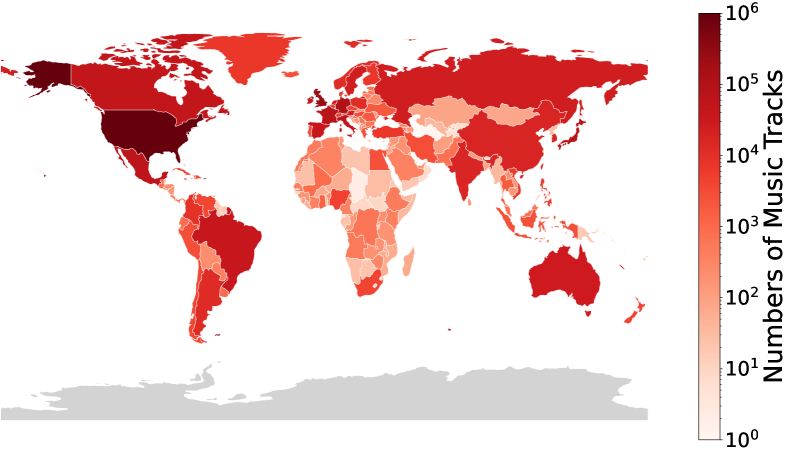
Figure 4: Country-wise distribution of music tracks in M4-RAG, spanning 194 countries.
### 3.3 Dataset Statistics
Through metadata curation, we obtained M4-RAG, which consists of 2.31 million entries. It includes 0.58 million ABC-text pairs from WebMT, 0.17 million MIDI-text pairs from MMD, and 1.56 million audio-text pairs.
Each metadata entry includes both short-form annotations, such as genres and tags, and detailed long-form descriptions. As summarized in Table 1, the long-form descriptions account for the majority of the dataset, providing extensive semantic details from multiple perspectives.
M4-RAG spans 27 languages, with the original metadata predominantly in English, as shown in Fig. 3. To address this imbalance, translations were added to the long-form descriptions, greatly boosting non-English data. This was particularly impactful for low-resource languages, such as Malay and Burmese, where most data depends on translations, greatly enhancing their representation.
In terms of geographic coverage, M4-RAG incorporates music from 194 countries. Fig. 4 illustrates contributions from both major music-producing nations and less-represented regions. This global reach ensures the dataset reflects a diverse range of musical traditions and styles from across the world.
<details>
<summary>x5.png Details</summary>
### Visual Description
## Bar Chart: Music Genre Entries Distribution
### Overview
The image displays a vertical bar chart comparing the number of entries across eight music genres. The chart uses distinct colors for each genre, with numerical values labeled on top of each bar. The y-axis represents the "Number of Entries" (0–350), while the x-axis lists genres in descending order of entry counts.
### Components/Axes
- **X-Axis (Categories)**: Jazz, Pop, Country, Folk, Rock, Classical, Religious, R&B (left to right).
- **Y-Axis (Scale)**: Number of Entries (0–350, increments of 50).
- **Legend**: Located on the right, associating colors with genres:
- Jazz: Blue (#0077CC)
- Pop: Orange (#FF8C00)
- Country: Red (#B22222)
- Folk: Green (#32CD32)
- Rock: Purple (#8A2BE2)
- Classical: Teal (#008080)
- Religious: Dark Blue (#00008B)
- R&B: Light Blue (#ADD8E6)
### Detailed Analysis
1. **Jazz**: 331 entries (Blue bar, tallest).
2. **Pop**: 284 entries (Orange bar, second tallest).
3. **Country**: 108 entries (Red bar).
4. **Folk**: 90 entries (Green bar).
5. **Rock**: 82 entries (Purple bar).
6. **Classical**: 47 entries (Teal bar).
7. **Religious**: 30 entries (Dark Blue bar).
8. **R&B**: 28 entries (Light Blue bar, shortest).
### Key Observations
- **Dominance of Jazz and Pop**: Jazz leads by 47 entries over Pop, which itself is 176 entries ahead of Country.
- **Sharp Decline**: Entries drop significantly after Rock (82), with Classical, Religious, and R&B having fewer than 50 entries each.
- **Color Consistency**: All legend colors match their respective bars without discrepancies.
### Interpretation
The data suggests a clear hierarchy in music genre popularity, with Jazz and Pop dominating the dataset. The steep decline after Rock indicates these genres may reflect either listener preferences or submission biases in the data collection process. The low counts for Classical, Religious, and R&B could signal niche audiences or underrepresentation in the dataset. The chart’s descending order of genres on the x-axis visually reinforces this hierarchy, making comparisons intuitive. No anomalies are present, as all values align with the legend and axis scales.
</details>
Figure 5: Genre distribution of the WikiMT-X dataset.
### 3.4 Benchmark Dataset
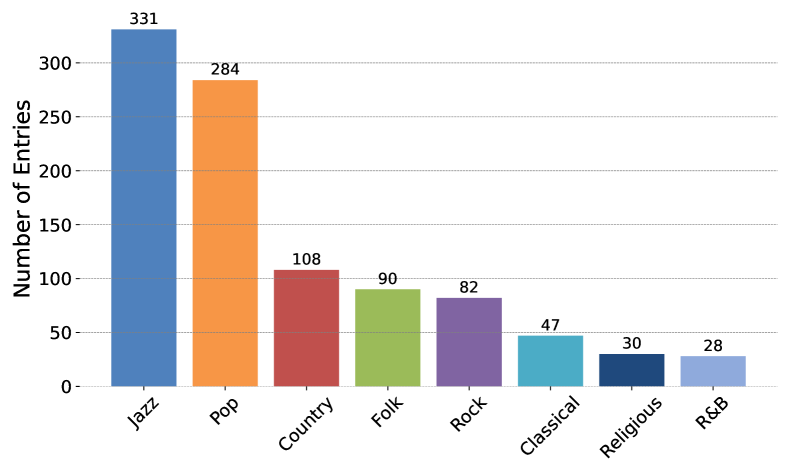
WikiMT-X (WikiMusicText-eXtended) extends WikiMT Wu et al. (2023a), focusing on 20th-century Western music with 1,000 entries, each with sheet music, audio, and detailed metadata.
The original WikiMT dataset had the following drawbacks: 1) the text was sourced from Wikipedia, mainly focused on background information with limited semantic diversity; 2) the absence of audio data severely restricted the evaluation scope; and 3) the genre labels were obtained through keyword matching, resulting in relatively low accuracy and reducing the reliability of the dataset.
To address these deficiencies, WikiMT-X made the following improvements:
- We used llama-3.1-sonar-large-128k-online https://www.perplexity.ai Dubey et al. (2024), feeding it sheet music with titles, artist names, and lyrics. It retrieved relevant web pages and summarized them into background, analysis, description, and scene.
- We manually matched sheet music with audio recordings retrieved from YouTube and removed 10 identified duplicates.
- We reorganized genre categories based on data distribution and re-annotated labels.
These enhancements make WikiMT-X useful for multimodal MIR research tasks, assessing models’ capabilities in handling text annotations of diverse semantic types, and classifying music across modalities using genre labels.
Appendix B presents detailed objective and human evaluations of WikiMT-X annotation quality. In addition, Appendix C provides t -SNE visualizations of CLaMP 3 embeddings on WikiMT-X, showing modality, language, and semantic distributions in the shared representation space.
Table 2: Results for English text-to-music retrieval on several benchmarks: WikiMT and MidiCaps have 1,010 pairs, Song Describer Dataset (SDD) has 706 audio and 1,106 captions, and MusicCaps-Remake (MC-R) contains 2,777 pairs. MC-R prevents data leakage by using full-length audio and rewritten captions from AudioSet’s evaluation set.
| Model | Symbolic Benchmarks | WikiMT-X (Sheet Music) | | | | |
| --- | --- | --- | --- | --- | --- | --- |
| WikiMT | MidiCaps | Background | Analysis | Description | Scene | |
| CLaMP | 0.2561 | 0.1236 | 0.2122 | 0.1345 | 0.0306 | 0.0426 |
| CLaMP 2 | 0.3438 | 0.2695 | 0.3024 | 0.2374 | 0.0418 | 0.0838 |
| CLaMP 3 ${}_sa^c2$ | 0.4498 | 0.2826 | 0.4028 | 0.3382 | 0.0835 | 0.1512 |
| CLaMP 3 saas | 0.3555 | 0.1798 | 0.3301 | 0.2758 | 0.1274 | 0.1500 |
| Model | Audio Benchmarks | WikiMT-X (Audio) | | | | |
| SDD | MC-R | Background | Analysis | Description | Scene | |
| CLAP | 0.1310 | 0.0657 | 0.0598 | 0.0429 | 0.0318 | 0.0218 |
| TTMR++ | 0.1437 | 0.1248 | 0.1119 | 0.0833 | 0.0584 | 0.0301 |
| CLaMP 3 ${}_sa^c2$ | 0.1612 | 0.0959 | 0.1180 | 0.1206 | 0.0639 | 0.0619 |
| CLaMP 3 saas | 0.1985 | 0.1177 | 0.2017 | 0.1711 | 0.0988 | 0.0963 |
## 4 Experiments
This section evaluates CLaMP 3 on retrieval tasks, comparing it to state-of-the-art baselines. We present results for the two best-performing CLaMP 3 variants—one for symbolic music and one for audio. A full retrieval comparison of all variants can be found in Appendix D, and classification results are available in Appendix E.
### 4.1 Settings
Both symbolic music and audio alignments were trained for up to 100 epochs on 8 NVIDIA H800 GPUs. Symbolic music alignment required 4 days with a learning rate of 5e-5 and a batch size of 1024. Audio alignment took 1 day with a learning rate of 1e-5 and a batch size of 2048.
M4-RAG was divided into 99% for training and 1% for validation. During training, metadata information was randomly selected to form text inputs. Mixed-precision Micikevicius et al. (2018), AdamW optimizer Loshchilov and Hutter (2019), and a 1,000-step warm-up Goyal et al. (2017) were used to enhance efficiency.
Following the training strategy in Sec. 2.1, we explored various modality alignment orders for symbolic and audio modalities, and present the two top-performing variants below:
CLaMP 3 ${}_\textnormal{saas}$ : Optimized for audio, this model follows the full multi-stage alignment: symbolic $→$ audio $→$ audio $→$ symbolic.
CLaMP 3 ${}_\textnormal{sa}^\textnormal{c2}$ : Optimized for symbolic, this model starts from CLaMP 2-initialized text and symbolic encoders, followed by two stages: the text encoder is jointly trained with the symbolic encoder, then frozen to align with the audio encoder.
### 4.2 English Text-to-Music Retrieval
We evaluated retrieval performance using Mean Reciprocal Rank (MRR), which measures the inverse of the rank of the paired item, across all tasks.
For symbolic music retrieval, we compared CLaMP 3 with CLaMP 2 Wu et al. (2024) and CLaMP Wu et al. (2023a) on WikiMT (using ABC notation) and MidiCaps Melechovsky et al. (2024) (using MIDI). For audio retrieval, we evaluated CLaMP 3 against state-of-the-art models CLAP Wu et al. (2023b) and TTMR++ Doh et al. (2024) on the Song Describer Dataset (SDD) Manco et al. (2023) and MusicCaps-Remake (MC-R) Agostinelli et al. (2023), which addresses data leakage by using full-length audio and rewritten captions (see Appendix F) from AudioSet’s evaluation set Gemmeke et al. (2017). In addition, we tested all models on WikiMT-X to evaluate their performance across varying semantic perspectives.
As shown in Table 2, CLaMP 3 achieved significant improvements over its predecessors and baseline models across both symbolic and audio retrieval tasks. For symbolic music retrieval, CLaMP 3 ${}_\textnormal{sa}^\textnormal{c2}$ achieved MRR scores of 0.4498 on WikiMT and 0.2826 on MidiCaps, clearly outperforming both CLaMP 2 and CLaMP, despite using only half the training data. This improvement can be attributed to the high-quality, richly annotated M4-RAG dataset. Similarly, CLaMP 3 ${}_\textnormal{saas}$ , though optimized for audio retrieval, exceeded CLaMP by a notable margin on symbolic benchmarks and performed comparably to CLaMP 2 on WikiMT. These results demonstrate that our multi-stage training approach effectively preserves performance on modalities that were not explicitly optimized.
Table 3: Results for multilingual text-to-music retrieval on translated WikiMT-X background annotations. Languages marked with asterisks were not included in the M4-RAG training data. The BLEU scores below each language are calculated by back-translating the text with the SeamlessM4T model and comparing it to the original English text.
| Model | ru | fr | es | ar | zh | fi* | el* | ta* | kk* | am* |
| --- | --- | --- | --- | --- | --- | --- | --- | --- | --- | --- |
| 49.69 | 55.50 | 62.82 | 53.38 | 39.58 | 39.19 | 55.55 | 40.07 | 36.57 | 56.08 | |
| ABC Notation | | | | | | | | | | |
| CLaMP 2 | 0.2668 | 0.2968 | 0.2934 | 0.2298 | 0.1646 | 0.2795 | 0.2410 | 0.0915 | 0.2543 | 0.1237 |
| CLaMP 3 ${}_sa^c2$ | 0.3614 | 0.3949 | 0.3921 | 0.3155 | 0.2373 | 0.3524 | 0.3226 | 0.1415 | 0.3397 | 0.1871 |
| CLaMP 3 saas | 0.2918 | 0.3214 | 0.3239 | 0.2789 | 0.2358 | 0.2919 | 0.2681 | 0.1246 | 0.2703 | 0.1139 |
| MIDI | | | | | | | | | | |
| CLaMP 2 | 0.1271 | 0.1414 | 0.1452 | 0.1113 | 0.0749 | 0.1438 | 0.1087 | 0.0466 | 0.1079 | 0.0616 |
| CLaMP 3 ${}_sa^c2$ | 0.1921 | 0.2101 | 0.2137 | 0.1681 | 0.1316 | 0.2019 | 0.1702 | 0.0804 | 0.1765 | 0.1039 |
| CLaMP 3 saas | 0.1165 | 0.1319 | 0.1330 | 0.1141 | 0.0937 | 0.1245 | 0.1143 | 0.0601 | 0.1104 | 0.0544 |
| Audio | | | | | | | | | | |
| CLaMP 3 ${}_sa^c2$ | 0.1068 | 0.1150 | 0.1202 | 0.0981 | 0.0877 | 0.1112 | 0.1014 | 0.0720 | 0.1005 | 0.0681 |
| CLaMP 3 saas | 0.1788 | 0.1980 | 0.1962 | 0.1665 | 0.1459 | 0.1770 | 0.1736 | 0.0945 | 0.1561 | 0.0675 |
Beyond symbolic music retrieval, CLaMP 3 also achieved notable performances in audio retrieval. Both variants—CLaMP 3 ${}_\textnormal{sa}^\textnormal{c2}$ and CLaMP 3 ${}_\textnormal{saas}$ —consistently outperformed CLAP, with CLaMP 3 ${}_\textnormal{saas}$ standing out. It achieved the highest MRR of 0.1985 on SDD, marking a substantial improvement over TTMR++ (0.1437) and CLAP (0.1310). While TTMR++ performed well on MC-R (0.1248), its results on the original MusicCaps dataset are abnormally higher (see Table 13), likely because it was trained on half of MusicCaps’ original music-text pairs. This training overlap suggests that indirect data leakage affects its performance, even when evaluated on MC-R.
CLaMP 3’s strong performance extends to WikiMT-X, with both variants outperforming baselines across all four semantic categories. In Background and Analysis, where texts provide rich cultural or technical details, CLaMP 3 ${}_\textnormal{sa}^\textnormal{c2}$ and CLaMP 3 ${}_\textnormal{saas}$ excelled, achieving MRRs of 0.4028 and 0.3382 (sheet music) and 0.2017 and 0.1711 (audio). Description and Scene, however, are much harder to retrieve because they are less specific and semantically sparse. Description excludes explicit identifiers like titles or artist names, while Scene focuses on abstract, visualized scenario depictions (rather than the music itself), both of which make retrieval more difficult. Even so, CLaMP 3 performed notably better, with CLaMP 3 ${}_\textnormal{saas}$ scoring 0.0988 (Description) and 0.0963 (Scene) in audio, compared to TTMR++ (0.0584, 0.0301). This improvement stems from M4-RAG’s diverse annotations, which better equip CLaMP 3 to retrieve abstract, semantically sparse texts compared to baseline models trained on less diverse data.
### 4.3 Multilingual Text-to-Music Retrieval
Currently, no non-English music-text benchmarks exist, making multilingual evaluation challenging. To address this, we used SeamlessM4T Barrault et al. (2023) to translate WikiMT-X background annotations into multiple languages. To account for translation noise, BLEU scores Papineni et al. (2002) were calculated by comparing original texts with back-translations. The translated annotations were then used for retrieval of matching ABC notation, MIDI (from ABC), and audio files.
We carefully selected ten languages to ensure diversity in linguistic families, scripts, regions, and resource levels. Five UN official languages were chosen from those included in M4-RAG as they represent different cultures and regions with global significance. The other five, marked with asterisks in Table 3, come from different linguistic families with distinct scripts and minimal vocabulary overlap, specifically to test CLaMP 3’s generalization to languages unseen in music-text alignment.
To the best of our knowledge, apart from CLaMP 3, CLaMP 2 is the only multilingual MIR model, but it is limited to symbolic music. No baselines exist for multilingual audio retrieval, as models like CLAP and TTMR++ are restricted to English.
CLaMP 3’s two variants differ in their language exposure. CLaMP 3 ${}_\textnormal{sa}^\textnormal{c2}$ initializes its text and symbolic music encoders from CLaMP 2, which was pre-trained on symbolic-text alignment across all XLM-R-supported languages, giving it prior exposure to all languages in Table 3. In contrast, CLaMP 3 ${}_\textnormal{saas}$ has never aligned music data with the languages marked with asterisks, demonstrating true cross-lingual generalization in its performance.
Table 3 shows that CLaMP 3 demonstrates strong cross-lingual generalization in both symbolic music and audio retrieval tasks. For symbolic music retrieval, CLaMP 3 ${}_\textnormal{sa}^\textnormal{c2}$ clearly outperforms CLaMP 2 on all languages, including those not in M4-RAG, showing that full language coverage during training is not necessary for improved multilingual retrieval. Meanwhile, CLaMP 3 ${}_\textnormal{saas}$ , without any prior alignment between these languages and music or specific optimization for symbolic music tasks, matches CLaMP 2’s performance on MIDI and surpasses it on ABC notation. This indicates that CLaMP 3 ${}_\textnormal{saas}$ achieves true cross-lingual generalization on unseen languages.
In audio retrieval, CLaMP 3 ${}_\textnormal{saas}$ performed well on languages it had never seen during alignment. For instance, it outperformed CLaMP 3 ${}_\textnormal{sa}^\textnormal{c2}$ on Finnish (0.1770 vs. 0.1112), Greek (0.1736 vs. 0.1014), and Kazakh (0.1561 vs. 0.1005), even though CLaMP 3 ${}_\textnormal{sa}^\textnormal{c2}$ had indirect exposure to these languages during CLaMP 2 pre-training. Notably, even for its weakest unseen language, Amharic (0.0675), CLaMP 3 ${}_\textnormal{saas}$ outperformed CLAP’s performance on English text (0.0598). This suggests that prior exposure to a language is not necessary for achieving strong audio retrieval performance.
The ability to retrieve languages beyond the training data stems from XLM-R’s cross-lingual semantics and the universal representations of CLaMP 3’s music encoders. This enables the model to handle low-resource languages and even generalize to unseen ones, enhancing its inclusivity and versatility for global MIR.
Table 4: Results for emergent cross-modal retrieval on WikiMT-X pairings across different musical modalities. S: Sheet Music (ABC notation), P: Performance Signals (MIDI, converted from ABC), A: Audio recordings.
| CLaMP 2 CLaMP 3 ${}_sa^c2$ CLaMP 3 saas | 0.5138 0.4547 0.3262 | - 0.0543 0.0578 | 0.4480 0.5293 0.3146 | - 0.0313 0.0397 | - 0.0492 0.0410 | - 0.0383 0.0303 |
| --- | --- | --- | --- | --- | --- | --- |
### 4.4 Emergent Cross-Modal Retrieval
Emergent cross-modal retrieval assesses a model’s ability to align and retrieve musical content across modalities without explicit alignment training, showcasing its capacity to generalize to unaligned modalities. Table 4 reports results for all possible retrieval directions between ABC notation, MIDI, and audio data.
CLaMP 3 significantly advances cross-modal retrieval by supporting both symbolic and audio modalities, addressing a key limitation of CLaMP 2. While CLaMP 2 excels in symbolic tasks (S $→$ P: 0.5138, P $→$ S: 0.4480) without explicit alignment between ABC and MIDI, it cannot retrieve between symbolic and audio modalities.
In contrast, CLaMP 3 ${}_\textnormal{sa}^\textnormal{c2}$ not only achieves state-of-the-art performance on symbolic music tasks like P $→$ S (0.5293) but also enables emergent retrieval between symbolic music and audio. Similarly, CLaMP 3 ${}_\textnormal{saas}$ , optimized for audio retrieval, achieves meaningful results on new tasks such as S $→$ A (0.0578) and P $→$ A (0.0397), demonstrating its ability to unify symbolic and audio modalities in a shared representation space.
While audio retrieval is inherently more challenging due to the continuous nature of audio signals, all directions achieve MRR scores well above the random baseline of 0.0075. Nonetheless, further optimization is required to reduce the performance gap between symbolic and audio retrieval.
## 5 Conclusions
In this paper, we introduced CLaMP 3, a unified MIR framework that aligns sheet music, performance signals, audio, and multilingual text using contrastive learning. CLaMP 3 demonstrates strong cross-modal and cross-lingual generalization, effectively handling unaligned modalities and unseen languages during training.
To address the lack of high-quality datasets, we curated M4-RAG, a collection of 2.31 million music-text pairs spanning 27 languages and 194 countries. We also released WikiMT-X, the first benchmark combining text, sheet music, and audio for comprehensive evaluation.
Our experiments show that CLaMP 3 achieves state-of-the-art performance in both symbolic and audio retrieval, excels in multilingual tasks, and enables retrieval across unaligned musical modalities. These results demonstrate its flexibility and the effectiveness of its shared representation space.
To conclude, CLaMP 3 sets a new standard in multimodal and multilingual MIR, demonstrating robust cross-modal and cross-lingual generalization. By releasing the CLaMP 3 model, M4-RAG dataset, and WikiMT-X benchmark, we provide resources to support future research in MIR and music generation across languages and modalities.
## 6 Limitations
Although CLaMP 3 attains state-of-the-art performance across modalities and languages, showing cross-modal and cross-lingual generalization, this work has several limitations that need to be addressed for further advancements in MIR.
First, while contrastive learning has advanced multimodal information retrieval, it struggles to capture the temporal dynamics of music. This is because such models typically use a single global representation to store the entire semantic content of a piece of music, making them insensitive to temporal dynamics. For example, in Beethoven’s Symphony No. 5, the iconic four-note motif develops throughout the piece, yet current systems often miss this context. Addressing this requires moving beyond contrastive learning to incorporate temporal modeling, enabling systems to better capture nuances and deliver more context-aware and accurate retrieval.
Second, although Table 3 indicates that while CLaMP 3 can generalize to languages beyond music-text alignment, the multilingual text-to-music retrieval evaluation in it heavily relies on translation models due to the lack of native multilingual benchmarks. The translation quality varies significantly across languages, which introduces noise and reduces the reliability of evaluations. Developing native multilingual benchmarks is the primary and almost indispensable solution to achieve more accurate and fair assessments of model performance.
Finally, as shown in Table 4, the alignment between audio and symbolic modalities, though showing emergent capabilities with performance far above random, remains relatively weak. Addressing this limitation requires collecting paired data for supervised alignment and leveraging text as a bridging modality to further enhance connections between different musical modalities.
## Authors
Shangda Wu 1, shangda@mail.ccom.edu.cn
Zhancheng Guo 1, 23a053@mail.ccom.edu.cn
Ruibin Yuan 2, ryuanab@connect.ust.hk
Junyan Jiang 3, 4, jj2731@nyu.edu
Seungheon Doh 5, seungheondoh@kaist.ac.kr
Gus Xia 3, 4, Gus.Xia@mbzuai.ac.ae
Juhan Nam 5, juhan.nam@kaist.ac.kr
Xiaobing Li 1, lxiaobing@ccom.edu.cn
Feng Yu 1, yufengai@ccom.edu.cn
## Correspondence
Maosong Sun 1, 6, sms@tsinghua.edu.cn
## Affiliations
1 Central Conservatory of Music 2 Hong Kong University of Science and Technology 3 New York University Shanghai 4 Mohamed bin Zayed University of Artificial Intelligence 5 Korea Advanced Institute of Science and Technology 6 Tsinghua University
## Acknowlegdements
This work was supported by the following funding sources: Special Program of National Natural Science Foundation of China (Grant No. T2341003), Advanced Discipline Construction Project of Beijing Universities, Major Program of National Social Science Fund of China (Grant No. 21ZD19), and the National Culture and Tourism Technological Innovation Engineering Project (Research and Application of 3D Music).
In addition, we thank Flaticon https://www.flaticon.com for icons used in Fig. 1 and Fig. 2, Yusong Wu (University of Montreal) for helping us understand CLAP in detail, and Monan Zhou (Central Conservatory of Music) for assisting with WikiMT-X data processing.
## References
- Agostinelli et al. (2023) Andrea Agostinelli, Timo I Denk, Zalán Borsos, Jesse Engel, Mauro Verzetti, Antoine Caillon, Qingqing Huang, Aren Jansen, Adam Roberts, Marco Tagliasacchi, et al. 2023. Musiclm: Generating music from text. arXiv preprint arXiv:2301.11325.
- Bai et al. (2024) Jisheng Bai, Haohe Liu, Mou Wang, Dongyuan Shi, Wenwu Wang, Mark D Plumbley, Woon-Seng Gan, and Jianfeng Chen. 2024. Audiosetcaps: An enriched audio-caption dataset using automated generation pipeline with large audio and language models. arXiv preprint arXiv:2411.18953.
- Barrault et al. (2023) Loïc Barrault, Yu-An Chung, Mariano Cora Meglioli, David Dale, Ning Dong, Paul-Ambroise Duquenne, Hady Elsahar, Hongyu Gong, Kevin Heffernan, John Hoffman, et al. 2023. Seamlessm4t-massively multilingual & multimodal machine translation. arXiv preprint arXiv:2308.11596.
- Bogdanov et al. (2019) Dmitry Bogdanov, Minz Won, Philip Tovstogan, Alastair Porter, and Xavier Serra. 2019. The mtg-jamendo dataset for automatic music tagging. ICML.
- Chen et al. (2024) Ke Chen, Yusong Wu, Haohe Liu, Marianna Nezhurina, Taylor Berg-Kirkpatrick, and Shlomo Dubnov. 2024. Musicldm: Enhancing novelty in text-to-music generation using beat-synchronous mixup strategies. In IEEE International Conference on Acoustics, Speech and Signal Processing, ICASSP 2024, Seoul, Republic of Korea, April 14-19, 2024, pages 1206–1210. IEEE.
- Chou et al. (2021) Yi-Hui Chou, I Chen, Chin-Jui Chang, Joann Ching, Yi-Hsuan Yang, et al. 2021. Midibert-piano: large-scale pre-training for symbolic music understanding. arXiv preprint arXiv:2107.05223.
- Conneau et al. (2020) Alexis Conneau, Kartikay Khandelwal, Naman Goyal, Vishrav Chaudhary, Guillaume Wenzek, Francisco Guzmán, Edouard Grave, Myle Ott, Luke Zettlemoyer, and Veselin Stoyanov. 2020. Unsupervised cross-lingual representation learning at scale. In Proceedings of the 58th Annual Meeting of the Association for Computational Linguistics, ACL 2020, Online, July 5-10, 2020, pages 8440–8451. Association for Computational Linguistics.
- Copet et al. (2023) Jade Copet, Felix Kreuk, Itai Gat, Tal Remez, David Kant, Gabriel Synnaeve, Yossi Adi, and Alexandre Défossez. 2023. Simple and controllable music generation. In Advances in Neural Information Processing Systems 36: Annual Conference on Neural Information Processing Systems 2023, NeurIPS 2023, New Orleans, LA, USA, December 10 - 16, 2023.
- Doh et al. (2023a) Seungheon Doh, Keunwoo Choi, Jongpil Lee, and Juhan Nam. 2023a. Lp-musiccaps: Llm-based pseudo music captioning. In Proceedings of the 24th International Society for Music Information Retrieval Conference, ISMIR 2023, Milan, Italy, November 5-9, 2023, pages 409–416.
- Doh et al. (2024) Seungheon Doh, Minhee Lee, Dasaem Jeong, and Juhan Nam. 2024. Enriching music descriptions with A finetuned-llm and metadata for text-to-music retrieval. In IEEE International Conference on Acoustics, Speech and Signal Processing, ICASSP 2024, Seoul, Republic of Korea, April 14-19, 2024, pages 826–830. IEEE.
- Doh et al. (2023b) Seungheon Doh, Minz Won, Keunwoo Choi, and Juhan Nam. 2023b. Toward universal text-to-music retrieval. In IEEE International Conference on Acoustics, Speech and Signal Processing ICASSP 2023, Rhodes Island, Greece, June 4-10, 2023, pages 1–5. IEEE.
- Dubey et al. (2024) Abhimanyu Dubey, Abhinav Jauhri, Abhinav Pandey, Abhishek Kadian, Ahmad Al-Dahle, Aiesha Letman, Akhil Mathur, Alan Schelten, Amy Yang, Angela Fan, et al. 2024. The llama 3 herd of models. arXiv preprint arXiv:2407.21783.
- Ferreira and Whitehead (2019) Lucas Ferreira and Jim Whitehead. 2019. Learning to generate music with sentiment. In Proceedings of the 20th International Society for Music Information Retrieval Conference, ISMIR 2019, Delft, The Netherlands, November 4-8, 2019, pages 384–390.
- Gemmeke et al. (2017) Jort F. Gemmeke, Daniel P. W. Ellis, Dylan Freedman, Aren Jansen, Wade Lawrence, R. Channing Moore, Manoj Plakal, and Marvin Ritter. 2017. Audio set: An ontology and human-labeled dataset for audio events. In 2017 IEEE International Conference on Acoustics, Speech and Signal Processing, ICASSP 2017, New Orleans, LA, USA, March 5-9, 2017, pages 776–780. IEEE.
- Girdhar et al. (2023) Rohit Girdhar, Alaaeldin El-Nouby, Zhuang Liu, Mannat Singh, Kalyan Vasudev Alwala, Armand Joulin, and Ishan Misra. 2023. Imagebind one embedding space to bind them all. In IEEE/CVF Conference on Computer Vision and Pattern Recognition, CVPR 2023, Vancouver, BC, Canada, June 17-24, 2023, pages 15180–15190. IEEE.
- Goyal et al. (2017) Priya Goyal, Piotr Dollár, Ross B. Girshick, Pieter Noordhuis, Lukasz Wesolowski, Aapo Kyrola, Andrew Tulloch, Yangqing Jia, and Kaiming He. 2017. Accurate, large minibatch SGD: training imagenet in 1 hour. CoRR, abs/1706.02677.
- Huang et al. (2022) Qingqing Huang, Aren Jansen, Joonseok Lee, Ravi Ganti, Judith Yue Li, and Daniel P. W. Ellis. 2022. Mulan: A joint embedding of music audio and natural language. In Proceedings of the 23rd International Society for Music Information Retrieval Conference, ISMIR 2022, Bengaluru, India, December 4-8, 2022, pages 559–566.
- Joulin et al. (2017) Armand Joulin, Edouard Grave, Piotr Bojanowski, and Tomás Mikolov. 2017. Bag of tricks for efficient text classification. In Proceedings of the 15th Conference of the European Chapter of the Association for Computational Linguistics, EACL 2017, Valencia, Spain, April 3-7, 2017, Volume 2: Short Papers, pages 427–431. Association for Computational Linguistics.
- Lewis et al. (2020) Patrick S. H. Lewis, Ethan Perez, Aleksandra Piktus, Fabio Petroni, Vladimir Karpukhin, Naman Goyal, Heinrich Küttler, Mike Lewis, Wen-tau Yih, Tim Rocktäschel, Sebastian Riedel, and Douwe Kiela. 2020. Retrieval-augmented generation for knowledge-intensive NLP tasks. In Advances in Neural Information Processing Systems 33: Annual Conference on Neural Information Processing Systems 2020, NeurIPS 2020, December 6-12, 2020, virtual.
- Li et al. (2024) Yizhi Li, Ruibin Yuan, Ge Zhang, Yinghao Ma, Xingran Chen, Hanzhi Yin, Chenghao Xiao, Chenghua Lin, Anton Ragni, Emmanouil Benetos, Norbert Gyenge, Roger B. Dannenberg, Ruibo Liu, Wenhu Chen, Gus Xia, Yemin Shi, Wenhao Huang, Zili Wang, Yike Guo, and Jie Fu. 2024. MERT: acoustic music understanding model with large-scale self-supervised training. In The Twelfth International Conference on Learning Representations, ICLR 2024, Vienna, Austria, May 7-11, 2024. OpenReview.net.
- Loshchilov and Hutter (2019) Ilya Loshchilov and Frank Hutter. 2019. Decoupled weight decay regularization. In 7th International Conference on Learning Representations, ICLR 2019, New Orleans, LA, USA, May 6-9, 2019. OpenReview.net.
- Manco et al. (2023) Ilaria Manco, Benno Weck, Seungheon Doh, Minz Won, Yixiao Zhang, Dmitry Bogdanov, Yusong Wu, Ke Chen, Philip Tovstogan, Emmanouil Benetos, et al. 2023. The song describer dataset: a corpus of audio captions for music-and-language evaluation. arXiv preprint arXiv:2311.10057.
- Melechovsky et al. (2024) Jan Melechovsky, Abhinaba Roy, and Dorien Herremans. 2024. Midicaps–a large-scale midi dataset with text captions. arXiv preprint arXiv:2406.02255.
- Micikevicius et al. (2018) Paulius Micikevicius, Sharan Narang, Jonah Alben, Gregory F. Diamos, Erich Elsen, David García, Boris Ginsburg, Michael Houston, Oleksii Kuchaiev, Ganesh Venkatesh, and Hao Wu. 2018. Mixed precision training. In 6th International Conference on Learning Representations, ICLR 2018, Vancouver, BC, Canada, April 30 - May 3, 2018, Conference Track Proceedings. OpenReview.net.
- Oord et al. (2018) Aaron van den Oord, Yazhe Li, and Oriol Vinyals. 2018. Representation learning with contrastive predictive coding. arXiv preprint arXiv:1807.03748.
- Papineni et al. (2002) Kishore Papineni, Salim Roukos, Todd Ward, and Wei-Jing Zhu. 2002. Bleu: a method for automatic evaluation of machine translation. In Proceedings of the 40th Annual Meeting of the Association for Computational Linguistics, July 6-12, 2002, Philadelphia, PA, USA, pages 311–318. ACL.
- Retkowski et al. (2024) Jan Retkowski, Jakub Stępniak, and Mateusz Modrzejewski. 2024. Frechet music distance: A metric for generative symbolic music evaluation. arXiv preprint arXiv:2412.07948.
- Sohn (2016) Kihyuk Sohn. 2016. Improved deep metric learning with multi-class n-pair loss objective. In Advances in Neural Information Processing Systems 29: Annual Conference on Neural Information Processing Systems 2016, December 5-10, 2016, Barcelona, Spain, pages 1849–1857.
- Vaswani et al. (2017) Ashish Vaswani, Noam Shazeer, Niki Parmar, Jakob Uszkoreit, Llion Jones, Aidan N. Gomez, Lukasz Kaiser, and Illia Polosukhin. 2017. Attention is all you need. In Advances in Neural Information Processing Systems 30: Annual Conference on Neural Information Processing Systems 2017, December 4-9, 2017, Long Beach, CA, USA, pages 5998–6008.
- Wu et al. (2024) Shangda Wu, Yashan Wang, Ruibin Yuan, Zhancheng Guo, Xu Tan, Ge Zhang, Monan Zhou, Jing Chen, Xuefeng Mu, Yuejie Gao, et al. 2024. Clamp 2: Multimodal music information retrieval across 101 languages using large language models. arXiv preprint arXiv:2410.13267.
- Wu et al. (2023a) Shangda Wu, Dingyao Yu, Xu Tan, and Maosong Sun. 2023a. Clamp: Contrastive language-music pre-training for cross-modal symbolic music information retrieval. In Proceedings of the 24th International Society for Music Information Retrieval Conference, ISMIR 2023, Milan, Italy, November 5-9, 2023, pages 157–165.
- Wu et al. (2023b) Yusong Wu, Ke Chen, Tianyu Zhang, Yuchen Hui, Taylor Berg-Kirkpatrick, and Shlomo Dubnov. 2023b. Large-scale contrastive language-audio pretraining with feature fusion and keyword-to-caption augmentation. In IEEE International Conference on Acoustics, Speech and Signal Processing ICASSP 2023, Rhodes Island, Greece, June 4-10, 2023, pages 1–5. IEEE.
- Yang et al. (2024) An Yang, Baosong Yang, Beichen Zhang, Binyuan Hui, Bo Zheng, Bowen Yu, Chengyuan Li, Dayiheng Liu, Fei Huang, Haoran Wei, et al. 2024. Qwen2. 5 technical report. arXiv preprint arXiv:2412.15115.
- Yuan et al. (2023) Ruibin Yuan, Yinghao Ma, Yizhi Li, Ge Zhang, Xingran Chen, Hanzhi Yin, Le Zhuo, Yiqi Liu, Jiawen Huang, Zeyue Tian, Binyue Deng, Ningzhi Wang, Chenghua Lin, Emmanouil Benetos, Anton Ragni, Norbert Gyenge, Roger B. Dannenberg, Wenhu Chen, Gus Xia, Wei Xue, Si Liu, Shi Wang, Ruibo Liu, Yike Guo, and Jie Fu. 2023. MARBLE: music audio representation benchmark for universal evaluation. In Advances in Neural Information Processing Systems 36: Annual Conference on Neural Information Processing Systems 2023, NeurIPS 2023, New Orleans, LA, USA, December 10 - 16, 2023.
- Zeng et al. (2021) Mingliang Zeng, Xu Tan, Rui Wang, Zeqian Ju, Tao Qin, and Tie-Yan Liu. 2021. Musicbert: Symbolic music understanding with large-scale pre-training. In Findings of the Association for Computational Linguistics: ACL/IJCNLP 2021, Online Event, August 1-6, 2021, volume ACL/IJCNLP 2021 of Findings of ACL, pages 791–800. Association for Computational Linguistics.
- Zhu et al. (2025) Haina Zhu, Yizhi Zhou, Hangting Chen, Jianwei Yu, Ziyang Ma, Rongzhi Gu, Wei Tan, and Xie Chen. 2025. Muq: Self-supervised music representation learning with mel residual vector quantization. arXiv preprint arXiv:2501.01108.
## Appendix A Prompt and Examples
<details>
<summary>x6.png Details</summary>
### Visual Description
## JSON Schema for Music Metadata Extraction
### Overview
The image contains a detailed JSON schema specification for extracting music metadata. It defines required and optional fields, language requirements, and strict formatting rules for summarizing music-related information from search results.
### Components/Axes
1. **Core Fields** (Required):
- `title`: Music title (original language)
- `artists`: Array of creator names (original language)
- `sufficient_information`: Boolean flag for data completeness
2. **Metadata Fields** (Required):
- `region`: Geographical origin (English)
- `language`: Primary language of search results (English)
- `genres`: Array of genres (specified language)
- `tags`: Array of keywords/playlists (specified language)
3. **Descriptive Fields** (Required):
- `background`: Cultural/social context (specified language)
- `analysis`: Musical breakdown (specified language)
- `description`: De-identified summary (specified language)
- `scene`: Visual scene description (specified language)
4. **Search Results Structure**:
- Nested array of objects with `title` and `text` fields
### Detailed Analysis
- **Language Requirements**:
- Title/artists: Original language
- Region/language: English
- Other fields: Language specified in `language` field
- **Background Field**:
- Focus on creation context, cultural impact, and artist influence
- **Analysis Field**:
- Requires technical breakdown of melody, harmony, instrumentation, and emotional tone
- **Scene Field**:
- Mandatory for soundtracks (exact representative scene)
- For non-soundtracks: Evocative visual elements matching music
### Key Observations
1. Strict JSON formatting required with no comments/explanations
2. Language consistency enforced through field-specific requirements
3. Search results must be thoroughly utilized for comprehensive metadata
4. Optional fields (`artists`, `region`) may be omitted if unavailable
5. Boolean flag `sufficient_information` validates data completeness
### Interpretation
This schema enables standardized music metadata extraction while balancing linguistic accuracy with search result utilization. The multi-language approach preserves cultural context while ensuring English accessibility for technical fields. The hierarchical structure separates core identification (title/artists) from analytical components (background/analysis), creating a comprehensive yet flexible framework for music documentation. The emphasis on de-identified descriptions suggests potential applications in music recommendation systems or cultural heritage preservation.
</details>
Figure 6: The metadata generation prompt was used for constructing the M4-RAG dataset. This prompt outlines the required JSON structure for describing music metadata comprehensively, including fields for title, artists, region, language, genres, tags, background context, musical analysis, general description, and visual scene. Detailed instructions and formatting requirements are provided to ensure high-quality and consistent metadata extraction from search results. Based on our experience, we recommend adding the requirement to the prompt that Region and Language be output in accordance with ISO standards, which can reduce the need for post-processing.
<details>
<summary>x7.png Details</summary>
### Visual Description
## JSON Data Structure: Scottish Folk Song & Jazz Standard Metadata
### Overview
The image contains a JSON structure with two primary entries:
1. **"Mairi's Wedding"** (Scottish folk song)
2. **"Deed I Do"** (Jazz standard)
Each entry includes metadata, descriptions, translations, and cultural context. The data is organized hierarchically with nested arrays and strings.
---
### Components/Axes
#### Common Fields Across Entries:
- `"id"`: Unique identifier (e.g., `"---aL9Tdel4"`, `"Vj4gbky1QCU"`)
- `"title"`: Song title (e.g., `"Mairi's Wedding"`, `"Deed I Do"`)
- `"artists"`: Array of performer names (e.g., `["Noel McLoughlin"]`, `["Fred Rose", "Walter Hirsch"]`)
- `"region"`: Geographic origin (e.g., `"United Kingdom of Great Britain and Northern Ireland"`, `"Scotland"`)
- `"language"`: Primary language (e.g., `"English"`, `"Gaelic"`)
- `"genres"`: Array of genre tags (e.g., `["Folk", "Traditional"]`, `["Jazz"]`)
- `"tags"`: Additional keywords (e.g., `["Scottish", "Wedding"]`, `["Love", "Devotion"]`)
- `"background"`: Historical/cultural context (e.g., Gaelic origins, 1935 performance)
- `"analysis"`: Thematic interpretation (e.g., celebration of marriage, jazz improvisation)
- `"description"`: Detailed lyrical/scene depiction (e.g., wedding festivities, jazz club atmosphere)
- `"scene"`: Narrative setting (e.g., Scottish village, dimly lit jazz club)
- `"translations"`: Vietnamese translations of key fields (e.g., `"Bài hát 'Dám Cưới Mairi'"`, `"Diễm khúc 'Deed I Do'"`)
#### Unique Fields:
- `"artists"`: Contains multiple performers for "Deed I Do" (jazz ensemble) vs. single artist for "Mairi's Wedding".
- `"translations"`: Vietnamese translations for both songs, including titles, backgrounds, and analyses.
---
### Detailed Analysis
#### "Mairi's Wedding" (Scottish Folk Song)
- **Cultural Context**:
- Originated in Gaelic as *"Bài hát 'Dám Cưới Mairi'"* (Mary McNiven's wedding song).
- Translated into English in 1936 by Hugh S. Robertson.
- Performed by artists like The High Kings and The Clancy Brothers.
- **Lyrics & Mood**:
- Describes a joyful wedding procession with guests traveling through towns.
- Features a "repetitive and danceable chorus" with fiddle, banjo, and bagpipes.
- Vietnamese translation emphasizes themes of love and community.
#### "Deed I Do" (Jazz Standard)
- **Musical Structure**:
- Composed in the early 20th century; follows AABA form.
- Lyrics express longing and devotion, with improvisation opportunities.
- Performed by Fred Rose and Walter Hirsch.
- **Performance Style**:
- Smooth, flowing melody with piano, bass, and light percussion.
- Vietnamese translation highlights romantic yearning and intimate atmosphere.
---
### Key Observations
1. **Cultural Duality**:
- "Mairi's Wedding" reflects Scottish traditions, while "Deed I Do" embodies jazz's improvisational spirit.
2. **Translation Nuances**:
- Vietnamese translations preserve lyrical themes but adapt idioms (e.g., `"tuyển thông"` for "joyful celebration").
3. **Artistic Diversity**:
- "Mairi's Wedding" is rooted in communal celebration; "Deed I Do" focuses on personal emotion.
---
### Interpretation
The JSON structure serves as a comparative catalog of two culturally distinct songs. "Mairi's Wedding" emphasizes collective joy and tradition, whereas "Deed I Do" explores individual longing through jazz's expressive framework. The inclusion of Vietnamese translations suggests an effort to bridge cultural gaps, highlighting universal themes of love and celebration across musical genres. The data underscores how regional and historical contexts shape lyrical content and performance styles.
</details>
Figure 7: Metadata examples from the M4-RAG and WikiMT-X datasets. The top section shows an entry for “Mairi’s Wedding” from the M4-RAG dataset, including detailed multilingual metadata in English and Vietnamese, and an associated audio recording identified by a YouTube ID. The bottom section presents an entry for “Deed I Do” from the WikiMT-X dataset, which includes a YouTube ID linking to an audio recording, a genre label (Jazz, one of eight predefined categories), four types of long-form text annotations, and a lead sheet in ABC notation.
Table 5: Average cosine similarity between text and music features across datasets and annotation types, alongside human ratings of music-text alignment and musical aesthetics. Cosine similarity reflects pairing quality as estimated by text-to-music retrieval models, while human ratings assess how well the text semantically aligns with the music (Alignment) and the perceived aesthetic quality of the music (Aesthetics).
| Dataset WikiMT MidiCaps | Annotation Caption Caption | CLaMP 0.1900 0.1133 | CLaMP 2 0.1244 0.0255 | CLaMP 3 ${}_\textnormal{sa}^\textnormal{c2}$ 0.2028 0.1401 | CLaMP 3 ${}_\textnormal{saas}$ 0.2184 0.1583 | Alignment 4.83 3.92 | Aesthetics 3.42 2.83 |
| --- | --- | --- | --- | --- | --- | --- | --- |
| WikiMT-X | Background | 0.2429 | 0.1343 | 0.2239 | 0.2264 | 4.67 | 3.50 |
| Analysis | 0.1336 | 0.1097 | 0.2261 | 0.2461 | 3.75 | | |
| Description | 0.0794 | 0.0451 | 0.2359 | 0.2752 | 3.42 | | |
| Scene | 0.0779 | 0.1410 | 0.2240 | 0.2874 | 3.67 | | |
| Dataset | Annotation | CLAP | TTMR++ | CLaMP 3 ${}_\textnormal{sa}^\textnormal{c2}$ | CLaMP 3 ${}_\textnormal{saas}$ | Alignment | Aesthetics |
| SDD | Caption | 0.3446 | 0.3340 | 0.1129 | 0.1683 | 2.25 | 2.50 |
| MusicCaps | Caption | 0.2518 | 0.3957 | 0.1077 | 0.1500 | 4.08 | 2.58 |
| WikiMT-X | Background | 0.3734 | 0.4477 | 0.0092 | 0.1186 | 4.50 | 3.58 |
| Analysis | 0.2594 | 0.3813 | 0.0024 | 0.1298 | 3.92 | | |
| Description | 0.2000 | 0.3340 | 0.0385 | 0.1738 | 3.33 | | |
| Scene | 0.1848 | 0.2590 | 0.0525 | 0.1996 | 3.83 | | |
## Appendix B Evaluation of Annotation Quality Across Benchmarks
To evaluate the semantic quality of music-text pairings, we conduct an evaluation combining (i) automatic similarity scores from models and (ii) human ratings on music-text alignment and musical aesthetics. The results are summarized in Table 5.
We include both LLM-generated and human-annotated datasets in this evaluation. Specifically, all symbolic datasets—WikiMT, MidiCaps, and WikiMT-X—contain text annotations generated by large language models. In contrast, the audio datasets differ in annotation quality: MusicCaps captions are written by trained musicians, while SDD was annotated by non-expert crowd workers.
For the automatic evaluation, we report the average cosine similarity between text and music embeddings generated by multiple retrieval models, including CLAP, TTMR++, CLaMP, CLaMP 2, and two CLaMP 3 variants. These similarity scores indicate how well the text and music are aligned in the shared embedding space.
WikiMT-X consistently achieves higher similarity scores across most annotation types compared to previous datasets. For example, its Background annotations reach cosine similarities of 0.2429 (CLaMP), 0.3734 (CLAP), and 0.4477 (TTMR++), outperforming scores seen in other datasets. Similar improvements are observed in the Analysis and Description categories, with the highest overall score of 0.2874 achieved by CLaMP 3 ${}_\textnormal{saas}$ on the Scene annotation type.
To complement the automatic metrics, we conducted a human evaluation. Four conservatory-trained musicians (each with over 10 years of formal experience) rated 144 music-text examples based on two criteria: semantic alignment (how well the text matches the music) and musical aesthetics (the perceived quality of the music), using a 1-5 scale.
Results show that WikiMT-X performs on par with or better than expert-annotated datasets. In the symbolic domain, its Background annotations receive a high alignment score of 4.67—close to WikiMT’s 4.83 and higher than MidiCaps’ 3.92.
In the audio domain, WikiMT-X again demonstrates strong performance. Its alignment scores reach up to 4.50, and aesthetics up to 3.58—substantially outperforming SDD (2.25 / 2.50) and MusicCaps (4.08 / 2.58), which include more amateur or crowd-sourced material. The consistently higher aesthetic ratings for WikiMT and WikiMT-X likely stem from their inclusion of well-known Western popular music from the 20th century, in contrast to the less polished recordings found in other benchmarks.
Overall, the results support WikiMT-X as a high-quality benchmark for multimodal text-to-music retrieval. Its annotations show robust semantic alignment and musical relevance, confirmed by both model metrics and expert ratings. With careful filtering and validation, LLM-generated annotations can match or even exceed expert quality across both symbolic and audio datasets.
## Appendix C t -SNE Visualizations on WikiMT-X
We apply t -SNE (t-distributed Stochastic Neighbor Embedding) to the WikiMT-X dataset to visualize how CLaMP 3 organizes data into a shared representation space. The projections illustrate the model’s ability to align data across modalities, languages, and semantic categories.
Fig. 8(a) includes features from Text (background annotations), ABC notation, MIDI, and Audio. Each modality forms a distinct cluster, reflecting the inherent differences in how information is encoded. Notably, modalities closer to Text tend to perform better, aligning with the trend in Table 3, suggesting a correlation between embedding proximity and cross-modal effectiveness. Additionally, all musical modalities display a mirrored symmetry around the Text cluster, indicating that Text may serve as a semantic anchor. This symmetry suggests CLaMP 3 aligns modalities relative to Text, balancing modality-specific features while preserving semantic consistency.
Fig. 8(b) focuses on background annotations in four languages—English, Spanish, Chinese, and Amharic—selected to represent varying retrieval performance levels. Despite their linguistic differences, these languages largely overlap, indicating strong cross-lingual alignment. English and Spanish cluster closely, reflecting both their shared linguistic roots. Chinese shows moderate overlap with English, suggesting that CLaMP 3 effectively bridges typologically distant languages. However, Amharic, a low-resource and unseen language, forms more isolated clusters, indicating the challenges of aligning low-resource languages.
Fig. 8(c) shows four semantic categories— Background, Analysis, Description, and Scene —presenting how CLaMP 3 handles different content types. Background, Analysis, and Description often converge, reflecting the overlap in explanatory texts as they cover related musical concepts. In contrast, Scene forms distinct clusters, likely because it focuses on visual depictions, leading to more consistent semantic patterns tied to specific imagery rather than music.
Across all three visualizations, genre boundaries remain clear despite differences in modality, language, or semantic category. This shows that CLaMP 3 effectively aligns multimodal and multilingual data while preserving genre-specific distinctions, demonstrating the model’s strong representational capabilities.
<details>
<summary>x8.png Details</summary>
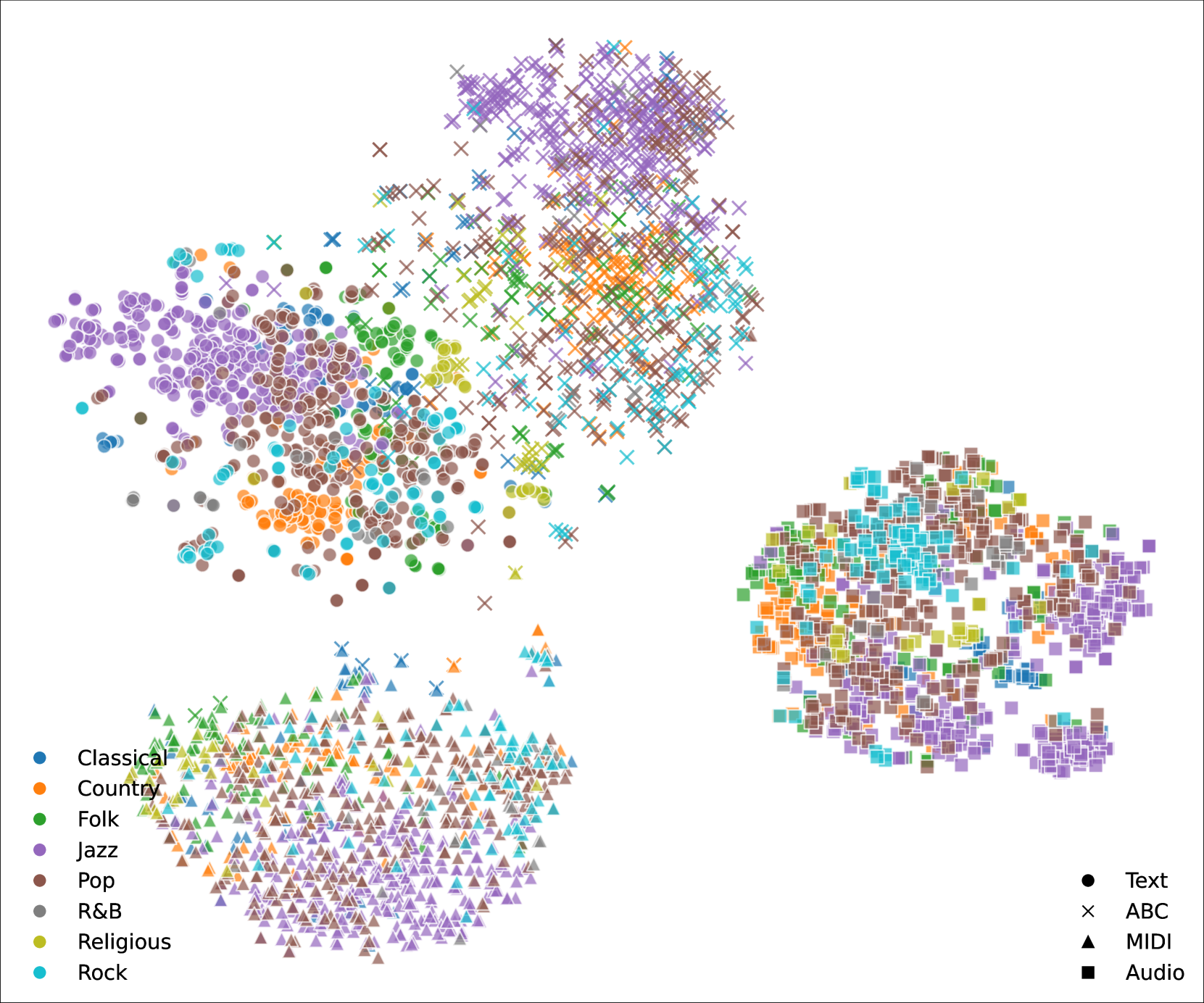
### Visual Description
## Scatter Plot: Music Genre Distribution Across Data Types
### Overview
The image displays three distinct clusters of data points representing music genre distributions across four data types (Text, ABC, MIDI, Audio). Each cluster uses a unique geometric shape (circle, cross, triangle, square) to denote data type, while color-coded points represent 8 music genres. The visualization appears to compare genre prevalence across different data modalities.
### Components/Axes
- **Legend**: Located in the bottom-left corner, color-coded with:
- **Genres**:
- Blue = Classical
- Orange = Country
- Green = Folk
- Purple = Jazz
- Brown = Pop
- Gray = R&B
- Yellow = Religious
- Teal = Rock
- **Data Types**:
- Black circle = Text
- Brown cross = ABC
- Purple triangle = MIDI
- Teal square = Audio
- **Clusters**:
1. **Top-left**: Circles (Text data)
2. **Top-right**: Crosses (ABC data)
3. **Bottom-right**: Squares (Audio data)
4. **Bottom-left**: Triangles (MIDI data)
- **Axes**: No explicit axis labels or scales visible. Positioning suggests:
- X-axis: Likely represents genre diversity or density
- Y-axis: Possibly represents data type specificity or volume
### Detailed Analysis
1. **Top-left Cluster (Text Data)**:
- Dominated by purple (Jazz) and brown (Pop) circles
- Secondary presence of teal (Rock) and green (Folk)
- Density: ~60% Jazz/Pop, 20% Rock/Folk, 20% other genres
2. **Top-right Cluster (ABC Data)**:
- Highest density of purple (Jazz) and brown (Pop) crosses
- Notable orange (Country) and yellow (Religious) outliers
- Distribution: ~55% Jazz/Pop, 15% Country/Religious, 30% other
3. **Bottom-right Cluster (Audio Data)**:
- Most diverse cluster with all genres present
- Strong purple (Jazz) and brown (Pop) dominance
- Significant teal (Rock) and green (Folk) presence
- Distribution: ~50% Jazz/Pop, 25% Rock/Folk, 25% other
4. **Bottom-left Cluster (MIDI Data)**:
- Most concentrated cluster with tight grouping
- Overwhelming purple (Jazz) and brown (Pop) triangles
- Minimal presence of other genres
- Distribution: ~70% Jazz/Pop, 15% Rock, 15% other
### Key Observations
1. **Genre Dominance**:
- Jazz (purple) and Pop (brown) consistently dominate all clusters
- Average prevalence: 55-70% across all data types
- Rock (teal) and Folk (green) show secondary presence (15-25%)
2. **Data Type Patterns**:
- Text data (circles) shows highest genre diversity
- MIDI data (triangles) exhibits strongest genre concentration
- Audio data (squares) demonstrates most balanced distribution
3. **Outliers**:
- Country (orange) and Religious (yellow) genres appear only in ABC and Audio clusters
- R&B (gray) and Classical (blue) show minimal presence (<5% in all clusters)
### Interpretation
The visualization reveals a clear hierarchy in music genre representation across data types:
1. **Genre Prevalence**: Jazz and Pop dominate all modalities, suggesting these genres have the most comprehensive digital representations or are most frequently analyzed.
2. **Data Type Specificity**:
- MIDI data shows strongest genre concentration, possibly indicating specialized compositional patterns
- Text data exhibits highest diversity, potentially reflecting broader lyrical content analysis
- Audio data's balanced distribution might represent raw audio processing capabilities
3. **Missing Genres**: The absence of Classical, R&B, and Religious genres in MIDI data suggests these may be underrepresented in compositional datasets or have different representation requirements.
The clustering pattern implies that while Jazz and Pop are universally prevalent, different data modalities capture distinct aspects of musical representation. This could inform decisions about which data types to prioritize for specific genre analysis tasks.
</details>
(a) Modality
<details>
<summary>x9.png Details</summary>
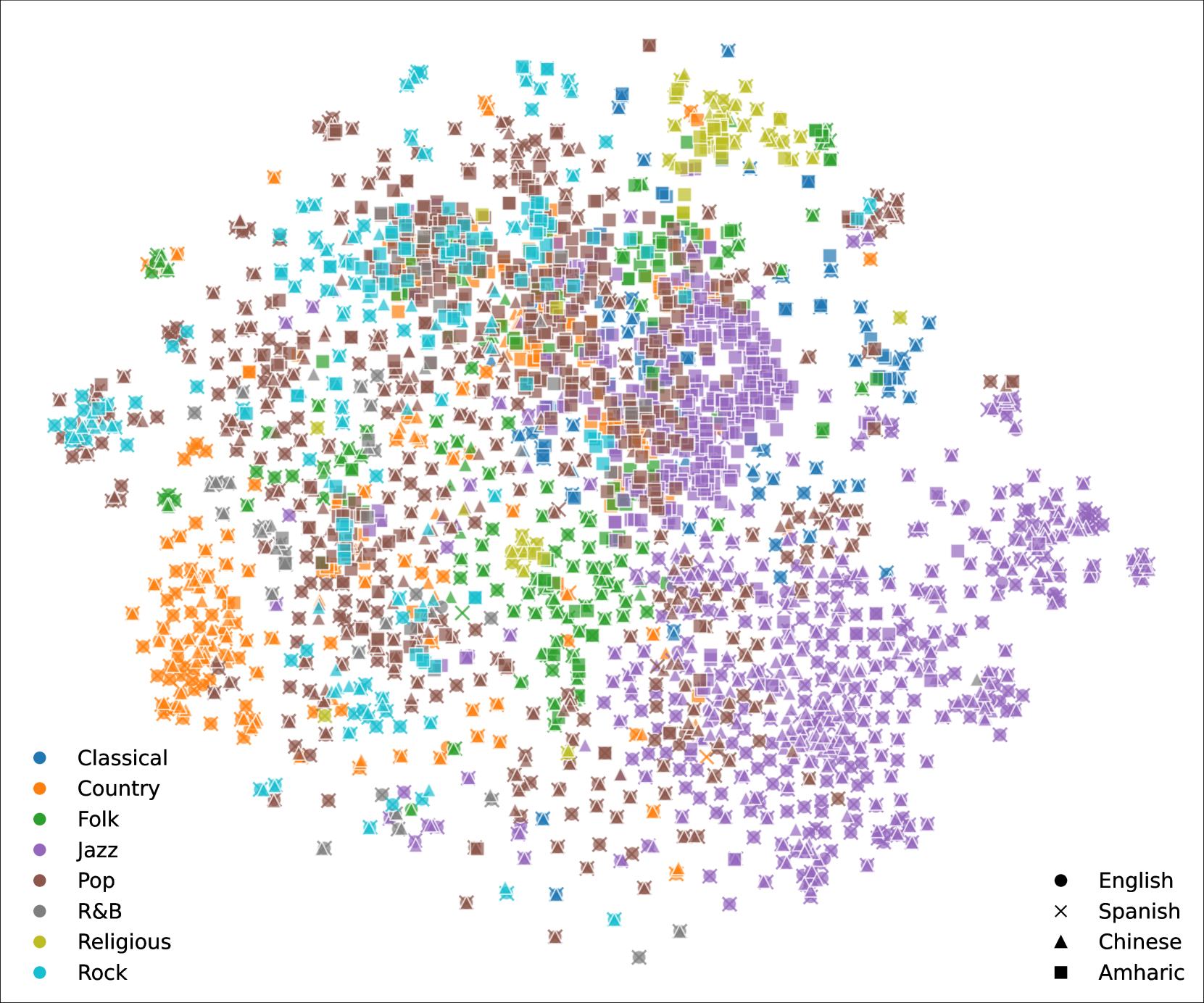
### Visual Description
## Scatter Plot: Music Genre and Language Distribution
### Overview
The image is a scatter plot visualizing the distribution of music genres and languages across a two-dimensional space. Data points are represented by colored and shaped markers, with a legend on the left for genres and a secondary legend on the right for languages. The plot reveals clusters and spatial patterns, suggesting relationships between genres, languages, and their distributions.
---
### Components/Axes
- **X/Y Axes**: No explicit labels or scales are visible, but the axes define a coordinate system for positioning data points.
- **Legend (Left)**:
- **Genres**:
- Classical: Blue circles
- Country: Orange crosses
- Folk: Green triangles
- Jazz: Purple squares
- Pop: Brown diamonds
- R&B: Gray pentagons
- Religious: Yellow hexagons
- Rock: Cyan stars
- **Legend (Right)**:
- **Languages**:
- English: Black circles
- Spanish: Red crosses
- Chinese: Blue triangles
- Amharic: Purple squares
---
### Detailed Analysis
1. **Genre Distribution**:
- **Jazz (Purple Squares)**: Dominates the center-right region, forming the largest cluster (~30% of points). High density suggests prevalence.
- **Country (Orange Crosses)**: Concentrated in the bottom-left quadrant (~15% of points).
- **Folk (Green Triangles)**: Clustered in the top-left (~10% of points).
- **Classical (Blue Circles)**: Scattered across the top-right (~8% of points).
- **Pop (Brown Diamonds)**: Spread across the center (~12% of points).
- **R&B (Gray Pentagons)**: Concentrated in the bottom-center (~7% of points).
- **Religious (Yellow Hexagons)**: Small cluster in the top-right (~5% of points).
- **Rock (Cyan Stars)**: Scattered in the bottom-right (~6% of points).
2. **Language Distribution**:
- **English (Black Circles)**: Widely dispersed, with no dominant cluster.
- **Spanish (Red Crosses)**: Clustered near the center (~10% of points).
- **Chinese (Blue Triangles)**: Concentrated in the top-right (~8% of points).
- **Amharic (Purple Squares)**: Overlaps with Jazz (purple squares) in the center-right (~5% of points).
3. **Color/Shape Consistency**:
- Confirmed: Genre colors/shapes match the legend (e.g., Jazz = purple squares).
- **Conflict**: Amharic (purple squares) shares the same color/shape as Jazz, potentially causing ambiguity. This may indicate a data labeling error or intentional overlap for thematic emphasis.
---
### Key Observations
- **Dominant Genres**: Jazz and Country occupy the largest spatial regions.
- **Language Overlap**: Spanish and Amharic clusters intersect with genre clusters (e.g., Amharic overlaps with Jazz).
- **Scattered Genres**: Classical and Rock show the most dispersed distributions.
- **Central Density**: The center of the plot contains the highest concentration of data points, suggesting a mix of genres/languages in this region.
---
### Interpretation
The plot highlights how music genres and languages are spatially distributed, potentially reflecting cultural or regional associations. For example:
- **Jazz and Amharic Overlap**: The shared purple squares in the center-right may imply a thematic or cultural link, though this could also be a visualization artifact.
- **Classical and Rock Dispersion**: Their scattered nature might indicate broader, less localized popularity.
- **Central Clusters**: The high density of Spanish and Amharic points in the center suggests these languages are associated with a mix of genres, possibly reflecting multilingual or hybrid musical traditions.
**Notable Anomalies**:
- The overlap between Amharic and Jazz (same color/shape) risks misinterpretation. This could be a critical flaw in the data encoding or an intentional design choice to emphasize a connection.
- The lack of axis labels limits quantitative analysis, relying instead on relative spatial positioning.
This visualization underscores the interplay between artistic expression (genres) and linguistic diversity, offering insights into how these elements coexist or diverge in the dataset.
</details>
(b) Language
<details>
<summary>x10.png Details</summary>
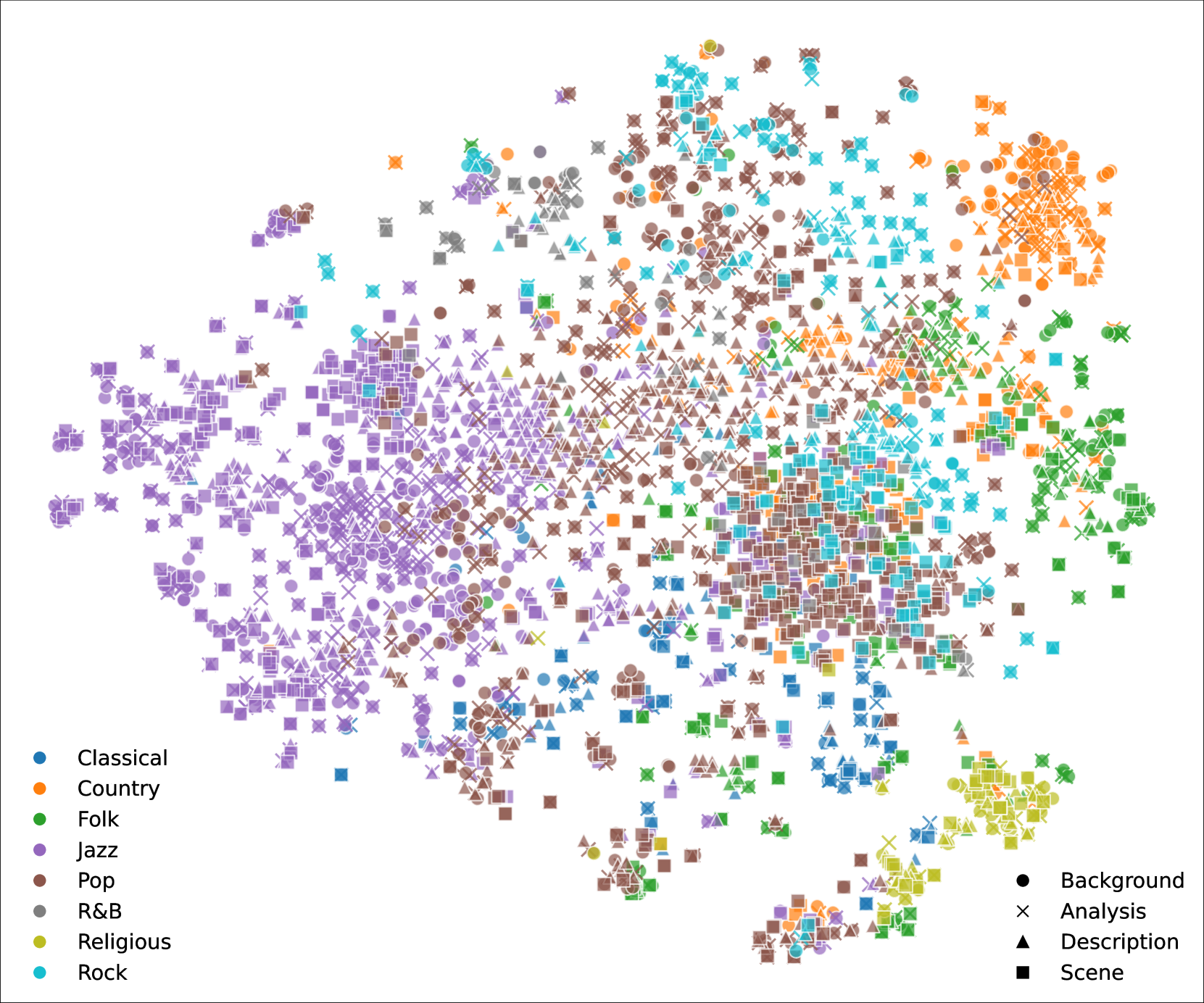
### Visual Description
## Scatter Plot: Genre Distribution Analysis
### Overview
The image is a scatter plot visualizing the distribution of music genres across a two-dimensional space. Each genre is represented by a distinct color, and data points within each genre are differentiated by symbols (circles, crosses, triangles, squares). The plot lacks labeled axes but includes a legend on the left side, which maps colors to genres and symbols to data categories (Background, Analysis, Description, Scene). The distribution shows dense clusters for certain genres and sparse representation for others, with overlapping symbols in the central region.
---
### Components/Axes
- **Legend**: Located on the left side of the plot.
- **Colors**:
- Blue: Classical
- Orange: Country
- Green: Folk
- Purple: Jazz
- Brown: Pop
- Gray: R&B
- Yellow: Religious
- Cyan: Rock
- **Symbols**:
- Circle: Background
- Cross: Analysis
- Triangle: Description
- Square: Scene
- **Axes**: No explicit labels or scales are visible. The x- and y-axes appear to represent abstract or normalized dimensions (e.g., thematic or stylistic axes).
---
### Detailed Analysis
1. **Genre Distribution**:
- **Pop (Brown)**: Dominates the plot with the highest density of symbols (circles, crosses, triangles, squares).
- **Rock (Cyan)**: Second-most prevalent, with dense clusters of crosses and squares.
- **Jazz (Purple)**: Moderate density, primarily circles and triangles.
- **Country (Orange)**: Concentrated in the upper-right quadrant, with crosses and squares.
- **Folk (Green)**: Sparse but clustered in the lower-right quadrant, with circles and triangles.
- **Classical (Blue)**: Scattered symbols, mostly circles and crosses.
- **R&B (Gray)**: Moderate density, with crosses and triangles.
- **Religious (Yellow)**: Least dense, with circles and squares in the lower-left quadrant.
2. **Symbol Trends**:
- **Background (Circles)**: Most common across all genres, suggesting foundational data points.
- **Analysis (Crosses)**: Predominant in Rock, Country, and Pop.
- **Description (Triangles)**: Most frequent in Jazz and R&B.
- **Scene (Squares)**: Concentrated in Pop, Rock, and Religious genres.
3. **Overlap**:
- Central region shows overlapping symbols from multiple genres, indicating shared or hybrid data points (e.g., cross-genre analyses or descriptions).
---
### Key Observations
- **Density Variance**: Pop and Rock genres have the highest number of data points, while Religious and Classical have the fewest.
- **Symbol Dominance**: Crosses (Analysis) and circles (Background) are the most widespread symbols.
- **Spatial Clustering**:
- Pop and Rock dominate the central and upper regions.
- Folk and Religious genres are isolated in the lower-right and lower-left quadrants, respectively.
- **Ambiguity**: Lack of axis labels prevents quantitative interpretation of trends.
---
### Interpretation
The plot suggests a focus on analyzing and describing Pop and Rock genres, as evidenced by their high density of "Analysis" (crosses) and "Scene" (squares) symbols. Jazz and R&B emphasize descriptive elements (triangles), while Folk and Religious genres are underrepresented overall. The central overlap implies potential cross-genre influences or hybrid data points, though the absence of axis labels limits precise interpretation. The use of distinct symbols per data category allows for granular analysis of how different aspects (e.g., background vs. scene) are prioritized across genres.
**Notable Outlier**: Religious genre’s sparse representation contrasts with its symbolic presence in the lower-left quadrant, possibly indicating niche or specialized data collection.
</details>
(c) Semantics
Figure 8: t -SNE visualization of the WikiMT-X dataset, illustrating the distribution of samples based on three distinct factors: (a) Modality, (b) Language, and (c) Semantics. The representations are extracted using CLaMP 3 ${}_\textnormal{saas}$ . Each point represents a data sample, colored according to its genre.
Table 6: Results for English text-to-music retrieval on several benchmarks: WikiMT and MidiCaps have 1,010 pairs, Song Describer Dataset (SDD) has 706 audio and 1,106 captions, and MusicCaps-Remake (MC-R) contains 2,777 pairs. MC-R prevents data leakage by using full-length audio and rewritten captions from AudioSet’s evaluation set.
| Model | Symbolic Benchmarks | WikiMT-X (Sheet Music) | | | | |
| --- | --- | --- | --- | --- | --- | --- |
| WikiMT | MidiCaps | Background | Analysis | Description | Scene | |
| CLaMP 3 as | 0.1973 | 0.0788 | 0.2108 | 0.1660 | 0.1049 | 0.1056 |
| CLaMP 3 sa | 0.3789 | 0.1322 | 0.3591 | 0.3088 | 0.1316 | 0.1643 |
| CLaMP 3 ${}_sa^c2$ | 0.4498 | 0.2826 | 0.4028 | 0.3382 | 0.0835 | 0.1512 |
| CLaMP 3 assa | 0.2993 | 0.0884 | 0.2919 | 0.2507 | 0.1459 | 0.1464 |
| CLaMP 3 saas | 0.3555 | 0.1798 | 0.3301 | 0.2758 | 0.1274 | 0.1512 |
| CLaMP 3 ${}_saas^c2$ | 0.3631 | 0.2688 | 0.3295 | 0.2957 | 0.0951 | 0.1395 |
| Model | Audio Benchmarks | WikiMT-X (Audio) | | | | |
| SDD | MC-R | Background | Analysis | Description | Scene | |
| CLaMP 3 as | 0.1977 | 0.1117 | 0.1602 | 0.1375 | 0.0854 | 0.0819 |
| CLaMP 3 sa | 0.1607 | 0.0937 | 0.1718 | 0.1586 | 0.0997 | 0.0871 |
| CLaMP 3 ${}_sa^c2$ | 0.1612 | 0.0959 | 0.1180 | 0.1206 | 0.0639 | 0.0619 |
| CLaMP 3 assa | 0.2003 | 0.1045 | 0.1597 | 0.1522 | 0.1020 | 0.0873 |
| CLaMP 3 saas | 0.1985 | 0.1177 | 0.2017 | 0.1711 | 0.0988 | 0.0963 |
| CLaMP 3 ${}_saas^c2$ | 0.2115 | 0.1180 | 0.1583 | 0.1530 | 0.0768 | 0.0885 |
Table 7: Results for multilingual text-to-music retrieval on translated WikiMT-X background annotations. Languages marked with asterisks were not included in the M4-RAG training data. The BLEU scores below each language are calculated by back-translating the text with the SeamlessM4T model and comparing it to the original English text.
| ABC Notation CLaMP 3 as CLaMP 3 sa | 0.1750 0.3262 | 0.1931 0.3544 | 0.1964 0.3536 | 0.1594 0.3072 | 0.1559 0.2459 | 0.1828 0.3163 | 0.1641 0.2879 | 0.0997 0.1336 | 0.1575 0.2894 | 0.0876 0.1317 |
| --- | --- | --- | --- | --- | --- | --- | --- | --- | --- | --- |
| CLaMP 3 ${}_sa^c2$ | 0.3614 | 0.3949 | 0.3921 | 0.3155 | 0.2373 | 0.3524 | 0.3226 | 0.1415 | 0.3397 | 0.1871 |
| CLaMP 3 assa | 0.2648 | 0.2810 | 0.2817 | 0.2450 | 0.2271 | 0.2644 | 0.2415 | 0.1432 | 0.2561 | 0.1300 |
| CLaMP 3 saas | 0.2918 | 0.3214 | 0.3239 | 0.2789 | 0.2358 | 0.2919 | 0.2681 | 0.1246 | 0.2703 | 0.1139 |
| CLaMP 3 ${}_saas^c2$ | 0.2954 | 0.3171 | 0.3225 | 0.2773 | 0.2144 | 0.2990 | 0.2721 | 0.1348 | 0.2750 | 0.1690 |
| MIDI | | | | | | | | | | |
| CLaMP 3 as | 0.0418 | 0.0416 | 0.0432 | 0.0404 | 0.0332 | 0.0456 | 0.0449 | 0.0297 | 0.0398 | 0.0267 |
| CLaMP 3 sa | 0.1174 | 0.1284 | 0.1316 | 0.1132 | 0.0890 | 0.1217 | 0.1112 | 0.0623 | 0.1117 | 0.0540 |
| CLaMP 3 ${}_sa^c2$ | 0.1921 | 0.2101 | 0.2137 | 0.1681 | 0.1316 | 0.2019 | 0.1702 | 0.0804 | 0.1765 | 0.1039 |
| CLaMP 3 assa | 0.0565 | 0.0582 | 0.0620 | 0.0582 | 0.0517 | 0.0620 | 0.0585 | 0.0394 | 0.0595 | 0.0354 |
| CLaMP 3 saas | 0.1165 | 0.1319 | 0.1330 | 0.1141 | 0.0937 | 0.1245 | 0.1143 | 0.0601 | 0.1104 | 0.0544 |
| CLaMP 3 ${}_saas^c2$ | 0.1499 | 0.1645 | 0.1664 | 0.1408 | 0.1049 | 0.1560 | 0.1399 | 0.0653 | 0.1335 | 0.0793 |
| Audio | | | | | | | | | | |
| CLaMP 3 as | 0.1267 | 0.1515 | 0.1525 | 0.1210 | 0.1089 | 0.1430 | 0.1428 | 0.0610 | 0.1043 | 0.0559 |
| CLaMP 3 sa | 0.1619 | 0.1717 | 0.1714 | 0.1529 | 0.1414 | 0.1585 | 0.1544 | 0.0991 | 0.1456 | 0.0774 |
| CLaMP 3 ${}_sa^c2$ | 0.1068 | 0.1150 | 0.1202 | 0.0981 | 0.0877 | 0.1112 | 0.1014 | 0.0720 | 0.1005 | 0.0681 |
| CLaMP 3 assa | 0.1426 | 0.1580 | 0.1588 | 0.1370 | 0.1202 | 0.1468 | 0.1431 | 0.0795 | 0.1276 | 0.0617 |
| CLaMP 3 saas | 0.1788 | 0.1980 | 0.1962 | 0.1665 | 0.1459 | 0.1770 | 0.1736 | 0.0945 | 0.1561 | 0.0675 |
| CLaMP 3 ${}_saas^c2$ | 0.1331 | 0.1566 | 0.1554 | 0.1304 | 0.1208 | 0.1550 | 0.1460 | 0.0901 | 0.1340 | 0.0874 |
Table 8: Results for emergent cross-modal retrieval on WikiMT-X pairings across different musical modalities. S: Sheet Music (ABC notation), P: Performance Signals (MIDI, converted from ABC), A: Audio recordings.
| CLaMP 3 as CLaMP 3 sa CLaMP 3 ${}_sa^c2$ | 0.1637 0.3205 0.4547 | 0.0557 0.0739 0.0543 | 0.1477 0.3054 0.5293 | 0.0248 0.0397 0.0313 | 0.0456 0.0479 0.0492 | 0.0237 0.0237 0.0383 |
| --- | --- | --- | --- | --- | --- | --- |
| CLaMP 3 assa | 0.1911 | 0.0619 | 0.1646 | 0.0299 | 0.0513 | 0.0264 |
| CLaMP 3 saas | 0.3262 | 0.0578 | 0.3146 | 0.0397 | 0.0410 | 0.0303 |
| CLaMP 3 ${}_saas^c2$ | 0.3909 | 0.0688 | 0.4375 | 0.0467 | 0.0558 | 0.0431 |
## Appendix D Performance of CLaMP 3 Variants
A straightforward way to train CLaMP 3 would be to align symbolic music, audio, and text all at once. However, early experiments showed that this led to unstable training. The text encoder struggled because symbolic and audio data had very different distributions (Fig. 8(a)) and pulled it in opposite directions, making alignment ineffective. To solve this, we adopted a multi-stage alignment strategy (Sec. 2.1) that gradually integrates each modality, ensuring stable and effective alignment.
To explore the best way to align modalities, we tested different training orders, leading to several model variants. The main difference among them is how and when the text encoder is aligned with symbolic music and audio encoders:
CLaMP 3 ${}_\textnormal{as}$ : A two-stage alignment where text is first aligned with audio, then the text encoder is frozen while aligning with symbolic music.
CLaMP 3 ${}_\textnormal{sa}$ : The reverse of CLaMP 3 ${}_\textnormal{as}$ , first aligning text with symbolic music, then freezing the text encoder while aligning with audio.
CLaMP 3 ${}_\textnormal{sa}^\textnormal{c2}$ : Same as CLaMP 3 ${}_\textnormal{sa}$ , but starting with pre-trained text and symbolic encoders from CLaMP 2.
CLaMP 3 ${}_\textnormal{assa}$ : A four-stage alignment: audio $→$ symbolic $→$ symbolic $→$ audio, with the text encoder frozen in the second and fourth stages to maintain stability.
CLaMP 3 ${}_\textnormal{saas}$ : A four-stage alignment: symbolic $→$ audio $→$ audio $→$ symbolic, also freezing the text encoder in the second and fourth stages.
CLaMP 3 ${}_\textnormal{saas}^\textnormal{c2}$ : Same as CLaMP 3 ${}_\textnormal{saas}$ , but initialized with pre-trained text and symbolic encoders from CLaMP 2.
We evaluate these six variants across all experiments in Sec. 4 to assess their effectiveness in different retrieval tasks.
Table 6 shows that aligning text with symbolic music before audio improves generalization in English text-to-music retrieval. CLaMP 3 ${}_\textnormal{sa}$ outperforms CLaMP 3 ${}_\textnormal{as}$ in symbolic retrieval without compromising audio performance. Four-stage models outperform two-stage models in audio retrieval, emphasizing the importance of iterative alignment. Among them, CLaMP 3 ${}_\textnormal{saas}$ achieves the best balance between symbolic and audio retrieval. Leveraging CLaMP 2’s weight initialization enhances symbolic retrieval, as seen in CLaMP 3 ${}_\textnormal{sa}^\textnormal{c2}$ leading symbolic tasks. However, it does not consistently improve audio retrieval, likely because CLaMP 2 was trained only on symbolic music, limiting its text encoder’s adaptability to audio alignment.
Table 7 demonstrates the impact of pre-training and training order on multilingual text-to-music retrieval. In symbolic retrieval, using CLaMP 2’s pre-trained text-symbolic encoders provides a clear advantage, with CLaMP 3 ${}_\textnormal{sa}^\textnormal{c2}$ achieving the highest scores across most languages. This suggests that pre-training helps build a strong shared representation space, especially for MIDI, where M4-RAG’s limited native data weakens overall performance. However, pre-training is not always decisive, as some non-pretrained models surpass pre-trained variants in certain languages for ABC retrieval. In contrast, audio retrieval is consistently strongest with CLaMP 3 ${}_\textnormal{saas}$ , even in unseen languages, suggesting that training order plays a more crucial role in cross-lingual generalization.
Table 8 evaluates emergent cross-modal retrieval, where no direct supervised alignment exists among musical modalities. CLaMP 3 ${}_\textnormal{sa}^\textnormal{c2}$ achieves the best symbolic retrieval (S $↔$ P), showing that CLaMP 2 pre-training strengthens symbolic-text alignment, which indirectly benefits symbolic retrieval. For symbolic-audio retrieval, CLaMP 3 ${}_\textnormal{saas}^\textnormal{c2}$ performs best, leading in P $→$ A (0.0467), A $→$ S (0.0558), and A $→$ P (0.0431). It consistently outperforms CLaMP 3 ${}_\textnormal{saas}$ , suggesting that pre-training provides a stronger shared representation space, leading to better cross-modal generalization between unpaired modalities.
These results show the importance of both training order and pre-training in MIR. Multi-stage alignment stabilizes training, while training order plays a key role, particularly in audio retrieval and cross-lingual generalization. Pre-training with CLaMP 2 strengthens symbolic retrieval and improves cross-modal generalization, but its benefits are limited for audio retrieval.
Table 9: Symbolic classification performance for ABC notation and MIDI was assessed across three datasets: WikiMT (1,010 pieces, 8 genres), VGMIDI (204 pieces, 4 emotions), and Pianist8 (411 pieces, 8 composers).
| M3 CLaMP CLaMP 2 | ABC ABC ABC | 0.2349 0.3452 0.3990 | 0.4010 0.4267 0.4653 | 0.6016 0.6453 0.7449 | 0.6341 0.6866 0.8049 | 0.7395 0.7067 0.8025 | 0.7590 0.7152 0.8072 |
| --- | --- | --- | --- | --- | --- | --- | --- |
| CLaMP 3 as | ABC | 0.3135 | 0.4307 | 0.6638 | 0.7073 | 0.6872 | 0.6867 |
| CLaMP 3 sa | ABC | 0.3225 | 0.4455 | 0.7725 | 0.8049 | 0.7403 | 0.7590 |
| CLaMP 3 ${}_sa^c2$ | ABC | 0.3316 | 0.4356 | 0.6845 | 0.7317 | 0.7722 | 0.7711 |
| CLaMP 3 assa | ABC | 0.3102 | 0.4455 | 0.4990 | 0.6341 | 0.6796 | 0.6988 |
| CLaMP 3 saas | ABC | 0.3177 | 0.4356 | 0.7969 | 0.8049 | 0.7716 | 0.7952 |
| CLaMP 3 ${}_saas^c2$ | ABC | 0.3568 | 0.4257 | 0.6694 | 0.7561 | 0.7891 | 0.7952 |
| M3 | MIDI | 0.2621 | 0.4257 | 0.5399 | 0.6098 | 0.9199 | 0.9157 |
| CLaMP 2 | MIDI | 0.2898 | 0.4455 | 0.5246 | 0.6585 | 0.8927 | 0.8916 |
| CLaMP 3 as | MIDI | 0.3361 | 0.4653 | 0.5600 | 0.5854 | 0.8186 | 0.8313 |
| CLaMP 3 sa | MIDI | 0.2614 | 0.4010 | 0.6864 | 0.7073 | 0.8461 | 0.8554 |
| CLaMP 3 ${}_sa^c2$ | MIDI | 0.3073 | 0.4455 | 0.6223 | 0.7073 | 0.8696 | 0.8675 |
| CLaMP 3 assa | MIDI | 0.2882 | 0.4406 | 0.5001 | 0.6098 | 0.8076 | 0.8193 |
| CLaMP 3 saas | MIDI | 0.2721 | 0.4158 | 0.5723 | 0.6341 | 0.7834 | 0.7952 |
| CLaMP 3 ${}_saas^c2$ | MIDI | 0.2943 | 0.4208 | 0.5474 | 0.6829 | 0.8565 | 0.8554 |
Table 10: Audio classification performance is evaluated on multiple benchmarks included in MARBLE: MTT (25,860 clips, 50 tags), GS (7,035 clips, 24 keys), GTZAN (1,000 clips, 10 genres), EMO (744 clips, valence/arousal regression), Nsynth (305,979 clips, 11 instrument categories, 88 pitches), and VocalSet (7,506 clips, 17 singing techniques, 20 singers).
| MERT mean CLAP TTMR++ | 0.9068 0.9066 0.9082 | 0.3915 0.3897 0.3922 | 0.6475 0.1596 0.1672 | 0.6689 0.8207 0.8551 | 0.5185 0.5408 0.5599 | 0.7501 0.7025 0.7116 | 0.6963 0.7817 0.6735 | 0.9152 0.5146 0.5012 | 0.7219 0.6868 0.6342 | 0.8961 0.6327 0.5352 |
| --- | --- | --- | --- | --- | --- | --- | --- | --- | --- | --- |
| CLaMP 3 as | 0.9097 | 0.3888 | 0.4935 | 0.8379 | 0.5944 | 0.7413 | 0.6445 | 0.8601 | 0.6780 | 0.8491 |
| CLaMP 3 sa | 0.9084 | 0.3863 | 0.2533 | 0.8448 | 0.6031 | 0.6949 | 0.6338 | 0.8647 | 0.7061 | 0.8419 |
| CLaMP 3 ${}_sa^c2$ | 0.9092 | 0.3924 | 0.2545 | 0.8551 | 0.5477 | 0.6876 | 0.6147 | 0.8574 | 0.6710 | 0.8007 |
| CLaMP 3 assa | 0.9098 | 0.3935 | 0.1498 | 0.8793 | 0.5921 | 0.7327 | 0.6411 | 0.8742 | 0.6842 | 0.8555 |
| CLaMP 3 saas | 0.9109 | 0.3941 | 0.5377 | 0.8655 | 0.5907 | 0.7004 | 0.6377 | 0.8689 | 0.7053 | 0.8441 |
| CLaMP 3 ${}_saas^c2$ | 0.9095 | 0.3938 | 0.3907 | 0.8138 | 0.5368 | 0.6589 | 0.6562 | 0.8732 | 0.6798 | 0.8470 |
Table 11: Audio classification performance on the MTG-Jamendo dataset (55,000+ tracks) was evaluated across four tasks: instrument classification (41 tags), mood/theme classification (59 tags), genre classification (95 tags), and top-50 multi-label classification.
| MERT mean CLAP TTMR++ | 0.7421 0.7480 0.7806 | 0.1764 0.1812 0.2111 | 0.7598 0.7601 0.7705 | 0.1383 0.1323 0.1477 | 0.8672 0.8544 0.8742 | 0.1818 0.1716 0.2030 | 0.8280 0.8197 0.8340 | 0.2837 0.2773 0.3049 |
| --- | --- | --- | --- | --- | --- | --- | --- | --- |
| CLaMP 3 as | 0.7895 | 0.2254 | 0.7814 | 0.1476 | 0.8750 | 0.2114 | 0.8321 | 0.3068 |
| CLaMP 3 sa | 0.7780 | 0.2112 | 0.7823 | 0.1533 | 0.8713 | 0.2008 | 0.8276 | 0.3011 |
| CLaMP 3 ${}_sa^c2$ | 0.7832 | 0.2168 | 0.7796 | 0.1475 | 0.8679 | 0.2046 | 0.8220 | 0.2964 |
| CLaMP 3 assa | 0.7911 | 0.2269 | 0.7828 | 0.1486 | 0.8763 | 0.2109 | 0.8290 | 0.3041 |
| CLaMP 3 saas | 0.7872 | 0.2208 | 0.7835 | 0.1547 | 0.8703 | 0.2076 | 0.8242 | 0.3021 |
| CLaMP 3 ${}_saas^c2$ | 0.7803 | 0.2145 | 0.7825 | 0.1522 | 0.8734 | 0.2092 | 0.8296 | 0.3074 |
## Appendix E Music Classification
This section evaluates CLaMP 3 variants and baselines via linear probing, assessing their ability to classify musical attributes in symbolic and audio music, as well as musical modalities and text annotations in WikiMT-X.
### E.1 Symbolic Music Classification
Table 9 presents symbolic music classification results for ABC notation and MIDI across three benchmarks:
WikiMT Wu et al. (2023a) consists of 1,010 lead sheets in ABC notation sourced from Wikifonia http://www.synthzone.com/files/Wikifonia/Wikifonia.zip, labeled into 8 genre categories based on corresponding Wikipedia entries.
VGMIDI Ferreira and Whitehead (2019) contains 204 MIDI transcriptions of video game soundtracks, annotated with 4 emotion labels derived from valence and arousal levels.
Pianist8 Chou et al. (2021) includes 411 piano performances, transcribed from audio to performance MIDI, and labeled with their respective composers across eight categories.
To enable evaluation in both formats, all datasets were converted between ABC and MIDI.
Despite improved text alignment, CLaMP 3 does not surpass CLaMP 2 in sheet music classification. This is likely because CLaMP 3 was trained on only half as much symbolic data. While stronger textual supervision benefits retrieval, it does not fully offset the reduced symbolic training for classification. However, CLaMP 3 still outperforms M3—the symbolic music encoder it was initialized from—on most benchmarks, suggesting that contrastive text supervision enhances the semantic salience of extracted features.
These results indicate that retrieval and classification improvements are relatively independent. In text-to-music retrieval (Table 2, Table 3), CLaMP 3—especially CLaMP 3 ${}_\textnormal{sa}^\textnormal{c2}$ —significantly outperforms CLaMP 2, yet this advantage does not extend to classification. A possible explanation is that retrieval requires rich representations and effective interaction between text and music encoders, while classification depends solely on an encoder’s ability to extract features relevant to predefined labels. Thus, while higher-quality text annotations enhance retrieval, they do not necessarily improve symbolic music classification.
### E.2 Audio Music Classification
To evaluate the audio classification performance of CLaMP 3 variants and baselines, we conduct linear probing on MARBLE Yuan et al. (2023) and MTG-Jamendo Bogdanov et al. (2019).
MARBLE is a comprehensive benchmark collection for music representation evaluation. We assess models on 8 tasks covering different aspects of audio understanding. MTG-Jamendo is a large-scale benchmark with over 55,000 music tracks annotated for multiple classification tasks. It focuses on high-level musical attributes, making it well-suited for evaluating a model’s ability to capture semantic meaning in music.
We also assess the self-supervised model MERT, CLaMP 3’s audio feature extractor, averaging embeddings to one per 5-second clip across layers and time steps.
Table 10 shows the strengths of contrastive and self-supervised models on the MARBLE benchmark. CLaMP 3 variants excel in high-level tasks, like genre classification (GTZAN) and tagging (MTT), where capturing abstract musical meaning is crucial. MERT, however, performs better in low-level tasks such as key detection (GS) and pitch classification (Nsynth), where fine spectral detail is more important. Contrastive models generally struggle with short-duration audio (e.g., 4-second clips in Nsynth) because their focus on aligning longer segments with text limits their ability to capture acoustic details. These results suggest contrastive learning is better for semantic tasks, while self-supervised models are more effective for low-level acoustic analysis.
Table 11 shows that contrastive models, particularly CLaMP 3 variants, consistently outperform MERT across all MTG-Jamendo tasks. Notably, CLaMP 3 models achieve the highest scores in most tasks, demonstrating how diverse and high-quality text annotations help contrastive models learn and capture complex musical semantics.
In summary, contrastive models perform well in high-level classification tasks but struggle with short clips and fine-grained acoustic details. Their effectiveness heavily depends on the text annotations used during training. For instance, CLAP achieves strong results in instrument classification (Nsynth) because its training data is dominated by instrument and genre descriptions. However, it performs poorly in key detection (GS), where such annotations offer little relevant information.
Table 12: Classification performance on WikiMT-X (1,000 entries, 8 genres) across different musical modalities and text annotations.
| Accuracy CLaMP CLaMP 2 | 0.7000 0.6800 | - 0.6350 | - - | 0.8050 0.7900 | 0.7900 0.8150 | 0.6900 0.7250 | 0.6250 0.6150 |
| --- | --- | --- | --- | --- | --- | --- | --- |
| CLAP | - | - | 0.6450 | 0.6950 | 0.6800 | 0.6500 | 0.5550 |
| TTMR++ | - | - | 0.7150 | 0.7400 | 0.7600 | 0.6700 | 0.5950 |
| CLaMP 3 as | 0.6850 | 0.6100 | 0.7050 | 0.8200 | 0.8350 | 0.7800 | 0.6550 |
| CLaMP 3 sa | 0.7000 | 0.6650 | 0.6850 | 0.8000 | 0.8600 | 0.7700 | 0.6500 |
| CLaMP 3 ${}_sa^c2$ | 0.6850 | 0.6350 | 0.6850 | 0.7850 | 0.8550 | 0.7750 | 0.6500 |
| CLaMP 3 assa | 0.7000 | 0.6300 | 0.7200 | 0.8650 | 0.8650 | 0.7700 | 0.6850 |
| CLaMP 3 saas | 0.7150 | 0.6800 | 0.7050 | 0.8400 | 0.8550 | 0.7800 | 0.6650 |
| CLaMP 3 ${}_saas^c2$ | 0.6750 | 0.6300 | 0.6850 | 0.8300 | 0.8500 | 0.7700 | 0.6850 |
| F1-macro | | | | | | | |
| CLaMP | 0.5252 | - | - | 0.6835 | 0.6486 | 0.6079 | 0.4447 |
| CLaMP 2 | 0.5287 | 0.3784 | - | 0.6617 | 0.6832 | 0.6333 | 0.3710 |
| CLAP | - | - | 0.3943 | 0.5913 | 0.5491 | 0.4921 | 0.3100 |
| TTMR++ | - | - | 0.4714 | 0.6914 | 0.6694 | 0.6254 | 0.4246 |
| CLaMP 3 as | 0.5431 | 0.4005 | 0.4755 | 0.7424 | 0.7933 | 0.7639 | 0.4780 |
| CLaMP 3 sa | 0.5345 | 0.5108 | 0.4881 | 0.7917 | 0.8199 | 0.7372 | 0.4527 |
| CLaMP 3 ${}_sa^c2$ | 0.5428 | 0.4171 | 0.4589 | 0.6626 | 0.7439 | 0.7318 | 0.4260 |
| CLaMP 3 assa | 0.5499 | 0.3976 | 0.5130 | 0.8486 | 0.8277 | 0.6878 | 0.5207 |
| CLaMP 3 saas | 0.5720 | 0.4967 | 0.4995 | 0.8123 | 0.8225 | 0.7484 | 0.4742 |
| CLaMP 3 ${}_saas^c2$ | 0.5182 | 0.4313 | 0.4432 | 0.7811 | 0.8054 | 0.7082 | 0.4999 |
### E.3 Classification on WikiMT-X
Table 12 presents classification results across different musical modalities (ABC, MIDI, Audio) and text annotations (Background, Analysis, Description, Scene) on WikiMT-X.
Compared to the WikiMT results in Table 9, all models show substantial gains in genre classification accuracy and F1-macro for ABC and MIDI. This confirms that reannotating genre labels significantly reduced label noise, leading to more reliable classification. The improvements suggest that earlier inconsistencies in genre annotations were a major limiting factor in classification performance. The reorganized label taxonomy and refined annotations in WikiMT-X provide a more structured and consistent genre framework, making it a more reliable benchmark for music classification.
Across different musical modalities, the best-performing models for ABC, MIDI, and Audio achieve comparable classification results. This suggests that genre-related features are well-preserved regardless of musical representation. Fig. 8(a) further supports this observation, showing clear genre boundaries across all modalities, indicating CLaMP 3 models can effectively extract genre information from both representations, reinforcing the idea that genre characteristics are consistently encoded in musical data.
A clear distinction emerges between text and music classification: models perform significantly better on text annotations (Background, Analysis, Description) than on music data. This is likely because text often contains explicit genre-related cues, making classification more direct. For example, descriptions like “syncopated piano chords and walking bass” strongly suggest jazz. In contrast, classifying music requires models to infer genre from intricate relationships between harmony, rhythm, and timbre. However, Scene classification behaves differently from other text-based categories—it describes environmental settings rather than musical attributes, making its classification challenge more similar to music than text.
Models trained solely on audio-text alignment (i.e., CLAP, TTMR++) perform worse in text classification, likely due to the limited diversity of annotations in large-scale audio-text datasets, which often list only instruments and genres. In contrast, symbolic-text datasets provide richer semantics, including background context and musicological analysis. CLaMP 3 ${}_\textnormal{as}$ is an exception—though its text encoder was fully updated during audio alignment, it achieves much stronger text classification than models like CLAP and TTMR++. This is likely due to M4-RAG’s well-curated and diverse annotations, which offer a broader and more expressive linguistic representation of musical content.
Table 13: Results for English text-to-music retrieval on MusicCaps, reflecting data leakage in baseline models. Evaluations are conducted on both the full set and the AudioSet evaluation set. R/O denotes the use of rewritten or original captions, while F/C indicates retrieval using full tracks or clips.
| CLAP TTMR++ CLaMP 3 as | 0.0536 0.1410 0.0874 | 0.0743 0.2315 0.0642 | 0.0640 0.1757 0.0696 | 0.0894 0.3155 0.0536 | 0.0657 0.1248 0.1119 | 0.0886 0.1341 0.0830 | 0.0774 0.1219 0.0917 | 0.1113 0.1382 0.0699 |
| --- | --- | --- | --- | --- | --- | --- | --- | --- |
| CLaMP 3 sa | 0.0741 | 0.0591 | 0.0530 | 0.0431 | 0.0934 | 0.0735 | 0.0661 | 0.0572 |
| CLaMP 3 ${}_sa^c2$ | 0.0729 | 0.0609 | 0.0619 | 0.0504 | 0.0961 | 0.0832 | 0.0822 | 0.0651 |
| CLaMP 3 assa | 0.0830 | 0.0592 | 0.0743 | 0.0530 | 0.1045 | 0.0784 | 0.0897 | 0.0723 |
| CLaMP 3 saas | 0.0890 | 0.0705 | 0.0652 | 0.0523 | 0.1177 | 0.0889 | 0.0890 | 0.0682 |
| CLaMP 3 ${}_saas^c2$ | 0.0973 | 0.0737 | 0.0762 | 0.0550 | 0.1180 | 0.0933 | 0.0961 | 0.0710 |
## Appendix F Data Leakage of MusicCaps
MusicCaps, a widely used text-to-music retrieval benchmark, includes 5,521 music-text pairs with 10-second audio clips. As a subset of AudioSet, many models are trained on overlapping data, raising concerns about reliability, as they may memorize seen examples rather than learning true retrieval patterns.
Table 13 shows text-to-music retrieval results on MusicCaps, examining data leakage in baseline models. We evaluate performance on the full dataset (Full Set) and the AudioSet evaluation subset (Eval Set), while also assessing the effects of caption rewording (Original vs. Rewritten) and audio length (Clip vs. Full Track).
Leakage varies across models: TTMR++ is the most affected, having been trained on MusicCaps pairs from the training set of AudioSet, exposing it to half the benchmark; CLAP, trained on the full AudioSet, has seen all MusicCaps audio; in contrast, CLaMP 3 has minimal exposure, with only 150 audio recordings appearing in M4-RAG.
To mitigate leakage effects, we introduce rewritten captions generated using Qwen, ensuring semantic consistency while incorporating structured aspect lists—detailed annotations of key musical attributes such as instrumentation, mood, and rhythm. Additionally, we conduct retrieval on both 10-second clips and full-length tracks, forming four evaluation settings:
- RF: Rewritten captions with full tracks.
- RC: Rewritten captions with clips.
- OF: Original captions with full tracks.
- OC: Original captions with clips.
Table 13 reveals clear data leakage. TTMR++ is the only model that performs worse on the evaluation set than on the full benchmark, despite the evaluation set containing fewer retrieval candidates, which should naturally lead to higher MRR scores. This suggests severe overfitting to seen MusicCaps training data. Additionally, both TTMR++ and CLAP show performance drops with rewritten captions and full-length tracks. For TTMR++, this suggests that these modifications help reduce leakage effects, though not entirely. For CLAP, the decline is likely due to rewritten captions incorporating more detailed semantic information from aspect lists, which may shift retrieval behavior.
In contrast, all CLaMP 3 variants show improved performance with rewritten captions, likely due to M4-RAG’s use of Qwen, making them more attuned to its text patterns. They also gain an advantage in full-track retrieval. While baseline models rely on 10-second clips and average embeddings across segments, CLaMP 3 processes up to 640 seconds of audio, enabling it to capture relationships across an entire track. In contrast, baselines extract semantics from isolated clips, restricting their ability to utilize long-form audio context effectively.
These results raise broader concerns about benchmark reliability in text-to-music retrieval. Other benchmarks also face leakage risks—SDD, for instance, comes from MTG-Jamendo, which was included in CLAP’s training data. In contrast, WikiMT-X, manually curated for this study, mitigates leakage by sourcing audio from the web rather than existing datasets. However, since this audio remains publicly accessible, large-scale models may still have exposure. To further reduce leakage, future benchmarks should prioritize private or newly recorded datasets for unbiased evaluation.