# Retrieval-Augmented Process Reward Model for Generalizable Mathematical Reasoning
> *Corresponding author
Abstract
While large language models (LLMs) have significantly advanced mathematical reasoning, Process Reward Models (PRMs) have been developed to evaluate the logical validity of reasoning steps. However, PRMs still struggle with out-of-distribution (OOD) challenges. This paper identifies key OOD issues, including step OOD—caused by differences in reasoning patterns across model types and sizes—and question OOD, which arises from dataset shifts between training data and real-world problems. To address these issues, we introduce Retrieval-Augmented Process Reward Model (RetrievalPRM), a novel framework designed to tackle these OOD issues. By utilizing a two-stage retrieval-enhanced mechanism, RetrievalPRM retrieves semantically similar questions and steps as a warmup, enhancing PRM’s ability to evaluate target steps and improving generalization and reasoning consistency across different models and problem types. Our extensive experiments demonstrate that RetrievalPRM outperforms existing baselines across multiple real-world datasets. Our open-source contributions include a retrieval-enhanced dataset, a tuning framework for PRM training, and the RetrievalPRM model, establishing a new standard for PRM performance.
Retrieval-Augmented Process Reward Model for Generalizable Mathematical Reasoning
Jiachen Zhu 1, Congmin Zheng 1, Jianghao Lin 1, Kounianhua Du 1 Ying Wen 1 ∗, Yong Yu 1, Jun Wang 2, Weinan Zhang 1 thanks: *Corresponding author 1 Shanghai Jiao Tong University, 2 University College London {gebro13,desp.zcm,chiangel,kounianhuadu,ying.wen,wnzhang}@sjtu.edu.cn, yyu@apex.sjtu.edu.cn jun.wang@cs.ucl.ac.uk
1 Introduction
While large language models (LLMs) have advanced mathematical reasoning OpenAI (2023); Dubey et al. (2024); Zhu et al. (2024); Shao et al. (2024); Yang et al. (2024b), they remain prone to critical flaws: explicit errors (e.g., miscalculations, logical inconsistencies) and implicit risks where correct answers mask flawed intermediate steps. Even when final results are accurate, LLMs often generate plausible-but-incorrect reasoning chains, eroding trust in their problem-solving processes Lightman et al. (2023). To address this, Process Reward Models (PRMs) Lightman et al. (2023); Wang et al. (2024b) have been developed to rigorously evaluate the logical validity of intermediate steps Cobbe et al. (2021), mirroring human pedagogical practices that prioritize reasoning quality over answer correctness.
<details>
<summary>x1.png Details</summary>
### Visual Description
## Scatter Plot: Dataset Distribution
### Overview
The image is a scatter plot visualizing the distribution of three datasets: GSM8k, MATH, and OlympiadBench. The plot uses two dimensions (Dimension x and Dimension y) to represent the data points, with each dataset distinguished by color (GSM8k - light green, MATH - light orange, OlympiadBench - light blue). Density contours are overlaid on each dataset to highlight areas of high concentration.
### Components/Axes
* **X-axis:** Dimension x, ranging from -40 to 50, with tick marks at -40, -30, -20, -10, 0, 10, 20, 30, 40, and 50.
* **Y-axis:** Dimension y, ranging from -20 to 25, with tick marks at -20, -15, -10, -5, 0, 5, 10, 15, 20, and 25.
* **Legend:** Located in the top-left corner, the legend identifies the datasets:
* GSM8k (light green)
* MATH (light orange)
* OlympiadBench (light blue)
### Detailed Analysis
* **GSM8k (light green):** The GSM8k data points are clustered primarily in the positive x and y quadrant. The density contour is centered around x=30 and y=0, with points ranging approximately from x=15 to x=45 and y=-15 to y=15.
* Trend: Cluster in the positive quadrant.
* **MATH (light orange):** The MATH data points are clustered primarily in the negative x and y quadrant. The density contour is centered around x=-30 and y=-10, with points ranging approximately from x=-40 to x=-15 and y=-20 to y=0. There is also a scattering of orange points within the blue cluster.
* Trend: Cluster in the negative quadrant.
* **OlympiadBench (light blue):** The OlympiadBench data points are clustered primarily in the negative x and positive y quadrant. The density contour is centered around x=-10 and y=5, with points ranging approximately from x=-25 to x=10 and y=-5 to y=15.
* Trend: Cluster in the negative x, positive y quadrant.
### Key Observations
* The three datasets occupy distinct regions in the two-dimensional space, suggesting different characteristics or properties.
* There is some overlap between the OlympiadBench and MATH datasets.
* The GSM8k dataset appears to be the most concentrated, while the MATH dataset is the most dispersed.
### Interpretation
The scatter plot visualizes the distribution of three datasets (GSM8k, MATH, and OlympiadBench) in a two-dimensional space. The clustering of each dataset suggests that they possess unique characteristics that differentiate them along the two dimensions represented by the x and y axes. The density contours highlight the areas where data points are most concentrated for each dataset. The plot suggests that the datasets are separable to some extent, but there is some overlap, particularly between OlympiadBench and MATH. This visualization could be used to inform further analysis or modeling of these datasets.
</details>
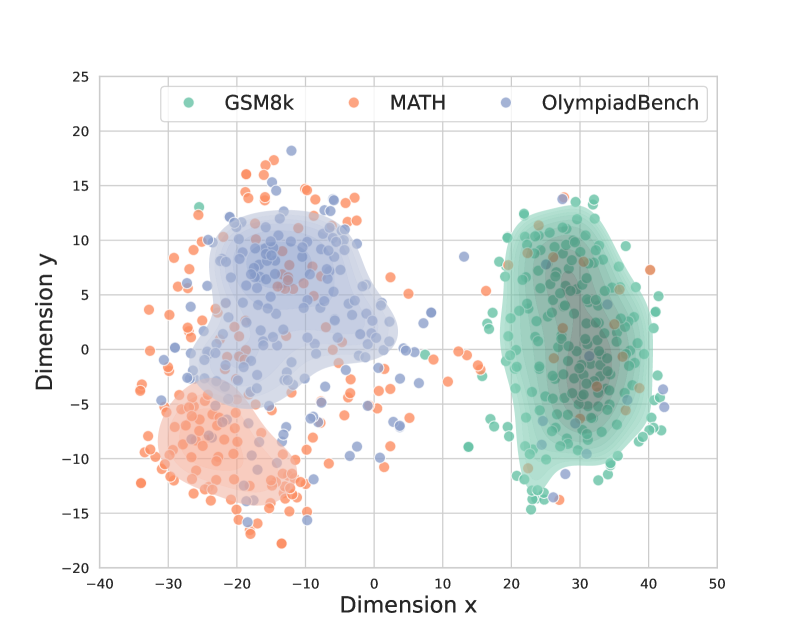
Figure 1: The distribution differences across three datasets: GSM8K, MATH and Olympiad. We use sentence-bert to encode these questions and perform t-sne visualization.
Existing works Wang et al. (2024a); o1 Team (2024); Zheng et al. (2024) frame PRM as a binary classification problem. They train PRM on open-source base LLMs such as Qwen Yang et al. (2024b) or Llama Dubey et al. (2024) using human-annotated dataset Lightman et al. (2023) or automated process supervision method Wang et al. (2024b); Luo et al. (2024); Qin et al. (2024). Although these approaches show great performance and empirical success, they still face kinds of out-of-distribution challenges. We believe the out-of-distribution (OOD) problem can be viewed from the following perspectives:
<details>
<summary>x2.png Details</summary>
### Visual Description
## Model Comparison: Solving a Number Puzzle
### Overview
The image presents a comparison of three different language models (ChatGPT-4o, Qwen2.5-Math-72B-instruct, and Qwen2.5-Math-1.5B-instruct) attempting to solve the same mathematical problem. The problem involves finding the largest of five numbers given the sums of all possible pairs of those numbers. The image highlights the different approaches each model takes, their chain length (number of steps), solution style, and final answer.
### Components/Axes
* **Question:** The problem statement is at the top of the image.
* "Five different numbers are added together in pairs, and the results are 101, 102, 103, 104, 105, 106, 107, 108, 109, 111. Which is the largest of the five numbers?"
* **Model Processes:** Three separate boxes, each detailing the process of one model.
* **ChatGPT-4o Process:** (Leftmost box, pink border)
* Model Name: ChatGPT-4o
* Process Description: Begins by denoting the five numbers as a, b, c, d, and e, where a < b < c < d < e. It then attempts to find the sum of all pairwise sums.
* Chain Length: 6 steps
* Solution Style: Analyze, Calculate
* Answer: 56
* Includes an OpenAI logo at the bottom.
* **Qwen2.5-Math-72B-instruct Process:** (Center box, blue border)
* Model Name: Qwen2.5-Math-72B-instruct
* Process Description: Denotes the five numbers as a, b, c, d, and e, where a < b < c < d < e. It identifies the smallest sum as a+b=101 and the largest sum as d+e=111.
* Chain Length: 10 steps
* Solution Style: Solve Equations
* Answer: 57
* Includes a model logo at the bottom.
* **Qwen2.5-Math-1.5B-instruct Process:** (Rightmost box, green border)
* Model Name: Qwen2.5-Math-1.5B-instruct
* Process Description: Aims to determine the largest number among the five given sums. It attempts to identify the pair that produces the highest sum when each number is added to itself.
* Chain Length: 3 steps
* Solution Style: Enumerate
* Answer: 56
* Includes a model logo at the bottom.
* **Model Type Difference:** An arrow points from the ChatGPT-4o box to the Qwen2.5-Math-72B-instruct box, indicating a difference in model type.
* **Model Size Difference:** An arrow points from the Qwen2.5-Math-72B-instruct box to the Qwen2.5-Math-1.5B-instruct box, indicating a difference in model size.
### Detailed Analysis or Content Details
* **ChatGPT-4o:**
* The process description includes the statement: "The total of all ten pairwise sums is:...."
* It states: "This is equivalent to: 4(a+b+c+d+e). Let S=a+b+c+d+e. Then, the total sum of all pairwise sums is 4S."
* It calculates 4S=1066, so S=1066/4=266.5.
* **Qwen2.5-Math-72B-instruct:**
* It identifies a+b=101, d+e=111, a+c=102, c+e=109, a+d=103, and b+e=108.
* It performs the subtraction (a+c)-(a+b)=102-101, leading to c-b=1, and c=b+1.
* **Qwen2.5-Math-1.5B-instruct:**
* It lists possible pairs: (101,101), (101,102), (101,103), (101,104), (101,105), (101,106)...
### Key Observations
* The three models use different approaches to solve the problem.
* ChatGPT-4o and Qwen2.5-Math-1.5B-instruct arrive at the same answer (56), while Qwen2.5-Math-72B-instruct arrives at a different answer (57).
* The chain length varies significantly between the models, with Qwen2.5-Math-72B-instruct having the longest chain (10 steps) and Qwen2.5-Math-1.5B-instruct having the shortest (3 steps).
* The solution styles also differ, with ChatGPT-4o using "Analyze, Calculate," Qwen2.5-Math-72B-instruct using "Solve Equations," and Qwen2.5-Math-1.5B-instruct using "Enumerate."
### Interpretation
The image demonstrates how different language models can approach the same problem in various ways, leading to potentially different solutions. The chain length and solution style reflect the model's internal reasoning process and algorithmic approach. The fact that two models arrive at the same answer while one differs suggests that there might be multiple ways to interpret or solve the problem, or that one of the models made an error in its reasoning. The comparison highlights the strengths and weaknesses of each model in the context of mathematical problem-solving. The differences in model type and size also likely contribute to the variations in approach and accuracy.
</details>
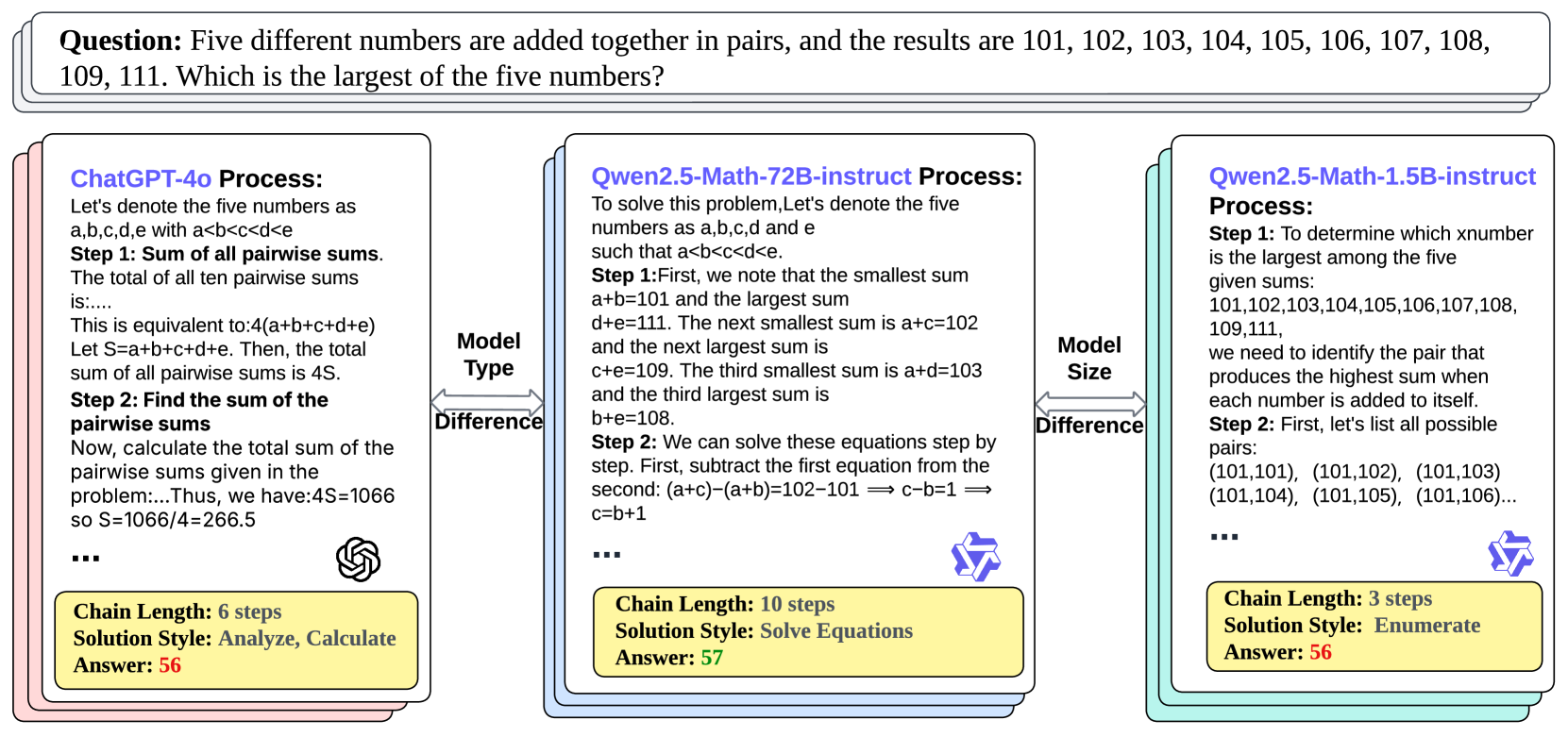
Figure 2: Processes and problem-solving ideas for the same question vary from different models with the perspectives of model types and model sizes. GPT tends to analyze and calculate, while Qwen-72B tends to solve equations. Qwen-1.5B is small and relatively weak. It can only enumerate, and its thinking chain is short, so its answers are also very wrong.
Firstly, Step OOD may occur because of different processes generated by different models. Due to the high cost of manual annotation, there are very few accurately labeled PRM expert datasets, such as PRM800K and ProcessBench, with processes generated by GPT OpenAI (2023) and Qwen Yang et al. (2024b), respectively. However, different model types (e.g., GPT, Qwen, Llama Dubey et al. (2024)) approach problem-solving differently. As is shown in Figure 2, when facing the same question, GPT-4o tends to analyze and calculate, while Qwen-72B tends to solve questions directly. They have different solution styles. Therefore, using process data generated by one model to train a PRM and then applying it to guide another model leads to an OOD issue. Moreover, models of different sizes also exhibit different reasoning processes. Larger models, like exceptional students, tend to have clearer and more accurate reasoning steps, while smaller models tend to have very short reasoning chains, as shown in Figure 2.
Secondly, Question OOD emerges because of dataset shift. Current PRM datasets contain only a limited number of problems. For example, Math Shepherd and PRM800K cover problems from the GSM8K and MATH datasets, with GSM8K being at the elementary to middle school level and MATH at the high school to university level. However, real-world problems are far more diverse, such as those in the Olympic math competition dataset He et al. (2024), leading to OOD issues in other datasets. As shown in the Figure 1, we used Sentence-BERT Reimers (2019) to encode all the problems from the three datasets and visualized the distribution with t-SNE. It is evident that the distributions differ, and since both Olympic and MATH problems are typically from high school-level exams, they are semantically closer to each other than to GSM8K.
To address this issue, we propose a new framework, Retrieval Augmented Process Reward Model (RetrievalPRM), which leverages a Two-stage Retrieval-enhanced Mechanism to help PRMs solve the OOD problem. we retrieve relevant questions and steps in these two stages to address the issues of question OOD and step OOD, respectively. Specifically, when predicting a step for a given question, we select semantically similar questions based on their embeddings, placing them at the beginning of the entire prompt. Additionally, we select more fine-grained, similar steps and use them as references when predicting the correctness of the step. These retrieved questions and steps serve as a kind of warm-up for PRM, acting as example problems for reference. They not only help stimulate PRM’s potential by warming up but also allow the system to handle more difficult problems by identifying similarities, thus alleviating OOD issues.
Our main contributions are summarized as follows:
- To the best of our knowledge, we are the first to highlight the key OOD problems in Process Reward Models (PRMs), particularly the question OOD and step OOD, which arise due to differences in reasoning patterns across model types (e.g., GPT, Qwen), model sizes (1.5B, 72B) and varying problem difficulties in real-world datasets.
- We introduce the Retrieval-Augmented Process Reward Model (RetrievalPRM) framework, which utilizes a Two-stage Retrieval-enhanced Mechanism to address OOD issues by incorporating both Question-level Retrieval and Step-level Retrieval, thereby enhancing PRM’s ability to generalize across diverse problem-solving scenarios.
- We build a Retrieval-enhanced dataset for training PRM using RetrievalPRM framework. We have made our code publicly available. https://anonymous.4open.science/r/RetrievalPRM-1C77 Our dataset https://huggingface.co/datasets/gebro13/RetrievalPRM_ Dataset and model https://huggingface.co/gebro13/RetrievalPRM are open-sourced.
- Extensive experiments on the ProcessBench Zheng et al. (2024) on four public real-world datasets demonstrate that RetrievalPRM outperforms strong baselines and that the Out-of-distribution issue has been alleviated due to our retrieval approach.
2 Preliminary
In this section, we formulate the whole problem and introduce PRM as a binary classification model.
2.1 Problem Formulation
We denote the Math dataset as $\mathcal{D}=\{(q_{i},\mathbf{s}_{i},\mathbf{y}_{i})\}_{i=1}^{N}$ , where $N$ is the number of data instances. The input $q_{i}$ is the $i^{th}$ Math question. $\mathbf{s}_{i}=\{s^{1}_{i},s^{2}_{i},...,s^{n_{i}}_{i}\}$ are the solution steps, where $n_{i}$ is the step number of solution $\mathbf{s}_{i}$ . $\mathbf{y}_{i}=\{y^{1}_{i},y^{2}_{i},...,y^{n_{i}}_{i}\}$ and the label $y^{j}_{i}$ indicates the correctness from the $1^{st}$ step to the $j^{th}$ step.
$$
y^{j}_{i}=\begin{cases}1,~{}(s^{1}_{i},\ldots,s^{j}_{i})~{}\text{is correct %
for}~{}q_{i};\\
0,~{}\text{otherwise.}\end{cases} \tag{1}
$$
2.2 ORM vs. PRM
Outcome-supervised Reward Models are introduced (ORM) by Cobbe et al. (2021), where verifiers are trained for judging the final correctness of generated solutions. ORM only predicts the final label $\hat{y}^{n_{i}}_{i}$ , which can be formulated as
$$
\forall{i},\hat{y}^{n_{i}}_{i}=\text{ORM}(q_{i},s^{1}_{i},\ldots,s^{n_{i}}_{i}). \tag{2}
$$
Building on this, the concept of process reward models (PRM) is introduced as a more granular and transparent approach. Not only does PRM evaluate the final solutions but it also assesses intermediate processes, where $\hat{y}^{j}_{i}$ represents the predicted label for the $j^{th}$ step by PRM.
$$
\forall{i,j},\hat{y}^{j}_{i}=\text{PRM}(q_{i},s^{1}_{i},\ldots,s^{j}_{i}). \tag{3}
$$
2.3 Large Language Model for PRM scoring
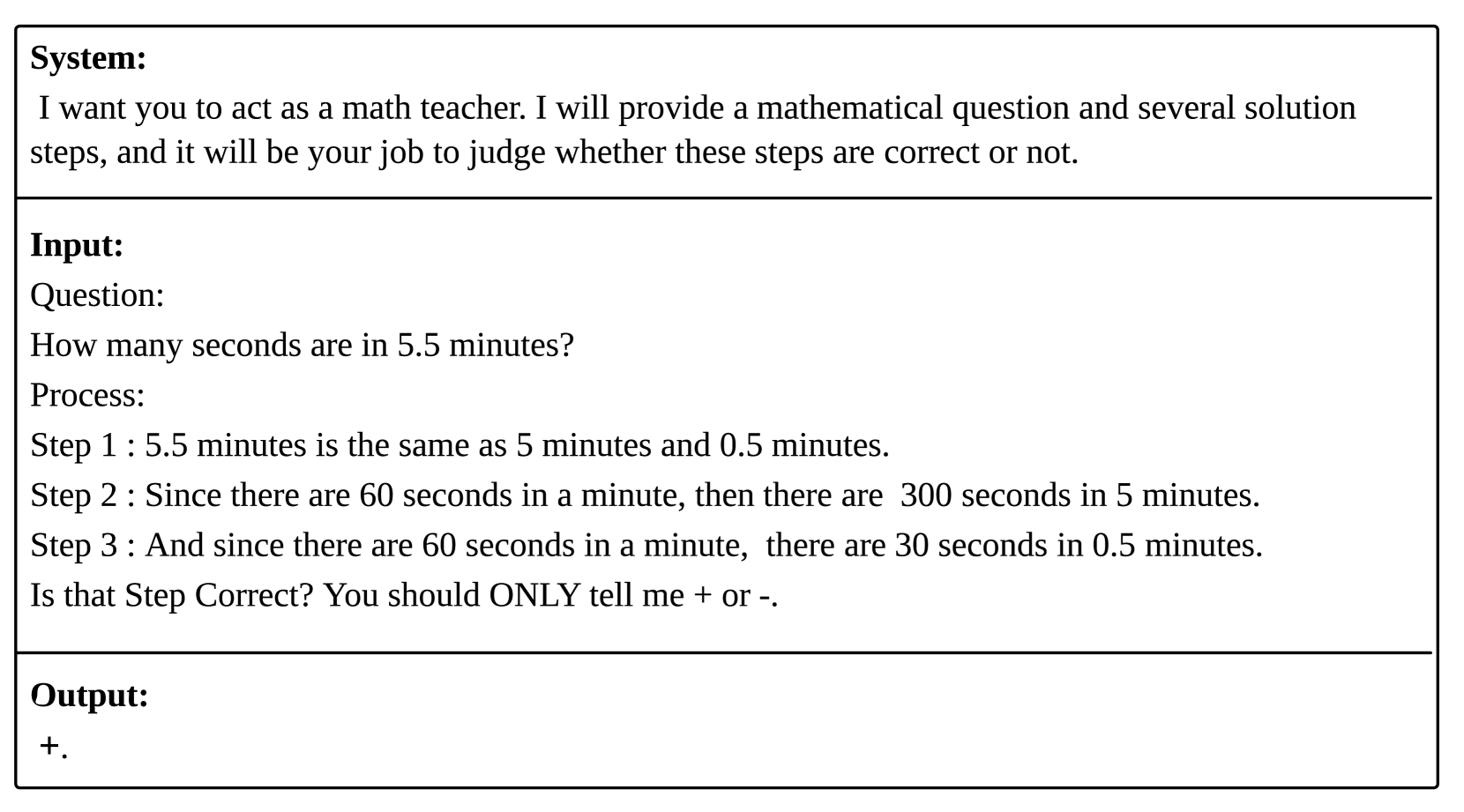
When directly adopting LLMs as the PRM for scoring, we need to convert the data $(q_{i},\mathbf{s}_{i},\mathbf{y}_{i})$ with a hard prompt template. The whole template example is illustrated in Appendix B.2.
The textual input consists of the question $q_{i}$ and steps $\mathbf{s}_{i}$ , followed by a binary question about the correctness of these steps.
To obtain the floating-point correctness estimation $\hat{y}_{i}^{j}∈[0,1]$ instead of discrete word tokens ’+’ or ’-’, we apply bidimensional softmax over the corresponding logits of the binary key answer tokens (ie., + & -) from LLMs to accomplish the correctness estimation during evaluation:
$$
\hat{y}_{i}^{j}=\frac{\exp(l_{i,\text{+}})}{\exp(l_{i,\text{+}})+\exp(l_{i,%
\text{-}})}\in(0,1). \tag{4}
$$
where $l_{i,\text{+}}$ and $l_{i,\text{-}}$ are the logits of token + and - in the $i^{th}$ instance, respectively.
It is important to note that the estimated PRM scoring $\hat{y}_{i}^{j}$ is used solely for evaluation on the testing set. If training is involved, we maintain the standard instruction tuning and causal language modeling paradigm for LLMs. In this way, we don’t need to replace the language model head with binary classification head which is the last layer of LLM.
3 Methodology
In this section, we introduce our proposed RetrievalPRM framework in detail.
<details>
<summary>x3.png Details</summary>
### Visual Description
## Flowchart: Comparison of PRM Frameworks
### Overview
The image presents a comparative diagram of three different Problem Reasoning and Manipulation (PRM) frameworks: Traditional PRM, Two-stage Retrieval-enhanced Mechanism, and Retrieval PRM Framework. Each framework is illustrated as a flowchart, outlining the process from the initial prompt to the final evaluation.
### Components/Axes
**1. Traditional PRM (Left Panel):**
* **Title:** Traditional PRM
* **System Prompt:** "I want you to act as a math teacher. I will provide a mathematical question and several solution steps, and it will be your job to judge whether these steps are correct or not."
* **Target Question:** "How many seconds are in 5.5 minutes?"
* **Solution Steps:**
* Step 1: "5.5 minutes is the same as 5 minutes and 0.5 minutes."
* Step 2: "Since there are 60 seconds in a minute, then there are 300 seconds in 5 minutes."
* Step 3: "And since there are 60 seconds in a minute, there are 50 seconds in 0.5 minutes."
* **Target Step:** "Is that step correct?"
* **Decision Outcomes:**
* Yes: 0.9 (associated with a sad face emoji)
* No: 0.1
**2. Two-stage Retrieval-enhanced Mechanism (Middle Panel):**
* **Title:** Two-stage Retrieval-enhanced Mechanism
* **Target Question:** Labeled as "Q" in red.
* **Question Pool:** Represented by a database icon, followed by a series of document icons.
* **Target Step:** Labeled as "S" in red.
* **New Step Pool:** Represented by a database icon.
* **Reference Question 1:**
* "What is the equivalent number of seconds in 7.8 minutes?"
* Process: "Since there are 60 seconds in a minute, we can find the number of seconds by multiplying the number of minutes by 60. (+) So, 7.8 minutes is equal to 7.8 * 60 = 46 seconds. The answer is: 46 (-)"
* **Reference Question 2:**
* Process: "..."
* **Reference Step 1:**
* "0.3 hours equal to 0.3 * 60 = 18 minutes. This reference step is correct."
* **Reference Step 2:** "..."
**3. Retrieval PRM Framework (Right Panel):**
* **Title:** Retrieval PRM Framework
* **System Prompt:** "I want you to act as a math teacher. I will... judge whether these steps are correct or not. First I will give you some similar questions and their steps for reference. For each step, if the step is correct, the step is labeled as +. If the step is wrong, the step is labeled as -. If there is no relevant or helpful information in the provided questions and steps, try to answer yourself."
* **Reference Question 1:**
* Step 1: "5.5 minutes is the same as 5 minutes and 0.5 minutes."
* Step 2: "Since there are 60 seconds in a minute, then there are 300 seconds in 5 minutes."
* **Reference Question 2:**
* **Target Question:** "How many seconds are in 5.5 minutes?"
* Step 3: "And since there are 60 seconds in a minute, there are 50 seconds in 0.5 minutes."
* **Additional Text:** "I will give you some steps for reference"
* **Reference Step 2**
* **Reference Step 1**
* **Target Step:** "Is the target step correct?"
* **Decision Outcomes:**
* Yes: 0.2 (associated with a happy face emoji)
* No: 0.8
### Detailed Analysis
**Traditional PRM:**
* The system is given a direct question and a series of solution steps.
* The system must evaluate the correctness of the provided steps.
* The output suggests a high confidence (0.9) that the steps are incorrect, indicated by the sad face emoji.
**Two-stage Retrieval-enhanced Mechanism:**
* This framework involves retrieving relevant information from a question pool and a step pool.
* Reference questions and steps are used to aid in the problem-solving process.
* Reference Question 1 contains an arithmetic error: 7.8 * 60 = 468, not 46.
* The reference step is correct.
**Retrieval PRM Framework:**
* This framework also uses reference questions and steps.
* The system is provided with a target question and must determine the correctness of the steps.
* The output suggests a higher confidence (0.8) that the steps are incorrect, indicated by the happy face emoji.
### Key Observations
* The Traditional PRM and Retrieval PRM Frameworks both involve evaluating the correctness of solution steps.
* The Two-stage Retrieval-enhanced Mechanism incorporates a retrieval process to gather relevant information.
* There is an arithmetic error in Reference Question 1 within the Two-stage Retrieval-enhanced Mechanism.
* The confidence levels in the "Yes/No" decisions differ between the Traditional PRM and Retrieval PRM Frameworks.
### Interpretation
The diagram illustrates different approaches to problem-solving using PRM frameworks. The Traditional PRM relies on direct evaluation, while the Retrieval-enhanced mechanisms incorporate information retrieval to aid in the process. The arithmetic error in the Two-stage Retrieval-enhanced Mechanism highlights the importance of verifying the accuracy of retrieved information. The differing confidence levels in the final decisions suggest that the frameworks may have varying levels of effectiveness or biases. The use of emojis to represent the "Yes/No" outcomes adds a layer of emotional context to the decision-making process.
</details>
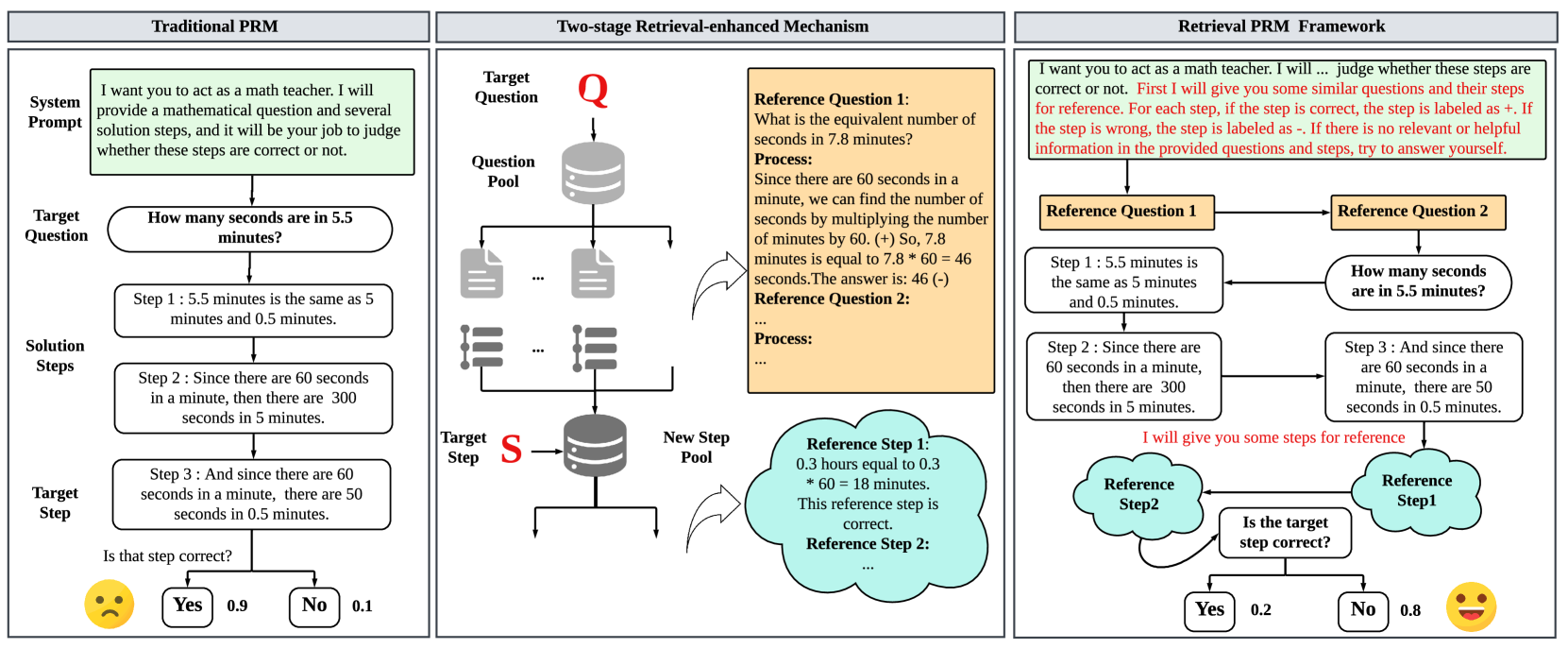
Figure 3: The model structure of our proposed RetrievalPRM framework and its difference with traditional PRM. We design a Two-stage Retrieval Module to retrieve reference questions and steps in each stage.
3.1 Overview of RetrievalPRM
The RetrievalPRM is developed to address the problem of out-of-distribution (OOD) scenarios in mathematical problem-solving, specifically focusing on both question OOD and step OOD. According to Figure 3, traditional PRM models are constrained by predefined solution steps and are unable to handle unseen questions or steps effectively, especially when the problem context shifts or the solution process deviates from previously seen examples. RetrievalPRM overcomes this challenge by incorporating a Two-stage Retrieval-enhanced Mechanism that dynamically fetches relevant questions and steps from a large pool of questions and their solutions. These retrieved questions and steps serve as a kind of warm-up for PRM, acting as example problems for reference. They not only help stimulate PRM’s potential by warming up but also allow the system to handle more difficult problems by identifying similarities.
3.2 Two-stage Retrieval-enhanced Mechanism
The core of RetrievalPRM is the Two-stage Retrieval-enhanced Mechanism, which consists of two key phases: Question-level Retrieval and Step-level Retrieval.
3.2.1 Question-level Retrieval
The first stage of retrieval tackles the question OOD issue. As is shown in Figure 3, the retrieval pool is the question database $\mathbb{D}_{q}=\{q_{i}\}_{i=1}^{N}$ . During retrieval process, we treat:
- Query: the target question $q_{t}$ .
- Key: all $q_{i}$ in the retrieval pool.
- Value: all the $(q_{i},\mathbf{s}_{i})$ pair in the retrieval pool.
We calculate their similarities $<q_{i},q_{t}>$ to match the most similar n questions. Specifically, all questions will first pass through a Sentence-BERT model to encode questions and obtain their semantic representations.
$$
\{e_{q_{i}}\}_{i=1}^{N}=\text{SentenceBERT}(\{q_{i}\}_{i=1}^{N}) \tag{5}
$$
where $e_{q_{i}}∈\mathbb{R}^{D}$ is the embedding vector of the question $q_{i}$ .
And then all the embeddings undergo Principle Component Analysis (PCA) Kurita (2021) for dimensionality reduction to extract the most important dimensions.
$$
\{e^{\prime}_{q_{i}}\}_{i=1}^{N}=\text{PCA}(\{e_{q_{i}}\}_{i=1}^{N}) \tag{6}
$$
where $e^{\prime}_{q_{i}}∈\mathbb{R}^{d}$ is the embedding after dimension reduction.
Finally, we compute the cosine similarity between the target question and the entire question pool, selecting the top- k most similar questions and inputting them into the text.
$$
\displaystyle\langle q_{i},q_{t}\rangle \displaystyle=\frac{e^{\prime}_{q_{t}}\cdot e^{\prime}_{q_{i}}}{|e^{\prime}_{q%
_{t}}|\cdot|e^{\prime}_{q_{i}}|}. \tag{7}
$$
Now we sort the vector $\{\langle q_{i},q_{t}\rangle\}_{i=1}^{N}$ of similarity and choose top- k $(q_{i},\mathbf{s}_{i})$ pairs as reference questions $q_{r}$ and put them in RetrievalPRM’s input together with the target question. Furthermore, we store all the solutions $\{\mathbf{s}_{i}\}_{i=1}^{m}$ of top- m ( $m>k$ ) questions in a new database to conduct a further step-level retrieval.
3.2.2 Step-level Retrieval
We place step-level retrieval in the second stage of the two-stage retrieval process, rather than as a separate module, for two key reasons:
Firstly, for a solution to be meaningful, both the question and the steps must be similar. For example, two different types of questions might both use the letter "p" to represent an unknown variable, but in some problems, "p" represents a prime number, while in others, it represents probability. This results in steps that may appear similar but have entirely different meanings, rendering the retrieved steps potentially unhelpful.
Secondly, since there are many possible solutions to a question, this leads to a large number of steps. If the majority of these steps are irrelevant, the time spent calculating similarities becomes inefficient. By placing step-level retrieval in the second stage, we can save both time and computational resources.
Therefore, after retrieving the top- m most similar questions, we inject all their solutions into a new steps database $\mathbb{D}_{s}$ . Then, we use the target step as the query to retrieve reference steps from this new database. The similarity for retrieval is still calculated using Sentence-BERT, PCA, and cosine similarity, as mentioned in 3.2.1.
3.3 Retrieval-based System Prompt
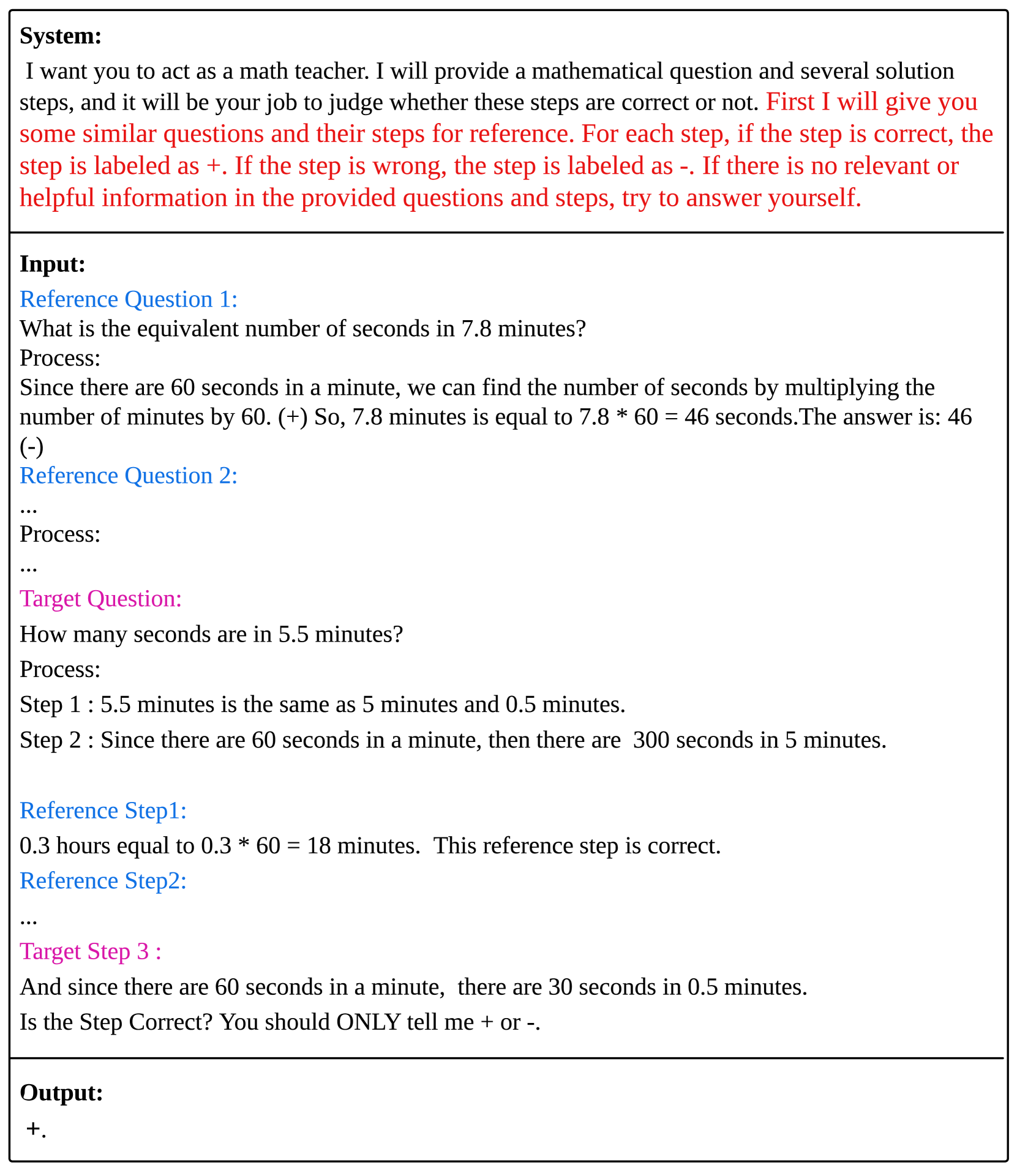
In RetrievalPRM, The system prompt serves as the instruction set for the model, framing the problem and directing it to evaluate each step of the solution. Besides the traditional system prompt for PRM, the Retrieval-based System Prompt (RetSP) is extended with additional instructions, as shown in the red sentence in Figure 3, which encourages the model to leverage knowledge from reference questions. For example, we inform PRM that step labels "+" and "-" represent correct and incorrect steps, respectively. At the same time, to avoid noise, we specify that if the reference question or step contains no relevant or helpful information, it should not be considered. These retrieval-based system prompts give PRM a more flexible thinking process, enabling it to actively decide whether to use retrieval-based knowledge.
We define reference questions of $q_{i}$ as $\mathbf{q}_{i}^{r}$ and reference steps as $\mathbf{s}_{i}^{r}$ . The whole input $\mathbf{x}_{i}^{j}$ of predicting the $j_{th}$ step of $q_{i}$ in RetrievalPRM can be formulated as:
$$
\displaystyle\mathbf{x}^{j}_{i}=(RetSP,\mathbf{q}^{r}_{i}, \displaystyle q_{i},s^{1}_{i},\ldots,s^{j-1}_{i},\mathbf{s}^{r}_{i},s^{j}_{i},%
y^{j}_{i}), \displaystyle\hat{y}^{j}_{i}= \displaystyle\text{PRM}(\mathbf{x}^{j}_{i}) \tag{8}
$$
where $s^{j}_{i}$ is the $j_{th}$ step of solution $\mathbf{s}_{i}$ .
According to the input template above, it is worth noting that when predicting step n, we assume that steps 1 through n-1 are correct Luo et al. (2024); Zheng et al. (2024). At this point, the most important task for PRM is to predict step n, so PRM can only access the reference steps for step n and cannot see the reference steps for steps $1\sim n-1$ .
4 Experiments
Table 1: The performance of different models on ProcessBench. The best result is given in bold, and the second-best value is underlined. See Table 3 in Appendix D for breakdown of evaluation results.
| Model | GSM8k | MATH | OlympiadBench | OmniMATH | Avg.F1 | | | | | |
| --- | --- | --- | --- | --- | --- | --- | --- | --- | --- | --- |
| ArithACC | F1 | ArithACC | F1 | ArithACC | F1 | ArithACC | F1 | | | |
| Open-source PRM | RetrievalPRM-7B(Ours) | 76.0 | 74.6 | 70.6 | 71.1 | 59.1 | 60.2 | 55.2 | 57.33 | 65.8 |
| Qwen2.5-Math-7B-PRM800K | 73.5 | 68.2 | 65.1 | 62.6 | 53.2 | 50.7 | 43.4 | 44.3 | 56.5 | |
| Skywork-PRM-7B | 71.6 | 70.8 | 54.5 | 53.6 | 25.6 | 22.9 | 23.7 | 21.0 | 42.1 | |
| Skywork-PRM-1.5B | 59.9 | 59.0 | 49.1 | 48.0 | 20.5 | 19.3 | 19.7 | 19.2 | 36.4 | |
| Math-Shepherd-PRM-7B | 58.3 | 47.9 | 45.1 | 29.5 | 39.7 | 24.8 | 34.8 | 23.8 | 31.5 | |
| RLHFlow-PRM-Mistral-8B | 62.3 | 50.4 | 42.1 | 33.4 | 22.3 | 13.8 | 19.1 | 15.8 | 28.4 | |
| RLHFlow-PRM-Deepseek-8B | 56.9 | 38.8 | 45.1 | 33.8 | 26.5 | 16.9 | 23.2 | 16.9 | 26.6 | |
| Language Models as Critic | QwQ-32B-Preview | 87.9 | 88.0 | 78.5 | 78.7 | 59.2 | 57.8 | 61.1 | 61.3 | 71.5 |
| GPT-4o | 80.2 | 79.2 | 63.4 | 63.6 | 50.1 | 51.4 | 50.1 | 53.5 | 61.9 | |
| Qwen2.5-72B-Instruct | 77.9 | 76.2 | 65.4 | 61.8 | 59.8 | 54.6 | 55.1 | 52.2 | 61.2 | |
| Llama-3.3-70B-Instruct | 83.7 | 82.9 | 63.7 | 59.4 | 54.3 | 46.7 | 51.0 | 43.0 | 58.0 | |
| Qwen2.5-Coder-32B-Instruct | 72.0 | 68.9 | 64.5 | 60.1 | 57.0 | 48.9 | 52.5 | 46.3 | 56.1 | |
| Llama-3.1-70B-Instruct | 75.3 | 74.9 | 52.6 | 48.2 | 50.0 | 46.7 | 43.2 | 41.0 | 52.7 | |
| Qwen2.5-14B-Instruct | 72.3 | 69.3 | 59.2 | 53.3 | 50.2 | 45.0 | 43.5 | 41.3 | 52.2 | |
| Qwen2-72B-Instruct | 67.8 | 67.6 | 52.3 | 49.2 | 43.3 | 42.1 | 39.3 | 40.2 | 49.8 | |
| Qwen2.5-32B-Instruct | 70.6 | 65.6 | 61.9 | 53.1 | 53.5 | 40.0 | 47.7 | 38.3 | 49.3 | |
| Qwen2.5-Math-72B-Instruct | 70.3 | 65.8 | 59.6 | 52.1 | 56.1 | 32.5 | 55.1 | 31.7 | 45.5 | |
| Qwen2.5-Coder-14B-Instruct | 61.9 | 50.1 | 54.2 | 39.9 | 51.4 | 34.0 | 55.6 | 27.3 | 37.8 | |
| Qwen2.5-7B-Instruct | 37.8 | 36.5 | 36.9 | 36.6 | 29.9 | 29.7 | 27.3 | 27.4 | 32.6 | |
| Meta-Llama-3-70B-Instruct | 62.4 | 52.2 | 48.3 | 22.8 | 46.2 | 21.2 | 44.8 | 20.0 | 29.1 | |
| Qwen2.5-Math-7B-Instruct | 54.4 | 26.8 | 50.3 | 25.7 | 43.1 | 14.2 | 41.6 | 12.7 | 19.9 | |
| Qwen2-7B-Instruct | 25.1 | 8.4 | 20.4 | 19.0 | 16.1 | 14.7 | 13.8 | 12.1 | 13.6 | |
| Meta-Llama-3-8B-Instruct | 27.1 | 13.1 | 17.3 | 13.8 | 14.2 | 4.8 | 19.7 | 12.6 | 11.1 | |
| Qwen2.5-Coder-7B-Instruct | 49.1 | 14.3 | 46.3 | 6.5 | 47.2 | 4.1 | 48.9 | 1.8 | 6.7 | |
| Llama-3.1-8B-Instruct | 27.3 | 10.9 | 20.5 | 5.1 | 16.0 | 2.8 | 15.0 | 1.6 | 5.1 | |
Table 2: The performance of different variants of RetrievalPRM on ProcessBench. We remove different components of RetrievalPRM to evaluate the contribution of each part to the model. The best result is given in bold, and the second-best value is underlined. See Table 4 in Appendix D for breakdown of evaluation results.
| Retrieval Components | GSM8k | MATH | OlympiadBench | OmniMATH | Avg.F1 | | | | | |
| --- | --- | --- | --- | --- | --- | --- | --- | --- | --- | --- |
| Question-level | Step-level | ArithACC | F1 | ArithACC | F1 | ArithACC | F1 | ArithACC | F1 | |
| ✓ | ✓ | 76.0 | 74.6 | 70.6 | 71.1 | 59.1 | 60.2 | 55.2 | 57.3 | 65.8 |
| ✓ | $×$ | 77.8 | 74.9 | 70.7 | 71.2 | 58.4 | 59.8 | 50.5 | 54.4 | 65.0 |
| $×$ | ✓ | 73.8 | 67.5 | 69.5 | 69.2 | 58.2 | 58.9 | 52.2 | 56.3 | 63.0 |
| $×$ | $×$ | 71.0 | 65.6 | 67.3 | 67.5 | 54.3 | 55.8 | 47.2 | 50.9 | 59.9 |
<details>
<summary>x4.png Details</summary>
### Visual Description
## Bar Chart: F1 Score vs. Number of Retrieval Questions
### Overview
The image is a bar chart comparing the F1 scores of different datasets (GSM8k, MATH, OlympiadBench, and OmniMATH) across varying numbers of retrieval questions (Top-0, Top-1, Top-2, and Top-3). The chart also includes a line graph representing the average F1 score across all datasets for each number of retrieval questions.
### Components/Axes
* **Title (X-axis):** Number of Retrieval Questions
* Categories: Top-0, Top-1, Top-2, Top-3
* **Title (Y-axis):** F1 Score
* Scale: 50 to 80, incrementing by 5
* **Legend (Top-Left):**
* GSM8k (Light Gray)
* MATH (Light Blue)
* OlympiadBench (Dark Green)
* OmniMATH (Light Orange)
* Average F1 (Black Dashed Line with Circle Markers)
### Detailed Analysis
**GSM8k (Light Gray Bars):**
* Top-0: 65.60
* Top-1: 70.50
* Top-2: 74.90
* Top-3: 72.30
* Trend: Generally increasing from Top-0 to Top-2, then slightly decreasing at Top-3.
**MATH (Light Blue Bars):**
* Top-0: 67.50
* Top-1: 72.60
* Top-2: 71.20
* Top-3: 71.60
* Trend: Increasing from Top-0 to Top-1, then slightly decreasing at Top-2, and slightly increasing at Top-3.
**OlympiadBench (Dark Green Bars):**
* Top-0: 55.80
* Top-1: 60.80
* Top-2: 59.80
* Top-3: 57.30
* Trend: Increasing from Top-0 to Top-1, then decreasing at Top-2 and Top-3.
**OmniMATH (Light Orange Bars):**
* Top-0: 50.90
* Top-1: 56.90
* Top-2: 54.40
* Top-3: 56.70
* Trend: Increasing from Top-0 to Top-1, then decreasing at Top-2, and slightly increasing at Top-3.
**Average F1 (Black Dashed Line with Circle Markers):**
* Top-0: 60
* Top-1: 65.5
* Top-2: 65.2
* Top-3: 64.5
* Trend: Increasing from Top-0 to Top-1, then slightly decreasing at Top-2 and Top-3.
### Key Observations
* MATH and GSM8k generally outperform OlympiadBench and OmniMATH across all retrieval question numbers.
* The average F1 score peaks at Top-1 and then gradually declines.
* The F1 scores for all datasets tend to converge as the number of retrieval questions increases (Top-3).
### Interpretation
The chart suggests that increasing the number of retrieval questions initially improves the F1 score, but beyond a certain point (around Top-1), the performance plateaus or even declines slightly. This could indicate that while retrieving more information can be helpful, the quality and relevance of the retrieved information become more critical as the number of retrieval questions increases. The higher F1 scores for MATH and GSM8k might reflect the nature of these datasets, possibly indicating they are more amenable to retrieval-based question answering compared to OlympiadBench and OmniMATH. The convergence of F1 scores at Top-3 could imply that the benefits of additional retrieval questions diminish as the retrieval process becomes saturated.
</details>
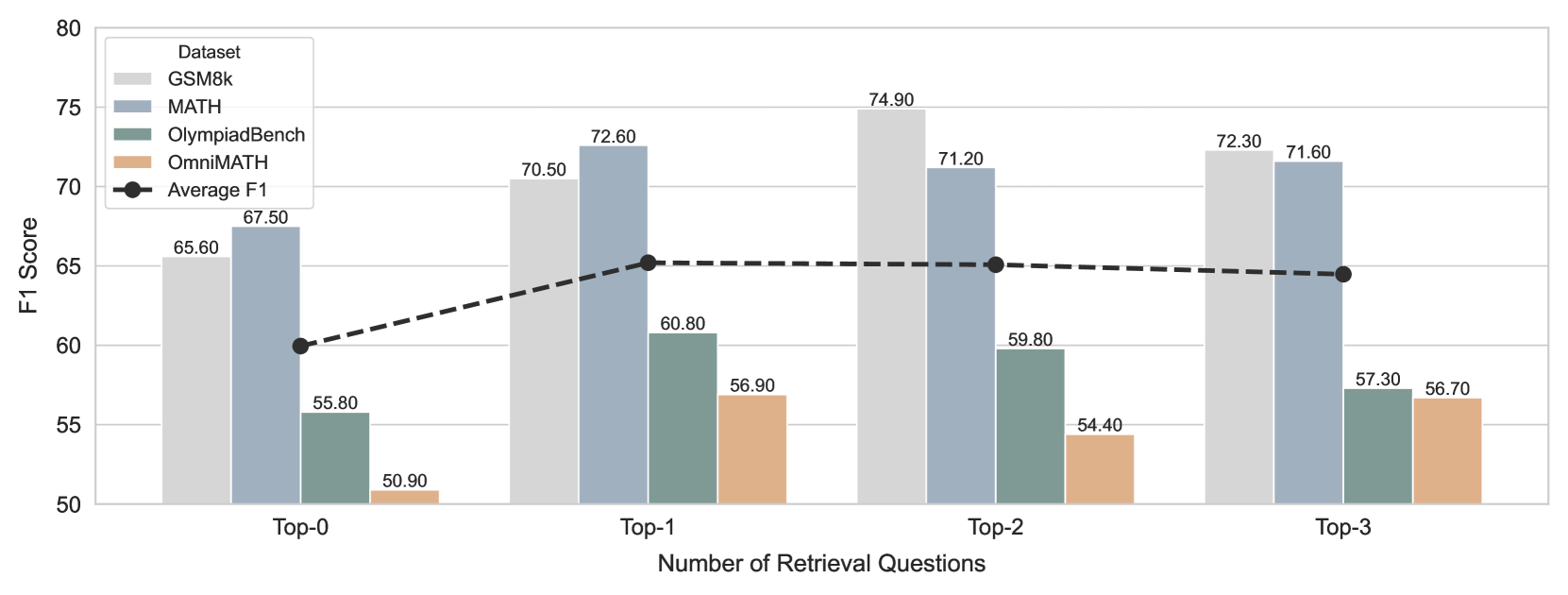
Figure 4: We show the F1 scores of Retrieval-PRM on four datasets and their average, as the number of retrieval questions varies. Specifically, Top-0 means no retrieval questions.
In this section, we present the experimental settings and results. Our implementation code of RetrievalPRM is publicly available.
4.1 Experiment Setup
4.1.1 Datasets
Datasets are categorized into two kinds: Math reasoning datasets, and prm training datasets.
Math Reasoning Datasets
We conduct experiments on four public and widely used datasets in mathematical reasoning tasks: GSM8K Cobbe et al. (2021) which contains math problems from elementary to middle school, MATH Hendrycks et al. (2021) which contains math problems from basic to university level, OlympiadBench He et al. (2024) which involves questions from the Mathematical Olympiad, Omni-MATH Gao et al. (2024b) which covers multi-domain high-difficulty problems. Further details are provided in Appendix C.
Except for GSM8K, which focuses on grade school math problems, the other three datasets feature problems of competition or Olympiad-level difficulty.
PRM training datasets
We conduct experiments on two publicly available datasets for PRM:
PRM800K Lightman et al. (2023): Based on the MATH dataset, it contains 800,000 manually annotated step-level correctness labels for training the Process Reward Model. It relies on expensive manual annotations.
Math-Shepherd Wang et al. (2024b): It generates 400,000 machine-annotated step-level labels (covering MATH and GSM8K datasets) by automatically building process supervision data, without manual annotation.
4.1.2 Evaluation Metrics
We evaluate our model in a public PRM benchmark ProcessBench Zheng et al. (2024). The aim is to judge whether PRM can find the first wrong step. It divides data into two parts: samples with incorrect and correct final answers and then conducts harmonic mean on the accuracy of these two parts to get the final F1-score. Moreover, we think since the sample number of each part isn’t balanced, We add an additional metric: weighted arithmetic mean of these two parts, which is shown in Table 1 as ArithACC.
4.1.3 Baselines
Following Zheng et al. (2024), we divide all baselines into two parts:
(1) Open-source PRM, including Skywork o1 Team (2024), Qwen2.5-PRM Zheng et al. (2024), Math-Shepherd Wang et al. (2024b) and RLHFlow Xiong et al. (2024). These models are binary classification PRMs.
(2) Language Models as Critic, including Llama Dubey et al. (2024), Qwen2 Yang et al. (2024b), Qwen2.5 Team (2024), Qwen2.5-MATH Yang et al. (2024a), Qwen2.5-Coder Hui et al. (2024), GPT-4o OpenAI et al. (2024). These models are promoted to judge the steps with the help of majority voting.
Further details of these baselines are provided in Appendix A due to article length limitations.
4.1.4 Implementation Details
Details like base models, hyperparameters, prompts, and training sizes are provided in Appendix B due to the article length limitations.
4.2 Overall Performance
We evaluate RetrievalPRM against existing baselines on ProcessBench, and the results are presented in Table 1. The findings are as follows:
- RetrievalPRM-7B surpasses all open-source PRM baselines, achieving the highest performance. Notably, the most significant improvement is observed on OmniMATH, the most challenging dataset, with performance gains increasing as dataset difficulty rises. This phenomenon may stem from the fact that most baseline PRMs are trained on human- or machine-annotated datasets such as PRM800K or Math-Shepherd, which primarily focus on GSM8K or MATH and exhibit OOD issues when applied to more complex datasets. In contrast, our RetrievalPRM effectively mitigates the OOD problem through its retrieval-based approach, demonstrating the efficacy of our Two-stage Retrieval-enhanced Mechanism.
- When comparing models of different scales, RetrievalPRM outperforms all evaluated language models, including Qwen2.5-72B-Instruct and Llama3.3-70B-Instruct, with the sole exception of QwQ-32B-Preview. Remarkably, RetrievalPRM achieves this with a model size of just 7B. This highlights that PRMs, being both lightweight and task-specific, maintain strong competitiveness and potential compared to LLMs as critics.
4.3 Ablation Study
We analyze two main components in the Two-stage Retrieval-enhanced Mechanism: Question-level Retrieval and Step-level Retrieval —through the following ablations:
RetrievalPRM (Ours): The complete version of our proposed method.
RetrievalPRM (w/o Step-level Retrieval): This variant retains only the Question-level Retrieval, removing Step-level Retrieval during both training and inference.
RetrievalPRM (w/o Question-level Retrieval): This variant retains only the Step-level Retrieval, removing Question-level Retrieval during both training and inference.
RetrievalPRM (w/o Question-level and Step-level Retrieval): In this variant, both Question-level and Step-level Retrieval are removed during training and inference.
The performance of these variants is presented in Table 2, from which we can draw the following observations:
- The performance of RetrievalPRM (w/o Step-level Retrieval) remains almost identical to that of RetrievalPRM on GSM8K and MATH but exhibits a slight decline on OlympiadBench and OmniMATH. This can be attributed to the fact that Step-level Retrieval information is partially absorbed by Question-level Retrieval. As a result, Question-level Retrieval alone may be sufficiently effective for relatively easy datasets, as the reference steps it provides contain adequate knowledge for step prediction. However, for more challenging datasets, Step-level Retrieval becomes significantly more crucial, as it offers finer-grained guidance essential for handling complex problem-solving processes.
- RetrievalPRM (w/o Question-level Retrieval) shows lower performance, as it relies solely on Step-level Retrieval. The model lacks knowledge of reference questions, which is useful to alleviate question OOD, restricting its overall performance.
- RetrievalPRM (w/o both Retrieval) performs the worst, which is expected, demonstrating the effectiveness of both question-level and Step-level Retrieval.
4.4 Hyperparameter Study
Figure 4 illustrates the impact of the number of retrieval questions on the model’s performance. The findings are as follows:
Compared to Top-0, where no retrieval questions are used, models that incorporate retrieval questions show improved performance, highlighting the importance of Question-level Retrieval. It inspires us that Reference questions are important for PRM to get warmup, no matter how many reference questions there are.
The performance of Top-3 exhibits a slight decline, potentially due to two factors: (1) An excessive number of reference questions may lead to an overly long input prompt, making it difficult for PRMs to comprehend or extract key information effectively. (2) A limited retrieval pool might result in later reference questions being less relevant than earlier ones, increasing the likelihood of misjudgments in the model’s predictions.
5 Related Works
5.1 Process Reward Models
Process reward models (PRMs) have demonstrated significant advantages over traditional outcome reward models (ORMs) Cobbe et al. (2021) in enhancing process-level reasoning accuracy and improving long-process reasoning abilities in model training Lightman et al. (2023); Uesato et al. (2022). A growing number of PRMs have been proposed for application in process-level reinforcement learning with human feedback (RLHF) Wang et al. (2024b); Qin et al. (2024); Xia et al. (2025); o1 Team (2024). For instance, Lightman et al. (2023) made a substantial contribution by releasing a large set of human-annotated data at the process level, opening up new research opportunities for multi-step reasoning.
Additionally, Wang et al. (2024b) introduces an automatic, self-supervised pipeline for generating process-level labels and training PRMs, enabling efficient data generation. Xia et al. (2025) employs PRMs as automatic evaluators to assess the accuracy of multi-step reasoning in language models (LMs). With the surge in PRM-focused research and data curation, numerous PRMs o1 Team (2024); Xiong et al. (2024); Sun et al. (2024); Gao et al. (2024a); Wang et al. (2024a) have been proposed. Additionally, several studies focus on leveraging natural language feedback from large language models (LLMs) as rewards, which are termed critic models McAleese et al. (2024); Zhang et al. (2024); Gao et al. (2024a).
However, most existing PRMs trained on math datasets such as GSM8K and MATH inevitably encounter Out-of-distribution issues, which can be divided into two categories: question OOD, where PRMs trained on simpler or medium-difficulty datasets lack understanding of questions from more challenging datasets, and step OOD, where different base models and model sizes in LLMs lead to different step distributions for the same question. This is reflected in differences in chain length, problem-solving approaches, and methods. To address these issues, we propose the RetrievalPRM framework to tackle the OOD problems encountered in the current PRM field, achieving promising results.
5.2 Retrieval-Augmented Generation
Retrieval-augmented generation (RAG) enhances language models by dynamically integrating external knowledge, pioneered by Lewis et al. (2021) through their joint retrieval-generation architecture. Subsequent advances refined this paradigm. Guu et al. (2020) introduced REALM to co-train retrieval and generation modules via masked language modeling, while Izacard and Grave (2021) proposed Fusion-in-Decoder (FiD) to process multi-document contexts efficiently. Research further optimized retrieval precision through dense passage embeddings Karpukhin et al. (2020) and scaled retrieval to web-level corpora Borgeaud et al. (2022).
6 Conclusion
In this paper, we have addressed the significant out-of-distribution (OOD) challenges faced by Process Reward Models (PRMs), particularly step OOD and question OOD. By introducing the Retrieval Augmented Process Reward Model (RetrievalPRM), we propose an effective solution that leverages a Two-stage Retrieval-enhanced Mechanism to improve the generalization of PRMs across diverse models and problems. Extensive experiments on multiple real-world datasets have shown that RetrievalPRM consistently outperforms existing methods, highlighting its effectiveness in tackling OOD issues.
7 Limitation
RetrievalPRM has two main limitations. Firstly, the retrieval pool is only constructed from PRM800K and Math-Shepherd at present, which is relatively small and limits the diversity and breadth of the mathematical problems. Second, using Sentence-BERT to embed questions and steps struggles to capture the full complexity of mathematical problems as semantic similarity doesn’t mean knowledge similarity in Math problems. As a result, the naive cosine similarity calculated through embeddings may fail to accurately reflect the true similarity between two questions.
References
- Borgeaud et al. (2022) Sebastian Borgeaud, Arthur Mensch, Jordan Hoffmann, Trevor Cai, Eliza Rutherford, Katie Millican, George van den Driessche, Jean-Baptiste Lespiau, Bogdan Damoc, Aidan Clark, Diego de Las Casas, Aurelia Guy, Jacob Menick, Roman Ring, Tom Hennigan, Saffron Huang, Loren Maggiore, Chris Jones, Albin Cassirer, Andy Brock, Michela Paganini, Geoffrey Irving, Oriol Vinyals, Simon Osindero, Karen Simonyan, Jack W. Rae, Erich Elsen, and Laurent Sifre. 2022. Improving language models by retrieving from trillions of tokens. Preprint, arXiv:2112.04426.
- Cobbe et al. (2021) Karl Cobbe, Vineet Kosaraju, Mohammad Bavarian, Mark Chen, Heewoo Jun, Lukasz Kaiser, Matthias Plappert, Jerry Tworek, Jacob Hilton, Reiichiro Nakano, Christopher Hesse, and John Schulman. 2021. Training verifiers to solve math word problems. CoRR, abs/2110.14168.
- Dubey et al. (2024) Abhimanyu Dubey, Abhinav Jauhri, Abhinav Pandey, Abhishek Kadian, Ahmad Al-Dahle, Aiesha Letman, Akhil Mathur, Alan Schelten, Amy Yang, Angela Fan, et al. 2024. The llama 3 herd of models. arXiv preprint arXiv:2407.21783.
- Gao et al. (2024a) Bofei Gao, Zefan Cai, Runxin Xu, Peiyi Wang, Ce Zheng, Runji Lin, Keming Lu, Dayiheng Liu, Chang Zhou, Wen Xiao, Junjie Hu, Tianyu Liu, and Baobao Chang. 2024a. Llm critics help catch bugs in mathematics: Towards a better mathematical verifier with natural language feedback. Preprint, arXiv:2406.14024.
- Gao et al. (2024b) Bofei Gao, Feifan Song, Zhe Yang, Zefan Cai, Yibo Miao, Qingxiu Dong, Lei Li, Chenghao Ma, Liang Chen, Runxin Xu, Zhengyang Tang, Benyou Wang, Daoguang Zan, Shanghaoran Quan, Ge Zhang, Lei Sha, Yichang Zhang, Xuancheng Ren, Tianyu Liu, and Baobao Chang. 2024b. Omni-math: A universal olympiad level mathematic benchmark for large language models. Preprint, arXiv:2410.07985.
- Guu et al. (2020) Kelvin Guu, Kenton Lee, Zora Tung, Panupong Pasupat, and Ming-Wei Chang. 2020. Realm: Retrieval-augmented language model pre-training. Preprint, arXiv:2002.08909.
- He et al. (2024) Chaoqun He, Renjie Luo, Yuzhuo Bai, Shengding Hu, Zhen Leng Thai, Junhao Shen, Jinyi Hu, Xu Han, Yujie Huang, Yuxiang Zhang, Jie Liu, Lei Qi, Zhiyuan Liu, and Maosong Sun. 2024. Olympiadbench: A challenging benchmark for promoting agi with olympiad-level bilingual multimodal scientific problems. Preprint, arXiv:2402.14008.
- Hendrycks et al. (2021) Dan Hendrycks, Collin Burns, Saurav Kadavath, Akul Arora, Steven Basart, Eric Tang, Dawn Song, and Jacob Steinhardt. 2021. Measuring mathematical problem solving with the math dataset. arXiv preprint arXiv:2103.03874.
- Hui et al. (2024) Binyuan Hui, Jian Yang, Zeyu Cui, Jiaxi Yang, Dayiheng Liu, Lei Zhang, Tianyu Liu, Jiajun Zhang, Bowen Yu, Keming Lu, Kai Dang, Yang Fan, Yichang Zhang, An Yang, Rui Men, Fei Huang, Bo Zheng, Yibo Miao, Shanghaoran Quan, Yunlong Feng, Xingzhang Ren, Xuancheng Ren, Jingren Zhou, and Junyang Lin. 2024. Qwen2.5-coder technical report. Preprint, arXiv:2409.12186.
- Izacard and Grave (2021) Gautier Izacard and Edouard Grave. 2021. Leveraging passage retrieval with generative models for open domain question answering. Preprint, arXiv:2007.01282.
- Karpukhin et al. (2020) Vladimir Karpukhin, Barlas Oğuz, Sewon Min, Patrick Lewis, Ledell Wu, Sergey Edunov, Danqi Chen, and Wen tau Yih. 2020. Dense passage retrieval for open-domain question answering. Preprint, arXiv:2004.04906.
- Kurita (2021) Takio Kurita. 2021. Principal component analysis (pca). In Computer vision: a reference guide, pages 1013–1016. Springer.
- Lewis et al. (2021) Patrick Lewis, Ethan Perez, Aleksandra Piktus, Fabio Petroni, Vladimir Karpukhin, Naman Goyal, Heinrich Küttler, Mike Lewis, Wen tau Yih, Tim Rocktäschel, Sebastian Riedel, and Douwe Kiela. 2021. Retrieval-augmented generation for knowledge-intensive nlp tasks. Preprint, arXiv:2005.11401.
- Lightman et al. (2023) Hunter Lightman, Vineet Kosaraju, Yura Burda, Harri Edwards, Bowen Baker, Teddy Lee, Jan Leike, John Schulman, Ilya Sutskever, and Karl Cobbe. 2023. Let’s verify step by step. arXiv preprint arXiv:2305.20050.
- Luo et al. (2024) Liangchen Luo, Yinxiao Liu, Rosanne Liu, Samrat Phatale, Meiqi Guo, Harsh Lara, Yunxuan Li, Lei Shu, Yun Zhu, Lei Meng, Jiao Sun, and Abhinav Rastogi. 2024. Improve mathematical reasoning in language models by automated process supervision. Preprint, arXiv:2406.06592.
- McAleese et al. (2024) Nat McAleese, Rai Michael Pokorny, Juan Felipe Ceron Uribe, Evgenia Nitishinskaya, Maja Trebacz, and Jan Leike. 2024. Llm critics help catch llm bugs. Preprint, arXiv:2407.00215.
- o1 Team (2024) Skywork o1 Team. 2024. Skywork-o1 open series. https://huggingface.co/Skywork.
- OpenAI et al. (2024) OpenAI, :, Aaron Hurst, Adam Lerer, Adam P. Goucher, Adam Perelman, Aditya Ramesh, Aidan Clark, AJ Ostrow, and Akila Welihinda et al. 2024. Gpt-4o system card. Preprint, arXiv:2410.21276.
- OpenAI (2023) R OpenAI. 2023. Gpt-4 technical report. arxiv 2303.08774. View in Article, 2(5).
- Qin et al. (2024) Yiwei Qin, Xuefeng Li, Haoyang Zou, Yixiu Liu, Shijie Xia, Zhen Huang, Yixin Ye, Weizhe Yuan, Hector Liu, Yuanzhi Li, and Pengfei Liu. 2024. O1 replication journey: A strategic progress report – part 1. Preprint, arXiv:2410.18982.
- Reimers (2019) N Reimers. 2019. Sentence-bert: Sentence embeddings using siamese bert-networks. arXiv preprint arXiv:1908.10084.
- Shao et al. (2024) Zhihong Shao, Peiyi Wang, Qihao Zhu, Runxin Xu, Junxiao Song, Xiao Bi, Haowei Zhang, Mingchuan Zhang, YK Li, Y Wu, et al. 2024. Deepseekmath: Pushing the limits of mathematical reasoning in open language models. arXiv preprint arXiv:2402.03300.
- Sun et al. (2024) Zhiqing Sun, Longhui Yu, Yikang Shen, Weiyang Liu, Yiming Yang, Sean Welleck, and Chuang Gan. 2024. Easy-to-hard generalization: Scalable alignment beyond human supervision. Preprint, arXiv:2403.09472.
- Team (2024) Qwen Team. 2024. Qwen2.5: A party of foundation models.
- Uesato et al. (2022) Jonathan Uesato, Nate Kushman, Ramana Kumar, Francis Song, Noah Siegel, Lisa Wang, Antonia Creswell, Geoffrey Irving, and Irina Higgins. 2022. Solving math word problems with process- and outcome-based feedback. Preprint, arXiv:2211.14275.
- Wang et al. (2024a) Jun Wang, Meng Fang, Ziyu Wan, Muning Wen, Jiachen Zhu, Anjie Liu, Ziqin Gong, Yan Song, Lei Chen, Lionel M. Ni, Linyi Yang, Ying Wen, and Weinan Zhang. 2024a. Openr: An open source framework for advanced reasoning with large language models. Preprint, arXiv:2410.09671.
- Wang et al. (2024b) Peiyi Wang, Lei Li, Zhihong Shao, Runxin Xu, Damai Dai, Yifei Li, Deli Chen, Yu Wu, and Zhifang Sui. 2024b. Math-shepherd: Verify and reinforce llms step-by-step without human annotations. In Proceedings of the 62nd Annual Meeting of the Association for Computational Linguistics (Volume 1: Long Papers), pages 9426–9439.
- Xia et al. (2025) Shijie Xia, Xuefeng Li, Yixin Liu, Tongshuang Wu, and Pengfei Liu. 2025. Evaluating mathematical reasoning beyond accuracy. Preprint, arXiv:2404.05692.
- Xiong et al. (2024) Wei Xiong, Hanning Zhang, Nan Jiang, and Tong Zhang. 2024. An implementation of generative prm. https://github.com/RLHFlow/RLHF-Reward-Modeling.
- Yang et al. (2024a) An Yang, Beichen Zhang, Binyuan Hui, Bofei Gao, Bowen Yu, Chengpeng Li, Dayiheng Liu, Jianhong Tu, Jingren Zhou, Junyang Lin, Keming Lu, Mingfeng Xue, Runji Lin, Tianyu Liu, Xingzhang Ren, and Zhenru Zhang. 2024a. Qwen2.5-math technical report: Toward mathematical expert model via self-improvement. Preprint, arXiv:2409.12122.
- Yang et al. (2024b) An Yang, Beichen Zhang, Binyuan Hui, Bofei Gao, Bowen Yu, Chengpeng Li, Dayiheng Liu, Jianhong Tu, Jingren Zhou, Junyang Lin, et al. 2024b. Qwen2. 5-math technical report: Toward mathematical expert model via self-improvement. arXiv preprint arXiv:2409.12122.
- Zhang et al. (2024) Lunjun Zhang, Arian Hosseini, Hritik Bansal, Mehran Kazemi, Aviral Kumar, and Rishabh Agarwal. 2024. Generative verifiers: Reward modeling as next-token prediction. Preprint, arXiv:2408.15240.
- Zheng et al. (2024) Chujie Zheng, Zhenru Zhang, Beichen Zhang, Runji Lin, Keming Lu, Bowen Yu, Dayiheng Liu, Jingren Zhou, and Junyang Lin. 2024. Processbench: Identifying process errors in mathematical reasoning. arXiv preprint arXiv:2412.06559.
- Zhu et al. (2024) Qihao Zhu, Daya Guo, Zhihong Shao, Dejian Yang, Peiyi Wang, Runxin Xu, Y Wu, Yukun Li, Huazuo Gao, Shirong Ma, et al. 2024. Deepseek-coder-v2: Breaking the barrier of closed-source models in code intelligence. arXiv preprint arXiv:2406.11931.
Appendix A Baselines
A.1 Open-source PRM
<details>
<summary>x5.png Details</summary>
### Visual Description
## Text-Based Task: Math Teacher Roleplay
### Overview
The image presents a text-based interaction where a system is instructed to act as a math teacher. The system receives a question and a proposed solution, and its task is to judge the correctness of the solution steps. The image is divided into three sections: System, Input, and Output.
### Components/Axes
* **System:** Instructions for the system's role.
* **Input:** The mathematical question and the proposed solution steps.
* **Output:** The system's judgment on the correctness of the solution.
### Detailed Analysis or ### Content Details
**System:**
* "I want you to act as a math teacher. I will provide a mathematical question and several solution steps, and it will be your job to judge whether these steps are correct or not."
**Input:**
* **Question:** "How many seconds are in 5.5 minutes?"
* **Process:**
* Step 1: "5.5 minutes is the same as 5 minutes and 0.5 minutes."
* Step 2: "Since there are 60 seconds in a minute, then there are 300 seconds in 5 minutes."
* Step 3: "And since there are 60 seconds in a minute, there are 30 seconds in 0.5 minutes."
* "Is that Step Correct? You should ONLY tell me + or -."
**Output:**
* "+"
### Key Observations
* The system is designed to evaluate the correctness of mathematical solution steps.
* The input question involves converting minutes to seconds.
* The proposed solution breaks down 5.5 minutes into 5 minutes and 0.5 minutes, then calculates the seconds in each.
* The system's output is "+", indicating that the proposed solution is correct.
### Interpretation
The image demonstrates a simple example of an AI system performing a math teacher role. The system correctly identifies the steps in the provided solution as accurate. The breakdown of 5.5 minutes into 5 minutes and 0.5 minutes simplifies the calculation. 5 minutes * 60 seconds/minute = 300 seconds, and 0.5 minutes * 60 seconds/minute = 30 seconds. The implicit final step would be 300 seconds + 30 seconds = 330 seconds, which is the correct answer to the initial question. The "+" output confirms the system's understanding and ability to validate the provided steps.
</details>
Figure 5: The illustration of PRM input template.
<details>
<summary>x6.png Details</summary>
### Visual Description
## Text-Based Instructions and Examples
### Overview
The image presents a set of instructions for an AI model to act as a math teacher, evaluating the correctness of solution steps to mathematical problems. It includes example questions and steps, labeled as either correct (+) or incorrect (-), to guide the AI's judgment.
### Components/Axes
The image is structured into the following sections:
1. **System:** Instructions for the AI model.
2. **Input:** Contains reference questions and a target question with solution steps.
* Reference Question 1
* Reference Question 2
* Target Question
3. **Output:** The AI's evaluation of the target question's steps.
### Detailed Analysis or ### Content Details
**System:**
* The AI is instructed to act as a math teacher.
* The AI must judge the correctness of solution steps.
* Correct steps are labeled "+", incorrect steps are labeled "-".
* If there is no relevant or helpful information, the AI should try to answer itself.
**Input:**
* **Reference Question 1:**
* Question: "What is the equivalent number of seconds in 7.8 minutes?"
* Process: "Since there are 60 seconds in a minute, we can find the number of seconds by multiplying the number of minutes by 60. (+) So, 7.8 minutes is equal to 7.8 \* 60 = 46 seconds. The answer is: 46 (-)"
* The initial statement about multiplying by 60 is marked as correct (+).
* The final answer of 46 seconds is marked as incorrect (-).
* **Reference Question 2:**
* Content is elided ("...")
* **Target Question:**
* Question: "How many seconds are in 5.5 minutes?"
* Process:
* Step 1: "5.5 minutes is the same as 5 minutes and 0.5 minutes."
* Step 2: "Since there are 60 seconds in a minute, then there are 300 seconds in 5 minutes."
* **Reference Step 1:**
* "0.3 hours equal to 0.3 \* 60 = 18 minutes. This reference step is correct."
* **Reference Step 2:**
* Content is elided ("...")
* **Target Step 3:**
* "And since there are 60 seconds in a minute, there are 30 seconds in 0.5 minutes."
* "Is the Step Correct? You should ONLY tell me + or -."
**Output:**
* The AI's response: "+".
### Key Observations
* Reference Question 1 contains an error in the final calculation, despite the correct initial approach. 7.8 * 60 = 468, not 46.
* The AI correctly identifies Target Step 3 as correct.
### Interpretation
The image provides a test case for an AI model designed to evaluate mathematical problem-solving steps. The reference questions serve as examples, demonstrating how to identify correct and incorrect steps. The target question and its steps are then presented for the AI to evaluate. The AI's output indicates its ability to correctly assess the validity of the provided steps based on the given instructions and examples. The error in Reference Question 1 serves as a negative example, highlighting the importance of accurate calculations.
</details>
Figure 6: The illustration of RetrievalPRM input template.
- Skywork-PRM o1 Team (2024) is a Qwen2.5-Math-based PRM published by KunLun.
- Qwen2.5-PRM Zheng et al. (2024) is trained by fine-tuning the Qwen2.5-Math-7B-Instruct model on the PRM800K dataset.
- Math-Shepherd Wang et al. (2024b) generates process labels for each step by estimating the empirical probability that a given step leads to the correct final answer and trains a PRM based on their published dataset.
- RLHFlow-PRM Xiong et al. (2024) is an 8-billion-parameter reward model trained with process supervision.
A.2 Language Models as Critic
- Llama Dubey et al. (2024) is an open-source model developed by Meta (formerly Facebook), designed for natural language understanding and generation tasks.
- Qwen2 Yang et al. (2024b) is a large language model developed by Alibaba Cloud, offering multilingual support and strong capabilities in language understanding and generation.
- Qwen2.5 Team (2024) is an advanced iteration of the Qwen series, pretrained on 18 trillion tokens, enhancing knowledge retention, programming, and mathematical reasoning.
- Qwen2.5-MATH Yang et al. (2024a) is a specialized model for mathematical problem-solving, trained on extensive math-focused data and incorporating Chain-of-Thought (CoT) and Tool-Integrated Reasoning (TIR).
- Qwen2.5-Coder Hui et al. (2024) is a programming-oriented model trained on 5.5 trillion code-related tokens, excelling in code generation, debugging, and multilingual programming tasks.
- GPT-4o OpenAI et al. (2024) is a multimodal AI model developed by OpenAI that processes and generates text, audio, and images in real-time, with enhanced speed and natural interaction capabilities.
Appendix B Implementation Details
B.1 Basemodel and Training hyperparameters
We selected Qwen-2.5-Math-7b-instruct Team (2024) as the foundational large language model (LLM) for our experiments. All computations were performed using H100 GPUs. To enhance training resource efficiency, we employed Parameter-Efficient Fine-tuning techniques LoRA. The LoRA configuration was set with a rank of 32, an alpha value of 64, and dropout set to 0.1. LoRA update matrices were specifically applied to the query and value projection matrices within the attention blocks.
We use PRM800K as our training data and both PRM800K and Math-Shepherd as our retrieval pool. The training process was carried out with batch sizes chosen from $\{64,128,256,512\}$ and initial learning rates selected from $\{1× 10^{-3},1× 10^{-4},3× 10^{-4},1× 10^{-5},3× 10^{%
-5}\}$ using a linear scheduler.
B.2 Prompts
In this section, we show our training prompts for PRM in details as is shown in Figure 5 and Figure 6.
Appendix C Datasets
GSM8K Cobbe et al. (2021): Grade School Math is a dataset for basic to intermediate math problems, covering arithmetic, algebra, geometry and other fields. Its difficulty is suitable for math problems in elementary to middle school.
MATH Hendrycks et al. (2021): The MATH dataset contains a variety of math problems from basic to university level, covering multiple mathematical fields such as algebra, geometry, calculus, number theory, etc.
OlympiadBench He et al. (2024): The Olympiadbench dataset contains questions from the Mathematical Olympiad. The questions are of high difficulty and involve complex combinatorial mathematics, number theory, geometry and other advanced mathematical fields.
Omni-MATH Gao et al. (2024b): Omni-MATH is a general Olympiad-level mathematics benchmark dataset for large language models, covering multi-domain and high-difficulty mathematics problems, and is designed to evaluate the reasoning ability of models in various mathematical fields.
Except for GSM8K, which focuses on grade school math problems, the other three datasets feature problems of competition or Olympiad-level difficulty.
Appendix D Supplementary Evaluation Results
In this section, we show the breakdown of our main results in Table 3 and ablation results in Table 4
Table 3: Breakdown of evaluation results of different models on ProcessBench. The best result is given in bold, and the second-best value is underlined.
| Model | GSM8k | MATH | OlympiadBench | OmniMATH | | | | | | | | | |
| --- | --- | --- | --- | --- | --- | --- | --- | --- | --- | --- | --- | --- | --- |
| error | correct | F1 | error | correct | F1 | error | correct | F1 | error | correct | F1 | | |
| Open-source PRM | RetrievalPRM-7B(Ours) | 64.7 | 88.1 | 74.6 | 67.2 | 75.6 | 71.1 | 56.0 | 65.2 | 60.2 | 52.8 | 62.65 | 57.33 |
| Qwen2.5-Math-7B-PRM800K | 53.1 | 95.3 | 68.2 | 48.0 | 90.1 | 62.6 | 35.7 | 87.3 | 50.7 | 29.8 | 86.3 | 44.3 | |
| Skywork-PRM-7B | 61.8 | 82.9 | 70.8 | 43.8 | 69.2 | 53.6 | 17.9 | 31.9 | 22.9 | 14.0 | 41.9 | 21.0 | |
| RLHFlow-PRM-Mistral-8B | 33.8 | 99.0 | 50.4 | 21.7 | 72.2 | 33.4 | 8.2 | 43.1 | 13.8 | 9.6 | 45.2 | 15.8 | |
| RLHFlow-PRM-Deepseek-8B | 24.2 | 98.4 | 38.8 | 21.4 | 80.0 | 33.8 | 10.1 | 51.0 | 16.9 | 10.1 | 51.9 | 16.9 | |
| Skywork-PRM-1.5B | 50.2 | 71.5 | 59.0 | 37.9 | 65.3 | 48.0 | 15.4 | 26.0 | 19.3 | 13.6 | 32.8 | 19.2 | |
| Math-Shepherd-PRM-7B | 32.4 | 91.7 | 47.9 | 18.0 | 82.0 | 29.5 | 15.0 | 71.1 | 24.8 | 14.2 | 73.0 | 23.8 | |
| Language Models | QwQ-32B-Preview | 81.6 | 95.3 | 88.0 | 78.1 | 79.3 | 78.7 | 61.4 | 54.6 | 57.8 | 55.7 | 68.0 | 61.3 |
| GPT-4o | 70.0 | 91.2 | 79.2 | 54.4 | 76.6 | 63.6 | 45.8 | 58.4 | 51.4 | 45.2 | 53.5 | 61.9 | |
| Qwen2.5-72B-Instruct | 62.8 | 96.9 | 76.2 | 46.3 | 93.1 | 61.8 | 38.7 | 92.6 | 54.6 | 36.6 | 90.9 | 52.2 | |
| Llama-3.3-70B-Instruct | 72.5 | 96.9 | 82.9 | 43.3 | 94.6 | 59.4 | 31.0 | 94.1 | 46.7 | 28.2 | 90.5 | 43.0 | |
| Qwen2.5-32B-Instruct | 49.3 | 97.9 | 65.6 | 36.7 | 95.8 | 53.1 | 25.3 | 95.9 | 40.0 | 24.1 | 92.5 | 38.3 | |
| Qwen2.5-14B-Instruct | 54.6 | 94.8 | 69.3 | 38.4 | 87.4 | 53.3 | 31.5 | 78.8 | 45.0 | 28.3 | 76.3 | 41.3 | |
| Qwen2.5-Coder-32B-Instruct | 54.1 | 94.8 | 68.9 | 44.9 | 90.6 | 60.1 | 33.4 | 91.2 | 48.9 | 31.5 | 87.6 | 46.3 | |
| Qwen2.5-Coder-14B-Instruct | 33.8 | 96.4 | 50.1 | 25.4 | 92.4 | 39.9 | 20.7 | 94.1 | 34.0 | 15.9 | 94.2 | 27.3 | |
| Qwen2.5-Coder-7B-Instruct | 7.7 | 100.0 | 14.3 | 3.4 | 98.3 | 6.5 | 2.1 | 99.1 | 4.1 | 0.9 | 98.3 | 1.8 | |
| Qwen2.5-Math-72B-Instruct | 49.8 | 96.9 | 65.8 | 36.0 | 94.3 | 52.1 | 19.5 | 97.3 | 32.5 | 19.0 | 96.3 | 31.7 | |
| Qwen2.5-Math-7B-Instruct | 15.5 | 100.0 | 26.8 | 14.8 | 96.8 | 25.7 | 7.7 | 91.7 | 14.2 | 6.9 | 88.0 | 12.7 | |
| Llama-3.1-70B-Instruct | 64.3 | 89.6 | 74.9 | 35.4 | 75.6 | 48.2 | 35.1 | 69.9 | 46.7 | 30.7 | 61.8 | 41.0 | |
| Meta-Llama-3-70B-Instruct | 35.7 | 96.9 | 52.2 | 13.0 | 93.3 | 22.8 | 12.0 | 92.0 | 21.2 | 11.2 | 91.7 | 20.0 | |
| Qwen2-72B-Instruct | 57.0 | 82.9 | 67.6 | 37.7 | 70.9 | 49.2 | 34.0 | 55.2 | 42.1 | 32.3 | 53.1 | 40.2 | |
| Qwen2.5-7B-Instruct | 40.6 | 33.2 | 36.5 | 30.8 | 45.1 | 36.6 | 26.5 | 33.9 | 29.7 | 26.2 | 28.6 | 27.4 | |
| Qwen2-7B-Instruct | 40.6 | 4.7 | 8.4 | 30.5 | 13.8 | 19.0 | 22.4 | 10.9 | 14.7 | 20.0 | 8.7 | 12.1 | |
| Llama-3.1-8B-Instruct | 44.4 | 6.2 | 10.9 | 41.9 | 2.7 | 5.1 | 32.4 | 1.5 | 2.8 | 32.0 | 0.8 | 1.6 | |
| Meta-Llama-3-8B-Instruct | 42.5 | 7.8 | 13.1 | 28.6 | 9.1 | 13.8 | 27.1 | 2.7 | 4.8 | 26.1 | 8.3 | 12.6 | |
Table 4: Breakdown of evaluation results of different variants of RetrievalPRM on ProcessBench. We remove different components of RetrievalPRM to evaluate the contribution of each part to the model. The best result is given in bold, and the second-best value is underlined.
| Retrieval Components | GSM8k | MATH | OlympiadBench | OmniMATH | Avg.F1 | | | | | | | | | |
| --- | --- | --- | --- | --- | --- | --- | --- | --- | --- | --- | --- | --- | --- | --- |
| Question-level | Step-level | error | correct | F1 | error | correct | F1 | error | correct | F1 | error | correct | F1 | |
| ✓ | ✓ | 64.7 | 88.1 | 74.6 | 67.2 | 75.6 | 71.1 | 56.0 | 65.2 | 60.2 | 52.8 | 62.65 | 57.33 | 65.8 |
| ✓ | $×$ | 61.8 | 94.8 | 74.9 | 62.1 | 83.3 | 71.2 | 48.7 | 77.3 | 59.8 | 43.2 | 73.4 | 54.4 | 65.0 |
| $×$ | ✓ | 51.7 | 97.4 | 67.5 | 57.2 | 87.4 | 69.2 | 46.0 | 82.0 | 58.9 | 43.9 | 78.4 | 56.3 | 63.0 |
| $×$ | $×$ | 50.7 | 92.7 | 65.6 | 57.9 | 81.0 | 67.5 | 46.9 | 68.7 | 55.8 | 39.7 | 71.0 | 50.9 | 59.9 |