# 1.4 Million Open-Source Distilled Reasoning Dataset to Empower Large Language Model Training
**Authors**: Han Zhao, Haotian Wang, Yiping Peng, Sitong Zhao, Xiaoyu Tian, Shuaiting Chen, Yunjie Ji, Xiangang Li
> a-m-team
Abstract
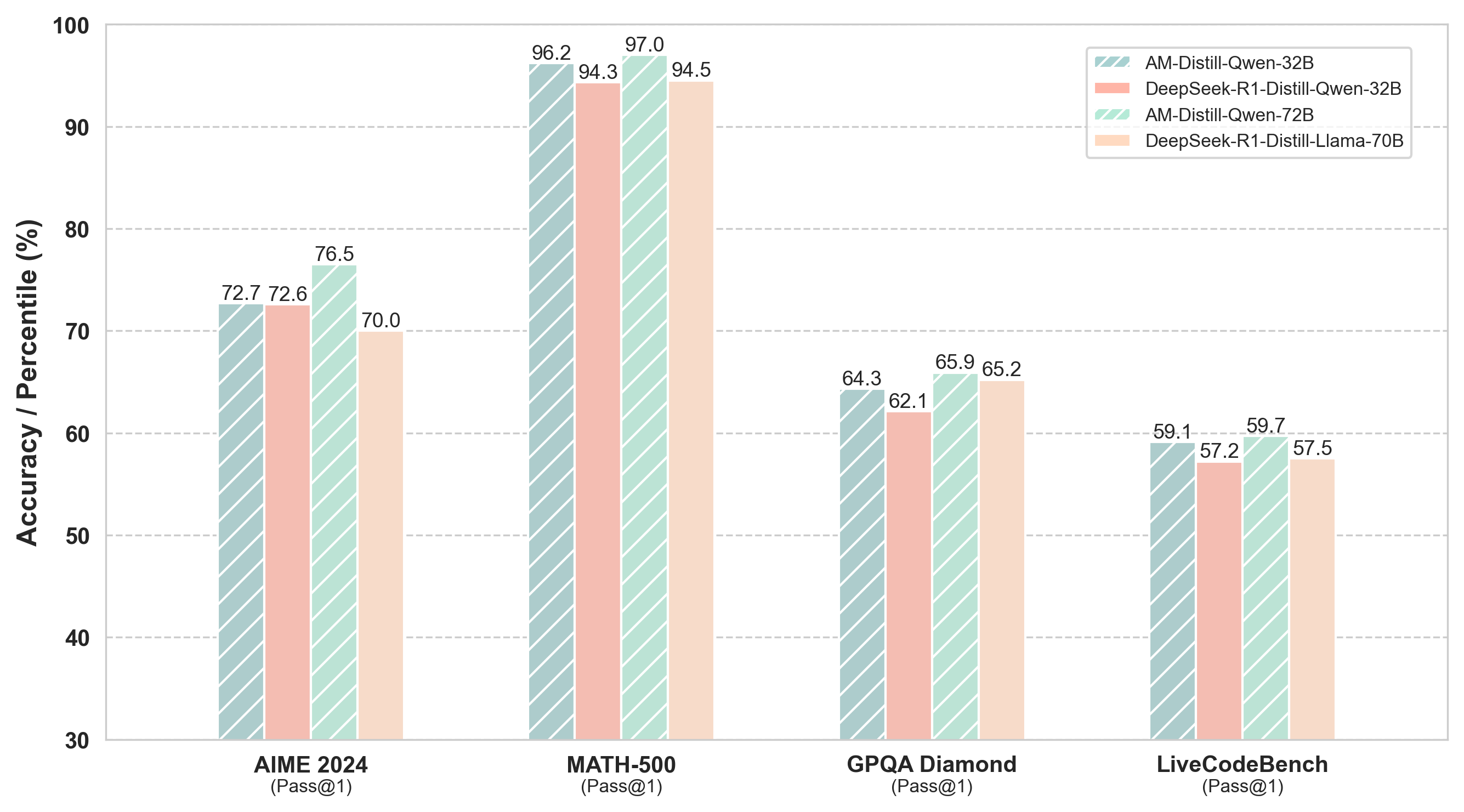
The AM-DeepSeek-R1-Distilled is a large-scale dataset with thinking traces for general reasoning tasks, composed of high-quality and challenging reasoning problems. These problems are collected from a multitude of open-source datasets, subjected to semantic deduplication and meticulous cleaning to eliminate test set contamination. All responses within the dataset are distilled from reasoning models (predominantly DeepSeek-R1) and have undergone rigorous verification procedures. Mathematical problems are validated by checking against reference answers, code problems are verified using test cases, and other tasks are evaluated with the aid of a reward model. The AM-Distill-Qwen-32B model, which was trained through only simple Supervised Fine-Tuning (SFT) using this batch of data, outperformed the DeepSeek-R1-Distill-Qwen-32B model on four benchmarks: AIME2024, MATH-500, GPQA-Diamond, and LiveCodeBench. Additionally, the AM-Distill-Qwen-72B model surpassed the DeepSeek-R1-Distill-Llama-70B model on all benchmarks as well. We are releasing these 1.4 million problems and their corresponding responses to the research community with the objective of fostering the development of powerful reasoning-oriented Large Language Models (LLMs). The dataset was published in https://huggingface.co/datasets/a-m-team/AM-DeepSeek-R1-Distilled-1.4M
<details>
<summary>extracted/6308700/20250325-163012.png Details</summary>
### Visual Description
## Bar Chart: Model Performance on Various Benchmarks
### Overview
The image is a bar chart comparing the performance of four different language models on four different benchmarks: AIME 2024, MATH-500, GPQA Diamond, and LiveCodeBench. The y-axis represents Accuracy/Percentile (%), ranging from 30 to 100. The x-axis represents the benchmarks. The chart uses different colored bars to represent each model.
### Components/Axes
* **Y-axis:** Accuracy / Percentile (%)
* Scale: 30 to 100, with gridlines at intervals of 10.
* **X-axis:** Benchmarks (AIME 2024, MATH-500, GPQA Diamond, LiveCodeBench), with "(Pass@1)" below each benchmark name.
* **Legend:** Located at the top-right of the chart.
* Light Green (with diagonal lines): AM-Distill-Qwen-32B
* Light Red (with diagonal lines): DeepSeek-R1-Distill-Qwen-32B
* Light Green (with diagonal lines): AM-Distill-Qwen-72B
* Light Orange (with diagonal lines): DeepSeek-R1-Distill-Llama-70B
### Detailed Analysis
Here's a breakdown of the performance of each model on each benchmark:
* **AIME 2024 (Pass@1):**
* AM-Distill-Qwen-32B (Light Green): 72.7
* DeepSeek-R1-Distill-Qwen-32B (Light Red): 72.6
* AM-Distill-Qwen-72B (Light Green): 76.5
* DeepSeek-R1-Distill-Llama-70B (Light Orange): 70.0
* **MATH-500 (Pass@1)::**
* AM-Distill-Qwen-32B (Light Green): 96.2
* DeepSeek-R1-Distill-Qwen-32B (Light Red): 94.3
* AM-Distill-Qwen-72B (Light Green): 97.0
* DeepSeek-R1-Distill-Llama-70B (Light Orange): 94.5
* **GPQA Diamond (Pass@1):**
* AM-Distill-Qwen-32B (Light Green): 64.3
* DeepSeek-R1-Distill-Qwen-32B (Light Red): 62.1
* AM-Distill-Qwen-72B (Light Green): 65.9
* DeepSeek-R1-Distill-Llama-70B (Light Orange): 65.2
* **LiveCodeBench (Pass@1):**
* AM-Distill-Qwen-32B (Light Green): 59.1
* DeepSeek-R1-Distill-Qwen-32B (Light Red): 57.2
* AM-Distill-Qwen-72B (Light Green): 59.7
* DeepSeek-R1-Distill-Llama-70B (Light Orange): 57.5
### Key Observations
* The AM-Distill-Qwen-72B model generally performs the best across all benchmarks, achieving the highest scores in AIME 2024, MATH-500, and GPQA Diamond.
* The MATH-500 benchmark has the highest scores for all models, indicating it might be an easier task compared to the others.
* The LiveCodeBench benchmark has the lowest scores for all models, suggesting it is the most challenging task.
* The performance difference between the models is most pronounced in the AIME 2024 benchmark.
### Interpretation
The bar chart provides a comparative analysis of the performance of four language models on different benchmarks. The AM-Distill-Qwen-72B model consistently outperforms the other models, especially on the MATH-500 benchmark. The LiveCodeBench benchmark appears to be the most difficult for all models. The data suggests that the choice of model can significantly impact performance, and the difficulty of the benchmark also plays a crucial role. The "Pass@1" likely refers to the evaluation metric, indicating the accuracy of generating the correct answer on the first attempt.
</details>
Figure 1: Overall performance of AM model
1 Introduction
OpenAI’s o1 series models (OpenAI, 2024) were the pioneers in introducing inference-time scaling by extending the length of the Chain-of-thought reasoning process (Wei et al., 2023; Snell et al., 2024; Wu et al., 2025). This approach has yielded remarkable improvements across various reasoning tasks, including mathematics, coding, and scientific reasoning (Lightman et al., 2023; Hwang et al., 2024).
Subsequently, the introduction of DeepSeek-R1 (DeepSeek-AI et al., 2025) significantly propelled the open-source community forward, enabling deeper insights into inference-time scaling. DeepSeek also introduced the DeepSeek-R1-distilled series of models. These models solely utilized distilled data with reasoning chains for Supervised Fine-Tuning (SFT), yet they achieved outstanding results on diverse benchmarks. In the training pipeline of DeepSeek-R1, compared with DeepSeek-R1-Zero, 800,000 selected entries of data were used for SFT. This is a crucial factor contributing to DeepSeek-R1’s superiority over DeepSeek-R1-Zero, thus demonstrating the necessity of high-quality SFT. SFT process, with carefully selected data, can effectively improve the performance of the model, as evidenced by the significant improvement of DeepSeek-R1 over its counterpart. This not only highlights the importance of data selection in SFT but also further validates the positive impact of well-executed SFT on enhancing a model’s reasoning ability.
Building upon prior work, the open-source community has recently introduced numerous datasets that distilled reasoning models from DeepSeek-R1 (OpenThoughts, 2025; Xu et al., 2025). However, the scale of these datasets is generally smaller than the 800,000 samples employed by DeepSeek in its distilled series of models. To date, few open-source initiatives have matched the performance achieved by the DeepSeek-R1-distilled series models based on the corresponding base models. Therefore, we have constructed the AM-DeepSeek-R1-Distilled dataset, which encompasses 1.4 million high-quality data entries with reasoning chains. Among these, 0.5 million data entries are entirely sourced from open-source datasets, and 0.9 million data entries are distilled by AM from DeepSeek-R1, as denoted by the “am-0309” in the response sources. The AM-DeepSeek-R1-Distilled dataset we developed exhibits significant advantages in terms of data scale, quality, and diversity. Through our meticulous data processing and stringent verification procedures, this dataset can offer robust support for the long COT training of large language models.
In terms of data collection, we comprehensively gathered diverse types of reasoning problems from numerous open-source datasets and implemented semantic deduplication and cleaning to guarantee the high quality and purity of the data (Li et al., 2023; Tirumala et al., 2023). Simultaneously, we conducted strict verification of all responses, including validating mathematical problems through answer checking, verifying code problems via test cases, and evaluating other tasks using a reward model, thereby ensuring the accuracy and reliability of the data.
Regarding data scale, the AM dataset, with its 1.4 million data entries, has significantly outperformed other recent open-source datasets. Among these entries, 500,000 are fully derived from open-source datasets. They span a wide range of knowledge domains and problem types. For the remaining 900,000, the instruction part is sourced from open-source datasets, and the response part is distilled by the AM team from DeepSeek-R1. These data have undergone processing in our data pipeline and possess high quality.
In terms of diversity, our dataset not only encompasses problems from common domains such as math, code, and science but also includes some cross-domain and comprehensive reasoning tasks. This can comprehensively exercise the reasoning ability and generalization ability of the models (Song et al., 2024). Moreover, we meticulously processed the instruction part. We utilized a large language model to score all instructions in terms of difficulty and category and performed strict semantic deduplication according to these labels to ensure the high quality and diversity of the instructions (Xu et al., 2024).
In addition, our dataset adopts a unified format, and each data entry is annotated in detail, including user-assistant interaction information, reasoning processes, final answers, reference answers, test cases, and other metadata. This standardized format renders the dataset easy to use and understand, facilitating researchers in conducting data processing and model training.
We believe that the release of the AM-DeepSeek-R1-Distilled dataset will offer crucial resource support for the research of reasoning-oriented large language models and is anticipated to drive further development and innovation in this field. We look forward to the research community leveraging this dataset to achieve more research breakthroughs and jointly promote the progress of AGI.
2 Approach
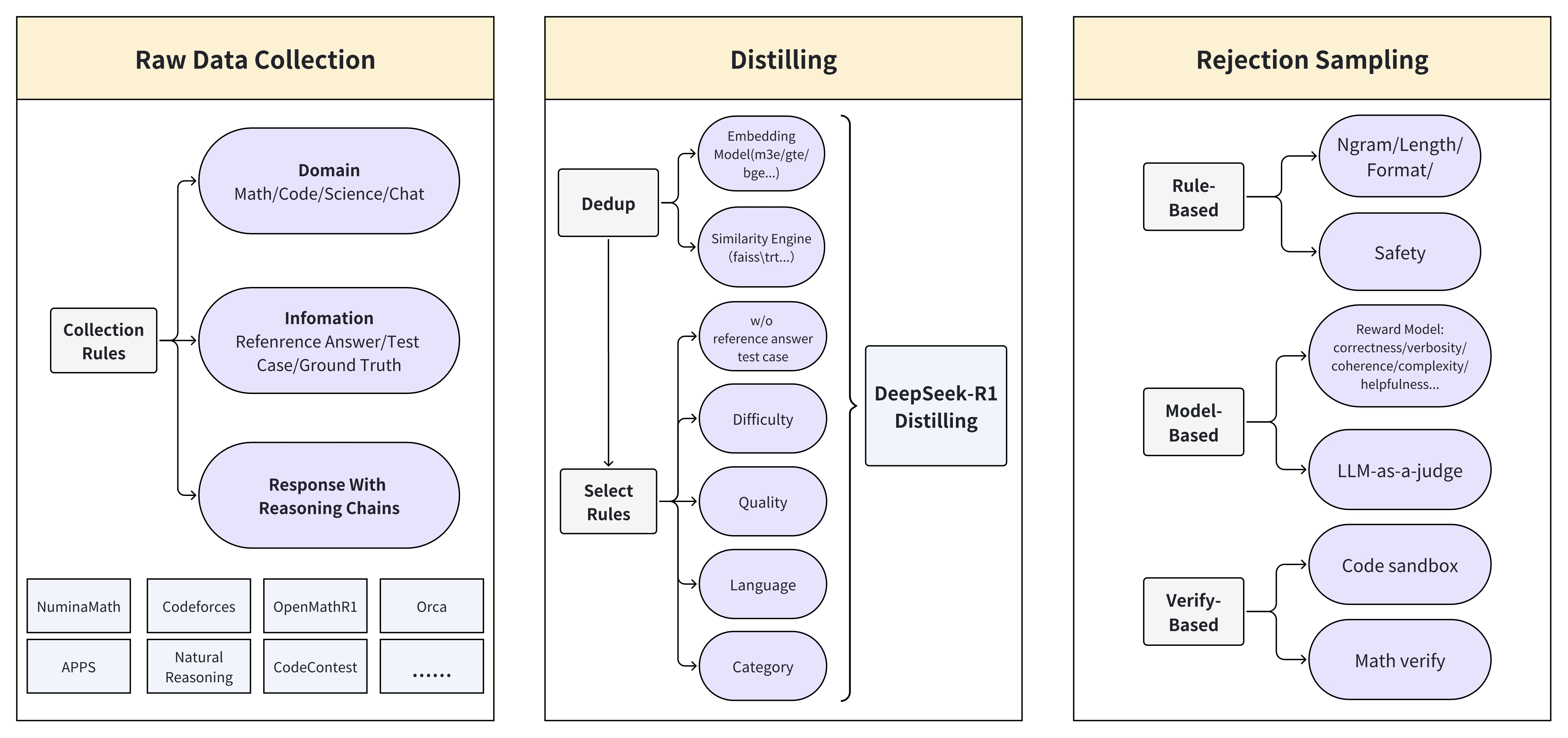
The core criteria for our data selection mainly include three aspects: diversity, complexity, and accuracy. We constructed our data pipeline around how to improve these three core indicators. As demonstrated in Figure 2, the entire pipeline can be divided into (1) Raw Data Collection, (2) Distilling, and (3) Rejection Sampling. The subsequent sections will elaborate on these components in detail.
<details>
<summary>extracted/6308700/20250322-135500.jpeg Details</summary>
### Visual Description
## Data Processing Pipeline: Raw Data Collection, Distilling, and Rejection Sampling
### Overview
The image presents a diagram illustrating a data processing pipeline, divided into three main stages: Raw Data Collection, Distilling, and Rejection Sampling. Each stage involves specific processes and rules to refine and filter data.
### Components/Axes
**1. Raw Data Collection:**
* **Title:** Raw Data Collection (located at the top of the section)
* **Elements:**
* Collection Rules (rectangular box on the left)
* Domain (rounded rectangle): Math/Code/Science/Chat
* Infomation (rounded rectangle): Reference Answer/Test Case/Ground Truth
* Response With Reasoning Chains (rounded rectangle)
* APPS (rectangular box): Contains sub-elements: NuminaMath, Codeforces, OpenMathR1, Orca, Natural Reasoning, CodeContest, and "..." indicating more elements.
**2. Distilling:**
* **Title:** Distilling (located at the top of the section)
* **Elements:**
* Dedup (rectangular box on the left)
* Embedding Model (m3e/gte/bge...) (rounded rectangle)
* Similarity Engine (faiss\trt...) (rounded rectangle)
* w/o reference answer test case (rounded rectangle)
* Select Rules (rectangular box on the left)
* Difficulty (rounded rectangle)
* Quality (rounded rectangle)
* Language (rounded rectangle)
* Category (rounded rectangle)
* DeepSeek-R1 Distilling (rectangular box on the right)
**3. Rejection Sampling:**
* **Title:** Rejection Sampling (located at the top of the section)
* **Elements:**
* Rule-Based (rectangular box on the left)
* Ngram/Length/Format/ (rounded rectangle)
* Safety (rounded rectangle)
* Model-Based (rectangular box on the left)
* Reward Model: correctness/verbosity/coherence/complexity/helpfulness... (rounded rectangle)
* LLM-as-a-judge (rounded rectangle)
* Verify-Based (rectangular box on the left)
* Code sandbox (rounded rectangle)
* Math verify (rounded rectangle)
### Detailed Analysis or ### Content Details
**1. Raw Data Collection:**
* Collection Rules feeds into Domain, Infomation, and Response With Reasoning Chains.
* APPS lists specific applications or datasets used in the raw data collection.
**2. Distilling:**
* Dedup feeds into Embedding Model and Similarity Engine.
* Select Rules feeds into Difficulty, Quality, Language, and Category.
* All elements feed into DeepSeek-R1 Distilling.
**3. Rejection Sampling:**
* Rule-Based feeds into Ngram/Length/Format/ and Safety.
* Model-Based feeds into Reward Model and LLM-as-a-judge.
* Verify-Based feeds into Code sandbox and Math verify.
### Key Observations
* The diagram outlines a multi-stage process for data refinement.
* Each stage has specific rules and processes to filter and improve data quality.
* The flow of data is generally from left to right, with specific rules feeding into various data characteristics or models.
### Interpretation
The diagram illustrates a comprehensive data processing pipeline designed to collect, refine, and filter data for specific applications, likely related to machine learning or AI. The Raw Data Collection stage gathers data from various sources and domains. The Distilling stage focuses on refining the data by removing duplicates, assessing quality, and categorizing it. Finally, the Rejection Sampling stage uses rule-based, model-based, and verification-based methods to filter out undesirable data points, ensuring the final dataset is of high quality and suitable for its intended purpose. The pipeline emphasizes the importance of data quality and relevance in AI and machine learning applications.
</details>
Figure 2: Construction process of data pipeline.
2.1 Raw Data
2.1.1 Data Sources
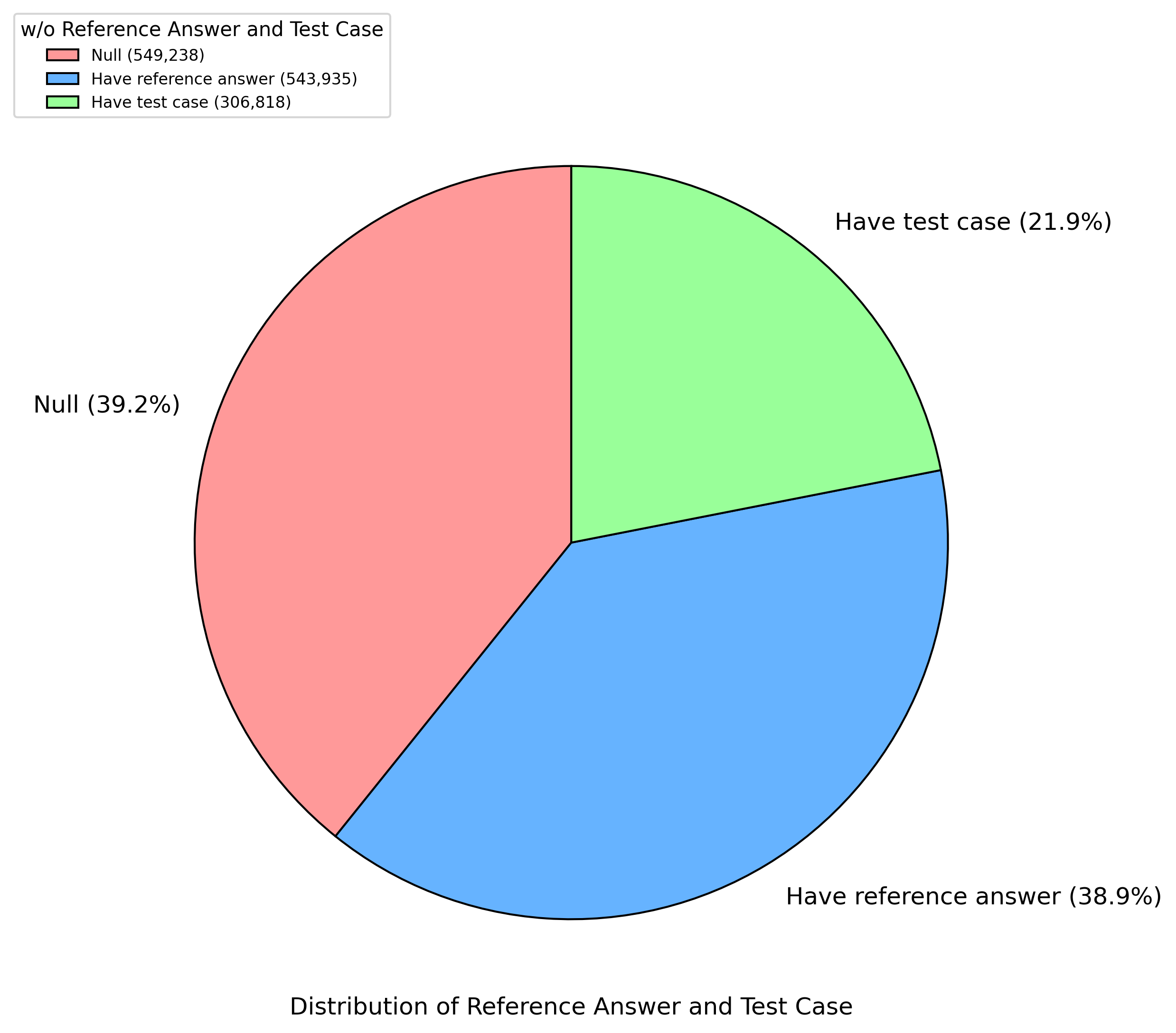
We divided the data selection into four major categories: math, code, scienceQA, and general chat. We classified high-quality open-source datasets into these four categories. For Math, Code, and ScienceQA, we prioritized to select datasets with reference answers or test cases, such as NuminaMath (LI et al., 2024), MetaMathQA (Yu et al., 2023), natural_reasoning (Yuan et al., 2025), OpenCoder (Huang et al., 2024), Omni-MATH (Gao et al., 2024), PRIME (Yuan et al., 2024), CodeIO (Li et al., 2025), MATH-lighteval (Hendrycks et al., 2021). Additionally, we also selected some datasets with reasoning chains generated by DeepSeek-R1 from the open-source community, such as Openthoughts (OpenThoughts, 2025), OpenR1Math (Open-R1, 2025), KodCode (Xu et al., 2025), Bespoke-Stratos-17k (Bespoke, 2025), GeneralThought (Reasoning, 2025), Dolphin-R1 (cognitivecomputations, 2025), data_ablation_full59K (Muennighoff et al., 2025), s1K (Muennighoff et al., 2025), LIMO (Ye et al., 2025). Additionally, to enhance the model’s chatting ability, we obtained chat data from general-data SFT datasets, such as InfinityInstruct (BAAI, 2024), Orca (Lian et al., 2023). The distribution of reference answers and test cases can be found in Appendix A.2
2.1.2 Categories
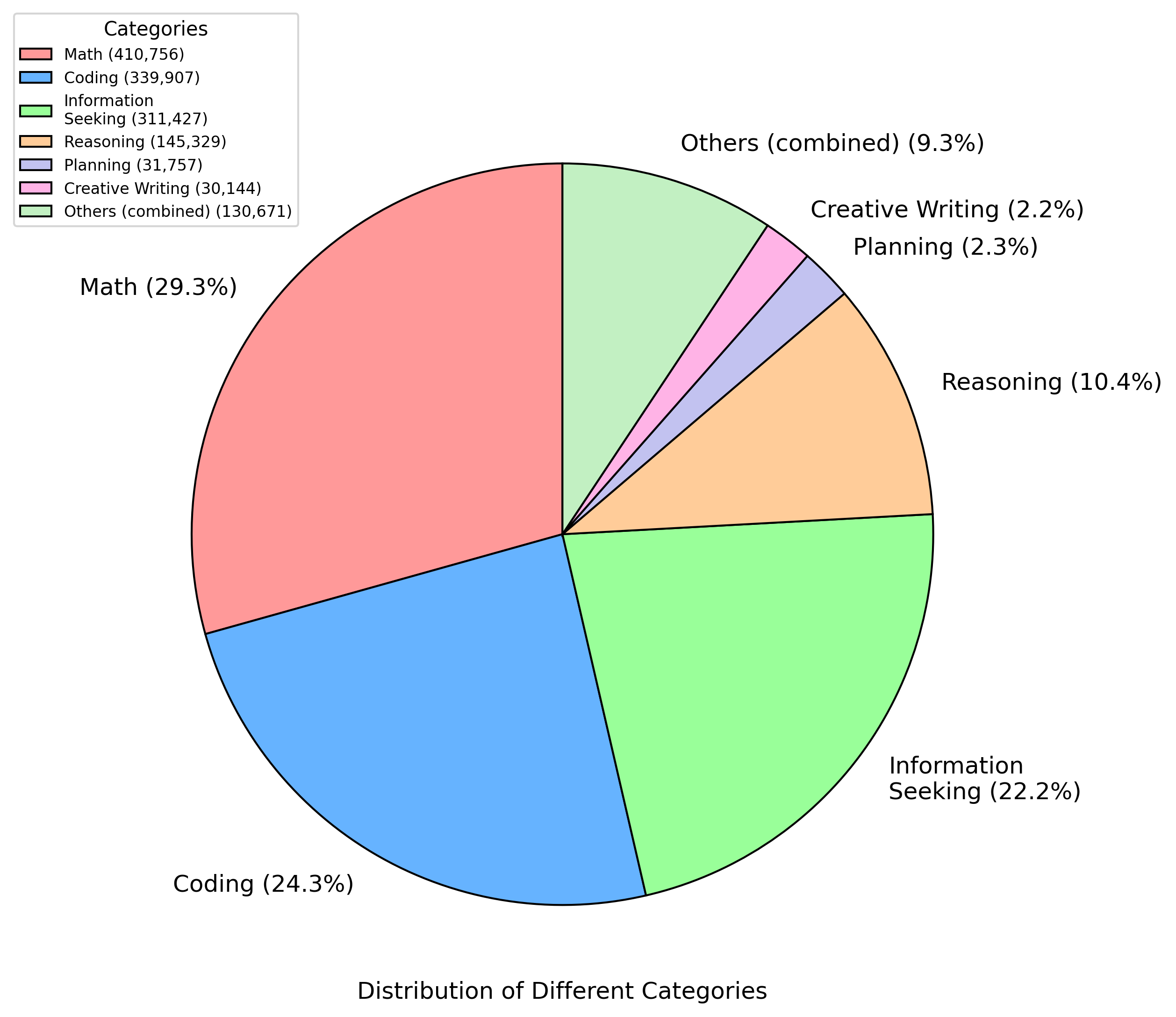
The initial four categories alone were insufficient, especially for general chat data. Thus, we designed some more detailed categories, such as creative writing and instruction following. To facilitate data matching and enhance the diversity of the AM dataset, we used the Qwen2.5-7B-Instruct model (Qwen, 2024) to label the data. The details of the categories can be found in the Appendix A.3 and Appendix B.2.
2.1.3 Difficulty
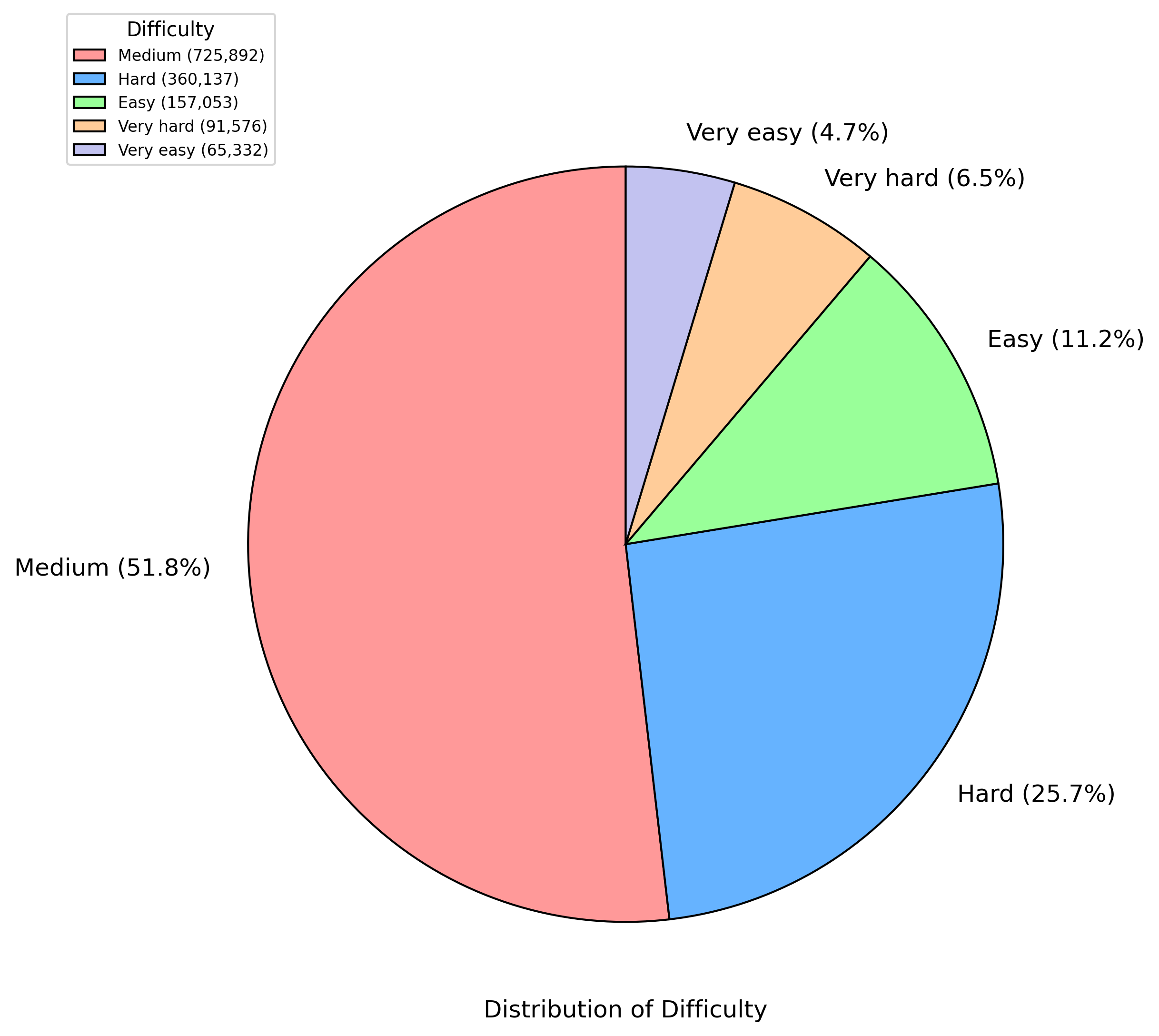
For the training of long-cot models, more challenging data can effectively extend the length of the reasoning chains generated by the model and improve its reasoning ability. Thus, we used a large language model to score the difficulty of all instructions, subsequently screening the data and downsampling easy and medium difficulty examples. This ensures that the AM dataset emphasizes more challenging data while maintaining its diversity. The difficulty distribution of the data can be found in Appendix A.4 and Appendix B.1.
2.1.4 Deduplication
We performed strict semantic deduplication on the collected data. We calculated the embedding for each data entry and computed text similarity based on their embeddings to obtain the semantic similarity of different data entries. For data with high semantic similarity, we designed some priority strategies and ultimately retained only one representative entry. This process ensures dataset uniqueness and diversity of the dataset and prevents the negative impact of similar data during model training.
2.2 Distilled Data
We obtained responses to prompts via two ways: filtering existing responses and creating new responses. For prompts with existing responses, we retained the original response if it can pass reference-answer or test-case verification. For data without reasoning chains, we generated new responses using DeepSeek-R1.
2.2.1 Ground Truth Verification
For problems with available reference answers, we conducted verification through a combination of rule-based methods and a large language model. Initially, we applied math-verify (Kydlíček and Gandenberger, 2025) to assess whether the response matched reference answers in terms of format and calculation results. Subsequently, we used Qwen2.5-7B-Instruct to further evaluate the correctness and consistency of these responses, the prompt could be found in Appendix B.3. For code-related problems with test cases, we verified responses within a sandbox environment. We ultimately removed the data that did not pass the verification to ensure the accuracy and reliability of the dataset.
2.2.2 Reward
We used two methods, Decision-Tree-Reward-Llama-3.1-8B (Rlhflow, 2025) as reward model and Qwen2.5-7B-Instruct for large language model scoring, to evaluate the answer_content part of the model output. We set a certain score threshold based on the score distribution and removed the data with lower scores. The reward model evaluates responses across five dimensions: correctness, helpfulness, coherence, complexity, and verbosity to ensure the selected responses contribute to improving the overall quality of the dataset.
2.2.3 Rule Verification
We established verification rules, such as format template conformity and n-gram repetition checks. For format verification, we ensured that each response adhered strictly to the specified format, such as clearly indicating <think>reasoning process here</think><answer>final answer here</answer>in the prompt. For n-gram repetition verification, we checked responses for excessive consecutive word repetition. Responses failing these rule-based verifications were excluded to guarantee dataset quality and consistency.
2.2.4 Labels
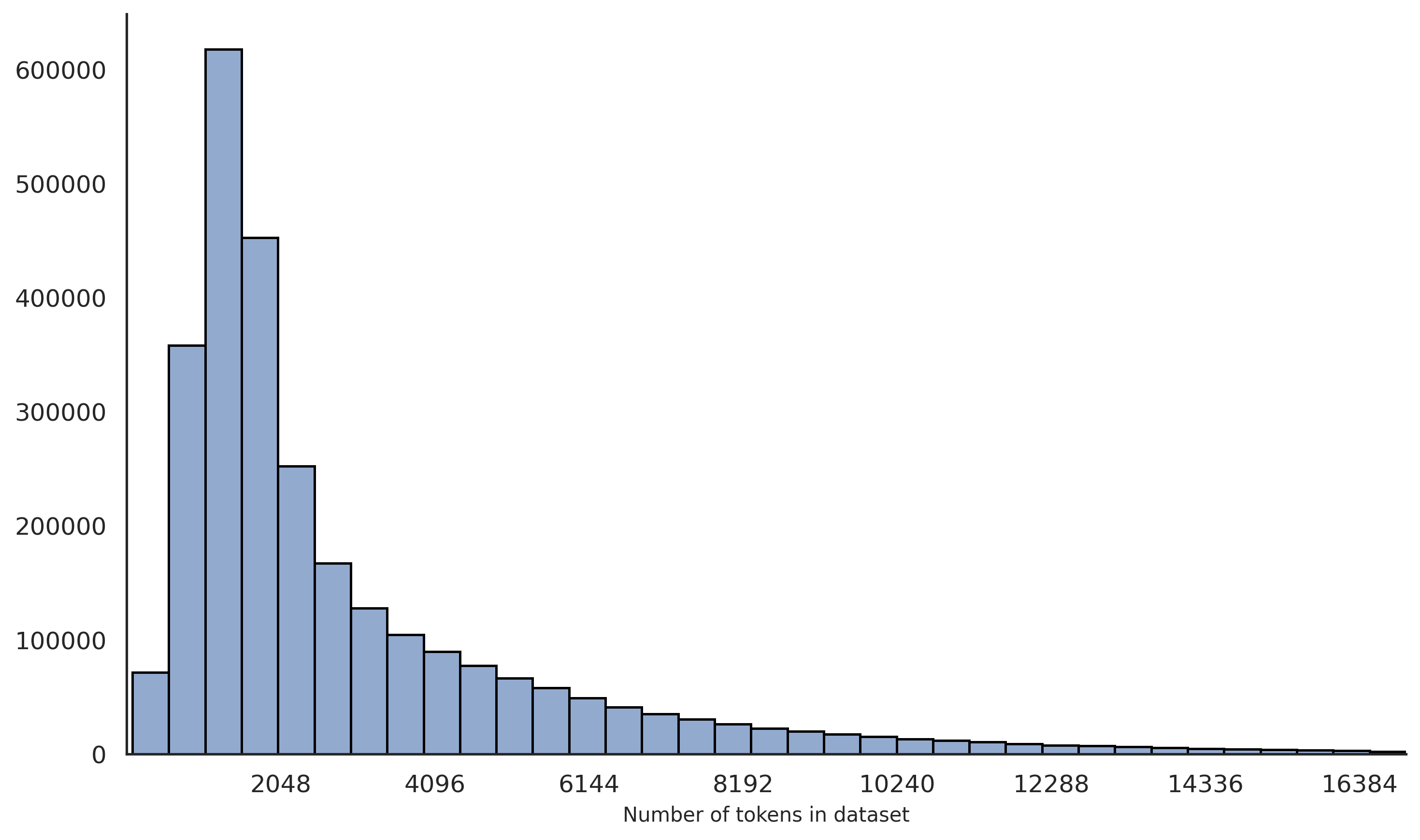
We additionally annotated the data with supplementary information, such as length and language. For length annotation, we calculated the number of words or tokens per data entry, providing insights into the complexity and scale of the dataset. The length distribution of the data can be found in Appendix A.1. For language annotation, we primarily annotated entries as Chinese, English, or other languages. These labels facilitate effective data screening and analysis.
3 Experiment
3.1 Evaluation
3.1.1 Benchmark
We evaluated the reasoning ability of the model using LiveCodeBench (Jain et al., 2024) (2024-08–2025-01), GPQA-Diamond (Rein et al., 2023), AIME 2024 (MAA, 2024), and MATH-500 (Lightman et al., 2023). These benchmarks span multiple fields and difficulty levels, enabling a thorough assessment of the model’s reasoning performance across diverse scenarios.
3.1.2 Evaluation Methodology
We set the maximum generation length to 32,768 tokens. For benchmarks requiring sampling, the temperature was uniformly set to 0.6, and the top-p value to 0.95. For AIME 2024 (MAA, 2024), we generated 16 samples per query to estimate pass@1. For LiveCodeBench (Jain et al., 2024), MATH-500 (Lightman et al., 2023) and GPQA Diamond (Rein et al., 2023), we generated 4 responses per query, also to estimate pass@1. The evaluation metric across these benchmarks was the globally averaged accuracy.
3.2 Main Result
We performed SFT on Qwen2.5-32B producing a model named AM-Distill-Qwen-32B, the system prompt used is shown in Table 1. Compared with DeepSeek-R1-Distill-Qwen-32B, our models achieved significant improvements. Evaluation results are shown in Table 2. Specifically, on AIME2024, the accuracy increased from 72.6% to 72.7%; on MATH-500, from 94.3% to 96.2%; on GPQA-Diamond, from 62.1% to 64.3%; and on LiveCodeBench, from 57.2% to 59.1%. Overall, the average accuracy improved from 71.6% to 73.1%.
| You are a helpful assistant. To answer the user’s question, you first think about the reasoning process and then provide the user with the answer. The reasoning process and answer are enclosed within <think> and <answer> tags, respectively, i.e., <think> reasoning process here </think> <answer> answer here </answer>. |
| --- |
Table 1: System prompt in training process.
We further performed training based on the Qwen2.5-72B model to obtain AM-Distill-Qwen-72B. Compared with DeepSeek-R1-Distill-Llama-70B, our 72B model achieved notable improvements across all evaluation benchmarks. Specifically, accuracy on AIME2024 significantly increased from 70.0% to 76.5%; MATH-500 improved from 94.5% to 97.0%; GPQA-Diamond rose from 65.2% to 65.9%; and LiveCodeBench increased from 57.5% to 59.7%.
Experimental results demonstrate that models trained on our constructed AM-DeepSeek-R1-Distilled-1.4M dataset exhibit substantial enhancements in reasoning ability.
| DeepSeek-R1-Distill-Qwen-32B AM-Distill-Qwen-32B DeepSeek-R1-Distill-Llama-70B | 72.6 72.7 70.0 | 94.3 96.2 94.5 | 62.1 64.3 65.2 | 57.2 59.1 57.5 | 71.6 73.1 71.8 |
| --- | --- | --- | --- | --- | --- |
| AM-Distill-Qwen-72B | 76.5 | 97.0 | 65.9 | 59.7 | 74.8 |
Table 2: Model performance.
4 Limitation
Since the responses in this dataset are generated by large language models and have not been rigorously verified, there are still deficiencies in terms of factual accuracy and other aspects. When using this dataset, it is necessary to conduct a careful examination. This dataset is mainly used to enhance the reasoning capabilities of large language models (LLMs). We have not carried out a thorough filtering of the harmful instructions or responses within it. We require developers to use only the open-sourced code, data, model, and any other artifacts generated through this project for research purposes. Commercial use and other potential harmful use cases are not permitted. In addition, due to the nested relationships among some data sources, there may be issues with the inaccuracy of the data sources.
5 Conclusion
In this study, we have constructed and released an AM-DeepSeek-R1-Distilled dataset, a large-scale general reasoning task dataset with 1.4 million data entries and rich thinking traces. It was created through meticulous selection, semantic deduplication, and strict cleaning of a large number of open-source datasets.
Furthermore, the AM-Distill-Qwen-32B model, developed by performing SFT on Qwen2.5-32B with the utilization of our constructed dataset, has exhibited remarkable performance enhancements. This compellingly demonstrates that our dataset serves as a significant asset in training the reasoning capabilities of the model. We are optimistic that our endeavors will play a substantial and catalytic role in the research related to reasoning-oriented Large Language Models, propelling forward the development in this field.
References
- BAAI (2024) BAAI. Infinity instruct. 2024. URL https://huggingface.co/datasets/BAAI/Infinity-Instruct.
- Bespoke (2025) Bespoke. Bespoke-stratos: The unreasonable effectiveness of reasoning distillation. https://www.bespokelabs.ai/blog/bespoke-stratos-the-unreasonable-effectiveness-of-reasoning-distillation, 2025. Accessed: 2025-01-22.
- cognitivecomputations (2025) cognitivecomputations. dolphin-r1. https://huggingface.co/datasets/cognitivecomputations/dolphin-r1, 2025.
- DeepSeek-AI et al. (2025) DeepSeek-AI, Daya Guo, Dejian Yang, Haowei Zhang, Junxiao Song, Ruoyu Zhang, Runxin Xu, Qihao Zhu, Shirong Ma, Peiyi Wang, Xiao Bi, Xiaokang Zhang, Xingkai Yu, Yu Wu, Z. F. Wu, Zhibin Gou, Zhihong Shao, Zhuoshu Li, Ziyi Gao, Aixin Liu, Bing Xue, Bingxuan Wang, Bochao Wu, Bei Feng, Chengda Lu, Chenggang Zhao, Chengqi Deng, Chenyu Zhang, Chong Ruan, Damai Dai, Deli Chen, Dongjie Ji, Erhang Li, Fangyun Lin, Fucong Dai, Fuli Luo, Guangbo Hao, Guanting Chen, Guowei Li, H. Zhang, Han Bao, Hanwei Xu, Haocheng Wang, Honghui Ding, Huajian Xin, Huazuo Gao, Hui Qu, Hui Li, Jianzhong Guo, Jiashi Li, Jiawei Wang, Jingchang Chen, Jingyang Yuan, Junjie Qiu, Junlong Li, J. L. Cai, Jiaqi Ni, Jian Liang, Jin Chen, Kai Dong, Kai Hu, Kaige Gao, Kang Guan, Kexin Huang, Kuai Yu, Lean Wang, Lecong Zhang, Liang Zhao, Litong Wang, Liyue Zhang, Lei Xu, Leyi Xia, Mingchuan Zhang, Minghua Zhang, Minghui Tang, Meng Li, Miaojun Wang, Mingming Li, Ning Tian, Panpan Huang, Peng Zhang, Qiancheng Wang, Qinyu Chen, Qiushi Du, Ruiqi Ge, Ruisong Zhang, Ruizhe Pan, Runji Wang, R. J. Chen, R. L. Jin, Ruyi Chen, Shanghao Lu, Shangyan Zhou, Shanhuang Chen, Shengfeng Ye, Shiyu Wang, Shuiping Yu, Shunfeng Zhou, Shuting Pan, S. S. Li, Shuang Zhou, Shaoqing Wu, Shengfeng Ye, Tao Yun, Tian Pei, Tianyu Sun, T. Wang, Wangding Zeng, Wanjia Zhao, Wen Liu, Wenfeng Liang, Wenjun Gao, Wenqin Yu, Wentao Zhang, W. L. Xiao, Wei An, Xiaodong Liu, Xiaohan Wang, Xiaokang Chen, Xiaotao Nie, Xin Cheng, Xin Liu, Xin Xie, Xingchao Liu, Xinyu Yang, Xinyuan Li, Xuecheng Su, Xuheng Lin, X. Q. Li, Xiangyue Jin, Xiaojin Shen, Xiaosha Chen, Xiaowen Sun, Xiaoxiang Wang, Xinnan Song, Xinyi Zhou, Xianzu Wang, Xinxia Shan, Y. K. Li, Y. Q. Wang, Y. X. Wei, Yang Zhang, Yanhong Xu, Yao Li, Yao Zhao, Yaofeng Sun, Yaohui Wang, Yi Yu, Yichao Zhang, Yifan Shi, Yiliang Xiong, Ying He, Yishi Piao, Yisong Wang, Yixuan Tan, Yiyang Ma, Yiyuan Liu, Yongqiang Guo, Yuan Ou, Yuduan Wang, Yue Gong, Yuheng Zou, Yujia He, Yunfan Xiong, Yuxiang Luo, Yuxiang You, Yuxuan Liu, Yuyang Zhou, Y. X. Zhu, Yanhong Xu, Yanping Huang, Yaohui Li, Yi Zheng, Yuchen Zhu, Yunxian Ma, Ying Tang, Yukun Zha, Yuting Yan, Z. Z. Ren, Zehui Ren, Zhangli Sha, Zhe Fu, Zhean Xu, Zhenda Xie, Zhengyan Zhang, Zhewen Hao, Zhicheng Ma, Zhigang Yan, Zhiyu Wu, Zihui Gu, Zijia Zhu, Zijun Liu, Zilin Li, Ziwei Xie, Ziyang Song, Zizheng Pan, Zhen Huang, Zhipeng Xu, Zhongyu Zhang, and Zhen Zhang. Deepseek-r1: Incentivizing reasoning capability in llms via reinforcement learning, 2025. URL https://arxiv.org/abs/2501.12948.
- Gao et al. (2024) Bofei Gao, Feifan Song, Zhe Yang, Zefan Cai, Yibo Miao, Qingxiu Dong, Lei Li, Chenghao Ma, Liang Chen, Runxin Xu, Zhengyang Tang, Benyou Wang, Daoguang Zan, Shanghaoran Quan, Ge Zhang, Lei Sha, Yichang Zhang, Xuancheng Ren, Tianyu Liu, and Baobao Chang. Omni-math: A universal olympiad level mathematic benchmark for large language models, 2024. URL https://arxiv.org/abs/2410.07985.
- Hendrycks et al. (2021) Dan Hendrycks, Collin Burns, Saurav Kadavath, Akul Arora, Steven Basart, Eric Tang, Dawn Song, and Jacob Steinhardt. Measuring mathematical problem solving with the math dataset. arXiv preprint arXiv:2103.03874, 2021.
- Huang et al. (2024) Siming Huang, Tianhao Cheng, Jason Klein Liu, Jiaran Hao, Liuyihan Song, Yang Xu, J. Yang, J. H. Liu, Chenchen Zhang, Linzheng Chai, Ruifeng Yuan, Zhaoxiang Zhang, Jie Fu, Qian Liu, Ge Zhang, Zili Wang, Yuan Qi, Yinghui Xu, and Wei Chu. Opencoder: The open cookbook for top-tier code large language models. 2024. URL https://arxiv.org/pdf/2411.04905.
- Hwang et al. (2024) Hyeonbin Hwang, Doyoung Kim, Seungone Kim, Seonghyeon Ye, and Minjoon Seo. Self-explore: Enhancing mathematical reasoning in language models with fine-grained rewards, 2024. URL https://arxiv.org/abs/2404.10346.
- Jain et al. (2024) Naman Jain, King Han, Alex Gu, Wen-Ding Li, Fanjia Yan, Tianjun Zhang, Sida Wang, Armando Solar-Lezama, Koushik Sen, and Ion Stoica. Livecodebench: Holistic and contamination free evaluation of large language models for code. arXiv preprint arXiv:2403.07974, 2024.
- Kydlíček and Gandenberger (2025) Hynek Kydlíček and Greg Gandenberger. Math-verify, 2025. URL https://github.com/huggingface/math-verify.
- LI et al. (2024) Jia LI, Edward Beeching, Lewis Tunstall, Ben Lipkin, Roman Soletskyi, Shengyi Costa Huang, Kashif Rasul, Longhui Yu, Albert Jiang, Ziju Shen, Zihan Qin, Bin Dong, Li Zhou, Yann Fleureau, Guillaume Lample, and Stanislas Polu. Numinamath. https://huggingface.co/AI-MO/NuminaMath-CoT, 2024.
- Li et al. (2025) Junlong Li, Daya Guo, Dejian Yang, Runxin Xu, Yu Wu, and Junxian He. Codei/o: Condensing reasoning patterns via code input-output prediction. arXiv preprint arXiv:2502.07316, 2025.
- Li et al. (2023) Zhuoyan Li, Hangxiao Zhu, Zhuoran Lu, and Ming Yin. Synthetic data generation with large language models for text classification: Potential and limitations, 2023. URL https://arxiv.org/abs/2310.07849.
- Lian et al. (2023) Wing Lian, Bleys Goodson, Eugene Pentland, Austin Cook, Chanvichet Vong, and ”Teknium”. Openorca: An open dataset of gpt augmented flan reasoning traces. https://https://huggingface.co/datasets/Open-Orca/OpenOrca, 2023.
- Lightman et al. (2023) Hunter Lightman, Vineet Kosaraju, Yura Burda, Harri Edwards, Bowen Baker, Teddy Lee, Jan Leike, John Schulman, Ilya Sutskever, and Karl Cobbe. Let’s verify step by step, 2023. URL https://arxiv.org/abs/2305.20050.
- MAA (2024) MAA. American invitational mathematics examination - aime. https://maa.org/math-competitions/american-invitational-mathematics-examination-aime, feb 2024. Accessed in February 2024, from American Invitational Mathematics Examination - AIME 2024.
- Muennighoff et al. (2025) Niklas Muennighoff, Zitong Yang, Weijia Shi, Xiang Lisa Li, Li Fei-Fei, Hannaneh Hajishirzi, Luke Zettlemoyer, Percy Liang, Emmanuel Candès, and Tatsunori Hashimoto. s1: Simple test-time scaling, 2025. URL https://arxiv.org/abs/2501.19393.
- Open-R1 (2025) Open-R1. Openr1-math-220k. https://huggingface.co/datasets/open-r1/OpenR1-Math-220k, 2025.
- OpenAI (2024) OpenAI. Learning to reason with llms, 2024. URL https://openai.com/index/learning-to-reason-with-llms/.
- OpenThoughts (2025) Team OpenThoughts. Open Thoughts. https://open-thoughts.ai, January 2025.
- Qwen (2024) Qwen. Team qwen2.5: A party of foundation models, September 2024. URL https://qwenlm.github.io/blog/qwen2.5/.
- Reasoning (2025) General Reasoning. Generalthought-feb25. https://huggingface.co/datasets/GeneralReasoning/GeneralThought-Feb25, 02 2025.
- Rein et al. (2023) David Rein, Betty Li Hou, Asa Cooper Stickland, Jackson Petty, Richard Yuanzhe Pang, Julien Dirani, Julian Michael, and Samuel R. Bowman. Gpqa: A graduate-level google-proof q&a benchmark, 2023. URL https://arxiv.org/abs/2311.12022.
- Rlhflow (2025) Rlhflow. Decision tree reward model. https://rlhflow.github.io/posts/2025-01-22-decision-tree-reward-model/, 2025. Accessed: 2025-03-11.
- Snell et al. (2024) Charlie Snell, Jaehoon Lee, Kelvin Xu, and Aviral Kumar. Scaling llm test-time compute optimally can be more effective than scaling model parameters, 2024. URL https://arxiv.org/abs/2408.03314.
- Song et al. (2024) Feifan Song, Bowen Yu, Hao Lang, Haiyang Yu, Fei Huang, Houfeng Wang, and Yongbin Li. Scaling data diversity for fine-tuning language models in human alignment, 2024. URL https://arxiv.org/abs/2403.11124.
- Tirumala et al. (2023) Kushal Tirumala, Daniel Simig, Armen Aghajanyan, and Ari S. Morcos. D4: Improving llm pretraining via document de-duplication and diversification, 2023. URL https://arxiv.org/abs/2308.12284.
- Wei et al. (2023) Jason Wei, Xuezhi Wang, Dale Schuurmans, Maarten Bosma, Brian Ichter, Fei Xia, Ed Chi, Quoc Le, and Denny Zhou. Chain-of-thought prompting elicits reasoning in large language models, 2023. URL https://arxiv.org/abs/2201.11903.
- Wu et al. (2025) Yangzhen Wu, Zhiqing Sun, Shanda Li, Sean Welleck, and Yiming Yang. Inference scaling laws: An empirical analysis of compute-optimal inference for problem-solving with language models, 2025. URL https://arxiv.org/abs/2408.00724.
- Xu et al. (2024) Zhangchen Xu, Fengqing Jiang, Luyao Niu, Yuntian Deng, Radha Poovendran, Yejin Choi, and Bill Yuchen Lin. Magpie: Alignment data synthesis from scratch by prompting aligned llms with nothing, 2024. URL https://arxiv.org/abs/2406.08464.
- Xu et al. (2025) Zhangchen Xu, Yang Liu, Yueqin Yin, Mingyuan Zhou, and Radha Poovendran. Kodcode: A diverse, challenging, and verifiable synthetic dataset for coding. 2025. URL https://arxiv.org/abs/2503.02951.
- Ye et al. (2025) Yixin Ye, Zhen Huang, Yang Xiao, Ethan Chern, Shijie Xia, and Pengfei Liu. Limo: Less is more for reasoning, 2025. URL https://arxiv.org/abs/2502.03387.
- Yu et al. (2023) Longhui Yu, Weisen Jiang, Han Shi, Jincheng Yu, Zhengying Liu, Yu Zhang, James T Kwok, Zhenguo Li, Adrian Weller, and Weiyang Liu. Metamath: Bootstrap your own mathematical questions for large language models. arXiv preprint arXiv:2309.12284, 2023.
- Yuan et al. (2024) Lifan Yuan, Wendi Li, Huayu Chen, Ganqu Cui, Ning Ding, Kaiyan Zhang, Bowen Zhou, Zhiyuan Liu, and Hao Peng. Free process rewards without process labels. arXiv preprint arXiv:2412.01981, 2024.
- Yuan et al. (2025) Weizhe Yuan, Jane Yu, Song Jiang, Karthik Padthe, Yang Li, Dong Wang, Ilia Kulikov, Kyunghyun Cho, Yuandong Tian, Jason E Weston, and Xian Li. Naturalreasoning: Reasoning in the wild with 2.8m challenging questions, 2025. URL https://arxiv.org/abs/2502.13124.
Appendix A Data Analysis
A.1 Length Distribution
<details>
<summary>extracted/6308700/length_dist_1.png Details</summary>
### Visual Description
## Histogram: Number of Tokens in Dataset
### Overview
The image is a histogram showing the distribution of the number of tokens in a dataset. The x-axis represents the number of tokens, and the y-axis represents the frequency or count of datasets with that number of tokens. The histogram shows a right-skewed distribution, indicating that most datasets have a relatively small number of tokens, while a few datasets have a much larger number of tokens.
### Components/Axes
* **X-axis:** "Number of tokens in dataset". The x-axis is scaled from approximately 0 to 16384, with tick marks at 2048, 4096, 6144, 8192, 10240, 12288, 14336, and 16384.
* **Y-axis:** The y-axis represents the frequency or count. The y-axis is scaled from 0 to 600000, with tick marks at 100000, 200000, 300000, 400000, 500000, and 600000.
* **Bars:** The histogram consists of a series of bars, each representing a range of token counts. The height of each bar corresponds to the number of datasets falling within that range. The bars are light blue with black outlines.
### Detailed Analysis
The histogram bars show a decreasing trend as the number of tokens increases.
* **2048 tokens:** The bar height is approximately 620000.
* **4096 tokens:** The bar height is approximately 105000.
* **6144 tokens:** The bar height is approximately 65000.
* **8192 tokens:** The bar height is approximately 35000.
* **10240 tokens:** The bar height is approximately 15000.
* **12288 tokens:** The bar height is approximately 8000.
* **14336 tokens:** The bar height is approximately 4000.
* **16384 tokens:** The bar height is approximately 2000.
### Key Observations
* The distribution is heavily skewed to the right, with a large number of datasets having a small number of tokens.
* The frequency of datasets decreases rapidly as the number of tokens increases.
* There are very few datasets with a large number of tokens.
### Interpretation
The histogram indicates that the dataset contains a large number of relatively small text samples, and a small number of very large text samples. This could be due to a variety of factors, such as the nature of the data being collected, the way the data was preprocessed, or the specific application for which the data is being used. The skewness of the distribution suggests that the average number of tokens per dataset is likely to be much lower than the median number of tokens. This information could be useful for tasks such as text classification, language modeling, or information retrieval.
</details>
Figure 3: Token length distribution of data entries in the dataset. Most data entries contain fewer than 4096 tokens, with the highest concentration around approximately 2048 tokens. The distribution gradually decreases as the token count increases, indicating fewer samples with longer contexts.
A.2 Reference Distribution
<details>
<summary>extracted/6308700/test_case_distribution.png Details</summary>
### Visual Description
## Pie Chart: Distribution of Reference Answer and Test Case
### Overview
The image is a pie chart illustrating the distribution of data related to reference answers and test cases. The chart is divided into three segments, each representing a different category: "Null," "Have reference answer," and "Have test case." Each segment is labeled with its corresponding percentage and the absolute number of occurrences.
### Components/Axes
* **Title:** "w/o Reference Answer and Test Case"
* **Chart Title:** "Distribution of Reference Answer and Test Case" (located at the bottom of the chart)
* **Segments:**
* **Null:** Light red color, representing 39.2% (549,238)
* **Have reference answer:** Light blue color, representing 38.9% (543,935)
* **Have test case:** Light green color, representing 21.9% (306,818)
* **Legend:** Located in the top-left corner, matching the colors and labels of the segments.
### Detailed Analysis
* **Null:** The light red segment occupies approximately 39.2% of the pie chart, corresponding to 549,238 instances.
* **Have reference answer:** The light blue segment occupies approximately 38.9% of the pie chart, corresponding to 543,935 instances.
* **Have test case:** The light green segment occupies approximately 21.9% of the pie chart, corresponding to 306,818 instances.
### Key Observations
* The "Null" and "Have reference answer" categories have very similar percentages (39.2% and 38.9%, respectively), indicating a near-equal distribution between them.
* The "Have test case" category has a significantly smaller percentage (21.9%) compared to the other two, suggesting that test cases are less prevalent in the dataset.
### Interpretation
The pie chart provides a clear visual representation of the distribution of reference answers and test cases. The data suggests that a significant portion of the data lacks either a reference answer or a test case ("Null" category). The near-equal distribution between "Null" and "Have reference answer" indicates that having a reference answer is almost as common as having neither a reference answer nor a test case. The relatively smaller proportion of "Have test case" suggests that test cases are less frequently available compared to reference answers. This could imply a need for more comprehensive test case development or data collection efforts.
</details>
Figure 4: Distribution of reference answers and test cases in the dataset. Among the entries, 38.9% have reference answers, 21.9% include test cases, and 39.2% have neither reference answers nor test cases.
A.3 Category Distribution
<details>
<summary>extracted/6308700/category_distribution.png Details</summary>
### Visual Description
## Chart Type: Pie Chart
### Overview
The image is a pie chart illustrating the distribution of different categories. The chart shows the percentage and absolute value for each category.
### Components/Axes
* **Title:** Distribution of Different Categories
* **Legend (Top-Left):**
* Math (410,756) - Light Red
* Coding (339,907) - Light Blue
* Information Seeking (311,427) - Light Green
* Reasoning (145,329) - Light Orange
* Planning (31,757) - Light Purple
* Creative Writing (30,144) - Light Pink
* Others (combined) (130,671) - Light Green
### Detailed Analysis
The pie chart is divided into seven segments, each representing a category. The percentage and absolute value for each category are as follows:
* **Math:** 29.3% (410,756) - Light Red
* **Coding:** 24.3% (339,907) - Light Blue
* **Information Seeking:** 22.2% (311,427) - Light Green
* **Reasoning:** 10.4% (145,329) - Light Orange
* **Others (combined):** 9.3% (130,671) - Light Green
* **Planning:** 2.3% (31,757) - Light Purple
* **Creative Writing:** 2.2% (30,144) - Light Pink
### Key Observations
* Math constitutes the largest portion of the distribution at 29.3%.
* Coding and Information Seeking are also significant, with 24.3% and 22.2% respectively.
* Planning and Creative Writing have the smallest shares, at 2.3% and 2.2% respectively.
* "Others (combined)" represents a notable portion at 9.3%.
### Interpretation
The pie chart provides a clear visual representation of the relative proportions of different categories within a dataset. The data suggests that Math, Coding, and Information Seeking are the most prevalent categories, while Planning and Creative Writing are less common. The "Others (combined)" category indicates that there are other, less significant categories that have been grouped together. The chart is useful for quickly understanding the distribution and relative importance of each category.
</details>
Figure 5: Distribution of data entries across different task categories. The dataset primarily consists of Math (29.3%), Coding (24.3%), and Information Seeking (22.2%) tasks, followed by Reasoning (10.4%), Planning (2.3%), Creative Writing (2.2%), and other combined categories (9.3%).
A.4 Difficulty Distribution
<details>
<summary>extracted/6308700/difficulty_distribution.png Details</summary>
### Visual Description
## Chart Type: Pie Chart
### Overview
The image is a pie chart illustrating the distribution of difficulty levels. The chart is divided into five categories: Medium, Hard, Easy, Very hard, and Very easy. Each category is represented by a different color and its corresponding percentage and numerical value are displayed.
### Components/Axes
* **Title:** Distribution of Difficulty (located at the bottom center of the chart)
* **Legend:** Located at the top-left corner of the chart.
* **Medium:** Light red color, value (725,892)
* **Hard:** Light blue color, value (360,137)
* **Easy:** Light green color, value (157,053)
* **Very hard:** Light orange color, value (91,576)
* **Very easy:** Light purple color, value (65,332)
* **Pie Chart Slices:**
* **Medium:** Light red, 51.8%
* **Hard:** Light blue, 25.7%
* **Easy:** Light green, 11.2%
* **Very hard:** Light orange, 6.5%
* **Very easy:** Light purple, 4.7%
### Detailed Analysis
The pie chart is divided into five slices, each representing a different difficulty level. The size of each slice corresponds to the percentage of the total distribution that it represents.
* **Medium:** The largest slice, colored light red, represents 51.8% of the distribution, corresponding to a value of 725,892.
* **Hard:** The second-largest slice, colored light blue, represents 25.7% of the distribution, corresponding to a value of 360,137.
* **Easy:** The third-largest slice, colored light green, represents 11.2% of the distribution, corresponding to a value of 157,053.
* **Very hard:** The fourth-largest slice, colored light orange, represents 6.5% of the distribution, corresponding to a value of 91,576.
* **Very easy:** The smallest slice, colored light purple, represents 4.7% of the distribution, corresponding to a value of 65,332.
### Key Observations
* The "Medium" difficulty level accounts for the majority (51.8%) of the distribution.
* The "Hard" difficulty level is the second most common, accounting for 25.7% of the distribution.
* The "Very easy" and "Very hard" difficulty levels are the least common, accounting for 4.7% and 6.5% of the distribution, respectively.
### Interpretation
The pie chart indicates that the distribution of difficulty levels is skewed towards the "Medium" and "Hard" categories. This suggests that most of the tasks or activities being measured are of moderate difficulty. The relatively small percentages for "Very easy" and "Very hard" suggest that these extreme difficulty levels are less common. The data implies a general tendency towards tasks that are neither too simple nor overly challenging.
</details>
Figure 6: Difficulty distribution of the data entries. Most of the dataset entries are classified as Medium (51.8%) or Hard (25.7%). A smaller proportion falls into the Easy (11.2%), Very Hard (6.5%), and Very Easy (4.7%) categories.
Appendix B Prompt
B.1 Difficulty Rating
To grading difficulty rating, wo use prompt as Table 3.
| ⬇ # Instruction You first need to analyze the given user intent and then label the difficulty level of the user query based on the content of the user query. ## User Query ‘‘‘ {input} ‘‘‘ ## Evaluation Criteria Given the user query, you first need to analyze the user intent and the knowledge needed to solve the task in the user query. Then, rate the difficulty level of the user query as ‘ very easy ‘, ‘ easy ‘, ‘ medium ‘, ‘ hard ‘, or ‘ very hard ‘. Classify the difficulty of the query into one of five levels: - very easy: Basic, straightforward questions requiring minimal reasoning. - easy: Simple factual queries with slightly more depth. - medium: Requires moderate reasoning, explanation, or multi - step processing. - hard: Involves advanced concepts, deeper analysis, or multiple interrelated steps. - very hard: Expert - level queries demanding significant domain expertise, synthesis, or novel problem - solving. ## Output Format Just output the json format answer, don ’ t provide additional explanation Now, please output the difficulty level below in a json format by filling in the placeholders in []: ‘‘‘ json { " difficulty ": "[very easy / easy / medium / hard / very hard]" } ‘‘‘ |
| --- |
Table 3: Difficulty rating prompt.
B.2 Category Classification
To label category, wo use prompt as Table 4.
| ⬇ # Instruction Please label the task tags for the user query. ## User Query ‘‘‘ {input} ‘‘‘ ## Tagging the user input Please label the task tags for the user query. You will need to analyze the user query and select the most relevant task tag from the list below. all_task_tags = [ " Logic ", # Queries involving logical puzzles, riddles, or formal deductive reasoning. " Information ", # Users ask for specific information or facts about various topics. " Editing ", # Involves editing, rephrasing, proofreading, or other tasks related to the composition of general written content. " Coding ", # Users seek help with writing, reviewing, or fixing code in programming. " Math ", # Queries related to mathematical concepts, problems, and calculations. " Brainstorming ", # Involves generating ideas, creative thinking, exploring possibilities, or assisting with decision - making processes. " Others " # Any queries that do not fit into the above categories or are of a miscellaneous nature. ] ## Output Format: Note that you can only select a single primary tag. Other applicable tags can be added to the list of other tags. Now, please output your tags below in a json format by filling in the placeholders in <...>: ‘‘‘ {{ " primary_tag ": "< primary tag >", " other_tags ": ["< tag 1>", "< tag 2>", ... ] }} ‘‘‘ |
| --- |
Table 4: Category classification prompt.
B.3 Correctness Rating
To rate correctness, wo use prompt as Table 5.
| ⬇ # Instruction You are an evaluation expert tasked with assessing the correctness of answers provided by a relatively small - sized Language Model (such as a 7 B model) based on three inputs. Assign a score from 1 to 5 according to the following criteria: - Score 5: Completely correct, fully matches the reference answer or accurately addresses the query when the reference answer is not provided. - Score 4: Mostly correct, minor deviations or insignificant errors that do not affect overall meaning. - Score 3: Partially correct, includes key information but contains noticeable errors or omissions. - Score 2: Minimally correct, significant errors or major omissions, answer barely meets requirements. - Score 1: Completely incorrect, fails to address the question or content severely mismatches the query. ### Please score based on the following inputs: - ** Query **: {input_query} - ** Reference Answer:** (May be empty) {reference_answer} - ** LLM Answer **: {llm_answer} ### Provide your score strictly following the output format below: ‘‘‘ {{ " correctness ": "< correctness score >", }} ‘‘‘ ** Justification ** (briefly explain your scoring decision): |
| --- |
Table 5: Correctness Rating prompt.